Funding for Nonprofit Collaboration Cynthia Bailie, The Foundation Center
The Lodestar Foundation: Overview Strategies:  Increase philanthropic resources by supporting organizations, programs and projects that encourage philanthropy, public service and/or volunteerism Increase philanthropic impact by encouraging and supporting long-term collaborations among nonprofits working in the same area in order to increase efficiency and/or impact and to reduce duplication of efforts, and the adoption of other sound business practices
Lodestar Funding Rationale Grow philanthropy by increasing both philanthropic development (“input” side of philanthropy) and impact of philanthropic grants (“output” side of philanthropy) Inputs:  Support projects and organizations that encourage and help people be philanthropic Social Venture Partners Arizona Lodestar Center for Philanthropy and Nonprofit Innovation Outputs:  Support collaborations to maximize the effectiveness of philanthropic dollars Lodestar Day Resource Center AWEE/Women Living Free merger The Collaboration Prize
Goals Identify models of nonprofit collaboration for inspiration and replication in the nonprofit sector Build an information base (database) of effective practice models for research and use by nonprofit leaders, grantmakers, academics, consultants and others
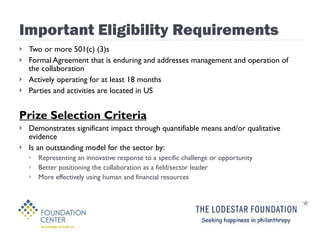
Important Eligibility Requirements Two or more 501(c) (3)s Formal Agreement that is enduring and addresses management and operation of the collaboration Actively operating for at least 18 months Parties and activities are located in US Prize Selection Criteria Demonstrates significant impact through quantifiable means and/or qualitative evidence Is an outstanding model for the sector by: Representing an innovative response to a specific challenge or opportunity Better positioning the collaboration as a field/sector leader More effectively using human and financial resources
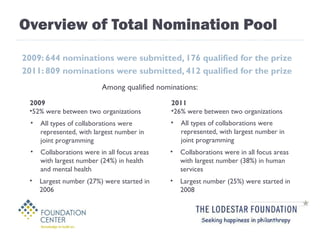
Overview of Total Nomination Pool 2009: 644 nominations were submitted, 176 qualified for the prize 2011: 809 nominations were submitted, 412 qualified for the prize Among qualified nominations: 2009 52% were between two organizations 2011 26% were between two organizations All types of collaborations were represented, with largest number in joint programming All types of collaborations were represented, with largest number in joint programming Collaborations were in all focus areas with largest number (24%) in health and mental health Collaborations were in all focus areas with largest number (38%) in human services Largest number (27%) were started in 2006 Largest number (25%) were started in 2008
The Nonprofit Collaboration Database collaboration.foundationcenter.org/search/searchGenerator.php Contains models and best practices drawn from 670 projects presented for consideration for the 2009 and 2011 Collaboration Prize Competitions
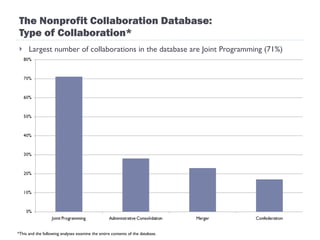
The Nonprofit Collaboration Database: Type of Collaboration* Largest number of collaborations in the database are Joint Programming (71%) *This and the following analyses examine the entire contents of the database.
The Nonprofit Collaboration Database:  Collaboration Focus Area Collaborations in the area of Human Services make up the largest portion (46%) followed by Education (23%), Health (20%), and Mental Health (20%)
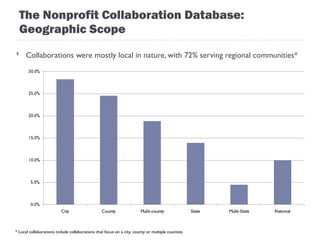
The Nonprofit Collaboration Database: Geographic Scope Collaborations were mostly local in nature, with 72% serving regional communities*   * Local collaborations include collaborations that focus on a city, county or multiple counties.
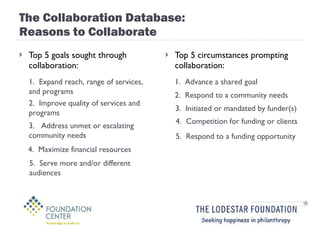
The Collaboration Database: Reasons to Collaborate Top 5 goals sought through collaboration: Top 5 circumstances prompting collaboration: 1.  Expand reach, range of services, and programs 2.  Improve quality of services and programs 3.  Address unmet or escalating community needs 4.  Maximize financial resources 5.  Serve more and/or different audiences 3.  Initiated or mandated by funder(s) 2.  Respond to a community needs 4.  Competition for funding or clients 1.  Advance a shared goal 5.  Respond to a funding opportunity
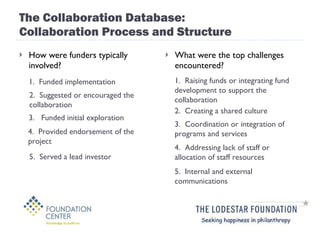
The Collaboration Database: Collaboration Process and Structure How were funders typically involved? What were the top challenges encountered? 1.  Funded implementation 2.  Suggested or encouraged the collaboration 3.  Funded initial exploration 4.  Provided endorsement of the project 5.  Served a lead investor 3.  Coordination or integration of programs and services 2.  Creating a shared culture 4.  Addressing lack of staff or allocation of staff resources  1.  Raising funds or integrating fund development to support the collaboration 5.  Internal and external communications
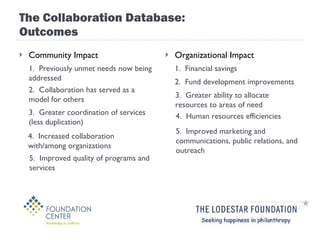
The Collaboration Database: Outcomes Community Impact Organizational Impact 1.  Previously unmet needs now being addressed 2.  Collaboration has served as a model for others 3.  Greater coordination of services (less duplication) 4.  Increased collaboration with/among organizations 5.  Improved quality of programs and services 3.  Greater ability to allocate resources to areas of need 2.  Fund development improvements 4.  Human resources efficiencies 1.  Financial savings 5.  Improved marketing and communications, public relations, and outreach
 
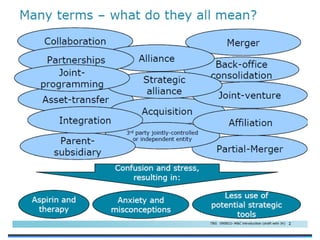
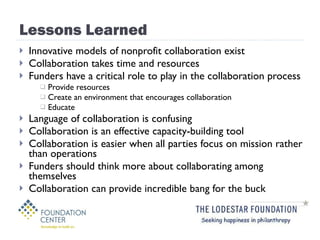
Lessons Learned Innovative models of nonprofit collaboration exist Collaboration takes time and resources Funders have a critical role to play in the collaboration process Provide resources Create an environment that encourages collaboration Educate Language of collaboration is confusing Collaboration is an effective capacity-building tool Collaboration is easier when all parties focus on mission rather than operations Funders should think more about collaborating among themselves Collaboration can provide incredible bang for the buck
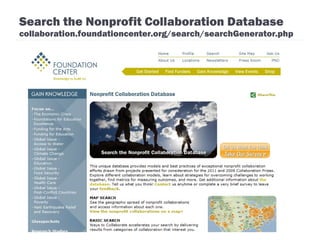
Search the Nonprofit Collaboration Database collaboration.foundationcenter.org/search/searchGenerator.php
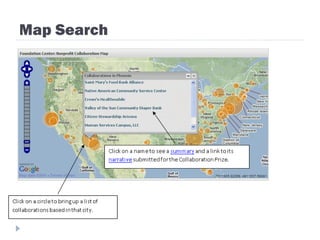
Map Search
Collaboration Summary
Collaboration Narrative
Basic Search
Detailed Search
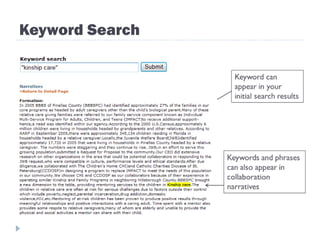
Keyword Search
The Collaboration Database: Future Enhancements Open submissions Interactivity Training Matching service
Funding for Nonprofit Collaboration Cynthia Bailie, The Foundation Center

Keynote cynthia bailie

  • 1.
    Funding for NonprofitCollaboration Cynthia Bailie, The Foundation Center
  • 2.
    The Lodestar Foundation:Overview Strategies: Increase philanthropic resources by supporting organizations, programs and projects that encourage philanthropy, public service and/or volunteerism Increase philanthropic impact by encouraging and supporting long-term collaborations among nonprofits working in the same area in order to increase efficiency and/or impact and to reduce duplication of efforts, and the adoption of other sound business practices
  • 3.
    Lodestar Funding RationaleGrow philanthropy by increasing both philanthropic development (“input” side of philanthropy) and impact of philanthropic grants (“output” side of philanthropy) Inputs: Support projects and organizations that encourage and help people be philanthropic Social Venture Partners Arizona Lodestar Center for Philanthropy and Nonprofit Innovation Outputs: Support collaborations to maximize the effectiveness of philanthropic dollars Lodestar Day Resource Center AWEE/Women Living Free merger The Collaboration Prize
  • 4.
    Goals Identify modelsof nonprofit collaboration for inspiration and replication in the nonprofit sector Build an information base (database) of effective practice models for research and use by nonprofit leaders, grantmakers, academics, consultants and others
  • 5.
    Important Eligibility RequirementsTwo or more 501(c) (3)s Formal Agreement that is enduring and addresses management and operation of the collaboration Actively operating for at least 18 months Parties and activities are located in US Prize Selection Criteria Demonstrates significant impact through quantifiable means and/or qualitative evidence Is an outstanding model for the sector by: Representing an innovative response to a specific challenge or opportunity Better positioning the collaboration as a field/sector leader More effectively using human and financial resources
  • 6.
    Overview of TotalNomination Pool 2009: 644 nominations were submitted, 176 qualified for the prize 2011: 809 nominations were submitted, 412 qualified for the prize Among qualified nominations: 2009 52% were between two organizations 2011 26% were between two organizations All types of collaborations were represented, with largest number in joint programming All types of collaborations were represented, with largest number in joint programming Collaborations were in all focus areas with largest number (24%) in health and mental health Collaborations were in all focus areas with largest number (38%) in human services Largest number (27%) were started in 2006 Largest number (25%) were started in 2008
  • 7.
    The Nonprofit CollaborationDatabase collaboration.foundationcenter.org/search/searchGenerator.php Contains models and best practices drawn from 670 projects presented for consideration for the 2009 and 2011 Collaboration Prize Competitions
  • 8.
    The Nonprofit CollaborationDatabase: Type of Collaboration* Largest number of collaborations in the database are Joint Programming (71%) *This and the following analyses examine the entire contents of the database.
  • 9.
    The Nonprofit CollaborationDatabase: Collaboration Focus Area Collaborations in the area of Human Services make up the largest portion (46%) followed by Education (23%), Health (20%), and Mental Health (20%)
  • 10.
    The Nonprofit CollaborationDatabase: Geographic Scope Collaborations were mostly local in nature, with 72% serving regional communities* * Local collaborations include collaborations that focus on a city, county or multiple counties.
  • 11.
    The Collaboration Database:Reasons to Collaborate Top 5 goals sought through collaboration: Top 5 circumstances prompting collaboration: 1. Expand reach, range of services, and programs 2. Improve quality of services and programs 3. Address unmet or escalating community needs 4. Maximize financial resources 5. Serve more and/or different audiences 3. Initiated or mandated by funder(s) 2. Respond to a community needs 4. Competition for funding or clients 1. Advance a shared goal 5. Respond to a funding opportunity
  • 12.
    The Collaboration Database:Collaboration Process and Structure How were funders typically involved? What were the top challenges encountered? 1. Funded implementation 2. Suggested or encouraged the collaboration 3. Funded initial exploration 4. Provided endorsement of the project 5. Served a lead investor 3. Coordination or integration of programs and services 2. Creating a shared culture 4. Addressing lack of staff or allocation of staff resources 1. Raising funds or integrating fund development to support the collaboration 5. Internal and external communications
  • 13.
    The Collaboration Database:Outcomes Community Impact Organizational Impact 1. Previously unmet needs now being addressed 2. Collaboration has served as a model for others 3. Greater coordination of services (less duplication) 4. Increased collaboration with/among organizations 5. Improved quality of programs and services 3. Greater ability to allocate resources to areas of need 2. Fund development improvements 4. Human resources efficiencies 1. Financial savings 5. Improved marketing and communications, public relations, and outreach
  • 14.
  • 15.
    Lessons Learned Innovativemodels of nonprofit collaboration exist Collaboration takes time and resources Funders have a critical role to play in the collaboration process Provide resources Create an environment that encourages collaboration Educate Language of collaboration is confusing Collaboration is an effective capacity-building tool Collaboration is easier when all parties focus on mission rather than operations Funders should think more about collaborating among themselves Collaboration can provide incredible bang for the buck
  • 16.
    Search the NonprofitCollaboration Database collaboration.foundationcenter.org/search/searchGenerator.php
  • 17.
  • 18.
  • 19.
  • 20.
  • 21.
  • 22.
  • 23.
    The Collaboration Database:Future Enhancements Open submissions Interactivity Training Matching service
  • 24.
    Funding for NonprofitCollaboration Cynthia Bailie, The Foundation Center

Editor's Notes

  • #9 Percentages will not add up to 100% because nominees were able to select more than one category.
  • #11 Top five states represented: California New York Pennsylvania Florida Ohio Only one includes multiple counties in more than one state, the Fund for Our Economic Future (OH and CA).
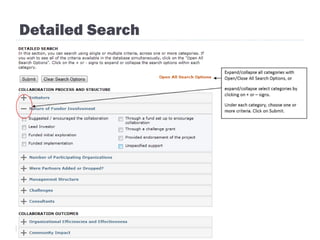
  • #17 To reiterate, the Collaboration Database contains 670 collaborations Let’s look at the Collaboration Database and explore how to use it. [click] You have four ways to find profiles [click]: basic search [click], map search [click], detailed search [click]h, and keyword search. Let’s look at each of these and explore the information included in the database.
  • #18 A larger circle means that more collaborations are based in that area. Click on a circle to bring up a list of collaborations based in that city. Click on a name to see a summary and a link to its narrative submitted for the Collaboration Prize.  
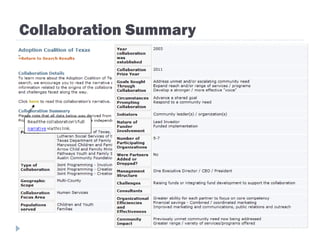
  • #19 The summary covers the collaboration’s Who, What, Where, When, and Why, as you can see from the fields shown here.   All data contained in these summaries comes from the collaboration’s materials submitted for the Collaboration Prize. None of the data were verified independently for accuracy.
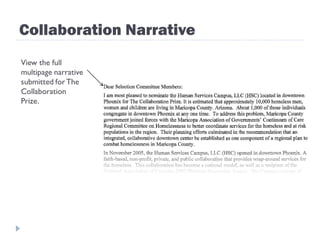
  • #20 You can access the collaboration’s full, multipage narrative submitted for The Collaboration Prize. Some are saved as PDF files that you can view, download, or print.
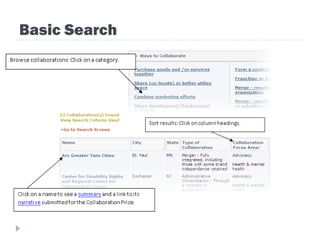
  • #21 Basic Search lets you browse collaborations by category. Click on a category to start. You can sort your results by clicking on the column headings. Then click on a name to see a summary.
  • #23 In addition, keyword search is a type of search that looks for results in the collaboration database that contain one or more words specified by the user. For example, you could search on a city name, like “Cleveland,” or a phrase, like “kinship care.”