This document discusses how HR can contribute to and align with business strategy in three main ways:
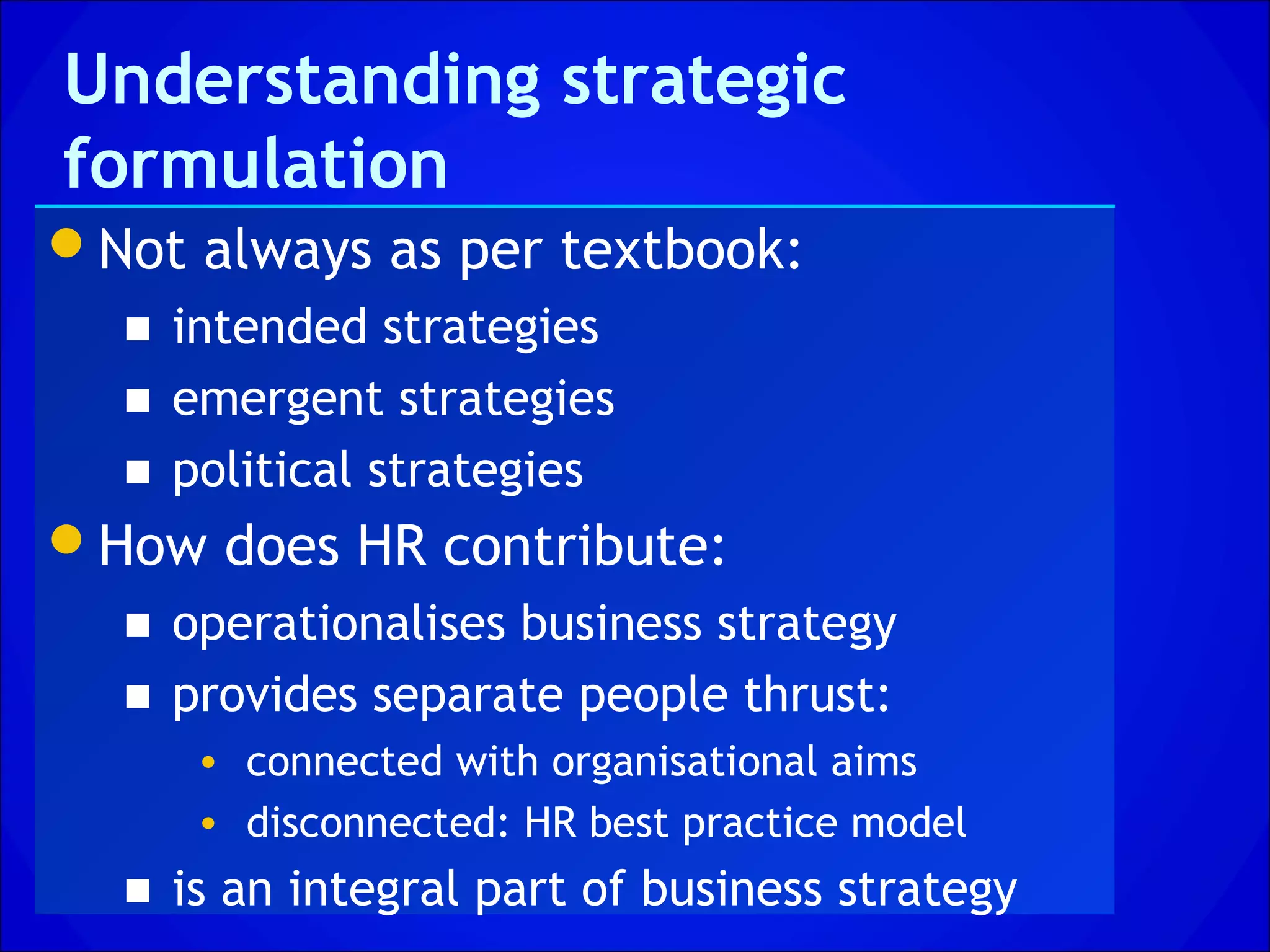
1. HR can operationalize business strategy by implementing the people-related aspects of strategic plans.
2. HR can provide its own "people thrust" that is either connected to or disconnected from organizational aims through HR best practices.
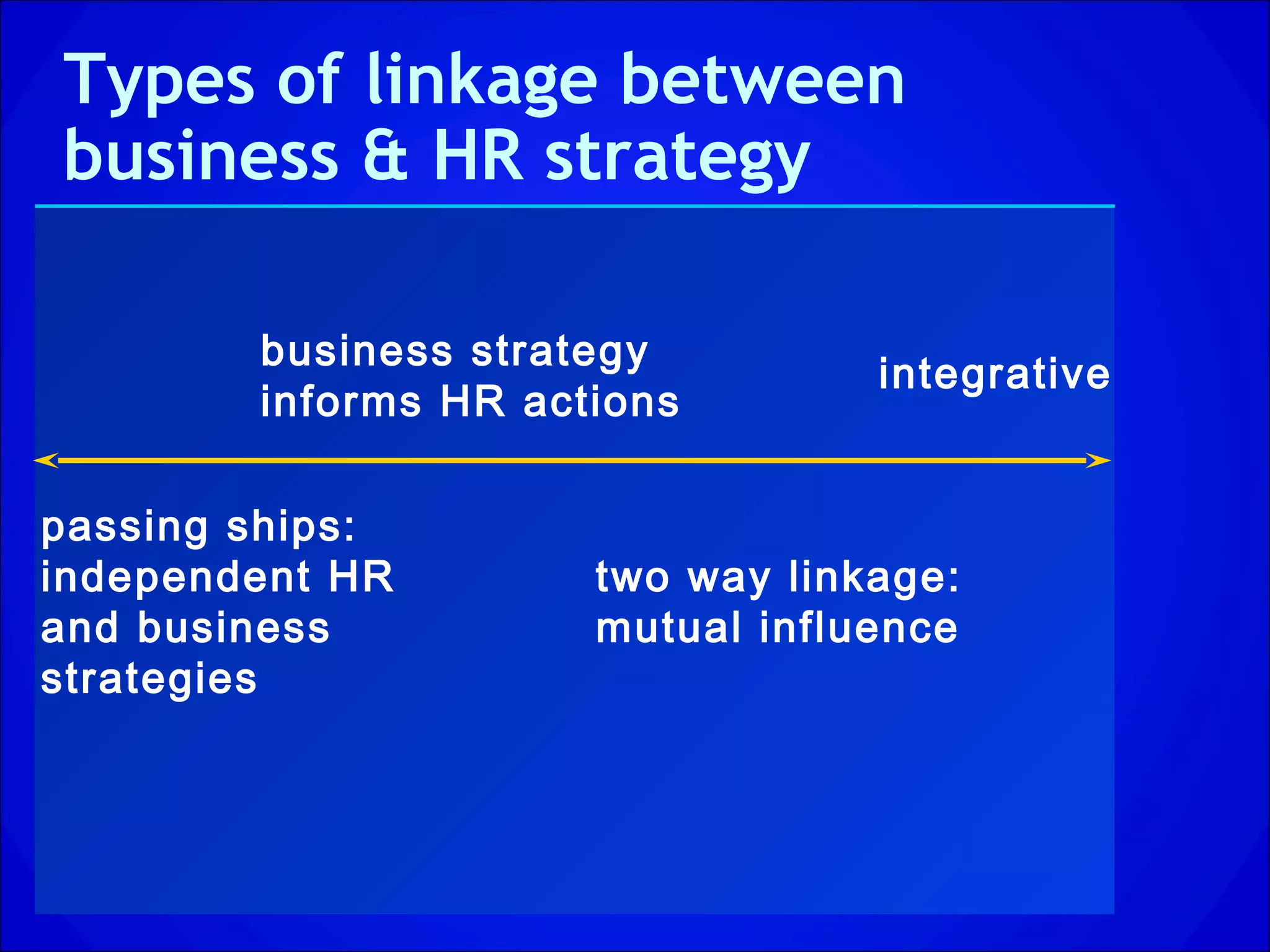
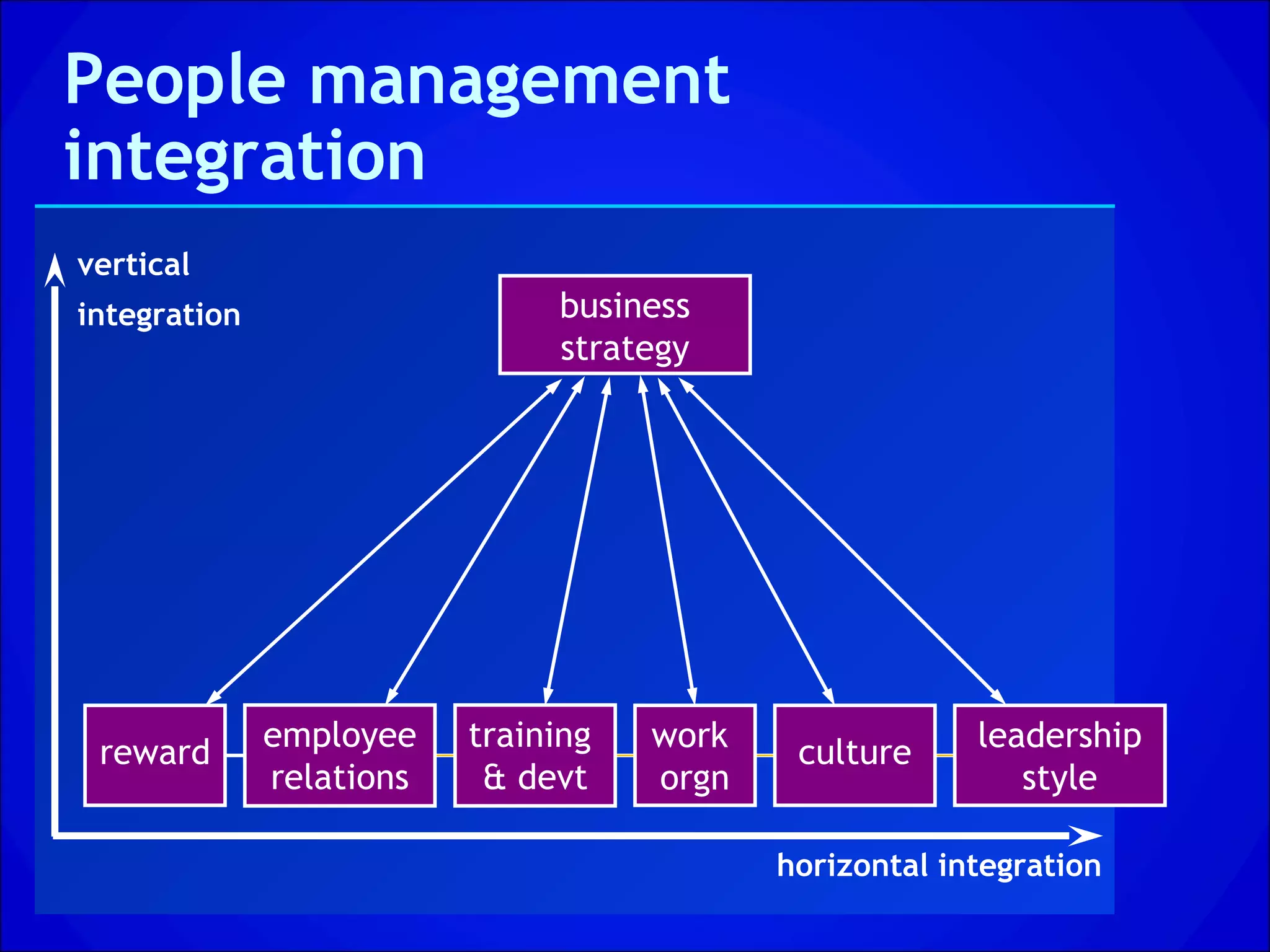
3. HR can be an integral part of business strategy formulation by having two-way influence between business and HR strategies through mutual involvement in planning.
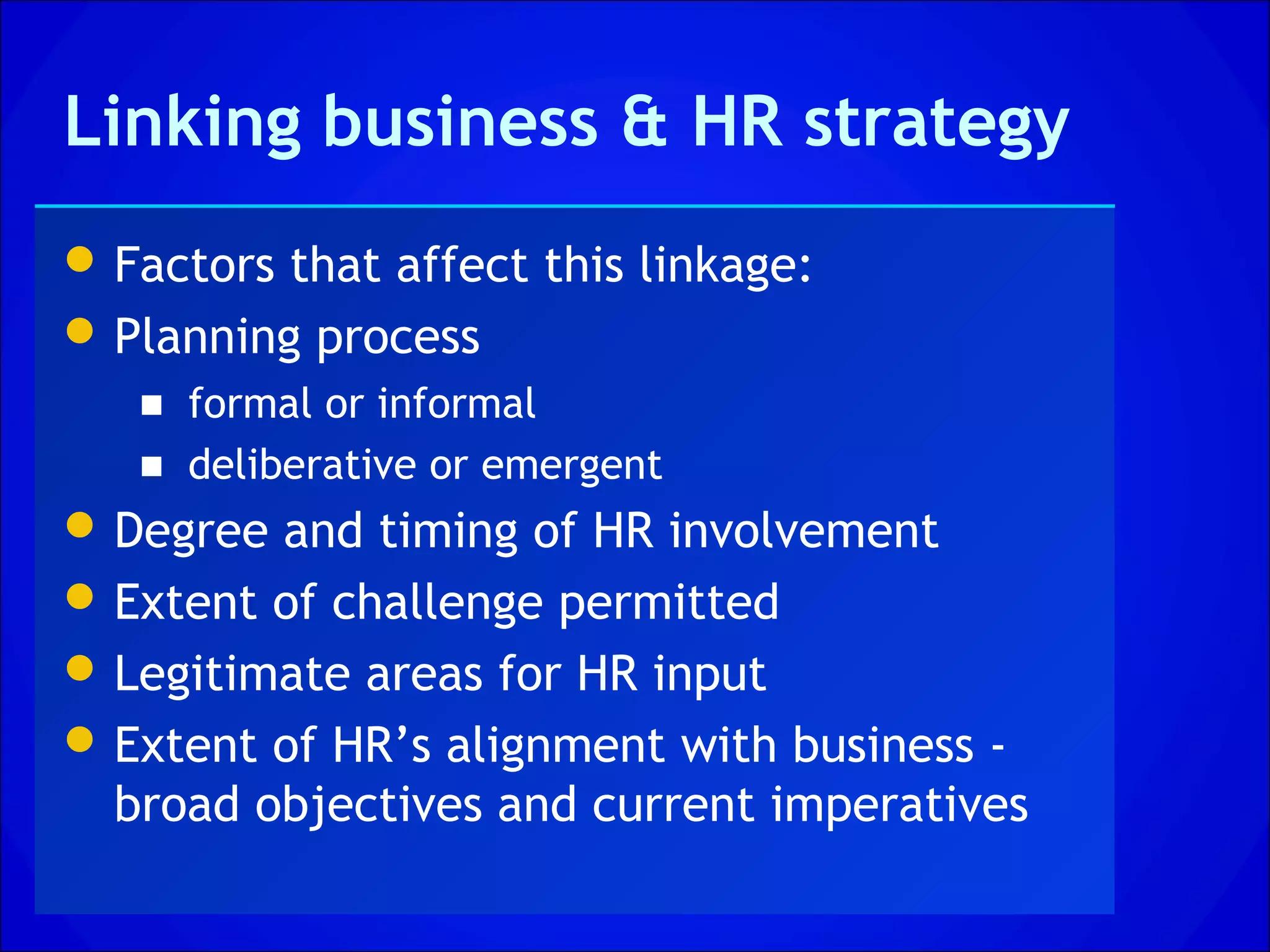
The level of integration between business and HR strategies depends on factors like the planning process, HR's involvement in decision-making, and the extent HR is aligned with business objectives. Measuring HR and people management performance is important to
Understanding strategic
formulation
Not alwaysas per textbook:
■ intended strategies
■ emergent strategies
■ political strategies
How does HR contribute:
■ operationalises business strategy
■ provides separate people thrust:
• connected with organisational aims
• disconnected: HR best practice model
■ is an integral part of business strategy
3.
Types of linkagebetween
business & HR strategy
business strategy
integrative
informs HR actions
passing ships:
independent HR two way linkage:
and business mutual influence
strategies
4.
Linking business &HR strategy
Factors that affect this linkage:
Planning process
■ formal or informal
■ deliberative or emergent
Degree and timing of HR involvement
Extent of challenge permitted
Legitimate areas for HR input
Extent of HR’s alignment with business -
broad objectives and current imperatives
5.
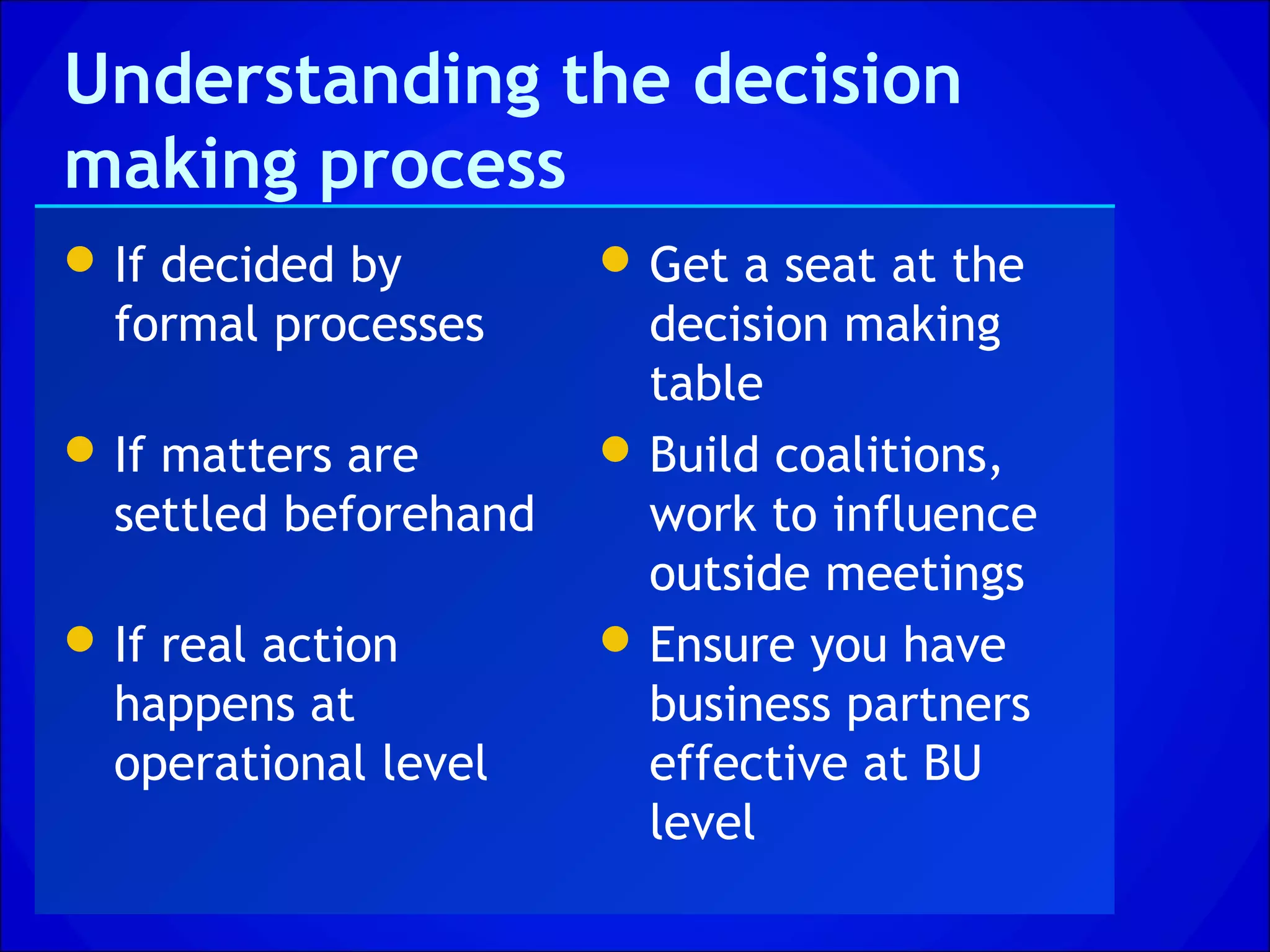
Understanding the decision
makingprocess
If decided by Get a seat at the
formal processes decision making
table
If matters are Build coalitions,
settled beforehand work to influence
outside meetings
If real action Ensure you have
happens at business partners
operational level effective at BU
level
6.
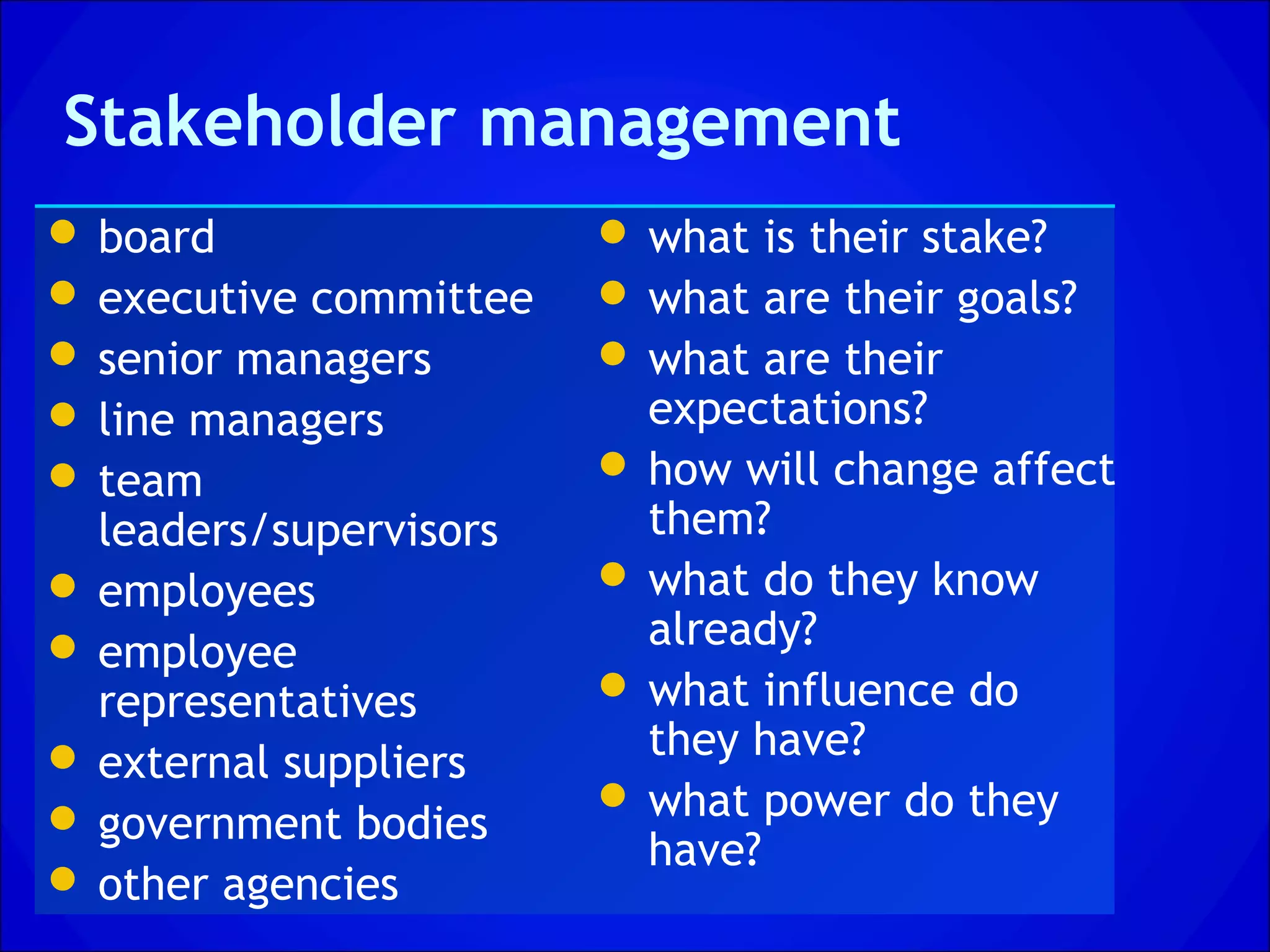
Stakeholder management
board what is their stake?
executive committee what are their goals?
senior managers what are their
line managers expectations?
team how will change affect
leaders/supervisors them?
employees what do they know
employee already?
representatives what influence do
external suppliers they have?
what power do they
government bodies
have?
other agencies
7.
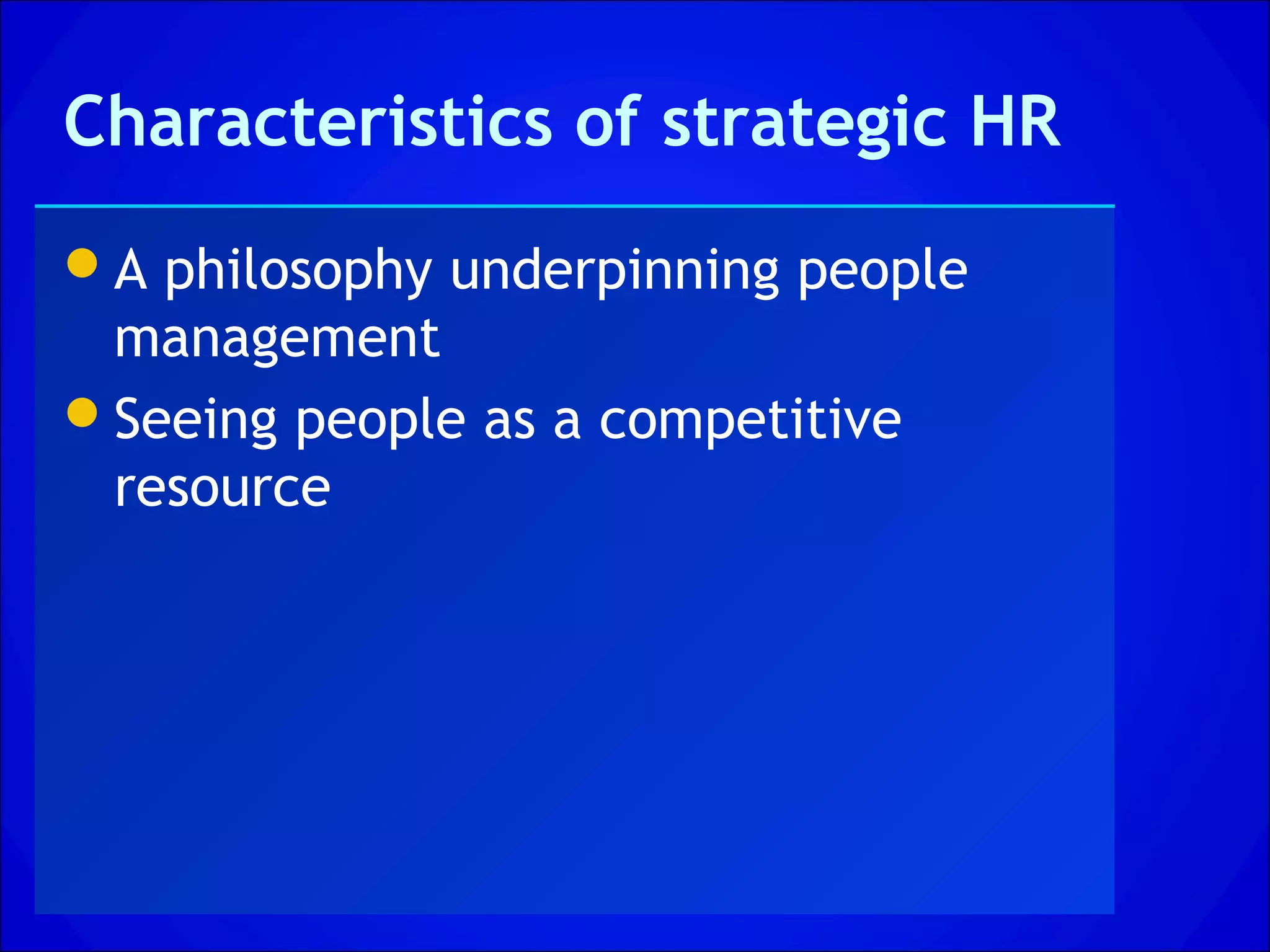
Characteristics of strategicHR
A philosophy underpinning people
management
Seeing people as a competitive
resource
8.
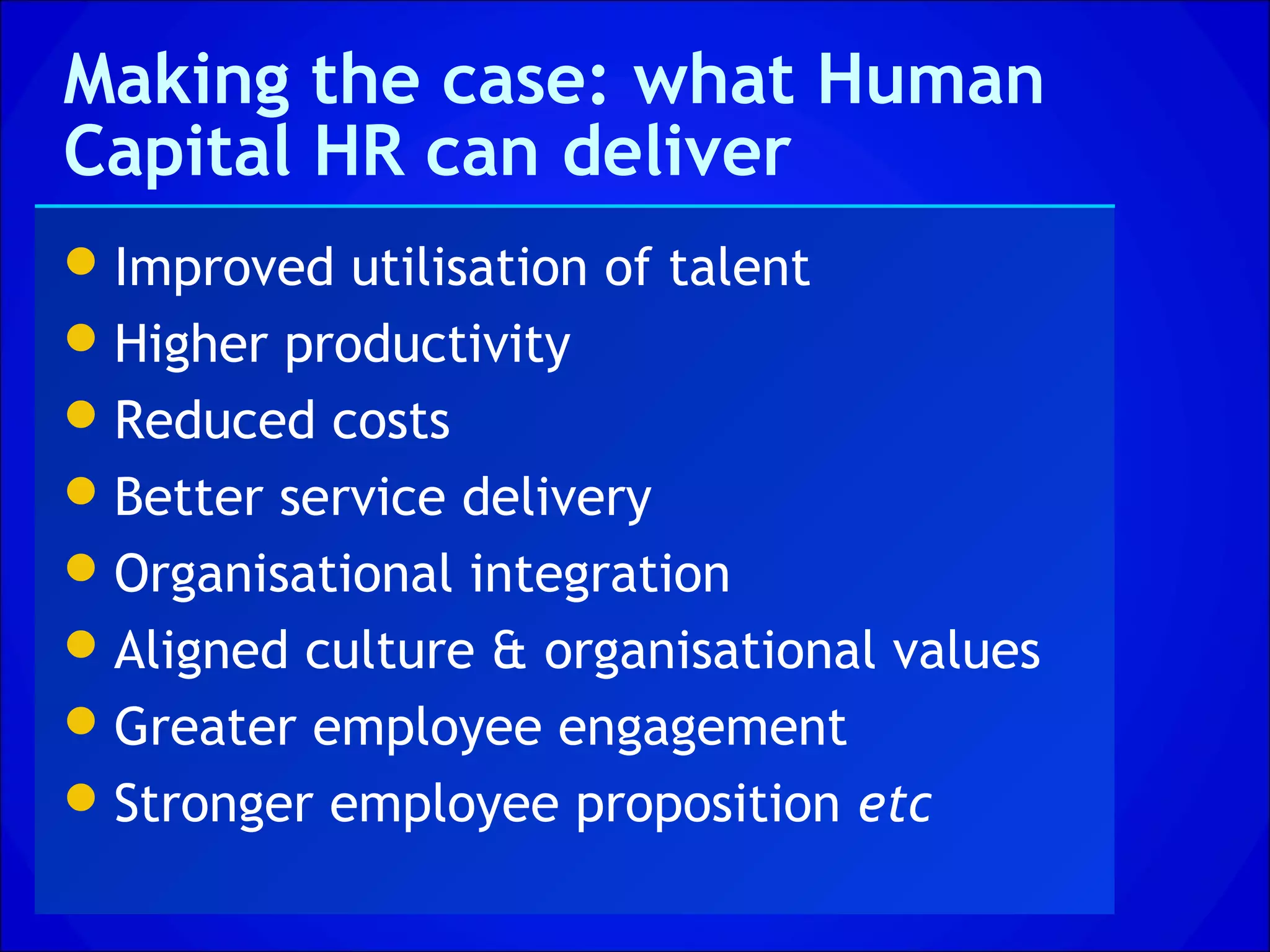
Making the case:what Human
Capital HR can deliver
Improved utilisation of talent
Higher productivity
Reduced costs
Better service delivery
Organisational integration
Aligned culture & organisational values
Greater employee engagement
Stronger employee proposition etc
9.
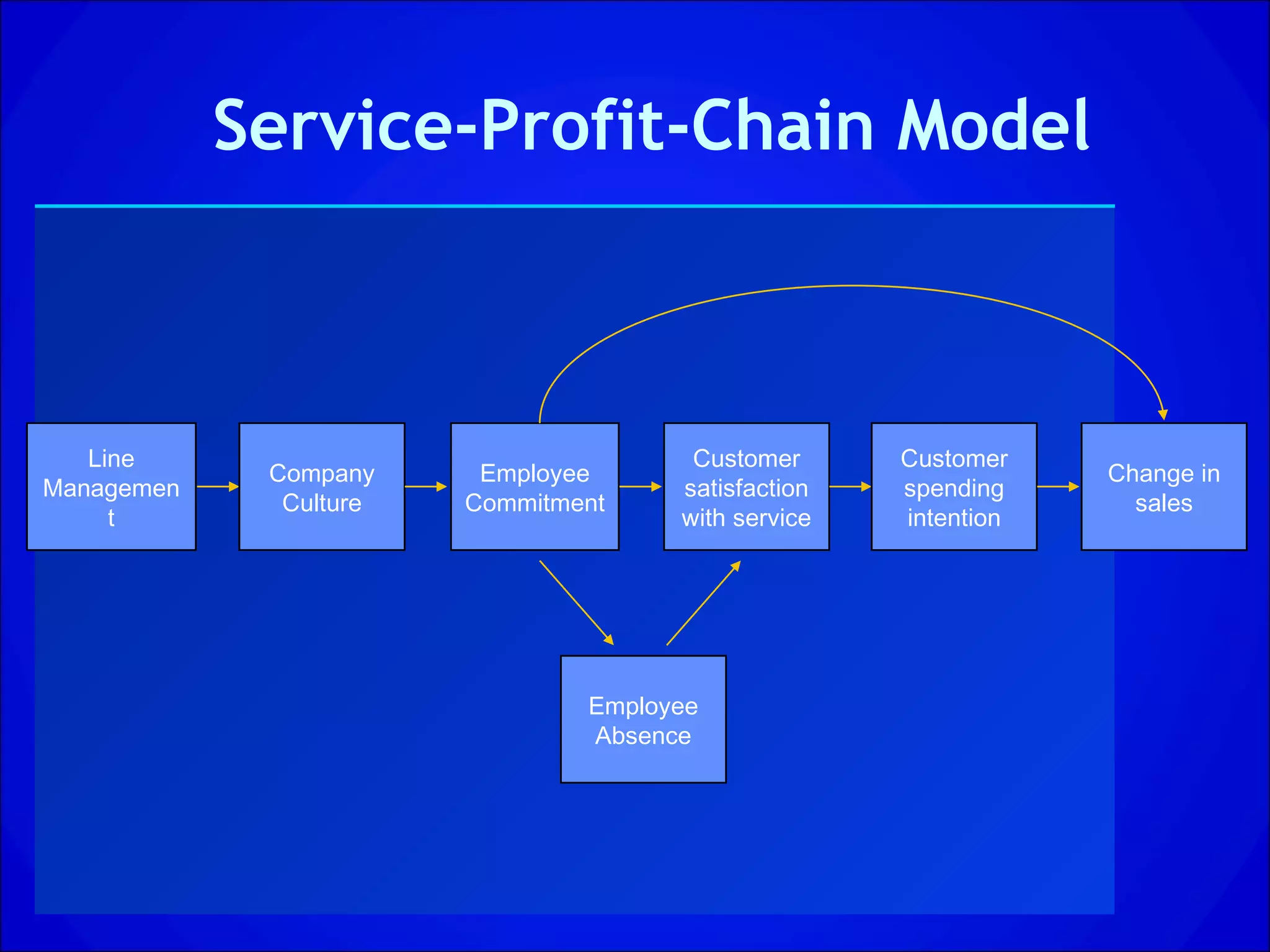
Service-Profit-Chain Model
Line Customer Customer
Company Employee Change in
Managemen satisfaction spending
Culture Commitment sales
t with service intention
Employee
Absence
10.
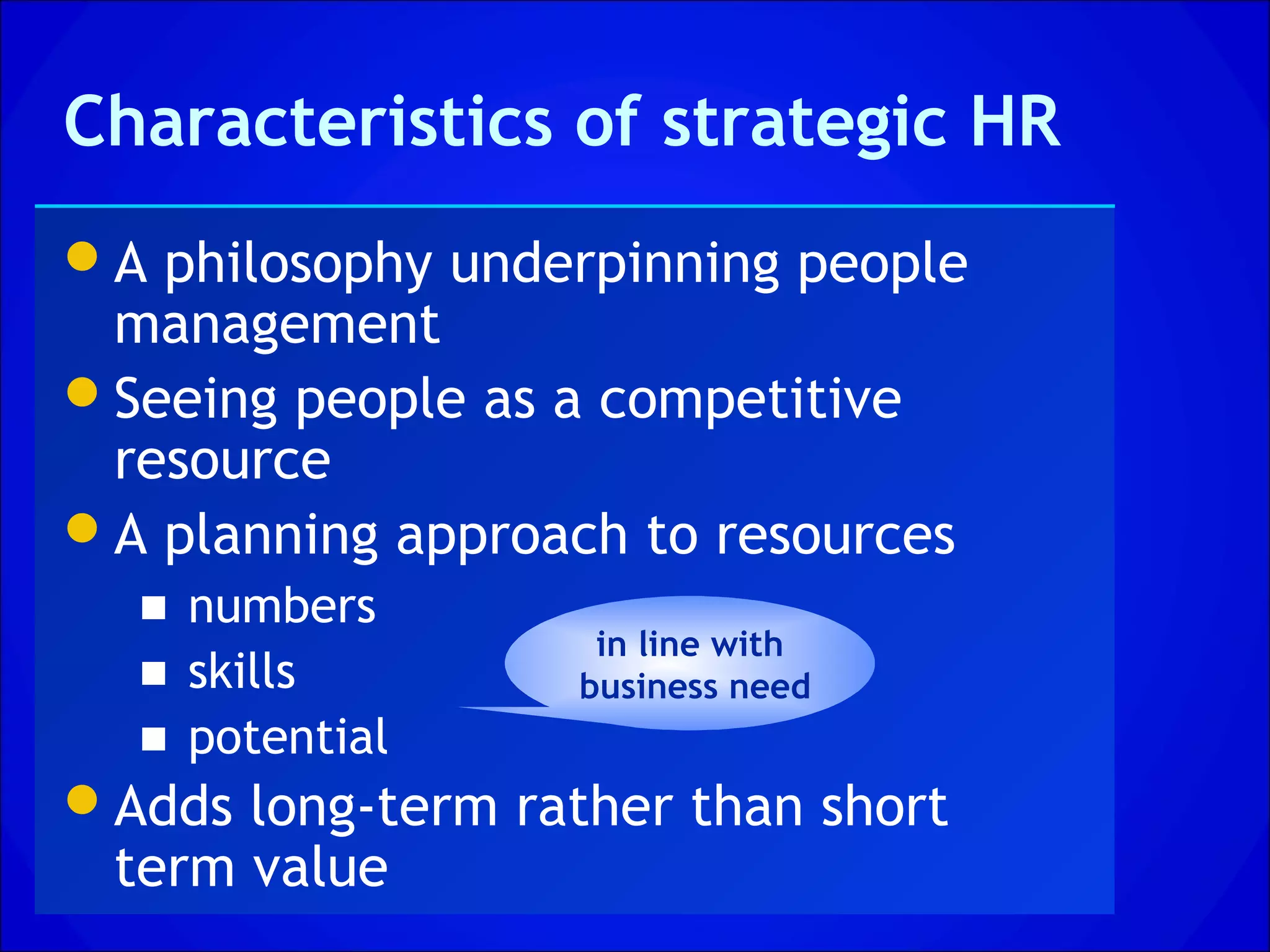
Characteristics of strategicHR
A philosophy underpinning people
management
Seeing people as a competitive
resource
A planning approach to resources
■ numbers
in line with
■ skills business need
■ potential
Adds long-term rather than short
term value
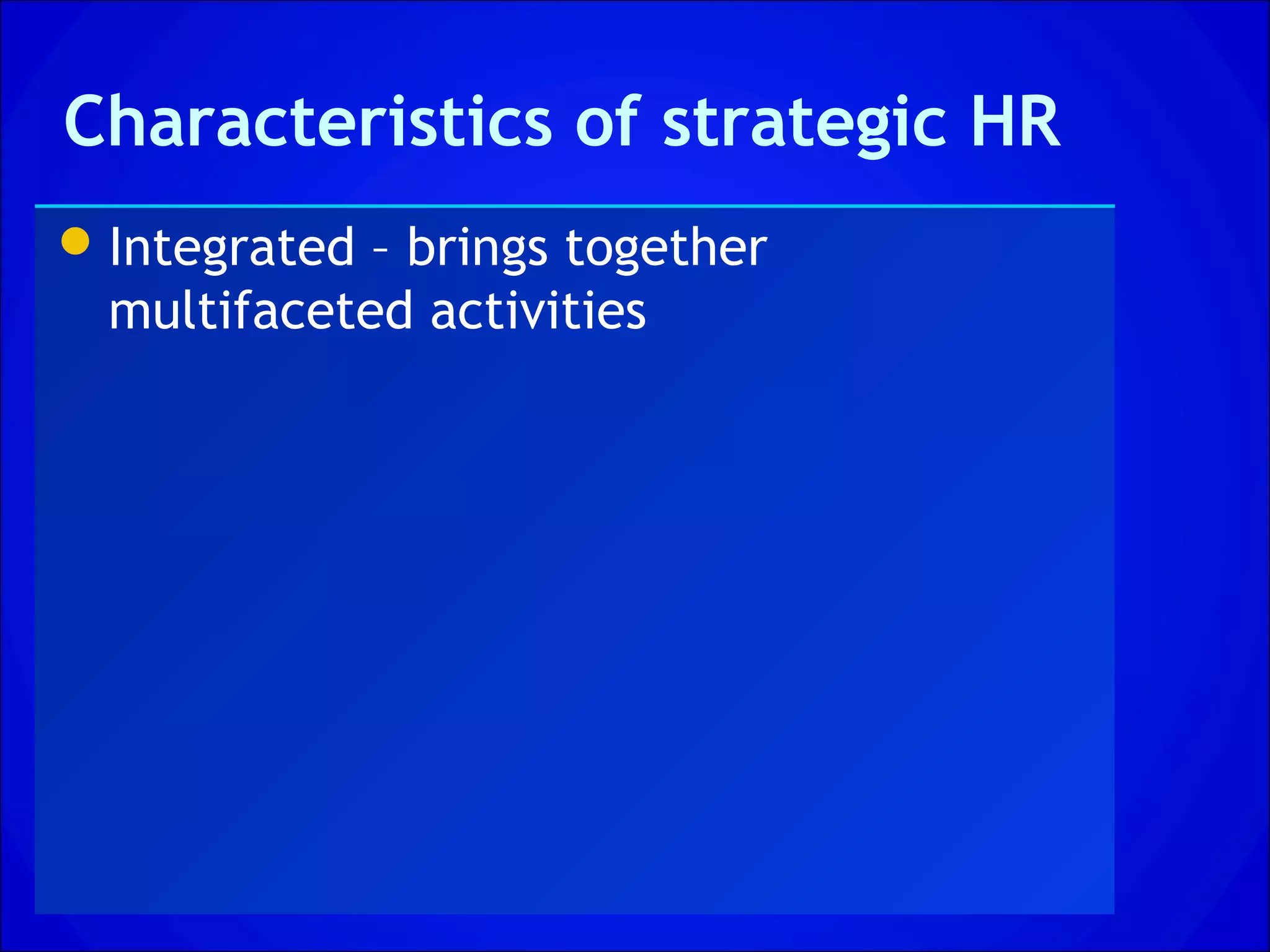
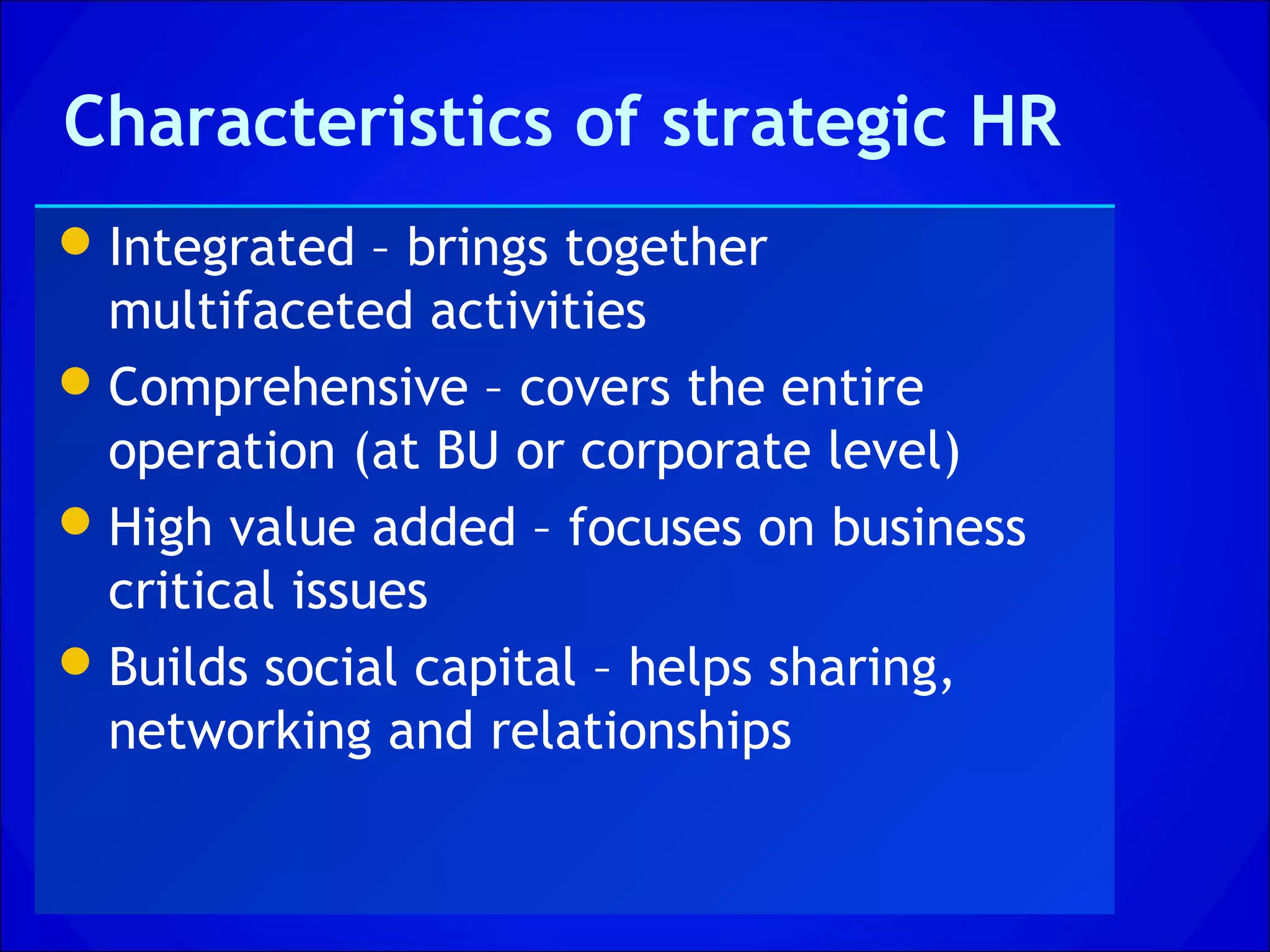
Characteristics of strategicHR
Integrated – brings together
multifaceted activities
Comprehensive – covers the entire
operation (at BU or corporate level)
High value added – focuses on business
critical issues
Builds social capital – helps sharing,
networking and relationships
14.
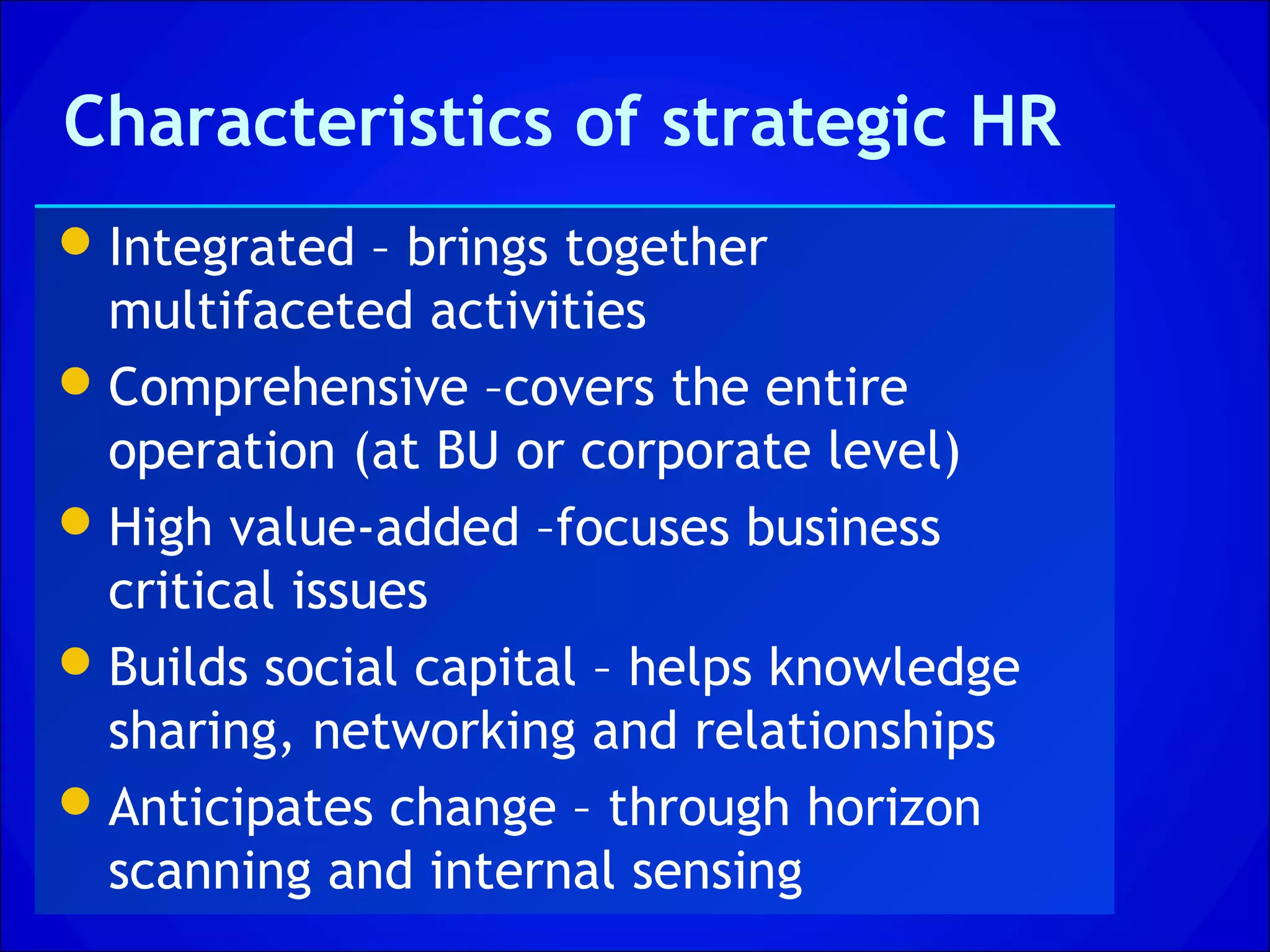
Characteristics of strategicHR
Integrated – brings together
multifaceted activities
Comprehensive –covers the entire
operation (at BU or corporate level)
High value-added –focuses business
critical issues
Builds social capital – helps knowledge
sharing, networking and relationships
Anticipates change – through horizon
scanning and internal sensing
15.
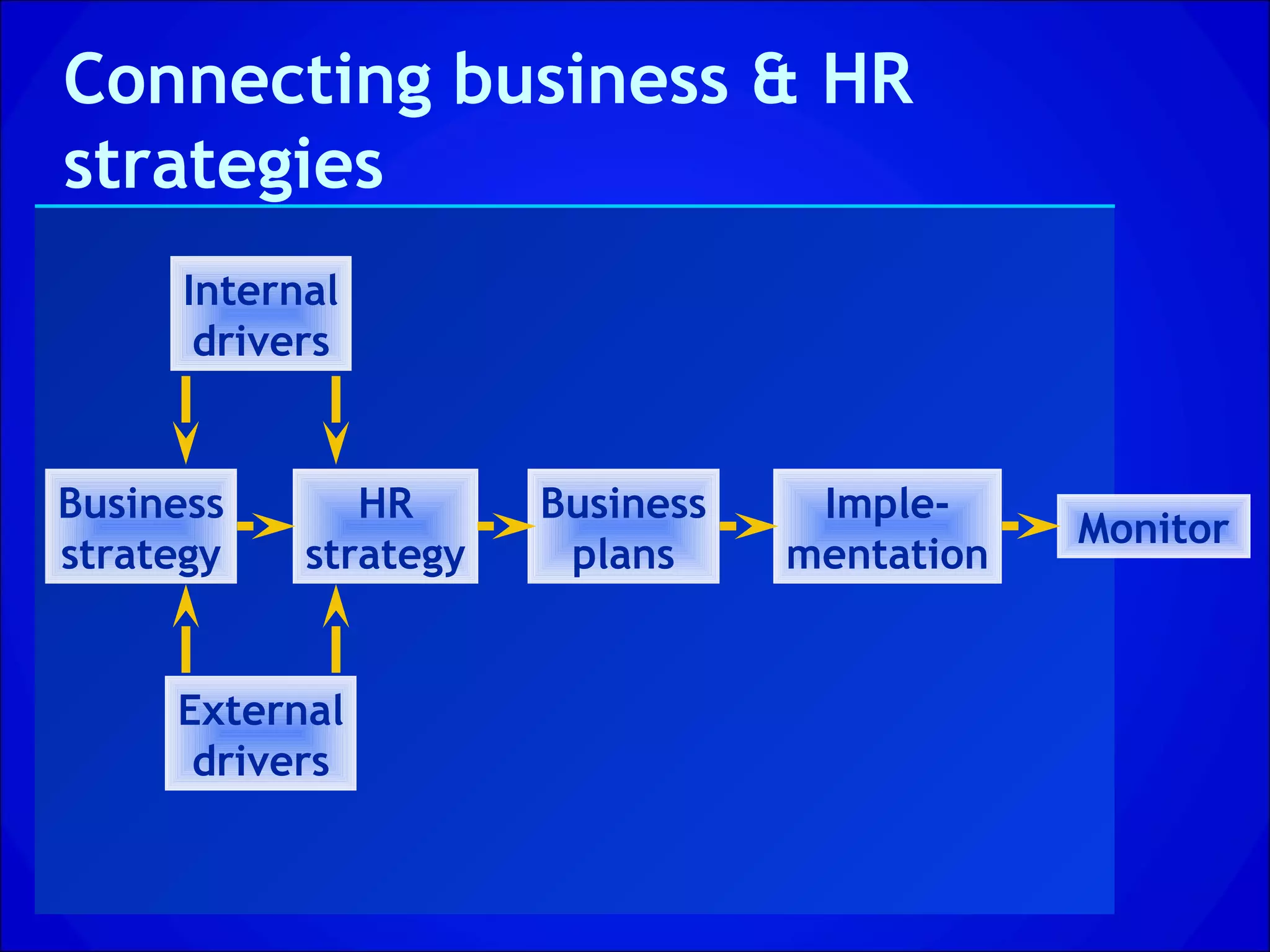
Connecting business &HR
strategies
Internal
drivers
Business HR Business Imple-
Monitor
strategy strategy plans mentation
External
drivers
16.
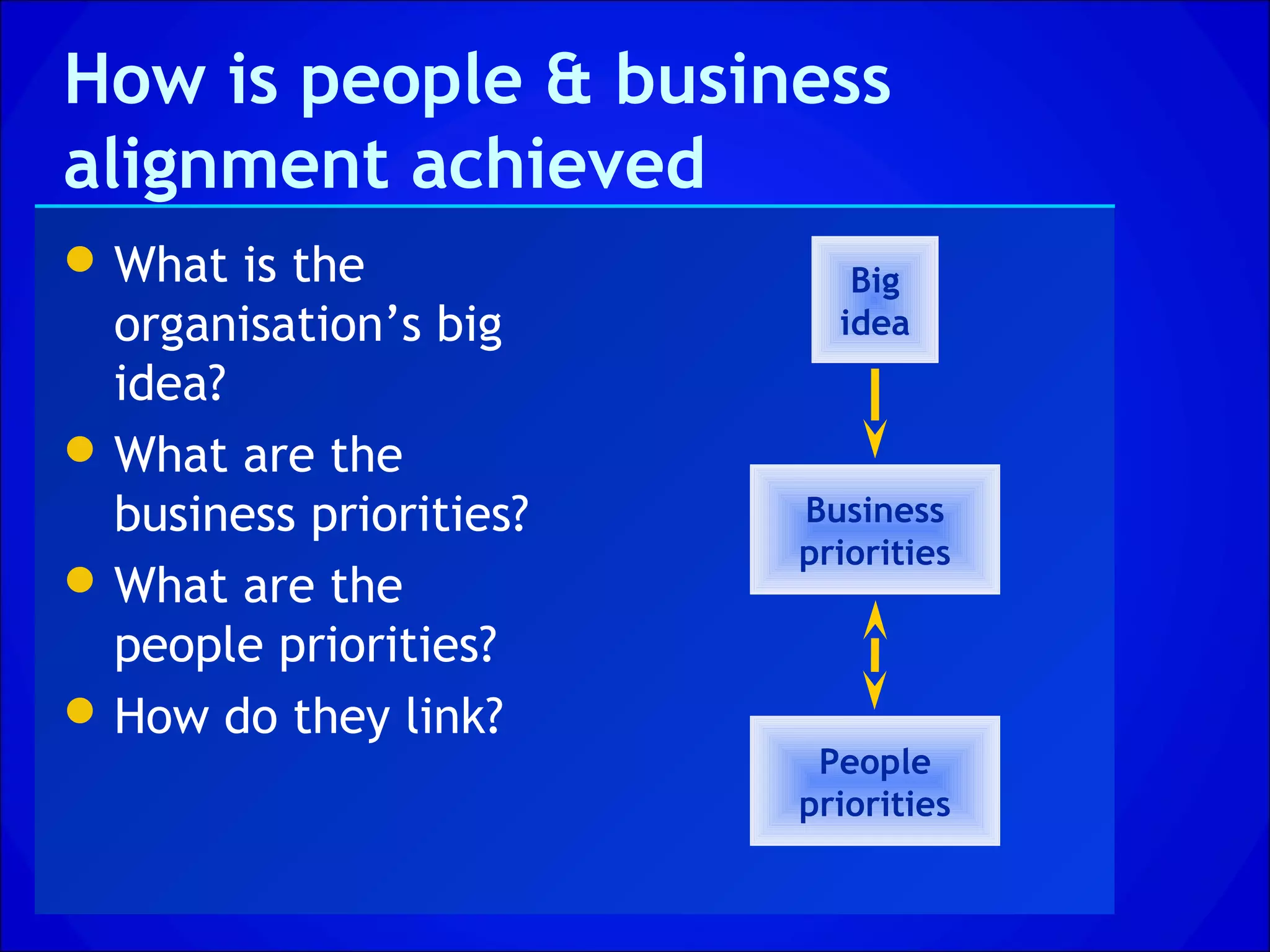
How is people& business
alignment achieved
What is the Big
organisation’s big idea
idea?
What are the
business priorities? Business
priorities
What are the
people priorities?
How do they link?
People
priorities
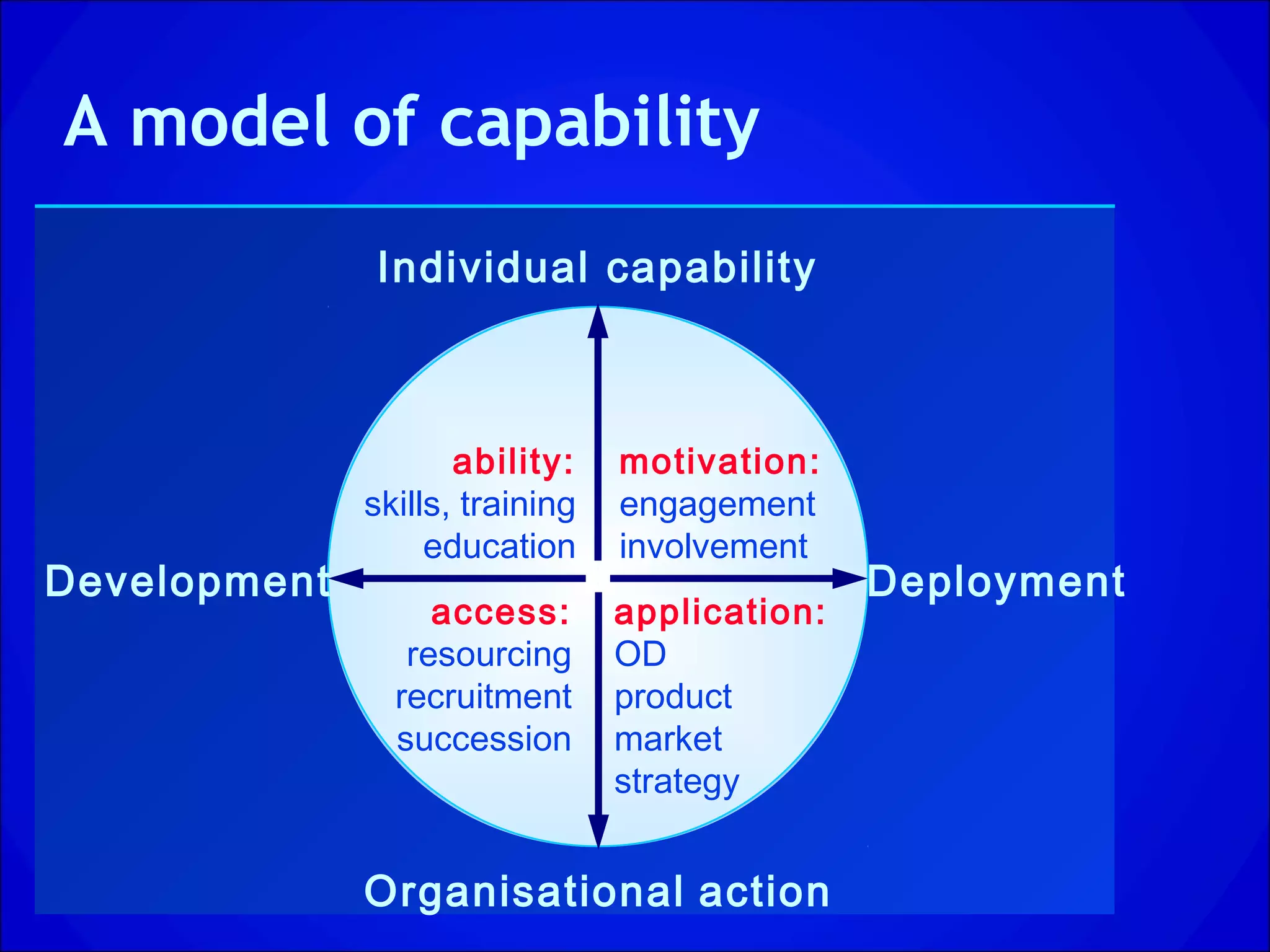
A model ofcapability
Individual capability
ability: motivation:
skills, training engagement
education involvement
Development Deployment
access: application:
resourcing OD
recruitment product
succession market
strategy
Organisational action
19.
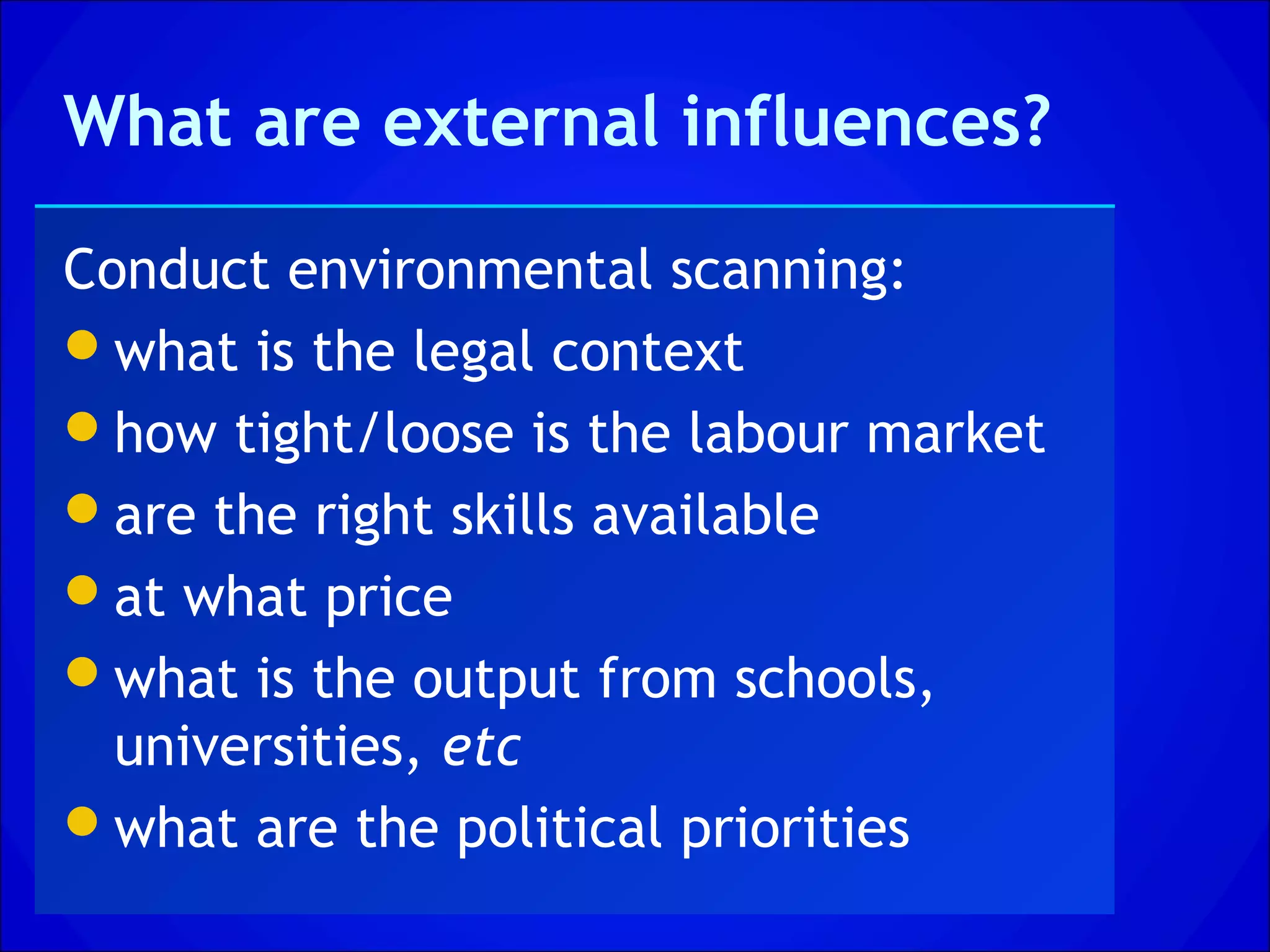
What are externalinfluences?
Conduct environmental scanning:
what is the legal context
how tight/loose is the labour market
are the right skills available
at what price
what is the output from schools,
universities, etc
what are the political priorities
20.
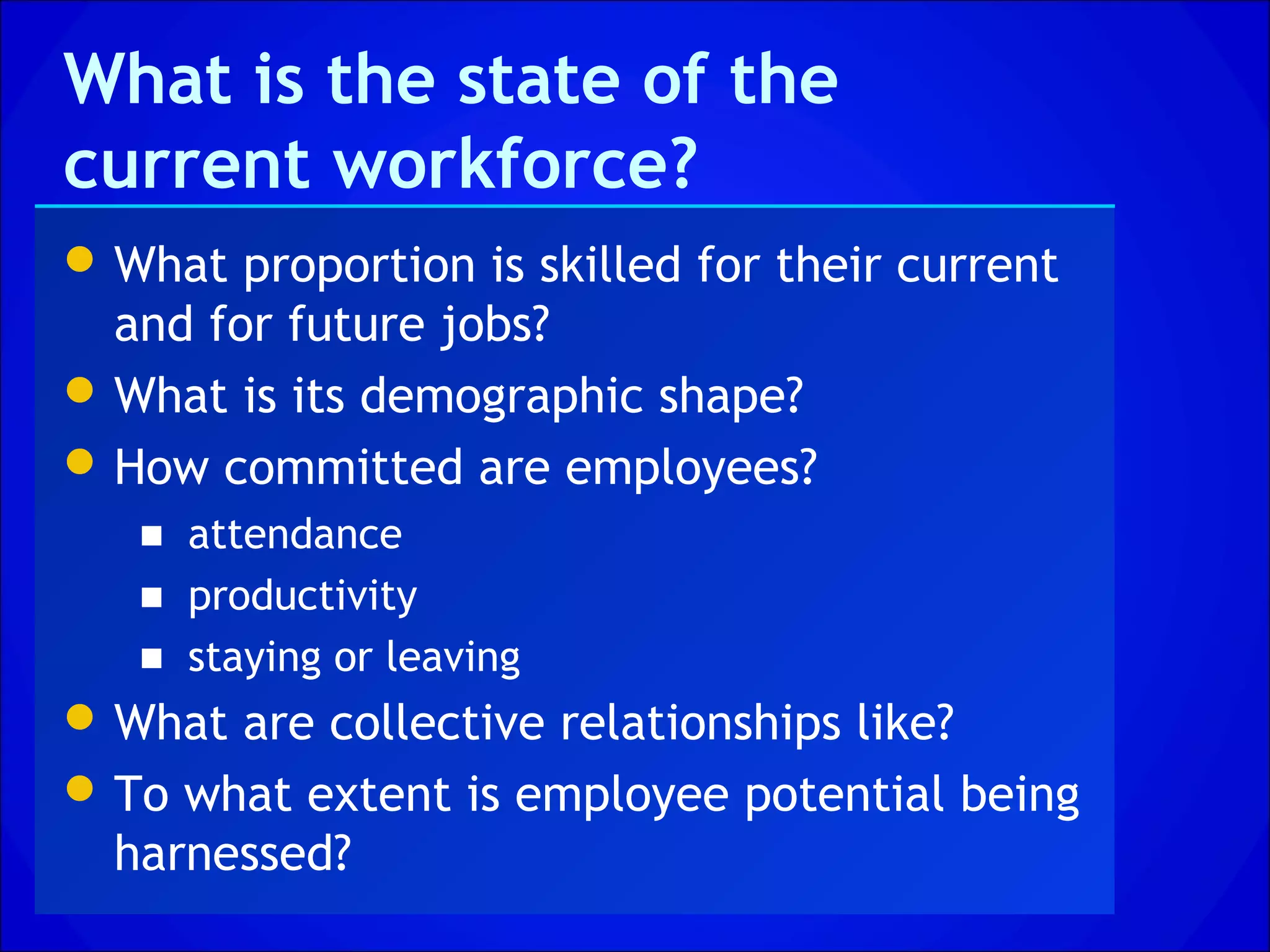
What is thestate of the
current workforce?
What proportion is skilled for their current
and for future jobs?
What is its demographic shape?
How committed are employees?
■ attendance
■ productivity
■ staying or leaving
What are collective relationships like?
To what extent is employee potential being
harnessed?
21.
What stops HRsucceeding?
Human capital not recognised as a
source of advantage
Weak organisational leadership
Poor teamworking across organisation
Business strategy poorly defined
There is little forward planning
People resources assumed to be
unlimited, free or fully trained
Resources are hoarded & not shared
22.
HR’s own problemareas
Obstacles to
success:
■ time
■ capacity
■ focus
■ capability
■ positioning
■ organisation
23.
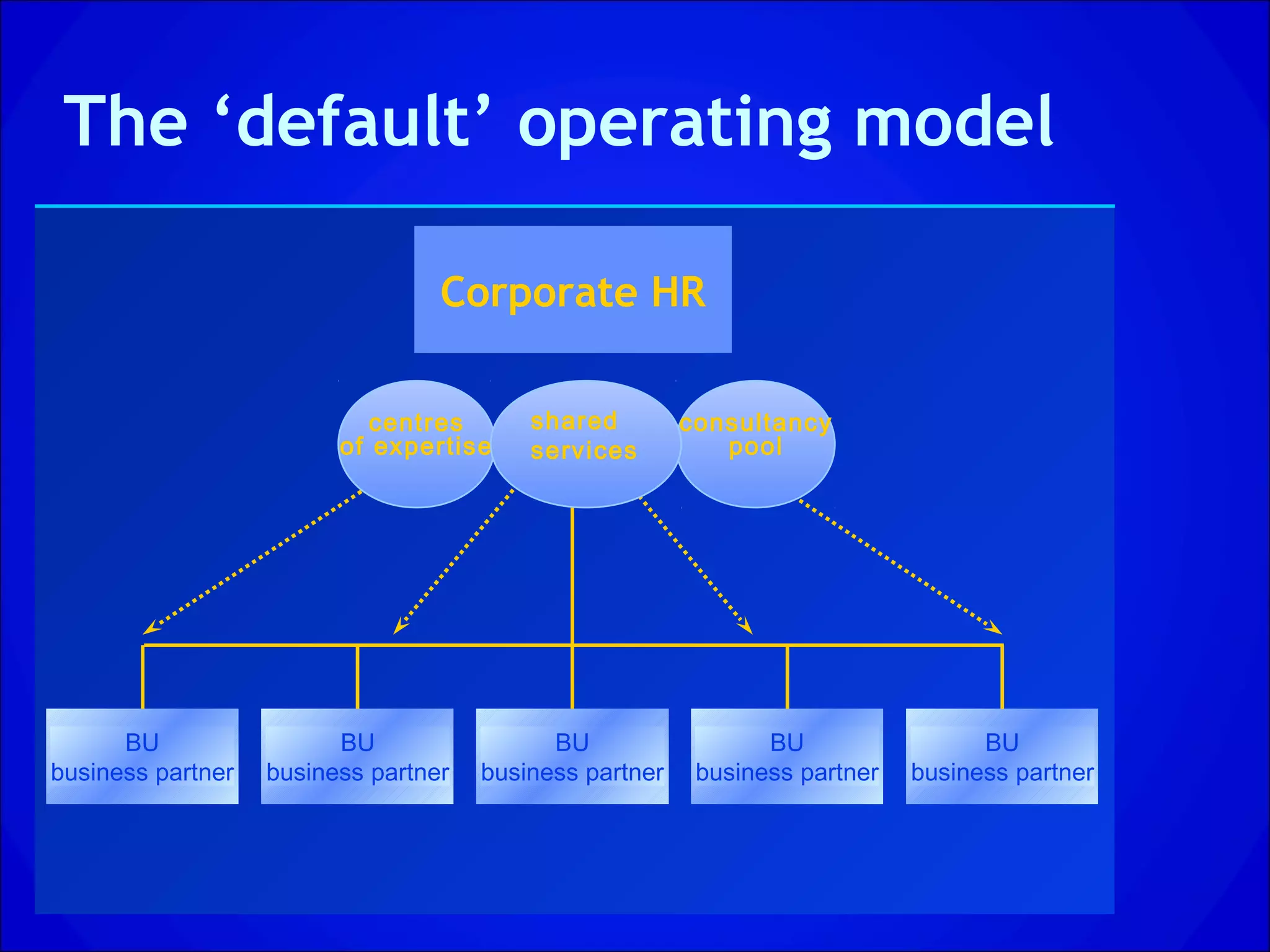
The ‘default’ operatingmodel
Corporate HR
centres shared consultancy
of expertise services pool
BU BU BU BU BU
business partner business partner business partner business partner business partner
24.
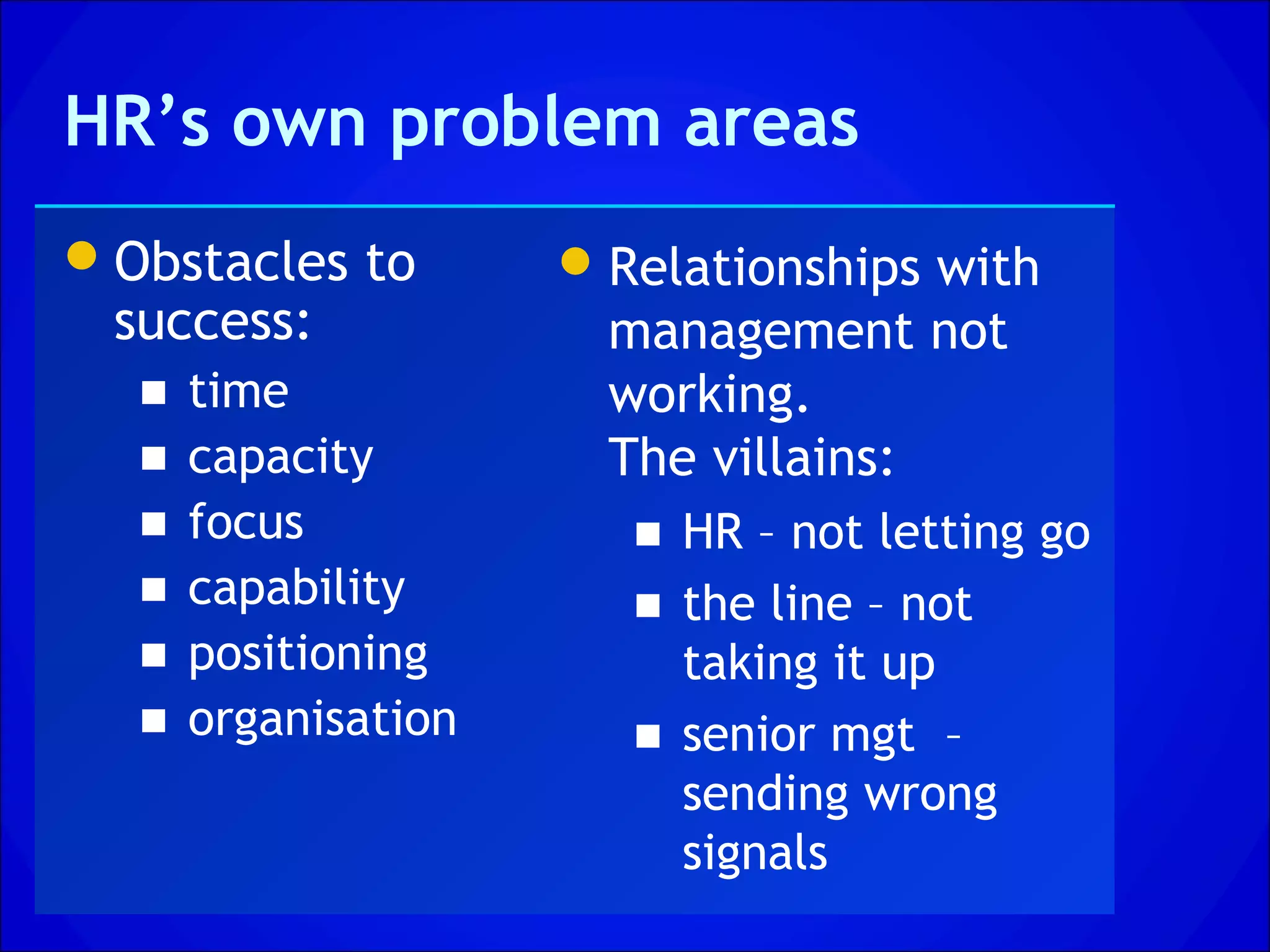
HR’s own problemareas
Obstacles to Relationships with
success: management not
■ time working.
■ capacity The villains:
■ focus ■ HR – not letting go
■ capability ■ the line – not
■ positioning taking it up
■ organisation ■ senior mgt –
sending wrong
signals
25.
Results
Inadequate HRservice performance
Concentrating on low value tasks
HR policies are disjoined & inconsistent
They serve functional not organisational
needs
Weak functional leadership
Poor internal reputation
Human capital not exploited, developed
26.
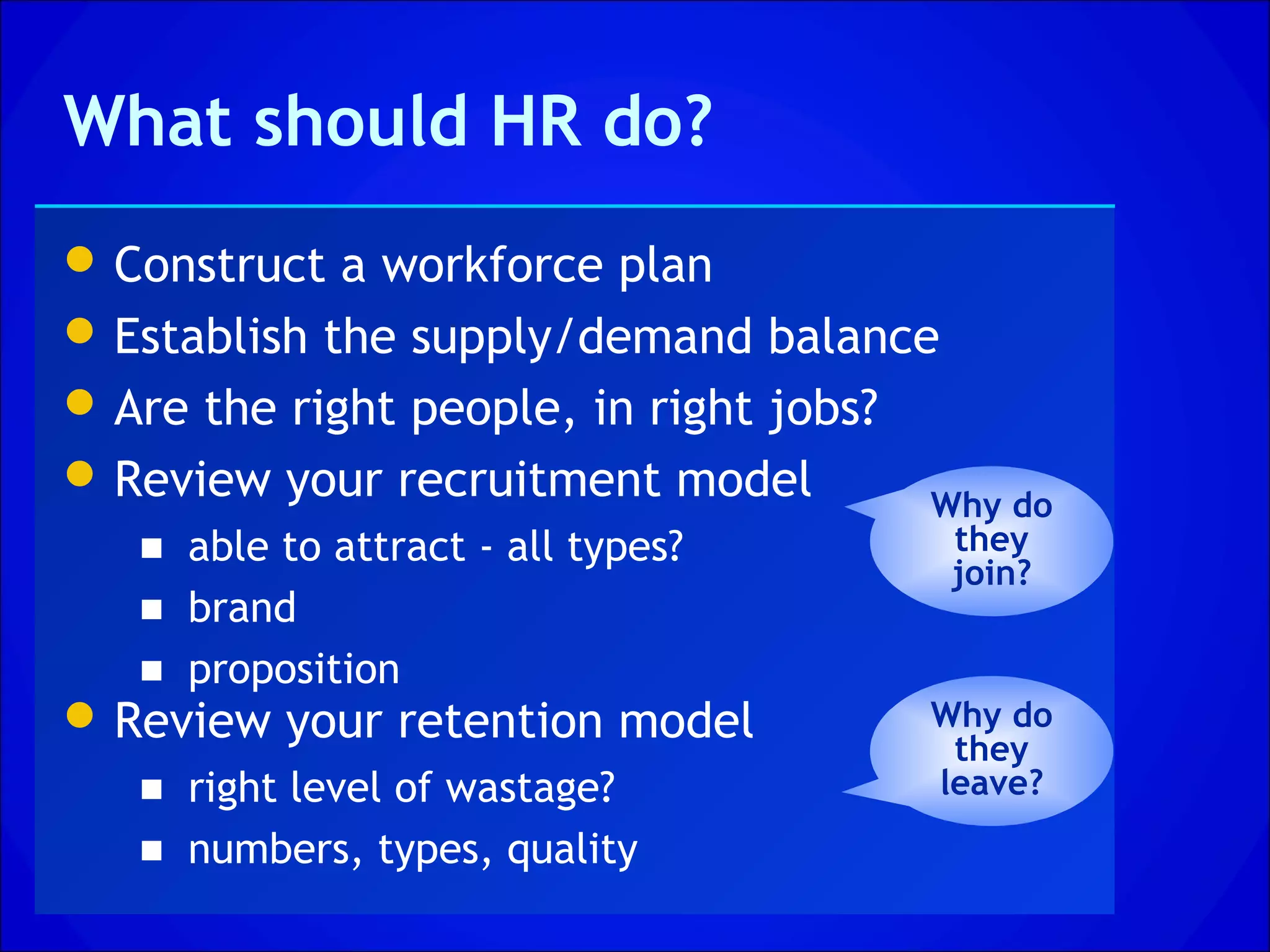
What should HRdo?
Construct a workforce plan
Establish the supply/demand balance
Are the right people, in right jobs?
Review your recruitment model
Why do
■ able to attract - all types? they
join?
■ brand
■ proposition
Review your retention model Why do
they
■ right level of wastage? leave?
■ numbers, types, quality
27.
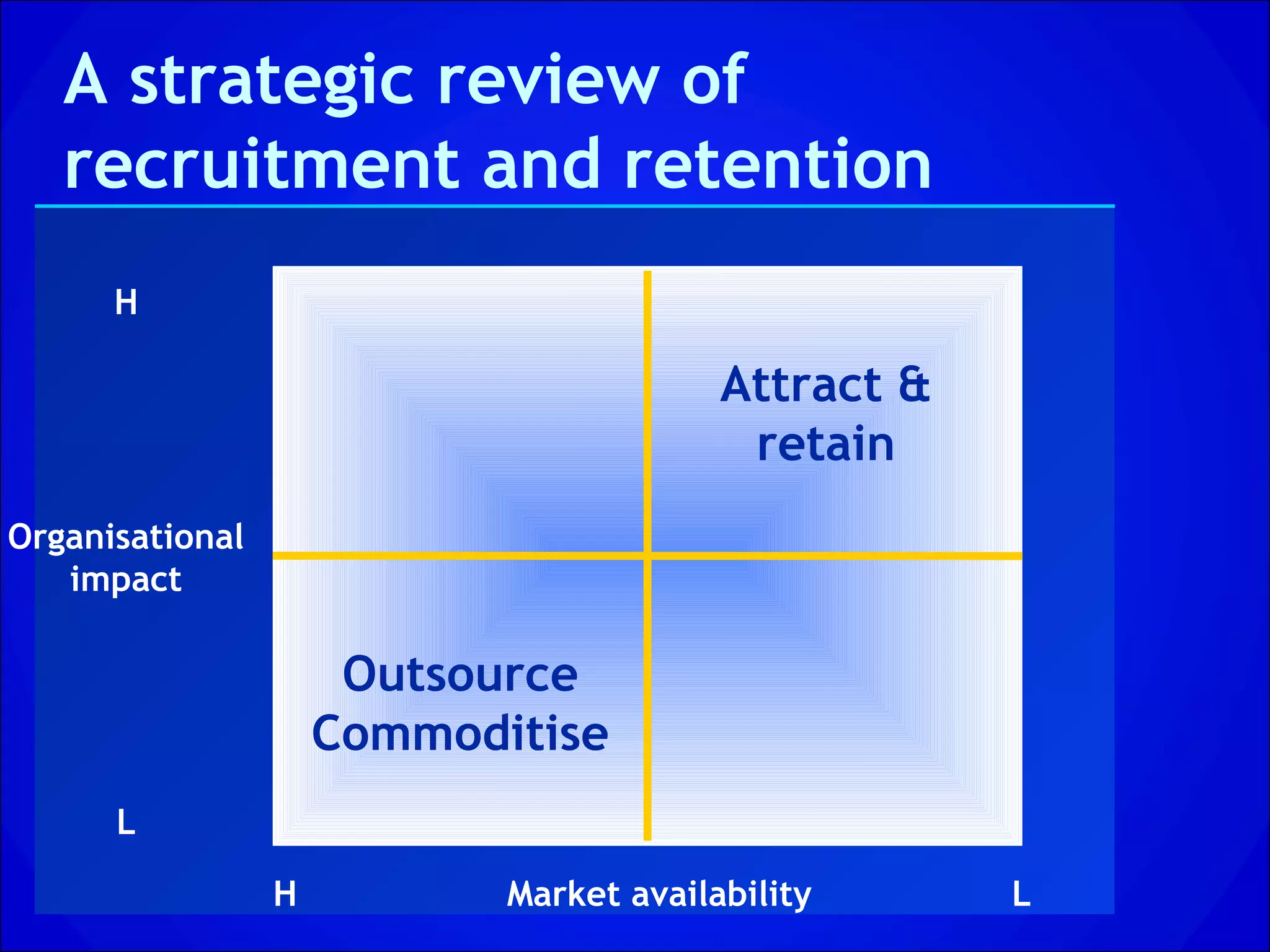
A strategic reviewof
recruitment and retention
H
Attract &
retain
Organisational
impact
Outsource
Commoditise
L
H Market availability L
What should HRdo? (2)
Are you able to motivate staff?
How do
■ degree of engagement you
know?
■ what motivates them?
■ what demotivates them?
■ what impact does pay and performance
management have?
How well are employees aware of
■ the bigger picture?
■ their job?
■ what success looks like?
30.
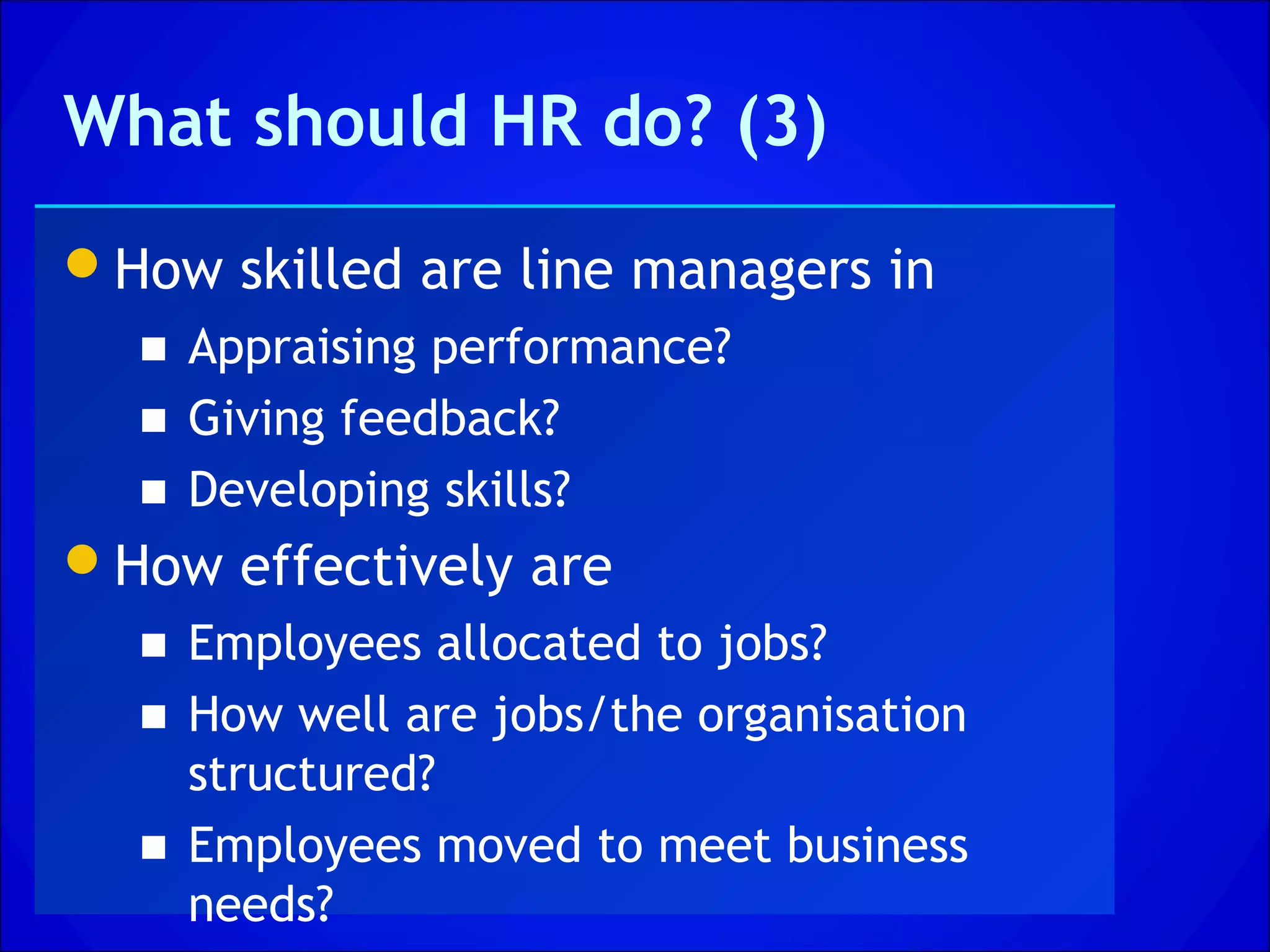
What should HRdo? (3)
How skilled are line managers in
■ Appraising performance?
■ Giving feedback?
■ Developing skills?
How effectively are
■ Employees allocated to jobs?
■ How well are jobs/the organisation
structured?
■ Employees moved to meet business
needs?
31.
What should HRdo? (4)
What is the organisation’s
■ Ability to change/innovate
How good is the organisation’s
governance structure?
How strong (and respected) are the
organisational values, eg
■ On diversity?
■ Whistleblowing?
■ Meritocratic progression?
32.
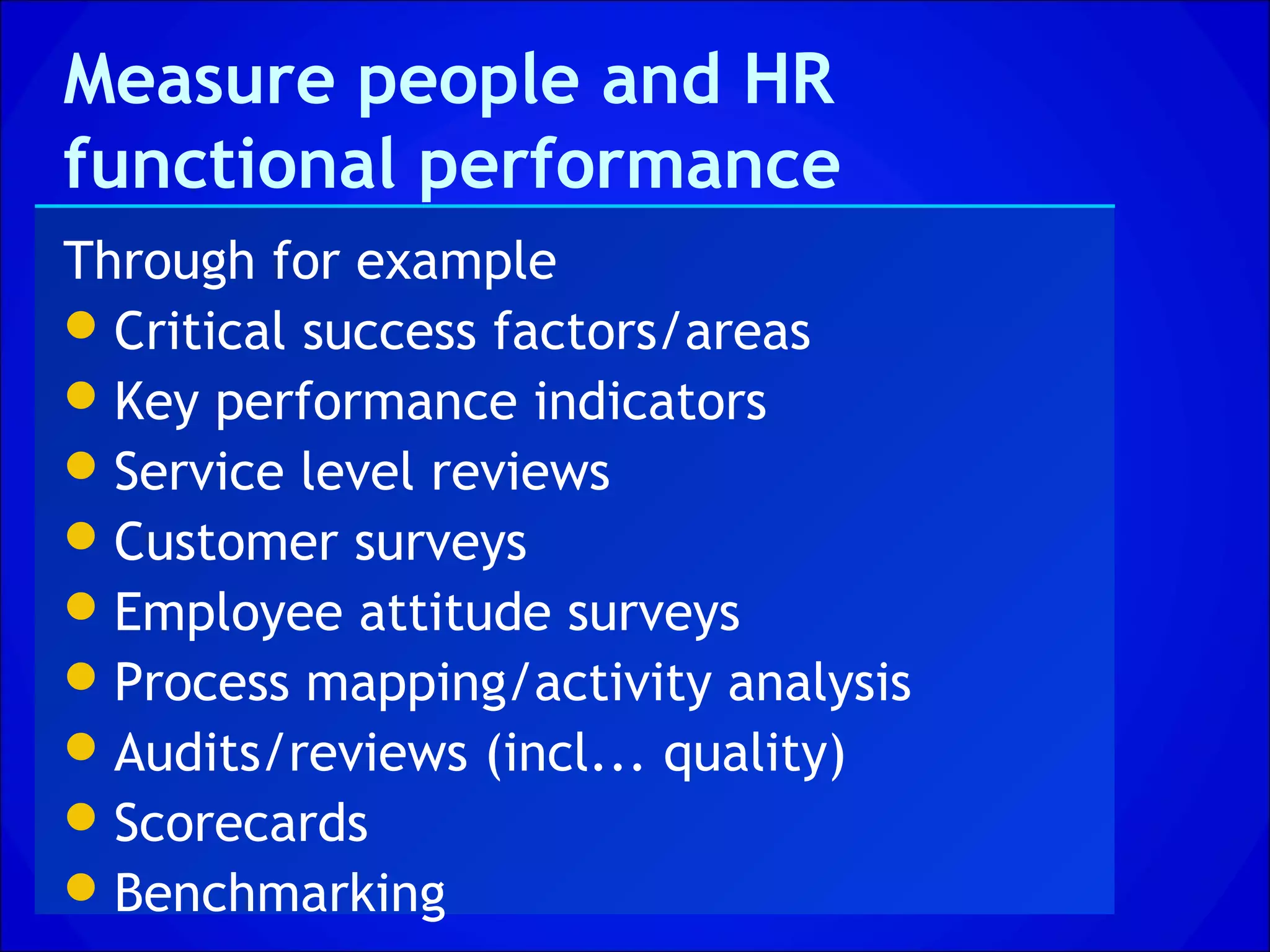
Measure people andHR
functional performance
Through for example
Critical success factors/areas
Key performance indicators
Service level reviews
Customer surveys
Employee attitude surveys
Process mapping/activity analysis
Audits/reviews (incl... quality)
Scorecards
Benchmarking
33.
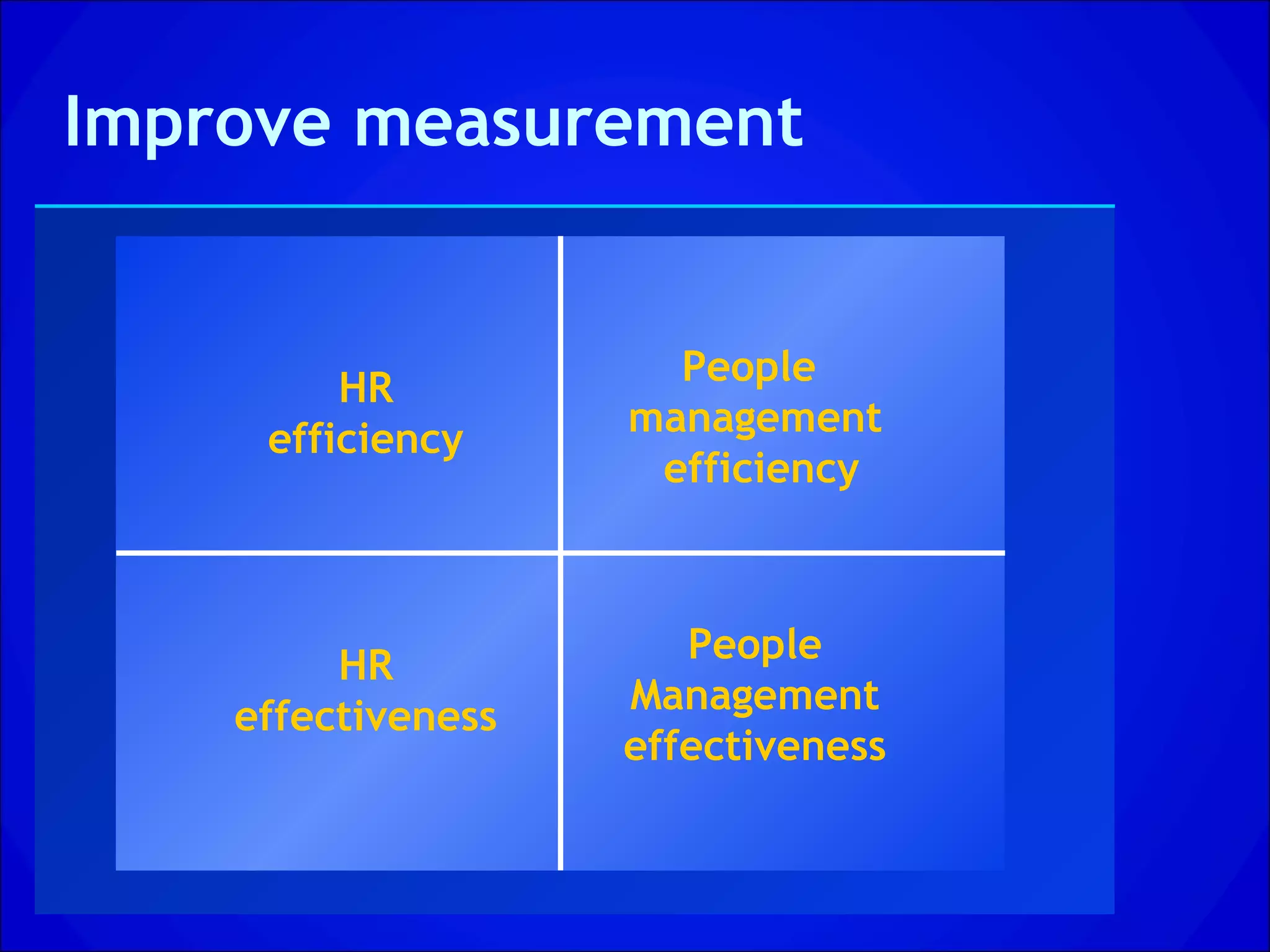
Improve measurement
People
HR
management
efficiency
efficiency
People
HR
Management
effectiveness
effectiveness
34.
Examples of measuresin multi
dimensional measurement
Cost/Income
Process metrics
against
Ratios
Customer views
headcount
Strategic alignment
Human Capital
Functional positioning
35.
Human capital measuring& doing
business goals
HR policies
& practices
HCM
measuring
reporting acting
managing
internal external people
business
performance
#36 Or may be the Holy Grail for HCM is knitting together the measuring of human assets for reporting purposes and acting upon that information to drive how people are managed in the organisation. Simply producing the data is not enough, especially if it is overly influenced by traditional accountancy models. Proving to the world that business performance is affected by the management of people may be desirable for both internal and external consumption to ensure that employees place in the business is given its rightful place.