













CYBERSECURITY CERTIFICATION COURSE www.edureka.co/cybersecurity-certification-training
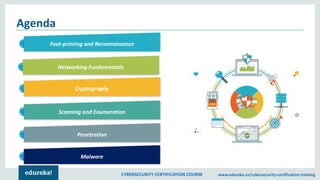
Foot-printing and Reconnaissance
Networking Fundamentals
Cryptography
Scanning and Enumeration
Agenda
Penetration
Malware
CYBERSECURITY CERTIFICATION COURSE www.edureka.co/cybersecurity-certification-training
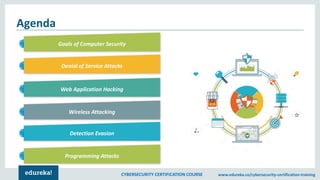
Goals of Computer Security
Denial of Service Attacks
Web Application Hacking
Agenda
Wireless Attacking
Detection Evasion
Programming Attacks
What is Hacking?
CYBERSECURITY CERTIFICATION COURSE www.edureka.co/cybersecurity-certification-training
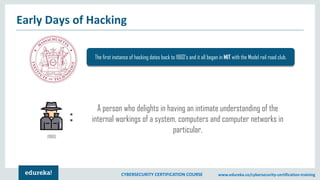
Early Days of Hacking
The first instance of hacking dates back to 1960’s and it all began in MIT with the Model rail road club.
(1960)
:
A person who delights in having an intimate understanding of the
internal workings of a system, computers and computer networks in
particular.
CYBERSECURITY CERTIFICATION COURSE www.edureka.co/cybersecurity-certification-training
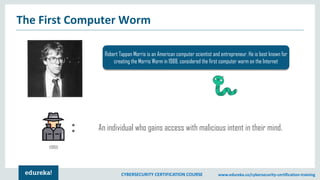
The First Computer Worm
Robert Tappan Morris is an American computer scientist and entrepreneur. He is best known for
creating the Morris Worm in 1988, considered the first computer worm on the Internet
(1980)
: An individual who gains access with malicious intent in their mind.
CYBERSECURITY CERTIFICATION COURSE www.edureka.co/cybersecurity-certification-training
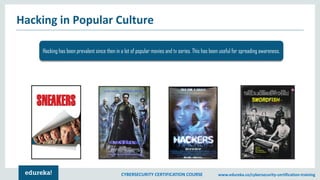
Hacking in Popular Culture
Hacking has been prevalent since then in a lot of popular movies and tv series. This has been useful for spreading awareness.
CYBERSECURITY CERTIFICATION COURSE www.edureka.co/cybersecurity-certification-training
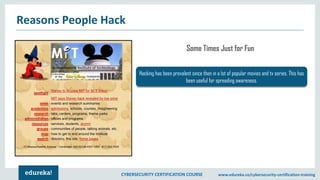
Reasons People Hack
Hacking has been prevalent since then in a lot of popular movies and tv series. This has
been useful for spreading awareness.
Some Times Just for Fun
CYBERSECURITY CERTIFICATION COURSE www.edureka.co/cybersecurity-certification-training
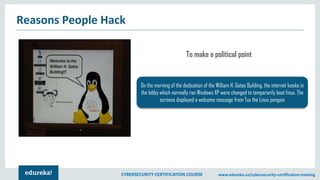
Reasons People Hack
On the morning of the dedication of the William H. Gates Building, the internet kiosks in
the lobby which normally ran Windows XP were changed to temporarily boot linux. The
screens displayed a welcome message from Tux the Linux penguin
To make a political point
CYBERSECURITY CERTIFICATION COURSE www.edureka.co/cybersecurity-certification-training
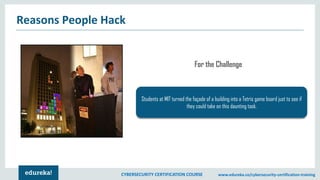
Reasons People Hack
Students at MIT turned the façade of a building into a Tetris game board just to see if
they could take on this daunting task.
For the Challenge
CYBERSECURITY CERTIFICATION COURSE www.edureka.co/cybersecurity-certification-training
Reasons People Hack
Sometimes, its better to hack so that you know what’s wrong with a system and
fix it before someone with malicious intentions gets knowledge of it.
To get there before the bad guys
CYBERSECURITY CERTIFICATION COURSE www.edureka.co/cybersecurity-certification-training
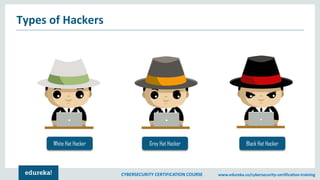
Types of Hackers
White Hat Hacker Grey Hat Hacker Black Hat Hacker
CYBERSECURITY CERTIFICATION COURSE www.edureka.co/cybersecurity-certification-training
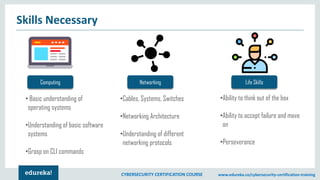
Skills Necessary
Computing
• Basic understanding of
operating systems
•Understanding of basic software
systems
•Grasp on CLI commands
Networking
•Cables, Systems, Switches
•Networking Architecture
•Understanding of different
networking protocols
Life Skills
•Ability to think out of the box
•Ability to accept failure and move
on
•Perseverance
CYBERSECURITY CERTIFICATION COURSE www.edureka.co/cybersecurity-certification-training
Skills Necessary
Tools
•How to use a lot of tools
•Networking
•Security
Networking
•How to capture packets from a
network
•TCP/IP in detail
•Understanding how protocols
interact
Methods
•How to use gathered information
•Getting the best out of your
resources
Types of Attacks
CYBERSECURITY CERTIFICATION COURSE www.edureka.co/cybersecurity-certification-training
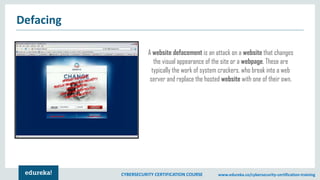
Defacing
A website defacement is an attack on a website that changes
the visual appearance of the site or a webpage. These are
typically the work of system crackers, who break into a web
server and replace the hosted website with one of their own.
CYBERSECURITY CERTIFICATION COURSE www.edureka.co/cybersecurity-certification-training
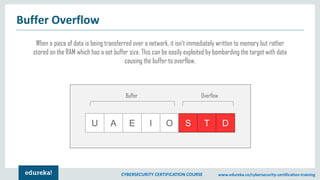
Buffer Overflow
U A E I O S T D
Buffer Overflow
When a piece of data is being transferred over a network, it isn’t immediately written to memory but rather
stored on the RAM which has a set buffer size. This can be easily exploited by bombarding the target with data
causing the buffer to overflow.
CYBERSECURITY CERTIFICATION COURSE www.edureka.co/cybersecurity-certification-training
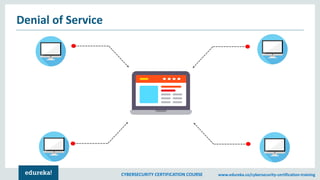
Denial of Service
Penetration Testing
CYBERSECURITY CERTIFICATION COURSE www.edureka.co/cybersecurity-certification-training
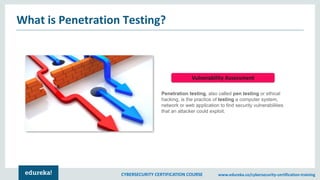
What is Penetration Testing?
Vulnerability Assessment
Penetration testing, also called pen testing or ethical
hacking, is the practice of testing a computer system,
network or web application to find security vulnerabilities
that an attacker could exploit.
CYBERSECURITY CERTIFICATION COURSE www.edureka.co/cybersecurity-certification-training
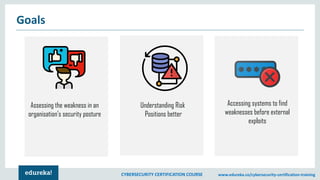
Goals
Assessing the weakness in an
organisation’s security posture
Understanding Risk
Positions better
Accessing systems to find
weaknesses before external
exploits
CYBERSECURITY CERTIFICATION COURSE www.edureka.co/cybersecurity-certification-training
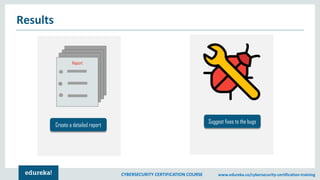
Results
Report
Create a detailed report
Suggest fixes to the bugs
CYBERSECURITY CERTIFICATION COURSE www.edureka.co/cybersecurity-certification-training
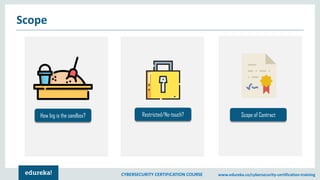
Scope
How big is the sandbox? Restricted/No-touch? Scope of Contract
Footprinting
CYBERSECURITY CERTIFICATION COURSE www.edureka.co/cybersecurity-certification-training
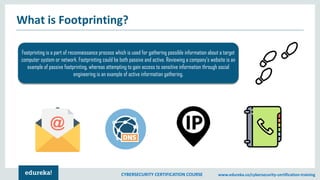
What is Footprinting?
Footprinting is a part of reconnaissance process which is used for gathering possible information about a target
computer system or network. Footprinting could be both passive and active. Reviewing a company’s website is an
example of passive footprinting, whereas attempting to gain access to sensitive information through social
engineering is an example of active information gathering.
CYBERSECURITY CERTIFICATION COURSE www.edureka.co/cybersecurity-certification-training
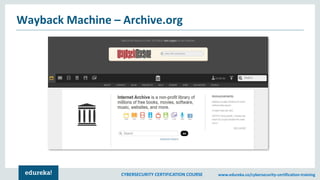
Wayback Machine – Archive.org
CYBERSECURITY CERTIFICATION COURSE www.edureka.co/cybersecurity-certification-training
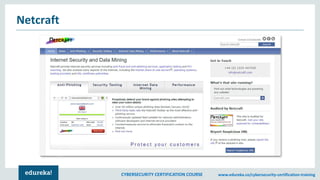
Netcraft
Using DNS to Get information
CYBERSECURITY CERTIFICATION COURSE www.edureka.co/cybersecurity-certification-training
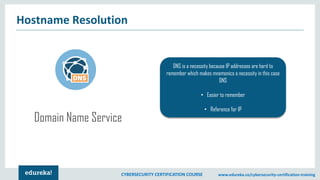
Hostname Resolution
Domain Name Service
DNS is a necessity because IP addresses are hard to
remember which makes mnemonics a necessity in this case
DNS
• Easier to remember
• Reference for IP
CYBERSECURITY CERTIFICATION COURSE www.edureka.co/cybersecurity-certification-training
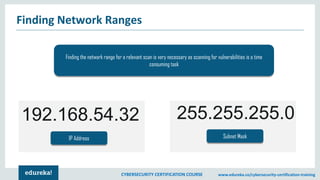
Finding Network Ranges
192.168.54.32
IP Address
255.255.255.0
Subnet Mask
Finding the network range for a relevant scan is very necessary as scanning for vulnerabilities is a time
consuming task
Using Google for Reconnaissance
CYBERSECURITY CERTIFICATION COURSE www.edureka.co/cybersecurity-certification-training
Google Hacking
Google is a valuable resource when it comes to information gathering, Knowing how to use google to target the
things you are looking for is a useful skill as an ethical hacker
TCP/IP
CYBERSECURITY CERTIFICATION COURSE www.edureka.co/cybersecurity-certification-training
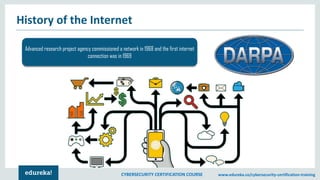
History of the Internet
Advanced research project agency commissioned a network in 1968 and the first internet
connection was in 1969
CYBERSECURITY CERTIFICATION COURSE www.edureka.co/cybersecurity-certification-training
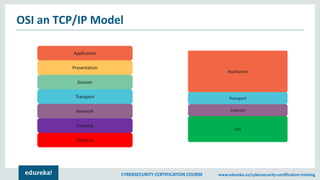
OSI an TCP/IP Model
Application
Presentation
Session
Transport
Network
Datalink
Physical
Application
Transport
Internet
Link
CYBERSECURITY CERTIFICATION COURSE www.edureka.co/cybersecurity-certification-training
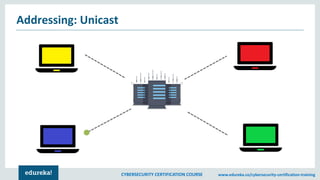
Addressing: Unicast
CYBERSECURITY CERTIFICATION COURSE www.edureka.co/cybersecurity-certification-training
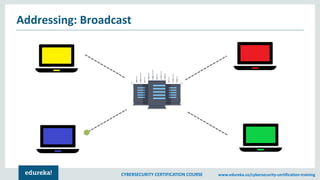
Addressing: Broadcast
CYBERSECURITY CERTIFICATION COURSE www.edureka.co/cybersecurity-certification-training
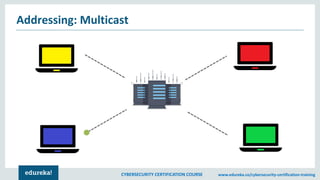
Addressing: Multicast
Wireshark
CYBERSECURITY CERTIFICATION COURSE www.edureka.co/cybersecurity-certification-training
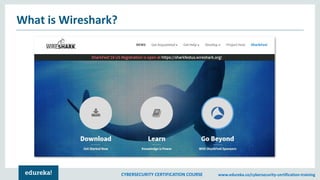
What is Wireshark?
DHCP
CYBERSECURITY CERTIFICATION COURSE www.edureka.co/cybersecurity-certification-training
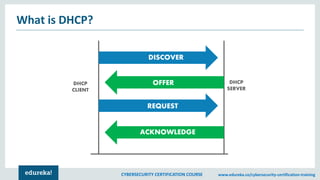
What is DHCP?
DHCP
CLIENT
DHCP
SERVER
DISCOVER
OFFER
REQUEST
ACKNOWLEDGE
CYBERSECURITY CERTIFICATION COURSE www.edureka.co/cybersecurity-certification-training
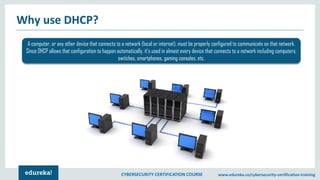
Why use DHCP?
A computer, or any other device that connects to a network (local or internet), must be properly configured to communicate on that network.
Since DHCP allows that configuration to happen automatically, it's used in almost every device that connects to a network including computers,
switches, smartphones, gaming consoles, etc.
Address Resolution Protocol
CYBERSECURITY CERTIFICATION COURSE www.edureka.co/cybersecurity-certification-training
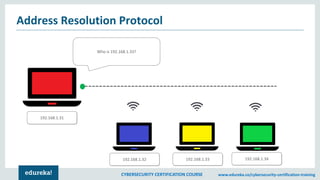
Address Resolution Protocol
192.168.1.31
192.168.1.33192.168.1.32 192.168.1.34
Who is 192.168.1.33?
CYBERSECURITY CERTIFICATION COURSE www.edureka.co/cybersecurity-certification-training
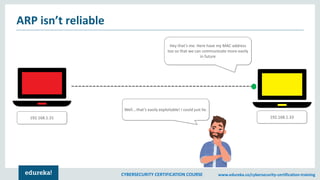
ARP isn’t reliable
192.168.1.31
Hey that’s me. Here have my MAC address
too so that we can communicate more easily
in future
192.168.1.33
Well….that’s easily exploitable! I could just lie.
CYBERSECURITY CERTIFICATION COURSE www.edureka.co/cybersecurity-certification-training
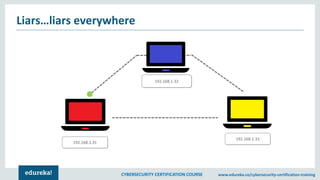
Liars…liars everywhere
192.168.1.31
192.168.1.33
192.168.1.32
Cryptography
CYBERSECURITY CERTIFICATION COURSE www.edureka.co/cybersecurity-certification-training
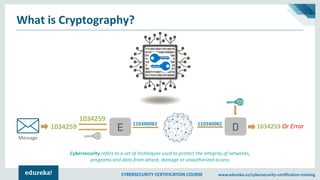
What is Cryptography?
Message
1034259
1034259
110340082
E
110340082
D 1034259 Or Error
Cybersecurity refers to a set of techniques used to protect the integrity of networks,
programs and data from attack, damage or unauthorized access
CYBERSECURITY CERTIFICATION COURSE www.edureka.co/cybersecurity-certification-training
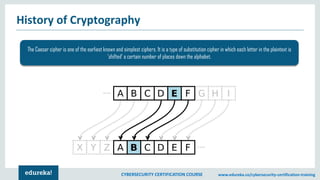
History of Cryptography
The Caesar cipher is one of the earliest known and simplest ciphers. It is a type of substitution cipher in which each letter in the plaintext is
'shifted' a certain number of places down the alphabet.
CYBERSECURITY CERTIFICATION COURSE www.edureka.co/cybersecurity-certification-training
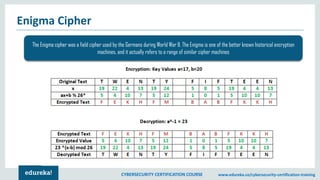
Enigma Cipher
The Enigma cipher was a field cipher used by the Germans during World War II. The Enigma is one of the better known historical encryption
machines, and it actually refers to a range of similar cipher machines
CYBERSECURITY CERTIFICATION COURSE www.edureka.co/cybersecurity-certification-training
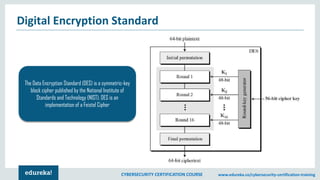
Digital Encryption Standard
The Data Encryption Standard (DES) is a symmetric-key
block cipher published by the National Institute of
Standards and Technology (NIST). DES is an
implementation of a Feistel Cipher
CYBERSECURITY CERTIFICATION COURSE www.edureka.co/cybersecurity-certification-training
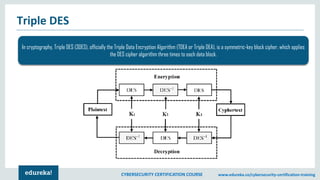
Triple DES
In cryptography, Triple DES (3DES), officially the Triple Data Encryption Algorithm (TDEA or Triple DEA), is a symmetric-key block cipher, which applies
the DES cipher algorithm three times to each data block.
CYBERSECURITY CERTIFICATION COURSE www.edureka.co/cybersecurity-certification-training
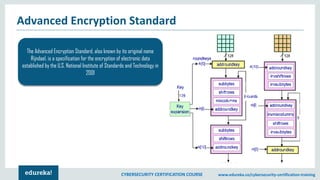
Advanced Encryption Standard
The Advanced Encryption Standard, also known by its original name
Rijndael, is a specification for the encryption of electronic data
established by the U.S. National Institute of Standards and Technology in
2001
Types of Cryptography
Certificates
CYBERSECURITY CERTIFICATION COURSE www.edureka.co/cybersecurity-certification-training
What is a Certificate?
A Digital Certificate is an electronic "password" that allows a person, organizaion to exchange data securely
over the Internet using the public key infrastructure (PKI). Digital Certificate is also known as a public key
certificate or identity certificate.
CYBERSECURITY CERTIFICATION COURSE www.edureka.co/cybersecurity-certification-training
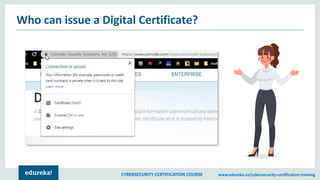
Who can issue a Digital Certificate?
Cryptographic Hashing
CYBERSECURITY CERTIFICATION COURSE www.edureka.co/cybersecurity-certification-training
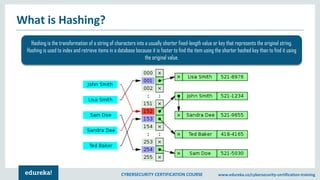
What is Hashing?
Hashing is the transformation of a string of characters into a usually shorter fixed-length value or key that represents the original string.
Hashing is used to index and retrieve items in a database because it is faster to find the item using the shorter hashed key than to find it using
the original value.
TLS and SSL
CYBERSECURITY CERTIFICATION COURSE www.edureka.co/cybersecurity-certification-training
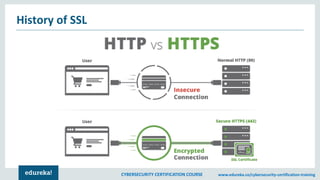
History of SSL
CYBERSECURITY CERTIFICATION COURSE www.edureka.co/cybersecurity-certification-training
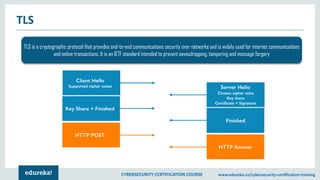
TLS
TLS is a cryptographic protocol that provides end-to-end communications security over networks and is widely used for internet communications
and online transactions. It is an IETF standard intended to prevent eavesdropping, tampering and message forgery
Disk Encryption
CYBERSECURITY CERTIFICATION COURSE www.edureka.co/cybersecurity-certification-training
Bitlocker
Scanning
CYBERSECURITY CERTIFICATION COURSE www.edureka.co/cybersecurity-certification-training
What is Scanning?
Network scanning refers to the use of a computer network to gather information regarding computing systems. Network scanning is mainly used
for security assessment, system maintenance, and also for performing attacks by hackers.
CYBERSECURITY CERTIFICATION COURSE www.edureka.co/cybersecurity-certification-training
NMAP
Nmap is a free and open-source security scanner, originally written by Gordon Lyon, used to discover hosts and services on a computer network,
thus building a "map" of the network.
IDS Evasion
CYBERSECURITY CERTIFICATION COURSE www.edureka.co/cybersecurity-certification-training
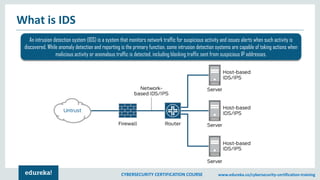
What is IDS
An intrusion detection system (IDS) is a system that monitors network traffic for suspicious activity and issues alerts when such activity is
discovered. While anomaly detection and reporting is the primary function, some intrusion detection systems are capable of taking actions when
malicious activity or anomalous traffic is detected, including blocking traffic sent from suspicious IP addresses.
CYBERSECURITY CERTIFICATION COURSE www.edureka.co/cybersecurity-certification-training
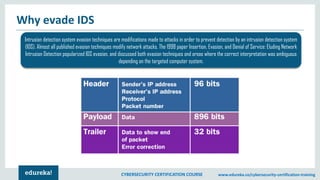
Why evade IDS
Intrusion detection system evasion techniques are modifications made to attacks in order to prevent detection by an intrusion detection system
(IDS). Almost all published evasion techniques modify network attacks. The 1998 paper Insertion, Evasion, and Denial of Service: Eluding Network
Intrusion Detection popularized IDS evasion, and discussed both evasion techniques and areas where the correct interpretation was ambiguous
depending on the targeted computer system.

Complete Ethical Hacking Course | Ethical Hacking Training for Beginners | Edureka

  • 1.
    CYBERSECURITY CERTIFICATION COURSEwww.edureka.co/cybersecurity-certification-training
  • 2.
    CYBERSECURITY CERTIFICATION COURSEwww.edureka.co/cybersecurity-certification-training Foot-printing and Reconnaissance Networking Fundamentals Cryptography Scanning and Enumeration Agenda Penetration Malware
  • 3.
    CYBERSECURITY CERTIFICATION COURSEwww.edureka.co/cybersecurity-certification-training Goals of Computer Security Denial of Service Attacks Web Application Hacking Agenda Wireless Attacking Detection Evasion Programming Attacks
  • 4.
  • 5.
    CYBERSECURITY CERTIFICATION COURSEwww.edureka.co/cybersecurity-certification-training Early Days of Hacking The first instance of hacking dates back to 1960’s and it all began in MIT with the Model rail road club. (1960) : A person who delights in having an intimate understanding of the internal workings of a system, computers and computer networks in particular.
  • 6.
    CYBERSECURITY CERTIFICATION COURSEwww.edureka.co/cybersecurity-certification-training The First Computer Worm Robert Tappan Morris is an American computer scientist and entrepreneur. He is best known for creating the Morris Worm in 1988, considered the first computer worm on the Internet (1980) : An individual who gains access with malicious intent in their mind.
  • 7.
    CYBERSECURITY CERTIFICATION COURSEwww.edureka.co/cybersecurity-certification-training Hacking in Popular Culture Hacking has been prevalent since then in a lot of popular movies and tv series. This has been useful for spreading awareness.
  • 8.
    CYBERSECURITY CERTIFICATION COURSEwww.edureka.co/cybersecurity-certification-training Reasons People Hack Hacking has been prevalent since then in a lot of popular movies and tv series. This has been useful for spreading awareness. Some Times Just for Fun
  • 9.
    CYBERSECURITY CERTIFICATION COURSEwww.edureka.co/cybersecurity-certification-training Reasons People Hack On the morning of the dedication of the William H. Gates Building, the internet kiosks in the lobby which normally ran Windows XP were changed to temporarily boot linux. The screens displayed a welcome message from Tux the Linux penguin To make a political point
  • 10.
    CYBERSECURITY CERTIFICATION COURSEwww.edureka.co/cybersecurity-certification-training Reasons People Hack Students at MIT turned the façade of a building into a Tetris game board just to see if they could take on this daunting task. For the Challenge
  • 11.
    CYBERSECURITY CERTIFICATION COURSEwww.edureka.co/cybersecurity-certification-training Reasons People Hack Sometimes, its better to hack so that you know what’s wrong with a system and fix it before someone with malicious intentions gets knowledge of it. To get there before the bad guys
  • 12.
    CYBERSECURITY CERTIFICATION COURSEwww.edureka.co/cybersecurity-certification-training Types of Hackers White Hat Hacker Grey Hat Hacker Black Hat Hacker
  • 13.
    CYBERSECURITY CERTIFICATION COURSEwww.edureka.co/cybersecurity-certification-training Skills Necessary Computing • Basic understanding of operating systems •Understanding of basic software systems •Grasp on CLI commands Networking •Cables, Systems, Switches •Networking Architecture •Understanding of different networking protocols Life Skills •Ability to think out of the box •Ability to accept failure and move on •Perseverance
  • 14.
    CYBERSECURITY CERTIFICATION COURSEwww.edureka.co/cybersecurity-certification-training Skills Necessary Tools •How to use a lot of tools •Networking •Security Networking •How to capture packets from a network •TCP/IP in detail •Understanding how protocols interact Methods •How to use gathered information •Getting the best out of your resources
  • 15.
  • 16.
    CYBERSECURITY CERTIFICATION COURSEwww.edureka.co/cybersecurity-certification-training Defacing A website defacement is an attack on a website that changes the visual appearance of the site or a webpage. These are typically the work of system crackers, who break into a web server and replace the hosted website with one of their own.
  • 17.
    CYBERSECURITY CERTIFICATION COURSEwww.edureka.co/cybersecurity-certification-training Buffer Overflow U A E I O S T D Buffer Overflow When a piece of data is being transferred over a network, it isn’t immediately written to memory but rather stored on the RAM which has a set buffer size. This can be easily exploited by bombarding the target with data causing the buffer to overflow.
  • 18.
    CYBERSECURITY CERTIFICATION COURSEwww.edureka.co/cybersecurity-certification-training Denial of Service
  • 19.
  • 20.
    CYBERSECURITY CERTIFICATION COURSEwww.edureka.co/cybersecurity-certification-training What is Penetration Testing? Vulnerability Assessment Penetration testing, also called pen testing or ethical hacking, is the practice of testing a computer system, network or web application to find security vulnerabilities that an attacker could exploit.
  • 21.
    CYBERSECURITY CERTIFICATION COURSEwww.edureka.co/cybersecurity-certification-training Goals Assessing the weakness in an organisation’s security posture Understanding Risk Positions better Accessing systems to find weaknesses before external exploits
  • 22.
    CYBERSECURITY CERTIFICATION COURSEwww.edureka.co/cybersecurity-certification-training Results Report Create a detailed report Suggest fixes to the bugs
  • 23.
    CYBERSECURITY CERTIFICATION COURSEwww.edureka.co/cybersecurity-certification-training Scope How big is the sandbox? Restricted/No-touch? Scope of Contract
  • 24.
  • 25.
    CYBERSECURITY CERTIFICATION COURSEwww.edureka.co/cybersecurity-certification-training What is Footprinting? Footprinting is a part of reconnaissance process which is used for gathering possible information about a target computer system or network. Footprinting could be both passive and active. Reviewing a company’s website is an example of passive footprinting, whereas attempting to gain access to sensitive information through social engineering is an example of active information gathering.
  • 26.
    CYBERSECURITY CERTIFICATION COURSEwww.edureka.co/cybersecurity-certification-training Wayback Machine – Archive.org
  • 27.
    CYBERSECURITY CERTIFICATION COURSEwww.edureka.co/cybersecurity-certification-training Netcraft
  • 28.
    Using DNS toGet information
  • 29.
    CYBERSECURITY CERTIFICATION COURSEwww.edureka.co/cybersecurity-certification-training Hostname Resolution Domain Name Service DNS is a necessity because IP addresses are hard to remember which makes mnemonics a necessity in this case DNS • Easier to remember • Reference for IP
  • 30.
    CYBERSECURITY CERTIFICATION COURSEwww.edureka.co/cybersecurity-certification-training Finding Network Ranges 192.168.54.32 IP Address 255.255.255.0 Subnet Mask Finding the network range for a relevant scan is very necessary as scanning for vulnerabilities is a time consuming task
  • 31.
    Using Google forReconnaissance
  • 32.
    CYBERSECURITY CERTIFICATION COURSEwww.edureka.co/cybersecurity-certification-training Google Hacking Google is a valuable resource when it comes to information gathering, Knowing how to use google to target the things you are looking for is a useful skill as an ethical hacker
  • 33.
  • 34.
    CYBERSECURITY CERTIFICATION COURSEwww.edureka.co/cybersecurity-certification-training History of the Internet Advanced research project agency commissioned a network in 1968 and the first internet connection was in 1969
  • 35.
    CYBERSECURITY CERTIFICATION COURSEwww.edureka.co/cybersecurity-certification-training OSI an TCP/IP Model Application Presentation Session Transport Network Datalink Physical Application Transport Internet Link
  • 36.
    CYBERSECURITY CERTIFICATION COURSEwww.edureka.co/cybersecurity-certification-training Addressing: Unicast
  • 37.
    CYBERSECURITY CERTIFICATION COURSEwww.edureka.co/cybersecurity-certification-training Addressing: Broadcast
  • 38.
    CYBERSECURITY CERTIFICATION COURSEwww.edureka.co/cybersecurity-certification-training Addressing: Multicast
  • 39.
  • 40.
    CYBERSECURITY CERTIFICATION COURSEwww.edureka.co/cybersecurity-certification-training What is Wireshark?
  • 41.
  • 42.
    CYBERSECURITY CERTIFICATION COURSEwww.edureka.co/cybersecurity-certification-training What is DHCP? DHCP CLIENT DHCP SERVER DISCOVER OFFER REQUEST ACKNOWLEDGE
  • 43.
    CYBERSECURITY CERTIFICATION COURSEwww.edureka.co/cybersecurity-certification-training Why use DHCP? A computer, or any other device that connects to a network (local or internet), must be properly configured to communicate on that network. Since DHCP allows that configuration to happen automatically, it's used in almost every device that connects to a network including computers, switches, smartphones, gaming consoles, etc.
  • 44.
  • 45.
    CYBERSECURITY CERTIFICATION COURSEwww.edureka.co/cybersecurity-certification-training Address Resolution Protocol 192.168.1.31 192.168.1.33192.168.1.32 192.168.1.34 Who is 192.168.1.33?
  • 46.
    CYBERSECURITY CERTIFICATION COURSEwww.edureka.co/cybersecurity-certification-training ARP isn’t reliable 192.168.1.31 Hey that’s me. Here have my MAC address too so that we can communicate more easily in future 192.168.1.33 Well….that’s easily exploitable! I could just lie.
  • 47.
    CYBERSECURITY CERTIFICATION COURSEwww.edureka.co/cybersecurity-certification-training Liars…liars everywhere 192.168.1.31 192.168.1.33 192.168.1.32
  • 48.
  • 49.
    CYBERSECURITY CERTIFICATION COURSEwww.edureka.co/cybersecurity-certification-training What is Cryptography? Message 1034259 1034259 110340082 E 110340082 D 1034259 Or Error Cybersecurity refers to a set of techniques used to protect the integrity of networks, programs and data from attack, damage or unauthorized access
  • 50.
    CYBERSECURITY CERTIFICATION COURSEwww.edureka.co/cybersecurity-certification-training History of Cryptography The Caesar cipher is one of the earliest known and simplest ciphers. It is a type of substitution cipher in which each letter in the plaintext is 'shifted' a certain number of places down the alphabet.
  • 51.
    CYBERSECURITY CERTIFICATION COURSEwww.edureka.co/cybersecurity-certification-training Enigma Cipher The Enigma cipher was a field cipher used by the Germans during World War II. The Enigma is one of the better known historical encryption machines, and it actually refers to a range of similar cipher machines
  • 52.
    CYBERSECURITY CERTIFICATION COURSEwww.edureka.co/cybersecurity-certification-training Digital Encryption Standard The Data Encryption Standard (DES) is a symmetric-key block cipher published by the National Institute of Standards and Technology (NIST). DES is an implementation of a Feistel Cipher
  • 53.
    CYBERSECURITY CERTIFICATION COURSEwww.edureka.co/cybersecurity-certification-training Triple DES In cryptography, Triple DES (3DES), officially the Triple Data Encryption Algorithm (TDEA or Triple DEA), is a symmetric-key block cipher, which applies the DES cipher algorithm three times to each data block.
  • 54.
    CYBERSECURITY CERTIFICATION COURSEwww.edureka.co/cybersecurity-certification-training Advanced Encryption Standard The Advanced Encryption Standard, also known by its original name Rijndael, is a specification for the encryption of electronic data established by the U.S. National Institute of Standards and Technology in 2001
  • 55.
  • 56.
  • 57.
    CYBERSECURITY CERTIFICATION COURSEwww.edureka.co/cybersecurity-certification-training What is a Certificate? A Digital Certificate is an electronic "password" that allows a person, organizaion to exchange data securely over the Internet using the public key infrastructure (PKI). Digital Certificate is also known as a public key certificate or identity certificate.
  • 58.
    CYBERSECURITY CERTIFICATION COURSEwww.edureka.co/cybersecurity-certification-training Who can issue a Digital Certificate?
  • 59.
  • 60.
    CYBERSECURITY CERTIFICATION COURSEwww.edureka.co/cybersecurity-certification-training What is Hashing? Hashing is the transformation of a string of characters into a usually shorter fixed-length value or key that represents the original string. Hashing is used to index and retrieve items in a database because it is faster to find the item using the shorter hashed key than to find it using the original value.
  • 61.
  • 62.
    CYBERSECURITY CERTIFICATION COURSEwww.edureka.co/cybersecurity-certification-training History of SSL
  • 63.
    CYBERSECURITY CERTIFICATION COURSEwww.edureka.co/cybersecurity-certification-training TLS TLS is a cryptographic protocol that provides end-to-end communications security over networks and is widely used for internet communications and online transactions. It is an IETF standard intended to prevent eavesdropping, tampering and message forgery
  • 64.
  • 65.
    CYBERSECURITY CERTIFICATION COURSEwww.edureka.co/cybersecurity-certification-training Bitlocker
  • 66.
  • 67.
    CYBERSECURITY CERTIFICATION COURSEwww.edureka.co/cybersecurity-certification-training What is Scanning? Network scanning refers to the use of a computer network to gather information regarding computing systems. Network scanning is mainly used for security assessment, system maintenance, and also for performing attacks by hackers.
  • 68.
    CYBERSECURITY CERTIFICATION COURSEwww.edureka.co/cybersecurity-certification-training NMAP Nmap is a free and open-source security scanner, originally written by Gordon Lyon, used to discover hosts and services on a computer network, thus building a "map" of the network.
  • 69.
  • 70.
    CYBERSECURITY CERTIFICATION COURSEwww.edureka.co/cybersecurity-certification-training What is IDS An intrusion detection system (IDS) is a system that monitors network traffic for suspicious activity and issues alerts when such activity is discovered. While anomaly detection and reporting is the primary function, some intrusion detection systems are capable of taking actions when malicious activity or anomalous traffic is detected, including blocking traffic sent from suspicious IP addresses.
  • 71.
    CYBERSECURITY CERTIFICATION COURSEwww.edureka.co/cybersecurity-certification-training Why evade IDS Intrusion detection system evasion techniques are modifications made to attacks in order to prevent detection by an intrusion detection system (IDS). Almost all published evasion techniques modify network attacks. The 1998 paper Insertion, Evasion, and Denial of Service: Eluding Network Intrusion Detection popularized IDS evasion, and discussed both evasion techniques and areas where the correct interpretation was ambiguous depending on the targeted computer system.