Certified Ethical Hacking
Ron Woerner, CISSP, CEH
Agenda
 Is computer hacking necessary?
 What is a Certified Ethical Hacker?
 Is that an oxymoron?
 What I learned
 Cool stuff from the class
 The Exam
 Importance of certifications
Two Questions
   Why are you here?

   Why am I here?
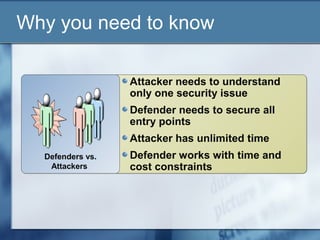
Why you need to know

                  Attacker needs to understand
                  only one security issue
                  Defender needs to secure all
                  entry points
                  Attacker has unlimited time
  Defenders vs.   Defender works with time and
   Attackers      cost constraints
Why you need to know
“If you know the enemy
   and know yourself, you
   need not fear the result
   of a hundred battles.”
              ––Sun Tzu,
   Art of War
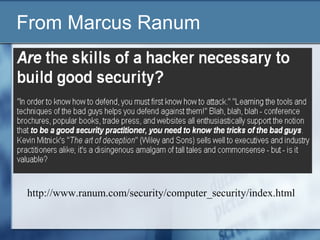
From Marcus Ranum


http://www.ranum.com/security/computer_security/index.html
Understand this (1):
   Hacking skills are good for the here and now;
   Knowledge of Security Principles are needed
    for the hereafter;
   Both are required to be an information security
    professional.
Understand this (2):
   “In a nutshell, security is now about risk
    management.”
   Penetration / vulnerability testing is an element
    of the risk assessment.
   It is critical to balance the risks based on
    business decisions
   Degrees of separation
   The building of multiple layers
Understand this (3):
   CEH Helps you
     Identify risks, vulnerabilities, threats and
      weaknesses;
     Determine monitoring needs and incident response;
     Sell Security
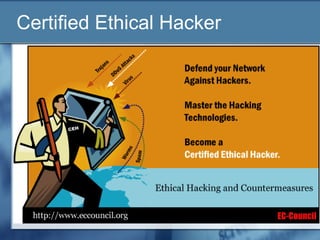
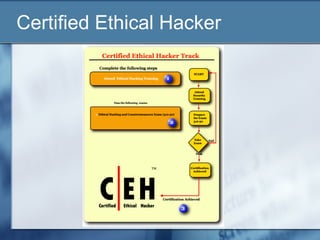
Certified Ethical Hacker
“If you want to stop hackers from invading
   your network, first you’ve got to invade their
   minds.”
 Ethical Hacking & Countermeasures course
 “Official” certification from EC-Council       (
  http://www.eccouncil.org)
Certified Ethical Hacker
Can Hacking be Ethical (and can
you really be certified in it)?

            IT DEPENDS
Can Hacking be Ethical (and can
you really be certified in it)?
   The noun ‘hacker’ refers to a person who enjoys
    learning the details of computer systems and stretch
    their capabilities.
   The verb ‘hacking’ describes the rapid development of
    new programs or the reverse engineering of already
    existing software to make the code better, and efficient
    (and more secure).
   The term ‘cracker’ refers to a person who uses his
    hacking skills for offensive (malicious) purposes.
   The term ‘ethical hacker’ refers to security
    professionals who apply their hacking skills for
    defensive purposes.
EC-Council Code of Ethics

EC-Council Code of Ethics

In other words, don’t be stupid.
Ethical Hacking
   Ethical hackers try to answer:
       What can the intruder see on the target system?
        (Reconnaissance and Scanning phase of hacking)
       What can an intruder do with that information? (Gaining
        Access and Maintaining Access phases)
       Does anyone at the target notice the intruders attempts
        or success? (Reconnaissance and Covering Tracks
        phases)
   If hired by any organization, an ethical hacker asks the
    organization what it is trying to protect, against whom
    and what resources it is willing to expend in order to
    gain protection.
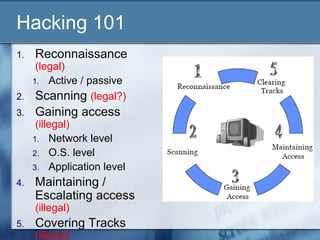
Hacking 101
1.   Reconnaissance
    (legal)
   1. Active / passive
2. Scanning (legal?)
3.   Gaining access
      (illegal)
     1. Network level
     2. O.S. level
     3. Application level
4.   Maintaining /
     Escalating access
     (illegal)
5.   Covering Tracks
     (illegal)
Class Modules
1.    Legality              1.    Web App Vulnerabilities
2.    Footprinting          2.    Web-based password
3.    Scanning                    cracking
4.    Enumeration           3.    SQL injection
5.    System Hacking        4.    Hacking Wireless Nets
6.    Trojans & Backdoors   5.    Virus
7.    Sniffers              6.    Physical Security
8.    Denial of Service     7.    Linux Hacking
9.    Social Engineering    8.    Evading IDS, etc.
10.   Session Hacking       9.    Buffer Overflows
11.   Hacking Web Servers   10.   Cryptography
                            11.   Pen Test Methodologies
Footprinting
    Web tools
         www.samspade.org
         www.dnsstuff.com
         www.netcraft.com
         Web site archives: www.archive.org (wayback machine)
         People Search: www.intellius.com
    Tools
         Whois (www.networksolutions.com) (Free)
         Nslookup (Free)
         ARIN (http://www.arin.net/whois) (Free)
         Traceroute (Free)
         Visual Route (http://www.visualroute.com/) ($$)
         SmartWhois (www.tamos.com) ($$)
Scanning – Port & Ping
   NMap / NMapWin (Free)
   HPing2 (UNIX) (http://www.hping.org/) (Free)
   Superscan (Free)
   Firewalk (UNIX) (http://www.packetfactory.net/firewalk/)
    (Free)
   WPSweep (http://ntsecurity.nu/toolbox/ipsecscan/) (Free)
   IPSec Scan      (http://ntsecurity.nu/toolbox/ipsecscan/)   (Free)
   Cheops (UNIX) (http://cheops-ng.sourceforge.net/) (Free)
   NetScan Tools Pro (www.netscantools.com) ($$)
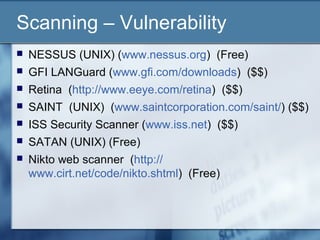
Scanning – Vulnerability
   NESSUS (UNIX) (www.nessus.org) (Free)
   GFI LANGuard (www.gfi.com/downloads) ($$)
   Retina (http://www.eeye.com/retina) ($$)
   SAINT (UNIX) (www.saintcorporation.com/saint/) ($$)
   ISS Security Scanner (www.iss.net) ($$)
   SATAN (UNIX) (Free)
   Nikto web scanner (http://
    www.cirt.net/code/nikto.shtml) (Free)
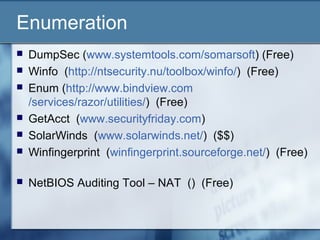
Enumeration
   DumpSec (www.systemtools.com/somarsoft) (Free)
   Winfo (http://ntsecurity.nu/toolbox/winfo/) (Free)
   Enum (http://www.bindview.com
    /services/razor/utilities/) (Free)
   GetAcct (www.securityfriday.com)
   SolarWinds (www.solarwinds.net/) ($$)
   Winfingerprint (winfingerprint.sourceforge.net/) (Free)

   NetBIOS Auditing Tool – NAT () (Free)
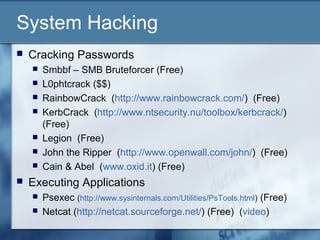
System Hacking
   Cracking Passwords
       Smbbf – SMB Bruteforcer (Free)
       L0phtcrack ($$)
       RainbowCrack (http://www.rainbowcrack.com/) (Free)
       KerbCrack (http://www.ntsecurity.nu/toolbox/kerbcrack/)
        (Free)
       Legion (Free)
       John the Ripper (http://www.openwall.com/john/) (Free)
       Cain & Abel (www.oxid.it) (Free)
   Executing Applications
       Psexec (http://www.sysinternals.com/Utilities/PsTools.html) (Free)
       Netcat (http://netcat.sourceforge.net/) (Free) (video)
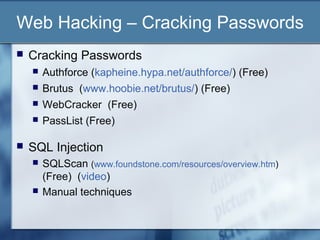
Web Hacking – Cracking Passwords
   Cracking Passwords
       Authforce (kapheine.hypa.net/authforce/) (Free)
       Brutus (www.hoobie.net/brutus/) (Free)
       WebCracker (Free)
       PassList (Free)

   SQL Injection
       SQLScan (www.foundstone.com/resources/overview.htm)
        (Free) (video)
       Manual techniques
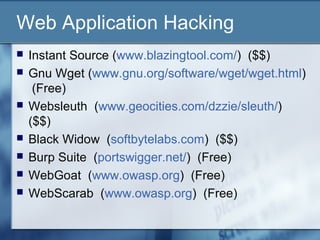
Web Application Hacking
   Instant Source (www.blazingtool.com/) ($$)
   Gnu Wget (www.gnu.org/software/wget/wget.html)
     (Free)
   Websleuth (www.geocities.com/dzzie/sleuth/)
    ($$)
   Black Widow (softbytelabs.com) ($$)
   Burp Suite (portswigger.net/) (Free)
   WebGoat (www.owasp.org) (Free)
   WebScarab (www.owasp.org) (Free)
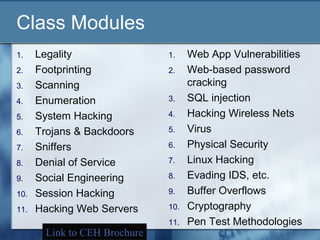
Class Modules
1.    Legality                1.    Web App Vulnerabilities
2.    Footprinting            2.    Web-based password
3.    Scanning                      cracking
4.    Enumeration             3.    SQL injection
5.    System Hacking          4.    Hacking Wireless Nets
6.    Trojans & Backdoors     5.    Virus
7.    Sniffers                6.    Physical Security
8.    Denial of Service       7.    Linux Hacking
9.    Social Engineering      8.    Evading IDS, etc.
10.   Session Hacking         9.    Buffer Overflows
11.   Hacking Web Servers     10.   Cryptography
                              11.   Pen Test Methodologies
       Link to CEH Brochure
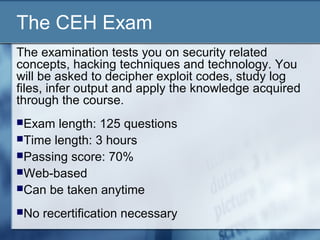
The CEH Exam
The examination tests you on security related
concepts, hacking techniques and technology. You
will be asked to decipher exploit codes, study log
files, infer output and apply the knowledge acquired
through the course.
Exam  length: 125 questions
Time length: 3 hours
Passing score: 70%
Web-based
Can be taken anytime

No   recertification necessary
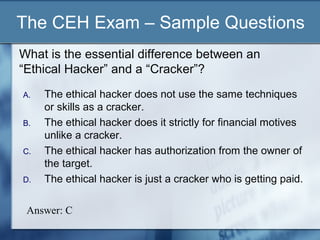
The CEH Exam – Sample Questions
What is the essential difference between an
“Ethical Hacker” and a “Cracker”?
A.   The ethical hacker does not use the same techniques
     or skills as a cracker.
B.   The ethical hacker does it strictly for financial motives
     unlike a cracker.
C.   The ethical hacker has authorization from the owner of
     the target.
D.   The ethical hacker is just a cracker who is getting paid.

 Answer: C
The CEH Exam – Sample Questions
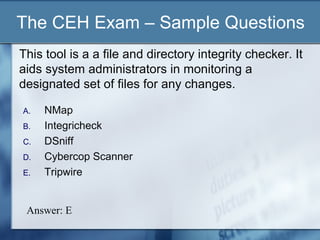
This tool is a a file and directory integrity checker. It
aids system administrators in monitoring a
designated set of files for any changes.

A.   NMap
B.   Integricheck
C.   DSniff
D.   Cybercop Scanner
E.   Tripwire


 Answer: E
The CEH Exam – Sample Questions
Netcat is a simple network utility which reads and
writes data across network connections, using TCP
or UDP protocol. Which of the following command
scans for open ports between [1 - 140]?
(Select the Best Answer)

A.   nc -xx -q -w2 my-attacker-IP-address [1-140]
B.   nc -vv -z -w2 my-attacker-IP-address 1-140
C.   nc my-attacker-IP-address (1,140)
D.   nc 140 my-attacker-IP-address -vv


 Answer: B
The CEH Exam – Sample Questions
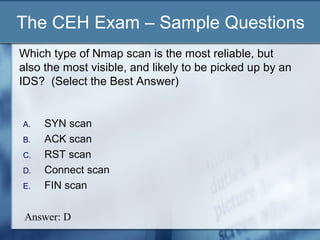
Which type of Nmap scan is the most reliable, but
also the most visible, and likely to be picked up by an
IDS? (Select the Best Answer)


A.   SYN scan
B.   ACK scan
C.   RST scan
D.   Connect scan
E.   FIN scan

 Answer: D
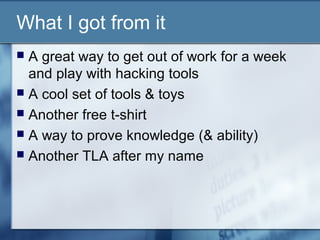
What I got from it
 A great way to get out of work for a week
  and play with hacking tools
 A cool set of tools & toys
 Another free t-shirt
 A way to prove knowledge (& ability)
 Another TLA after my name
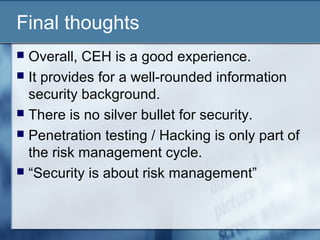
Final thoughts
 Overall, CEH is a good experience.
 It provides for a well-rounded information
  security background.
 There is no silver bullet for security.
 Penetration testing / Hacking is only part of
  the risk management cycle.
 “Security is about risk management”
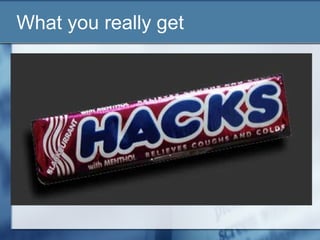
What you really get
Ron Woerner, CISSP, CEH
ron.woerner@conagrafoods.com

Super1

  • 1.
    Certified Ethical Hacking RonWoerner, CISSP, CEH
  • 2.
    Agenda  Is computerhacking necessary?  What is a Certified Ethical Hacker?  Is that an oxymoron?  What I learned  Cool stuff from the class  The Exam  Importance of certifications
  • 3.
    Two Questions  Why are you here?  Why am I here?
  • 4.
    Why you needto know Attacker needs to understand only one security issue Defender needs to secure all entry points Attacker has unlimited time Defenders vs. Defender works with time and Attackers cost constraints
  • 5.
    Why you needto know “If you know the enemy and know yourself, you need not fear the result of a hundred battles.” ––Sun Tzu, Art of War
  • 6.
  • 7.
    Understand this (1):  Hacking skills are good for the here and now;  Knowledge of Security Principles are needed for the hereafter;  Both are required to be an information security professional.
  • 8.
    Understand this (2):  “In a nutshell, security is now about risk management.”  Penetration / vulnerability testing is an element of the risk assessment.  It is critical to balance the risks based on business decisions  Degrees of separation  The building of multiple layers
  • 9.
    Understand this (3):  CEH Helps you  Identify risks, vulnerabilities, threats and weaknesses;  Determine monitoring needs and incident response;  Sell Security
  • 10.
  • 11.
    Certified Ethical Hacker “Ifyou want to stop hackers from invading your network, first you’ve got to invade their minds.”  Ethical Hacking & Countermeasures course  “Official” certification from EC-Council ( http://www.eccouncil.org)
  • 12.
  • 13.
    Can Hacking beEthical (and can you really be certified in it)? IT DEPENDS
  • 14.
    Can Hacking beEthical (and can you really be certified in it)?  The noun ‘hacker’ refers to a person who enjoys learning the details of computer systems and stretch their capabilities.  The verb ‘hacking’ describes the rapid development of new programs or the reverse engineering of already existing software to make the code better, and efficient (and more secure).  The term ‘cracker’ refers to a person who uses his hacking skills for offensive (malicious) purposes.  The term ‘ethical hacker’ refers to security professionals who apply their hacking skills for defensive purposes.
  • 15.
    EC-Council Code ofEthics EC-Council Code of Ethics In other words, don’t be stupid.
  • 16.
    Ethical Hacking  Ethical hackers try to answer:  What can the intruder see on the target system? (Reconnaissance and Scanning phase of hacking)  What can an intruder do with that information? (Gaining Access and Maintaining Access phases)  Does anyone at the target notice the intruders attempts or success? (Reconnaissance and Covering Tracks phases)  If hired by any organization, an ethical hacker asks the organization what it is trying to protect, against whom and what resources it is willing to expend in order to gain protection.
  • 17.
    Hacking 101 1. Reconnaissance (legal) 1. Active / passive 2. Scanning (legal?) 3. Gaining access (illegal) 1. Network level 2. O.S. level 3. Application level 4. Maintaining / Escalating access (illegal) 5. Covering Tracks (illegal)
  • 18.
    Class Modules 1. Legality 1. Web App Vulnerabilities 2. Footprinting 2. Web-based password 3. Scanning cracking 4. Enumeration 3. SQL injection 5. System Hacking 4. Hacking Wireless Nets 6. Trojans & Backdoors 5. Virus 7. Sniffers 6. Physical Security 8. Denial of Service 7. Linux Hacking 9. Social Engineering 8. Evading IDS, etc. 10. Session Hacking 9. Buffer Overflows 11. Hacking Web Servers 10. Cryptography 11. Pen Test Methodologies
  • 19.
    Footprinting  Web tools  www.samspade.org  www.dnsstuff.com  www.netcraft.com  Web site archives: www.archive.org (wayback machine)  People Search: www.intellius.com  Tools  Whois (www.networksolutions.com) (Free)  Nslookup (Free)  ARIN (http://www.arin.net/whois) (Free)  Traceroute (Free)  Visual Route (http://www.visualroute.com/) ($$)  SmartWhois (www.tamos.com) ($$)
  • 20.
    Scanning – Port& Ping  NMap / NMapWin (Free)  HPing2 (UNIX) (http://www.hping.org/) (Free)  Superscan (Free)  Firewalk (UNIX) (http://www.packetfactory.net/firewalk/) (Free)  WPSweep (http://ntsecurity.nu/toolbox/ipsecscan/) (Free)  IPSec Scan (http://ntsecurity.nu/toolbox/ipsecscan/) (Free)  Cheops (UNIX) (http://cheops-ng.sourceforge.net/) (Free)  NetScan Tools Pro (www.netscantools.com) ($$)
  • 21.
    Scanning – Vulnerability  NESSUS (UNIX) (www.nessus.org) (Free)  GFI LANGuard (www.gfi.com/downloads) ($$)  Retina (http://www.eeye.com/retina) ($$)  SAINT (UNIX) (www.saintcorporation.com/saint/) ($$)  ISS Security Scanner (www.iss.net) ($$)  SATAN (UNIX) (Free)  Nikto web scanner (http:// www.cirt.net/code/nikto.shtml) (Free)
  • 22.
    Enumeration  DumpSec (www.systemtools.com/somarsoft) (Free)  Winfo (http://ntsecurity.nu/toolbox/winfo/) (Free)  Enum (http://www.bindview.com /services/razor/utilities/) (Free)  GetAcct (www.securityfriday.com)  SolarWinds (www.solarwinds.net/) ($$)  Winfingerprint (winfingerprint.sourceforge.net/) (Free)  NetBIOS Auditing Tool – NAT () (Free)
  • 23.
    System Hacking  Cracking Passwords  Smbbf – SMB Bruteforcer (Free)  L0phtcrack ($$)  RainbowCrack (http://www.rainbowcrack.com/) (Free)  KerbCrack (http://www.ntsecurity.nu/toolbox/kerbcrack/) (Free)  Legion (Free)  John the Ripper (http://www.openwall.com/john/) (Free)  Cain & Abel (www.oxid.it) (Free)  Executing Applications  Psexec (http://www.sysinternals.com/Utilities/PsTools.html) (Free)  Netcat (http://netcat.sourceforge.net/) (Free) (video)
  • 24.
    Web Hacking –Cracking Passwords  Cracking Passwords  Authforce (kapheine.hypa.net/authforce/) (Free)  Brutus (www.hoobie.net/brutus/) (Free)  WebCracker (Free)  PassList (Free)  SQL Injection  SQLScan (www.foundstone.com/resources/overview.htm) (Free) (video)  Manual techniques
  • 25.
    Web Application Hacking  Instant Source (www.blazingtool.com/) ($$)  Gnu Wget (www.gnu.org/software/wget/wget.html) (Free)  Websleuth (www.geocities.com/dzzie/sleuth/) ($$)  Black Widow (softbytelabs.com) ($$)  Burp Suite (portswigger.net/) (Free)  WebGoat (www.owasp.org) (Free)  WebScarab (www.owasp.org) (Free)
  • 26.
    Class Modules 1. Legality 1. Web App Vulnerabilities 2. Footprinting 2. Web-based password 3. Scanning cracking 4. Enumeration 3. SQL injection 5. System Hacking 4. Hacking Wireless Nets 6. Trojans & Backdoors 5. Virus 7. Sniffers 6. Physical Security 8. Denial of Service 7. Linux Hacking 9. Social Engineering 8. Evading IDS, etc. 10. Session Hacking 9. Buffer Overflows 11. Hacking Web Servers 10. Cryptography 11. Pen Test Methodologies Link to CEH Brochure
  • 27.
    The CEH Exam Theexamination tests you on security related concepts, hacking techniques and technology. You will be asked to decipher exploit codes, study log files, infer output and apply the knowledge acquired through the course. Exam length: 125 questions Time length: 3 hours Passing score: 70% Web-based Can be taken anytime No recertification necessary
  • 28.
    The CEH Exam– Sample Questions What is the essential difference between an “Ethical Hacker” and a “Cracker”? A. The ethical hacker does not use the same techniques or skills as a cracker. B. The ethical hacker does it strictly for financial motives unlike a cracker. C. The ethical hacker has authorization from the owner of the target. D. The ethical hacker is just a cracker who is getting paid. Answer: C
  • 29.
    The CEH Exam– Sample Questions This tool is a a file and directory integrity checker. It aids system administrators in monitoring a designated set of files for any changes. A. NMap B. Integricheck C. DSniff D. Cybercop Scanner E. Tripwire Answer: E
  • 30.
    The CEH Exam– Sample Questions Netcat is a simple network utility which reads and writes data across network connections, using TCP or UDP protocol. Which of the following command scans for open ports between [1 - 140]? (Select the Best Answer) A. nc -xx -q -w2 my-attacker-IP-address [1-140] B. nc -vv -z -w2 my-attacker-IP-address 1-140 C. nc my-attacker-IP-address (1,140) D. nc 140 my-attacker-IP-address -vv Answer: B
  • 31.
    The CEH Exam– Sample Questions Which type of Nmap scan is the most reliable, but also the most visible, and likely to be picked up by an IDS? (Select the Best Answer) A. SYN scan B. ACK scan C. RST scan D. Connect scan E. FIN scan Answer: D
  • 32.
    What I gotfrom it  A great way to get out of work for a week and play with hacking tools  A cool set of tools & toys  Another free t-shirt  A way to prove knowledge (& ability)  Another TLA after my name
  • 33.
    Final thoughts  Overall,CEH is a good experience.  It provides for a well-rounded information security background.  There is no silver bullet for security.  Penetration testing / Hacking is only part of the risk management cycle.  “Security is about risk management”
  • 34.
  • 35.
    Ron Woerner, CISSP,CEH ron.woerner@conagrafoods.com