Compiler Design-Phases Of
Compiler
Nazmul Hoque 161-15-7506
Deb Debashish 161-15-7510
Mohsin Sikdar 161-15-7499
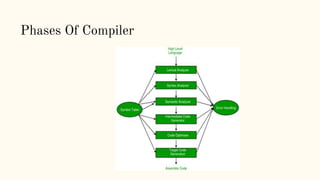
Phases Of Compiler
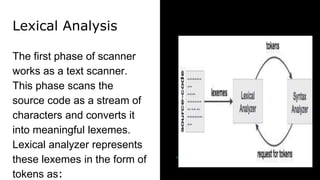
Lexical Analysis
The first phase of scanner
works as a text scanner.
This phase scans the
source code as a stream of
characters and converts it
into meaningful lexemes.
Lexical analyzer represents
these lexemes in the form of
tokens as:
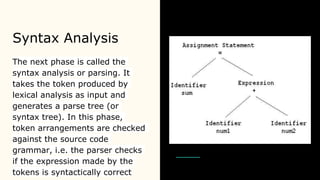
Syntax Analysis
The next phase is called the
syntax analysis or parsing. It
takes the token produced by
lexical analysis as input and
generates a parse tree (or
syntax tree). In this phase,
token arrangements are checked
against the source code
grammar, i.e. the parser checks
if the expression made by the
tokens is syntactically correct
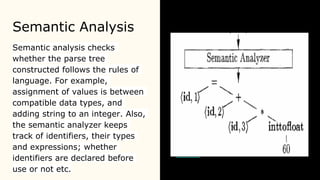
Semantic Analysis
Semantic analysis checks
whether the parse tree
constructed follows the rules of
language. For example,
assignment of values is between
compatible data types, and
adding string to an integer. Also,
the semantic analyzer keeps
track of identifiers, their types
and expressions; whether
identifiers are declared before
use or not etc.
Intermediate Code generator
Compiler Design. Intermediate Code Generation. In the
analysis-synthesis model of a compiler, the front end of
acompiler translates a source program into an
independentintermediate code, then the back end of the
compiler uses this intermediate code to generate the target
code (which can be understood by the machin
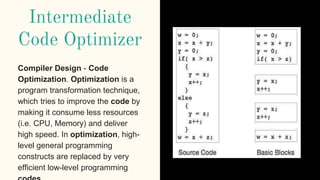
Intermediate
Code Optimizer
Compiler Design - Code
Optimization. Optimization is a
program transformation technique,
which tries to improve the code by
making it consume less resources
(i.e. CPU, Memory) and deliver
high speed. In optimization, high-
level general programming
constructs are replaced by very
efficient low-level programming
Target Code Generator
Code generation can be considered as the final phase of compilation. Through
post code generation, optimization process can be applied on the code, but that
can be seen as a part of code generation phase itself. The code generated by the
compiler is an object code of some lower-level programming language, for
example, assembly language. We have seen that the source code written in a
higher-level language is transformed into a lower-level language that results in a
lower-level object code, which should have the following minimum properties

Compiler design

  • 1.
    Compiler Design-Phases Of Compiler NazmulHoque 161-15-7506 Deb Debashish 161-15-7510 Mohsin Sikdar 161-15-7499
  • 2.
  • 3.
    Lexical Analysis The firstphase of scanner works as a text scanner. This phase scans the source code as a stream of characters and converts it into meaningful lexemes. Lexical analyzer represents these lexemes in the form of tokens as:
  • 4.
    Syntax Analysis The nextphase is called the syntax analysis or parsing. It takes the token produced by lexical analysis as input and generates a parse tree (or syntax tree). In this phase, token arrangements are checked against the source code grammar, i.e. the parser checks if the expression made by the tokens is syntactically correct
  • 5.
    Semantic Analysis Semantic analysischecks whether the parse tree constructed follows the rules of language. For example, assignment of values is between compatible data types, and adding string to an integer. Also, the semantic analyzer keeps track of identifiers, their types and expressions; whether identifiers are declared before use or not etc.
  • 6.
    Intermediate Code generator CompilerDesign. Intermediate Code Generation. In the analysis-synthesis model of a compiler, the front end of acompiler translates a source program into an independentintermediate code, then the back end of the compiler uses this intermediate code to generate the target code (which can be understood by the machin
  • 7.
    Intermediate Code Optimizer Compiler Design- Code Optimization. Optimization is a program transformation technique, which tries to improve the code by making it consume less resources (i.e. CPU, Memory) and deliver high speed. In optimization, high- level general programming constructs are replaced by very efficient low-level programming
  • 8.
    Target Code Generator Codegeneration can be considered as the final phase of compilation. Through post code generation, optimization process can be applied on the code, but that can be seen as a part of code generation phase itself. The code generated by the compiler is an object code of some lower-level programming language, for example, assembly language. We have seen that the source code written in a higher-level language is transformed into a lower-level language that results in a lower-level object code, which should have the following minimum properties