CSPC-COMPUTER SYSTEMS
PROGRAMMING IN ‘C’
ANKUR SRIVASTAVA
DEPARTMENT OF COMPUTER SCIENCE
08/11/18ANKUR SRIVASTAVA ASSISTANT PROFESSOR JETGI
1
ARRAYS: ARRAY NOTATION AND REPRESENTATION,
MANIPULATING ARRAY ELEMENTS, USING MULTI-
DIMENSIONAL ARRAYS.
STRUCTURE, UNION, ENUMERATED DATA TYPES.
UNIT-4 TOPICS
08/11/18ANKUR SRIVASTAVA ASSISTANT PROFESSOR JETGI
2
UNIT-4 ARRAYS
 An arrayarray is a named collection of homogeneous items in which
individual items are accessed by their place within the collection.
 An arrayarray is a collection of variables of the same type that are referred
to by a common name.
Eg.
 product part numbers:
int part numbers[] = {123, 326, 178, 1209};
 student scores:
int scores[10] = {1, 3, 4, 5, 1, 3, 2, 3, 4, 4};
 characters:
char alphabet[5] = {’A’, ’B’, ’C’, ’D’, ’E’};
08/11/18ANKUR SRIVASTAVA ASSISTANT PROFESSOR JETGI
3
INITIALIZATION OF ARRAY
 Array – a set of elements all of the same type stored contiguously
in memory – e.g.,
 int A[25]; // 25 integers
 struct Str B[15]; /* 15 objects of
type struct Str */
 double C[]; /* indeterminate #
of doubles */
08/11/18ANKUR SRIVASTAVA ASSISTANT PROFESSOR JETGI
4
ARRAY NOTATION
08/11/18ANKUR SRIVASTAVA ASSISTANT PROFESSOR JETGI
5
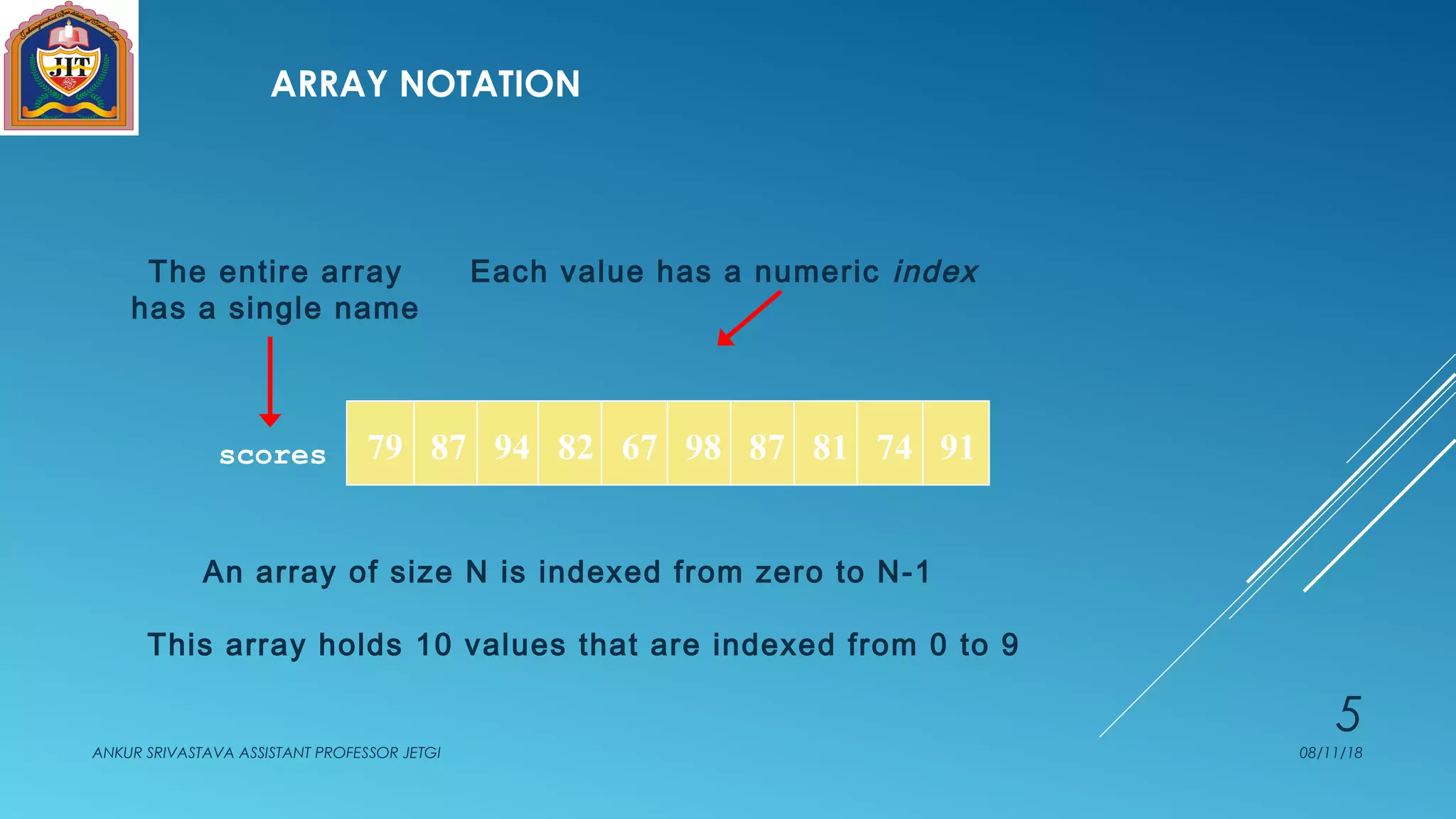
An array of size N is indexed from zero to N-1
79 87 94 82 67 98 87 81 74 91scores
The entire array
has a single name
Each value has a numeric index
This array holds 10 values that are indexed from 0 to 9
MANIPULATING ARRAY ELEMENTS
 Some other examples of array declarations:
float[] prices = new float[500];
boolean[] flags;
flags = new boolean[20];
char[] codes = new char[1750];
08/11/18ANKUR SRIVASTAVA ASSISTANT PROFESSOR JETGI
6
2D ARRAY
08/11/18ANKUR SRIVASTAVA ASSISTANT PROFESSOR JETGI
7
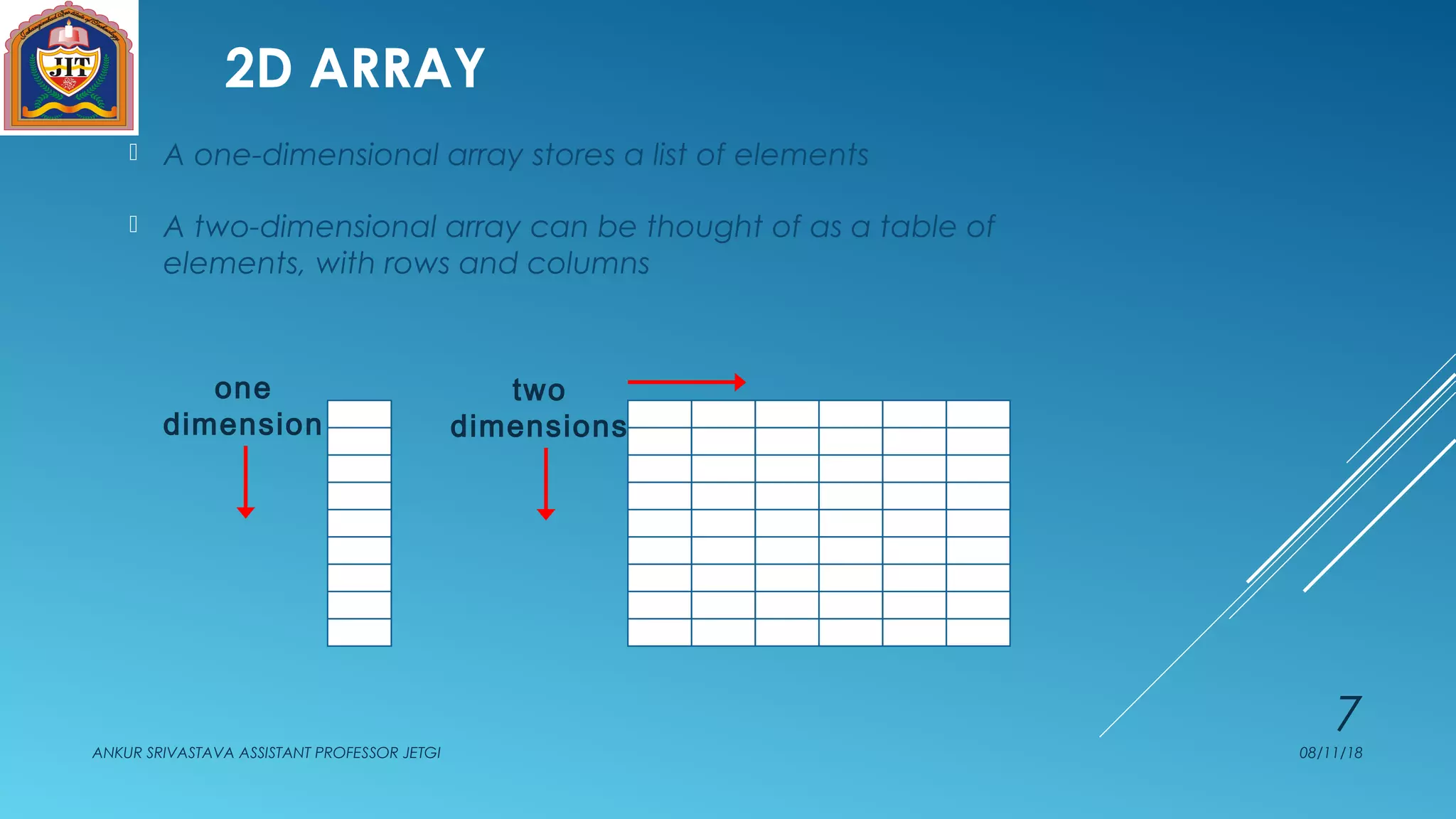
 A one-dimensional array stores a list of elements
 A two-dimensional array can be thought of as a table of
elements, with rows and columns
one
dimension
two
dimensions
3D ARRAY
08/11/18ANKUR SRIVASTAVA ASSISTANT PROFESSOR JETGI
8
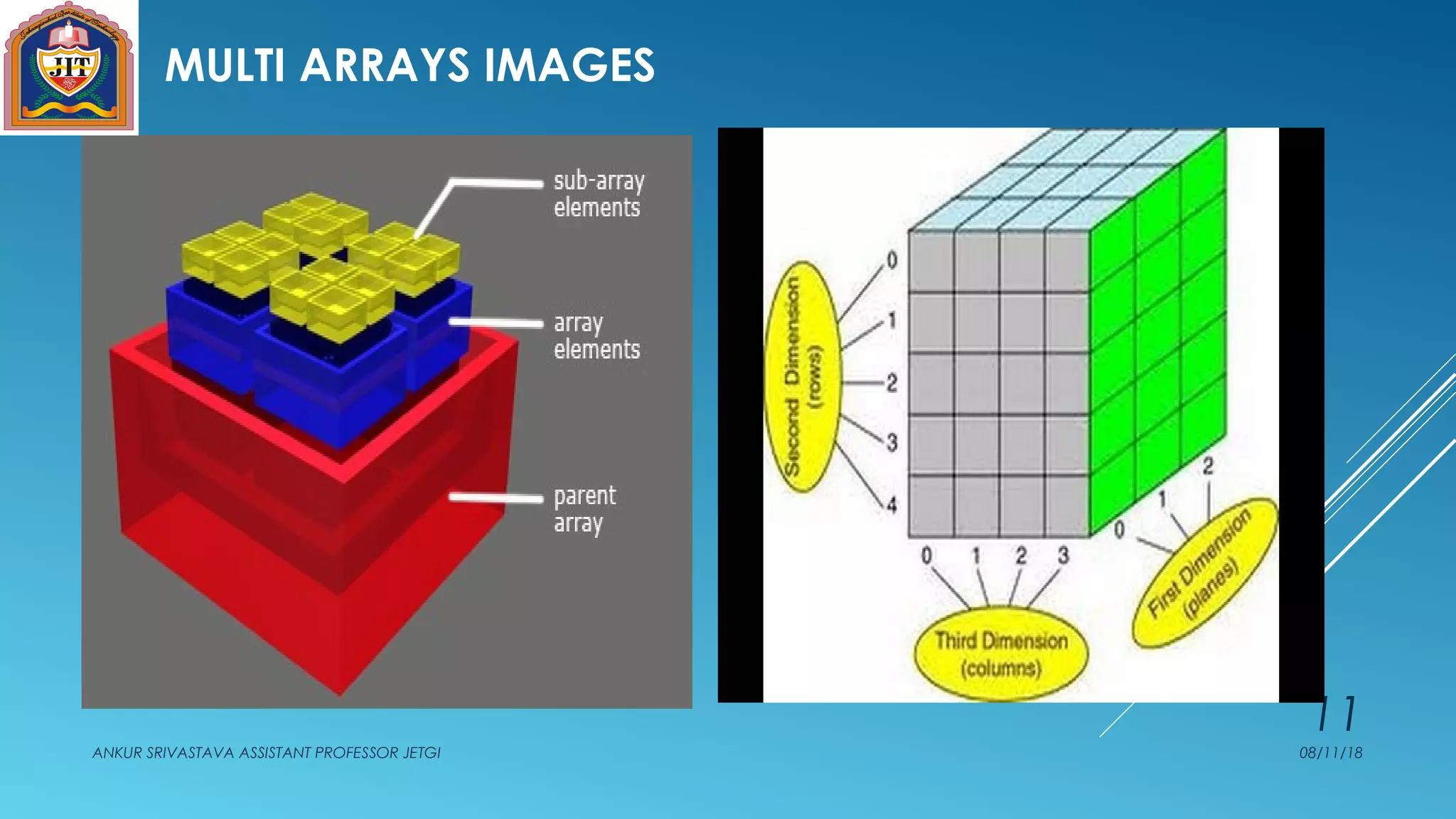
An array can be declared with multiple dimensions.
2 Dimensional 3 Dimensional
Multiple dimensions get difficult to visualize graphically.
•
int [][][] table3 = { { {1,2}, {3,4} },
{ {5,6,7} , {8}, {9,10}
}
};
USING MULTI-DIMENSIONAL ARRAYS
 An array can have many dimensions – if it has more than one
dimension, it is called a multidimensional array
 Each dimension subdivides the previous one into the specified
number of elements
 Each dimension has its own length constant
 Because each dimension is an array of array references, the
arrays within one dimension can be of different lengths
 these are sometimes called ragged arrays
08/11/18ANKUR SRIVASTAVA ASSISTANT PROFESSOR JETGI
9
MULTIDIMENSIONAL ARRAY
 Arrays with more than one index
 number of dimensions = number of indexes
 Arrays with more than two dimensions are a simple extension of
two-dimensional (2-D) arrays
 A 2-D array corresponds to a table or grid
 one dimension is the row
 the other dimension is the column
 cell: an intersection of a row and column
 an array element corresponds to a cell in the table
08/11/18ANKUR SRIVASTAVA ASSISTANT PROFESSOR JETGI
10
MULTI ARRAYS IMAGES
08/11/18ANKUR SRIVASTAVA ASSISTANT PROFESSOR JETGI
11
STRUCTURE:
 A structure is a collection of one or more components (members).
 Structures are called records in many other programming languages.
 Members are known as fields.
Declaring a structure:-
struct {
char name[25];
int id, age;
char sex;
} s1, s2;
08/11/18ANKUR SRIVASTAVA ASSISTANT PROFESSOR JETGI
12
INITIALIZING A STRUCTURE:-
struct {
char name[25];
int id, age;
char sex;
}
s1 = { "Smith, John", 2813, 25, 'M'},
s 2 = { "Smith, Mary", 4692, 23, 'F'};
08/11/18ANKUR SRIVASTAVA ASSISTANT PROFESSOR JETGI
13
ACCESSING THE MEMBERS OF A STRUCTURE:
 The members of a structure are accessed by writing first the name
of the structure, then a period, then the name of the member:
struct student {
char name[25];
int id, age;
char sex;
} s;
strcpy(s.name, "Doe, John");
s.id = 18193;
s.age = 18;
s.sex = 'M';
08/11/18ANKUR SRIVASTAVA ASSISTANT PROFESSOR JETGI
14
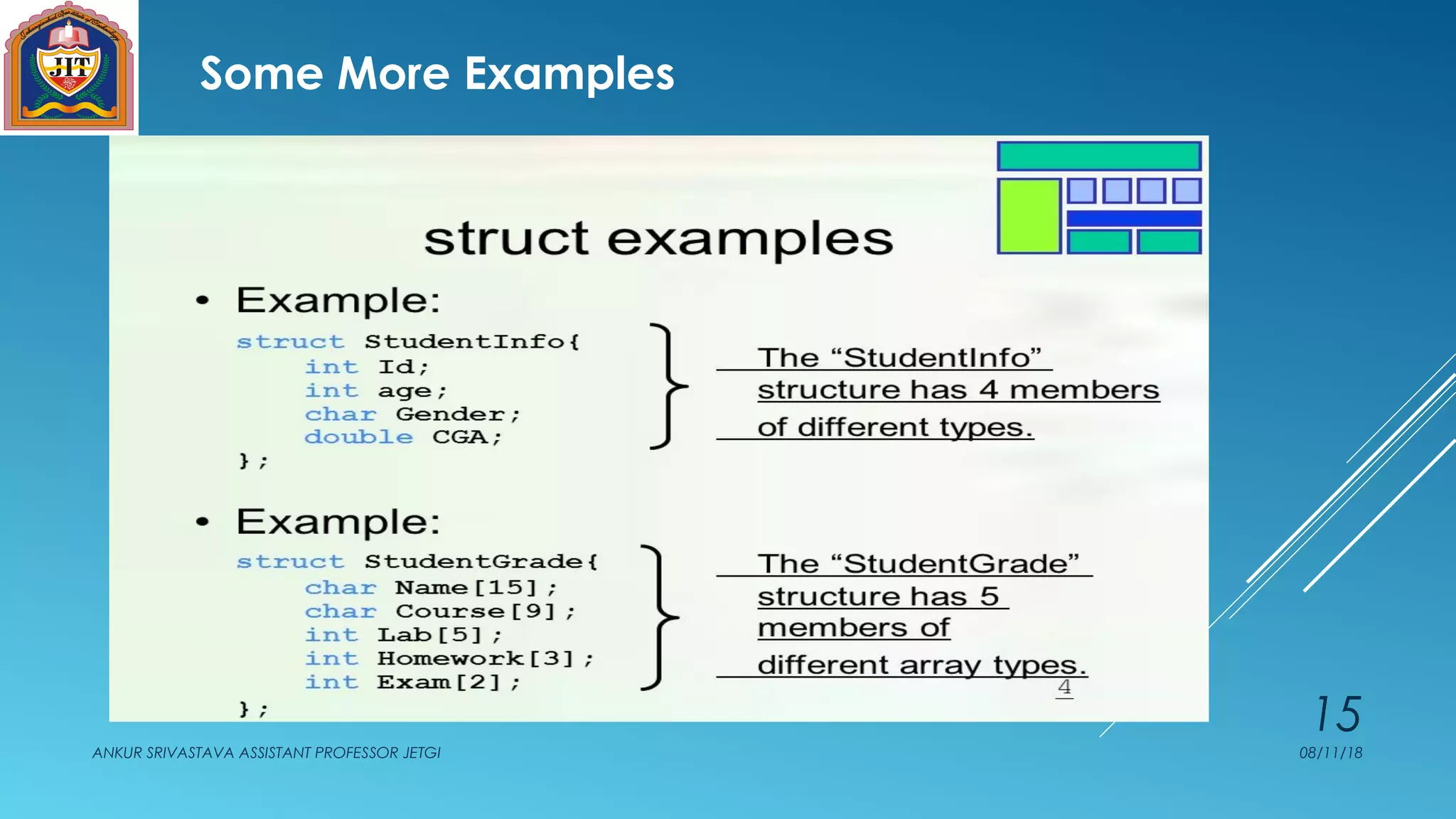
Some More Examples
08/11/18ANKUR SRIVASTAVA ASSISTANT PROFESSOR JETGI
15
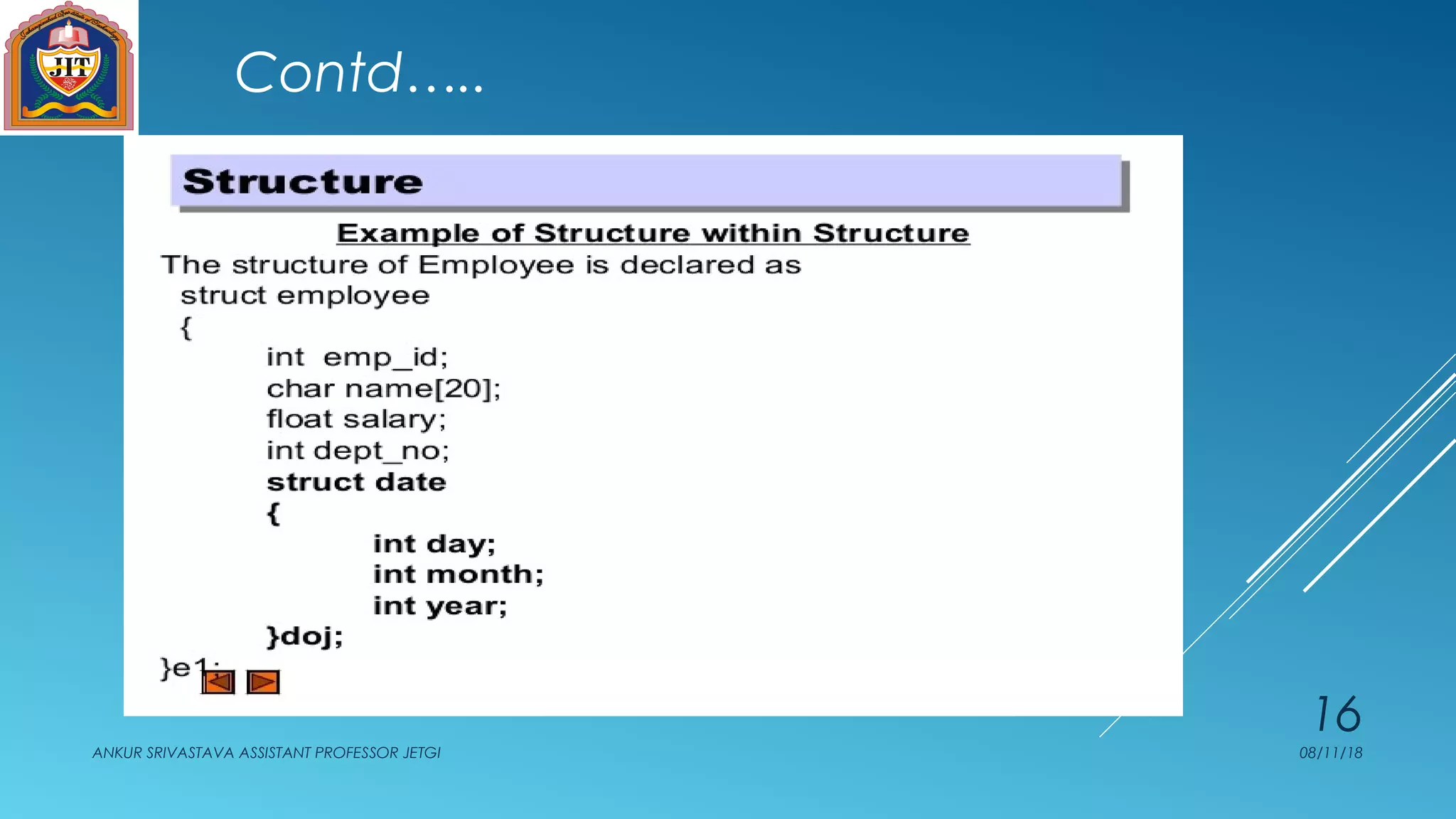
Contd…..
08/11/18ANKUR SRIVASTAVA ASSISTANT PROFESSOR JETGI
16
INITIALIZATION OF STRUCTURE ARRAYS
 Structure arrays are initialized by enclosing the list of values of its
elements within a pair of braces.
 Example:
struct unit
{ char ch ;
int i ;
} ;
struct unit series [3]=
{ (‘a’, 100) (‘b’, 200) (‘c’, 400)
};
08/11/18ANKUR SRIVASTAVA ASSISTANT PROFESSOR JETGI
17
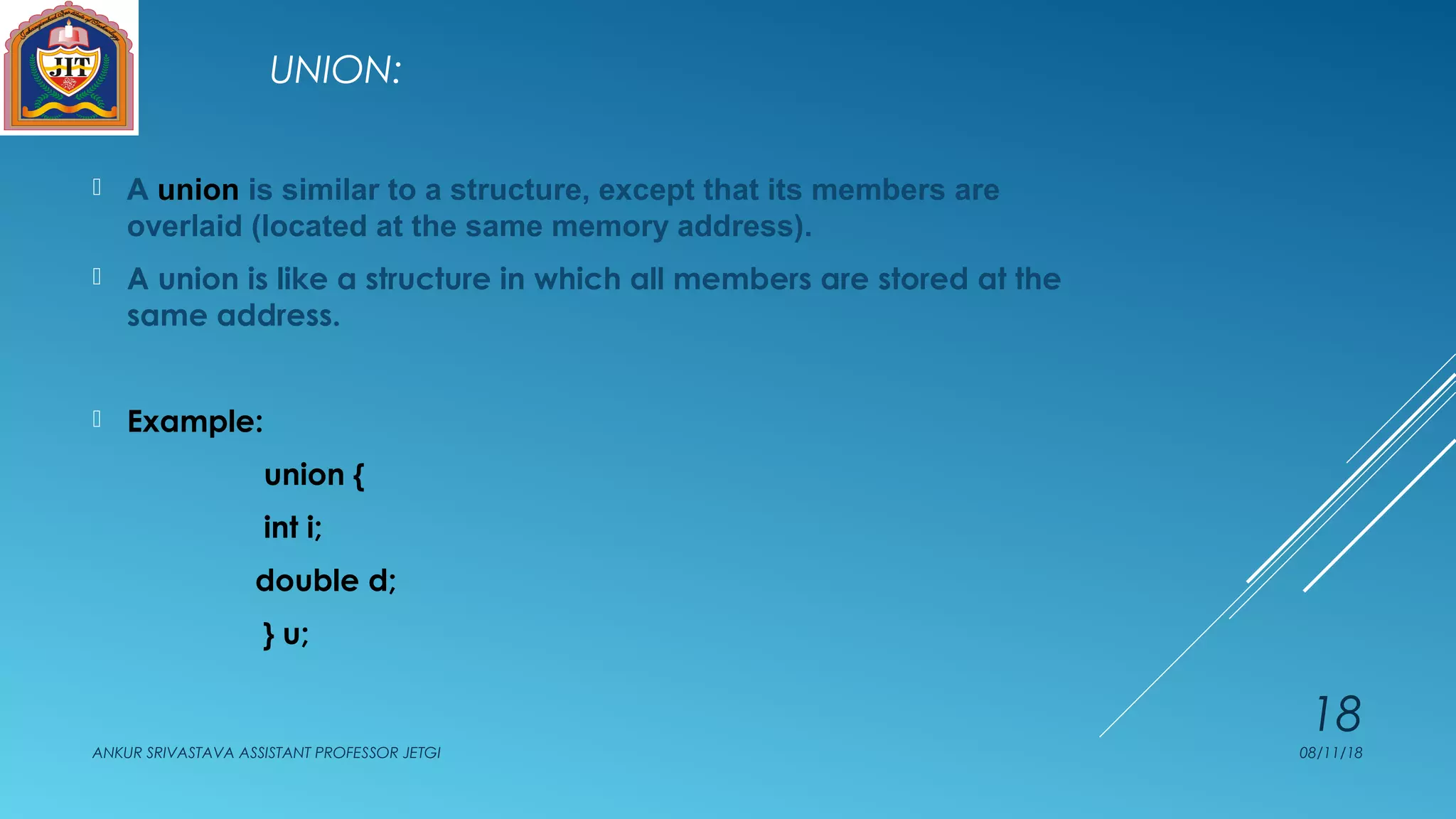
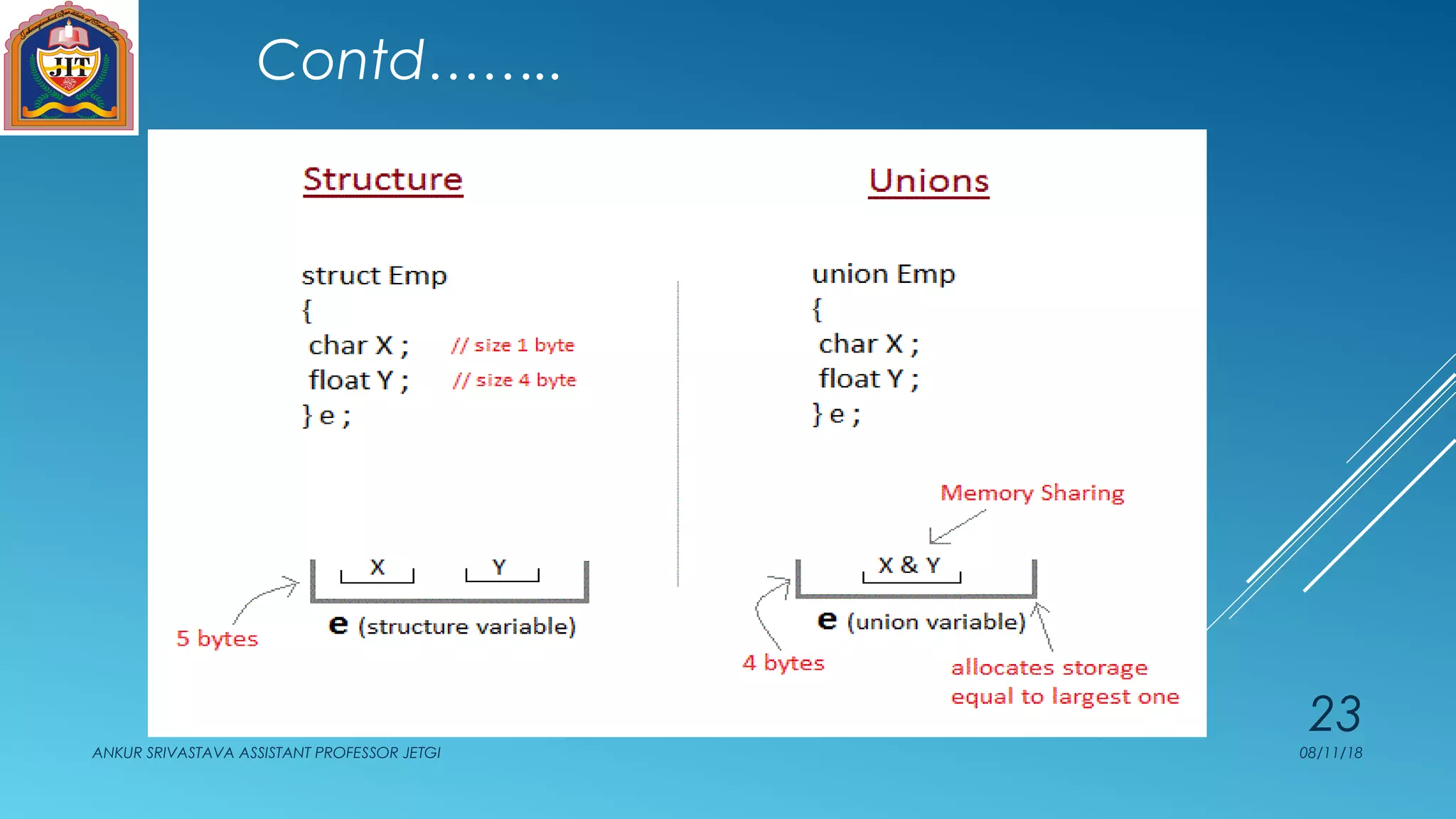
UNION:
 A union is similar to a structure, except that its members are
overlaid (located at the same memory address).
 A union is like a structure in which all members are stored at the
same address.
 Example:
union {
int i;
double d;
} u;
08/11/18ANKUR SRIVASTAVA ASSISTANT PROFESSOR JETGI
18
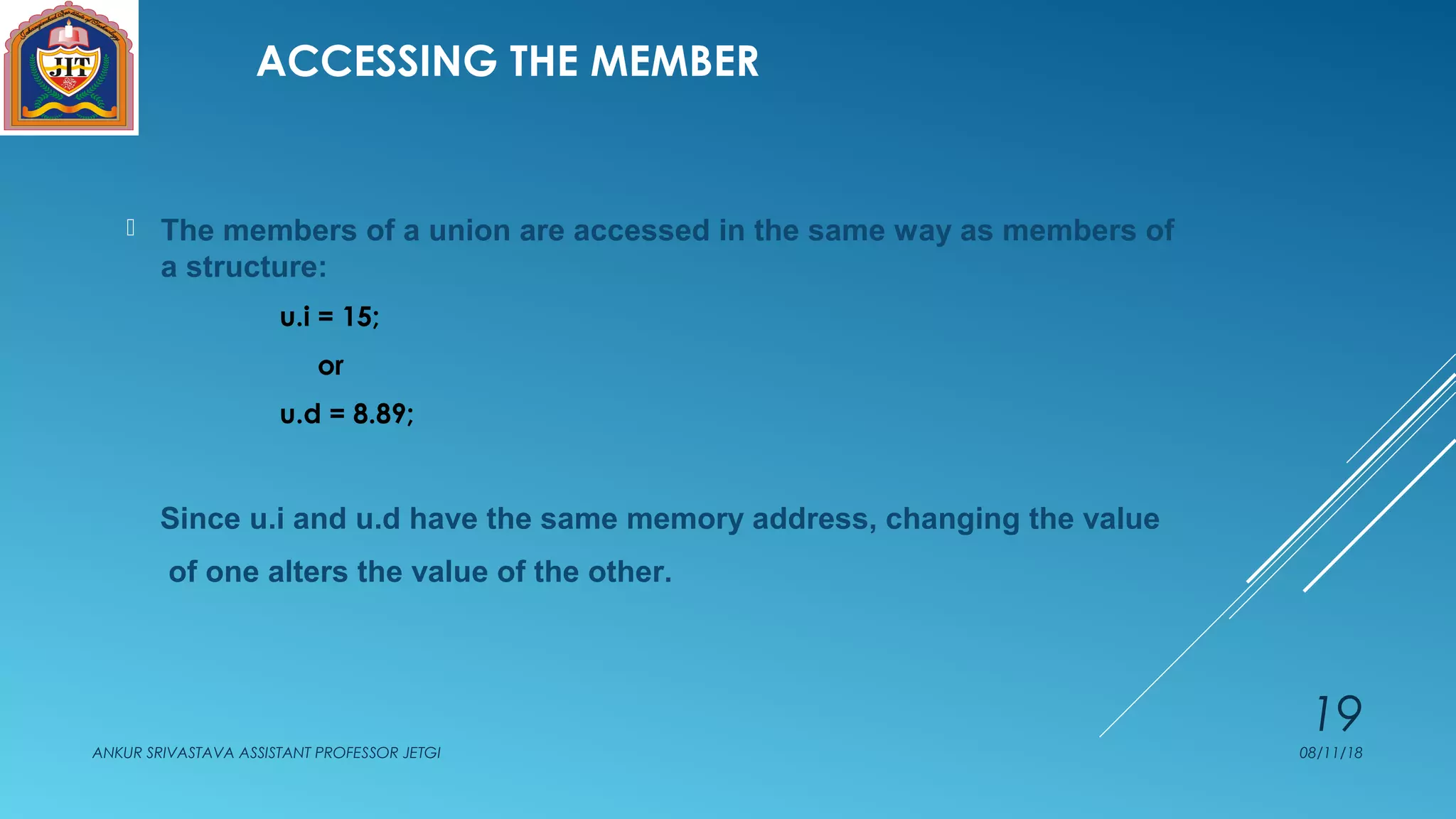
ACCESSING THE MEMBER
 The members of a union are accessed in the same way as members of
a structure:
u.i = 15;
or
u.d = 8.89;
Since u.i and u.d have the same memory address, changing the value
of one alters the value of the other.
08/11/18ANKUR SRIVASTAVA ASSISTANT PROFESSOR JETGI
19
Difference Between Structure & Union
08/11/18ANKUR SRIVASTAVA ASSISTANT PROFESSOR JETGI
20
// declaring structure
struct struct_example
{
int integer;
float decimal;
char name[20];
};
// declaring union  
union union_example
{
    int integer;
    float decimal;
    char name[20];
};
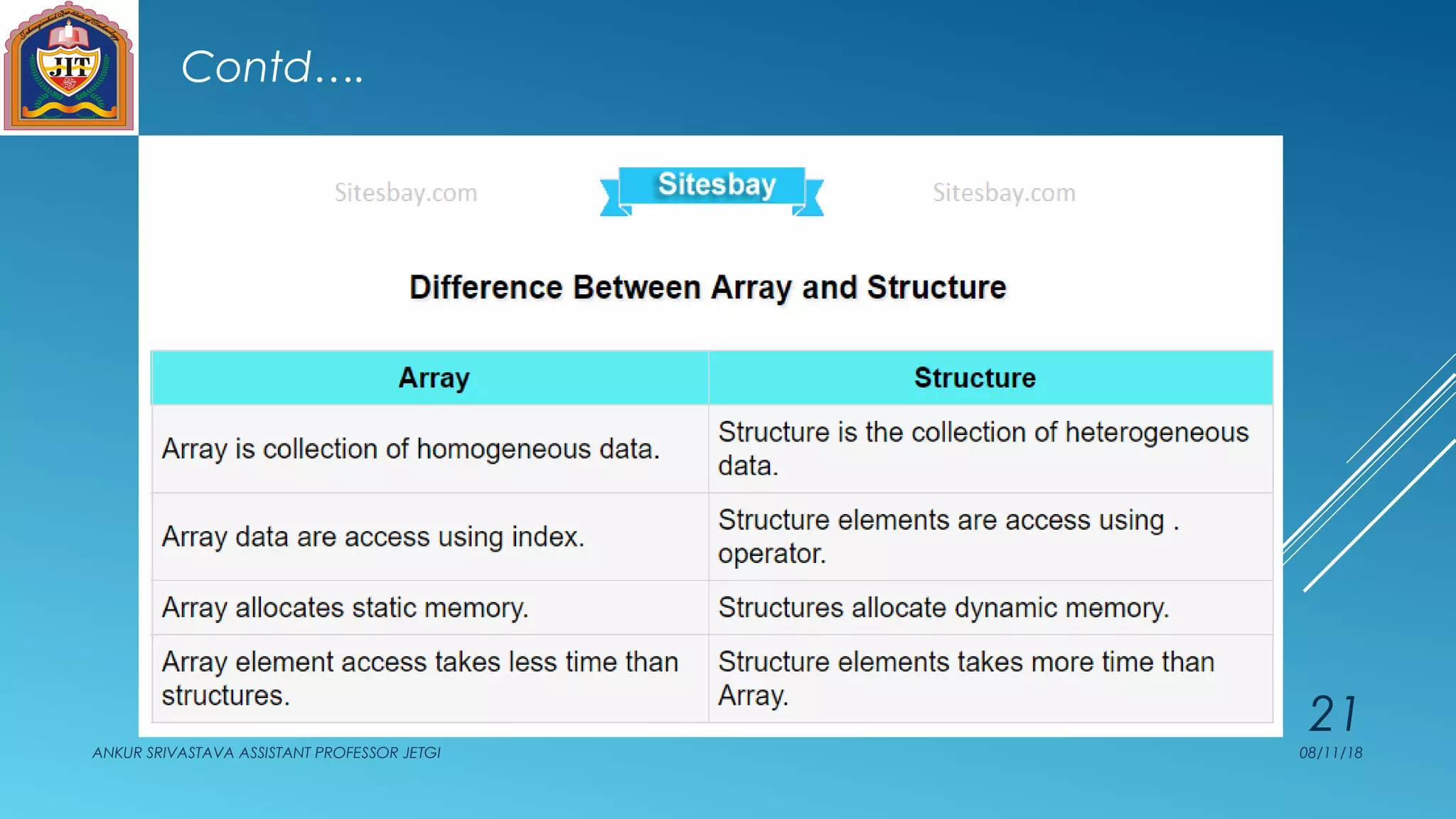
Contd….
08/11/18ANKUR SRIVASTAVA ASSISTANT PROFESSOR JETGI
21
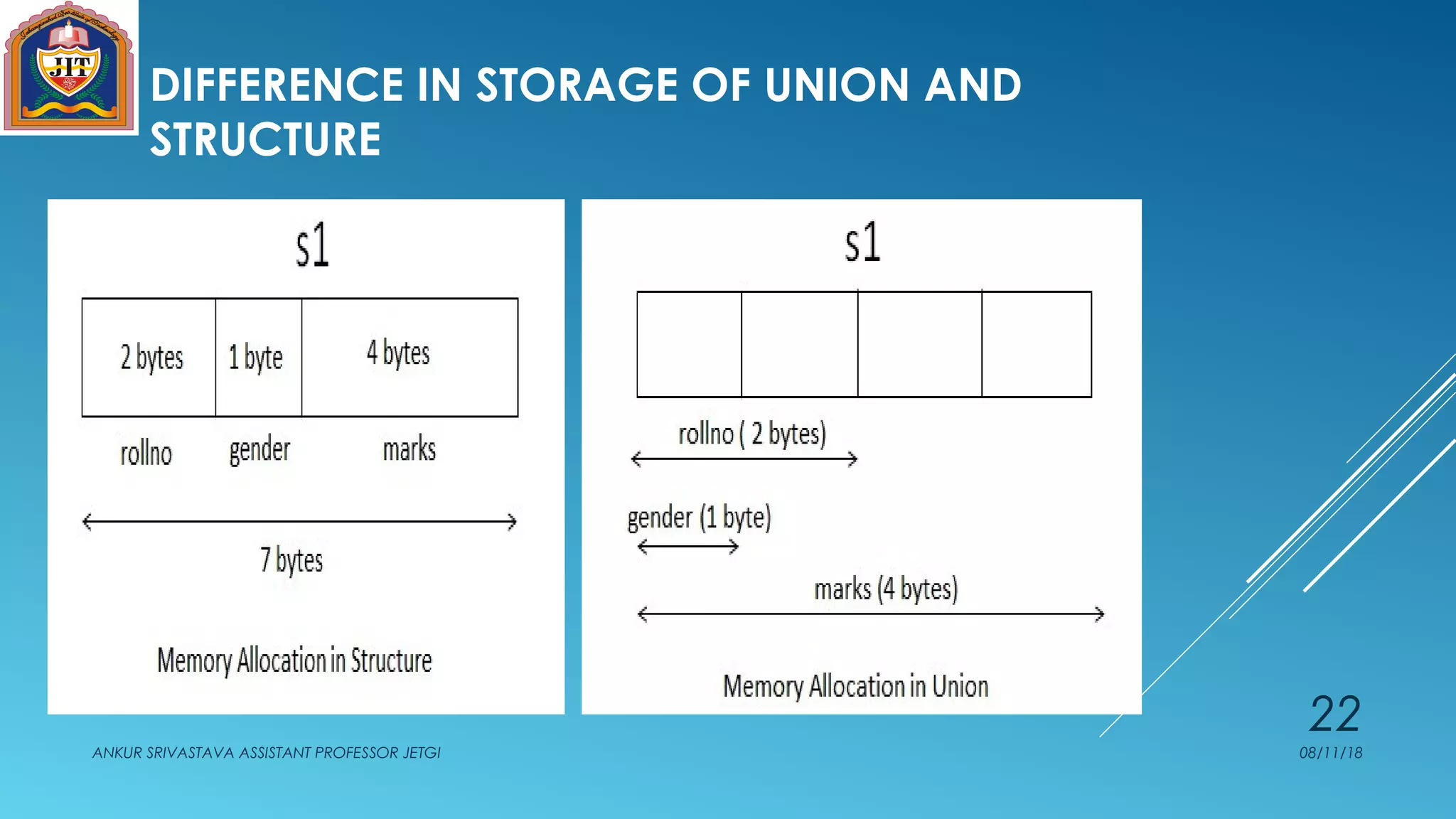
DIFFERENCE IN STORAGE OF UNION AND
STRUCTURE
08/11/18ANKUR SRIVASTAVA ASSISTANT PROFESSOR JETGI
22
Contd……..
08/11/18ANKUR SRIVASTAVA ASSISTANT PROFESSOR JETGI
23
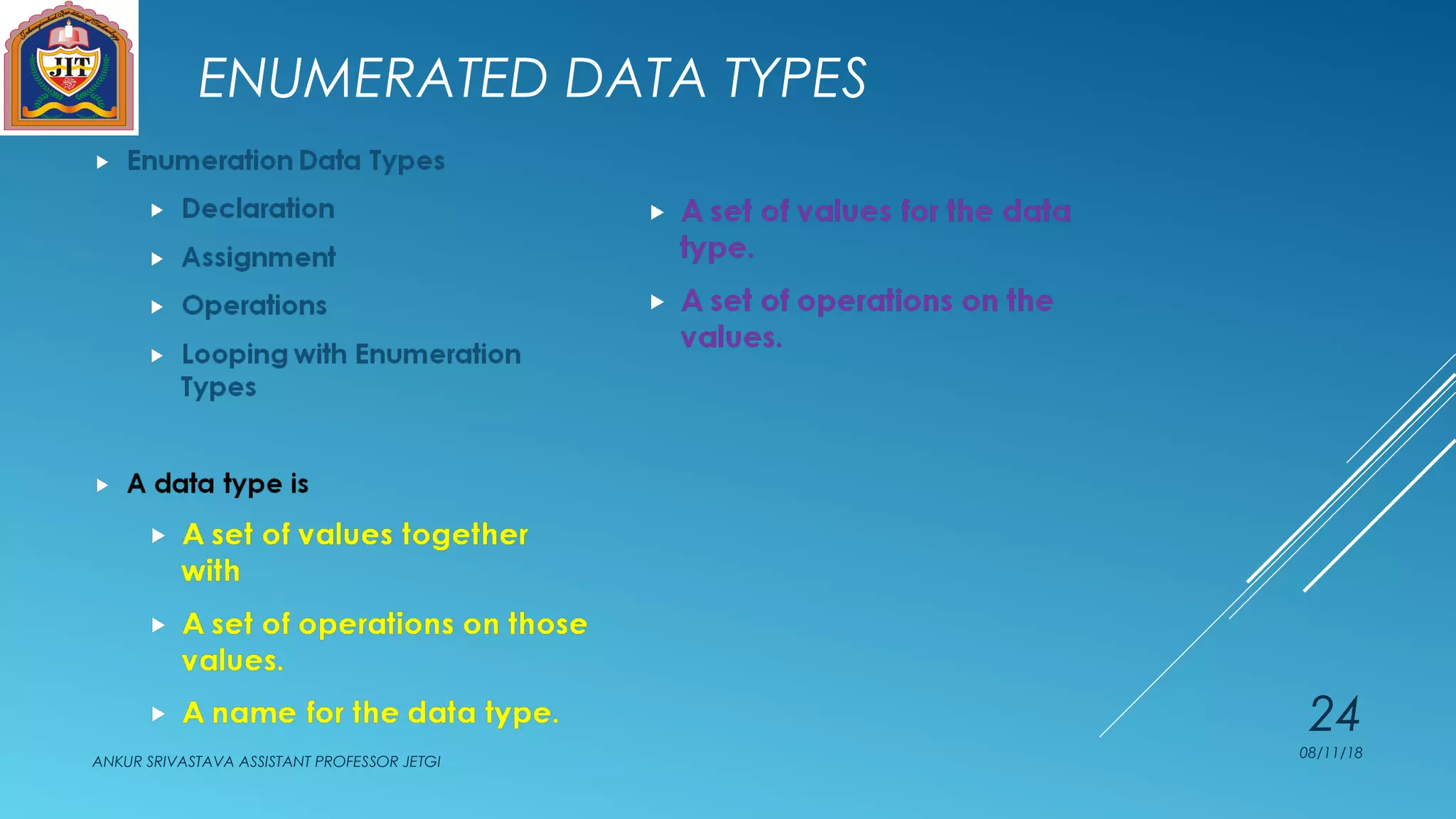
ENUMERATED DATA TYPES
08/11/18
ANKUR SRIVASTAVA ASSISTANT PROFESSOR JETGI
24
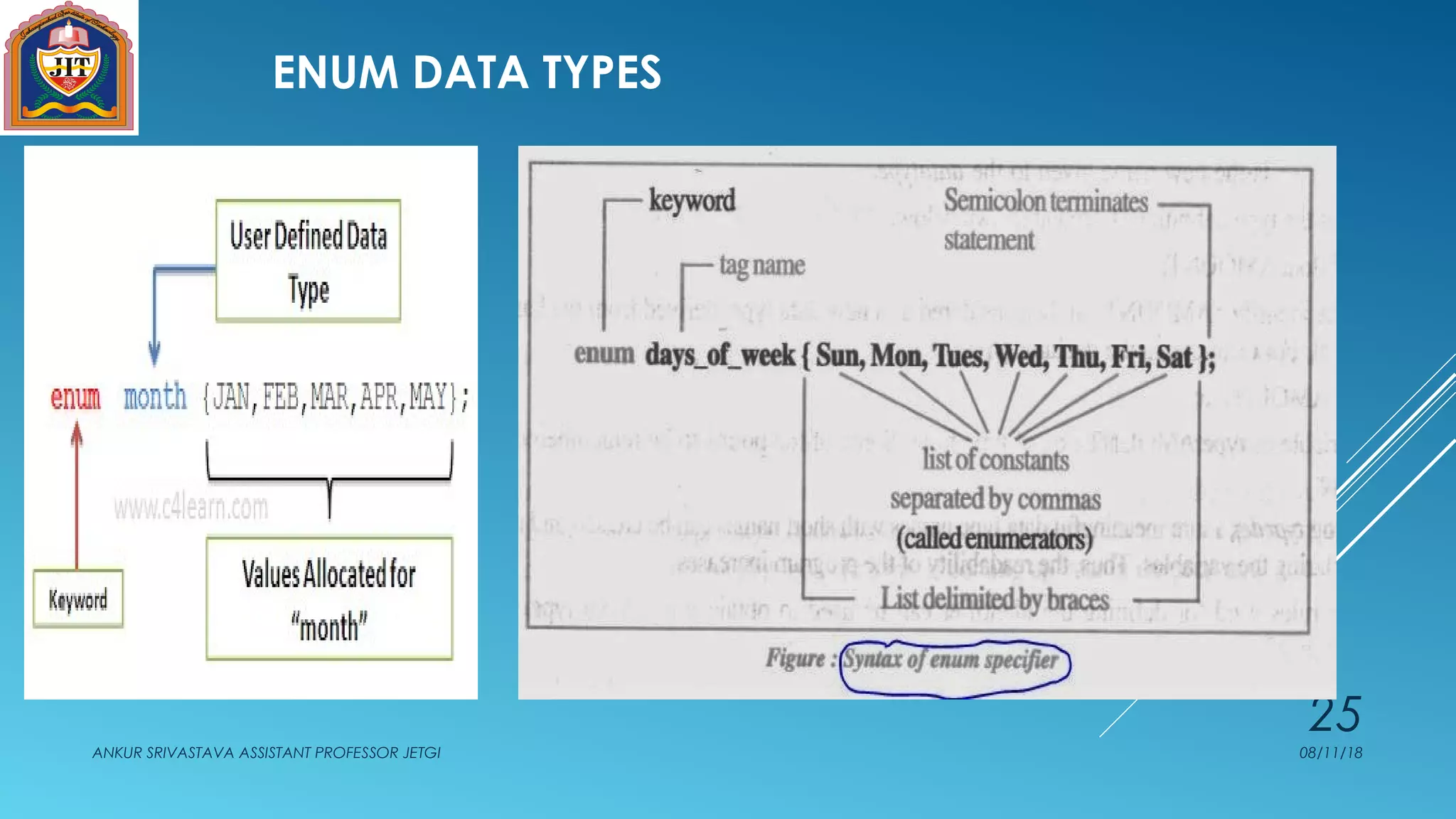
ENUM DATA TYPES
08/11/18ANKUR SRIVASTAVA ASSISTANT PROFESSOR JETGI
25

Unit 4 cspc

  • 1.
    CSPC-COMPUTER SYSTEMS PROGRAMMING IN‘C’ ANKUR SRIVASTAVA DEPARTMENT OF COMPUTER SCIENCE 08/11/18ANKUR SRIVASTAVA ASSISTANT PROFESSOR JETGI 1
  • 2.
    ARRAYS: ARRAY NOTATIONAND REPRESENTATION, MANIPULATING ARRAY ELEMENTS, USING MULTI- DIMENSIONAL ARRAYS. STRUCTURE, UNION, ENUMERATED DATA TYPES. UNIT-4 TOPICS 08/11/18ANKUR SRIVASTAVA ASSISTANT PROFESSOR JETGI 2
  • 3.
    UNIT-4 ARRAYS  Anarrayarray is a named collection of homogeneous items in which individual items are accessed by their place within the collection.  An arrayarray is a collection of variables of the same type that are referred to by a common name. Eg.  product part numbers: int part numbers[] = {123, 326, 178, 1209};  student scores: int scores[10] = {1, 3, 4, 5, 1, 3, 2, 3, 4, 4};  characters: char alphabet[5] = {’A’, ’B’, ’C’, ’D’, ’E’}; 08/11/18ANKUR SRIVASTAVA ASSISTANT PROFESSOR JETGI 3
  • 4.
    INITIALIZATION OF ARRAY Array – a set of elements all of the same type stored contiguously in memory – e.g.,  int A[25]; // 25 integers  struct Str B[15]; /* 15 objects of type struct Str */  double C[]; /* indeterminate # of doubles */ 08/11/18ANKUR SRIVASTAVA ASSISTANT PROFESSOR JETGI 4
  • 5.
    ARRAY NOTATION 08/11/18ANKUR SRIVASTAVAASSISTANT PROFESSOR JETGI 5 An array of size N is indexed from zero to N-1 79 87 94 82 67 98 87 81 74 91scores The entire array has a single name Each value has a numeric index This array holds 10 values that are indexed from 0 to 9
  • 6.
    MANIPULATING ARRAY ELEMENTS Some other examples of array declarations: float[] prices = new float[500]; boolean[] flags; flags = new boolean[20]; char[] codes = new char[1750]; 08/11/18ANKUR SRIVASTAVA ASSISTANT PROFESSOR JETGI 6
  • 7.
    2D ARRAY 08/11/18ANKUR SRIVASTAVAASSISTANT PROFESSOR JETGI 7  A one-dimensional array stores a list of elements  A two-dimensional array can be thought of as a table of elements, with rows and columns one dimension two dimensions
  • 8.
    3D ARRAY 08/11/18ANKUR SRIVASTAVAASSISTANT PROFESSOR JETGI 8 An array can be declared with multiple dimensions. 2 Dimensional 3 Dimensional Multiple dimensions get difficult to visualize graphically. • int [][][] table3 = { { {1,2}, {3,4} }, { {5,6,7} , {8}, {9,10} } };
  • 9.
    USING MULTI-DIMENSIONAL ARRAYS An array can have many dimensions – if it has more than one dimension, it is called a multidimensional array  Each dimension subdivides the previous one into the specified number of elements  Each dimension has its own length constant  Because each dimension is an array of array references, the arrays within one dimension can be of different lengths  these are sometimes called ragged arrays 08/11/18ANKUR SRIVASTAVA ASSISTANT PROFESSOR JETGI 9
  • 10.
    MULTIDIMENSIONAL ARRAY  Arrayswith more than one index  number of dimensions = number of indexes  Arrays with more than two dimensions are a simple extension of two-dimensional (2-D) arrays  A 2-D array corresponds to a table or grid  one dimension is the row  the other dimension is the column  cell: an intersection of a row and column  an array element corresponds to a cell in the table 08/11/18ANKUR SRIVASTAVA ASSISTANT PROFESSOR JETGI 10
  • 11.
    MULTI ARRAYS IMAGES 08/11/18ANKURSRIVASTAVA ASSISTANT PROFESSOR JETGI 11
  • 12.
    STRUCTURE:  A structureis a collection of one or more components (members).  Structures are called records in many other programming languages.  Members are known as fields. Declaring a structure:- struct { char name[25]; int id, age; char sex; } s1, s2; 08/11/18ANKUR SRIVASTAVA ASSISTANT PROFESSOR JETGI 12
  • 13.
    INITIALIZING A STRUCTURE:- struct{ char name[25]; int id, age; char sex; } s1 = { "Smith, John", 2813, 25, 'M'}, s 2 = { "Smith, Mary", 4692, 23, 'F'}; 08/11/18ANKUR SRIVASTAVA ASSISTANT PROFESSOR JETGI 13
  • 14.
    ACCESSING THE MEMBERSOF A STRUCTURE:  The members of a structure are accessed by writing first the name of the structure, then a period, then the name of the member: struct student { char name[25]; int id, age; char sex; } s; strcpy(s.name, "Doe, John"); s.id = 18193; s.age = 18; s.sex = 'M'; 08/11/18ANKUR SRIVASTAVA ASSISTANT PROFESSOR JETGI 14
  • 15.
    Some More Examples 08/11/18ANKURSRIVASTAVA ASSISTANT PROFESSOR JETGI 15
  • 16.
  • 17.
    INITIALIZATION OF STRUCTUREARRAYS  Structure arrays are initialized by enclosing the list of values of its elements within a pair of braces.  Example: struct unit { char ch ; int i ; } ; struct unit series [3]= { (‘a’, 100) (‘b’, 200) (‘c’, 400) }; 08/11/18ANKUR SRIVASTAVA ASSISTANT PROFESSOR JETGI 17
  • 18.
    UNION:  A unionis similar to a structure, except that its members are overlaid (located at the same memory address).  A union is like a structure in which all members are stored at the same address.  Example: union { int i; double d; } u; 08/11/18ANKUR SRIVASTAVA ASSISTANT PROFESSOR JETGI 18
  • 19.
    ACCESSING THE MEMBER The members of a union are accessed in the same way as members of a structure: u.i = 15; or u.d = 8.89; Since u.i and u.d have the same memory address, changing the value of one alters the value of the other. 08/11/18ANKUR SRIVASTAVA ASSISTANT PROFESSOR JETGI 19
  • 20.
    Difference Between Structure& Union 08/11/18ANKUR SRIVASTAVA ASSISTANT PROFESSOR JETGI 20 // declaring structure struct struct_example { int integer; float decimal; char name[20]; }; // declaring union   union union_example {     int integer;     float decimal;     char name[20]; };
  • 21.
  • 22.
    DIFFERENCE IN STORAGEOF UNION AND STRUCTURE 08/11/18ANKUR SRIVASTAVA ASSISTANT PROFESSOR JETGI 22
  • 23.
  • 24.
    ENUMERATED DATA TYPES 08/11/18 ANKURSRIVASTAVA ASSISTANT PROFESSOR JETGI 24
  • 25.
    ENUM DATA TYPES 08/11/18ANKURSRIVASTAVA ASSISTANT PROFESSOR JETGI 25