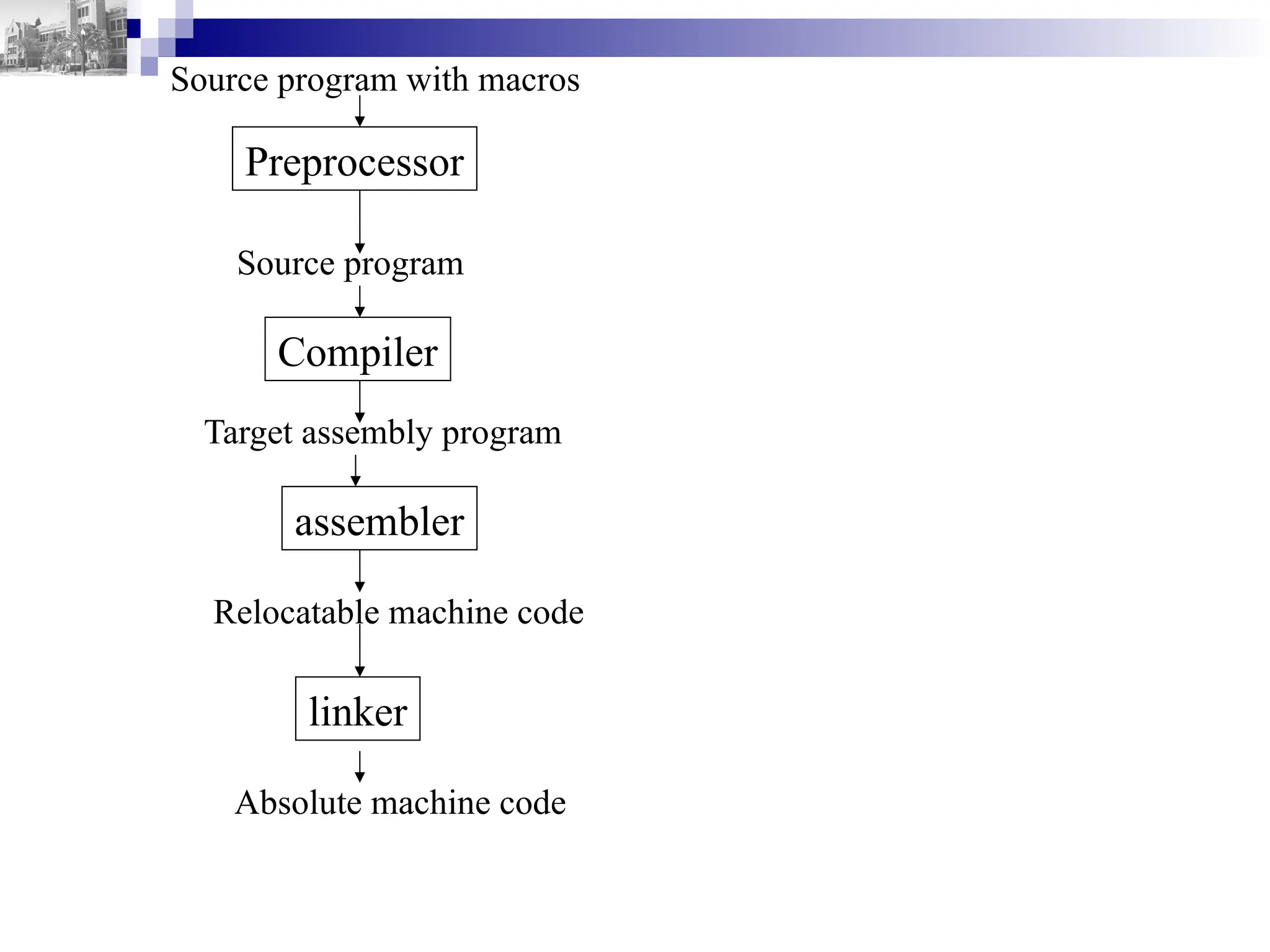
Source program withmacros
Preprocessor
Source program
Compiler
Target assembly program
assembler
Relocatable machine code
linker
Absolute machine code
4.
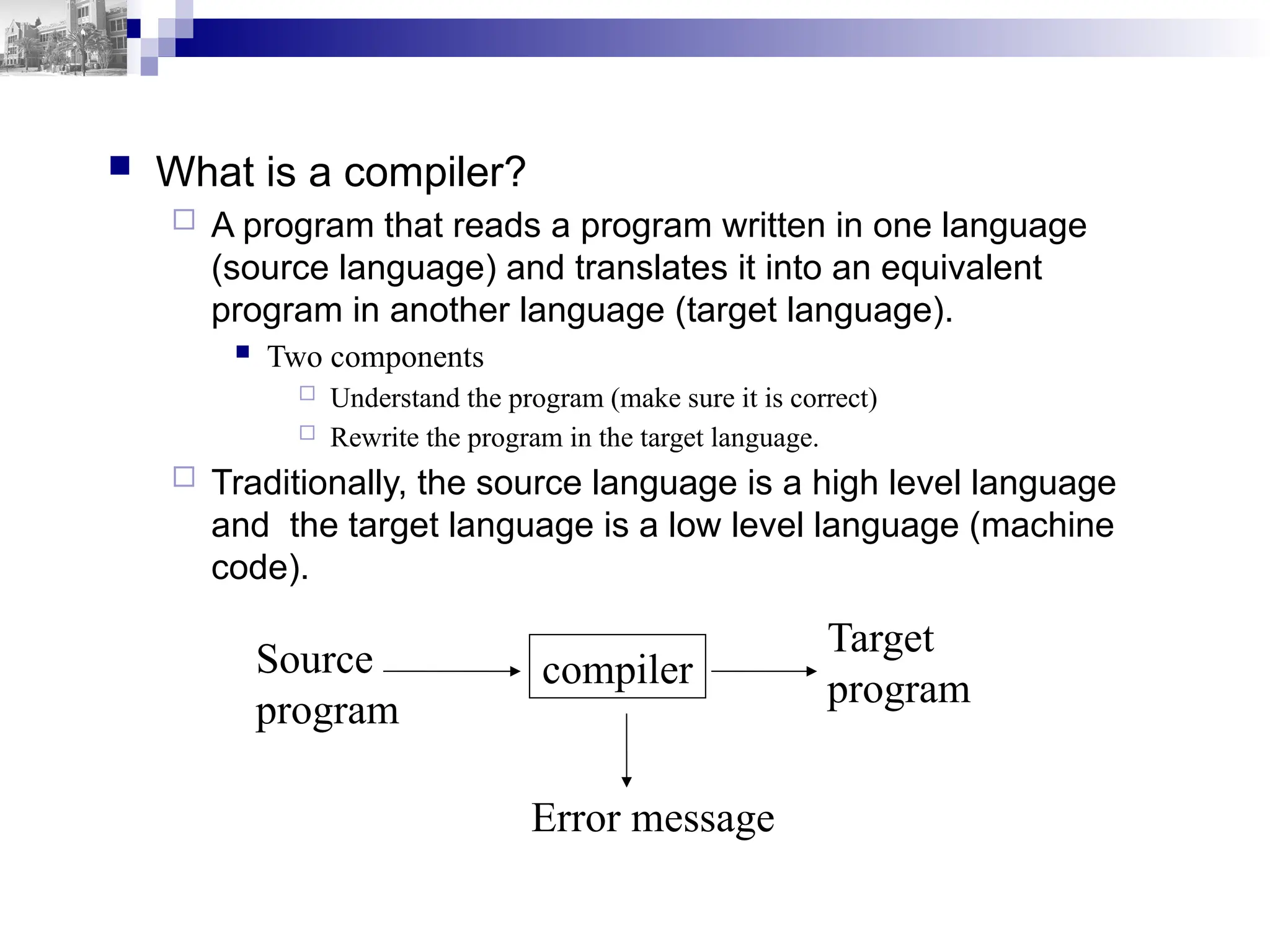
What isa compiler?
A program that reads a program written in one language
(source language) and translates it into an equivalent
program in another language (target language).
Two components
Understand the program (make sure it is correct)
Rewrite the program in the target language.
Traditionally, the source language is a high level language
and the target language is a low level language (machine
code).
compiler
Source
program
Target
program
Error message
5.
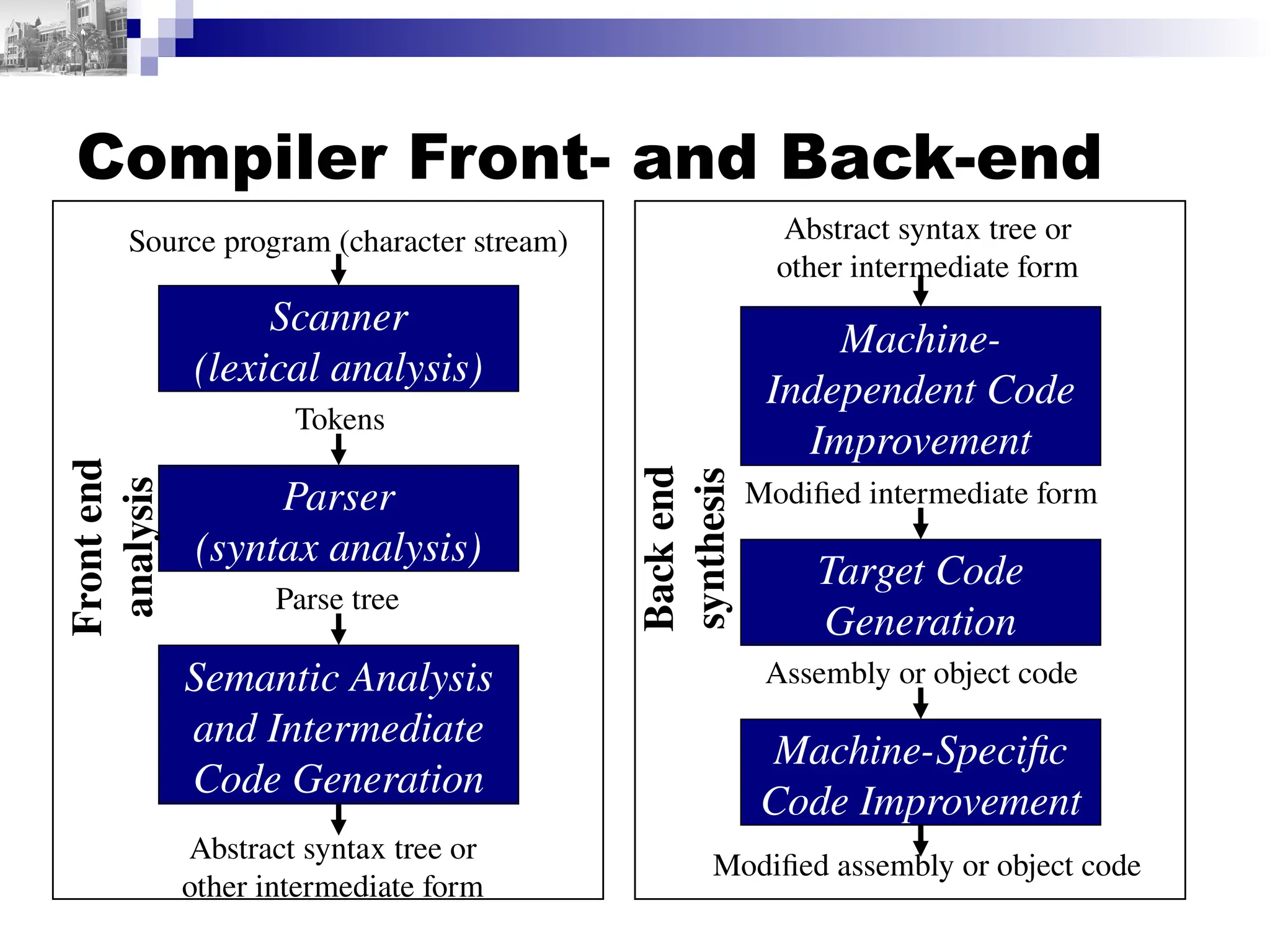
Compiler Front- andBack-end
Semantic Analysis
and Intermediate
Code Generation
Scanner
(lexical analysis)
Parser
(syntax analysis)
Machine-
Independent Code
Improvement
Target Code
Generation
Machine-Specific
Code Improvement
Source program (character stream)
Tokens
Parse tree
Abstract syntax tree or
other intermediate form
Modified intermediate form
Assembly or object code
Modified assembly or object code
Abstract syntax tree or
other intermediate form
Front
end
analysis
Back
end
synthesis
6.
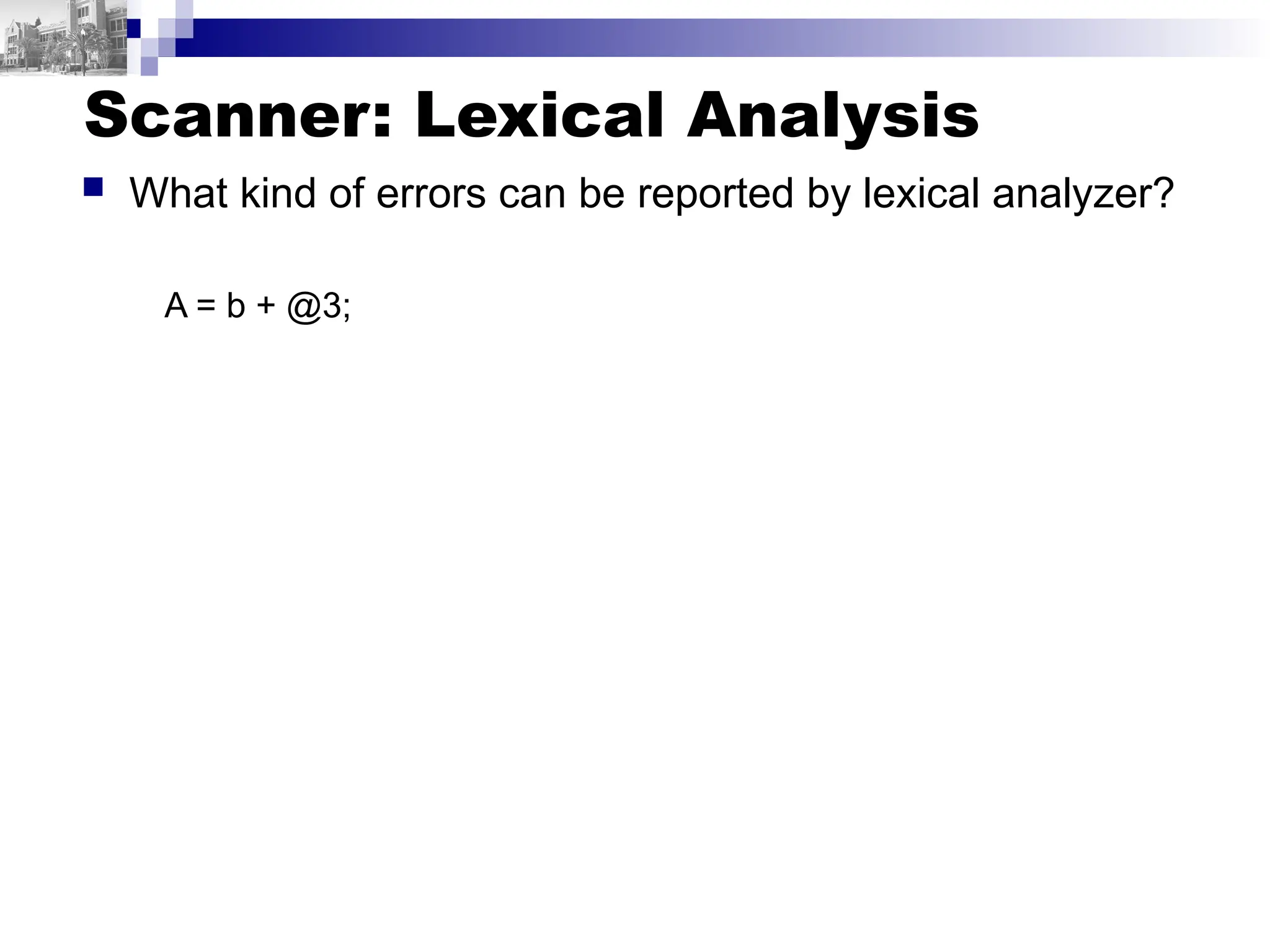
Scanner: Lexical Analysis
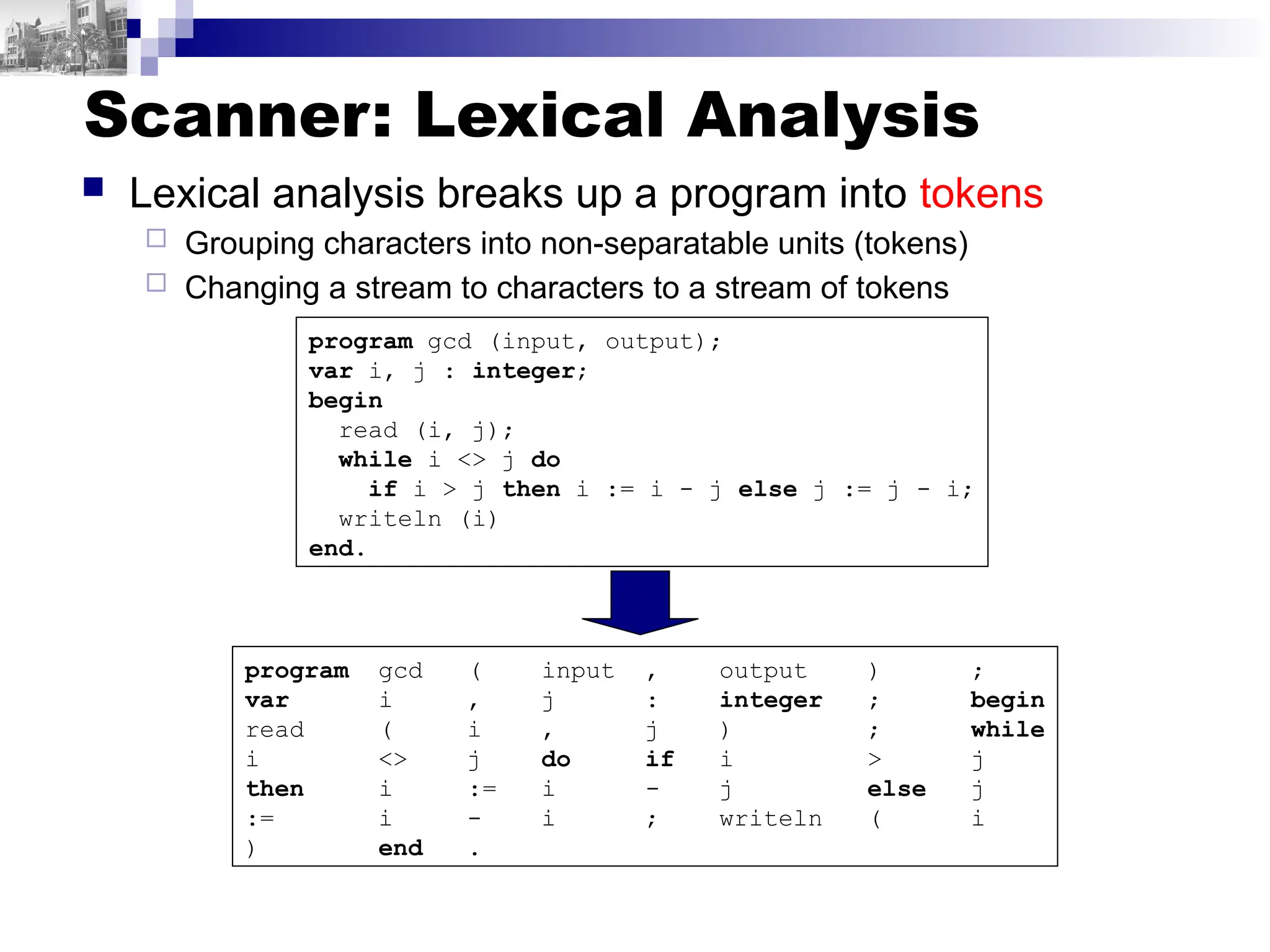
Lexical analysis breaks up a program into tokens
Grouping characters into non-separatable units (tokens)
Changing a stream to characters to a stream of tokens
program gcd (input, output);
var i, j : integer;
begin
read (i, j);
while i <> j do
if i > j then i := i - j else j := j - i;
writeln (i)
end.
program gcd ( input , output ) ;
var i , j : integer ; begin
read ( i , j ) ; while
i <> j do if i > j
then i := i - j else j
:= i - i ; writeln ( i
) end .
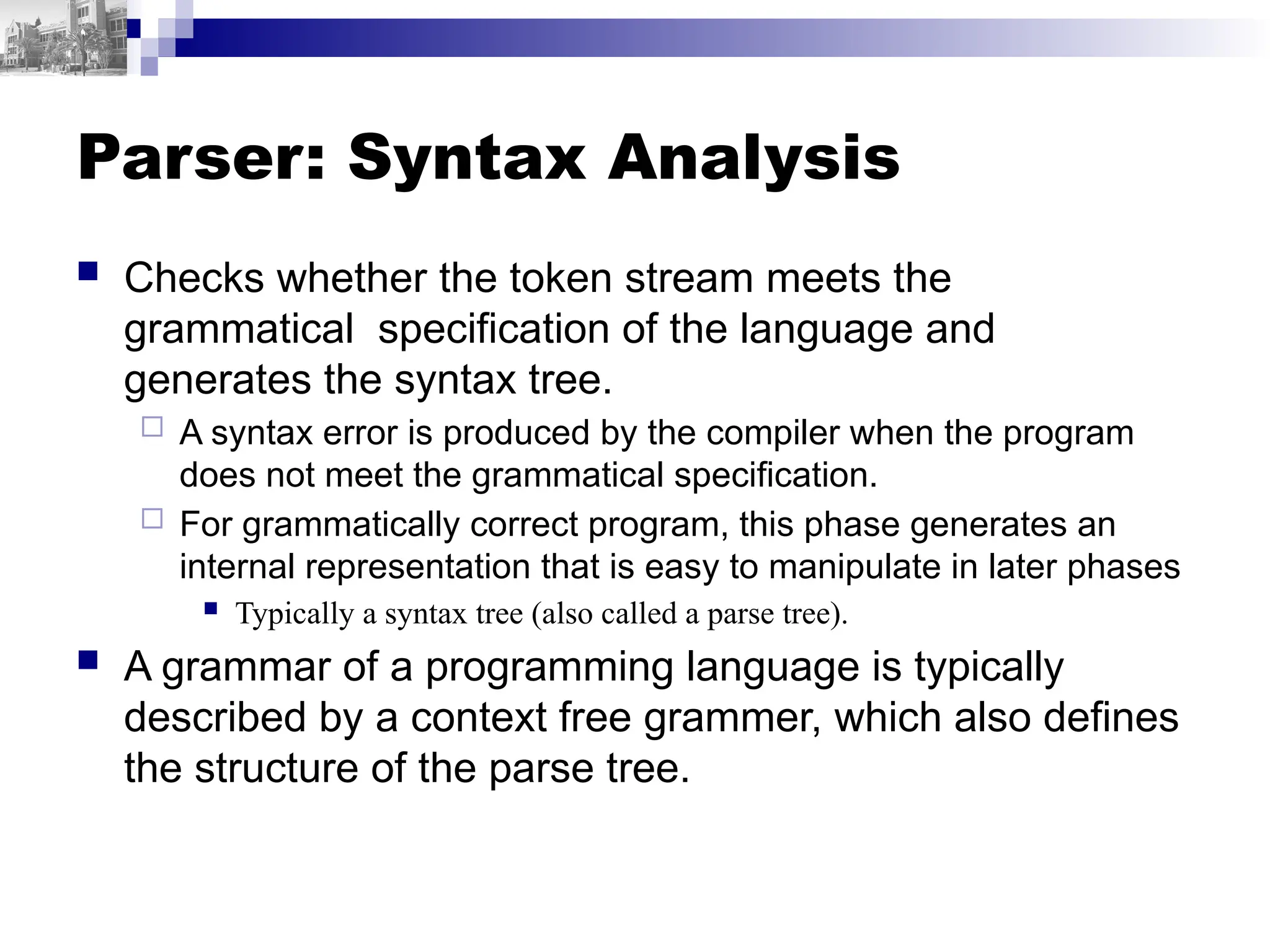
Parser: Syntax Analysis
Checks whether the token stream meets the
grammatical specification of the language and
generates the syntax tree.
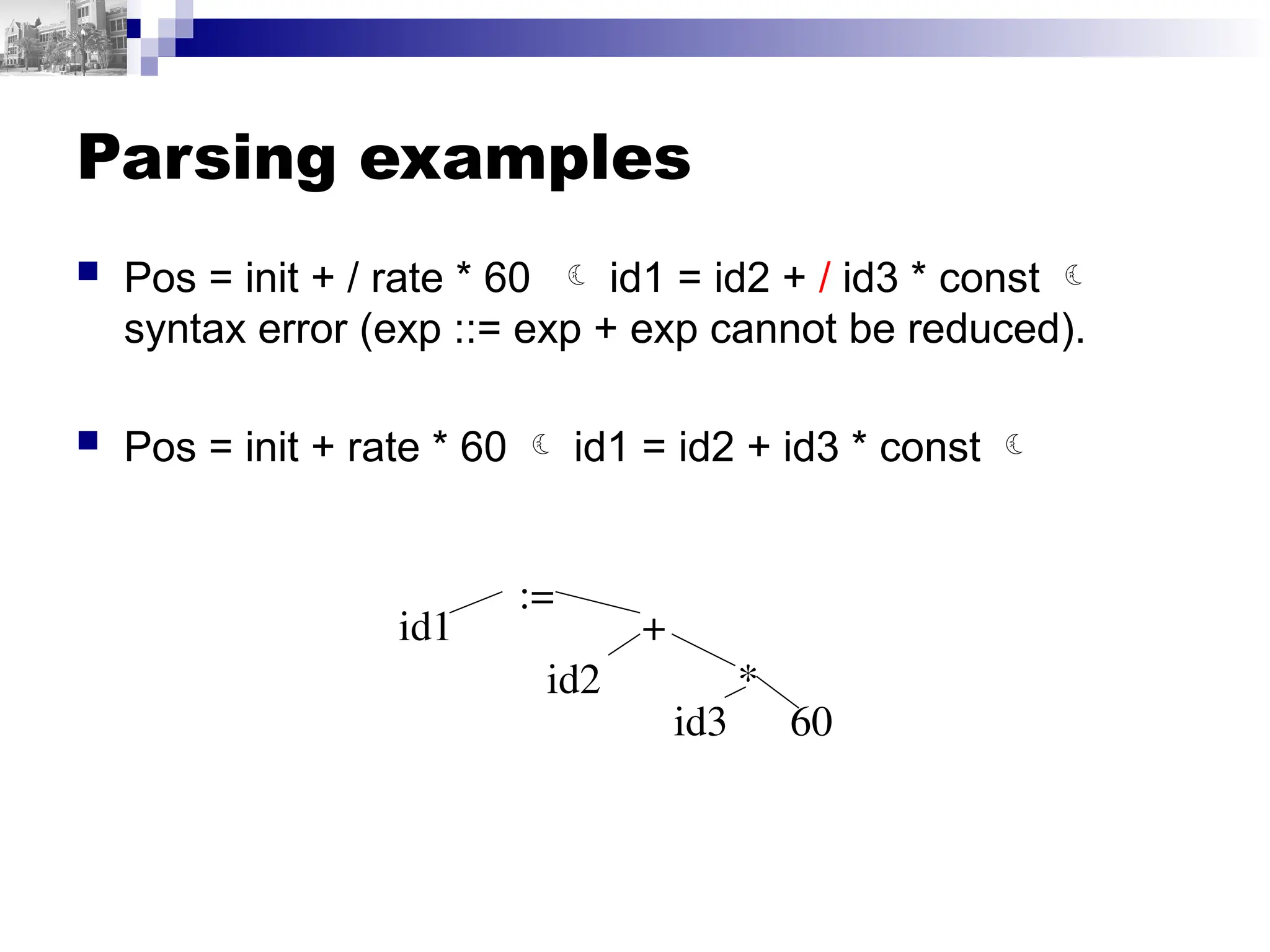
A syntax error is produced by the compiler when the program
does not meet the grammatical specification.
For grammatically correct program, this phase generates an
internal representation that is easy to manipulate in later phases
Typically a syntax tree (also called a parse tree).
A grammar of a programming language is typically
described by a context free grammer, which also defines
the structure of the parse tree.
9.
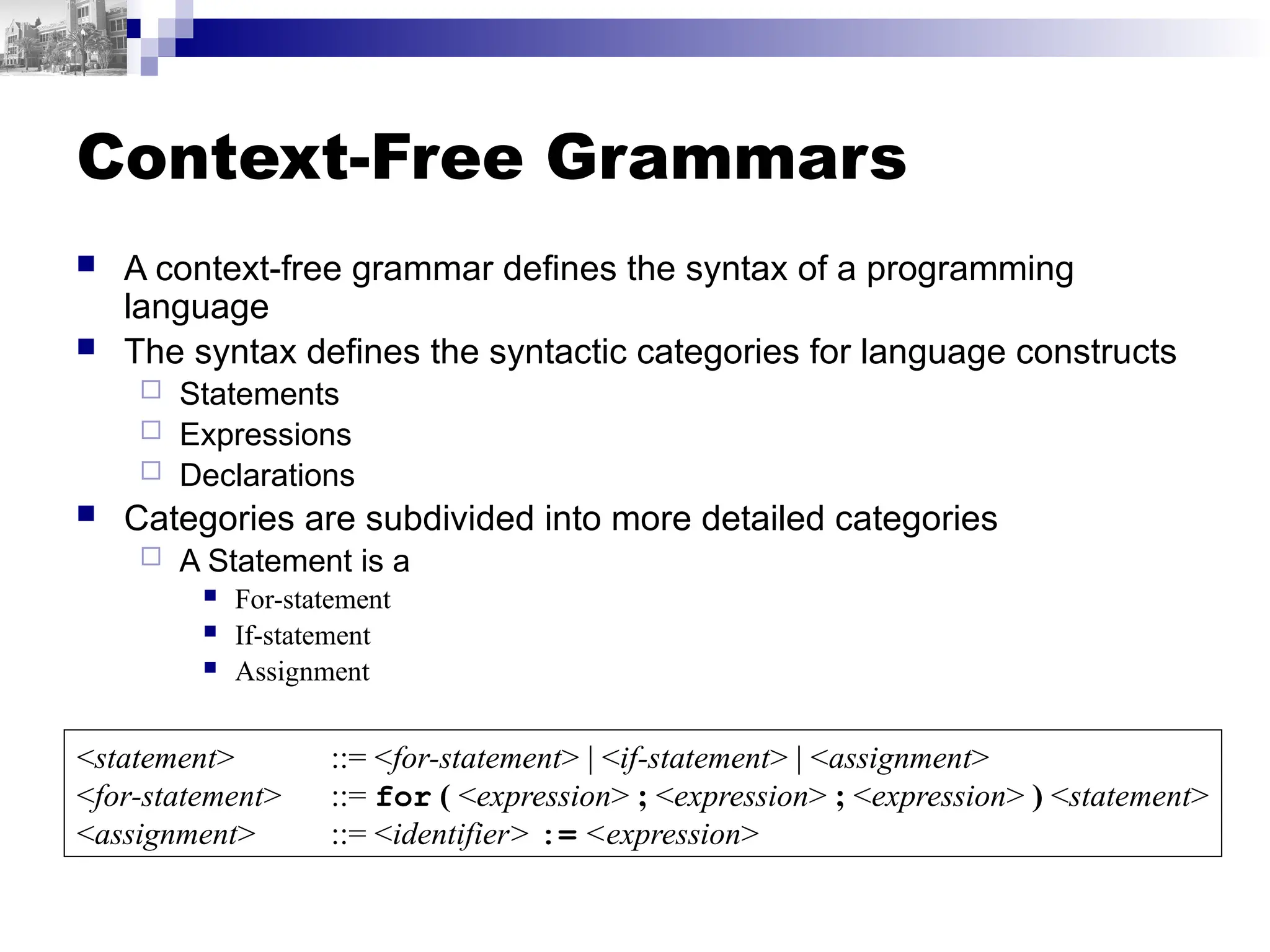
Context-Free Grammars
Acontext-free grammar defines the syntax of a programming
language
The syntax defines the syntactic categories for language constructs
Statements
Expressions
Declarations
Categories are subdivided into more detailed categories
A Statement is a
For-statement
If-statement
Assignment
<statement> ::= <for-statement> | <if-statement> | <assignment>
<for-statement> ::= for ( <expression> ; <expression> ; <expression> ) <statement>
<assignment> ::= <identifier> := <expression>
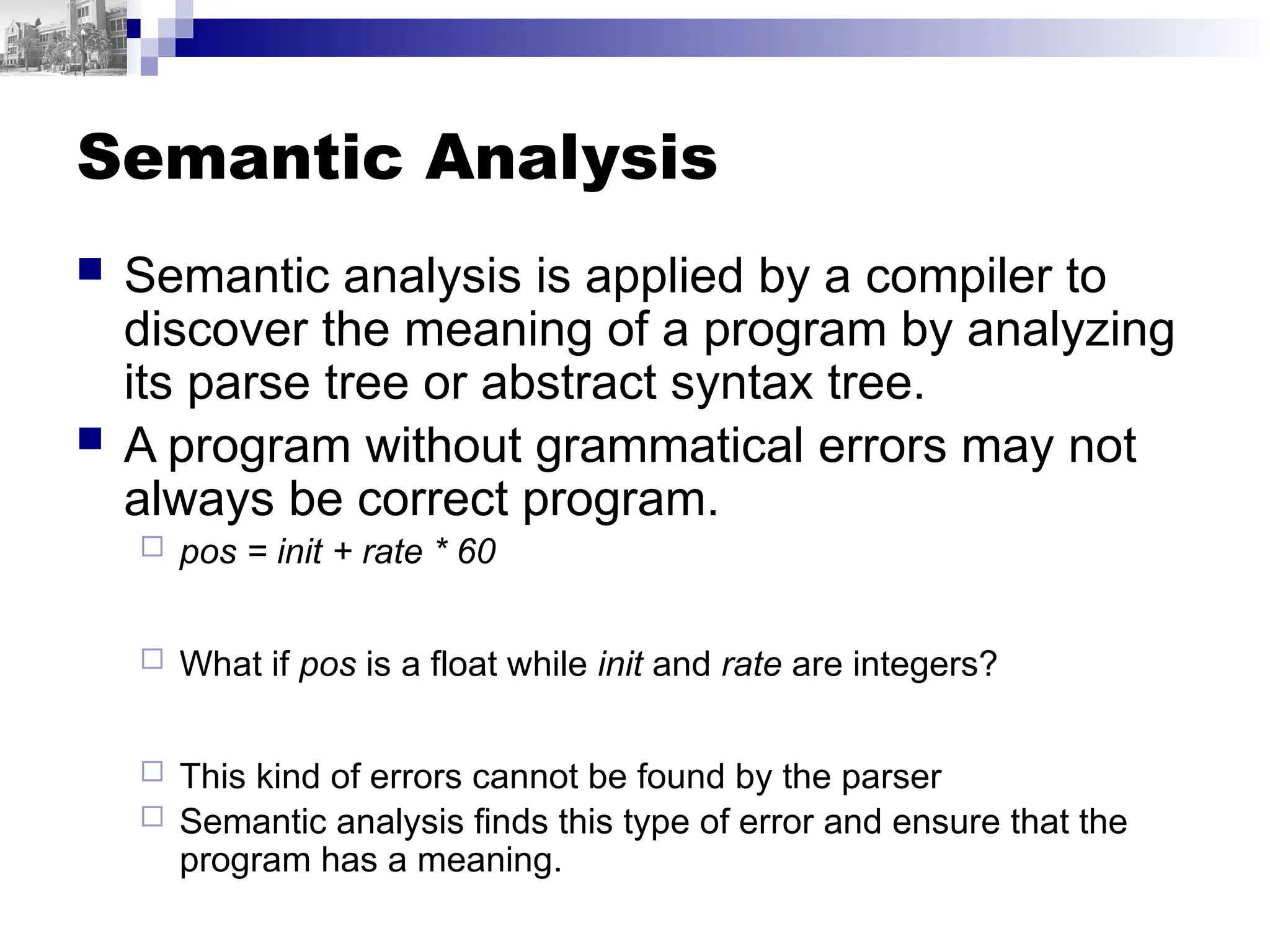
Semantic Analysis
Semanticanalysis is applied by a compiler to
discover the meaning of a program by analyzing
its parse tree or abstract syntax tree.
A program without grammatical errors may not
always be correct program.
pos = init + rate * 60
What if pos is a float while init and rate are integers?
This kind of errors cannot be found by the parser
Semantic analysis finds this type of error and ensure that the
program has a meaning.
12.
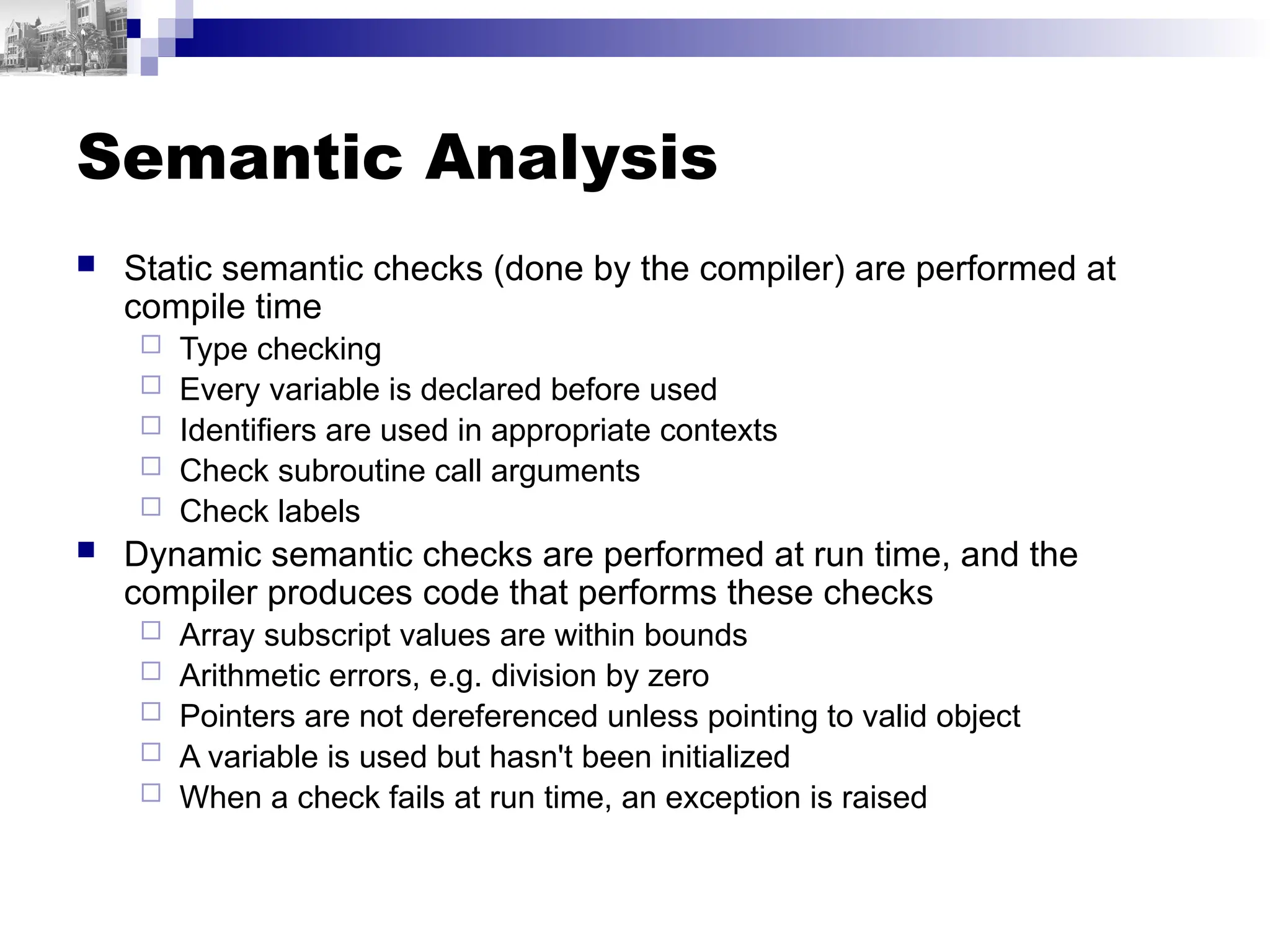
Semantic Analysis
Staticsemantic checks (done by the compiler) are performed at
compile time
Type checking
Every variable is declared before used
Identifiers are used in appropriate contexts
Check subroutine call arguments
Check labels
Dynamic semantic checks are performed at run time, and the
compiler produces code that performs these checks
Array subscript values are within bounds
Arithmetic errors, e.g. division by zero
Pointers are not dereferenced unless pointing to valid object
A variable is used but hasn't been initialized
When a check fails at run time, an exception is raised
13.
Semantic Analysis andStrong
Typing
A language is strongly typed "if (type) errors are always
detected"
Errors are either detected at compile time or at run time
Examples of such errors are listed on previous slide
Languages that are strongly typed are Ada, Java, ML, Haskell
Languages that are not strongly typed are Fortran, Pascal, C/C+
+, Lisp
Strong typing makes language safe and easier to use,
but potentially slower because of dynamic semantic
checks
In some languages, most (type) errors are detected late
at run time which is detrimental to reliability e.g. early
Basic, Lisp, Prolog, some script languages
14.
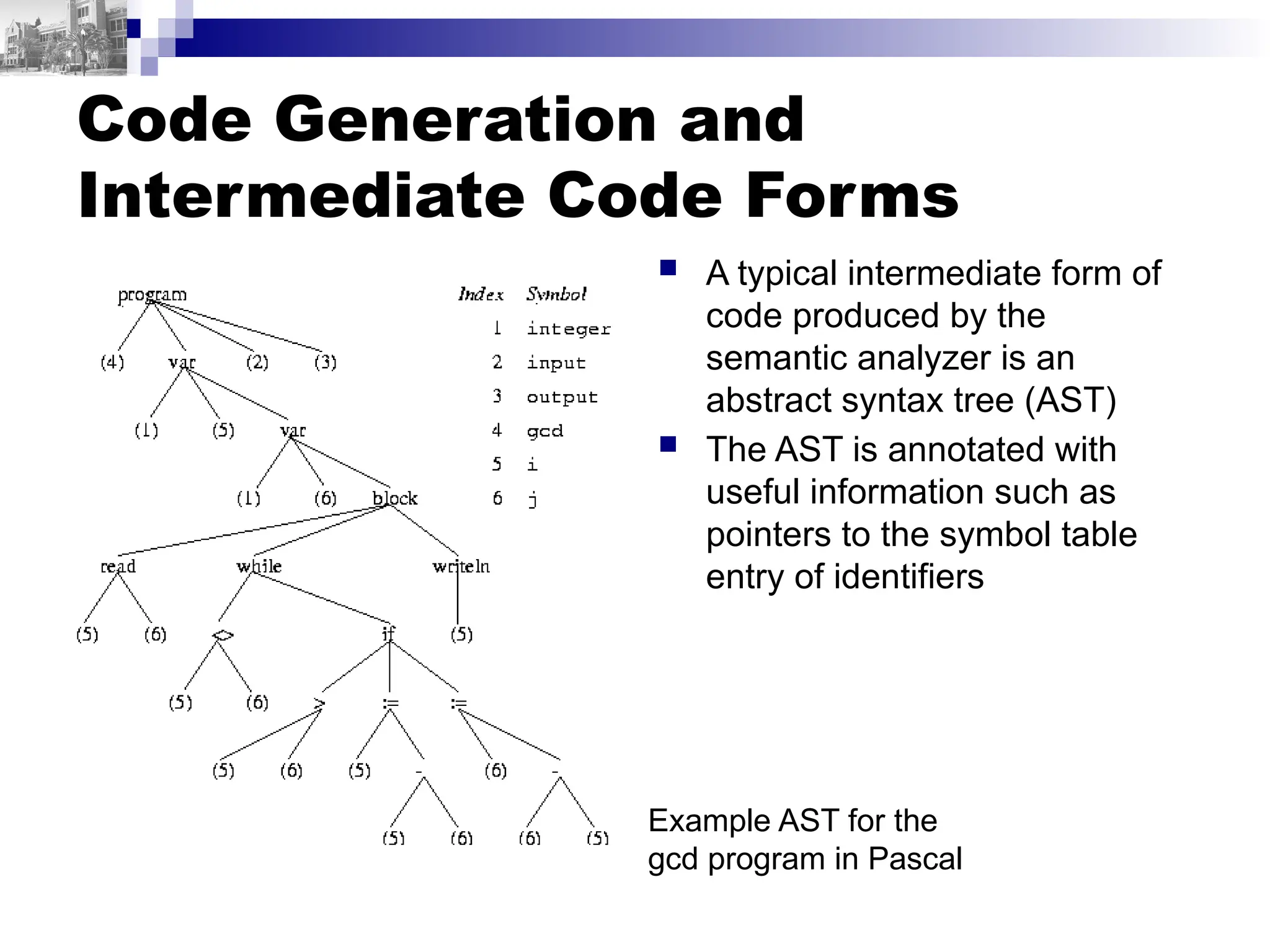
Code Generation and
IntermediateCode Forms
A typical intermediate form of
code produced by the
semantic analyzer is an
abstract syntax tree (AST)
The AST is annotated with
useful information such as
pointers to the symbol table
entry of identifiers
Example AST for the
gcd program in Pascal
15.
Code Generation and
IntermediateCode Forms
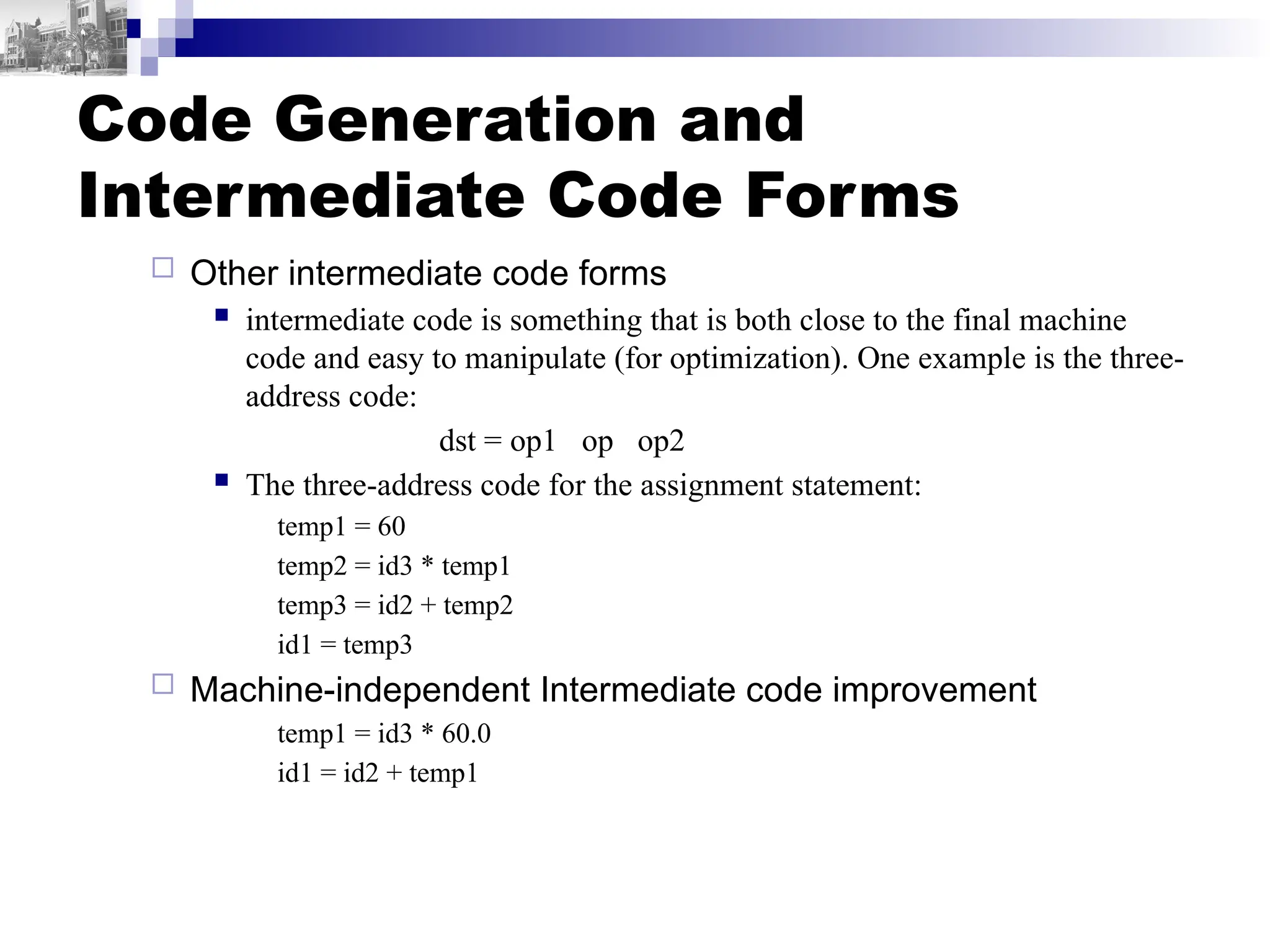
Other intermediate code forms
intermediate code is something that is both close to the final machine
code and easy to manipulate (for optimization). One example is the three-
address code:
dst = op1 op op2
The three-address code for the assignment statement:
temp1 = 60
temp2 = id3 * temp1
temp3 = id2 + temp2
id1 = temp3
Machine-independent Intermediate code improvement
temp1 = id3 * 60.0
id1 = id2 + temp1
16.
Target Code Generationand
Optimization
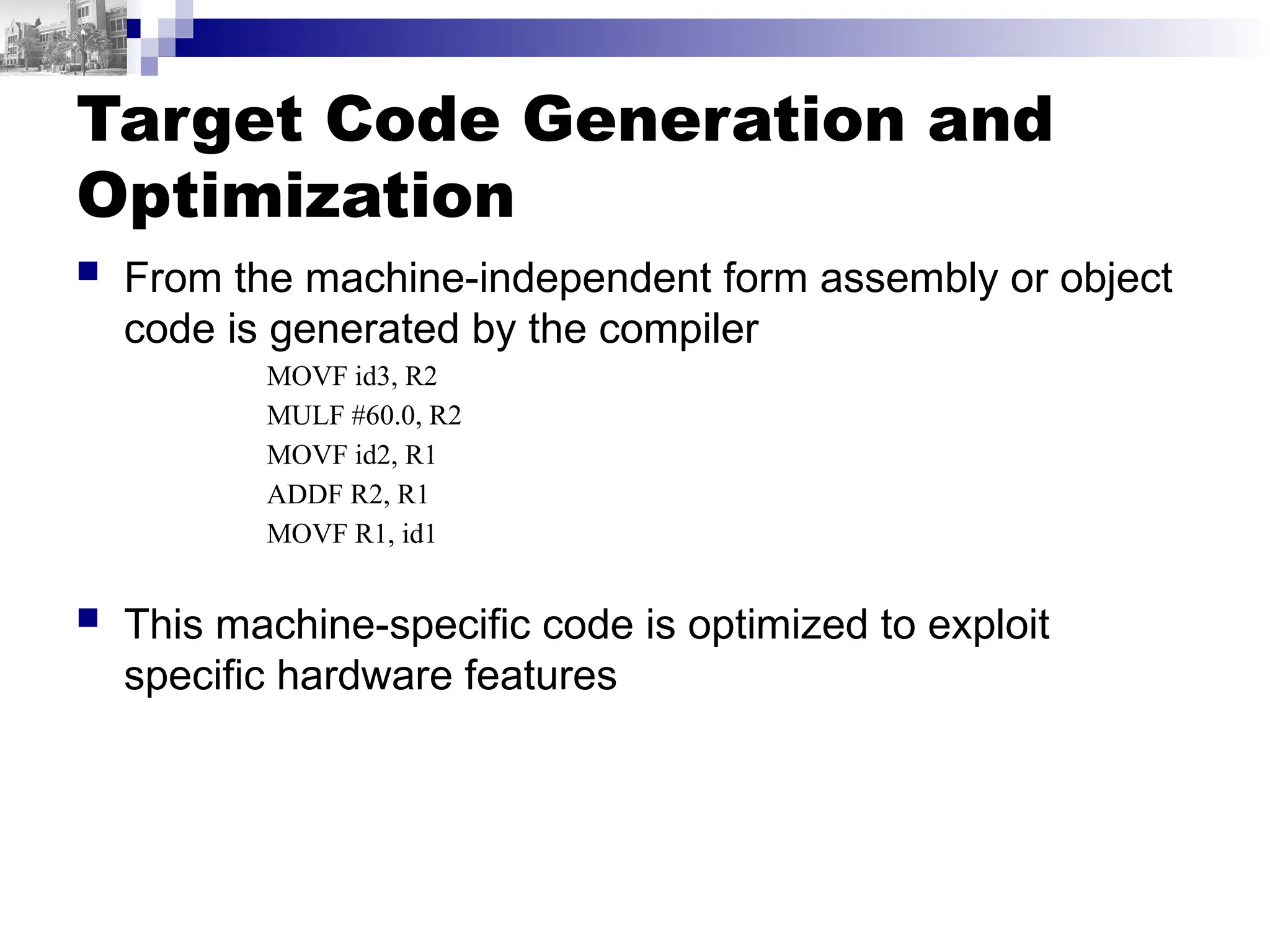
From the machine-independent form assembly or object
code is generated by the compiler
MOVF id3, R2
MULF #60.0, R2
MOVF id2, R1
ADDF R2, R1
MOVF R1, id1
This machine-specific code is optimized to exploit
specific hardware features
17.
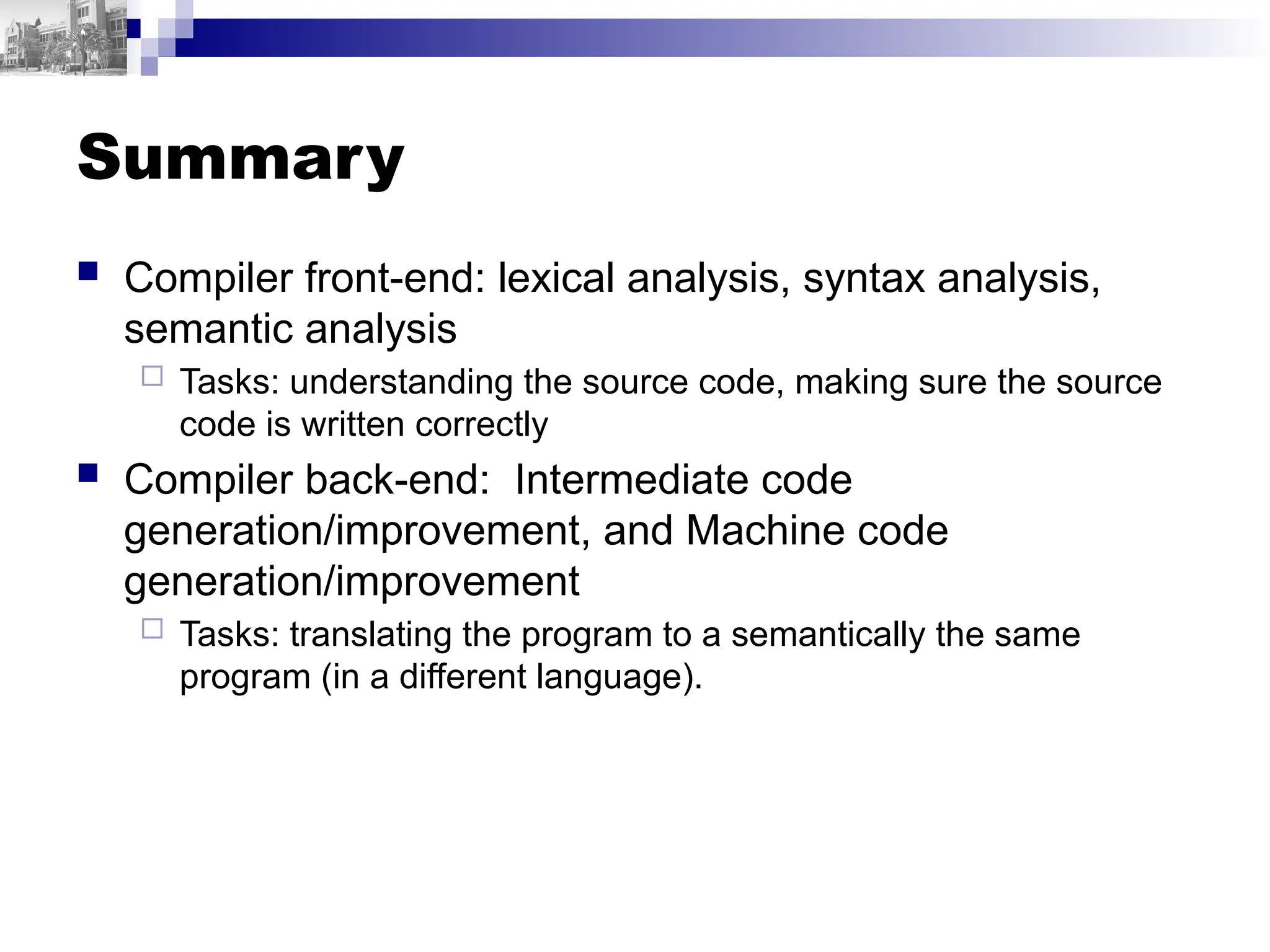
Summary
Compiler front-end:lexical analysis, syntax analysis,
semantic analysis
Tasks: understanding the source code, making sure the source
code is written correctly
Compiler back-end: Intermediate code
generation/improvement, and Machine code
generation/improvement
Tasks: translating the program to a semantically the same
program (in a different language).