PHASES OF
COMPILER
BY PANKAJ
KUMAR
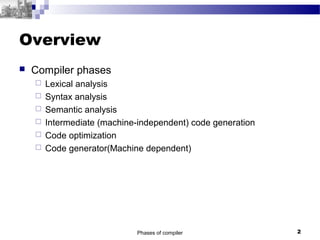
Overview
 Compiler phases
 Lexical analysis
 Syntax analysis
 Semantic analysis
 Intermediate (machine-independent) code generation
 Code optimization
 Code generator(Machine dependent)
Phases of compiler 2
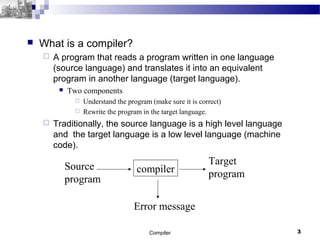
 What is a compiler?
 A program that reads a program written in one language
(source language) and translates it into an equivalent
program in another language (target language).
 Two components
 Understand the program (make sure it is correct)
 Rewrite the program in the target language.
 Traditionally, the source language is a high level language
and the target language is a low level language (machine
code).
Compiler 3
compilerSource
program
Target
program
Error message
Compilation Phases and Passes
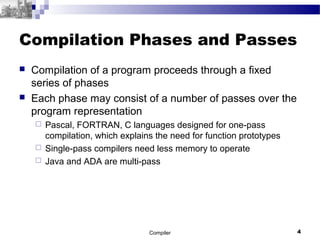
 Compilation of a program proceeds through a fixed
series of phases
 Each phase may consist of a number of passes over the
program representation
 Pascal, FORTRAN, C languages designed for one-pass
compilation, which explains the need for function prototypes
 Single-pass compilers need less memory to operate
 Java and ADA are multi-pass
Compiler 4
Scanner: Lexical Analysis
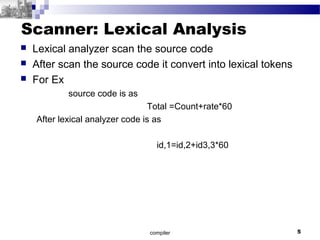
 Lexical analyzer scan the source code
 After scan the source code it convert into lexical tokens
 For Ex
source code is as
Total =Count+rate*60
After lexical analyzer code is as
id,1=id,2+id3,3*60
compiler 5
Parser: (Syntax Analysis)
 The syntax analysis is also called parsing
 In this phase the token generated by the lexical analyzer
are grouped together in the form of hierarchical form
This form is called parse tree or syntax tree
Compiler 6
Parsing examples
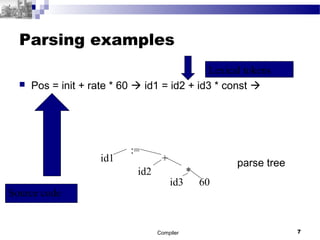
 Pos = init + rate * 60  id1 = id2 + id3 * const 
parse tree
Compiler 7
:=
id1 +
id2 *
id3 60
Source code
Lexical tokens
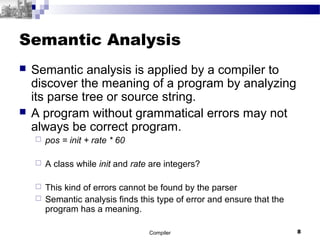
Semantic Analysis
 Semantic analysis is applied by a compiler to
discover the meaning of a program by analyzing
its parse tree or source string.
 A program without grammatical errors may not
always be correct program.
 pos = init + rate * 60
 A class while init and rate are integers?
 This kind of errors cannot be found by the parser
 Semantic analysis finds this type of error and ensure that the
program has a meaning.
Compiler 8
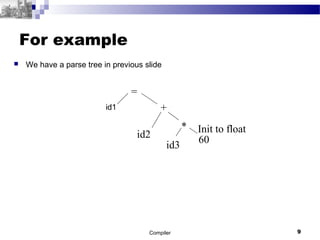
For example
 We have a parse tree in previous slide
id1
Compiler 9
=
+
id2
*
id3
60
Init to float
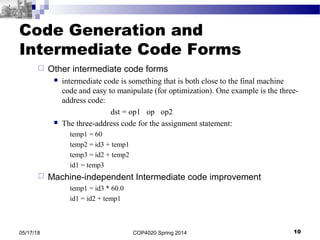
Code Generation and
Intermediate Code Forms
 Other intermediate code forms
 intermediate code is something that is both close to the final machine
code and easy to manipulate (for optimization). One example is the three-
address code:
dst = op1 op op2
 The three-address code for the assignment statement:
temp1 = 60
temp2 = id3 + temp1
temp3 = id2 + temp2
id1 = temp3
 Machine-independent Intermediate code improvement
temp1 = id3 * 60.0
id1 = id2 + temp1
COP4020 Spring 2014 1005/17/18
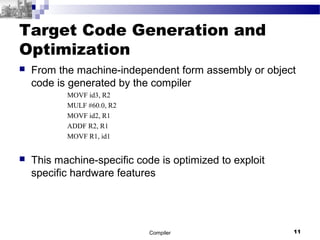
Target Code Generation and
Optimization
 From the machine-independent form assembly or object
code is generated by the compiler
MOVF id3, R2
MULF #60.0, R2
MOVF id2, R1
ADDF R2, R1
MOVF R1, id1
 This machine-specific code is optimized to exploit
specific hardware features
Compiler 11
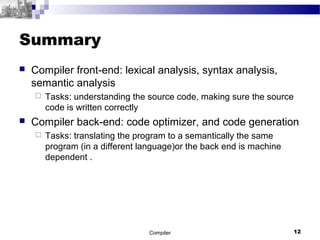
Summary
 Compiler front-end: lexical analysis, syntax analysis,
semantic analysis
 Tasks: understanding the source code, making sure the source
code is written correctly
 Compiler back-end: code optimizer, and code generation
 Tasks: translating the program to a semantically the same
program (in a different language)or the back end is machine
dependent .
Compiler 12

Phases of compiler

  • 1.
  • 2.
    Overview  Compiler phases Lexical analysis  Syntax analysis  Semantic analysis  Intermediate (machine-independent) code generation  Code optimization  Code generator(Machine dependent) Phases of compiler 2
  • 3.
     What isa compiler?  A program that reads a program written in one language (source language) and translates it into an equivalent program in another language (target language).  Two components  Understand the program (make sure it is correct)  Rewrite the program in the target language.  Traditionally, the source language is a high level language and the target language is a low level language (machine code). Compiler 3 compilerSource program Target program Error message
  • 4.
    Compilation Phases andPasses  Compilation of a program proceeds through a fixed series of phases  Each phase may consist of a number of passes over the program representation  Pascal, FORTRAN, C languages designed for one-pass compilation, which explains the need for function prototypes  Single-pass compilers need less memory to operate  Java and ADA are multi-pass Compiler 4
  • 5.
    Scanner: Lexical Analysis Lexical analyzer scan the source code  After scan the source code it convert into lexical tokens  For Ex source code is as Total =Count+rate*60 After lexical analyzer code is as id,1=id,2+id3,3*60 compiler 5
  • 6.
    Parser: (Syntax Analysis) The syntax analysis is also called parsing  In this phase the token generated by the lexical analyzer are grouped together in the form of hierarchical form This form is called parse tree or syntax tree Compiler 6
  • 7.
    Parsing examples  Pos= init + rate * 60  id1 = id2 + id3 * const  parse tree Compiler 7 := id1 + id2 * id3 60 Source code Lexical tokens
  • 8.
    Semantic Analysis  Semanticanalysis is applied by a compiler to discover the meaning of a program by analyzing its parse tree or source string.  A program without grammatical errors may not always be correct program.  pos = init + rate * 60  A class while init and rate are integers?  This kind of errors cannot be found by the parser  Semantic analysis finds this type of error and ensure that the program has a meaning. Compiler 8
  • 9.
    For example  Wehave a parse tree in previous slide id1 Compiler 9 = + id2 * id3 60 Init to float
  • 10.
    Code Generation and IntermediateCode Forms  Other intermediate code forms  intermediate code is something that is both close to the final machine code and easy to manipulate (for optimization). One example is the three- address code: dst = op1 op op2  The three-address code for the assignment statement: temp1 = 60 temp2 = id3 + temp1 temp3 = id2 + temp2 id1 = temp3  Machine-independent Intermediate code improvement temp1 = id3 * 60.0 id1 = id2 + temp1 COP4020 Spring 2014 1005/17/18
  • 11.
    Target Code Generationand Optimization  From the machine-independent form assembly or object code is generated by the compiler MOVF id3, R2 MULF #60.0, R2 MOVF id2, R1 ADDF R2, R1 MOVF R1, id1  This machine-specific code is optimized to exploit specific hardware features Compiler 11
  • 12.
    Summary  Compiler front-end:lexical analysis, syntax analysis, semantic analysis  Tasks: understanding the source code, making sure the source code is written correctly  Compiler back-end: code optimizer, and code generation  Tasks: translating the program to a semantically the same program (in a different language)or the back end is machine dependent . Compiler 12