By Isabelle Michele / Philippe Kopcsan / Lukas Ritzel
Lukas Ritzel, Swiss, management Professional Details:  Mr. Lukas Ritzel currently is Manager ICT with  DCT International Hotel & Business Management School , responsible for all virtual and collaborative technologies on campus, as well as faculty lecturing on different management topics.   Mr. Ritzel has been in international management since over 20 years, has done workshops and presentations in 40++ countries in 4++ languages.  Further ; Mr. Ritzel is Cofounder of Change Management consulting company  Prasena  (www.prasena.com), his company got in 2004 the Purple Cow award of companies who "make a difference" from the FAST company.  Mr. Ritzel has been working for  Accor  Asia Pacific as a consultant to the group in the innovative usage of technologies for all their Asia Rim Mr. Ritzel is a specialist in Creativity, eLearning, Management of Change, Learning Organizations and Knowledge management . His own teaching site is at http://www.dct.ch/ict/dct.htm.  Mr. Ritzel is Switzerland chapter President of the Digital Workforce Education Society (www.digibridge.org).  Mr. Ritzel has been speaker (in real as well as virtual) at many international conferences, some of his best presentations can be seen at Prasena's Virtual_U (http://www.prasena.com/public/virtual_u.html).  Google "Lukas Ritzel" for more digital footprints.  Online CV available at  http://www.prasena.com/public/cvlor.htm
Competencies in HR How to use the talent of your workforce
.. And who is going? “ Silent” Generation  (born 1930-1945) Born with the military technologies that were to lead to analog, digital and virtual technologies   “ Baby-Boom”  Generation (born 1945-1960) Born with the analog and astronautic technologies   Generation “X”  ( born 1960-1975) Born among analog technologies (telephone, TV), witnessed and participated in the development of digital technologies   Generation “Y”   (born 1975-1990) Born with the first generation of digital technologies, witnessed and participated in the development of networked technologies   …  and soon ,  Generation “e”  (born 1990-2005) Born in the midst of new technologies
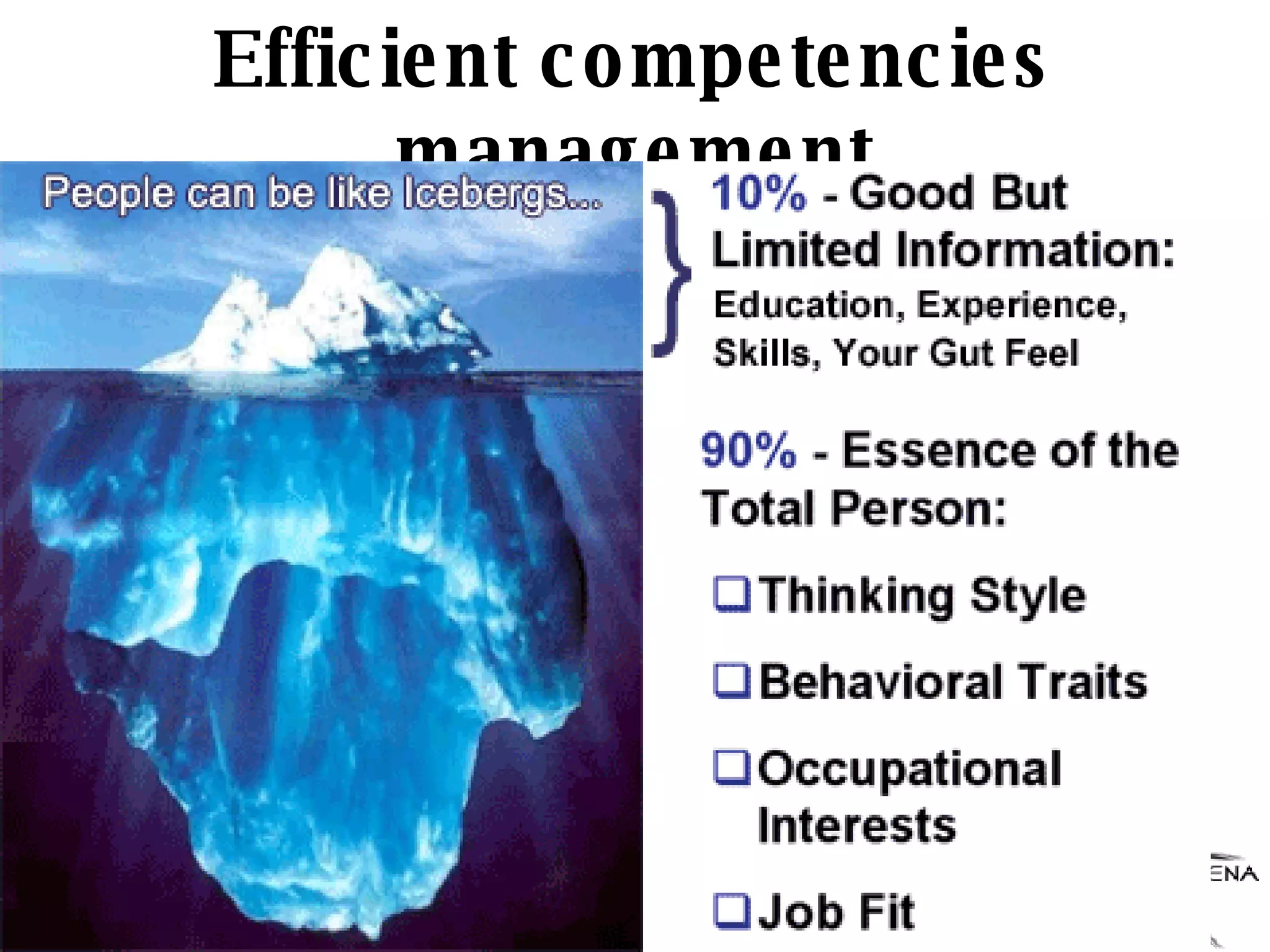
Efficient competencies management
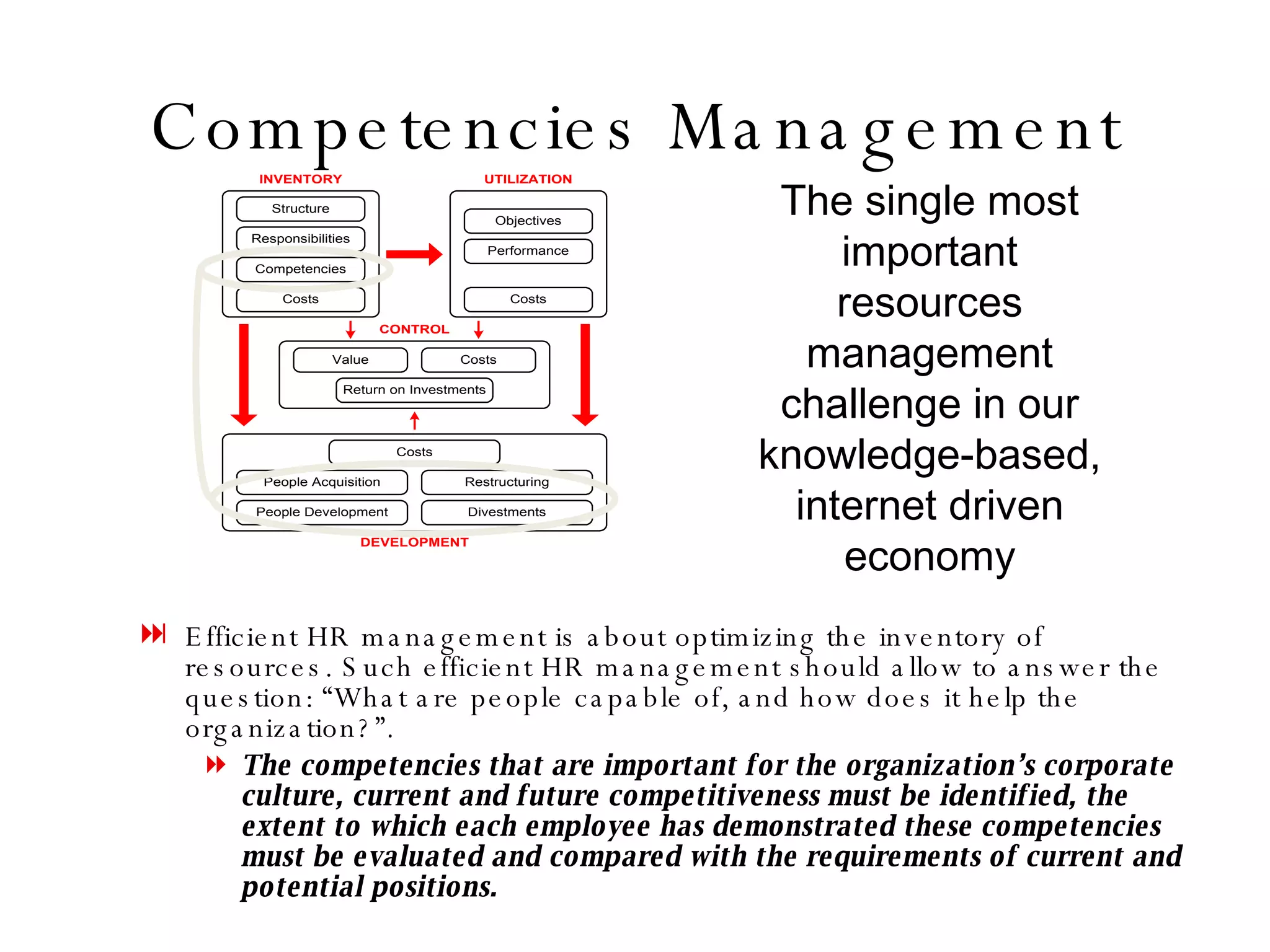
Competencies Management The single most important resources management challenge in our knowledge-based, internet driven economy Efficient HR management is about optimizing the inventory of resources. Such efficient HR management should allow to answer the question: “What are people capable of, and how does it help the organization?”. The competencies that are important for the organization’s corporate culture, current and future competitiveness must be identified, the extent to which each employee has demonstrated these competencies must be evaluated and compared with the requirements of current and potential positions.
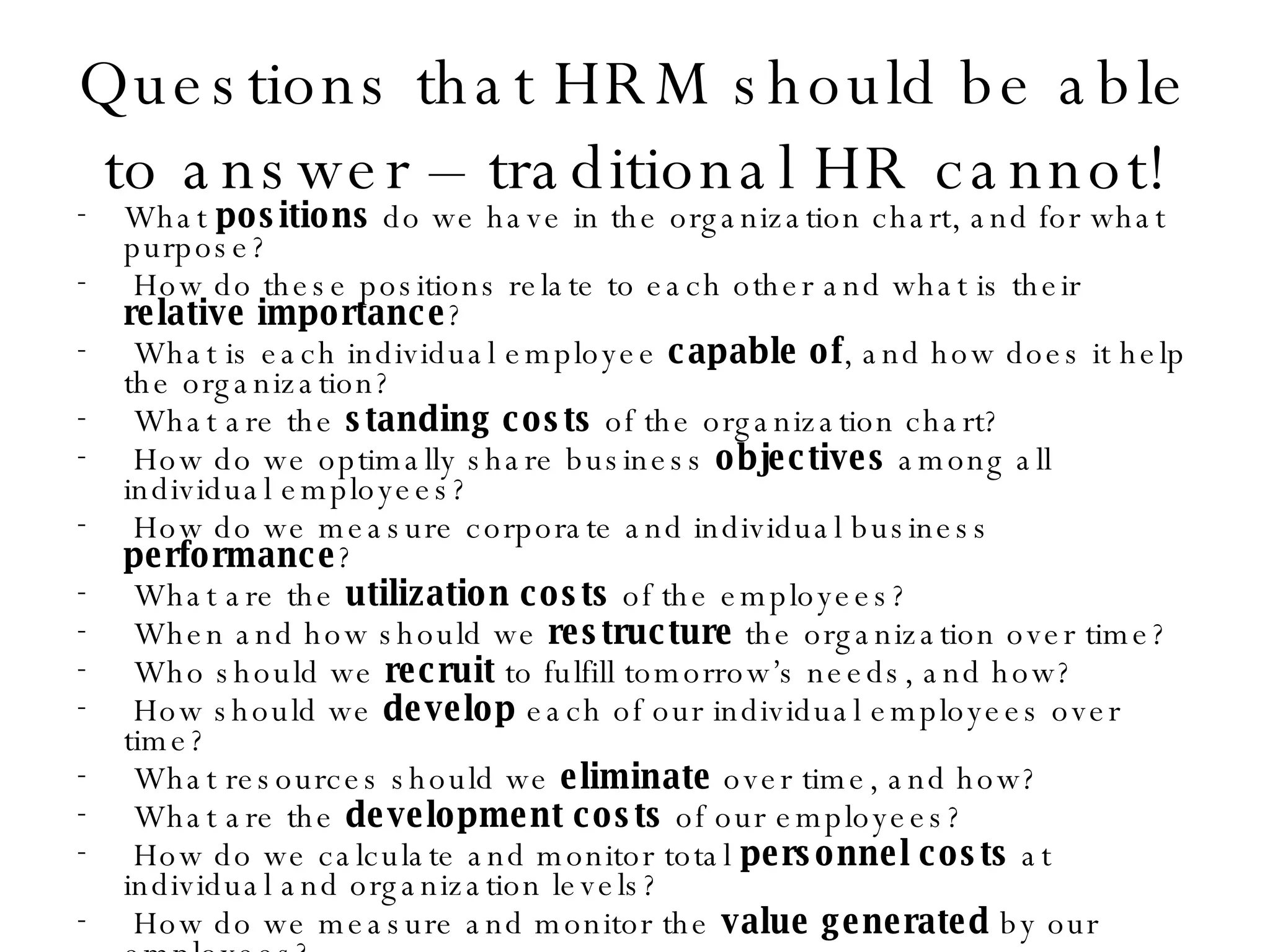
Questions that HRM should be able to answer – traditional HR cannot! What  positions  do we have in the organization chart, and for what purpose?  How do these positions relate to each other and what is their  relative importance ? What is each individual employee  capable of , and how does it help the organization? What are the  standing costs  of the organization chart? How do we optimally share business  objectives  among all individual employees? How do we measure corporate and individual business  performance ? What are the  utilization costs  of the employees? When and how should we  restructure  the organization over time? Who should we  recruit  to fulfill tomorrow’s needs, and how? How should we  develop  each of our individual employees over time? What resources should we  eliminate  over time, and how? What are the  development costs  of our employees? How do we calculate and monitor total  personnel costs  at individual and organization levels? How do we measure and monitor the  value generated  by our employees? How do we evaluate  return on our human investments ?
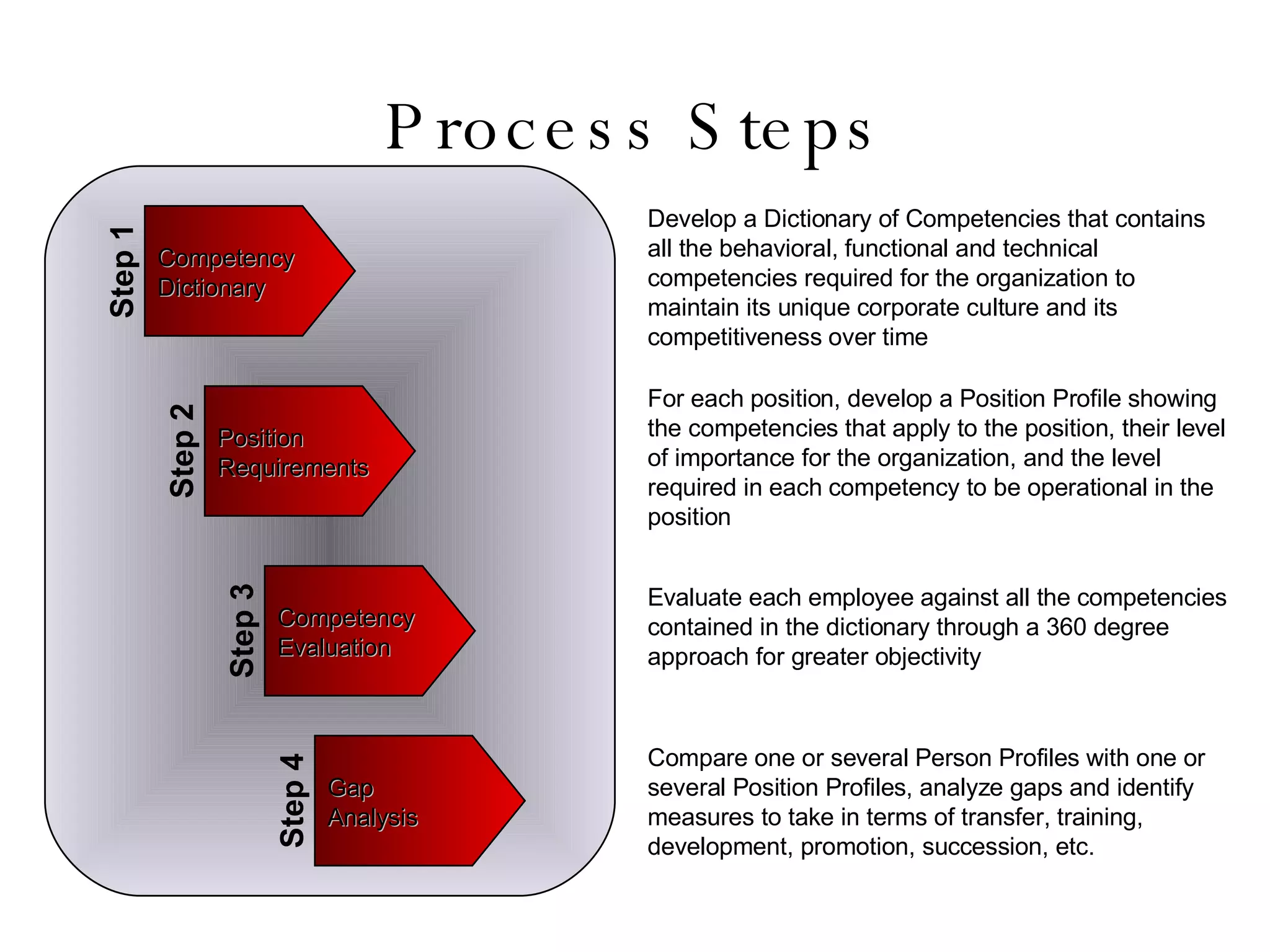
Process Steps Develop a Dictionary of Competencies that contains all the behavioral, functional and technical competencies required for the organization to maintain its unique corporate culture and its competitiveness over time For each position, develop a Position Profile showing the competencies that apply to the position, their level of importance for the organization, and the level required in each competency to be operational in the position Evaluate each employee against all the competencies contained in the dictionary through a 360 degree approach for greater objectivity Competency Dictionary Step 1 Position Requirements Step 2 Competency Evaluation Step 3 Gap Analysis Step 4 Compare one or several Person Profiles with one or several Position Profiles, analyze gaps and identify measures to take in terms of transfer, training, development, promotion, succession, etc.
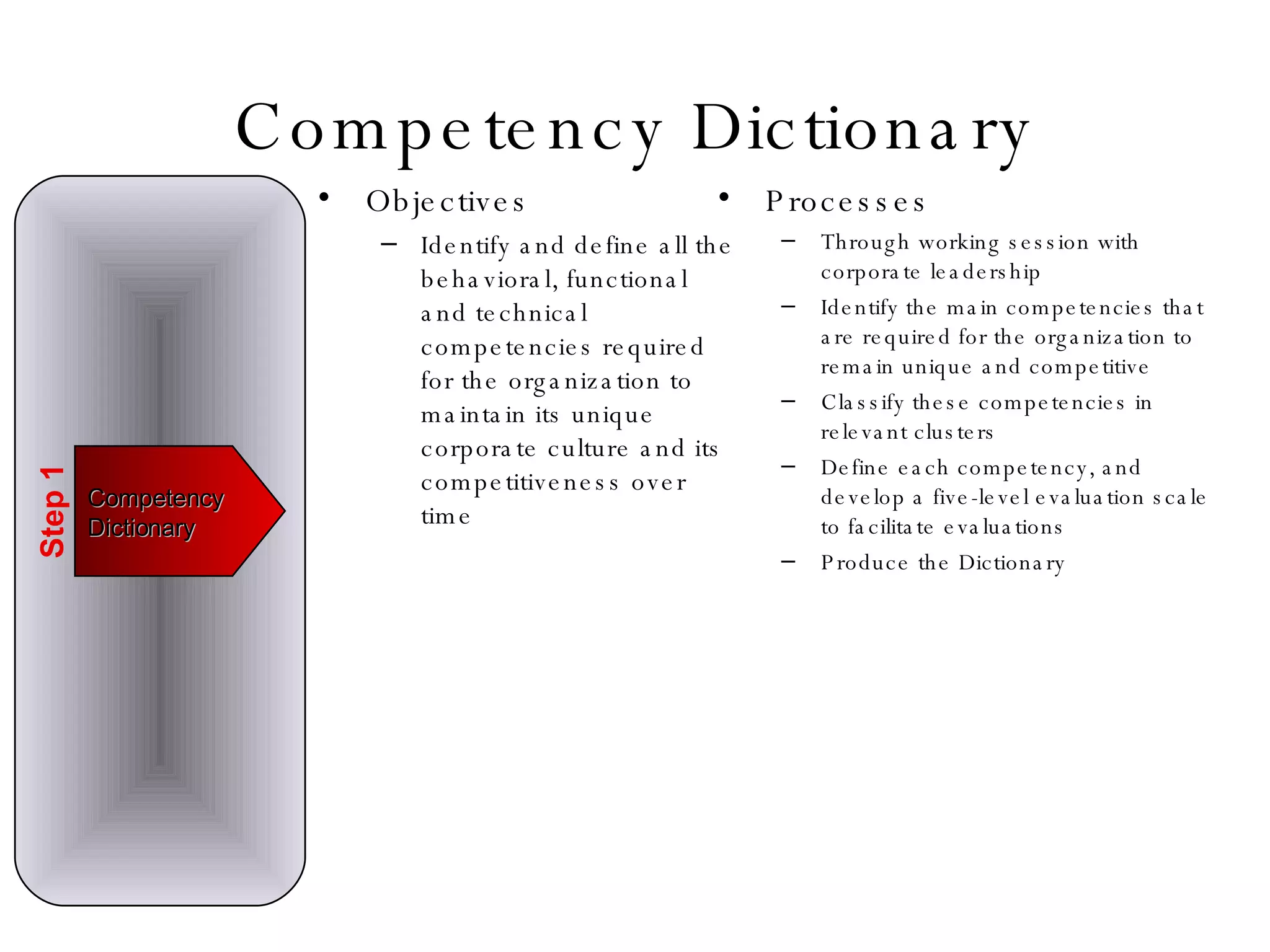
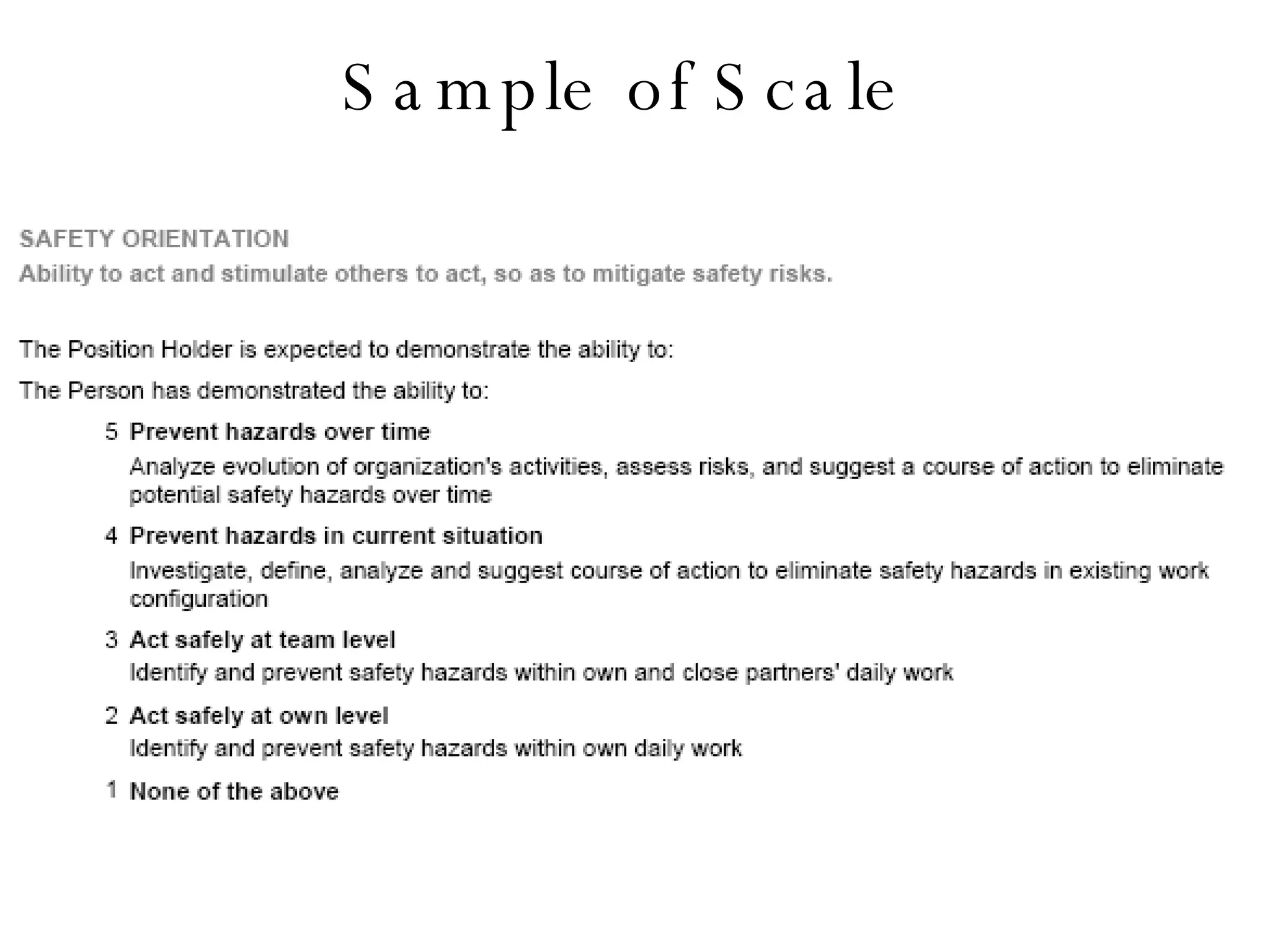
Competency Dictionary Objectives Identify and define all the behavioral, functional and technical competencies required for the organization to maintain its unique corporate culture and its competitiveness over time Processes Through working session with corporate leadership Identify the main competencies that are required for the organization to remain unique and competitive  Classify these competencies in relevant clusters Define each competency, and develop a five-level evaluation scale to facilitate evaluations Produce the Dictionary Competency  Dictionary Step 1
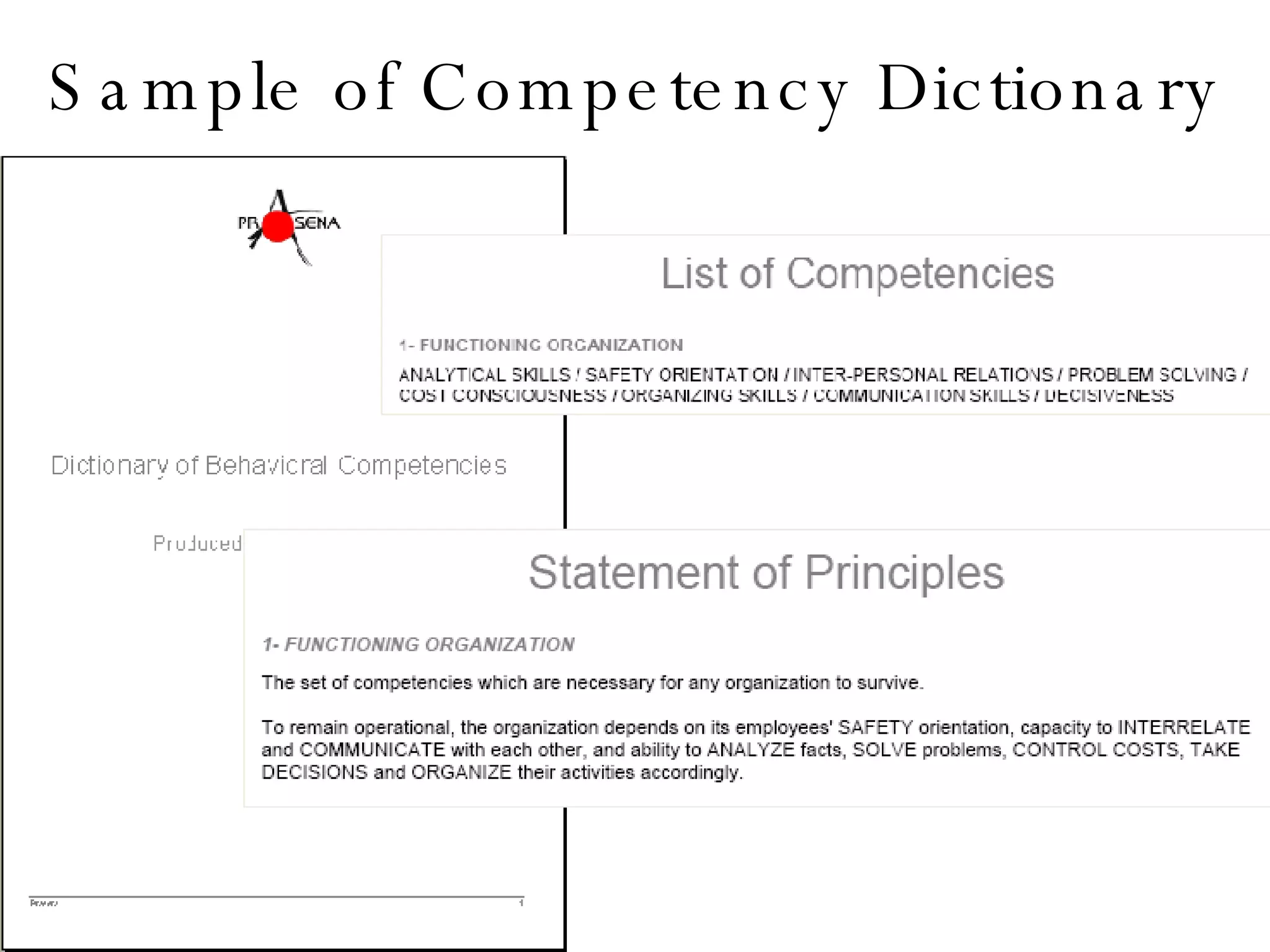
Sample of Competency Dictionary
Sample of Scale
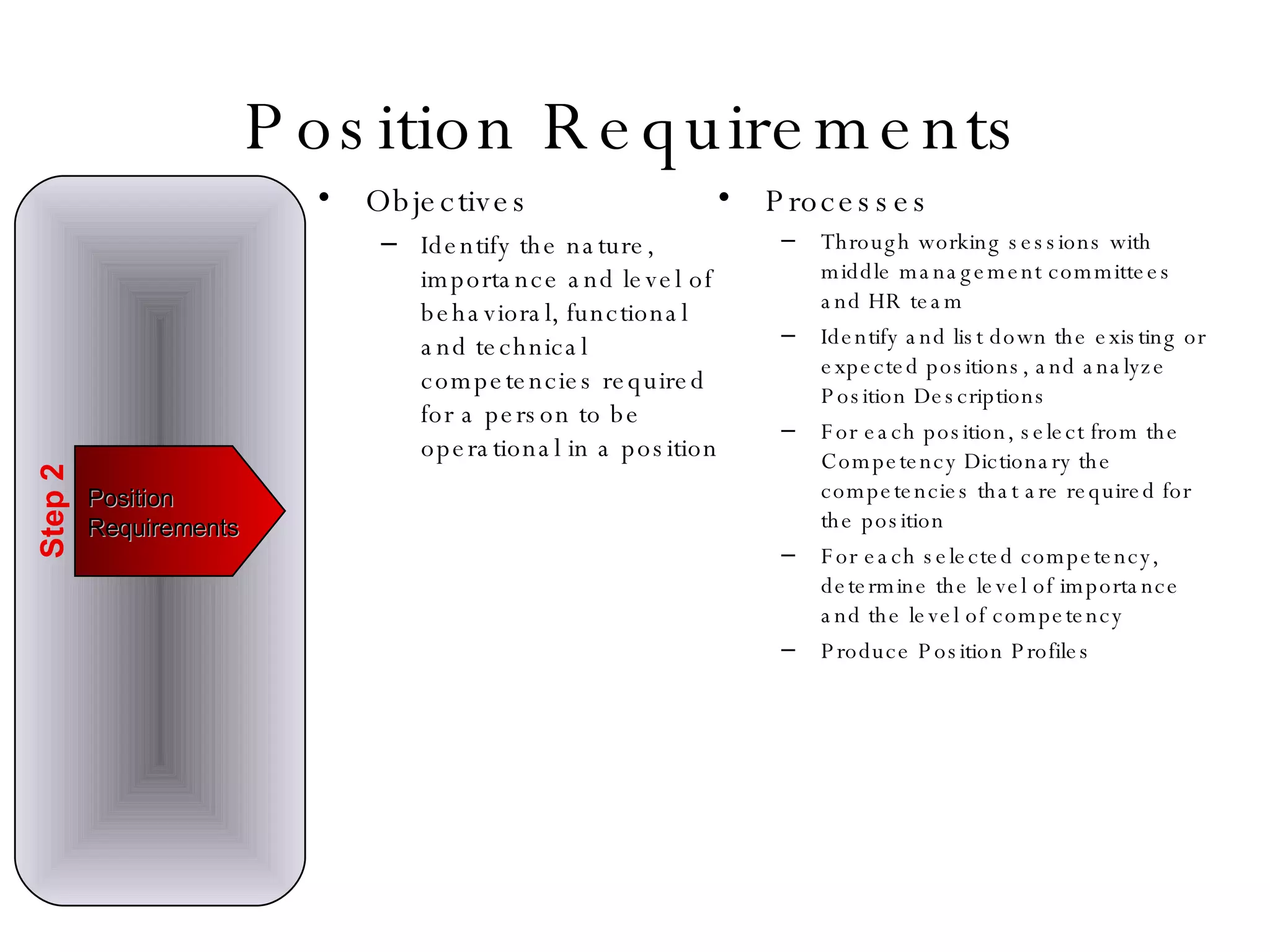
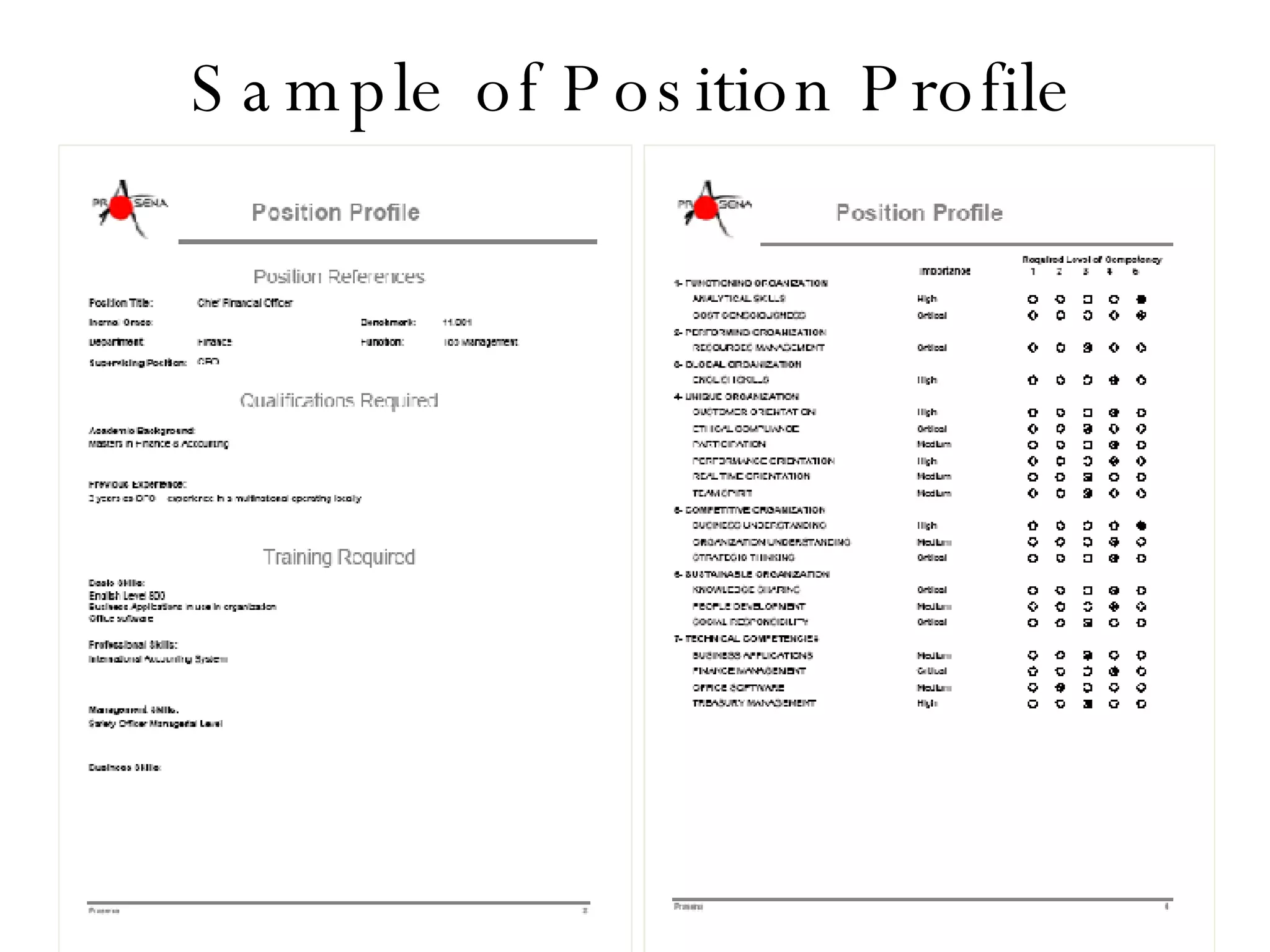
Position Requirements Objectives Identify the nature, importance and level of behavioral, functional and technical competencies required for a person to be operational in a position Processes Through working sessions with middle management committees and HR team Identify and list down the existing or expected positions, and analyze Position Descriptions For each position, select from the Competency Dictionary the competencies that are required for the position For each selected competency, determine the level of importance and the level of competency Produce Position Profiles Position Requirements Step 2
Sample of Position Profile
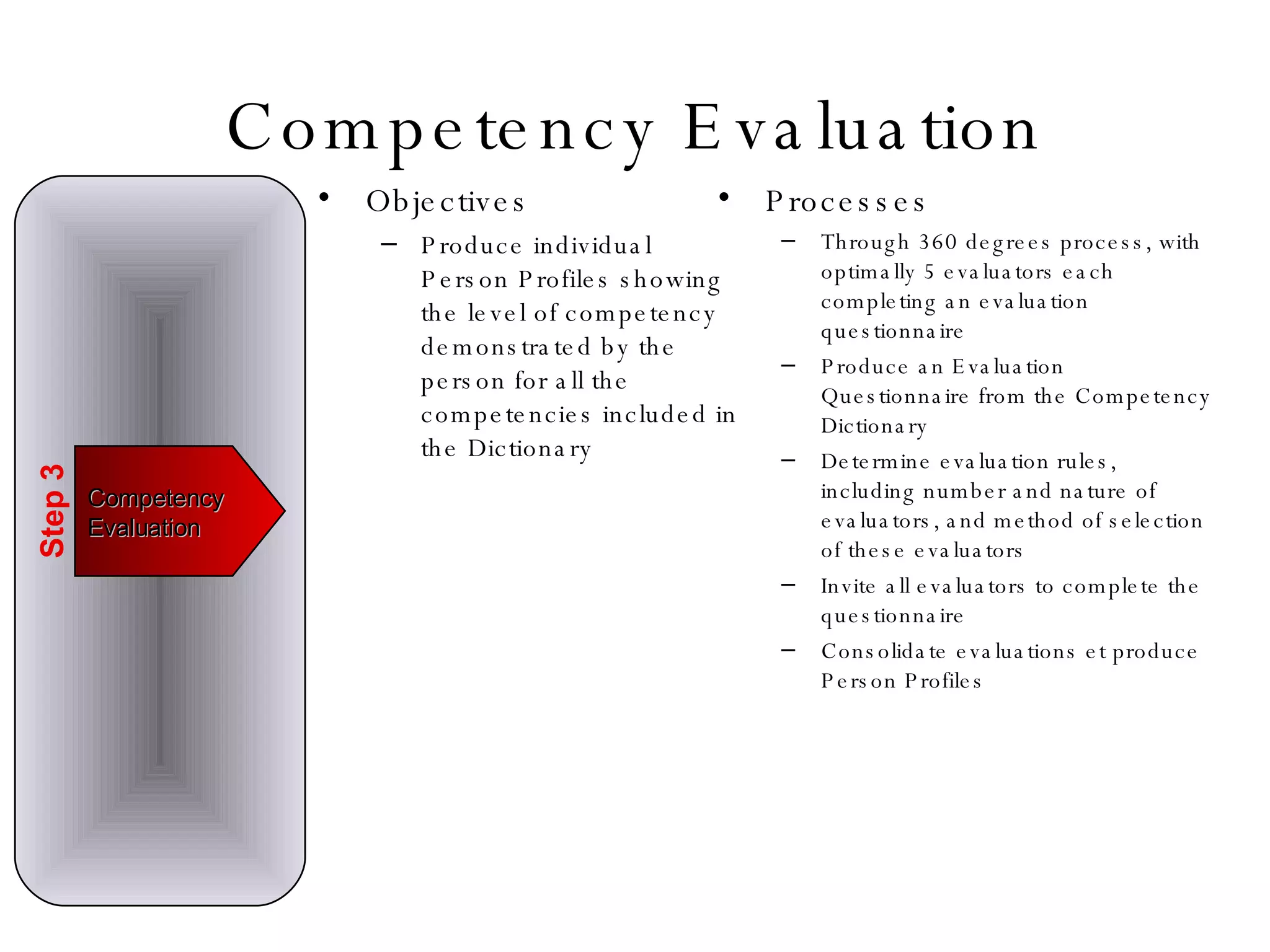
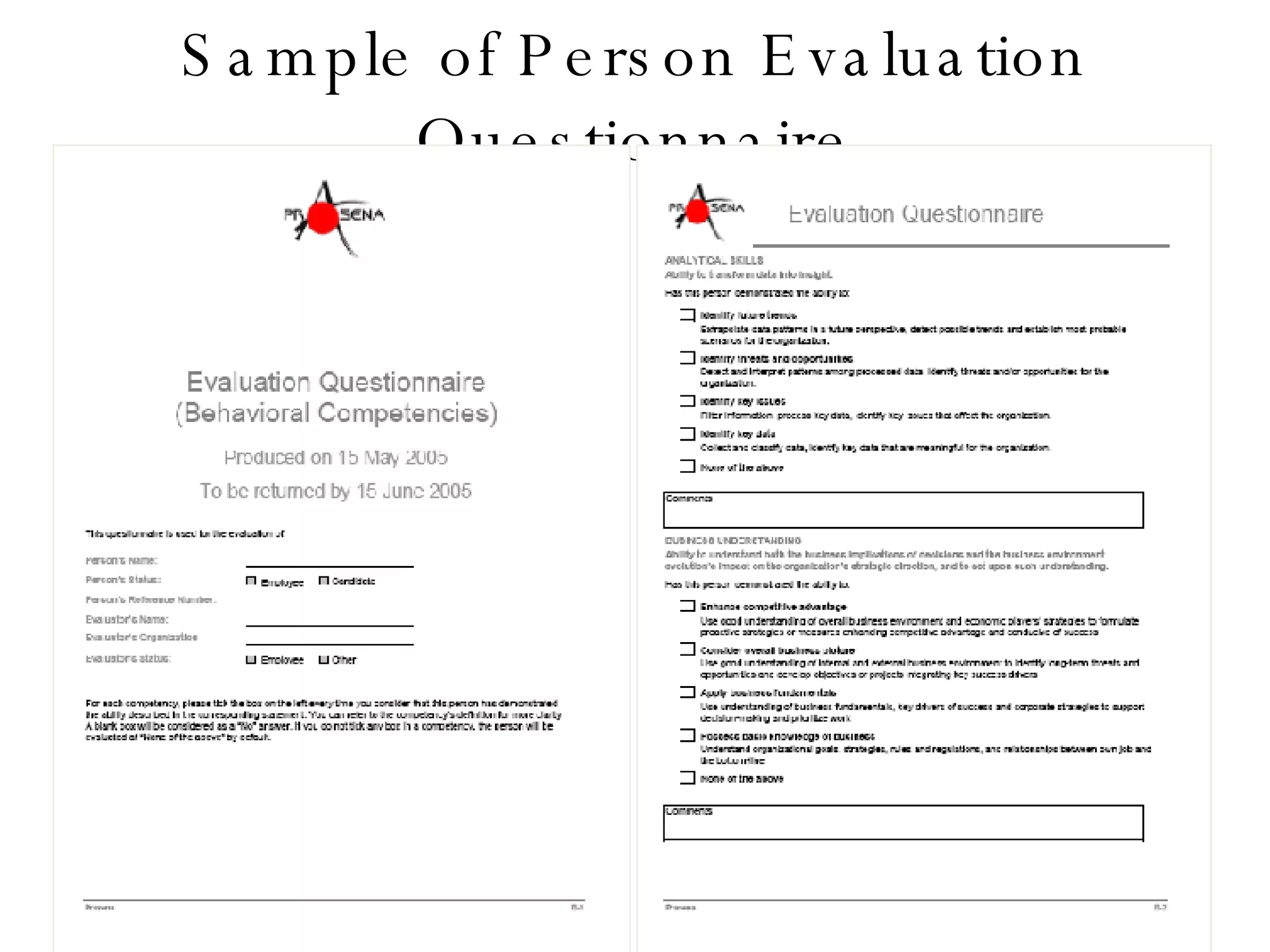
Competency Evaluation Objectives Produce individual Person Profiles showing the level of competency demonstrated by the person for all the competencies included in the Dictionary Processes Through 360 degrees process, with optimally 5 evaluators each completing an evaluation questionnaire Produce an Evaluation Questionnaire from the Competency Dictionary Determine evaluation rules, including number and nature of evaluators, and method of selection of these evaluators Invite all evaluators to complete the questionnaire Consolidate evaluations et produce Person Profiles Competency Evaluation Step 3
Sample of Person Evaluation Questionnaire
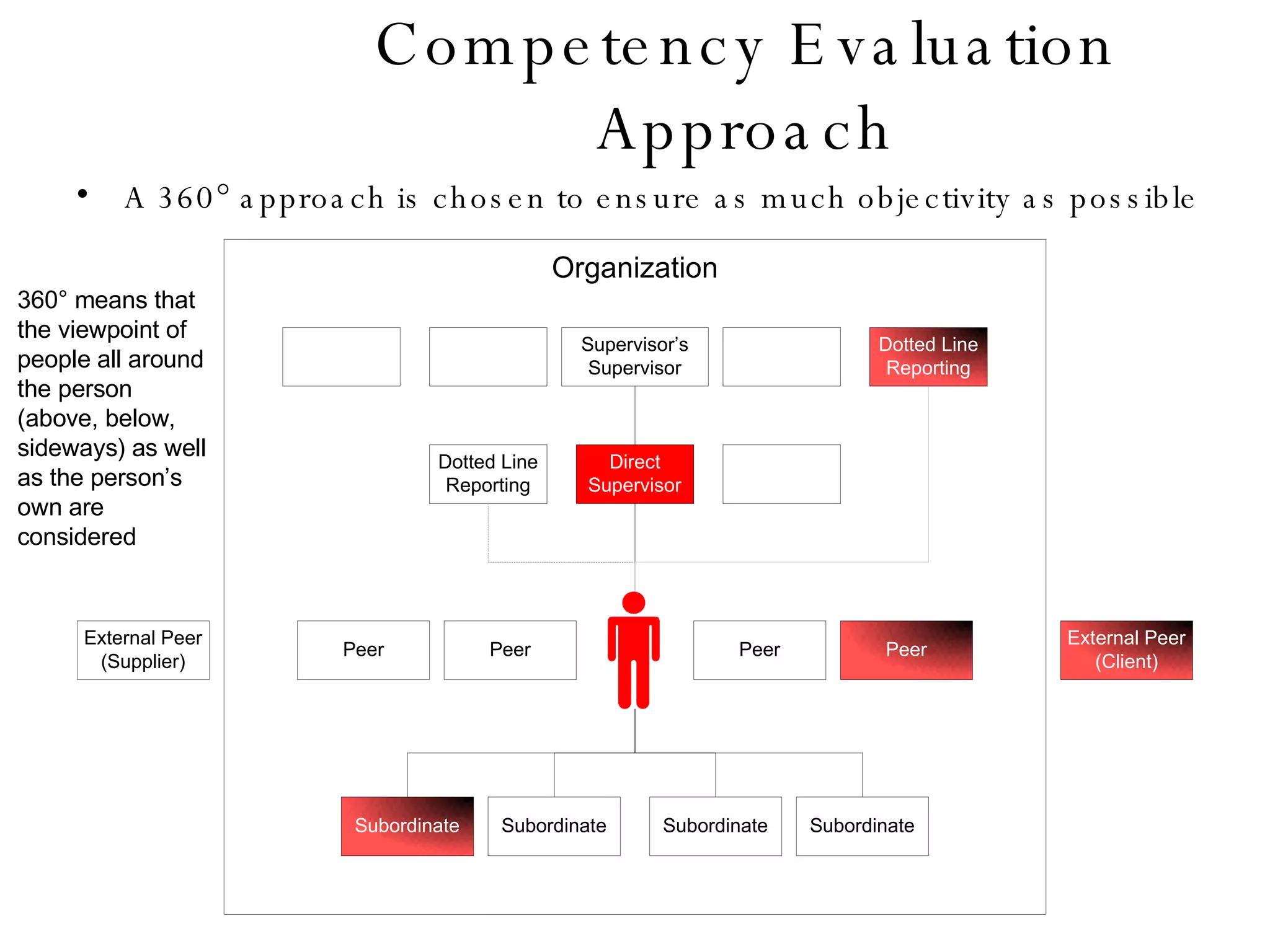
Competency Evaluation Approach A 360° approach is chosen to ensure as much objectivity as possible 360° means that the viewpoint of people all around the person (above, below, sideways) as well as the person’s own are considered
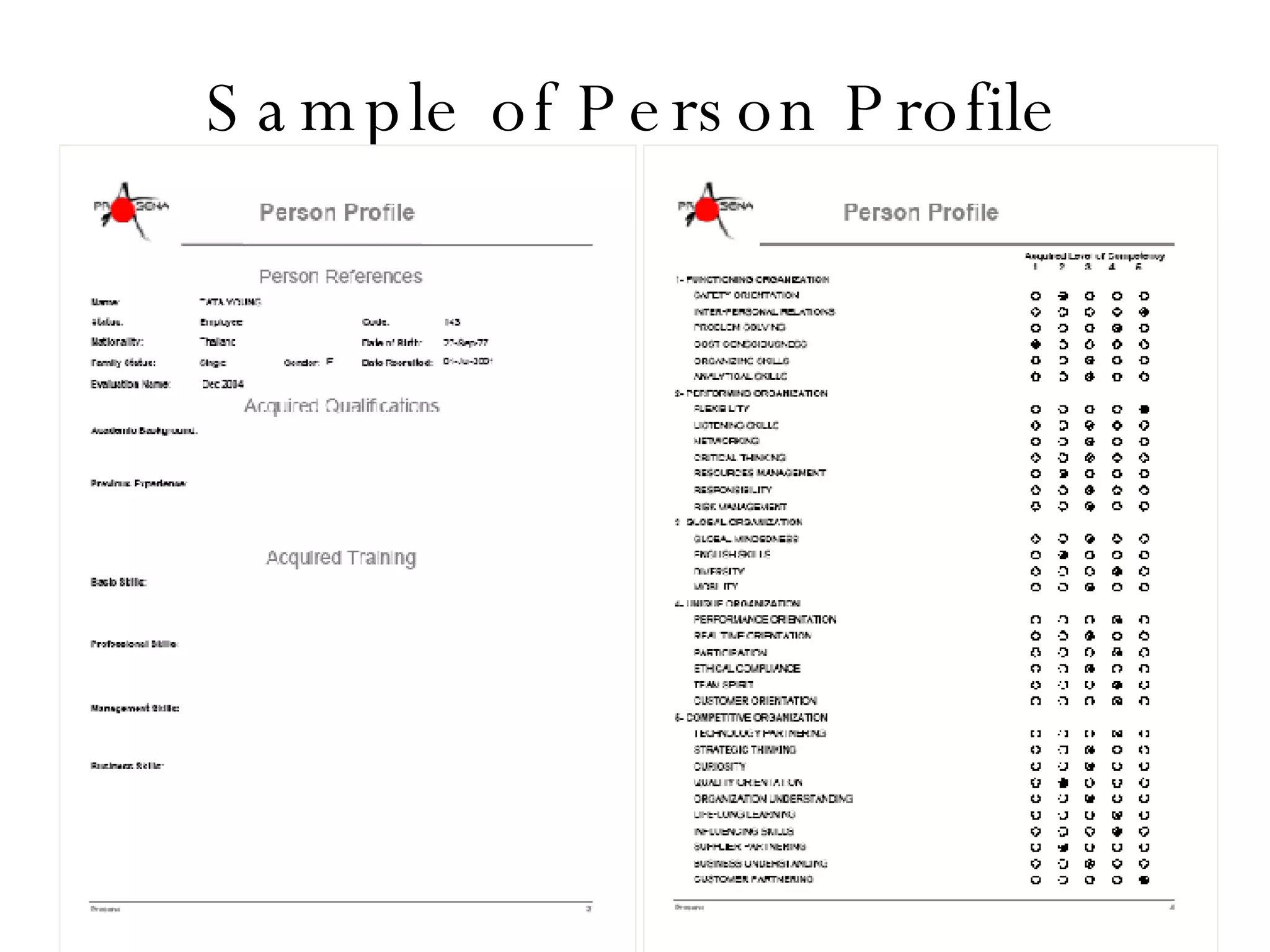
Sample of Person Profile
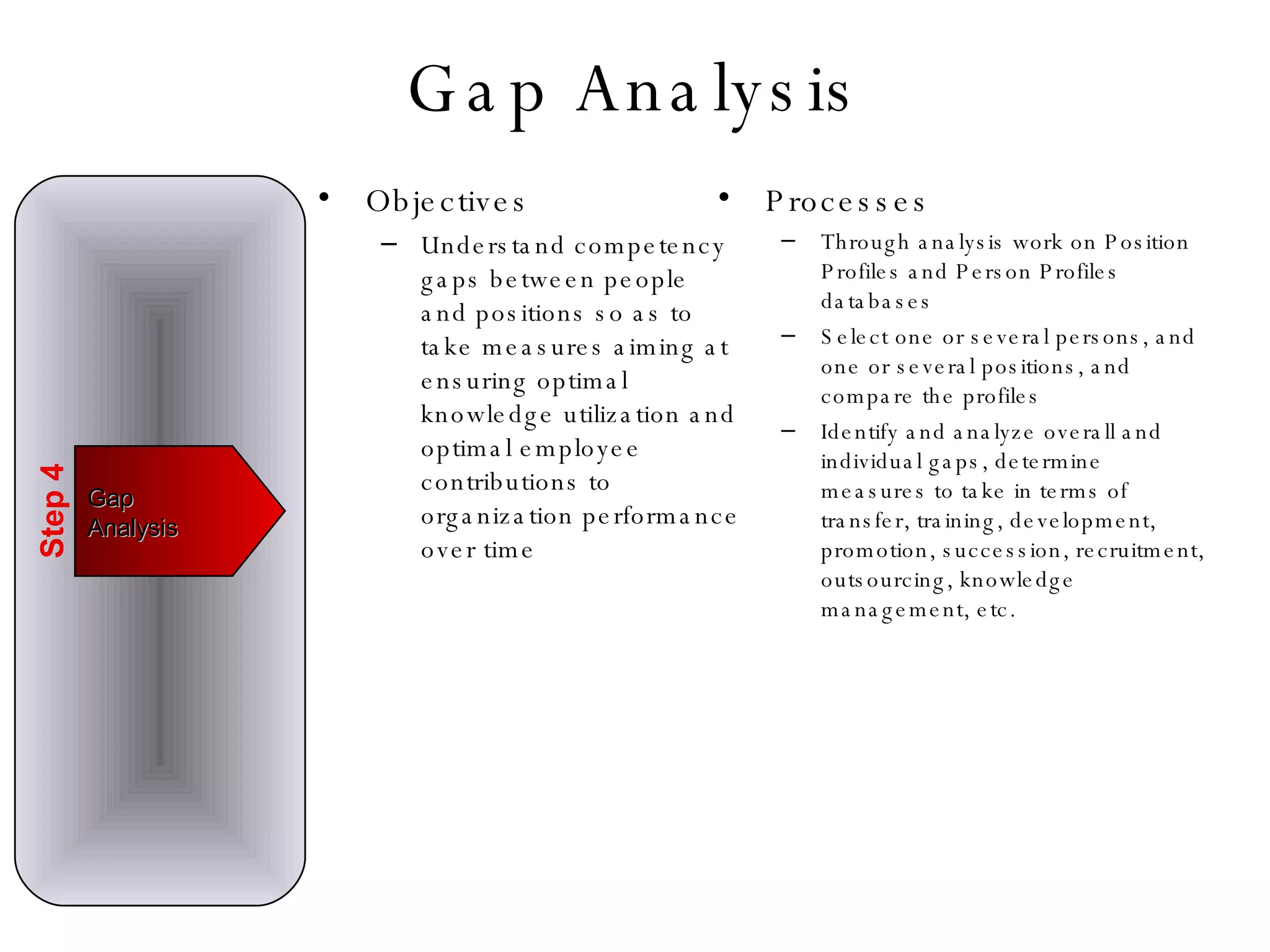
Gap Analysis Objectives Understand competency gaps between people and positions so as to take measures aiming at ensuring optimal knowledge utilization and optimal employee contributions to organization performance over time  Processes Through analysis work on Position Profiles and Person Profiles databases Select one or several persons, and one or several positions, and compare the profiles Identify and analyze overall and individual gaps, determine measures to take in terms of transfer, training, development, promotion, succession, recruitment, outsourcing, knowledge management, etc. Gap Analysis Step 4
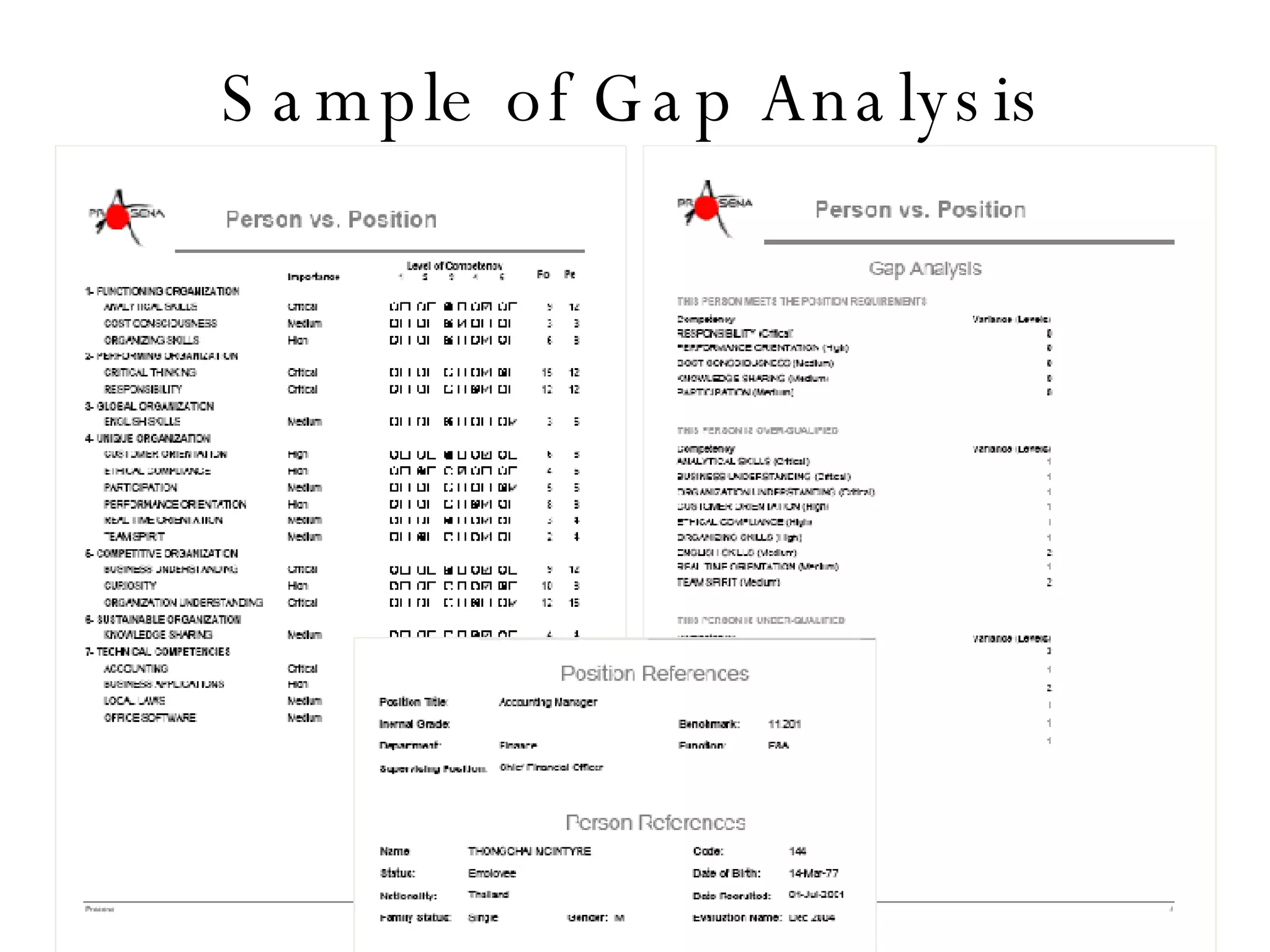
Sample of Gap Analysis
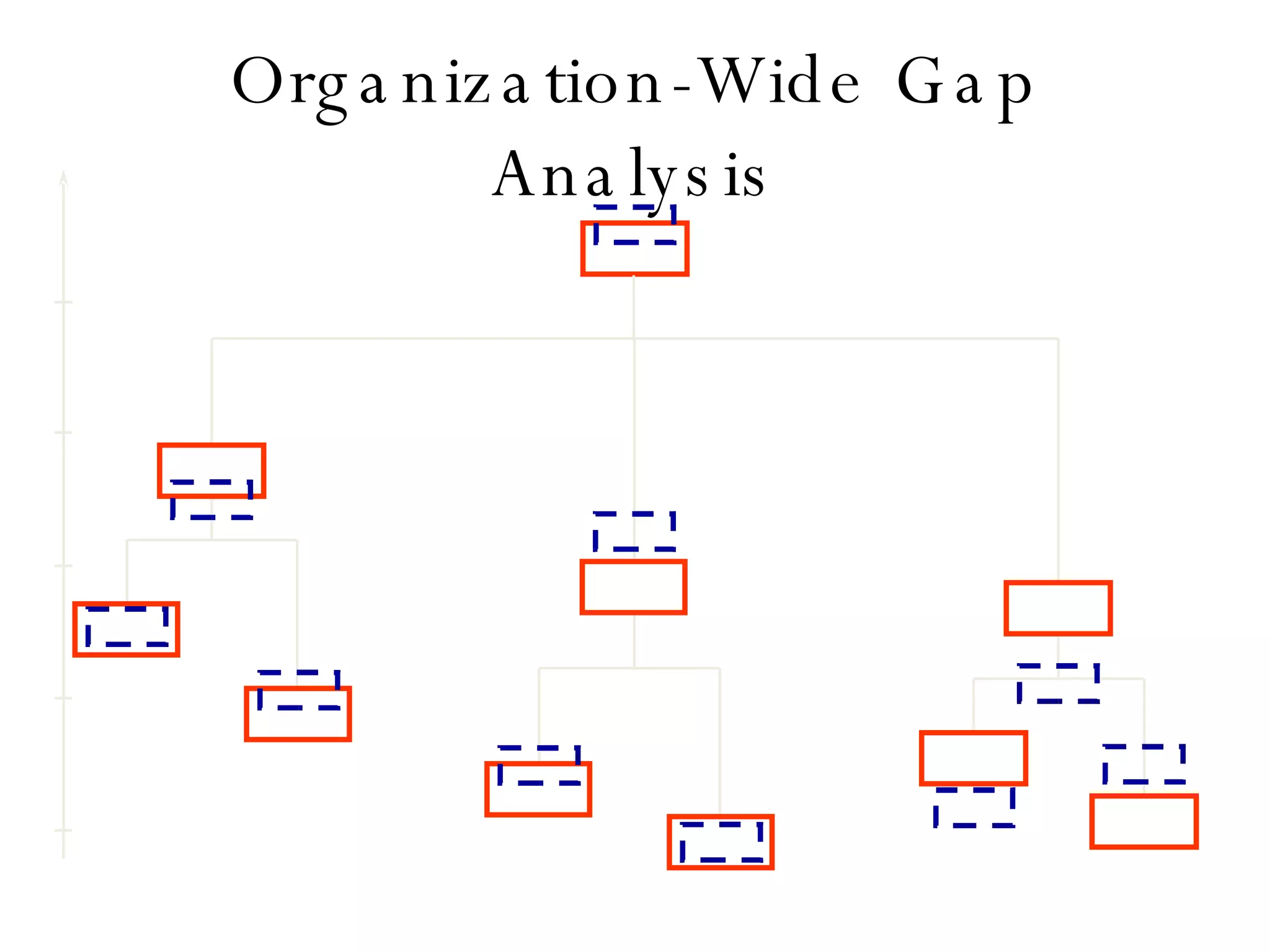
Organization-Wide Gap Analysis
System’s Applications At Individual Level Succession Planning Recruitment Career Management Promotion Planning Person Development Performance Problem Solving At Organization Level Corporate Culture Corporate Strengths Restructuring Training Policies Knowledge Sharing Human Capital Development Benefits Successful and well integrated corporate culture The right person in the right position Sustainable employment of valuable individuals Zero-defect recruitment Prompt performance problem solving Careers aligned with organization’s needs and person’s aspirations Return on training investments Full employment at all times (no undue vacancies) Well prepared restructuring exercises (no undue lay-offs) Competitiveness through human capital development
Sample of Candidate Selection Process
Sample of Promotion Planning Process
www.prasena.com

Competencies Concept in Human Resources Management

  • 1.
    By Isabelle Michele/ Philippe Kopcsan / Lukas Ritzel
  • 2.
    Lukas Ritzel, Swiss,management Professional Details: Mr. Lukas Ritzel currently is Manager ICT with DCT International Hotel & Business Management School , responsible for all virtual and collaborative technologies on campus, as well as faculty lecturing on different management topics.   Mr. Ritzel has been in international management since over 20 years, has done workshops and presentations in 40++ countries in 4++ languages. Further ; Mr. Ritzel is Cofounder of Change Management consulting company Prasena (www.prasena.com), his company got in 2004 the Purple Cow award of companies who "make a difference" from the FAST company. Mr. Ritzel has been working for Accor Asia Pacific as a consultant to the group in the innovative usage of technologies for all their Asia Rim Mr. Ritzel is a specialist in Creativity, eLearning, Management of Change, Learning Organizations and Knowledge management . His own teaching site is at http://www.dct.ch/ict/dct.htm. Mr. Ritzel is Switzerland chapter President of the Digital Workforce Education Society (www.digibridge.org). Mr. Ritzel has been speaker (in real as well as virtual) at many international conferences, some of his best presentations can be seen at Prasena's Virtual_U (http://www.prasena.com/public/virtual_u.html). Google "Lukas Ritzel" for more digital footprints. Online CV available at http://www.prasena.com/public/cvlor.htm
  • 3.
    Competencies in HRHow to use the talent of your workforce
  • 4.
    .. And whois going? “ Silent” Generation (born 1930-1945) Born with the military technologies that were to lead to analog, digital and virtual technologies “ Baby-Boom” Generation (born 1945-1960) Born with the analog and astronautic technologies Generation “X” ( born 1960-1975) Born among analog technologies (telephone, TV), witnessed and participated in the development of digital technologies Generation “Y” (born 1975-1990) Born with the first generation of digital technologies, witnessed and participated in the development of networked technologies … and soon , Generation “e” (born 1990-2005) Born in the midst of new technologies
  • 5.
  • 6.
    Competencies Management Thesingle most important resources management challenge in our knowledge-based, internet driven economy Efficient HR management is about optimizing the inventory of resources. Such efficient HR management should allow to answer the question: “What are people capable of, and how does it help the organization?”. The competencies that are important for the organization’s corporate culture, current and future competitiveness must be identified, the extent to which each employee has demonstrated these competencies must be evaluated and compared with the requirements of current and potential positions.
  • 7.
    Questions that HRMshould be able to answer – traditional HR cannot! What positions do we have in the organization chart, and for what purpose? How do these positions relate to each other and what is their relative importance ? What is each individual employee capable of , and how does it help the organization? What are the standing costs of the organization chart? How do we optimally share business objectives among all individual employees? How do we measure corporate and individual business performance ? What are the utilization costs of the employees? When and how should we restructure the organization over time? Who should we recruit to fulfill tomorrow’s needs, and how? How should we develop each of our individual employees over time? What resources should we eliminate over time, and how? What are the development costs of our employees? How do we calculate and monitor total personnel costs at individual and organization levels? How do we measure and monitor the value generated by our employees? How do we evaluate return on our human investments ?
  • 8.
    Process Steps Developa Dictionary of Competencies that contains all the behavioral, functional and technical competencies required for the organization to maintain its unique corporate culture and its competitiveness over time For each position, develop a Position Profile showing the competencies that apply to the position, their level of importance for the organization, and the level required in each competency to be operational in the position Evaluate each employee against all the competencies contained in the dictionary through a 360 degree approach for greater objectivity Competency Dictionary Step 1 Position Requirements Step 2 Competency Evaluation Step 3 Gap Analysis Step 4 Compare one or several Person Profiles with one or several Position Profiles, analyze gaps and identify measures to take in terms of transfer, training, development, promotion, succession, etc.
  • 9.
    Competency Dictionary ObjectivesIdentify and define all the behavioral, functional and technical competencies required for the organization to maintain its unique corporate culture and its competitiveness over time Processes Through working session with corporate leadership Identify the main competencies that are required for the organization to remain unique and competitive Classify these competencies in relevant clusters Define each competency, and develop a five-level evaluation scale to facilitate evaluations Produce the Dictionary Competency Dictionary Step 1
  • 10.
  • 11.
  • 12.
    Position Requirements ObjectivesIdentify the nature, importance and level of behavioral, functional and technical competencies required for a person to be operational in a position Processes Through working sessions with middle management committees and HR team Identify and list down the existing or expected positions, and analyze Position Descriptions For each position, select from the Competency Dictionary the competencies that are required for the position For each selected competency, determine the level of importance and the level of competency Produce Position Profiles Position Requirements Step 2
  • 13.
  • 14.
    Competency Evaluation ObjectivesProduce individual Person Profiles showing the level of competency demonstrated by the person for all the competencies included in the Dictionary Processes Through 360 degrees process, with optimally 5 evaluators each completing an evaluation questionnaire Produce an Evaluation Questionnaire from the Competency Dictionary Determine evaluation rules, including number and nature of evaluators, and method of selection of these evaluators Invite all evaluators to complete the questionnaire Consolidate evaluations et produce Person Profiles Competency Evaluation Step 3
  • 15.
    Sample of PersonEvaluation Questionnaire
  • 16.
    Competency Evaluation ApproachA 360° approach is chosen to ensure as much objectivity as possible 360° means that the viewpoint of people all around the person (above, below, sideways) as well as the person’s own are considered
  • 17.
  • 18.
    Gap Analysis ObjectivesUnderstand competency gaps between people and positions so as to take measures aiming at ensuring optimal knowledge utilization and optimal employee contributions to organization performance over time Processes Through analysis work on Position Profiles and Person Profiles databases Select one or several persons, and one or several positions, and compare the profiles Identify and analyze overall and individual gaps, determine measures to take in terms of transfer, training, development, promotion, succession, recruitment, outsourcing, knowledge management, etc. Gap Analysis Step 4
  • 19.
    Sample of GapAnalysis
  • 20.
  • 21.
    System’s Applications AtIndividual Level Succession Planning Recruitment Career Management Promotion Planning Person Development Performance Problem Solving At Organization Level Corporate Culture Corporate Strengths Restructuring Training Policies Knowledge Sharing Human Capital Development Benefits Successful and well integrated corporate culture The right person in the right position Sustainable employment of valuable individuals Zero-defect recruitment Prompt performance problem solving Careers aligned with organization’s needs and person’s aspirations Return on training investments Full employment at all times (no undue vacancies) Well prepared restructuring exercises (no undue lay-offs) Competitiveness through human capital development
  • 22.
    Sample of CandidateSelection Process
  • 23.
    Sample of PromotionPlanning Process
  • 24.

Editor's Notes

  • #2 http://edition.cnn.com/video/#/video/world/2007/06/28/dougherty.russia.the.future.affl You have it all, so what can I tell you? More movies to watch by yourself http://www.youtube.com/watch?v=z_OUkc7hh30 part 1 http://www.youtube.com/watch?v=16y2QIplmrs part 2 05/27/09