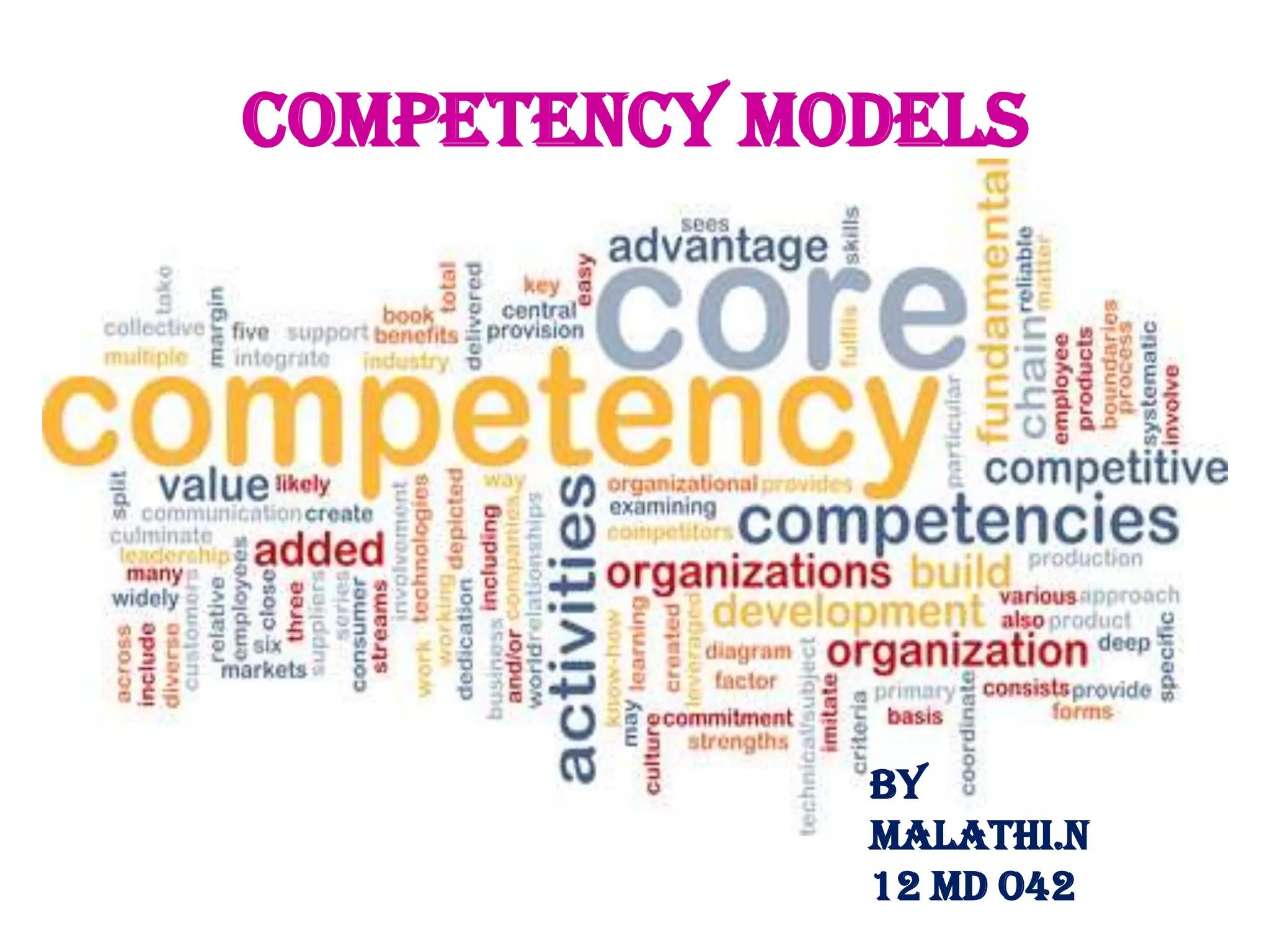
COMPETENCY MODELS
BY
MALATHI.N
12 MD O42
COMPETENCY
competency is described as "a cluster of
knowledge, skills, abilities, behaviors, and attitudes related to
job success and failure " (Byham & Moyer, 2000;
Cooper, 2000; Green, 1999; Lucia & Lepsinger, 1999;
Parry, 1996 ).
This new behavioral approach creates what "good" competencies
might look like. Characteristics of a set of useful competency
list are,
1) Exhibiting job-relatedness,
2) Observable and measurable against well-accepted job
standards or criteria,
3) Being improved via training and development, and
4) Providing insights on determining how capable or fitness a
person is to a job and an organization.
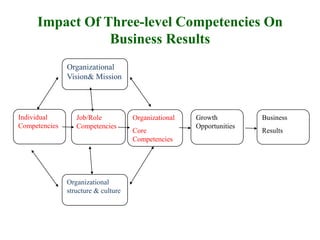
Impact Of Three-level Competencies On
Business Results
Individual
Competencies
Organizational
structure & culture
Organizational
Vision& Mission
Job/Role
Competencies
Organizational
Core
Competencies
Growth
Opportunities
Business
Results
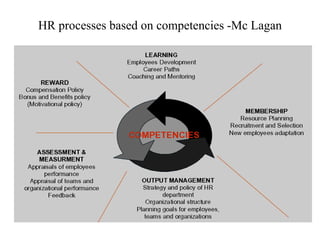
HR processes based on competencies -Mc Lagan
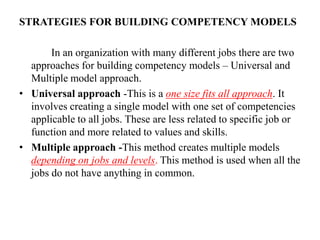
STRATEGIES FOR BUILDING COMPETENCY MODELS
In an organization with many different jobs there are two
approaches for building competency models – Universal and
Multiple model approach.
• Universal approach -This is a one size fits all approach. It
involves creating a single model with one set of competencies
applicable to all jobs. These are less related to specific job or
function and more related to values and skills.
• Multiple approach -This method creates multiple models
depending on jobs and levels. This method is used when all the
jobs do not have anything in common.
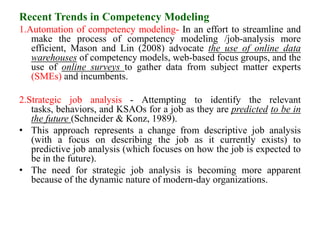
Recent Trends in Competency Modeling
1.Automation of competency modeling- In an effort to streamline and
make the process of competency modeling /job-analysis more
efficient, Mason and Lin (2008) advocate the use of online data
warehouses of competency models, web-based focus groups, and the
use of online surveys to gather data from subject matter experts
(SMEs) and incumbents.
2.Strategic job analysis - Attempting to identify the relevant
tasks, behaviors, and KSAOs for a job as they are predicted to be in
the future (Schneider & Konz, 1989).
• This approach represents a change from descriptive job analysis
(with a focus on describing the job as it currently exists) to
predictive job analysis (which focuses on how the job is expected to
be in the future).
• The need for strategic job analysis is becoming more apparent
because of the dynamic nature of modern-day organizations.
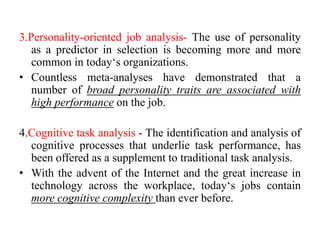
3.Personality-oriented job analysis- The use of personality
as a predictor in selection is becoming more and more
common in today‘s organizations.
• Countless meta-analyses have demonstrated that a
number of broad personality traits are associated with
high performance on the job.
4.Cognitive task analysis - The identification and analysis of
cognitive processes that underlie task performance, has
been offered as a supplement to traditional task analysis.
• With the advent of the Internet and the great increase in
technology across the workplace, today‘s jobs contain
more cognitive complexity than ever before.
Potential Uses Of The Model
The model can be used for multiple reasons.
1.Competency modeling is an important innovation in that it is a
way to get organizations to pay attention to job-related
information and employee skills in the management of
employees.
2.They are often intended to distinguish top performers from
average performers (e.g., Parry, 1996; Olesen, White, &
Lemmer, 2007). They focus less on and may even omit
descriptors of tasks or KSAOs that do not help understand
employee performance (but cf., Lievens, Sanchez, & De Corte,
2004).
3.They often include descriptions of how the competencies
change or progress with employee level (e.g., Martone, 2003;
Rodriguez et al.,2002).
4.The KSAOs are usually linked to the business objectives and
strategies (e.g., Green, 1999; Martone, 2003; Rodriguez et
al., 2002).
5. They are developed top down rather than bottom up like job
analysis.
6.Competency models may consider future job requirements
either directly or indirectly (e.g., Parry, 1996; Rodriguez et
al., 2002; Schippmann et al., 2000). They do not document the
status quo but attempt to look into the future.
7.Competency models are usually presented in a manner that
facilitates ease of use. Designing for ease of use often includes
the utilization of organization-specific language.
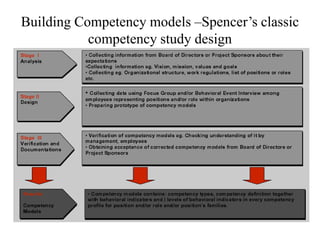
Building Competency models –Spencer’s classic
competency study design
Multipurpose Occupational Systems Analysis
Inventory - Close-Ended (MOSAIC)
Competencies
United States, Office Of Personnel Management ,OPM has been
conducting Government wide occupational studies using its
Multipurpose Occupational Systems Analysis Inventory -
Close-Ended (MOSAIC) methodology for more than two
decades.
MOSAIC, a multipurpose, survey-based occupational analysis
approach, is used to collect information from incumbents and
supervisors on many occupations for a wide range of human
resource management functions
MOSAIC Continued…
Identified the 885 competencies employees need to perform
successfully in nearly 200 Federal occupations, as well as for
leadership positions.
These competencies provide users with a basis for building
integrated human resource management systems that use a
common set of competencies to structure job
design, recruitment, selection, performance
management, training, and career development so that
employees receive a consistent message about the factors on
which they are selected, trained, and evaluated.
Developing Competency Model
Competency modeling is a process of determining what
competencies are necessary for successfully performing a job
or a role.
The competency models are normally linked to organization‘s
strategic purposes for achieving results. Valid competency
models help to strengthen HR systems, improve overall
performance, and increase business impacts over time (Cook
& Bemthal, 1996; Parry, 1996, 1998)
A variety of a profile and its applications varies according to a
diversity of business results, target groups, job/ roles, and
positions.
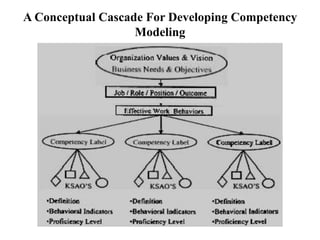
A Conceptual Cascade For Developing Competency
Modeling
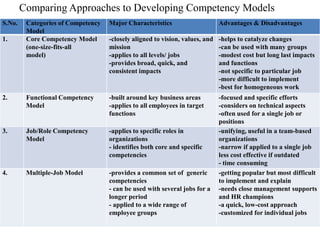
Comparing Approaches to Developing Competency Models
S.No. Categories of Competency
Model
Major Characteristics Advantages & Disadvantages
1. Core Competency Model
(one-size-fits-all
model)
-closely aligned to vision, values, and
mission
-applies to all levels/ jobs
-provides broad, quick, and
consistent impacts
-helps to catalyze changes
-can be used with many groups
-modest cost but long last impacts
and functions
-not specific to particular job
-more difficult to implement
-best for homogeneous work
2. Functional Competency
Model
-built around key business areas
-applies to all employees in target
functions
-focused and specific efforts
-considers on technical aspects
-often used for a single job or
positions
3. Job/Role Competency
Model
-applies to specific roles in
organizations
- identifies both core and specific
competencies
-unifying, useful in a team-based
organizations
-narrow if applied to a single job
less cost effective if outdated
- time consuming
4. Multiple-Job Model -provides a common set of generic
competencies
- can be used with several jobs for a
longer period
- applied to a wide range of
employee groups
-getting popular but most difficult
to implement and explain
-needs close management supports
and HR champions
-a quick, low-cost approach
-customized for individual jobs
HR Professional Framework
 The HR Professional Framework will help to identify the
person in relation to the roles.
 The purpose of the framework is to help think about the
direction you would like to take as you pursue a career within
the HR profession.
 It can be a useful reference in building the Individual
Development Plan (IDP) with the manager, coach or mentor.
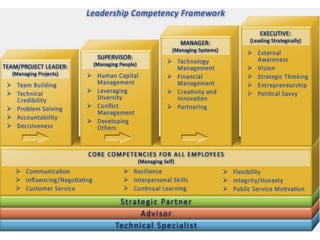
 The HRM Competency Model features 24 general
competencies, categorized into three HR Professional Roles,
plus the Leader Role.
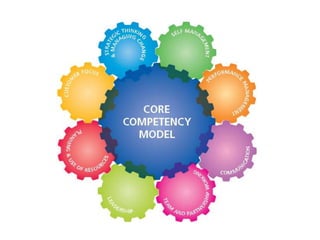
I-Core Competency Model:
• CUSTOMER FOCUS
• PERFORMANCE MANAGEMENT
• PLANNING & USE OF RESOURCES
• COMMUNICATION
• STRATEGIC THINKING
& MANAGING CHANGE
• SELF MANAGEMENT
• LEADERSHIP
• TEAM AND PARTNERSHIP WORKING
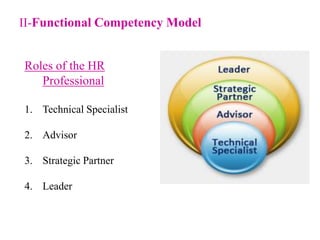
II-Functional Competency Model
Roles of the HR
Professional
1. Technical Specialist
2. Advisor
3. Strategic Partner
4. Leader
The seven critical general competencies in the ADVISOR
ROLE are:
• Creative Thinking
• Client Engagement / Change Management
• Decision Making
• Flexibility
• Influencing/Negotiating
• Project Management
• Reasoning
III-Job/Role Competency Model
SPECIFIC ROLES OF ADVISOR:
• Advisor Apprentice
• Advisor Practitioner
• Advisor Expert
Advisor Apprentice:
• Has a moderate level of strategic ability and only a limited
familiarity with technical HR operations.
• Is likely in the beginning stages of a career as an HR leader.
• The Advisor Apprentice's skills would be enhanced through
partnering with and learning from experts in both technical and
strategic HR operations.
Advisor Practitioner
• Has a moderate level of both strategic and technical HR
ability.
• The Advisor Practitioner would serve as an effective
advisor for experienced HR leaders.
Advisor Expert
• Has a high level of technical ability and a moderate
familiarity with strategic HR operations.
• Serves as an excellent advisor to experienced and
novice HR leaders.
• With a little more strategic training, the Advisory
Expert can likely be an effective HR leader.
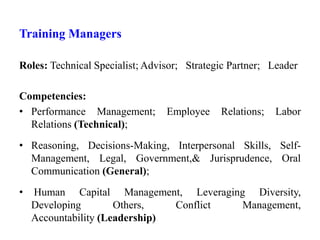
Training Managers
Roles: Technical Specialist; Advisor; Strategic Partner; Leader
Competencies:
• Performance Management; Employee Relations; Labor
Relations (Technical);
• Reasoning, Decisions-Making, Interpersonal Skills, Self-
Management, Legal, Government,& Jurisprudence, Oral
Communication (General);
• Human Capital Management, Leveraging Diversity,
Developing Others, Conflict Management,
Accountability (Leadership)
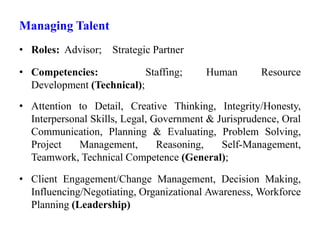
Managing Talent
• Roles: Advisor; Strategic Partner
• Competencies: Staffing; Human Resource
Development (Technical);
• Attention to Detail, Creative Thinking, Integrity/Honesty,
Interpersonal Skills, Legal, Government & Jurisprudence, Oral
Communication, Planning & Evaluating, Problem Solving,
Project Management, Reasoning, Self-Management,
Teamwork, Technical Competence (General);
• Client Engagement/Change Management, Decision Making,
Influencing/Negotiating, Organizational Awareness, Workforce
Planning (Leadership)
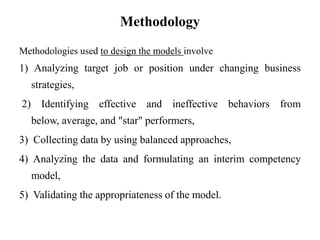
Methodology
Methodologies used to design the models involve
1) Analyzing target job or position under changing business
strategies,
2) Identifying effective and ineffective behaviors from
below, average, and "star" performers,
3) Collecting data by using balanced approaches,
4) Analyzing the data and formulating an interim competency
model,
5) Validating the appropriateness of the model.
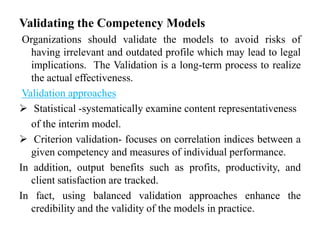
Validating the Competency Models
Organizations should validate the models to avoid risks of
having irrelevant and outdated profile which may lead to legal
implications. The Validation is a long-term process to realize
the actual effectiveness.
Validation approaches
 Statistical -systematically examine content representativeness
of the interim model.
 Criterion validation- focuses on correlation indices between a
given competency and measures of individual performance.
In addition, output benefits such as profits, productivity, and
client satisfaction are tracked.
In fact, using balanced validation approaches enhance the
credibility and the validity of the models in practice.
Benefits of Valid competency models
 They provide directional guidance in behavioral terms what
people at every level need to do in delivering results.
 When properly defined, their measurability helps to differentiate
effective performance from those average and substandard. The
assessment information can also be used to benchmark
management effectiveness between organizations.
 Competencies regarded as critical to business survival and
success can be learned and improved.
 Good competency models provide comprehensive integration into
many human resource practices.
Competency-based Management (CBM)
CBM can be regarded as an approach to managing employee
performance based on both the "what" is achieved and the
"how" results are derived.
The presence of organizational culture that fosters change,
excellence innovation, participative decision-making, and
continuous learning will greatly enable the application of
CBM to success.
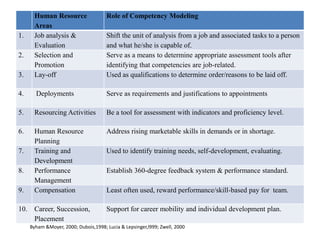
Human Resource
Areas
Role of Competency Modeling
1. Job analysis &
Evaluation
Shift the unit of analysis from a job and associated tasks to a person
and what he/she is capable of.
2. Selection and
Promotion
Serve as a means to determine appropriate assessment tools after
identifying that competencies are job-related.
3. Lay-off Used as qualifications to determine order/reasons to be laid off.
4. Deployments Serve as requirements and justifications to appointments
5. Resourcing Activities Be a tool for assessment with indicators and proficiency level.
6. Human Resource
Planning
Address rising marketable skills in demands or in shortage.
7. Training and
Development
Used to identify training needs, self-development, evaluating.
8. Performance
Management
Establish 360-degree feedback system & performance standard.
9. Compensation Least often used, reward performance/skill-based pay for team.
10. Career, Succession,
Placement
Support for career mobility and individual development plan.
Byham &Moyer, 2000; Dubois,1998; Lucia & Lepsinger,l999; Zwell, 2000
CONCLUSION:
It is realized that there is no right answer to competency
issues. What is important for organizations is adopting
definitions, models, and approaches that make sense, meet
their needs, and used them consistently.
THANK YOU

competencymodel-131110094804-phpapp01.pdf

  • 1.
  • 2.
    COMPETENCY competency is describedas "a cluster of knowledge, skills, abilities, behaviors, and attitudes related to job success and failure " (Byham & Moyer, 2000; Cooper, 2000; Green, 1999; Lucia & Lepsinger, 1999; Parry, 1996 ). This new behavioral approach creates what "good" competencies might look like. Characteristics of a set of useful competency list are, 1) Exhibiting job-relatedness, 2) Observable and measurable against well-accepted job standards or criteria, 3) Being improved via training and development, and 4) Providing insights on determining how capable or fitness a person is to a job and an organization.
  • 3.
    Impact Of Three-levelCompetencies On Business Results Individual Competencies Organizational structure & culture Organizational Vision& Mission Job/Role Competencies Organizational Core Competencies Growth Opportunities Business Results
  • 4.
    HR processes basedon competencies -Mc Lagan
  • 5.
    STRATEGIES FOR BUILDINGCOMPETENCY MODELS In an organization with many different jobs there are two approaches for building competency models – Universal and Multiple model approach. • Universal approach -This is a one size fits all approach. It involves creating a single model with one set of competencies applicable to all jobs. These are less related to specific job or function and more related to values and skills. • Multiple approach -This method creates multiple models depending on jobs and levels. This method is used when all the jobs do not have anything in common.
  • 6.
    Recent Trends inCompetency Modeling 1.Automation of competency modeling- In an effort to streamline and make the process of competency modeling /job-analysis more efficient, Mason and Lin (2008) advocate the use of online data warehouses of competency models, web-based focus groups, and the use of online surveys to gather data from subject matter experts (SMEs) and incumbents. 2.Strategic job analysis - Attempting to identify the relevant tasks, behaviors, and KSAOs for a job as they are predicted to be in the future (Schneider & Konz, 1989). • This approach represents a change from descriptive job analysis (with a focus on describing the job as it currently exists) to predictive job analysis (which focuses on how the job is expected to be in the future). • The need for strategic job analysis is becoming more apparent because of the dynamic nature of modern-day organizations.
  • 7.
    3.Personality-oriented job analysis-The use of personality as a predictor in selection is becoming more and more common in today‘s organizations. • Countless meta-analyses have demonstrated that a number of broad personality traits are associated with high performance on the job. 4.Cognitive task analysis - The identification and analysis of cognitive processes that underlie task performance, has been offered as a supplement to traditional task analysis. • With the advent of the Internet and the great increase in technology across the workplace, today‘s jobs contain more cognitive complexity than ever before.
  • 8.
    Potential Uses OfThe Model The model can be used for multiple reasons. 1.Competency modeling is an important innovation in that it is a way to get organizations to pay attention to job-related information and employee skills in the management of employees. 2.They are often intended to distinguish top performers from average performers (e.g., Parry, 1996; Olesen, White, & Lemmer, 2007). They focus less on and may even omit descriptors of tasks or KSAOs that do not help understand employee performance (but cf., Lievens, Sanchez, & De Corte, 2004). 3.They often include descriptions of how the competencies change or progress with employee level (e.g., Martone, 2003; Rodriguez et al.,2002).
  • 9.
    4.The KSAOs areusually linked to the business objectives and strategies (e.g., Green, 1999; Martone, 2003; Rodriguez et al., 2002). 5. They are developed top down rather than bottom up like job analysis. 6.Competency models may consider future job requirements either directly or indirectly (e.g., Parry, 1996; Rodriguez et al., 2002; Schippmann et al., 2000). They do not document the status quo but attempt to look into the future. 7.Competency models are usually presented in a manner that facilitates ease of use. Designing for ease of use often includes the utilization of organization-specific language.
  • 10.
    Building Competency models–Spencer’s classic competency study design
  • 11.
    Multipurpose Occupational SystemsAnalysis Inventory - Close-Ended (MOSAIC) Competencies United States, Office Of Personnel Management ,OPM has been conducting Government wide occupational studies using its Multipurpose Occupational Systems Analysis Inventory - Close-Ended (MOSAIC) methodology for more than two decades. MOSAIC, a multipurpose, survey-based occupational analysis approach, is used to collect information from incumbents and supervisors on many occupations for a wide range of human resource management functions
  • 12.
    MOSAIC Continued… Identified the885 competencies employees need to perform successfully in nearly 200 Federal occupations, as well as for leadership positions. These competencies provide users with a basis for building integrated human resource management systems that use a common set of competencies to structure job design, recruitment, selection, performance management, training, and career development so that employees receive a consistent message about the factors on which they are selected, trained, and evaluated.
  • 13.
    Developing Competency Model Competencymodeling is a process of determining what competencies are necessary for successfully performing a job or a role. The competency models are normally linked to organization‘s strategic purposes for achieving results. Valid competency models help to strengthen HR systems, improve overall performance, and increase business impacts over time (Cook & Bemthal, 1996; Parry, 1996, 1998) A variety of a profile and its applications varies according to a diversity of business results, target groups, job/ roles, and positions.
  • 14.
    A Conceptual CascadeFor Developing Competency Modeling
  • 15.
    Comparing Approaches toDeveloping Competency Models S.No. Categories of Competency Model Major Characteristics Advantages & Disadvantages 1. Core Competency Model (one-size-fits-all model) -closely aligned to vision, values, and mission -applies to all levels/ jobs -provides broad, quick, and consistent impacts -helps to catalyze changes -can be used with many groups -modest cost but long last impacts and functions -not specific to particular job -more difficult to implement -best for homogeneous work 2. Functional Competency Model -built around key business areas -applies to all employees in target functions -focused and specific efforts -considers on technical aspects -often used for a single job or positions 3. Job/Role Competency Model -applies to specific roles in organizations - identifies both core and specific competencies -unifying, useful in a team-based organizations -narrow if applied to a single job less cost effective if outdated - time consuming 4. Multiple-Job Model -provides a common set of generic competencies - can be used with several jobs for a longer period - applied to a wide range of employee groups -getting popular but most difficult to implement and explain -needs close management supports and HR champions -a quick, low-cost approach -customized for individual jobs
  • 16.
    HR Professional Framework The HR Professional Framework will help to identify the person in relation to the roles.  The purpose of the framework is to help think about the direction you would like to take as you pursue a career within the HR profession.  It can be a useful reference in building the Individual Development Plan (IDP) with the manager, coach or mentor.  The HRM Competency Model features 24 general competencies, categorized into three HR Professional Roles, plus the Leader Role.
  • 18.
    I-Core Competency Model: •CUSTOMER FOCUS • PERFORMANCE MANAGEMENT • PLANNING & USE OF RESOURCES • COMMUNICATION • STRATEGIC THINKING & MANAGING CHANGE • SELF MANAGEMENT • LEADERSHIP • TEAM AND PARTNERSHIP WORKING
  • 19.
    II-Functional Competency Model Rolesof the HR Professional 1. Technical Specialist 2. Advisor 3. Strategic Partner 4. Leader
  • 20.
    The seven criticalgeneral competencies in the ADVISOR ROLE are: • Creative Thinking • Client Engagement / Change Management • Decision Making • Flexibility • Influencing/Negotiating • Project Management • Reasoning
  • 21.
    III-Job/Role Competency Model SPECIFICROLES OF ADVISOR: • Advisor Apprentice • Advisor Practitioner • Advisor Expert Advisor Apprentice: • Has a moderate level of strategic ability and only a limited familiarity with technical HR operations. • Is likely in the beginning stages of a career as an HR leader. • The Advisor Apprentice's skills would be enhanced through partnering with and learning from experts in both technical and strategic HR operations.
  • 22.
    Advisor Practitioner • Hasa moderate level of both strategic and technical HR ability. • The Advisor Practitioner would serve as an effective advisor for experienced HR leaders. Advisor Expert • Has a high level of technical ability and a moderate familiarity with strategic HR operations. • Serves as an excellent advisor to experienced and novice HR leaders. • With a little more strategic training, the Advisory Expert can likely be an effective HR leader.
  • 24.
    Training Managers Roles: TechnicalSpecialist; Advisor; Strategic Partner; Leader Competencies: • Performance Management; Employee Relations; Labor Relations (Technical); • Reasoning, Decisions-Making, Interpersonal Skills, Self- Management, Legal, Government,& Jurisprudence, Oral Communication (General); • Human Capital Management, Leveraging Diversity, Developing Others, Conflict Management, Accountability (Leadership)
  • 25.
    Managing Talent • Roles:Advisor; Strategic Partner • Competencies: Staffing; Human Resource Development (Technical); • Attention to Detail, Creative Thinking, Integrity/Honesty, Interpersonal Skills, Legal, Government & Jurisprudence, Oral Communication, Planning & Evaluating, Problem Solving, Project Management, Reasoning, Self-Management, Teamwork, Technical Competence (General); • Client Engagement/Change Management, Decision Making, Influencing/Negotiating, Organizational Awareness, Workforce Planning (Leadership)
  • 26.
    Methodology Methodologies used todesign the models involve 1) Analyzing target job or position under changing business strategies, 2) Identifying effective and ineffective behaviors from below, average, and "star" performers, 3) Collecting data by using balanced approaches, 4) Analyzing the data and formulating an interim competency model, 5) Validating the appropriateness of the model.
  • 27.
    Validating the CompetencyModels Organizations should validate the models to avoid risks of having irrelevant and outdated profile which may lead to legal implications. The Validation is a long-term process to realize the actual effectiveness. Validation approaches  Statistical -systematically examine content representativeness of the interim model.  Criterion validation- focuses on correlation indices between a given competency and measures of individual performance. In addition, output benefits such as profits, productivity, and client satisfaction are tracked. In fact, using balanced validation approaches enhance the credibility and the validity of the models in practice.
  • 28.
    Benefits of Validcompetency models  They provide directional guidance in behavioral terms what people at every level need to do in delivering results.  When properly defined, their measurability helps to differentiate effective performance from those average and substandard. The assessment information can also be used to benchmark management effectiveness between organizations.  Competencies regarded as critical to business survival and success can be learned and improved.  Good competency models provide comprehensive integration into many human resource practices.
  • 29.
    Competency-based Management (CBM) CBMcan be regarded as an approach to managing employee performance based on both the "what" is achieved and the "how" results are derived. The presence of organizational culture that fosters change, excellence innovation, participative decision-making, and continuous learning will greatly enable the application of CBM to success.
  • 30.
    Human Resource Areas Role ofCompetency Modeling 1. Job analysis & Evaluation Shift the unit of analysis from a job and associated tasks to a person and what he/she is capable of. 2. Selection and Promotion Serve as a means to determine appropriate assessment tools after identifying that competencies are job-related. 3. Lay-off Used as qualifications to determine order/reasons to be laid off. 4. Deployments Serve as requirements and justifications to appointments 5. Resourcing Activities Be a tool for assessment with indicators and proficiency level. 6. Human Resource Planning Address rising marketable skills in demands or in shortage. 7. Training and Development Used to identify training needs, self-development, evaluating. 8. Performance Management Establish 360-degree feedback system & performance standard. 9. Compensation Least often used, reward performance/skill-based pay for team. 10. Career, Succession, Placement Support for career mobility and individual development plan. Byham &Moyer, 2000; Dubois,1998; Lucia & Lepsinger,l999; Zwell, 2000
  • 31.
    CONCLUSION: It is realizedthat there is no right answer to competency issues. What is important for organizations is adopting definitions, models, and approaches that make sense, meet their needs, and used them consistently.
  • 32.