

REVIEW OF IS 875(PART 3) 1987 AND COMPARISON
WITH ASCE 7-10
By
Alifur Rahaman Mandal
CIVIL ENGINEERING DEPERTMENT
CONTENTS
1. OBJECTIVE OF THE PROJECT
2. INTRODUCTION
3. CODES USED
4. REVIEW OF IS 875(PART 3) 1987
5. GEOMETRIC DETAILS
6. DESIGN PROCEDURE
7. RESULTS AND COMPARISON
8. CONCLUSION
9. REFERENCE
OBJECTIVE:
• To give a review of IS 875 (PART 3) 1987.
• Compare the results of wind pressure of IS 875 (PART 3) 1987
AND ASCE 7-10.
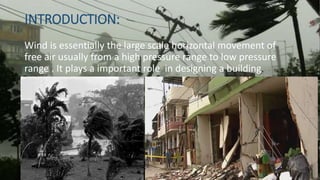
INTRODUCTION:
Wind is essentially the large scale horizontal movement of
free air usually from a high pressure range to low pressure
range . It plays a important role in designing a building.
CODES USED:
The codes required for this work purpose is
1. IS 875 (PART 3)-1987:CODE OF PRACTICE FOR DESIGN
LOADS (OTHER THAN EARTHQUAKE )FOR BUILDING AND
STRUCTURE .
2. ASCE 7-10- MENIMUM DESIGN LOADS FOR BUILDING AND
OTHER STRUCTURE
Review of IS CODE 875 (PART 3)-1987
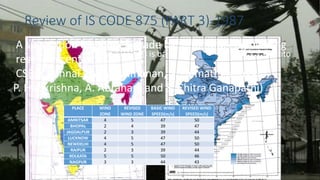
• The basic wind speed map was is based on the wind speed data upto
1982..
A suggestion have been made by Structural engineering
research center ,
CSRI,Chennai.( N. Lakshmanan, S. Gomathinayagam,
P. Harikrishna, A. Abraham and S. Chitra Ganapathi)
PLACE WIND
ZONE
REVISED
WIND ZONE
BASIC WIND
SPEED(m/s)
REVISED WIND
SPEED(m/s)
AMRITSAR 4 5 47 50
BHOPAL 2 4 39 47
JAGDALPUR 2 3 39 44
LUCKNOW 4 5 47 50
NEWDELHI 4 5 47 50
RAIPUR 2 3 39 44
KOLKATA 5 5 50 46
NAGPUR 3 3 44 43
Review of IS CODE 875 (PART 3)-1987(CONT.)
• SPECIAL WIND REGION:. The wind speed may be very at
those regions where different guidelines have to be adopted
for that regions. Micro-zonation technique have to be
adapted for these places.
• WIND DIRECTIONALITY: The factor recognizes the fact of
(i) reduced probability of maximum winds coming from any
given direction
(ii) reduced probability of the maximum pressure coefficient
occurring for any given wind direction.
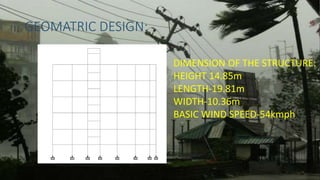
GEOMATRIC DESIGN:
DIMENSION OF THE STRUCTURE:
HEIGHT 14.85m
LENGTH-19.81m
WIDTH-10.36m
BASIC WIND SPEED-54kmph
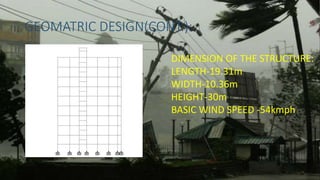
GEOMATRIC DESIGN(CONT.):
DIMENSION OF THE STRUCTURE:
LENGTH-19.31m
WIDTH-10.36m
HEIGHT-30m
BASIC WIND SPEED -54kmph
DESIGN PROCEDURE:
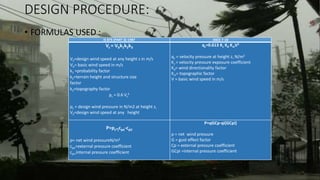
• FORMULAS USED :
IS 875 (PART 3)-1987 ASCE 7-10
Vz = Vbk1k2k3
VZ=design wind speed at any height z in m/s
Vb= basic wind speed in m/s
k1 =probability factor
k2=terrain height and structure size
factor
k3=topography factor
pz = 0.6 Vz
2
pz = design wind pressure in N/m2 at height z,
VZ=design wind speed at any height
qz=0.613 Kz Kd KztV2
qz = velocity pressure at height z, N/m2
Kz = velocity pressure exposure coefficient
Kd= wind directionality factor
Kzt= topographic factor
V = basic wind speed in m/s
P=pz*(cpe-cpi)
p= net wind pressureN/m2
cpe=external pressure coefficient
cpi=internal pressure coefficient
P=qGCp-qi(GCpi)
p = net wind pressure
G = gust effect factor
Cp = external pressure coefficient
GCpi =internal pressure coefficient
RESULTS:
0
0.2
0.4
0.6
0.8
1
1.2
1.4
1.6
1.8
2
10M 14.85M
1.8 1.89
1.47
1.62
VELOCITY PRESSURE(kN/m2)
IS 875(PART 3) 1987 ASCE 7-10
0
0.5
1
1.5
2
2.5
10M 14.85M
2.16 2.28
1.45 1.54
NET PRESSURE(kN/m2)
IS 875(PART 3) 1987 ASCE 7-10
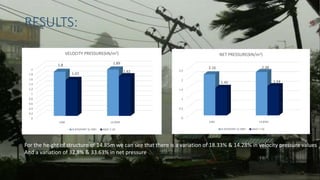
For the height of structure of 14.85m we can see that there is a variation of 18.33% & 14.28% in velocity pressure values
And a variation of 32.8% & 33.63% in net pressure
RESULTS(CONT.):
0
0.5
1
1.5
2
2.5
10M 15M 20M 30M
1.8
1.93 2
2.2
1.5
1.68 1.72
1.85
VELOCITY PRESSURE(kN/m2)
IS 875(PART 3) 1987 ASCE 7-10
0
0.5
1
1.5
2
2.5
3
10M 15M 20M 30M
2.16
2.31 2.4
2.64
1.55 1.62 1.7 1.76
NET PRESSURE(kN/m2)
IS 875(PART 3) 1987 ASCE 7-10
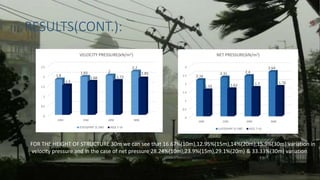
FOR THE HEIGHT OF STRUCTURE 30m we can see that 16.67%(10m),12.95%(15m),14%(20m),15.9%(30m) variation in
velocity pressure and in the case of net pressure 28.24%(10m),23.9%(15m),29.1%(20m) & 33.33%(30m) variation
RESULTS(CONT.):
0
0.5
1
1.5
2
2.5
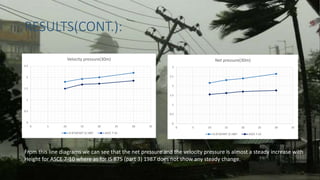
0 5 10 15 20 25 30 35
Velocity pressure(30m)
IS 875(PART 3) 1987 ASCE 7-10
0
0.5
1
1.5
2
2.5
3
0 5 10 15 20 25 30 35
Net pressure(30m)
IS 875(PART 3) 1987 ASCE 7-10
From this line diagrams we can see that the net pressure and the velocity pressure is almost a steady increase with
Height for ASCE 7-10 where as for IS 875 (part 3) 1987 does not show any steady change.
CONCLUSION:
• The pressures according to IS875(part 3)-1987 was found to be
greater than ASCE 7-10 in all cases in above cases.
• Gust factor consideration can be a key reason for this. ASCE code have
included Gust Factor of 0.85 even for the rigid building,
• The wind directionality factor "Kd" 0.85 included in American code.
Wind Directionality factor is not included in IS 875-1987.
• Study of wind have advanced a lot in last 3 three decades, where Is
875(part 3) was formed 35 years back. With this newer studies
included in recent international code it gives a more accurate value
with increased complexity in compared to IS 875(part 3) 1987.
REFERENCE:
• IS 875(PART 3) 1987-CODE OF PRACTICE FOR DESIGN LOADS (OTHER THAN
EARTHQUAKE )FOR BUILDING AND STRUCTURE
• ASCE 7-10 MENIMUM DESIGN LOADS FOR BUILDING AND OTHER
STRUCTURE
• BASIC WIND MAP OF INDIA WITH LONG TERM HOURLY WIND DATA ,N.
LAKSHMANAN,S. GOMATHINAYAGAM,P.HARIKRISHNA,A. ABRAHAM AND S.
CHITRA GANAPATHI
• www.hpsdma.nic.in/ResourceList/Maps/WindIndia.pdf FOR WIND AND
CYCLONE MAP OF INDIA
• Micro-zoned Design Maps of Topographic Wind Effects and Exposure in the
State of Hawaii Building Code, Gary Chock, S.E. Martin & Chock, Inc.
Honolulu, Hawaii
Comparison between different code

Comparison between different code

  • 1.
    REVIEW OF IS875(PART 3) 1987 AND COMPARISON WITH ASCE 7-10 By Alifur Rahaman Mandal CIVIL ENGINEERING DEPERTMENT
  • 2.
    CONTENTS 1. OBJECTIVE OFTHE PROJECT 2. INTRODUCTION 3. CODES USED 4. REVIEW OF IS 875(PART 3) 1987 5. GEOMETRIC DETAILS 6. DESIGN PROCEDURE 7. RESULTS AND COMPARISON 8. CONCLUSION 9. REFERENCE
  • 3.
    OBJECTIVE: • To givea review of IS 875 (PART 3) 1987. • Compare the results of wind pressure of IS 875 (PART 3) 1987 AND ASCE 7-10.
  • 4.
    INTRODUCTION: Wind is essentiallythe large scale horizontal movement of free air usually from a high pressure range to low pressure range . It plays a important role in designing a building.
  • 5.
    CODES USED: The codesrequired for this work purpose is 1. IS 875 (PART 3)-1987:CODE OF PRACTICE FOR DESIGN LOADS (OTHER THAN EARTHQUAKE )FOR BUILDING AND STRUCTURE . 2. ASCE 7-10- MENIMUM DESIGN LOADS FOR BUILDING AND OTHER STRUCTURE
  • 6.
    Review of ISCODE 875 (PART 3)-1987 • The basic wind speed map was is based on the wind speed data upto 1982.. A suggestion have been made by Structural engineering research center , CSRI,Chennai.( N. Lakshmanan, S. Gomathinayagam, P. Harikrishna, A. Abraham and S. Chitra Ganapathi) PLACE WIND ZONE REVISED WIND ZONE BASIC WIND SPEED(m/s) REVISED WIND SPEED(m/s) AMRITSAR 4 5 47 50 BHOPAL 2 4 39 47 JAGDALPUR 2 3 39 44 LUCKNOW 4 5 47 50 NEWDELHI 4 5 47 50 RAIPUR 2 3 39 44 KOLKATA 5 5 50 46 NAGPUR 3 3 44 43
  • 7.
    Review of ISCODE 875 (PART 3)-1987(CONT.) • SPECIAL WIND REGION:. The wind speed may be very at those regions where different guidelines have to be adopted for that regions. Micro-zonation technique have to be adapted for these places. • WIND DIRECTIONALITY: The factor recognizes the fact of (i) reduced probability of maximum winds coming from any given direction (ii) reduced probability of the maximum pressure coefficient occurring for any given wind direction.
  • 8.
    GEOMATRIC DESIGN: DIMENSION OFTHE STRUCTURE: HEIGHT 14.85m LENGTH-19.81m WIDTH-10.36m BASIC WIND SPEED-54kmph
  • 9.
    GEOMATRIC DESIGN(CONT.): DIMENSION OFTHE STRUCTURE: LENGTH-19.31m WIDTH-10.36m HEIGHT-30m BASIC WIND SPEED -54kmph
  • 10.
    DESIGN PROCEDURE: • FORMULASUSED : IS 875 (PART 3)-1987 ASCE 7-10 Vz = Vbk1k2k3 VZ=design wind speed at any height z in m/s Vb= basic wind speed in m/s k1 =probability factor k2=terrain height and structure size factor k3=topography factor pz = 0.6 Vz 2 pz = design wind pressure in N/m2 at height z, VZ=design wind speed at any height qz=0.613 Kz Kd KztV2 qz = velocity pressure at height z, N/m2 Kz = velocity pressure exposure coefficient Kd= wind directionality factor Kzt= topographic factor V = basic wind speed in m/s P=pz*(cpe-cpi) p= net wind pressureN/m2 cpe=external pressure coefficient cpi=internal pressure coefficient P=qGCp-qi(GCpi) p = net wind pressure G = gust effect factor Cp = external pressure coefficient GCpi =internal pressure coefficient
  • 11.
    RESULTS: 0 0.2 0.4 0.6 0.8 1 1.2 1.4 1.6 1.8 2 10M 14.85M 1.8 1.89 1.47 1.62 VELOCITYPRESSURE(kN/m2) IS 875(PART 3) 1987 ASCE 7-10 0 0.5 1 1.5 2 2.5 10M 14.85M 2.16 2.28 1.45 1.54 NET PRESSURE(kN/m2) IS 875(PART 3) 1987 ASCE 7-10 For the height of structure of 14.85m we can see that there is a variation of 18.33% & 14.28% in velocity pressure values And a variation of 32.8% & 33.63% in net pressure
  • 12.
    RESULTS(CONT.): 0 0.5 1 1.5 2 2.5 10M 15M 20M30M 1.8 1.93 2 2.2 1.5 1.68 1.72 1.85 VELOCITY PRESSURE(kN/m2) IS 875(PART 3) 1987 ASCE 7-10 0 0.5 1 1.5 2 2.5 3 10M 15M 20M 30M 2.16 2.31 2.4 2.64 1.55 1.62 1.7 1.76 NET PRESSURE(kN/m2) IS 875(PART 3) 1987 ASCE 7-10 FOR THE HEIGHT OF STRUCTURE 30m we can see that 16.67%(10m),12.95%(15m),14%(20m),15.9%(30m) variation in velocity pressure and in the case of net pressure 28.24%(10m),23.9%(15m),29.1%(20m) & 33.33%(30m) variation
  • 13.
    RESULTS(CONT.): 0 0.5 1 1.5 2 2.5 0 5 1015 20 25 30 35 Velocity pressure(30m) IS 875(PART 3) 1987 ASCE 7-10 0 0.5 1 1.5 2 2.5 3 0 5 10 15 20 25 30 35 Net pressure(30m) IS 875(PART 3) 1987 ASCE 7-10 From this line diagrams we can see that the net pressure and the velocity pressure is almost a steady increase with Height for ASCE 7-10 where as for IS 875 (part 3) 1987 does not show any steady change.
  • 14.
    CONCLUSION: • The pressuresaccording to IS875(part 3)-1987 was found to be greater than ASCE 7-10 in all cases in above cases. • Gust factor consideration can be a key reason for this. ASCE code have included Gust Factor of 0.85 even for the rigid building, • The wind directionality factor "Kd" 0.85 included in American code. Wind Directionality factor is not included in IS 875-1987. • Study of wind have advanced a lot in last 3 three decades, where Is 875(part 3) was formed 35 years back. With this newer studies included in recent international code it gives a more accurate value with increased complexity in compared to IS 875(part 3) 1987.
  • 15.
    REFERENCE: • IS 875(PART3) 1987-CODE OF PRACTICE FOR DESIGN LOADS (OTHER THAN EARTHQUAKE )FOR BUILDING AND STRUCTURE • ASCE 7-10 MENIMUM DESIGN LOADS FOR BUILDING AND OTHER STRUCTURE • BASIC WIND MAP OF INDIA WITH LONG TERM HOURLY WIND DATA ,N. LAKSHMANAN,S. GOMATHINAYAGAM,P.HARIKRISHNA,A. ABRAHAM AND S. CHITRA GANAPATHI • www.hpsdma.nic.in/ResourceList/Maps/WindIndia.pdf FOR WIND AND CYCLONE MAP OF INDIA • Micro-zoned Design Maps of Topographic Wind Effects and Exposure in the State of Hawaii Building Code, Gary Chock, S.E. Martin & Chock, Inc. Honolulu, Hawaii