Dr. Naveed Anwar
Dynamic Response
Design of Tall Buildings: Trends and Achievements for
Structural Performance
Bangkok-Thailand
November 7-11, 2016
Naveed Anwar, PhD
Dr. Naveed Anwar
2
2
What is the first thing
a doctor does before
seeing a patient
Dr. Naveed Anwar
Check Blood
Pressure and
Heart Rate
Dr. Naveed Anwar
4
4
This is an indicator of the body’s
state and potential for any
problems due to other cause
Dr. Naveed Anwar
5
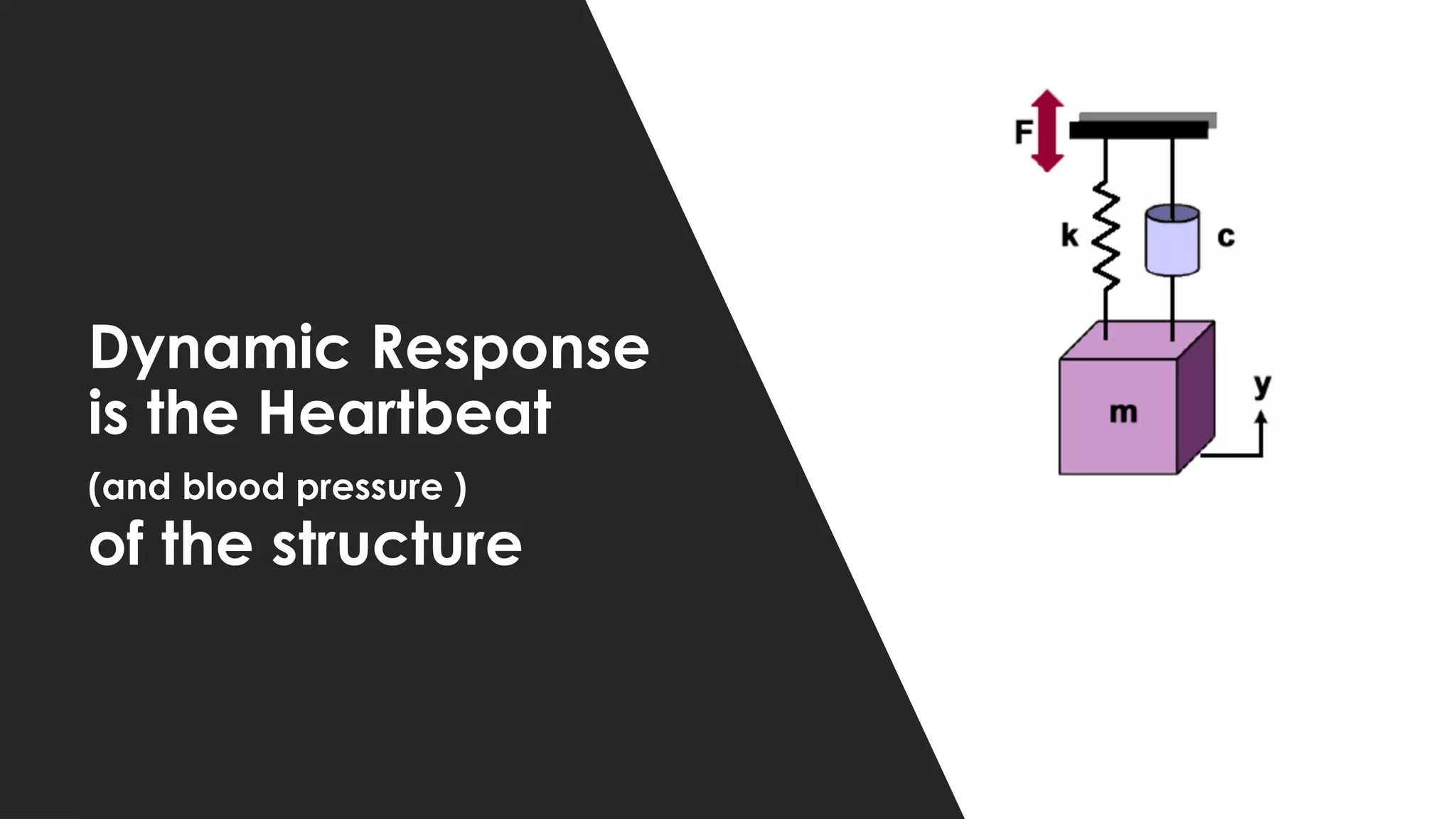
Dynamic Response
is the Heartbeat
(and blood pressure )
of the structure
Dr. Naveed Anwar
6
Basic Physics of Dynamics
• Newton’s View, for rigid bodies
F = ma
Dr. Naveed Anwar
7
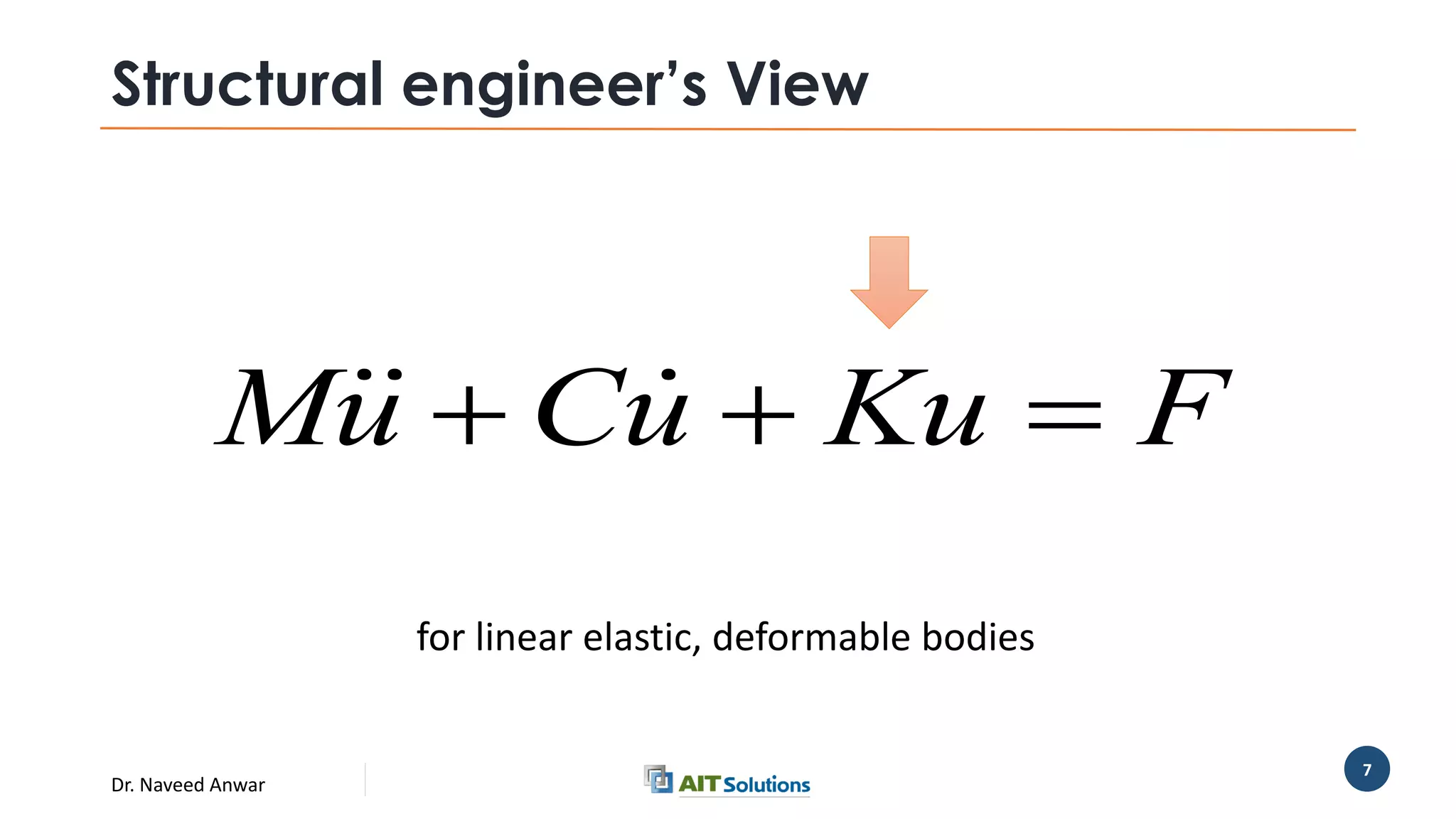
Structural engineer’s View
FKuuCuM  
for linear elastic, deformable bodies
Dr. Naveed Anwar
8
Structural as a Linear Spring
FKuuCuM  
Dr. Naveed Anwar
9
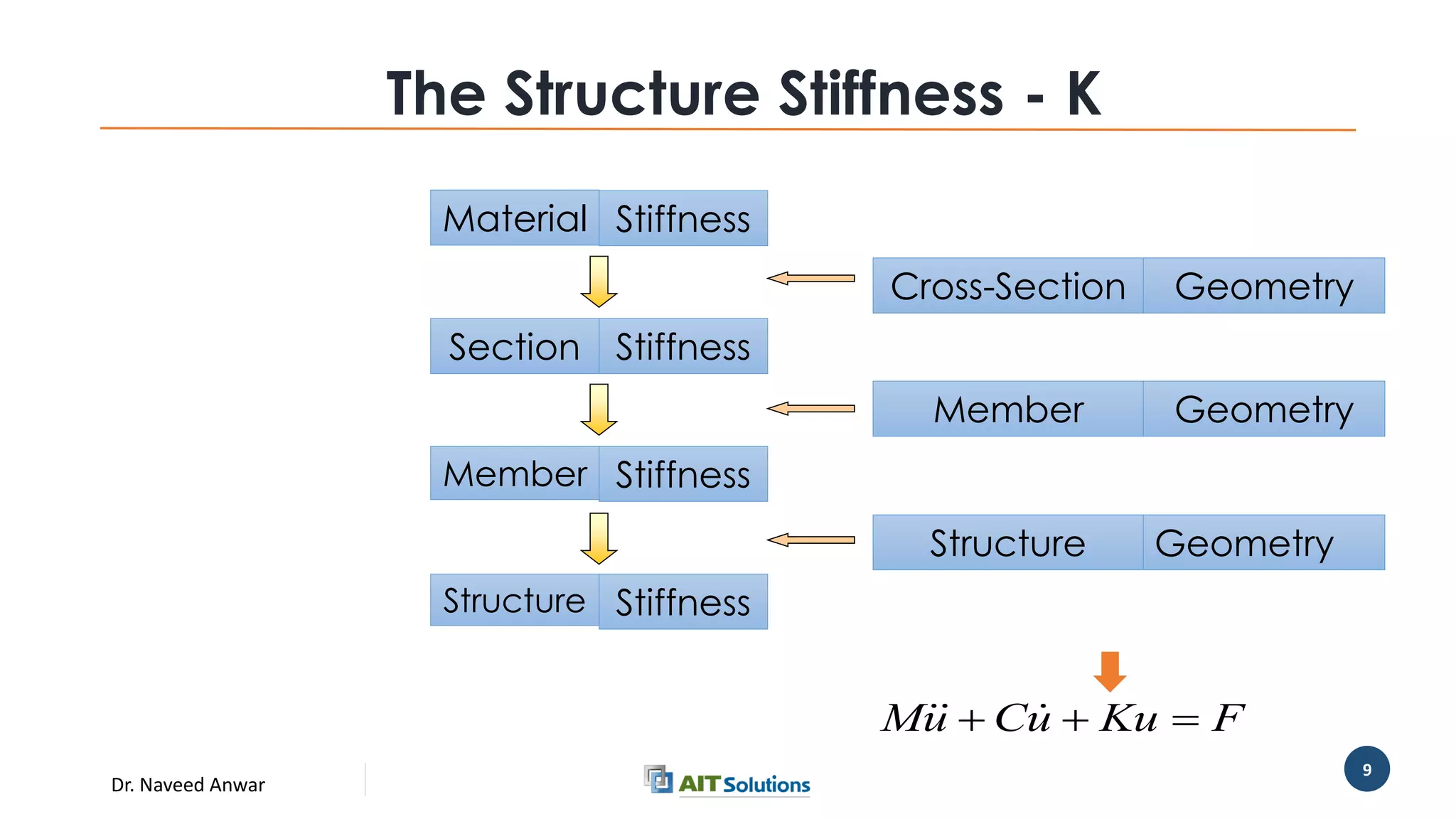
The Structure Stiffness - K
Material Stiffness
Section Stiffness
Member Stiffness
Structure Stiffness
Cross-Section Geometry
Member Geometry
Structure Geometry
FKuuCuM  
Dr. Naveed Anwar
10
The Structure Stiffness - K
Material Stiffness
Section Stiffness
Member Stiffness
Structure Stiffness
Cross-Section Geometry
Member Geometry
Structure Geometry
Non-Linear
Linear
FKuuCuM  
Dr. Naveed Anwar
11
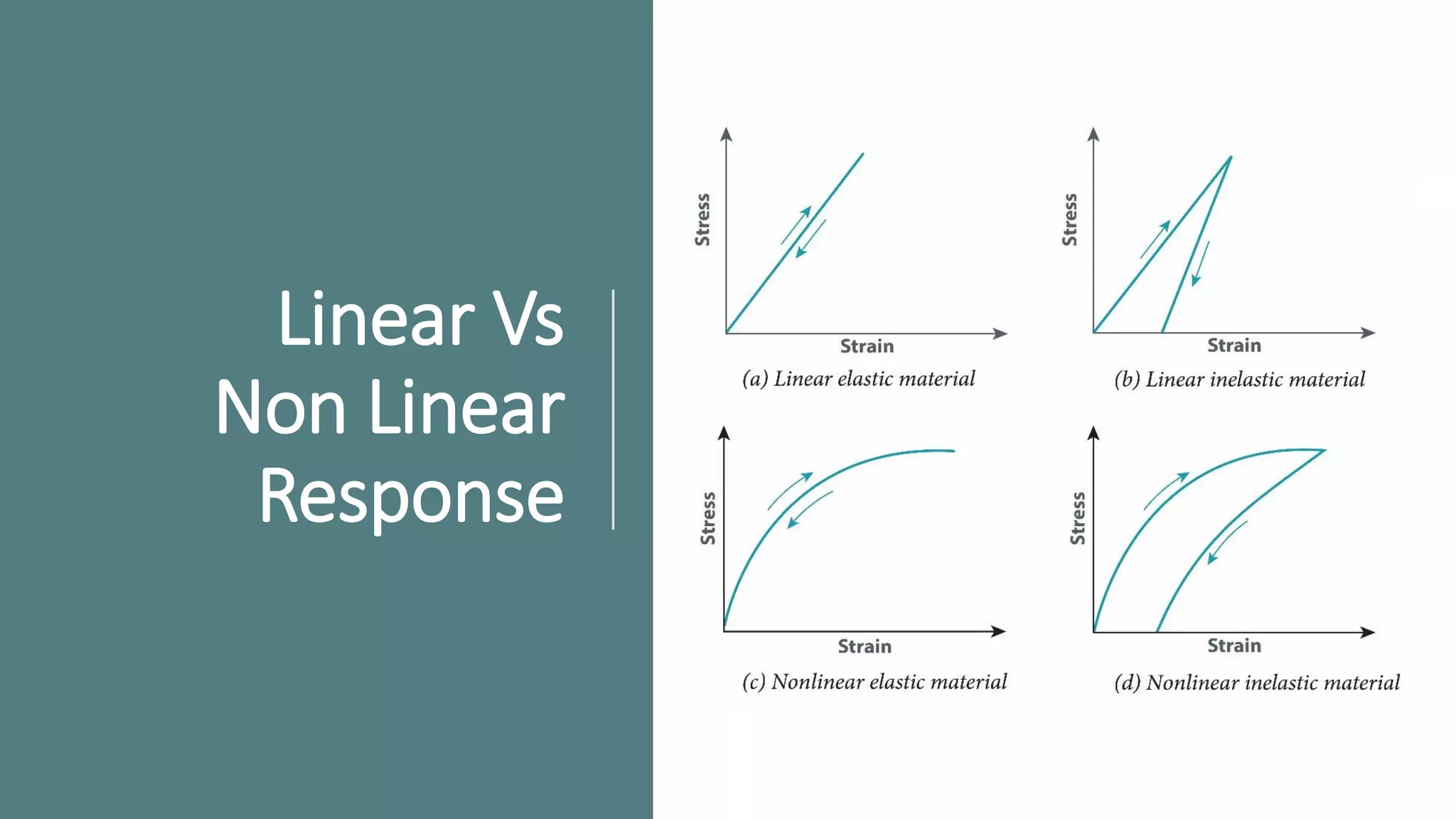
Linear Vs
Non Linear
Response
Dr. Naveed Anwar
12
Dynamic Equilibrium
FFKuuCuM NL  
Damping-Velocity
Mass-Acceleration Stiffness-Displacement
Nonlinearity
External Force
KuuCuM  
The basic variable is displacement and its derivatives
Dr. Naveed Anwar
13
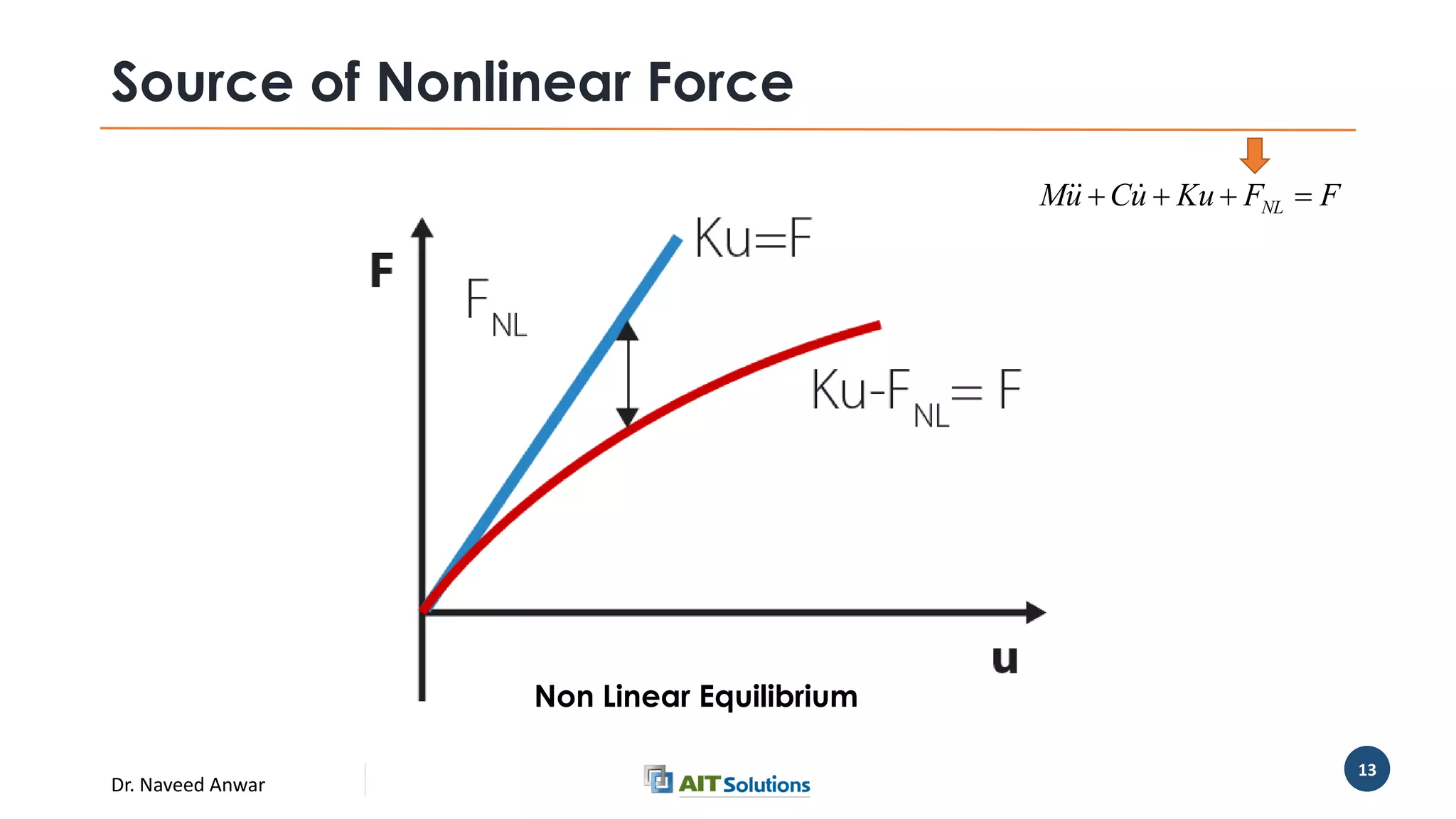
Source of Nonlinear Force
Non Linear Equilibrium
FFKuuCuM NL  
Dr. Naveed Anwar
14
The ‘Natural Free’ Dynamics
FFKuuCuM NL  
0 KuuM 
Free Vibration
Natural Frequencies and Mode Shape
Dr. Naveed Anwar
The Modal Dynamic Response
Dr. Naveed Anwar
16
Modal Analysis
• The modal analysis determines the inherent natural frequencies of vibration
• Each natural frequency is related to a time period and a mode shape
• Time Period is the time it takes to complete one cycle of vibration
• The Mode Shape is normalized deformation pattern
• The number of Modes is typically equal to the number of Degrees of Freedom
• The Time Period and Mode Shapes are inherent properties of the structure and
do not depend on the applied loads
Dr. Naveed Anwar
17
Modal Analysis
• The Modal Analysis should be run before applying loads any other
analysis to check the model and to understand the response of the
structure.
• Modal analysis is precursor to most types of analysis including
Response Spectrum, Time History, Push-over analysis, etc.
• Modal analysis is a useful tool even if full Dynamic Analysis is not
performed.
• Modal analysis is easy to run and is fun to watch when animated.
Dr. Naveed Anwar
18
Application of Modal Analysis
• The Time Period and Mode Shapes, together with animation immediately exhibit the
strengths and weaknesses of the structure.
• Modal analysis can be used to check the accuracy of the structural model
– The Time Period should be within reasonable range,
– The disconnected members are identified
– Local modes are identified that may need suppression
• The symmetry of the structure can be determined
– For doubly symmetrical buildings, generally the first two modes are translational and
the third mode is rotational
– If the first mode is rotational, the structural is un-symmetrical
• The resonance with the applied loads or excitation can be avoided
– The natural frequency of the structure should not be close to excitation frequency
Dr. Naveed Anwar
19
Natural Periods or Frequency
• The heartbeat of the structure
• Indicates the “stiffness” and “mass” relationship
• Basis for damping, resonance and amplification effects
• Many relationships for tall buildings (0.1 N, with Height etc,)
Dr. Naveed Anwar
20
Mode Shapes
• A mode shape is a set of relative (not absolute) nodal displacement
for a particular mode of free vibration for a specific natural frequency
• There are as many modes as there are DOF in the system
• Not all of the modes are significant
• Local modes may disrupt the modal mass participation
Dr. Naveed Anwar
21
Eccentric and Concentric Response
Mode-1 Mode-2 Mode-3
Symmetrical Mass
and Stiffness
Unsymmetrical
Mass and Stiffness
Dr. Naveed Anwar
22
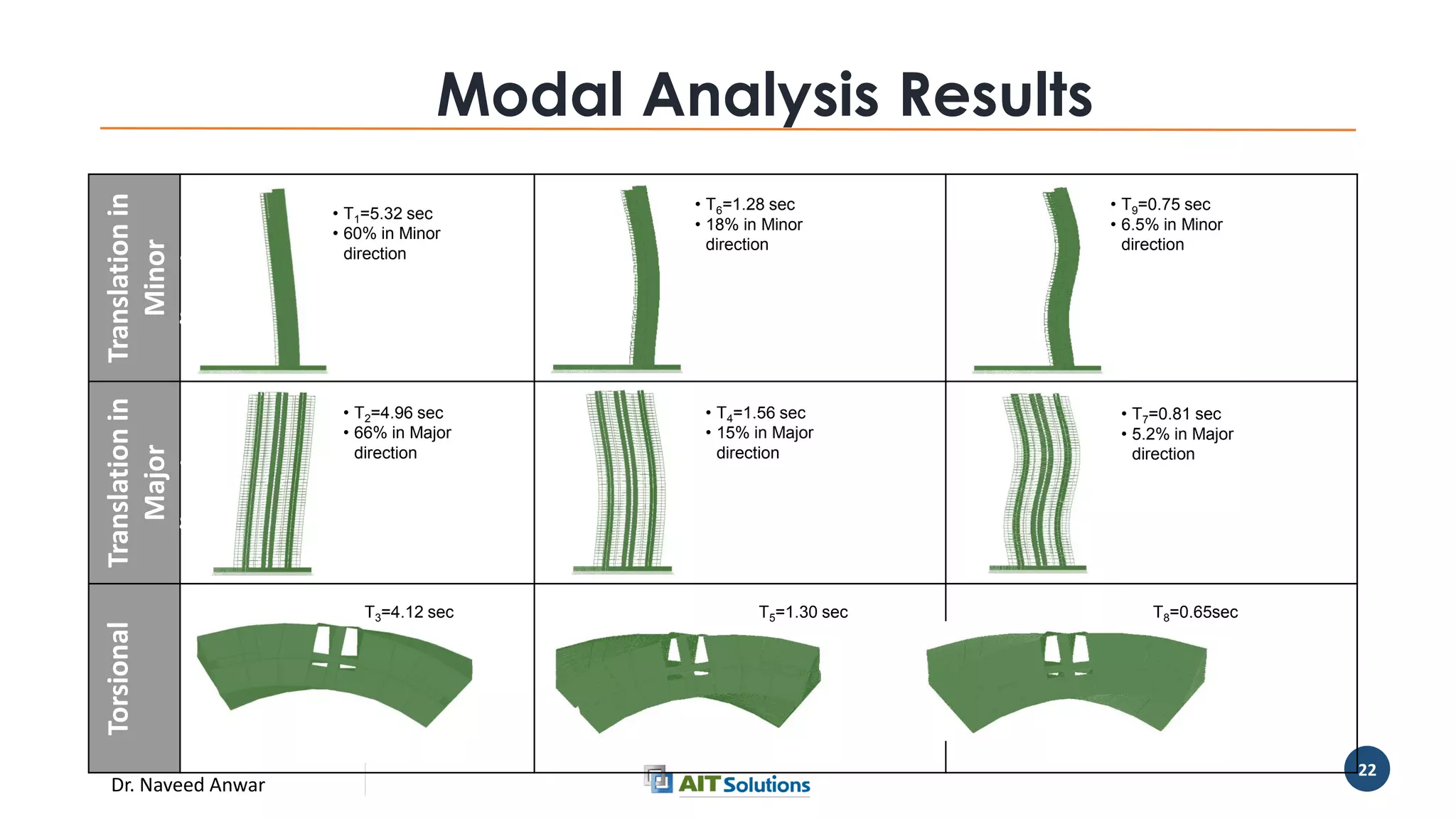
Modal Analysis ResultsTranslationin
Minor
direction
Translationin
Major
direction
Torsional
• T1=5.32 sec
• 60% in Minor
direction
• T6=1.28 sec
• 18% in Minor
direction
• T9=0.75 sec
• 6.5% in Minor
direction
• T2=4.96 sec
• 66% in Major
direction
• T7=0.81 sec
• 5.2% in Major
direction
• T4=1.56 sec
• 15% in Major
direction
T3=4.12 sec T8=0.65secT5=1.30 sec
Dr. Naveed Anwar
23
Higher Mode Effects in Tall Buildings
• The contribution of higher
modes on reposes of Tall
Buildings for earthquakes (and
wind) is one the most important
difference between the low rise
and tall buildings
Dr. Naveed Anwar
24
Effect of Modes on Story Moment
24
Dr. Naveed Anwar
25
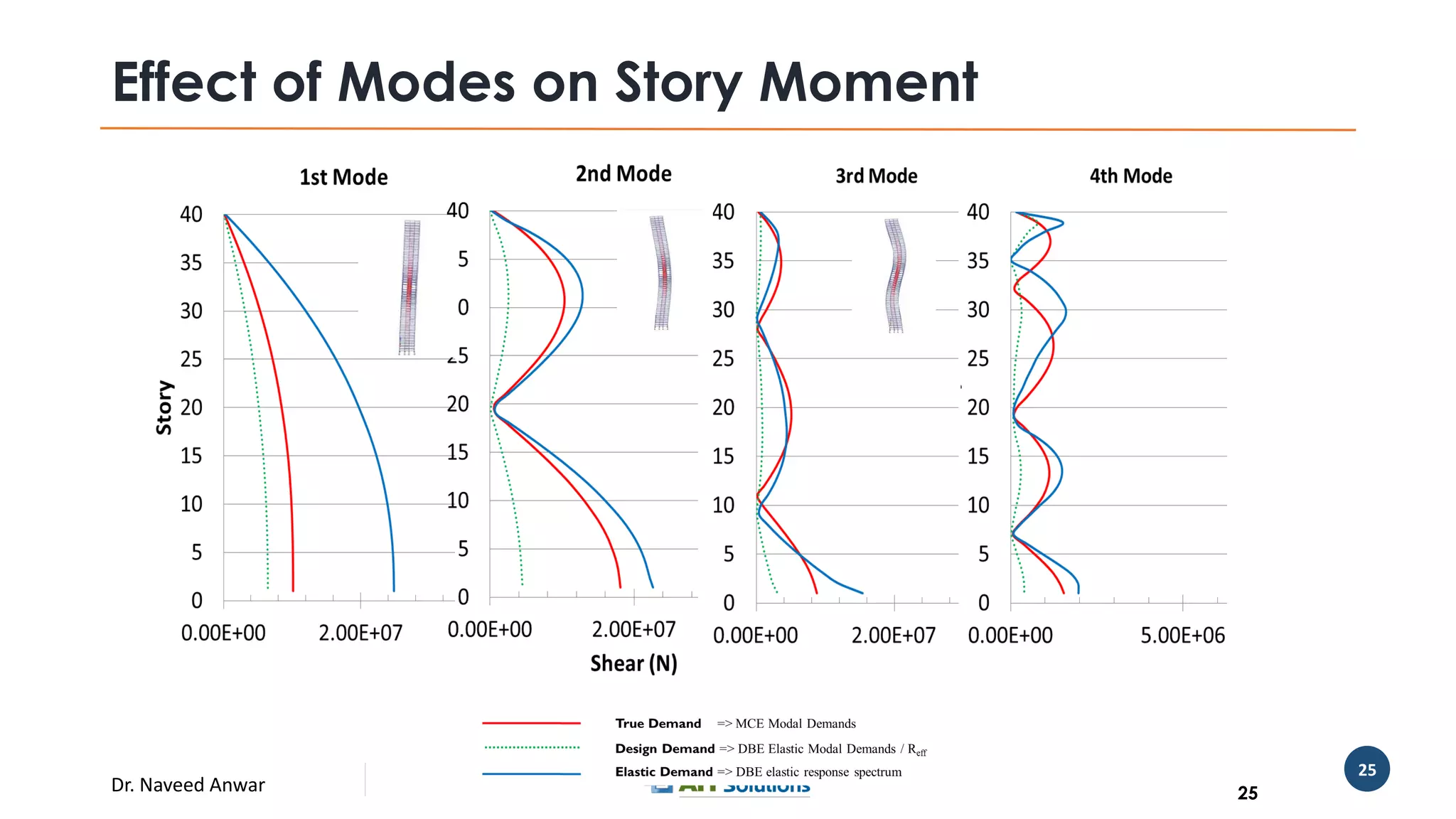
Effect of Modes on Story Moment
25
Dr. Naveed Anwar
26
Building 50 Story
50%30%10%
Dr. Naveed Anwar
27
Building 25 Story
80%15%4%
Dr. Naveed Anwar
28
Modal Response Influenced by
• Structure
• Attachments
• Occupants
Mass
• Tower
• Podium
• Basement
• Foundation
• Soil
Stiffness
Dr. Naveed Anwar
29
Elastic Stiffness Estimation Influenced by
• Material modeling
• Cross-section Modeling
• Member Modeling
• Foundation Modeling
Dr. Naveed Anwar
30
“Actual” Stiffness Estimation Influenced by
• The state of the
structure at any given
time
• Damage
• Deformation
• Cracking
• Creep/Shrinkage
• Stress-state
Dr. Naveed Anwar
31
Estimating Stiffness through “Cracking Factors”
• Code specified cracking factors
• Typical applied to all members
• At all locations
• For all load cases
• Not realistic, and subject to
considerable variation and
debate
Dr. Naveed Anwar
32
Estimating Natural Period at States
• Use Non-linear models
• Apply gravity loads, incrementally as a non linear case
• Determine Modal Properties at the end of the Gravity Case
• Use Gravity case and Modal properties as a start for other cases
Dr. Naveed Anwar
33
Seismic Response
FFKuuCuM NL  
Time History Analysis
0 KuuM 
EQNL FFKu 
Free Vibration
Pushover
Analysis
EQFKu 
Equivalent
Static Analysis
EQFKu 
Response Spectrums
Response Spectrum
Analysis
Acceleration Records
guMKuuCuM  
Dr. Naveed Anwar
34
Special Analysis Types
Non-Linear
Analysis
• P-Delta Analysis
• Buckling Analysis
• Staitc Pushover Analysis
• Fast Non-Linear Analysis
(FNA)
• Large Displacement
Analysis
Dynamic Analysis
• Free Vibration and Modal
Analysis
• Response Spectrum
Analysis
• Steady State Dynamic
Analysis
Dr. Naveed Anwar
35
Seismic Analysis Procedures
Linear Static
Procedures
• Equivalent Static
Analysis
Nonlinear Static
Procedures
• Capacity Spectrum
Method
• Displacement
Coefficient Method
• Various Other
Pushover Analysis
Methods
Linear Dynamic
Procedures
• Response
Spectrum Analysis
• Linear Response
History Analysis
Nonlinear
Dynamic
Procedures
• Nonlinear
Response
History Analysis
Dr. Naveed Anwar
36
Nonlinear Dynamic Time History
• Nonlinear Dynamic Time History Advantage
 It applies to structures of all types
 It accounts directly for the dynamic nature of earthquakes loads
 It accounts directly for hysteretic loops and energy dissipation
 More accurate than pushover analysis
• Nonlinear Dynamic Time History Disadvantage
 More complex, needs more information, tools, skills
 Response spectrum cannot use. Uses ground motions.
 The Response can be sensitive to changes in the ground motion. Analysis must
be carried out for a number of earthquakes
 Requires more computer time than pushover
Dr. Naveed Anwar
37
Initial Conditions
• The initial conditions describe the state of the structure at the
beginning of a time-history case. These include:
• Displacements and velocities
• Internal forces and stresses
• Internal state variables for nonlinear elements
• Energy values for the structure
• External loads
• The accelerations are not considered initial conditions, but are
computed from the equilibrium equation.
Dr. Naveed Anwar
38
Additional Information Required for NDA
Appropriate Hysteretic Response of either Material or Structural Components has to be Provided
(At present, there is no clear recommendations)
Dr. Naveed Anwar
39
Estimating, understanding and including
dynamic response in the design
is the key for high and reliable performance of
structures for Wind and Earthquakes
It all starts with Modal Analysis
Dr. Naveed Anwar
40
Dr. Naveed Anwar
41
View publication statsView publication stats

Dynamic Response

  • 1.
    Dr. Naveed Anwar DynamicResponse Design of Tall Buildings: Trends and Achievements for Structural Performance Bangkok-Thailand November 7-11, 2016 Naveed Anwar, PhD
  • 2.
    Dr. Naveed Anwar 2 2 Whatis the first thing a doctor does before seeing a patient
  • 3.
    Dr. Naveed Anwar CheckBlood Pressure and Heart Rate
  • 4.
    Dr. Naveed Anwar 4 4 Thisis an indicator of the body’s state and potential for any problems due to other cause
  • 5.
    Dr. Naveed Anwar 5 DynamicResponse is the Heartbeat (and blood pressure ) of the structure
  • 6.
    Dr. Naveed Anwar 6 BasicPhysics of Dynamics • Newton’s View, for rigid bodies F = ma
  • 7.
    Dr. Naveed Anwar 7 Structuralengineer’s View FKuuCuM   for linear elastic, deformable bodies
  • 8.
    Dr. Naveed Anwar 8 Structuralas a Linear Spring FKuuCuM  
  • 9.
    Dr. Naveed Anwar 9 TheStructure Stiffness - K Material Stiffness Section Stiffness Member Stiffness Structure Stiffness Cross-Section Geometry Member Geometry Structure Geometry FKuuCuM  
  • 10.
    Dr. Naveed Anwar 10 TheStructure Stiffness - K Material Stiffness Section Stiffness Member Stiffness Structure Stiffness Cross-Section Geometry Member Geometry Structure Geometry Non-Linear Linear FKuuCuM  
  • 11.
    Dr. Naveed Anwar 11 LinearVs Non Linear Response
  • 12.
    Dr. Naveed Anwar 12 DynamicEquilibrium FFKuuCuM NL   Damping-Velocity Mass-Acceleration Stiffness-Displacement Nonlinearity External Force KuuCuM   The basic variable is displacement and its derivatives
  • 13.
    Dr. Naveed Anwar 13 Sourceof Nonlinear Force Non Linear Equilibrium FFKuuCuM NL  
  • 14.
    Dr. Naveed Anwar 14 The‘Natural Free’ Dynamics FFKuuCuM NL   0 KuuM  Free Vibration Natural Frequencies and Mode Shape
  • 15.
    Dr. Naveed Anwar TheModal Dynamic Response
  • 16.
    Dr. Naveed Anwar 16 ModalAnalysis • The modal analysis determines the inherent natural frequencies of vibration • Each natural frequency is related to a time period and a mode shape • Time Period is the time it takes to complete one cycle of vibration • The Mode Shape is normalized deformation pattern • The number of Modes is typically equal to the number of Degrees of Freedom • The Time Period and Mode Shapes are inherent properties of the structure and do not depend on the applied loads
  • 17.
    Dr. Naveed Anwar 17 ModalAnalysis • The Modal Analysis should be run before applying loads any other analysis to check the model and to understand the response of the structure. • Modal analysis is precursor to most types of analysis including Response Spectrum, Time History, Push-over analysis, etc. • Modal analysis is a useful tool even if full Dynamic Analysis is not performed. • Modal analysis is easy to run and is fun to watch when animated.
  • 18.
    Dr. Naveed Anwar 18 Applicationof Modal Analysis • The Time Period and Mode Shapes, together with animation immediately exhibit the strengths and weaknesses of the structure. • Modal analysis can be used to check the accuracy of the structural model – The Time Period should be within reasonable range, – The disconnected members are identified – Local modes are identified that may need suppression • The symmetry of the structure can be determined – For doubly symmetrical buildings, generally the first two modes are translational and the third mode is rotational – If the first mode is rotational, the structural is un-symmetrical • The resonance with the applied loads or excitation can be avoided – The natural frequency of the structure should not be close to excitation frequency
  • 19.
    Dr. Naveed Anwar 19 NaturalPeriods or Frequency • The heartbeat of the structure • Indicates the “stiffness” and “mass” relationship • Basis for damping, resonance and amplification effects • Many relationships for tall buildings (0.1 N, with Height etc,)
  • 20.
    Dr. Naveed Anwar 20 ModeShapes • A mode shape is a set of relative (not absolute) nodal displacement for a particular mode of free vibration for a specific natural frequency • There are as many modes as there are DOF in the system • Not all of the modes are significant • Local modes may disrupt the modal mass participation
  • 21.
    Dr. Naveed Anwar 21 Eccentricand Concentric Response Mode-1 Mode-2 Mode-3 Symmetrical Mass and Stiffness Unsymmetrical Mass and Stiffness
  • 22.
    Dr. Naveed Anwar 22 ModalAnalysis ResultsTranslationin Minor direction Translationin Major direction Torsional • T1=5.32 sec • 60% in Minor direction • T6=1.28 sec • 18% in Minor direction • T9=0.75 sec • 6.5% in Minor direction • T2=4.96 sec • 66% in Major direction • T7=0.81 sec • 5.2% in Major direction • T4=1.56 sec • 15% in Major direction T3=4.12 sec T8=0.65secT5=1.30 sec
  • 23.
    Dr. Naveed Anwar 23 HigherMode Effects in Tall Buildings • The contribution of higher modes on reposes of Tall Buildings for earthquakes (and wind) is one the most important difference between the low rise and tall buildings
  • 24.
    Dr. Naveed Anwar 24 Effectof Modes on Story Moment 24
  • 25.
    Dr. Naveed Anwar 25 Effectof Modes on Story Moment 25
  • 26.
    Dr. Naveed Anwar 26 Building50 Story 50%30%10%
  • 27.
  • 28.
    Dr. Naveed Anwar 28 ModalResponse Influenced by • Structure • Attachments • Occupants Mass • Tower • Podium • Basement • Foundation • Soil Stiffness
  • 29.
    Dr. Naveed Anwar 29 ElasticStiffness Estimation Influenced by • Material modeling • Cross-section Modeling • Member Modeling • Foundation Modeling
  • 30.
    Dr. Naveed Anwar 30 “Actual”Stiffness Estimation Influenced by • The state of the structure at any given time • Damage • Deformation • Cracking • Creep/Shrinkage • Stress-state
  • 31.
    Dr. Naveed Anwar 31 EstimatingStiffness through “Cracking Factors” • Code specified cracking factors • Typical applied to all members • At all locations • For all load cases • Not realistic, and subject to considerable variation and debate
  • 32.
    Dr. Naveed Anwar 32 EstimatingNatural Period at States • Use Non-linear models • Apply gravity loads, incrementally as a non linear case • Determine Modal Properties at the end of the Gravity Case • Use Gravity case and Modal properties as a start for other cases
  • 33.
    Dr. Naveed Anwar 33 SeismicResponse FFKuuCuM NL   Time History Analysis 0 KuuM  EQNL FFKu  Free Vibration Pushover Analysis EQFKu  Equivalent Static Analysis EQFKu  Response Spectrums Response Spectrum Analysis Acceleration Records guMKuuCuM  
  • 34.
    Dr. Naveed Anwar 34 SpecialAnalysis Types Non-Linear Analysis • P-Delta Analysis • Buckling Analysis • Staitc Pushover Analysis • Fast Non-Linear Analysis (FNA) • Large Displacement Analysis Dynamic Analysis • Free Vibration and Modal Analysis • Response Spectrum Analysis • Steady State Dynamic Analysis
  • 35.
    Dr. Naveed Anwar 35 SeismicAnalysis Procedures Linear Static Procedures • Equivalent Static Analysis Nonlinear Static Procedures • Capacity Spectrum Method • Displacement Coefficient Method • Various Other Pushover Analysis Methods Linear Dynamic Procedures • Response Spectrum Analysis • Linear Response History Analysis Nonlinear Dynamic Procedures • Nonlinear Response History Analysis
  • 36.
    Dr. Naveed Anwar 36 NonlinearDynamic Time History • Nonlinear Dynamic Time History Advantage  It applies to structures of all types  It accounts directly for the dynamic nature of earthquakes loads  It accounts directly for hysteretic loops and energy dissipation  More accurate than pushover analysis • Nonlinear Dynamic Time History Disadvantage  More complex, needs more information, tools, skills  Response spectrum cannot use. Uses ground motions.  The Response can be sensitive to changes in the ground motion. Analysis must be carried out for a number of earthquakes  Requires more computer time than pushover
  • 37.
    Dr. Naveed Anwar 37 InitialConditions • The initial conditions describe the state of the structure at the beginning of a time-history case. These include: • Displacements and velocities • Internal forces and stresses • Internal state variables for nonlinear elements • Energy values for the structure • External loads • The accelerations are not considered initial conditions, but are computed from the equilibrium equation.
  • 38.
    Dr. Naveed Anwar 38 AdditionalInformation Required for NDA Appropriate Hysteretic Response of either Material or Structural Components has to be Provided (At present, there is no clear recommendations)
  • 39.
    Dr. Naveed Anwar 39 Estimating,understanding and including dynamic response in the design is the key for high and reliable performance of structures for Wind and Earthquakes It all starts with Modal Analysis

  • 40.
  • 41.
    Dr. Naveed Anwar 41 Viewpublication statsView publication stats