COMPARISON BETWEEN Codes
ECP (EGYPTIAN CODE OF PRACTICE)
BSI (BRITISH STANDARD INSTITUTE)
ACI (AMERICAN CONCRETE INSTITUTE)
PREPARD BY
STRUCTURAL DEPARTMENT TEAM
CHECKED BY
STRUCTURAL DEPARTMENT SENIOR
ENG. WAEL MOHMED ABDUL MAQSOOD
INTRODUCTION
This comparison between codes provides minimum requirements
for design and construction of structural concrete members of any
structure in different codes, That doesn't mean that the structural
design safe in code and unsafe at the other one But this difference
due to factor of safety used, the quality control of materials used in
the construction …etc. as a result we have to study carefully those
differences between codes in order to we can do a smart design.
- COMPARISON BETWEEN ECP & ACI & BSI
Columns Design
AXIAL LOADED COLUMN:
-
‫مقاومه‬ ‫حساب‬ ‫يتم‬ ‫منه‬ ‫و‬ ‫العمود‬ ‫يتحمله‬ ‫حمل‬ ‫اقصى‬ ‫حساب‬ ‫يتم‬ ‫العمود‬ ‫تصميم‬ ‫عند‬
‫الضغط‬
‫بالمعاد‬ ‫موضح‬ ‫هو‬ ‫كما‬ ‫العمود‬ ‫تسليح‬ ‫من‬ ‫الناتج‬ ‫الضغط‬ ‫مقاومه‬ ‫و‬ ‫للعمود‬ ‫الخرسانى‬
‫له‬
‫التالية‬
:
-
-
Egyptian code (2007)
- Pu : ‫العمود‬ ‫مقاومة‬
- Cc : ‫الخرساني‬ ‫القطاع‬ ‫مقاومة‬
- Cs : ‫العمود‬ ‫تسليح‬ ‫مقاومة‬
- : Factor of safety for material .
𝝲𝐶=1.5[(
7
6
)- (
et
3
)] ,
Egyptian code (2007)
𝝲s=1.15[(
7
6
)- (
et
3
)]
- The Existence of moment leads to a reduction in axial load capacity.
Thus the code impose a further reduction on the column strength by
reducing the capacity by 10% So, the equation:
Egyptian code (2007)
Pu = 0.35*Fcu*Ac+0.67*Asc*Fy
-
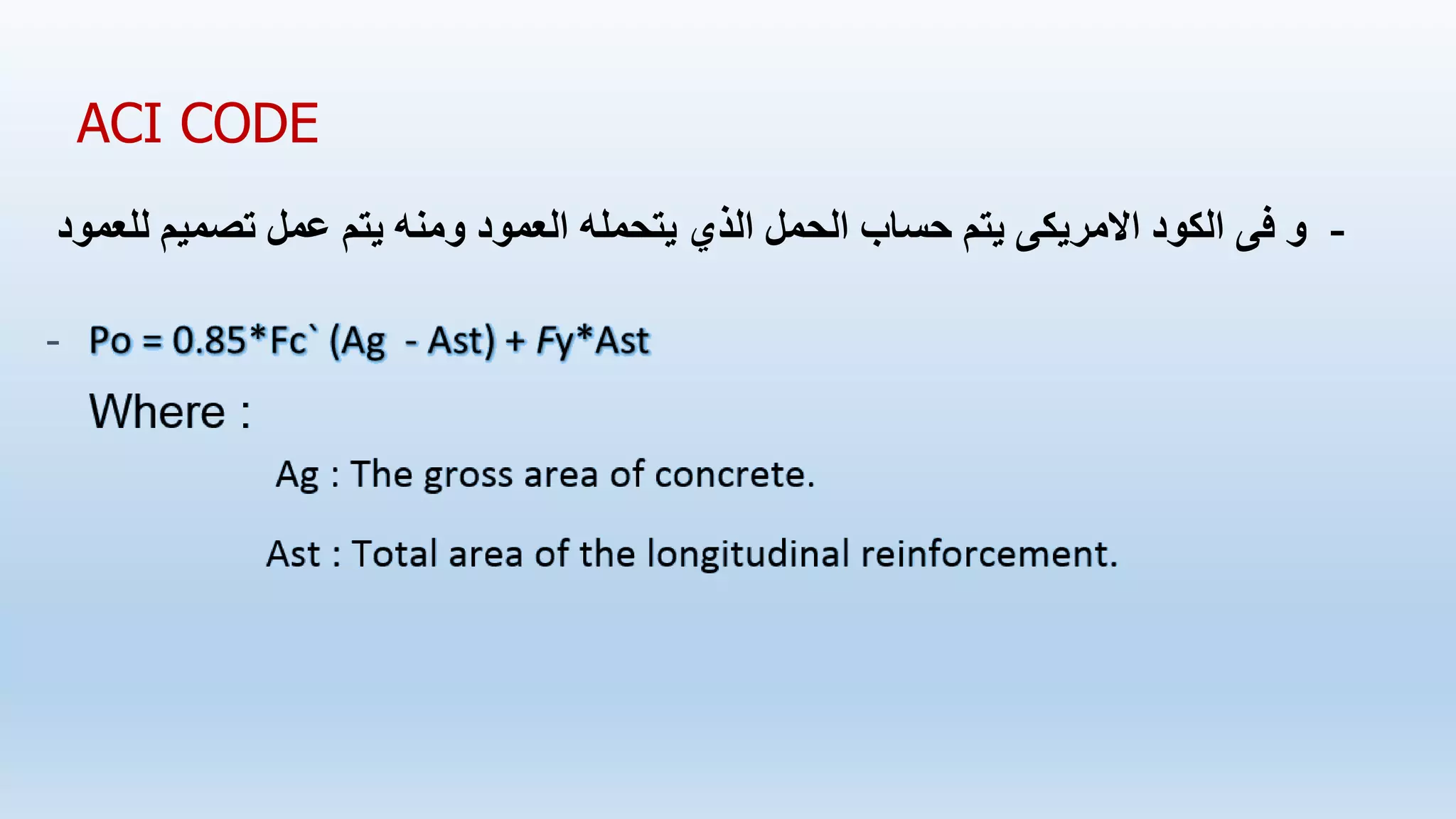
‫للعمود‬ ‫تصميم‬ ‫عمل‬ ‫يتم‬ ‫ومنه‬ ‫العمود‬ ‫يتحمله‬ ‫الذي‬ ‫الحمل‬ ‫حساب‬ ‫يتم‬ ‫االمريكى‬ ‫الكود‬ ‫فى‬ ‫و‬
-
ACI CODE
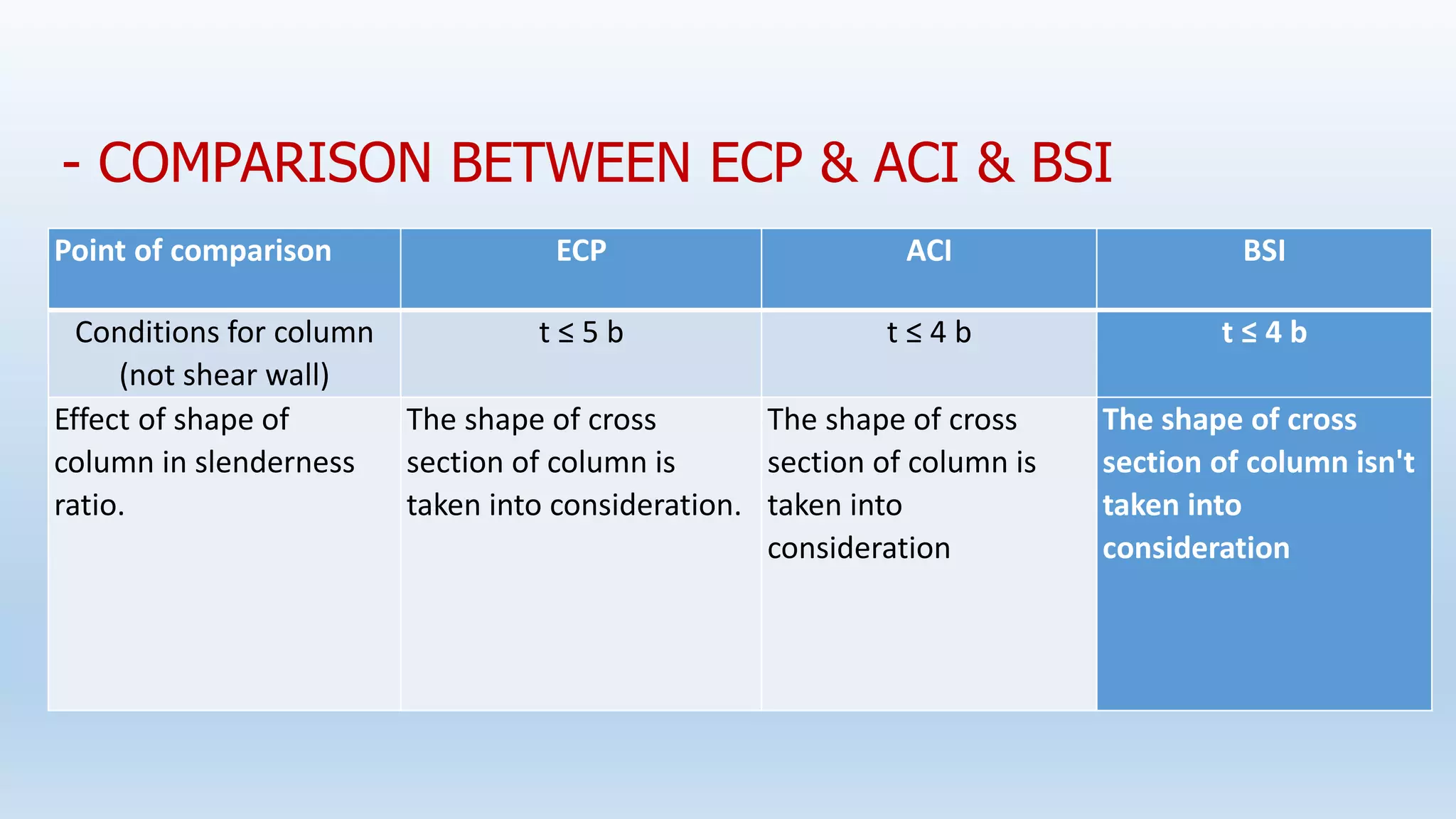
- COMPARISON BETWEEN ECP & ACI & BSI
BSI
ACI
ECP
Point of comparison
t ≤ 4 b
t ≤ 4 b
t ≤ 5 b
Conditions for column
(not shear wall)
The shape of cross
section of column isn't
taken into
consideration
The shape of cross
section of column is
taken into
consideration
The shape of cross
section of column is
taken into consideration.
Effect of shape of
column in slenderness
ratio.
- COMPARISON BETWEEN ECP & ACI & BSI
BSI
ACI
ECP
Point of comparison
0.4
100
Ag
1
100
Ag
0.6
100
Ag
Asmin
6% Ag
8% Ag
4% Ag for Interior col.
5% Ag for Edge col.
6% Ag for Corner col.
Asmax
155 mm
6 inch=150 mm
250 mm
Smax
30mm
25mm
70mm
Smin
- COMPARISON BETWEEN ECP & ACI & BSI
BSI
ACI
ECP
Point of comparison
Braced &
Un Braced
Sway & non- Sway
Braced & Unbraced
Classification of structure
according to buckling design.
Slenderness Limits For
Columns 𝐿0 < 60𝑏
Slenderness of
unbraced Columns
𝐿0 =
100𝑏2
ℎ
≤ 60𝑏
not braced against side sway
𝐾 𝐿𝑢
𝑟
≤ 22
braced against side sway
𝐾 𝐿𝑢
𝑟
≤34 – 12(M1/M2) ≤ 40
Rec. Circular
Braced 30 25
Unbraced 23 18
Maximum slenderness ratio.
𝐿𝑒 = 𝛽𝐿0
Values of 𝛽 for braced
columns
Non-sway
K Lu
r
≤ 34 -12 (
𝑀1
𝑀2
) ≤ 40
Sway
𝐾 𝐿𝑢
𝑟
≤ 22
Braced
𝐾𝐻
𝑏1 𝑜𝑟 𝑡1
< 15
Unbraced
𝐾𝐻
𝑏1 𝑜𝑟 𝑡1
< 10
Neglect slenderness effect if :
- COMPARISON BETWEEN ECP & ACI & BSI
BSI
ACI
ECP
Point of
comparison
Values of 𝛽 for
unbraced columns
Where:
𝐿0: clear height
between end restraints
b: width of column
h: depth of cross
section
𝐿𝑒:effective height of
column
K: effective length factor (for
braced (non sway) frame ≤ 1
Lu: unsupported height of
column from top of floor to the
bottom of the beams or slab in
the slab above
R: radius of gyration, equal to 0.3
and 0.25 times the overall depth
of rectangular and circular
columns , respectively
M1/M2: ratio of the moments at
the two ends of the column
‫حالة‬ ‫فى‬
‫يؤ‬ ‫جانبيا‬ ‫المقيدة‬ ‫المبانى‬ ‫فى‬ ‫األعمدة‬
‫طول‬ ‫خذ‬
‫االنبعاج‬
He
‫من‬ ‫لألصغر‬ ‫مساويا‬
𝐻𝑒 = 𝐻0 0.7 + 0.05 𝛼1 + 𝛼2 ≤ 𝐻0
𝐻𝑒 = 𝐻0 0.85 + 0.05 𝛼𝑚𝑖𝑛 ≤ 𝐻0
‫جانب‬ ‫مقيدة‬ ‫الغير‬ ‫المبانى‬ ‫فى‬ ‫األعمدة‬ ‫حالة‬ ‫وفى‬
‫يؤخذ‬ ‫يا‬
‫االنبعاج‬ ‫طول‬
He
‫من‬ ‫لألصغر‬ ‫مساويا‬
𝐻𝑒 = 𝐻0 1 + 0.15 𝛼1 + 𝛼2 ≥ 𝐻0
𝐻𝑒 = 𝐻0 2 + 0.3 𝛼𝑚𝑖𝑛 ≥ 𝐻0
α = Σ
Σ
𝐸𝑐𝐼𝑐
𝐻0
𝐸𝑐𝐼𝑏
𝐿𝑏
‫أن‬ ‫حيث‬
𝐻0
‫الخالص‬ ‫العمود‬ ‫ارتفاع‬ ‫هو‬
‫و‬
𝛼𝑚𝑖𝑛
‫من‬ ‫األصغر‬ ‫القيمة‬ ‫هى‬
𝛼1
‫الطرف‬ ‫عند‬
‫و‬ ‫السفلى‬
𝛼2
‫العلوى‬ ‫الطرف‬ ‫عند‬
Neglect slenderness
effect if :
BSI
ACI
ECP
Point of comparison
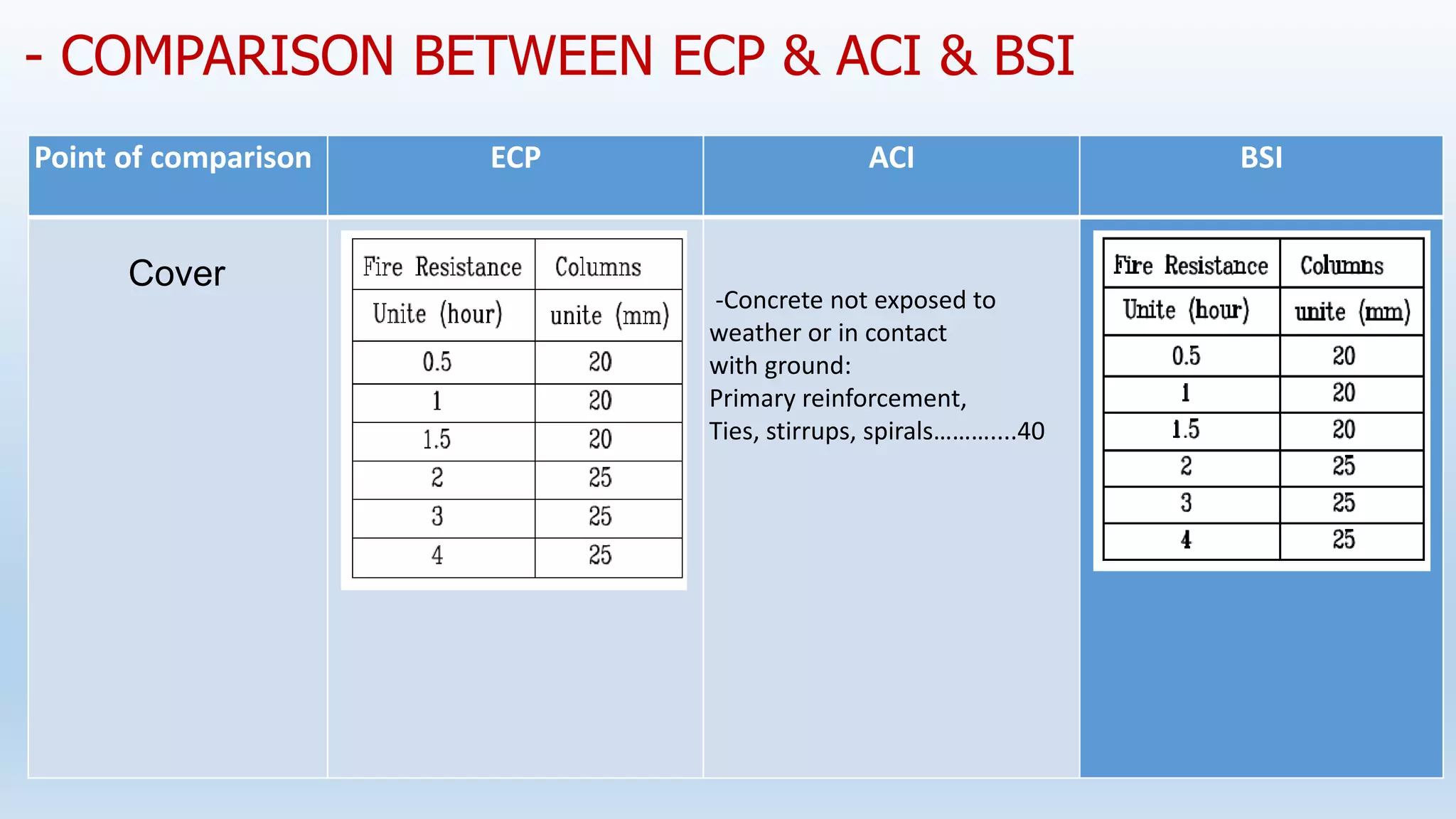
-Concrete not exposed to
weather or in contact
with ground:
Primary reinforcement,
Ties, stirrups, spirals………....40
Cover
- COMPARISON BETWEEN ECP & ACI & BSI
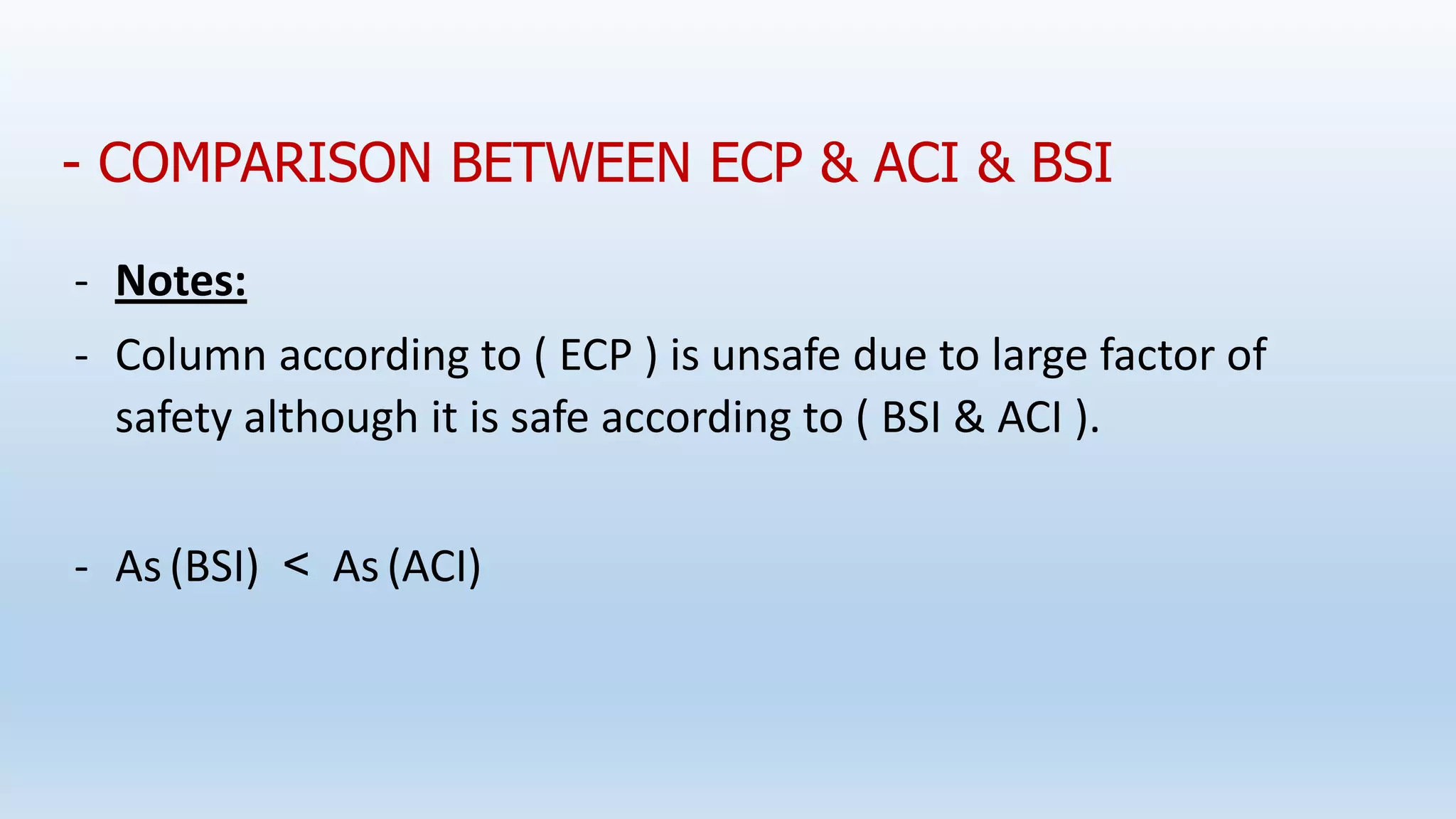
- Notes:
- Column according to ( ECP ) is unsafe due to large factor of
safety although it is safe according to ( BSI & ACI ).
- As (BSI) < As (ACI)
- COMPARISON BETWEEN ECP & ACI & BSI
Beam Design
- COMPARISON BETWEEN ECP & ACI & BSI
Shear Design
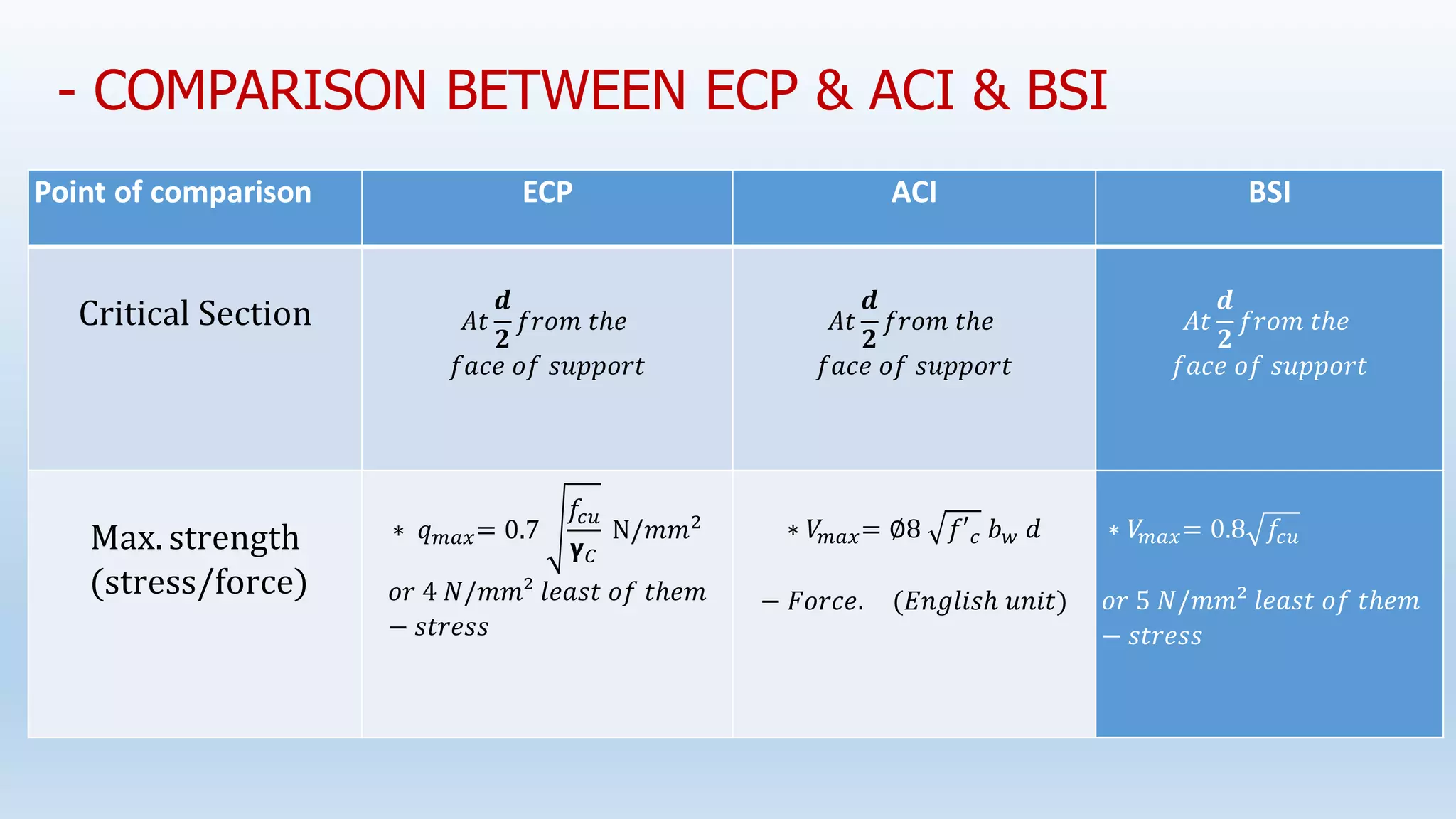
- COMPARISON BETWEEN ECP & ACI & BSI
BSI
ACI
ECP
Point of comparison
𝐴𝑡
𝒅
𝟐
𝑓𝑟𝑜𝑚 𝑡ℎ𝑒
𝑓𝑎𝑐𝑒 𝑜𝑓 𝑠𝑢𝑝𝑝𝑜𝑟𝑡
𝐴𝑡
𝒅
𝟐
𝑓𝑟𝑜𝑚 𝑡ℎ𝑒
𝑓𝑎𝑐𝑒 𝑜𝑓 𝑠𝑢𝑝𝑝𝑜𝑟𝑡
𝐴𝑡
𝒅
𝟐
𝑓𝑟𝑜𝑚 𝑡ℎ𝑒
𝑓𝑎𝑐𝑒 𝑜𝑓 𝑠𝑢𝑝𝑝𝑜𝑟𝑡
Critical Section
∗ 𝑉
𝑚𝑎𝑥= 0.8 𝑓𝑐𝑢
𝑜𝑟 5 𝑁/𝑚𝑚² 𝑙𝑒𝑎𝑠𝑡 𝑜𝑓 𝑡ℎ𝑒𝑚
− 𝑠𝑡𝑟𝑒𝑠𝑠
∗ 𝑉
𝑚𝑎𝑥= ∅8 𝑓′𝑐 𝑏𝑤 𝑑
− 𝐹𝑜𝑟𝑐𝑒. (𝐸𝑛𝑔𝑙𝑖𝑠ℎ 𝑢𝑛𝑖𝑡)
∗ 𝑞𝑚𝑎𝑥= 0.7
𝑓𝑐𝑢
𝝲𝐶
N/𝑚𝑚2
𝑜𝑟 4 𝑁/𝑚𝑚² 𝑙𝑒𝑎𝑠𝑡 𝑜𝑓 𝑡ℎ𝑒𝑚
− 𝑠𝑡𝑟𝑒𝑠𝑠
Max. strength
(stress/force)
- COMPARISON BETWEEN ECP & ACI & BSI
BSI
ACI
ECP
Point of comparison
∗ 𝑉
𝑐 = 0.79
100 𝐴𝑆
𝑏𝑣 𝑑
1
3
(
400
𝑑
)
1
4 / 𝛾𝑚
• 𝑑𝑒𝑝𝑒𝑛𝑑𝑠 𝑜𝑛 𝑓𝑐𝑢 , d & AS
∗ ∅ 𝑉𝐶 = ∅2 𝑓′𝑐 𝑏𝑑
• 𝐹𝑜𝑟𝑐𝑒 … … 𝐸𝑛𝑔𝑙𝑖𝑠ℎ 𝑢𝑛𝑖𝑡
• 𝑑𝑒𝑝𝑒𝑛𝑑𝑠 𝑜𝑛 𝑓′𝑐 , b & d.
∗ 𝑞𝑐𝑢= 0.24
𝑓𝑐𝑢
𝝲𝐶
N/𝑚𝑚2
• 𝑠𝑡𝑟𝑒𝑠𝑠
• 𝑑𝑒𝑝𝑒𝑛𝑑𝑠 𝑜𝑛 𝑓𝑐𝑢
Nominal shear strength
of concrete
(stress/force)
∗ 𝑉𝑈 →
𝑄𝑈
𝑏𝑑
∗ 𝑉𝑈 → 𝑠ℎ𝑒𝑎𝑟 𝑓𝑜𝑟𝑐𝑒.
∗ 𝑞𝑢 =
𝑄𝑢
𝑏.𝑑
Design value of shear
(stress/force)
- COMPARISON BETWEEN ECP & ACI & BSI
BSI
ACI
ECP
Point of
comparison
− 𝐼𝐹 𝑉
𝑢 <
𝑉𝐶
2
→ 𝑁𝑜 𝑠ℎ𝑒𝑎𝑟 𝑅𝐹𝑇 𝑖𝑠 𝑢𝑠𝑒𝑑
− 𝐼𝐹 𝑉
𝑢 < 𝑉
𝑐
→ 𝑀𝑖𝑛 𝑠ℎ𝑒𝑎𝑟 𝑅𝐹𝑇 𝑖𝑠 𝑢𝑠𝑒𝑑
𝐴𝑠𝑣
𝑆𝑣
=
0.4𝑏𝑣
0.95𝐹𝑦𝑣
if V≤𝑉
𝑐+0.4𝑏𝑣d
𝐴𝑠𝑣
𝑆𝑣
=
𝑉−𝑉𝑐
0.95𝐹𝑦𝑣𝑏𝑡
if V≤𝑉
𝑐+0.4𝑏𝑣d
− 𝐼𝐹 𝑞𝑢 < 𝑞𝑐𝑢
→ 𝑈𝑠𝑒 𝑚𝑖𝑛. 𝑠ℎ𝑒𝑎𝑟 𝑅𝐹𝑇.
5 ∅8/𝑚
− 𝐼𝐹𝑞𝑐𝑢˂𝑞𝑢 ≤ 𝑞𝑚𝑎𝑥
→ 𝑈𝑠𝑒 𝑠ℎ𝑒𝑎𝑟 𝑅𝐹𝑇.
∗ ( 𝑞𝑢 −
𝑞𝑐𝑢
2
) = 𝐴𝑠𝑡
𝑏.𝑠
∗
𝑓𝑦
𝛾𝑠
− 𝐼𝐹 𝑞𝑢˃ 𝑞𝑚𝑎𝑥
→ 𝐼𝑛𝑐𝑟𝑒𝑠𝑒 𝑑𝑖𝑚𝑒𝑛𝑠𝑖𝑜𝑛.
R. F. T
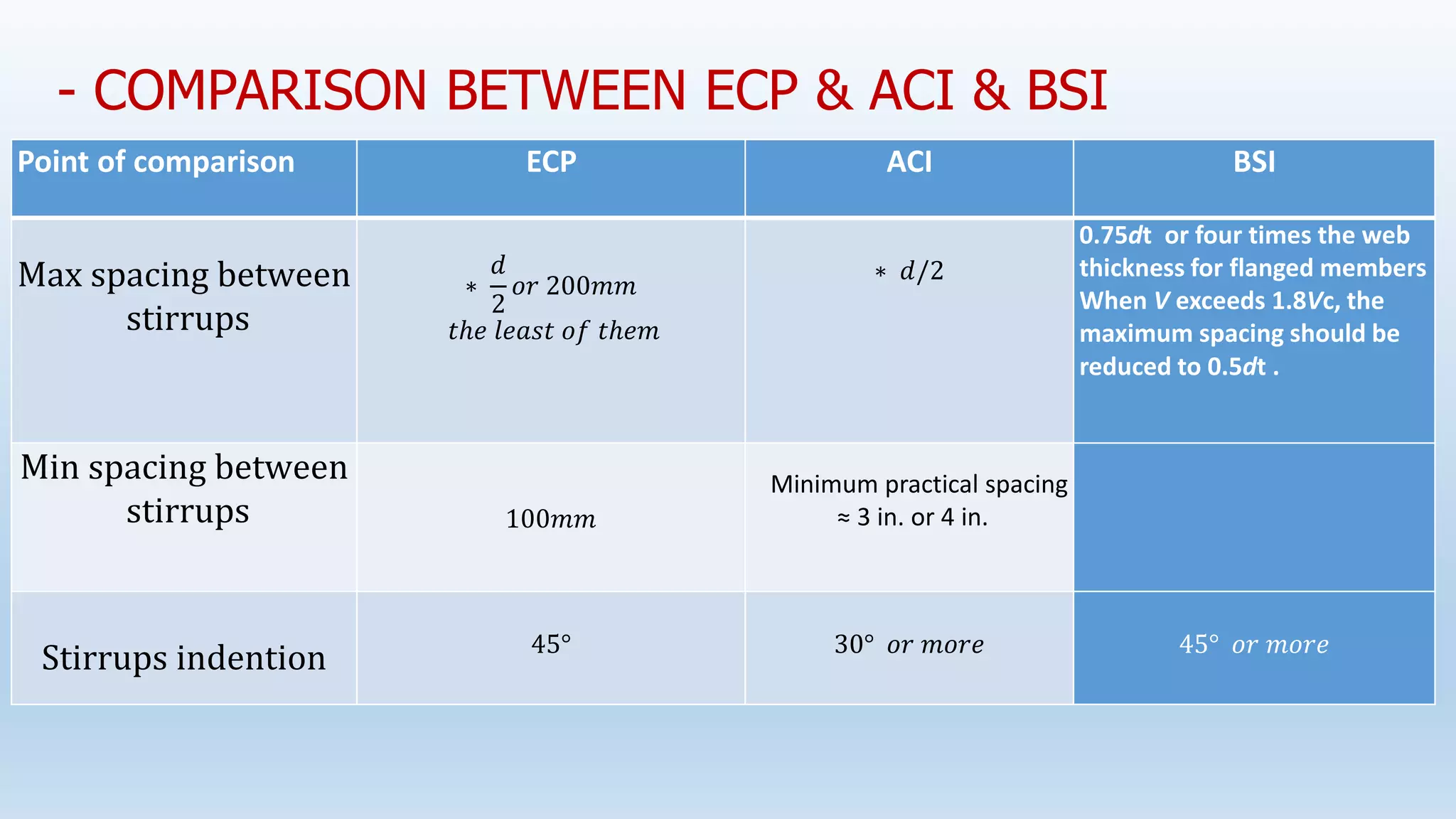
BSI
ACI
ECP
Point of comparison
0.75dt or four times the web
thickness for flanged members
When V exceeds 1.8Vc, the
maximum spacing should be
reduced to 0.5dt .
∗ 𝑑/2
∗
𝑑
2
𝑜𝑟 200𝑚𝑚
𝑡ℎ𝑒 𝑙𝑒𝑎𝑠𝑡 𝑜𝑓 𝑡ℎ𝑒𝑚
Max spacing between
stirrups
Minimum practical spacing
≈ 3 in. or 4 in.
100𝑚𝑚
Min spacing between
stirrups
45° 𝑜𝑟 𝑚𝑜𝑟𝑒
30° 𝑜𝑟 𝑚𝑜𝑟𝑒
45°
Stirrups indention
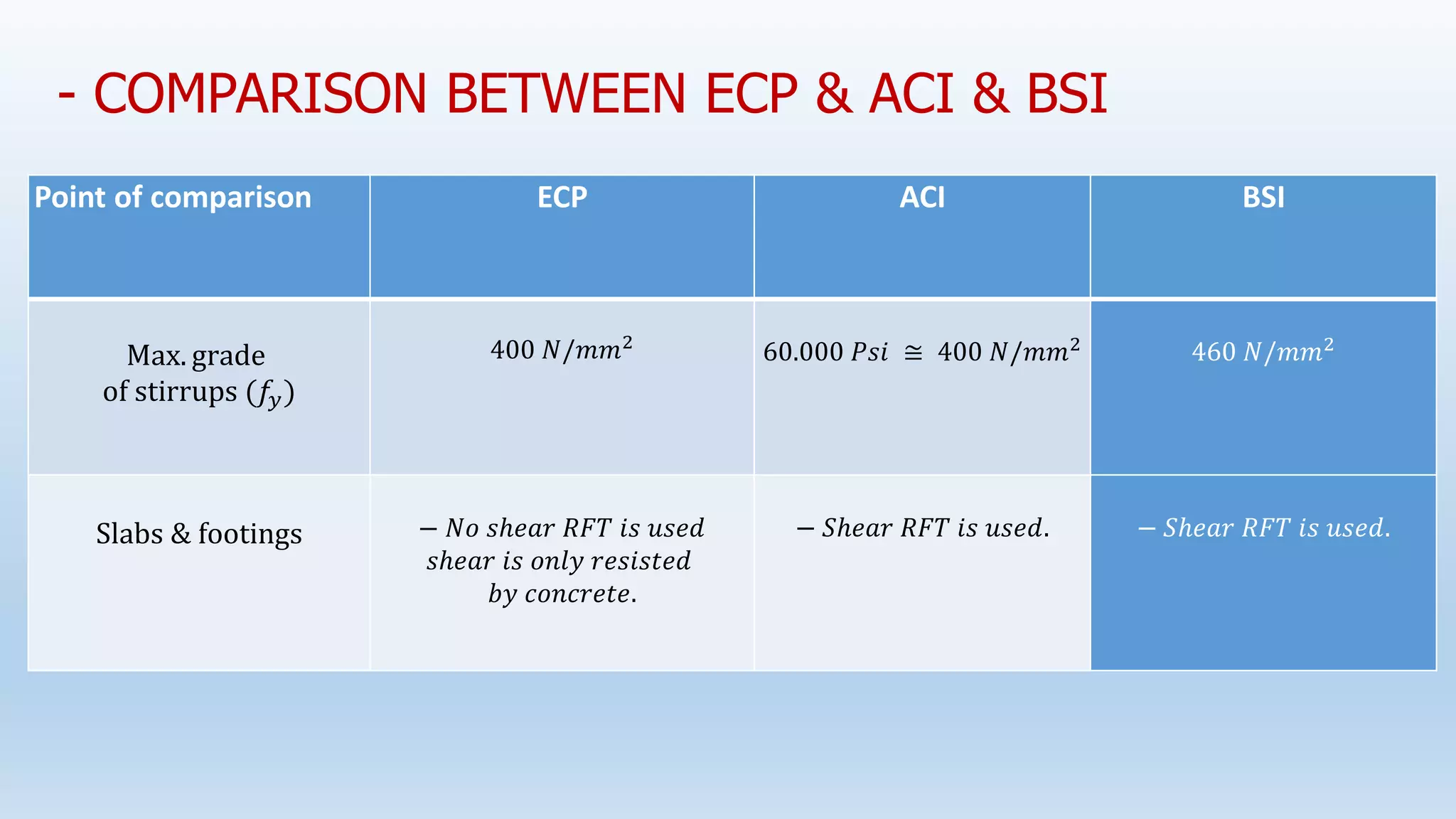
- COMPARISON BETWEEN ECP & ACI & BSI
BSI
ACI
ECP
Point of comparison
460 𝑁/𝑚𝑚2
60.000 𝑃𝑠𝑖 ≅ 400 𝑁/𝑚𝑚2
400 𝑁/𝑚𝑚2
Max. grade
of stirrups (𝑓𝑦)
− 𝑆ℎ𝑒𝑎𝑟 𝑅𝐹𝑇 𝑖𝑠 𝑢𝑠𝑒𝑑.
− 𝑁𝑜 𝑠ℎ𝑒𝑎𝑟 𝑅𝐹𝑇 𝑖𝑠 𝑢𝑠𝑒𝑑
𝑠ℎ𝑒𝑎𝑟 𝑖𝑠 𝑜𝑛𝑙𝑦 𝑟𝑒𝑠𝑖𝑠𝑡𝑒𝑑
𝑏𝑦 𝑐𝑜𝑛𝑐𝑟𝑒𝑡𝑒.
Slabs & footings
- COMPARISON BETWEEN ECP & ACI & BSI
Flexural design
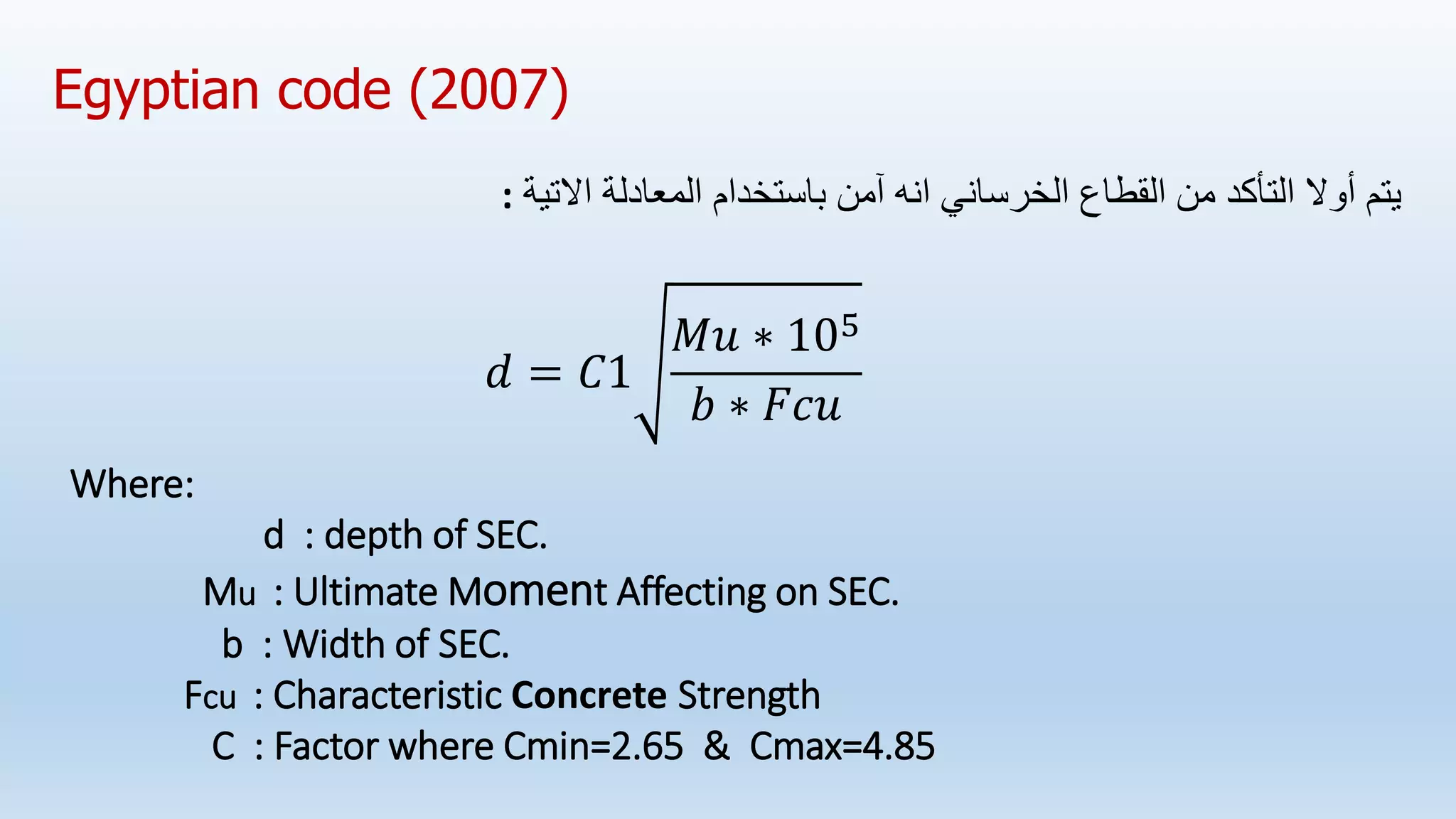
Egyptian code (2007)
‫من‬ ‫التأكد‬ ‫أوال‬ ‫يتم‬
‫الخرساني‬ ‫القطاع‬
‫انه‬
‫آمن‬
‫اال‬ ‫المعادلة‬ ‫باستخدام‬
‫تية‬
:
𝑑 = 𝐶1
𝑀𝑢 ∗ 105
𝑏 ∗ 𝐹𝑐𝑢
Where:
d : depth of SEC.
Mu : Ultimate Moment Affecting on SEC.
b : Width of SEC.
Fcu : Characteristic Concrete Strength
C : Factor where Cmin=2.65 & Cmax=4.85
-
‫بمعلومية‬
‫الخرساني‬ ‫القطاع‬
‫ال‬
b*d
‫ال‬ ‫قيمة‬ ‫وكذلك‬
Mult
‫السابق‬ ‫المعادلة‬ ‫فى‬ ‫التعويض‬ ‫نستطيع‬
‫ة‬
‫ال‬ ‫قيمة‬ ‫وايجاد‬
. C
-
‫ال‬ ‫قيمة‬ ‫كانت‬ ‫فاذا‬
C
‫ال‬ ‫من‬ ‫أقل‬
Cmin =2.65
‫قطاع‬ ‫أبعاد‬ ‫فنزيد‬ ‫امن‬ ‫غير‬ ‫القطاع‬ ‫يكون‬
‫الخرسانة‬
.
-
‫ال‬ ‫قيمة‬ ‫كانت‬ ‫واذا‬
C
‫ال‬ ‫من‬ ‫أكبر‬
Cmax
‫القطاع‬ ‫فيكون‬
more safe
‫قيمة‬ ‫تتراوح‬ ‫ان‬ ‫من‬ ‫فالبد‬
‫ال‬
C
‫ال‬ ‫بين‬
Cmin
‫و‬
Cmax
.
-
‫ال‬ ‫في‬ ‫الحديد‬ ‫قيمة‬ ‫اليجاد‬ ‫االتية‬ ‫المعادلة‬ ‫فى‬ ‫التعويض‬ ‫يتم‬ ‫امن‬ ‫القطاع‬ ‫أن‬ ‫من‬ ‫التاكد‬ ‫بعد‬
‫قطاع‬
. As
𝑨𝒔 =
𝑴𝒖
𝑭𝒚 ∗ 𝒅 ∗ 𝑱
Egyptian code (2007)
𝑨𝒔 =
𝑴𝒖
𝑭𝒚 ∗ 𝒅 ∗ 𝑱
Where
Fy : Yield Stress
d : depth of SEC
Mu: Ultimate Moment Affecting on
Section
J: Factor Get It's Value From Table
According to Value Of C1
Egyptian code (2007)
‫قطاع‬ ‫من‬ ‫التأكد‬ ‫أوال‬ ‫يتم‬
‫الخرساني‬
‫المعادلة‬ ‫باستخدام‬ ‫امن‬ ‫انه‬
‫االتية‬
‫ال‬ ‫قيمة‬ ‫اليجاد‬
Rn
:
∅ 𝑅𝑛 =
𝑀𝑢
𝑏𝑑2 ………… We can get Rn=√√√
Where
d: depth of Section.
Mu: Ultimate Moment Affecting on Section.
b: Width of Section.
∅ = 0.9
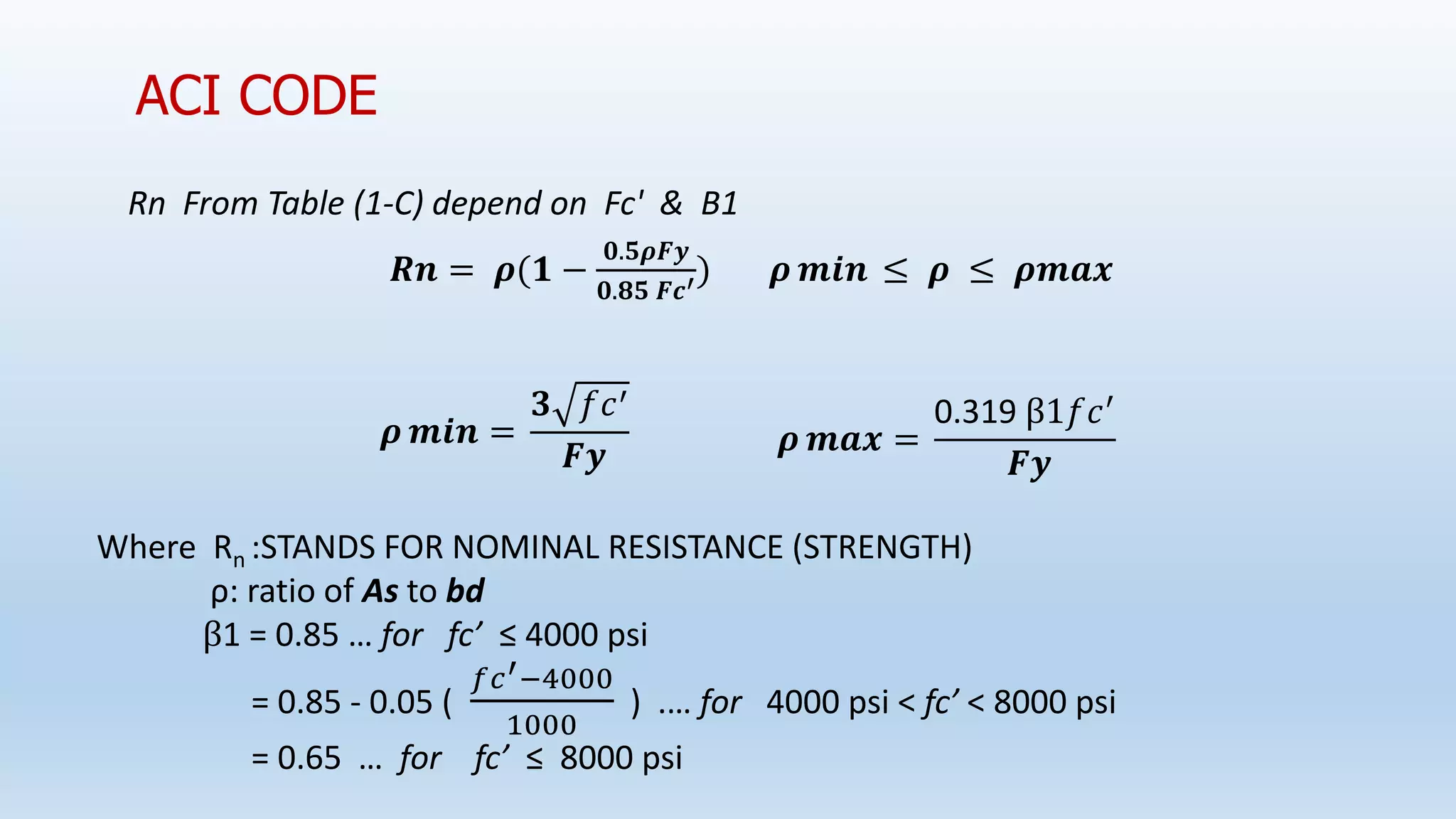
ACI CODE
Rn From Table (1-C) depend on Fc' & B1
𝑹𝒏 = 𝝆(𝟏 −
𝟎.𝟓𝝆𝑭𝒚
𝟎.𝟖𝟓 𝑭𝒄′) 𝝆 𝒎𝒊𝒏 ≤ 𝝆 ≤ 𝝆𝒎𝒂𝒙
ACI CODE
𝝆 𝒎𝒊𝒏 =
𝟑 𝑓𝑐′
𝑭𝒚 𝝆 𝒎𝒂𝒙 =
0.319 β1𝑓𝑐′
𝑭𝒚
Where Rn :STANDS FOR NOMINAL RESISTANCE (STRENGTH)
ρ: ratio of As to bd
β1 = 0.85 … for fc’ ≤ 4000 psi
= 0.85 - 0.05 (
𝑓𝑐′−4000
1000
) .… for 4000 psi < fc’ < 8000 psi
= 0.65 … for fc’ ≤ 8000 psi
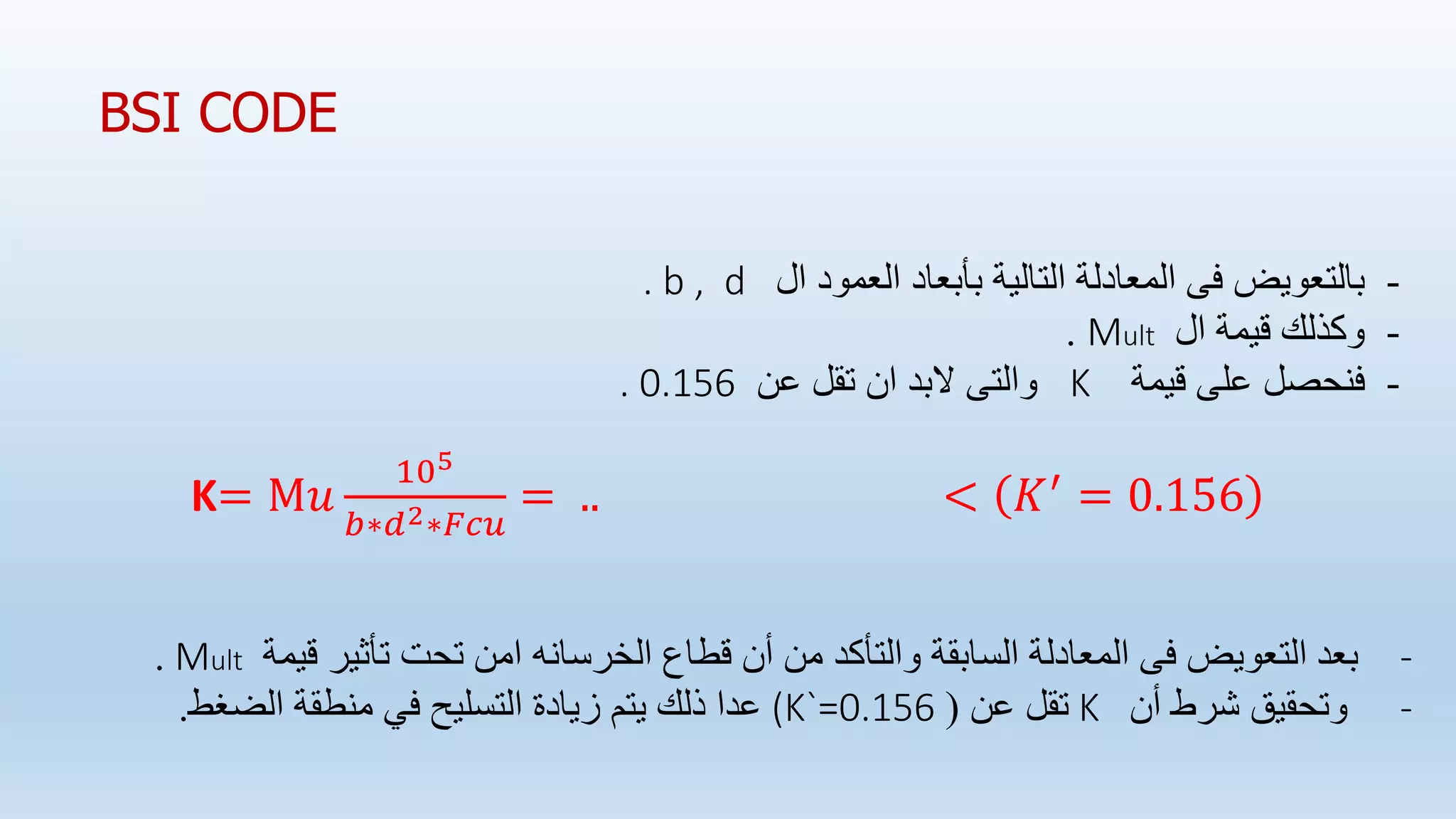
-
‫بالتعويض‬
‫ال‬ ‫العمود‬ ‫بأبعاد‬ ‫التالية‬ ‫المعادلة‬ ‫فى‬
. b , d
-
‫وكذلك‬
‫ال‬ ‫قيمة‬
Mult
.
-
‫فنحصل‬
‫قيمة‬ ‫على‬
K
‫والتى‬
‫ان‬ ‫البد‬
‫عن‬ ‫تقل‬
. 0.156
K= M𝑢
105
𝑏∗𝑑2∗𝐹𝑐𝑢
= .. < 𝐾′
= 0.156
-
‫بعد‬
‫قطاع‬ ‫أن‬ ‫من‬ ‫والتأكد‬ ‫السابقة‬ ‫المعادلة‬ ‫فى‬ ‫التعويض‬
‫الخرسانه‬
‫قيمة‬ ‫تأثير‬ ‫تحت‬ ‫امن‬
Mult
.
-
‫أن‬ ‫شرط‬ ‫وتحقيق‬
K
‫تقل‬
‫عن‬
(
(K`=0.156
‫الضغط‬ ‫منطقة‬ ‫في‬ ‫التسليح‬ ‫زيادة‬ ‫يتم‬ ‫ذلك‬ ‫عدا‬
.
BSI CODE
-
‫تسليح‬ ‫قيمة‬ ‫حساب‬ ‫ذلك‬ ‫بعد‬ ‫يتم‬
‫الخرساني‬
‫التالية‬ ‫المعادلة‬ ‫باستخدام‬
:
𝑨𝒔 = Mu ∗
105
0.87 ∗ 𝐹𝑦 ∗ 𝑑 ∗ 0.95
𝑤ℎ𝑒𝑟𝑒:
𝐹𝑦 = characteristic concrete strength.
𝐹𝑐𝑢 = characteristic yield strength.
BSI CODE
- COMPARISON BETWEEN ECP & ACI & BSI
BSI
ACI
ECP
Point of comparison
0.0035
0.003
0.003
The Strain Of Concrete
𝜻𝑐𝑢
𝑏 +
𝐿
10
𝑏 +
𝐿
5
0.12𝐿 𝑂𝑟 6𝑡𝑠
0.25 L Or 8ts
𝑘𝐿
10
+ 𝑏 𝑜𝑟 6𝑡𝑠 + 𝑏 (L section)
𝑘𝐿
5
+ 𝑏 𝑜𝑟 16𝑡𝑠 + 𝑏 ((T section)
B1 section
- COMPARISON BETWEEN ECP & ACI & BSI
BSI
ACI
ECP
Point of comparison
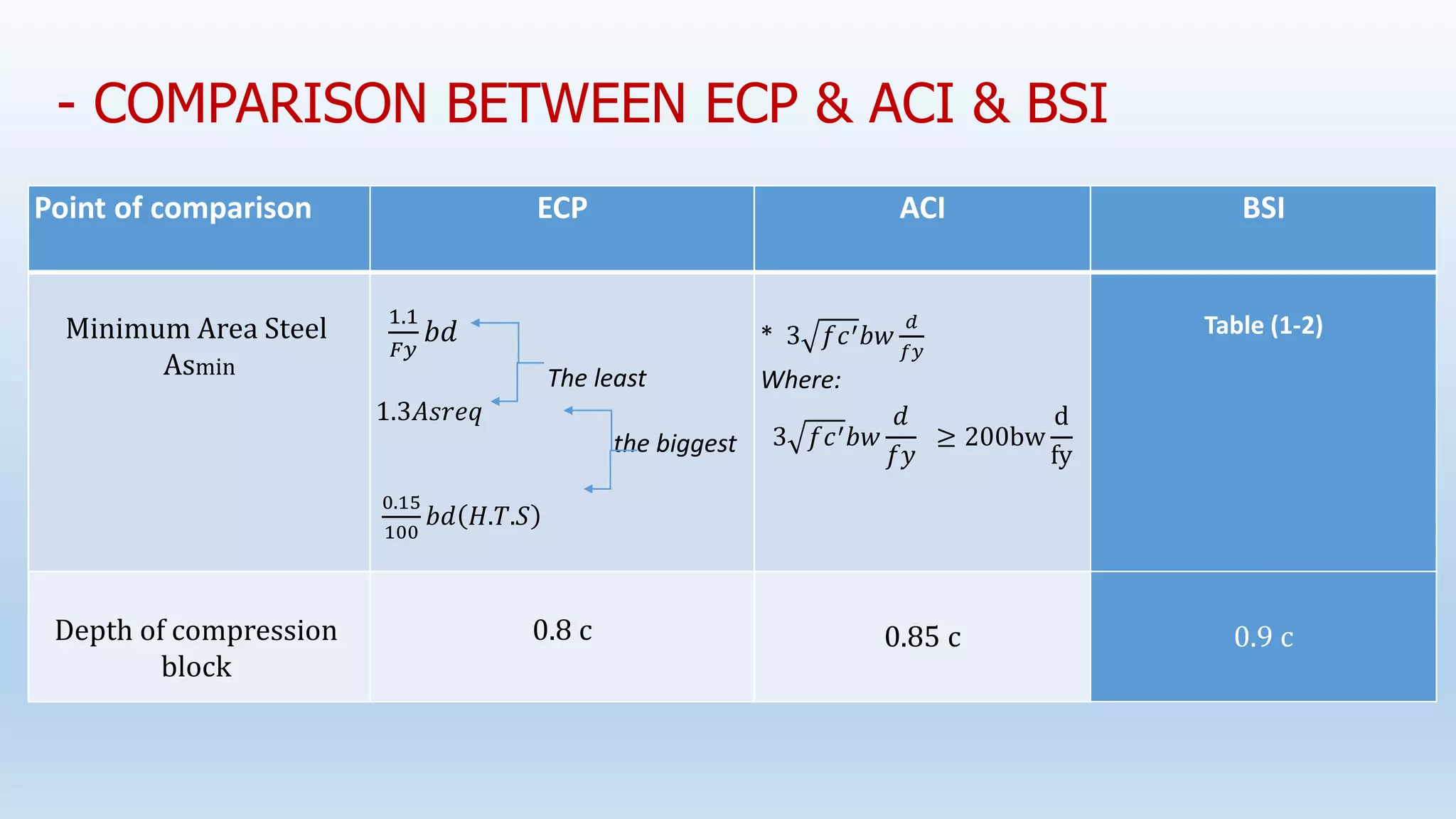
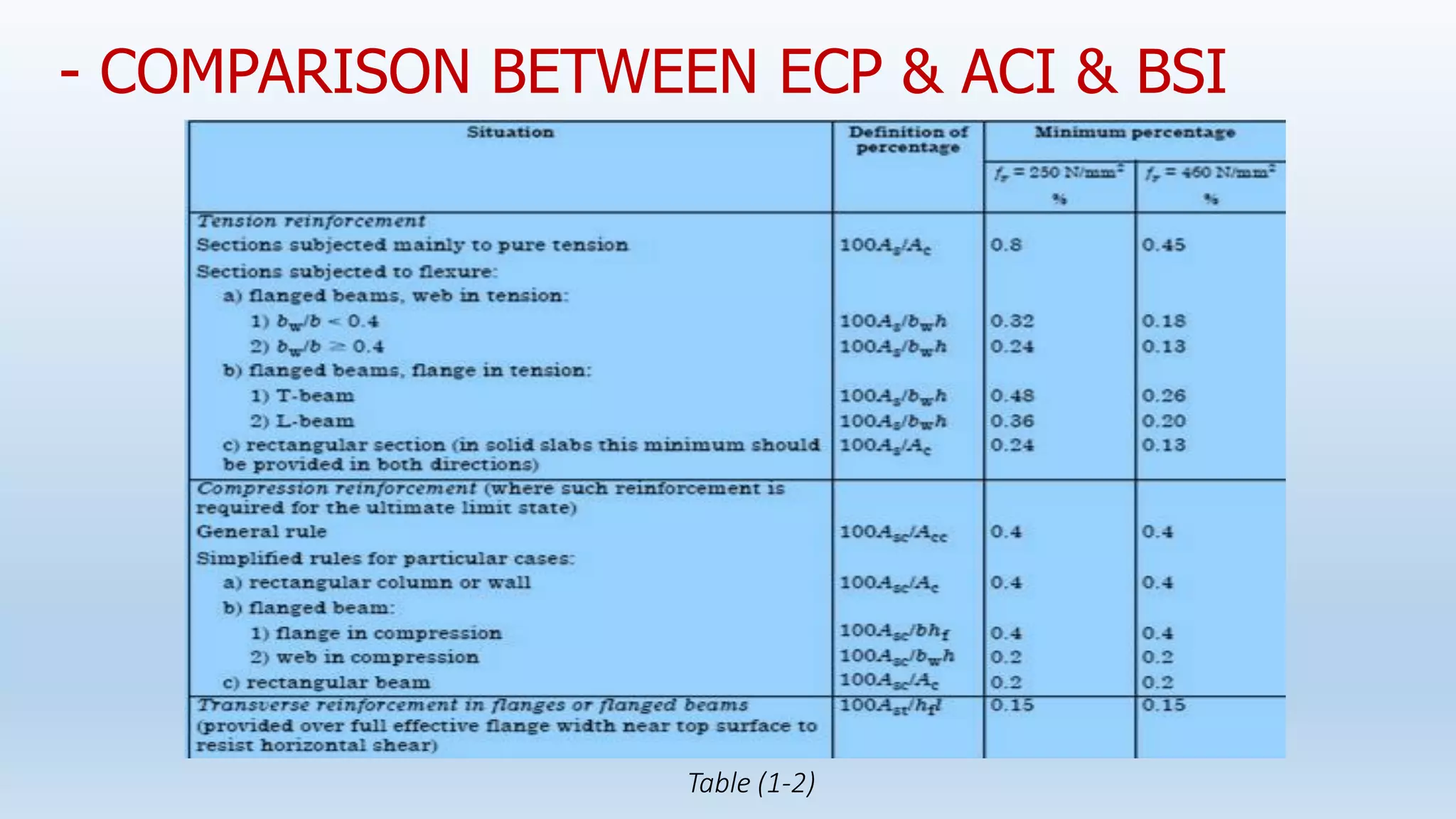
Table (1-2)
* 3 𝑓𝑐′𝑏𝑤
𝑑
𝑓𝑦
Where:
3 𝑓𝑐′𝑏𝑤
𝑑
𝑓𝑦
≥ 200bw
d
fy
1.1
𝐹𝑦
𝑏𝑑
The least
1.3𝐴𝑠𝑟𝑒𝑞
the biggest
0.15
100
𝑏𝑑 𝐻.𝑇.𝑆
Minimum Area Steel
Asmin
0.9 c
0.85 c
0.8 c
Depth of compression
block
- COMPARISON BETWEEN ECP & ACI & BSI
BSI
ACI
ECP
Point of comparison
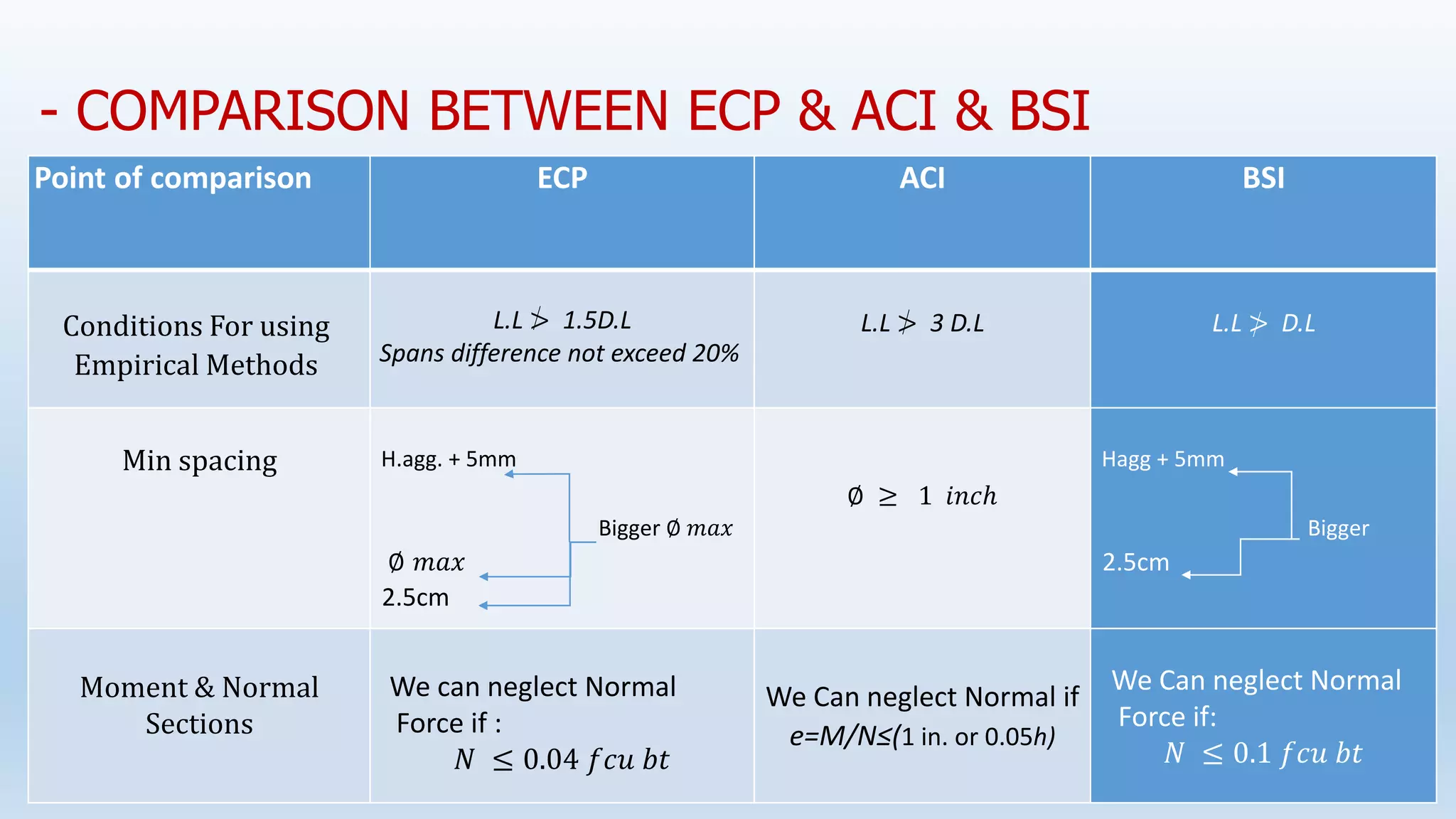
L.L > D.L
L.L > 3 D.L
L.L > 1.5D.L
Spans difference not exceed 20%
Conditions For using
Empirical Methods
Hagg + 5mm
Bigger
2.5cm
∅ ≥ 1 𝑖𝑛𝑐ℎ
H.agg. + 5mm
Bigger ∅ 𝑚𝑎𝑥
∅ 𝑚𝑎𝑥
2.5cm
Min spacing
We Can neglect Normal
Force if:
𝑁 ≤ 0.1 𝑓𝑐𝑢 𝑏𝑡
We Can neglect Normal if
e=M/N≤(1 in. or 0.05h)
We can neglect Normal
Force if :
𝑁 ≤ 0.04 𝑓𝑐𝑢 𝑏𝑡
Moment & Normal
Sections
- COMPARISON BETWEEN ECP & ACI & BSI
BSI
ACI
ECP
Point of comparison
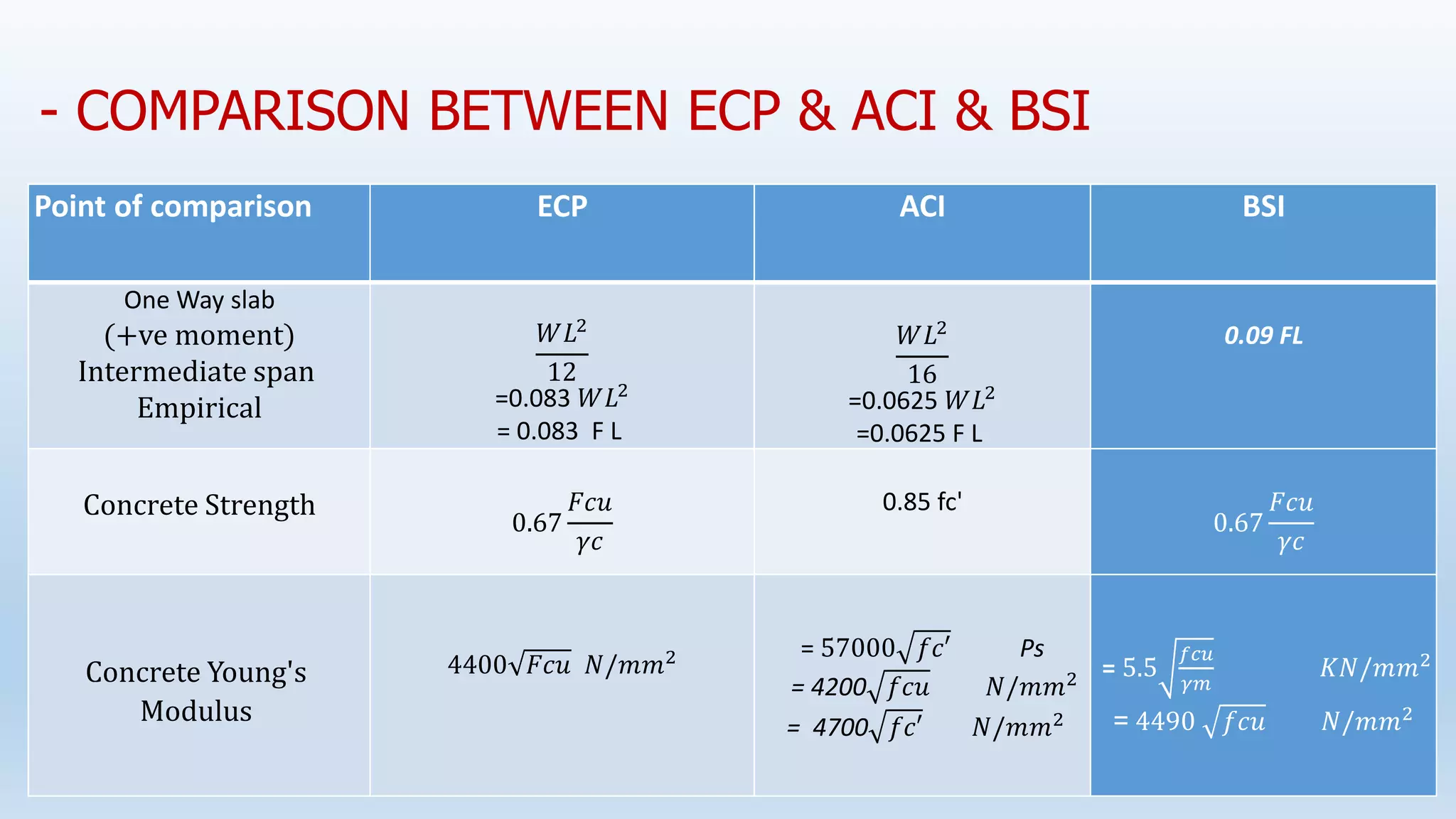
0.09 FL
𝑊𝐿2
16
=0.0625 𝑊𝐿2
=0.0625 F L
𝑊𝐿2
12
=0.083 𝑊𝐿2
= 0.083 F L
One Way slab
(+ve moment)
Intermediate span
Empirical
0.67
𝐹𝑐𝑢
𝛾𝑐
0.85 fc'
0.67
𝐹𝑐𝑢
𝛾𝑐
Concrete Strength
𝐾𝑁/𝑚𝑚2
= 5.5
𝑓𝑐𝑢
𝛾𝑚
4490 𝑓𝑐𝑢 𝑁/𝑚𝑚2
=
= 57000 𝑓𝑐′ Ps
= 4200 𝑓𝑐𝑢 𝑁/𝑚𝑚2
= 4700 𝑓𝑐′ 𝑁/𝑚𝑚2
4400 𝐹𝑐𝑢 𝑁/𝑚𝑚2
Concrete Young's
Modulus
- COMPARISON BETWEEN ECP & ACI & BSI
BSI
ACI
ECP
Point of comparison
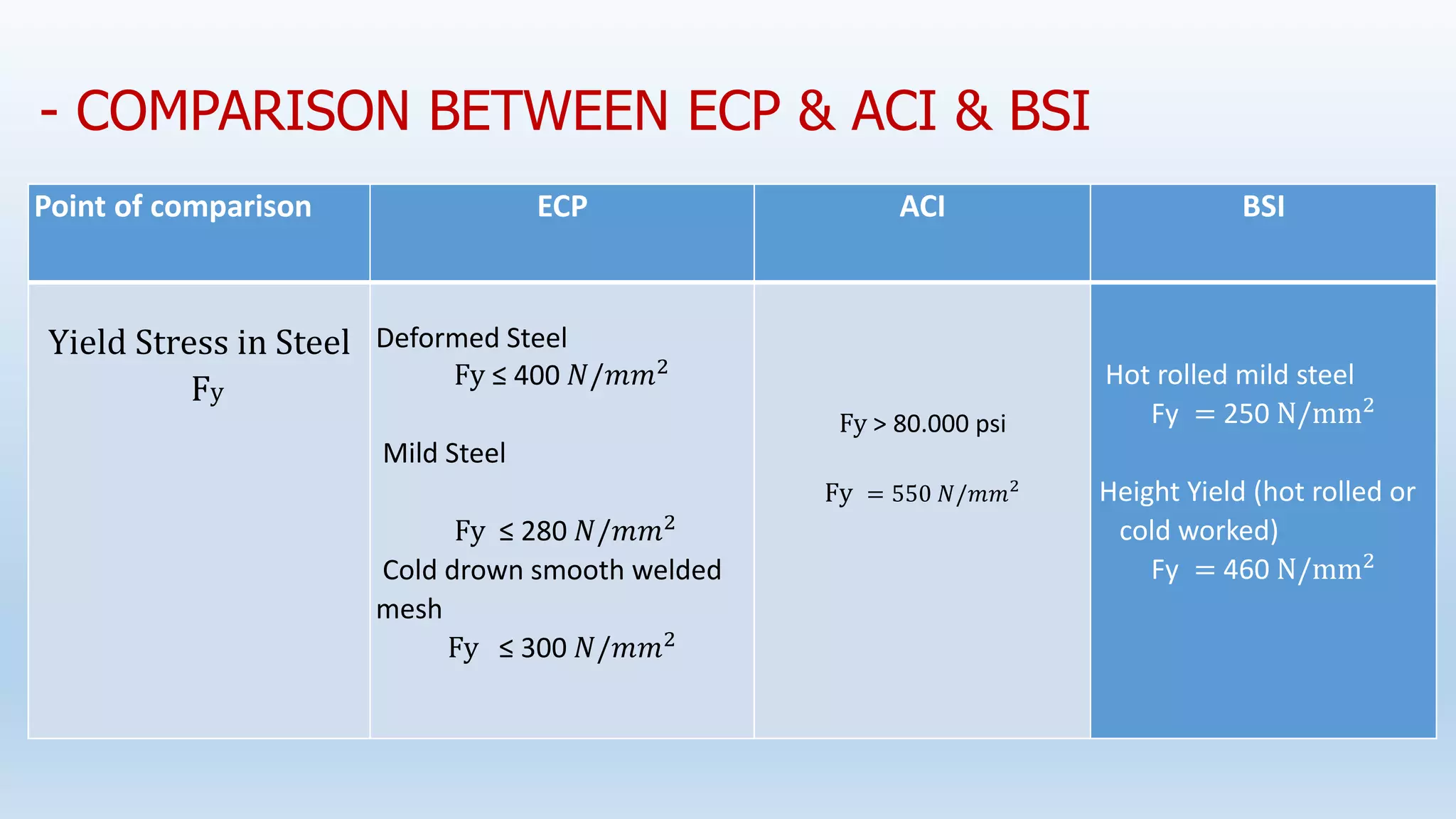
Hot rolled mild steel
Fy = 250 N/mm2
Height Yield (hot rolled or
cold worked)
Fy = 460 N/mm2
Fy > 80.000 psi
Fy = 550 𝑁/𝑚𝑚2
Deformed Steel
Fy ≤ 400 𝑁/𝑚𝑚2
Mild Steel
Fy ≤ 280 𝑁/𝑚𝑚2
Cold drown smooth welded
mesh
Fy ≤ 300 𝑁/𝑚𝑚2
Yield Stress in Steel
Fy
BSI
ACI
ECP
Point of
comparison
-Concrete not exposed to
weather or in contact
with ground:
Primary reinforcement, ties,
stirrups,
spirals..……….. 40
Cover
- COMPARISON BETWEEN ECP & ACI & BSI
Table (1-2)
- COMPARISON BETWEEN ECP & ACI & BSI
Slabs Design
- COMPARISON BETWEEN ECP & ACI & BSI
BSI
ACI
ECP
Point of comparison
• solid slab
• Flat slab
• Hollow block slab
• One way slab
• Two way slab
a)- Two way beam supported
slab
b)- Flat plate
c)- Flat slab
d)- Waffle slab
• solid slab
• Flat slab
• Hollow block slab
Types of Slabs
Solid Slab Design
- COMPARISON BETWEEN ECP & ACI & BSI
BSI
ACI
ECP
Point of comparison
• One way slab
-simply supported slab
tmin =
𝑙
20
-one end continuous
tmin =
𝑙
24
-both ends continuous
tmin =
𝑙
28
-cantilever
tmin =
𝑙
10
Where 𝑙 is the direction of the
load
• One way slab
-simply supported slab
tmin =
𝑙
30
-one end continuous
tmin =
𝑙
35
-both ends continuous
tmin =
𝑙
40
-cantilever
tmin =
𝑙
𝟏0
Where 𝑙 is the direction of
the load
Thickness of slabs
- COMPARISON BETWEEN ECP & ACI & BSI
BSI
ACI
ECP
Point of comparison
• Two way slab
-fy = 280 (N/𝑚𝑚2
)
tmin =
𝑙
36
-fy = 420 (N/𝑚𝑚2
)
tmin =
𝑙
33
-fy = 520 (N/𝑚𝑚2
)
tmin =
𝑙
28
* Where
𝑙 : is long span length measured
face to face from support
• Two way slab
-simply supported slab
tmin =
𝑙
35
-one end continuous
tmin =
𝑙
40
-both ends continuous
tmin =
𝑙
45
* Where
𝑙 :is short span length
measured from center to
center
Thickness of slabs
BSI
ACI
ECP
Point of
comparison
-Shells, folded plate members:
No. 19 bar and larger.....…..20
No. 16 bar, MW200 or MD200
wire, and smaller…………… 13
Cover
- COMPARISON BETWEEN ECP & ACI & BSI
Flat Slab Design
- COMPARISON BETWEEN ECP & ACI & BSI
BSI
ACI
ECP
Point of comparison
* Where
𝑙 :is long span length
measured from center to
center
Thickness of slabs
- COMPARISON BETWEEN ECP & ACI & BSI
BSI
ACI
ECP
Point of comparison
𝑙
𝟑
≤ Ldrop
tdrop min. = 1.25 tslab
𝑙
𝟑
≤ Ldrop
tdrop min. = 1.25 tslab
𝑙𝑠ℎ𝑜𝑟𝑡
3
< Ldrop <
𝑙𝑚𝑖𝑛
2
Drop panel
- COMPARISON BETWEEN ECP & ACI & BSI
BSI
ACI
ECP
Point of
comparison
tBeam ≥ 1.5 tslab
Effective beam section :
• Edge beam
b + hw ≤ b + 4 tslab
• Interior beam
b + 2 hw ≤ b + 8 tslab
tBeam ≥ 2.5 tslab
tBeam ≥ 3 tslab
Marginal
beam
- COMPARISON BETWEEN ECP & ACI & BSI
BSI
ACI
ECP
Point of
comparison
1-Holes in areas bounded by column
strips:
that their greatest dimension in a
direction parallel to a centre-line of
the panel does not exceed 0.4 ɭ .
2-Holes in areas common to two
column strips:
that in aggregate their length or
width does not exceed one-tenth of
the width of the column strip
3-Holes in areas common to a
column strip and middle strip:
that in aggregate their length or
width does not exceed one- quarter
of the width of the column strip
In case of col. Strip intersecting with
col. Strip:
Lvoid ≤ ɭ1 / 16
In case of col. Strip intersecting with
middle strip :
Lvoid ≤ ɭ1 / 8
In case of middle Strip intersecting
with middle strip :
Opening in
the slab
- COMPARISON BETWEEN ECP & ACI & BSI
BSI
ACI
ECP
Point of comparison
If ʋ ≤ 1.6 ʋc use :
• 𝑑𝑒𝑝𝑒𝑛𝑑𝑠 𝑜𝑛 𝑐𝑜𝑛𝑐𝑟𝑒𝑡𝑒
And steel
Vu ≤ ∅ Vn ___ safe punching
Where : Vn = Vc+ Vs
Vs =
𝐴𝑣 𝑑 𝑓𝑦𝑡
𝑆
• 𝑑𝑒𝑝𝑒𝑛𝑑𝑠 𝑜𝑛 𝑐𝑜𝑛𝑐𝑟𝑒𝑡𝑒
And steel
𝑞𝑝𝑢 ≤ 𝑞𝑐𝑝𝑢 ___ safe punching
• 𝑑𝑒𝑝𝑒𝑛𝑑𝑠 𝑜𝑛 𝑐𝑜𝑛𝑐𝑟𝑒𝑡𝑒 only
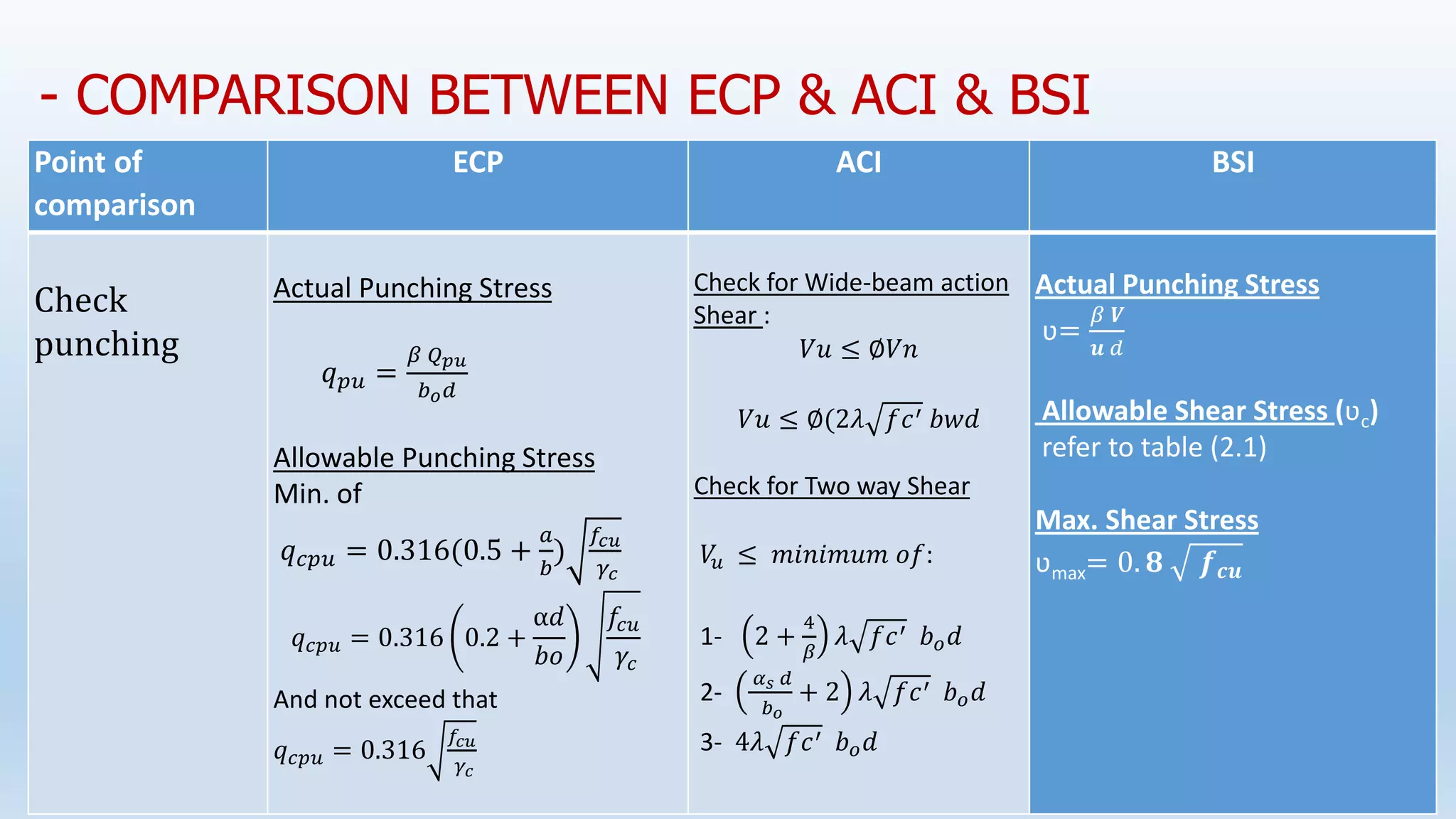
Check punching
- COMPARISON BETWEEN ECP & ACI & BSI
BSI
ACI
ECP
Point of
comparison
Actual Punching Stress
ʋ=
𝛽 𝑽
𝒖 𝑑
Allowable Shear Stress (ʋc)
refer to table (2.1)
Max. Shear Stress
ʋmax= 0. 𝟖 𝒇𝒄𝒖
Check for Wide-beam action
Shear :
𝑉𝑢 ≤ ∅𝑉𝑛
𝑉𝑢 ≤ ∅(2𝜆 𝑓𝑐′ 𝑏𝑤𝑑
Check for Two way Shear
𝑉
𝑢 ≤ 𝑚𝑖𝑛𝑖𝑚𝑢𝑚 𝑜𝑓:
1- 2 +
4
𝛽
𝜆 𝑓𝑐′ 𝑏𝑜𝑑
2-
𝛼𝑠 𝑑
𝑏𝑜
+ 2 𝜆 𝑓𝑐′ 𝑏𝑜𝑑
3- 4𝜆 𝑓𝑐′ 𝑏𝑜𝑑
Actual Punching Stress
𝑞𝑝𝑢 =
𝛽 𝑄𝑝𝑢
𝑏𝑜𝑑
Allowable Punching Stress
Min. of
𝑞𝑐𝑝𝑢 = 0.316(0.5 +
𝑎
𝑏
)
𝑓𝑐𝑢
𝛾𝑐
𝑞𝑐𝑝𝑢 = 0.316 0.2 +
α𝑑
𝑏𝑜
𝑓𝑐𝑢
𝛾𝑐
And not exceed that
𝑞𝑐𝑝𝑢 = 0.316
𝑓𝑐𝑢
𝛾𝑐
Check
punching
- COMPARISON BETWEEN ECP & ACI & BSI
BSI
ACI
ECP
Point of
comparison
If ʋ ≤ 1.6 ʋc use :
If 1.6 ʋc < v ≤ 2 ʋc use :
If v > 2 ʋc use :
• Increase fc’
• increase slab thickness by
Using drop panel
• Providing shear
reinforcement
Av =
𝑉𝑢−∅ 𝑉𝑐 𝑆
∅ 𝑑 𝑓𝑦𝑡
if un safe punching
• Increase fc’
• increase slab thickness by
Using drop panel
• Providing shear reinforcement
( bars, wires , steel I shape
Or headed shear studs )
if un safe punching
• Increase slab thickness
• Use drop panel
Check punching
- COMPARISON BETWEEN ECP & ACI & BSI
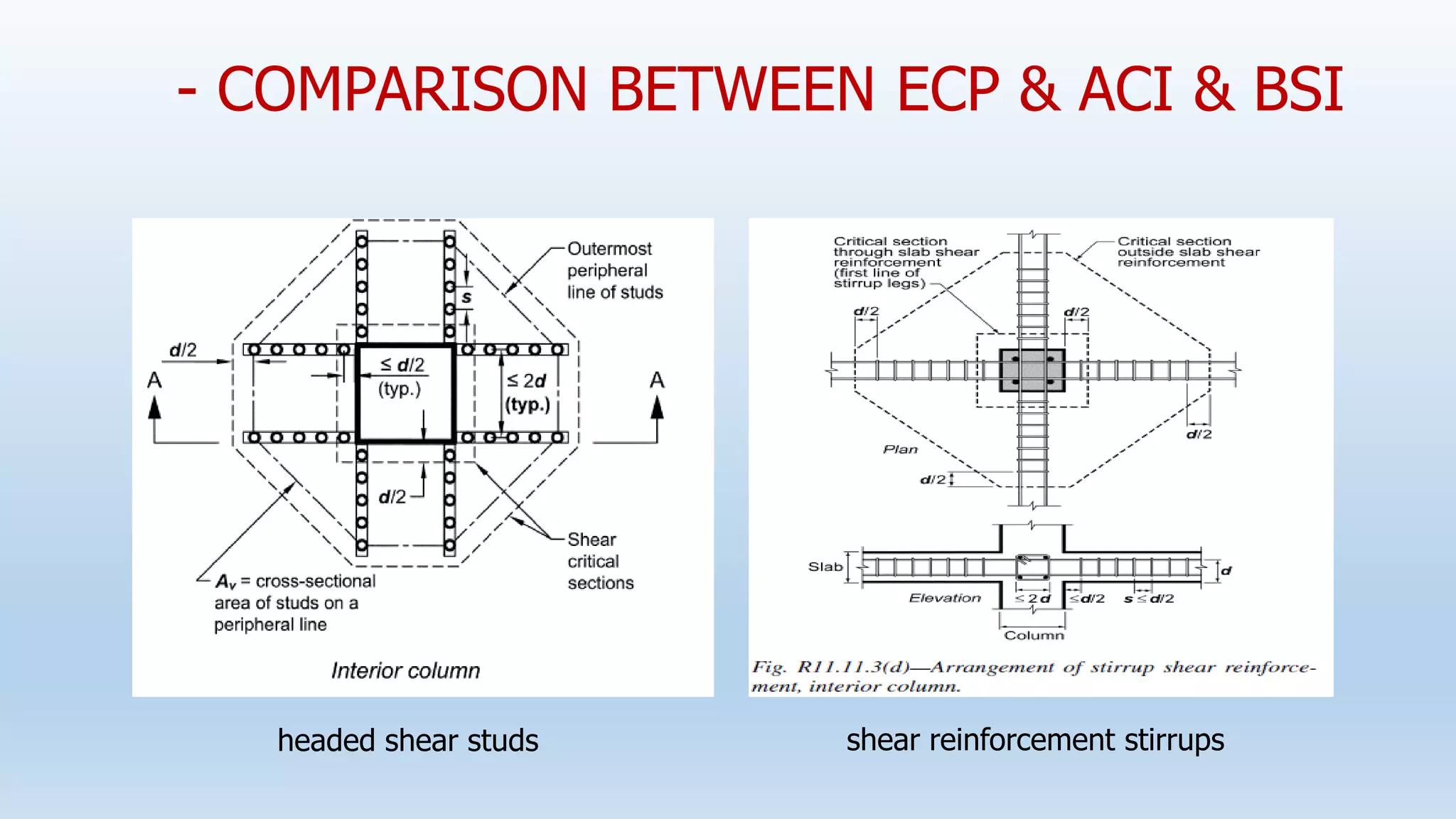
shear reinforcement stirrups
headed shear studs
- COMPARISON BETWEEN ECP & ACI & BSI
BSI
ACI
ECP
Point of
comparison
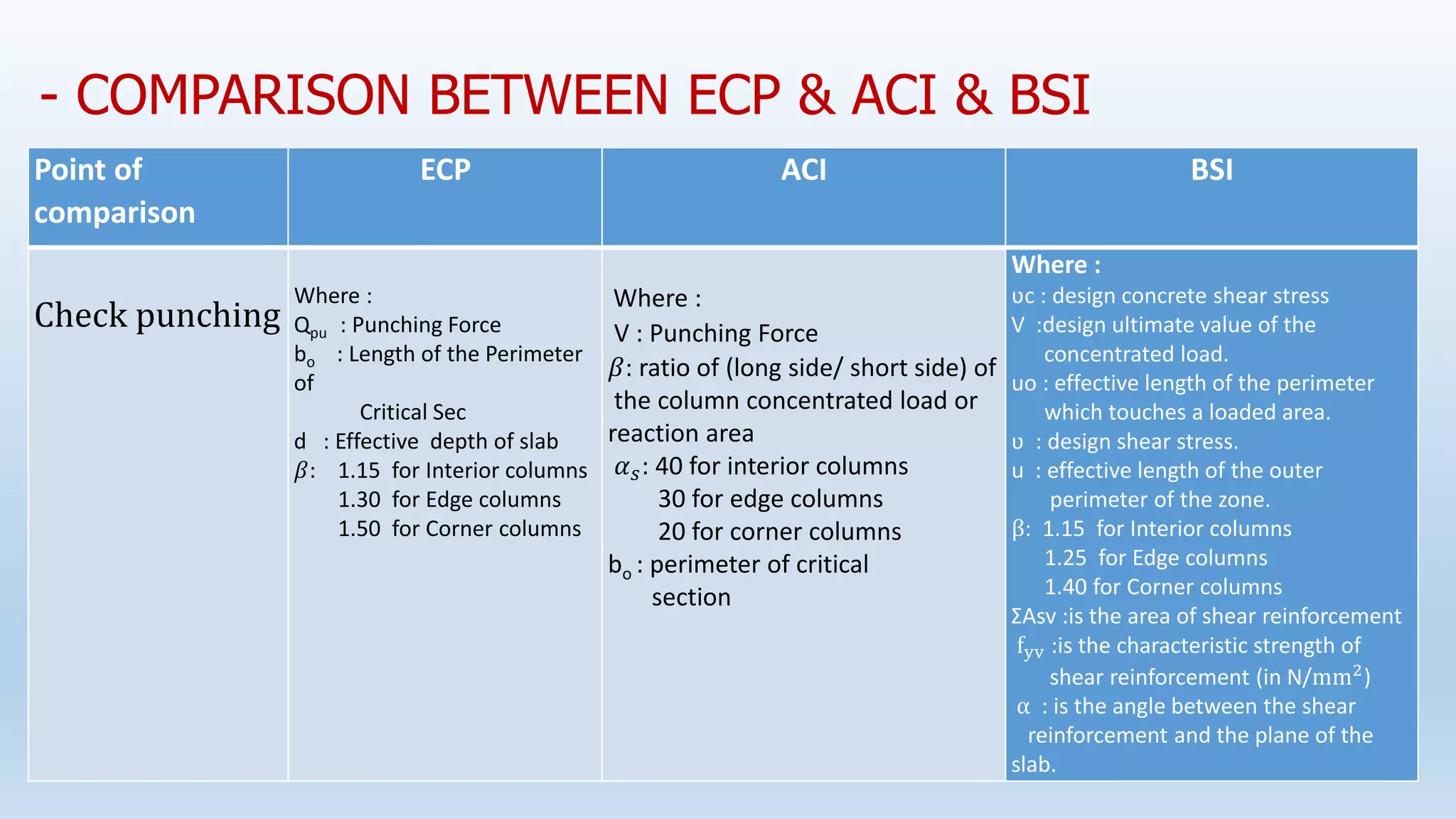
Where :
ʋc : design concrete shear stress
V :design ultimate value of the
concentrated load.
uo : effective length of the perimeter
which touches a loaded area.
ʋ : design shear stress.
u : effective length of the outer
perimeter of the zone.
β: 1.15 for Interior columns
1.25 for Edge columns
1.40 for Corner columns
ΣAsv :is the area of shear reinforcement
fyv :is the characteristic strength of
shear reinforcement (in N/mm2
)
α : is the angle between the shear
reinforcement and the plane of the
slab.
Where :
V : Punching Force
𝛽: ratio of (long side/ short side) of
the column concentrated load or
reaction area
𝛼𝑠: 40 for interior columns
30 for edge columns
20 for corner columns
bo : perimeter of critical
section
Where :
Qpu : Punching Force
bo : Length of the Perimeter
of
Critical Sec
d : Effective depth of slab
𝛽: 1.15 for Interior columns
1.30 for Edge columns
1.50 for Corner columns
Check punching
- COMPARISON BETWEEN ECP & ACI & BSI
BSI
ACI
ECP
Point of comparison
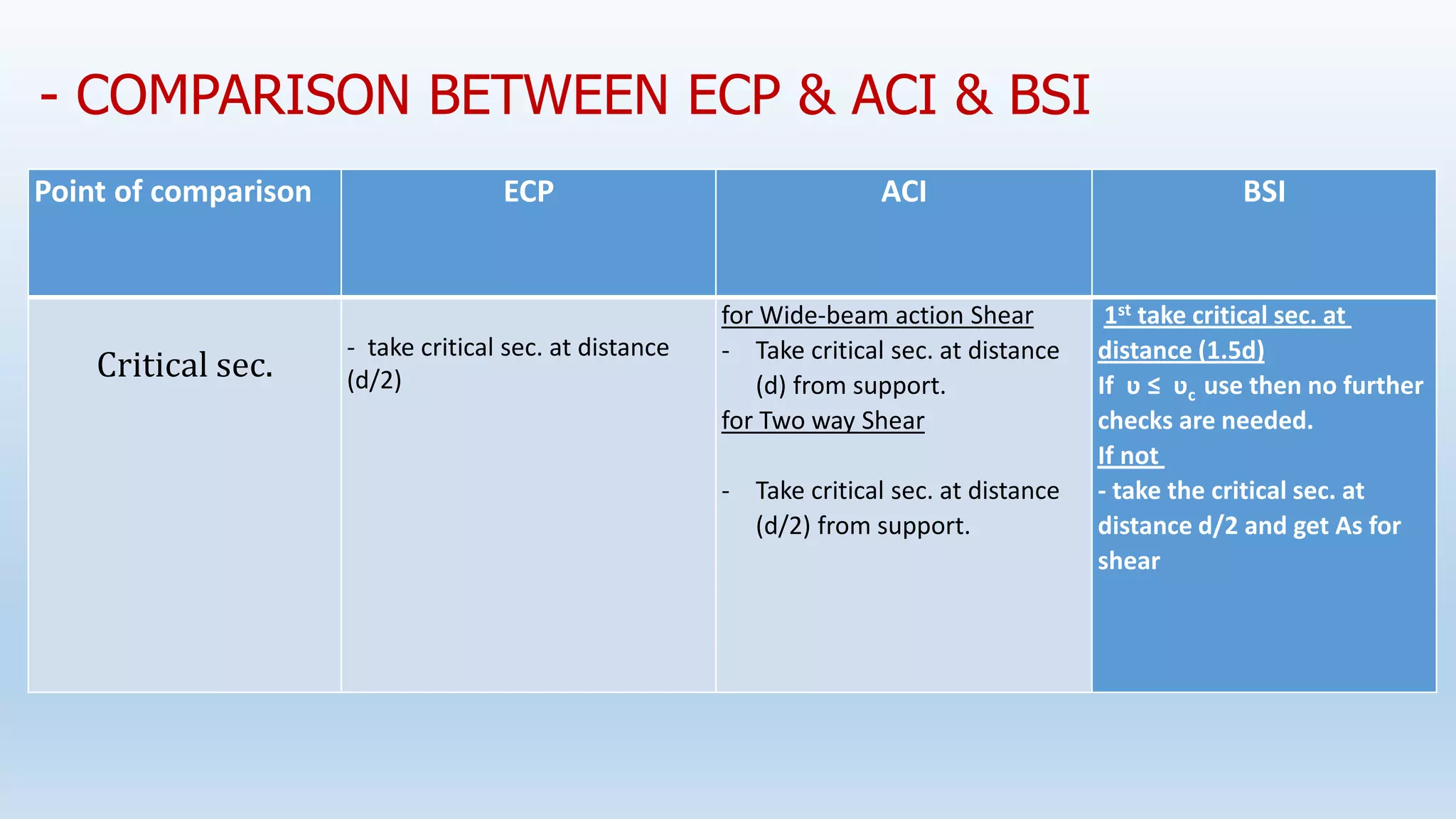
1st take critical sec. at
distance (1.5d)
If ʋ ≤ ʋc use then no further
checks are needed.
If not
- take the critical sec. at
distance d/2 and get As for
shear
for Wide-beam action Shear
- Take critical sec. at distance
(d) from support.
for Two way Shear
- Take critical sec. at distance
(d/2) from support.
- take critical sec. at distance
(d/2)
Critical sec.
- COMPARISON BETWEEN ECP & ACI & BSI
Table (2.1)
Hollow block design
- COMPARISON BETWEEN ECP & ACI & BSI
BSI
ACI
ECP
Point of
comparison
-In situ ribs should be
spaced at centers not
exceeding 1.5 m & should
not exceed four times their
width
-PAN WIDE (500-750)mm
PANS FORM
- COMPARISON BETWEEN ECP & ACI & BSI
BSI
ACI
ECP
Point of
comparison
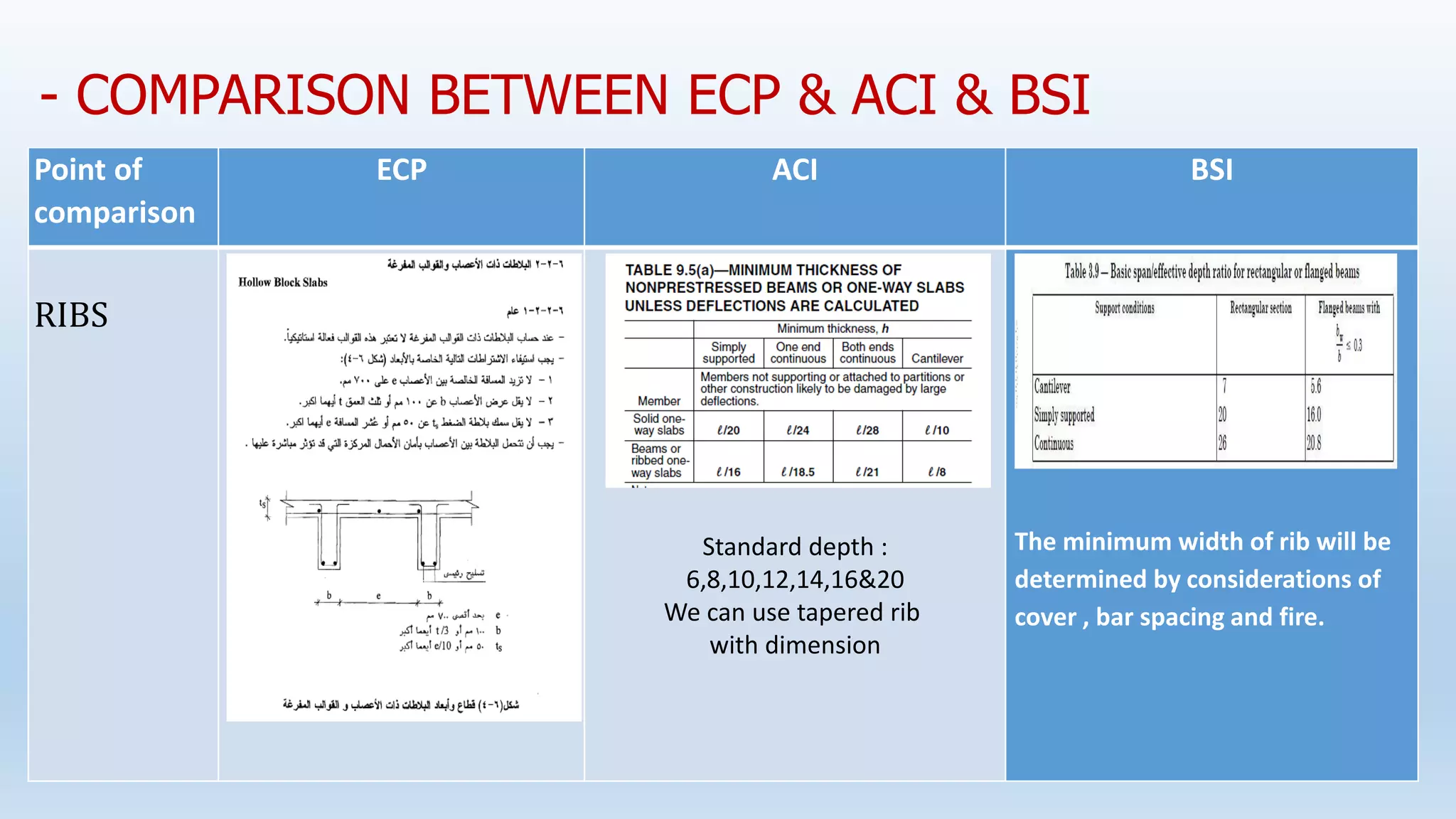
The minimum width of rib will be
determined by considerations of
cover , bar spacing and fire.
Standard depth :
6,8,10,12,14,16&20
We can use tapered rib
with dimension
RIBS
- COMPARISON BETWEEN ECP & ACI & BSI
BSI
ACI
ECP
Point of
comparison
One at mid for span ( 6-9 )m
& 2 ribs at third points for spans over
(9) m.
Cross rib
- COMPARISON BETWEEN ECP & ACI & BSI
BSI
ACI
ECP
Point of
comparison
-not less than 20mm or
1/10 clear distance between
ribs
Slab thickness over permanent
fillers shall be not less than
one-twelfth the clear distance
between ribs ,nor less than 40
mm .
Cover Slab
- COMPARISON BETWEEN ECP & ACI & BSI
BSI
ACI
ECP
Point of
comparison
Cover slab Rein.
Consideration should be
given to providing a single
layer of welded steel fabric,
having a cross-sectional area
of not less than 0.12 % of the
topping, in each direction;
the spacing between wires
should not be greater than
half the center-to-center
distance between ribs.
Reinforcement
- COMPARISON BETWEEN ECP & ACI & BSI
BSI
ACI
ECP
Point of
comparison
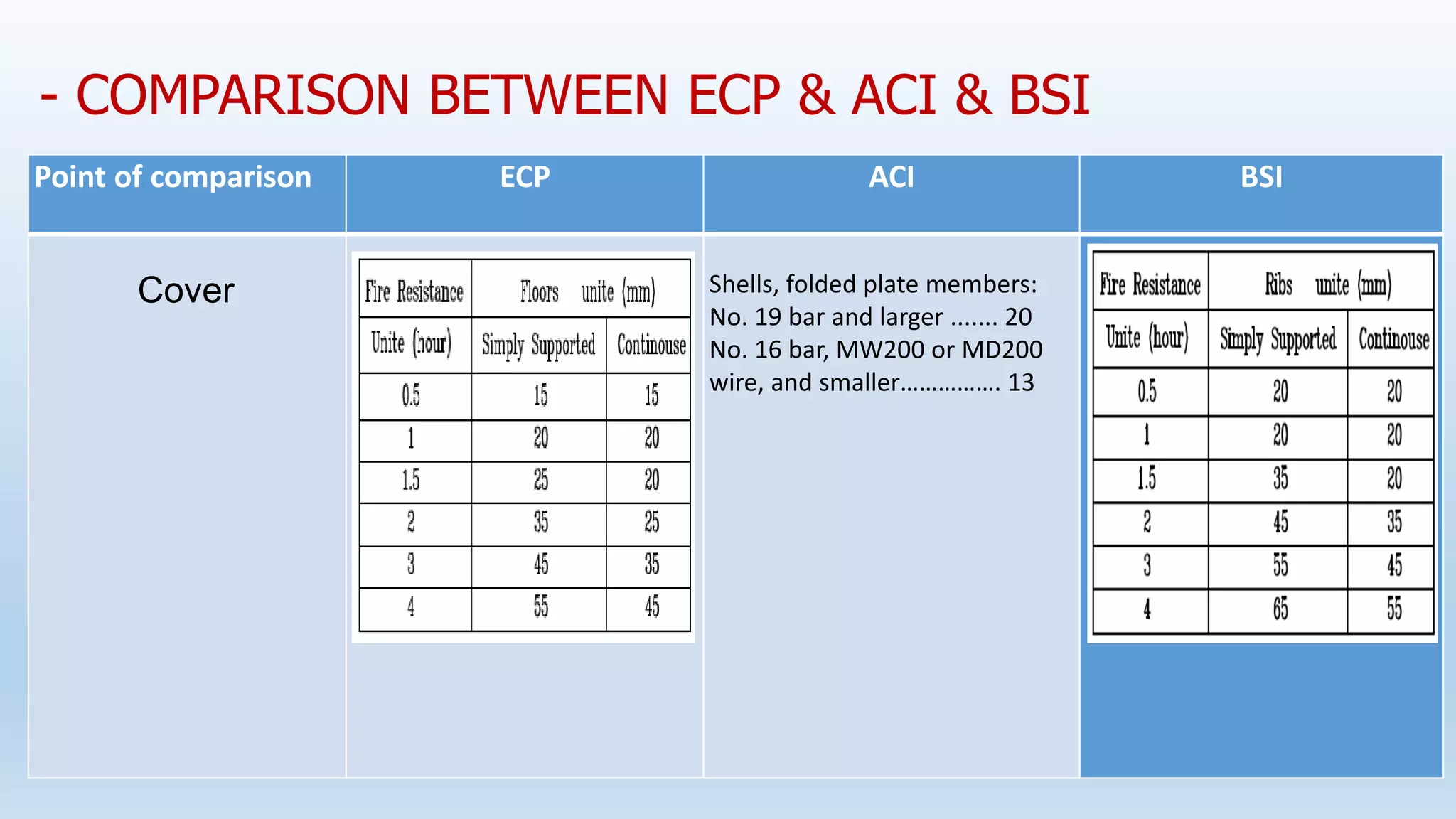
1 hour:
(20)mm for slab
2 hour:
(25)mm for slab
Fire
resisting
BSI
ACI
ECP
Point of comparison
Shells, folded plate members:
No. 19 bar and larger ....... 20
No. 16 bar, MW200 or MD200
wire, and smaller……………. 13
Cover
- COMPARISON BETWEEN ECP & ACI & BSI
Footing Design
- COMPARISON BETWEEN ECP & ACI & BSI
BSI
ACI
ECP
Point of comparison
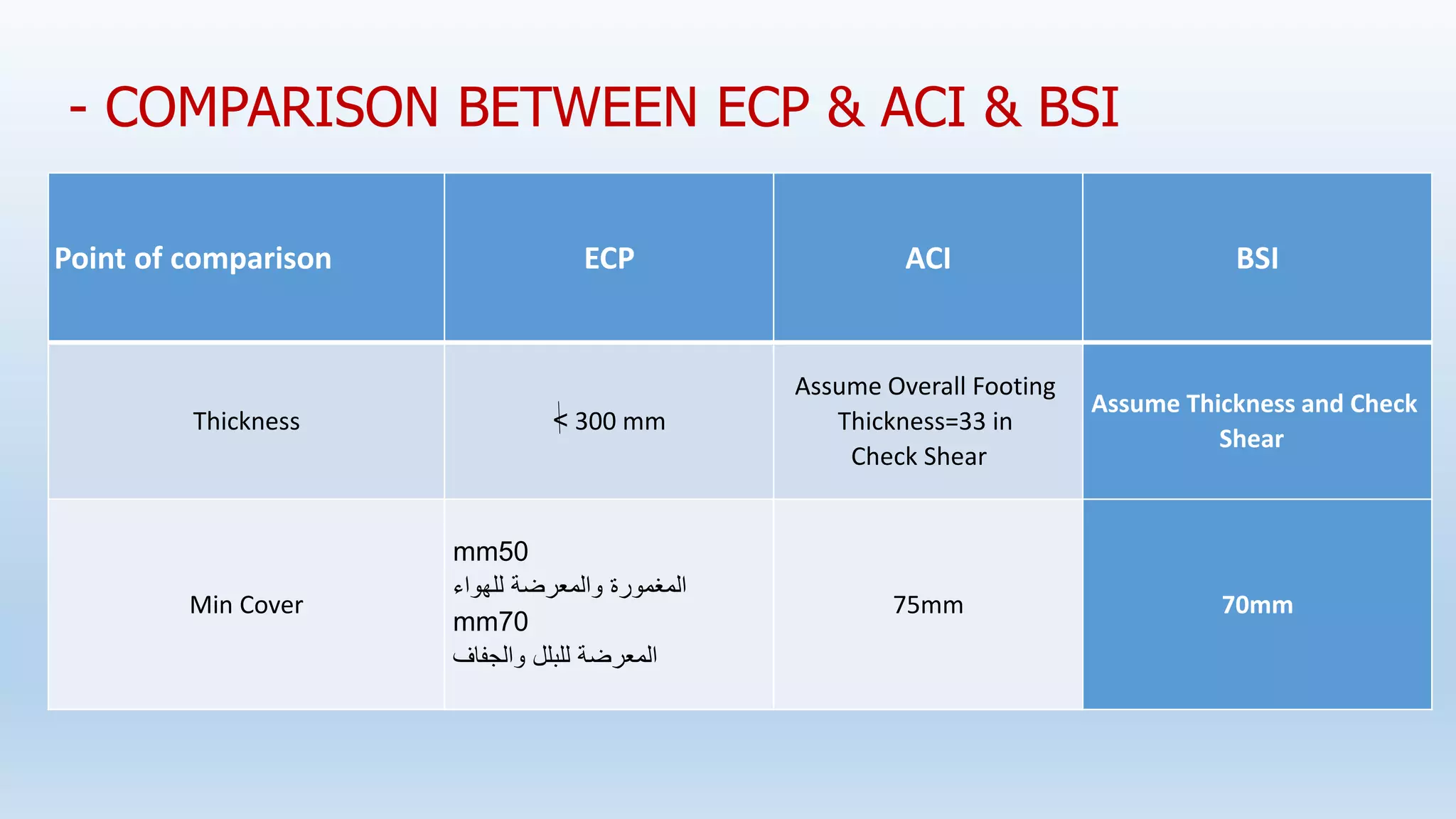
Assume Thickness and Check
Shear
Assume Overall Footing
Thickness=33 in
Check Shear
< 300 mm
Thickness
70mm
75mm
mm50
‫للهواء‬ ‫والمعرضة‬ ‫المغمورة‬
mm70
‫والجفاف‬ ‫للبلل‬ ‫المعرضة‬
Min Cover
- COMPARISON BETWEEN ECP & ACI & BSI
BSI
ACI
ECP
Point of
comparison
Actual Punching Stress
ʋ=
𝛽 𝑽
𝒖 𝑑
Allowable Shear Stress (ʋc)
refer to table (2.1)
Max. Shear Stress
ʋmax= 0. 𝟖 𝒇𝒄𝒖
Check for Wide-beam action
Shear :
𝑉𝑢 ≤ ∅𝑉𝑛
𝑉𝑢 ≤ ∅(2𝜆 𝑓𝑐′ 𝑏𝑤𝑑
Check for Two way Shear
𝑉
𝑢 ≤ 𝑚𝑖𝑛𝑖𝑚𝑢𝑚 𝑜𝑓:
1- 2 +
4
𝛽
𝜆 𝑓𝑐′ 𝑏𝑜𝑑
2-
𝛼𝑠 𝑑
𝑏𝑜
+ 2 𝜆 𝑓𝑐′ 𝑏𝑜𝑑
3- 4𝜆 𝑓𝑐′ 𝑏𝑜𝑑
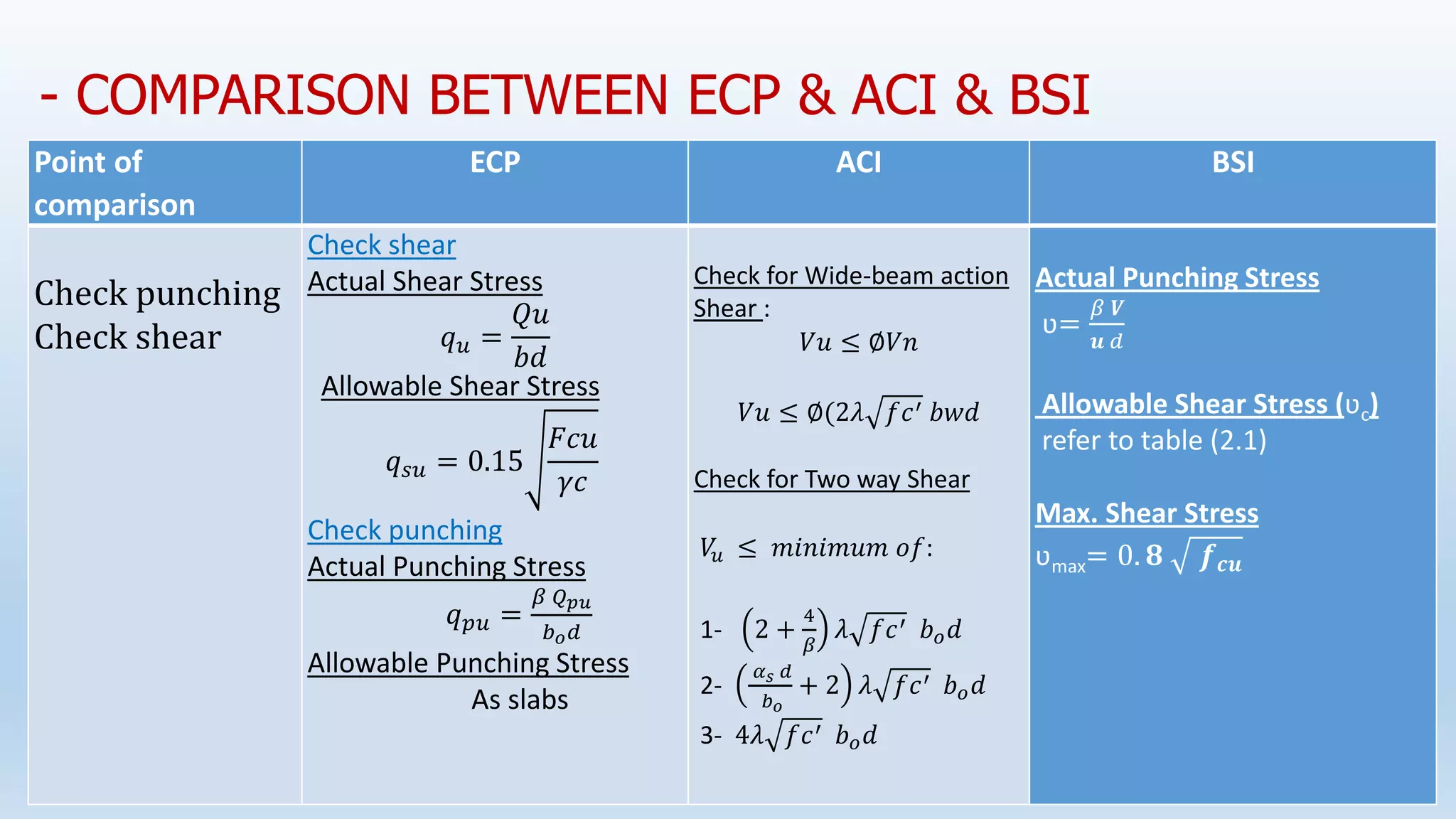
Check shear
Actual Shear Stress
𝑞𝑢 =
𝑄𝑢
𝑏𝑑
Allowable Shear Stress
𝑞𝑠𝑢 = 0.15
𝐹𝑐𝑢
𝛾𝑐
Check punching
Actual Punching Stress
𝑞𝑝𝑢 =
𝛽 𝑄𝑝𝑢
𝑏𝑜𝑑
Allowable Punching Stress
As slabs
Check punching
Check shear
- COMPARISON BETWEEN ECP & ACI & BSI
BSI
ACI
ECP
Point of
comparison
If ʋ ≤ 1.6 ʋc use :
If 1.6 ʋc < v ≤ 2 ʋc use :
If v > 2 ʋc use :
• Increase fc’
• increase footing thickness
or
Using drop panel
• Providing shear
reinforcement
Av =
𝑉𝑢−∅ 𝑉𝑐 𝑆
∅ 𝑑 𝑓𝑦𝑡
if un safe punching
• Increase fc’
• increase footing thickness or
Using drop panel
• Providing shear reinforcement
stirrups
if un safe punching
• Increase footing
thickness
• Use drop panel
Check punching
- COMPARISON BETWEEN ECP & ACI & BSI
BSI
ACI
ECP
Point of
comparison
Where :
ʋc : design concrete shear stress
V :design ultimate value of the
concentrated load.
uo : effective length of the perimeter
which touches a loaded area.
ʋ : design shear stress.
u : effective length of the outer
perimeter of the zone.
β: 1.15 for Interior columns
1.25 for Edge columns
1.40 for Corner columns
ΣAsv :is the area of shear reinforcement
fyv :is the characteristic strength of
shear reinforcement (in N/mm2
)
α : is the angle between the shear
reinforcement and the plane of the
slab.
Where :
V : Punching Force
𝛽: ratio of (long side/ short side) of
the column concentrated load or
reaction area
𝛼𝑠: 40 for interior columns
30 for edge columns
20 for corner columns
bo : perimeter of critical
section
Where :
Qpu : Punching Force
bo : Length of the Perimeter
of
Critical Sec
d : Effective depth of slab
𝛽: 1.15 for Interior columns
1.30 for Edge columns
1.50 for Corner columns
Check punching
- COMPARISON BETWEEN ECP & ACI & BSI
BSI
ACI
ECP
Point of comparison
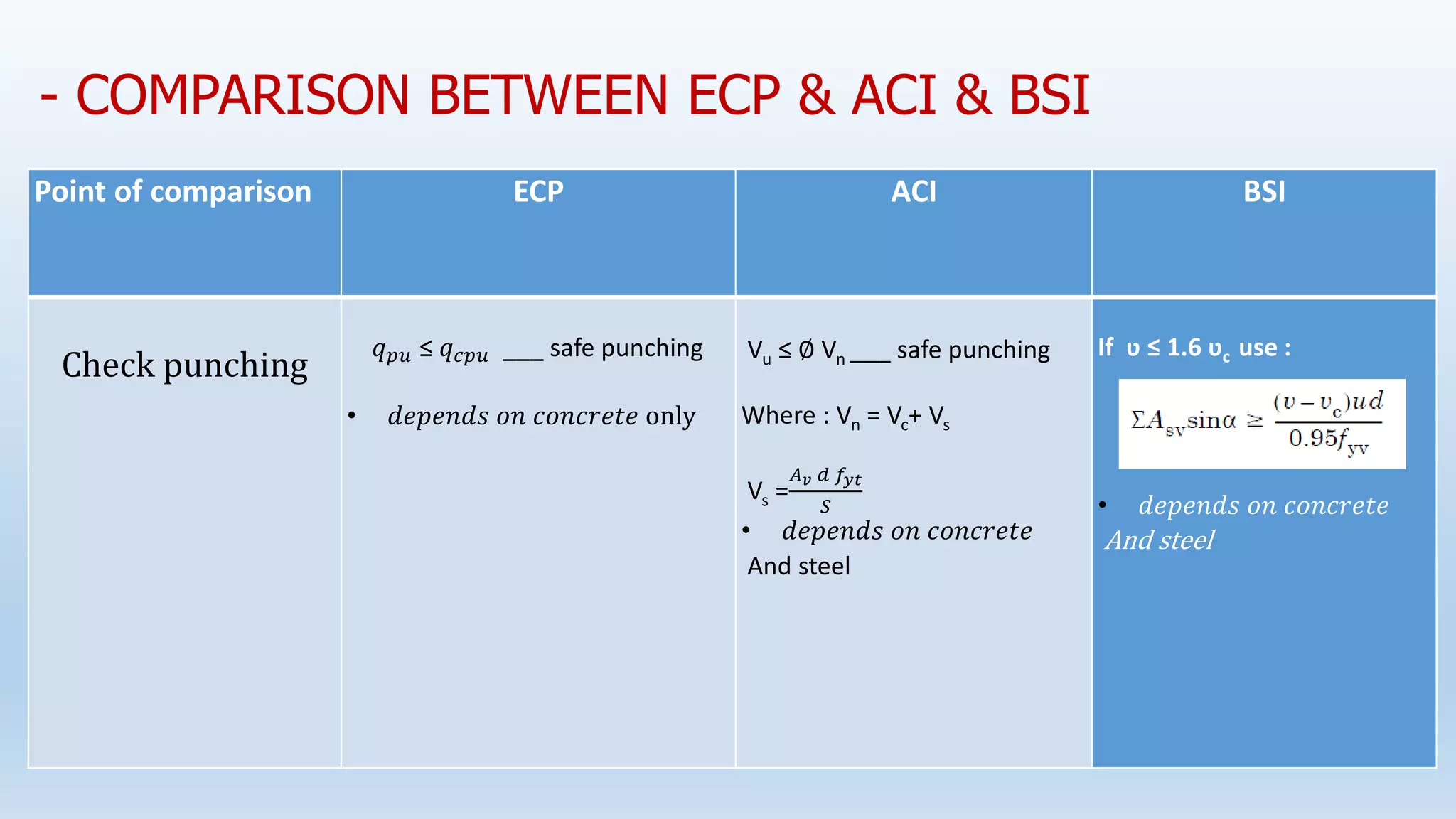
If ʋ ≤ 1.6 ʋc use :
• 𝑑𝑒𝑝𝑒𝑛𝑑𝑠 𝑜𝑛 𝑐𝑜𝑛𝑐𝑟𝑒𝑡𝑒
And steel
Vu ≤ ∅ Vn ___ safe punching
Where : Vn = Vc+ Vs
Vs =
𝐴𝑣 𝑑 𝑓𝑦𝑡
𝑆
• 𝑑𝑒𝑝𝑒𝑛𝑑𝑠 𝑜𝑛 𝑐𝑜𝑛𝑐𝑟𝑒𝑡𝑒
And steel
𝑞𝑝𝑢 ≤ 𝑞𝑐𝑝𝑢 ___ safe punching
• 𝑑𝑒𝑝𝑒𝑛𝑑𝑠 𝑜𝑛 𝑐𝑜𝑛𝑐𝑟𝑒𝑡𝑒 only
Check punching
THANK YOU

COMPARISON BETWEEN CODES

  • 1.
    COMPARISON BETWEEN Codes ECP(EGYPTIAN CODE OF PRACTICE) BSI (BRITISH STANDARD INSTITUTE) ACI (AMERICAN CONCRETE INSTITUTE)
  • 2.
    PREPARD BY STRUCTURAL DEPARTMENTTEAM CHECKED BY STRUCTURAL DEPARTMENT SENIOR ENG. WAEL MOHMED ABDUL MAQSOOD
  • 3.
    INTRODUCTION This comparison betweencodes provides minimum requirements for design and construction of structural concrete members of any structure in different codes, That doesn't mean that the structural design safe in code and unsafe at the other one But this difference due to factor of safety used, the quality control of materials used in the construction …etc. as a result we have to study carefully those differences between codes in order to we can do a smart design.
  • 4.
    - COMPARISON BETWEENECP & ACI & BSI Columns Design
  • 5.
    AXIAL LOADED COLUMN: - ‫مقاومه‬‫حساب‬ ‫يتم‬ ‫منه‬ ‫و‬ ‫العمود‬ ‫يتحمله‬ ‫حمل‬ ‫اقصى‬ ‫حساب‬ ‫يتم‬ ‫العمود‬ ‫تصميم‬ ‫عند‬ ‫الضغط‬ ‫بالمعاد‬ ‫موضح‬ ‫هو‬ ‫كما‬ ‫العمود‬ ‫تسليح‬ ‫من‬ ‫الناتج‬ ‫الضغط‬ ‫مقاومه‬ ‫و‬ ‫للعمود‬ ‫الخرسانى‬ ‫له‬ ‫التالية‬ : - - Egyptian code (2007)
  • 6.
    - Pu :‫العمود‬ ‫مقاومة‬ - Cc : ‫الخرساني‬ ‫القطاع‬ ‫مقاومة‬ - Cs : ‫العمود‬ ‫تسليح‬ ‫مقاومة‬ - : Factor of safety for material . 𝝲𝐶=1.5[( 7 6 )- ( et 3 )] , Egyptian code (2007) 𝝲s=1.15[( 7 6 )- ( et 3 )]
  • 7.
    - The Existenceof moment leads to a reduction in axial load capacity. Thus the code impose a further reduction on the column strength by reducing the capacity by 10% So, the equation: Egyptian code (2007)
  • 8.
    Egyptian code (2007) Pu= 0.35*Fcu*Ac+0.67*Asc*Fy
  • 9.
    - ‫للعمود‬ ‫تصميم‬ ‫عمل‬‫يتم‬ ‫ومنه‬ ‫العمود‬ ‫يتحمله‬ ‫الذي‬ ‫الحمل‬ ‫حساب‬ ‫يتم‬ ‫االمريكى‬ ‫الكود‬ ‫فى‬ ‫و‬ - ACI CODE
  • 10.
    - COMPARISON BETWEENECP & ACI & BSI BSI ACI ECP Point of comparison t ≤ 4 b t ≤ 4 b t ≤ 5 b Conditions for column (not shear wall) The shape of cross section of column isn't taken into consideration The shape of cross section of column is taken into consideration The shape of cross section of column is taken into consideration. Effect of shape of column in slenderness ratio.
  • 11.
    - COMPARISON BETWEENECP & ACI & BSI BSI ACI ECP Point of comparison 0.4 100 Ag 1 100 Ag 0.6 100 Ag Asmin 6% Ag 8% Ag 4% Ag for Interior col. 5% Ag for Edge col. 6% Ag for Corner col. Asmax 155 mm 6 inch=150 mm 250 mm Smax 30mm 25mm 70mm Smin
  • 12.
    - COMPARISON BETWEENECP & ACI & BSI BSI ACI ECP Point of comparison Braced & Un Braced Sway & non- Sway Braced & Unbraced Classification of structure according to buckling design. Slenderness Limits For Columns 𝐿0 < 60𝑏 Slenderness of unbraced Columns 𝐿0 = 100𝑏2 ℎ ≤ 60𝑏 not braced against side sway 𝐾 𝐿𝑢 𝑟 ≤ 22 braced against side sway 𝐾 𝐿𝑢 𝑟 ≤34 – 12(M1/M2) ≤ 40 Rec. Circular Braced 30 25 Unbraced 23 18 Maximum slenderness ratio. 𝐿𝑒 = 𝛽𝐿0 Values of 𝛽 for braced columns Non-sway K Lu r ≤ 34 -12 ( 𝑀1 𝑀2 ) ≤ 40 Sway 𝐾 𝐿𝑢 𝑟 ≤ 22 Braced 𝐾𝐻 𝑏1 𝑜𝑟 𝑡1 < 15 Unbraced 𝐾𝐻 𝑏1 𝑜𝑟 𝑡1 < 10 Neglect slenderness effect if :
  • 13.
    - COMPARISON BETWEENECP & ACI & BSI BSI ACI ECP Point of comparison Values of 𝛽 for unbraced columns Where: 𝐿0: clear height between end restraints b: width of column h: depth of cross section 𝐿𝑒:effective height of column K: effective length factor (for braced (non sway) frame ≤ 1 Lu: unsupported height of column from top of floor to the bottom of the beams or slab in the slab above R: radius of gyration, equal to 0.3 and 0.25 times the overall depth of rectangular and circular columns , respectively M1/M2: ratio of the moments at the two ends of the column ‫حالة‬ ‫فى‬ ‫يؤ‬ ‫جانبيا‬ ‫المقيدة‬ ‫المبانى‬ ‫فى‬ ‫األعمدة‬ ‫طول‬ ‫خذ‬ ‫االنبعاج‬ He ‫من‬ ‫لألصغر‬ ‫مساويا‬ 𝐻𝑒 = 𝐻0 0.7 + 0.05 𝛼1 + 𝛼2 ≤ 𝐻0 𝐻𝑒 = 𝐻0 0.85 + 0.05 𝛼𝑚𝑖𝑛 ≤ 𝐻0 ‫جانب‬ ‫مقيدة‬ ‫الغير‬ ‫المبانى‬ ‫فى‬ ‫األعمدة‬ ‫حالة‬ ‫وفى‬ ‫يؤخذ‬ ‫يا‬ ‫االنبعاج‬ ‫طول‬ He ‫من‬ ‫لألصغر‬ ‫مساويا‬ 𝐻𝑒 = 𝐻0 1 + 0.15 𝛼1 + 𝛼2 ≥ 𝐻0 𝐻𝑒 = 𝐻0 2 + 0.3 𝛼𝑚𝑖𝑛 ≥ 𝐻0 α = Σ Σ 𝐸𝑐𝐼𝑐 𝐻0 𝐸𝑐𝐼𝑏 𝐿𝑏 ‫أن‬ ‫حيث‬ 𝐻0 ‫الخالص‬ ‫العمود‬ ‫ارتفاع‬ ‫هو‬ ‫و‬ 𝛼𝑚𝑖𝑛 ‫من‬ ‫األصغر‬ ‫القيمة‬ ‫هى‬ 𝛼1 ‫الطرف‬ ‫عند‬ ‫و‬ ‫السفلى‬ 𝛼2 ‫العلوى‬ ‫الطرف‬ ‫عند‬ Neglect slenderness effect if :
  • 14.
    BSI ACI ECP Point of comparison -Concretenot exposed to weather or in contact with ground: Primary reinforcement, Ties, stirrups, spirals………....40 Cover - COMPARISON BETWEEN ECP & ACI & BSI
  • 15.
    - COMPARISON BETWEENECP & ACI & BSI - Notes: - Column according to ( ECP ) is unsafe due to large factor of safety although it is safe according to ( BSI & ACI ). - As (BSI) < As (ACI)
  • 16.
    - COMPARISON BETWEENECP & ACI & BSI Beam Design
  • 17.
    - COMPARISON BETWEENECP & ACI & BSI Shear Design
  • 18.
    - COMPARISON BETWEENECP & ACI & BSI BSI ACI ECP Point of comparison 𝐴𝑡 𝒅 𝟐 𝑓𝑟𝑜𝑚 𝑡ℎ𝑒 𝑓𝑎𝑐𝑒 𝑜𝑓 𝑠𝑢𝑝𝑝𝑜𝑟𝑡 𝐴𝑡 𝒅 𝟐 𝑓𝑟𝑜𝑚 𝑡ℎ𝑒 𝑓𝑎𝑐𝑒 𝑜𝑓 𝑠𝑢𝑝𝑝𝑜𝑟𝑡 𝐴𝑡 𝒅 𝟐 𝑓𝑟𝑜𝑚 𝑡ℎ𝑒 𝑓𝑎𝑐𝑒 𝑜𝑓 𝑠𝑢𝑝𝑝𝑜𝑟𝑡 Critical Section ∗ 𝑉 𝑚𝑎𝑥= 0.8 𝑓𝑐𝑢 𝑜𝑟 5 𝑁/𝑚𝑚² 𝑙𝑒𝑎𝑠𝑡 𝑜𝑓 𝑡ℎ𝑒𝑚 − 𝑠𝑡𝑟𝑒𝑠𝑠 ∗ 𝑉 𝑚𝑎𝑥= ∅8 𝑓′𝑐 𝑏𝑤 𝑑 − 𝐹𝑜𝑟𝑐𝑒. (𝐸𝑛𝑔𝑙𝑖𝑠ℎ 𝑢𝑛𝑖𝑡) ∗ 𝑞𝑚𝑎𝑥= 0.7 𝑓𝑐𝑢 𝝲𝐶 N/𝑚𝑚2 𝑜𝑟 4 𝑁/𝑚𝑚² 𝑙𝑒𝑎𝑠𝑡 𝑜𝑓 𝑡ℎ𝑒𝑚 − 𝑠𝑡𝑟𝑒𝑠𝑠 Max. strength (stress/force)
  • 19.
    - COMPARISON BETWEENECP & ACI & BSI BSI ACI ECP Point of comparison ∗ 𝑉 𝑐 = 0.79 100 𝐴𝑆 𝑏𝑣 𝑑 1 3 ( 400 𝑑 ) 1 4 / 𝛾𝑚 • 𝑑𝑒𝑝𝑒𝑛𝑑𝑠 𝑜𝑛 𝑓𝑐𝑢 , d & AS ∗ ∅ 𝑉𝐶 = ∅2 𝑓′𝑐 𝑏𝑑 • 𝐹𝑜𝑟𝑐𝑒 … … 𝐸𝑛𝑔𝑙𝑖𝑠ℎ 𝑢𝑛𝑖𝑡 • 𝑑𝑒𝑝𝑒𝑛𝑑𝑠 𝑜𝑛 𝑓′𝑐 , b & d. ∗ 𝑞𝑐𝑢= 0.24 𝑓𝑐𝑢 𝝲𝐶 N/𝑚𝑚2 • 𝑠𝑡𝑟𝑒𝑠𝑠 • 𝑑𝑒𝑝𝑒𝑛𝑑𝑠 𝑜𝑛 𝑓𝑐𝑢 Nominal shear strength of concrete (stress/force) ∗ 𝑉𝑈 → 𝑄𝑈 𝑏𝑑 ∗ 𝑉𝑈 → 𝑠ℎ𝑒𝑎𝑟 𝑓𝑜𝑟𝑐𝑒. ∗ 𝑞𝑢 = 𝑄𝑢 𝑏.𝑑 Design value of shear (stress/force)
  • 20.
    - COMPARISON BETWEENECP & ACI & BSI BSI ACI ECP Point of comparison − 𝐼𝐹 𝑉 𝑢 < 𝑉𝐶 2 → 𝑁𝑜 𝑠ℎ𝑒𝑎𝑟 𝑅𝐹𝑇 𝑖𝑠 𝑢𝑠𝑒𝑑 − 𝐼𝐹 𝑉 𝑢 < 𝑉 𝑐 → 𝑀𝑖𝑛 𝑠ℎ𝑒𝑎𝑟 𝑅𝐹𝑇 𝑖𝑠 𝑢𝑠𝑒𝑑 𝐴𝑠𝑣 𝑆𝑣 = 0.4𝑏𝑣 0.95𝐹𝑦𝑣 if V≤𝑉 𝑐+0.4𝑏𝑣d 𝐴𝑠𝑣 𝑆𝑣 = 𝑉−𝑉𝑐 0.95𝐹𝑦𝑣𝑏𝑡 if V≤𝑉 𝑐+0.4𝑏𝑣d − 𝐼𝐹 𝑞𝑢 < 𝑞𝑐𝑢 → 𝑈𝑠𝑒 𝑚𝑖𝑛. 𝑠ℎ𝑒𝑎𝑟 𝑅𝐹𝑇. 5 ∅8/𝑚 − 𝐼𝐹𝑞𝑐𝑢˂𝑞𝑢 ≤ 𝑞𝑚𝑎𝑥 → 𝑈𝑠𝑒 𝑠ℎ𝑒𝑎𝑟 𝑅𝐹𝑇. ∗ ( 𝑞𝑢 − 𝑞𝑐𝑢 2 ) = 𝐴𝑠𝑡 𝑏.𝑠 ∗ 𝑓𝑦 𝛾𝑠 − 𝐼𝐹 𝑞𝑢˃ 𝑞𝑚𝑎𝑥 → 𝐼𝑛𝑐𝑟𝑒𝑠𝑒 𝑑𝑖𝑚𝑒𝑛𝑠𝑖𝑜𝑛. R. F. T
  • 21.
    BSI ACI ECP Point of comparison 0.75dtor four times the web thickness for flanged members When V exceeds 1.8Vc, the maximum spacing should be reduced to 0.5dt . ∗ 𝑑/2 ∗ 𝑑 2 𝑜𝑟 200𝑚𝑚 𝑡ℎ𝑒 𝑙𝑒𝑎𝑠𝑡 𝑜𝑓 𝑡ℎ𝑒𝑚 Max spacing between stirrups Minimum practical spacing ≈ 3 in. or 4 in. 100𝑚𝑚 Min spacing between stirrups 45° 𝑜𝑟 𝑚𝑜𝑟𝑒 30° 𝑜𝑟 𝑚𝑜𝑟𝑒 45° Stirrups indention - COMPARISON BETWEEN ECP & ACI & BSI
  • 22.
    - COMPARISON BETWEENECP & ACI & BSI BSI ACI ECP Point of comparison 460 𝑁/𝑚𝑚2 60.000 𝑃𝑠𝑖 ≅ 400 𝑁/𝑚𝑚2 400 𝑁/𝑚𝑚2 Max. grade of stirrups (𝑓𝑦) − 𝑆ℎ𝑒𝑎𝑟 𝑅𝐹𝑇 𝑖𝑠 𝑢𝑠𝑒𝑑. − 𝑆ℎ𝑒𝑎𝑟 𝑅𝐹𝑇 𝑖𝑠 𝑢𝑠𝑒𝑑. − 𝑁𝑜 𝑠ℎ𝑒𝑎𝑟 𝑅𝐹𝑇 𝑖𝑠 𝑢𝑠𝑒𝑑 𝑠ℎ𝑒𝑎𝑟 𝑖𝑠 𝑜𝑛𝑙𝑦 𝑟𝑒𝑠𝑖𝑠𝑡𝑒𝑑 𝑏𝑦 𝑐𝑜𝑛𝑐𝑟𝑒𝑡𝑒. Slabs & footings
  • 23.
    - COMPARISON BETWEENECP & ACI & BSI Flexural design
  • 24.
    Egyptian code (2007) ‫من‬‫التأكد‬ ‫أوال‬ ‫يتم‬ ‫الخرساني‬ ‫القطاع‬ ‫انه‬ ‫آمن‬ ‫اال‬ ‫المعادلة‬ ‫باستخدام‬ ‫تية‬ : 𝑑 = 𝐶1 𝑀𝑢 ∗ 105 𝑏 ∗ 𝐹𝑐𝑢 Where: d : depth of SEC. Mu : Ultimate Moment Affecting on SEC. b : Width of SEC. Fcu : Characteristic Concrete Strength C : Factor where Cmin=2.65 & Cmax=4.85
  • 25.
    - ‫بمعلومية‬ ‫الخرساني‬ ‫القطاع‬ ‫ال‬ b*d ‫ال‬ ‫قيمة‬‫وكذلك‬ Mult ‫السابق‬ ‫المعادلة‬ ‫فى‬ ‫التعويض‬ ‫نستطيع‬ ‫ة‬ ‫ال‬ ‫قيمة‬ ‫وايجاد‬ . C - ‫ال‬ ‫قيمة‬ ‫كانت‬ ‫فاذا‬ C ‫ال‬ ‫من‬ ‫أقل‬ Cmin =2.65 ‫قطاع‬ ‫أبعاد‬ ‫فنزيد‬ ‫امن‬ ‫غير‬ ‫القطاع‬ ‫يكون‬ ‫الخرسانة‬ . - ‫ال‬ ‫قيمة‬ ‫كانت‬ ‫واذا‬ C ‫ال‬ ‫من‬ ‫أكبر‬ Cmax ‫القطاع‬ ‫فيكون‬ more safe ‫قيمة‬ ‫تتراوح‬ ‫ان‬ ‫من‬ ‫فالبد‬ ‫ال‬ C ‫ال‬ ‫بين‬ Cmin ‫و‬ Cmax . - ‫ال‬ ‫في‬ ‫الحديد‬ ‫قيمة‬ ‫اليجاد‬ ‫االتية‬ ‫المعادلة‬ ‫فى‬ ‫التعويض‬ ‫يتم‬ ‫امن‬ ‫القطاع‬ ‫أن‬ ‫من‬ ‫التاكد‬ ‫بعد‬ ‫قطاع‬ . As 𝑨𝒔 = 𝑴𝒖 𝑭𝒚 ∗ 𝒅 ∗ 𝑱 Egyptian code (2007)
  • 26.
    𝑨𝒔 = 𝑴𝒖 𝑭𝒚 ∗𝒅 ∗ 𝑱 Where Fy : Yield Stress d : depth of SEC Mu: Ultimate Moment Affecting on Section J: Factor Get It's Value From Table According to Value Of C1 Egyptian code (2007)
  • 27.
    ‫قطاع‬ ‫من‬ ‫التأكد‬‫أوال‬ ‫يتم‬ ‫الخرساني‬ ‫المعادلة‬ ‫باستخدام‬ ‫امن‬ ‫انه‬ ‫االتية‬ ‫ال‬ ‫قيمة‬ ‫اليجاد‬ Rn : ∅ 𝑅𝑛 = 𝑀𝑢 𝑏𝑑2 ………… We can get Rn=√√√ Where d: depth of Section. Mu: Ultimate Moment Affecting on Section. b: Width of Section. ∅ = 0.9 ACI CODE
  • 28.
    Rn From Table(1-C) depend on Fc' & B1 𝑹𝒏 = 𝝆(𝟏 − 𝟎.𝟓𝝆𝑭𝒚 𝟎.𝟖𝟓 𝑭𝒄′) 𝝆 𝒎𝒊𝒏 ≤ 𝝆 ≤ 𝝆𝒎𝒂𝒙 ACI CODE 𝝆 𝒎𝒊𝒏 = 𝟑 𝑓𝑐′ 𝑭𝒚 𝝆 𝒎𝒂𝒙 = 0.319 β1𝑓𝑐′ 𝑭𝒚 Where Rn :STANDS FOR NOMINAL RESISTANCE (STRENGTH) ρ: ratio of As to bd β1 = 0.85 … for fc’ ≤ 4000 psi = 0.85 - 0.05 ( 𝑓𝑐′−4000 1000 ) .… for 4000 psi < fc’ < 8000 psi = 0.65 … for fc’ ≤ 8000 psi
  • 29.
    - ‫بالتعويض‬ ‫ال‬ ‫العمود‬ ‫بأبعاد‬‫التالية‬ ‫المعادلة‬ ‫فى‬ . b , d - ‫وكذلك‬ ‫ال‬ ‫قيمة‬ Mult . - ‫فنحصل‬ ‫قيمة‬ ‫على‬ K ‫والتى‬ ‫ان‬ ‫البد‬ ‫عن‬ ‫تقل‬ . 0.156 K= M𝑢 105 𝑏∗𝑑2∗𝐹𝑐𝑢 = .. < 𝐾′ = 0.156 - ‫بعد‬ ‫قطاع‬ ‫أن‬ ‫من‬ ‫والتأكد‬ ‫السابقة‬ ‫المعادلة‬ ‫فى‬ ‫التعويض‬ ‫الخرسانه‬ ‫قيمة‬ ‫تأثير‬ ‫تحت‬ ‫امن‬ Mult . - ‫أن‬ ‫شرط‬ ‫وتحقيق‬ K ‫تقل‬ ‫عن‬ ( (K`=0.156 ‫الضغط‬ ‫منطقة‬ ‫في‬ ‫التسليح‬ ‫زيادة‬ ‫يتم‬ ‫ذلك‬ ‫عدا‬ . BSI CODE
  • 30.
    - ‫تسليح‬ ‫قيمة‬ ‫حساب‬‫ذلك‬ ‫بعد‬ ‫يتم‬ ‫الخرساني‬ ‫التالية‬ ‫المعادلة‬ ‫باستخدام‬ : 𝑨𝒔 = Mu ∗ 105 0.87 ∗ 𝐹𝑦 ∗ 𝑑 ∗ 0.95 𝑤ℎ𝑒𝑟𝑒: 𝐹𝑦 = characteristic concrete strength. 𝐹𝑐𝑢 = characteristic yield strength. BSI CODE
  • 31.
    - COMPARISON BETWEENECP & ACI & BSI BSI ACI ECP Point of comparison 0.0035 0.003 0.003 The Strain Of Concrete 𝜻𝑐𝑢 𝑏 + 𝐿 10 𝑏 + 𝐿 5 0.12𝐿 𝑂𝑟 6𝑡𝑠 0.25 L Or 8ts 𝑘𝐿 10 + 𝑏 𝑜𝑟 6𝑡𝑠 + 𝑏 (L section) 𝑘𝐿 5 + 𝑏 𝑜𝑟 16𝑡𝑠 + 𝑏 ((T section) B1 section
  • 32.
    - COMPARISON BETWEENECP & ACI & BSI BSI ACI ECP Point of comparison Table (1-2) * 3 𝑓𝑐′𝑏𝑤 𝑑 𝑓𝑦 Where: 3 𝑓𝑐′𝑏𝑤 𝑑 𝑓𝑦 ≥ 200bw d fy 1.1 𝐹𝑦 𝑏𝑑 The least 1.3𝐴𝑠𝑟𝑒𝑞 the biggest 0.15 100 𝑏𝑑 𝐻.𝑇.𝑆 Minimum Area Steel Asmin 0.9 c 0.85 c 0.8 c Depth of compression block
  • 33.
    - COMPARISON BETWEENECP & ACI & BSI BSI ACI ECP Point of comparison L.L > D.L L.L > 3 D.L L.L > 1.5D.L Spans difference not exceed 20% Conditions For using Empirical Methods Hagg + 5mm Bigger 2.5cm ∅ ≥ 1 𝑖𝑛𝑐ℎ H.agg. + 5mm Bigger ∅ 𝑚𝑎𝑥 ∅ 𝑚𝑎𝑥 2.5cm Min spacing We Can neglect Normal Force if: 𝑁 ≤ 0.1 𝑓𝑐𝑢 𝑏𝑡 We Can neglect Normal if e=M/N≤(1 in. or 0.05h) We can neglect Normal Force if : 𝑁 ≤ 0.04 𝑓𝑐𝑢 𝑏𝑡 Moment & Normal Sections
  • 34.
    - COMPARISON BETWEENECP & ACI & BSI BSI ACI ECP Point of comparison 0.09 FL 𝑊𝐿2 16 =0.0625 𝑊𝐿2 =0.0625 F L 𝑊𝐿2 12 =0.083 𝑊𝐿2 = 0.083 F L One Way slab (+ve moment) Intermediate span Empirical 0.67 𝐹𝑐𝑢 𝛾𝑐 0.85 fc' 0.67 𝐹𝑐𝑢 𝛾𝑐 Concrete Strength 𝐾𝑁/𝑚𝑚2 = 5.5 𝑓𝑐𝑢 𝛾𝑚 4490 𝑓𝑐𝑢 𝑁/𝑚𝑚2 = = 57000 𝑓𝑐′ Ps = 4200 𝑓𝑐𝑢 𝑁/𝑚𝑚2 = 4700 𝑓𝑐′ 𝑁/𝑚𝑚2 4400 𝐹𝑐𝑢 𝑁/𝑚𝑚2 Concrete Young's Modulus
  • 35.
    - COMPARISON BETWEENECP & ACI & BSI BSI ACI ECP Point of comparison Hot rolled mild steel Fy = 250 N/mm2 Height Yield (hot rolled or cold worked) Fy = 460 N/mm2 Fy > 80.000 psi Fy = 550 𝑁/𝑚𝑚2 Deformed Steel Fy ≤ 400 𝑁/𝑚𝑚2 Mild Steel Fy ≤ 280 𝑁/𝑚𝑚2 Cold drown smooth welded mesh Fy ≤ 300 𝑁/𝑚𝑚2 Yield Stress in Steel Fy
  • 36.
    BSI ACI ECP Point of comparison -Concrete notexposed to weather or in contact with ground: Primary reinforcement, ties, stirrups, spirals..……….. 40 Cover - COMPARISON BETWEEN ECP & ACI & BSI
  • 37.
    - COMPARISON BETWEENECP & ACI & BSI Table (1-2)
  • 38.
    - COMPARISON BETWEENECP & ACI & BSI Slabs Design
  • 39.
    - COMPARISON BETWEENECP & ACI & BSI BSI ACI ECP Point of comparison • solid slab • Flat slab • Hollow block slab • One way slab • Two way slab a)- Two way beam supported slab b)- Flat plate c)- Flat slab d)- Waffle slab • solid slab • Flat slab • Hollow block slab Types of Slabs
  • 40.
  • 41.
    - COMPARISON BETWEENECP & ACI & BSI BSI ACI ECP Point of comparison • One way slab -simply supported slab tmin = 𝑙 20 -one end continuous tmin = 𝑙 24 -both ends continuous tmin = 𝑙 28 -cantilever tmin = 𝑙 10 Where 𝑙 is the direction of the load • One way slab -simply supported slab tmin = 𝑙 30 -one end continuous tmin = 𝑙 35 -both ends continuous tmin = 𝑙 40 -cantilever tmin = 𝑙 𝟏0 Where 𝑙 is the direction of the load Thickness of slabs
  • 42.
    - COMPARISON BETWEENECP & ACI & BSI BSI ACI ECP Point of comparison • Two way slab -fy = 280 (N/𝑚𝑚2 ) tmin = 𝑙 36 -fy = 420 (N/𝑚𝑚2 ) tmin = 𝑙 33 -fy = 520 (N/𝑚𝑚2 ) tmin = 𝑙 28 * Where 𝑙 : is long span length measured face to face from support • Two way slab -simply supported slab tmin = 𝑙 35 -one end continuous tmin = 𝑙 40 -both ends continuous tmin = 𝑙 45 * Where 𝑙 :is short span length measured from center to center Thickness of slabs
  • 43.
    BSI ACI ECP Point of comparison -Shells, foldedplate members: No. 19 bar and larger.....…..20 No. 16 bar, MW200 or MD200 wire, and smaller…………… 13 Cover - COMPARISON BETWEEN ECP & ACI & BSI
  • 44.
  • 45.
    - COMPARISON BETWEENECP & ACI & BSI BSI ACI ECP Point of comparison * Where 𝑙 :is long span length measured from center to center Thickness of slabs
  • 46.
    - COMPARISON BETWEENECP & ACI & BSI BSI ACI ECP Point of comparison 𝑙 𝟑 ≤ Ldrop tdrop min. = 1.25 tslab 𝑙 𝟑 ≤ Ldrop tdrop min. = 1.25 tslab 𝑙𝑠ℎ𝑜𝑟𝑡 3 < Ldrop < 𝑙𝑚𝑖𝑛 2 Drop panel
  • 47.
    - COMPARISON BETWEENECP & ACI & BSI BSI ACI ECP Point of comparison tBeam ≥ 1.5 tslab Effective beam section : • Edge beam b + hw ≤ b + 4 tslab • Interior beam b + 2 hw ≤ b + 8 tslab tBeam ≥ 2.5 tslab tBeam ≥ 3 tslab Marginal beam
  • 48.
    - COMPARISON BETWEENECP & ACI & BSI BSI ACI ECP Point of comparison 1-Holes in areas bounded by column strips: that their greatest dimension in a direction parallel to a centre-line of the panel does not exceed 0.4 ɭ . 2-Holes in areas common to two column strips: that in aggregate their length or width does not exceed one-tenth of the width of the column strip 3-Holes in areas common to a column strip and middle strip: that in aggregate their length or width does not exceed one- quarter of the width of the column strip In case of col. Strip intersecting with col. Strip: Lvoid ≤ ɭ1 / 16 In case of col. Strip intersecting with middle strip : Lvoid ≤ ɭ1 / 8 In case of middle Strip intersecting with middle strip : Opening in the slab
  • 49.
    - COMPARISON BETWEENECP & ACI & BSI BSI ACI ECP Point of comparison If ʋ ≤ 1.6 ʋc use : • 𝑑𝑒𝑝𝑒𝑛𝑑𝑠 𝑜𝑛 𝑐𝑜𝑛𝑐𝑟𝑒𝑡𝑒 And steel Vu ≤ ∅ Vn ___ safe punching Where : Vn = Vc+ Vs Vs = 𝐴𝑣 𝑑 𝑓𝑦𝑡 𝑆 • 𝑑𝑒𝑝𝑒𝑛𝑑𝑠 𝑜𝑛 𝑐𝑜𝑛𝑐𝑟𝑒𝑡𝑒 And steel 𝑞𝑝𝑢 ≤ 𝑞𝑐𝑝𝑢 ___ safe punching • 𝑑𝑒𝑝𝑒𝑛𝑑𝑠 𝑜𝑛 𝑐𝑜𝑛𝑐𝑟𝑒𝑡𝑒 only Check punching
  • 50.
    - COMPARISON BETWEENECP & ACI & BSI BSI ACI ECP Point of comparison Actual Punching Stress ʋ= 𝛽 𝑽 𝒖 𝑑 Allowable Shear Stress (ʋc) refer to table (2.1) Max. Shear Stress ʋmax= 0. 𝟖 𝒇𝒄𝒖 Check for Wide-beam action Shear : 𝑉𝑢 ≤ ∅𝑉𝑛 𝑉𝑢 ≤ ∅(2𝜆 𝑓𝑐′ 𝑏𝑤𝑑 Check for Two way Shear 𝑉 𝑢 ≤ 𝑚𝑖𝑛𝑖𝑚𝑢𝑚 𝑜𝑓: 1- 2 + 4 𝛽 𝜆 𝑓𝑐′ 𝑏𝑜𝑑 2- 𝛼𝑠 𝑑 𝑏𝑜 + 2 𝜆 𝑓𝑐′ 𝑏𝑜𝑑 3- 4𝜆 𝑓𝑐′ 𝑏𝑜𝑑 Actual Punching Stress 𝑞𝑝𝑢 = 𝛽 𝑄𝑝𝑢 𝑏𝑜𝑑 Allowable Punching Stress Min. of 𝑞𝑐𝑝𝑢 = 0.316(0.5 + 𝑎 𝑏 ) 𝑓𝑐𝑢 𝛾𝑐 𝑞𝑐𝑝𝑢 = 0.316 0.2 + α𝑑 𝑏𝑜 𝑓𝑐𝑢 𝛾𝑐 And not exceed that 𝑞𝑐𝑝𝑢 = 0.316 𝑓𝑐𝑢 𝛾𝑐 Check punching
  • 51.
    - COMPARISON BETWEENECP & ACI & BSI BSI ACI ECP Point of comparison If ʋ ≤ 1.6 ʋc use : If 1.6 ʋc < v ≤ 2 ʋc use : If v > 2 ʋc use : • Increase fc’ • increase slab thickness by Using drop panel • Providing shear reinforcement Av = 𝑉𝑢−∅ 𝑉𝑐 𝑆 ∅ 𝑑 𝑓𝑦𝑡 if un safe punching • Increase fc’ • increase slab thickness by Using drop panel • Providing shear reinforcement ( bars, wires , steel I shape Or headed shear studs ) if un safe punching • Increase slab thickness • Use drop panel Check punching
  • 52.
    - COMPARISON BETWEENECP & ACI & BSI shear reinforcement stirrups headed shear studs
  • 53.
    - COMPARISON BETWEENECP & ACI & BSI BSI ACI ECP Point of comparison Where : ʋc : design concrete shear stress V :design ultimate value of the concentrated load. uo : effective length of the perimeter which touches a loaded area. ʋ : design shear stress. u : effective length of the outer perimeter of the zone. β: 1.15 for Interior columns 1.25 for Edge columns 1.40 for Corner columns ΣAsv :is the area of shear reinforcement fyv :is the characteristic strength of shear reinforcement (in N/mm2 ) α : is the angle between the shear reinforcement and the plane of the slab. Where : V : Punching Force 𝛽: ratio of (long side/ short side) of the column concentrated load or reaction area 𝛼𝑠: 40 for interior columns 30 for edge columns 20 for corner columns bo : perimeter of critical section Where : Qpu : Punching Force bo : Length of the Perimeter of Critical Sec d : Effective depth of slab 𝛽: 1.15 for Interior columns 1.30 for Edge columns 1.50 for Corner columns Check punching
  • 54.
    - COMPARISON BETWEENECP & ACI & BSI BSI ACI ECP Point of comparison 1st take critical sec. at distance (1.5d) If ʋ ≤ ʋc use then no further checks are needed. If not - take the critical sec. at distance d/2 and get As for shear for Wide-beam action Shear - Take critical sec. at distance (d) from support. for Two way Shear - Take critical sec. at distance (d/2) from support. - take critical sec. at distance (d/2) Critical sec.
  • 55.
    - COMPARISON BETWEENECP & ACI & BSI Table (2.1)
  • 56.
  • 57.
    - COMPARISON BETWEENECP & ACI & BSI BSI ACI ECP Point of comparison -In situ ribs should be spaced at centers not exceeding 1.5 m & should not exceed four times their width -PAN WIDE (500-750)mm PANS FORM
  • 58.
    - COMPARISON BETWEENECP & ACI & BSI BSI ACI ECP Point of comparison The minimum width of rib will be determined by considerations of cover , bar spacing and fire. Standard depth : 6,8,10,12,14,16&20 We can use tapered rib with dimension RIBS
  • 59.
    - COMPARISON BETWEENECP & ACI & BSI BSI ACI ECP Point of comparison One at mid for span ( 6-9 )m & 2 ribs at third points for spans over (9) m. Cross rib
  • 60.
    - COMPARISON BETWEENECP & ACI & BSI BSI ACI ECP Point of comparison -not less than 20mm or 1/10 clear distance between ribs Slab thickness over permanent fillers shall be not less than one-twelfth the clear distance between ribs ,nor less than 40 mm . Cover Slab
  • 61.
    - COMPARISON BETWEENECP & ACI & BSI BSI ACI ECP Point of comparison Cover slab Rein. Consideration should be given to providing a single layer of welded steel fabric, having a cross-sectional area of not less than 0.12 % of the topping, in each direction; the spacing between wires should not be greater than half the center-to-center distance between ribs. Reinforcement
  • 62.
    - COMPARISON BETWEENECP & ACI & BSI BSI ACI ECP Point of comparison 1 hour: (20)mm for slab 2 hour: (25)mm for slab Fire resisting
  • 63.
    BSI ACI ECP Point of comparison Shells,folded plate members: No. 19 bar and larger ....... 20 No. 16 bar, MW200 or MD200 wire, and smaller……………. 13 Cover - COMPARISON BETWEEN ECP & ACI & BSI
  • 64.
  • 65.
    - COMPARISON BETWEENECP & ACI & BSI BSI ACI ECP Point of comparison Assume Thickness and Check Shear Assume Overall Footing Thickness=33 in Check Shear < 300 mm Thickness 70mm 75mm mm50 ‫للهواء‬ ‫والمعرضة‬ ‫المغمورة‬ mm70 ‫والجفاف‬ ‫للبلل‬ ‫المعرضة‬ Min Cover
  • 66.
    - COMPARISON BETWEENECP & ACI & BSI BSI ACI ECP Point of comparison Actual Punching Stress ʋ= 𝛽 𝑽 𝒖 𝑑 Allowable Shear Stress (ʋc) refer to table (2.1) Max. Shear Stress ʋmax= 0. 𝟖 𝒇𝒄𝒖 Check for Wide-beam action Shear : 𝑉𝑢 ≤ ∅𝑉𝑛 𝑉𝑢 ≤ ∅(2𝜆 𝑓𝑐′ 𝑏𝑤𝑑 Check for Two way Shear 𝑉 𝑢 ≤ 𝑚𝑖𝑛𝑖𝑚𝑢𝑚 𝑜𝑓: 1- 2 + 4 𝛽 𝜆 𝑓𝑐′ 𝑏𝑜𝑑 2- 𝛼𝑠 𝑑 𝑏𝑜 + 2 𝜆 𝑓𝑐′ 𝑏𝑜𝑑 3- 4𝜆 𝑓𝑐′ 𝑏𝑜𝑑 Check shear Actual Shear Stress 𝑞𝑢 = 𝑄𝑢 𝑏𝑑 Allowable Shear Stress 𝑞𝑠𝑢 = 0.15 𝐹𝑐𝑢 𝛾𝑐 Check punching Actual Punching Stress 𝑞𝑝𝑢 = 𝛽 𝑄𝑝𝑢 𝑏𝑜𝑑 Allowable Punching Stress As slabs Check punching Check shear
  • 67.
    - COMPARISON BETWEENECP & ACI & BSI BSI ACI ECP Point of comparison If ʋ ≤ 1.6 ʋc use : If 1.6 ʋc < v ≤ 2 ʋc use : If v > 2 ʋc use : • Increase fc’ • increase footing thickness or Using drop panel • Providing shear reinforcement Av = 𝑉𝑢−∅ 𝑉𝑐 𝑆 ∅ 𝑑 𝑓𝑦𝑡 if un safe punching • Increase fc’ • increase footing thickness or Using drop panel • Providing shear reinforcement stirrups if un safe punching • Increase footing thickness • Use drop panel Check punching
  • 68.
    - COMPARISON BETWEENECP & ACI & BSI BSI ACI ECP Point of comparison Where : ʋc : design concrete shear stress V :design ultimate value of the concentrated load. uo : effective length of the perimeter which touches a loaded area. ʋ : design shear stress. u : effective length of the outer perimeter of the zone. β: 1.15 for Interior columns 1.25 for Edge columns 1.40 for Corner columns ΣAsv :is the area of shear reinforcement fyv :is the characteristic strength of shear reinforcement (in N/mm2 ) α : is the angle between the shear reinforcement and the plane of the slab. Where : V : Punching Force 𝛽: ratio of (long side/ short side) of the column concentrated load or reaction area 𝛼𝑠: 40 for interior columns 30 for edge columns 20 for corner columns bo : perimeter of critical section Where : Qpu : Punching Force bo : Length of the Perimeter of Critical Sec d : Effective depth of slab 𝛽: 1.15 for Interior columns 1.30 for Edge columns 1.50 for Corner columns Check punching
  • 69.
    - COMPARISON BETWEENECP & ACI & BSI BSI ACI ECP Point of comparison If ʋ ≤ 1.6 ʋc use : • 𝑑𝑒𝑝𝑒𝑛𝑑𝑠 𝑜𝑛 𝑐𝑜𝑛𝑐𝑟𝑒𝑡𝑒 And steel Vu ≤ ∅ Vn ___ safe punching Where : Vn = Vc+ Vs Vs = 𝐴𝑣 𝑑 𝑓𝑦𝑡 𝑆 • 𝑑𝑒𝑝𝑒𝑛𝑑𝑠 𝑜𝑛 𝑐𝑜𝑛𝑐𝑟𝑒𝑡𝑒 And steel 𝑞𝑝𝑢 ≤ 𝑞𝑐𝑝𝑢 ___ safe punching • 𝑑𝑒𝑝𝑒𝑛𝑑𝑠 𝑜𝑛 𝑐𝑜𝑛𝑐𝑟𝑒𝑡𝑒 only Check punching
  • 70.