What is meant by Bar Bending
Schedule (BBS)
 Bar Bending Schedule, commonly referred to as “BBS”
is a comprehensive list that describes the location,
mark, type, size, length and number, and bending
details of each bar or fabric in
a Reinforcement Drawing of a Structure.
 This process of listing the location, type and size,
number of and all other details is called “Scheduling”.
In context of Reinforcement bars, it is called bar
scheduling. In short, Bar Bending Schedule is a way of
organizing rebars for each structural unit, giving
detailed reinforcement requirements.
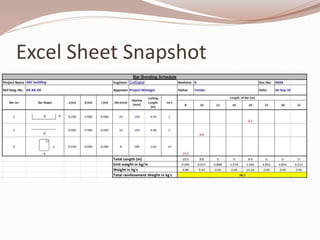
Excel Sheet Snapshot
General guidelines to be followed in
preparing BBS
 The bars should be grouped together for each structural unit,
e.g. beam, column, etc.
 In a building structure, the bars should be listed floor by floor
 For cutting and bending purposes schedules should be provided as
separate A4 sheets and not as part of the detailed reinforcement
drawings.
 The form of bar and fabric schedule and the shapes of bar used should
be in accordance with BS 8666.
 It is preferable that bars should be listed in the schedule in numerical
order.
 It is essential that the bar mark reference on the label attached to a
bundle of bars refers uniquely to a particular group or set of bars of
defined length, size, shape and type used on the job.
 This is imperative as a bar mark reference can then point to a class of
bar characteristics. Also, this helps steel fixers and laborers keep track
of the type and number of bars needed to complete a certain work.
Bar Bending Schedule is used by
 Detailer
 person checking the drawing
 contractor who orders the reinforcement
 organization responsible for fabricating the reinforcement
 steel fixer
 clerk of works or other inspector
 the quantity surveyor
 Quantity surveyor is responsible for estimation and costing
operations of a project. This kind of surveying demands a
high level of precision. Bar Bending Schedule helps the
quantity surveyor to consolidate the number of bars required
of each bar type.
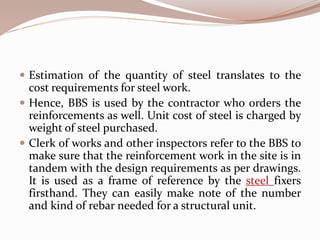
 Estimation of the quantity of steel translates to the
cost requirements for steel work.
 Hence, BBS is used by the contractor who orders the
reinforcements as well. Unit cost of steel is charged by
weight of steel purchased.
 Clerk of works and other inspectors refer to the BBS to
make sure that the reinforcement work in the site is in
tandem with the design requirements as per drawings.
It is used as a frame of reference by the steel fixers
firsthand. They can easily make note of the number
and kind of rebar needed for a structural unit.
 In essence, Bar Bending Schedule subsumes all
necessary information on reinforcements, used by
professionals at various stages of the construction
process, right from procurement to finish.
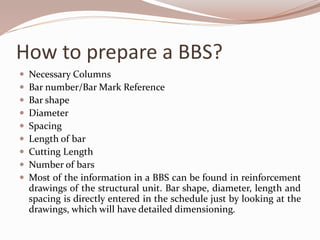
How to prepare a BBS?
 Necessary Columns
 Bar number/Bar Mark Reference
 Bar shape
 Diameter
 Spacing
 Length of bar
 Cutting Length
 Number of bars
 Most of the information in a BBS can be found in reinforcement
drawings of the structural unit. Bar shape, diameter, length and
spacing is directly entered in the schedule just by looking at the
drawings, which will have detailed dimensioning.
 Number of bars:
 Suppose the spacing of stirrups is 150 c/c and the
length along which they are placed is 6800 mm, we
can find the number of bars by the formula below
 [ Length / Spacing ] + 1 = number of bars
 [ 6800 / 150 ] + 1 = 46.33
 In this case, we always round up. Hence, we require 47
stirrups.
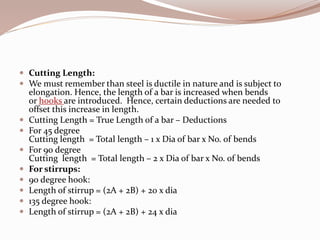
 Cutting Length:
 We must remember than steel is ductile in nature and is subject to
elongation. Hence, the length of a bar is increased when bends
or hooks are introduced. Hence, certain deductions are needed to
offset this increase in length.
 Cutting Length = True Length of a bar – Deductions
 For 45 degree
Cutting length = Total length – 1 x Dia of bar x No. of bends
 For 90 degree
Cutting length = Total length – 2 x Dia of bar x No. of bends
 For stirrups:
 90 degree hook:
 Length of stirrup = (2A + 2B) + 20 x dia
 135 degree hook:
 Length of stirrup = (2A + 2B) + 24 x dia
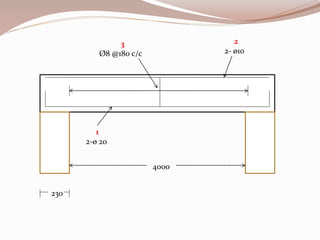
Example
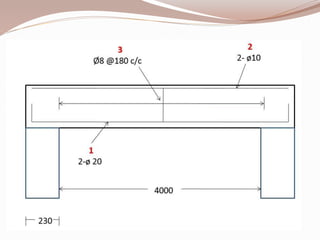
4000
230
1
2-ø 20
2
2- ø10
3
Ø8 @180 c/c
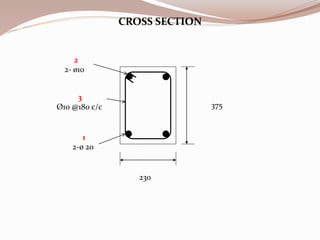
3
Ø10 @180 c/c
2
2- ø10
1
2-ø 20
375
230
CROSS SECTION
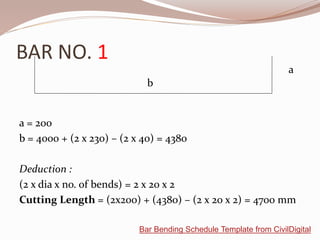
BAR NO. 1
a = 200
b = 4000 + (2 x 230) – (2 x 40) = 4380
Deduction :
(2 x dia x no. of bends) = 2 x 20 x 2
Cutting Length = (2x200) + (4380) – (2 x 20 x 2) = 4700 mm
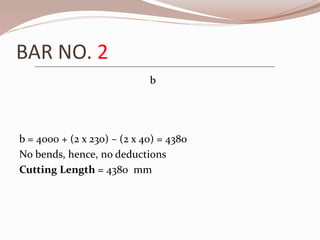
b
a
Bar Bending Schedule Template from CivilDigital
BAR NO. 2
b = 4000 + (2 x 230) – (2 x 40) = 4380
No bends, hence, no deductions
Cutting Length = 4380 mm
b
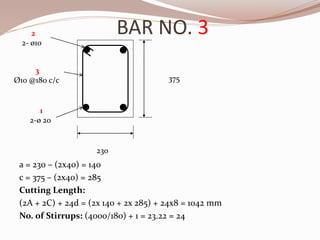
BAR NO. 3
a = 230 – (2x40) = 140
c = 375 – (2x40) = 285
Cutting Length:
(2A + 2C) + 24d = (2x 140 + 2x 285) + 24x8 = 1042 mm
No. of Stirrups: (4000/180) + 1 = 23.22 = 24
3
Ø10 @180 c/c
2
2- ø10
1
2-ø 20
375
230

BBS ppt.pptx

  • 2.
    What is meantby Bar Bending Schedule (BBS)  Bar Bending Schedule, commonly referred to as “BBS” is a comprehensive list that describes the location, mark, type, size, length and number, and bending details of each bar or fabric in a Reinforcement Drawing of a Structure.  This process of listing the location, type and size, number of and all other details is called “Scheduling”. In context of Reinforcement bars, it is called bar scheduling. In short, Bar Bending Schedule is a way of organizing rebars for each structural unit, giving detailed reinforcement requirements.
  • 3.
  • 4.
    General guidelines tobe followed in preparing BBS  The bars should be grouped together for each structural unit, e.g. beam, column, etc.  In a building structure, the bars should be listed floor by floor  For cutting and bending purposes schedules should be provided as separate A4 sheets and not as part of the detailed reinforcement drawings.  The form of bar and fabric schedule and the shapes of bar used should be in accordance with BS 8666.  It is preferable that bars should be listed in the schedule in numerical order.  It is essential that the bar mark reference on the label attached to a bundle of bars refers uniquely to a particular group or set of bars of defined length, size, shape and type used on the job.  This is imperative as a bar mark reference can then point to a class of bar characteristics. Also, this helps steel fixers and laborers keep track of the type and number of bars needed to complete a certain work.
  • 5.
    Bar Bending Scheduleis used by  Detailer  person checking the drawing  contractor who orders the reinforcement  organization responsible for fabricating the reinforcement  steel fixer  clerk of works or other inspector  the quantity surveyor  Quantity surveyor is responsible for estimation and costing operations of a project. This kind of surveying demands a high level of precision. Bar Bending Schedule helps the quantity surveyor to consolidate the number of bars required of each bar type.
  • 6.
     Estimation ofthe quantity of steel translates to the cost requirements for steel work.  Hence, BBS is used by the contractor who orders the reinforcements as well. Unit cost of steel is charged by weight of steel purchased.  Clerk of works and other inspectors refer to the BBS to make sure that the reinforcement work in the site is in tandem with the design requirements as per drawings. It is used as a frame of reference by the steel fixers firsthand. They can easily make note of the number and kind of rebar needed for a structural unit.
  • 7.
     In essence,Bar Bending Schedule subsumes all necessary information on reinforcements, used by professionals at various stages of the construction process, right from procurement to finish.
  • 8.
    How to preparea BBS?  Necessary Columns  Bar number/Bar Mark Reference  Bar shape  Diameter  Spacing  Length of bar  Cutting Length  Number of bars  Most of the information in a BBS can be found in reinforcement drawings of the structural unit. Bar shape, diameter, length and spacing is directly entered in the schedule just by looking at the drawings, which will have detailed dimensioning.
  • 10.
     Number ofbars:  Suppose the spacing of stirrups is 150 c/c and the length along which they are placed is 6800 mm, we can find the number of bars by the formula below  [ Length / Spacing ] + 1 = number of bars  [ 6800 / 150 ] + 1 = 46.33  In this case, we always round up. Hence, we require 47 stirrups.
  • 11.
     Cutting Length: We must remember than steel is ductile in nature and is subject to elongation. Hence, the length of a bar is increased when bends or hooks are introduced. Hence, certain deductions are needed to offset this increase in length.  Cutting Length = True Length of a bar – Deductions  For 45 degree Cutting length = Total length – 1 x Dia of bar x No. of bends  For 90 degree Cutting length = Total length – 2 x Dia of bar x No. of bends  For stirrups:  90 degree hook:  Length of stirrup = (2A + 2B) + 20 x dia  135 degree hook:  Length of stirrup = (2A + 2B) + 24 x dia
  • 12.
  • 13.
  • 14.
    3 Ø10 @180 c/c 2 2-ø10 1 2-ø 20 375 230 CROSS SECTION
  • 15.
    BAR NO. 1 a= 200 b = 4000 + (2 x 230) – (2 x 40) = 4380 Deduction : (2 x dia x no. of bends) = 2 x 20 x 2 Cutting Length = (2x200) + (4380) – (2 x 20 x 2) = 4700 mm b a Bar Bending Schedule Template from CivilDigital
  • 16.
    BAR NO. 2 b= 4000 + (2 x 230) – (2 x 40) = 4380 No bends, hence, no deductions Cutting Length = 4380 mm b
  • 17.
    BAR NO. 3 a= 230 – (2x40) = 140 c = 375 – (2x40) = 285 Cutting Length: (2A + 2C) + 24d = (2x 140 + 2x 285) + 24x8 = 1042 mm No. of Stirrups: (4000/180) + 1 = 23.22 = 24 3 Ø10 @180 c/c 2 2- ø10 1 2-ø 20 375 230