OBJECTIVES:
1. Differentiate analogous structure from
homologous structure.
2. Classify structures of organisms as to analogous
or homologous structure.
3. Explain the relevance of comparative anatomy
as an evidence of evolution.
PRE-ACTIVITY
Direction:
Identify what organism is shown
in the picture based on its
structure
Human arm
Bat Wings
Bird Wings
Dog
Forelimb
Whale flipper
Activity Proper
Direction:
Match column A with Column B
according to structure and function
Answers
C
D
A
E
B
1.How did you pair/match the organisms?
Do
2. Do these organisms belong to the same
group?
Comparative anatomy is the study of the
similarities and differences in the structures of
different species. Similar body parts may be
homologies or analogies. Both provide evidence for
evolution
What is Comparative Anatomy?
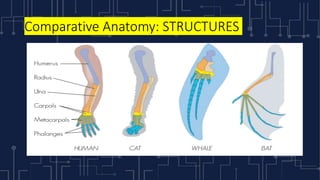
Comparative Anatomy: STRUCTURES
1. Homologous structures are structures that
are similar in related organisms because they
were inherited from a common ancestor.
These structures may or may not have the
same function in the descendants
Comparative Anatomy: STRUCTURES
HOMOLOGOUS STRUCTURE
The picture shows the hands of several
different mammals. They all have the same
basic pattern of bones. They inherited this
pattern from a common ancestor. However,
their forelimbs now have different functions.
ANALOGOUS STRUCTURE
2. Analogous structures are structures
that are similar in unrelated organisms.
structures are similar because they
do the same job, not because they were
inherited from a common ancestor.
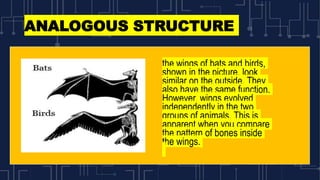
ANALOGOUS STRUCTURE
the wings of bats and birds,
shown in the picture, look
similar on the outside. They
also have the same function.
However, wings evolved
independently in the two
groups of animals. This is
apparent when you compare
the pattern of bones inside
the wings.

COMPARATIVE ANATOMY