Biology I: Form and Function Mr. Nettles
Today’s Agenda: Thurs. Dec. 1, 2011 Warm-Up:  Finish up Summarizations (Due Today) Lesson:  Form and Function Lecture
Today’s Objectives: I will define:  evolution, form, function, comparative anatomy, homologous structure, analogous structure, and vestigial structure. I will recognize the relationship between form and function in living things.
What is Evolution? Evolution   is the process by which species change over time.
Form vs. Function Form   is the visual appearance and configuration of an organism. Function   is any type of life process carried out by an organism.
Comparative Anatomy Comparative Anatomy   is a method by which scientist study the physical features and body parts of different animals to discover how they are related or similar.
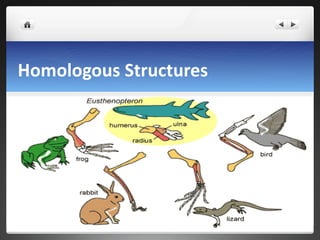
Homologous Structures Homologous Structures  are structures that have similar form but different functions.  These structures look alike in some ways, but they do different things.
Homologous Structures
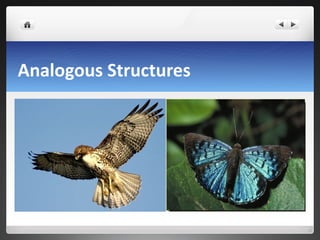
Analogous Structures Analogous Structures  are structures that have similar function but different forms.  These structures do the same thing, but they look different.
Analogous Structures
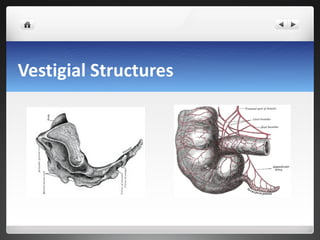
Vestigial Structures Vestigial Structures  are structures that don’t play a role in the way an organism functions.  They are body parts that don’t really do much work in the body.
Vestigial Structures

Form and function