Zero Based Budgeting
Presented by
Dr. Himani
Junior Resident 3
Department of Community
Medicine
PGIMS Rohtak
Moderator
Dr. Monika Das
Senior Resident
Department of Community
Medicine
PGIMS ROHTAK
Contents
• BUDGET
• ZERO BASED BUDGET
-Historical development .
-Steps Involved.
-Advantages.
-Limitations.
• ALTERNATIVES TO ZBB.
Budget
• A budget can be defined as a quantitative expression of the operational
plans of an organization for a future accounting period.
• Usually prepared for a period of one year but may be prepared to
coincide with the seasonal needs or other factors as per requirement.
• It is both, a plan of action as well as control medium.
• It is a financial document used to estimate future income and expenses
for a specified period which is usually a year.
Budget…Contd
• Budgeting is required in private corporate sectors as well in public
administration.
• The 3 essentials of a budget:
-Prepared in advance based on future plan of action.
-Relates to future period and based on objective to be achieved.
-Is a monetary statement that makes the management think, plan and
act as a team to render better medical service at affordable costs.
Objectives of Budgeting
A)To control the cost and increase revenue and thereby maximizing the
profit.
B)To run production activities in an efficient manner by to decrease the
chances of interruption in production process due to lack of material,
labour etc.
C)To establish coordination between different functions of an
enterprise.
D)To ensure that actions taken are in accordance with the targets and if
required, to take suitable corrective action.
Objectives of Budgeting…Contd.
E) To incorporate measures of calculation of deviations from budgeted
results and analysis of the same, whereby responsibility can be fixed
and controlling measures/action can be taken.
Advantages Of Budgeting
A)It leads to maximum utilization of resources with a view to ensure
maximum return.
B)Process of self-examination & self-criticism which is essential for the
success of any organization.
C)Enables the organization to prefix its goals and push up the forces
towards their achievements.
D)It stimulates the effective use of resources and creates an attitude of
cost consciousness throughout the organization.
E)It creates the bases for measuring performances of different departments
as well as different functions of the production activities.
Disadvantages Of Budgeting
A) Forecasting, planning or budgeting is not an exact science and a
certain amount of judgement is present in any budgeting plan.
B) The basic requirement for the success of budgeting is the absolute
support and enthusiasm provided by the top management. If it is
lacking at any time, the whole system will collapse.
C) Budgeting should be followed up by effective control action, this is
often lacking in many organizations, which defeats the very purpose of
budgeting.
Disadvantages Of Budgeting…Contd.
D) The installation of budgeting system is an lengthy process and it
takes time.
E) It is only a source and not a target and hence, can not take the place
of management, while it is only a tool of management.
F) It requires the experienced man-power, technical staff, analysis,
control etc., hence, it is costly affair.
Time Function Flexibility
Long-term Sales Fixed
Short-term Production Flexible
Current Cost of Production
Purchase
Research
Cash
Master
Classification of Budget
Budgeting methods
Zero Based Incremental
Activity
Based
Value
Proposition
4 M/C Budgeting Methods
Zero Based Budgeting
• It is defined as an operating, planning and budgeting process which
requires each officer to justify her/his budget demand from zero level
upwards.
• It requires fresh justification for the funds required to run a
programme and carry on activities.
• The start is from a zero Base of no allocation of funds for a
programme.
• Then the sanctioning of every Rupee needs justification, even for on-
going programmes.
Historical Development-ZBB
• Zero-base budgeting (ZBB) became
popular in the 1970s but the concept
has been around since as early as 1924
when British budget authority E. Hilton
Young advocated complete justification
of every item requested in a budget.
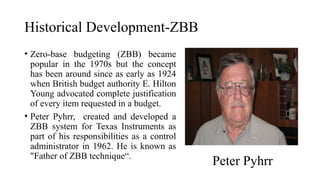
• Peter Pyhrr, created and developed a
ZBB system for Texas Instruments as
part of his responsibilities as a control
administrator in 1962. He is known as
"Father of ZBB technique“.
Peter Pyhrr
Historical Development-ZBB…Contd.
1.In 1962 the U.S. Department of
Agriculture adopted a ground-up system of
budgeting which is considered to be the
first formal use of ZBB in the U.S.
government.
2.The process finally evolved into the
current ZBB concept, which was
popularized by Pyhrr in 1970 in an article
in the Harvard Business Review. Jimmy
Carter (Governor of Georgia), read his
article, was impressed with it, and invited
Pyhrr to join him in adapting ZBB for
Georgia's 1972/1973 budget.
Historical Development-ZBB…Contd.
• Carter was so enthusiastic about the system that, when he became
President, he ordered all federal agencies to implement a ZBB system
by 1979.
• The concept of ZBB soon spread throughout both the public and
private sectors with mixed results and was the subject of many articles
in the 1970s, although Ronald Reagan dropped ZBB during his tenure
as President.
ZBB in India
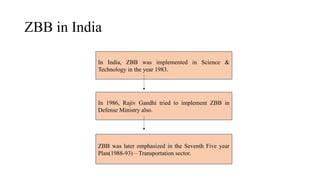
In India, ZBB was implemented in Science &
Technology in the year 1983.
In 1986, Rajiv Gandhi tried to implement ZBB in
Defense Ministry also.
ZBB was later emphasized in the Seventh Five year
Plan(1988-93) – Transportation sector.
ZBB in India
• While introducing ZBB, the Govt of India had issued a questionnaire
to be filled for each programme some of which are:
Are there other agencies performing the same activity and if yes is it
necessary to continue the same?
What changes would you suggest to make the activity/programme
more effective and achieve the objective in a cost effective manner?
If additional funds say 25% are given, what would be the benefit?
If allotment of funds is cut say 25%, what would be the adverse
consequences?
Steps involved in ZBB
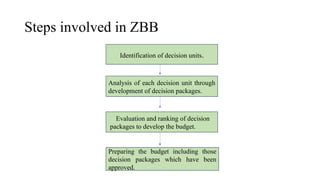
Identification of decision units.
Analysis of each decision unit through
development of decision packages.
Evaluation and ranking of decision
packages to develop the budget.
Preparing the budget including those
decision packages which have been
approved.
Defining a decision unit
• A ZBB decision unit is an activity/programme or department for
which decision packages are to be developed and analyzed.
• Managers of each decision units are responsible for developing a
description of each programme to be operated in the next fiscal year.
For e.g. In a district, the decision units could be different specialist
clinics, programme units, hospital OPD unit, dispensaries or
individual PHC’s.
Defining a decision unit..Contd
• A specific manager should be clearly
responsible for the operation of the
program.
• Identify and describe a particular
activity.
• It must have well defined &
measurable objectives and impacts.
Development of Decision Packages
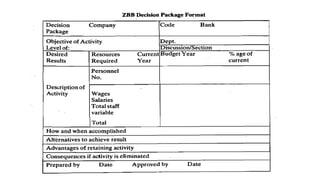
• After the identification of appropriate decision units, the next step is to
prepare a document for each of these describing the objectives or
purposes of the decision unit and the actions that could be taken to
achieve them. Such document is called “Decision Package”.
• Decision packages will have work packages, Costs, returns, purpose,
expected results, alternatives available, Consequences if activity is not
performed or reduced.
• Decision packages can be
1. Mutually exclusive( Contains alternative ways of doing a job).
2. Incremental (Defining different levels of efforts).
Decision Making-Review And Ranking Of
Decision Package
• Decide to accept or reject or amend the activity.
• Once the decision packages have been prepared, they are ranked on an
ordinal scale i.e. 1st, 2nd, 3rd, etc in order of priority using Cost
benefit Analysis.
• Surplus funds are then allocated to these decision packages.
Decision Making-Review And Ranking Of
Decision Package….Contd
• Take a Decision Package:
1. Is the activity under our control.
2. Recognize less effective activities.
3. Elimination of irrelevant activity.
4. Make the activity profitable.
ZBB Approach
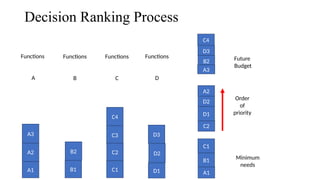
• As an example: consider 4 functions/activities to be performed by a decision unit
– decision packages A,B,C and D.
Decision package A – OPD can have 3 alternatives.
A1 - OPD giving only Allopathic treatment.
A2 - OPD Allopathic + Ayurveda.
A3 - OPD Allopathic + Ayurveda + Homeopathy.
Decision package B – Pathology unit.
B1 – Basic Path lab with referral services.
B2 – Well equipped Path Lab.
ZBB Approach
Decision package C – Specialist clinics.
C1 – Child care unit.
C2 – Family welfare clinic.
C3 – Orthopaedic rehabilitation centre.
C4 – Leprosy clinic.
Decision package D – X-ray Unit.
D1 – Single vertical machine.
D2 – additional horizontal bed machine.
D3 – well equipped Radiology department.
ZBB Approach
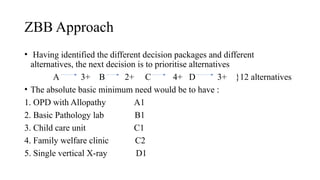
• Having identified the different decision packages and different
alternatives, the next decision is to prioritise alternatives
A 3+ B 2+ C 4+ D 3+ }12 alternatives
• The absolute basic minimum need would be to have :
1. OPD with Allopathy A1
2. Basic Pathology lab B1
3. Child care unit C1
4. Family welfare clinic C2
5. Single vertical X-ray D1
ZBB Approach…Contd.
These are now ranked as
A1 – B1 – C1 – C2 – D1
Increase Funds – in order of priority.
Prioritisation depends on the specific needs of the particular
district/hospital/PHC and may be pre determined.
Decision Ranking Process
A1
A2
A3
B1
B2
A1
B1
D2
C2
D1
C1
C4
D3
B2
A2
A3
Future
Budget
Functions
A
Functions
B
Functions
C
Functions
D
Order
of
priority
Minimum
needs
C4
C3
C1
C2 D2
D1
D3
Benefits of ZBB
Proper Allocation of Funds
• When funds are scarce, priority in allocation of funds is made on cost-
benefit analysis.
Systematic Evaluation
• Manager has to justify the demand for resources, every year.
• It provides the organization a systematic way to evaluate different
programmes and operations undertaken.
• Funds allocation for the ongoing projects is made, if there is
justification to continue them further.
Benefits of ZBB…Contd.
Links Budgets with Goals of Enterprise
• The projects that do not fit within the overall goals of the enterprise
are not continued, even if they were commenced.
Optimum use of Resources
• As cost-benefit analysis is the guiding principle in fixing priorities,
resources are used to the optimum advantage of the organization.
Benefits of ZBB…Contd.
Zero Base Approach
• Zero is taken as the base, every time.
• Activities and programs that are essential are undertaken, which
improves the overall efficiency of the enterprise.
• Alternative courses of action are always studied.
• The focus of the management is on analysis and decision-making.
Benefits of ZBB…Contd.
Non Incremental Approach
• Normally, budgets are based on incremental approach.
• The usual feature of functional heads is to seek information from the
accounts department for the previous year’s expenditure, add
‘something’ for the current year and try to justify the increase.
• Manager has to justify their activities and the funds requested.
Limitations Of ZBB
• Increased paper work.
• Cost of preparing many packages.
• Subjective ranking.
• More emphasis on short term benefits.
• Small organization cannot afford it.
• The identification of decision units and decision packages creates
number of problems for the organization(Decentralized).
Limitations Of ZBB…Contd.
• Requires experience, intelligence, expertise, and continuous training
on the part of executives. Thus ,it is not suitable for an ordinary
organization.
Modified ZBB
• Modified zero-base budgeting approach also called Service-level
budgeting/Target-based budgeting.
• This concept matches spending levels with services to be performed.
• Estimates for the coming financial year are based upon a percentage
(usually b/w 70-90%) of approved expenditure for the current FY.
• The remaining funds are set aside in a separate pool to finance new
projects or activities.
What Are The Alternatives To ZBB?
• Here are the three major alternatives:
Priority budgeting:-
• Under this system, the government first determines how much revenue it has
available, then identifies the community’s most important priorities, and then
allocates resources to the priorities rather than directly to departments.
• Programs are ranked according to how well they align with the priorities.
• This form of budgeting focuses on determining which services the
government should offer in order to get the most value from the tax money.
• Hence, it too is a non incremental form of budgeting - an alternative to ZBB.
Alternatives to ZBB…Contd.
• Program review:- It is a planning method used to examine, outside of
the budget process, how a program is provided.
• It can answer several important questions, for example: What services
should we provide?
• For those services we do offer, what level of service should we provide?
• Are we providing that level of service efficiently?
• Program review answers these questions outside the pressures of the
budget process, and thus may be more successful than ZBB in finding
real alternatives.
Alternatives to ZBB…Contd.
Traditional Based Budgeting:-
• Last year’s budget is taken as base.
• Current year’s budget is prepared by making changes to previous years
budget by adjusting the expenses based on the inflation rate, consumer
demand, market situation etc.
• TBB is much less intensive than ZBB.
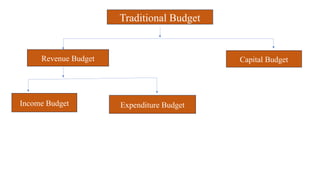
Revenue Budget Capital Budget
Income Budget Expenditure Budget
Traditional Budget
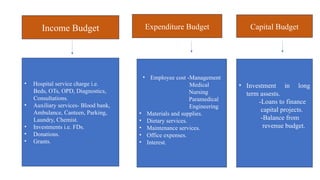
Income Budget
• Hospital service charge i.e.
Beds, OTs, OPD, Diagnostics,
Consultations.
• Auxiliary services- Blood bank,
Ambulance, Canteen, Parking,
Laundry, Chemist.
• Investments i.e. FDs.
• Donations.
• Grants.
Expenditure Budget
• Employee cost -Management
Medical
Nursing
Paramedical
Engineering
• Materials and supplies.
• Dietary services.
• Maintenance services.
• Office expenses.
• Interest.
Capital Budget
• Investment in long
term assests.
-Loans to finance
capital projects.
-Balance from
revenue budget.
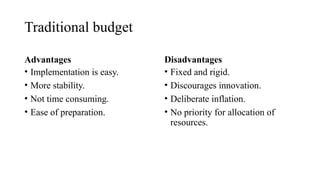
Traditional budget
Advantages
• Implementation is easy.
• More stability.
• Not time consuming.
• Ease of preparation.
Disadvantages
• Fixed and rigid.
• Discourages innovation.
• Deliberate inflation.
• No priority for allocation of
resources.
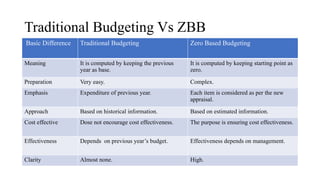
Traditional Budgeting Vs ZBB
Basic Difference Traditional Budgeting Zero Based Budgeting
Meaning It is computed by keeping the previous
year as base.
It is computed by keeping starting point as
zero.
Preparation Very easy. Complex.
Emphasis Expenditure of previous year. Each item is considered as per the new
appraisal.
Approach Based on historical information. Based on estimated information.
Cost effective Dose not encourage cost effectiveness. The purpose is ensuring cost effectiveness.
Effectiveness Depends on previous year’s budget. Effectiveness depends on management.
Clarity Almost none. High.
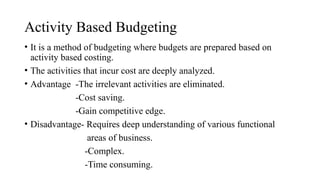
Activity Based Budgeting
• It is a method of budgeting where budgets are prepared based on
activity based costing.
• The activities that incur cost are deeply analyzed.
• Advantage -The irrelevant activities are eliminated.
-Cost saving.
-Gain competitive edge.
• Disadvantage- Requires deep understanding of various functional
areas of business.
-Complex.
-Time consuming.
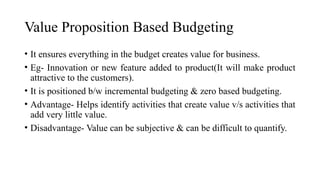
Value Proposition Based Budgeting
• It ensures everything in the budget creates value for business.
• Eg- Innovation or new feature added to product(It will make product
attractive to the customers).
• It is positioned b/w incremental budgeting & zero based budgeting.
• Advantage- Helps identify activities that create value v/s activities that
add very little value.
• Disadvantage- Value can be subjective & can be difficult to quantify.
References
• PV Sathe Textbook of Public Health Management 3rd
edition.
• IAPSM’s Textbook of Community Medicine 2nd
edition.
Thank You

Presentationonzerobasedbudgetinghealtheconomics.pptx

  • 1.
    Zero Based Budgeting Presentedby Dr. Himani Junior Resident 3 Department of Community Medicine PGIMS Rohtak Moderator Dr. Monika Das Senior Resident Department of Community Medicine PGIMS ROHTAK
  • 2.
    Contents • BUDGET • ZEROBASED BUDGET -Historical development . -Steps Involved. -Advantages. -Limitations. • ALTERNATIVES TO ZBB.
  • 3.
    Budget • A budgetcan be defined as a quantitative expression of the operational plans of an organization for a future accounting period. • Usually prepared for a period of one year but may be prepared to coincide with the seasonal needs or other factors as per requirement. • It is both, a plan of action as well as control medium. • It is a financial document used to estimate future income and expenses for a specified period which is usually a year.
  • 4.
    Budget…Contd • Budgeting isrequired in private corporate sectors as well in public administration. • The 3 essentials of a budget: -Prepared in advance based on future plan of action. -Relates to future period and based on objective to be achieved. -Is a monetary statement that makes the management think, plan and act as a team to render better medical service at affordable costs.
  • 5.
    Objectives of Budgeting A)Tocontrol the cost and increase revenue and thereby maximizing the profit. B)To run production activities in an efficient manner by to decrease the chances of interruption in production process due to lack of material, labour etc. C)To establish coordination between different functions of an enterprise. D)To ensure that actions taken are in accordance with the targets and if required, to take suitable corrective action.
  • 6.
    Objectives of Budgeting…Contd. E)To incorporate measures of calculation of deviations from budgeted results and analysis of the same, whereby responsibility can be fixed and controlling measures/action can be taken.
  • 7.
    Advantages Of Budgeting A)Itleads to maximum utilization of resources with a view to ensure maximum return. B)Process of self-examination & self-criticism which is essential for the success of any organization. C)Enables the organization to prefix its goals and push up the forces towards their achievements. D)It stimulates the effective use of resources and creates an attitude of cost consciousness throughout the organization. E)It creates the bases for measuring performances of different departments as well as different functions of the production activities.
  • 8.
    Disadvantages Of Budgeting A)Forecasting, planning or budgeting is not an exact science and a certain amount of judgement is present in any budgeting plan. B) The basic requirement for the success of budgeting is the absolute support and enthusiasm provided by the top management. If it is lacking at any time, the whole system will collapse. C) Budgeting should be followed up by effective control action, this is often lacking in many organizations, which defeats the very purpose of budgeting.
  • 9.
    Disadvantages Of Budgeting…Contd. D)The installation of budgeting system is an lengthy process and it takes time. E) It is only a source and not a target and hence, can not take the place of management, while it is only a tool of management. F) It requires the experienced man-power, technical staff, analysis, control etc., hence, it is costly affair.
  • 10.
    Time Function Flexibility Long-termSales Fixed Short-term Production Flexible Current Cost of Production Purchase Research Cash Master Classification of Budget
  • 11.
    Budgeting methods Zero BasedIncremental Activity Based Value Proposition 4 M/C Budgeting Methods
  • 12.
    Zero Based Budgeting •It is defined as an operating, planning and budgeting process which requires each officer to justify her/his budget demand from zero level upwards. • It requires fresh justification for the funds required to run a programme and carry on activities. • The start is from a zero Base of no allocation of funds for a programme. • Then the sanctioning of every Rupee needs justification, even for on- going programmes.
  • 13.
    Historical Development-ZBB • Zero-basebudgeting (ZBB) became popular in the 1970s but the concept has been around since as early as 1924 when British budget authority E. Hilton Young advocated complete justification of every item requested in a budget. • Peter Pyhrr, created and developed a ZBB system for Texas Instruments as part of his responsibilities as a control administrator in 1962. He is known as "Father of ZBB technique“. Peter Pyhrr
  • 14.
    Historical Development-ZBB…Contd. 1.In 1962the U.S. Department of Agriculture adopted a ground-up system of budgeting which is considered to be the first formal use of ZBB in the U.S. government. 2.The process finally evolved into the current ZBB concept, which was popularized by Pyhrr in 1970 in an article in the Harvard Business Review. Jimmy Carter (Governor of Georgia), read his article, was impressed with it, and invited Pyhrr to join him in adapting ZBB for Georgia's 1972/1973 budget.
  • 15.
    Historical Development-ZBB…Contd. • Carterwas so enthusiastic about the system that, when he became President, he ordered all federal agencies to implement a ZBB system by 1979. • The concept of ZBB soon spread throughout both the public and private sectors with mixed results and was the subject of many articles in the 1970s, although Ronald Reagan dropped ZBB during his tenure as President.
  • 16.
    ZBB in India InIndia, ZBB was implemented in Science & Technology in the year 1983. In 1986, Rajiv Gandhi tried to implement ZBB in Defense Ministry also. ZBB was later emphasized in the Seventh Five year Plan(1988-93) – Transportation sector.
  • 17.
    ZBB in India •While introducing ZBB, the Govt of India had issued a questionnaire to be filled for each programme some of which are: Are there other agencies performing the same activity and if yes is it necessary to continue the same? What changes would you suggest to make the activity/programme more effective and achieve the objective in a cost effective manner? If additional funds say 25% are given, what would be the benefit? If allotment of funds is cut say 25%, what would be the adverse consequences?
  • 18.
    Steps involved inZBB Identification of decision units. Analysis of each decision unit through development of decision packages. Evaluation and ranking of decision packages to develop the budget. Preparing the budget including those decision packages which have been approved.
  • 19.
    Defining a decisionunit • A ZBB decision unit is an activity/programme or department for which decision packages are to be developed and analyzed. • Managers of each decision units are responsible for developing a description of each programme to be operated in the next fiscal year. For e.g. In a district, the decision units could be different specialist clinics, programme units, hospital OPD unit, dispensaries or individual PHC’s.
  • 20.
    Defining a decisionunit..Contd • A specific manager should be clearly responsible for the operation of the program. • Identify and describe a particular activity. • It must have well defined & measurable objectives and impacts.
  • 21.
    Development of DecisionPackages • After the identification of appropriate decision units, the next step is to prepare a document for each of these describing the objectives or purposes of the decision unit and the actions that could be taken to achieve them. Such document is called “Decision Package”. • Decision packages will have work packages, Costs, returns, purpose, expected results, alternatives available, Consequences if activity is not performed or reduced. • Decision packages can be 1. Mutually exclusive( Contains alternative ways of doing a job). 2. Incremental (Defining different levels of efforts).
  • 23.
    Decision Making-Review AndRanking Of Decision Package • Decide to accept or reject or amend the activity. • Once the decision packages have been prepared, they are ranked on an ordinal scale i.e. 1st, 2nd, 3rd, etc in order of priority using Cost benefit Analysis. • Surplus funds are then allocated to these decision packages.
  • 24.
    Decision Making-Review AndRanking Of Decision Package….Contd • Take a Decision Package: 1. Is the activity under our control. 2. Recognize less effective activities. 3. Elimination of irrelevant activity. 4. Make the activity profitable.
  • 25.
    ZBB Approach • Asan example: consider 4 functions/activities to be performed by a decision unit – decision packages A,B,C and D. Decision package A – OPD can have 3 alternatives. A1 - OPD giving only Allopathic treatment. A2 - OPD Allopathic + Ayurveda. A3 - OPD Allopathic + Ayurveda + Homeopathy. Decision package B – Pathology unit. B1 – Basic Path lab with referral services. B2 – Well equipped Path Lab.
  • 26.
    ZBB Approach Decision packageC – Specialist clinics. C1 – Child care unit. C2 – Family welfare clinic. C3 – Orthopaedic rehabilitation centre. C4 – Leprosy clinic. Decision package D – X-ray Unit. D1 – Single vertical machine. D2 – additional horizontal bed machine. D3 – well equipped Radiology department.
  • 27.
    ZBB Approach • Havingidentified the different decision packages and different alternatives, the next decision is to prioritise alternatives A 3+ B 2+ C 4+ D 3+ }12 alternatives • The absolute basic minimum need would be to have : 1. OPD with Allopathy A1 2. Basic Pathology lab B1 3. Child care unit C1 4. Family welfare clinic C2 5. Single vertical X-ray D1
  • 28.
    ZBB Approach…Contd. These arenow ranked as A1 – B1 – C1 – C2 – D1 Increase Funds – in order of priority. Prioritisation depends on the specific needs of the particular district/hospital/PHC and may be pre determined.
  • 29.
  • 30.
    Benefits of ZBB ProperAllocation of Funds • When funds are scarce, priority in allocation of funds is made on cost- benefit analysis. Systematic Evaluation • Manager has to justify the demand for resources, every year. • It provides the organization a systematic way to evaluate different programmes and operations undertaken. • Funds allocation for the ongoing projects is made, if there is justification to continue them further.
  • 31.
    Benefits of ZBB…Contd. LinksBudgets with Goals of Enterprise • The projects that do not fit within the overall goals of the enterprise are not continued, even if they were commenced. Optimum use of Resources • As cost-benefit analysis is the guiding principle in fixing priorities, resources are used to the optimum advantage of the organization.
  • 32.
    Benefits of ZBB…Contd. ZeroBase Approach • Zero is taken as the base, every time. • Activities and programs that are essential are undertaken, which improves the overall efficiency of the enterprise. • Alternative courses of action are always studied. • The focus of the management is on analysis and decision-making.
  • 33.
    Benefits of ZBB…Contd. NonIncremental Approach • Normally, budgets are based on incremental approach. • The usual feature of functional heads is to seek information from the accounts department for the previous year’s expenditure, add ‘something’ for the current year and try to justify the increase. • Manager has to justify their activities and the funds requested.
  • 34.
    Limitations Of ZBB •Increased paper work. • Cost of preparing many packages. • Subjective ranking. • More emphasis on short term benefits. • Small organization cannot afford it. • The identification of decision units and decision packages creates number of problems for the organization(Decentralized).
  • 35.
    Limitations Of ZBB…Contd. •Requires experience, intelligence, expertise, and continuous training on the part of executives. Thus ,it is not suitable for an ordinary organization.
  • 36.
    Modified ZBB • Modifiedzero-base budgeting approach also called Service-level budgeting/Target-based budgeting. • This concept matches spending levels with services to be performed. • Estimates for the coming financial year are based upon a percentage (usually b/w 70-90%) of approved expenditure for the current FY. • The remaining funds are set aside in a separate pool to finance new projects or activities.
  • 37.
    What Are TheAlternatives To ZBB? • Here are the three major alternatives: Priority budgeting:- • Under this system, the government first determines how much revenue it has available, then identifies the community’s most important priorities, and then allocates resources to the priorities rather than directly to departments. • Programs are ranked according to how well they align with the priorities. • This form of budgeting focuses on determining which services the government should offer in order to get the most value from the tax money. • Hence, it too is a non incremental form of budgeting - an alternative to ZBB.
  • 38.
    Alternatives to ZBB…Contd. •Program review:- It is a planning method used to examine, outside of the budget process, how a program is provided. • It can answer several important questions, for example: What services should we provide? • For those services we do offer, what level of service should we provide? • Are we providing that level of service efficiently? • Program review answers these questions outside the pressures of the budget process, and thus may be more successful than ZBB in finding real alternatives.
  • 39.
    Alternatives to ZBB…Contd. TraditionalBased Budgeting:- • Last year’s budget is taken as base. • Current year’s budget is prepared by making changes to previous years budget by adjusting the expenses based on the inflation rate, consumer demand, market situation etc. • TBB is much less intensive than ZBB.
  • 40.
    Revenue Budget CapitalBudget Income Budget Expenditure Budget Traditional Budget
  • 41.
    Income Budget • Hospitalservice charge i.e. Beds, OTs, OPD, Diagnostics, Consultations. • Auxiliary services- Blood bank, Ambulance, Canteen, Parking, Laundry, Chemist. • Investments i.e. FDs. • Donations. • Grants. Expenditure Budget • Employee cost -Management Medical Nursing Paramedical Engineering • Materials and supplies. • Dietary services. • Maintenance services. • Office expenses. • Interest. Capital Budget • Investment in long term assests. -Loans to finance capital projects. -Balance from revenue budget.
  • 42.
    Traditional budget Advantages • Implementationis easy. • More stability. • Not time consuming. • Ease of preparation. Disadvantages • Fixed and rigid. • Discourages innovation. • Deliberate inflation. • No priority for allocation of resources.
  • 43.
    Traditional Budgeting VsZBB Basic Difference Traditional Budgeting Zero Based Budgeting Meaning It is computed by keeping the previous year as base. It is computed by keeping starting point as zero. Preparation Very easy. Complex. Emphasis Expenditure of previous year. Each item is considered as per the new appraisal. Approach Based on historical information. Based on estimated information. Cost effective Dose not encourage cost effectiveness. The purpose is ensuring cost effectiveness. Effectiveness Depends on previous year’s budget. Effectiveness depends on management. Clarity Almost none. High.
  • 44.
    Activity Based Budgeting •It is a method of budgeting where budgets are prepared based on activity based costing. • The activities that incur cost are deeply analyzed. • Advantage -The irrelevant activities are eliminated. -Cost saving. -Gain competitive edge. • Disadvantage- Requires deep understanding of various functional areas of business. -Complex. -Time consuming.
  • 45.
    Value Proposition BasedBudgeting • It ensures everything in the budget creates value for business. • Eg- Innovation or new feature added to product(It will make product attractive to the customers). • It is positioned b/w incremental budgeting & zero based budgeting. • Advantage- Helps identify activities that create value v/s activities that add very little value. • Disadvantage- Value can be subjective & can be difficult to quantify.
  • 46.
    References • PV SatheTextbook of Public Health Management 3rd edition. • IAPSM’s Textbook of Community Medicine 2nd edition.
  • 47.