Community, social and administrative Pharmacy
By: Dr. Yasar Shah Page 1
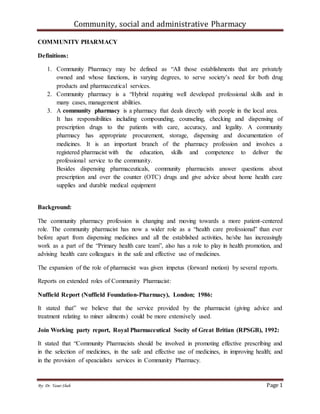
COMMUNITY PHARMACY
Definitions:
1. Community Pharmacy may be defined as “All those establishments that are privately
owned and whose functions, in varying degrees, to serve society’s need for both drug
products and pharmaceutical services.
2. Community pharmacy is a “Hybrid requiring well developed professional skills and in
many cases, management abilities.
3. A community pharmacy is a pharmacy that deals directly with people in the local area.
It has responsibilities including compounding, counseling, checking and dispensing of
prescription drugs to the patients with care, accuracy, and legality. A community
pharmacy has appropriate procurement, storage, dispensing and documentation of
medicines. It is an important branch of the pharmacy profession and involves a
registered pharmacist with the education, skills and competence to deliver the
professional service to the community.
Besides dispensing pharmaceuticals, community pharmacists answer questions about
prescription and over the counter (OTC) drugs and give advice about home health care
supplies and durable medical equipment
Background:
The community pharmacy profession is changing and moving towards a more patient-centered
role. The community pharmacist has now a wider role as a “health care professional” than ever
before apart from dispensing medicines and all the established activities, he/she has increasingly
work as a part of the “Primary health care team”, also has a role to play in health promotion, and
advising health care colleagues in the safe and effective use of medicines.
The expansion of the role of pharmacist was given impetus (forward motion) by several reports.
Reports on extended roles of Community Pharmacist:
Nuffield Report (Nuffield Foundation-Pharmacy), London; 1986:
It stated that” we believe that the service provided by the pharmacist (giving advice and
treatment relating to miner ailments) could be more extensively used.
Join Working party report, Royal Pharmaceutical Socity of Great Britian (RPSGB), 1992:
It stated that “Community Pharmacists should be involved in promoting effective prescribing and
in the selection of medicines, in the safe and effective use of medicines, in improving health; and
in the provision of speacialists services in Community Pharmacy.
Community, social and administrative Pharmacy
By: Dr. Yasar Shah Page 2
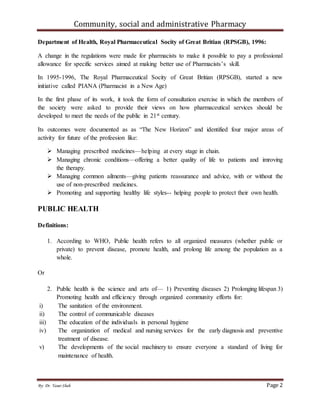
Department of Health, Royal Pharmaceutical Socity of Great Britian (RPSGB), 1996:
A change in the regulations were made for pharmacists to make it possible to pay a professional
allowance for specific services aimed at making better use of Pharmacists’s skill.
In 1995-1996, The Royal Pharmaceutical Socity of Great Britian (RPSGB), started a new
initiative called PIANA (Pharmacist in a New Age)
In the first phase of its work, it took the form of consultation exercise in which the members of
the society were asked to provide their views on how pharmaceutical services should be
developed to meet the needs of the public in 21st century.
Its outcomes were documented as as “The New Horizon” and identified four major areas of
activity for future of the profeesion like:
 Managing prescribed medicines—helping at every stage in chain.
 Managing chronic conditions—offering a better quality of life to patients and imroving
the therapy.
 Managing common ailments—giving patients reassurance and advice, with or without the
use of non-prescribed medicines.
 Promoting and supporting healthy life styles-- helping people to protect their own health.
PUBLIC HEALTH
Definitions:
1. According to WHO, Public health refers to all organized measures (whether public or
private) to prevent disease, promote health, and prolong life among the population as a
whole.
Or
2. Public health is the science and arts of— 1) Preventing diseases 2) Prolonging lifespan 3)
Promoting health and efficiency through organized community efforts for:
i) The sanitation of the environment.
ii) The control of communicable diseases
iii) The education of the individuals in personal hygiene
iv) The organization of medical and nursing services for the early diagnosis and preventive
treatment of disease.
v) The developments of the social machinery to ensure everyone a standard of living for
maintenance of health.
Community, social and administrative Pharmacy
By: Dr. Yasar Shah Page 3
A recent definition of public health, which meets the criteria of modern public health is as
follows—
3. “Public health is the planning carrying out an evolution of health measures and system
services that both maintain and improve the health of a population group, prevent and
control diseases within the population group”.
HEALTH
Definition:
According to the WHO (1948), “Health is a state of complete physical, mental and social well
being and not merely an absence of disease or infirmity so that each citizen can live a socially
and economically productive life”.
Scope of Public health:
Its activities aim to provide conditions in which people can be healthy and focus on entire
populations, not on individual patients or diseases. Thus, public health is concerned with the
total system and not only the eradication of a particular disease. The three main public health
functions are:
 The assessment and monitoring of the health of communities and populations at risk to
identify health problems and priorities.
 The formulation of public policies designed to solve identified local and national
health problems and priorities.
 To assure that all populations have access to appropriate and cost-effective care,
including health promotion and disease prevention services.
Public health professionals monitor and diagnose the health concerns of entire communities
and promote healthy practices and behaviours to ensure that populations stay healthy.
Health care
Definition:
It is defined as the multitude of services rendered to individuals, families or communities by the
agents of a health services or professions for the purpose of promoting, maintaining, monitoring
or restoring health.
All services have one thing in common, people are being served i.e., diagnosed health cured,
educated and rehabilitated by health personnel.
Community, social and administrative Pharmacy
By: Dr. Yasar Shah Page 4
Medical care
Definition:
It refers chiefly to those personal services that are provided directly by physicians or rendered as
the result physician’s instructions. It ranges from domiciliary care to residence hospital care. The
term medical care is not synonymous with health care. Medical care is a subset of health care
system.
Levels of health care
Health services are usually organized at three levels, each level supported by a higher level to
which the patient is referred. Three levels are: A. Primary health care B. Secondary health care
(intermediate level) C. Tertiary health care (central level)
A. Primary health care
a) Grass root level. b) first level on contact of individuals, the family and community with
National Health System when essential health care (primary health care) is provided. c) This
level of care is most effective within the context of the area’s needs and limitations because of
providing by the primary health center or other sub center.
Example: Basic health units (BHU’s).
B. Secondary Health Care (Intermediate Level)
At this level, more complex problems are dealt with. This care comprises essentially curative
services and is provided by the district hospital and community health centre. This level is
assigned to provide some specialist services particularly in internal medicine, general surgery,
obstetrics, gynecology and pediatrics.
Example: District Headquarter Hospital Swabi.
C. Tertiary health care (central level)
This level offers super specialist care. This care is provided by the regional or central level
institutions. This institutions provide not only highly specialized care but also planning and
managerial skills and teaching for specialized staff e,g. medical college hospital and other
specialized hospital, cancer hospital, eye hospital, mental hospital etc.
Community, social and administrative Pharmacy
By: Dr. Yasar Shah Page 5
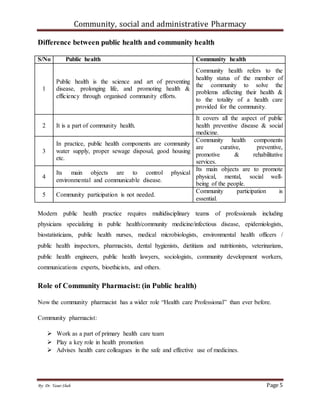
Difference between public health and community health
S/No Public health Community health
1
Public health is the science and art of preventing
disease, prolonging life, and promoting health &
efficiency through organised community efforts.
Community health refers to the
healthy status of the member of
the community to solve the
problems affecting their health &
to the totality of a health care
provided for the community.
2 It is a part of community health.
It covers all the aspect of public
health preventive disease & social
medicine.
3
In practice, public health components are community
water supply, proper sewage disposal, good housing
etc.
Community health components
are curative, preventive,
promotive & rehabilitative
services.
4
Its main objects are to control physical
environmental and communicable disease.
Its main objects are to promote
physical, mental, social well-
being of the people.
5 Community participation is not needed.
Community participation is
essential.
Modern public health practice requires multidisciplinary teams of professionals including
physicians specializing in public health/community medicine/infectious disease, epidemiologists,
biostatisticians, public health nurses, medical microbiologists, environmental health officers /
public health inspectors, pharmacists, dental hygienists, dietitians and nutritionists, veterinarians,
public health engineers, public health lawyers, sociologists, community development workers,
communications experts, bioethicists, and others.
Role of Community Pharmacist: (in Public health)
Now the community pharmacist has a wider role “Health care Professional” than ever before.
Community pharmacist:
 Work as a part of primary health care team
 Play a key role in health promotion
 Advises health care colleagues in the safe and effective use of medicines.
Community, social and administrative Pharmacy
By: Dr. Yasar Shah Page 6
Social and administrative pharmacy:
Definition:
“is concerned with understanding how and why medicines are used in society and how to
optimize pharmaceutical-related regulation, reimbursement, and policy pertaining to medicines
and pharmacy practice”.
Or
“The endeavor to integrate drugs into a broader perspective and to include legal, ethical,
economic, political, social, communicative, and psychological aspects into their evaluation in
order to contribute to the safe and rational use of drugs”.
{Source Reference: Schaefer, et al. J Soc Admin Pharm 1992; 9(4):141-148}
Social pharmacy can be considered to consist of all the social factors that influence medicine use,
such as medicine-related beliefs, regulations, policy, attitudes, medicine information, ethics and
behavior.

Community pharmacy

  • 1.
    Community, social andadministrative Pharmacy By: Dr. Yasar Shah Page 1 COMMUNITY PHARMACY Definitions: 1. Community Pharmacy may be defined as “All those establishments that are privately owned and whose functions, in varying degrees, to serve society’s need for both drug products and pharmaceutical services. 2. Community pharmacy is a “Hybrid requiring well developed professional skills and in many cases, management abilities. 3. A community pharmacy is a pharmacy that deals directly with people in the local area. It has responsibilities including compounding, counseling, checking and dispensing of prescription drugs to the patients with care, accuracy, and legality. A community pharmacy has appropriate procurement, storage, dispensing and documentation of medicines. It is an important branch of the pharmacy profession and involves a registered pharmacist with the education, skills and competence to deliver the professional service to the community. Besides dispensing pharmaceuticals, community pharmacists answer questions about prescription and over the counter (OTC) drugs and give advice about home health care supplies and durable medical equipment Background: The community pharmacy profession is changing and moving towards a more patient-centered role. The community pharmacist has now a wider role as a “health care professional” than ever before apart from dispensing medicines and all the established activities, he/she has increasingly work as a part of the “Primary health care team”, also has a role to play in health promotion, and advising health care colleagues in the safe and effective use of medicines. The expansion of the role of pharmacist was given impetus (forward motion) by several reports. Reports on extended roles of Community Pharmacist: Nuffield Report (Nuffield Foundation-Pharmacy), London; 1986: It stated that” we believe that the service provided by the pharmacist (giving advice and treatment relating to miner ailments) could be more extensively used. Join Working party report, Royal Pharmaceutical Socity of Great Britian (RPSGB), 1992: It stated that “Community Pharmacists should be involved in promoting effective prescribing and in the selection of medicines, in the safe and effective use of medicines, in improving health; and in the provision of speacialists services in Community Pharmacy.
  • 2.
    Community, social andadministrative Pharmacy By: Dr. Yasar Shah Page 2 Department of Health, Royal Pharmaceutical Socity of Great Britian (RPSGB), 1996: A change in the regulations were made for pharmacists to make it possible to pay a professional allowance for specific services aimed at making better use of Pharmacists’s skill. In 1995-1996, The Royal Pharmaceutical Socity of Great Britian (RPSGB), started a new initiative called PIANA (Pharmacist in a New Age) In the first phase of its work, it took the form of consultation exercise in which the members of the society were asked to provide their views on how pharmaceutical services should be developed to meet the needs of the public in 21st century. Its outcomes were documented as as “The New Horizon” and identified four major areas of activity for future of the profeesion like:  Managing prescribed medicines—helping at every stage in chain.  Managing chronic conditions—offering a better quality of life to patients and imroving the therapy.  Managing common ailments—giving patients reassurance and advice, with or without the use of non-prescribed medicines.  Promoting and supporting healthy life styles-- helping people to protect their own health. PUBLIC HEALTH Definitions: 1. According to WHO, Public health refers to all organized measures (whether public or private) to prevent disease, promote health, and prolong life among the population as a whole. Or 2. Public health is the science and arts of— 1) Preventing diseases 2) Prolonging lifespan 3) Promoting health and efficiency through organized community efforts for: i) The sanitation of the environment. ii) The control of communicable diseases iii) The education of the individuals in personal hygiene iv) The organization of medical and nursing services for the early diagnosis and preventive treatment of disease. v) The developments of the social machinery to ensure everyone a standard of living for maintenance of health.
  • 3.
    Community, social andadministrative Pharmacy By: Dr. Yasar Shah Page 3 A recent definition of public health, which meets the criteria of modern public health is as follows— 3. “Public health is the planning carrying out an evolution of health measures and system services that both maintain and improve the health of a population group, prevent and control diseases within the population group”. HEALTH Definition: According to the WHO (1948), “Health is a state of complete physical, mental and social well being and not merely an absence of disease or infirmity so that each citizen can live a socially and economically productive life”. Scope of Public health: Its activities aim to provide conditions in which people can be healthy and focus on entire populations, not on individual patients or diseases. Thus, public health is concerned with the total system and not only the eradication of a particular disease. The three main public health functions are:  The assessment and monitoring of the health of communities and populations at risk to identify health problems and priorities.  The formulation of public policies designed to solve identified local and national health problems and priorities.  To assure that all populations have access to appropriate and cost-effective care, including health promotion and disease prevention services. Public health professionals monitor and diagnose the health concerns of entire communities and promote healthy practices and behaviours to ensure that populations stay healthy. Health care Definition: It is defined as the multitude of services rendered to individuals, families or communities by the agents of a health services or professions for the purpose of promoting, maintaining, monitoring or restoring health. All services have one thing in common, people are being served i.e., diagnosed health cured, educated and rehabilitated by health personnel.
  • 4.
    Community, social andadministrative Pharmacy By: Dr. Yasar Shah Page 4 Medical care Definition: It refers chiefly to those personal services that are provided directly by physicians or rendered as the result physician’s instructions. It ranges from domiciliary care to residence hospital care. The term medical care is not synonymous with health care. Medical care is a subset of health care system. Levels of health care Health services are usually organized at three levels, each level supported by a higher level to which the patient is referred. Three levels are: A. Primary health care B. Secondary health care (intermediate level) C. Tertiary health care (central level) A. Primary health care a) Grass root level. b) first level on contact of individuals, the family and community with National Health System when essential health care (primary health care) is provided. c) This level of care is most effective within the context of the area’s needs and limitations because of providing by the primary health center or other sub center. Example: Basic health units (BHU’s). B. Secondary Health Care (Intermediate Level) At this level, more complex problems are dealt with. This care comprises essentially curative services and is provided by the district hospital and community health centre. This level is assigned to provide some specialist services particularly in internal medicine, general surgery, obstetrics, gynecology and pediatrics. Example: District Headquarter Hospital Swabi. C. Tertiary health care (central level) This level offers super specialist care. This care is provided by the regional or central level institutions. This institutions provide not only highly specialized care but also planning and managerial skills and teaching for specialized staff e,g. medical college hospital and other specialized hospital, cancer hospital, eye hospital, mental hospital etc.
  • 5.
    Community, social andadministrative Pharmacy By: Dr. Yasar Shah Page 5 Difference between public health and community health S/No Public health Community health 1 Public health is the science and art of preventing disease, prolonging life, and promoting health & efficiency through organised community efforts. Community health refers to the healthy status of the member of the community to solve the problems affecting their health & to the totality of a health care provided for the community. 2 It is a part of community health. It covers all the aspect of public health preventive disease & social medicine. 3 In practice, public health components are community water supply, proper sewage disposal, good housing etc. Community health components are curative, preventive, promotive & rehabilitative services. 4 Its main objects are to control physical environmental and communicable disease. Its main objects are to promote physical, mental, social well- being of the people. 5 Community participation is not needed. Community participation is essential. Modern public health practice requires multidisciplinary teams of professionals including physicians specializing in public health/community medicine/infectious disease, epidemiologists, biostatisticians, public health nurses, medical microbiologists, environmental health officers / public health inspectors, pharmacists, dental hygienists, dietitians and nutritionists, veterinarians, public health engineers, public health lawyers, sociologists, community development workers, communications experts, bioethicists, and others. Role of Community Pharmacist: (in Public health) Now the community pharmacist has a wider role “Health care Professional” than ever before. Community pharmacist:  Work as a part of primary health care team  Play a key role in health promotion  Advises health care colleagues in the safe and effective use of medicines.
  • 6.
    Community, social andadministrative Pharmacy By: Dr. Yasar Shah Page 6 Social and administrative pharmacy: Definition: “is concerned with understanding how and why medicines are used in society and how to optimize pharmaceutical-related regulation, reimbursement, and policy pertaining to medicines and pharmacy practice”. Or “The endeavor to integrate drugs into a broader perspective and to include legal, ethical, economic, political, social, communicative, and psychological aspects into their evaluation in order to contribute to the safe and rational use of drugs”. {Source Reference: Schaefer, et al. J Soc Admin Pharm 1992; 9(4):141-148} Social pharmacy can be considered to consist of all the social factors that influence medicine use, such as medicine-related beliefs, regulations, policy, attitudes, medicine information, ethics and behavior.