

ESCUELA : NOMBRES: COMMUNICATIVE GRAMMAR III  I BIMESTRE FECHA: Lic. Paúl González T. ABRIL  – AGOSTO 2009 Inglés
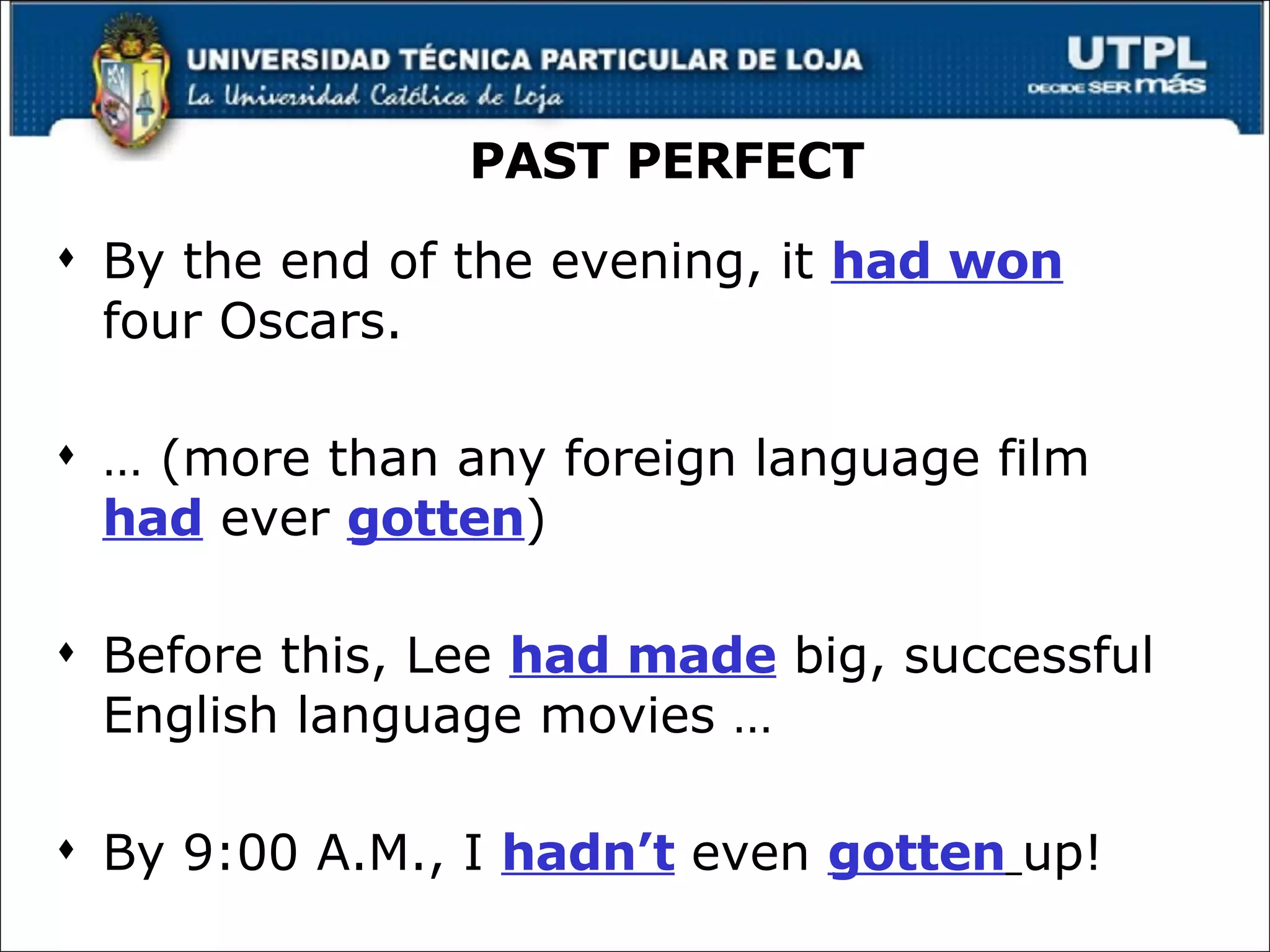
PAST PERFECT By the end of the evening, it  had won  four Oscars. …  (more than any foreign language film  had   ever  gotten ) Before this, Lee  had made  big, successful English language movies … By 9:00 A.M., I  hadn’t   even  gotten   up!
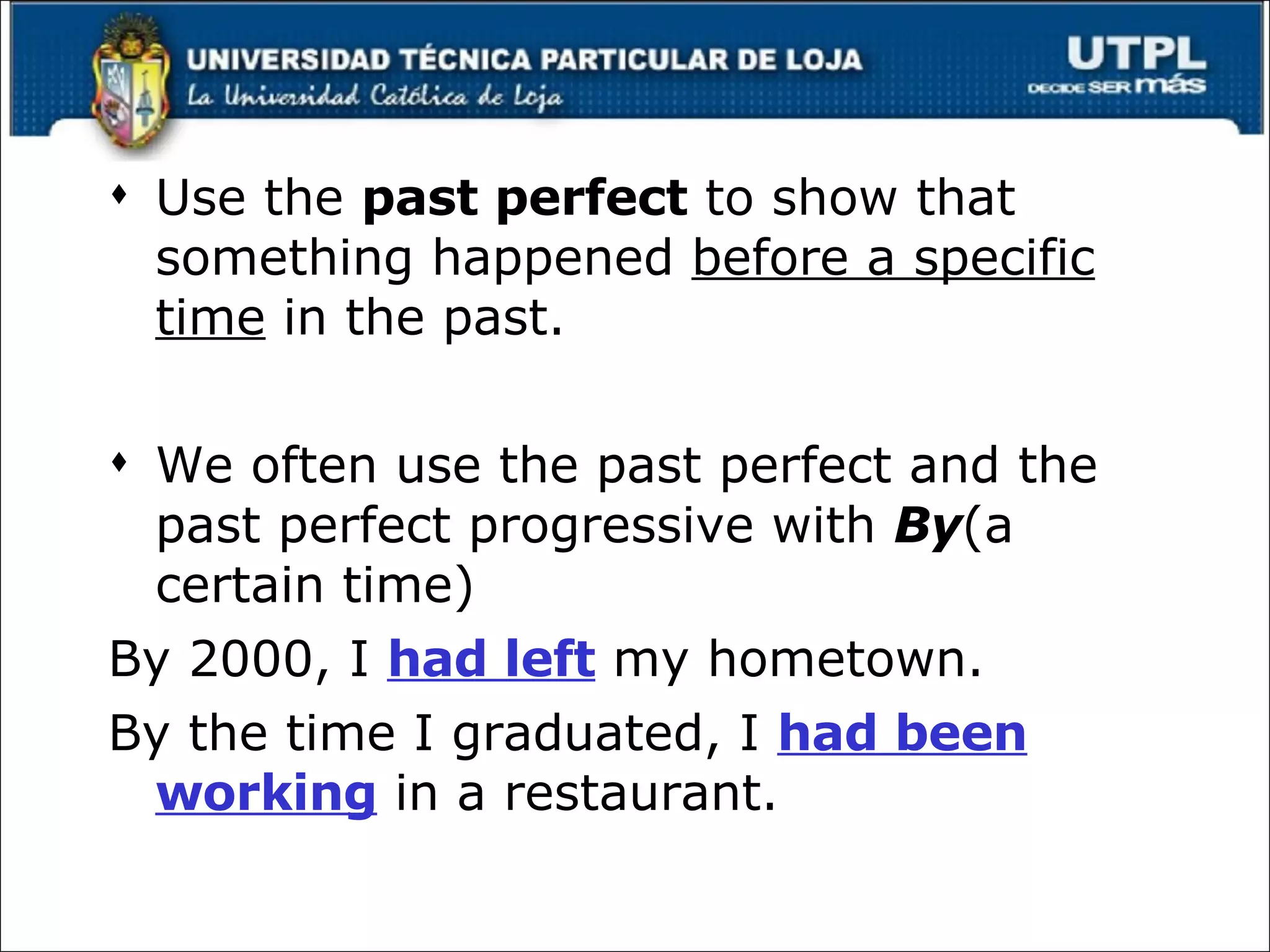
Use the  past perfect  to show that something happened  before a specific time  in the past. We often use the past perfect and the past perfect progressive with  By (a certain time) By 2000, I  had left  my hometown. By the time I graduated, I  had been working  in a restaurant.
PAST PERFECT PROGRESSIVE For six years, his wife  had been working  as a researcher, … …  he  had been writing  scripts …
Use the past  perfect progressive  to talk about an action that  was in progress before a specific time  in the past. The progressive emphasizes the continuing activity, not the end result.
FUTURE PROGRESSIVE (unit 5) Her son  will be waking up  soon Use the  future progressive  to talk about actions that will be in progress at a specific time in the future.
FUTURE PERFECT (unit 6) A typical college freshman  will have gotten  eight credit card offers by the end of the first semester. Everything you bought on that card  will have cost  twice as much as the actual price.
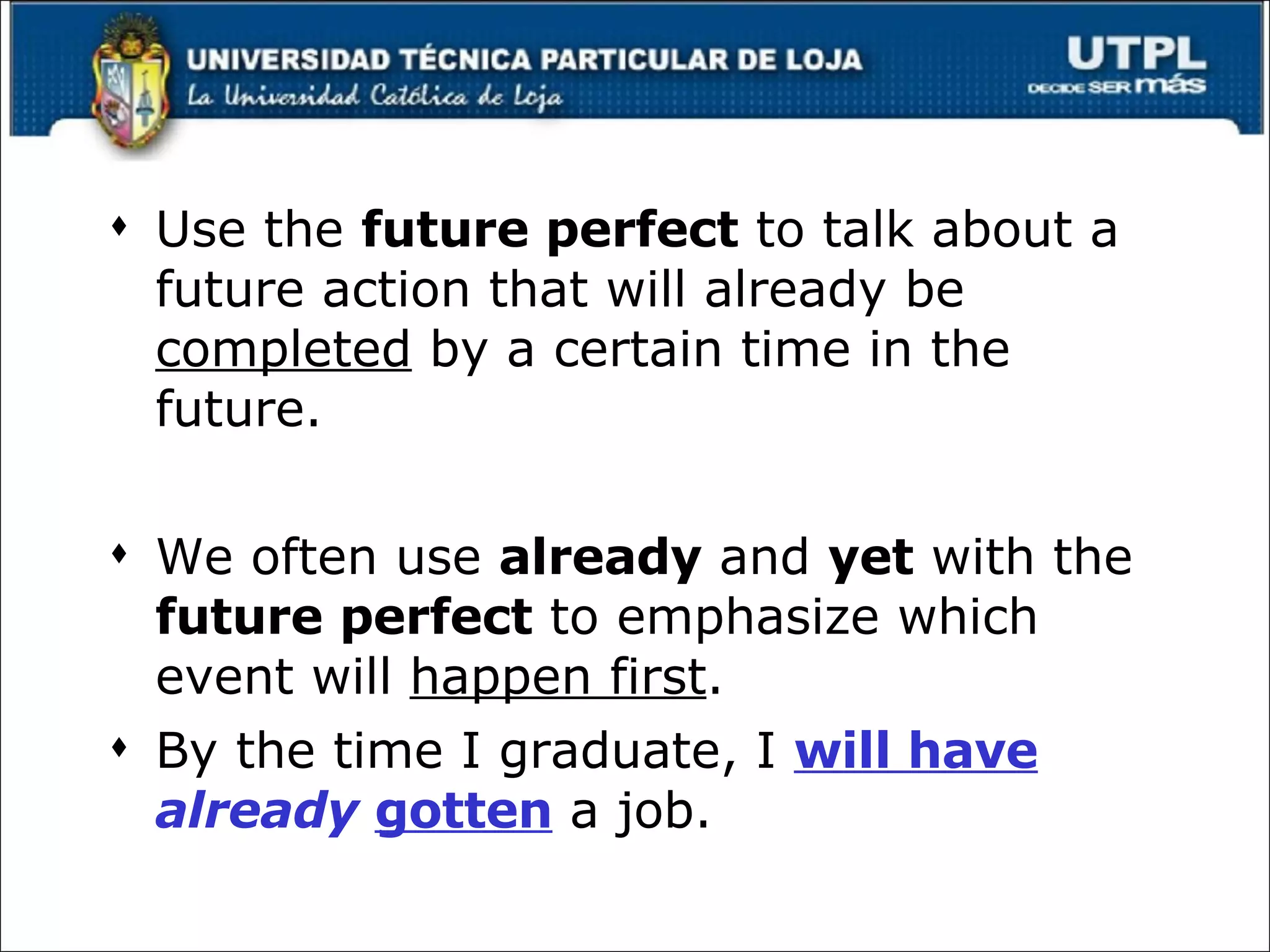
Use the  future perfect  to talk about a future action that will already be  completed  by a certain time in the future. We often use  already  and  yet  with the  future perfect  to emphasize which event will  happen first . By the time I graduate, I  will have  already  gotten  a job.
FUTURE PERFECT PROGRESSIVE … By the end of tonight’s Money Talks, we ’ll   have been traveling  for a month, … …  I ’ll have been paying  interest for nine months on pizzas I ate last September!
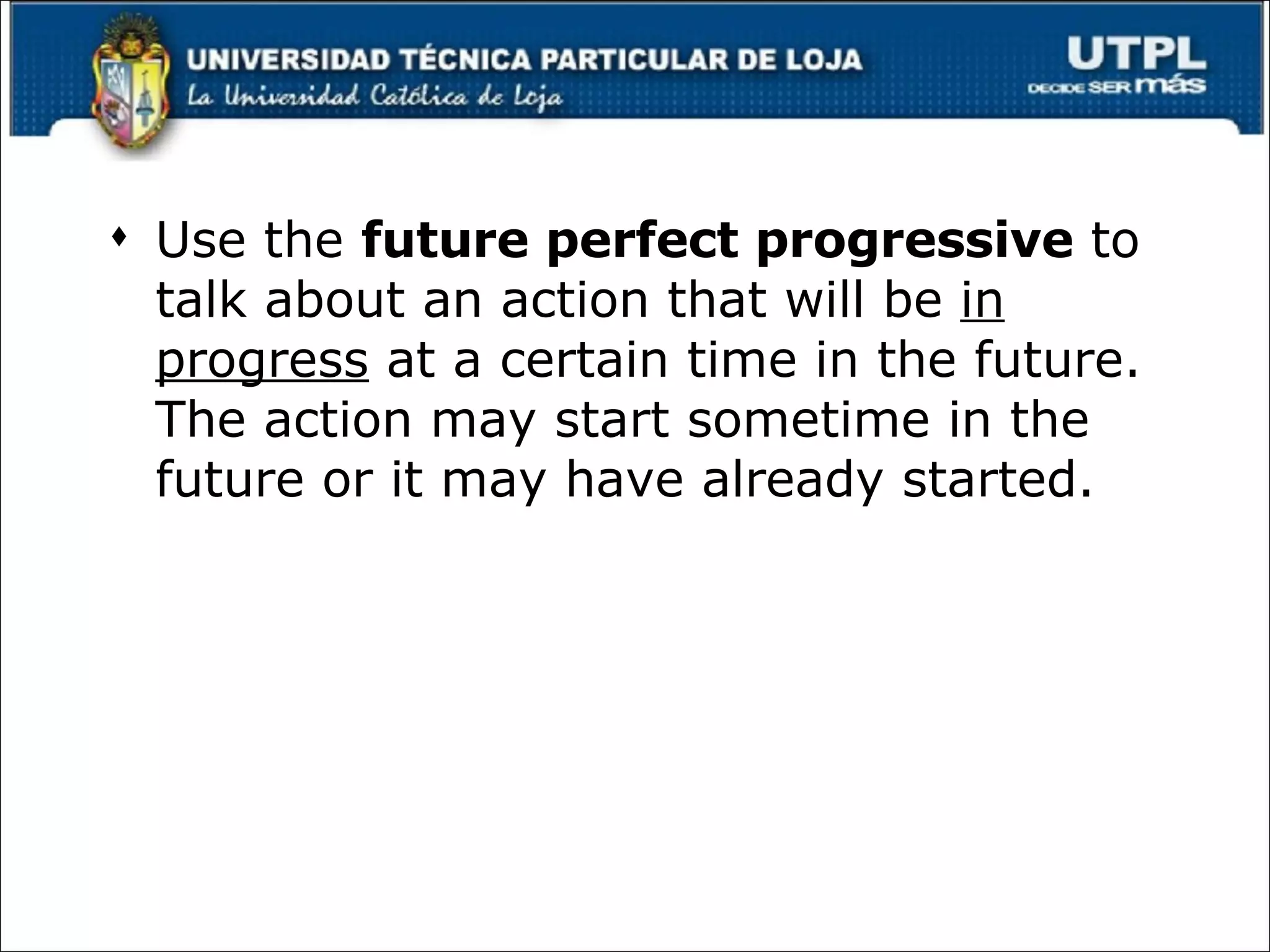
Use the  future perfect progressive  to talk about an action that will be  in progress  at a certain time in the future. The action may start sometime in the future or it may have already started.
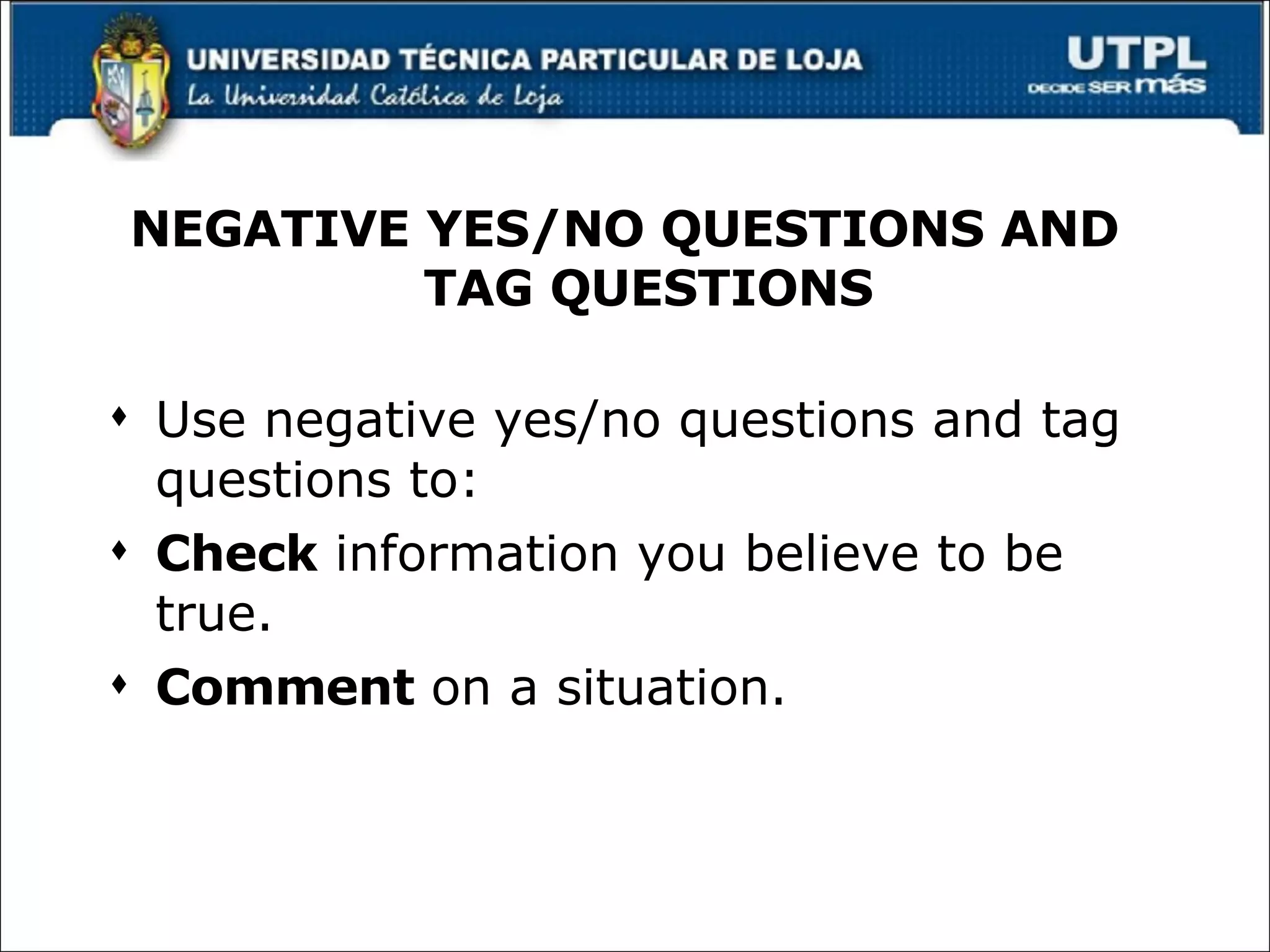
Use negative yes/no questions and tag questions to: Check  information you believe to be true. Comment  on a situation. NEGATIVE YES/NO QUESTIONS AND TAG QUESTIONS
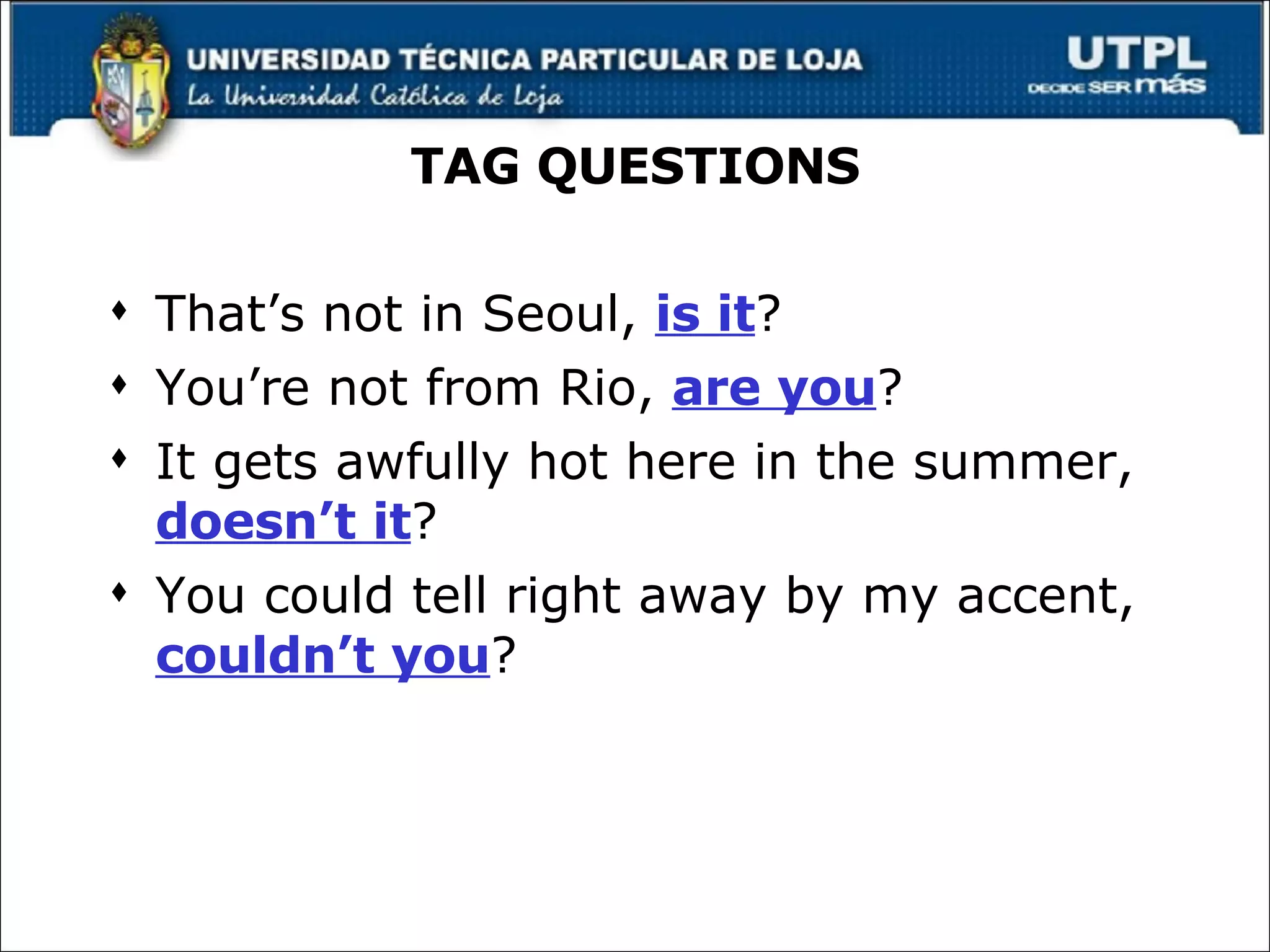
TAG QUESTIONS That’s not in Seoul,  is it ? You’re not from Rio,  are you ? It gets awfully hot here in the summer,  doesn’t it ? You could tell right away by my accent,  couldn’t you ?
TAG QUESTIONS:  statement + tag The  statement  expresses an assumption. The  tag  means  Right?  Or  Isn’t that true? If the statement verb is affirmative, the tag verb is negative. If the statement verb is negative, the tag verb is affirmative.
Use the  same auxiliary  that is in the statement. If the statement does not use be or an auxiliary verb, use an appropriate form of  do  in the tag. In the tag, only use pronouns.
NEGATIVE YES/NO QUESTIONS Don’t you  miss your family …? Hey,  didn’t you  buy anything? Haven’t   we met before? Aren’t I  right? We almost always use contractions in negative questions.
ADDITIONS  USING  SO ,  TOO ,  NEITHER ,  NOT EITHER , and  BU T We use  additions  to avoid repeating information. Additions  express similarity or contrast .
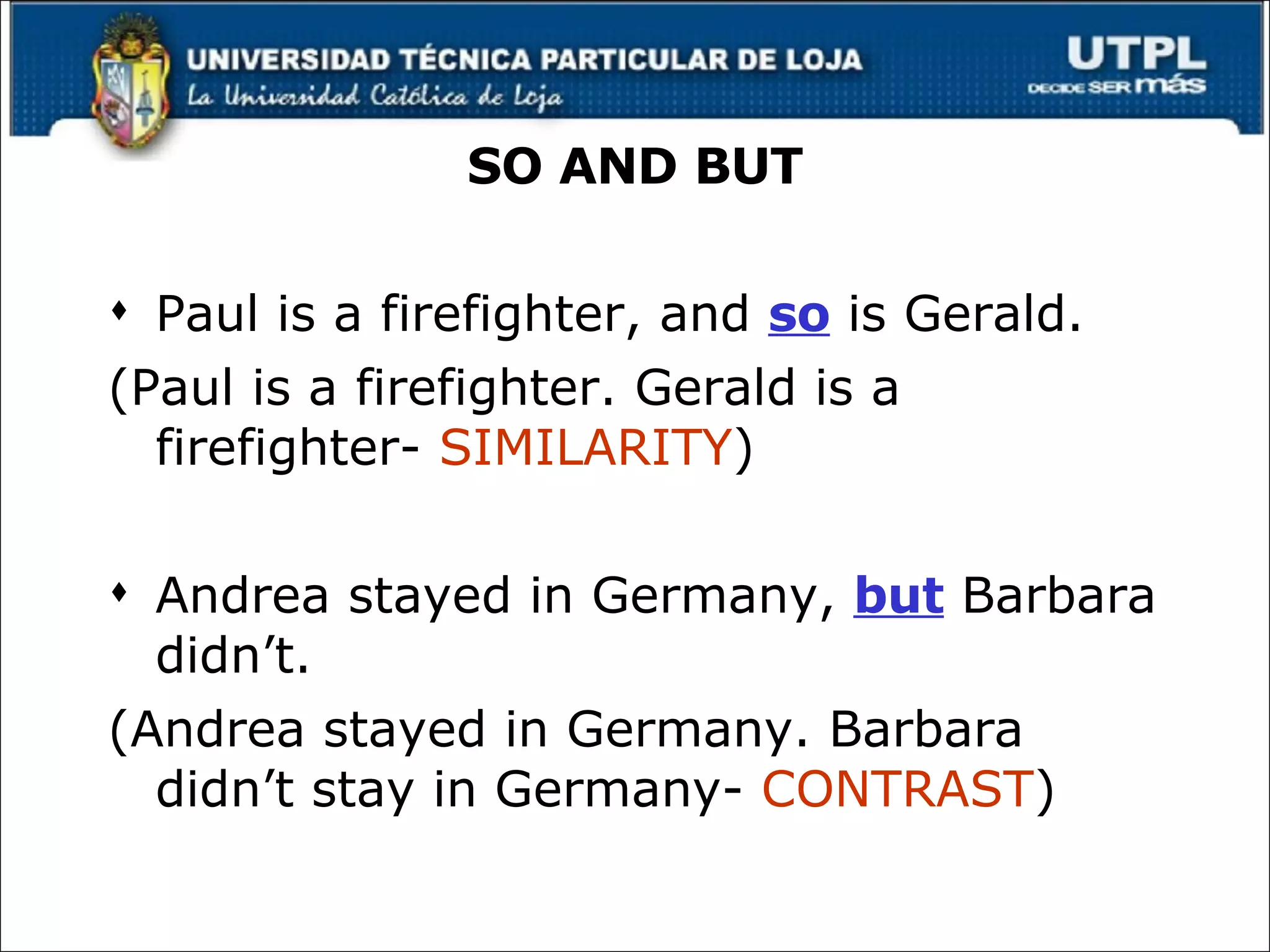
SO AND BUT Paul is a firefighter, and  so  is Gerald. (Paul is a firefighter. Gerald is a firefighter-  SIMILARITY )  Andrea stayed in Germany,  but  Barbara didn’t. (Andrea stayed in Germany. Barbara didn’t stay in Germany-  CONTRAST )
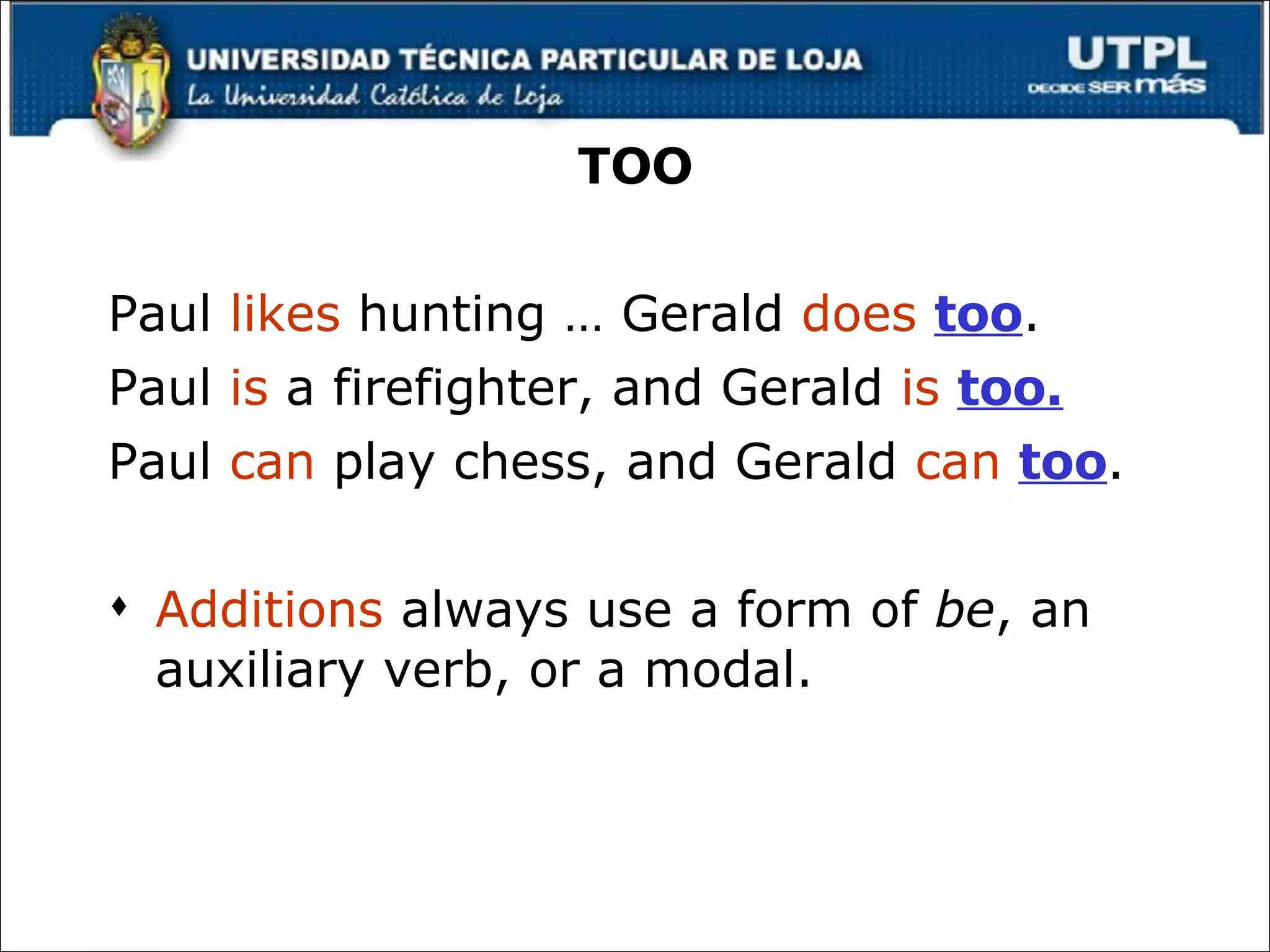
TOO Paul  likes  hunting … Gerald  does   too . Paul  is  a firefighter, and  Gerald  is   too. Paul  can  play chess, and Gerald  can   too . Additions  always use a form of  be , an auxiliary verb, or a modal.
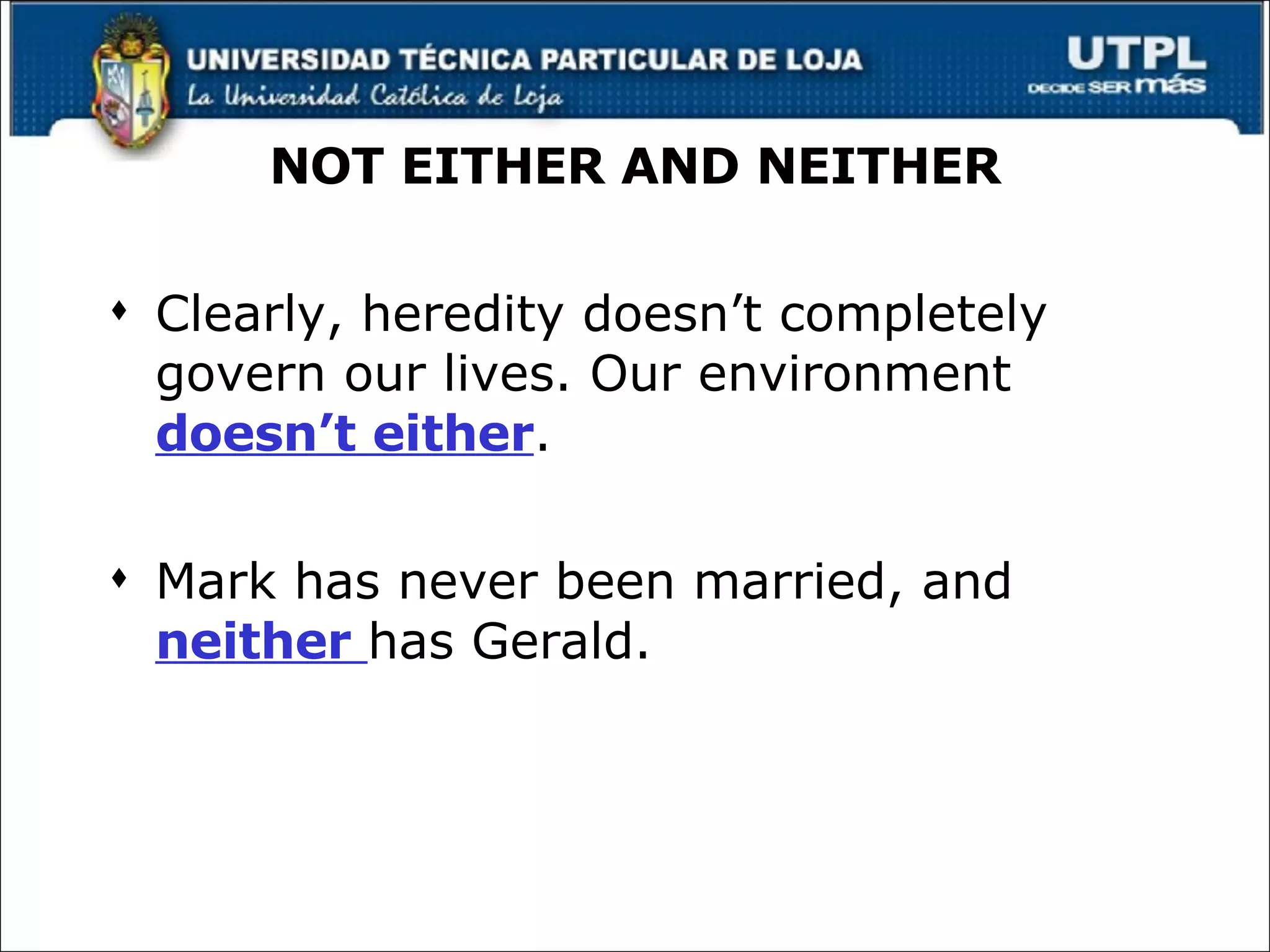
NOT EITHER AND NEITHER Clearly, heredity doesn’t completely govern our lives. Our environment  doesn’t either . Mark has never been married, and  neither  has Gerald.
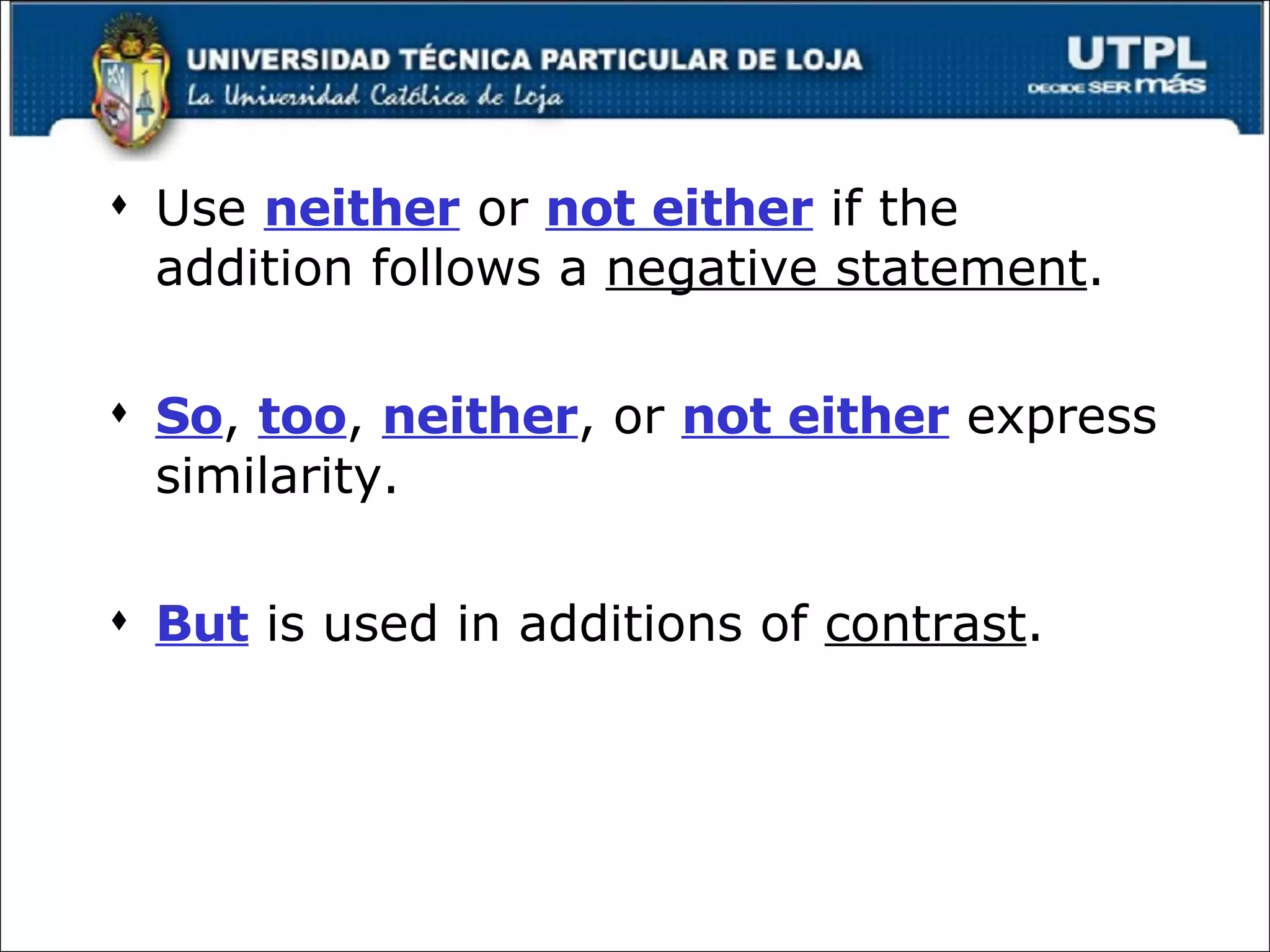
Use  neither  or  not either  if the addition follows a  negative statement . So ,  too ,  neither , or  not either  express similarity. But  is used in additions of  contrast .
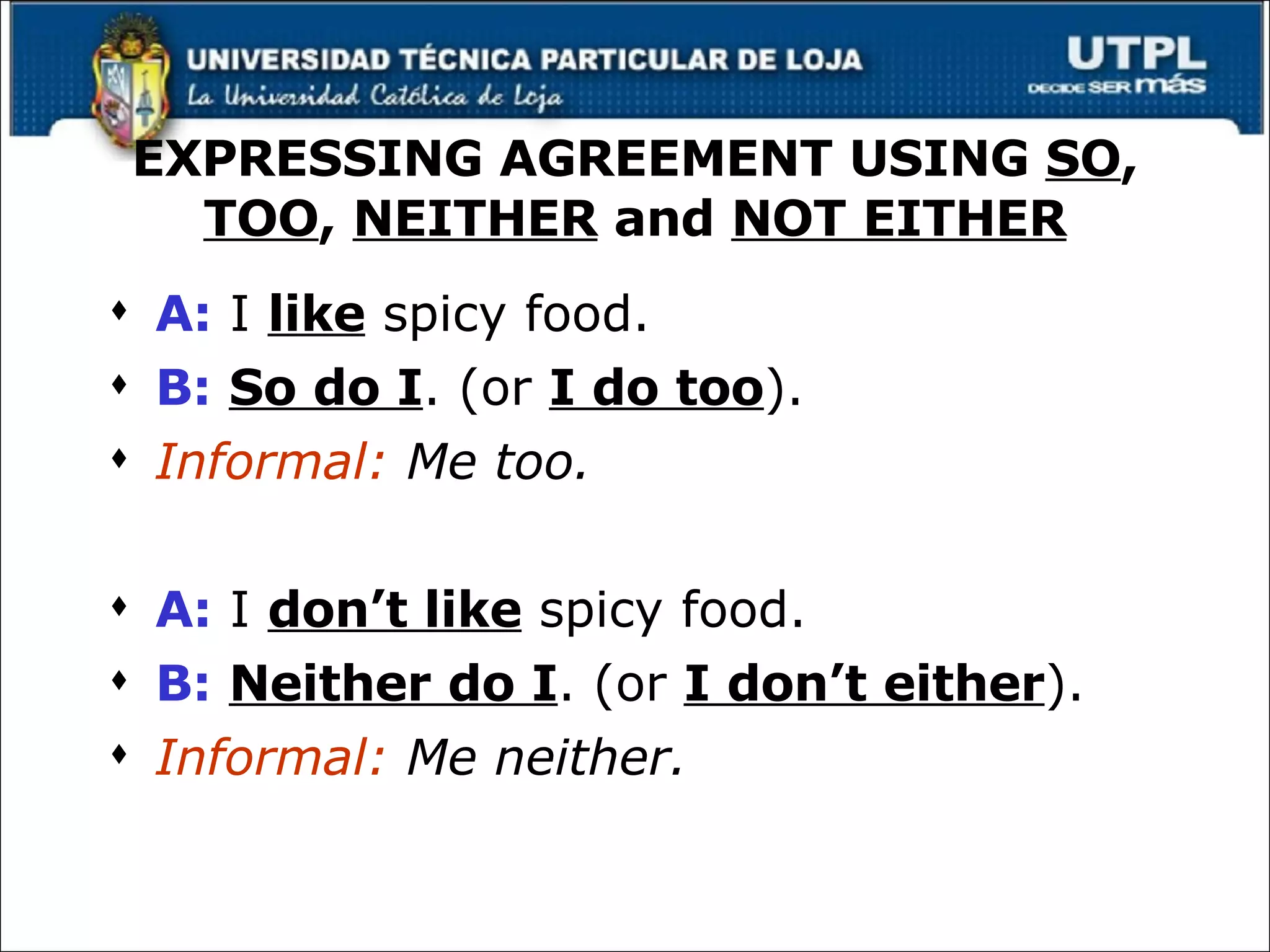
EXPRESSING AGREEMENT USING  SO ,  TOO ,  NEITHER  and  NOT EITHER A:  I  like  spicy food. B:   So do I . (or  I do too ). Informal:  Me too. A:  I  don’t like  spicy food. B:   Neither do I . (or  I don’t either ). Informal:  Me neither.
GERUNDS Dining  on fast food has become a way of life… But apart from the speed of  ordering  and  getting  served, …customers talk about… … fast-food restaurants may prevent families from  spending  quality time together…
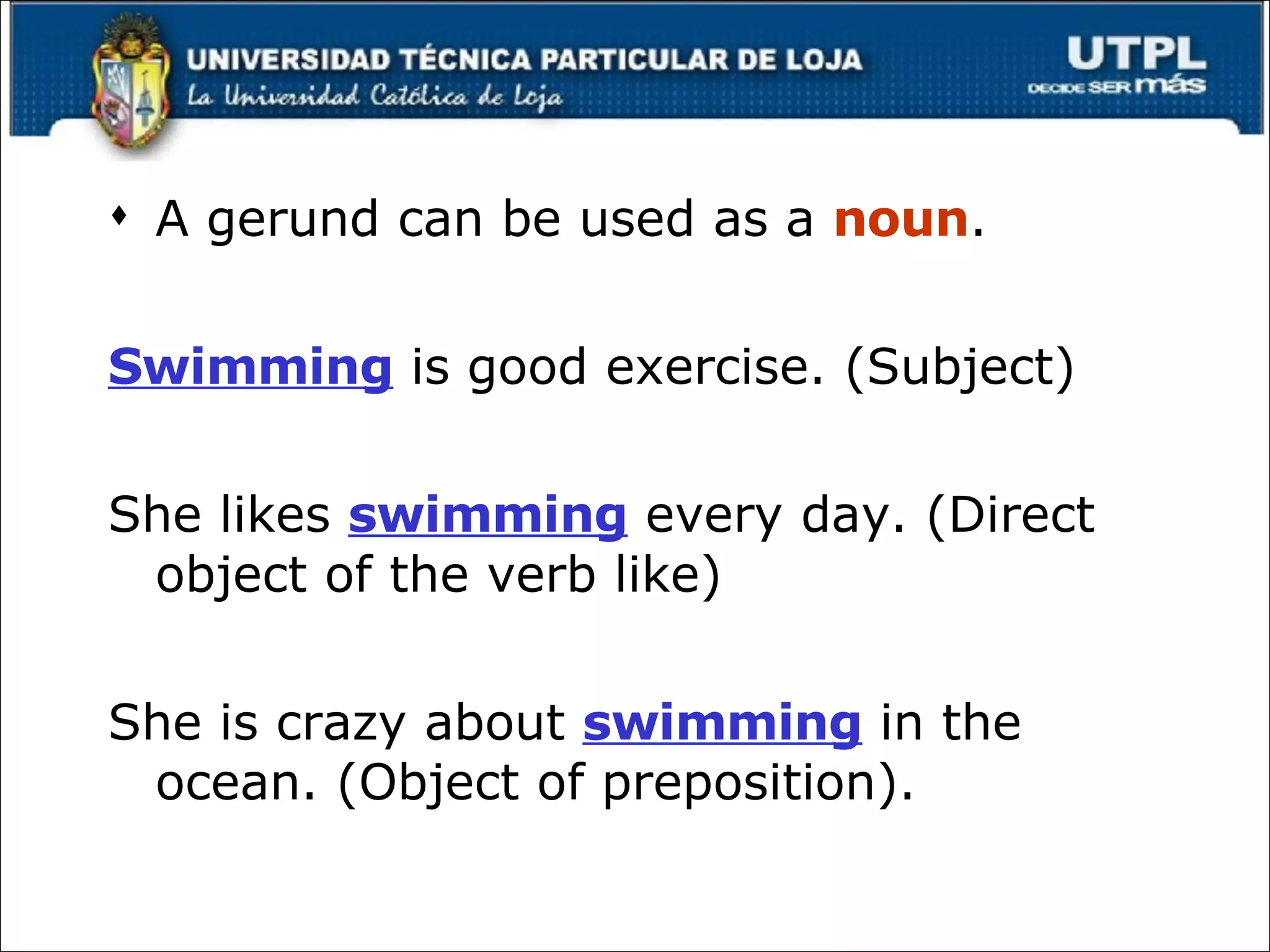
A gerund can be used as a  noun . Swimming  is good exercise. (Subject) She likes  swimming  every day. (Direct object of the verb like) She is crazy about  swimming  in the ocean. (Object of preposition).
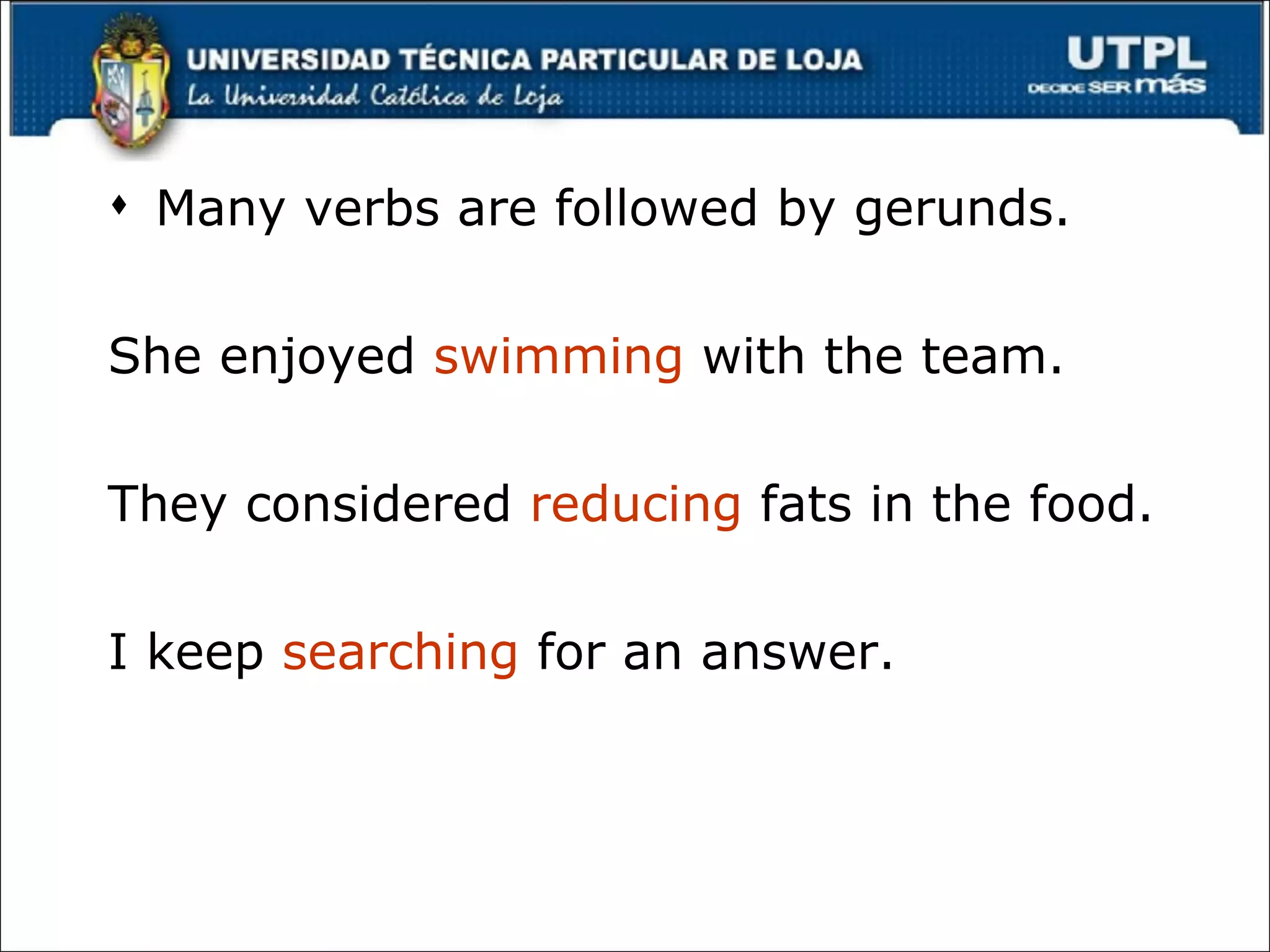
Many verbs are followed by gerunds. She enjoyed  swimming  with the team. They considered  reducing  fats in the food. I keep  searching  for an answer.
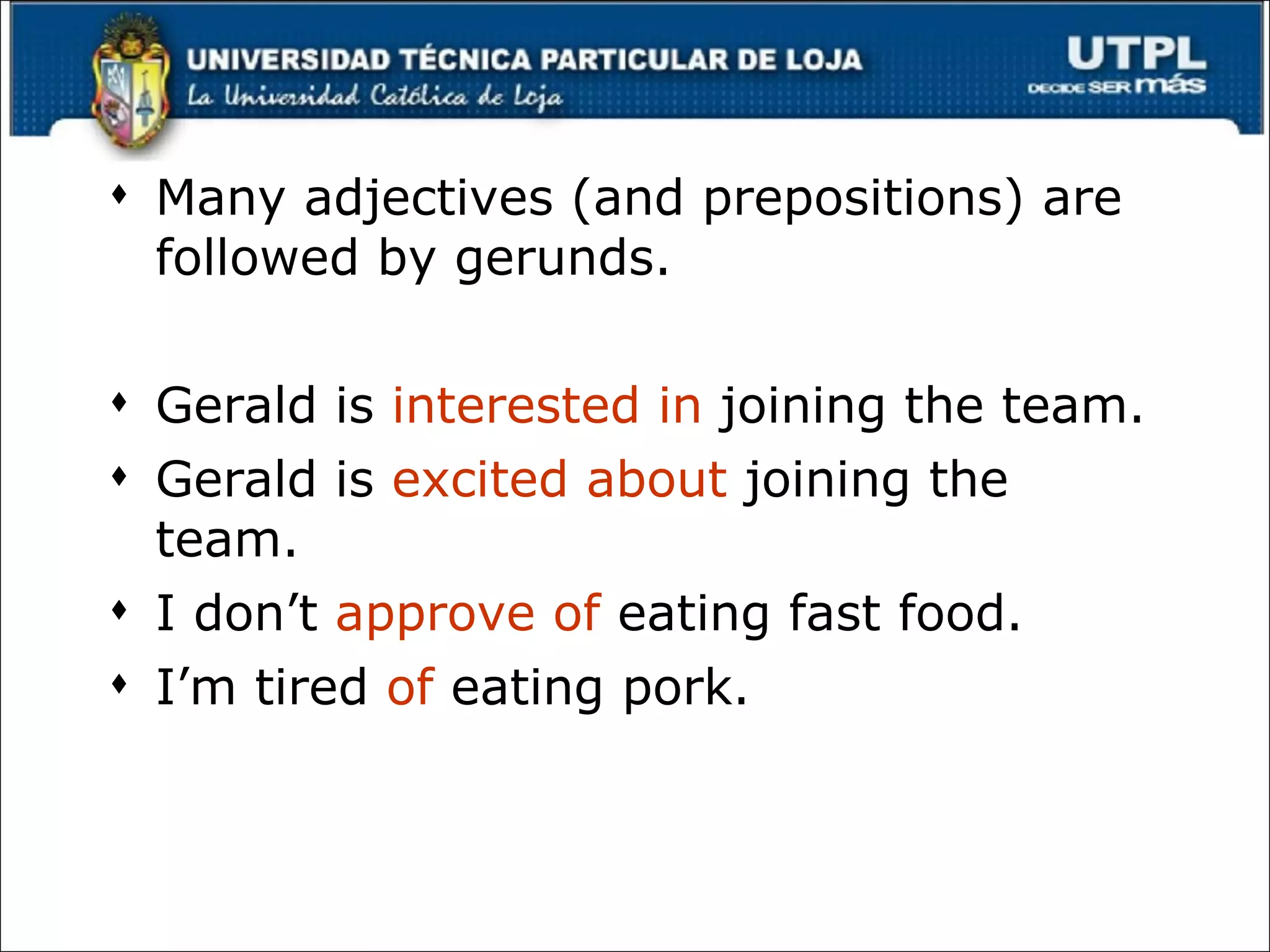
Many adjectives (and prepositions) are followed by gerunds.  Gerald is  interested in  joining the team. Gerald is  excited about  joining the team. I don’t  approve of  eating fast food. I’m tired  of  eating pork.
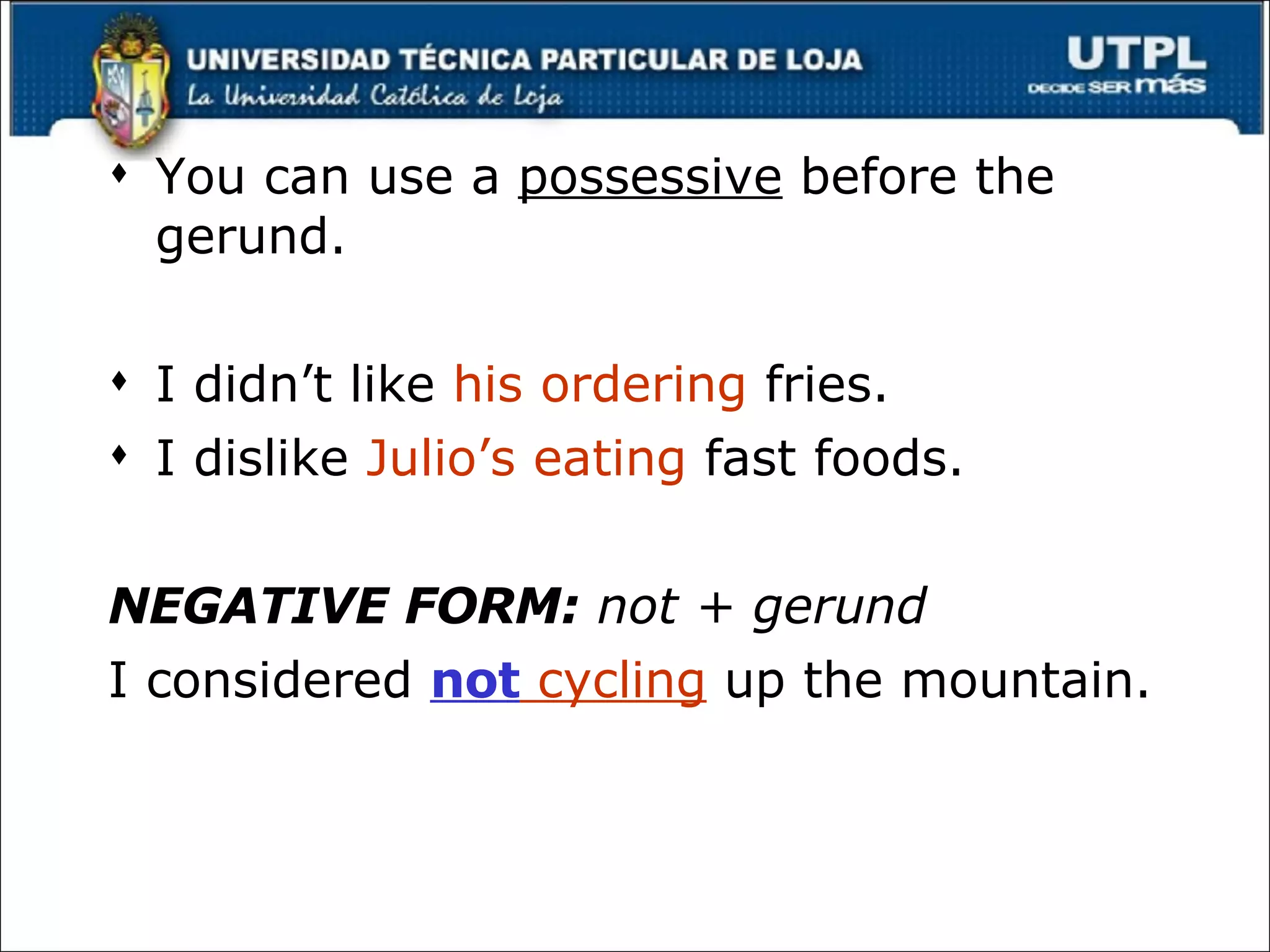
You can use a  possessive  before the gerund. I didn’t like  his ordering  fries. I dislike  Julio’s eating  fast foods. NEGATIVE FORM:  not + gerund I considered  not  cycling  up the mountain.
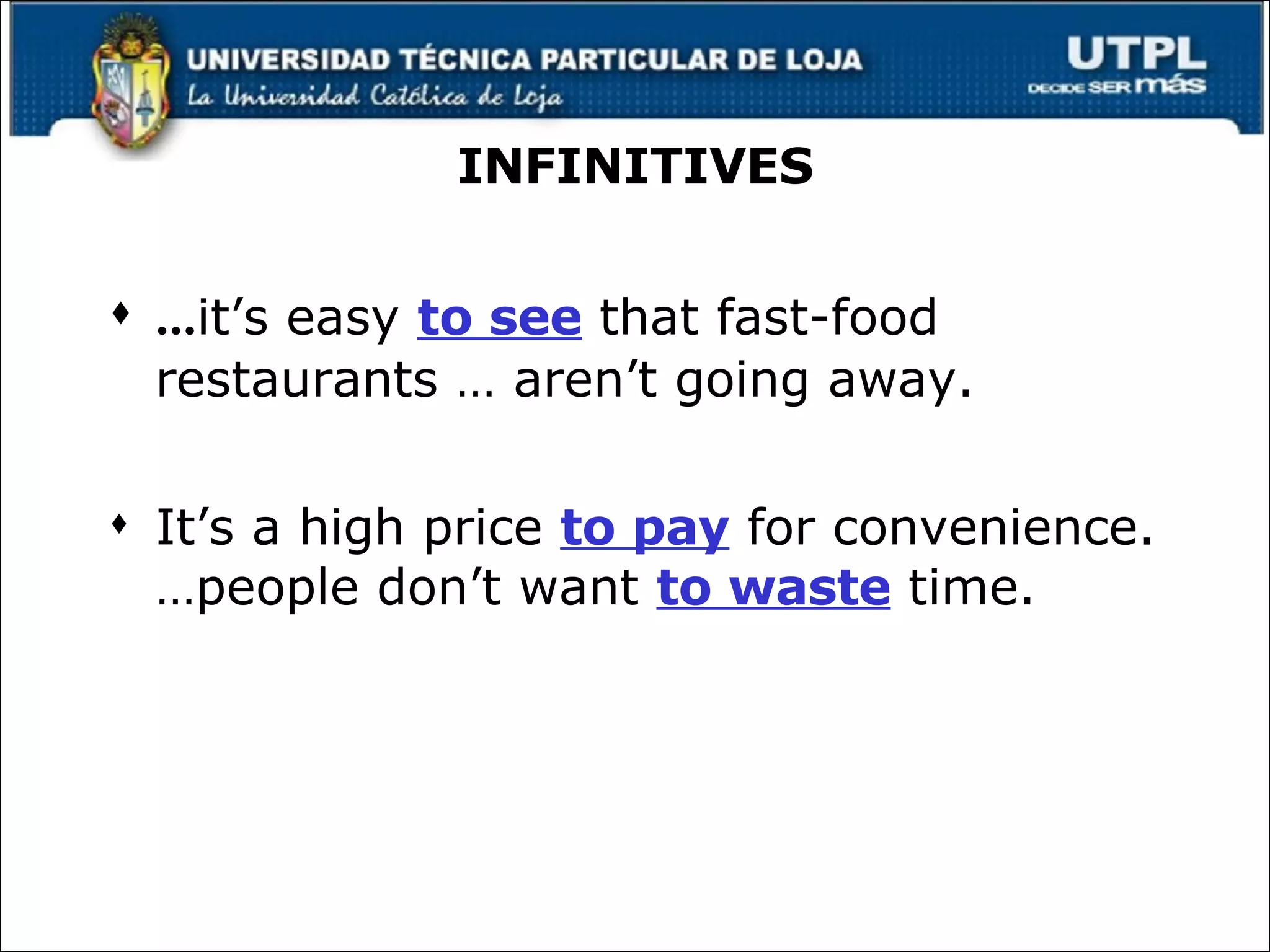
INFINITIVES … it’s easy  to see  that fast-food restaurants … aren’t going away. It’s a high price  to pay  for convenience. …people don’t want  to waste  time.
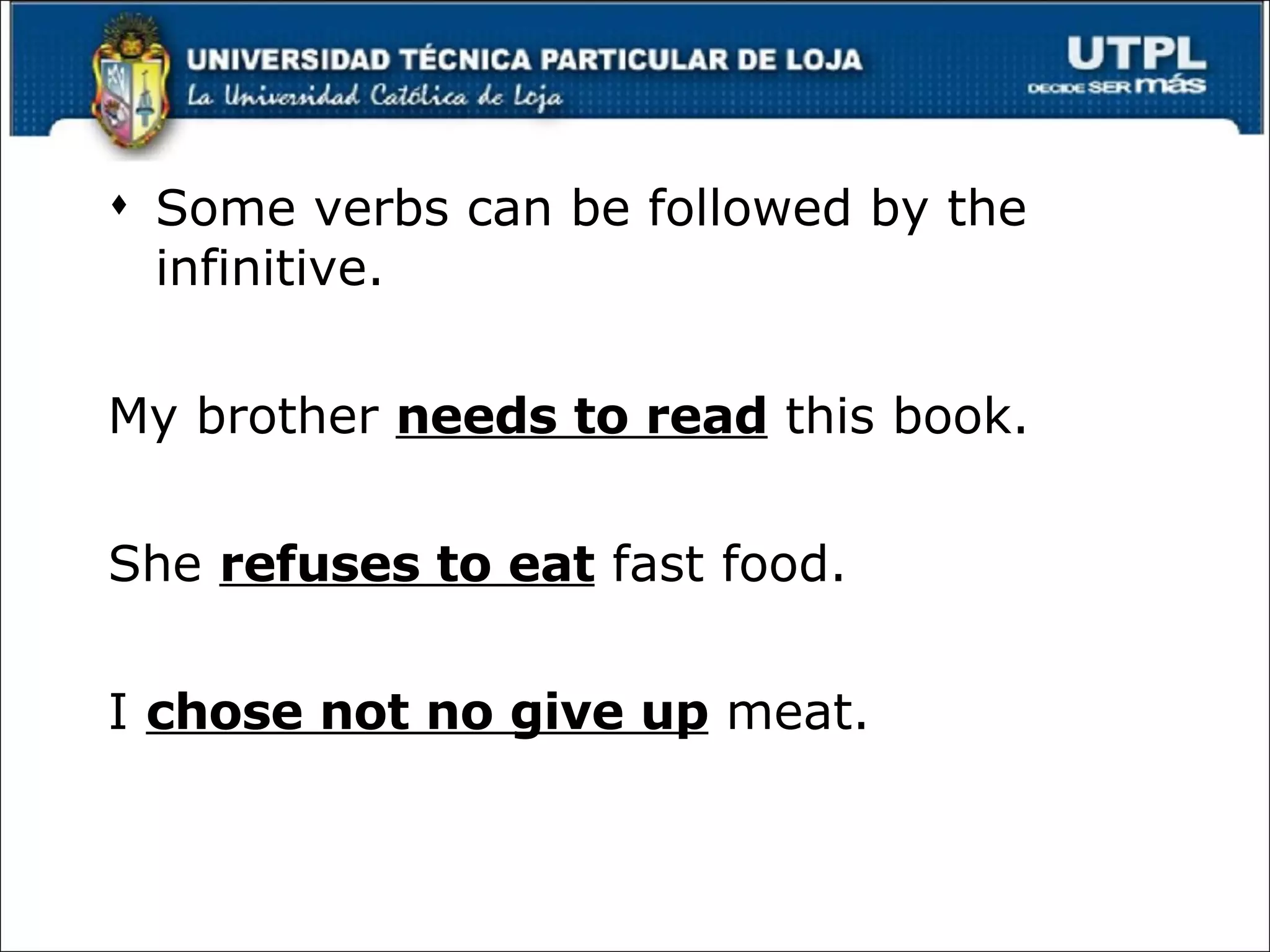
Some verbs can be followed by the infinitive. My brother  needs to read  this book. She  refuses to eat  fast food. I  chose not no give up  meat.
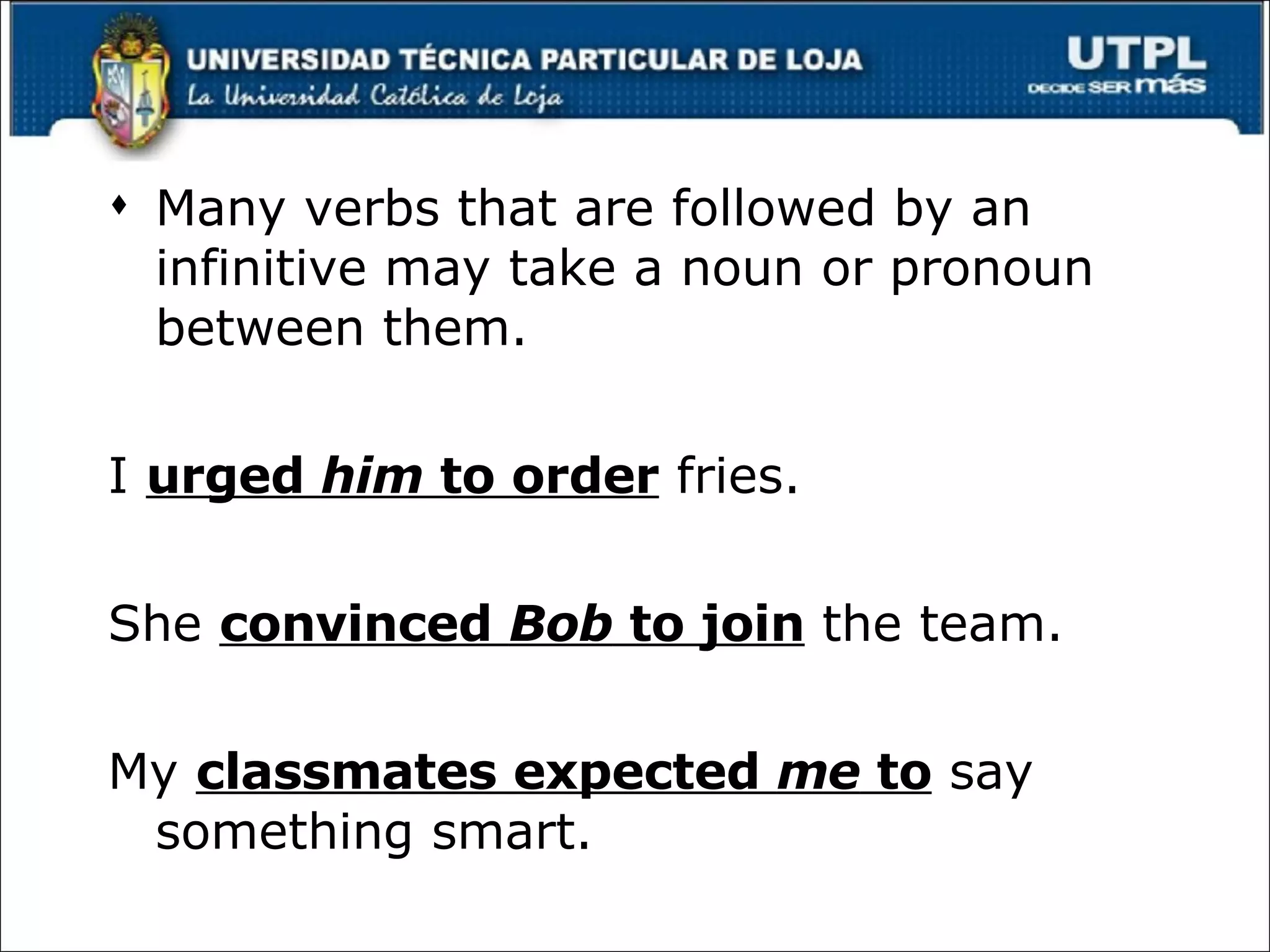
Many verbs that are followed by an infinitive may take a noun or pronoun between them.  I  urged  him  to order  fries. She  convinced  Bob  to join  the team. My  classmates expected  me  to  say something smart.
The infinitive can often  follow an adjective . We are  ready to start  the course. Bob was  surprised to read  the number of calories.
The infinitive can also  follow certain nouns . It’s  time to eat . Paul made a  decision to quit  smoking. It’s a high  price to pay .
MAKE, HAVE, LET, HELP  and  GET But how do trainers …  make them “dance” ? …  a trainer  lets an animal act  freely. … parks wanted to  have dolphins do tricks . Gary Priest …  helped the keepers train  the elephants… But how do trainers  get a nine-ton whale to do  acrobatic tricks
LET  (let + object + verb) This construction means "to allow someone to do something.“ John  let me drive  his new car.  Will your parents  let you go  to the party?
MAKE  (make + object + verb) This construction means "to force someone to do something." My teacher  made me apologize  for what I had said.  Did somebody  make you wear  that ugly hat?  She  made her children do  their homework.   Make FORM [make + person + verb] USE This construction means "to force someone to do something." Examples: My teacher  made me apologize  for what I had said.  Did somebody  make you wear  that ugly hat?  She  made her children do  their homework.
HAVE  (have + person + verb) This construction means "to give someone the responsibility to do something." Dr. Smith  had his nurse take  the patient's temperature.  Please  have your secretary fax  me the information.  I  had the mechanic check  the brakes.
GET  (get + person + to + verb) This construction usually means "to convince to do something" or "to trick someone into doing something." Susie  got her son to take  the medicine even though it tasted terrible.  How can parents  get their children to read  more?  The government TV commercials are trying to  get people to stop  smoking .
HELP  ( help + base form) (help + infinitive) Help + base form  of the verb is more common. He  helped me understand  the problem. He  helped me to understand  the problem.
PHRASAL VERBS A  phrasal verb  (two-word verb) has two parts: come back come  – main verb back  – particle Particles often  change the meaning  of the main verb.
TRANSITIVE PHRASAL VERBS He had  set  it  up  on a busy street. The desperate owner  tore down  the old entrance and  put up  a new one.
Transitive  – take objects. He  picked out  a nice suit. pick out  – phrasal verb a nice suit  - object
Most transitive phrasal verbs are  separable . This means that  noun objects  can go: Turn off   the TV .  (after the particle) Turn   the TV   off .  (between the verb and the particle)
If the direct object is a  pronoun , it must go  between  the verb and the article. Turn  it  off. Turn  it  down. Pick  me  up at 7 P.M.
INTRANSITIVE PHRASAL VERBS But customers rarely  came back . His action  paid off . Feng shui has  caught on  with homeowners and architects everywhere.
Some phrasal verbs are  intransitive . They do not take an object. They are always inseparable.
INSEPARABLE TRANSITIVE …  write down  the date and time of the call. (This direc object is too long to go before the particle.) …  get off  the phone.
Some transitive phrasal verbs are  inseparable . This means that both noun and pronoun objects always go  after  the particle. You cannot separate the verb from its particle. We should  stick with   the plan . We should  stick with   it .
SEPARABLE TRANSITIVE You hesitate to  pick  it  up . “ Junk mail”  fills up  our mailboxes (and later our trash cans when we  throw  it  out ).
A small group of transitive phrasal verbs must be separated. You need to  call   Gerald   back . ( NOT  You need to call back Gerald) Keep   your coat   on . ( NOT  Keep on your coat)
Some transitive phrasal verbs are used in combination with certain prepositions. The combination  phrasal verb +  preposition   ( three-word verb )  is usually inseparable. This scientist  came up  with  a new idea.
INTRANSITIVE (INSEPARABLE) You just  got back  from a long, hard day at the office. “ I ’m   hanging up  now.” Phrasal verbs are  more common in informal writing  than their one-word synonyms.
ADJECTIVE CLAUSES AFTER THE MAIN CLAUSE For some, a friend can be a person  who chats with you on the Internet . … friendship is a relationship  that emphasizes sharing your innermost feelings … We may not be able to select … the people  that ride the bus with us …
ADJECTIVE CLAUSES INSIDE THE MAIN CLAUSE For French friends,  who enjoy arguing about intellectual issues , disagreement is “the breath of life.” … for Germans,  whose friendships are based on mutuality of feeling , deep disagreement on any subject  that matters to both  is … a tragedy.
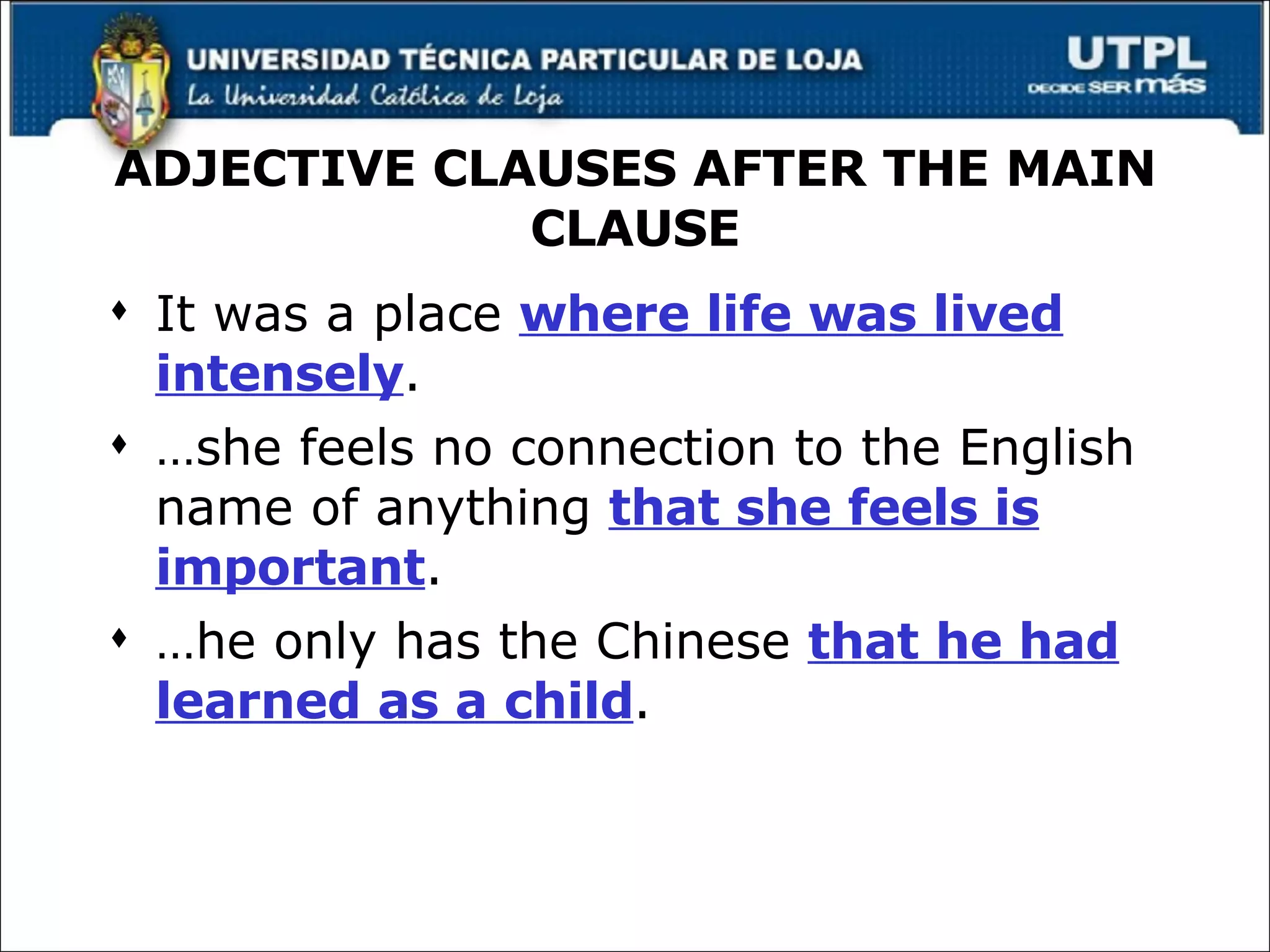
ADJECTIVE CLAUSES AFTER THE MAIN CLAUSE It was a place  where life was lived intensely . … she feels no connection to the English name of anything  that she feels is important . … he only has the Chinese  that he had learned as a child .
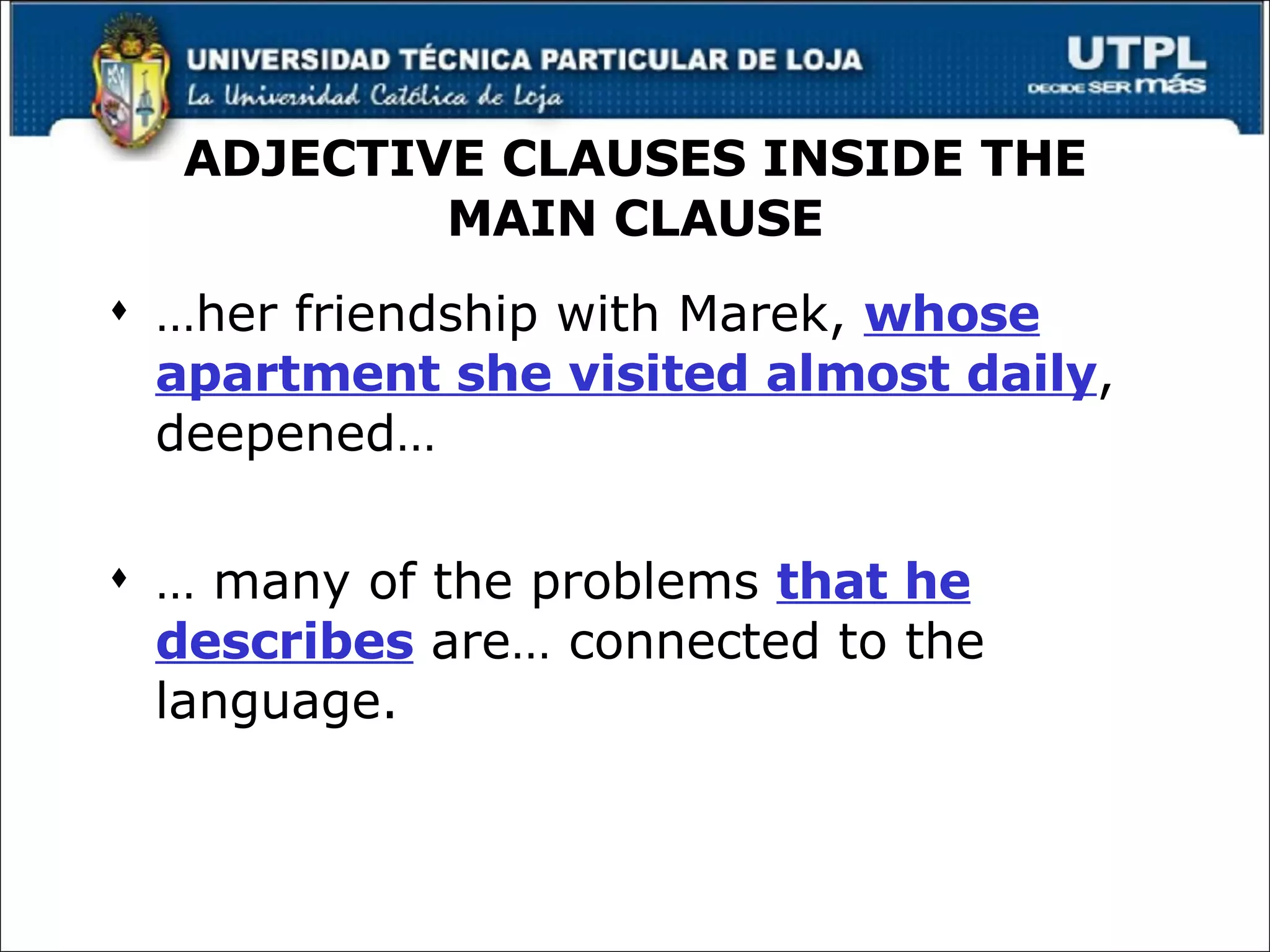
ADJECTIVE CLAUSES INSIDE THE MAIN CLAUSE … her friendship with Marek,  whose apartment she visited almost daily , deepened… …  many of the problems  that he describes  are… connected to the language.
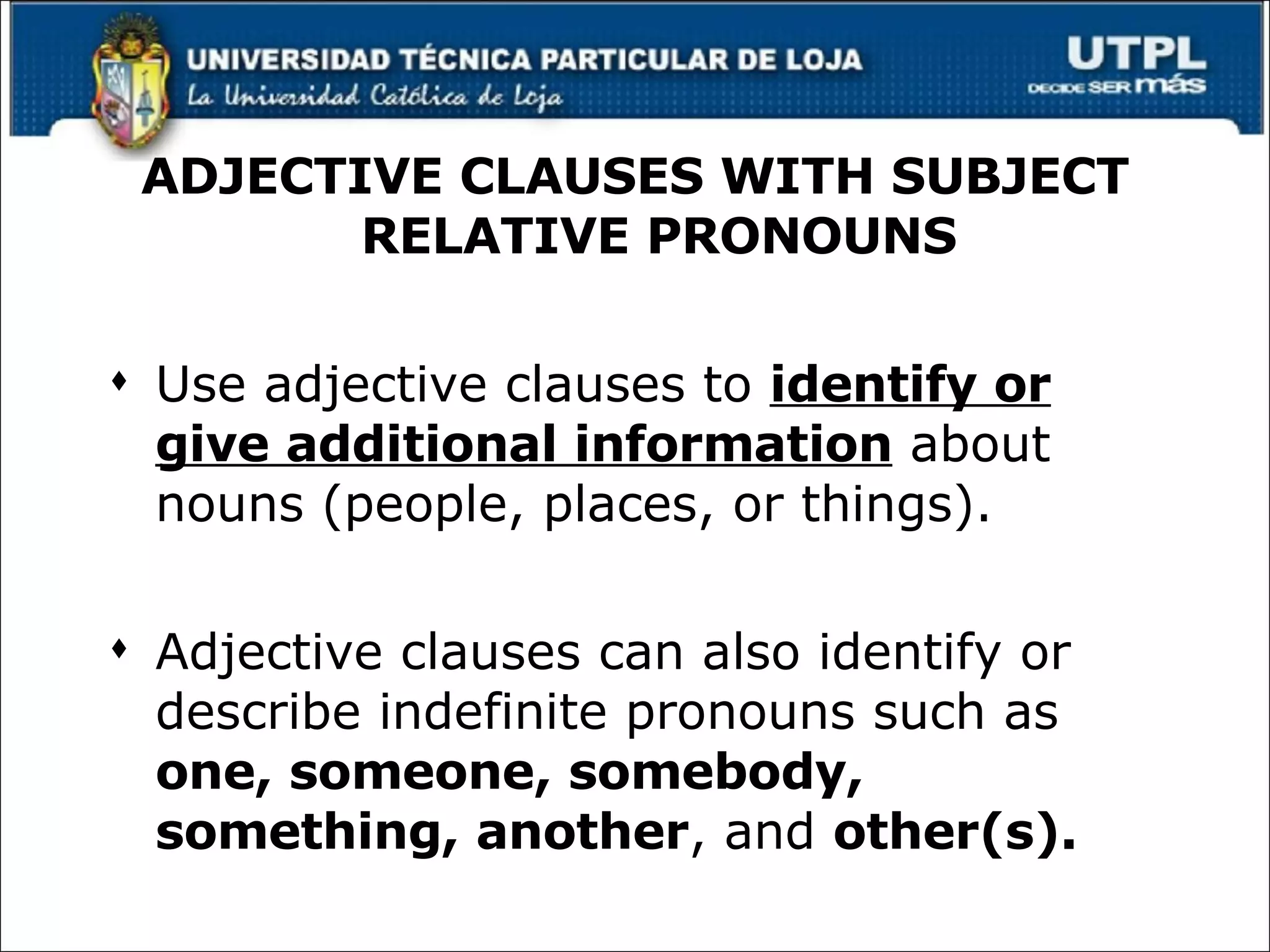
ADJECTIVE CLAUSES WITH SUBJECT RELATIVE PRONOUNS Use adjective clauses to  identify or give additional information  about nouns (people, places, or things). Adjective clauses can also identify or describe indefinite pronouns such as  one, someone, somebody, something, another , and  other(s).
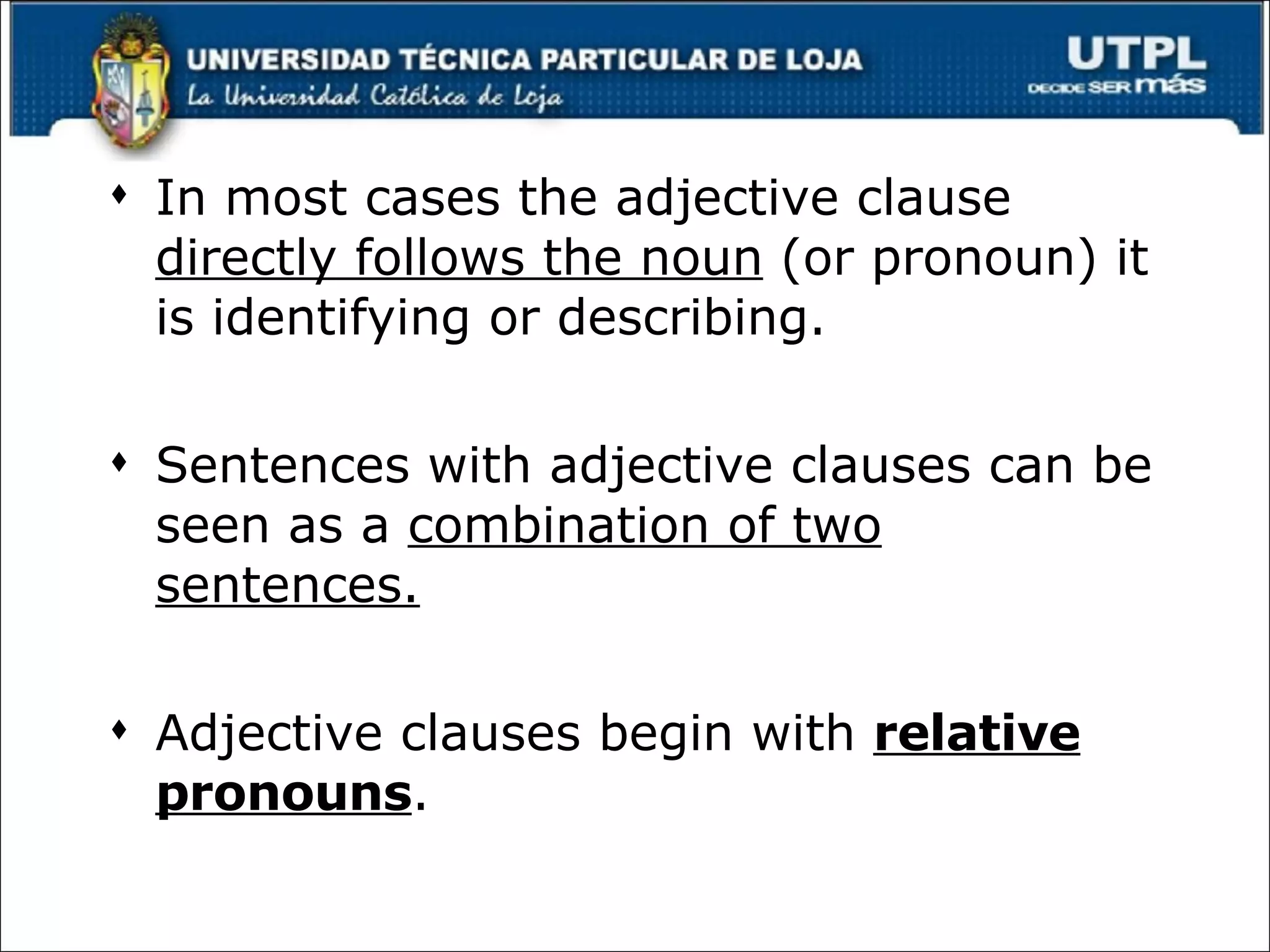
In most cases the adjective clause  directly follows the noun  (or pronoun) it is identifying or describing. Sentences with adjective clauses can be seen as a  combination of two sentences. Adjective clauses begin with  relative pronouns .
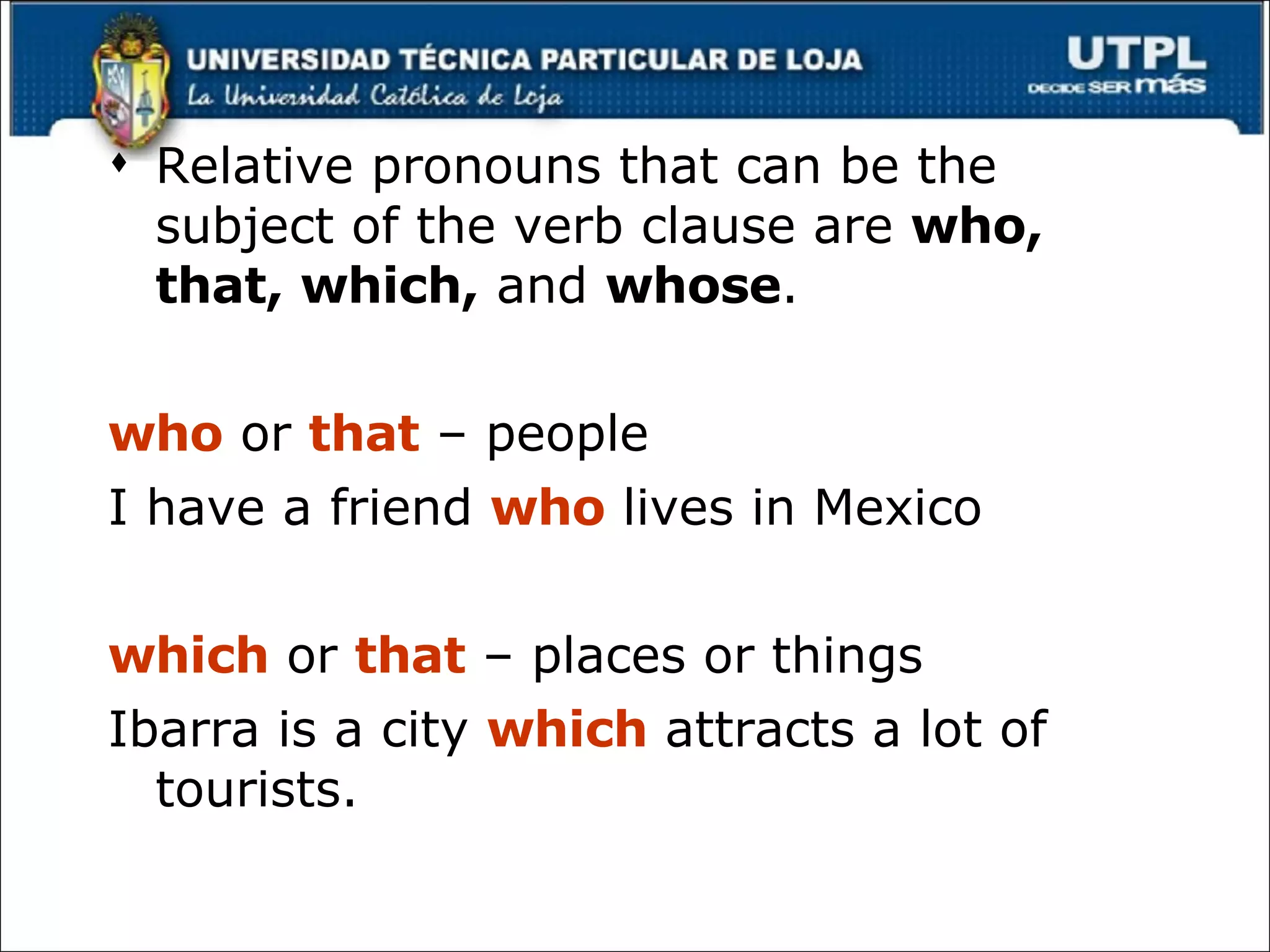
Relative pronouns that can be the subject of the verb clause are  who, that, which,  and  whose . who  or  that  – people I have a friend  who  lives in Mexico which  or  that   – places or things Ibarra is a city  which  attracts a lot of tourists.
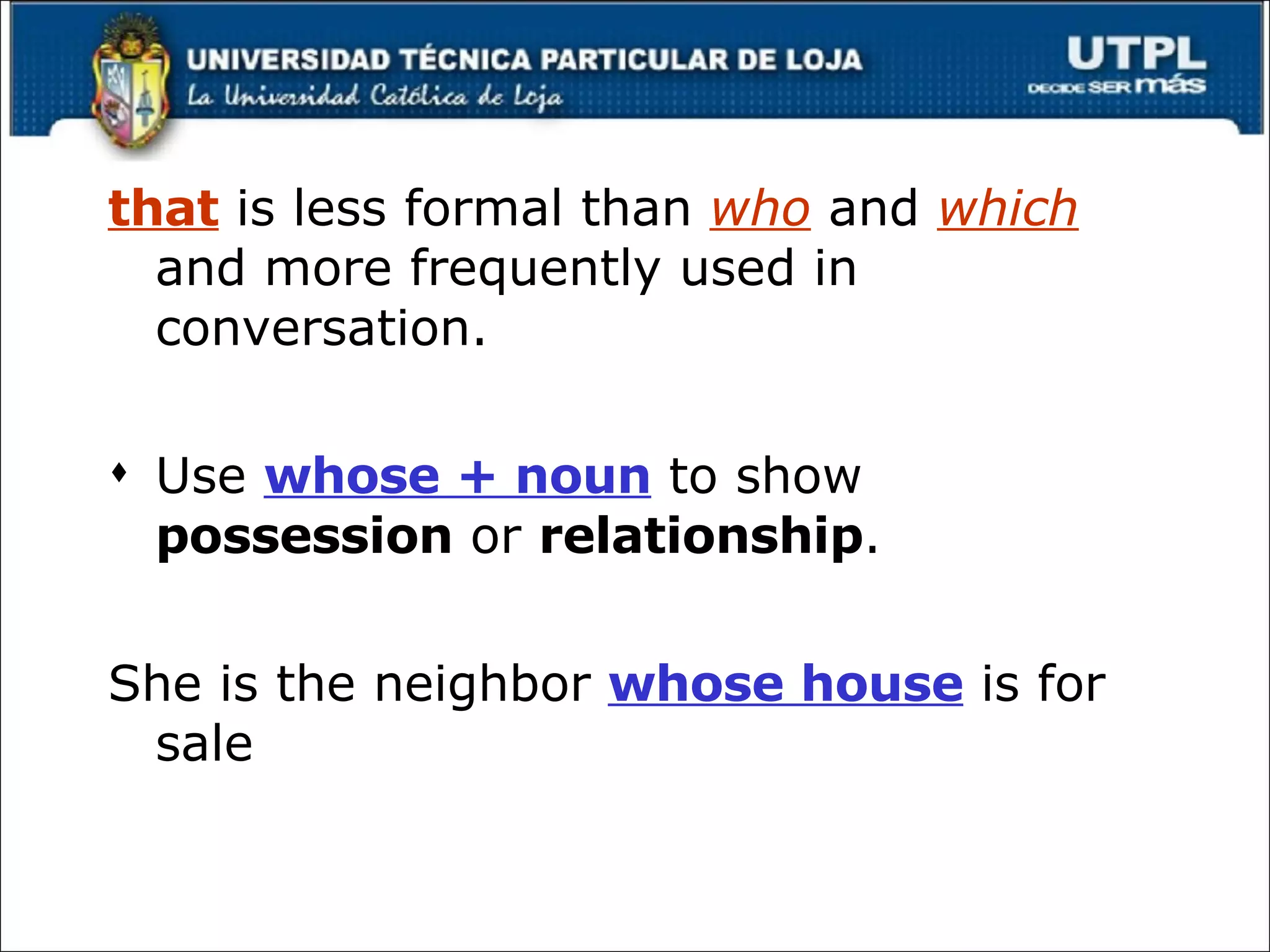
that  is less formal than  who  and  which  and more frequently used in conversation. Use  whose + noun  to show  possession  or  relationship . She is the neighbor  whose house  is for sale
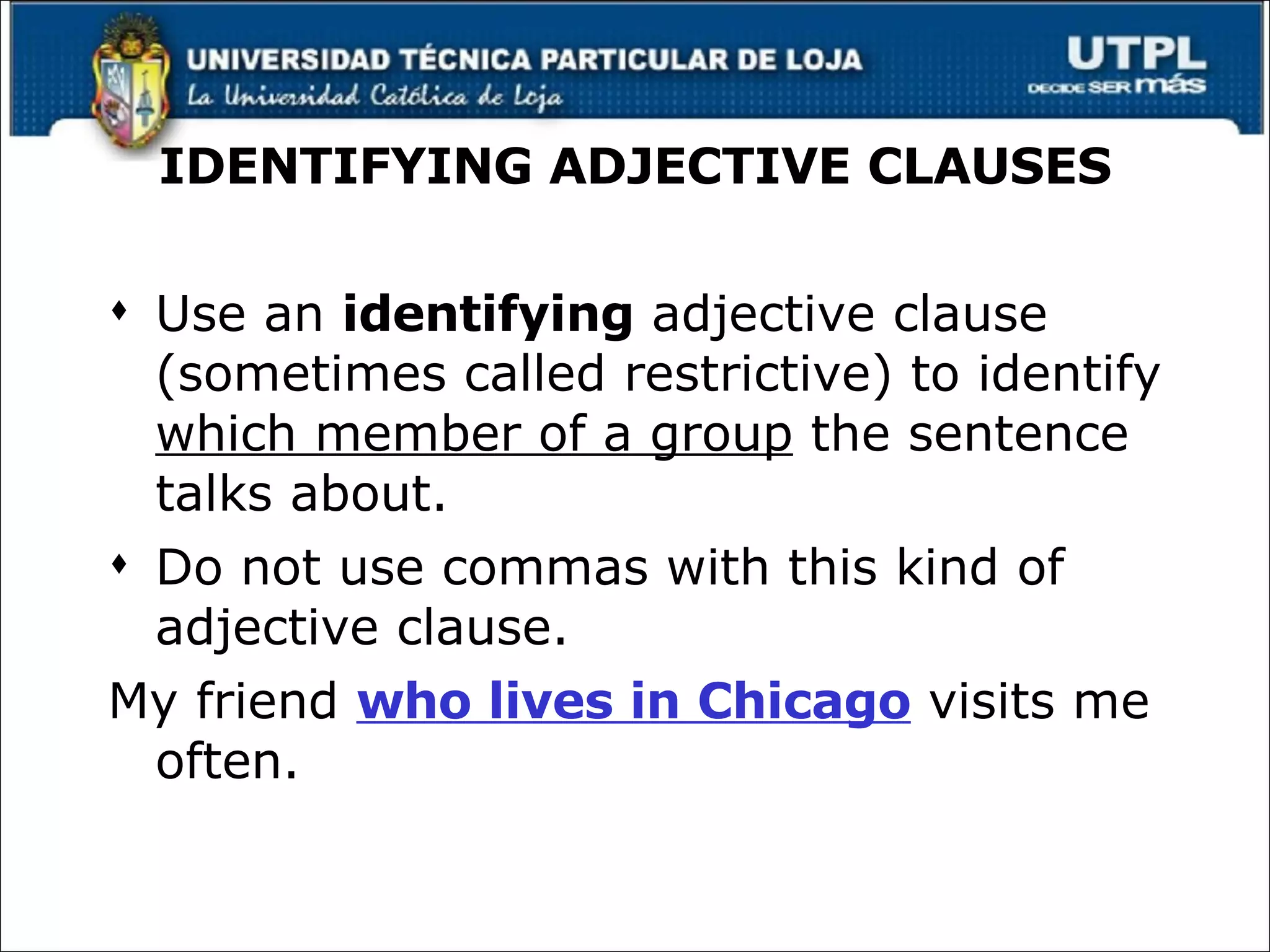
IDENTIFYING ADJECTIVE CLAUSES Use an  identifying  adjective clause (sometimes called restrictive) to identify  which member of a group  the sentence talks about. Do not use commas with this kind of adjective clause. My friend  who lives in Chicago  visits me often.
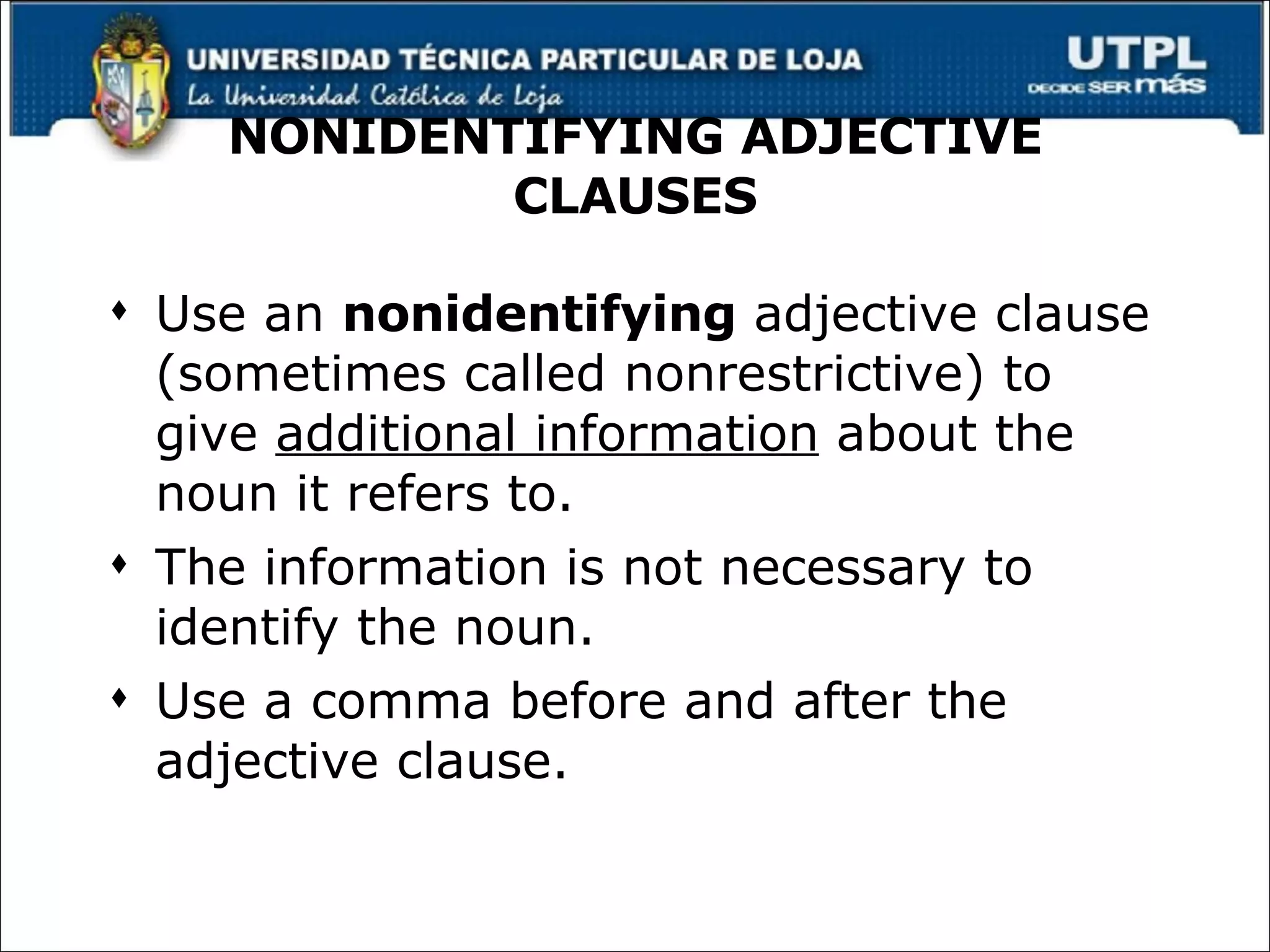
NONIDENTIFYING ADJECTIVE CLAUSES Use an  nonidentifying  adjective clause (sometimes called nonrestrictive) to give  additional information  about the noun it refers to. The information is not necessary to identify the noun. Use a comma before and after the adjective clause.
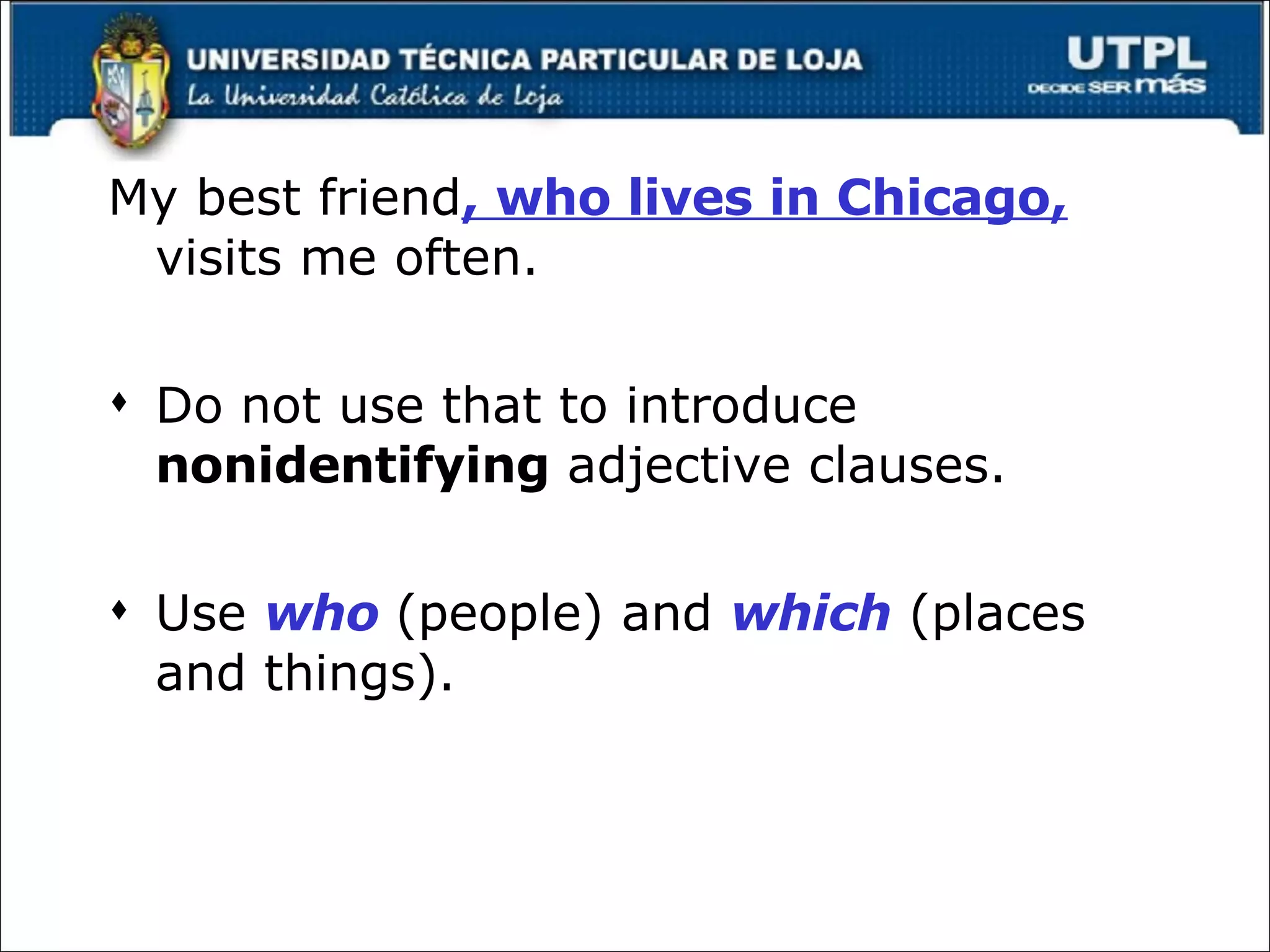
My best friend , who lives in Chicago,  visits me often. Do not use that to introduce  nonidentifying  adjective clauses. Use  who   (people) and  which  (places and things).
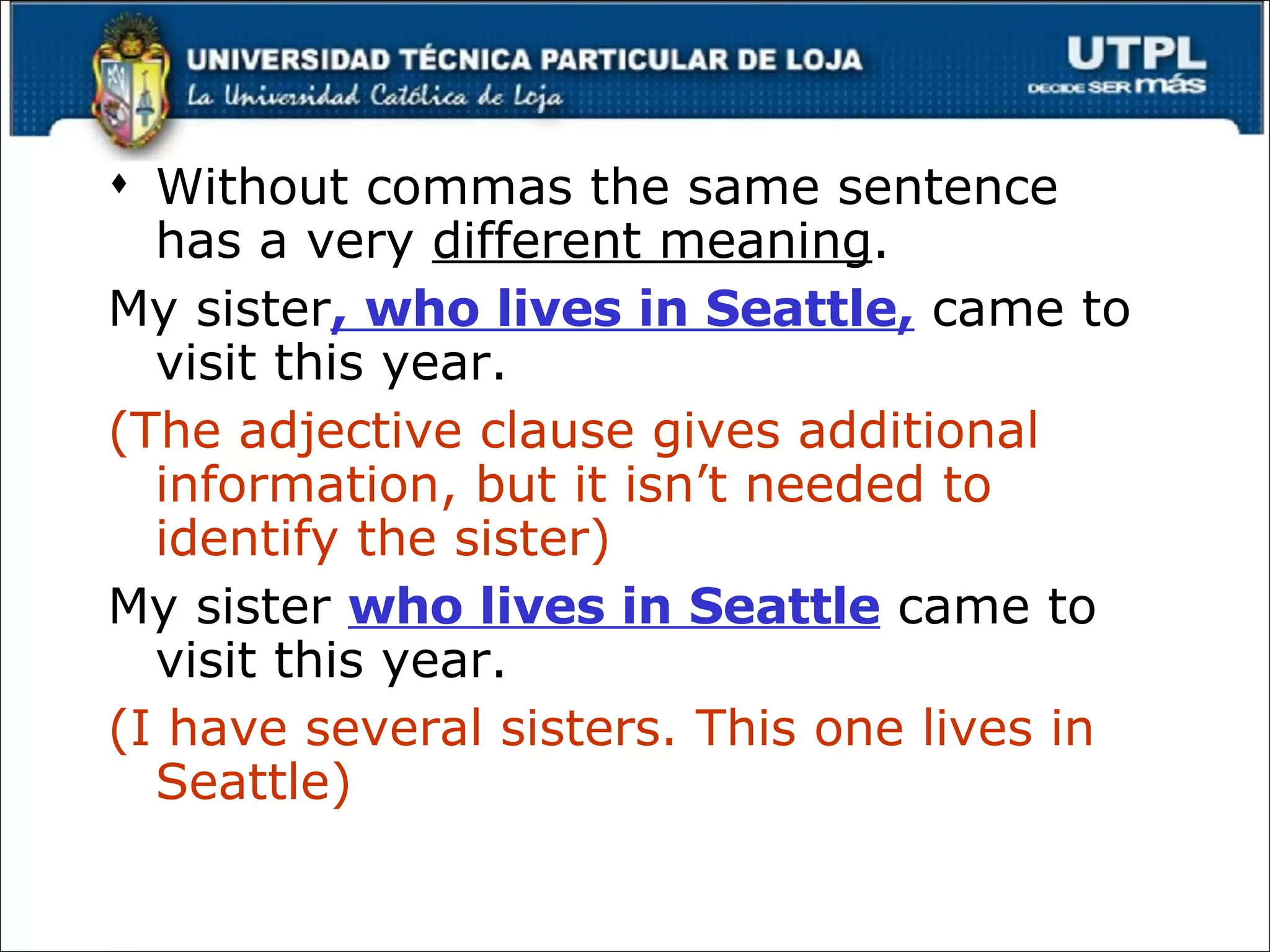
Without commas the same sentence has a very  different meaning . My sister , who lives in Seattle,  came to visit this year. (The adjective clause gives additional information, but it isn’t needed to identify the sister) My sister  who lives in Seattle  came to visit this year. (I have several sisters. This one lives in Seattle)
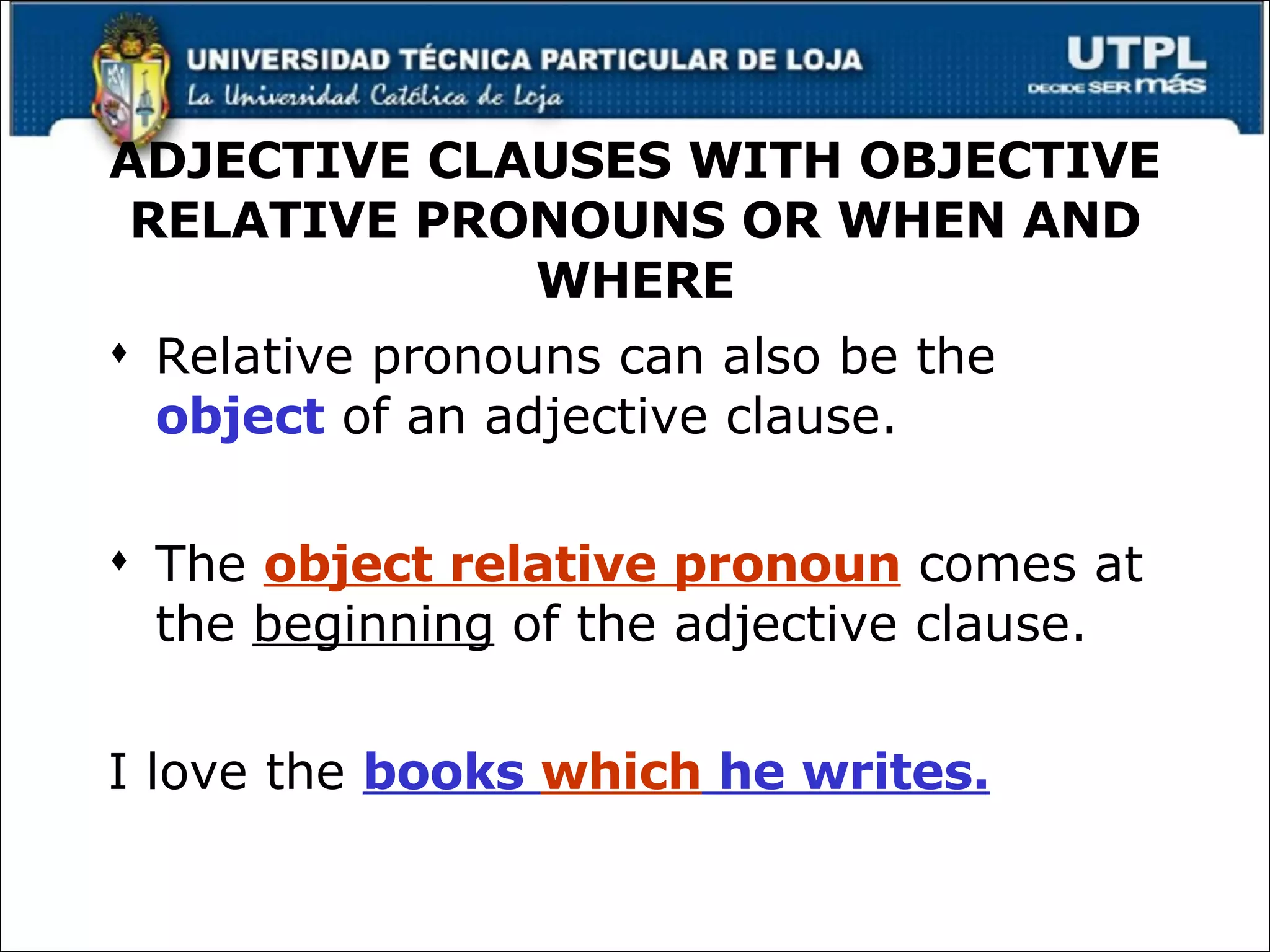
ADJECTIVE CLAUSES WITH OBJECTIVE RELATIVE PRONOUNS OR WHEN AND WHERE Relative pronouns can also be the  object  of an adjective clause. The  object relative pronoun  comes at the  beginning  of the adjective clause. I love the  books  which  he writes.
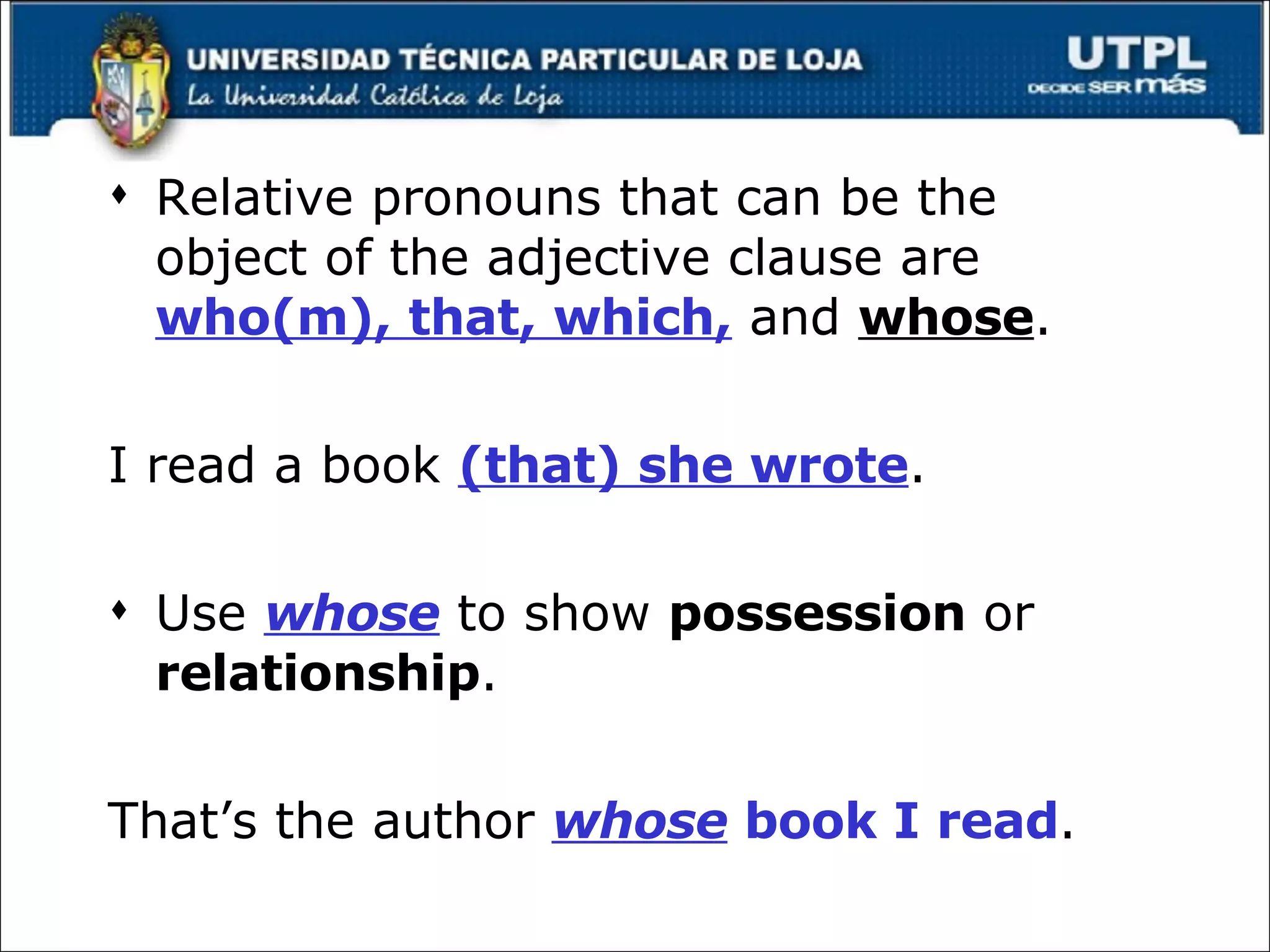
Relative pronouns that can be the object of the adjective clause are  who(m), that, which,  and  whose . I read a book  (that) she wrote . Use  whose  to show  possession  or  relationship . That’s the author  whose   book I read .
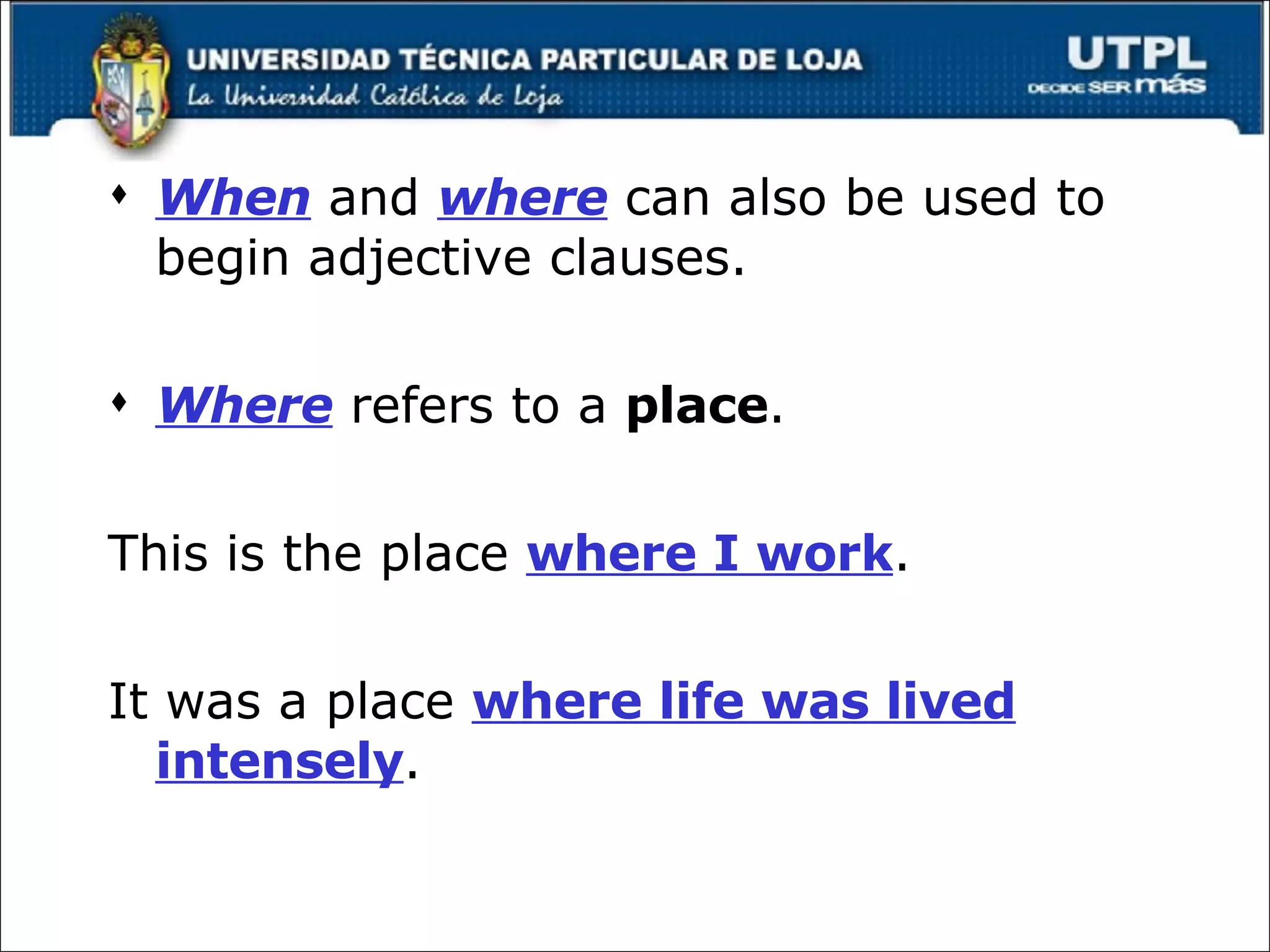
When  and  where  can also be used to begin adjective clauses. Where  refers to a  place . This is the place  where I work . It was a place  where life was lived intensely .
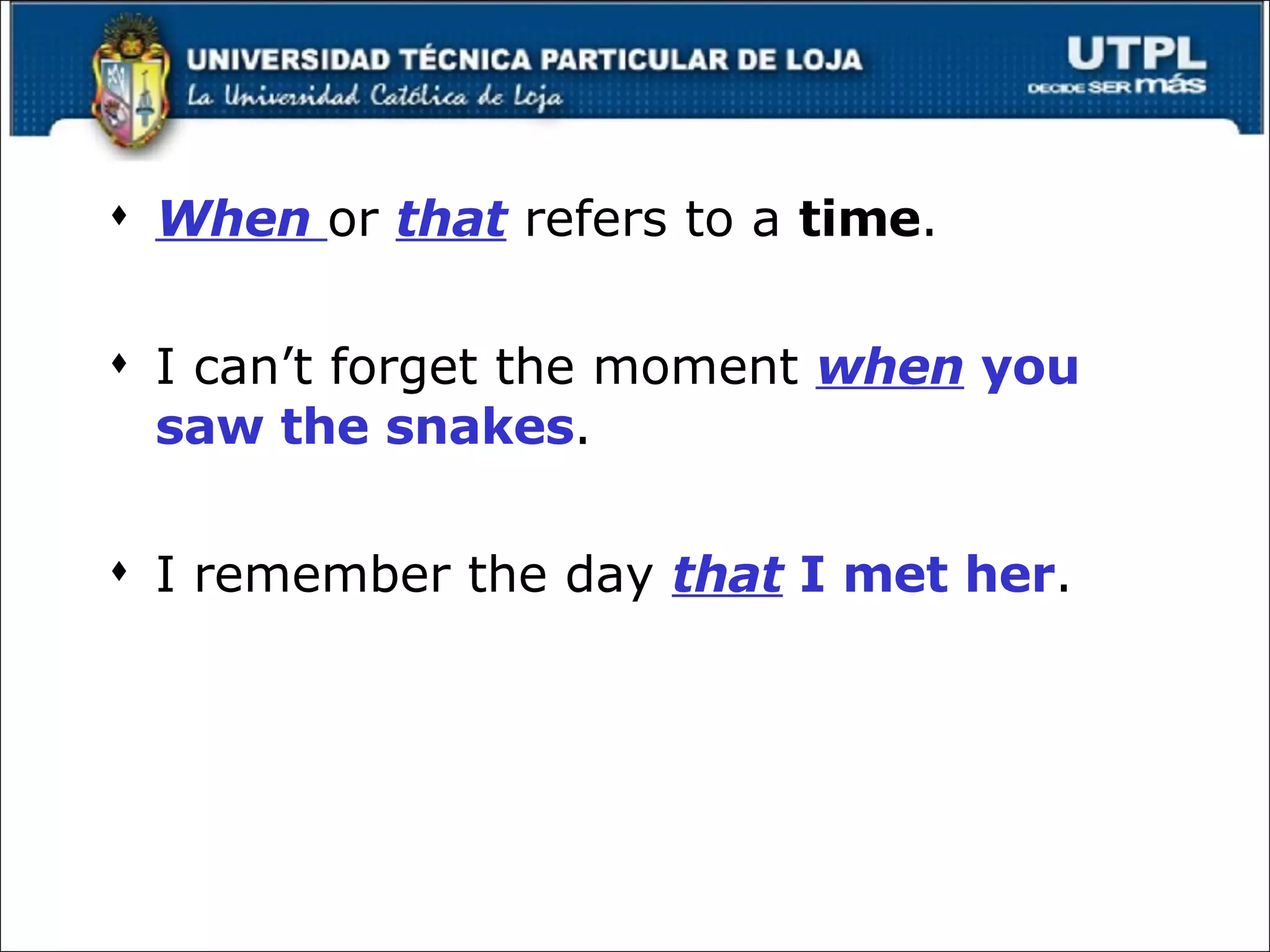
When  or  that  refers to a  time . I can’t forget the moment  when  you saw the snakes . I remember the day  that  I met her .
Communicative Gramar I Bimestre

Communicative Gramar I Bimestre

  • 1.
    ESCUELA : NOMBRES:COMMUNICATIVE GRAMMAR III I BIMESTRE FECHA: Lic. Paúl González T. ABRIL – AGOSTO 2009 Inglés
  • 2.
    PAST PERFECT Bythe end of the evening, it had won four Oscars. … (more than any foreign language film had ever gotten ) Before this, Lee had made big, successful English language movies … By 9:00 A.M., I hadn’t even gotten up!
  • 3.
    Use the past perfect to show that something happened before a specific time in the past. We often use the past perfect and the past perfect progressive with By (a certain time) By 2000, I had left my hometown. By the time I graduated, I had been working in a restaurant.
  • 4.
    PAST PERFECT PROGRESSIVEFor six years, his wife had been working as a researcher, … … he had been writing scripts …
  • 5.
    Use the past perfect progressive to talk about an action that was in progress before a specific time in the past. The progressive emphasizes the continuing activity, not the end result.
  • 6.
    FUTURE PROGRESSIVE (unit5) Her son will be waking up soon Use the future progressive to talk about actions that will be in progress at a specific time in the future.
  • 7.
    FUTURE PERFECT (unit6) A typical college freshman will have gotten eight credit card offers by the end of the first semester. Everything you bought on that card will have cost twice as much as the actual price.
  • 8.
    Use the future perfect to talk about a future action that will already be completed by a certain time in the future. We often use already and yet with the future perfect to emphasize which event will happen first . By the time I graduate, I will have already gotten a job.
  • 9.
    FUTURE PERFECT PROGRESSIVE… By the end of tonight’s Money Talks, we ’ll have been traveling for a month, … … I ’ll have been paying interest for nine months on pizzas I ate last September!
  • 10.
    Use the future perfect progressive to talk about an action that will be in progress at a certain time in the future. The action may start sometime in the future or it may have already started.
  • 11.
    Use negative yes/noquestions and tag questions to: Check information you believe to be true. Comment on a situation. NEGATIVE YES/NO QUESTIONS AND TAG QUESTIONS
  • 12.
    TAG QUESTIONS That’snot in Seoul, is it ? You’re not from Rio, are you ? It gets awfully hot here in the summer, doesn’t it ? You could tell right away by my accent, couldn’t you ?
  • 13.
    TAG QUESTIONS: statement + tag The statement expresses an assumption. The tag means Right? Or Isn’t that true? If the statement verb is affirmative, the tag verb is negative. If the statement verb is negative, the tag verb is affirmative.
  • 14.
    Use the same auxiliary that is in the statement. If the statement does not use be or an auxiliary verb, use an appropriate form of do in the tag. In the tag, only use pronouns.
  • 15.
    NEGATIVE YES/NO QUESTIONSDon’t you miss your family …? Hey, didn’t you buy anything? Haven’t we met before? Aren’t I right? We almost always use contractions in negative questions.
  • 16.
    ADDITIONS USING SO , TOO , NEITHER , NOT EITHER , and BU T We use additions to avoid repeating information. Additions express similarity or contrast .
  • 17.
    SO AND BUTPaul is a firefighter, and so is Gerald. (Paul is a firefighter. Gerald is a firefighter- SIMILARITY ) Andrea stayed in Germany, but Barbara didn’t. (Andrea stayed in Germany. Barbara didn’t stay in Germany- CONTRAST )
  • 18.
    TOO Paul likes hunting … Gerald does too . Paul is a firefighter, and Gerald is too. Paul can play chess, and Gerald can too . Additions always use a form of be , an auxiliary verb, or a modal.
  • 19.
    NOT EITHER ANDNEITHER Clearly, heredity doesn’t completely govern our lives. Our environment doesn’t either . Mark has never been married, and neither has Gerald.
  • 20.
    Use neither or not either if the addition follows a negative statement . So , too , neither , or not either express similarity. But is used in additions of contrast .
  • 21.
    EXPRESSING AGREEMENT USING SO , TOO , NEITHER and NOT EITHER A: I like spicy food. B: So do I . (or I do too ). Informal: Me too. A: I don’t like spicy food. B: Neither do I . (or I don’t either ). Informal: Me neither.
  • 22.
    GERUNDS Dining on fast food has become a way of life… But apart from the speed of ordering and getting served, …customers talk about… … fast-food restaurants may prevent families from spending quality time together…
  • 23.
    A gerund canbe used as a noun . Swimming is good exercise. (Subject) She likes swimming every day. (Direct object of the verb like) She is crazy about swimming in the ocean. (Object of preposition).
  • 24.
    Many verbs arefollowed by gerunds. She enjoyed swimming with the team. They considered reducing fats in the food. I keep searching for an answer.
  • 25.
    Many adjectives (andprepositions) are followed by gerunds. Gerald is interested in joining the team. Gerald is excited about joining the team. I don’t approve of eating fast food. I’m tired of eating pork.
  • 26.
    You can usea possessive before the gerund. I didn’t like his ordering fries. I dislike Julio’s eating fast foods. NEGATIVE FORM: not + gerund I considered not cycling up the mountain.
  • 27.
    INFINITIVES … it’seasy to see that fast-food restaurants … aren’t going away. It’s a high price to pay for convenience. …people don’t want to waste time.
  • 28.
    Some verbs canbe followed by the infinitive. My brother needs to read this book. She refuses to eat fast food. I chose not no give up meat.
  • 29.
    Many verbs thatare followed by an infinitive may take a noun or pronoun between them. I urged him to order fries. She convinced Bob to join the team. My classmates expected me to say something smart.
  • 30.
    The infinitive canoften follow an adjective . We are ready to start the course. Bob was surprised to read the number of calories.
  • 31.
    The infinitive canalso follow certain nouns . It’s time to eat . Paul made a decision to quit smoking. It’s a high price to pay .
  • 32.
    MAKE, HAVE, LET,HELP and GET But how do trainers … make them “dance” ? … a trainer lets an animal act freely. … parks wanted to have dolphins do tricks . Gary Priest … helped the keepers train the elephants… But how do trainers get a nine-ton whale to do acrobatic tricks
  • 33.
    LET (let+ object + verb) This construction means "to allow someone to do something.“ John let me drive his new car. Will your parents let you go to the party?
  • 34.
    MAKE (make+ object + verb) This construction means "to force someone to do something." My teacher made me apologize for what I had said. Did somebody make you wear that ugly hat? She made her children do their homework. Make FORM [make + person + verb] USE This construction means "to force someone to do something." Examples: My teacher made me apologize for what I had said. Did somebody make you wear that ugly hat? She made her children do their homework.
  • 35.
    HAVE (have+ person + verb) This construction means "to give someone the responsibility to do something." Dr. Smith had his nurse take the patient's temperature. Please have your secretary fax me the information. I had the mechanic check the brakes.
  • 36.
    GET (get+ person + to + verb) This construction usually means "to convince to do something" or "to trick someone into doing something." Susie got her son to take the medicine even though it tasted terrible. How can parents get their children to read more? The government TV commercials are trying to get people to stop smoking .
  • 37.
    HELP (help + base form) (help + infinitive) Help + base form of the verb is more common. He helped me understand the problem. He helped me to understand the problem.
  • 38.
    PHRASAL VERBS A phrasal verb (two-word verb) has two parts: come back come – main verb back – particle Particles often change the meaning of the main verb.
  • 39.
    TRANSITIVE PHRASAL VERBSHe had set it up on a busy street. The desperate owner tore down the old entrance and put up a new one.
  • 40.
    Transitive –take objects. He picked out a nice suit. pick out – phrasal verb a nice suit - object
  • 41.
    Most transitive phrasalverbs are separable . This means that noun objects can go: Turn off the TV . (after the particle) Turn the TV off . (between the verb and the particle)
  • 42.
    If the directobject is a pronoun , it must go between the verb and the article. Turn it off. Turn it down. Pick me up at 7 P.M.
  • 43.
    INTRANSITIVE PHRASAL VERBSBut customers rarely came back . His action paid off . Feng shui has caught on with homeowners and architects everywhere.
  • 44.
    Some phrasal verbsare intransitive . They do not take an object. They are always inseparable.
  • 45.
    INSEPARABLE TRANSITIVE … write down the date and time of the call. (This direc object is too long to go before the particle.) … get off the phone.
  • 46.
    Some transitive phrasalverbs are inseparable . This means that both noun and pronoun objects always go after the particle. You cannot separate the verb from its particle. We should stick with the plan . We should stick with it .
  • 47.
    SEPARABLE TRANSITIVE Youhesitate to pick it up . “ Junk mail” fills up our mailboxes (and later our trash cans when we throw it out ).
  • 48.
    A small groupof transitive phrasal verbs must be separated. You need to call Gerald back . ( NOT You need to call back Gerald) Keep your coat on . ( NOT Keep on your coat)
  • 49.
    Some transitive phrasalverbs are used in combination with certain prepositions. The combination phrasal verb + preposition ( three-word verb ) is usually inseparable. This scientist came up with a new idea.
  • 50.
    INTRANSITIVE (INSEPARABLE) Youjust got back from a long, hard day at the office. “ I ’m hanging up now.” Phrasal verbs are more common in informal writing than their one-word synonyms.
  • 51.
    ADJECTIVE CLAUSES AFTERTHE MAIN CLAUSE For some, a friend can be a person who chats with you on the Internet . … friendship is a relationship that emphasizes sharing your innermost feelings … We may not be able to select … the people that ride the bus with us …
  • 52.
    ADJECTIVE CLAUSES INSIDETHE MAIN CLAUSE For French friends, who enjoy arguing about intellectual issues , disagreement is “the breath of life.” … for Germans, whose friendships are based on mutuality of feeling , deep disagreement on any subject that matters to both is … a tragedy.
  • 53.
    ADJECTIVE CLAUSES AFTERTHE MAIN CLAUSE It was a place where life was lived intensely . … she feels no connection to the English name of anything that she feels is important . … he only has the Chinese that he had learned as a child .
  • 54.
    ADJECTIVE CLAUSES INSIDETHE MAIN CLAUSE … her friendship with Marek, whose apartment she visited almost daily , deepened… … many of the problems that he describes are… connected to the language.
  • 55.
    ADJECTIVE CLAUSES WITHSUBJECT RELATIVE PRONOUNS Use adjective clauses to identify or give additional information about nouns (people, places, or things). Adjective clauses can also identify or describe indefinite pronouns such as one, someone, somebody, something, another , and other(s).
  • 56.
    In most casesthe adjective clause directly follows the noun (or pronoun) it is identifying or describing. Sentences with adjective clauses can be seen as a combination of two sentences. Adjective clauses begin with relative pronouns .
  • 57.
    Relative pronouns thatcan be the subject of the verb clause are who, that, which, and whose . who or that – people I have a friend who lives in Mexico which or that – places or things Ibarra is a city which attracts a lot of tourists.
  • 58.
    that isless formal than who and which and more frequently used in conversation. Use whose + noun to show possession or relationship . She is the neighbor whose house is for sale
  • 59.
    IDENTIFYING ADJECTIVE CLAUSESUse an identifying adjective clause (sometimes called restrictive) to identify which member of a group the sentence talks about. Do not use commas with this kind of adjective clause. My friend who lives in Chicago visits me often.
  • 60.
    NONIDENTIFYING ADJECTIVE CLAUSESUse an nonidentifying adjective clause (sometimes called nonrestrictive) to give additional information about the noun it refers to. The information is not necessary to identify the noun. Use a comma before and after the adjective clause.
  • 61.
    My best friend, who lives in Chicago, visits me often. Do not use that to introduce nonidentifying adjective clauses. Use who (people) and which (places and things).
  • 62.
    Without commas thesame sentence has a very different meaning . My sister , who lives in Seattle, came to visit this year. (The adjective clause gives additional information, but it isn’t needed to identify the sister) My sister who lives in Seattle came to visit this year. (I have several sisters. This one lives in Seattle)
  • 63.
    ADJECTIVE CLAUSES WITHOBJECTIVE RELATIVE PRONOUNS OR WHEN AND WHERE Relative pronouns can also be the object of an adjective clause. The object relative pronoun comes at the beginning of the adjective clause. I love the books which he writes.
  • 64.
    Relative pronouns thatcan be the object of the adjective clause are who(m), that, which, and whose . I read a book (that) she wrote . Use whose to show possession or relationship . That’s the author whose book I read .
  • 65.
    When and where can also be used to begin adjective clauses. Where refers to a place . This is the place where I work . It was a place where life was lived intensely .
  • 66.
    When or that refers to a time . I can’t forget the moment when you saw the snakes . I remember the day that I met her .

Editor's Notes