





COMMUNICATIONS
WORKSHOP
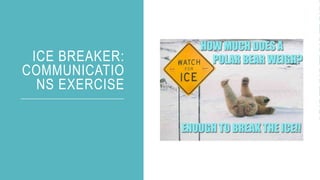
ICE BREAKER:
COMMUNICATIO
NS EXERCISE
WHY IS COMMUNICATION
IMPORTANT?
Communication can be a tricky
concept to master within an
organization, particularly one
with complex levels and
multiple issues. When all parts
of your organization
communicate smoothly, it can
improve workflow and overall
productivity.
“Without good communication leaders make decisions in a vacuum” – via @RobertSher on Twitter
INTERNAL VS. EXTERNAL
Internal communications: The process of exchanging information among
people of different levels or with other participants within the organization.
External communications: Informal exchange of information and messages
between an organization and other organizations, groups or individuals
outside its formal structure.
Are the following groups internal or external?
• Employees
• Donors
• Press/Reporters
• Social Media Followers
• Board of Directors
• Volunteers
PUBLIC PERCEPTION
Public perception is important. It drives donations, volunteers,
employee recruitment, good will, etc.
What the general public believes they know about your organization
should align with your mission.
If you don’t communicate regularly with them, they will make
assumptions about what your organization is about and stands for. In
a world of fake news, this can be disastrous.
Check out this next video about the 10 biggest fake news stories…
INTERNAL COMMUNICATIONS
 What are all the ways your
organization communicates with
donors, supporters, general public,
etc.?
 What do you think these groups
would find interesting about your
department?
 How do you communicate across
departments to get information out
the door for use in social media,
newsletters, events, etc.?
POINTERS FOR COMMUNICATING
INTERNALLY
Good internal communication flows two ways.
Give as good as you get.
Create and reward open dialogue.
Lead by example – share, comment, give feedback and answer questions.
Encourage employees to share information.
Establish regular processes for communication. Develop processes for
sharing information – email, texts, phone messages, tools/software.
Listen. Don’t make assumptions.
EMPLOYEES ARE
KEY
Employees serve as a conduit to other audiences
Clear, open, effective communication:
 Creates a sense of transparency, which builds
trust between levels of employees.
 More collaboration = greater productivity.
 Encourages sharing of potential issues,
requirements and feedback that can make the
result stronger.
 Ensures everyone is on the same page and
prevents problems down the road.
10-MINUTE
BREAK
EMAIL PROS & CONS
Pros:
 Essentially free
 Fast
 Accessible
 Can add attachments
 Communicate with one person or groups of
people
 No distance limits
 Environmentally friendly
 Easy to quickly review/reference
Cons:
 Less personal
 Easier for misunderstandings to occur
 Impossible to take back once sent
 Can be sent anonymously
 Easy to make mistakes by clicking a wrong button
 Information overload
 Spam
 Viruses travel via email
 Can be time consuming
Although email has transformed communication in some very useful ways, not all the changes that email has
brought are positive.
EMAIL
BEHAVIOR
Have you ever found yourself
clicking "reply," typing up a quick
response, and hitting "send"
without giving so much as a
thought about what you've just
written?
Your email behavior has the
potential to sabotage your
reputation both personally and
professionally. Your email
correspondence is a reflection of
you.
EMAIL ETIQUETTE TIPS
Nothing is confidential. Assume all emails
are public.
Have a clear subject line.
Always lead with a kind salutation.
Avoid humor – it is easily taken out of
context on email.
Spell check & proofread – do it again.
Don’t assume – provide details.
EMAIL ETIQUETTE TIPS, CONT.
 Don’t shoot from the hip. Avoid sending an email
when you are angry or frustrated. Wait an hour.
 Avoid starting an email chain. Develop one concise
email with everything you need.
 Respond to every email before you leave for the day.
It is just polite.
 If you can’t provide the information requested,
respond and say so.
 Emails should not to be sent to others without the
sender’s permission first.
HOW SOCIAL MEDIA
FITS INTO OUR
SOCIETY
Social media has single
handily changed society and
altered the way we view
ourselves and others.
 There are overall 2.3 billion worldwide
active social media users.
 Across the globe, mobile devices
dominate in terms of total minutes
spent online. This puts the ability to
connect anywhere, at any time on any
device, in everyone’s hands.
 65% of all individuals feel
uncomfortable and uneasy when they
are unable to gain access to their
social media profiles.
FACEBOOK
Facebook reigns supreme in the world of social
and is the biggest and most powerful social
media platform out there.
 Globally there are 2.2 billion monthly active users &
1.5 billion daily active users.
 Facebook is accessed on average 8 times per day.
 Every minute, 400 new users sign up to join
Facebook.
 As of January 2018, there was a 600% increase in
Facebook interactions.
 85% of smartphone owners use the Facebook app.
 47% of Facebook users access it via mobile.
 83% of women compared to 75% of men use
Facebook.
 65% of adults between 50 and 64 years of age use
Facebook.
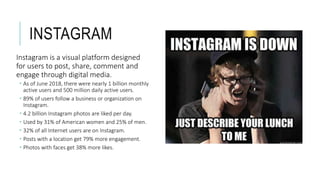
INSTAGRAM
Instagram is a visual platform designed
for users to post, share, comment and
engage through digital media.
 As of June 2018, there were nearly 1 billion monthly
active users and 500 million daily active users.
 89% of users follow a business or organization on
Instagram.
 4.2 billion Instagram photos are liked per day.
 Used by 31% of American women and 25% of men.
 32% of all Internet users are on Instagram.
 Posts with a location get 79% more engagement.
 Photos with faces get 38% more likes.
PURPOSE OF SOCIAL MEDIA
Below are some ways people can
connect with your brand on social.
 Acknowledge gifts received. Not just
monetary.
 Provide updates on the organization.
 Answer questions.
 Share helpful resources which spread your
mission.
 Showcase your donors.
 Demonstrate impact. Tell the story of your
organization and its impact on the world.
BENEFITS
TO YOUR
ORGANIZATI
ON
People are on social to stay “in-the-know” and
connect with family, friends and brands. Social is an
extremely cost-effective way to market any business
or organization.
Benefits of Social Media Marketing:
• Allow for the telling of your organization’s story.
• Can help engage supporters, capturing and retaining their attention.
• Increase awareness of your organization – supports fundraising
efforts.
• Opportunity to connect with followers by responding to questions
or comments.
• Expands the impact of your organization which can add your overall
mission.
SOCIAL IS A COLLABORATIVE
EFFORT
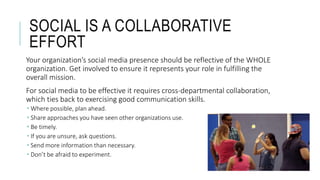
Your organization’s social media presence should be reflective of the WHOLE
organization. Get involved to ensure it represents your role in fulfilling the
overall mission.
For social media to be effective it requires cross-departmental collaboration,
which ties back to exercising good communication skills.
 Where possible, plan ahead.
 Share approaches you have seen other organizations use.
 Be timely.
 If you are unsure, ask questions.
 Send more information than necessary.
 Don’t be afraid to experiment.
SIMPLE SOCIAL TACTICS
Simple tactics anyone can do to help with promotion on social media:
 Take photos and videos whenever possible.
 Share information. Events, activities, birthdays, celebrations, donors, etc.
 Fun day-to-day interactions.
 Provide answers to questions you get asked all the time.
 Behind the scenes.
 Highlight staff, donors, volunteers, etc.
 Mission impact.
General rule: If you find it interesting, amusing or informational, others likely
will to.
10-MINUTE BREAK
WORKSHOP – PICTURE
THIS
30-DAY
CHALLENGE
Cue Meetings are short daily
get togethers for everyone to
share what is going on in
their portion of the
organization.
THANK YOU!
Our contact information:
Vicki Dirksen & Betsy McCloskey
Principal/Partners at Plaid Swan Inc.
Phone 563.556.1633
Website www.plaidswan.com
Follow us on social! Facebook, Twitter and Instagram @PlaidSwan

Communications Workshop

  • 1.
  • 2.
  • 3.
    WHY IS COMMUNICATION IMPORTANT? Communicationcan be a tricky concept to master within an organization, particularly one with complex levels and multiple issues. When all parts of your organization communicate smoothly, it can improve workflow and overall productivity. “Without good communication leaders make decisions in a vacuum” – via @RobertSher on Twitter
  • 4.
    INTERNAL VS. EXTERNAL Internalcommunications: The process of exchanging information among people of different levels or with other participants within the organization. External communications: Informal exchange of information and messages between an organization and other organizations, groups or individuals outside its formal structure. Are the following groups internal or external? • Employees • Donors • Press/Reporters • Social Media Followers • Board of Directors • Volunteers
  • 5.
    PUBLIC PERCEPTION Public perceptionis important. It drives donations, volunteers, employee recruitment, good will, etc. What the general public believes they know about your organization should align with your mission. If you don’t communicate regularly with them, they will make assumptions about what your organization is about and stands for. In a world of fake news, this can be disastrous. Check out this next video about the 10 biggest fake news stories…
  • 7.
    INTERNAL COMMUNICATIONS  Whatare all the ways your organization communicates with donors, supporters, general public, etc.?  What do you think these groups would find interesting about your department?  How do you communicate across departments to get information out the door for use in social media, newsletters, events, etc.?
  • 8.
    POINTERS FOR COMMUNICATING INTERNALLY Goodinternal communication flows two ways. Give as good as you get. Create and reward open dialogue. Lead by example – share, comment, give feedback and answer questions. Encourage employees to share information. Establish regular processes for communication. Develop processes for sharing information – email, texts, phone messages, tools/software. Listen. Don’t make assumptions.
  • 9.
    EMPLOYEES ARE KEY Employees serveas a conduit to other audiences Clear, open, effective communication:  Creates a sense of transparency, which builds trust between levels of employees.  More collaboration = greater productivity.  Encourages sharing of potential issues, requirements and feedback that can make the result stronger.  Ensures everyone is on the same page and prevents problems down the road.
  • 10.
  • 11.
    EMAIL PROS &CONS Pros:  Essentially free  Fast  Accessible  Can add attachments  Communicate with one person or groups of people  No distance limits  Environmentally friendly  Easy to quickly review/reference Cons:  Less personal  Easier for misunderstandings to occur  Impossible to take back once sent  Can be sent anonymously  Easy to make mistakes by clicking a wrong button  Information overload  Spam  Viruses travel via email  Can be time consuming Although email has transformed communication in some very useful ways, not all the changes that email has brought are positive.
  • 12.
    EMAIL BEHAVIOR Have you everfound yourself clicking "reply," typing up a quick response, and hitting "send" without giving so much as a thought about what you've just written? Your email behavior has the potential to sabotage your reputation both personally and professionally. Your email correspondence is a reflection of you.
  • 13.
    EMAIL ETIQUETTE TIPS Nothingis confidential. Assume all emails are public. Have a clear subject line. Always lead with a kind salutation. Avoid humor – it is easily taken out of context on email. Spell check & proofread – do it again. Don’t assume – provide details.
  • 14.
    EMAIL ETIQUETTE TIPS,CONT.  Don’t shoot from the hip. Avoid sending an email when you are angry or frustrated. Wait an hour.  Avoid starting an email chain. Develop one concise email with everything you need.  Respond to every email before you leave for the day. It is just polite.  If you can’t provide the information requested, respond and say so.  Emails should not to be sent to others without the sender’s permission first.
  • 15.
    HOW SOCIAL MEDIA FITSINTO OUR SOCIETY Social media has single handily changed society and altered the way we view ourselves and others.  There are overall 2.3 billion worldwide active social media users.  Across the globe, mobile devices dominate in terms of total minutes spent online. This puts the ability to connect anywhere, at any time on any device, in everyone’s hands.  65% of all individuals feel uncomfortable and uneasy when they are unable to gain access to their social media profiles.
  • 16.
    FACEBOOK Facebook reigns supremein the world of social and is the biggest and most powerful social media platform out there.  Globally there are 2.2 billion monthly active users & 1.5 billion daily active users.  Facebook is accessed on average 8 times per day.  Every minute, 400 new users sign up to join Facebook.  As of January 2018, there was a 600% increase in Facebook interactions.  85% of smartphone owners use the Facebook app.  47% of Facebook users access it via mobile.  83% of women compared to 75% of men use Facebook.  65% of adults between 50 and 64 years of age use Facebook.
  • 17.
    INSTAGRAM Instagram is avisual platform designed for users to post, share, comment and engage through digital media.  As of June 2018, there were nearly 1 billion monthly active users and 500 million daily active users.  89% of users follow a business or organization on Instagram.  4.2 billion Instagram photos are liked per day.  Used by 31% of American women and 25% of men.  32% of all Internet users are on Instagram.  Posts with a location get 79% more engagement.  Photos with faces get 38% more likes.
  • 18.
    PURPOSE OF SOCIALMEDIA Below are some ways people can connect with your brand on social.  Acknowledge gifts received. Not just monetary.  Provide updates on the organization.  Answer questions.  Share helpful resources which spread your mission.  Showcase your donors.  Demonstrate impact. Tell the story of your organization and its impact on the world.
  • 19.
    BENEFITS TO YOUR ORGANIZATI ON People areon social to stay “in-the-know” and connect with family, friends and brands. Social is an extremely cost-effective way to market any business or organization. Benefits of Social Media Marketing: • Allow for the telling of your organization’s story. • Can help engage supporters, capturing and retaining their attention. • Increase awareness of your organization – supports fundraising efforts. • Opportunity to connect with followers by responding to questions or comments. • Expands the impact of your organization which can add your overall mission.
  • 20.
    SOCIAL IS ACOLLABORATIVE EFFORT Your organization’s social media presence should be reflective of the WHOLE organization. Get involved to ensure it represents your role in fulfilling the overall mission. For social media to be effective it requires cross-departmental collaboration, which ties back to exercising good communication skills.  Where possible, plan ahead.  Share approaches you have seen other organizations use.  Be timely.  If you are unsure, ask questions.  Send more information than necessary.  Don’t be afraid to experiment.
  • 21.
    SIMPLE SOCIAL TACTICS Simpletactics anyone can do to help with promotion on social media:  Take photos and videos whenever possible.  Share information. Events, activities, birthdays, celebrations, donors, etc.  Fun day-to-day interactions.  Provide answers to questions you get asked all the time.  Behind the scenes.  Highlight staff, donors, volunteers, etc.  Mission impact. General rule: If you find it interesting, amusing or informational, others likely will to.
  • 22.
  • 23.
  • 24.
    30-DAY CHALLENGE Cue Meetings areshort daily get togethers for everyone to share what is going on in their portion of the organization.
  • 25.
    THANK YOU! Our contactinformation: Vicki Dirksen & Betsy McCloskey Principal/Partners at Plaid Swan Inc. Phone 563.556.1633 Website www.plaidswan.com Follow us on social! Facebook, Twitter and Instagram @PlaidSwan

Editor's Notes

  • #5 Employees [internal] Donors [external] Press/Reporters [external] Social Media Followers [both] Board of Directors [internal] Volunteers [external]
  • #6 [Note: The public impression of an organization defines the success or failure of the company in the long-run.]
  • #8 [Note: Are they effective? Why or why not? What frustrates you about your internal communication efforts? Why do you think these communication shortfalls occur?]
  • #9 2. Give as good as you get. [Note: Teach people to give feedback on information they get.] 5. [Note: The fact that you understand your thoughts, doesn't automatically mean others will have the same understanding. Most people are trained at writing for themselves, sharing information from their perspectives and not for others.] 6. [Note: Daily cue meetings] 7. [Note: We have 2 ears and 1 mouth, so we should listen more than we say.]
  • #10 [Note: If employees are informed and engaged than other constituencies are likely to be strong as well.] -Creates a sense of transparency, which builds trust between levels of employees. [Note: Confusion and ambiguity lead to negativity and a tense atmosphere.]
  • #13 [Note: If employees are informed and engaged than other constituencies are likely to be strong as well.] -Creates a sense of transparency, which builds trust between levels of employees. [Note: Confusion and ambiguity lead to negativity and a tense atmosphere.]
  • #14 -Nothing is confidential. Assume all emails are public. [Note: Ask yourself if the topic being discussed is something, you'd write on company letterhead or post on a bulletin board for all to see before clicking "send."] -Have a clear subject line. [Note: People often decide whether to open an email based on the subject line] -Always lead with a kind salutation. [Note: If you are uncertain whether the recipient recognizes you, remind them.]
  • #15 -If you can’t provide the information requested, respond and say so. [Note: Let people know their email has been received.] -Emails should not to be sent to others without the sender’s permission first. [Note: Forwarding outside your organization could put the organization at risk. Internally, you may be putting your reputation as a professional on the line. Common courtesy dictates you do not forward without the original sender’s knowledge.]
  • #19 Showcase your donors. [Note: Showcasing the generosity and passion of your donors will help you stand out in the cluttered news feed and encourage donors to share the post with their networks.]