COMMUNICATIO
NS THROUGH
SPACE AND
SYMBOLS
Communication for Management and Business
(BM/ABM – 505) MBA-ABM 1st year
Presented to:
Dr. Kapil Kathuria
Presented by :
Gyanendra Maurya
CONTENTS:
2
Communication
Types of communication
Communication through Spaces
Intimate space language
Personal space Language
Social space language
Public space language
Communication through symbols
Symbol meaning
Logo
Reference
“The most important thing in
communication is hearing
what isn't said.
-Peter Drucker
33
COMMUNICATION:
Communication simply means the act of transferring
information from one place to other through different
channels. Communication has much importance at work
places, Few are listed below:-
Greater awareness of organisational goals and team work.
Better employer- employee relationship
Help in problem solving
Improves performance
4
TYPES OF COMMUNICATION
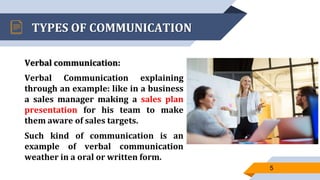
Verbal communication:
Verbal Communication explaining
through an example: like in a business
a sales manager making a sales plan
presentation for his team to make
them aware of sales targets.
Such kind of communication is an
example of verbal communication
weather in a oral or written form.
5
TYPES OF COMMUNICATION
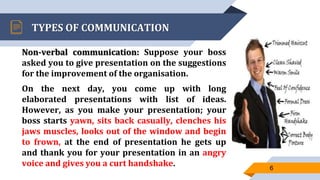
Non-verbal communication: Suppose your boss
asked you to give presentation on the suggestions
for the improvement of the organisation.
On the next day, you come up with long
elaborated presentations with list of ideas.
However, as you make your presentation; your
boss starts yawn, sits back casually, clenches his
jaws muscles, looks out of the window and begin
to frown, at the end of presentation he gets up
and thank you for your presentation in an angry
voice and gives you a curt handshake. 6
COMMUNICATION THROUGH SPACES
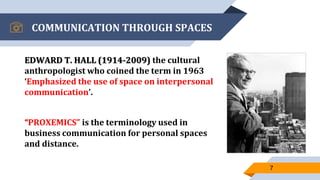
EDWARD T. HALL (1914-2009) the cultural
anthropologist who coined the term in 1963
‘Emphasized the use of space on interpersonal
communication’.
“PROXEMICS” is the terminology used in
business communication for personal spaces
and distance.
7
SPACE COMMUNICATION
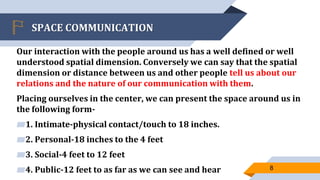
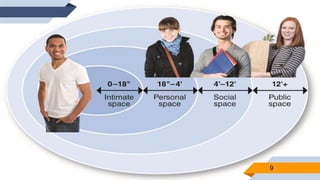
Our interaction with the people around us has a well defined or well
understood spatial dimension. Conversely we can say that the spatial
dimension or distance between us and other people tell us about our
relations and the nature of our communication with them.
Placing ourselves in the center, we can present the space around us in
the following form-
▰1. Intimate-physical contact/touch to 18 inches.
▰2. Personal-18 inches to the 4 feet
▰3. Social-4 feet to 12 feet
▰4. Public-12 feet to as far as we can see and hear 8
9
INTIMATE SPACE LANGUAGE
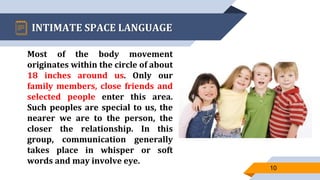
Most of the body movement
originates within the circle of about
18 inches around us. Only our
family members, close friends and
selected people enter this area.
Such peoples are special to us, the
nearer we are to the person, the
closer the relationship. In this
group, communication generally
takes place in whisper or soft
words and may involve eye.
10
PERSONAL SPACE LANGUAGE
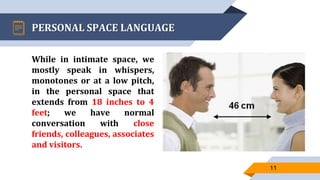
While in intimate space, we
mostly speak in whispers,
monotones or at a low pitch,
in the personal space that
extends from 18 inches to 4
feet; we have normal
conversation with close
friends, colleagues, associates
and visitors.
11
SOCIAL SPACE LANGUAGE
Extending from 4 to about 12 feet
is what has very aptly been called
the social space. This is mostly
used for formal purpose and the
relationship within this circle is
more official. We do most of our
work in this area while feeling,
emotion, likes and dislikes are
used /shared in intimate and
personal space
12
PUBLIC SPACE LANGUAGE
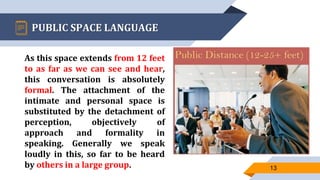
As this space extends from 12 feet
to as far as we can see and hear,
this conversation is absolutely
formal. The attachment of the
intimate and personal space is
substituted by the detachment of
perception, objectively of
approach and formality in
speaking. Generally we speak
loudly in this, so far to be heard
by others in a large group. 13
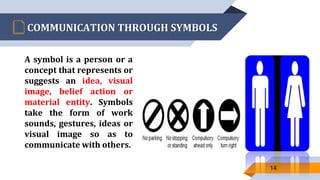
COMMUNICATION THROUGH SYMBOLS
A symbol is a person or a
concept that represents or
suggests an idea, visual
image, belief action or
material entity. Symbols
take the form of work
sounds, gestures, ideas or
visual image so as to
communicate with others.
14
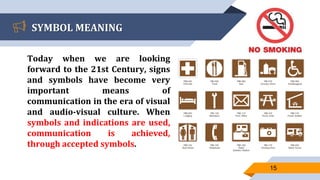
SYMBOL MEANING
15
Today when we are looking
forward to the 21st Century, signs
and symbols have become very
important means of
communication in the era of visual
and audio-visual culture. When
symbols and indications are used,
communication is achieved,
through accepted symbols.
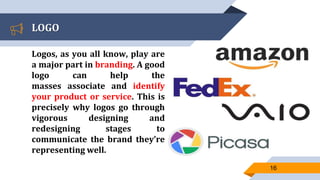
LOGO
Logos, as you all know, play are
a major part in branding. A good
logo can help the
masses associate and identify
your product or service. This is
precisely why logos go through
vigorous designing and
redesigning stages to
communicate the brand they’re
representing well.
16
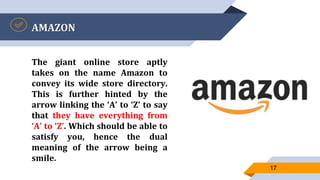
AMAZON
The giant online store aptly
takes on the name Amazon to
convey its wide store directory.
This is further hinted by the
arrow linking the ‘A’ to ‘Z’ to say
that they have everything from
‘A’ to ‘Z’. Which should be able to
satisfy you, hence the dual
meaning of the arrow being a
smile.
17
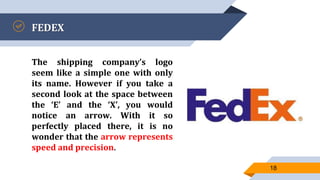
FEDEX
The shipping company’s logo
seem like a simple one with only
its name. However if you take a
second look at the space between
the ‘E’ and the ‘X’, you would
notice an arrow. With it so
perfectly placed there, it is no
wonder that the arrow represents
speed and precision.
18
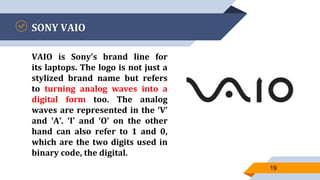
SONY VAIO
VAIO is Sony’s brand line for
its laptops. The logo is not just a
stylized brand name but refers
to turning analog waves into a
digital form too. The analog
waves are represented in the ‘V’
and ‘A’. ‘I’ and ‘O’ on the other
hand can also refer to 1 and 0,
which are the two digits used in
binary code, the digital.
19
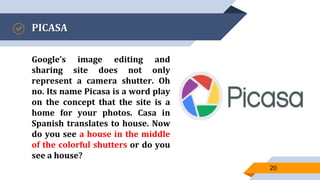
PICASA
Google’s image editing and
sharing site does not only
represent a camera shutter. Oh
no. Its name Picasa is a word play
on the concept that the site is a
home for your photos. Casa in
Spanish translates to house. Now
do you see a house in the middle
of the colorful shutters or do you
see a house?
20
21
THANKS!
Any questions?
You can find me at
rachingyanendra@gmail.com
http://www.linkedin.com/in/gyanendra-maurya-a20697a9
CREDITS:
Special thanks to all the people who made and released these awesome
resources for free
▰ http://www.afirstlook.com/docs/proxemic.pdf
▰http://worldlitonline.net/proxemics-the-o.pdf
▰http://www.complexneeds.org.uk/modules/Module-3.1-
Communication---augmentative-and-assistive-
strategies/C/downloads/m09p110bcd/using_symbols_for_communicatio
n_a4.pdf
▰http://www.okladot.state.ok.us/traffic/mutcd2003/htmversion/htm/fi
g2h-05-2_longdesc.htm
▰http://www.hongkiat.com/blog/logos-hidden-meaning/ 22

Communications through space & symbols

  • 1.
    COMMUNICATIO NS THROUGH SPACE AND SYMBOLS Communicationfor Management and Business (BM/ABM – 505) MBA-ABM 1st year Presented to: Dr. Kapil Kathuria Presented by : Gyanendra Maurya
  • 2.
    CONTENTS: 2 Communication Types of communication Communicationthrough Spaces Intimate space language Personal space Language Social space language Public space language Communication through symbols Symbol meaning Logo Reference
  • 3.
    “The most importantthing in communication is hearing what isn't said. -Peter Drucker 33
  • 4.
    COMMUNICATION: Communication simply meansthe act of transferring information from one place to other through different channels. Communication has much importance at work places, Few are listed below:- Greater awareness of organisational goals and team work. Better employer- employee relationship Help in problem solving Improves performance 4
  • 5.
    TYPES OF COMMUNICATION Verbalcommunication: Verbal Communication explaining through an example: like in a business a sales manager making a sales plan presentation for his team to make them aware of sales targets. Such kind of communication is an example of verbal communication weather in a oral or written form. 5
  • 6.
    TYPES OF COMMUNICATION Non-verbalcommunication: Suppose your boss asked you to give presentation on the suggestions for the improvement of the organisation. On the next day, you come up with long elaborated presentations with list of ideas. However, as you make your presentation; your boss starts yawn, sits back casually, clenches his jaws muscles, looks out of the window and begin to frown, at the end of presentation he gets up and thank you for your presentation in an angry voice and gives you a curt handshake. 6
  • 7.
    COMMUNICATION THROUGH SPACES EDWARDT. HALL (1914-2009) the cultural anthropologist who coined the term in 1963 ‘Emphasized the use of space on interpersonal communication’. “PROXEMICS” is the terminology used in business communication for personal spaces and distance. 7
  • 8.
    SPACE COMMUNICATION Our interactionwith the people around us has a well defined or well understood spatial dimension. Conversely we can say that the spatial dimension or distance between us and other people tell us about our relations and the nature of our communication with them. Placing ourselves in the center, we can present the space around us in the following form- ▰1. Intimate-physical contact/touch to 18 inches. ▰2. Personal-18 inches to the 4 feet ▰3. Social-4 feet to 12 feet ▰4. Public-12 feet to as far as we can see and hear 8
  • 9.
  • 10.
    INTIMATE SPACE LANGUAGE Mostof the body movement originates within the circle of about 18 inches around us. Only our family members, close friends and selected people enter this area. Such peoples are special to us, the nearer we are to the person, the closer the relationship. In this group, communication generally takes place in whisper or soft words and may involve eye. 10
  • 11.
    PERSONAL SPACE LANGUAGE Whilein intimate space, we mostly speak in whispers, monotones or at a low pitch, in the personal space that extends from 18 inches to 4 feet; we have normal conversation with close friends, colleagues, associates and visitors. 11
  • 12.
    SOCIAL SPACE LANGUAGE Extendingfrom 4 to about 12 feet is what has very aptly been called the social space. This is mostly used for formal purpose and the relationship within this circle is more official. We do most of our work in this area while feeling, emotion, likes and dislikes are used /shared in intimate and personal space 12
  • 13.
    PUBLIC SPACE LANGUAGE Asthis space extends from 12 feet to as far as we can see and hear, this conversation is absolutely formal. The attachment of the intimate and personal space is substituted by the detachment of perception, objectively of approach and formality in speaking. Generally we speak loudly in this, so far to be heard by others in a large group. 13
  • 14.
    COMMUNICATION THROUGH SYMBOLS Asymbol is a person or a concept that represents or suggests an idea, visual image, belief action or material entity. Symbols take the form of work sounds, gestures, ideas or visual image so as to communicate with others. 14
  • 15.
    SYMBOL MEANING 15 Today whenwe are looking forward to the 21st Century, signs and symbols have become very important means of communication in the era of visual and audio-visual culture. When symbols and indications are used, communication is achieved, through accepted symbols.
  • 16.
    LOGO Logos, as youall know, play are a major part in branding. A good logo can help the masses associate and identify your product or service. This is precisely why logos go through vigorous designing and redesigning stages to communicate the brand they’re representing well. 16
  • 17.
    AMAZON The giant onlinestore aptly takes on the name Amazon to convey its wide store directory. This is further hinted by the arrow linking the ‘A’ to ‘Z’ to say that they have everything from ‘A’ to ‘Z’. Which should be able to satisfy you, hence the dual meaning of the arrow being a smile. 17
  • 18.
    FEDEX The shipping company’slogo seem like a simple one with only its name. However if you take a second look at the space between the ‘E’ and the ‘X’, you would notice an arrow. With it so perfectly placed there, it is no wonder that the arrow represents speed and precision. 18
  • 19.
    SONY VAIO VAIO isSony’s brand line for its laptops. The logo is not just a stylized brand name but refers to turning analog waves into a digital form too. The analog waves are represented in the ‘V’ and ‘A’. ‘I’ and ‘O’ on the other hand can also refer to 1 and 0, which are the two digits used in binary code, the digital. 19
  • 20.
    PICASA Google’s image editingand sharing site does not only represent a camera shutter. Oh no. Its name Picasa is a word play on the concept that the site is a home for your photos. Casa in Spanish translates to house. Now do you see a house in the middle of the colorful shutters or do you see a house? 20
  • 21.
    21 THANKS! Any questions? You canfind me at rachingyanendra@gmail.com http://www.linkedin.com/in/gyanendra-maurya-a20697a9
  • 22.
    CREDITS: Special thanks toall the people who made and released these awesome resources for free ▰ http://www.afirstlook.com/docs/proxemic.pdf ▰http://worldlitonline.net/proxemics-the-o.pdf ▰http://www.complexneeds.org.uk/modules/Module-3.1- Communication---augmentative-and-assistive- strategies/C/downloads/m09p110bcd/using_symbols_for_communicatio n_a4.pdf ▰http://www.okladot.state.ok.us/traffic/mutcd2003/htmversion/htm/fi g2h-05-2_longdesc.htm ▰http://www.hongkiat.com/blog/logos-hidden-meaning/ 22