Basic Communication Skills
Dr. Vineeta Shukla
1
What is Communication?
• Countless number of ways that humans have of keeping in touch with
each other
• It is the process by which we relate and interact with other people
• It is a mutual process between two sides (Dialogue) not a one sided
monologue
• It includes listening & understanding with passion & respect as well as
expressing views & ideas and passing information to others in a clear
manner
2
Aims of Communication
• To promote the practice of effective communication within
healthcare with patients, carers, colleagues and other
professionals
• To bring about a change in the desired direction of the person
who receives the communication (This may be at cognitive,
affective or psychomotor level)
3
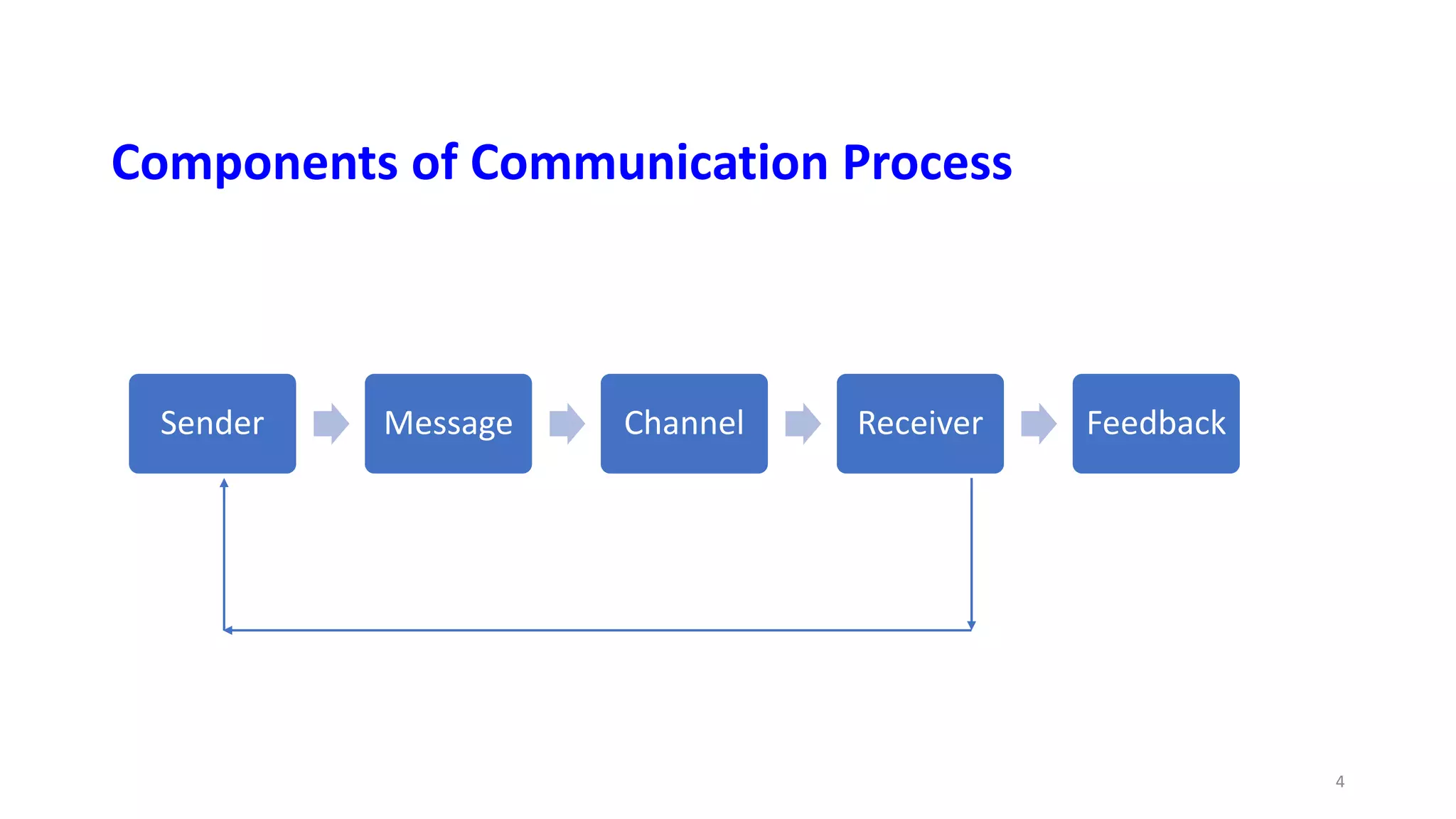
Components of Communication Process
4
Sender Message Channel Receiver Feedback
Sender
• Should know-
• His objectives
• Audience
• Message
• Channels of communication
• Professional abilities and limitations
5
Message
• Characteristics of good message
• In line with objective
• Meaningful
• Based on felt needs
• Clear and understandable
• Specific and accurate
• Timely and adequate
• Fitting the audience
• Interesting
• Culturally and socially acceptable
6
Channels of Communication
• Interpersonal communication
• Mass media
• Folk media
7
Receiver
• Audience is of two types
• Controlled- held by common interest
• Uncontrolled- gathered due to curiosity
• More homogenous the audience is,
greater the chance of effective communication
8
Feedback
• Flow of information from audience to sender
• Interpersonal communication-immediate feedback
• Mass communication-takes time
• Methods of obtaining feedback-opinion polls, attitude surveys,
interviews
9
Types of Communication
Types Characteristics
One-way Communication (Didactic method) Knowledge is imposed
Learning is authorative
Little audience participation
No feedback
Does not influence human behaviour
Two-way Communication (Socratic method) More likely to influence human behaviour
Verbal Communication Persuasive than written communication
Non-verbal Communication Bodily movements, postures, gestures, facial expressions
Formal and Informal Communication
Visual Communication Charts, graphs, tables, pictograms
Telecommunication and Internet
10
Barriers of Communication
• Physiological e.g. visual or hearing difficulties
• Psychological e.g. emotional disturbances, levels of intelligence etc
• Environmental e.g. noise
• Cultural e.g. Illiteracy, level of knowledge & education, language,
customs & beliefs
11
Thank you
12

Basic communication skills

  • 1.
  • 2.
    What is Communication? •Countless number of ways that humans have of keeping in touch with each other • It is the process by which we relate and interact with other people • It is a mutual process between two sides (Dialogue) not a one sided monologue • It includes listening & understanding with passion & respect as well as expressing views & ideas and passing information to others in a clear manner 2
  • 3.
    Aims of Communication •To promote the practice of effective communication within healthcare with patients, carers, colleagues and other professionals • To bring about a change in the desired direction of the person who receives the communication (This may be at cognitive, affective or psychomotor level) 3
  • 4.
    Components of CommunicationProcess 4 Sender Message Channel Receiver Feedback
  • 5.
    Sender • Should know- •His objectives • Audience • Message • Channels of communication • Professional abilities and limitations 5
  • 6.
    Message • Characteristics ofgood message • In line with objective • Meaningful • Based on felt needs • Clear and understandable • Specific and accurate • Timely and adequate • Fitting the audience • Interesting • Culturally and socially acceptable 6
  • 7.
    Channels of Communication •Interpersonal communication • Mass media • Folk media 7
  • 8.
    Receiver • Audience isof two types • Controlled- held by common interest • Uncontrolled- gathered due to curiosity • More homogenous the audience is, greater the chance of effective communication 8
  • 9.
    Feedback • Flow ofinformation from audience to sender • Interpersonal communication-immediate feedback • Mass communication-takes time • Methods of obtaining feedback-opinion polls, attitude surveys, interviews 9
  • 10.
    Types of Communication TypesCharacteristics One-way Communication (Didactic method) Knowledge is imposed Learning is authorative Little audience participation No feedback Does not influence human behaviour Two-way Communication (Socratic method) More likely to influence human behaviour Verbal Communication Persuasive than written communication Non-verbal Communication Bodily movements, postures, gestures, facial expressions Formal and Informal Communication Visual Communication Charts, graphs, tables, pictograms Telecommunication and Internet 10
  • 11.
    Barriers of Communication •Physiological e.g. visual or hearing difficulties • Psychological e.g. emotional disturbances, levels of intelligence etc • Environmental e.g. noise • Cultural e.g. Illiteracy, level of knowledge & education, language, customs & beliefs 11
  • 12.