BUSINESS COMMUNICATION
Faculty- Meenakshi Aggarwal August 12, 2011
 No late coming
 Be dressed in formals
 If you have a query, talk to me
 All genuine doubts are welcome but no nuisance will be
tolerated
 English should be the only medium of communication
 First impression is the last impression
 Global and diverse work place requires excellent
communication skills
 One cannot go around with a sign board specifying
his/her educational or professional qualification
 Forms a relationship and understanding between
colleagues
• What is communication?
• Ways to communicate
• Types of communication
• Communication networks
• Communication process
• Barriers to communication
• Listening
• Do’s and don’ts
 COMMUNICATION IS THE ART OF TRANSMITTING
INFORMATION, IDEAS AND ATTITUDES FROM
ONE PERSON TO ANOTHER.
 IT IS THE PROCESS OF MEANINGFUL INTERACTION
AMONG HUMAN BEINGS.
PERSONAL PROCESS
OCCURS BETWEEN PEOPLE
INVOLVES CHANGE IN BEHAVIOUR
MEANS TO INFLUENCE OTHERS
EXPRESSION OF THOUGHTS AND
EMOTIONS THROUGH WORDS & ACTIONS
TOOL FOR CONTROLLING AND MOTIVATING PEOPLE
IT IS A SOCIAL AND EMOTIONAL PROCESS
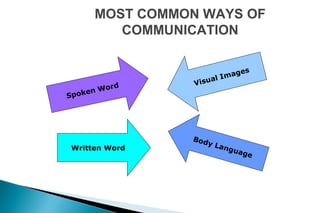
MOST COMMON WAYS OF
COMMUNICATION
Spoken Word
Written Word
Visual Images
Body Language
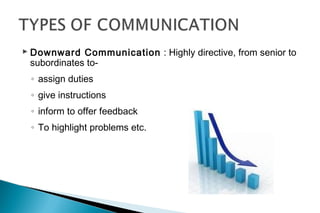
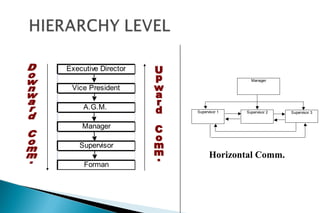
 Downward Communication : Highly directive, from senior to
subordinates to-
◦ assign duties
◦ give instructions
◦ inform to offer feedback
◦ To highlight problems etc.
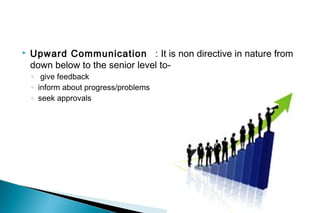
 Upward Communication : It is non directive in nature from
down below to the senior level to-
◦ give feedback
◦ inform about progress/problems
◦ seek approvals
 Lateral or Horizontal Communication: Among colleagues
and peers at same level for information sharing and
coordination, to save time.
Formal Network: Generally vertical or as per the
chain of command within the hierarchy.
Informal Network:Free to move in any direction and
may skip formal chain of command. Likely to satisfy
social and emotional needs.
Executive Director
Vice President
A.G.M.
Manager
Supervisor
Forman
Supervisor 3Supervisor 1 Supervisor 2
Manager
Horizontal Comm.
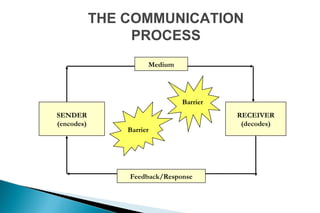
THE COMMUNICATION
PROCESS
SENDER
(encodes)
RECEIVER
(decodes)
Barrier
Barrier
Medium
Feedback/Response
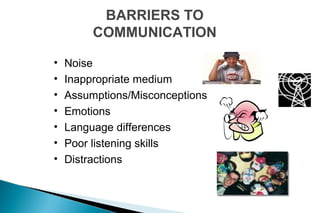
BARRIERS TO
COMMUNICATION
• Noise
• Inappropriate medium
• Assumptions/Misconceptions
• Emotions
• Language differences
• Poor listening skills
• Distractions
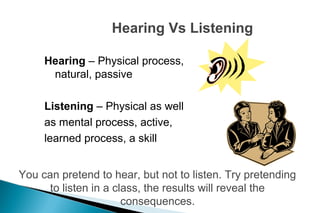
Hearing Vs Listening
Hearing – Physical process,
natural, passive
Listening – Physical as well
as mental process, active,
learned process, a skill
You can pretend to hear, but not to listen. Try pretending
to listen in a class, the results will reveal the
consequences.
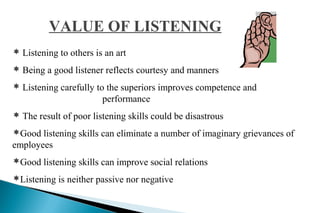
VALUE OF LISTENING
 Listening to others is an art
 Being a good listener reflects courtesy and manners
 Listening carefully to the superiors improves competence and
performance
 The result of poor listening skills could be disastrous
Good listening skills can eliminate a number of imaginary grievances of
employees
Good listening skills can improve social relations
Listening is neither passive nor negative
Always think ahead about what you are going to say
Use simple words and phrases understood by all
Speak loudly and clearly
Check with the listener whether you have been understood accurately or not
In case of an interruption, always do a little recap of what has already been said
Always pay undivided attention to the speaker while listening.
While listening, always make notes of important points.
Always ask for clarification if you have failed to grasp other’s point of view.
Repeat what the speaker has said to check whether you have understood accurately
ESSENTIALS OF COMMUNICATION
Dos
ESSENTIALS OF COMMUNICATION
DON’Ts
Do not instantly react and mutter something in anger
Do not use technical terms & terminologies not understood by the listener
Do not speak too fast or too slow
Do not speak in inaudible surroundings as you won’t be heard
Do not assume that every body understands you
While listening’ do not glance here and there as it might distract the
speaker
Do not interrupt the speaker.
Do not jump to the conclusion that you have understood every thing
How to Improve Existing Level of
COMMUNICATION?
IMPROVE LANGUAGE.
IMPROVE PRONUNCIATION.
WORK ON VOICE MODULATION.
WORK ON BODY LANGUAGE.
READ MORE
LISTEN MORE
AVOID READING OR WATCHING OR LISTENING TO
UNWANTED LITERATURE, GOSSIP, MEDIA
PRESENTATION ETC.
PRACTICE MEDITATION
THINK AND SPEAK.
USE SIMPLE VOCABULARY.
DO NOT SPEAK ONLY TO IMPRESS SOMEONE.
LOOK PRESENTABLE AND CONFIDENT.
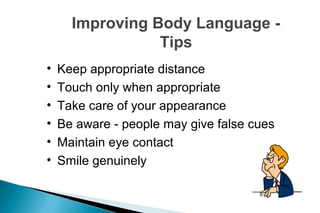
Improving Body Language -
Tips
• Keep appropriate distance
• Touch only when appropriate
• Take care of your appearance
• Be aware - people may give false cues
• Maintain eye contact
• Smile genuinely
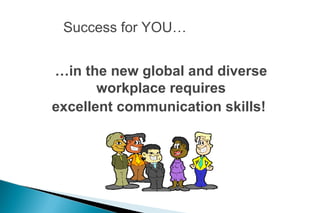
…in the new global and diverse
workplace requires
excellent communication skills!
Success for YOU…
Questions

SOME POINTS YOU SHOULD KNOW ABOUT BUSINESS COMMUNICATION

  • 1.
  • 2.
     No latecoming  Be dressed in formals  If you have a query, talk to me  All genuine doubts are welcome but no nuisance will be tolerated  English should be the only medium of communication
  • 3.
     First impressionis the last impression  Global and diverse work place requires excellent communication skills  One cannot go around with a sign board specifying his/her educational or professional qualification  Forms a relationship and understanding between colleagues
  • 4.
    • What iscommunication? • Ways to communicate • Types of communication • Communication networks • Communication process • Barriers to communication • Listening • Do’s and don’ts
  • 5.
     COMMUNICATION ISTHE ART OF TRANSMITTING INFORMATION, IDEAS AND ATTITUDES FROM ONE PERSON TO ANOTHER.  IT IS THE PROCESS OF MEANINGFUL INTERACTION AMONG HUMAN BEINGS.
  • 6.
    PERSONAL PROCESS OCCURS BETWEENPEOPLE INVOLVES CHANGE IN BEHAVIOUR MEANS TO INFLUENCE OTHERS EXPRESSION OF THOUGHTS AND EMOTIONS THROUGH WORDS & ACTIONS TOOL FOR CONTROLLING AND MOTIVATING PEOPLE IT IS A SOCIAL AND EMOTIONAL PROCESS
  • 7.
    MOST COMMON WAYSOF COMMUNICATION Spoken Word Written Word Visual Images Body Language
  • 8.
     Downward Communication: Highly directive, from senior to subordinates to- ◦ assign duties ◦ give instructions ◦ inform to offer feedback ◦ To highlight problems etc.
  • 9.
     Upward Communication: It is non directive in nature from down below to the senior level to- ◦ give feedback ◦ inform about progress/problems ◦ seek approvals
  • 10.
     Lateral orHorizontal Communication: Among colleagues and peers at same level for information sharing and coordination, to save time.
  • 11.
    Formal Network: Generallyvertical or as per the chain of command within the hierarchy. Informal Network:Free to move in any direction and may skip formal chain of command. Likely to satisfy social and emotional needs.
  • 12.
    Executive Director Vice President A.G.M. Manager Supervisor Forman Supervisor3Supervisor 1 Supervisor 2 Manager Horizontal Comm.
  • 13.
  • 14.
    BARRIERS TO COMMUNICATION • Noise •Inappropriate medium • Assumptions/Misconceptions • Emotions • Language differences • Poor listening skills • Distractions
  • 15.
    Hearing Vs Listening Hearing– Physical process, natural, passive Listening – Physical as well as mental process, active, learned process, a skill You can pretend to hear, but not to listen. Try pretending to listen in a class, the results will reveal the consequences.
  • 16.
    VALUE OF LISTENING Listening to others is an art  Being a good listener reflects courtesy and manners  Listening carefully to the superiors improves competence and performance  The result of poor listening skills could be disastrous Good listening skills can eliminate a number of imaginary grievances of employees Good listening skills can improve social relations Listening is neither passive nor negative
  • 17.
    Always think aheadabout what you are going to say Use simple words and phrases understood by all Speak loudly and clearly Check with the listener whether you have been understood accurately or not In case of an interruption, always do a little recap of what has already been said Always pay undivided attention to the speaker while listening. While listening, always make notes of important points. Always ask for clarification if you have failed to grasp other’s point of view. Repeat what the speaker has said to check whether you have understood accurately ESSENTIALS OF COMMUNICATION Dos
  • 18.
    ESSENTIALS OF COMMUNICATION DON’Ts Donot instantly react and mutter something in anger Do not use technical terms & terminologies not understood by the listener Do not speak too fast or too slow Do not speak in inaudible surroundings as you won’t be heard Do not assume that every body understands you While listening’ do not glance here and there as it might distract the speaker Do not interrupt the speaker. Do not jump to the conclusion that you have understood every thing
  • 19.
    How to ImproveExisting Level of COMMUNICATION? IMPROVE LANGUAGE. IMPROVE PRONUNCIATION. WORK ON VOICE MODULATION. WORK ON BODY LANGUAGE. READ MORE LISTEN MORE
  • 20.
    AVOID READING ORWATCHING OR LISTENING TO UNWANTED LITERATURE, GOSSIP, MEDIA PRESENTATION ETC. PRACTICE MEDITATION THINK AND SPEAK. USE SIMPLE VOCABULARY. DO NOT SPEAK ONLY TO IMPRESS SOMEONE. LOOK PRESENTABLE AND CONFIDENT.
  • 21.
    Improving Body Language- Tips • Keep appropriate distance • Touch only when appropriate • Take care of your appearance • Be aware - people may give false cues • Maintain eye contact • Smile genuinely
  • 22.
    …in the newglobal and diverse workplace requires excellent communication skills! Success for YOU…
  • 23.