Communicating better
by Toronto Training and HR
September 2013
CONTENTS
5-6 Definition
7-8 Types of communication
9-10 Communication styles
11-12 The communication process
13-16 Elements of communication
17-18 Skills of communication
19-20 Communication relationships
21-22 Six components of the process
23-25 Characteristics of effective communication
26-27 Barriers to communication
28-29 Responses or roles that can cause problems
30-31 Intrapersonal communication
32-33 Listening
34-35 Body language
36-37 Verbal faux pas
38-39 Social media
40-41 Breaking bad news (healthcare)
42-43 Communication competence
44-45 Strategic flexibility
46-47 Communicating for change management
48-49 What format should be used?
50-51 Conclusion and questions
Page 2
Page 3
Introduction
Page 4
Introduction to Toronto Training
and HR
Toronto Training and HR is a specialist training and
human resources consultancy headed by Timothy Holden
10 years in banking
10 years in training and human resources
Freelance practitioner since 2006
The core services provided by Toronto Training and HR
are:
Training event design
Training event delivery
Reducing costs, saving time plus improving
employee engagement and morale
Services for job seekers
Page 5
Definition
Definition
• Communication
• Fulfilling needs
Page 6
Page 7
Types of communication
• Downwards
• Upwards
• Lateral or horizontal
Page 8
Page 9
Communication styles
• Passive
• Aggressive
• Passive-aggressive
• Assertive
Page 10
Page 11
The communication
process
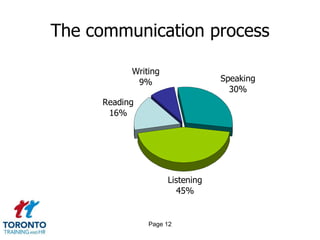
The communication process
Page 12
Reading
16%
Writing
9% Speaking
30%
Listening
45%
Page 13
Elements of
communication
Elements of communication 1 of 3
• Senders and receivers
• Messages
• Channels
• Feedback
• Blocks
• Setting
Page 14
Elements of communication 2 of 3
Page 9
Page 9
Page 17
Skills of communication
• Oral
• Written
• Non-verbal
Page 18
Page 19
Communication
relationships
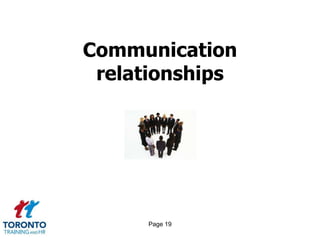
Communication relationships
• Non-recognition relationships
• Conflictual relationships
• Collaborative relationships
• Negotiative relationships
• Competitive relationships
Page 20
Page 21
Six components of the
process
Six components of the process
• The sender initiates a message
• The content of the message is
determined
• The message is sent through a verbal or
electronic or physical channel
• The message is received by the receiver
• The message is processed by the
receiver
• The receiver provides feedback,
questioning or agreeing with the
meaning and intentions of the message
Page 22
Page 23
Characteristics of effective
communication
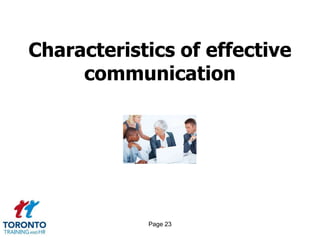
Characteristics of effective
communication 1 of 2
• The message
• The sender
• The channel
• The receiver
Page 24
Characteristics of effective
communication 2 of 2
• Effective verbal communicators
• Effective non-verbal communicators
Page 25
Page 26
Barriers to communication
• Sender
• Receiver
• External barriers
Page 27
Page 28
Responses or roles that
can cause problems
Responses or roles that can cause
problems
• Placater
• Blamer
• Computer
• Distracter
Page 29
Page 30
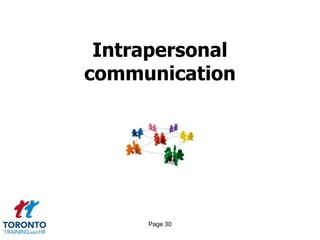
Intrapersonal
communication
Page 9
Page 32
Listening
Listening
• Basic reasons we do not listen
• Levels of listening
• Improving listening skills
• Active listening
• Sins of not listening
• Helping and hindering
• Listening for a conclusion
• Taking notes
• Following directions
Page 33
Page 34
Body language
Body language
• Postures and gestures
• Eye contact
• Orientation
• Presentation
• Looks
• Expressions of emotion
Page 35
Page 36
Verbal faux pas
Verbal faux pas
• “Let me be honest with you”
• “Kinda”, “Sorta” and “Wanta”
• “I’ll try”
• “I have to…”
• “You know” or “You know what I
mean”
Page 37
Page 38
Social media
Social media
• How does Canada compare?
• Why not implement/expand?
• What is it used for?
• Who is the audience?
Page 39
Page 40
Breaking bad news
(healthcare)
Breaking bad news (healthcare)
• Prepare
• Find out what the patient knows
• Find out what the patient wants to
know
• Share the information
• Respond to emotions
• Plan follow-up
Page 41
Page 42
Communication
competence
Communication competence
• Definition
• Knowledge
• Skill
• Motivation
• Elements of communication
competence
Page 43
Page 44
Strategic flexibility
• Definition
• Steps needed
Page 45
Page 46
Communicating for change
management
Communicating for change
management
PURPOSES
• To motivate
• To guide
• To provide place
Page 47
Page 48
What format should be
used?
What format should be used?
• With whom am I communicating?
• What is the direction within the
organization?
• What is the formality expectation?
Page 49
Page 50
Conclusion and questions
Page 51
Conclusion and questions
Summary
Videos
Questions

Communication September 2013