Language
Registers
Purposive
Communication
Euginn A. Buletin
Learning Objectives
Evaluate the effectiveness of
different language registers
in achieving specific
communication goals, such
as persuading, informing,
entertaining, or instructing
Determine what are the
different language registers
Students will understand why it is
crucial to match the appropriate
language register to different
communication contexts, such as
academic writing, casual
conversations, professional emails,
etc.
01 02 03
Introduction
Language register refers to the variation in language use that
depends on the social context, purpose, and audience of
communication. It's essentially about choosing the appropriate level
of formality or informality in language based on who you are
speaking to or writing for, and the situation in which communication
takes place.
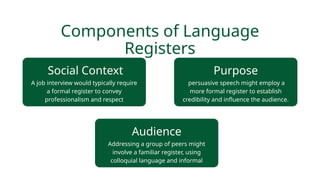
Components of Language
Registers
Social Context
A job interview would typically require
a formal register to convey
professionalism and respect
Purpose
persuasive speech might employ a
more formal register to establish
credibility and influence the audience.
Audience
Addressing a group of peers might
involve a familiar register, using
colloquial language and informal
tone.
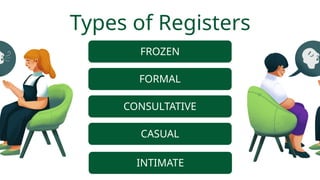
FROZEN
FORMAL
CONSULTATIVE
CASUAL
Types of Registers
INTIMATE
FROZEN
is a type of register that does not
change. It is a fact that language is
dynamic; it changes with time.
However, this type of register does
not change. It is static.
Religious texts, national anthems,
pledges, and ceremonial speeches
often use frozen language that
maintains historical or traditional
integrity
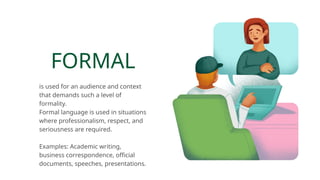
FORMAL
is used for an audience and context
that demands such a level of
formality.
Formal language is used in situations
where professionalism, respect, and
seriousness are required.
Examples: Academic writing,
business correspondence, official
documents, speeches, presentations.
CONSULTATIVE
as the name suggests, is commonly used in
consultation situations.
Consultative register is a form of language
use characterized by its relatively formal
tone and cooperative interaction.
examples are consultations between
professionals and clients, professional
meetings discussion among colleagues or
experts in a formal setting, and customer
service interaction between service
providers and customers.
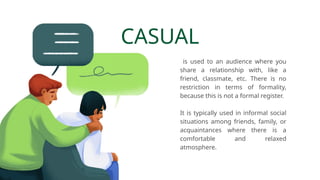
CASUAL
is used to an audience where you
share a relationship with, like a
friend, classmate, etc. There is no
restriction in terms of formality,
because this is not a formal register.
It is typically used in informal social
situations among friends, family, or
acquaintances where there is a
comfortable and relaxed
atmosphere.
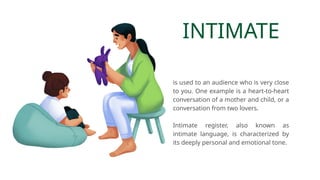
INTIMATE
is used to an audience who is very close
to you. One example is a heart-to-heart
conversation of a mother and child, or a
conversation from two lovers.
Intimate register, also known as
intimate language, is characterized by
its deeply personal and emotional tone.
Importance of Language
Register:
• Effective Communication: Choosing the appropriate register enhances clarity and
understanding, ensuring that messages are received as intended.
• Social Etiquette: Adapting language to the social context demonstrates respect and
awareness of social norms, fostering positive interactions.
• Professionalism: In professional settings, using the correct register reinforces
credibility and professionalism, influencing how others perceive competence and
authority.
• Cultural Sensitivity: Different cultures may have distinct expectations regarding
language formality, requiring sensitivity and adaptation to ensure effective cross-
cultural communication.
References:
Acoritay, D. P., Into, W. P., Malanguis, J. T., Maningo, R. M. L., & Tan, D. J. T. (2020). Purposive communication: Learning guide
https://drsaraheaton.wordpress.com/2012/05/22/language-register-and-why-it-matters-or-why-you-cant-write-an-academic-paper-in-
gangsta-slang
https://study.com/academy/lesson/language-registers-definition-uses-examples.html

Purposive Communication Language Registers

  • 1.
  • 2.
    Learning Objectives Evaluate theeffectiveness of different language registers in achieving specific communication goals, such as persuading, informing, entertaining, or instructing Determine what are the different language registers Students will understand why it is crucial to match the appropriate language register to different communication contexts, such as academic writing, casual conversations, professional emails, etc. 01 02 03
  • 3.
    Introduction Language register refersto the variation in language use that depends on the social context, purpose, and audience of communication. It's essentially about choosing the appropriate level of formality or informality in language based on who you are speaking to or writing for, and the situation in which communication takes place.
  • 4.
    Components of Language Registers SocialContext A job interview would typically require a formal register to convey professionalism and respect Purpose persuasive speech might employ a more formal register to establish credibility and influence the audience. Audience Addressing a group of peers might involve a familiar register, using colloquial language and informal tone.
  • 5.
  • 6.
    FROZEN is a typeof register that does not change. It is a fact that language is dynamic; it changes with time. However, this type of register does not change. It is static. Religious texts, national anthems, pledges, and ceremonial speeches often use frozen language that maintains historical or traditional integrity
  • 7.
    FORMAL is used foran audience and context that demands such a level of formality. Formal language is used in situations where professionalism, respect, and seriousness are required. Examples: Academic writing, business correspondence, official documents, speeches, presentations.
  • 8.
    CONSULTATIVE as the namesuggests, is commonly used in consultation situations. Consultative register is a form of language use characterized by its relatively formal tone and cooperative interaction. examples are consultations between professionals and clients, professional meetings discussion among colleagues or experts in a formal setting, and customer service interaction between service providers and customers.
  • 9.
    CASUAL is used toan audience where you share a relationship with, like a friend, classmate, etc. There is no restriction in terms of formality, because this is not a formal register. It is typically used in informal social situations among friends, family, or acquaintances where there is a comfortable and relaxed atmosphere.
  • 10.
    INTIMATE is used toan audience who is very close to you. One example is a heart-to-heart conversation of a mother and child, or a conversation from two lovers. Intimate register, also known as intimate language, is characterized by its deeply personal and emotional tone.
  • 11.
    Importance of Language Register: •Effective Communication: Choosing the appropriate register enhances clarity and understanding, ensuring that messages are received as intended. • Social Etiquette: Adapting language to the social context demonstrates respect and awareness of social norms, fostering positive interactions. • Professionalism: In professional settings, using the correct register reinforces credibility and professionalism, influencing how others perceive competence and authority. • Cultural Sensitivity: Different cultures may have distinct expectations regarding language formality, requiring sensitivity and adaptation to ensure effective cross- cultural communication.
  • 12.
    References: Acoritay, D. P.,Into, W. P., Malanguis, J. T., Maningo, R. M. L., & Tan, D. J. T. (2020). Purposive communication: Learning guide https://drsaraheaton.wordpress.com/2012/05/22/language-register-and-why-it-matters-or-why-you-cant-write-an-academic-paper-in- gangsta-slang https://study.com/academy/lesson/language-registers-definition-uses-examples.html

Editor's Notes

  • #1 In simpler terms, register means the level of formality of a language. In a language, even in a language variety, many registers maybe used. It is essential to determine which register to use for a specific audience in a context. In the classroom, you may talk formally to the instructor, but casually outside the classroom setting.
  • #3 Language register encompasses the concept of adjusting language according to the social context, purpose, and audience involved in communication. It reflects the dynamic and situational nature of language, where speakers or writers consciously select words, phrases, and expressions to suit the specific circumstances. You can speak with the teacher informally outside of the classroom, but informally in the classroom.
  • #4 Social Context: Definition: The environment or setting in which communication occurs, including factors like the relationship between participants, the setting (formal or informal), and cultural norms. Example: A job interview would typically require a formal register to convey professionalism and respect. Purpose: Definition: The specific goal or intention behind communication, such as informing, persuading, entertaining, or expressing emotions. Example: A persuasive speech might employ a more formal register to establish credibility and influence the audience. Audience: Definition: The group or individual receiving the communication, influencing language choices based on their familiarity with the topic, their expectations, and their relationship with the speaker or writer. Example: Addressing a group of peers might involve a familiar register, using colloquial language and informal tone.
  • #6 While language registers typically evolve and adapt to changing social contexts and linguistic trends, the frozen register remains static, preserving historical, cultural, and ceremonial significance through its steadfast adherence to established forms and conventions.
  • #7 Formal language is used in situations where professionalism, respect, and seriousness are required. It often employs standard grammar, vocabulary, and sentence structure. To convey authority, professionalism, and respect for the audience or topic. For example, you may be friendly with your instructor, but it is responsible and ethical to speak in the formal register when you are in the classroom setting. Another example, even though your audience at a health awareness seminar does not require formality, it is still essential to speak in the formal register because of the context.
  • #8  It typically occurs in professional or advisory settings where individuals engage in respectful and informative exchanges. For example, you are buying groceries, and the cashier asks if you have a smaller amount of cash. In this example, a consultative register is used. It is formal, but not too formal. It is also applicable when you are talking with the teller of the bank, talking with your doctor, or even asking someone for directions Consultations: Conversations between professionals and clients, where advice or information is sought and provided. Professional Meetings: Discussions among colleagues or experts in a formal setting, focusing on collaborative decision-making or problem-solving. Customer Service: Interactions between service providers and customers that prioritize clear communication and mutual understanding.
  • #9  Casual register, also known as informal register, is a type of language characterized by its relaxed tone and familiarity. It is typically used in informal social situations among friends, family, or acquaintances where there is a comfortable and relaxed atmosphere. Colloquialisms and Slang: Uses informal vocabulary, colloquialisms, and slang that are specific to particular social groups or regions. Abbreviations and Contractions: Frequently uses contractions (e.g., "can't," "won't") and abbreviations (e.g., "info" for information).
  • #10 Intimate register, also known as intimate language, is characterized by its deeply personal and emotional tone. It is used in very close and personal relationships, where individuals feel comfortable expressing their deepest emotions and thoughts. Personal and Emotional Content: Emotional Language: Uses emotive language and expressions to convey deep feelings, emotions, and personal experiences. Shared History: Often includes references to shared experiences, memories, and inside jokes known only to those involved. Vocabulary and Expressions: Endearments and Affectionate Terms: Includes terms of endearment, pet names, and affectionate expressions that reflect the closeness between individuals. Personal Pronouns: Uses first-person pronouns (e.g., "I," "we") and intimate second-person pronouns (e.g., "you," "we") to address the person directly.
  • #11 By understanding and mastering language registers, individuals can navigate diverse communication contexts effectively, fostering clearer understanding and stronger connections in both personal and professional interactions.