What is communication
Communication can be defined as the process by
which people share ideas, experience, knowledge
and feelings through the transmission of symbolic
messages.
The means of communication are usually
spoken or written words, pictures or symbols.
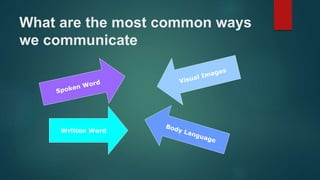
What are the most common ways
we communicate
Written Word
Types of Communication
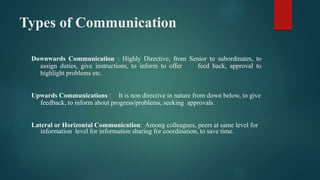
Downwards Communication : Highly Directive, from Senior to subordinates, to
assign duties, give instructions, to inform to offer feed back, approval to
highlight problems etc.
Upwards Communications : It is non directive in nature from down below, to give
feedback, to inform about progress/problems, seeking approvals.
Lateral or Horizontal Communication: Among colleagues, peers at same level for
information level for information sharing for coordination, to save time.
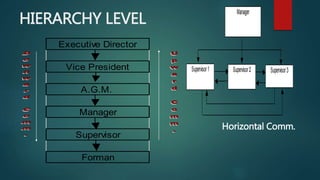
HIERARCHY LEVEL
Executive Director
Vice President
A.G.M.
Manager
Supervisor
Forman
Supervisor3Supervisor1 Supervisor2
Manager
Horizontal Comm.
Communication Key Elements
• Message
• Source (sender)
• Channel
• Receiver
• Filter
• Feedback
Characteristics of effective
communications
Effective communication requires the message to be:
 Clear and concise
 Accurate
 Relevant to the needs of the receiver
 Timely
 Meaningful
 Applicable to the situation
Characteristics of effective
communicator
An effective verbal communicator:
 Clarifies
 Listens
 Encourages empathically
 Acknowledges
 Restates/repeats
An effective nonverbal
communicator:
 Relaxes
 Opens up
 Leans toward the other person
 Establishes eye contact
 Shows appropriate facial
expressions
How Well Do You Listen
Listening Skills
Hear the message.
Interpret the message.
Evaluate the message.
Respond to the message.
Barriers to communication
• Language
• Values and beliefs
• Sex/gender and age
• Economic status
• Educational level
• Physical barriers
• Attitude
• Timing
• Understanding of message
• Trust
New Technologies for Communication
 Informational databases
 Electronic mail systems
 Voice mail systems
 Fax machine systems
 Cellular phone systems
How Do New Technologies
Affect Behavior?
 Fast, immediate access to information
 Immediate access to people in power
 Instant information exchange across distance
 Makes schedules & office hours irrelevant
 May equalize group power
 May equalize group participation

Strive for
message
completeness
Tips for Effective Use of New
Communication Technologies
Build in
feedback
opportunities
Provide
social
interaction
opportunities
Don’t
assume
immediate
response
Is the
message
really
necessary?
Regularly
disconnect
from the
technology
Provide
social
interaction
opportunities

Communication management

  • 1.
    What is communication Communicationcan be defined as the process by which people share ideas, experience, knowledge and feelings through the transmission of symbolic messages. The means of communication are usually spoken or written words, pictures or symbols.
  • 2.
    What are themost common ways we communicate Written Word
  • 3.
    Types of Communication DownwardsCommunication : Highly Directive, from Senior to subordinates, to assign duties, give instructions, to inform to offer feed back, approval to highlight problems etc. Upwards Communications : It is non directive in nature from down below, to give feedback, to inform about progress/problems, seeking approvals. Lateral or Horizontal Communication: Among colleagues, peers at same level for information level for information sharing for coordination, to save time.
  • 4.
    HIERARCHY LEVEL Executive Director VicePresident A.G.M. Manager Supervisor Forman Supervisor3Supervisor1 Supervisor2 Manager Horizontal Comm.
  • 5.
    Communication Key Elements •Message • Source (sender) • Channel • Receiver • Filter • Feedback
  • 6.
    Characteristics of effective communications Effectivecommunication requires the message to be:  Clear and concise  Accurate  Relevant to the needs of the receiver  Timely  Meaningful  Applicable to the situation
  • 7.
    Characteristics of effective communicator Aneffective verbal communicator:  Clarifies  Listens  Encourages empathically  Acknowledges  Restates/repeats An effective nonverbal communicator:  Relaxes  Opens up  Leans toward the other person  Establishes eye contact  Shows appropriate facial expressions
  • 8.
    How Well DoYou Listen Listening Skills Hear the message. Interpret the message. Evaluate the message. Respond to the message.
  • 9.
    Barriers to communication •Language • Values and beliefs • Sex/gender and age • Economic status • Educational level • Physical barriers • Attitude • Timing • Understanding of message • Trust
  • 10.
    New Technologies forCommunication  Informational databases  Electronic mail systems  Voice mail systems  Fax machine systems  Cellular phone systems
  • 11.
    How Do NewTechnologies Affect Behavior?  Fast, immediate access to information  Immediate access to people in power  Instant information exchange across distance  Makes schedules & office hours irrelevant  May equalize group power  May equalize group participation
  • 12.
     Strive for message completeness Tips forEffective Use of New Communication Technologies Build in feedback opportunities Provide social interaction opportunities Don’t assume immediate response Is the message really necessary? Regularly disconnect from the technology Provide social interaction opportunities