



COMMUNICATION
SOFT SKILLS SERIES
Anthony Elgan
Corporate Trainer
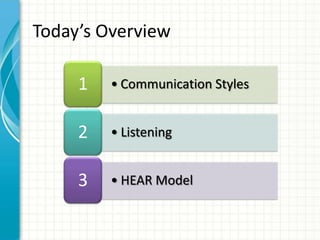
Today’s Overview
1

• Communication Styles

2

• Listening

3

• HEAR Model
COMMUNICATION
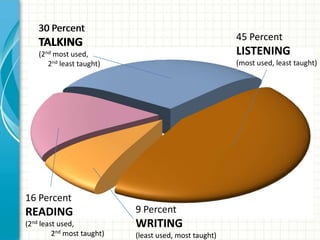
30 Percent

45 Percent

TALKING

LISTENING

(2nd most used,
2nd least taught)

(most used, least taught)

16 Percent

READING

9 Percent

(2nd least used,
2nd most taught)

(least used, most taught)

WRITING
Ways We Communicate

100%

0%
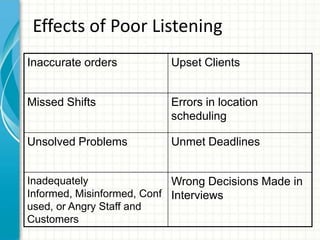
Effects of Poor Listening
Inaccurate orders

Upset Clients

Missed Shifts

Errors in location
scheduling

Unsolved Problems

Unmet Deadlines

Inadequately
Wrong Decisions Made in
Informed, Misinformed, Conf Interviews
used, or Angry Staff and
Customers
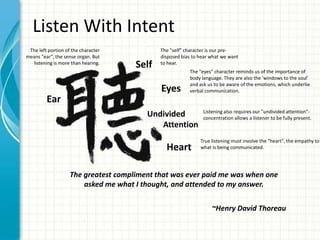
Listen With Intent
The left portion of the character
means "ear", the sense organ. But
listening is more than hearing.

Ear

Self

The "self" character is our predisposed bias to hear what we want
to hear.

Eyes

The "eyes" character reminds us of the importance of
body language. They are also the 'windows to the soul'
and ask us to be aware of the emotions, which underlie
verbal communication.

Undivided
Attention

Heart

Listening also requires our "undivided attention"concentration allows a listener to be fully present.

True listening must involve the "heart", the empathy to
what is being communicated.

The greatest compliment that was ever paid me was when one
asked me what I thought, and attended to my answer.
~Henry David Thoreau
QUIZ!
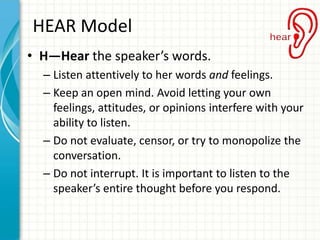
HEAR Model
• H—Hear the speaker’s words.
– Listen attentively to her words and feelings.
– Keep an open mind. Avoid letting your own
feelings, attitudes, or opinions interfere with your
ability to listen.
– Do not evaluate, censor, or try to monopolize the
conversation.
– Do not interrupt. It is important to listen to the
speaker’s entire thought before you respond.
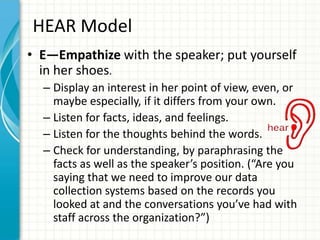
HEAR Model
• E—Empathize with the speaker; put yourself
in her shoes.
– Display an interest in her point of view, even, or
maybe especially, if it differs from your own.
– Listen for facts, ideas, and feelings.
– Listen for the thoughts behind the words.
– Check for understanding, by paraphrasing the
facts as well as the speaker’s position. (“Are you
saying that we need to improve our data
collection systems based on the records you
looked at and the conversations you’ve had with
staff across the organization?”)
HEAR Model
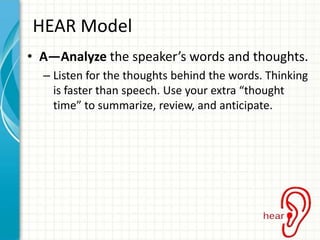
• A—Analyze the speaker’s words and thoughts.
– Listen for the thoughts behind the words. Thinking
is faster than speech. Use your extra “thought
time” to summarize, review, and anticipate.
HEAR Model
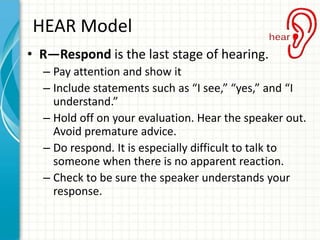
• R—Respond is the last stage of hearing.
– Pay attention and show it
– Include statements such as “I see,” “yes,” and “I
understand.”
– Hold off on your evaluation. Hear the speaker out.
Avoid premature advice.
– Do respond. It is especially difficult to talk to
someone when there is no apparent reaction.
– Check to be sure the speaker understands your
response.
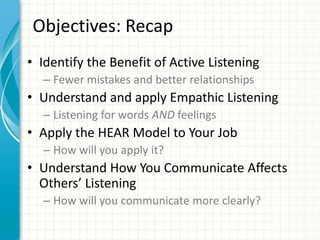
Objectives: Recap
• Identify the Benefit of Active Listening
– Fewer mistakes and better relationships

• Understand and apply Empathic Listening
– Listening for words AND feelings

• Apply the HEAR Model to Your Job
– How will you apply it?

• Understand How You Communicate Affects
Others’ Listening
– How will you communicate more clearly?
QUESTIONS?

Communication: Listening

  • 1.
  • 2.
    Today’s Overview 1 • CommunicationStyles 2 • Listening 3 • HEAR Model
  • 3.
  • 4.
    30 Percent 45 Percent TALKING LISTENING (2ndmost used, 2nd least taught) (most used, least taught) 16 Percent READING 9 Percent (2nd least used, 2nd most taught) (least used, most taught) WRITING
  • 5.
  • 6.
    Effects of PoorListening Inaccurate orders Upset Clients Missed Shifts Errors in location scheduling Unsolved Problems Unmet Deadlines Inadequately Wrong Decisions Made in Informed, Misinformed, Conf Interviews used, or Angry Staff and Customers
  • 7.
    Listen With Intent Theleft portion of the character means "ear", the sense organ. But listening is more than hearing. Ear Self The "self" character is our predisposed bias to hear what we want to hear. Eyes The "eyes" character reminds us of the importance of body language. They are also the 'windows to the soul' and ask us to be aware of the emotions, which underlie verbal communication. Undivided Attention Heart Listening also requires our "undivided attention"concentration allows a listener to be fully present. True listening must involve the "heart", the empathy to what is being communicated. The greatest compliment that was ever paid me was when one asked me what I thought, and attended to my answer. ~Henry David Thoreau
  • 8.
  • 10.
    HEAR Model • H—Hearthe speaker’s words. – Listen attentively to her words and feelings. – Keep an open mind. Avoid letting your own feelings, attitudes, or opinions interfere with your ability to listen. – Do not evaluate, censor, or try to monopolize the conversation. – Do not interrupt. It is important to listen to the speaker’s entire thought before you respond.
  • 11.
    HEAR Model • E—Empathizewith the speaker; put yourself in her shoes. – Display an interest in her point of view, even, or maybe especially, if it differs from your own. – Listen for facts, ideas, and feelings. – Listen for the thoughts behind the words. – Check for understanding, by paraphrasing the facts as well as the speaker’s position. (“Are you saying that we need to improve our data collection systems based on the records you looked at and the conversations you’ve had with staff across the organization?”)
  • 12.
    HEAR Model • A—Analyzethe speaker’s words and thoughts. – Listen for the thoughts behind the words. Thinking is faster than speech. Use your extra “thought time” to summarize, review, and anticipate.
  • 13.
    HEAR Model • R—Respondis the last stage of hearing. – Pay attention and show it – Include statements such as “I see,” “yes,” and “I understand.” – Hold off on your evaluation. Hear the speaker out. Avoid premature advice. – Do respond. It is especially difficult to talk to someone when there is no apparent reaction. – Check to be sure the speaker understands your response.
  • 14.
    Objectives: Recap • Identifythe Benefit of Active Listening – Fewer mistakes and better relationships • Understand and apply Empathic Listening – Listening for words AND feelings • Apply the HEAR Model to Your Job – How will you apply it? • Understand How You Communicate Affects Others’ Listening – How will you communicate more clearly?
  • 15.

Editor's Notes

  • #8 Add slides to each topic section as necessary, including slides with tables, graphs, and images. See next section for sampletable, graph, image, and video layouts.
  • #9 Is there a federal law against a man marrying his widow’s sister? Well, there is a law against marrying dead people, so sort of. (if you are a widow then your husband is dead, so he can’t marry anybody)If you went to bed in September 1952 at eight o’clock and set the alarm to wake up at nine o’clock in the morning, how many hours of sleep would you get? One hour. Wind up clocks did not have am/pm settings.Do they have a 4th of July in England? Yes. Right after the 3rd of July.If you had only one match and entered a cold room that had a kerosene lamp, an oil heater, and a wood stove, which would you light first for maximum heat?The match. How many animals of each species did Moses take aboard the Ark with him before the great flood? Moses didn’t have an ark. That would be Noah.The Yankees and the Tigers play five baseball games. They each win three games. No ties or disputed games are involved. How come? They weren’t playing each other.How many birthdays does the average man have? The average woman?Everybody only has one birthday. Everything else is an anniversary of that birthday. According to international law, if an airplane should crash on the exact border between two countries, would unidentified survivors be buried in the country they were traveling to or the country they were traveling from? You let the survivors LIVE!An archeologist claims he has dug up a coin that is clearly dated 46 BC. How do you know he is a liar? They didn’t date coins BC. How would they know how far BC it was?A man builds an ordinary house with four sides, except that each side has a southern exposure. A bear comes to the door and rings the doorbell. What color is the bear? White, because you are on the North Pole where all windows face south.
  • #10 Add slides to each topic section as necessary, including slides with tables, graphs, and images. See next section for sampletable, graph, image, and video layouts.
  • #11 Add slides to each topic section as necessary, including slides with tables, graphs, and images. See next section for sampletable, graph, image, and video layouts.
  • #12 Add slides to each topic section as necessary, including slides with tables, graphs, and images. See next section for sampletable, graph, image, and video layouts.
  • #13 Add slides to each topic section as necessary, including slides with tables, graphs, and images. See next section for sampletable, graph, image, and video layouts.
  • #14 Add slides to each topic section as necessary, including slides with tables, graphs, and images. See next section for sampletable, graph, image, and video layouts.
  • #15 Add slides to each topic section as necessary, including slides with tables, graphs, and images. See next section for sampletable, graph, image, and video layouts.