Negotiation 7th EditionLewicki Solutions Manual
download
https://testbankfan.com/product/negotiation-7th-edition-lewicki-
solutions-manual/
Explore and download more test bank or solution manual
at testbankfan.com
2.
We have selectedsome products that you may be interested in
Click the link to download now or visit testbankfan.com
for more options!.
Negotiation 7th Edition Lewicki Test Bank
https://testbankfan.com/product/negotiation-7th-edition-lewicki-test-
bank/
Negotiation Readings Exercises and Cases 7th Edition
Lewicki Solutions Manual
https://testbankfan.com/product/negotiation-readings-exercises-and-
cases-7th-edition-lewicki-solutions-manual/
Essentials of Negotiation 6th Edition Lewicki Solutions
Manual
https://testbankfan.com/product/essentials-of-negotiation-6th-edition-
lewicki-solutions-manual/
Operations Management Processes and Supply Chains 11th
Edition Krajewski Solutions Manual
https://testbankfan.com/product/operations-management-processes-and-
supply-chains-11th-edition-krajewski-solutions-manual/
3.
Competing for Advantage3rd Edition Hoskisson Solutions
Manual
https://testbankfan.com/product/competing-for-advantage-3rd-edition-
hoskisson-solutions-manual/
Business Law and the Legal Environment Standard Edition
8th Edition Beatty Test Bank
https://testbankfan.com/product/business-law-and-the-legal-
environment-standard-edition-8th-edition-beatty-test-bank/
Enhanced Microsoft Word 2013 Comprehensive 1st Edition
Vermaat Test Bank
https://testbankfan.com/product/enhanced-microsoft-
word-2013-comprehensive-1st-edition-vermaat-test-bank/
Personal Finance Canadian Canadian 6th Edition Kapoor Test
Bank
https://testbankfan.com/product/personal-finance-canadian-
canadian-6th-edition-kapoor-test-bank/
Economics Today The Macro View Canadian 5th Edition Miller
Test Bank
https://testbankfan.com/product/economics-today-the-macro-view-
canadian-5th-edition-miller-test-bank/
4.
U S ForeignPolicy The Paradox of World Power 5th Edition
Hook Test Bank
https://testbankfan.com/product/u-s-foreign-policy-the-paradox-of-
world-power-5th-edition-hook-test-bank/
5.
51
Chapter 7
Communication
Overview
In thischapter we examine the process by which negotiators
communicate their own interests, positions, and goals—and in
turn make sense of those of the other party and of the
negotiation as a whole. Clearly, communication pervades the
negotiation process; accordingly, research on communication
sheds light on negotiation both as a process of interaction and
as a context for communication subtleties that may influence
processes and outcomes (Chatman, Putnam, and Sondak, 1991). This
chapter opens with a discussion of the basic mechanisms through
which messages are encoded, sent, received, and decoded. We then
will consider in some depth what is communicated in a negotiation,
followed by an exploration of how people communicate in
negotiation. The chapter concludes with discussions of how to
improve communication in negotiation and of special
communication considerations at the close of negotiations.
Learning Objectives
1. Basic models of communication.
2. What is communicated during negotiation?
3. How people communicate in negotiation.
4. How to improve communication in negotiation.
5. Special communication considerations at the close of negotiation.
I. Basic Models of Communication
A. Communication as an activity that occurs between two
people: a sender and a receiver.
1. A sender has a thought or meaning in mind. The sender
encodes this meaning into a message that is to be
transmitted to a receiver.
2. Once encoded, the message is then transmitted through a channel
or medium to the receiver. The receiver’s receptors—eyes and
ears—receive the transmission and then the brain decodes and
interprets it, giving meaning and understanding to the
receiver.
6.
52
B. Distortion inCommunication – the elements of the model and the linkages among them
are subject to external factors that distort messages and their meaning, which inhibits
comprehension and mutual understanding. Distortions in communication occur due to
the following elements:
1. Individual Communicators (senders and receivers).
a) The more diverse the goal, the greater the likelihood that distortions and errors
will occur.
b) Individual characteristics of the sender and receiver contribute to a different way
of viewing the world.
2. Messages.
a) The symbolic forms by which information is
communicated.
b) Using symbols can distort communication.
3. Encoding.
a) The process by which messages are put into symbolic
form.
b) The encoding process will be affected by varying
degrees of skill in encoding (e.g., fluency in
language, skill at written and oral expression).
4. Channels and media.
a) The conduits by which messages are carried from one
party to another.
b) Messages are subject to distortion from channel noise,
a broad term used to describe various forms of
interference in the communication process.
5. Reception.
a) The process of translating messages from their
symbolic form into a form that makes sense.
6. Interpretations/Meanings.
a) The facts, ideas, feelings, reactions, or thoughts
that exist within individuals and act as a set of
filters for interpreting the decoded messages.
b) Meanings will vary depending on other aspects of the
communication sequence and the relationship between
the parties.
7. Feedback.
a) The process by which the receiver reacts to the
sender’s message.
7.
53
b) Feedback isuseful to inform the sender that the
message was received, encoded, and ascribed with the
meaning the sender intended.
c) The absence of feedback can contribute to significant
distortions in communication.
II. What is Communicated During Negotiation?
A. Offers, counteroffers, and motives.
1. A negotiator’s preferences are communicated during a
negotiation – they can have a powerful influence on the
actions of the other party and on outcomes.
2. A communicative framework for negotiation is based on the
assumptions that:
a) The communication of offers is a dynamic process;
b) The offer process is interactive;
c) Various internal and external factors drive the
interaction and motivate a bargainer to change his or
her offer.
B. Information about alternatives.
1. The existence of a BATNA changes several things in a
negotiation:
a) Compared to negotiators without attractive BATNAs,
negotiators with attractive BATNAs set higher
reservation prices for themselves than their
counterparts did;
b) Negotiators whose counterparts had attractive BATNAs
set lower reservation points for themselves; and
c) When both parties were aware of the attractive BATNA
that one of the negotiators had, that negotiator
received a more positive negotiation outcome.
C. Information about outcomes.
1. Negotiators should be cautious about sharing their
outcomes or even their positive reactions to outcomes
with the other party, especially if they are going to
negotiate with that party again in the future.
D. Social Accounts.
8.
54
1. The methodused by negotiators to explain things to the other
party, especially when negotiators need to justify bad
news.
2. Sitkin and Bies (1993) suggests that three types of
explanations are important:
a) Explanations of mitigating circumstances, where
negotiators suggest that they had no choice in taking
the positions they did;
b) Explanations of exonerating circumstances, where
negotiators explain their positions from a broader
perspective, suggesting that while their current
position may appear negative, it derives from positive
motives;
c) Reframing explanations, where outcomes can be
explained by changing the context.
E. Communication about process.
1. This can involve how well the process is going or what
procedures might be adopted to improve the situation.
Three key questions about what is communicated during
negotiations.
1. Are negotiators consistent or adaptive?
a) When it comes to communication patterns, negotiators
are more likely to be consistent in their strategies
than to vary their approach.
b) When it comes to making choices about communication,
many negotiators prefer sticking with the familiar
rather than venturing into improvisation.
2. Does it matter what is said early in the negotiation?
a) Recent research indicates that communication during
the first five minutes had no effects on the ability
of the parties to achieve joint gains.
b) Other research points to what negotiators do in the
first half of the process has a significant impact on
their ability to generate integrative solutions and
with high joint gains.
3. Is more information always better?
a) The influence of the exchange of accurate information
does not automatically lead to better understanding of
the other party’s preferences or to better negotiation
outcomes.
9.
55
b) The effectof exchanging information during negotiation
depends on the type of issues being discussed and the
negotiators’ motivation to use the information.
III. How People Communicate in Negotiation
A. Characteristics of language.
1. Language operates at two levels: the logical level (for
proposals or offers) and the pragmatic level (semantics,
syntax, and style).
a) The meaning conveyed by a proposition or statement is a
combination of one logical, surface message and
several pragmatic messages.
2. Gibbons, Bradac, and Busch suggest that threats can be
made more credible and more compelling by negatively
polarized descriptions of the other party and his or her
position.
3. No matter the intent, how parties communicate in
negotiation would seem to depend on the ability of the
speaker to encode thoughts properly, as well as on the
ability of the listener to understand and decode the
intended message(s).
4. Negotiators’ use of idioms or colloquialisms is often
problematic, especially in cross-cultural negotiations.
5. A negotiator’s choice of words may not only signal a
position but also shape and predict it.
B. Use of nonverbal communication.
1. Attending behaviors let the other know that you are listening
and prepare the other party to receive your message.
There are three important attending behaviors:
a) Make eye contact.
(1) When speaking, one should not keep their eyes
continually fixed on the other person – occasionally
look away.
(2) When persuading someone, it is important to make eye
contact when delivering the most important part of
the message.
(3) Maintain eye contact when receiving communication as
well as when speaking.
10.
56
b) Adjust bodyposition.
(1) To ensure that others know you are attentive to
them, hold your body erect, lean slightly forward,
and face the other person directly.
c) Nonverbally encourage or discourage what the other
says.
C. Selection of a communication channel.
1. People negotiate through a variety of communication media: over the telephone, in
writing, and increasingly through such electronic channels as e-mail and
teleconferencing systems, instant messaging, and even text messaging.
2. There is evidence that negotiation through written
channels is more likely to end in impasse than
negotiation that occurs face-to-face or by phone.
3. There is also evidence that e-mail negotiators reach
agreements that are more equal than face-to-face
negotiators. Further, negotiators using e-mail need to
work harder at building personal rapport with the other
party if they are to overcome limitations of the channel
that would otherwise inhibit optimal agreements or fuel
impasse.
4. Thompson and Nadler (2002) identified four biases that
can threaten e-mail negotiations. Face to face or over
the phone interactions can help combat these biases:
a) Temporal synchrony bias.
b) Burned bridge bias.
c) Squeaky wheel bias.
d) Sinister attribution bias.
IV. How to Improve Communication in Negotiation
A. The use of questions.
1. The use of questions aids in clarifying communication and
eliminating noise and distortion.
2. Asking good questions enables negotiators to secure a
great deal of information about the other party’s
position, supporting arguments, and needs.
3. Nierenberg (1976) proposed that questions could be
divided into two basic categories:
11.
57
a) Manageable.
b) Unmanageable.
B.Listening.
1. Passive listening: involves receiving the message while
providing no feedback to the sender about the accuracy or
completeness of reception.
2. Acknowledging: When acknowledging the message, receivers
occasionally nod their heads, maintain eye contact, or
interject responses.
3. Active listening: When receivers are actively listening,
they restate or paraphrase the sender’s message in their
own language. Successful reflective responding is a
critical part of active listening.
C. Role Reversal.
1. In general, the research supports the following conclusions:
a) Role reversal is effective in producing cognitive changes and attitude changes.
b) When the parties’ positions are fundamentally compatible with each other, role
reversal is likely to produce acceptable results (cognitive and attitudinal change);
when the parties’ positions are fundamentally incompatible, role reversal may
sharpen the perceptions of incompatibility and inhibit positive attitude change.
c) Although role reversal may induce greater understanding of the other party’s
position and highlight possible areas of similarity, it is not necessarily effective
overall as a means of inducing agreement between parties.
V. Special Communication Considerations at the Close of
Negotiations
A. Avoiding fatal mistakes.
1. Karrass suggestions to negotiators:
a) Avoid making last minute remarks that may push a
wavering counterpart away from the agreement.
b) Recognize the other party’s faux pas and do not
respond to them.
c) Watch out for last-minute problems such as nit-picking
or second-guessing.
d) Reduce the agreement to written form.
B. Achieving closure.
12.
58
1. Keep trackof what you expected would happen,
systematically guarding against self-serving
expectations, and making sure you review the lessons your
feedback has provided the next time a similar decision
comes along.
Summary
In this chapter we have considered elements of the art and
science of communication that are relevant to understanding
negotiations. We began with models that show communication as
prone to error and distortion. Such distortions are more likely
to occur when communicating parties have conflicting goals and
objectives or strong feelings of dislike for one another.
Distortion may occur as information is encoded, transmitted, and
decoded. The closure of the communication loop occurs through
feedback, by which the success of the intended communication can
be checked. During transmission and feedback, the problem of
“noise” or interference might affect the clarity with which the
message and response are sent and received.
We then moved to a discussion of what is communicated during
negotiation. Rather than simply being an exchange of preferences
about solutions, negotiations covers a wide-ranging number of
topics in an environment where each party is trying to influence
the other. This was followed by an exploration of three issues
related to how people communicate in negotiation: the use of
language, nonverbal communication, and the selection of a
communication channel.
In the final two sections of the chapter we considered: (1) how
to improve communication in negotiation, where we discussed
listening skills and the use of questions; and (2) special
communication considerations at the close of negotiation, where
we discussed avoiding last-minute mistakes and achieving
closure.
incomes over £300pay 1s. in each and every pound. Incomes
from personal exertion pay 10s. between £100 and £125; £1
between £126 and £150; between £151 and £300 have £100
exempt and pay 6d. in each and every pound over £100:
between £301 and £500 6d. in every pound; between £501 and
£1000 6d. in every pound of the first £500 and 7d. in every
pound over £500, between £1001 and £1500 7d. in every pound
of the first £1000, and 8d. in every pound over £1000; incomes
over £1500 pay 8d. in every pound; 1s. in every pound is
charged on the incomes of all companies and of all absentees.
South Australia.—The income tax dates from 1884 and is
levied on all incomes arising, accruing in or derived from South
Australia, except municipal corporations, district councils,
societies, &c., not carrying on business for the purpose ot gain,
and all friendly societies. Where the income is derived from
personal exertion the rate of tax is 4½d. in the pound up to
£800, and 7d. in the pound over £800. For income derived from
property the rate is 9d. in the pound up to £800, and 1s. 1½d.
in the pound over £800. There is an exemption of £150 on
incomes up to £400, but no exemption over that limit.
Tasmania.—In Tasmania there is (a) an income tax proper,
and (b) a non-inquisitorial ability tax, one complementary to the
other. The income tax proper is levied on all income of any
company, at the rate of 1s. for every pound of the taxable
amount; on all income of any person, at the rate of 1s. for every
pound of the taxable amount derived from property, and on
every dividend at the same rate. Personal incomes of £400 and
over are assessed at the full amount, but an abatement of £10
for every £50 of income is allowed on incomes below £400 down
15.
to incomes of£150, which thus have £50 deducted; incomes
between £120 and £150 have £60 deducted; incomes between
£110 and £120, £70, and incomes between £100 and £110, £80.
The ability tax is paid by (a) occupiers and sub-occupiers of
property and (b) by lodgers. The amount of tax paid by
occupiers or sub-occupiers is calculated upon the assessed
annual value of the property occupied, and that of lodgers from
the assessed annual value of their board and lodging. A detailed
account of both taxes will be found in House of Commons
Papers, No. 282 of 1905.
Victoria.—In Victoria the rate of income tax is fixed annually
by act. The rate charged on income derived from property is
exactly double that charged on income derived from personal
exertion, the rate for which for 1905 was: on the first £500 or
fractional part thereof, 3d. in the pound; on the second £500 or
fractional part thereof, 4d. in the pound; on the third £500 or
fractional part thereof, 5d. in the pound; on all incomes in
excess of £1500, 6d. in the pound. All companies, except life
insurance companies, were charged 7d. in the pound on their
incomes; life insurance companies were charged 8d. in the
pound.
Bibliography.—The Annual Reports of the Commissioners of
Inland Revenue, the Reports of Committees and other
references mentioned in the article, as well as Dowell’s History
of Taxation in England (1884); Dowell’s Acts relating to the
Income Tax (6th ed., 1908), and Robinson’s Law relating to
Income Tax (2nd ed., 1908).
16.
1 Full statisticsof the yield of income tax and other information
pertaining thereto will be found in the Reports of the Commissioners of
His Majesty’s Inland Revenue (published annually); those issued in 1870
and in 1885 are especially interesting.
2 In Appendix No. 4 to the Report from the Select Committee on
Income Tax (1906), will be found a valuable list (prepared in the Library
of the London School of Economics) of references to the graduation of
the income tax and the distribution of incomes both in the United
Kingdom and in other countries.
INCORPORATION (from Lat. incorporare, to form into a body),
in law, the embodying or formation of a legal corporation, brought
about either by a general rule contained in such laws, e.g. as the
Companies acts, and applicable wherever its conditions are satisfied;
or by a special act of sovereign power, e.g. an incorporating statute
or charter. The word is used also in the sense of uniting, e.g. a will
may incorporate by reference other papers, which may be then
taken as part of the will, as much as if they were set out at length in
it.
INCUBATION and INCUBATORS. The subject of “incubation”
(Lat. incubare, to brood; in-cumbere, to lie on), a term which, while
17.
strictly signifying theaction of a hen in sitting on her eggs to hatch
them, is also used in pathology for the development within the body
of the germs of disease, is especially associated with the artificial
means, or “incubators,” devised for hatching eggs, or for analogous
purposes of an artificial foster-mother nature, or for use in
bacteriological laboratories.
Life is dependent, alike for its awakening and its maintenance,
upon the influence of certain physical and chemical factors, among
which heat and moisture may be regarded as the chief. It is
therefore obvious that any method of incubation must provide for a
due degree of temperature and moisture. And this degree must be
one within limits, for while all organisms are plastic and can attune
themselves to a greater or less range of variation in their physical
environment, there is a given degree at which the processes of life
in each species proceed most favourably. It is this particular degree,
which differs for different species, which must be attained, if artificial
incubation is to be successfully conducted. In other words, the
degree of temperature and moisture within the incubation drawer
must remain uniform throughout the period of incubation if the best
results are to be reached. It is not easy to attain these conditions,
for there are many disturbing factors. We may therefore next
consider the more important of them.
The chief causes which operate to make the temperature within
the incubator drawer variable are the changes of the temperature of
the outer air, fluctuations in the pressure of the gas when that is
used as the source of heat, or the gradual diminution of the
oxidizing power of the flame and wick when an oil lamp is
substituted for gas. Also, the necessary opening of the incubator
drawer, either for airing or for sprinkling the eggs with water when
18.
that is necessary,tends to reduce the temperature. But there is
another equally important though less obvious source of
disturbance, and this resides within the organism undergoing
incubation. In the case of the chick, at about the ninth or tenth days
of incubation important changes are occurring. Between this period
and the fourteenth day the chick becomes relatively large and bulky,
and the temporary respiratory organ, the allantois, together with its
veins, increases greatly in size and extent. As a consequence, the
respiratory processes are enabled to proceed with greater activity,
and the chemical processes of oxidation thus enhanced necessarily
largely increase the amount of heat which the chick itself produces.
Thus an incubator, to be successful, must be capable of
automatically adjusting itself to this heightened temperature.
The drawer of an incubator is a confined space and is usually
packed as closely as possible with the contained eggs. The eggs are
living structures and consequently need air. This necessitates some
method of direct ventilation, and this in its turn necessarily increases
the evaporation of water vapour from the surface of the egg. Unless,
therefore, this evaporation is checked, the eggs will be too dry at the
period—from the tenth day onwards—when moisture is more than
ever an important factor. There is, according to some poultry
authorities, reason to believe that the sitting hen secretes some oily
substance which, becoming diffused over the surface of the egg,
prevents or retards evaporation from within; presumably, this oil is
permeable to oxygen. In nature, with the sitting hen, and in the
“Mamal” artificial incubating establishments of the Egyptians, direct
air currents do not exist, owing to the large size of the chambers,
and consequently incubation can be successfully achieved without
any special provision for the supply of moisture.
19.
Artificial incubation hasbeen known to the Egyptians and the
Chinese from almost time immemorial. In Egypt, at Berme on the
Delta, the trade of artificial hatching is traditionally transmitted from
father to son, and is consequently confined to particular families.
The secrets of the process are guarded with a religious zeal, and the
individuals who practise it are held under plighted word not to
divulge them. It is highly probable that the process of artificial
incubation as practised by the Egyptians is not so simple as it is
believed to be. But as far as the structures and processes involved
have been ascertained by travellers, it appears that the “Mamal” is a
brick building, consisting of four large ovens, each of such a size that
several men could be contained within it. These ovens are in pairs,
in each pair one oven being above the other, on each side of a long
passage, into which they open by a circular aperture, just large
enough for a man to obtain access to each. The eggs are placed in
the middle of the floor of the oven, and in the gutters round the
sides the fire is lighted. The material for this latter, according to one
account, consists of camels’ dung and chopped hay, and according
to another of horses’ dung. The attainment of the right degree of
heat is apparently reached wholly by the skill of the persons
employed. When this has been attained, they plug the entrance hole
with coarse tow. On the tenth to twelfth days they cease to light the
fires.
Each “Mamal” may contain from 40,000 to 80,000 eggs. There are
386 “Mamals” in the country, which are only worked for six months
of the year, and produce in that time eight broods. Many more than
two-thirds of the eggs put in are successfully hatched. It is
estimated that 90,000,000 eggs are annually hatched by the
Bermeans.
20.
A method ofincubating that appears to have been altogether
overlooked in England—or at least never to have been practised—is
that carried on by the Couveurs or professional hatchers in France.
They make use of hen-turkeys for the purpose, and each bird can be
made to sit continuously for from three to six months. The modus
operandi is as follows: a dark room which is kept at a constant
temperature throughout the year contains a number of boxes, just
large enough to accommodate a turkey. The bottom of the box is
filled with some vegetable material, bracken, hay, heather, straw or
cocoa-fibres. Each box is covered in with lattice-work wire, so
arranged that the freedom of the sitting bird is limited and its escape
prevented. Dummy eggs, made by emptying addled ones and filling
with plaster of Paris, are then placed in the nest and a bird put in. At
first it endeavours to escape, but after an interval of a few days it
becomes quiet, and the dummy eggs being then removed, fresh
ones are inserted. As soon as the chickens are hatched, they are
withdrawn and fresh eggs substituted. The hen turkeys are also
used successfully as foster-mothers. Each bird can adequately cover
about two dozen eggs.
Incubation as an industry in Europe and America is of recent
development. The growing scarcity of game birds of all kinds,
coincident with the increase of population, and the introduction of
the breech-loading gun, together with the marked revival of interest
in fancy poultry about the year 1870, led, however, to the production
of a great variety of appliances designed to render artificial
incubation successful.
Previously to this, several interesting attempts had been made. As
long ago as 1824, Walthew constructed an incubator designed to be
used by farmers’ wives with the aid of no more than ordinary
21.
household conditions. Itconsisted of a double-walled metal box,
with several pipes opening into the walled space round the sides,
bottom and top of the incubator. These pipes were connected with
an ordinary kitchen boiler. Walthew, however, constructed a fire
grate, with a special boiler adapted to the requirements of the
incubator. Into the walled space of the incubator, steam from the
kitchen boiler passed; the excess steam escaped from an aperture in
the roof, and the condensed steam through one in the floor.
Ventilating holes and also plugs, into which thermometers were
placed, pierced the door of the incubator.
In 1827, J. H. Barlow successfully reared hens and other birds by
means of steam at Drayton Green, Ealing. He constructed very large
rooms and rearing houses, expending many thousands of pounds
upon the work. He reared some 64,000 game birds annually. The
celebrated physician Harvey, and the famous anatomist Hunter were
much interested in his results.
To John Champion, Berwick-on-Tweed, in 1870, belongs, however,
the credit of instituting a system which, when extended, may
become the system of the future, and will rival the ancient “Mamals”
in the success of the incubation and in the largeness of the numbers
of eggs incubated. He used a large room through which passed two
heated flues, the eggs being placed upon a table in the centre. The
flues opened out into an adjoining space. The temperature of the
room was adjusted by personal supervision of the fire. This system,
more elaborated and refined, is now in use in some parts of
America.
Bird Incubators.
22.
Owing to thegreat variety in the details of construction, it is
difficult to arrange a classification of incubators which shall include
them all. They may, however, be classified in one of two ways. We
may either consider the method by which they are heated or the
method by which their temperature is regulated.
In the former case we may divide them into “hot-air” incubators
and into “hot-water” or “tank” incubators. In the latter ease we may
classify them according as their thermostat or temperature-regulator
is actuated by a liquid expanding with rising temperature, or by
solids, usually metals.
In America incubators of the hot-air type with solid and metallic
thermostats are most used, while in Europe the “tank” type, with a
thermostat of expansible liquid, prevails.
For the purpose of more adequately considering the various forms
which have been in use, or are still used, we shall here divide them
into the “hot-air” and “hot-water” (or “tank”) classes.
In the hot-air types the incubator chamber is heated by columns
of hot air, while in the tank system this chamber is heated by a tank
of warmed water.
(a) Hot-Water Incubators.—In 1866 Colonel Stuart Wortley
described in The Field an incubator constructed upon a novel
principle, but which appears never to have been adopted by
breeders. The descriptive article is illustrated with a sketch.
Essentially the incubator consists of four pipes which extend
across the egg chamber some little distance above the eggs.
The pipes pass through holes in the side of the incubator, which
are furnished with pads, so as to render their passage air-tight.
Externally they are connected with a boiler. This is provided with
23.
a dome throughwhich steam escapes, and also with a glass
gauge to show the height of the water within the boiler. The
water in the boiler is kept at the boiling point, and the
temperature of the incubator is regulated by adjustment of the
length of the hot-water pipes within the egg chamber. To raise
the temperature, a greater length of the pipes is pushed into the
chamber, and to reduce it, more of their length is pulled
outwards. It is claimed for this instrument that since the
temperature of boiling water at any particular locality remains
practically constant, the disadvantages due to fluctuations in the
activity of a lamp flame or the size of a gas flame are obviated.
But it has the serious disadvantage that there is no automatic
adjustment to compensate for fluctuations of atmospheric
temperature. And experiments by C. Hearson have shown that
even if the temperature of the tank or source of heat be
constant, that of the incubator drawer will nevertheless vary
with fluctuations of external temperature. Probably if the
mechanical difficulties of providing a self-regulator were
overcome, it would prove an efficient and reliable incubator. The
difficulties do not seem to be insuperable, and it appears
possible that a thermostatic bar could be so arranged as to
automatically increase or decrease the length of hot-water pipes
within the incubator, and therefore the incubator temperature.
Another early form of incubator is Brindley’s, which was first in
use about 1845, and in his hands it appeared occasionally to act
successfully, but it never became generally used. The egg
chamber was lined with felt, and was placed beneath a heated
air chamber, the floor and roof of which were composed of
glass. The air chamber was heated by a number of hot-water
pipes which were connected with a copper boiler. This latter was
24.
heated by meansof a lamp so constructed as to burn steadily.
The temperature of the air chamber was regulated within certain
limits by means of a balanced valve, which could be so adjusted
that it would open at any desired temperature.
In Colonel Stuart Wortley’s incubator the hot-water tubes
passed directly into the egg chamber, and in Brindley’s into a
chamber above it. But in other forms of incubators in which the
principle of an external boiler connected with water tubes is
adopted, the latter pass not into the egg chamber nor into an air
chamber, but open into and from a tank of water. The floor of
this tank forms the roof of the egg chamber, so that the eggs
are heated from above. This device of warming the eggs from
above was adopted in imitation of the processes that
presumably occur with the sitting hen; for it is generally
assumed that the surface of the eggs in contact with the hen is
warmer than that in contact with the damp soil or with the
material of the nest.
One of the earliest of this form of incubator is that invented by
F. Schröder, manager of the now extinct British National Poultry
Company. In this incubator the form is circular, and there are
four egg drawers, so that each one occupied the quadrant of a
circle, and the inner corner of each drawer meets in the middle
of the incubator. From the centre of the incubator a vertical
chimney passes upwards and opens out from the inner corners
of the four egg drawers. This chimney acts as a ventilator to the
incubating chambers. These latter are open above, but their
floors are made of perforated zinc, and when in use they are
partially filled with chaff or similar material. Under them is a
tank containing cold water and common to all four drawers; the
25.
slight vapour risingfrom the surface of the water diffuses
through the egg drawers and thus insures a sufficient degree of
humidity to the air within. Above the egg drawers is a circular
tank containing warm water. The floor of this tank constitutes
the roof of the egg drawers, while the roof forms the floor of a
circular chamber above it, the side wall of which is composed of
perforated zinc. This upper chamber is used to dry the chicks
when they are just hatched and to rear them until they are
strong enough for removal. It is partially filled with sand, which
serves the double purpose of retaining the heat in the warm-
water tank beneath and of forming a bed for the chicks. The
water in the warm-water tank is heated by means of a boiler
which is external to the incubator, and in communication with
the tank by means of an inlet and an outlet pipe. There is no
valve to regulate the temperature, and the latter is measured by
means of a thermometer, the bulb of which is situated not in the
incubator drawers, but in the warm-water tank. This is a wrong
position for the thermometer, since it is now known that the
temperature of the water tank may be different by several
degrees to that of the egg drawer; for with a fall of external
temperature that of the latter necessarily tends to fall more
rapidly than the former. But, none the less, in skilful hands this
incubator gave good results.
26.
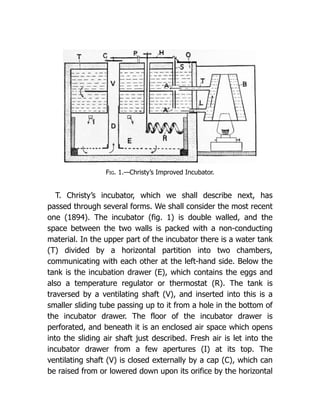
Fig. 1.—Christy’s ImprovedIncubator.
T. Christy’s incubator, which we shall describe next, has
passed through several forms. We shall consider the most recent
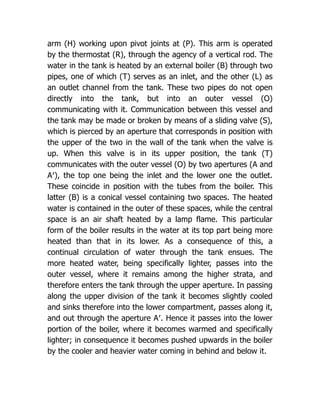
one (1894). The incubator (fig. 1) is double walled, and the
space between the two walls is packed with a non-conducting
material. In the upper part of the incubator there is a water tank
(T) divided by a horizontal partition into two chambers,
communicating with each other at the left-hand side. Below the
tank is the incubation drawer (E), which contains the eggs and
also a temperature regulator or thermostat (R). The tank is
traversed by a ventilating shaft (V), and inserted into this is a
smaller sliding tube passing up to it from a hole in the bottom of
the incubator drawer. The floor of the incubator drawer is
perforated, and beneath it is an enclosed air space which opens
into the sliding air shaft just described. Fresh air is let into the
incubator drawer from a few apertures (I) at its top. The
ventilating shaft (V) is closed externally by a cap (C), which can
be raised from or lowered down upon its orifice by the horizontal
27.
arm (H) workingupon pivot joints at (P). This arm is operated
by the thermostat (R), through the agency of a vertical rod. The
water in the tank is heated by an external boiler (B) through two
pipes, one of which (T) serves as an inlet, and the other (L) as
an outlet channel from the tank. These two pipes do not open
directly into the tank, but into an outer vessel (O)
communicating with it. Communication between this vessel and
the tank may be made or broken by means of a sliding valve (S),
which is pierced by an aperture that corresponds in position with
the upper of the two in the wall of the tank when the valve is
up. When this valve is in its upper position, the tank (T)
communicates with the outer vessel (O) by two apertures (A and
A′), the top one being the inlet and the lower one the outlet.
These coincide in position with the tubes from the boiler. This
latter (B) is a conical vessel containing two spaces. The heated
water is contained in the outer of these spaces, while the central
space is an air shaft heated by a lamp flame. This particular
form of the boiler results in the water at its top part being more
heated than that in its lower. As a consequence of this, a
continual circulation of water through the tank ensues. The
more heated water, being specifically lighter, passes into the
outer vessel, where it remains among the higher strata, and
therefore enters the tank through the upper aperture. In passing
along the upper division of the tank it becomes slightly cooled
and sinks therefore into the lower compartment, passes along it,
and out through the aperture A′. Hence it passes into the lower
portion of the boiler, where it becomes warmed and specifically
lighter; in consequence it becomes pushed upwards in the boiler
by the cooler and heavier water coming in behind and below it.
28.
Should the temperaturein the incubator drawer rise, the
bimetallic thermostat (R) opens out its coil and pulls down the
vertical rod. This simultaneously effects two things: it raises the
cap (C) over the ventilating shaft and allows of a more rapid
flow of fresh air through the incubator drawer, and it also lowers
the slide-valve (S) so that the tank becomes cut off from
communication with the outer vessel (O) and therefore with the
boiler. The temperature thereupon begins to fall and the
thermostat, coiling closer, raises the vertical rod, closes the
ventilating shaft, and once more places the tank in
communication with the boiler.
The structure of the thermostat is given below.
The Chantry Incubator (Sheffield) is also an incubator with a
hot-water tank, the circulation of which is maintained by an
outside boiler. Its temperature is regulated by a metal regulator.
In Schröder’s and Christy’s incubators the hot-water pipes
from the boiler simply entered the warm-water tank but did not
traverse it. In the two incubators to be next described the hot-
water pipes are made to pass through the water in the tank, and
are so arranged as to minimize the possibility that the outside of
the tank may become colder than the centre. Both of them are
also fitted with an ingenious though slightly complex valve for
maintaining an approximately constant temperature.
Halsted’s incubator was the earliest of this type. Since his
original form was constructed he has designed an improved one,
and it is this latter which will be described.
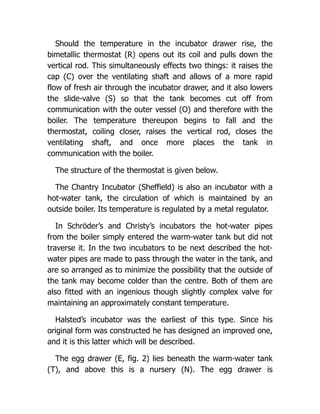
The egg drawer (E, fig. 2) lies beneath the warm-water tank
(T), and above this is a nursery (N). The egg drawer is
29.
Fig 2.—Halsted’s Incubator.
ventilatedby two tubular
shafts (V), of which only
one is represented in the
illustration; the tubes are
about 2½ in. in diameter,
and each one is fitted at
its upper end, where it
opens into the nursery,
with a swing-valve (V′)
which turns upon a
horizontal axis (A), in its
turn connected, by
means of cranks (C) and
shafts (S), with the heat
regulating apparatus (R).
A space of about 2 in.
between the top of the
incubating drawer and the warm-water tank is necessary for the
insertion of this apparatus. The water in the tank (T) is heated
by means of the boiler (B); the tank and boiler are connected by
the two pipes (I) and (O), of which one is the inlet and the other
the outlet channel. The boiler consists of an inner (I′) and an
outer (O) division in communication with each other below. The
latter is cylindrical in form, while the outer wall of the former is
cylindrical and its inner wall conical. The conical wall of the inner
boiler is the surface which is heated by the lamp (L). The
arrangement of the inlet and outlet tubes is important. In the
illustration, for the sake of clearness, they are represented as
one above the other. In reality they lie in the same plane, and
the fork (F) of the inlet pipe similarly lies in the horizontal plane
30.
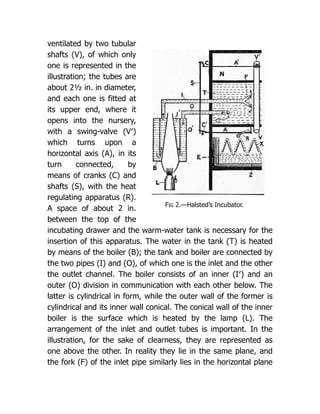
and not verticallyas represented. The inlet pipe not only differs
from the outlet pipe in the possession of a forked end, but it is
carried to the farther end (not shown in the diagram) of the
water tank, while the outlet pipe opens from about the middle of
the tank. The inlet pipe is connected with the inner portion of
the boiler and the outlet one with the outer portion. The result
of this adjustment of the parts is that the warmer water of the
inner boiler, being specifically lighter than the cooler water of the
outer boiler, rises up and passes through the inlet pipe (I) and is
discharged into the tank through the two divergent orifices of
the fork (F). Here the water strikes the side wall of the farther
end of the tank and is reflected back along the back and front
walls towards the nearer side. Hence it is again reflected, but in
the opposite direction, and now forms a central current, which is
directed towards the centrally situated orifice of the outlet tube
(O). Through this it passes to the outer boiler, and sinking
towards the bottom, reaches the base of the inner boiler. Here it
becomes heated and lighter and consequently rises to the top,
and once more passes through the inlet pipe to the water tank.
The warm water thus travels round the outer walls of the tank
and the cooled water is conducted away along the middle
portion. A more equable distribution of temperature over the
roof of the incubating chamber is thus ensured than would be
the case if the heated water were discharged either into the
centre or at any other single point only of the tank.
To a very large extent, the efficiency of this apparatus
depends upon the approximately perfect performance of the
lamp. A good, steadily burning one should be employed, and
only the best oil used; for, should the wick become fouled the
31.
flame cannot freelyburn. For this reason it is better to use gas,
whenever obtainable.
The maintenance of an approximately uniform temperature is
obtained by allowing the heated air of the egg-drawer to escape
through the two ventilating shafts (V). The swing-valves of these
are opened or closed by means of the regulator (R). This latter
consists of a glass bowl prolonged into a tube, about 8 in. long
and three-eighths of an inch in diameter. The glass tube swings
upon an axis (A) which is situated as near as possible to the
bowl of the regulator. The axis is connected with a crank (C′)
which is disposed so as to act as a lever upon the vertical shaft
(S), which in its turn is connected with the upper crank (C); this
works the axis (A′) of the swing-valves, and so can open or
close the apertures of the ventilating pipes. The bowl of the
regulator is filled with mercury to such an extent that at the
temperature of 100° F., and when the tube is slightly inclined
upwards from the horizontal it just flows slightly into the tube
from the bowl. On the lever-crank (C′) a weight is slung by a
sliding adjustment, and is so placed that when the temperature
of the egg-drawer is 103° it just balances the tube of the
regulator when it is slightly inclined upwards. Should the
temperature of the drawer now rise higher the mercury flows
towards the distant end of the tube and, causing it to fall down,
brings about a rotation of the regulator axis and as a
consequence the opening of the ventilating valves. A transverse
stay prevents the limb of the regulator from quite reaching the
horizontal when it falls. As the temperature cools down the
mercury contracts and retraces to the nearer end of the tube
and to the bowl, and consequently results in the upward
inclination of the limb; the valves are thus closed again.
32.
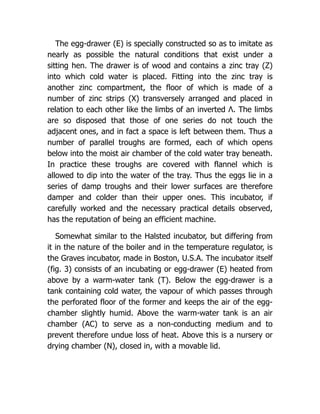
The egg-drawer (E)is specially constructed so as to imitate as
nearly as possible the natural conditions that exist under a
sitting hen. The drawer is of wood and contains a zinc tray (Z)
into which cold water is placed. Fitting into the zinc tray is
another zinc compartment, the floor of which is made of a
number of zinc strips (X) transversely arranged and placed in
relation to each other like the limbs of an inverted Λ. The limbs
are so disposed that those of one series do not touch the
adjacent ones, and in fact a space is left between them. Thus a
number of parallel troughs are formed, each of which opens
below into the moist air chamber of the cold water tray beneath.
In practice these troughs are covered with flannel which is
allowed to dip into the water of the tray. Thus the eggs lie in a
series of damp troughs and their lower surfaces are therefore
damper and colder than their upper ones. This incubator, if
carefully worked and the necessary practical details observed,
has the reputation of being an efficient machine.
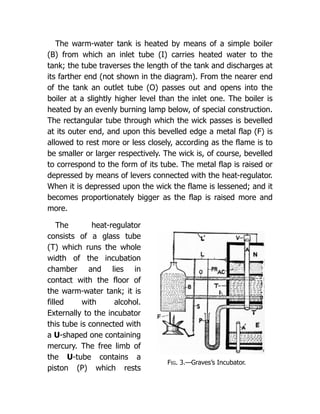
Somewhat similar to the Halsted incubator, but differing from
it in the nature of the boiler and in the temperature regulator, is
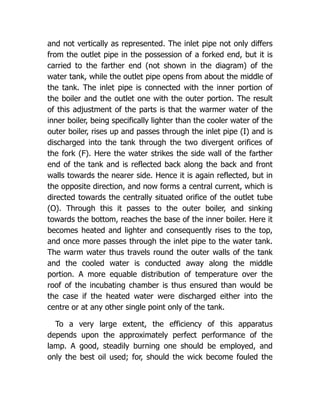
the Graves incubator, made in Boston, U.S.A. The incubator itself
(fig. 3) consists of an incubating or egg-drawer (E) heated from
above by a warm-water tank (T). Below the egg-drawer is a
tank containing cold water, the vapour of which passes through
the perforated floor of the former and keeps the air of the egg-
chamber slightly humid. Above the warm-water tank is an air
chamber (AC) to serve as a non-conducting medium and to
prevent therefore undue loss of heat. Above this is a nursery or
drying chamber (N), closed in, with a movable lid.
33.
Fig. 3.—Graves’s Incubator.
Thewarm-water tank is heated by means of a simple boiler
(B) from which an inlet tube (I) carries heated water to the
tank; the tube traverses the length of the tank and discharges at
its farther end (not shown in the diagram). From the nearer end
of the tank an outlet tube (O) passes out and opens into the
boiler at a slightly higher level than the inlet one. The boiler is
heated by an evenly burning lamp below, of special construction.
The rectangular tube through which the wick passes is bevelled
at its outer end, and upon this bevelled edge a metal flap (F) is
allowed to rest more or less closely, according as the flame is to
be smaller or larger respectively. The wick is, of course, bevelled
to correspond to the form of its tube. The metal flap is raised or
depressed by means of levers connected with the heat-regulator.
When it is depressed upon the wick the flame is lessened; and it
becomes proportionately bigger as the flap is raised more and
more.
The heat-regulator
consists of a glass tube
(T) which runs the whole
width of the incubation
chamber and lies in
contact with the floor of
the warm-water tank; it is
filled with alcohol.
Externally to the incubator
this tube is connected with
a U-shaped one containing
mercury. The free limb of
the U-tube contains a
piston (P) which rests
34.
upon the surfaceof the mercury in that limb. From the piston a
piston rod (PR) passes vertically upwards and is connected with
a lever (L) which operates, through the agency of a second lever
(L′) the movements of the ventilating valve (V) inserted over the
orifice of the ventilating shaft (A) which opens from the roof of
the incubator drawer. The lever (L) is further connected with a
spiral spring (S) which works the metal flap of the lamp already
described. The height of the piston in the U tube can be so
adjusted, by varying the quantity of mercury in the tube, that
when the temperature of the incubation drawer is 103° F., the
ventilating valves are closed and the wick is burning to its full
extent. Should the temperature rise, the alcohol in the glass
tube (T) expands and causes the mercury in the free limb of the
U tube to rise. This carries with it the piston, and this movement
brings about the opening of the ventilating valves, and at the
same time, through the agency of the lever (L) and the spiral
spring (S) the metal flap is brought down upon the wick, cutting
off more or less of the flame. Should the temperature then fall
to 103° or lower, the contraction of the alcohol reverses these
movements, the valve closes, and the wick once more burns to
its full extent.
In practice, the boiler and the temperature regulator are
duplicated, there being a set on both sides of the incubator. Any
slight irregularity on the one side may be thus compensated for
by the other side.
Graves’s incubator has the reputation of being a good
machine.
Among the most recent type of incubators made in England is
that of Charles Hearson. This differs from any of those described
35.
in the simplicityand ingenuity of the heat regulator, and in that
the tubes which traverse the water tank are hot-air flues,
carrying the air heated by the flame and not warm water.
Consequently a further simplification is introduced inasmuch as
no boiler is required.
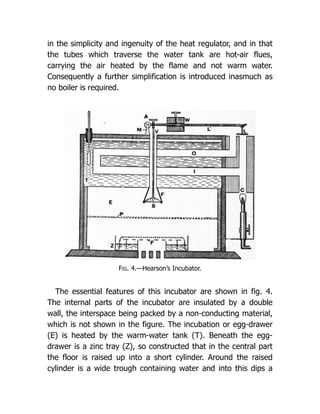
Fig. 4.—Hearson’s Incubator.
The essential features of this incubator are shown in fig. 4.
The internal parts of the incubator are insulated by a double
wall, the interspace being packed by a non-conducting material,
which is not shown in the figure. The incubation or egg-drawer
(E) is heated by the warm-water tank (T). Beneath the egg-
drawer is a zinc tray (Z), so constructed that in the central part
the floor is raised up into a short cylinder. Around the raised
cylinder is a wide trough containing water and into this dips a
36.
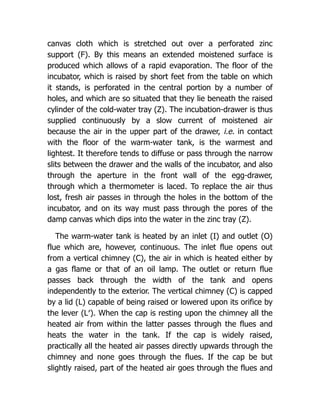
canvas cloth whichis stretched out over a perforated zinc
support (F). By this means an extended moistened surface is
produced which allows of a rapid evaporation. The floor of the
incubator, which is raised by short feet from the table on which
it stands, is perforated in the central portion by a number of
holes, and which are so situated that they lie beneath the raised
cylinder of the cold-water tray (Z). The incubation-drawer is thus
supplied continuously by a slow current of moistened air
because the air in the upper part of the drawer, i.e. in contact
with the floor of the warm-water tank, is the warmest and
lightest. It therefore tends to diffuse or pass through the narrow
slits between the drawer and the walls of the incubator, and also
through the aperture in the front wall of the egg-drawer,
through which a thermometer is laced. To replace the air thus
lost, fresh air passes in through the holes in the bottom of the
incubator, and on its way must pass through the pores of the
damp canvas which dips into the water in the zinc tray (Z).
The warm-water tank is heated by an inlet (I) and outlet (O)
flue which are, however, continuous. The inlet flue opens out
from a vertical chimney (C), the air in which is heated either by
a gas flame or that of an oil lamp. The outlet or return flue
passes back through the width of the tank and opens
independently to the exterior. The vertical chimney (C) is capped
by a lid (L) capable of being raised or lowered upon its orifice by
the lever (L′). When the cap is resting upon the chimney all the
heated air from within the latter passes through the flues and
heats the water in the tank. If the cap is widely raised,
practically all the heated air passes directly upwards through the
chimney and none goes through the flues. If the cap be but
slightly raised, part of the heated air goes through the flues and
37.
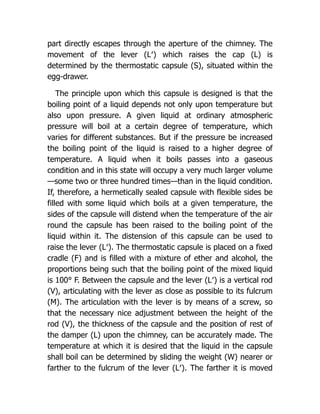
part directly escapesthrough the aperture of the chimney. The
movement of the lever (L′) which raises the cap (L) is
determined by the thermostatic capsule (S), situated within the
egg-drawer.
The principle upon which this capsule is designed is that the
boiling point of a liquid depends not only upon temperature but
also upon pressure. A given liquid at ordinary atmospheric
pressure will boil at a certain degree of temperature, which
varies for different substances. But if the pressure be increased
the boiling point of the liquid is raised to a higher degree of
temperature. A liquid when it boils passes into a gaseous
condition and in this state will occupy a very much larger volume
—some two or three hundred times—than in the liquid condition.
If, therefore, a hermetically sealed capsule with flexible sides be
filled with some liquid which boils at a given temperature, the
sides of the capsule will distend when the temperature of the air
round the capsule has been raised to the boiling point of the
liquid within it. The distension of this capsule can be used to
raise the lever (L′). The thermostatic capsule is placed on a fixed
cradle (F) and is filled with a mixture of ether and alcohol, the
proportions being such that the boiling point of the mixed liquid
is 100° F. Between the capsule and the lever (L′) is a vertical rod
(V), articulating with the lever as close as possible to its fulcrum
(M). The articulation with the lever is by means of a screw, so
that the necessary nice adjustment between the height of the
rod (V), the thickness of the capsule and the position of rest of
the damper (L) upon the chimney, can be accurately made. The
temperature at which it is desired that the liquid in the capsule
shall boil can be determined by sliding the weight (W) nearer or
farther to the fulcrum of the lever (L′). The farther it is moved
38.
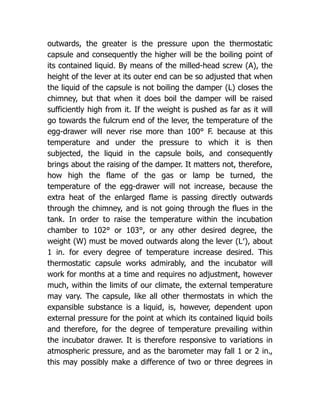
outwards, the greateris the pressure upon the thermostatic
capsule and consequently the higher will be the boiling point of
its contained liquid. By means of the milled-head screw (A), the
height of the lever at its outer end can be so adjusted that when
the liquid of the capsule is not boiling the damper (L) closes the
chimney, but that when it does boil the damper will be raised
sufficiently high from it. If the weight is pushed as far as it will
go towards the fulcrum end of the lever, the temperature of the
egg-drawer will never rise more than 100° F. because at this
temperature and under the pressure to which it is then
subjected, the liquid in the capsule boils, and consequently
brings about the raising of the damper. It matters not, therefore,
how high the flame of the gas or lamp be turned, the
temperature of the egg-drawer will not increase, because the
extra heat of the enlarged flame is passing directly outwards
through the chimney, and is not going through the flues in the
tank. In order to raise the temperature within the incubation
chamber to 102° or 103°, or any other desired degree, the
weight (W) must be moved outwards along the lever (L′), about
1 in. for every degree of temperature increase desired. This
thermostatic capsule works admirably, and the incubator will
work for months at a time and requires no adjustment, however
much, within the limits of our climate, the external temperature
may vary. The capsule, like all other thermostats in which the
expansible substance is a liquid, is, however, dependent upon
external pressure for the point at which its contained liquid boils
and therefore, for the degree of temperature prevailing within
the incubator drawer. It is therefore responsive to variations in
atmospheric pressure, and as the barometer may fall 1 or 2 in.,
this may possibly make a difference of two or three degrees in
39.
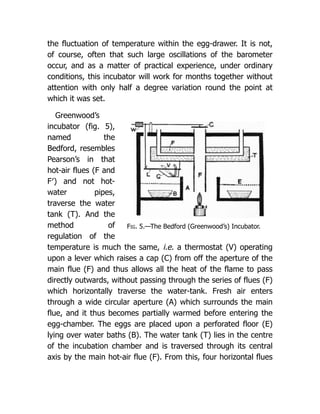
Fig. 5.—The Bedford(Greenwood’s) Incubator.
the fluctuation of temperature within the egg-drawer. It is not,
of course, often that such large oscillations of the barometer
occur, and as a matter of practical experience, under ordinary
conditions, this incubator will work for months together without
attention with only half a degree variation round the point at
which it was set.
Greenwood’s
incubator (fig. 5),
named the
Bedford, resembles
Pearson’s in that
hot-air flues (F and
F′) and not hot-
water pipes,
traverse the water
tank (T). And the
method of
regulation of the
temperature is much the same, i.e. a thermostat (V) operating
upon a lever which raises a cap (C) from off the aperture of the
main flue (F) and thus allows all the heat of the flame to pass
directly outwards, without passing through the series of flues (F)
which horizontally traverse the water-tank. Fresh air enters
through a wide circular aperture (A) which surrounds the main
flue, and it thus becomes partially warmed before entering the
egg-chamber. The eggs are placed upon a perforated floor (E)
lying over water baths (B). The water tank (T) lies in the centre
of the incubation chamber and is traversed through its central
axis by the main hot-air flue (F). From this, four horizontal flues
40.
pass outwards throughthe water and open into small vertical
flues, which in their turn communicate with the exterior.
The thermostat (V) consists of a glass tube of peculiar form.
This is closed at the end of its short limb and open at its other
extremity on the long limb. The bent portion of the tube is filled
with mercury and between the mercury column and the closed
end is a small quantity of ether. The thermostat is lodged in a
box (G), which forms part of the lever (L). At one end this lever
is pivoted to a fixed arm, and at the other to the vertical rod
which operates the ventilating cap (C). If the temperature
should rise, the ether in the thermostat expands and pushes the
mercury column up along the inclined long limb. This disturbs
the equilibrium of the lever (L), and it descends downwards,
pulling with it the vertical rod, and thus raising the cap over the
main flue. If the temperature falls the reverse series of changes
occur. The temperature at which the cap will be raised can be
adjusted within limits by the position of the weight (W) and by
the adjustment of the degree of inclination of the thermostat.
The Proctor incubator, made at Otley, is apparently, in its main
features, similar to the Greenwood.
41.
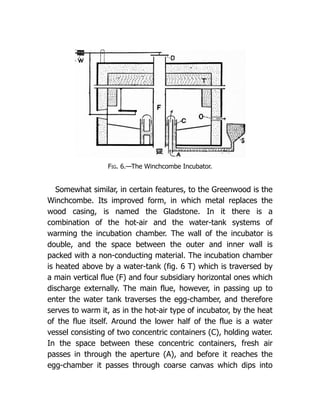
Fig. 6.—The WinchcombeIncubator.
Somewhat similar, in certain features, to the Greenwood is the
Winchcombe. Its improved form, in which metal replaces the
wood casing, is named the Gladstone. In it there is a
combination of the hot-air and the water-tank systems of
warming the incubation chamber. The wall of the incubator is
double, and the space between the outer and inner wall is
packed with a non-conducting material. The incubation chamber
is heated above by a water-tank (fig. 6 T) which is traversed by
a main vertical flue (F) and four subsidiary horizontal ones which
discharge externally. The main flue, however, in passing up to
enter the water tank traverses the egg-chamber, and therefore
serves to warm it, as in the hot-air type of incubator, by the heat
of the flue itself. Around the lower half of the flue is a water
vessel consisting of two concentric containers (C), holding water.
In the space between these concentric containers, fresh air
passes in through the aperture (A), and before it reaches the
egg-chamber it passes through coarse canvas which dips into
42.
the water inthe containers, and is therefore kept permanently
moist. The containers are filled from a water tank (S) outside
the incubator. Air passes out from the egg-chamber through the
aperture (O). The temperature is regulated by a bimetallic
thermostat (see below), which operates two levers, that by their
arrangement can raise or depress the cap (D) over the main flue
(F). The temperature at which this occurs will be determined,
within limits, by the position of the adjustable weight (W).
Tomlinson’s incubator, designed in 1880, is novel in principle.
It possesses a very large water tank, holding 15 gallons for
every hundred eggs. Through this tank there pass two hot-air
horizontal flues, lying in the same plane. The novelty of the
construction lies in the great volume of water used and in the
disposition of the flues towards the top of the tank. It is said
that very little circulation of water takes place beneath the flues,
because warmed water rises instead of falling. The great body of
water below the flues will therefore only take up heat relatively
slowly, and will, on account of its bulk and its physical
properties, but slowly lose it. Should the flame fall in power, or
even go out for ten or twelve hours, it is claimed that no serious
loss of efficiency of the apparatus will result.
Regulation of the temperature is by means of an air tube, the
air in which expanding bulges out an india-rubber diaphragm
and this moves a lever. The lever operates a valve which allows
more or less of the heated air to escape from the egg-drawer.
(b) Hot-air Incubators.—W. H. Hillier’s Incubator (fig. 7) is
circular in form and is constructed of a double-walled metal
case. The space between the two walls is packed with a non-
conducting material. The incubation or egg-chamber (C) is
43.
Welcome to ourwebsite – the perfect destination for book lovers and
knowledge seekers. We believe that every book holds a new world,
offering opportunities for learning, discovery, and personal growth.
That’s why we are dedicated to bringing you a diverse collection of
books, ranging from classic literature and specialized publications to
self-development guides and children's books.
More than just a book-buying platform, we strive to be a bridge
connecting you with timeless cultural and intellectual values. With an
elegant, user-friendly interface and a smart search system, you can
quickly find the books that best suit your interests. Additionally,
our special promotions and home delivery services help you save time
and fully enjoy the joy of reading.
Join us on a journey of knowledge exploration, passion nurturing, and
personal growth every day!
testbankfan.com