S
TEACHING READING
APPROACHES TO ENGLISH COLLEGE TEACHING
S Reading is defined as “the meaningful
interpretation of written or printed verbal
symbols and a result of interaction between
the perception of graphic symbols that
represent language and the reader’s
language skills, cognitive skill, and
knowledge of the world (Albert. J. et al as
cited in Thao Le Thanh, 2010).
S Moreover, Rumptz (2003) explains this in
his words “Reading is a complex process.
It involves visual action in analyzing
printed letters, and then identifying these
letters as the components of words, until
reaching the interpretation of the meaning
of these words”.
READING
COMPREHENSION
According to Seyed et al (2010), the word
comprehension refers to “the ability to go beyond
the words, to understand the ideas conveyed in
the entire text”
 Furthermore, Snow (2002) sees that reading
comprehension refers to “the simultaneous
ability used by a reader to construct and extract
meaning through interaction and involvement
with written materials”
Reading comprehension
is the process of
extracting meaning from
text.
SIMULTANEOUS
APPLICATION OF SKILLS
 IDENTIFYING THE AUTHOR’S
MOOD AND PURPOSE
 IDENTIFYING MAIN IDEAS
 USING CONTEXT CLUES
 DECODING MEANING, ANALYSIS
AND EVALUATION
CHARACTERISTICS OF
READING
1. LANGUAGE SKILL
2. TWO-WAY PROCESS
3. VISUAL
4. RECEPTIVE PROCESS
5. WRITING FOUNDATION
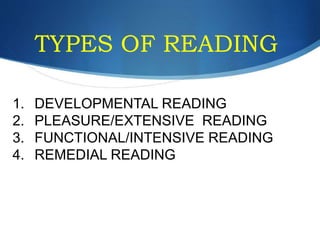
TYPES OF READING
1. DEVELOPMENTAL READING
2. PLEASURE/EXTENSIVE READING
3. FUNCTIONAL/INTENSIVE READING
4. REMEDIAL READING
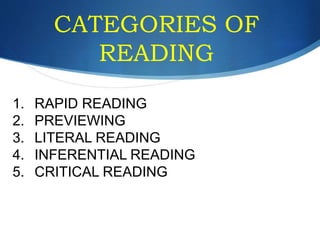
CATEGORIES OF
READING
1. RAPID READING
2. PREVIEWING
3. LITERAL READING
4. INFERENTIAL READING
5. CRITICAL READING
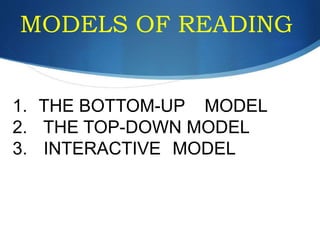
MODELS OF READING
1. THE BOTTOM-UP MODEL
2. THE TOP-DOWN MODEL
3. INTERACTIVE MODEL
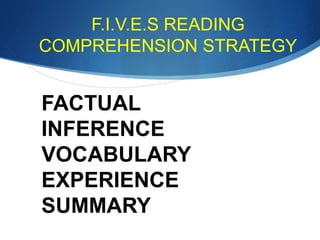
F.I.V.E.S READING
COMPREHENSION STRATEGY
FACTUAL
INFERENCE
VOCABULARY
EXPERIENCE
SUMMARY
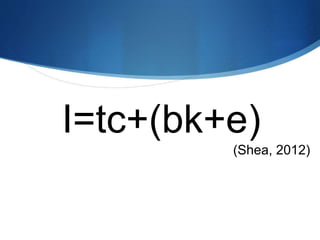
I=tc+(bk+e)
(Shea, 2012)

Teaching Reading