ENGLISH
REGISTER
(ENGLISH 28)
MR. RYAN JIMENEZ, MAELS
Class Schedule: Tue/Fri (2:30-4:00 P.M.
5. Farewell, and godspeed.
1. Goodbye. We
look forward to
seeing you again.
4. Goodbye. Have
a good weekend.
2. Bye now – take care.
3. later, darlin’.
1. Farewell, and godspeed.
2. Goodbye. We
look forward to
seeing you again.
3. Goodbye. Have
a good weekend.
4. Bye now – take care.
5. later, darlin’.
ENGLISH
REGISTER
In Language Usage
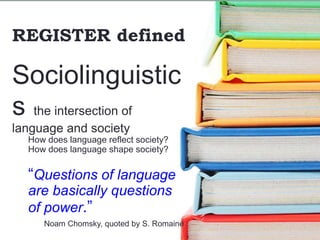
Sociolinguistic
s the intersection of
language and society
How does language reflect society?
How does language shape society?
“Questions of language
are basically questions
of power.”
Noam Chomsky, quoted by S. Romaine
REGISTER defined
A simple observation:
In different
situations, people
use different forms
of language.
Depending on the situation,
we use
different words and phrases
For example, to refer to death:
died, passed away, passed, passed on, moved on,
expired, croaked, bought the farm, passed from life temporal
to life spiritual, went to meet her Maker, be taken, meet
one’s end, perish
different grammatical patterns
Gimme a dime.
Could I trouble you for the time?
Do call me.
Social setting
Situation
Addressor
Addressee
Topic
who, what, when,
where
The concept of register is
typically concerned with
variations in language
conditioned by uses rather
than users and involves
consideration of the situation
or context of use, the purpose,
subject-matter and content of
the message, and the
relationship between the
participants. (ROMAINE, 1994)
How do you decide which
language register is appropriate
to use?
Deciding which
language
register is
appropriate
depends on
the:
How do you decide which
language register is appropriate
to use?
Deciding which
language
register is
appropriate
depends on
the:
oAudience
oTopic
oSituation
5 LANGUAGE
REGISTERS
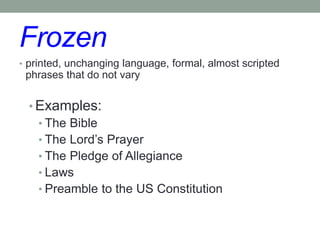
Frozen
• printed, unchanging language, formal, almost scripted
phrases that do not vary
• Examples:
• The Bible
• The Lord’s Prayer
• The Pledge of Allegiance
• Laws
• Preamble to the US Constitution
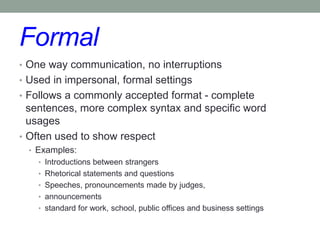
Formal
• One way communication, no interruptions
• Used in impersonal, formal settings
• Follows a commonly accepted format - complete
sentences, more complex syntax and specific word
usages
• Often used to show respect
• Examples:
• Introductions between strangers
• Rhetorical statements and questions
• Speeches, pronouncements made by judges,
• announcements
• standard for work, school, public offices and business settings
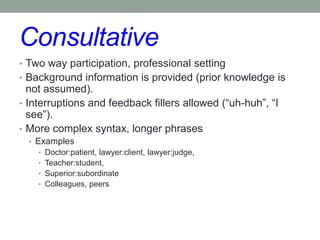
Consultative
• Two way participation, professional setting
• Background information is provided (prior knowledge is
not assumed).
• Interruptions and feedback fillers allowed (“uh-huh”, “I
see”).
• More complex syntax, longer phrases
• Examples
• Doctor:patient, lawyer:client, lawyer:judge,
• Teacher:student,
• Superior:subordinate
• Colleagues, peers
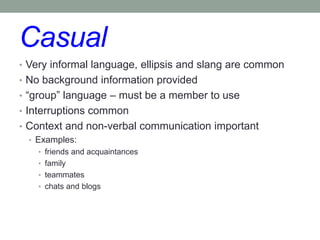
Casual
• Very informal language, ellipsis and slang are common
• No background information provided
• “group” language – must be a member to use
• Interruptions common
• Context and non-verbal communication important
• Examples:
• friends and acquaintances
• family
• teammates
• chats and blogs
Intimate
• Non-public
• Intonation as important as wording and grammar
• Often a private vocabulary
• Examples:
• husband, wife
• boyfriend/girlfriend
• twins (siblings)
• pets, I would also add
Interesting to note here, this is the
language of sexual harassment as well.
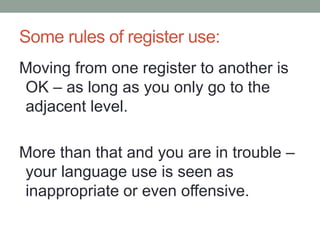
Some rules of register use:
Moving from one register to another is
OK – as long as you only go to the
adjacent level.
More than that and you are in trouble –
your language use is seen as
inappropriate or even offensive.
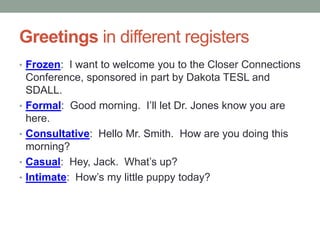
Greetings in different registers
• Frozen: I want to welcome you to the Closer Connections
Conference, sponsored in part by Dakota TESL and
SDALL.
• Formal: Good morning. I’ll let Dr. Jones know you are
here.
• Consultative: Hello Mr. Smith. How are you doing this
morning?
• Casual: Hey, Jack. What’s up?
• Intimate: How’s my little puppy today?
Requests in different registers
• Frozen: Please submit the information at your earliest
convenience.
• Formal: Could you possibly type this up for me by
tomorrow?
• Consultative: Can you finish this after lunch?
• Casual: Watch the door for me, OK?
• Intimate: Hey, darlin’, pour me a cuppa joe.
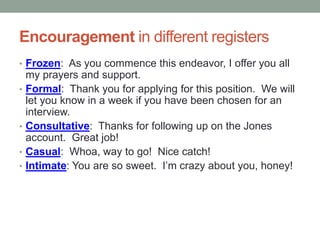
Encouragement in different registers
• Frozen: As you commence this endeavor, I offer you all
my prayers and support.
• Formal: Thank you for applying for this position. We will
let you know in a week if you have been chosen for an
interview.
• Consultative: Thanks for following up on the Jones
account. Great job!
• Casual: Whoa, way to go! Nice catch!
• Intimate: You are so sweet. I’m crazy about you, honey!
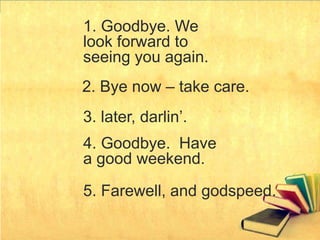
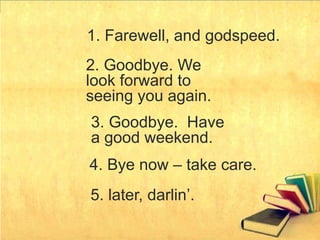
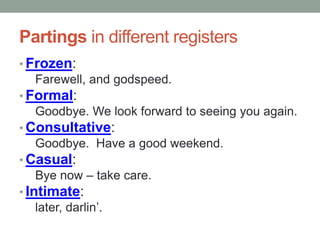
Partings in different registers
• Frozen:
Farewell, and godspeed.
• Formal:
Goodbye. We look forward to seeing you again.
• Consultative:
Goodbye. Have a good weekend.
• Casual:
Bye now – take care.
• Intimate:
later, darlin’.
ENGLISH
REGISTER
(ENGLISH 28)
MR. RYAN JIMENEZ, MAELS
Class Schedule: Tue/Fri (2:30-4:00 P.M.

Types of Language Registers

  • 1.
    ENGLISH REGISTER (ENGLISH 28) MR. RYANJIMENEZ, MAELS Class Schedule: Tue/Fri (2:30-4:00 P.M.
  • 2.
    5. Farewell, andgodspeed. 1. Goodbye. We look forward to seeing you again. 4. Goodbye. Have a good weekend. 2. Bye now – take care. 3. later, darlin’.
  • 3.
    1. Farewell, andgodspeed. 2. Goodbye. We look forward to seeing you again. 3. Goodbye. Have a good weekend. 4. Bye now – take care. 5. later, darlin’.
  • 5.
  • 6.
    Sociolinguistic s the intersectionof language and society How does language reflect society? How does language shape society? “Questions of language are basically questions of power.” Noam Chomsky, quoted by S. Romaine REGISTER defined
  • 7.
    A simple observation: Indifferent situations, people use different forms of language.
  • 8.
    Depending on thesituation, we use different words and phrases For example, to refer to death: died, passed away, passed, passed on, moved on, expired, croaked, bought the farm, passed from life temporal to life spiritual, went to meet her Maker, be taken, meet one’s end, perish different grammatical patterns Gimme a dime. Could I trouble you for the time? Do call me.
  • 9.
  • 10.
    The concept ofregister is typically concerned with variations in language conditioned by uses rather than users and involves consideration of the situation or context of use, the purpose, subject-matter and content of the message, and the relationship between the participants. (ROMAINE, 1994)
  • 11.
    How do youdecide which language register is appropriate to use? Deciding which language register is appropriate depends on the:
  • 12.
    How do youdecide which language register is appropriate to use? Deciding which language register is appropriate depends on the: oAudience oTopic oSituation
  • 13.
  • 14.
    Frozen • printed, unchanginglanguage, formal, almost scripted phrases that do not vary • Examples: • The Bible • The Lord’s Prayer • The Pledge of Allegiance • Laws • Preamble to the US Constitution
  • 15.
    Formal • One waycommunication, no interruptions • Used in impersonal, formal settings • Follows a commonly accepted format - complete sentences, more complex syntax and specific word usages • Often used to show respect • Examples: • Introductions between strangers • Rhetorical statements and questions • Speeches, pronouncements made by judges, • announcements • standard for work, school, public offices and business settings
  • 16.
    Consultative • Two wayparticipation, professional setting • Background information is provided (prior knowledge is not assumed). • Interruptions and feedback fillers allowed (“uh-huh”, “I see”). • More complex syntax, longer phrases • Examples • Doctor:patient, lawyer:client, lawyer:judge, • Teacher:student, • Superior:subordinate • Colleagues, peers
  • 17.
    Casual • Very informallanguage, ellipsis and slang are common • No background information provided • “group” language – must be a member to use • Interruptions common • Context and non-verbal communication important • Examples: • friends and acquaintances • family • teammates • chats and blogs
  • 18.
    Intimate • Non-public • Intonationas important as wording and grammar • Often a private vocabulary • Examples: • husband, wife • boyfriend/girlfriend • twins (siblings) • pets, I would also add Interesting to note here, this is the language of sexual harassment as well.
  • 19.
    Some rules ofregister use: Moving from one register to another is OK – as long as you only go to the adjacent level. More than that and you are in trouble – your language use is seen as inappropriate or even offensive.
  • 20.
    Greetings in differentregisters • Frozen: I want to welcome you to the Closer Connections Conference, sponsored in part by Dakota TESL and SDALL. • Formal: Good morning. I’ll let Dr. Jones know you are here. • Consultative: Hello Mr. Smith. How are you doing this morning? • Casual: Hey, Jack. What’s up? • Intimate: How’s my little puppy today?
  • 21.
    Requests in differentregisters • Frozen: Please submit the information at your earliest convenience. • Formal: Could you possibly type this up for me by tomorrow? • Consultative: Can you finish this after lunch? • Casual: Watch the door for me, OK? • Intimate: Hey, darlin’, pour me a cuppa joe.
  • 22.
    Encouragement in differentregisters • Frozen: As you commence this endeavor, I offer you all my prayers and support. • Formal: Thank you for applying for this position. We will let you know in a week if you have been chosen for an interview. • Consultative: Thanks for following up on the Jones account. Great job! • Casual: Whoa, way to go! Nice catch! • Intimate: You are so sweet. I’m crazy about you, honey!
  • 23.
    Partings in differentregisters • Frozen: Farewell, and godspeed. • Formal: Goodbye. We look forward to seeing you again. • Consultative: Goodbye. Have a good weekend. • Casual: Bye now – take care. • Intimate: later, darlin’.
  • 24.
    ENGLISH REGISTER (ENGLISH 28) MR. RYANJIMENEZ, MAELS Class Schedule: Tue/Fri (2:30-4:00 P.M.