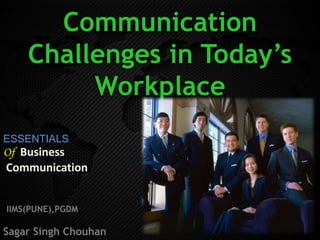



Communication
Challenges in Today’s
Workplace
IIMS(PUNE),PGDM
Sagar Singh Chouhan
ESSENTIALS
Of Business
Communication
Career Success Begins
With Communication Skills
“If I went back to college again, I’d
concentrate on two areas: learning to write
and to speak before an audience. Nothing in
life is more important than the ability to
communicate effectively.”
Gerald R. Ford
38th President of USA
Writing skills are increasingly significant.
"Businesses are crying out—they need to have
people who write better.”
Bill Gates
Ten Misconceptions About Listening
1. Listening is a matter of intelligence.
FACT: Careful listening is a learned behavior.
2. Speaking is more important than listening in
the communication process.
FACT: Speaking and listening are equally
important.
3. Listening is easy and requires little energy.
FACT: Active listeners undergo the same
physiological changes as a person jogging.
4. Listening and hearing are the same process.
FACT: Listening is a conscious, selective
process. Hearing is an involuntary act.
Ten Misconceptions About Listening
5. Speakers are able to command listening.
FACT: Speakers cannot make a person
really listen.
6. Hearing ability determines listening ability.
FACT: Listening happens mentally—
between the ears.
Ten Misconceptions About Listening
7. Speakers are totally responsible for
communication success.
FACT: Communication is a two-way street.
8. Listening is only a matter of understanding
a speaker’s words.
FACT: Nonverbal signals also help listeners
gain understanding.
Ten Misconceptions About Listening
9. Daily practice eliminates the need for
listening training.
FACT: Without effective listening training,
most practice merely reinforces negative
behaviors.
10. Competence in listening develops naturally.
FACT: Untrained people listen at only 25
percent efficiency.
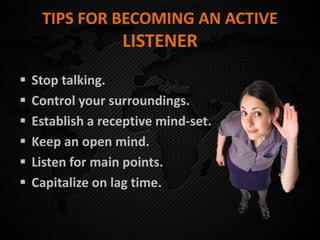
TIPS FOR BECOMING AN ACTIVE
LISTENER
 Stop talking.
 Control your surroundings.
 Establish a receptive mind-set.
 Keep an open mind.
 Listen for main points.
 Capitalize on lag time.
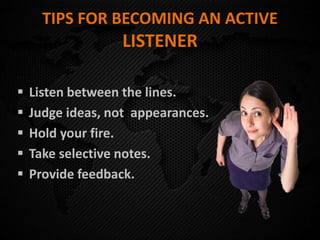
TIPS FOR BECOMING AN ACTIVE
LISTENER
 Listen between the lines.
 Judge ideas, not appearances.
 Hold your fire.
 Take selective notes.
 Provide feedback.
Barriers That Create
Misunderstandings
 Bypassing
 Poor listening skills
 Differing frames of reference
 Lack of language skills
 Emotional interference
 Physical distractions
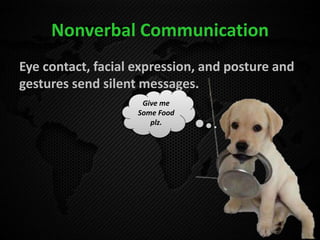
Nonverbal Communication
Eye contact, facial expression, and posture and
gestures send silent messages.
Give me
Some Food
plz.
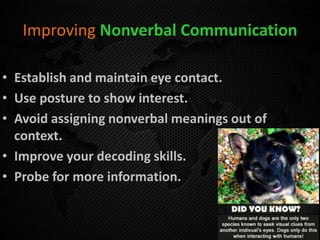
Improving Nonverbal Communication
• Establish and maintain eye contact.
• Use posture to show interest.
• Avoid assigning nonverbal meanings out of
context.
• Improve your decoding skills.
• Probe for more information.
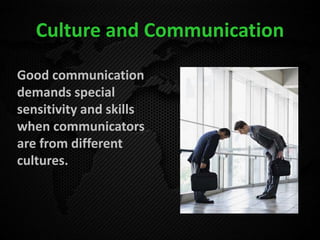
Culture and Communication
Good communication
demands special
sensitivity and skills
when communicators
are from different
cultures.
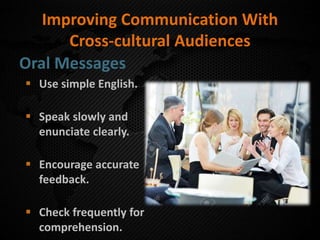
Improving Communication With
Cross-cultural Audiences
Oral Messages
 Use simple English.
 Speak slowly and
enunciate clearly.
 Encourage accurate
feedback.
 Check frequently for
comprehension.
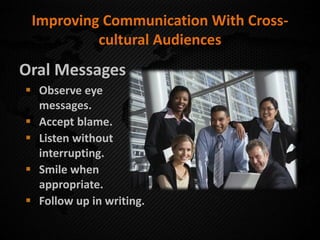
Improving Communication With Cross-
cultural Audiences
Oral Messages
 Observe eye
messages.
 Accept blame.
 Listen without
interrupting.
 Smile when
appropriate.
 Follow up in writing.
©Creatas/PhotolibraryGroup/IndexStockImagery
Communication challenges in today’s workplace

Communication challenges in today’s workplace

  • 1.
    Communication Challenges in Today’s Workplace IIMS(PUNE),PGDM SagarSingh Chouhan ESSENTIALS Of Business Communication
  • 2.
    Career Success Begins WithCommunication Skills “If I went back to college again, I’d concentrate on two areas: learning to write and to speak before an audience. Nothing in life is more important than the ability to communicate effectively.” Gerald R. Ford 38th President of USA
  • 3.
    Writing skills areincreasingly significant. "Businesses are crying out—they need to have people who write better.” Bill Gates
  • 4.
    Ten Misconceptions AboutListening 1. Listening is a matter of intelligence. FACT: Careful listening is a learned behavior. 2. Speaking is more important than listening in the communication process. FACT: Speaking and listening are equally important.
  • 5.
    3. Listening iseasy and requires little energy. FACT: Active listeners undergo the same physiological changes as a person jogging. 4. Listening and hearing are the same process. FACT: Listening is a conscious, selective process. Hearing is an involuntary act. Ten Misconceptions About Listening
  • 6.
    Ten Misconceptions AboutListening 5. Speakers are able to command listening. FACT: Speakers cannot make a person really listen. 6. Hearing ability determines listening ability. FACT: Listening happens mentally— between the ears.
  • 7.
    Ten Misconceptions AboutListening 7. Speakers are totally responsible for communication success. FACT: Communication is a two-way street. 8. Listening is only a matter of understanding a speaker’s words. FACT: Nonverbal signals also help listeners gain understanding.
  • 8.
    Ten Misconceptions AboutListening 9. Daily practice eliminates the need for listening training. FACT: Without effective listening training, most practice merely reinforces negative behaviors. 10. Competence in listening develops naturally. FACT: Untrained people listen at only 25 percent efficiency.
  • 9.
    TIPS FOR BECOMINGAN ACTIVE LISTENER  Stop talking.  Control your surroundings.  Establish a receptive mind-set.  Keep an open mind.  Listen for main points.  Capitalize on lag time.
  • 10.
    TIPS FOR BECOMINGAN ACTIVE LISTENER  Listen between the lines.  Judge ideas, not appearances.  Hold your fire.  Take selective notes.  Provide feedback.
  • 11.
    Barriers That Create Misunderstandings Bypassing  Poor listening skills  Differing frames of reference  Lack of language skills  Emotional interference  Physical distractions
  • 12.
    Nonverbal Communication Eye contact,facial expression, and posture and gestures send silent messages. Give me Some Food plz.
  • 13.
    Improving Nonverbal Communication •Establish and maintain eye contact. • Use posture to show interest. • Avoid assigning nonverbal meanings out of context. • Improve your decoding skills. • Probe for more information.
  • 14.
    Culture and Communication Goodcommunication demands special sensitivity and skills when communicators are from different cultures.
  • 15.
    Improving Communication With Cross-culturalAudiences Oral Messages  Use simple English.  Speak slowly and enunciate clearly.  Encourage accurate feedback.  Check frequently for comprehension.
  • 16.
    Improving Communication WithCross- cultural Audiences Oral Messages  Observe eye messages.  Accept blame.  Listen without interrupting.  Smile when appropriate.  Follow up in writing. ©Creatas/PhotolibraryGroup/IndexStockImagery