Refrigerant Recovery-
What and Why?
The Ozone Layer Under Chemical Attack
According to EPA sources, 30 percent of all CFCs released into the
atmosphere come from mobile air conditioners. Some of the refrigerant
leaks out, of course, but the majority of CFC releases occur during air
conditioning service and repair. This means that you have direct control
over its release and must recover and recycle to prevent this from
happening.
Sagar Singh Chouhan
KDK College of Engineering, Nagpur
Introduction:
We introduce a new series of professional recovery system. The
recovery system are compact, lightweight and work with all
refrigerants. They are ideal for commercial, residential or
industrial appliance applications. As we know our refrigerant
system work refrigeration cycle which contains refrigerant and
that refrigerant contains harmful chemicals like
chlorofluorocarbons (CFCs). And if our system gets breakdown
we usually gives it to mechanic who releases the refrigerant in
atmosphere which is very harmful to human being as well as for
atmospheric conditions i.e : Ozone layer depletion. So our aim is
to recover that refrigerant filter it and reuse it again and again
with help of REFRIGERANT RECOVERY UNIT with no loss as we
are saving our environment.
Chemicals which responsible for
destroying OZONE layer
• CFC (Chlorofluorocarbon)
• HCFC (Hydrochlorofluorcarbons)
• HFC (Hydrofluorocarbons)
• HC (Hydrocarbons)
CFCs & HCFCs
– because they destroy ozone and cause
climate change.
HFCs
– because they cause climate change.
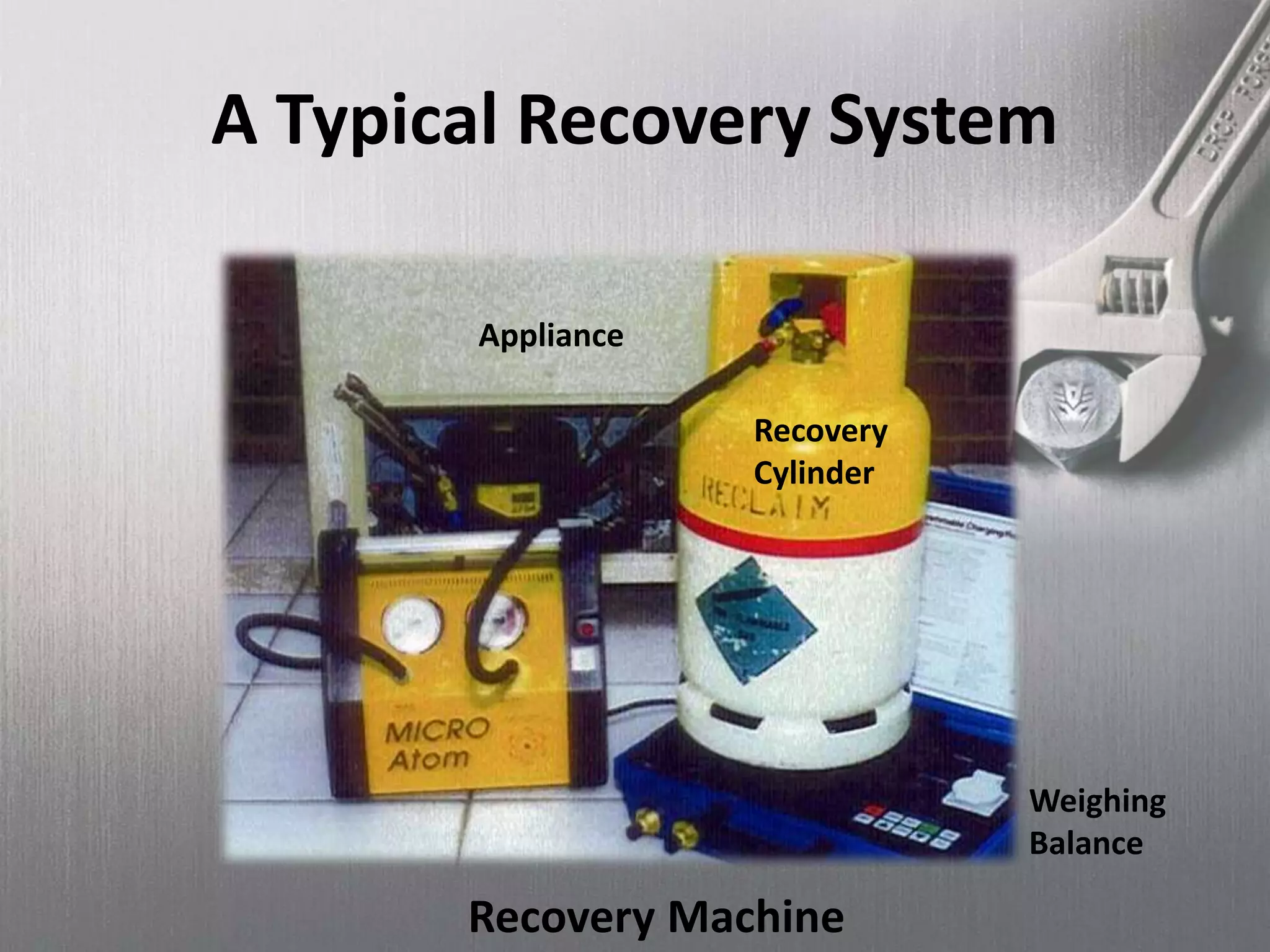
A Typical Recovery System
Recovery
Cylinder
Appliance
Weighing
Balance
Recovery Machine
Recovery Procedure
• Connect appliance to recovery machine inlet
• Connect recovery machine outlet to cylinder
– Weigh cylinder
• Open valves and start machine
• Recover until:
– sufficient amount, if appliance is serviced
– as low as possible, if appliance is scrapped
• Stop machine and close valves
International Experience
• In many countries, law doesn’t permit venting
of refrigerants
• Refrigerants have to be recovered and recycled
or recovered and destroyed
• Most R&R systems are certified
• In developed countries:
– Most CFCs, HCFCs & HFCs are recovered
– Most technicians have/ share recovery
machines
– There exist many recycling centres
Making a Recovery Machine
• Components required
• Assembling the machine
• Operation
• Maintenance and reliability
Components needed
• condensing unit
• pressure switches
• shut off valves
• fittings and pipings
• on / off switch
• drier
Operation & Maintenance
• Have separate recovery machine for
each refrigerant
• Use with correct refrigerant
• Do not allow liquid into machine
Objectives
• Refrigerant recovery systems all work using a vacuum or
compression pump.
• Depending on the type of recovery apparatus, there may also
b filters in this line before it enters the recovery tank.
• A vacuum pump pulls the refrigerant out of the donor’s
compressor and into the recovery tank.
• Some recovery machine actually contain compressor rather
than simple vacuum pumps that essentially enlarge the
compression cycle to draw the refrigerant out into the
recovery tank.
• A refrigerant recovery machine is a device which can b used
to remove refrigerant from a cooling system such as freezer,
refrigerator, or air conditioning system.

Refrigerant Recovery system part 1

  • 1.
    Refrigerant Recovery- What andWhy? The Ozone Layer Under Chemical Attack According to EPA sources, 30 percent of all CFCs released into the atmosphere come from mobile air conditioners. Some of the refrigerant leaks out, of course, but the majority of CFC releases occur during air conditioning service and repair. This means that you have direct control over its release and must recover and recycle to prevent this from happening. Sagar Singh Chouhan KDK College of Engineering, Nagpur
  • 2.
    Introduction: We introduce anew series of professional recovery system. The recovery system are compact, lightweight and work with all refrigerants. They are ideal for commercial, residential or industrial appliance applications. As we know our refrigerant system work refrigeration cycle which contains refrigerant and that refrigerant contains harmful chemicals like chlorofluorocarbons (CFCs). And if our system gets breakdown we usually gives it to mechanic who releases the refrigerant in atmosphere which is very harmful to human being as well as for atmospheric conditions i.e : Ozone layer depletion. So our aim is to recover that refrigerant filter it and reuse it again and again with help of REFRIGERANT RECOVERY UNIT with no loss as we are saving our environment.
  • 3.
    Chemicals which responsiblefor destroying OZONE layer • CFC (Chlorofluorocarbon) • HCFC (Hydrochlorofluorcarbons) • HFC (Hydrofluorocarbons) • HC (Hydrocarbons) CFCs & HCFCs – because they destroy ozone and cause climate change. HFCs – because they cause climate change.
  • 4.
    A Typical RecoverySystem Recovery Cylinder Appliance Weighing Balance Recovery Machine
  • 5.
    Recovery Procedure • Connectappliance to recovery machine inlet • Connect recovery machine outlet to cylinder – Weigh cylinder • Open valves and start machine • Recover until: – sufficient amount, if appliance is serviced – as low as possible, if appliance is scrapped • Stop machine and close valves
  • 6.
    International Experience • Inmany countries, law doesn’t permit venting of refrigerants • Refrigerants have to be recovered and recycled or recovered and destroyed • Most R&R systems are certified • In developed countries: – Most CFCs, HCFCs & HFCs are recovered – Most technicians have/ share recovery machines – There exist many recycling centres
  • 7.
    Making a RecoveryMachine • Components required • Assembling the machine • Operation • Maintenance and reliability
  • 8.
    Components needed • condensingunit • pressure switches • shut off valves • fittings and pipings • on / off switch • drier
  • 9.
    Operation & Maintenance •Have separate recovery machine for each refrigerant • Use with correct refrigerant • Do not allow liquid into machine
  • 10.
    Objectives • Refrigerant recoverysystems all work using a vacuum or compression pump. • Depending on the type of recovery apparatus, there may also b filters in this line before it enters the recovery tank. • A vacuum pump pulls the refrigerant out of the donor’s compressor and into the recovery tank. • Some recovery machine actually contain compressor rather than simple vacuum pumps that essentially enlarge the compression cycle to draw the refrigerant out into the recovery tank. • A refrigerant recovery machine is a device which can b used to remove refrigerant from a cooling system such as freezer, refrigerator, or air conditioning system.