Communication & Networks
Part - 1
MR. RAJASEKAR RAMALINGAM
LECTURER – DEPARTMENT OF INFORMATION TECHNOLOGY,
COLLEGE OF APPLIED SCIENCES – SUR,
SULTANATE OF OMAN.
In this lecture…
 Computers in communications
 Advantages of using networks
 Network scale
 Network architecture
 Network topology
 Ethernet and Bluetooth
2
Computer communications
 Home
 Office
 School
 Café
 Wireless hotspot
 Anywhere!
3
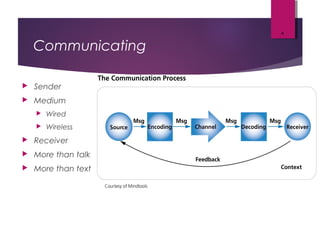
Communicating
 Sender
 Medium
 Wired
 Wireless
 Receiver
 More than talk
 More than text
4
Networks
 "Collection of computers and devices
connected together using communication
devices and transmission media“
 Any device connected to a network (wired or
wireless) is called a node
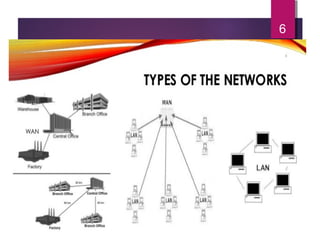
 The next slide has a diagram from the text
showing advantages of using networks
5
6
Network Scale
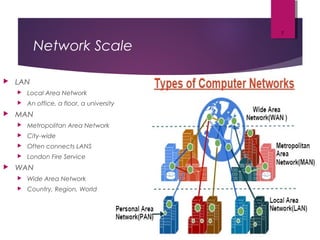
 LAN
 Local Area Network
 An office, a floor, a university
 MAN
 Metropolitan Area Network
 City-wide
 Often connects LANS
 London Fire Service
 WAN
 Wide Area Network
 Country, Region, World
7
Network Architecture
Client-Server
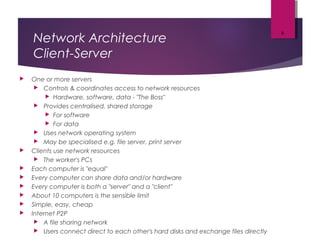
 One or more servers
 Controls & coordinates access to network resources
 Hardware, software, data - "The Boss"
 Provides centralised, shared storage
 For software
 For data
 Uses network operating system
 May be specialised e.g. file server, print server
 Clients use network resources
 The worker's PCs
 Each computer is "equal"
 Every computer can share data and/or hardware
 Every computer is both a "server" and a "client"
 About 10 computers is the sensible limit
 Simple, easy, cheap
 Internet P2P
 A file sharing network
 Users connect direct to each other's hard disks and exchange files directly
8
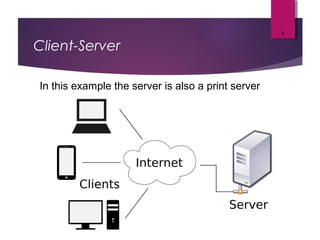
Client-Server
9
In this example the server is also a print server
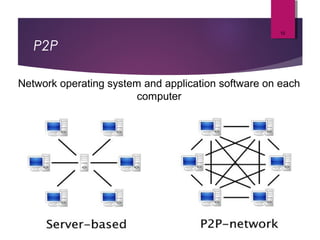
P2P
10
Network operating system and application software on each
computer
Network topology
 The layout of the network
 Bus network
 Nodes connected to a single central cable (the bus)
 Inexpensive, easy to install
 Easy to connect/disconnect nodes without disruption
 Problems if the bus fails!
11
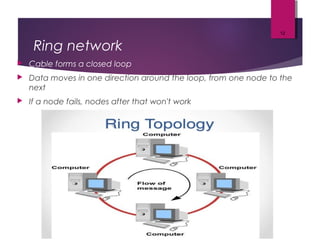
Ring network
 Cable forms a closed loop
 Data moves in one direction around the loop, from one node to the
next
 If a node fails, nodes after that won't work
12
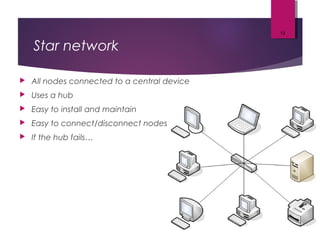
Star network
 All nodes connected to a central device
 Uses a hub
 Easy to install and maintain
 Easy to connect/disconnect nodes
 If the hub fails…
13
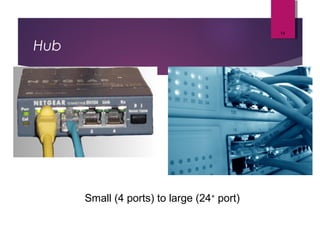
Hub
14
Small (4 ports) to large (24+
port)
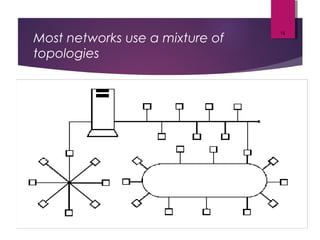
Most networks use a mixture of
topologies
15
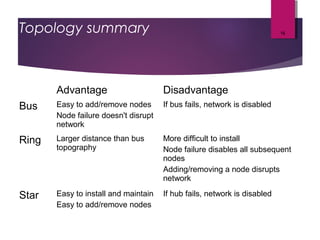
Topology summary
Advantage Disadvantage
Bus Easy to add/remove nodes
Node failure doesn't disrupt
network
If bus fails, network is disabled
Ring Larger distance than bus
topography
More difficult to install
Node failure disables all subsequent
nodes
Adding/removing a node disrupts
network
Star Easy to install and maintain
Easy to add/remove nodes
If hub fails, network is disabled
16
Communication standards
 Allow different devices to "talk" to each other
 Example - PC, Apple, mobile phone
 Allow different networks to "talk" to each other
 Example - LAN, WAN, wired and wireless
 A standard that outlines how network devices
communicate is called a protocol
 The language that is used to communicate
 Examples include TCP/IP (in OMINT103), Ethernet
and Bluetooth
17
Ethernet
 A networking standard
 Based on bus topology, but also used for star
 Specifies physical configuration
 Cabling, network cards, nodes etc
 Popular - inexpensive, relatively easy to maintain
 Often uses cable as transmission media
18
Bluetooth
 A network protocol
 Defines how Bluetooth devices use short-range radio
devices to transmit data
 Speeds up to 2 Mbps
 Over distances of up to 10m
 Devices require a built-in Bluetooth chip, or a plug-in
Bluetooth adapter
 Examples - wireless mouse, sync PC and mobile
phone, phone and headset.
19

Communication and networks Part 1

  • 1.
    Communication & Networks Part- 1 MR. RAJASEKAR RAMALINGAM LECTURER – DEPARTMENT OF INFORMATION TECHNOLOGY, COLLEGE OF APPLIED SCIENCES – SUR, SULTANATE OF OMAN.
  • 2.
    In this lecture… Computers in communications  Advantages of using networks  Network scale  Network architecture  Network topology  Ethernet and Bluetooth 2
  • 3.
    Computer communications  Home Office  School  Café  Wireless hotspot  Anywhere! 3
  • 4.
    Communicating  Sender  Medium Wired  Wireless  Receiver  More than talk  More than text 4
  • 5.
    Networks  "Collection ofcomputers and devices connected together using communication devices and transmission media“  Any device connected to a network (wired or wireless) is called a node  The next slide has a diagram from the text showing advantages of using networks 5
  • 6.
  • 7.
    Network Scale  LAN Local Area Network  An office, a floor, a university  MAN  Metropolitan Area Network  City-wide  Often connects LANS  London Fire Service  WAN  Wide Area Network  Country, Region, World 7
  • 8.
    Network Architecture Client-Server  Oneor more servers  Controls & coordinates access to network resources  Hardware, software, data - "The Boss"  Provides centralised, shared storage  For software  For data  Uses network operating system  May be specialised e.g. file server, print server  Clients use network resources  The worker's PCs  Each computer is "equal"  Every computer can share data and/or hardware  Every computer is both a "server" and a "client"  About 10 computers is the sensible limit  Simple, easy, cheap  Internet P2P  A file sharing network  Users connect direct to each other's hard disks and exchange files directly 8
  • 9.
    Client-Server 9 In this examplethe server is also a print server
  • 10.
    P2P 10 Network operating systemand application software on each computer
  • 11.
    Network topology  Thelayout of the network  Bus network  Nodes connected to a single central cable (the bus)  Inexpensive, easy to install  Easy to connect/disconnect nodes without disruption  Problems if the bus fails! 11
  • 12.
    Ring network  Cableforms a closed loop  Data moves in one direction around the loop, from one node to the next  If a node fails, nodes after that won't work 12
  • 13.
    Star network  Allnodes connected to a central device  Uses a hub  Easy to install and maintain  Easy to connect/disconnect nodes  If the hub fails… 13
  • 14.
    Hub 14 Small (4 ports)to large (24+ port)
  • 15.
    Most networks usea mixture of topologies 15
  • 16.
    Topology summary Advantage Disadvantage BusEasy to add/remove nodes Node failure doesn't disrupt network If bus fails, network is disabled Ring Larger distance than bus topography More difficult to install Node failure disables all subsequent nodes Adding/removing a node disrupts network Star Easy to install and maintain Easy to add/remove nodes If hub fails, network is disabled 16
  • 17.
    Communication standards  Allowdifferent devices to "talk" to each other  Example - PC, Apple, mobile phone  Allow different networks to "talk" to each other  Example - LAN, WAN, wired and wireless  A standard that outlines how network devices communicate is called a protocol  The language that is used to communicate  Examples include TCP/IP (in OMINT103), Ethernet and Bluetooth 17
  • 18.
    Ethernet  A networkingstandard  Based on bus topology, but also used for star  Specifies physical configuration  Cabling, network cards, nodes etc  Popular - inexpensive, relatively easy to maintain  Often uses cable as transmission media 18
  • 19.
    Bluetooth  A networkprotocol  Defines how Bluetooth devices use short-range radio devices to transmit data  Speeds up to 2 Mbps  Over distances of up to 10m  Devices require a built-in Bluetooth chip, or a plug-in Bluetooth adapter  Examples - wireless mouse, sync PC and mobile phone, phone and headset. 19

Editor's Notes

  • #16 Ask students to identify bus, ring and star topologies
  • #20 Explain meaning of "Mbps"