What is Communal Violence
Communal violence involves people belonging to
two different religious or ethnic communities mobilized
against each other and carrying the feelings of hostility,
emotional fury, exploitation, social discrimination and
social neglect. The high degree of cohesion in one
community against another is built around tension and
polarization. The targets of attack are the members of the
‘enemy’ community. Generally, there is no leadership in
communal riots which could effectively control and contain
the riot situation. It could thus be said that communal
violence is based mainly on hatred, enmity and revenge.
Factors Responsible For Communal
Violence
i. Historical Factors:
The history of Partition and the two-nation theory have generated a
deep sense of communalism and lack of mutual trust among both the
communities. It discouraged a harmonious association and peaceful
co-existence.
ii. Political Factors:
Divide and rule policy practiced by the British and the subsequent
vote-bank politics followed by Indian political parties after
Independence have added to the divide between the communities.
Lack of liberal, progressive and modern attitude in both communities
has also weakened the cause of communal harmony.
iii. Educational Factors:
There is lack of modern education among a large section of Indian
society. A majority of Indians failed to adopt a scientific and
technological approach, hence are reluctant to adopt liberal,
progressive values.
iv. Socio-Economic Factors:
Due to their educational backwardness, the Muslims have not
been represented sufficiently in public services, industry and
trade, etc. Their economic status is very low. This causes the
feeling of relative deprivation and such feelings contain the
seeds of communalism.
v. Psychological Factors:
Psychological factors play an important role in the development
of communalism. Both communities have perceived grudges
against each other. There is a sort of fear psychosis amongst
Muslims. These lead to communal ill-feelings.
vi. Demographic Factors:
Demographic changes in Assam, West Bengal and the Kashmir
Valley create opportunities for manipulation of communal
sentiments for short-term political objectives.
vii. Social Media Factors:
Negative impact of social media in spreading rumours,
disinformation, hate-campaign and fanning violence.
Measures need to be implemented to
prevent communal violence:
1. Taking Pride in Our Heritage:
The feelings of nationalism should be inculcated in the minds of
people by reminding them about the glorious moments of
freedom struggle wherein Hindus, Muslims and Sikhs were
united in the fight against the British to safeguard the interests
of the country.
2. Impartial Administration and Police:
Most riots persist for longer periods because people feel that
the administration/police is not impartial. Changing this
perception is most crucial for stopping riots. Perceived political
interference in administration during communal violence must
be eliminated
3. Policy of Zero-Tolerance Towards Violence:
Government policy and practices should be firm and strict in this
regard. It should not be affected by vote-bank politics. Police
must take immediate, strong and effective action against those
who indulge in violence irrespective of their community.
4. Peace Committees:
Peace committees should be mandatory in every area. It should
include secular and visionary people from all communities.
People with high social standing like doctors, philanthropists and
social workers must be engaged with such peace committees.
Meetings of peace committee should be organized regularly.
The district administration should engage actively with such
committees to promote communal harmony.
5. Win People’s Hearts through Media and Civil Society:
The faith of common people in the local police should be
restored with the help of civil society, NGOs and media.
6. Holistic Development of Minority Communities:
There should be a sincere effort to ensure that employment and
skill development opportunities are available in the economic,
educational and social spheres for the minority communities.
Efforts should be made for bringing them in the mainstream of
Indian society.
7. Strong Legal Action:
The police should take adequate steps to identify in advance
potential trouble makers and make timely use of preventive
sections of law. Those inciting communal feelings must be
punished. Provocative speeches by religious leaders in public
and media must be dealt with strictly and strong legal action
should be taken against them.
8. Impart Liberal Values:
Government should impart liberal values in our society through
our education system. Soft skill development training should be
provide to police and administration personnel.
9. Positive Utilization of Social Media and Mass Media for
Awareness:
The misuse of social media and mass media should be
prevented. Efforts should be made through mass media for
changing the attitude of people towards other communities.
People must be made aware of the evils of communalism.
Government should sponsor movies promoting communal
harmony and secularism.
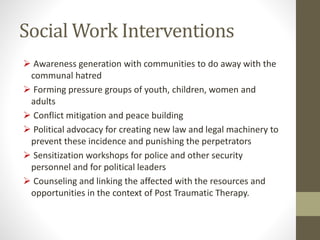
Social Work Interventions
 Awareness generation with communities to do away with the
communal hatred
 Forming pressure groups of youth, children, women and
adults
 Conflict mitigation and peace building
 Political advocacy for creating new law and legal machinery to
prevent these incidence and punishing the perpetrators
 Sensitization workshops for police and other security
personnel and for political leaders
 Counseling and linking the affected with the resources and
opportunities in the context of Post Traumatic Therapy.
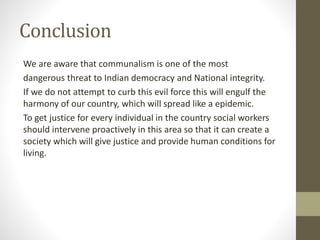
Conclusion
We are aware that communalism is one of the most
dangerous threat to Indian democracy and National integrity.
If we do not attempt to curb this evil force this will engulf the
harmony of our country, which will spread like a epidemic.
To get justice for every individual in the country social workers
should intervene proactively in this area so that it can create a
society which will give justice and provide human conditions for
living.
Reference
1. Ahuja, Ram , Social Problems in India.2nd Ed. Jaipur: Rawat
Publications; 1992.
2. Manali C. Essay on Communal Violence in India. India
Essays. [Internet]
Available From :
http://www.indiaessays.com/essays/india/violence/essay-on-
communal-violence-in-india/15094
THANK

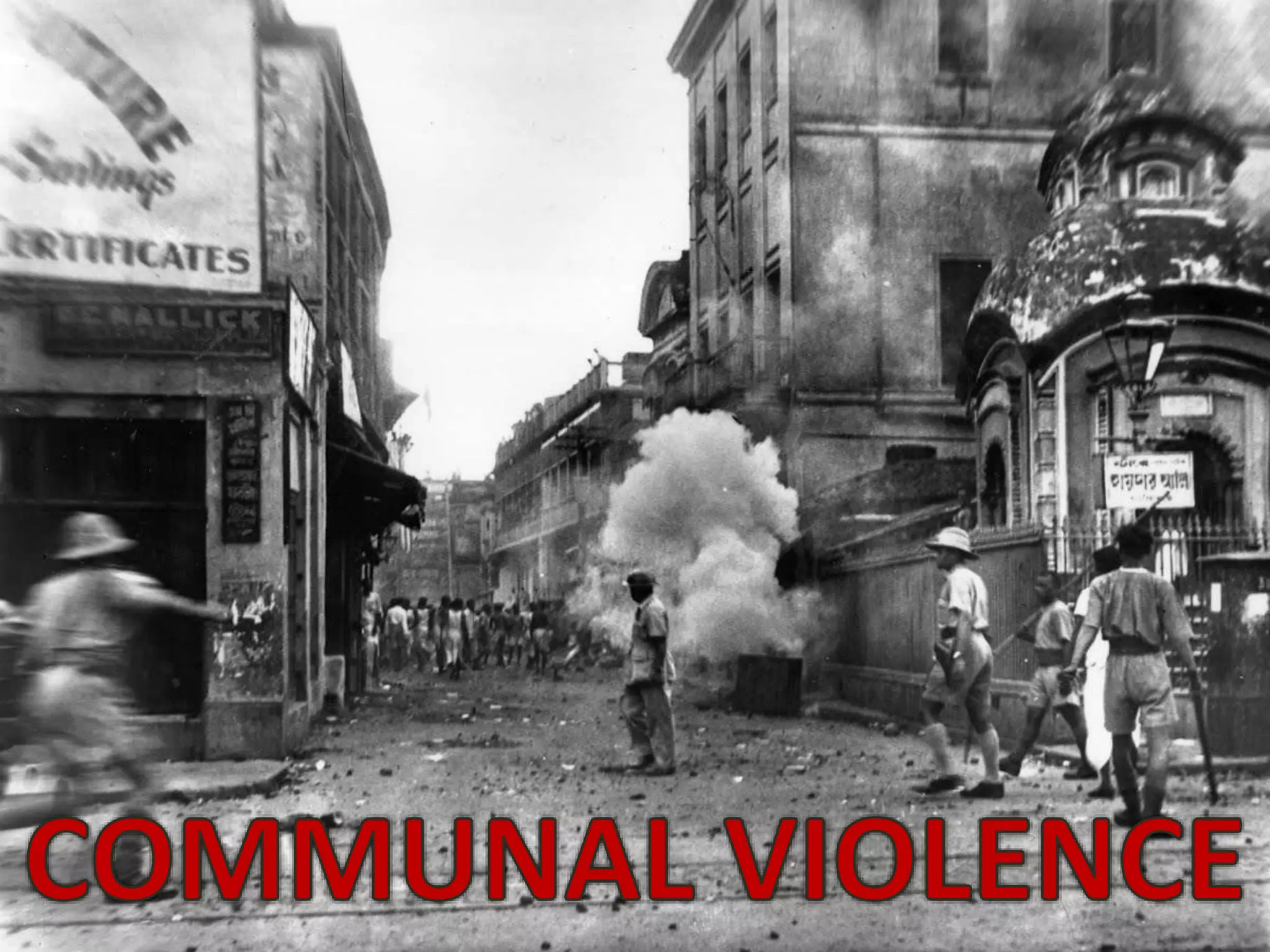
Communal Violence

  • 2.
    What is CommunalViolence Communal violence involves people belonging to two different religious or ethnic communities mobilized against each other and carrying the feelings of hostility, emotional fury, exploitation, social discrimination and social neglect. The high degree of cohesion in one community against another is built around tension and polarization. The targets of attack are the members of the ‘enemy’ community. Generally, there is no leadership in communal riots which could effectively control and contain the riot situation. It could thus be said that communal violence is based mainly on hatred, enmity and revenge.
  • 3.
    Factors Responsible ForCommunal Violence i. Historical Factors: The history of Partition and the two-nation theory have generated a deep sense of communalism and lack of mutual trust among both the communities. It discouraged a harmonious association and peaceful co-existence. ii. Political Factors: Divide and rule policy practiced by the British and the subsequent vote-bank politics followed by Indian political parties after Independence have added to the divide between the communities. Lack of liberal, progressive and modern attitude in both communities has also weakened the cause of communal harmony. iii. Educational Factors: There is lack of modern education among a large section of Indian society. A majority of Indians failed to adopt a scientific and technological approach, hence are reluctant to adopt liberal, progressive values.
  • 4.
    iv. Socio-Economic Factors: Dueto their educational backwardness, the Muslims have not been represented sufficiently in public services, industry and trade, etc. Their economic status is very low. This causes the feeling of relative deprivation and such feelings contain the seeds of communalism. v. Psychological Factors: Psychological factors play an important role in the development of communalism. Both communities have perceived grudges against each other. There is a sort of fear psychosis amongst Muslims. These lead to communal ill-feelings. vi. Demographic Factors: Demographic changes in Assam, West Bengal and the Kashmir Valley create opportunities for manipulation of communal sentiments for short-term political objectives. vii. Social Media Factors: Negative impact of social media in spreading rumours, disinformation, hate-campaign and fanning violence.
  • 5.
    Measures need tobe implemented to prevent communal violence: 1. Taking Pride in Our Heritage: The feelings of nationalism should be inculcated in the minds of people by reminding them about the glorious moments of freedom struggle wherein Hindus, Muslims and Sikhs were united in the fight against the British to safeguard the interests of the country. 2. Impartial Administration and Police: Most riots persist for longer periods because people feel that the administration/police is not impartial. Changing this perception is most crucial for stopping riots. Perceived political interference in administration during communal violence must be eliminated
  • 6.
    3. Policy ofZero-Tolerance Towards Violence: Government policy and practices should be firm and strict in this regard. It should not be affected by vote-bank politics. Police must take immediate, strong and effective action against those who indulge in violence irrespective of their community. 4. Peace Committees: Peace committees should be mandatory in every area. It should include secular and visionary people from all communities. People with high social standing like doctors, philanthropists and social workers must be engaged with such peace committees. Meetings of peace committee should be organized regularly. The district administration should engage actively with such committees to promote communal harmony. 5. Win People’s Hearts through Media and Civil Society: The faith of common people in the local police should be restored with the help of civil society, NGOs and media.
  • 7.
    6. Holistic Developmentof Minority Communities: There should be a sincere effort to ensure that employment and skill development opportunities are available in the economic, educational and social spheres for the minority communities. Efforts should be made for bringing them in the mainstream of Indian society. 7. Strong Legal Action: The police should take adequate steps to identify in advance potential trouble makers and make timely use of preventive sections of law. Those inciting communal feelings must be punished. Provocative speeches by religious leaders in public and media must be dealt with strictly and strong legal action should be taken against them.
  • 8.
    8. Impart LiberalValues: Government should impart liberal values in our society through our education system. Soft skill development training should be provide to police and administration personnel. 9. Positive Utilization of Social Media and Mass Media for Awareness: The misuse of social media and mass media should be prevented. Efforts should be made through mass media for changing the attitude of people towards other communities. People must be made aware of the evils of communalism. Government should sponsor movies promoting communal harmony and secularism.
  • 9.
    Social Work Interventions Awareness generation with communities to do away with the communal hatred  Forming pressure groups of youth, children, women and adults  Conflict mitigation and peace building  Political advocacy for creating new law and legal machinery to prevent these incidence and punishing the perpetrators  Sensitization workshops for police and other security personnel and for political leaders  Counseling and linking the affected with the resources and opportunities in the context of Post Traumatic Therapy.
  • 10.
    Conclusion We are awarethat communalism is one of the most dangerous threat to Indian democracy and National integrity. If we do not attempt to curb this evil force this will engulf the harmony of our country, which will spread like a epidemic. To get justice for every individual in the country social workers should intervene proactively in this area so that it can create a society which will give justice and provide human conditions for living.
  • 11.
    Reference 1. Ahuja, Ram, Social Problems in India.2nd Ed. Jaipur: Rawat Publications; 1992. 2. Manali C. Essay on Communal Violence in India. India Essays. [Internet] Available From : http://www.indiaessays.com/essays/india/violence/essay-on- communal-violence-in-india/15094
  • 12.