Popular Social Science
THE COMMUNAL PROBLEM
Report of the Committee
appointed by the
Indian National Congress (Karachi Session 1931)
to enquire into the Kanpur Riots of March 1931
NATIONAL BOOK TRUST, INDIA
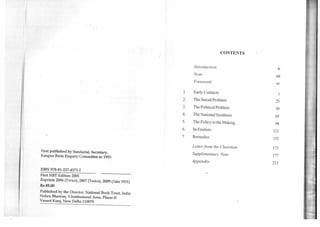
CONTENTS
Introduction
Note
Foreword
ix
xiii
xv
1. Early Contacts 1
2. The Social Problem 23
3. The Political Problem 39
4. The National Synthesis 65
5. The Policy in the Making 94
6. Its Fruition 121
7. Remedies 152
Letter, from the Chairman 173
First published by Sundarlal, Secretary,
Kanpur Riots Enquiry Committee in 1933
Supplementary Note 177
Appendix 213
ISBN 978-81-2374573-2
First NBT Edition 2005
Reprints 2006 (Twice), 2007 (Twice), 2009 (Saka1931)
Rs 85.00
Published by the Director, National Book Trust, India
Nehru Bhav3an, 5 Institutional Area, Phase-II
Vasant Kunj, New Delhi-110070
1
This Report was duly presented to the President, All India
Congress Committee, in October 1931. After considering it the
Working Committee ofthe All India Congress Committee resolved
to publish it, at its meeting of the 31st December 1934. Within a
few days, most of the members of the Working Committee and
four out of six members of the Enquiry Corrimittee were in jail.
These facts and the events that followed account for the
extraordinary delay in its publication. But the publication, though
so late, is necessary, to carry out the Resolution of the All India
Working Committee and because it deals with matters of lasting
interest and value, viz., historical causes and practical remedies.
SUNDARLAL
Secretary
Kanpur Riots Enquiry Committee
11ctlibers of the Committee
Bhagavan Das, Chairman
Sundarlal, Secretary
Purushottam Das Tandon
Manzar Ali Sokhta
Abdul LatifBijnori
Zafarul-Mulk
Introduction
Hindu-Muslim riots broke out with great ferocity in Kanpur on 24
March, 1931 and lasted for several days. Ganesh Shankar
Vidyarthi, a noted journalist and President of the UP Provincial
Congress Committee, was killed while attempting to douse the
communal fire and rescue those in danger.
At its Karachi Session at the end of March 1931, the Indian
National Congress set up a committee consisting of six members
to look into the Kanpur riots, to discover the causes of communal
tension and to suggest measures needed to check the spread of
communalism and communal animosity to other areas. The
Committee submitted its report to the Working Committee of the
INC in October 1931, which decided to publish it immediately.
The report was published in 1933. The six-member Committee
produced one of the finest available analysis of the genesis and
the rise and spread of communalism in modem India, as also the
remedies needed to check and uproot it. But the colonial
government immediately banned it. Since then it has not been easily
available. Since communalism still poses a major threat to the
Indian people and polity, the National Book Trust, India has
decided to bring it out in an abridged form. It still retains all parts
of the report except those describing the course and events of the
riots, the list ofwitnesses the members of the Committee examined,
photographs of the havoc caused by the riots, and the public appeals
that the Committee and its members issued in Hindi and Urdu. A
Oil COMMUNAL PROBLEM	 INTRODUCTION	xi
heir t 4)1't l ie Memorandum of Work submitted by Bhagavan Das,
I las been included in a note.
I
We may briefly point to three seminal or basic insights of the report.
First that communalism has above all to be seen as communal
thinking or outlook, i.e., as an ideology. The riots are not to be
seen "as an isolated and unusual occurrence". They are the result
of the . spread of communal thinking. To quote from the
memorandum submitted by the Chairperson of the report: "The
Kanpur riots were only a most violent manifestation of a deep-
seated disease which has been growing actively for the last ten or
twelve years, out of germs fostered in the body politic of India,
for some generations at least." Once communal thinking pervades,
"riots can be caused almost at will by interested parties wherever
and whenever it may suit them." Consequently, the Committee
came to the conclusion that "mere temporary palliatives would be
of no avail" and what is needed is "a thorough examination of the
problem" and adoption of long-term remedies based on such
examination. The communal problem had to be examined "in its
entirety, treating the Kanpur riots as merely an aggravated symptom
of the disease". And then long-term remedies based on such
examination had to be adopted to deal with this 'disease' .
Secondly, the report emphasized the critical role played in
the rise and growth of communalism by the view of Indian history
that colonial writers and administrators developed and propagated
in the I 9th and early 20th centuries and then followed by both
Hindu and Muslim communalists. Communalism was based on,
had its roots in, and was propagated through, this 'perverted view'
of Indian history. Moreover, noted the report, so pervasive has
this communal view of Indian history become that many otherwise
secular nationalists also accepted it. Consequently, as a first, and
the most important, step in the struggle against communalism, it
was necessary to remove the communal mentality by getting rid of
this wrong communal view of Indian history, especially as taught
in schools. It is also for this reason that the main part of the report
was devoted to the study of the medieval and colonial periods of
Indian history.
The authors of the report also argued that communalism was
not an "agelong" problem that the 19th century Indians inherited
from their ancestors. It was a recent phenomenon that was born
during the recent, modem period. It did not exist in pre-colonial
India.
Thirdly, the authors of the report concluded that religious
differences were not responsible for the rise and growth of
communalism, though the British and communalists used these
differences to propagate communal thinking. As they point out,
"Surely there is nothing in their religions which makes it impossible
for Hindus and Muslims to live peacefully as good neighbours and
fellow-citizens." They also point to the evolution of"one common
culture" in the medieval period despite "clash of Kings and
generals".
ll
A very valuable part of the report is the section on the Remedies.
Arguing that national unity could not be based on 'toleration' of
each other by various religious communities, the authors of the
report point to various aspects of life and culture that unite the
people of the country, and argue that the objective of all the
remedies has to be the development of common culture and
education, common social and political life, and the spirit of 'living
together'. They then suggest series of 'remedies' or steps-religious,
‘11	1111 ( 'OM M UNAL PROBLEM
social, cultural, economic and administrative—most ofwhich are
of great and immediate relevance today.
At the end of the report are given three individual notes where
different members ofthe Committee express their basic agreement
with the report they had signed but express their disagreement on
a few of the suggested remedies.
PROF. B1PAN CHANDRA
Chairman
National Book Trust, India
Note
Our investigations at Kanpur revealed to us the fearful nature and
the extent ofthe tragedy and the terrible possibility of its spreading
into other parts in India. The Kanpur riots were not an isolated
and unusual occurrence. The Benares riots which preceded them
by only six weeks were serious enough to have required a full
investigation. They were only put into the background by this much
greater tragedy. Other extraordinary occurrences have been taking
place since, in British as well as Indian India, in various places.
Things have come to such a deplorable pass that riots can be
caused almost at will by interested parties, wherever and whenever
it may suit them.
The Kanpur riots were only a most violent manifestation of a
deep-seated disease which has been growing actively for the last
ten or twelve years, out of germs fostered in the body politic of
India, for some generations at least. From the conditions we saw
and the evidence we recorded, we became convinced that mere
temporary palliatives would be of no avail, and that by confining
efforts only to areas of violent repercussions the Congress would
be wasting energN A thorough examination of the problem was
needed and remedial measures had to be devised which would
be of general application and lasting utility. The move we thought
over and discussed the question, the firmer grew our conviction
that it was our duty to go into the matter thoroughly and to deal
with the Hindu-Muslim problem in its entirety, treating the Kanpur
riots as merely an aggravated symptom of the disease.
NI%	THE COMMUNAL PROBLEM
.
Once committed to-this position, our task became rather
heavy. Our personal experience and the evidence we took in the
course of our investigations revealed to us that a deep impression
existed in the minds of the people that the Hindu-Muslim problem
was an age-long problem, that the two communities were inherently
antagonistic to each other, that they had always shed each other's
blood, and would continue to do so till one or the other was
destroyed or was in a position to dominate over the other. We
found that the conviction had sunk deep into the public mind, and
by trying further to comprehend its nature we found that it had its
root ina perverted view of history. Even some of our best Congress
workers, both Hindu and Muslim, are possessed with this idea,
which cannot be driven away from their mind because they
sincerely believe that this is the lesson taught to us by the last
several centuries of our history. This is a dangerous mentality which
tends to make all efforts at reconciliation lifeless and unreal, and
which generates a feeling of desperation and a callous disregard
of the consequences of a situation which appears to them as
insoluble. We felt that the first step towards the solution of the
Hindu-Muslim problem was an attempt to remove this mentality
from the workers as well as from the public. This could only be
done by presenting before them a correct and constructive view
of the past relations of the two communities and by exposing the
methods by which our history has been deliberately misinterpreted
and misrepresented. The task was as difficult as it was essential.
It required time; but we could not grudge time in a matter of such
vital consequences. We are, therefore, submitting a historical
ithospect covering the Muslim and the British periods. It is intended
to show the development of the social and political forces which
are responsible for the present situation. The Kanpur incidents
are then narrated to supply an ocular demonstration of the working
ofthe forces described in the Historical Section, and the last Section
deals with remedial measures.
BHAGAVAN DAS
Foreword
The prevailing impression is that the Hindu-Muslim problem in its
present form is an age long problem and that the two communities
have, in their different religions and cultures, a source of
inexhaustible and ineradicable antagonism which has made their
mutual relations bitter, distrustful, and hostile from the very outset.
This is an extremely wrong impression, created by interested parties
through deliberate misrepresentations, about the propagation of
Islam in India, about the nature and incidents of Muslim rule, and
generally about the relations which subsisted during this period
between the Hindus and the Musalmans.
In the following retrospect it is our purpose to correct this
view which is generally met with in school histories and other
interested works, and which at present is playing a considerable
part in estranging the two communities. We feel that unless the
people begin to see the past in a truer perspective it will be very
difficult or well-nigh impossible to restore mutual confidence and
to arrive at a real and permanent solution of the present differences.
We consider, therefore, that an attempt to remove historical
misconceptions,is the first and the most indispensable step in the
real solution of the Hindu-Muslim problem.
Genesis of the Communal Problem
This problem is a prdblem arising out of the mutual distrust and
the real or supposed conflict of rights and interests of the two
major communities of India. In its very nature, it implies the
FOREWORD	xvii
I It Vin OWh community ()fa separate collective consciousness
‘k Cif lig of separate collective communal motives under which
can as a single unit act and re-act against the other. The
I Inklu-Muslimproblem, therefore, in its presents form, could only
arise when each of the two communities has developed this
separate collective consciousness, and such motives and objectives.
This stage of development is reached in Indian history only after
1857. Throughout the Muslim period no All-India communal
consciousness and corresponding motives and objectives are
patently perceptible either in the Muslims or in the Hindus, and
the political and economic relations of the two communities are
found to be almost altogether free from communal bias or bigotry.
Communalism in India develops as a concomitant to Indian
Nationalism and is nothing but Nationalism driven into religious
channels. In Hindus, it has allied itself to a territorial sentiment
because of the more ancient connection of Hinduism with India
and also because of confinement of Hinduism to this country. In
Musalmans, it has got deflected towards Pan-Islamism because
of the action of the divisive British policy, the foreign origin of
Islam, and the existence of Muslims in other countries where Islam
is politically regnant. But in both the communities these
developments begin to take place naturally after the upsetting of
the old social balances and ideals by British conquests and the
introduction ofthe nationalistic ideal in Indian life through the spread
of Western ideas and education.
Scope of the Historical Retrospect
It is impossible in a report of this nature to deal with all the aspects
of our social and political life; and even those that we touch upon
will have to be dealt with very cursorily. It is not our purpose, nor
is it possible for us, to write a complete history. We wish merely
to indicate some lines of thought and describe some features and
incidents of Indian history, which are generally disregarded but in
the light of which we can better understand the present and the
past relations of the two communities.
We divide the Retrospect into two broad sections, the Muslim
period and the British period. In the first section we take a bird's-
eye view of the relations of the two communities from their first
contacts upto the Mughal period, indicating broadly the affinities
which existed between them and the broad synthesis towards which
their life was moving. In the second, we try to show how the
synthesis was disturbed and indicate the social, religious, and
political factors which have been in the main responsible for the
birth of the communal problem and the part which British policy
had played in working it up and in bringing matters to the present
crisis.
1
EARLY CONTACTS
Relations between India and Arabia
Before the Birth of Islam
Before the birth of Islam, Arabia and India were linked pretty
closely together through trade and commerce. The Arabs in those
clays carried the rich merchandise of India right up to Egypt and
into the countries ofEurope, on the west, and, on the east, passing
through the rich and fertile Islands of the Pacific across the Indian
coasts, they carried it to the distant countries of Japan and China.
On this account, the Western and Eastern coasts of India had
Arab colonies, and Arabs and Indians knew each other and lived
and worked with each other on terms of perfect friendliness and
cordiality, long centuries before the birth of Islam.
From time immemorial incursions from the north by the
migrating tribes of Central Asia, who came and settled in the land
from time to time, sometimes peacefully and at others through
invasions and conquests, were introducing an element of
cosmopolitanism in the life of India. This cosmopolitanism was
further helped throjigh her economic relations with other civilized
nations of the world almost from the beginning of history, because
during all this time, and down to the 19thCentury when British
rule was well consolidated, she continued to be one of the richest
and greatest centres of world-trade. These factors contributed to
give to her economic and political life a liberalism which was
directly opposite in form and spirit to the rigid exclusiveness of
her religious and social systems. No other country extended its
EARLY CONTACTS	3
1111 COMMUNAL PROBLEM
unstinted hospitality and welcome to followers of other faiths and
creeds in the same way and to the same extent as India did ri the
past. And no other country benefited more by such foreign contacts
and successfully assimilated the good points of the other systems
without undermining the roots of its own culture or annihilating its
own individuality. We are mentioning these aspects because they
are generally absent from our histories and because a knowledge
of them is essential to see our past in its true historical perspective.
First Muslim Colonies
When about 630A.D. almost the whole of Arabia accepted Islam
the Arab colonies in India automatically became Muslim colonies,
and the profound moral and economic impulse that Islam gave to
the life of the Arabs had its immediate reactions in India by
increasing the number and the importance of these colonies. From
630 A.D. to 1000 A.D. when, with the exception of the solitary
Arab invasion of Sindh, the Muslim invasions of India maybe said
to begin, India lived in intimate contact with Islam. During this
period Islam spread into practically all those parts of the world
where it exists at present; it set its cultural and intellectual stamp
on the various nations of the world and passed the meridian of its
power and glory. Its real political contacts began to be established
with India when the first fInsh ofits cultural and spiritual momentum
was practically exhausted. With the exception of the invasion of
Sindh, which may be regarded as a comparatively isolated episode
of Indian history, up to 1000 A.D. India never came under the
dominance of any Muslim power or suffered from any Muslim
invasion. But during all this time Islam spread peacefully practically
in all her provinces and made considerable progress. Particularly
in Southern India, in regions below the rivers Mahanadi and
Narbida, which remained altogether free from Muslim invasion
and conquest right up to the end of the thirteenth century. Islam
made its earliest appearance and continued peacefully to progress,
and the followers of the two religions lived together in perfect
harmony. Not that their relationships remained confined to trade
alone. Throughout this period we find them co-operating and.
working together in every walk of national life. We give below a
bird's-eye view of these relations to show the nature of the
reception Islam received in these regions and other parts of India
and the relations which existed between the Muslim and the other
communities inhabiting India.
"The first Muslim fleet appeared in Indian waters in 636A.D.
Meanwhile commerce by sea continued and the Muslims made
their settlements in the towns along the South Indian coast and in
Ceylon. Rowlandson says that the Muslim Arabs first settled on
the Malabar coast about the end of the seventh century....
"In the eighth century the Arab fleets attacked Broach and
the ports on the Kathiawad coast. Their trade and settlements
continued to flourish....
"Henceforth Muslim influence grew rapidly. For over a
hundred years the Muslims had been established on the Malabar
coast. They were welcomed as traders and apparently facilities
were given to them to settle and acquire lands and openly practise
their religion. They must have entered upon missionary efforts soon
after settling down, for Islam is essentially a missionary religion
and every Musalman is a missionary of his faith. Many were
undoubtedly held in respectful esteem; they came to India not like
the Christian colonies of Syrians driven and persecuted from their
homelands but full of the ardour of a new- found religion and of
the prestige of conquest and glory. Before the ninth century was
far advanced, they had spread over the whole of the western
coast of India and had created a stir among the Hindu populace
as much by their peculiar beliefs and worships as by the zeal with
which they professed and advocated them. The south of India
was then greatly agitated by the conflict of religion, for Neo-
Hindu; sm was struggling with Buddhism as id Jainism for the upper
.4	I IF COMMUNAL PROBLEM
EARLY CONTACTS	5
hand. Politically, too, it was a period of unsettlement and upheavals.
The Cheras were losing power and new dynasties were emerging,
into power. Naturally the minds of the people were perturbed and
they were prone to accept new ideas from whatever quarter they
came. Islam appeared upon the scene with a simple formula of
faith, well-defined dogmas and rites, and democratic theories of
social organisation. It produced a tremendous effect, and before
the first quarter of the ninth century was over the last of the
Cheraman Perumal Kings of Malabar who reigned at Kodungallur
had become a convert to the new religion....
"The Musalmans evidently had acquired great importance
at this period. They were designated by the name of Mappillas
which means either "a great child" or a "bridegroom" and was
considered a title of honour. It was bestowed on some Christians
also, and in order to distinguish the two communities the Christians
were called Nussarani Mappillas. Other privileges were showered
upon them. A Musalman could be seated by the side of a
Nambutiri Brahman while a Nair could not do so. The religious
leader of the Mappillas, the Thangal, was allowed to ride in a
palanquin alongside of the Zamorin.
"Under the patronage and encouragement of the Zamorin
the Arab merchants settled in large numbers in their dominions,
and not only materially increased his power and wealth by their
trade but directly supported him in his campaigns of aggran-
disement. The Zamorins, who originally hailed from Nediyiruppa
in Emad, overran Palanad the neighbouring territory of Porlattiri
Raja and secured the land thus won at the point of the sword by a
fort at Velapuram. Here, according to tradition, a merchant who
had been trading with Arabia settled and established a mart which
grew into the flourishing port of Calicut. He became the Koya
(Kazi) of Calicut and his successors fought on the side of the
Zamorin against the Rajas of the surrounding Nads. The Raja
Valluvakona of Walavanada was defeated and management of
the Manamakham festival at Tirunavayi and with it the pre-
dominance in Southern Malabar passed into the Zamorin's hands.
The Muslim family of Ali Rajas (Lords of the deep) who were the
admirals and ministers of the Kolattiri rajas were according to
one tradition the descendants of an Arab Musalman who had
been invited from their native land by Cheraman Perumal and
were installed as Chiefs of Kannanur (Kannur), according to
another tradition the first chieftain of the family was a Nayar who
was a minister of the Kolattiri and who embraced Islam but was
retained in his post on account of his skill and ability.
"The Zamorin thought so highly of the Muslims that he
definitely encouraged conversion in order to man the Arab ships
on which he depended for his aggrandisement; he gave orders
that in every family of fishermen (Mukkuvans) in his dominion one
or more of the male members should be brought up as
Mohammadans....
"These narratives conclusively show that on the western coast
of India Muslims settled down early and grew in numbers, wealth
and power....
"Their principal settlement on the east coast was Kayal-
pattanam in Tinnevelly (Tirunelveli) district near the mouth of the
Tamrapami river, where still the Labbies form the majority of the
population, and where Caldwell picked up in large quantities
broken pieces of pottery and what is more important a number of
Muslim coins bearing dates from the 7th Century (71 Am.) to
thirteenth Century A.D.
"The Musalmans started their religious propaganda as soon
as they had settled down in some numbers. Many of the Islamic
communities of the South trace their origin to these times. The
Ravuttans of Madura and Trichinopoly (Tiruchirapally) believe
that they were persuaded to change their religion by Nathad Vali
whose tomb exists at Trichinopoly and bears the date of his death
417 A.H. (1039 A.D.)....
I III COMMI 1NAL PROBLEM
" I he Dudekulas.attribute their conversion to Baba
I.iikIt rudd in, the saint of Pennulconda. He became a disciple of
Nat had Vali, converted the Raja of Penukonda and built a mosque
there. The date of his death according to Thurston was 564 A.H.
"In Madura the Musalmans made their entrance in 1050
A.D.under the leadership ofMalikul Muluk, who was accompanied
by a great saint Hazrat Aliyar Shah Sahib whose remains were
buried near the Huzur Kacheri in Madura... The grant of villages
for its maintenance (made in the eleventh or twelfth century) was
subjected to enquiry in the time ofVirappaNayakan and confirmed
in 1573 A.D....
"The Coromandal Coast became the Mabar (passage) of
the Muslim traders. According to Wassaf, it extended from Kulam
to Nilwar (Nellore) nearly three hundred parasangs along the sea-
coast."'
Islam Preceded theEstablishment of Muslim.Political
Power in India
The conditions which we find existing in the regions south of
Mahanadi and Narmada existed practically all over India. Almost
in every province Islam preceded the establishment of Muslim
political power by centuries and the Muslim colonists are found to
live and participate practically in every sphere of Indian life. To
mention afew of these colonies, they existed in Daibal, Broach,
Cambay, Sindhan, and Chaul; also in Cutch and Kathiawar. There
was one in Sopara in Maharashtra and others in the kingdom of
Kanauj and even in Benares. In Gujarat their relations with the
State were as cordial as in Malabar itself.
"Sulaiman, Masudi, Ibn Haukal, and Abu Zaid, all agree in
praising Balhara (the Valabhi ruler of Gujrat) for the friendliness
which he exhibited towards the Musalmans. Sulaiman writes, 'There
EARLY CONTACTS	7
does not exist among rulers a prince who likes the Arabs more
than Balhara, and his subjects follow his example'. Masudi saw
his co-religionists practising their religion openly everywhere.
Speaking of the King of Gujrat he says, 'In his kingdom Islam is
respected and protected, in all parts rise chapels and splendid
mosques where the Muslims say their five daily prayers.' Al-Is-
takhari (951 A.D.) found Muslims in the cities of the kingdom of
Hal hara, and 'none but Musalmans rule over them on the part of
Ha I hara' ."2	 •
Thus already before the invasion of Mahmud of Ghazni
Mulsim Arabs had assumed in Western India and other
principalities a position of influence, and they used it to disseminate
their religion among the people. They were considerably
encouraged in this by the Hindu rulers themselves. In Cambay, on
one occasion the Hindus destroyed a Muslim Mosque. The Raja
of Gujrat made personal enquiries and restored the Mosque at
the expense ofthe State. The Muslim saints came in large numbers.
Baba Ratan came to Broach with a party of darveshes. The head
ofthe Borah community came from Yemen and settled in Gujarat,
and Nur Satagor converted the Kunbies, Kherwas, and Koeries
of Gujrat. Sindh, which in those days included Multan and touched
the boundaries of Kanauj towards the west, was from 715 A.D.
onwards, as we shall see, under Muslim rule. "In northern India
we find that in Wahind, ...which became the capital of the Punjab
after Kabul passed into Muslim hands, the number of Muslims
was quite respectable and they had a state of their own alongside
of the Hindu RAj, but the majority of the population was yet
Hindu."' "In Kanauj, a city which was on the borders of Punjab,
the Muslims had already established their rule. Muslim Arabs were
also present in Kashmeer."4 In the province of Punjab which
2. Ibid.
3. Arab our Hind ke Tact/hug:I, Sulaiman Nadvi, p. 398.
4. Ibid.I. Influence cy- Islam on Indian Culture, Tarachand,
till COMMUNAL PROBLEM
extended in those days to Hindukush and covered practically all
the area towards the west which is covered at present by
A Ighanistan, Arab Muslim colonies existed practically in every
big city. "In the most important cities ofAfghanistan, Musalmans
were living no doubt, but the Afghans themselves had not accepted
Islam so far. Though a king of Kabul (Kabul was the capital of the
province of Punjab at that time) had accepted Islam about the
third century Hijri, i.e., about a century before the Ghaznis, yet
most of the Afghan tribes began to accept Islam in the days of
Mahmud."5
Relations with the Hindus
From the above cursory sketch it is obvious that before the tenth
century. A.D.Arab traders and religious preachers had spread in
India from Cape Comorin to Hindukush. Before Mahmud began
his series of invasions, they had been living with the Hindus for
over two centuries on terms of the greatest intimacy. Everywhere
we find the Rajas favouring them. As a trading community, they
helped considerably in the economic development of the State
and added to its revenue. They acted as ministers and advisers to
the king, and were free to choose any avocation in life they liked.
They were free also to practise and spread their religion, and no
penalties or restrictions existed to stop people from changing their
faith. These colonists generally married women of this country,
and a mixed population and a population of native converts was
growing side by side, and during two centuries must have reached
substantial proportions. At the time of outside invasions, these
Muslims fought on behalf of and for their Rajas irrespective of the
fact whether the invader was a Hindu or a Muslim. There were
Muslim armies and generals in the service of many Rajas, and the
armies of Muslim Kings included Hindu troops and commanders.
5. Ibid.
EARLY CONTACTS	9
The army of Ghazni itself had Hindu troops and several Hindu
generals even from before the time of Mahmud. Apart from all
this, in various places, as we have seen, Muslims had succeeded
in carving out small independent principalities for themselves.
Neither in the territories of Sindh and Multan, which were under
Muslim rule, nor in the rest of India which was under Hindu rulers,
was any difference made between the treatment of the subjects
on account of their religion. There was, of course, under Arab
rule in Sindh a difference on the basis of taxation. The Muslims
substituted a general tax for the Bradari and other taxes which
were charged by the Hindu Rajas in their territories, but the burden
of taxation could not have varied much between the two systems,
for the Jizia was a fairly light tax, lighter in fact than the Zakat
taken from the Muhammadans.
Thus, it is obvious that before the establishment of Muslim
rule, Islam had already secured a firm footing in India, and Muslims
and Hindus were living side by side and in perfect amity practically
all over the country. If the antagonism and intolerance we find
today had been inherent in the two systems, this was evidently the
period when they would have found their fullest expression. On
the contrary, we fmd Islam spreading in this country with the aid
and under the patronage of Hindu rulers themselves, and the sweep
of its mission covered every stratum of society from the humble
kories to the Kings. Hindu temples and Muslim mosques existed
side by side, and the votaries of both found no difficulty in
performing their respective worships. Religious exclusiveness
remained confined to the individual and social concerns of life and
was very different in its nature and expression from the religious
intolerance which, we shall see in a moment, existed in other
countries. In economic and political spheres no barriers whatever
seem to have existed between the two communities, for such
barriers seem to have been foreign to the religion and culture of
both. The outline of social conditions given above indicates that
10	THE COMMUNAL PROBLEM
Hinduism even in itS-rnqst orthodox form, if left to itself, was
incapable of generating forces of social bitterness towards
communities outside its own social organization, the more so as it
had for some centuries ceased to make and take converts and
thereby given up all aggression. If we find such forces existing
now, they must necessarily be of later growth and foreign
importation.
Now let us turn to another side of the picture and see how
the Muslim Arabs behaved when they entered the North-West
confines of India as invaders.
First Muslim Invasions
The first Muslim fleet, as we have seen, appeared in Indian waters
in 636 A.D., during the Caliphate of Omar, When Usman Sikiji,
the governor of Bahrain and Uman, sent an army across the seas
to Sana. But the Caliph disapproved of the invasion, because
India was a land where there was perfect freedom for the practice
and propagation of Islam, and in those days, according to Islamic
law and practice, it was not permissible for the faithful to attack
such a country without any valid justification. Usman Sikiji was
severely rebuked by the Caliph on the occasion and was threatened
with dire punishment in case he dared to repeat the experiment.
About the same time an expedition was taken out to Broach and
Debal, but Omar vigorously countermanded these expeditions also,
and the policy of armed interference with India remained in
abeyance for almost a century. These hundred years were
momentous in the history of Islam. It may be taken to have started
on its world mission in 622 A.D. and within a century or so it took
the world by storm and succeeded in creating a revolution
unprecedented in history.
"The rise of Islam is one of the marvels of History. In the
summer of 622 A.D. a prophet, without honour in his own country,
fled from his native city to seek an asylum in the town ofYathrib,
EARLY CONTACTS	11
since known as Madinat-un-Nabi, 'the Prophet's City', rather
more than two hundred miles north of Mecca, the town which
had cast him out. Little more than a century later the successors
and the followers of the fugitive were ruling an empire which
extended from the Atlantic to the Indus and from the Caspian to
the cataracts of the Nile, and included Spain and Portugal, some
of the most fertile regions of southern France, the whole of the
northern coast of Africa, Upper and Lower Egypt, their own native
Arabia, Syria, Mesopotamia, Armenia, Persia, Afghanistan,
Baluchistan and Transoxiana....
"By the beginning of the eighth century of the Christian era
the Arabs had carried their arms as far as the western confines of
India and bore sway in Mekran, the ancient Godrosia, that torrid
region extending inland from the northern shore of the Sea of Oman.
Immediately to the east of this province lay the kingdom of Sind,
ruled by Dahir, son of the usurping Brahman Chach."6
Muhammad Bin Qasim's Reign in Sindh
It was in 711 A.D. that the first Muslim invader Muhammad bin
Qasim crossed the sea, defeated Dahir, and laid the foundation of
the first Muslim kingdom in Sindh. We do not wish to follow all
the details of his campaign or of his administration. We will only
mention four incidents:
"During the conquest of Sindh when the Arab Commander
Muhammad bin Qasim reached Alror (Alor), the citizens resisted
the invader vigorously for several months. Then they sued for
peace insisting on two conditions, (1) that no resident of the city
be killed, and (2) that there should be no interference with their
places of worship. Muhammad bin Qasim in accepting these terms
said, 'The temples of Hindustan are like the Churches of Christians,
the Synagogues of Jews and the fire-temples of the Magians.'"7
6. Cambridge History of Medieval India.
7. Arab our Hind ke Taalluqat, Sulaiman Nadvi, p. 194.
EARLY CONTACTS	13
.2	THE COMMUNAL PROBLEM
And true to their word the.Arabs throughout their rule in
these parts never desecrated the temples of the Hindus nor did
they interfere with their religious practices and festivals.
The second incident is as follows:
"After the conquest of Sindh a deputation ofBrahmans waited
on Muhammad Qasim. Muhammad Qasim received them with
great respect. The Brahmans made this representation to him that
in accordance with the Hindu tradition and practice they should
be given in the kingdom a position higher than that of other
communities. Muhammad Qasim after ascertaining its truth
accepted their demands and appointed them to all higher posts
and offices.""
This is the third incident:
"The Arab Amir got it proclaimed that those who wished to
be converted to Islam might do so and be our brothers, and those
who wished to stick to their religion might do so and pay poll-tax.
Therefore some people accepted Islam and some remained
attached to their old religion."9
Chach-nama contains the following:
"Those of them that had turned Musalmans got exempted
from poll-tax and slavery and those who stuck to their religion
were split up into three divisions: (1) Highest class, that is, the
wealthy section, (2) Middle class, and (3) low class. They were
respectively charged 48 dirhams, 24 dirhams, and 12 dirhams.
Those who accepted Islam were exempted from this and those
who adhered to their ancestral religion paid poll-tax, but they were
not deprived of their estates and property, and were allowed to
retain them".
"The modem equivalent of one dirham cannot be more than
three and a half annas. Thus calculated, the rich must have paid an
8. Ibid. p. 200.
9. Ibid.
annual tax of Rs. 10, the middle class five, and the poor rupees
two and annas eight. And naturally, according to established
tradition, women, children, aged people, priests and other religious
servants, and those incapacitated people who cannot earn must
have been exempted. And Musalmans had to pay instead of poll-
tax, two and a half per cent. Zakat. The Musalmans might have
been charged one-tenth of their land produce and non-Muslims
their normal rent. There was no other tax besides these in the
kingdom of the Arabs."'"
The fourth incident is this:
`When the people of Brahmanabad implored Muhamamad
bin Qasim to grant them freedom of worship, he referred the matter
to Hajjaj, who sent the following reply:
" 'As they have made submission and agreed to pay taxes to
the Khalifa, nothing more can be properly required from them.
They have been taken under our protection, and we cannot in any
way stretch out our hands upon their lives or property. Permission
is given them to worship their gods. Nobody must be forbidden
or prevented from following his own religion. They live in their
houses in whatever manner they like"
The Arab administration of Sindh has been favourably noticed
by historians for its religious toleration, one of them describing it
as "a shining example of moderation and religious tolerance". And
we have seen that in its treatment of other religions, India was
even more tolerant than the Arabs. It was not in religious tolerance
alone but in varipus other aspects of life that India in this period
represented a higher stage of development, not to Arabs alone,
but also to the countries that had already come under their
domination. As a consequence, the first contacts of Islam with
India produced a profound influence on its later growth and history.
10. Ibid., p. 202
11. The History of Medieval India, Ishwari Prasad, p. 52-53.
EARLY CONTACTS	15
I ►	1111	 N:I. PROBLEM
111411.1u	ilization Higher than that of the Arabs
H Iii.ty be conceded at once that the Arab conquest of Sindh,
I onithe political point of view, was an insignificant event in the
history of Islam. But the effects of this conquest upon Muslim
culture were profound and far-reaching. When the Arabs came
to India, they were astonished at the superiority of the civilization
which they found in the country. The sublimity of Hindu
philosophical ideas and the richness and versatility of Hindu intellect
were a strange revelation to them. The cardinal doctrine of Muslim
theology, that there is one God, was already known to the Hindu
saints and philosophers, and they found that in the nobler arts,
which enhance the dignity of man, the Hindus far excelled them.
The Indian musician, the mason, and the painter were as much
admired by the Arabs as the philosopher and the man of learning.
Tabari writes that Khalifa Harun once sent for an Indian physician
to cure him of an obstinate and painful disease. The physician
succeeded in restoring his patient to health and was allowed to
return to India in safety. The Arabs learnt from the Hindus a great
deal in the practical art of administration, and the employment of
Brahman officials on a large scale was due to their better
knowledge, experience, and fitness for discharging efficiently the
duties of administration. Muslim historians are apt to forget or
minimize the debt which the Saracenic civilization owed to Indo-
Aryan culture. A great many of the elements of Arabian culture,
which afterwards had such a marvellous effect upon European
civilization, were borrowed from India. India, then, stood on a
much higher intellectual plane, and the Arab scholars sat at the
feet of Buddhist monks and Brahman pandits to learn philosophy,
astronomy, mathematics, chemistry, and other subjects of study.
The court at Baghdad extended its patronage to Indianscholarship,
and during the Khilafat of Mansur (753--/ 74 A n.) Arab scholars
went from India to Baghdad who carried with them two books,
the "Brahma Siddhanta" of Brahmagupta and his "Khanda
K hadyaka". These works were translated by Alfazari into Arabic
with the help of Indian Scholars. It was from them that the Arabs
learnt the first principles of scientific astronomy. The cause of Hindu
learning received much encouragement from the ministerial family
of Barmaks during the Khilafat of Harun (786-808 A.D.) Though
the Barmaks had been converted to Islam, they never felt
enthusiastic about it, and prompted by their Hindu inclinations,
(hey sent scholars to India to study medicine, astrology,
pharmacology, and other sciences. They invited Hindu scholars
to Baghdad and appointed them as the chief physicians of their
hospitals and asked them to translate from Sanskrit into Arabic
works on medicine, philosophy, toxicology, astrology, and other
subjects. But it must be admitted that the Muslims soon secularised
the learning they had borrowed from India, and presented it to
the European world in a new garb, which was perhaps more
acceptable to the European mind. When the Khilafat of Baghdad
lost its importance after the extinction of the Abbasid dynasty at
the hands of Halagu, the Arab governors of Sindh became
practically independent. The cultural connection was broken, and
the Arabian scholars no longer in contact with Indian savants,
turned to the study of Hellenic art, literature, philosophy; and
science. There is ample reason to endorse Havel I 's view that ' it
was India, not Greece, that taught Islam in the impressionable
years of its youth, formed its philosophy and esoteric religious
ideals, and inspired its most characteristic expression in literature,
art and architecture."''
Attempts at Early Synthesis
The quotation above shows the intimate nature of the relationship
which existed between Islam and India for centuries at a time
when she was altogether free from Muslim political dominance,
12. The History (.,f Medieval India, Ishwari Prasad, pp. 59, 61
I III	*NANO INA' 114o111 I m
011)1 it I i'vt'ilIs the deep synthesis of religious thought and culture
wit it, 1► hegran k) grow so early between Islam and Hinduism. The
141 nal Little tolerance for other faiths which existed in India and
which the Arabs also exhibited to such a degree was a most
uncommon feature for this age. Nothing shows a greater affinity
between the Hindu and the Islamic religions and cultures than their
tolerance in matters of religion when religious persecution of the
most narrow and brutal type was a normal feature of the times
elsewhere. Of the many wrong impressions prevailing at present
one which is the most fruitful source of bitterness and ill-will is the
impression that Islam is inherently bigoted and intolerant. But history
shows that in its earlier stages Islam was extremely tolerant. As its
spiritual life got gradually overwhelmed by its political successes,
priest-craft and king-craft got the upper hand and introduced much
intolerance and persecution where originally very little existed. As
a matter of fact, intolerance, to some extent, seems inherent in
every religious system, though it may assume different forms in
different religions and may be indulged in to a greater or lesser
degree. But history does not seem to justify us in giving a major
share of it to Islam. On the contrary, we fmd that; for its age, as a
political power, Islam behaved as tolerantly as any other religion,
and in some cases much more tolerantly in dealing with peoples
with whom it came in contact at the outset of its career. The theory
that Islam has spread by the sword had been canvassed so widely
and so persistently that for the average Indian mind this proposition
has become almost an axiom. And as this theory is responsible
for much misunderstanding and gives its edge to the Hindu-Mrs'lim
problem to-day, we propose to give a few illustrations whicOrnay
help us to see things in a truer perspective.
Toleration in Islam Contrasted with that in Other Faiths
Let us take Christianity. The Christian Church, till quite recently,
tolerated no liberty of conscience within its jurisdiction. Harsh
EARLY CONTACTS	17
andI cruel to other faiths, it never spared its own protestants and
411,,,;enters. At the period under discussion, so relentless was its
Hi it of persecution that it alienated vast sections of its Christian
s II)jects to such an extent that when Islam emerged from Arabia
.11141went as a conqueror to Christian territories, it was everywhere
killed as a deliverer by the Christian populations. Examples of
this can be quoted from almost every country under Christian
rule, but the following will be sufficient to illustrate our point of
view:
"The people of Emessa closed the gates of their city against
the army of Heraclius and told the Muslims that they preferred
their government and justice to the injustice and oppression of the
t ►reeks.
"Such was the state of feeling in Syria during the campaign
of 633-9 A.D. in which the Arabs gradually drove the Roman
army out of the province. And when Damascus, in 637 A.D., set
the example of making terms with the Arabs, and thus secured
immunity from plunder, and other favourable conditions, the rest
(lithe cities of Syria were not slow to follow. Emessa, Arethusa,
Ilieropolis, and other towns entered into treaties whereby they
became tributary to the Arabs. Even the patriarch of Jerusalem
surrendered the city on similar terms."
The facts of the surrender of Jerusalem are thus stated by
the same writer:
"When Jerusalem submitted to the Caliph Umar, the following
conditions were drawn up: 'In the name of God, the Merciful, the
Compassionate. The following are the terms of capitulation, which
1, Umar, the servant of God, the commander of the Faithful, grant
to the people of Jerusalem. I grant them security tbr their lives,
their possessions, and their children, their churches, their crosses,
and all that appertains to them in their integrity, and their lands,
II The Preaching of Islam, T.W. Arnold, p. 49.
EARLY CONTACTS	19
18	THE COMMUNAL PROBLEM
and to all of them di-eh-religion. Their churches therein shall not be
impoverished, nor destroyed, nor injured from among them, neither
their endowments, nor their dignity; and not a thing of their
property; neither shall the inhabitants of Jerusalem be exposed
to violence in following their religion; nor shall one of them be
injured.' A tribute was imposed upon them of five dinars for the
rich, four for the middle class, and three for the poor. In company
with the Patriarch, Umar visited the holy places, and it is said
while they were in the Church of the Resurrection, as it was the
appointed hour of prayer, the Patriarch be - 41,e Caliph offer his
prayers there, but he thoughtfully refused, saying that if he were
to do so, his followers might after wards claim it as a place of
Muslim worship.""
We will give only one more example faii-n Turkish rule in the
17th Century which will show that the character of Muslim
tolerance and Christian intolerance contin :led to be the same up
to that time.
"But if we except the tribute of the children, to which the
conquered Greeks seem to have submitted Ath so little show of
resistance, and which owed its abolition, not to any revolt or
insurrection against its continuance but to the increase ofthe Turkish
population and ofthe number of the renegades who were constantly
entering the Sultan's service, the teatment of their Christian subjects
by the Ottc an emperors—at least for two centuries after their
conquest of 3reece—exhibits a toleration such as was at that
time quite unknown in the rest ofEurope. The Calvinists ofHungary
and Transylvania, and the Unitariwis of the latter country, long
preferred to submit to the Turks miler than fall into the hands of
the fanatical house of Hapsburg; and the Protestants of Silesia
looked with longing eyes towards Turkey, and would gladly have
purchased religious freedom at the price of submission to the
14. The Preaching of Islam, T.W. Arnold, p. 51.
M us 1 i	It was to Turkey, that the persecuted Spanish Jews
11 ed refuge in enormous numbers at the end of the fifteenth
century, and the Cossacks, who belonged to the sect of the old
lie! ievers and were persecuted by the Russian State Church, found
in the dominions of the Sultan the toleration which their Christian
hreth, denied them. Well might Macarius, Patriarch ofAntioch
in the seventeenth century, congratulate' .self when he saw the
!Carful atrocities that the Catholic Pol, inflicted on the Russians
of the Orthodox Eastern Church:
`We all wept much over the thoi“. _As of martyrs who
were killed by those impious wretches, the enemies of the faith, in
the forty or fifty years. The number probably amounted to
wventy or eighty thousand souls. 0 you..fuels! 0 you monsters
°Ulm-	! 0 you hearts of stone! What had the nuns and women
done? What the girls and boys and infant cl-:.dren, that you should
murder them?... And why do I pron9unce them the Poles
accursed? Because they have shown themselves more debased
and wicked than the corrupt worshippers of idols, by their
cruel treatment of Christians thinking to 4Nolish the very name
olOrthodox. God perpetuate the emptre of the Turks for ever
and ever; for they take their impost,'5 and enter into no account
I S. Nature of the jizia.
:,apitation tax which the non-Mus! is had to pay was not in its
nature a measure of persecution.
"This tax was not imposed on the Christi, lome would have us
think, as a penalty for their refusal to accept the Muslim faith, but was
naid by them in common with the other dhimmis or non-Muslim sub-
; of the State whose religion prechl, '	'1 from serving in the
army in return for the protection secur 1 for tli .1 by the anus of the
Musalmans.
"...And it is very noticeable that when any Christian people served in
the Muslim army, they were exempted from the payments of this tax..."
"We find similar instances of the remission of jizyah in the case of
Christians who served in the army or navy under the Turkish rule.
1'111; COMMUNAL PROBLEM
EARLY CONTACTS	21
()I' rel igion, be their subjects Christians or Nazrenes, Jew or
Samaritans."16
Let us now to turn Persia. Here we find Zoroastrianism equally
intolerant.
"The Zoroastrian priests had acquired an enormous influence
in the State; they were well-nigh all-powerful in the councils of the
king and arrogated to themselves a very large share in the civil
administration. They took advantage of their position to persecute
all those religious bodies-and they were many-that dissented from
them. Besides the numerous adherents of older forms of the Persian
religion, there were Christians, Jews, Sabeans and numerous sects
in which the speculations of Gnostics, Manichean and Buddhists
li land expression. In all of these, persecution had stirred up feelings
I hi tier hatred against the established religion and the dynasty
dmh I supported its oppression, and so caused the Arab conquest
to appear in the light of a deliverance. The followers of all these
a ried forms of faith could breathe again under a rule that granted
t hem religious freedom and exemption from military service, on
payment of a light tribute. For the Muslim law granted toleration
and the right ofpaying jizyah not only to the Christians and Jews,
but to Zoroastrians and Sabeans, to worshippers of idols, of fire
and of stone. It was said that the Prophet himself had distinctly
given directions that the Zoroastrians were to be treated exactly
like 'the people of the book', i.e., the Jews and Christians, and
the jizyah might also be taken from them in return for protection."
Again,
"But the Muslim creed was most eagerly welcomed by the
townsfolk, the industrial classes and	artisans, whose
occupations made them impure according ) the Zoroastrian creed,
because in the pursuance of their trade or c cupations they defiled
fire, earth or water, and who thus, outcasts in the eyes of the law
and treated with scant consideration in consequence, embraced
with eagerness a creed that made them at once freemen and equal
in a brotherhood of faith.""
From Persia Islam entered into In 	'...sre also the Arabs
were helped by large numbers of inhuoitants who were dis-
contented with their own people.
"Besides these Arab troops, Muhamniad Bin Qasim enlisted
under his banner a large number of the discontented Jats and
Meds who had old accounts to settle with the intolerant Hindu
iovemmen: which had inflicted great humiliations upon them. They
"...On the other hand, when the Egyptian peasants, although Muslim
in faith, were made exempt from military service, a tax was imposed
upon them as on the Christians in lieu thereof...
"...But, instead of Ji7 h, the convert had now to pay the legal alms,
zakat, annually levie. an most kinds of moveable and immovable
property."... (The Preaching of Islam by T.W. Arnold, pp. 54-57)
The rates of Jizyah fixed by the early conquerors were not uniform
and the great Muslim doctors, Abu Hanifah and Malik, are not in
agreement on some of tt,e less important details; the following facts
taken from the Kitabu- aaraj, drawn up by Abu Yusuf at the request
of Harun-ur-Rashid (7z. -809 A.D.) may be taken as generally repre-
sentative of Muhammadan procedure under the Caliphate. The rich
were to pay 48 dirhams a year, the middle class 24, while from the poor,
i.e., the field-labourers and artisans, only 12 dirhams were taken. This
tax could be paid in kind if desired; cattle, merchand;se, household
effects, even needles were to be accepted in lieu of specie, but not
pigs, wine, or dead ani; Is. The tax was to be levied only on able-
bodied males, and not on women or children. The poor who were
dependent for their livelihood on alms and the aged pc who were
incapable of work were also specially exempted, as also the blind, the
lame, the incurables and the insane, unless they happened to be men
of wealth; this same condition applied to priests and monks who were
exempt if dependent on the alms of the rich but had to pay if they were
well-to-do and lived in comfort. The collectors of	Jizyah were
particularly instructed to show leniency and refrain Iron: all harsh
treatment or the inflic*"-n of corporal punishment in case of non-
payment.
16. The Preaching of Islam, T.W. Arnold.
17. The Preaching of Islam, T.W. Arnold, p. 177.
THE COMMUNAL PROW._ M
had been forbidden to ride in saddles, wear fine clothes, to uncover
the head, and this condemnation to the position of mere hewers of
wood and drawers ofwater had embittered animosities to such
extent that they readily threw in their lot with the foreigner."t8
Again,
"The People of Multan, merchants, traders, and artisans,
together with the Jats and Meds of the surrounding country whom
the native government had persecuted, waited upon the conqueror
and paid him homage."19
Thus we see that the age was an age of religious persecutions,
and in that age Islam seemed to be quite an exception. At least, it
was no worse than other religions. We shall also see later on that
such intolerance as was exhibited by the Indian faiths was rather
different in its nature from that of other faiths in being a heritage of
social custom from the past w' inspite of her best endeavours
India had not been able to shave off. We have quoted at such
length because we wish to remove a wrong impression at the
outset, as such impressions st md in the way of a dispassionate
consideration of historical inci ' ants and problems. The facts that
we have adduced so far go to show that the relations of Hindu
and Musalmans in India continued to be amicable and core 11
upto the time of the invasions of Mahmud Glianiavi: that the m
cause of this cordiality was the tolerant attitude of the two religions
towards each other: and that during this period of intimacy relig: us
and cultural processes had mdy come into existence whic.
promised to make their life and thought more harmonious. In
succeeding chapters we shall 3e how this union of two religions
and cultures acted and reacted In the various aspects of national
life. We shall confine, as far as possible, our examination to _hose
developments which tendt.- directly to influence the . utual
relations of the two commur
18, The History of Medieval India, Ishwari Prasad, p. 50.
19. Ibid., p. 53.
2
TH SOCIAL PROBLEM
Social and religious Condition of India in the
Eighth Century
I n this chapter we will confine ourselves to the r-sisideration of
the social problem with which India was faced at the time of the
advent of Islam in this country; and we will try to indicate the
nature of the contri.- -don of Islam towards the s(, ations of that
problem.
During the last years of the Prophet Mu: -mad and the
reigns of the first three Khalifas, King Harsha built up a great
Empire in the north of India over the ruins of th ; Gupta Empire
which had its seat at Pataliputra (modern Patn1.1. His ambition
was to conquer the whole of India, but he was checked by
Pulakeshi II who made himself sovereign of the southern half of
the country. King Harsha gave to his great dominion a spell of
peace and prosperity. He was equally tolerant to Vaidika I I nduism
and Buddhism, and impartially helped both; with his death in 647
A.D. Buddhism began to decline and an age of religious anarchy
set in when various old and new religions began to fight for mastery.
"Anandagiri, in hisShankara-Digvijaya .s drawn a graphic
picture of the religious condition of India in the ,..rz,hth century. He
mentions the numerous sects that sprang into existence and
inculcated the worship of all kinds of gods froth . ^ noblest and
highest to the moat repulsive deities, taking delight in drunken orgies
and grotesque rites. The leaders of rival sects cited the authority
ofthe Vedas in s..inort of their doctrines and practices, and wished
24	THE COMMUNAL PROBLEM
to over power one another. Some worshipped Shiva, while others
worshipped the lire, Cianesh, the Sun, Bhairava and Mattari,
Kart ika, the god of love, Yama, the god of death, Varuna, sky,
water, snakes, ghosts, etc., and acted according to their own
inclituit ions. t ldayana, by his relentless crusades against Buddhism,
had prepared the way for Shankara's vigorous onslaughts."2°
"All these religions, or rather sects, derived their authority
from the Vedas, and consequently all were indissolubly bound up
with the existing caste system, for at that period it was practically
universally, though wrongly, believed that such hereditary caste
was sanctioned by the Vedas. Also all of them v, ere remarkably
tolerant towards each other except on occi is of heat and
controversy.
"Buddhism and Hinduism flourished side by side and Jainism
too. In the same kingdom, in the same City, in the same family
even, Hindus, Jains and Buddhists lived peaceably, amicably holding
discussions without embitterment on the most abstruse questions
of man and god. T "the father was a devotee of Shiva, the son was
a devotee of Bu. 'ha, and the same man in I own life might
change his religion without causing disturbance ..:Ither in the family
or the society."'
Besides, as in the case of Islam, they were tolerant and at
times even indulgent to other religions. But while so tolerant to
each other and also to outside religions, they were very intolerant
in their treatment of the Shudras and other Lower castes. The
Shudras were shut out from all religious knowledge and practices.
The current rece, ion of the Code of Manu contains many penal
provisions again:, _iem which seem unbelievable to modem minds.
Along with the higher knowledge, the Shudras were shut out from
the political life c heir country also.
THE SOCIAL PROBLEM	25
"Particular persons of the three higher castes, Brahmins,
Kshatriy end Vaishyas did take some interest in politics, being
soldiers at_ lfficials, but the generality ofthe people, being Shudra,
was debarred from all participation in political activities."22
In addition to this general exclusion from all the higher
spheres of life they were subjected in various ways to many
hardships and humiliations as we saw in the case of the Meds and
.tats of Sindh. No wonder that large sections of the children of the
soil were discontented with their lot and considered their lives
miserable. When we descend to still lower strata of Indian society
we find a population almost as numerol, s as the Shudras
themselves, existing altogether outside the pale of H indu civilization
and 'society. The Shudras were only debarred from all near
participation in the political and religious life; but these classes
were rigorously excluded from even all social intercourse and
contact at any point with the higher castes. The Shudras were
almost as high above these unfortunate outcasts of society as the
Brahmans were above the Shudras. Such was the rigour of their
exclusion that in some cases even their shadows had become
contaminating to the Brahmans and some of these unfortunates
had to shriek from a distance to give notice of their presence
when they saw a human being approaching. It was a strange
anomaly that such inhuman intolerance and persecution should
have existed in the Hindu society which ien in those days was
pre-eminent for its intellectual power, and spiritual and moral
fervour. But sonic how the convention and practice had become
too deeply rooted in the body politic to be nosily eradicated.
In Buddhism India's soul had risen against this inhuman
system and shaken it to its foundations. But the relentless logic
and the cold moral severity, the ascetic renunciation of Buddhism,
and its refusal to take any aid from the mystic and emotional side
22. The History of Medieval Hindu India, C.V. Vaidya, Vol. I, p. 121.
20. The History of Medieval India, Ishwari Prasad, pp. xi, xii.
21. The History of Medieval Hindu India, C.V. Vaidya, Vol. I, p. 100.
ri COMM( NAI PROBLEM
THE SOCIAL PROBLEM	27
of human nature, made its scheme of life too high for its age and
too dry and unattractive for the emotional culture of India. In its
later form of Mahayana it could not compete with the ancient
faiths of the Land. The image of Buddha could not evoke the
same feelings of awe and reverence which the images of Shiva,
Vishnu and other ancient gods evoked. Besides, the new sacerdotal
class which grew up within and imposed itself on Buddhism
gradually became very avaricious, superstitious and immoral.
Consequently Buddhism lost its hold on the people. It was almost
sinking under its own weight when Brahmanism, taking advantage
of its weakness, delivered against it its final blows. The Kshattriyas
and other higher castes also co-operated because the upheaval in
the lower castes which Buddhism had greatly helped was
antagonistic to their interests and undermined their social monopoly
and influence. This powerful combination of the most organized
and resourceful sections of society wii cd Buddhism out of India
and, side by side, gradually crushed the rebellion against the
established social order which Buddhism had inaugurated.
in their social system to a greater extent than the followers of
►t I ler religions. Consequently at the psychological moment when
it came into India this peculiarity naturally acted on the mind ofthe
lower classes of India as a very strong recommendation. Their
minds were in a state of ferment and the hand of the ancient social
tyranny was falling more heavily upon them because of their
rebellion. Besides, the desire to be free musthave been seeking
some avenue for expression, and this was provided by the social
system of the new religion.
This mostly accounts for the great success which Islam seems
to have met on its arrival in India. It was not spread by the sword
o f the invader but by the indigenous caste tyranny. It satisfied the
social yearnings of vast sections of India's populations which were
struggling to be free from that tyranny. Besides, it could not have
met with the opposition which drove Buddhism out of India. The
higher castes dreaded the intrusion of their lower sections into
their own social preserves. It did not at all matter to them if these
c lasses accepted another religion and became a part of another
social system.23 In fact, the presence of another system, outside
their own social economy, which could absorb these classes, might
well have seemed to them to be even an advantage, as it would
remove a pressure and a potential danger from their midst.
There is another aspect.
As we have seen, socially at this period as ever before, India
was a collection of castes differentiated from each other by
sectarian creeds and customs. But these smaller and bigger groups
had not developed that collective consciousness which is implied
The Appearance of Islam
When this struggle between Buddhism and Bralunanism was going
on Islam made its appearance in India. Like the other religions
with historical beginnings, it arose essentially as a spiritual movement
meant to raise the believers morally and socially. But again, as in
the case of the other religions, it became unavoidably connected
with politics; and this very much obscured its real nature and
aspirations. It knew nothing of great religious dogmas and
complicated systems of transcendental philosophy at first. Its simple
message was: "God is one; so, as His humble servants and
creatures, we are all brothers. Let us then live like brothers and
worship Him". This message directly or indirectly is the message
of every religion, but the speciality of Islam lay in the fact that its
followers somehow or other succeeded in embodying this message
23. What of those far past times, this feeling prevails even to-day among
the orthodox. Only the other day an old Bengali Pandit was heard to
say, "A-barjan jachche," at a bathing ghat of the Ganga in Benares,
when a young man tried to convince him that Hinduism was losing
followers because of these caste tyrannies. "A-barjan jachche" means
"Rubbish is going away."
THE SOCIAL PROBLEM	29
28	THE COMMUNAL PROBLEM
in the present-day communalism. There was a unity in the people
as a whole, no doubt; but it was somewhat vague, broad, loose
socio-religious unity, the effective and active strength of which
was beginning to decay in direct proportion to the growth of rigidity
in the caste system. The higher castes were linked together by
common cultural ties and collaborated with each other without
any collective communal bias or feeling in the economic and political
upbuild of society. The lower castes hung loosely about without
much organic relationship with the higher, almost outside the pale
of Hindu religion or civilization. And though various regions were
well demarcated one from the other in language, dress, food, and
minor details of life, yet territorial predilections and conceptions in
their present Western form found no place in the Indian life of
those days. Consequently, along with social exclusiveness of a
particular type, no racial or territorial barriers existed anywhere in
the country. In fact, the caste life of India made the growth of such
barriers impossible. In a society so constituted every one who
lived his own life without interfering with the exclusive side of
his neighbour's life was welcome. Neither could the change of
faith by groups or by individuals, as it was in those days, bring
about any serious consequences or misunderstandings, for such
secession left the life of the parent group intact and gave liberty to
the seceding group to live its own life. It was this aspect of Indian
life which made the super-imposition of a collective communal
consciousness impossible. The phenomenon of the increase or
decrease in the number of a group was inconsequential, for very
little communal rivalry in its present form existed in the economic
and political concerns of life.
The weight which attaches to numbers, in politically
competing groups is largely a gift of present-day democracy and
representative institutions. The present collective consciousness
existing in the followers of the two religions which makes each
feel as a separate entity with separate political and economic
lo crests, was not yet born, because both could and did co-operate
together in the highest concerns of life and there was no third
petty intervening between the two to rouse suspicions and foment
disunion.
Thus, free from bitterness and friction and also from those
social restrictions to which the lower classes were subject, Islam
Could carry on its mission unfettered in every stratum of Indian
Society.Indirectly the proximity of a social system so completely
lice from all caste barriers and indefensible 'touch-me-notism'
t1 ould naturally act as a great warning and stimulus to rouse the
I uldu intellect and conscience to the great enormities of their social
Ie. Buddhism had already sapped the intellectual and moral
h mndationsofthis system. Though Shankara himself did not throw
his great weight against it, yet almost all the great reformers who
ime affer him denounced it as being irrational and against the
oil principles of the Vedic religion. In proportion to their success
these preachings indirectly raised the prestige of Islam in the eyes
the common people and added to its success. The tragic
immobility of the Hindu system and its failure to respond to the
call of its own reformers continued to increase the numbers of
converts to Islam. Islam satisfied a crying need of the social system
which Hinduism continued to neglect and whose satisfaction was
essential in the wider interests of nationalism and humanity.
•
Its Social Work
The real nature of the social work of Islam in India has been much
obscured on account of its being mixed up with politics and with
theodium theologicum of the learned. Acts of intolerance and
liersecution perpetrated through bigotry and pride of power or
policy by some Muslim rulers and exaggerated accounts of them
it our histories have raised strong feelings and created the
impression that Islam has spread by compulsion or other unfair
means. We have seen in the last chapter that such a view is
in	I lit ( oMMUNAL PROBLEM
THE SOCIAL PROBLEM	31
one-sided and greatly misleading. Moreover, present-day
knowledge of sociology and psychology has put this fact beyond
contention that no religion can live long or spread on a large scale
through fraud or compulsion, and that the one and basic reason
for the success of a faith is that it satisfies the social and
psychological needs of a people. "We know by this time, that
whatever may be the temporary effect of illusion, religions live
and spread by the truth at their core."24 In fact, the only criterion
to judge of the true nature of such movements and the real causes
of their success is the utility to grow and prosper. And we must
judge of this utility from the human and the natural point of view.
Thus judged, it will appear that the service which Islam has done
to its adopted mother in the social sphere has, in the main, been
constructive. We must recognize that so long as cast-barriers
and a persecuted class exist in India in such vast numbers,
and Hinduism fails to remove these bathers and to give that class
a reasonable place of equal opportunity in its religious, cultural,
and social economy, the utility of Islam for India will not be
exhausted.
The advantages Islam holds out to such classes as the Koris
and Chamars, who stand at the lowest level of Hindu society, and
the deliverance which conversion to Islam brings them, may be
best understood from the following passage descriptive of their
social condition as Hindus: "The lowest depth of misery and
degradation is reached by the Koris and Chamars, the weavers
and leather-cutters to the rest. Many of these in the northern
districts are actually bondslaves, having hardly ever the spirit to
avail themselves of the remedy offered by our courts, and descend
with their children from generation to generation as the value of an
old purchase. They hold the plough for the Brahman or Chhattri
master, whose pride of caste forbids him to touch it and live with
24. "The Place of Christianity among the Religions of the World, J. Estlin
Carpenter.
the pigs, less unclean than themselves, in separate quarters apart
from the rest of the village. Always on the verge of starvation,
their lean, black and ill-formed figures, their stupid faces and their
repulsively filthy habits reflect the wretched destiny which condemns
them to be lower than the beasts among their fellow-men, and yet
that they are far from incapable of improvement is proved by the
active and useful stable servants drawn from among them who
receive good pay and live well under European masters. A change
of religion is the only means of escape open to them, and they
have little reason to be faithful to their present creed.
"It is this absence of class prejudice which constitutes the
real strength ofIslam in India and enables it to win so many converts
from Hinduism..."25
Our histories do not present the problem from this point of
view. They generally content themselves with making dark
suggestions about wholesale conversions and religious persecutions
which only tend to cloud the real issue and make it difficult for us
to grasp the real causes of the success of the movement.
Take for example Bengal.
"Here Islam met with no consolidated religious system to
bar its progress, as in the north-west of India, where the
Muhammadan invaders found Brahmanism full of fresh life and
vigour after its triumphant struggle with Buddhism; where, inspite
ofpersecutions, its influence was an inspiring force in the opposition
offered by the Hindus, and retained its hold on them in the hour of
their deepest, distress and degradation. But in Bengal the Muslim
missionaries weje welcomed with open arms by the aborigines
and the low castes on the very outskirts of Hinduism, despised
and condemned by their proud Aryan rulers. To those poor people,
fishermen, hunters, and low caste tillers of the soil, Islam came as
a revelation from on high. It was the creed of the ruling race, its
25. The Preaching of Islam, T.W. Arnold, pp. 239-240
32	THE COMMUNAL PROBLEM
missionaries Were men of zeal who brought the Gospel of the
unity of God and the equality of men in sight to a despised and
neglected population. The initiatory rite rendered relapse
impossible, and made the proselyte and his posterity true believers
for ever. In this way, Islam settled down on the richest alluvial
province of India, the province which was capable of supporting
the most rapid and densest increase of population. Compulsory
conversions are occasionally recorded. But it was not to force
that Islam owed its permanent success in Lower Bengal. It
appealed to the people, and it derived the great mass of its
converts from the poor. It brought in a higher conception of God,
and a nobler idea of the brotherhood of man. It offered to the
teeming low castes of Bengal, who had sat for ages abject on the
outermost pale of the Hindu community, a free entrance into a
new social organisation!"26
Again,
"In Bengal, for example, the weavers of cotton piece goods,
who are looked down upon as vile by their Hindu co-religionists,
embrace Islam in large numbers, to escape from the low position
to which they are otherwise degraded.
"Of the 19 millions of Muhammadan in Bengal not more
than 25,000 belong to what is known in Bengal as the Bhadralog
class!'27
At present there are about ten million Muslims of the
weaver class in India who are actually employed in the
profession of weaving. About double this number, who belong
to this class or caste, are working in other department of life,
and some are distinguishing themselves as political leaders,
administrators, legislators, etc. These facts give us some idea
of the real nature of the problem and of the great national loss
THE SOCIAL PROBLEM	33
involved in the exclusion of the lower classes from equal
opportunities of development.
Islam Essentially a Social Movement
I t is not by advancing theories of compulsory conversion but by
coolly reflecting on the peculiarity of the two social systems and
realizing how they supplement each other in the national life that
he true nature of the problem can be properly understood and
t he understanding constructively applied. We give below another
quotation which goes a long way in showing that Islam is essentially
a social movement, and reveals the measure of its success which
really can be nothing else then the measure of its social utility. In
fact, it is not the first propagation of Islam that has to be explained
but the permanence with which it retains its hold upon the convert
and the sweeping nature of its progress in places where no question
ol'any political pressure or allurement can arise.
"And this advance is still active. The impression of some
superficial observers that Islam is dying of formalism, or is stricken
with decay like that beneath which some of its greatest historic
buildings seen crumbling away, is not supported by the indisputable
evidence of its progress among the races of very different origin,
history and social organization. The Wahabi movement has carried
it in triumph through halfAfrica, where some eighty millions out of
the two hundred occupying the Dark Continent are now gathered
under its sway. The simplicity and strenuousness of its faith, the
plainness of its ethical standards, the deep sense of brotherhood
which it inspires, all make it a powerful agent for good among the
Negroes who rise above their fetishism when they embrace it. But
these elements operate no-less upon the mingled races of India,
where caste disappears before the Mohammedan missionary and
the traditions of Hinduism fade in the light ofAl lah's name. The
increase in the number of Mohammedans far exceeds the natural
growth of the population. The last census (1901) shows an advance
26. The Preaching of Islam, T.W. Arnold, pp. 229, 230
27. The Preaching of Islam, T.W. Arnold, pp. 228-230.
34	THE COMMUNAL PROBLEM
— ,
of more than five million:on the figures of ten years before (1891,
57 million, 1901, nearly 620)28. In China, the rate of progress is
believed to be even more rapid. In 1892 the Mohammedans were
estimated at 30 million, ten years later good observers reckon
between 30 and 40 million, chiefly in the North and West. Such is
the growing power of Islam in the midst of the Confucian tradition.
Its missionary energy carries it steadily forwards; and neither the
State cultus nor the outworn forms of Buddhism can prevent its
extension."29
In face of a phenomenon so portentous the theory of
compulsion is altogether inadequate and should be almost
unthinkable. Canon Isaac Taylor has thus pointed out the central
difference which makes Islam more successful in its mission than
Christianity.
`The Christian ideal of the brotherhood of man is the highest;
but Islam preaches a practical brotherhood—the social equality
of all Moslems. This is the great bribe which Islam offers. The
convert is admitted at once to an exclusive social caste, he becomes
a member of a vast confraternity of 150,000,000. A Christian
convert is a reality. We have overmuch 'dearly beloved brethren'
in the reading desk but very little in dailylife.'°
A Suggestion for the Future'
Ifwe compare Hinduism with Islam or even with Christianity in
this respect, we shall find that instead of giving any 'bribes' of the
nature indicated above, Hinduism has been doing all in its power
28. The report was first published in 1933—Publisher.
29. The Place of Christianity among the Religions of the World, J. Estlin
Carpenter, pp. 75-77.
30. Quoted from the Life of Mohammed, Mirza Abul-Fazl, p. 217
31. All that has been written under the heading, "A suggestion for the
future" presents a purely Hindu view-point which cannot be shared
by a humble believer in Islam like myself.—Maulana Zafarul-Mulk.
THE SOCIAL PROBLEM	35
to drive its own children into other folds. It must either expand its
own social consciousness or calmly reconcile itself to the process
f natural attrition. It has deviated from its ancient ideals and
lOrgotten its spiritual mission of Aryanizing the world. At present
It is taking a very narrow view of that mission. But it has vast
stores of moral and spiritual energy yet left in it and its destiny
cal Is it to remove the iniquities of its social system and reorganise
it on the basis of a brotherhood wider and more real than that of
Islam itself; a brotherhood not only of religion but of all humanity.
Ifit could once make up its mind to rise to the heights that are
potential in it, it would not only emancipate.and absorb itsoutcasts
but would give to Islam itself as well as all the other great religions
an honoured place in its internal economy.
Hinduism can easily rise to these heights by the simple yet
far-reaching measure of transforming the current meaningless caste
system into a system of real social organization, by shifting it from
the basis rigid heredity to the basis of spontaneous variation in
respect of vocational temperament. The four castes should be
interpreted again—as they in ancient times were, there is much
reason to believe as (1) the men of knowledge fit for the learned
professions, (2) the men of action fit for the executive professions,
(3) the men of (acquisitive) desire, fit for the wealth-producing
and wealth-managing professions, and (4) the (comparatively)
intellectually less evolved and not educable men of labour, fit only
to assist the other three classes in minor capacities. And the main
prizes, rewards, or (psychological) luxuries of life, viz.,(1)honour,
(2) power, (3) wealth, i.e., large personal passions, especially
artistic, and (4) amusement, and also the main classes of means of
livelihood, viz., (1) public and private honoraria, (2) rents, or share
of produce or income, or public salaries, (3) profits oftrade and
industry of all kinds, and (4) ample wages ---thes
partitioned between the fourclasses.1 his will fitevery individual
into his appropriate place in society, ensure 'necessaries' to him
36	THE COMMUNAL PROBLEM
and at the same time pidiiide an adequate incentive for enterprise
and good work in the shape of one of the main 'luxuries,' the
principal objects of ambition.
Such a transmutation of the now wholly reasonless centrifugal
disruptive caste system into a rational social organization of four
interdependent and mutually helpful vocational classes will enable
Muslim, Christians, Jews, Parsis, Hindus, Buddhists, Jains, Sikhs,
etc., all to enter into those classes without changing their creeds in
any way.
It will automatically shift interdining and intermarriage from
the basis of nominal caste and sub-caste to the basis of similarity
in personal habits, sympathy in tastes and interests, friendship,
and parity of temperament.
There will be freedom for all to inderdine or intermarry or
not as they feel persuaded from within. There will be compulsion
neither for nor against. Untouchability on irrational grounds of
nominal caste and subcaste will be automatically abolished, but
will attach instead, to uncleanliness, contagious disease, evil personal
habits, and such other obvious scientific causes. Religio-communal
antagonism will disappear. Life for all will become more elastic
and sympathetic. All the followers of all the creeds inhabiting this
land will grow together side by side, rationally and happily, as
common members of four great natural interdependent
occupational guilds, instead of all decaying side by side because
of perpetual religious antipathies and conflicts.
"It is the goal of commerce to organise all the resources of
the earth for the supply of the wants of mankind; it is the goal of
science to diffuse one system ofknowledge; it is the goal ofpolitics
to combine all countries in one harmony of justice, peace, and
progress. Similarly, it is the goal of religion to inspire one faith."32
THE SOCIAL PROBLEM	37
We may add that it is the goal of labour to assist in the work of the
others.
A social organization like that indicated above will achieve
lust this, through its four guilds or classes of the men of (acquisitive)
desire, its men of knowledge, its men of action, and its men of
labour. The spreading of the knowledge of essential universal
religion as composed of the body of truths which are the common
core of all the religions, will also be the duty of the men of
knowledge. The helping of all these specialists with unskilled or
little skilled labour will be the duty of the men of labour.
Such a social organization will reconcile Individualism with
Socialism, ambitious spurs to individual enterprise with altruistic
inducements to social service, will make possible a pure and
philanthropic as well as experienced and talented legislature, a
true Swa-Raj of the higher SWA and will help to solve all human
problems.
Such is the high mission of Hinduism, and such the way in
which it may be fulfilled, all in accord with its best and most ancient
genius and traditions too, if only the Hindu mind will turn to them.
Islam also can successfully do her share in this mission if it
earnestly tries to understand why it has appealed mostly only to
the masses in India, why its mundane glories have decayed in the
countries where it established great kingdoms and empires, whether
the establishment of such kingdoms and empires was in accordance
with its principles, and if so, to what extent and under what
limitations; and why it has developed a priesthood despite its
principles which are.against any such priestly class. It should find
answers to these questions, and having found them should modify
its current customs and practices in accordance with them.
Hindus and Muslims should both realize that the real ultimate
cause of all communal tension is the exaggeration of non-essentials
inthe religions. If there is any way whereby in the present conditions
of life the religious, moral, and political practice of the people can32.• The Place of Christianity among the Religions of the World, J.Estlin
Carpenter, p. 113.
38	THE COMMUNAL PROBLEM
be reformed, it is the inculcation far and wide of the fundamental
truth that true Self-government is Government by the higher self in
all departments of life. The mission of India is to incorporate this
truth in its institutions and to establish a real and universal human
brotherhood on its basis. If her religions fail to co-operate with
her in this mission they will do so at their peril.
3
THE POLITICAL PROBLEM
Political Disintegration After the Death of Harsha
'theperiod of Indian history which began after the reign of Harsha
is marked by the political confusion and disintegration which usually
follows in the wake of the fall of every great Empire. It is an era of
small states, though these were often much bigger than many of
the states of modern Europe. After the death of Harsha in 647
A.D. right upto 1000 A.D. the political confusion grew from bad to
worse, and no person or dynasty of any eminence arose who or
which, by political prowess and ascendancy, could bring about
that unity and integration which the Empire of the Guptas and then
that of Harsha had given to India. At this time, as remarked by Dr.
lshwari Prasad, "what India lacked was political unity and social
solidarity. Her leaders counted by hundreds; her energy was
frittered away in petty squabbles between the various states. She
may correctly be described during this period as a geographical
expression."
How to make this geographical expression a political reality
was the great problem of India, and the immensity of the problem
can be conceived from the fact that India is not a district or a
province but a whole continent having for its population one-fifth
of the human race. The process which brings about the gradual
fusion of small territorial units into bigger ones, of principalities
into kingdoms, and kingdoms.into Empires, has so far in history
been invariably a series of wars and conquests, and as invariably
these wars and conquests have been attended with much
40	THE COMMUNAL PROBLEM
destruction and misery. Iii the initial stages the numbers.of these
wars are as numerous as the numbers of conflicting political units,
but gradually as these smaller groups are absorbed in bigger ones
the number of wars comparatively lessens, and greater security
and uniformity are established in the life of these bigger groups.
Thus the process of integration goes on, the bigger groups merging
into still bigger ones or being co-ordinated with them into some
sort of a stable political union, till a paramount power is evolved
strong enough and organized enough to consolidate and maintain
this unity for some time. For some time only—for, as history shows
only too plainly, these most painful blood-cemented integrations
are invariably followed, before very long, by disintegration. Empires
are formed with vast slaughter, out of small states, only to break
up again into small states, in one or two or three generations. It is
a problem of immense practical importance now in political science
and art, what the limits of the unitary state should be for the
purposes of permanent as well as effective administration; on what
principles states should be federated; and whether the overlordship
could reside effectively in a body like the League of Nations.
But such problems and view-points were unthinkable in that day.
India was in the travail of a fresh political birth, and her
religions and caste divisions added to this travail and delayed the
development of that unity after which her heart was yearning.
Our historians are obsessed with the development of European
political life and so generally look upon the Indian problem under
the influence of this obsession. "The Rajputs", it is said, "idealized
chivalry which led to fierce wars among themselves. They could
never rise to the lofty conception of national organization or unity.
Perhaps the idea of a national patriotism was foreign to the Age."
The idea of a national patriotism could only evolve after territorial
consolid#tion on an all-India basis had taken place, and economic
and political competition with similarly consolidated other countries
and nations as such had begun. The evolution of an ideal of territorial
THE POLITICAL PROBLEM	41
patriotism which existed in some of the old states of Greece, or in
the cities of Italy during the Middle Ages, or again which developed
In l!:urope and became idealized in the theory of nationalism which
holds the field to-day, could not take place in India then, as we
have seen, on account of her caste and creed divisions. But its
tri ar-development was not a curse but a blessing, for ifthe sentiment
of territorial patriotism had developed in India before she had
developed and an all-India political synthesis, her body politic
would have become fixedly divided into mutually independent and
conflicting units infinitely more numerous than those into which
Europe stands divided to-day. There are about six hundred Indian
States under the British, and British India may well be taken to
have absorbed at least half as many. The development of an
untimely territorial patriotism would have tended to petrify and
perpetuate these divisions, and, like her social system, India's
political life also would have become hopelessly and permanently
divided. India was developing a larger political synthesis than that
of Europe and ultimately succeeded in developing it. This was
more marvellous because, compared to Europe, she represented
a greater diversity in religion, in social divisions, and even in general
culture. This difference was due perhaps to the deeper moral and
religious basis of Indian civilization as compared with the more
economic and political basis of the civilization of the West.
Man's nature and environment are such that political
consolidation upto a particular point can be developed only through
wars and conquests. Incessant wars therefore formed a natural
part of India's economy. Chivalry was a part of Rajput nature,
lighting their usual pastime; and the desire for an all-India political
domination was not only encouraged by their traditions but formed
even apart of their religion. The great RajasuyaYajna was a symbol
of this desire, and even a virtuous king like Yudhishthira, by
performing it, gave it an almost divine sanction. Therefore in Indian
society, as all the world over, war needed no justification other
THE POLITICAL PROBLEM	4342	THE COMMUNAL PROBLEM
than the desire of acquiring an all-India suzereignty and founding
an all-India Empire.
After the death of Harsha this painful process of development
continued. Principality fought against principality, clan against clan,
and one dynasty against another. Now Kanauj held Kashmir in
fief; at another time Kashmir held Kanauj in subjection, or Bengal
struggled against it and destroyed its power. Again it rose and
became the centre of a big empire under Mihir Bhoja, and again it
succumbed in the year 916A.D. to the power of the Rashtra Kuta
Indra III. The kingdom ofAjmer repeats the same story. Chauhans,
Chandelas, Rathors, Parmars of Malwa, all struggle one against
the other for mastery. And the Chalukyas and the Rashtra-Kutas
of the Deccan contribute their own share, like the Pandyas, the
Cholas, and the Cheras of Kerala. For three hundred years this
turmoil goes on unabated till 1000A.D. Then apolitical movement
begins from the north and steadily and slowly carries on the process
of political consolidation and integration, and at the end of a few
centuries India, from merely a geographical expression, becomes
a political entity with a central paramount power and an imperial
organization to sustain and further solidify that power.
This process of development involved untold misery to the
people. War has always been the cruellest of human institutions,
and in the times of which we speak its ravages knew no bounds.
But the fact that from 1000A.D. Musalman Kings take a dominant
part in this movement of political consolidation, has greatly tended
to obscure its real nature.
Characteristics of Medieval Life
Religious bias has given it a deeply religious colonting and
exaggerated its sufferings and horrors. Muslims invaders and
conquerors have been painted as having been much too barbarous
and bigoted even for their age. But a comparative view of history
does not support this view. In fact, the enslavement of men and
women, destruction of cities, and desecration and spoliation of
temples was a common feature of war throughout the Medieval
Ages. We would mention a few instances to give an idea of the
ttge. The poet Anwari has written a dirge on the destruction of
K hurasan by the Ghuzz Turks from which we quote the following:
A stable now, where dome nor porch is found,
Nor can the savage foe proclaim his reign,
For Khurasaniya's criers all are slain
And all her pulpits leveled with the ground."
The destruction of monasteries in England during the Danish
invasion is another instance in point.
"Not a monk was left alive; the altars were overthrown, the
relic cases ransacked; the library which was rich in beautifully
illuminated parchments was strewed about and then all was set on
fire; and it went on burning for a fortnight before all was destroyed.
Then the fierce heathens went on their course, marked by blazing
churches, pillaged farms, and mutilated corpses, on to Ely, where
they found a nunnery, and after shocking atrocities slaughtered all
the women. This was but the story of what went on in different
parts of the country year after year."34
The fate of women during times of war in a cultured country
like India was unenviable.
"...In beleaguered fortresses and cities no mercy was shown
to the weaker sex when it fell into the hands of the enemies.""
"...We have to notice another inhuman custom which
appears to have,then obtained from the writings of poets and
even the descriptions of Bana in the Harsha Charitra.Widows
ofkings conquered and slain in battle appear to have been reduced
33. Quoted in the History of Persia, Percy Sykes, Vol. I.
34. The Story of Religion in England, p. 75.
35. The History of Medieval India, Ishwari Prasad, p. 35.
44	THE COMMUNAL PROBLEM
to the condition of servitude in the family of the conqueror... But
that widowed queens of conquered kings should usually have been
reduced to the status of servants and sometimes of concubines
seems rather strange and cruel compared with the otherwise well-
Ordered and moral condition of Hindu Society."36
The cruelty belonged to the age and not to individuals and
religions. Even Nausherwan the Just, king of Persia in the sixth
century, who is regarded as a very wise and humane monarch and
who belonged to the Zoroastrian faith, represented his age in his
campaigns and retributory measures. His campaign in Syria is thus
described:
"He treated with pitiless cruelty the first town that he captured
in order to strike terror throughout Syria, and marched towards
rich Antioch, ravaging the open country and extorting ransoms as
he proceeded. Antioch had suffered from a series of earthquakes
little more than a decade previously, its fortifications were badly
designed and in a broken-down condition, and there was no
adequate garrison for its defence. Consequently the capital of Syria
with its priceless treasures fell an easy prey to Nausherwan, who
in pursuance ofhis policy which aimed at inspiring terror, destroyed
every house and building that was not ransomed. As was invariably
the case under the Parthian and Sassanian monarchs alike, there
was no idea of annexation and administration, but only of raiding
and destruction."37
His dealing with his political opponents was equally
characteristic.
"This conspiracy being discovered, Nausherwan took
ruthless action and put to death all his brothers together with their
entire male offspring, the son of Zames, by name Kobad, alone
escaping... Equally ruthless was the action taken against Mazdak,
THE POLITICAL PROBLEM	45
who had escaped the former massacre. He and one hundred
thousand of his followers were put to death, and the sect was
enished for the time beingby this awful severity.""
Even Ashoka the Good realizes the enormity of imperialism
and political ambitions and is struck with remorse after about one
hundred thousand persons had been slain in his first and only war
with the King of Kalinga. Only after this does he devote himself,
heart and soul, to the moral and material uplift of all the people of
his vast Empire. Destruction of temples, violation of women, and
limitless slave-making was the order of the day during wars. When
the Moors were driven out of Spain every mosque in the country
was destroyed and wherever the Christian rule established itself
by dislodging the Muslim, all traces of Islam were wiped out. The
strong sentiments about religious liberty which exist at present
were not yet born, and religious intolerance in various forms was
a common feature of medieval life. But in India before as well as
under Muslim rulers, conditions were much better than in many
other countries. No doubt in the heat of war many wild deeds
were done. It may be easily understood what a welcome prey
would be temples and monasteries, for "nowhere else was the
booty so plentiful and nowhere was it so easy to take". Moreover,
the prestige of power nowhere would seem to shine more
effulgently than in destroying the gods who were supposed to
protect the conqueror's adversaries. Yet another method of
asserting royal authority existed in Medieval India. In this the victor
compelled his vanquished opponent to surrender the most cherished
idol in his principality. Harsha compelled the king of Kashmir to
part in this way with one of the holiest Buddhist relics, and his
namesake of the Chandela clan compelled the Raja of Kanauj to
deliver to him a valuable image of Vishnu as a recognition of his
superior power. But in India such incidents remained generally
38. A History of Persia, Percy Sykes, Vol. I. p. 499, 450.36. The History of Medieval Hindu India, C.V. Vaidya, Vol. II, p. 96.
37. A History of Persia, Percy Sykes, Vol. I, p. 451.
THE POLITICAL PROBLEM	47
46	THE COMMUNAL PROBLEM
• confined to times of war bt to acts of administrative exigency,
and the people in those troubled times took such occurrences as
part of the day's work and soon forgave and forgot them. In a
preponderatingly large number of case the temples destroyed by
Muslim Kings were permitted to be rebuilt and when peace was
established people were generally left to themselves to practise
their religions freely.
Stories of the Destruction of Idols and Temples
Though under these conditions many temples were and must have
been destroyed by Muslim Kings yet the stories about such
destructions which are generally in vogue are much too
exaggerated. We know as a matter of fact that in the course of
about two centuries thousands upon thousands of Buddhist temples
and monasteries with which India teemed in the days of Buddhist
glory had all vanished leaving no trace behind. Says Mr. Vaidya:
"And the wonder is that no Buddhist temples remained in
the land though there were thousands when Huen Tsang visited
India, if we except the cave temples and the colossal images of
Buddha hewn out of hill sides. The Mohammadans in the time of
Mahmud of Ghazni and later destroyed temples by thousands but
they were apparently all Hindu temples."39
If we remember that Harsha stopped "sacrifices involving
the killing of cows, horses and other animals," and thus created a
strong resentment in the orthodox Hindu Kingly families which
after his death led "to a concussion between Hinduism and
Buddhism;" if we also remember that the tolerant King Harsha
had to exile 500 Brahmans from his territories for conspiracy to
take his life because he appeared more partial to the Buddhist in
his charities; then we may find some clue at least to the perishing
of some of these temples. But although before the time of
39. The History of Medieval Hindu India, C.V. Vaidya, Vol. II. p. 248
Mahmud practically all Buddhist temples had perished and, as
I iuddhism had been completely suppressed, no new ones could
have been built in their places; nor could the Buddhist images
have been tolerated in Hindu temples; still the responsibility for
the mutilation of countless Buddhist idols and images with their
arms, legs, noses chipped off, which are found in every part of
India, is thrown exclusively on Mahmud, Aurangazeb, and Muslims
generally. Obviously these people could not have gone about
hunting for idols already discarded and thrown away, to chip off
their noses, and if they were mad enough to do so we might well
torgive them, as at least for once they acquired religious merit
without hurting anybody's feelings. But these very images are
collected from far and near and exhibited in public places and in
museums to keep old wounds fresh and aching. In the Calcutta
Museum some images are exhibited on which disparaging things
are inscribed in Arabic letters. The inscriptions cannot be genuine,
since no Muslim bigot will ever commit what he would regard as
the sin of profaning his alphabet in which God's name is written by
inscribing it on idols. But all the same these idols do their work,
for the Hindu is as ignorant in this respect as the exhibitor himself.
These stories of idol-breaking and forcible conversions give
colour to the view generally canvassed in our histories which
represents the whole movements as if it was a continued religious
war between Hinduism and Islam extending over eight centuries.
Even those writers who seem to understand its political nature by
their general treatment of the subject, invariably leave upon the
mind the same impression. Muslim Kings are regarded as zealous
crusaders whose dothinant motive was the spread of Islam and
whose method for achieving this object was the destruction of
temples and forcible conversions. Thus the real drift of affairs and
the constructive trend of the political events is lost sight of and a
wrong perspective is set which altogether blurs the view. All the
facts and conditions of Indian life which militate against this
THE POLITICAL PROBLEM	49
48	THE COMMUNAL PROBLEM
vi Ay are slurred over.The Mu5lim writers deplore the want of
tri e religious feeling in MusliniKings inpemiitting idolatry to persist
in heir dominion and the unbelievers to prosper, while the Hindu
writers bewail the weakness of the religious sentiment in Hindu
ru ers and their want of patriotism in not combining effectively
at iinst a foreigner in defence of their religion and their country.
We have seen in the first chapter how Muslim colonies existed
pr ictically in every province of India. Though Musalmans gradually
in creased in numbers yet up to the time of the Moghal rule
proportion of the Musalmans to the Hindus must have been
ceedingly small. Through out this period the entire subordinate
ork of administration, many of the higher posts, scores of states
a: :d principalities, and above all the greater part of the imperial
al my must necessarily have all been manned by members of the
indu Community. Moreover, it was a religious age, and Hindus
a id Muslims both were very religious-minded. Under these
c mditions it was obviously impossible for a religious crusade to
hive lasted unremittingly for a thousand years. A religious war
d vs not remain confined to actual fighting at particular points. It
a itomatically spreads to all centres where the contending parties
live together, and it does not find expression merely in wars of
Kings but assumes the nature of a general civil war extending into
every nook and corner of the country. But such a phenomenon,
c anything resembling it even distantly, is not met with anywhere
curing the Muslim period. Throughout, Hindu Kings in many
c impaigns of consequence fight on the side of Muslim Kings as
t ieir allies, and Muslim Kings fight on the side of Hindus. The
c efeated kings, whether Muslim or Hindu, are generally given back
t vir thrones on promise of mere allegiance. In no religious wars
t lsewhere in the world have soldiers belonging to two contending
religions fought indiscriminately on both sides. In India, from first
to last Hindu and Muslim soldiers in almost every important battle
fought side by side for their kings irrespective of their religion.
A slight suspicion that their religion was being tampered with
supplied the immediate occasion for an explosion which well-nigh
shattered the British Empire in 1857. Is it conceivable that a deliberate,
cold- blooded and continuous trampling upon the religious sentiment
of the Hindus would have been permitted to extend over centuries
without any sign of a general overt revolt in the people? All this
shows that the one-sided treatment of these writers has very
wrongly introduced religious motives and given to exclusively
political movements and events a deeply religious colour.
"The rhapsodies of Muslim historians in their accounts of the
suppression of a rising or the capture of a fortress, of towns and
villages burnt, of whole districts laid waste, of temples destroyed
and idols overthrown, of hecatombs of `misbelievers sent of Hell,'
or 'despatched to their own place,' and of thousands of women
and children enslaved, might delude us into the belief that the early
Muslim occupation of northern India was one prolonged holy war
waged for the extirpation of idolatry and the propagation of Islam,
had we not proof that this cannot have been the case. Mahmud
the Iconoclast maintained a large corps of Hindu horse; his son
Masud prohibited his Muslim officers from offending the religious
susceptibilities of their Hindu comrades; employed the Hindu Tilak
for the suppression of the rebellion of the Muslim Ahmad Niyaltigin,
approved ofTilak's mutilation of Muslims, and made him the equal
ofhis Muslim nobles; Muizud-din Muhammad allied himself with
the Hindu Raja ofJammu against the Muslim Khusrava Malik of
Lahore and employed Hindu legends on his coinage; all Muslim
rulers in India from Mahmud downwards, accepted, when it suited
them to do so, the allegiance of Hindu rulers and landlords, and
confirmed them, as vassals, in the possession of their hereditary
lands; and one of the pretexts for Taimur's invasion of India, at
the end of the fourteenth century, was the toleration of Hiduism."4')
40. The Cambridge History of India, Vol. III.
50	THE COMMUNAL PROBLEM THE POLITICAL PROBLEM	51
Difficulty in Dealing with the Period
The main difficulty in dealing With the period arises from the fact
that the only authorities for it on the Hindu side are lyrics composed
by Court Bards and poets, who take the Mahabharata for their
model, and conceive and develop their themes with more regard
to literary and poetical requirements than to historical truth or
accuracy. The other remaining sources are the contemporary or
distant accounts of Persian chroniclers who though they write in
prose are carried away by the rhetorical style of the times and
choose as their model the old chronicles of the first Mujahidins.
These chroniclers are usually Ulemas who naturally desire to exalt
their religion. Consequently their poetical tendencies lead to
exaggerations at every point and their religious bias gives an
intensely religidus colour to every political event. With these writers
the force of the enemy is always as numerous as the sands of the
sea, the pearls secured by the king as spoils are more than the
vast bosom of the ocean could hold, and the diamonds so
innumerable that, if scattered, they would illumine the whole world
like the stars of the firmament. And each successful campaign
brings such treasures. While the gains are so prodigious, the loss
inflicted on the unfortunate enemy is equally great. Whole broods
of infidels are sent to hell, thousands of temples are levelled with
the earth, and after every important battle, the world is purged
clean of every vestige of idolatry. Such was the force of habit
generated by the conventional style of the times that even Hindu
historians writing in Persian use such expressions as Kafir ba
jahannam raft (The infidel went to hell), for their own co-
religionists. It should have been impossible to misunderstand such
statements or to take them seriously, but a serious difficulty has
arisen in the way of appraising them at their proper value, from
the fact that the histories we read are compiled from such sources
by people'who for various reasons are interested in giving
prominence to such rubbish and suppressing the surrounding facts
which would enable us to estimate them properly.
These Chroniclers consider it an act of piety to represent
their kings as idol-breakers and champions of their faith. Among
the idol-breakers Mahmud Ghaznavi tops the list, probably
because his campaigns in India are described by his own scribe
Utbi. Perhaps Utbi wanted to defend his master from the attacks
of many contemporaries who condemned him as a Kafir. That
Mahmud's expeditions were not in the nature of a religious crusade
is accepted even by many Indian historians, both Hindu and
Musalman. In fact, the estimate ofhis character which we generally
meet in history shows that the unbridled vandalism attributed to
him is partly exaggerated and partly attributable to the age in which
he lived. We give below two estimates of his character by Hindu
Historians. And we give also a few samples of the Persian
chroniclers to show their style and the weight that should be
attached to their exaggerations.
The Ghaznavis
Mr. Vaidya thus sums up his estimate of Mahmud's character:
"To sum up, we think that Gibbon is right when he says that
Mahmud was one of the greatest kings of the world. He was an
intrepid soldier and a consummate commander, a lover ofjustice,
and patron of learned men, a sovereign who laboured for the
peace and prosperity of his people and strove to extend education
and commerce. As a man, Mahmud was a person of strict discipline
and was not by nature cruel or avaricious, but was temperate and
generous. He was also highly religious and of pure rigid faith. The
great and perhaps solitary blemish in his character was, according
to our view, his bigoted intolerance."~'
Dr. lshwari Prasad goes a step further, for he seems to
exonerate him even from the charge of excessive religious zeal.
41. The History of Medieval Hindu India,C.V. Vaidya, Vol. III, p. 104.
52	THE COMMUNAL PROBLEM
"It is not difficult to determine Mahmud's place in history.
The foregoing remarks have made it abundantly clear what a great
personality he was. To the Musalmans of his day, he was Ghazi, a
champion of faith, who tried to extirpate infidelity in heathen lands.
To the Hindus, he is to this day an inhuman tyrant, a veritable Hun,
who destroyed their most sacred shrines and wantonly wounded
their religious susceptibilities. But the unbiased enquirer who keeps
in mind the peculiar circumstances of the age must record a
different verdict. In his estimate, Mahmud was a great leader of
men, a just and upright ruler according to his own lights, an intrepid
and gifted soldier, a dispenser of justice, a patron of letters, and
deserves to be ranked among the greatest kings of the world."42
The Ghoris
After the Ghaznis come the Ghoris. Their first exploit was the
destruction of the city of Ghazni which Mahmud had converted
into one of the most beautiful cities in the world.
"Ala-ud-din followed up his victory and took the city of
Ghazni by storm. The finest buildings of the city, exquisite
memorials of the greatness and splendour of Mahmud, were
demolished, and during the seven days the Ghori chieftain
remained in occupation of the town 'the air, from the blackness of
the smoke, continued as black as night; and those nights, from the
flames rising in-the burning city, were lighted up as bright as day.
Rapine and massacre were carried on with the greatest pertinacity
and vindictiveness, and men, women and children were either killed
or made slaves. The dead bodies of all the Sultans of Ghazni
except those of Mahmud and Ibrahim were dug out from their
graves and treated with indignity and burnt."43
Next, the Ghoris turned their attention to India. The victories
42. The History of Medieval India, Ishwari Prasad, p. 91.
43. The History of Medieval India, Ishwari Prasad, pp. 110, 111.
THE POLITICAL PROBLEM	53
of Shahabuddin Ghori are thus glorified by the Persian chroniclers:
At Ajmere, "you might have said that the secret depositaries
of seas and hill were revealed. While the Sultan remained at
Ajmere he destroyed the idol temples and built in their place
mosques and colleges."
At Kanauj, "The impurities of idolatry were purged from
that land and immense booty was obtained such as the eyes would
be weary to look at."
At Benares:
"The royal army proceeded to Benares and there one
thousand temples were destroyed and mosques were raised on
their foundations and the faces of the Dinars and Mohurs were
adorned with the blessed name and title of the King."
But when the actual facts are analysed even historians who
can in no way be described as partial to the Muslims form the
following estimate of Shahabuddin:
"It cannot be alleged that the religious fervour actuating
Shahabuddin and his Mohammadans was stronger than that
actuating the Rajputs. Although Mohammadan historians describe
the former as making a religious war, Shahabuddin was fighting
for conquest of territory and not for extending religion. Indeed,
we find that conversion of the people to Mohammadanism was
not his motive in conquering Northern India."44.
After Shahabuddin the campaigns of Kutubuddin and
Altamash are described in the selfsame strains. But when we prune
away the hyperbolical setting we find that— ,
"Kutubuddin and Altamash were not fanatical Muslims and
were wise rulers who, like the British, saw the justice and even
the wisdom of not interfering with the religion of the people."45
It is everywhere the same. In fact, as in every other country,
44. The History of Medieval Hindu India, C.V. Vaidya, Vol. III, p. 361.
45. Ibid.
54	THE COMMUNAL PROE1EM
so in Muslim India alsb, +.11efe*Was a bigoted section of Ulemas,
"who inspite of Islam formed an Islamic priesthood, who claimed
the right of interpreting the Quran and therefore of guiding the
policy of the State." And, as priests of all religions are the same in
nature, the influence of the bigoted section was generally
reactionary. But the conditions in India were such that from the
very outset the good offices of this section were a source of the
greatest danger to the Empire and consequently the kings could
never listen to their advice in the higher policies of the State, and
so its influence even with religiously inclined rulers remained
confined within narrow limits and to unessential details. But while
exercising little authority in matters of State policy and
administration their bigotry and that of their disciples got full
opportunity to bubble at will in historical and other compilations
of the State. The Kings and other high officers did not object to
this form of innocuous adulation, because, in the first place, it was
altogether conventional and could not be misunderstood, and in
the next, it gave them religious merit in the eyes of the faithful
without in any way endangering their empire or raising
uncomfortable administrative complexities.
It is because of this that the pages of our histories are covered
with stories of desecrated temples and broken idols, and almost
every Muslim King is depicted as having a fair share of such
achievements to his credit. But so far no honest attempt has
been made to discover how many Hindu temples were built by
Muslim rulers, and how many of them received royal grants and
subsidies. When such researches are made it will be found that
even a king like Aurangzeb gave grants to a larger number of
temples than he is credibly alleged to have destroyed.
The Compelling Social Pressure
In fact, the conditions in India were such that, even if the Muslim
rulers were narrow bigots, these would not permit them to indulge
THE POLITICAL PROBLEM	55
freely in the luxury ofreligious persecution or wholesale conversion.
There was scarcely a Raja in the land of any consequence who
had not a considerable number of Muslim soldiers in his service,
and the army of every Muslim king in India inevitably possessed a
large number of Hindu soldiers raised from territories under his
rule according to established custom and practice. If we analyse
the battles of the Muslim period from the 8th century to the sixteenth
or even up to the establishment of British Power in India we shall
find that about the same number of battles are fought between
Muslim and Muslim and Hindu and Hindu as between Hindu and
Muslim kings. Nothing shows more clearly the dominance of the
political rather than the religious motives both in the Muslims and
the Hindus, and nothing shows more emphatically the utter
dependence of the Muslim Kings on their Hindu allies and
confederates. To be openly hostile in conditions like these would
have been to court evident disaster. It was this compelling social
pressure which would have tamed the wildest bigotry or destroyed
it before it could do much mischief. And it was this which in
addition to their moral and religious culture inclined the Hindu and
Muslim sovereigns to follow, in religious matter, a policy of generous
toleration which while morally meritorious was also the safest and
the best policy.
Geographical Confines of India
Not alone has this political movement from the North been
represented as a religious war but it has also been invariably
represented as a foreign invasion, and continues to be represented
as such. The irony of fate is that even the British themselves,
foreigners from 6,000 miles away, are blessed in our histories for
freeing India from a foreign rule, and giving us security from
Northern invasions by foreigners, though after the transfer of the
centre ofpolitical power from the Punjab to Delhi up to the fall of
the Moghal Empire, no invader came to India from or through the
46. The History of Medieval Hindu India, C.V. Vaidya.
THE POLITICAL PROBLEM	57
56	THE COMMUNAL PROBLEM
Afghan territories, if we except the passing inroads ofNadir Shah
and Ahmad Shah, and the whole of this region remained, with
occasional lapses, an integral part of India and of Indian Empires.
The successful invasions from or through Afghanistan which
took place during the course of some 800 years represented
huge Central Asian movements which produced considerable
repercussions in Asia, the Middle East, and other adjoining
countries. These movements have now ceased because the entire
nature of the Central Asian regions and their problems has changed
altogether, and not because of any special protective potency in
the British Raj. The money that has been spent on efforts to subdue
the Frontier tribes and keep the Afghans in check during the British
Period will perhaps be found to be greater in amount than that
spent by any set of Muslim kings during the same number of years
in their efforts to subjugate and stabilise political conditions in the
whole of India. And as for Afghanistan, though it was a turbulent
province, any governor, whether Muslim or Hindu, who was
appointed to the task, kept it under tolerable control like any other
province without much ado and without any special expenditure
from the imperial revenues.
Yet inspite of all this, religious bias and interested motives
have created the impressions that the invasions from the North
which began with Mahmud in the beginning of the 11th century
were all foreign invasions. That Islam came from outside is enough
to make every Muslim a foreigner to the Hindu, though the Hindu
himself is taught that he is descended from Aryan conquerors who
came into India from outside. So persistently and with such vigour
and assurance has the cry been repeated that the northerners were
foreigners that it has succeeded in producing a hypnotic effect
upon the whole nation. And the Muslim too has begun to regard
himself as redly a foreigner and conqueror. Yet the patent fact is
that the vast bulk of the Muslim population is of purely Indian
race, and that the few lakhs who came in from other countries
during the entire Muslim period have merged completely into the
indigenous population.
In fact, Ghaznis and Ghoris were as Indian in their blood
and culture as the Indians of more southerly regions, for Afghanistan
and even its adjacent territories on the west, from the most ancient
times upto the British rule, were considered an integral part of
India and were regarded as the cradle of her civilization.
"It is clear that before the 10th century the whole country
east of Helmand was Hindustan. Even Ghazni when it was taken
by Yakub-i-Iias was in India and so was Kabul, and Kandhar
which was in the country of Rajputs (Al Masudi 953 A.D.) When
the Ghazni Kingdom was founded it was bounded east; south,
north, and even west by Hindustan. This country was properly
called Hindustan, the people being Hindus."46
Strange though it may seem, the change of religion by the
people of this region not only made them foreigners but made
proper Hindustan also a foreign country. Yet the territories so
ostracised were those which gave to India her religion and her
culture.
"The Punjab had no doubt been the home of Vedic Aryans
from the most ancient days; the place where the Vedic hymns
were mostly composed and sung at sacrifices, the place where
even later Vedic civilization developed. Gandhara and Madra are
the lands of Panini and Asvapati, the teachers of grammar and
philosophy. The Upanishads contain many references to the
Brahmins and Kshatriyas of these famous lands on the west and
the east of the Indus. But the 'land of the five rivers and the sixth
Indus' subsequently became a home of Buddhism, next only to
Magadha. Buddha himself preached successfully in Afghanistan
and the Punjab, and later on Mahayana Buddhism was evolved
under Kanishka in this land. Purushapura (modern Peshawar) and
58	THE COMMUNAL PROBLEM
TakSEBSIla,two places of Vedic fame, became centres of Buddhist
learning. The Punjab, therefore, though originally the home ofIndo-
Aryans (even now it is pre-eminently Indo-Aryan as Sir H.Risley
found from facial measurements taken at the Census of 1901)
was less strong in the Hindu sentiment than the rest of India.'
This movement began from the land where the Vedic hymns
were mostly composed, and which gave to India the language
and the philosophy on which were laid the foundations of her
succeeding cultures. In every period of Indian history these regions
played an intimate part in her life, and in the period under discussion
most of the cities named above formed part of the province of the
Punjab which had its old capital at Kabul. Alaptigin carved his
kingdom of Ghazni cut of this province. Consequently evenbefore
the reign ofMahmud Ghaznavi hostilities had commenced between
the Raja of the Punjab and Alaptigin, and when Mahmud
succeeded, the Raja made another attempt to retrieve these
territories. This was the beginning of the hostilities which produced
such profound results in the history of India.
The people of these regions upto the time of Mahmud were
mainly Hindus. In 1000A.D. Islam was filtering into these regions
slowly.
"In the more important cities ofAfghanistanMusalmans were
living no doubt but the Afghans themselves had not accepted Islam
so far. Though a king of Kabul had accepted Islam about the third
Hijri, i.e., about a century before the Ghaznavis, yet most of the
Afghan tribes began to accept Islam only in the days ofMahmud."48
The Real Nature of the Struggle
Thus we see that the tussle which this political movement involves
is not in the nature of a foreign invasion. It is a continuation of the
THE POLITICAL PROBLEM	59
same old Rajput struggle to give India her political unity. The Hindus
and the Musalmans of India both participate in this struggle in the
same way and to the same extent as the Shaivas, Vaishnavas,
Jains, Buddhists, etc., participated in such struggles in the good
old days. That the Muslims prevailed in this struggle is due mainly
to the fact that their new religion gave them a more cohesive and
more broad-based social system. It was the want of a real social
solidarity which had made the development of a real and lasting
political solidarity so difficult of achievement in Hindu India. The
Muslim social solidarity partially remedied this evil and to that
extent facilitated political development on an all-India basis. As
far as the actual work of construction was concerned, it was done
by the mutual co-operation of Hindus and Muslims, who worked
throughout this period in the economic and political concern of
their country without importing much religious fanaticism or bigotry
into them. But no movement of this nature, especially in the times
we are dealing with, could work wholly without exhibiting such
traits. Religious intolerance and persecution are an immemorial
heritage of human history, and they must have had their normal
share in the life and activities of the times. Nor could India have
remained altogether free from the savagery and the ravages of
war any more than she was in the earlier past. But a study of
comparative history shows that from the llth to the 15th century
India passed through comparatively quieter times and fared better
in both these respects than most other parts of the world. Let us
take for instance the fate of Persia and other Islamic countries of
the Middle East.
The political movement which the birth of Islam set in motion
in 622 A.D. proceeded from the South to the North reaching almost
to the confines of China. But from the 11th CenturyA.D. a reverse
current sets in which practically annihilates all the centres of the
cultural and political life which Arab conquests had brought
into existence. Arabia, no doubt, continues to be a religious47. The History of Medieval Hindu India, C.V. Vaidya, p. 129.
48. Arab our Hind ke TaaIluqat, Sulaiman Nadvi, p. 205.
• THE POLITICAL PROBLEM	61
60	THE COMMUNAL PROBLEM
world-centre and Islam as a. socialand religious movement
continues to spread, but as a political power all vestiges of its life
are destroyed during this period; and even Arabia itself which had
never accepted a foreign yoke before, comes under the subjection
of Turkish rule. Even before this final catastrophe its political life
had weakened greatly. We cannot trace here the movement as
we have refered to above in all its ramifications among the Turks
and the Mongols and the other hordes of Central Asia that took
part in it and encompassed the destruction of the Muslim kingdoms
of Persia and the Middle East. We will give only one example,
that of the Moghul invasion, which is thus described by Arnold.
"There is no event in the History of [slam that for terror and
desolation can be compared to the Moghul conquest. Like an
avalanche, the hosts of Jingiz Khan swept over the centres of
Muslim culture and civilization, leaving behind them bare deserts
and shapeless ruins where before had stood the palaces of stately
cities, girt about with gardens and fruitful corn-land. When the
Mongol army had marched out of the city of Herat, a miserable
remnant of forty persons crept out of their hiding-places and gazed
horror stricken on the ruins of their beautiful city all that were left
out of a population of 100,000. In Bukhara, so famed for its men
ofpiety and learning, the Mongols stabled their horses in the sacred
precincts of the mosques and tore up the Qurans to serve as litter;
those of the inhabitants who were not butchered were carried
away into captivity and their city reduced to ashes. Such too was
the fate of Samangand, Balkh, and many another city of Central
Asia which had been the glories of Islamic civilization and the
dwelling-places of holy men and the seats of sound learning. Such
too the fate of Baghdad that Ibr centuries had been the capital of
the Abbasid dynasty.'''
The sack of Baghdad lasted for a week, during which nearly
one million of its inhabitants were massacred. The effect of this
invasion on Muslim civilization is thus summed up by Sir Percy
Sykes:
"Moslem civilization was at that period the shining light in
the world, and it has never recovered from the deadly blow. The
awful nature of the cataclysm which set back the hands of the
clock of progress among Muslim States, and thereby indirectly
throughout the world, is difficult to realize and impossible to
exaggerate. Incidentally the Arabic language, which had held a
position analogous to that of Latin in Europe, gradually declined
in importance."5°
The New Political Unity
While the Central Asian movement took the fonn of a catastrophe
for the Islamic world, the Indian movement from the North took a
steady and constructive form, and remained comparatively free
from those volcanic elements ofthe other movement which blasted
the Middle East. This fact is all the more significant when we
consider that members ofthe same sub-races of Turks and Tartars
and Mongols are seen taking a part in the Indian movement also.
But these Turks and Tartars are people who have been partially
humanized by Indian religion and culture, and the Mongols before
they come to India as conquerors have accepted Islam and
become humanized by a close contact with Islamic culture. The
enslavement of men and women, violence to women and places
of worship, destruction of resisting cities, religious intolerance
towards the conquered people were, as said before, features
common to ordinary warfare and conquests in those days. If a
comparative study of the period is made India, will be found to
have been much freer in all these respects than other countries
though religions and sects were many and wars frequent.
49. The Preaching of Islam, T.W. Arnold, p. 185. 50. A History of Persia, Percy Sykes, Vol. II, p. 98.
I	IIMMI fN l PROM I M
I Iv 1,,,111“ .11 III, ). lit, s,t which begins from 1001 A.D. with
uit 111‘ .1. loll, )1 Mahmild of Ghaziii does not descend upon India
Ilk r I deNt 1 1 it t I ve torrent ora devastating avalanche. Its progress
.L.t.ins to resemble more the course of a river which, though it
may cause destruction at the outset or when it casually overflows,
is beneficent and life giving in its ultimate results. It-takes this
movement quite a century to consolidate itself in the Punjab, whose
boundaries in those days extended right up to the Hindukush. In
the next century it descends to the northern banks of Mahanadi
and Narbada in the south, and to the east extends right to the
farthest corners of Bengal. By the end of the thirteenth century
and the beginning of the 14th under Alauddin Khilji it reaches the
farthest southern confines of India and, for the first time in Indian
History India "the geographical expression" comes under one
suzerain and assumes, however temporarily, a sort ofpolitical unity.
No doubt, Chandra Gupta and his grandson Ashoka ruled a great
Empire, but the empire was built at a time when the centrifugal
forces in the country were much too strong, and lasted barely a
century. The Gupta Empire lasted longer, for a little more than
three centuries, fourth to seventh. Harsha's was another attempt,
but his empire was the result of his personal greatness and so
ended with him. Alauddin's Empire also fell to pieces, but it was
the result of a continuity of effort which existed from before and
did not die with him. The movement which he represented
continued to work even after his death. Delhi from now becomes
a recognized centre of permanent political authority, and though
kings may change and provinces may rebel, its right to punish and
subdue them remains more or less unquestioned in the mind of the
people. Gradually the centrifugal forces are subdued and apolitical
organization to keep them in check evolved, and thus the
development of a central paramount power rendered increasingly
more feasible. The Moeials inherit this colossal effort of over five
centuries and during the Moghal period India realizes as she had
THE POLITICAL PROBLEM	63
never realized before within historical times, except once, in the
days of the illustrious Ashoka, the objective towards which she
had been consciously moving. From the beginning, her one mission
had been to weld her myriad children into a harmonious people
by giving them a political, economic and cultural unity. During the
Moghal period the foundations of this national synthesis were again
strongly and deeply laid.
"...On the other hand, the two hundred years of Mughal
rule, from the accession of Akbar to the death of Mohammad
Shah, 1556-1749, gave to the whole of Northern India and much
of the Deecan also, oneness ofthe official language, administrative
system, and coinage, and also a popular lingua Indica for all classes
except the Hindu priests and the stationary village folk. Even
outside the territory directly administered by the Mughal Emperors,
their administrative system, official nomenclature, court etiquette
and monetary type were borrowed, more or less, by the
neighbouring Hindu Rajas.
"All the twenty Indian subahs of the Mughal Empire were
governed by means of exactly the same administrative machinery,
with exactly the same procedure and official titles. Persian was
the one language used in all office records, farmans, sanads,
landgrants, passes, despatches and receipts. The same monetary
standard prevailed throughout the Empire, with coins having the
same names, the same purity and the same denominations, and
differing only in the name of the mint-town. Officials and soldiers
were frequently transferred from one province to another. Thus,
the native of one province felt himself almost at home in another
province; traders and travelers passed most easily from city to
city, subah to subah, and all realised the imperial oneness of this
vast country.',51
No doubt, the irruption of Europe which India could not
51. Mughal Administration, Jadunath Sarkar, pp. 129-130.
64	THE COMMUNAL PROB' i'M
control disturbed this synitesis:But England inherited the skeleton
and the muscles of the Indian Empire from the Moghals, just as
the Moghals had inherited the outline and back-bone from their
predecessors. It was the result of eight hundred years of constant
building that within a century of British rule India began to make
herself feh as a political unity and, as we shall see, inspite of the
utmost efforts of the British to the contrary, imbibed national
idealism and began to move irresistibly towards securing Western
representative institutions and freedom from foreign rule. There
runs throughout this period a continuity of constructive political
development of which any people may well be proud.
4
THE NATIONAL SYNTHESIS
The Meeting of Islam and Hinduism
The followers of Islam may well have wondered at their reception
in India and at the existence of a culture and a tolerance of other
faiths unknown in the history of civilized people. They must have
seen the high tenets of their faith regarding religious tolerance,
highest perhaps for the age in which they were given, being lived
up to by a whole nation. They must have wondered all the more
that the people who were so tolerant to outsiders and so free
from all racial and political bias, were the most conservative in the
world and rigidly exclusive in their social habits and customs. These
caste restrictions were a heritage from the past and the whole soul
of the nation had rebelled against them in the shape of Buddhism.
But there was a reaction from that rebellion, for it is not given to
humanity to transcend easily its great limitations, historical, social
and psychological. All the same, the religions and culture of India
had obviously transcended them in some respects and to some
extent, and inspite of the caste system had evolved a humanitarian
outlook and sympathy not vouchsafed to other peoples whose
civilizations are seemingly free from such limitations. We must also
remember that in their social organization and in their religious
beliefs the Hindu and Muslim communities greatly differed from
each other. And at the time when they came together, Islam was
in its first flush and Hinduism was in the throes of a great religious
ferment, socially reactionary and orthodox in its nature. With all
this the two communities found it possible not only to tolerate
66	THE COMMUNAL PROBLEM
each other but to live and grow together with the utmost cordiality
arid.co-operation. This shows a deep moral consciousness, a unity
of culture, a harmony and a broad outlook on life which could
have come to them only through religion, for both were deeply
religious.
Influence of Muslim Art on Indian Architecture
Like religion, the arts of India also filled the newcomers with
admiration. The temples, tanks and embankments were wonderful
works of art which have been very highly praised by Alberuni.
Speaking of Hindu architecture he says:
"In this they have attained to a very high degree of art, so
that our people when they see them, wonder at them and are
unable to describe them, much less to construct anything like them."
But soon on the soil of India the "clash of the two divergent
mentalities and their cultures resulted in the creation of a new
culture... In art, Hindu and Muslim elements coalesced to form a
new type of architecture. The buildings erected by Musalmans for
religious, civil or military purposes were not purely Muslim, Syro-
Egyptian, Persian, or Central Asian, nor the Hindu buildings,
temples or palaces or cenotaphs purely Hindu. The simple severity
of Muslim architecture was toned down and the plastic exuberance
of the Hindu was restrained. The craftsmanship, ornamental
richness and general design remained largely Hindu. The arcuated
form, plain domes, smooth-faced walls and elevated and spacious
interiors were super-impositions of the Muslims."52
India Wanted a New Synthesis
But though India had made considerable progress in religion,
philosophy and art, she was faced with a very serious problem in
her social and political life when Islam appeared on the scene.
52. Influence of Islam on Indian Culture, Tara Chand.
THE NATIONAL SYNTHESIS	67
Her religious life represented religion almost in every stage of its
evolution, from the simplest and crudest to the most complex and
the most perfect. Her social system was split up into pieces by her
caste-system, and after the fall of Harsha's Empire, the partial
political unity which he had achieved had been shattered, and,
like the social, her political life at the time consisted of innumerable
small and independent states, perpetually involved in mutual
conflicts and dissensions. In the face of these facts it is obvious
that her crying need at this period, as ever before, was religious
harmony and synthesis and social and political integration. The
mosaic ofher caste-system with its political replica of independent
and conflicting units had to be built up anew into a harmonious
structure. The people had to be welded into common brotherhood,
and a corresponding political unity had to be evolved to serve
their common needs and save them from unending conflicts. A
Pax Indicawas wanted. This was the great problem before India
when Islam began to act socially and politically on her national
life. To judge of Islam's collective influence on that life we shall
have to see how far it helped India in the solution of the problem.
How History has been Perverted
Our historians do not approach the question from this point of
view. The Muslim historian gloats over the discomfiture of the
unbeliever and counts as his successes the treasure he collects,
the temples he destroys, and the large number of kafirs he
successfully sends to hell. The Hindu bemoans the loss of political
power, the acts of religiqus vandalism, and the contamination of
his religious and social life by the intrusion of Mlechchhas. The
Westerner laughs at them both and cleverly sets them one against
the other. Such a communal and interested treatment of history
has done a lot of mischief. It has generated an atmosphere of
prejudice and passion which makes a dispassionate and
constructive consideration of the problem very difficult. Social •
68	TIIF COMMUNAL PROBLEM
THE NATIONAL SYNTHESIS	69
independent rural and urban units, whose constitutional
administrative rights within their respective areas were never
interfered with by Hindu or Muslim kings right down to the time of
Warren Hastings; and consequently the fights of kings and the
changes of dynasties could not disturb to any appreciable degree
the general peace and tranquility of the country. Still less could
this affect its economic, religious, and cultural progress. Such
perversions of our history are designed to create a contempt for
our past, a feeling of abject impotence, and an atmosphere of
unshakeable inferiority. Here we are concerned with the Hindu-
Muslim problem, and we feel constrained to say that nowhere the
design to demoralize and denationalize us through historical
perversions is more pointedly and more extensively used than in
the treatment of the Muslim period.
The example in this respect has been set by great but
interested and prejudiced English historians, and it is being followed
by others unconsciously or consciously from a variety of motives.
The Muslim period is represented as the darkest period of Indian
history, during which the national life of India was deflected from
the normal course of its evolution and plunged into a social and
religious chaos from which it is difficult for it to extricate itself.
Muslim rule is represented as a foreign rule and its wars as
protracted crusades to convert the country and to molest and
persecute the native populations. Partronizing tones are also
adopted at times, but the above is the general impression left on
the mind of the average student after a perusal of his prescribed
courses of history. And as school histories are more poisonous
than the higher ones, so the higher student goes to his studies
almost with his mind made up and with a strong bias which it is
almost impossible to shake. Through the schools and colleges the
poison has gone to papers and magazines, popular pamphlets
and books, speeches and conversations, and has thus come to
pervade the whole of our life.
and political movements have to be judged from the point of view
of their collective utility for the nation and not from isolated acts of
tyranny and intolerance, which are common to such movements
and part of the inevitable vicissitudes of human life. In the one-
sided pictures generally presented to us emphasis is laid on the
incessant political conflicts, on the tyrannies, intolerance, cruelties,
and extravagance of kings and conquerors and on the general
poverty and insecurity of the people. All this is attributed to a
general listlessness of the people, their other worldliness, their
want of interest in political life and want of stamina to shape it
according to their will. But nothing is said o f those countless checks
and safeguards, cultural, religious, and constitutional, against the
exercise of autocratic power, which no king, Hindu or Musalman,
could ever think oftransgressing; nor of that arrangement peculiar
to India in which the king and his court, though a part of the social
organism, had as little direct bearing on the economic, religious,
or social concerns of the people as the people had on court
interests, intrigues, and conflicts. Like the political, the religious
life of the people is also ridiculed, and its grosser elements and
superstitions are represented as if these were the be-all and end-
all of Indian civilization. A general impression is thus produced
that out progenitors were a set of superstitious dreamers, who in
their care for the other world lost even the one entrusted to them.
We are never told that from the beginning of human history upto
the 19th Century, when England had already consolidated her
power, India continued to be among her contemporaries the richest
and the greatest manufacturing country in the world. Obviously in
her care for the next, she had not neglected this world. Again, by
concentrating attention exclusively on political conflicts, we are
, made to believe that, prior to the advent of the British, the whole
country was in 8,state of veritable anarchy; though, as a fact, the
maintenance of law and order in India was the function of those
countless republics which covered the land in the shape of
f111, CUMMIIN A I
l ta v e rapidly traversed the whole period of Muslim rule
anti' indicated some I i nes of thought which go to show that such a
view is not warranted by our history. In fact, though the differences
between the two religions were obvious, the fundamental unity of
the lives of their followers in India and the compelling necessity of
their common destiny were even more obvious and more real.
And out of this grew that atmosphere ofco-operation and goodwill,
of tolerance and reverence for each other's sentiments which,
inspite of temporary set-backs, settled them down as brothers to
solve together the common problems of their lives. Their union
was a marvel for its age, and it took interested agencies quite a
long time to shake it seriously. Before it was thus shaken it had
made many achievements in the social, religious and political fields.
The Muslim conquest of India was very slow and steady. In
715 A.D. Sindh was conquered. In 1030 A.D. Punjab and Sindh
both came under the rule of Mahmud. Towards the end of the
12th century Northern India and Bengal were conquered. At the
end of the 13th century Muslim rulers reached the southernmost
confines of India. Thus Alauddin's achievement was in fact the
direct result of six centuries of continuous effort and aspiration.
The impetus for this prodigious effort came from the North and a
dominant part was played by the Muslim sons of India, because
the compactness of their social system served as a backbone in
the midst of a society divided by castes, and it gave a continuity
and a coherence to their policy which was lacking in previous
post-Buddhist efforts. Along with this impetus much fresh
equipment of the kind needed for Empire-building also became
available from the Muslim world outside India. Thousands of the
best minds and men of great experience, enterprise, and ability
came to India and assisted her in her great task. During these six
centuries she was able to construct anew a skeleton, imperfect,
crude, and incomplete, yet one round which could continue to
grow flesh and muscle till in the Moghal period it became a
THE NATIONAL SYNTHESIS	71
powerful living organism, representing on an enduring basis the
inner synthesis of the political life.
Kingship in India
This work was rendered possible because her ancient religion
and culture was comparatively free from racial and territorial
jealousy. Though orthodox and exclusive in her social tendencies,
India was always ready to adopt and assimilate all that was noble
and life-giving in other systems of culture. India's tolerance, like
her power of steady assimilation, except in the one respect of
caste, was boundless, and it was this tolerance which made it
possible for the Hindu and the Muslim communities to co-operate
whole-heartedly in her political and economic advancement. Her
people, moreover, both Hindu and Muslim, believed (whether
rightly or wrongly) kingship to be a divine dispensation, and
consequently without any qualms of conscience they could be
loyal to any king whether Hindu or Muslim. The social sphere of
life was thus freed from much of the acerbity and conflict which
usually results from political revolutions. Every king, no doubt,
had to maintain his position against ambitious claimants and
rebellious nobles, but the people in general took no interest in
their court competitions and conflicts, and readily offered their
loyalty to the person who ascended the throne irrespective of
whether he had done so through rightful power or through
treachery. This social device served as a safety valve to limit the
destructive results of ever-recurring political revolutions, and it
permitted the widest scope for evolution of that fresh political
synthesis after which the collective mind of India was aspiring,
and which it was trying to achieve by using the personal ambitions
of able men as instrument.
Besides all this, a great merit of this theory lay in the fact that
as it secured to the ruler the allegiance and loyalty of the whole
mass of his subjects almost automatically, it deprived him of the
THE NATIONAL SYNTHESIS	7372	THE COMMUNAL PROBLEM
motive of sowing religious or cOininunal discord among his people.
We find the kings (with unfortunate exceptions, of course,) playing
a high role, irrespective of caste or creed, in helping movements
of cultural assimilation and social harmony. They welcomed and
by their personal example encouraged that synthesis of thought
and belief which the saints of both religions were working into the
life ofthe common people.
The Social Synthesis
While the two religions co-operated in the political field to give
shape and form to the synthesis of Indian national life, their influence
on social synthesis was no less remarkable. Obviously the social
organizations of the two communities are very di fferent. The Hindu
social system is a collection of separate units mutually exclusive
and deliberately made impervious to all fbreign i ntmsion by a rigid
denial ofinter-dining and inter-marriage. The social system ofIslam
is the reverse, broad-based, inclusive, inspired by a feeling of
brotherliness and equality. The Hindu system had its own absorbing
and assimilating potentiality, but worked slowly and imperceptibly
and with many limitations. The Muslim system had great powers
of ready adoption and conscious expansion, though it also had its
own aloofness and distinctiveness in sonic respects.
The proximity of two such systems would on a superficial
view seem to indicate a great likelihood ofmutual friction, but on
a closer view it becomes apparent that it was not so.
The age and the rigidity of the caste system of India are a
marvel for the present-day world. But f'rom all times it has been a
problem ofthe first magnitude to all Indian thinkers and reformers.
The indigenous population of India was divided into clans and
tribes, before the Aryan civilisation crossed its northern valleys.
There is reason to believe that the early Aryan thinkers and leaders
developed a scheme of social organization, in accord with the
psycho-physical laws ofheredity as well as spontaneous variation,
by which they were able to absorb and civilize and Aryanize the
tribes they subjugated, as directed in the Vedas, assigning them to
one or another of four main vocational classes. In the course of
time, the living elasticity of this scheme was lost, and it became
ossified into a caste-system based rigidly on heredity alone, which
broke up Hindu society into thousands of fragments. But the
national mind continues to yearn for a higher synthesis and its
yearnings at last found a powerful expression in Buddhism. Buddha
enunciated again, in a famous verse, the basic principles of the
system of four-fold vocational social organization which had
degenerated into the so-called caste system. Though a profound
reaction followed after twelve hundred years of Buddhism, yet
the higher minds and instincts of the nation continued to move in
the same direction. With these Islam was quite in tune, and its
advent in India rallied them anew, so that within the Hindu fold
itself powerful movements against the caste-system came into
existence. Thus, so far as the social organization was concerned,
though there was an antagonism on the surface between Islam
and Hinduism, yet both were trying, the former consciously
and the latter subconsciously so to say, to lead the social system
in the same direction. In matters of proselytization there was a
fundamental difference between Islam and Buddhism. Buddhism
acted from within the social organism and Islam acted wholly from
without. Buddhism tried to destroy the hold of Brahmanism, and
its Bhikshus were the competitors of Brahman priests. Muslim
kings almost universally recognized the special privileges of the
Brahmans and there was no competition whatever between the
Muslim learned and pirs and faqirs, and the Hindu religious
orders—their clientele being different. Islam claimed its disciples
mainly from the lowest strata of Hindu society which were
practically outside the pale of orthodox Hinduism, and the Hindu
religious orders and learned men, who were the custodians of its
religious knowledge, could well afford to look upon its successes
74	THE COMMUNAL PROBLEM
with indifference. Its greatest successes were in the Punjab and
Bengal where the revival movement had met with the strongest
resistance and where, though Buddhism had been crushed, the
old order had not been able satisfactorily to assert its authority.
Indeed, the sting in the rivalry lay in the fact that the number of
Muslims increased rapidly and that of the Hindus dwindled steadily.
But this fact had not and could not have dawned upon the collective
Hindu consciousness as no such consciousness existed, on account
of the division of the people into innumerable creeds, each of
which was as real and as self-contained and self-assertive as Islam
itself. The consciousness of a collective unity could not grow till a
real and living religious synthesis had been established, and though
the national mind was fast moving in that direction, it was at that
period not an accomplished fact. This process of synthesis had
already included Buddhism in the array of its other cults, and gave
promise that when it became an accomplished fact, Islam would
be as much a part of it as the other religions of India.
Comparatively free from social and religious rancour, co-
operating closely in many concerns of life, the two communities
generally lived together in peace and harmony. The foreign element
in the Muslim community was almost microscopic. And even those
who came from other countries generally married women of the
land. The Indian women carried into the homes of those strangers
her own spiritual yearnings and religious outlook and thus created
a powerful link between their home-life and the life of the country.
Besides she imparted into the new home all her graceful and mystic
talents and social ceremonies and thus laid the first foundations
for the evolution of a common culture. Apart from this section,
exceedingly small in numbers, the rest of the M us I im community
consisted of Indians who had accepted Islam as their religion but
had never seen any other culture or life than their own. These
made a few necessary adjustments in their daily lite while the whole
tenor and background of that life on the cultural side remained
THE NATIONAL SYNTHESIS	75
practically unaltered. Conversions, as we have said, were generally
en masse, whole biradaries deciding together to accept the new
religion. Consequently in the lower stations of Muslim society the
old caste organization yet prevails, sometimes to the exclusion of
the personal law of inheritance itself At no point therefore were
the social contacts between the two communities ever broken
and the change of religion involved no violent break with the past.
While thus the lower spheres of life were closely interlinked there
was a still closer co-operation and comradeship in its higher
spheres. In the region of politics, in mutual alliances and intrigues,
in wars and treaties of peace, Eindus and Muslims acted as
members of common brotherhood. In the sphere of Art, of
'Painting, and Architecture, and even in Music, the two grew side
by side and took education, training, and inspiration from common
masters. Hindu savants taught Muslim pupils and Muslim savants
had Hindus as their disciples, and consequently a synthesis in the
genius of the two cultures was created which, in its richness and
beauty, surpassed all that had been achieved in the past. The
military life of the two communities was a mosaic in which Hindu
and Muslim officers and Hindu and Muslim chiefs all were pieced
together. And there could scarcely have been a battle of any
consequence in India in which the war-cries of the two communities,
"Har Har Mahadeva" and "Allaho Akbar," did not both rise equally
on each side of the warring hosts.
Amalgamation of the Two Cultures
The natural and inevitable result of these historical processes was
that the Hindus and Musalmans were constantly influencing each
other, and affecting and changing each other's ways in every walk
of life. This mutual influence was very considerable, and necessarily
tended towards an amalgamation of cultures. Even so, today we
see assimilation of Western ways of thinking and living by well-to-
do Hindus and Musalmans going on in the towns. The difference
is that this assimilation is Coe-sided, and not being reciprocated
by the Western resident, is tainted with complete political
subjection, and is therefore of the nature of imitative slave-mentality
rather than of free acceptance. The political domination of
Musalmans over Hindus as such, even when the suzerainty of
Delhi was undoubted, was never so.one-sided and complete as
that of the British has latterly been over both. And even the
Musalmans who came from outside became and were Indians,
as the British have never been. The amalgamation of the cultures
progressed slowly because the outer forms of the two religions
were rather sharply different, but all the same it has been steady
and far-reaching on account of their constant neighbourliness,
interwoven lives and a common destiny.
They borrowed ideas from each other in philosophy, science,
astronomy, medicine, etc; in fine arts (architecture, music, dancing,
painting, calligraphy, illustration and illumination of manuscripts,
weaving of fine cloths of cotton, linen, silk and wool, jewellery,
perfumery, etc.) in crafts (metal-working, weapon-making, utensil
making, etc.) and in almost every conceivable department of
life. And in all these lines there was a synthetic progress which
enriched life and made it more beautiful than before. Especially in
arts connected with gustation and fragrance, did the Musalmans
introduce many improvements. Many of the most favourite
flowers of India today were brought from other lands or were
improved here—Gulab, Gul-i-Daudi, Gul-i-Shabbu, Gul-i-Abbas,
all show the country of their importation or the religion of their
improvers. Many fruits were newly introduced, many indigenous
ones were perfected. Along with the flora, the fituna of India also
was enriched. The breeds of horses, camels, and pigeons were
greatly improved. In music, Khayal, Thumri, Dadra, Ghazal, all
were developed during this period. The lower we descend the
wider becomes the basis of this synthesis. In tbod and dress,
wonderful interchange and additions took place in this period.
While the basic articles of use remained common to Hindu and
Muslim homes, such as dal, bhat, chapatti, roti, tarkari, many
new additions were made to sweets and other delicacies such as
Halwa, Qalaqand, Khurma, Balushahi, Barfi, Gulab Jamun, etc.,
which were developed by the common tastes of the people. The
additions to meat dishes were innumerable, as Muslims were meat-
eaters and so were a very large majority of Hindus also, the
difference being that the one avoided one animal, as too beneficent
to humanity to be killed, and the other another, as too unclean to
be eaten. The names of the clothes and utensils and articles of
furniture used by Hindus and Musalmans alike are an inseparable
mixture of Sanskrit and Persian words.
The Hindus especially, already accustomed by their priests
to all sorts of minor gods and goddesses, mineral, vegetable, and
animal, readily adopted into their pantheo•and scheme of worship,
takiyas, maqbaras, dargahs, and masjids. And they added to the
list of their existing preceptors imams, mujawirs, fakirs, auliyas,
etc.; and resorted to them for spiritual enlightenment and worldly
blessings, and also for magical cures, charms, and amulets, as
they had been resorting to their own pandas, sadhus, mahanths,
and jogis. If Hindu priests had been less exclusive, it is possible
that illiterate Muslims might also have begun going to them and
their places of worship in the same way and in the same numbers
as Hindus began going to the Muslim priests and places of worship.
Millions of Musalmans to this day offer milk and eatables on the
alter of Shitala, the goddess of small-pox, in villages, and many
other Hindu shrines are worshipped by them.
Also whole sections of Muslims retained their caste
exclusiveness in various shades and degrees, and some sections
adopted even Hindu 'touch-me-notism' in food. Consultation of
Hindu and Muslim astrologers was a common feature of the Muslim
period. Thousands of Hindu astrologers was patronized by and
lived in various Muslim courts and palaces.
THE NATIONAL SYNTHESIS	7776	THE COMMUNAL PROBLEM
THE NATIONAL SYNTHESIS ; 79
78	THE COMMUNAL PROBLEM
Some learned men arid poets and physicians of the other
community were almost always attached to the courts and houses
of royal and other powerful families of each community. In legal
matters, also, there was approximation, many new converts
retaining their old customary laws in matters of inheritance and
succession. The Musalman Taluqdars of Oudh, like their Hindu
confreres, follow the law of primogeniture, reaffirmed in a British
Indian Act. The Khojas also follow the Hindu law inheritance.
And in the matter of the daughter's share in the property left by
the father, the Hindu law and custom, i.e., of not giving her any
share, has in many places been retained.
The Muslim converts often retained their Hindu ceremonials
which were added to many new Muslim ones. Many Muslim
ceremonies were likewise adopted by the Hindus. Such
approximation was natural and inevitable, for the converts from
the ranks of the Hindus could not give up their life-long habits at
once, especially when those habits had been developed by and
were suited to environment. On the other hand, the comparatively
few Musalmans who came from other countries, when they
decided to settle here permanently, were compelled by the same
climatic and other conditions of the country to adopt many of its
habits. Converted Hindu women married into Muslim house-holds
retained many of their religious and semi-religious rites and
customs, and considerably modified Muslim life almost in every
home.
Friendship in Battles
Deeper touches of friendship and mutual attachment and devotion
carried the union from the forms into the spirit. Hindu generals
and soldiers fought and gave their lives for Musalman kings, and
Musalman generals and soldiers fought and gave their lives for
Hindu kings, against Musalman as well as I I indu kings. The story
is celebrated in ballad and song, ofking Hammira ofRanthambhor,
and his sacrifice of life and kingdom, for giving shelter to a
Musalman noble fleeing from the wrath of Sultan Alauddin; and of
how the Musalman refugee too gave up his life for his loyalty to
the memory of Hammira, because, when Alauddin questioned
him after his capture on the field of battle, what he would do if
allowed to live, he nobly replied that he would battle against
Alauddin and do his best to place the son of Hammira on the
throne of Delhi. Humayun risked his kingdom to respond to the
call of his adopted Rajput sister who had sent a rakhi to him in
token of her regard and affection. Such examples can be multiplied
indefinitely.
In Other Spheres of Life
In social relations, very strong and loyal personal friendships have
always existed as they exist to-day between individual Hindus
and Musalmans, or families of Hindus and Musalmans; and
particularly in the houses of land-holders residing in their villages,
rooms are specially provided for guests of the other community,
and special arrangements are made to suit their ways of living.
Gymnasiums and Akharas, the teaching and practice of arms, were
almost always joint. Hindu experts had Muslim as well as Hindu
pupils, and Muslim experts had Muslim as well as Hindu pupils.
Both communities joined in each other's festivals freely, in which
Akharas and display of arms played a great part. This was the
greatest and safest protective against all dangers from mutual
misunderstandings and frictions in the common life of the people,
for it introduced between the communities links deeper than that
of friendship—for disciples of the same guru or ustad were
regarded as nearer than brothers in eastern society.
Many teachers arose, from time to time, with numerous
following, within Hinduism, Kabir in the Middle country,
Namadeva and Tukaram in the south, Chaitanya in the east, Nanak
in the north, to mention only a few, who preached the essentials of
80	THE COMMUNAL PROBLEM
THE NATIONAL SYNTHESIS	81
Universal Religion. They tried hard to break the unreasonable,
harmful, tyrannical and withal largely'unreal and hypocritical, system
of countless rigidly hereditary castes and sub-castes; to promulgate
simple forms of worship; and to reconcile Hinduism and Islam,
using in their teachings and preachings terms and conceptions taken
from both religions. Though some subtle defect in the mental
atmosphere caused the followers of each such teacher to make
only another sect and another subcaste, so to say, yet some
approximation, very limited, was achieved. The followers of one
such teacher still make periodical pilgrimages to both Mecca and
Pandharpur. The Swami Narayan sect, which counts many
followers on the west coast, is still said to have both Hindu and
Musalman members, and the Aghakhanis many Hindu lay-
members. Some heads of Sufi sects even today claim many Hindu
lay-disciples.
The Moghal Court: A Symbol of the New Central Unity
This unity and harmony of life was reflected in the Royal Courts of
India more or less throughout the Muslim period. But in the Moghal
period it developed to such an extent that life of the Great Moghals
may well be regarded as a symbol of the unity of the two cultures.
The Moghal Emperors and Hindu Kings wore the same type of
dress at least on formal occasions. The extant portraits of Akbar
and Pratap Singh, and Aurngzeb and Shivaji show the same kind
of head-dress as well as body clothes. We will content ourselves
with mentioning a few striking features of the Moghal court and
life.
The Moghal Emperor sat for the Jharokha-Darshan every
morning and there, as the centre of political unity and symbol of
divine protective power, received homage from multitudes of his
subjects. This was no doubt an excessive exaggeration of a
sentiment, in itselfjust and proper, of mutual loyalty and personal
affection between the people and the head of the State; possibly it
was also not unmixed with a wish for divine honours (a common
failing, witness the case of some of the Roman Emperors) on the
part of that head; and certainly it tended to weaken the people's
self-respect and self-dependence, and their sense of the duties
owed to them by the king. But in that day, from the people's
stand-point, as God was the father of all, so the sovereign was his
symbol and shadow. This idealism largely deprived the people's
devotion of the taint of servility, for it was not a person that they
worshipped but an ideal. And it supplied the strongest motive for
sovereigns to rise above themselves, though they unfortunately
often failed to do so. At this distance it is very difficult for us to
comprehend or to appreciate the extent to which this idealism
tended to humanize politics in India. But apart from these wider
issues, what we Mean to emphasize here is the fact that a common
devotion to a common symbol of political unity had also a
cementive value for the life of the two communities.
Apart from the Emperor being a common symbol, his
costume and court ceremonial reflected a common life, the Hindu
and Muslim elements and traditions both finding in it their full
expression. On festive occasions this cultural unity found its fullest
and most visible expression. Nauroz was celebrated first for eleven
and then for nineteen days. Hindus, Muslims, Parsis, all joined in
it, and the elegance and splendour with which it was observed by
the Emperor has left its echoes in contemporary world history.
"Next to Nauroz and second only to Nauroz in pomp and
magnificence, came the weighing of the Emperor on his lunar and
solar birthdays. On the former he was weighed eight times, and
on the latter twelve tunes against various articles which were
distrib,uted among the courtiers and the indigent. Pompnd
ceremony hardly knew any bounds.
"The various Hindu and Muslim festival's were celebrated
with impartial splendour. On theliasehra, the anniversary of
Rama's victory over the deirions, the Imperial horses and elephants
N)	till i I Ittikit 1!	II( till f•NI
THE NATIONAL SYNTHESIS	83
were orraye(1 in decorated panoply and paraded for inspection.
On-the Raksha-bandhan, the Hindu nobles and Brahmans fastened
strings on the Emperor's arms. The Divali saw gambling in the
palace. The Shiva-ratri was duly observed, nor were the Muslim
Id and Shabi-i-barat neglected.""
• Like Tula-dan, there was another interesting feature in the
Moghal Emperors' private life. It was a habit with the Moghal
Emperors to drink no other water than Gangajal, and whether in
court and camp, at home, or in travel, there was a whole department
to keep up a regular supply. Their keener sympathy and_wider
assimilation of the spirit of Indian culture is further evidenced by
their treatment of the cow. Akbar stopped the slaughter of cows
all over his dominions, and Jahangir and Shahjahan both followed
the example. Jahangir went a step further and decreed that for
two days in the year there should be no slaughter in his realm of
any animal, even hunting being rigorously prohibited. These were
human touches which stirred deeper chords in the hearts of the
people and produced a unity of thought and emotion between the
rulers and the ruled as beautiful as it is unique in history.
The life of the Moghal Emperors reflected even a closer
union of the two cultures than the blood that flowed in their veins
from Jahangir downwards. Akbar had married several Hindu
princesses of the noblest blood and tradition. Jahangir, himself the
son of a Hindu princess, had several Hindu wives, of whom Man
Bai, the daughter of Raja Bhagavandas ofAmbar, was his best
beloved.
"Her suicide in 1604 (she was married in 1585) plunged
Salim into the deepest grief. Not a morsel of food, not a draught
of drink passed his lips for full four days. For a while life ceased to
offer any attraction to his afflicted soul. Words failed him when he
attempted two years later to describe her perfect 'intelligence,
53. History of Jahangir, Beni Prasad, p. 99-100.
her excellences and goodness; and her all-consuming devotion to
She committed suicidebecause her son Khusrau plotted
against her husband, and her own brother Madho Singh sided
with her son in these plots. She could not bear the thought of her
son and her brother joining together to destroy her husband.
Shahjahan, who succeeded Jahangir, was the son of Jodh
Bai or Jagat Gossain of Udaipur.
In the royal houses as well as in the courts, Hindu and Muslim
women and princesses lived together almost in equal numbers
and such intimate companionships could not fail to produce the
profoundest effect on the relationship of the two communities.
The education and training of the princes was on the most
liberal terms, and it was their temperamental differences and
accidents in life that became responsible for such diametrically
opposed outlooks as those of Dara and Aurangzeb, who were
sons of the same mother. The picture of Dara as given by Persian
chroniclers shows the extent to which he had become imbued
with Hindu culture.
Dara's Character and Views
"Dara Shikoh in his latter days did not restrain him self to free-
thinking and heretical notions which he had adopted under the
name of Tasawwuf (Sufism), but showed an inclination for the
religion and institutions of the Hindus. He was constantly in the
society of Brahmins, Jogis and Sannyasis, and he used to regard
these worthless teachers of delusions as learned and true masters
of wisdom. He considered their books which they call Ved as
being the word of God and revealed from heaven, and he called
them ancient and excellent books. He was under such delusion
about this Ved that he collected Brahmins and Sannyasis from all
54. History of Jahangir, Beni Prasad, p. 29.
84	THE COMMUNAL PROBLEM
THE NATIONAL SYNTHESIS	85
parts of the country and paying-Than great respects and attention,
he employed them in translating the Ved. He spent all his time in
this unholy work, and devoted all his attention to the contents of
these wretched books. Instead of the sacred name of God, he
adopted the Hindu name Prabhu (Lord) which the Hindus consider
holy, and he had this name engraved in Hindi letters upon rings of
diamonds, ruby, emerald, etc. Through these perverted opinions
he had given up the prayers, fasting, and other obligations imposed
by the law. It became manifest that if Dara Shikoh obtainedthe
throne and established his power, the foundations of the faith would
be in danger and the precepts of Islam would be changed for rant
of infidelity and Judaism."55
Just as the king is, so are his subjects. And the Royal courts
of the Moghals and the harmony of their cultural and emotional
life itself were at once the reflection and the reflecting centre of
the harmony and the cultural assimilation that was going on in
the people.
The Spiritual Harmony
Such a unity of life and aspiration could never be possible in a
country intensely religious-minded like India without a deep moral
and spiritual harmony. As we have seen, Islam came into India at
a time when reactionary conservatism had defeated Buddhism
and Jainism and was trying to revive the rigidly hereditary social
order and its connected ways of worship of all sorts of things.
The deeper side of Buddhism naturally could not appeal to the
masses of India because it was too metaphysical. No doubt, it
was presented to it also in a popular form, but Mahayana, on
its intellectual, emotional or mystic sides, was not substantially
different from or superior to the other great cults of India. But
though India gave up Buddhism in name and form, it assimilated
55. History ofIndia,H. Elliot, Vol. VII, p. 179.
and retained within itself its metaphysics and moral consciousness, -
and high and wide spiritual yearnings in the shape of revived
Vedanta and the Jnana-yoga, Bhakti-yoga, and Karma-yoga of
the Gita, and unfortunately also its Buddha-image worship in the
shape of multifarious idol-worship. While she did not endorse the
social unity of life which Buddhism had preached, her genius
continued to search for a spiritual conception which could
destroy all religious separativeness and weld her religious
systems into a common mould. Just before Islam entered into
India this powerful tendency of the revival movement was finding
expression in re-emphasizing the old great conception of the
Tri-murti which represented the three gods, Brahma, Vishnu,
and Mahesha, as three aspects (Sat, Chit, Ananda, or Wujud,
Ilm, Shuhud) of the same divinity. Shortly before or after Islam's
entry into India was born the great Shankara who was one of the
profoundest thinkers of his age. Shankara systematized anew
the teachings of the Vedanta and gave to his nation's genius the
conceptual synthesis and the spiritual principle it was struggling
to re-discover. He put this synthesis on a sound philosophic
basis, and reconciled and disarmed conservatism by basing it on _
the authority of revealed scriptures. Shankara showed that the
diversity of religious beliefs and forms of worship was due to
misunderstanding and misinterpretation of the scriptures, that
Sanatana Dharma had always insisted on the worship of one
God, the creator and sustainer of the Universe; that his worship
was the true worship and the rest was all delusion. The burning
Monotheism (or Mdnism) of Shankara had a fraternal resemblance
to the burning Monotheism (or Monism) of Muhammad, and there
was nothing in the two systems which could repel one another.
La maujuda illa Hu: Sarvam khalvidam Brahma;
Wandhahu la sharika lahu; ekamevadvitiyam.
86	THE COMMUNAL PROBLEM THE NATIONAL SYNTHESIS	87
57. I do not subscribe either to the cult of Kabir and Akbar or to all that
has been written here about them.—Maulana Zafarul Mulk.56. This portion does not present my view. —Maulana Zafarul Mulk.
Hindu andMuslim Saints56
No sooner the principle was discovered and put before the people
in the proper form than the genius ofIndia began to think of applying
it to the practical concerns of life. India works upon her people
not through economic and political motives but through moral and
spiritual ideas, and consequently her approaches to life's problems
are not so much intellectual as emotional. Two centuries or so
after Shankara, another great teacher and preacher, Ramanuj a,
gave a devotional turn to Shankara's Monism. The worship ofthe
Divine Principle became the ruling passion of the Indian people.
This movement found its emotional expression in the dominance
of the Bhakti schools of thought with their fervour of devotion and
their (at least theoretical) disregard for established ritual and caste
restrictions. Islam, through Sufism, was developing its emotional
side identically on the same line; and here the synthesis of the two
systems became so complete that they virtually lost themselves in
one another. The j oy of the new-found oneness transcended all
social and religious barrier; and through the emotional side India
came near to the realization of that social unity which Buddhism
had essayed to achieve from the intellectual side. Thousands upon
thousands of hymn-singers covered the land with their songs of
diVine oneness and human brotherhood. Many saints, Hindu and
Muslim, wandered from place to place, propagating the same
message. Many Gurus and Pirs settled down in every corner of
the land to whom millions of Hindu and Muslim disciples
went indiscriminately for moral and spiritual guidance. The
intellectual understanding and sympathy which existed after
Shankara between the learned and higher sections of the two
communities was thus carried through the emotional side to the
lowest strata of Indian society.
It was natural that this exuberance of devotional feeling and
the intense hankering after a realization of the basic unity ofhuman
life should begin to militate against the formal side of all religion
itself. The trend of human evolution, while, on the one hand, it
makes for differentiation of capacities, on the other hand, to the
levelling down of all bathers whether social, political or economic,
which divide man from man and group from group. Religion,
whose mission is to destroy these bathers, after a while becomes
a barrier itself, and the most rigid and indestructible of all. To a
soul struggling for unity with its Creator, a petrified religion with its
cold formalism and creed-barriers would naturally appear as a
shackle and impediment and all social divisions and discriminations
as an impious blasphemy. The created cannot really be different
from the Creator, and therefore no limitations tending to cloud
this moral and spiritual unity can be tolerated. Such limitations
constitute, as it were, a denial of the very law of life. This passion
for unity transcending all classes and creeds and having for its
social ideal the conception of a real human brotherhood—sans
religions, sans caste, sans worship, sans everything which tended
to divide—found many powerful exponents. These enraptured
saints and hermits, by their spiritual outpouring, and by the more
powerful influence of the example of their dedicated lives,
transmitted this message to the masses and infused its spirits into
every section of Indian society. In Kabir this great movement
reached its climax, and the sway it acquired over the mind of the
people can be imagined from the fact that Kabir counted in his
followers lacs of Hindu and Muslim disciples.
Kabir's synthesis"
"He asked the Hindus to give up—what every reformer since the
days of Buddha had insisted upon—ceremonial, sacrifice, lust for
but Kabir was the first to come forward boldly to proclaim a
religion of the centre, a middle path, and his cry was taken up all
over India and was re-echoed from a hundred places. He had
numerous Hindu and Muslim disciples, and today his sect numbers
a million. At Kabir Chaura, in Benares, they gather every year,
and at Maghar the Muslim followers congregate to keep fresh his
memory. But it is not the number of his following which is so
important, it is his influence which extends to Punjab, Gujarat,
and Bengal, and which continued to spread under the Moghal
rule, till a wise sovereign correctly estimating its value attempted
to make it a religion approved by the State. Akbar's Din-i-Ilahi
was not an isolated freak of an autocrat who had more power
than he knew how to employ, but an inevitable result of the forces
which were deeply surging in India's breast and finding expression
in the teachings of men like Kabir. Circumstances thwarted that
attempt, but destiny still points towards the same goal."58
Thus, by the time we reach the Moghal period, India had re-
evolved her ancient philosophy of life in new terms consistent with
her culture and suitable to her needs. This life, as we have seen,
was asserting itself in all directions and was fast breaking those
social barriers which had-kept her divided in the past. India had
transcended personality, and in the fullness of her soul was
spreading out her arms to enclose in her warm spiritual embrace
all the cultures of the East. Her contact with Islam had widened
her moral consciousness, sympathy, and aspirations. Her spirit
could no longer stop at her territorial boundaries, but out of her
moral depths was suecessfully evolving a synthesis which would
transcend the bounds of nationality and even of all formal religion
itself
"When the real history ofMedieval India comes to be written,
it will be seen that the fundamental fact about the fifteenth and
58. Influence of Islam on Indian Culture, Tara Chand.
THE NATIONAL SYNTHESIS	8988	THE COMMUNAL PROBLEM
magical powers, lip worship of idols, gods and goddesses,
Brahman supremacy, caste differences, prejudices concerning
touchability and food. He openly condemned the doctrine of
incarnations (avataras). 'The creator did not marry Sita, nor did
he make a stone bridge across the waters. They say that the Lord
of the world finding inequalities of the weak and the strong, came
as Rama. But Kabir says, before such a one as Rama who took
birth and died, I cannot bend my head.'
"He asked the liviusalmans to give up their exclusiveness,
their externalism in the performance of rites, pilgrimage to Mecca,
fast and regulated prayers, their worship of saints (aulias and pirs)
and prophet (paighambar).
"He asked both Hindus and Muslims to have reverence for
all living creatures and to abstain from bloodshed. He asks them
both to give up pride whether of birth or position, to give up
extremes of asceticism and worldliness, and to consider life as a
dedication.
" shut not my eyes, I close not my ears, I do not mortify
my body: I see with my eyes open and smile, and behold his
beauty everywhere.
" 'Whatever I do, it becomes his worship. All I achieve is his
service.'
"He repeats again and again that Hindus and Muslims are
one, they worship the same God, they are the children of the
same father, and they are made of the same blood. 'All the men
and women that are created are your form, Kabir is the son of
Allah and Rama. He (the Father) is his Guru and Pir,' and 'the
Hindus and Turks have one path which the True Teacher has
pointed out; says Kabir, hear ye saints! say Ram or Khuda, the
religion of those who understand is one, whether they are Pandits
or Shaikhs.' •
"Kabir's was the first attempt to reconcile Hinduism and
Islam. The teachers of the South had absorbed Muslim elements,
THE NATIONAL SYNTHESIS	91
90	THE COMMUNAL PROBLEM
sixteenth centuries is the energetic spirifofprotest against old creed
and formula, resulting in the religion of direct communion with the
Supreme Soul. Then it was that the currents of Islamic Sufism and
Hindu Bhakti combined into a mighty stream which fertilized old
desolate tracts and changed the face of the country. Fifty years
before the birth ofAkbar, one of the greatest of Indian saints, the
poor Muslim weaver, Kabir, had riddled current Hinduism and
Islam with argument and invective, ridicule and banter, and had
attracted a devoted band of disciples, and left behind him not only
a numerous sect but powerful strains of religious thought and
emotion. Raidas, a Hindu cobbler, Saina, a barber, Dhanna, a Jat,
Pipa, a ruling prince, followed him in proclaiming the gospel of
living personal faith in a living personal God. Nanak organised the
community of Sikhs (disciples) along the new reformed lines. The
sixteenth century was likewise prolific in Muslim saints and
reformers who discarded tradition and traditional ways of thinking
and emphasized the supreme importance of Faith.”59
Akbar's Recognition of the Movement
In Akbar's time this movement received royal recognition and a
unity was reached in the national consciousness which extended
from the cottage to the throne. Akbar's efforts to give it the form
of a new religion were bound to fail, because religions could not
be created through politics and also because a movement whose
essence consisted in transcending all religious formalism could not
be imprisoned in new bonds though cast in gold and set with
diamonds. But after this recognition politics could notbe an obstacle
in its path, and we find that throughout the Moghal period, though
thwarted by Aurangzeb, for awhile, to some extent, the movement
continued to widen and deepen in its course. Such was its force
that even Aurangzeb could play the bigot only half-heartedly and
59. History of Jahangir, Beni Prasad, pp. 38, 39.
with considerable self-restraint. And inspite ofthe disruption which
followed at the end of his rule, the convulsions'of politics could
not overwhelm the synthesis of social life, and Hindu-Muslim
relations continued the same upto the War of Independence of
1857.
Upto 1857
We may go further and say that even the political synthesis was
not seriously disturbed. The universal surge of loyalty and devotion
towards Bahadur Shah, the symbol of political unity, conclusively
showed for the first time in History that India had become politically
self-conscious and that the foundations of Indian nationality had
been truly and deeply laid. At the time of the War of Independence,
British diplomacy also had been acting with fatal effects for over a
century, but still Hindu-Muslim unity held its ground. Even after
that War, though now England stood between the two and tried
to pull them as under with all her might, the social relations of
Hindus and Muslims, though much perturbed, continued to be
very close and amicable till within recent memory. And in the Indian
States even now we can get living pictures of the old days, the
two communities living together in perfect cordiality without any
of that distrust and bitterness which are unhappily so prominent
now throughout British India.
We have now indicated the broad lines on which India
developed during the Muslim Period. We have seen how
throughout this period Hindus and Musalmans worked together
in the up-building ofthe social and political structure of the country.
Just as the Aryan had mingled with the pre-existing Indian culture
and evolved a new one, finer and more beautiful, so Islam also ,
during this period brought its Semitic treasures to the stores of the
adopted Mother, and out of the union of the two an edifice arose
whose glory surpassed all that the past had seen. No doubt, that
glory has passed away and the sons of India no longer take any
THE NATIONAL SYNTHESIS	9392	THE COMMUNAL PROBLEM
pride in it. They are overwhelmed by the sense of shame at their
great fall, brought about by handful of strangers. They are trying
to cover that shame by mutual dissensions. Like defeated generals,
they are blaming each other for the capricious turn of their fate.
The present bitterness of their soul throws its own shadow on the
past and embitters it too, and they are turning away from the one
great solace which can enhearten them and the one great light
which can guide them in their present gloom.
The Present Need
In all that has been written above, our endeavour and our hope
has been to turn again their hearts and eyes to that solace and that
light. There is in truth no reason to be down-hearted. In her struggle
with India, England has not succeeded. She has physically
overpowered India no doubt, for a little while, but she has not
succeeded in really and permanently undermining the moral and
spiritual aspirations of India's soul. India's moral energy has stood
the test, and within the short space of half a century she has begun
to assert herself in her own peculiar way which is astounding the
world. Unarmed, disorganized, held down by all the military
contrivances that Western science has evolved, and with a house
divided against itself by the terrible manipulations of Western
diplomacy, India is still asserting herself and is shaking the
foundations of the British Empire. Its mission is to renovate the
world spiritually, for if its moral sanction destroys the physical
sanction of Europe, militarism all over the world will be destroyed,
and India the slave will rise as the world's great emancipator. The
need of the hour is to look towards the past, to pick up the
processes of synthesis at the points where they have been broken,
to destroy communalism and to draw upon the inexhaustible
moral and spiritual resources of the country.
Before closing this part of our Report dealing with the Muslim
period, we may repeat that we have not tried to write the history
of twelve centuries. Our main purpose has been to suggest in a
broad outline the nature of the relationship which existed between
the Hindus and Muslims during the pre-British Period. We are
painfully conscious of the imperfections of our efforts. The picture
we have presented may appear to some as over-coloured, but it
may, at least, be taken as a supplement and a corrective to the
one-sided picture we generally fmd of this period in the current
histories. We have emphasized the constructive aspects of the
Hindu-Muslim relationship because we want to draw the attention
of the people strongly towards these aspects. No doubt, much
correction, supplementing, and balancing will be necessary before
the true perspective is developed, but a beginning has to be made,
and we have only tried to make that beginning.
Thus, it will be noted that all the main controversies which
at present embitter and have latterly divided the two communities,
for example, the cow question, Ramlila and Moharram, and other
religious occasions or processions, music before mosque; as also
the question of representation in services, in Municipalities
and Councils, joint and separate electorates; safeguards;
redistribution of Provinces and federal, as opposed to a unitary,
basis of the constitution—all these did not and could not have
existed during the Muslim Period. They are all products of
the British Period and of British Policy. In the next section we
shall try generally to indicate the conditions of their birth and
growth.
4
THE POLICY IN THE MAKING	95
5
THE POLICY IN THE MAKING
Relations upto 1815
Our retrospect of the Muslim Period shows that the Hindu-Muslim
Problem in its Present form is really of recent birth and has very
little to do with the religious and social differences of the two
communities. In consequence of (i) long neighbourhood and getting
accustomed to each other's presence and ways, and (ii) the
reconciling teachings of the Saints of both religions, the two
communities had very largely relaxed their tension and settled down
into friendly mutual accommodation and close co-operation in
polities, trade, business, and every-day social life. An official English
Publication,Hamilton S. Gazetteerof 1815 says: 'The two religions
have existed together so long that the professors .of both have
acquired a habit of looking on each other with a tolerance and
indulgence unusual in other countries."
Obviously, when the two communities lived and grew
together peacefully, on the whole, for over eight centuries they
could not all of a sudden automatically evolve from within a spirit
of conflict and discord, so disastrous for themselves and so helpful
for their enemies. How then was this problem born? To discover
the real social and political causes which have given birth to this
problem we shall have to study along with other factors the under
currents of British Policy during the whole period of British
administration and specially during the period following the War
of 1857, in so far as they bear directly on the Hindu-Muslim
problem.
The British got a firm footing in Bengal in 1757 after the
battle of Plassey. Upto the end of the 18th century they were
engaged in consolidating and their position and making new
affiances acquisitions. Their main consideration during this period,
as far as the people of Bengal were concerned, was the collection
of revenue and making as much money by trade or otherwise as
they could. During the days of the East India Company the Charter
of the Company was renewed periodically and at each renewal
the preceding period was reviewed by the Parliamentary Committee
and discussions about important matters concerning India took
place in Parliament at the time of the Presentation of the Charter
Bill. For the 18th century and the first six decades of the 19th,
much light can be found regarding Indian policy in the proceedings
ofParliamentary Committees. The discussions in these Committees
constitute the best evidence of the workings of the British mind
with regard to their Indian Possessions.
British Policy Regarding Evangelization of India
In 1793, Mr. Grant, whose heart was set "on the evangelization
of Indiarsuccessfully persuaded the Directors of the Company
to introduce in the Charter Bill clauses for carrying on missionary
work in India and for starting institutions to impart English
education. It will probably be a matter of surprise to many to
learn that at this period Christian Missions were not permitted to
work in India by the British, and though the indigenous system of
education had been destroyed by the abolition of the village
municipal system And the withdrawal of grants from other
seminaries, no facilities had been given or arrangements made for
imparting primary or secondary education to the people. In 1793,
when the question of Missions and education came before the
British Parliament, a hot discussion took place and the clauses
relating to this matter were finally deleted from the Bill. A summary
of the discussion is reported by Woodfall. We give below the
THE POLICY IN THE MAKING	97
96	THE COMMUNAL PROBLEM
„
arguments which influenced the Parliament in coming to this
decision. We quote only those which are given by Woodfall
under the heading, "Specific arguments first class."
"That the plan would be most dangerous and impolitic;
it would affect the peace and ultimate security of our possessions,
it would tend to endanger and injure our affairs there most fatally,
it would either produce disturbances, or bring the Christian
religion into contempt. Holding one faith or religion is the most
strong common cause with mankind, and this movement if it took
place in India would be an end of British Supremacy.
"That the principle of proselytizing was impolitic and was or
ought to be exploded in so enlightened a period as the eighteenth
centuiy."
"That it would be a most serious and fatal disaster if natives
of character, even a hundred thousand of them, were converted
to Christianity."
"That the establishment of seminaries and colleges in America
was one of the most efficient causes of the loss of that country."
"That suffering young clergymen (who are usually of
pleasurable habits) to over-run the interior of India would be
dangerous and ultimately destructive of the country's interest."
From these arguments it is clear that upto the end of the 18th
century the British Parliament did not permit Christian Missions to
come to India for converting the Indian people to a common faith
or educating them was considered dangerous to the existence of
British Rule. In 1813, at the time of the renewal of the Company's
Charter Act, this matter again came up before the British
Parliament. Evidence of the most responsible servants of the
Company was taken by the Lord's committee, and among the
witnesses examined were such experienced and responsible
persons as Lord liastings and Sir John Malcolm. The latter made
a lucid statement ofhis objections to the admission of missionaries
in India. We quote from it the following.
"In the present extended state of our Empire our security for
preserving a power of so extraordinary a nature as that we have
established rests upon the general division of the great communities
under Government and their sub-division into various castes and
sub-castes; while they continue divided in this manner no
insurrection is likely to shake the stability of our power."
"I do not think that the communication of any knowledge
which tended gradually to do away with the subsisting distinctions
among our native subjects or to diminish the respect which they
entertain for Europeans could be said to add to the political strength
of our Government."
But this time the attitude of the House was determined by
another set of arguments which Mr.Grant advanced. His main
arguments may be summarized from a pamphlet which he circulated
at the time for the information of the members of the House. These
are as follows:
"The establishment of Christianity in a county does not
necessarily bring after it a free political constitution. The early
Christians made no attempt to change forms of Government; the
spirit of the gospel does not encourage even any disposition which
might lead to such attempts. Christianity has been long the religion
of many parts of Europe and of various Protestant States where
the form of Government is not popular.
"We can foresee no period in which we may not govern our
Asiatic subjects more happily for them than they can be governed
by themselves or any other power, and doing this we need not
expose them to needless danger from without and from within
by giving the military power into their hands."
He clinched the +le issue by the following conclusive
argument:
"Wherever, we may venture to say, our principles and
language are introduced, our commerce will follow."
THE POLICY IN THE MAKING	99
98	THE COMMUNAL PROBLEM
A Glimpse into British Policy
Farington, in his Diary under date 21st May 1820, gives us a
glimpse into the policy of Government at this period. He says:
"After dinner Col. Brown gave us information respecting
India. He was stationed at Benares. He spoke of the Hindoos,
the native people, as being very inoffensive, but they as well as the
Musalmans make excellent soldiers. The Hindoos are the
aborigines of the country, the Mohammedans are intruders.
They have strong prejudices against each other, and the British
Government avails itself of their hostile feeling, which prevents
their coalescing in opposition to it."
Of course, when the writer says: "The Hindoos are the
aborigines, the Mohammadens are intruders", he either shows
ignorance of history, or only means that the religion of the one is of
older existence in the land than that of the other. For it is patent
that by far the larger bulk, we may indeed say all, of the Musalmans
of this land are to-day as completely and as literally the children of
Mother India as the Hindus, both having common ancestors in the
indigenous Hindu, population of the past; only a very small portion
of the Musalmans may also have ancestors belonging to other
lands. And as regards these it has to be remembered that even up
to the tenth century A.D. the countries now called Afghanistan,
Baluchistan, etc., and many parts of the Asiatic Turkistan were all
Hindu or Buddhist; and that upto the sixth century A.D.the whole
of Persia was Zoroastrian, i.e., semi Hindu. In fact, throughout
Indian history down to the end of the Moghal period, Afghanistan
and adjoining lands were always regarded as part of Hindustan,
and were united with India through bonds of common culture,
common religion, and even common politics and administration.
Col. Brown speaks of the HindusandMusalmans having strong
prejudices against each other. This is in direct contradiction to the
quotation we have given from Hamilton's Gazetteer of 1815.
Things could not have changed very much in five years in those
times. We have to understand that col. Brown's wish is father to
his thought, and that he is magnifying a mole-hill into a mountain.
When he says the British Government avails itself of their hostile
feeling we can easily see that he plainly means that it does its best
to inflame into positive hostility the differences that exist and to
create new ones.	.
Reorganization of the Army
The question of the reorganization of the army was considered
in 1821. A certain British Officer under the nom-de-plume of
`Carnaticus' thus laid down the basic principle in an article in the
Asiaticiournal for May 1821:
"Divide et Impera should be the motto for our Indian
administration, whether political, civil, or Military."
Following this principle he recommended mixed troops for
India, and this view prevailed at the time.
In 1857 many Indian troops revolted against the British, and
so in 1858 again a Commission was appointed to consider wherein
the existing system had proved defective. Many high officers put
forward their views before it. Sir John Lawrence submitted:
"It is found that different races mixed together do not long
preserve their distinctiveness; their corners and angles and feelings
and prejudices get rubbed off; till at last they assimilate, and the
object of their association to a considerable extent is lost."
Lt. John Coke stated:
"Our endeavour should be to uphold in full force the (for us
fortunate) separation which exists between the different religions
and races; not to eliclea∎ our to amalgamate them. 'Divide et
impera' should be the pri ciple of Indian Government"
Lord Elphinstone on ' ivide and Rule'
Lord Elphinstone, Governor of Bombay, in a minute dated 14th
May, 1858, wrote:
"Divide et impera' Was the old Roman motto, and it should
be ours. I might perhaps hesitate fo express my conviction so
decidedly if I were not able to show that my views upon this
subject are entirely in accordance with those of the Duke of
Wellington."
Imparting of Western Education
Christian missions were, as we have seen, permitted in 1813 to
work and to open educational institutions in India. But the
Government took no steps upto 1833 for imparting Western
,education to the people. In 1833, Macaulay pressed the matter
and made some impression, but diffidence and hesitation continued
till 1854, when the efforts of Sir Charles Trevelyan finally settled
the matter. He submitted in 1854 before the Parliamentary
Committee a paper on "The Political Tendencies of the Different
Systems of Education in India," which finally cleared the ground.
The basic arguments contained in this paper are the following:
'The existing connection between two such distant countries
as England and India, cannot in the nature of things be permanent;
no effort ofpolicy can prevent the natives from ultimately regaining
their independence. But there are two ways of arriving at this
point. One of them is through the medium of revolution, the other
through that of reform.
"As long as the natives are left to brood over their former
independence, their sole specific for improving their condition is
the immediate total expulsion ofthe English.
"Familiarly acquainted with us by means of our literature,
the Indian youths almost cease to regard us as foreigners. They
speak of our great men with the same enthusiasm as we do.
Educated in the same way, interested in the same objects, engaged
in the same pursuits with ourselves, they become more English
than Hindus, justas provincials became more Romans than Gauls
or Italians.
"There is no class of subjects to whom we are so thoroughly
necess--- as chcfse whose opinions have been cast in the English
-- „raid; they are spoiled for a purely native regime; they have
everything to fear from the premature establishment of a native
Government; their education would mark them out for
prosecution."
Lord Ellenborough Conciliating the Hindui
Our purpose in giving these quotations is to show-that both before
and after the War of 1857, the British Government was acting
with regard to India on the pc4icy of 'Divide and	Sornecimes
they favoured the Hindus, then the Musalmans, again the Hindus,
and so on as occasion required. As early as 1843 Lord
Ellenborough who was then the Viceroy of India had already plainly
adopted the policy of conciliating the Hindus and ignoring the
Musalmans. "I cannot close my eyes," he wrote, "to the belief
that this race (Musalman) is fundamentally hostile to us and
therefore our true policy is to conciliate the Hindus." One of the
schemes that his Lordship evolved for this purpose was unique
both in its conception and in its execution, and it would be of
some interest to give it here in full. The episode is connected with
the first Afghan War. After their first rebuff in this war in which
they suffered a heavy loss, the British made another attempt in
1842, when they succeeded in reaching Kabul. Their position in
Kabul was insecure and was rendered still more so by the
indiscretion of General Pollock about which a year later the Duke
of Wellington complained to Ellenborough in these words:
"I cannot understand how a man, who knows what soldiers
are made of, could think of giving an order for the destruction of
the bazaar and two mosques at Kabul."
In India also, the situation was critical, as appears from the
following excerpt from a letter of Lord Ellenborough:
"At Hyderabad and in Scinde as well as at Nepal and in the
100	THE COMMUNAL PROBLEM THE POLICY IN THE MAKING	101
102	till (()MM(INAL PROBLEM
Saugor district and in Bendelcund. I see the indication of the
change with respect to our power which the disasters at Kabul
have created in all men's opinion, and this makes me more
anxious to get back the army from Afghanistan. I have made the
most of the Victory of Jellalabad. I have issued general orders a
little in the French style; but they have their effect. I have given
honours and rewards with a large hand, and my old colleague
Sir W.Casement tells me that the general order I enclose is
worth 10,000 men. I do all I can to gratify the officers and
soldiers, and I really think I may depend upon the most zealous
support of the whole artny"6°
False Gates of Somnath
This mightcreate an impression on the army, but the imagination
of the people had also to be imposed upon, and for this a unique
idea occurred to the advisers of the Governor-General.
Ellenborough wrote to the Queen:—
"The gates of the temple of Somnath have been brought
away by Major-General Nott....
"Lord Ellenborough transmits for Your Majesty's information
a copy of the address he intends to publish on announcing that the
gates of the temple will be restored. The progress of the gates
from Ferozepore to Somnath will be one great national triumph
and their restoration to India will endear the Government to the
whole people."
To the Duke of Wellington he wrote at the same time:
"The Hindus, on the other hand, are delighted. It seems to
 me most unwise when we are sure of the hostility of one-tenth not
to secure the enthusiastic support of the nine-tenths which are
faithful. I would make the most of our successes and of the recovery
of the gates of the temple, treating it ostensibly as a great military
triumph but knowing very well that the Hindus will value it as the
guarantee of the fut.,. -e security of themselves and their religion
against Musalmans. All those who best know India tell me that
the effect will be very great indeed, and I think it
So this triumphant procession started and created a great
stir at the time in India. We can well conceive of the effect it must
have produced on the Hindu-Muslim feeling. Yet the whole episode
of the gates was entirely concocted.
"The story that Mahmud removed the sandal gates of the
temple of Somnath to Ghazni has not been credited by modern
scholars, and the gates which were brought by the English in 1843
after their conquest of Afghanistan are lying unnoticed in the fort
of Agra."62
Abolition of Persian
While the policies of the Government were being socoolly devised
and so unscrupulously executed to accentuate the old division
and to introduce new antagonisms in Indian life, some of its
measures adopted from other motives also helped in the same
direction. One such Measure was the abolition of Persian as the
Court language. It is true that Persian, not being an indigenous
language of the country, could not filter down to the masses and
was therefore not the most suitable medium for judicial and
administrative work, and it was the obvious right of the national
language, viz., Hindustani, and the provincial languages, to be
installed in courts and public offices. But throughout the Muslim
period, Persian was the language of common culture among the
aristocratic and highei middle classes, youths of both communities
studied Persian in Maktabs from their earliest years, and so a
strong cultural link was established between them. Persian poetry
THE POLICY IN THE MAKING	103
60. Rise of the Christian Power in India, Vol. V, pp. 82-83.
61. Rise of the Christian Power in India, Vol. V, p. 84, foot-note.
62. The History of Medieval Hindu India, C.V. Vaidya, Vol. III, p. 92.
104 THE COMMUNAL PROBLEM THE POLICY IN THE MAKING	105
was permeated with Su- fi thought; in fact, it was nothing but a
most exuberant expression of the emotional side of Sufism
which is so akin to Vedantism. It thus supplied at the time the
necessary momentum to the spirit of religious synthesis which was
growing in the two communities.
Raja Ram Mohan Roy belonged to the old school, and in
his make we see the process in actual working. In 1784, when
he was about twelve years old he was sent to study at Patna,
then a famous seat of Muhammadan learning, from where
appointments to Government service were generally made. The
effect of the education he received there is thus described by a
historian ofthe Brahmo Samaj:
"He is said to have been specially enchanted with the
writings ofthe Sufi school of Mohammedan philosophers.
...Throughout his subsequent life, Ram Mohan Roy never
entirely shook off these early Mohammedan influences In private
life, through a long course of years his habits and tastes were
those of a Mohammedan, and in private conversation, he always
delighted to quote freely from his favourite Sufi authors!"63
This was the normal type ofthe educated Hindu and Muslim
of the days preceding 1857.
With the abolition of Persian as a Court language, much of
the incentive to its study was gone, and the education of the two
communities began to diverge in different directions. If after the
supersession of Persian, both the communities had begun
immediately to go to the common English school, the danger and
the injury might have been averted. But the Musalmans, whose
hearts were smarting under their new enforced thraldom, were
rendered more irreconcilable by what they regarded as a blow to
their culture.
63. Modern Religious Movements in India, Farquhar, p. 30.
Muslims Keep Back from Western Education
Therefore, they almost in a body held back from the Western
schools of education which were then coming into vogue in place
of the Persian. On the other hand, the abolition of Persian put the
Hindu community at an advantage. That community had seriously
set about to educate itself in English already from 1818, and by
1837 it had made so much progress in this new field that its efforts
and enthusiasm were already attracting the notice of the
Government. In 1844, a further announcement was made by Lord
Hardinge that, in future, preference would be given in all
appointments to men who had received Western education. Under
the circumstances, this measure initiated a social revolution, for
henceforward Musalmans naturally began to be ousted from
Government posts and positions of influence and responsibility.
Their places began as naturally to be filled by Hindus, and
consequently a fruitful source of communal bitterness came into
existence. Muslim aloofness from English schools lasted almost
upto the eighties of the 19th century.
MusalmansLosing Ground -
"Almost everywhere," say_s Sir W.W. Hunter, "it was found that
the Hindu population seized with avidity on the opportunities
afforded by the State education for bettering themselves in 1 i fe,
while the Mohammedan community, excepting in certain localities,
failed as a whole to do so. State education thus put the finishing
stroke to the influence ofthe Mohammedans, as the former ruling
race in India."
In his addrest as president of the Indian National Congress
in 1897 Mr. Rahmatullah Muhammad Sayani Said:
"With the Introduction of English education the Hindus
began to pour into every grade of official life; and the State system
of education in 1854 completed the revolution." Indigenous
metiodi of teachilig disappeared every where, even in .the
106	THE COMMUNAL PROBLEM
mosques. "After the Mohafornedan conquest of India, the
mosques had become the centres of Islamic educational activity
and were supported by Imperial or local grants of lands. But
the mosques now ceased teaching, even in lower Bengal, the
province which, a hundred years previously, was officered by a
few Englishmen, a sprinkling of Hindus, and a multitude of
Mohammedans.lhe Musalmans lost all ground."
Meanwhile, the spread of English education among the
Hindus was revolutionizing the life and outlook of the upper
middle classes of the community. It was drawing them forcibly
towards the West and was generating in them a yearning for
the acquisition of Western political rights and the securing of
Western representative institutions. Gradually the ideal of
Nationalism was also taking shape, but while it was yet in the
making a demand for higher responsible offices had already come
into existence even before the War of 1857. Sir Valentine Chirol
has thus characterized this period:
"It was something of this change of temper that went on
in India, when from the schools and colleges which we had
ourselves set up, there emerged a new class of Indians who
ventured not only to criticize the Englishmen who ruled them
but to declare that they could perfectly well rule themselves.
As a first step, they agitated for a larger and more influential
share in the administration. In Queen Victoria's generous
proclamation of 1858, when she assumed the Government of
the Territories in India hitherto administered in trust for us by
the Honourable East India company, she reiterated the
assurance that had been given by Parliament in 1833, and
pledged her royal word that as far-as may be 'her subjects of
whatever creed or race' would be freely and impartially
admitted to offices in the service of the Crown. But the years
continued to pass without bringing Indians the increased
share of public appointments to which in their opinion
THE POLICY IN THE MAKING	107
their educational qualifications now fully entitled them.
Disappointment had already become acute."`4
Relations upto 1857
While these developments were going on and were destined to
have great reactions in the future, they do not seem to have
produced any material change in the relations of the two
communities upto the time of the Indian War of Independence.
Trust and confidence continued to be reposed by them in each
other, and though the link of their joint culture had become
weakened, it yet remained to keep them united and friendly towards
each other. Bahadur Shah chose Raja Ram Mohan Roy to go on
his behalf to England for pressing his personal claims, and Nana
Sahib, the great descendant of the Peshwas, sent a Musalman
friend and confederate to England to press his. Bahadur Shah,
Nana Sahib, and Azimullah Khan are important figures in the war
of 1857. That War was a widespread movement in which all
sections of the people participated, but from beginning to end it is
impossible to find in them any traces of communal motives. Its
flag was the green Moghal flag, and the paramount power was
to be restored to Bahadur Shah as the symbol of Hindustan's
political unity. The consciousness of a foreign rule and a collective
desire to uproot it is seen to emerge for the first time in Indian
History. It was a remarkable phenomenon that after a prostration
so complete, India should make an attempt so wide and so united.
It was a novel attempt in Indian History. It was not only a
confederacy of Indian princes which was fighting to overthrow a
political adversary; the people were also openly helping it. It was
not a national movement but a national conspiracy, and as such it
was the precursor of the national movement that was to come.
And at the time it portended the existence of a common will, a
64. India, Valentine Chirol, p. 84.
THE POLICY IN THE MAKING	109
108	THE COMMUNAL PROBLEM
common' objective, and a united resistive power which greatly
•
disturbed the self-possession and equanimity of the British.
Suppression of Musalmans after 1857
But the War of 1857 completed the processes that were already
tending to devitalize the Muslim community. The last Moghal
Emperor, Bahadur Shah, singing pathetically of the misfortunes of
the country after the fall of Delhi, made particular mention of the
fact that the Musalmans were the special object of the wrath of
the British rulers.
Gai Yak bayak jo hawa palat,
Nahin dil ko apne qarar hai;
Karun gham sitam ka main kya bayan,
Mera sina gham se figar hai;
Ye riyayai Hind tabah hui;
Kaho kya na inpe jafa hui.
Jise dekha hakim-i-waqt ne
Kaha yeh to qabil-i-dar hai.
kahin aisa bhi hai sitam suna,
Ke di phansi lakhon ko be-gunah;
Wale kalma-goyon ki taraf se
Abhi dil men unke ghubar hai."
65. Translation:
An awful change has come upon the air,
And 1 know not one single moment's peace;
How may I tell my misery in words,
My heart is torn in two with agony;
The people of this land are all destroyed,
What utmost sufferings have they not known;
Whome'er the masters of the day behold,
They say, "fit for the gallows is he too;"
When was suck' tyranny heard of by men,
That lakhs are hanged, and for no crime at all?
Still are their hearts charged with dark hate against
Those who pronounce the Kalima in Prayer.
On the condition of Musalmans, Sir W.W.Hunter wrote in
1868 as follows:
"After the mutiny the British turned upon the Musalmans as
their real enemies, so that the failure of the revolt was much more
disastrous to them than to the Hindus. They lost altogether all their
remaining prestige generation before it like a craft which has
snapped its moorings. Westernism became the fashion of the day,
and Westernism demanded of its votaries that they should cry
down the civilization of their own country. The more ardent their
admiration for everything Western, the more vehement became
their denunciation of everything Eastern. The ancient learning was
despised, ancient customs and traditions were thrust aside, ancient
religion was decried as an outworn superstition. The ancient
foundations upon which the complex structure of Hindu Society
had been built were undermined and the new generation of
iconoclasts found little enough with which to underpin the edifice
which they were so recklessly depriving of its own foundations."
Mission of Swami Dayanand
Such a condition ofthings naturally must have very strongly reacted
on Swami Dayanand and generated a repugnance for Western
civilization and a whole-hearted turning towards the great past of
his own country. "Back to the Vedas!" was the key-note of all his
religious and social propaganda. He felt it his mission to re-civilize
India along lines that would combine the good in both East and
West, but under the inspiration and guidance of the Vedic Dharma.
He preached againstidol-worship and hereditary caste, but he
based his teachings on the Vedas. His Arya Samaj was, in fact, a
Hindu Protestant and Revival Movement. The doctrines that he
preached were nearer to Islam in its conception of fundamentals
than the current popular forms of Hinduism against which his
movement was a revolt. But the methods of propaganda of
traditional superiority over the Hindus; they forfeited for the time
THE POLICY IN THE MAKING	111
110	THE COMMUNAL PROBLEM
being the confidence of their foreign rulers.
"In every district, the descendant of some line of (Muslim)
princes is sullenly eating his heart out in roofless palaces and weed-
choked tanks. The Muslims are excluded from the army and the
law. The Judiciary was either Anglicised or Hinduised; while the
Permanent Settlement led to the wholesale eviction of the Moslem
land-lords."
Thus, after the War of 1857 the position and outlook of the
two communities had undergone much relative change, socially,
economically and intellectually.
Birth of the Arya Samaj
The Hindu community gained in self-confidence, and a new
consciousness was born which found an expression in several
religious and social movements, the most important among which
was the Arya Samaj founded by Swami Dayanand in 1875. Swami
Dayanand had a twofold object in view. On the one side, he desired
to purify Hindu society and to purge it of the gross superstition
which during ages had become encrusted on it, and on the other,
to prevent Hindus from drifting towards other faiths and towards
the materialism which English education had brought in its train.
The Wave of Westernization
Lord Ronaldshay has, in his Heart of Aryavarta,thus described
this period: "By the middle of the nineteenth century, a period of
intellectual anarchy had set in which swept the rising which he
adopted were bound to bring his followers into clash with the
Muslim community."
The Brahmo Samaj
While the Arya Samaj was thus making headway and bringing
about a transformation in the religious and social outlook of the
Hindus of Northern India, the Brahmo Samaj founded by Raja
Ram Mohan Roy was working in Bengal. Its lines of work were,
however, in some respects, different from those of the Arya Samaj.
Its efforts were not only in the direction of social reform but in that
of a higher religious and moral synthesis. Keshub Chander, Sen,
who was the leader of the Brahmo Samaj at this period, once
symbolized in a unique ceremonial his own and his master's spiritual
yearnings.
"On the anniversary day in January 1881, he appeared on
the platform with twelve of his missionaries around him, of the
Naba Bidhana (Nava-Vidhana), that is, the New Dispensation,
and also an extraordinary symbol made up of the Hindu Trident,
the Christian Cross, and the Islamic Crescent. On the table lay
the scriptures of the four greatest religions of the world, Hinduism,
Buddhism, Christianity and Islam. Four of the apostles were
especially appointed that each might study the scriptures of one of
these religions. Henceforward the phrase Brahmo Samaj falls into
the back-ground and Keshab's group is known as the Church of
the New Dispensation."66
Sir Syed Ahmed
On the Muslim side also arose a leader of great force and
personality. His mission was not so much religious reform as the
material uplift and betterment of his great community. He wanted
to put the Muslims in practical contact with the realities of the
situation and thus to save them from irreparable ruin. He entered
the arena of religious polemics because, without destroying the
ignorant orthodoxy of his community he could not achieve his
objective. At one time he had "despaired of the regeneration of
Muslims of India and entertained the thought of migrating to
Egypt." But the love of his community had ultimately prevailed
and he had decided to dedicate his life to its service.
66. Modern Religious Movements in India, Farquhar, p. 56.
THE POLICY IN THE MAKING	113
Indian Association, representative of all interests and communities
with the avowed object of effectively representing matters to the
British Parliament. His work in the political sphere and his speeches
greatly helped in the creation of that atmosphere which ultimately
brought the Indian National Congress into existence. In 1884, he
made a speech at Gurdaspur in which he thus defined the ideal of
Indian Nationalism:
"From oldest times the word nation is applied to the
inhabitants of one country, though they differ in some peculiarities
which are characteristic of their own. Hindu and Mohammedan
brethren, do you prefer any country other than Hindustan? Do
you not inhabit the same land? Are you not burnt and buried in the
same soil? Do you not tread the same ground and live upon the
same soil? Remember that the words Hindu and Mohammedan,
are only meant for religious distinction, otherwise all persons whether
Hindu, Mohammedan, or Christian, who reside in this country
belong to one and the same nation. Then all these different sects
can only be described as one nation: they must each and all unite
for the good of the country, which is common to all".
On another occasion in the same year at Lahore he said:
"In the word Nation I include both Hindus and
Mohammedans, because that is the only meaning which I c,
attach to it... With me it is not so much worth considering what is
their religious faith, because we do not see anything of it. What
we do see is that we inhabit the same land, are subject to the rule
of the same Government, the fountains of benefits for all are the
same, and the pangs of famine also we suffer equally. These are
the different grounds upon which I call both these races which
inhabit India by one word, i.e., Hindu, meaning to say, that they
are the inhabitants of Hindustan. While in the Legislative Council I
was always anxious for the prosperity of this nation."67
67. Sir Syed Ahmad Khan: Indian Nation Builders Series, pp. 41-42.
112	THE COMMUNAL PROBLEM
Like Swami Dayanand,he was innocent of English, but
unlike him, he had acquired a strong fascination for Western
civilization and a yearning for securing for his country Western
representative institutions. He could not dream of re-establishing
Muslim political domination in India and therefore his first desire
was to teach his community to bow to the inevitable and to reconcile
them to the ways and methods of their rulers. He could read the
signs-of the times and could foresee the coming domination of
Western civilization over his country, and the one and only way in
which h thought he could save his community from isolation and
decay was to draw it into its vortex. Therefore, from the first to
the last he continued to concentrate on popularizing and organizing
Western education in his community.
His efforts were rendered successful because in the mean-
time a change had come over the Government in its attitude
towards the Musalmans. The resurgence of the Hindu community
had excited its fears, and it had already begun to look about to
discover a counterpoise to break its rising influence. Thus, though
the motives were different, the schemes of the Government and
Sir Syed were converging towards the same centre. He went to
England and studied at the Universities of Cambridge and Oxford.
On his return, after preparing the ground for a few years, he
founded the M.A.-O, College at Aligarh in 1875, the same year
in which Swami Dayanand founded his Samaj at Bombay. The
College was started under Government auspices, its grounds had
been secured by the Lieutenant-Governor ofU.P., its foundation
was laid by the Viceroy himself, and the retiring Viceroy made the
first big donation of Rs. 10,000.
The aim of Sir Syed was not merely to reconcile the Muslims
to the government but also to reconcile them to their country and
to the Hindu community. He regarded the two communities as
"the two eyes of Mother India," and he missed no opportunity to
teach them to love and respect each otherS He founded a British
THE POLICY IN THE MAKING	115
114	THE COMMUNAL PROBLEM
Birth of the Congress
While these social and religious movements were going on, a
greater movement was in progress in the Western educated
sections of the community, which was also being fed by the other
two movements in many ways. Western Education had brought
with it a yearning for participation in the administration of the
country and for Western political institutions. This yearning
had continued to grow till now it began to organise itself in the
shape of an All-India demand and an All-India organization.
The Government was aware of this yearning and was extremely
uncomfortable about it. No sufficient means existed in those days
for the Government to gauge its real depth and intensity, and it
wanted to get at the truth. In 1885, the psychological moment
arrived when actual attempts began to be made for its materiali-
zation. The idea began to take the form of an All-India Social
Organization to be organized under the presidentship of the Viceroy.
The Viceroy, when approached, thought otherwise. He thought
that anAll-India organization of the Westlingucated class would
be a better barometer of real Indian fef left free from all
official touch and control. Therefore, he advised the organization
of an independent association which might serve in India the
purpose which Her Majesty's opposition served in the British
Parliament. As a consequence, in 1885 at Bombay met a great
gathering which adopted the name and laid the foundation of the
Indian National Congress.
It was only seventy-two persons that met, and they
represented only twenty-seven districts of India; but it was not in
their number but in the idea they represented and the feeling
they embodied that the real importance of the movement lay. The
soul of India was yearning to find some avenue of self-expression
and self-assertion, and the Indian National congress afforded her
such an oppoAunity. At the time itself the movement was taken as
a portent, and the people and the Government were both struck
by the phenomenon. The tone of the correspondent of theTimes
gives an idea of the feelings with which this new organization was
received at the time. We give below an extract from what he wrote:
"This last week the Bombay leaders have again given proof
of their organizing powers. They have brought together a National
Congress composed of delegates from every political society of
any importance throughout the country. Seventy-nine members
met together; 29 great districts sent spokesmen.68 The whole of
India was represented, from Bombay to Calcutta, Madras to
Lahore. For the first time perhaps since the world began, the
Indians as a nation met together. Its congeries of races, its diversity
of castes, all seemed to find common ground in their political
aspirations."
It was indeed for the first time in Indian History that India
was acting as a political unit, not through her kings but through her
people. The formative stage had ended with the kings. Political
Unity had now become an accomplished fact. Henceforward the
responsibility for her life and growth will rest wholly on her people.
It was this aspect of the movement, the claim of the people of
India to come into their own, that excited the fears and roused the
indignation of her foreign possessors. And it was this which
constituted an irresistible appeal for her own people, and drew
them towards it as no other secular movement had drawn them
before. The real nature of the movement and the challenge that
was potential in it was apparent and unmistakable. The Times in
its editorial commented thus on the first session:
"The first question which this series of resolutions will suggest
is whether India ripe for the transformation which they involve.
If this is answered in the affirmative, the days of English rule are
numbered. If India can govern itself, our stay in the country is no
68. The Official Report gives the figure of delegates as 72 and that of
districts represented as 27.
116	THE COMMUNAL PROBLEM
•longer .called for. All that we have to do is to preside over the
construction of the new system and then to leave it to work. The
lawyers and school masters and news-paper editors will step into
the vacant place and conduct affairs with no help from us... Do
what they will, the Government of India cannot be made
constitutional. If it works, well, neither England nor India can have
any reason to be dissatisfied with it. The educated classes may
find fault with their exclusion from full political rights. Political
privileges they can obtain in the degree in which they prove
themselves deserving of them. But it was by force that India was
won, and it is by force that India must be governed, in whatever
hand the government of the country may be vested. If we were to
withdraw, it would be in favour not of the most fluent tongue or of
the most ready pen, but the strongest arm and the sharpest sword.
It would perhaps be well for the members of the late congress to
reconsider their position from this practical point of view."
This was a candid exposition of the true nature of the British
rule and of the real problem of India. But the more significant
criticismwas the following:
"That the entire Mohammedan population of India has
steadily refused to have anything to do with them is a sufficiently
ominous fact."
The Times correspondent had thus tried to play upon the
false pride of the Muslims and deflect their latent hostility from the
British to their Hindu countrymen.
"Only one great race was conspicuous by its absence; the
Mohammedans of India were not there, they remained steadfast
in their habitual separation. They certainly do not yield to either
Hindu or Parsi in their capacity for development, but they
persistently refuse to act in common with the rest of the Indian
subjects of the Queen-Empress. Not only in their religion but in
their schools and almost all their colleges and all their daily life
they maintain an almost haughty reserve. The reason is not hard
THE POLICY IN THE MAKING	117
to find. They cannot forget that less than four centuries ago they
were the dominant race, while their present rivals in progress only
counted as so many tax-paying units who contributed, each his
mite, to swell the glory of Islam."
The Hon. K.T. Telang replied in a letter to the above criticism
as follows:
"The first point is in reference to your remark that the
Mohammedans of India were conspicuous by their absence at
the Congress. Although it must be admitted that the Mohammedan
community was not adequately represented at our meeting,
your remark is not altogether an accurate one. TVvo leading
Mohammedan gentlemen did attend the Congress, viz:, IvIL.R.N.
-Sayani and Mr. A.M. Dharamsi. Both of these gentlemen are
graduates of the University and attorneys of standing at the High
Court of Bombay. Mr. Sayani held the office ofSheriff of Bombay
last year, was a member of the Khoja Law Conirnission, appointed
by Government some years ago, and has for many years: past
been a member of the Municipal Corporation and Town Council
of Bombay. Mr. Dharamsi Is also a member of the Municipal
Corporation of Bombay. Further, the Hon. Mr. Badruddin Tyebji,
a member of the Legislative Council at Bombay, and Mr.
Kamruddin Tyebji would have attended the Congress had they
not been abSent from Bombay at the time the Congress was sitting.
Mr. Badruddin is the Chairinan of tbe- r■onAiingCommittee,
Bombay Presidency Association which., in concertwiththe Poona
Sarvajanik Sabha convened the COngresS.7
Sir Syed kept Mohammedans AlciOf from the Congress,
In the' second Congress 55, and in the third, 76 Muslims attended
as delegates: Mr. Badruddin Tyebji was: President of the third
Session which made the famous safeguard clanses rega..-ding
the protection of minorities a part of the Congress constitution.
Sir Syed Ahmad abstained from'commenting on the Congress
118	THE COMMUNAL PROBLEM
for two years, but on the occasion of the third Session he
openly declared himself against the Congress Movement. A
Mohammedan Educational Conference was held at Lucknow
during the Christmas week in 1887. There at a special meeting of
delegates Sir Syed spoke against the Muslims joining the Congress.
In August 1888, the so-called Patriotic Association was formed
in opposition to the Congress. Mr. Mohammed Ali, in his
Presidential Address at the Congress of 1923, said:
"Efforts were made early enough to enlist the Musalmans as
delegates. But at this juncture, Sir Syed Ahmad Khan, the great
pioneer of Western Education among Musalmans, stepped into
the political arena, and in two historic speeches, one delivered at
Lucknow on the 28 December 1887, and the other at Meerut on
the 16 March 1888, decisively checked whatever signs the
Musalmans had shown of political activity in support of the
congress movement."
The real causes which influenced Sir Syed Ahmed to with-
hold support from the Congress have thus been described by
one of his friends, Nawab Mushtaq Husain:
"Syed Ahmed Khan closely watched the movement for three
years, but when he found that it was not moderate or reasonable
in its aspirations, nor sufficiently careful about the interest of the
minorities, and very far from respectful of fair in its tone as regards
its relations with the Government of the Country or the ruling race,
he did not hesitate to warn his excitable co-religionists that
participation in the agitation, such as the Congress advocated, by
precept and example, was against their best interests."
Sir Syed kept his judgment in suspense for three long
years during which the Government itself was undecided about its
attitude towards the movement, and finally declared himself against
it at the same time when the attitude of the Government became
openly antagonistic. His opposition supplied a new plank to the
Government, which henceforward began to justify its control of
THE POLICY IN THE MAKING	11,9
Indian affairs on the ground of its being the real Champion of
Indian minorities. As a consequence of all this, a feeling of being
as it were strangers in their own country, and being a helpless
minority surrounded by overwhelming numbers, continued to grow
in the Muslims. It was fanned both from within and without, and
as it grew, it increasingly destroyed their self-confidence and their
confidence in their own country and countrymen, and threw them
helplessly on the mercies of the foreign rule.
After the secession of the Muslims from the Congress, the
evolution of nationalism received a great set-back. The religious
and cultural synthesis was deteriorating rapidly, while the political
ideals and outlook born of English education could not take their
place to cement the widening rift. The communal conflict which'
had already started became much more intense. Religion became
a handmaid of politics, and was utilized for sinister political
purposes. The Muslims continued to drift more and more away
from politics. The Nationalist ideal could not yet draw them. There
had been a gap of two generations between Hindus and Muslims
in the political development; the former had begun English education
in 1818, and the latter in 1875. During this period many of the
links of common culture had also been destroyed. The new links
that were being formed by the new education, while they unified
Hindus, intensified Muslim aloofness.
Sir Syed, who was ahead of the generality of Muslims in
Western idealism and commanded influence, could perhaps have
drawn them into the Congress, but he thought it best to keep his
community away from it. He depended for its life and growth
wholly on the mercy of the Government. This had the inevitable
result of diverting all the energies of the Muslim community into
communal channels. It deadened their nationalistic tendencies and
made them prone and amenable to Pan-Islamic influences.
It is easy for the writer of history to be "wise after the event."
It is very difficult for the maker of history, however far-sighted--
120 THE COMMUNAL PROBLEM
and few men of action have the temperament or the leisure to
look very far ahead—to see the distant consequences of his actions.
Sir Syed did what he sincerely thought was right and proper, and
in the best interest of his community. Yet, in the light of subsequent
history, we cannot but regard his action with regard to the Congress,
as a grievous mistake which, however well-intentioned, has caused
an ever-widening rift between the two communities and led to the
most disastrous consequences.
6
ITS FRUITION
The National Movement takes a Communal Tinge
The result of Sir Syed's policy was that the responsibility for
carrying on the national movement, fell mainly on the Hindus. It
was theli!efore natural that during its dOelopmer4 it should receive
a Hindu/tinge. Thenationalist Hindus had to utilize all the resources
that were open to them to help in the growth of the movement,
which was yet in its infancy. With Hindus and Muslims working
together for a common end, each community would, while drawing
on its own resources, have exercised a restraining and balancing
influence on the other, and the result of their joint activities
would have been a national movement bearing the impress of the
welded culture of both the communities.
But as things were, the national movement remained under
the influence practically of Hindus alone, and drew its inspiration
and colour mainly from Hindu sources. This was true even in a
larger measure of the social movement which was started in 1887
under the name of the Indian Social Conference, and which
from the beginning was looked upon as an adjunct of the Indian
National Congress. It was a movement inaugurated mainly by
men who had imbibed Western culture and drew their inspiration
from the West. Reformers of the Eastern type, like the Arya
Samaj is, though they took part in it, were not its guiding spirits.
To transplant European ways, manners, and social institutions in
India seemed to be its ideal. It did not throw deep roots into the
soil. In fact, it never faced the real problem of a national synthesis,
122	THE COMMUNAL PROBLEM
which should have been the primaryfunction of a national social
movement. It therefore helped in Creating tnisunderstanding in
the minds of the Muslims not only because of the Hindu influence
under which it worked but also, paradoxical though it may seem,
on account of its heterodoxy.
Hindu national leaders also, not having the advantage of
the healthy influence which the co-operation of Muslim co-
workers would have exercised on them, often drifted, under the
belief that they were helping the national cause, into religious
and communal activities, with created further suspicions in the
minds of the Muslim community.
To arouse the national mass-consciousness, religious
Ganapati festivals and patriotic Shivaji celebrations started in
Maharashtra. In the Punjab, the Arya Samaj preached with greater
and greater fervour. The Arya Samaj is as iconoclastic (in theory)
and unitarian as Islam. Yet because the one believed exclusively
in the sacredness of the Sanskrit language and the word of the
Veda, and the other in that of the Arabic language and the word of
the Quran, and because the one thought that one set of forms was
the only possible way of worshipping God, and the other thought
that another set of ceremonies was the only way, and neither
would see that the same ideas and the same heart feelings and
aspirations underlay the different ways and the different words,
and much more, because the preachers of each used harsh
language against the other, they were bound to clash violently.
The Hindu was trying to reform and revive his religion. After
centuries of Tabligh, theArya Samaj, for the first time started the
counter-movement of Shuddhi. Sister Nivedita wrote a book on
"Aggressive Hinduism." Swami Vivekanada preached Vedantic
Monism, a subtler Sufi form ofUnitarianism, with much effect, not
only in India but even in the West. He started "Monasteries" for
social service Work and tried to refine Hinduism. All this helped
to make Hinduism self-confident and assertive.
ITS FRUITION	123
Its Reaction on Muslims
These developments naturally reacted upon the Muslims and
tended to rouse their suspicions. During all this period they started
orthodox Anjumans and founded communal societies. They
extended their organizations and propaganda on all sides and
kept the flag of orthodoxy flying.
The Qadiani sect arose, within Islam, in the North-West of
India, as an attempt to rationalize and purify the practice of that
religion.69 Mirza Ghulam Ahmad was born in 1839. He is said to
have had his first vision in 1876, after which he started his
missionary work. As an adherent of the sect7° writes, "Custom,
convention, book-worship, letter-worship, fo'rm-worship,
Mullah-worship, Pir-worship, these in short were stimany fetters
on the Musalman's soul keeping it in a state of perpetual slavery.
Death and decay was consequently the order of Muslim Society."
Mirza Ghulam Ahmad, the new Messiah, as his followers lovingly
call him, set himself to pour new spiritual life into this decadent
society. It will be re. dily observed that the words of the quotation
describe Hindu society equally well, if we only substitute Pandits
for Mullah and Guru for Pit And it is a very remarkable coincidence
that Ghulam Ahmad, of Qadian, began his reforming work shortly
after Sir Syed and Swami Dayanand. Yet it is very unfortunate
that the Qadiani and the Arya Samaji cannot agree—the reason
apparently being that neither can genuinely realize that his God is
also the other's God, and each feels much too strongly that,his
book is the only infallible guide for all humanity, for all time.7'
Throughout the nineties of the 19th century the social,
religious, and political forces were drifting without compass and
helping disruptive tendencies. Through administrative tact and
69. I do not agree with this.—Maulana Zafarul-Mulk.
ZO. Mirza Ghulam Ahmad, the Man, Muhammad Yakub Khan, (1924).
71. The infallibility of the Quran is the basic principle of Islam. Hence no
Musalman can think otherwise.—Maulana Zafarul-Mulk.
ITS FRUITION	125
124 THE COMMUNAL PROBLEM
manipulation Governinent officials were taking the fullest
advantage of the conflicting issues. From behind the scenes they
were patting and encouraging orthodoxy and egging it on to assert
and organise itself. The Hindu orthodox movement, which had
been gathering force culminated in 1900 in a Conference held
under the Presidency of the Maharaja of Darbhanga at Delhi,
when he, as the great champion of Hindu orthodoxy, 'walked
barefooted carrying a copy of the Veda' in his hands and
followed by a huge concourse of persons reported as being
about a lakh. It was in this Conference that the "Bharat Dharma
Mahamandar was founded which became for awhile an all-India
centre of orthodox religious activities.
Yet, inspite of these separatist tendencies, so deep was the
synthesis of the old culture ache
o compelling the necessity of
mutual trust and tolerance, t 	general temper of the people
continued to be friendly and the communal passion generally
remained localizedto some towns and cities. Moreover, the national
movement continued to grow and the national feeling continued
to spread all over the country, and though it was not able to draw
the Muslims as a body they could not escape its healthy influences
altogether.
The Nagri-Urdu Controversy
About this time an unfortunate controversy arose over the question
of the use of the Nagri script in the courts and public offices of the
United Provinces (then known as North-Western Provinces) side
by side with the Persianscript. This controversy took a Hindi-
Urdu and then a Hindu-Muslim complexion. In the development
of Hindi and Urdu, Hindus and Muslims had worked shoulder to
shoulder in the past. There had been great Muslim authors in Hindi
and great Hindu authors in Urdu. But this controversy took a
form as if Urdu were the exclusive patrimony of the Muslims and
Hindi that of the Hindus, and it was carried on with great bitterness.
Behind all this bitter controversy was the hand of Sir Antony
Macdonell, the then Lieutenant-Governor of the Provinces. In
1900, his government passed an order authorizing the use of
Nagri for certain specific purposes in courts and public offices. It
was an innocuous order. In fact, a knowledge of both Urdu and
Hindi is essential for establishing a cultural link between the two
communities. But at the time it effectively divided the two
communities.
The U.P was the cultural centre of Islamic India. From this
centre radiated currents of agitation which shook the whole country
from end to end and brought about a great Muslim upheaval.
In August 1900, representative Muslims from various Provinces
met together in a big Conference to ponder over the fate of their
injured community. It was at this time that a meeting of chosen
Muslim leaders decided to form a permanent All-India Muslim
Organization to watch with vigilance the political interests of the
community. The task of completing the details was left to Nawab
Viqaml-Mulk, who was appointed its Secretary.
So deep has the controversy sunk into the social organism
and so inexhaustible has proved the store of bitterness engendered
that its deadly energy has not even yet exhausted itself.
The Partition of Bengal
The effects of this Hindi-Urdu duel had scarcely subsided when
the Government delivered another blow more deadly and more
far-reaching. The Musalmans had been ruffled too deeply and so
had to be mollified. Hindu solidarity, self-consciousness, and
strength were increasing by leaps and bounds, and had to be
crushed at all costs. So the Government prepared a bomb which
was calculated to cripple the political life of the whole Hindu
community. In 1905, it partitioned Bengal and divided it into a
Hindu and a Muslim section.
Bengal constituted in those days the back-bone of the national
126 THE COMMUNAL PROBLEM
movement, and Calcutta was-the centre of India's political life and
leadership. The Government hid long been trying to tackle the
problem of irrepressible resurgence, but all its efforts had proved
ineffective, and so now it decided to launch against it its final
offensive. The policy underlying this measure was thus candidly
stated by an Anglo-Indian Daily of Calcutta:
"The objects of the Partition of Bengal are, briefly, firstly to
destroy the collective power of the Bengali people, secondly to
overthrow the political ascendancy of Calcutta, and thirdly to foster
in Eastern Bengal the growth of a Mohammedan power which it
is hoped will have the effect ofkeeping in check the rapidly growing
strength of the educated Hinducommunity
Thus, the measure was fatally designed to create Hindu-
Muslim disunion for, while it was meant to crush the Hindus, it
was seemingly calculated to benefit the Musalmans at their expense.
The Hindus had gloated over the discomfiture of the Muslims in
the Hindi-Urdu controversy; it was now the turn of the Musalmans
to gloat over the discomfiture of the Hindus. The Government
counted on the whole-hearted and universal support of the
Musalmans, but as the community was weak and politically
disorganized, not much could be expected from them in the nature
of active support, while from the Hindu side an outburst of popular
feeling followed which exceeded all the calculations of the
Government. "Nationalism in Maharashtra and Bengal", says Sir
Valentine Chirol, "had meant hitherto little more than Mahratta
and Bengali nationalism, each flowing in a separate stream. They
were now both merged in a larger stream which spread over a
great part of India." Thus, a measure which was meant to break
up Bengal built up a united India.
But the Partition agitation, while it deepened and widened
the political consciousness of India, deepened and widened
ITS FRUITION	127
proportionately the gulf between the Hindu and Muslim
communities. It was a measure, as we have said, fatally designed
to achieve this purpose, and it was made more fatal by the manner
of its execution. The Muslims were yet too dormant politically to
have been able to understand the full significance of such a measure
and consequently they were actually whipped up into action and
mercilessly pitted against the Hindus.
"The opportunity was taken by evilly disposed persons with
headquarters at Dacca to scatter emissaries throughout the country,
preaching the revival of Islam, advocating the wildest extremes,
and proclaiming to the villagers that the British Government was
on their side and would exact no penalties for violence done to
the Hindus. No steps were taken by the authOrities to check their
dangerous propaganda. Riots followed, lives were lost; Hindu
shops were looted, Hindu temples were desecrated and many
Hindu women were carried away. Some of the towns were
deserted, women spent nights hidden in tanks, the crime known
as group rape increased; throughout the country-districts there
reigned a general terror... Sir B. Fuller said, that of his two wives
the Mohammedan was the favourite; and the Musalmans generally
believed that the British officers were ready to forgive them all
excesses. '73
By such an unscrupulous use of one section of the people
against another, the bureaucracy succeeded in antagonizing the
communities over the whole length and breadth of India. So far
collision between the two had been on religious matters in which
the educated and the politically minded sections were not much
interested. But these new developments created a deep feeling of
bitterness even in these classes.
73. Sir H.Cotton, ex-Chief Commissioner of Assam and ex-President of
Congress.72. The Statesman.
128 THE COMMUNAL PROBLEM ITS FRUITION	129
The All-India Muslim Lea.go
Not content with the deadly antagonism it had thus created, the
Government now conceived a still more disastrous scheme for
perpetuating it. About this time it whispered into the ears of some
responsible Muslim leaders (many of whom have since then made
repentant confessions) that they should demand separate
electorates for the protection of their minority rights. Accordingly,
a "command deputation" waited on Lord Minto in October
1906 and demanded that in the Reforms which were then in
contemplation separate electorates should be made a part of the
Constitution. The deputation was very favourably received and
full assurance was given that the Governmentwould give due
consideration to their representation. This created a new hope
and a new upheaval in the politically-minded sections of the
Musalmans, and within three months of the deputation the old
movement for an All-India organization, which had been dormant
since 1900 was revived and an organization under the name of
the All-India Muslim League came into existence. The objects of
this League were: firstly, the promotion of loyalty to British
Government; secondly, the protection and promotion of Muslim
interests; and thirdly, the promotion of intercommunal unity. The
All-India gathering at Dacca which founded this league was
dominated by the Aligarh school of thought. No doubt it was a
day for the gratification of the Bureaucracy, for the plant it had
nurtured with such care had borne fruit and a Muslim educated
section had come into existence which could be effectively used
as a counter-poise to the Hindu educated section. Speaking of
theAll-India Muslim League, Mr. Ramsay MacDonald, at present
Prime-Mitister of England, says in hisAwakening of India(1911):
"The political successes which have rewarded the efforts of this
League are so fresh in the public mind that I need not refer to
them specifically. They have been so signal as to give support to a
suspicion that sinister influences have been at work, that the
Mohammedan leaders were inspired by certain Anglo-Indian
officials, and that these officials pulled wires at Simla, and in
London and, of malice aforethought, sowed discord between the
Hindu and the Mohammedan communities by showing the
Mohammedans special favour."
From the time of the Muslim League, the Aligarh school of
thought dominated Muslim politics. Secured in this direction, the
Government turned whole-heartedly to crush the Partition agitation.
Its plan of arranging a Royal Visit to India had proved only a
palliative. As soon as the Prince had left India, Mr. Morley, the
Secretary of State for India, declared the partition as a "settled
fact' and India's desire for Parliamentary GoVernment as a "crying
for the moon." The embers of agitation "were quickly kindled into
the fresh flames." The press grew more vitriolic, the popular
demonstrations more tumultuous, the National volunteers more
unruly. The boycott of British goods was renewed and enjoined
as a religious duty. Students and school boys were encouraged
to make bonfires of their foreign clothing and their English text-
books. These beacons of freedom "glowed as freely on the
hill-sides of Maharashtra as in the plains of Bengal."74
In its session of 1906, the National Congress proclaimed its
decision of standing shoulder to shoulder with Bengal, and
Dadabhai Naoroji declared from the Presidential chair that
henceforth India's demand would be Swaraj, which he defined as
the full measure of Self-Government thaf Great Britain and
Dominions enjoyed. But with all this, a great division was already
working inside the Congress camp on the question of the policy
of direct action and boycott, for up till now the Congress had
consistently followed the policy of petition, prayer, and protest,
and its sudden departure from this policy threatened a schism.
There was a section led by Sir Pheroze Shah Mehta and Gokhale,
74. India, Valentine Chirol, p. 110.
130 THE COMMUNAL PROBLEM
which did not approve of the Boycott resolution of the Benares
Congress and of the methods of agitation in vogue in Bengal.
There was another led by Lokamanya Tilak andAurobindo Ghosh
who had faith in these methods alone. Lala Lajpat Rai inclined
towards the latter, but did not want to break with the former. In
the meantime, Mr. Morley had raised his historic cry of "Rallying
the moderates," and the Government had begun desperately to
coquette with them. Consequently, before the Surat Congress,
forces had been working from without and within which made the
split almost inevitable. The bomb outrage at Muzaffarpur, which
followed the Congress, widened the split still further and gave the
Government an opportunity of scattering the extremist forces
altogether. Tilak was sent to jail for six years. Aurobindo Ghosh
was hauled up for conspiracy. Lala Lajpat Rai went to America
as a voluntary exile. The "Bande Mataram" was confiscated, the
whole nationalist press smashed and choked, and the movement
so forcibly suppressed that it went deep underground. On the
other hand, the Reforms which had been kept dangling before the
people began to take shape and appeared so satisfactory to
moderates that from the Congress camp at Madras, Surendra
Nath Banerji welcomed them in terms of genuine rapture. Thus
the situation was well in hand, and for some time there was no
danger of any untoward developments from the Congress side.
The suppressed fires which were still smouldering underground,
with occasional booms and flashes, could well be expected to
die a natural death on account of the change in the general
atmosphere of the country.
ITS FRUITION	131
Punjab Hindu Conference at Lahore, and a Hindu Sabha was
founded as a counterblast to the Muslim League.
The introduction of separate electorates was the crowning
measure of the divide-and-rule policy. The wedge thus devised
was by its very nature calculated to obstruct the growth of
Nationalism and could at will, by well-directed blows, be made
to sink deeper and deeper into the body politic.
"Hindus and Mohammedans were estranged more than
they had been for many years, constitutional reform received a
staggering blow. Hindus went about saying that it was no good
trying further to co-operate with Mohammedans for national
purposes, and Mohammedans were making nO:secret of their
delight and of their determination to continue the policy whiCh
had yielded them so much."
After this nothing remained to be done but to let things work.
The religious tension was already there; the political sections had
been successfully divided; the civic and economic life too was
effectively in hand; all that remained was, when policy demanded,
to pull a wire here and a wire there at psychological moments to
produce the desired explosion. In fact, so dependable were the
batteries and so surcharged remained the atmosphere with
destructive energy that, as we shall see, huge explosions were
suddenly created at moments, when politically and even in their
religious moods the two communities were most united. And
through these explosions, well-managed and well-timed, the rising
tides of the national movement, as they rolled against the
Government one after the other, were successfully attacked,
weakened and even broken.
Separate Electorates
In 1909, separate electorates became a part of the Constitution,
and elections on a communal basis began to carry the communal
virus into those sections of Indian society which upto this time
were comparatively free from it. In this year was held the first
Pan-Islamism
But while the Congress was losing power the Muslim League
75. The Awakening of India, Ramsay MacDonald.
132	THE COMMUNAL PROBLEM
began to gain in vitality and vigour., In February 1910, it changed
its constitution and appointed H.H. Sir Agha Khan as its permanent
president, and in December 1910, at the close of its session at
Nagpur, Sir Agha Khan took several Muslim leaders to confer
with the leaders of the Congress which had just finished its sessions
at Allahabad, with a view to come to some understanding regarding
the Hindu-Muslim differences. In 1911 came into existence the
two famous weeklies, the Comrade and Al-Hilal, edited by
Maulana Muhammad Ali and Maulana Abul-Kalam Azad, which
were destined to play a great part in those trials and struggles
which resulted in a fundamental change in the attitude of the
Musalmans towards the government and also in their national
outlook. To understand this change we must look back a little and
remember that after the destruction of the Moghal Empire the
Muslims of India, as they had refused to reconcile themselves
to British rule, had already begun to look towards the Sultan of
Turkey as their real sovereign. While Turkey was England's
friend, England had not discouraged this tendency; rather it had in
older days taken advantage of the position of Turkey and secured
the intercession of the Sultan in its dealings with Indian Muslim
kings. The Muslim sentiment for Turkey generally found a strong
expression on occasions when Turkey was attacked or threatened
by Western Powers, and during its war with Greece they had so
deeply identified themselves with the Sultan that his victory had
seemed to them as if it was their own. It was already an established
practice to recite the name of the Sultan of Turkey in the Friday
prayers; but hence forward the name of Sultan Abdul Hamid
acquired a new significance. Meanwhile, the attitude of Britain
towards Turkey had changed from that of friendliness to hostility,
and Sultan Abdul-Hamid, seeing his danger, had started the Pan-
Islamic movement as a counterblaSt to Britain's hostile policy. His
.object was to consolidate his power by making political use of the
religious sentiment which regards Muslims all over the world as
ITS FRUITION	133
forming a common brotherhood. This object had obviously nothing
to do with the spiritual mission of Islam.76 To capture the
imagination and sympathies of Muslims he had launched his great
scheme of the Hijaz Railway, and this had made him extremely
popular in the Muslim world. The Khilafat had never been so
popular as during his time. These outside influences had been
working for a long time and tending to draw the Indian Musalmans
more and more towards the outside Muslim world.
On the other hand, from the time they had begun to awaken
politically, conditions in India had tended still more to intensify
their outlandish outlook. Patriotism is essentially territorial in its
birth and aspiration. Their powerful protest against Indian
patriotism and their constant harping upon its dangerous
potentialities had increasingly accentuated their pan-Islamic out-
look and developed to an extent almost abnormal their sense of
kinship with the outside Muslim world.77 Pan-Islamism seemed to
76. I see no reason to question the sincerity of or attribute motives to the
Sultan.—Maulana Zafarul-Mulk.
77. Musalmans never protested against Indian patriotism. And their pan-
Islamic sympathies had nothing to do with Indian affairs. It has nowa-
days become a fashion with some people to decry pan-Islamism. No
doubt, the word has been coined only recently by a Frenchman, but
the idea of a common and real brotherhood among the Musalmans in
whatever remote regions they may be living, which is in fact the
essence of pan-Islamism, had all these thirteen centuries been one of
the cardinal principles of Islam. Islam never accepted any barriers of
race, colour or territory.
The very fact that the late Maulana Mohammad Ali, Dr. Ansari,
Maulana Abul Kalam Azad, and almost all the prominent Muslim
nationalists of India have been chiefly instrumental in popularizing
the pan-Islamic ideas among their Indian co-religionists, should be
sufficient to convince the Indain patriots that pan-Islamism is not
opposed to Indian nationalism. On the contrary, it has greatly helped
the rapprochement between Hindus and Musalmans, as shown by
Maulana Mohammad Ali in his Cocanada Address. At least those
who advocate pan-Indianism (vide Chapter on Remedies) have no
reason to look down on pan-Islamism.—Maulana Zafarul-Mulk.
ITS FRUITION	135
134	THE COMMUNAL PROBLEM
open pp before them anew vista of hopes and aspirations more
congenial and attractive than Indian nationalism, as in this new
vista their imagination could find security against the harrowing
horror of Hindu Raj, and at propitious times, even revel in dreams
of a possible Muslim world domination. This new outlook and
sentiment were exclusively the possession of the educated
sections of the Musalmans who could take a keen interest in the
affairs of the various Muslim states and appreciate the nature and
drift of the various political forces to which these States were
exposed. They began to realize to their great sorrow and
discomfiture that the British Government, whom they supported
in India and consideredas theiOaviour against the Hindus, was
merely using them as its tool to secure its position in India, in
order that through India's help and resources she might enslave
practically all the Muslim States of the Middle East. The
growth of this conviction estranged them from the British and the
gradual materialization of their fears dimmed and perhaps
destroyed their pan-Islamic hopes and turned them towards their
own country.
After 1911 a series of incidents occurred both inside and
outside India which brought about quite unexpectedly almost a
revolution in the relations of the tWavommunities.
Troubles in outside Muslim Countries
News began to arrive in India that Turkey, Persia, and Morocco
were being torn by internal disruptions and commotions and by
external diplomacy. By autumn came news of the unforgettable
massacres in the oasis ofTripoli and of Italy's lavqess usurpation
of that rich and fertile province. RuAia, about this time, with the
connivance of the British, hanged the Siqatul-Islam, who was the
highest religious dignitary in Persia and commanded much
reverence in the Muslim world; Meshedwas bombarded, and
Mecca itself was threatened with aeroplane bombardment.
Annulment of the Partition
While the Muslims were smarting under these blows, another
incident happened nearer home which convulsed the whole
community. All of a sudden, in January 1912, the partition of
Bengal was annulled, and thus were lost to them all the hopes
which the bureaucracy had engendered and encouraged and for
wl-ich they had fought with their brethren with such bitter results.
Nawab Salimullah Khan of Dacca died within a few months, of a
broken heart. The general effect which the measure produced
over the Muslims may well be described in the words of Maulana
Mohammad Ali.
"The benighted and uneducated Musalmans wanted the
Bengal Partition to remain unaltered. But really I never believed in
that partition. Only I ask you to realize the fact that this government
had to call upon the Musalmans to fight as its auxiliaries against
the Hindus in Bengal. Undoubtedly, undoubtedly I say, the partition
of Bengal, although it was most unjust and carried out in the most
vindictive spirit by Lord Curzon, did benefit the Muslims to a
certain extent. Yet, when the Government found that things were
getting too hot for it, it dropped the Musalmans like a hot potato.
Never was a more ignoble betrayal perpetrated in the whole
history of Indian politics.
"Nothing could have more clearly convinced them that their
dependence upon a foreign Government, for support as against
sister-communities, laid them perpetually open to such betrayals.
They now realized that they could place no reliance on such
support, whether at home or abroad, and it set them thinking that
perhaps at a niuch smaller sacrifice of their interests they could
purchase lasting peace and even secure the friendship of their
reighbours and fellow countrymen."
78. M. Mohammad Ali's Presidential Address at the Coconada Congress
1923.
ITS FRUITION	137
136	THE COMMUNAL PROBLEM
The Balkan War	 -
These bitter experiences were destined to be followed by others
still more bitter before the year came to its close. In the autumn of
1912 broke out the great Balkan War which at one time threatened
to drive the Turks out of Europe. The whole Muslim Community
was stirred to its depths. Maulana Shaukat Ali for the first time
entered politics and began to organize his famous Association
known as Khuddaman-i-Kaba. Dr. M.A. Ansari led a Red
Crescent Mission to Turkey. Maulana Mohammad Ali began to
write so bitterly and so vigorously in his Comrade that the
bureaucracy tried to gag it under the Press Act.
The Kanpur Mosque Incident
When the feelings of the Muslims were at this pitch of bitterness
and resentment came the mosque incident of Kanpur in which the
Hindus stood solid with the Muslims. The educated section of
Musalmans caught hold of this incident and successfully roused
the masses to an extent to which the Muslim masses had not been
roused before. In the electrified atmosphere of the country the
agitation caught like wild fire, and in a few short months the country
was all ablaze. Before the year was out, Lord Hardinge had himself
to go down to Kanpur and settle the affair.
The Lucknow Pact
These happenings were bound to create a profound change in the
angle of vision of the Muslim community. This change exhibited
itself in its coming closer to the Congress and in its taking greater
interest in movements inside the country. It was during this period
that the Muslim League changed its ideal and fixed the attainment
of Self-Government for India as its main objective. The clause
relating to loyalty to British government was dropped after a heated
discussion in the year 1912. In 1914 the War broke out. While
Al-Hilal had from its very inception been pointing out to the
Muslims the suicidal nature of their policy of aloofness from the
Congress and had been asking them to take their share in the
Indian political movement, even theComradewhich had so far
been an exponent of the Aligarh school of thought changed its
policy in 1914 and began to draw the Indian Musalmans towards
the National Congress. The Government under the excuse of
protecting India against German invasion and machinations, passed
the Defence of India Act in 1915, and in the same year interned
Maulana Abul-Kalam Azad, Maulana Hasrat Mohani and the Ali
Brothers under its provision. In reply to questions put by Maulana
Mazharul Haq in the Council Chamber, it was actually stated from
the side of the Government that Maulana Abul Kalam Azad was
suspected of sympathy with the Indian revolutionary movement
and had persuaded Muslims to join it. As a reaction against the
Government's repressive policy, the League continued to drift
towards the Congress. In 1915 this movement reached its climax
and in its sessions at Bombay the League authorized Maulana
Mazharul Haq, a sturdy and prominent Congressman, whom it
had advisedly chosen its president, to arrive at a permanent
settlement with the Indian National Congress. In the following
year, at the historic Congress sessions at Lucknow, the famous
Lucknow Pact was formed, and henceforward the political life of
the two communities began to flow in common channels.
But this unity was purchased at a great price; for the Pact
• accepted the principle of communal representation and sanctioned
separate electorates. Though at the time it acted as a powerful
cement between the two communities it had obviously mortgaged
their future for the present advantage. We feel that if at that time
separate electorates had been discarded, it would have been
impossible for the bureaucracy to divide the two communities as
it succeeded in doing only a few years after. But for the time the
pact to some extent helped the forward movement.
The year 1916 is an epoch-making year in the history of
138	THE COMMUNAL PROBLEM ITS FRUITION	139
Indian Nationalism. Ifwas the,year in which the Muslim
community, after wandering away from the national ideal for over
a generation, returned to the national fold: Its wanderings had
been full of varied experiences, of which disappointments and
sufferings had formed the major part, but through these it had
gained in experience, strength, and organization. It was also in
this year that the advanced wing of Indian nationalism, which had
been exiled from the Congress since 1907 on account of its
irrepressible and irreconcilable anti-British bias and tendencies
towards direct action, joined the Congress again. Lokamanya
Tilak had come back alter completing his six years' incarceration
and the nationalist forces had already begun to cluster round him.
Mrs. Besant also, who had at her back the powerful Theosophical
organization and commanded great resources in men and money,
decided all unexpectedly to throw herself whole-heartedly into
the political struggle. Her first achievement had been to bring about
reconciliation between the moderate and the extremist parties by
evolving a compromise formula for the Congress creed. Thus the
Musalmans, the Extremists, the Moderates, all met together at the
Lucknow Congress. By this time the Home Rule movement was
in full swing. The Musalmans had joined the movement whole-
heartedly, and so powerful was its sweep, that within a few
months a situation was created which pushed the Government
into a corner and compelled it to arrest Mrs. Besant. This incident
convulsed the country like a tempest and the whole. nation
concentrated as one body on her release.
The Arrah Riots
While the movement was thus in full swing and the Hindus and
Musalmans were acting with great co-operation and goodwill
all over the country, an incident happened which was as strange
as it was out of tune. It fell like a bomb on the movement and
would have altogether broken its momentum had it not been
irrepressible at the time in its onward course. Hindu-Muslim riots
broke out in Arrah on a scale so extensive and with a virulence so
startling that upto that time nothing like it had been heard of in the
history of Hindu-Muslim quarrels. The riots began on the 22
September 1917, and within two days rioting had begun through-
out a large tract of 40 square miles which passed into the hands of
the Hindu mobs.
The effect of an outbreak of this nature on the feelings of the
two communities can well be imagined. The whole Muslim
community was staggered at the unexpected nature and extent of
the calamity, harrowing details of which continued to appear in
the press for months together. But with a serenity praiseworthy
and unprecedented, it passed the painful ordeal without permitting
itself to be deflected from its political objective and effort. And
the national movement continued as vigorously as before. History
was repeating itself. While the calamity was still fresh, came a
stroke of British policy calculated to divide the moderates from
the extremists. Mr. Montagu, who had already made his famous
announcement in August 1917, foreshadowing constitutional
reforms, came about this time to India to see things personally
and to create an opinion in its favour. An effort was made to
divide the Muslim League from the Congress in making their
demands. But inspite of it a joint memorandum was submitted by
the leaders of both the organizations. As a result of Mr. Montagu's
policy of conciliating the people, Mrs. Besant was released. Her
release was hailed by the whole country as its first unmistakable
victory, and the movement continued to grow and spread among
the masses.
The Katarpur Riots
In 1918 broke out another serious Hindu-Muslim riot in Katarpur,
in the Saharanpur district of the United Provinces. The chief fact
to be noted in this connection is that in 1918 Hindus and Muslims
140 THE COMMUNAL PROBLEM ITS FRUITION	141
had beenabsolutely united in polifidalobjective and effort for almost
five years, and that therefore their social relations had much
improved and their religious bitterness much lessened. Still the
nation as a whole remained helpless to save itself from external
underhand machinations. The reason of this helplessness was that
the upper and educated classes took little or no interest in the life
of the common people, and the Congress, engrossed in political
matters, could not take any effective line of action to save itself
from these flank attacks. As a consequence, political unity of effort
and objective failed to bring with it the indispensable social and
religious security and peace. Inspite of the most powerful influences
from outside and great distractions from within, the wave of Hindu-
Muslim Unity and co-operation continued to rise higher and higher.
Punjab and Khilafat
The year 1919 marked the entry of Mahatma Gandhi into the
arena ofIndian politics. From the beginning he inspired a confidence
in the Muslims which no leader had ever inspired. He led the
agitation against the Rowlatt Bills and for the first time placed
before the country his programme of offering Satyagraha as a
means of obtaining redress against obnoxious measures of the
Government.
Under the inspiration of this movement, Hindus and
Musalmans came closer to each other than they had ever been
after the war of 1857. A high point of comradeship was reached,
when on the 29 March some Hindu and Muslim- youths were
killed as a result of firing by the authorities at Delhi. The funeral
procession was joined by large crowds of Hindus and Muslims
amidst scenes of great enthusiasm. Swami Shraddhanand, who
had till now confined his activities to social and educational reform,
was drawn into the vortex of politics. By his brave defiance of the
military picket, lie became the hero of the hour both with Hindus
and Muslims. The historic hartal on the 6 April evoked an
astounding response and changed the face of Indian politics. It
gave a new impetus to the nation and revealed its hidden strength.
The Government, alarmed beyond measure, made up its mind to
suppress the new movement. The crisis came in the Punjab. On
the 9 April the Ramnaumi festival was celebrated at Amritsar.
There was a huge procession in which Mohammedans joined in
large numbers, and there were enthusiastic scenes of complete
fraternization between the two communities. Stung and enraged
by these popular demonstrations and manifestations of unity, Sir
Michael O'Dwyer deported Dr. Satya Pal and Dr. Saifuddin
Kitchlew the very next day. The deportations further excited the
feelings of the people and led to a demonstration. The peaceful
demonstrators were fired on. A number of people were killed
and many more wounded. This led to some retaliatory violence
on the part of the mob. As a consequence, Amritsar was handed
over to Military authorities.
Mahatma Gandhi decided to go to the Punjab to control the
situation. He was arrested on crossing the Punjab borders and
sent back to the Bombay Presidency. The news of his arrest
created a convulsion all over the county. At Lahore in connection
with Gandhiji's arrest a demonstration was held on the 10 Apri I,
in the course of which a peaceful procession was fired on. Some
lives were lost and several persons were wounded. General Dyer,
to impress upon the people the might of the British Raj, enacted
on the 13 April 1919, the Jallianwala Bagh Tragedy, in which
innocent Hindus, Muslims, and Sikhs, men, women and children,
were shot down without any distinction and without any warning.
The sire was so directed as to kill and wound the largest number
possible. Martial law was introduced in the Punjab, and the cruelties
and humiliations to which people were subjected constitute one
of the blackest chapters in the history of British administration.
Mahatma Gandhi suspended the movement as a result of
some mob-violence in Gujarat. The Government had to appoint
ITS FRUITION	143142	THE COMMUNAL PROBLEM
the Hunter Committee to'enquifeinto the happenings in the Punjab.
The Congress also appointed a Committee of Enquiry. The eyes
of the whole country thus remained fixed on the intense sufferings
of the Punjab. These common sufferings gave the nation a new
determination and a new cohesion. Besides, there was the Khilafat
grievance of the Muslims. Mahatma Gandhi, as president of a
Muslim Conference at Delhi, helped in organizing the Central
Khilafat Committee. At this Conference a decision was also
taken to boycott the peace celebrations. This decision was
enthusiastically carried out by Hindus and Muslims jointly all over
the country. Swami Shraddhanand, who had already become
popular with Musalmans, was shown the unique respect of being
asked to give a discourse from the pulpit of the Great Mosque
(Jams. Masjid) at Delhi. The climax came when after their release
the All Brothers and other distinguished Muslim prisoners arrived,
direct from their places of internment, at the Congress in Amritsar.
The year 1920 saw the fusion of the National and the Khilafat
movements. Nationalist India had been moved to its depths by
the Punjab wrongs, and the termination of the War had brought
the question of the dismemberment of Turkey into prominence
and roused great resentment among the Muslims. The latter
approached Lokamanya Tilak, and he promised his whole-hearted
support to the Khilafat cause. They then approached Mahatma
Gandhi and requested him to lead the movement. He agreed on
condition of his non-cooperation programme being accepted. By
August 1920 the situation had clarified. A Khilafat Day was
celebrated and the non-cooperation programme was adopted
at public meetings all over India. The special Session of the
Congress at Calcutta, which was joined by Musalmans in large
numbers, also adopted the non-cooperation programme, and
henceforward the Swaraj and Khilafat movements almost
merged into orie. In 1920 and 1921 the Congress Committees
were full of Musalmans and Hindu Chairmen and Secretaries of
Khilafat Commitees could be counted by the score. The Hindus
began to realize how closely was the problem of the Middle East
linked with the fate of India. And once the eyes of the Muslim
intelligentsia turned toward their own country they began to realize
the great possibilities of Indian Nationalism both inside and outside
India, and their participation in the national movement during the
non-cooperation days of 1921 and 1922 was real, genuine and
sincere. It was a glorious time in the history of Indian Nationalism.
The Moplah Rebellion
But while this period was in full bloom, from a far-off corner of
the country came all unawares the news that the Moplas of Malabar
were in open rebellion against the mighty Government. Martial
Law was declared; and when the offending district had thus been
effectively screened from inconvenient intrusions from the outside,
news began to pour in of this rebellion having suddenly turned
against the Hindus. For some months the terrible episode filled
the columns of the Press and inflamed and embittered the people.
The Arrah and Katarpur Riots had tested the patience and
patriotism of the Muslims; the Malabar riots set the same ordeal
before the Hindus. The educated and the nationalist sections did
their best to maintain the balance. But the joy of the union of the
two communities was marred and the temper of the masses
effectively disturbed practically all over India. All the same, their
political life and effort remained united and irrepressible. The
boycott of the Prince of Wales was marvelously successful, and
when the Congress volunteer organizations were declared unlawful,
Hindu and Muslim youths defied the; measure with equal
enthusiasm. But then came Chauri-Chaura, in February 1922,
and the Non-cooperation movement was suspended. Soon after
Mahatma Gandhi was sent to jail. The Ali Brothers had already
been imprisoned in 1921. The movement had passed its meridian
and begun to decline. Both the communities were in the grip of
144 THE COMMUNAL PROBLEM
ITS FRUITION	145
war heat, and the suddeti suspension of the movement left no
legitimate vent for their excited feelings.
During the Mopla outbreak a number of Hindus had been
forcibly converted to Islam. The Ulemas and leading Muslim
leaders condemned these conversions and announced them as
null and void. Even some orthodox Pandits who had nothing to
do with Shuddhi so far, sanctioned the admission of such converts
into the Hindu fold. Thus the question of the re-conversion of
those who were known to have been converted to Islam
comparatively recently came to the forefront. The stories of the
forcible conversions in Malabar gave a fillip and a popularity to
the Shuddhi movement which it had never possessed before.
On the political side also a reaction followed. Mutual
quarrels and discussions rent the Congress into rival groups and
parties. The Government again came into dominance and,
comparatively free from the pressure of the movement, was in a
better position to take advantage of the prevailing demoralization.
With the weakening of the political pressure which had kept
the disruptive social forces suppressed for the time came rapidly
a resurgence of communal passions and communal motives. Before
the Gaya Congress was held in December 1922, the country had
been changed out of all recognition.
The Gaya Congress practically completed the rift between
the political parties and divided the Congress as nothing had done
since the Surat Congress in 1907. The Civil Disobedience Enquiry
Committee, appointed by the A.I. Congress Committee in that
year, had already shattered all hopes of any aggressive political
campaign, and the Swaraj Party which had emerged out of it
had as its main objective the capture of the Indian legislatures. A
strong section of Congressmen regarded this as a fundamental
departure from the principles which the congress had adopted for
carrying on the national fight. The new programme of Council
entry initiated a powerful disruption in the Muslim ranks also,
because the Muslim divines had based their programme of non-
cooperation with Government on religious grounds. All this meant
confusion and conflict. To top all, while the Session had scarcely
concluded came the rumour of the conversion of a large number
ofMalkanas in the Agra district upsetting the minds of Musalmans
and increasing the bitterness between the two communities.
Situation Passing into the Hands of Reactionaries
On both sides the communal situation passed altogether into the
hands of the reactionaries. Shuddhi and Tanzim became the order
of the day, and the Tablighi Mullas on one side, and the Shuddhi
leaders on the other, gained in popularity. Riots in various places,
Multan, Ajmere, Saharanpur, Agra and others, which inevitably
followed in the wake of such activities, brought to the communal
leaders new prestige and power. The Shuddhi Movement was
further extended. Swami Shraddhanand threw himself heart and
soul into it. The Tablighis on their side redoubled their efforts.
About this time a pamphlet issued by a Delhi religious leader came
to light, in which he had asked the Musalmans indiscriminately to
concentrate on proselytization and had suggested how Muslims
engaged in different professions and even the prostitutes could
help in the fulfillment of this object.79This pamphlet was condemned
by all fair-minded Muslims, but it naturally created a revulsion of
feeling among the Hindus. The pre-occupations Of the political
leaders left them little time or inclination to fight this rising tide.°
79. The letter of a Bengali leader himself, an exile in Europe, openly advo-
cated the establishment of a Hindu raj and thereby greatly stirred
Muslim feelings• all over India. The bitterness caused by it could have
been diminished if all fair-minded Hindus had condemned or dis-
owned it.—Maulana Zafarul-Mulk.
80. This plea does not stand good. M. Premchand, the famous short.
story writer and journalist, had clearly shown in his article published
in the `Zamana,' of Kanpur, in 1924, that the All-India Hindu leaders
failed to come out and openly fight these mischievous activities.
146 THE COMMUNAL PROBLEM
The programme of CoUncil entry made them susceptible to the
influences of popular mood. Consequently, the power of the
Congress collectively and whole-heartedly to fight communalism
was altogether undermined, and from 1922 to 1924 the latter
grew luxuriantly and dominated every other public activity.
Delhi and Kohat
The release of the Ali Brothers and of Mahatma Gandhi (1923-
24) roused new hopes, but it was soon proved that the situation
had become much too complex and much too irretrievable even
He had greatly eulogized Muslim leaders, like Ali Brothers and other
Khilafatists, who boldly tried to meet the situation and fought against
their own co-religionists.
Indeed, if we care to see the facts in their true perspective and have
courage enough to place them unreservedly before the country, it will
have to be admitted that while the late lamented Maulana Mohammad
Ali, his big brother, and numerous other Khilafat leaders and workers
stood fast to the cause of Hindi-Muslim Unity and openly fought not
only against the re-actionaries of their community, but also against
such old and esteemed co-workers as Dr. Kitchlu, Maulana Abdul
Majid of Badaun, and others who had started the Tanzeem movement
in 1925, not one of the galaxy of the great Hindu leaders of the Con-
gress came forward to combat the reactionaries of the Hindu Commu-
nity or such co-workers who had seceded from the Congress, or were
openly abusing it and carrying a stormy propaganda against its ac-
credited leaders.
It was this very attitude of the Hindu leaders of the Congress that
forced the Central Khilafat Committee in 1926 to reconsider its posi-
tion and finally decide to made necessary changes in its constitution,
so that Khilafat workers may be able to help the Indian Mussalmans
in defending their rights, persons and property.
Had not the Hindu leaders all along failed in their duty and had
they shown that strength of character and sincerity of purpose which
was expected of them after they had passed through the great purify-
ing and sacrificial ordeal of Non-co-operation, there is very little doubt
that the attitude of Maulana Mohammad Ali and the bulk of Indian
Muslims would have been quite different from what it was during the
Civil disobedience Movement of 1930.—Maulana Zafarul-Mulk.
ITS FRUITION	147
for these great leaders to cope with it successfully. Soon after
Mahatma Gandhi's release, occurred the Delhi riots, and while
Mahatma Gandhi was trying to grapple with them came the
Kohat tragedy, which drove the Mahatma to his historic twenty-
one days' fast, through which he tried to expiate for the sins of
the two communities. Mahatma Gandhi's fast had a sobering
effect on the situation. Maulana Mohammad Ali, whose guest
Mahatma Gandhi was at the time, summoned a Unity Conference
for finding a remedy for the Hindu-Muslim malady. The conference,
which met under the presidentship of Pandit Motilal Nehru, was
the most influential and representative which had till then sat for
considering this question. It met under the influence of the deep
feelings roused by the long fast of the acknowledged leader of
the country loved by both communities. But while nationalism
received lip homage, communalism claimed the real devotion of
those who held the key to the solution of the problem. The
Conference continued for some days and passed a number of
resolutions. But they lacked genuine effort and remained futile.
Sangathan and Tanzeem
Mutual recriminations filled the atmosphere. Friendliness had
vanished. The Hindu mind was obsessed with a peculiar fear.
The organization of the Congress and its influence on the masses
was exclusively political. But the organization of the Khilafat
movement and its influence on Muslims was in its essence
exclusively religious. Hindus and Muslims had worked equally for
its success but from different standpoints; the urge of the Hindus
had been political, that of the Muslims religious. Therefore the
Hindu communal leaders felt that the nationalists had helped to
create a force in the country which was extremely dangerous fOr
them in its potentialities. They therefore sounded the trumpet of
Hindu Sangathan. The Muslims as a counterblast raised the war-
cry of Tanzeem. Under names ofMahabir Dal and Ali Ghol, bands
ITS FRUITION	149
148 THE COMMUNAL PROBLEM
of volunteers began to be trained and organized for mutual
conflict. And as a counterpoise to the cow question, r )se into
prominence the question of music before mosque. This tddition
to the list of occasions for rioting was well-designed tc ;erve its
purpose. While the cow question could come up onl once a
year, and the Moharram and Ramlila synchronized c ily after
long intervals, the mosque question could be availab: every-
where and at all times.
Thus the communal movement in India entered in o its last
era of armed and organized communal hostilities.
Unity Conferences
As we have said, the complicated nature of the problerr the pre-
occupations of the political leaders and the exigencies of ;:lectoral
campaigns, all made it almost impossible for the Congre s openly
and directly to come to grips with communalism. But c )aseless,
indirect efforts were made to bring about peace bet teen the
conflicting groups and to bring them to some sort of settl ment on
the dividing issues. In 1923, Desh Bandhu Das prepay d a draft
of a compromise. It came up before the Congress at C ,conada.
It was however not accepted. The task of making a r nv draft
was entrusted to Dr. Ansari and Lala Lajpat Rai. Their )int draft
made its appearance in time but remained equally innocu. us. After
the virtual failure of the Unity Conference at Delhi, to rhich we
have already referred, another All-parties Conference v as called
at the end of1924 which appointed a Committee of 100 nembers
under the presidentship of Mahatma Gandhi to corn( to some
conclusion on the communal issues. This Committee ,fas more
influential and much more representative than the Unity C‘ inference
which had preceded it. This Committee met in Delhi, end after
prodigious efforts its session was postponed sine die wiflic ut having
come to any decision on any matter whatsoever. The f tilures of
these efforts continued to produce a worsening effect on the
situation because it embittered the controversy still further
and introduced an element of helplessness and despair in the
minds of the people. Each failure was a confession of impotence
on the part of the nationalist leaders and gave added prestige and
power to those who taught the country that the real panacea for
communal evils lay in the Shuddhi and Tabligh, Tanzeem and
Sangathan. The year 1926 ended with the murder of Swami
Shraddanand on the eve of the Gauhati Congress, a tragedy
which may well be taken as some indication of the communal
temper of the period and its dangerous trend.
But the efforts at peace continued. In 1927, the famous Delhi
proposals were formulated and another Unity Conference was
convened. The results of all these confabulations were ultimately
confirmed by the Madras Congress in December '1927 with
some modifications. In this Session, Maulana Mohammed Ali
and Pandit Madan Mohan Malaviya embraced each other in tears,
and it seemed as if, after all, the destiny of India was about to take
a more favourable turn. But soon after the session, difficulties
began to arise about the Madras decisions, and the whole question
was ripped open again by the squabbles of the communal groups.
Consequently, in 1928 another All-Parties Conference was
summoned under the presidentship of Dr. Ansari. It appointed
the Nehru Committee. When the Nehru Report appreared, the
country went into rejoicing and it seemed as if the long-sought
panacea had been found. But the Conference which was
summoned at Lucknow to consider the Nehru Draft sowed the
seeds of those schisms between the Muslim political groups which
are yet in the process of growth. This Conference drove Maulana
Shaukat Ali into active hostility with the Congress and from this
time his entire energies began to be devoted to undermine the
influence of the Congress among the Muslims. To complete the
story, we may mention that the Nehru Report was provisionally
adopted by the Calcutta Session of the National Congress for a
1926 . . . Delhi
1927 ... Lahore, Multan, Betiah, Bareilly, Nagpur, and
Kanpur
1928 ... Surat, Hyderabad (Deccan), and Kalipaty.
1929 ... Bombay
1930 ... Azamgarh, Dacca, Muttra, Mymensing, and
Daravi
1931 ... Basti, Benares, Mirzapur, Agra, and last but
not least, the great disaster at Kanpur
150	THE COMMUNAL PROBE EM
year in 1928 and was fontallydropped by the Lahore Session in
1929. In the meantime, the historic Fourteen Points of Mr. Jinnah
had come into the field and still constitute between the two
communities the proverbial bone of contention.
The Weak Position of the Congress
The position which the Congress occupied in these efforts was
that of an intermediary, and by implication it accepted the extreme
communalists of both sides as true representatives of the interests
of their respective communities. The more it clung to them for
settlement, the more it abdicated its own undoubted right to
arrive at final conclusion on communal matters on behalf of the
nation. The result was that the Congress, instead of crushing out
communalism from the national life by giving direct and open fight
for real leadership in communal matters, invested communalists
with greater importance and prestige. This course was bound to
be infructuous, as it left no chance for the saner elements in society
to assert themselves and in an organized way to subdue the
" mischievous activities of the communalists on both sides.
Communal Riots of the Last Decade
The ineffectiveness of this policy in communal matters can be
illustrated by a list of communal riots during the period of the
Unity Conference which we have just passed in review. The
following casual list of riots, which have been marked by increasing
violence and cruelty, gives some idea of the proportions the
problem has assumed during the last decade.
1921 ... Malabar
1922 ... Multan
1923 ... Ajmere, Saharanpur, Multan, Amritsar, Sindh,
Jubbulpur, Agra, and Rae-Bareli
1924 ... Delhi, Kohat, Nagpur, Indore, and Lucknow
1925 ... Calcutta, Allahabad, and Sholapur
ITS FRUITION	151
7
REMEDIES
Fundamental Unity of Religions
Surely there is nothing in their religions which makes it impossible
for Hindus and Muslims to live peacefully as good neighbours and
fellow-citizens.
Mazhab nahin sikhata apas men bair rakhna,
Hindi hain ham watan hai Hindostan hamara.
(Religion does not teach us to bear ill-will towards each other.
We are all Hindis, and Hindustan is our motherland.)
So sang tLe poet Iqbal in his better and loftier days.
There is a fundamental unity of religious thought underlying
the varying forms of Islam and Hinduism (or, in fact, of all the chief
religions for the world) and this has been recognized by the seers
of both religions, the Sants and the Sufis. This unity is well brought
out in the following verses which we cannot resist the temptation
of quoting. We circulated printed copies of these verses in Kanpur,
Benares, and other places, and they have also been sung at public
meetings, with good effect.
1. Turn Ram kaho, wo Rahim kahen,
donon ki gharaz Allah se hai,
Turn deen kaho, wo dharm kahen., mansha to usi ki
rah se hai.
Turn ishq kaho, wo-prem kahen, matlab to usi ki
chah se hai.
Wo yogi hon, turn salik ho, maqsud dil-i-agah se hai.
Kyon larta hai, murakh bande! Yeh teri khamkhayali hai.
Hai per ki jar to ek wahi, har mazhab ek ek dali hai.
.2. Banwao shivala ya masjid, hai int wuhi, chuna hai wuhi,.
Memar wuhi, mazdoor wuhi, mitti hai wuhi, gara hai wuhi;
Takbir ka jo kuchh matlab hai, naqus ka bhi mansha
hai wuhi,
Turn jinko namazen kahte ho, Hindu ke liye puja hai wuhi.
Phir larne se kya hasil hai? Zi-fahm ho turn, nadan nahin.
Jo bhai pa dauren ghurra kar, wuh ho sakte insan nahin.
3. Kya qatl o gharat khunrezi tariff yahi iman ki hai?
Kya apas men larkar marna talim yahi Quran ki hai?
Insaf karo, tafsir yahi kya Vedon ke farman ki hai?
Kya sachmuch ye khunkhari hi aala khaslat insan ki hai?
Turn aise bure aural par apne kuchh to Khuda se
sharm karo,
Patthar jo bana rakha hai `Saeed' is dilko zara to
narm karo."
81. Translation:
1.Say Ram, or say Rahim, both mean but God;
Say Dharm or Din, both are the Way to Him;
Prem or Ishq, both mean the Love of Him;
Salik or Yogi, both are Heart in tune with Him;
Why will ye fight, then, like the mindless brute?
All creeds are branches, God is the One Root.
2. Build mosque or temple—water, earth, brick, lime,
Labourer and architect all are the same.
The Azan and the conch, both call to Prayer,
To puja or namaz, both mean the same.
Why fight then? Are ye not endowed with mind?
Scarce e'en the animals are so purblind.
3. Murder and plunder, 'are these meant by "Faith"?
Does God's word in the Quran or ,the Ved
Command you thus to burn and loot and slay?
Is such blood-thirst the highest grace of man?
Brothers! Soften your stony hearts, take shame
A little; and foul not His Holy Name.
REMEDIES	153
REMEDIES	155
154	THE COMMUNAL PROBLEM
A Common Hindu sentiment
The real cause of the conflict does not lie in the basic doctrines of
the two religions. There are many sects which, within the general
fold of Hinduism, present differences, not only of ritual and
worship but even of what we may term secondary principles,
which are sometimes greater than those existing between some
of them and Islam. For instance, the root conception of one God
is common to Islam and most of the sub-divisions of Hinduism
(Ekamevadvitiyam,there is but One without a second;La ilaha
ill Allah, Wandahu la sharikalahu,there is no god other than
God.) But this conception varies amongst Hindus from that of a
personal God, a beneficent Father and Ruler, to that of a mere
mechanical natural force guiding the creation. There are some
sects whose philosophy takes no account of the God-idea but
whose followers, from the point of view of the Hindu-Muslim
question, are regarded as Hindus. Apart from these differences
of secondary principles, there are wide differences in regard to
details of religious ceremonies and worship. These differences
have in the past often led to fierce persecutions and sanguinary
conflicts, and have left traditions of bitterness behind. Ancient
history points to certain periods when in our land there were serious
conflicts for power between Aryas and Anaryas, between
Brahmans and Kshatriyas, Hindus and Buddhists, Hindus and
Jains, and Shaivas and Vaishnavas. But inspite of these ancient
rivalries and conflicts, time has cemented these peoples and sects,
and ages of comradeship have evolved what may be called
common Hindu sentiment.
A Common Muslim Sentiment
Amongst Muslims also there various sub-divisions, which differ
from one another in the interpretation of the Quran and the Hadis
on certain matters. These differences of interpretation have led
to differences of ceremonials and usages which have caused
most deadly conflicts and social persecution. Shias, Sunnis,
Ahmadias, Ahl-i-Hadis—they all have their tale of woe to relate.
But these sects, though the inherited elements of religious bitterness
against each other are even more deeply marked in some of them
than among the sub-divisions of Hinduism, have, on the whole,
learnt to live together peacefully, and have evolved a common
Muslim sentiment.
Insistence on Separate Hindu-Muslim Cultures
a Wrong Outlook
Now inspite of the clash of kings and generals in the past, there
has in the course of centuries been a distinct tendency towards
the merger of these two sentiments into one common culture. If
this had gone on unhampered, things would have been different
from what they are; but interested parties have played their game
so well that Hindus and Muslims have begun to think of them-
selves as separate units and to insist on their separate sentiments
as entities requiring individual and separate presentation and
preservation. This outlook, it seems to us, is the real cause of all
Hindu-Muslim differences. It has been aggravated within the last
five decades. Side by side with a rising surge of nationalism, an
insidious attempt has been carried on not only to prevent the
process of fusion but to widen the gulf under the guise of
friendliness. English writers and politicians have, on the one side,
sung praises of Hindu philosophy and culture, and stressed the
necessity of keeping that culture intact and well-preserved, and
have, on the other side, laid similar stress on the necessity of
preserving Muslim culture as a separate entity. Some of the best
intellects among Hindus and Muslims have taken up the tune. Not
that they do not desire Hindu-Muslim unity. They speak and
write about it eloquently and with sincere feeling, but they base it
on the virtue of toleration and the doctrine of 'Live and let live.'
It appears to us that this whole outlook is fundamentally wrong
156	THE COMMUNAL PROBLEM
and must be changed. This insistence on separate cultures is the
rationale of the separate educational institutions, and the latter
have gradually helped to build a cultural wall and to prevent the
currents oftheir social life from mingling with each other.
Fusion Our Objective.
To bring about a fusion of these so-called 'separate' cultures, to
remove all barriers which prevent these streams from commingl-
ing and flowing in the one direction which nature had marked
out for them, would, therefore, be the final object of all our
recommendations. And we feel that, though the goal may appear
distant to many today, it is not impossible of attainment within a
reasonable period of time. Our chief reason for entertaining this
feeling is that the things that bind them and are common to them
are stronger than the things that separate them. Hindus and
Muslims come from a common stock. They have in all essentials
a common language. Poetry, music, painting, architecture, these
have been developed by common efforts, and they belong as much
to Muslims as to Hindus. The common folk, particularly in rural
areas, observe many common local practices and rituals in their
daily lives and also on ceremonial occasions? such as festivals,
marriage and death. There are great differences also on such
occasions, and we are not blind to them, and do not minimize
them. These differences have grown stronger within the last few
decades with the growing consciousness of separateness. All that
we emphasize is that common bonds have existed for centuries
and are even now very strong, and the differences that have been
recently created or have existed for some time, are most of
them removable or reducible to such an extent that they may be
confined within very narrow limits and may not affect the
common social and political life of the two communities. If leaders
and workers of the Indian National Congress who have faith in
this common culture and social life, and who can resist the
temptation to work for their own separate communities, come
forward and organize themselves with courage, devotion, and
selflessness, and appeal to the imagination of the masses, both by
teaching and example, we feel assured of success. The cause is
worth the lives of the best amongst us.
A Suggestion to Government
Before considering remedies, however, we think that we might
briefly refer to one practical and effective method of preventing
communal riots. If the Government sincerely desire that these
communal riots should not occur, they have only to let it be clearly
understood that the District Magistrate and the Superintendent
of Police of the district, where a communal riot occurs, shall be
forth-with suspended and then allowed to submit explanations. If
this procedure is adopted, we are convinced that there will be
very little possibility left of such riots. Magistrates and Police
officers ought to know and do usually know the mischief-makers
and promoter of such trouble. They have only to take preventive
action against them. If they do not, then they are not worth their
salt.
Classification of Remedies
We group the remedies recommended by us under three heads:
(1) Religic-educational, (2) Politico-economic, and (3) Social.
We are conscious that some of the radical remedies that we have
in view cannot be put into immediate practice on a large scale;
some will meet with opposition from one community, and some
from the other. But our duty has rendered it imperative for us to
indicate them, so that they may not only be always kept in view as
the goal of all our efforts, but that a beginning may be made in
adopting practical measures to make them a part of our national
life. We will now take these headsseriatim.
REMEDIES	157
158	THE COMMUNAL PROBLEM
REMEDIES	159
I. RELIGIO2E'DUCATIONAL
(1) We feel that it will be very helpful in bringing about better
relations between the different religious groups if emphasis is laid
on the essential truths common to all religions, and if the minds of
the people, particularly of the younger generation, are attracted
towards these common truths. We advise that the Congress should
take it upon itself to bring out a series of graded books in which
these essential truths are presented in an impartial and attractive
manner, as far as possible, and are illustrated by parallel passages
from the scriptures of the several religions with translations. Efforts
should then be made for the inclusion of these books in the courses
of study prescribed for primary and higher classes of all educational
institutions.
The need of for such a series of books was recognized by all
the thirty-six Hindu, Muslim, and Christian witnesses (with one
single doubtful exception) whom we questioned on this point.
We also suggest that the Congress should, from time to time,
issue appeals to the religious leaders of all communities to lay
particular stress on the common essentials of all religions when
giving discourses to their followers.
(2) In the view that we take of the whole question, the denomi-
national institutions for the education of the youth of the country
should be nationalized. It is there that the seeds of separatism are
sown. It is a matter of common knowledge that Hindu and
Muslim students who have received their early education sitting
side by side in non-denominational schools and under Hindu and
Muslim teachers, possess a broader outlook on Hindu-Muslim.
relations thane those brought up in the atmosphere of exclusiveness
which is inseparable from denominational institutions. '
Our definite recommendations on this matter are:
(a) In future, no new school or college should be opened
bearing the name of Hindu, Muslim, Christian, or any
. other community, or any of its sub-divisions.
Wherever possible, the names of existing denomi-
national institutions should be altered in such a manner
that they may not appear communal; where some
delay is inevitable, steps should be taken to bring about
the change as early as possible.
(c) Members of other communities should gradually be
taken on the governing bodies of these institutions,
and be given a real voice in the management.
(d) The course of study and lectures should be so framed
as to bring about a broad cultural and national outlook,
as distinguished from a communal one.
(e) Students of other communities should be invited and
especially encouraged to join. All existing preferences
in favour of students of any particular community
should be abolished.
(f) During the period of transition, students of Muslim
institutions such as the Aligarh Muslim University,
or the Islamia College, Lahore, should be invited by
Hindu institutions, such as the Benares Hindu
University, or the D.A.V. College, Lahore, on festive
and other important occasions for a period of a week
or ten days, and vice-versa. These occasional visits
should be sources of enjoyment and profit to the
students, and the visitors should be made to feel that
they are loved and honoured guests of the receiving
institutions, and should be encouraged to mix freely in
its social life. Most of the national educational
institutions, though not denominational, are, in fact,
limited to students of one or the other community;
they should take a lead in removing these limits.
(3) New books on history should be written in such a way that
while adhering to truth, they may not only not tend to create a
communal mentality, but may help in the evolution of a national
(b)
160	THE COMMUNAL PROBL.,..4
outlook by regarding the heroes of history and mythology as the
common heroes of all the communities inhabiting the motherland.
Most of the standard books have been written by or under the
influence of foreigners with the purpose of embittering the feelings
of Hindus and Muslims against each other, and the text-books
which are taughtin schools and colleges are generally written under
their influence. If error and bias are unavoidable in human
authorship, then let them go in the direction of—not opening up
healed sores—but of forgiving and forgetting the "old, unhappy,
far off things and battles long ago," and of promoting love and
brotherliness.
In other departments also, such as poetry and fiction,
literature surging with a new life and bearing a new message of
hope and unity should be created by the scholars of the two
communities. Writers of short stories could be particularly help-
ful in this direction. The great educational institutions, such as the
Benares and the Aligarh Universities, should take up part of this
wc.-k and give a lead to other scholars and writers.
(4) Intimately connected with the above question is that of
the national language. Hindustani is now, by common consent,
recognized as the national language. It is a language which has
been evolved by the contact of Persian and Arabic with the
indigenous language of the land. Its two forms, Urdu and Hindi,
have been developed by both Hindus and Muslims working side
by side and writing for both communities. Kabir, Khusrau, Rahim
Khan Khanikhanan, Raskhan, Malik Muhammad Jaisi, Anis, are
among the master builders of Hindi poetry. Similarly, Daya
Shankar Nasim, Chandulal, Ramchander, Jwalaprasad Barg,
Ratannath Sarshar, BishanNarain Dar, and Brijnarain Chakbast,
are among the great names of Urdu literature. We feel that, with
the gradual fusion of the two communities, these two streams of
literature which emerge from a common source should merge
into one, the Hindustani literature, written in a language which
REMEDIES	161
would combine the best elements of Urdu and Hindi and which
could without difficulty be understood even by those of our
countrymen whose mother-tongue is not Hindustani.
The cause of nationalism would have been much farther
advanced, if it had been possible for the Congress to insist more
strongly, and sooner than it has done, on the use of the Hindustani
language in all proceedings of the Congress and its subordinate
bodies. It is a matter of satisfaction that the Congress at its
annual session held in 1925, added a clause to its constitution
recognizing Hindustani as the language of the Congress. We
strongly recommend that full effect should be given to this part of
constitution. Our further recommendations on the question of
language and script are—
(a) Both Hindi and Urdu, written in Nagri and Persian
scripts, should be compulsorily taught to all students
in Hindustani-speaking areas.
(b) All congressmen in Hindustani-speaking provinces
should seriously try to know both Hindi and Urdu,
and all Congressmen in other provinces, whose
mother tongue is not Hindustani, should learn
Hindustani through the medium of either the Nagri
or the Persian script.
(c) Notices and circulars issued by the All-India Congress
Committee, or its subordinate bodies in Provinces
where both scripts are prevalent should be in both
scripts.
(d) Hindi and Urdu authors, speakers, and newspaper
editors should help in the evolution of a common
Hindustani language by making greater use of common
phraseology and eschewing, as far as possible, difficult
Arabic, Persian, and Sanskrit words.
(e) The Persian script should, in our opinion, be some
what simplified and made more phonetic. We are glad
162 THE COMMUNAL PROBLEM
that the attention of Urdu scholars has already be n
drawn towards the subject.
(f) We think it very desirable that the Congress m
undertake the work of issuing a large weekly par,
This paper should be mainly devoted to artic 3s
educative of public opinion on all the serioulquestic is
of life with which Congress has to deal. These artic es
should be written by Hindus and Muslims in ae
common Hindustani language which we h: ye
advocated above, and every article should be prir_ ed
in both Nagri and Persian Scripts. In this way 1)
knowledge of the Hindustani language and its t vo
scripts will spread widely all over India, and (2) b )th
communities will come to learn, understand nd
appreciate, and reconcile each other's views ,nd
viewpoints, as they do not at present, because e tch
community mostly reads its own view in its own pa, )ers
and in its own favourite script.
(5) Some Hindu youths should from time to time be induce i to
study Islam in all its bearings, through original Arabic source3,if
possible, and some Muslim youths should similarly be require d to
study Hinduism on the same lines. Stipends should be give a to
such students during the period of their study.
A comparative study of religions and cultures should also
generally be promoted in all higher educational institutions.
The national educational institutions should give a le:.d in
these matters.
(6) Speakers, writers, and editors of newspapers should re gard
it as a sacred duty to refrain from speaking, writing, or publiaing
things that may tend to incite one community against the oil:
Attempts by any individual to inflame communal feeling si ould
be condemned by the leaders of the community to which that
individual belongs.
REMEDIES	163
(7) The Shuddhi and the Tabligh movements, as conducted
during the last 10 years, have been the main cause of discord
between Hindus and Muslims in this country, and should be
discontinued. This is not intended to stop any person from
propagating his religion by all honest, fair, and above-board
methods, nor to take away from any individual the right of
changing his religion. We strongly recommend that persons
changing their religion, should not change their names. In the Indian
Christian community, we often see persons, of high status too,
preserving their old names. This greatly helps to preserve the spirit
of Pan-Indianism from being narrowed into communalism, and
makes social relations easier, without in the least interfering with
the sincerity of religious conviction. True religion is a matter of the
heart, and not of name or dress.
Local joint Panchayats referred to in Para. II (12) infra, should
see that no unfair or underhand means are employed by any one
in making conversions.
Minors under eighteen years of age should not be converted
unless it be along with their parents and guardians, and if any
minor under 18 is found stranded by a person of another faith he
should be promptly handed ever to persons of his own faith.
H. POLITICO-ECONOMIC
(1) Our task has been lightened by the labours of the Funda-
mental Rights Committee. At the same time we think that the
Congress should place before the Indian people the outlines of a
more complete scheme of Swaraj, mentioning the fundamental
rights and duties of individuals, embodying its economic policy,
and indicating its methods for securing an upright and honest as
well as able and experienced legislature. This scheme should
convince Hindus and Muslims alike that the Congress strives
impartially for the moral and material good of all, and does not
favour any one community or section at the expense of another,
REMEDIES	165
164	THE COMMUNAL. PROBLEM
Hindu or Muslim, landholder or tenant, capitalist or labourer. it
should allay the fears of the minority communities and sections
while assuring the poorer classes of all communities that their
welfare will be the first consideration of the Swaraj Government.
When this Scheme is ready a vigorous propaganda should
be organized in favour of it.
(2) Changes should be introduced in the Congress constitution
with the object of laying down certain qualifications for persons
proposed to be elected as office-bearers or members of an
executive body. We suggest the following—
(a) They must be at least 25 years of age, for the Provincial
and Subordinate Committees, and 30 for the All-India
Committee.
They must have been members of the Congress for at
least five years.
They must not be members of any communal
organization which works for safeguarding the political
rights of the Hindu, Muslim, or Sikh community as
such.
(d) They should have the faith that, under the present
conditions of our country, the path of non-violence is
the only one which should be followed for the
attainment of Swaraj, and that all acts of violence
committed in our political fight injure our cause.
(3) The policy and methods of communalistic leaders should
be exposed, especially by members of their own communities. It
should be diligently explained how communalistic bodies injure
the interests of all, while the Congress works for the benefit of
every one in the land, trying to bring about such a distribution of
necessaries and worldly comforts that poverty may be banished
and a living wage may be secured for all, and thus the danger of
internecine clashes between creeds and classes, between "haves"
and "have-nots," may be avoided.
(4) We are strongly of opinion that the system of separate
electorates on the basis of religion should be abolished, and the
Congress should on no account agree to its continuance. Out of
26 Muslim witnesses whom we questioned on this point, 19
condemned the system of separate electorates and ascribed to it
most of the present communal bitterness, while seven supported
the system. On principle, we are also opposed to the idea of
reservations of seats on a religious basis, but having regard to the
suspicions and fears entertained by a large number of persons
among some minority communities, we think that, for a fixed
period, reservation of seats may be permitted to minority
communities. Out faith is, that a better and more national outlook,
born of a new confidence and hope, will ere long render reservation
unnecessary.
(5) The Congress should cease to deal with separate communal
organizations for the settlement of communal rights. It should, as
the body representing the whole nation, negotiate, when necessary,
with the Government.
(6) All attempts at organizing Hindus and Muslims separately,
such as the Sangathan and the Tanzeem, for defending one
community from the attacks of the other, should be stopped.
(7) All communal volunteer corps, like Mahabir Dals and Ali
Ghols, should be abolished and Joint volunteer corps consisting
of both Hindus and Muslims should be organized.
(8) Every Congress' volunteer should be made to take a vow
that in case of a Hindu-Muslim riot occurring in his locality, he will
do his utmost to bring about a reconciliation and to help both
Hindus and Muslims impartially, and will, even if attacked
personally, not retaliate but suffer in the cause of unity.
(9) Every attempt at the economic boycott of any section of
one community by members of the other community is a lasting
source of bitterness and conflict and injures the best interests of
both. It should be strongly put down.
(b)
(c)
REMEDIFS	167
166	THE COMMUNAL PROBLEM
(10) Economic co-operation between members of tl e two
communities should be encouraged. Banking, Insu -ance,
Trade, and Industry should be organized by joint efforts.
(11) Special efforts should be made to carry on Co egress
propaganda among the poor—the peasants, the labour( Ts and
the unemployed. The economic programme of the Cc egress
should be particularly explained to them, and they she ild be
made to see that Hindus and Muslims, the higher castes ..nd the
lower castes, all suffer equally under the domination of a 'oreign
power and the present organization of society, and that a better-
ment of their economic condition is possible only 1 i their
working together for common ends.
(12) Joint Hindu-Muslim Panchayats, with joint ye unteer
organizations under them should be formed as widely as I ossible
for consolidating intercommunal unity and keeping a u atchful
eye on local requirements and on the work of local boards should
be stopped.
(13) In all Congress meetings and processions, cries ending
with "Hai, hai!" and cries of "Jai!" or "Zindabad!" for violent
revolutionaries, should be stopped.
(14) Hartals, like picketing, should be absolutely peaceful. No
coercion of any kind should be employed.
DI. SOCIAL
(1) Every Hindu and every Muslim should try to be on familiar
terms with at least one friend belonging to the other con munity.
This will help in bringing about a better understandir g of the
view-points of each community by the other.
(2) Hindus and Muslims should join more and more in each
other's festivals; some of the present festivals, such as Holi,
Diwali, Idul-fitr, and Shab-e-barat should be regarded as
common festivals of both communities, and new common
national festivals should be created.
(3) Joint clubs for recreation and sports, and joint reading rooms
and societies should be established.
(4) All inhabitants of our country should call themselves Hindis
or Hindustanis, and differences in dress and appearance which
tend to make obtrusive the distinction between Hindus and
Muslims should be abolished, or, at least, minimized. This will be
a strong factor in bringing about unity of sentiment and fellow-
feeling.
(5) Special efforts should be made for the abolition of Purdah,
but with such restraints as are demanded by the best traditions of
Indian society. Hindu and Muslim women should see more of
each other, and women should be generally encouraged to take
greater part in public matters. The abolition of the Purdah would,
we are convinced, remove one of the greatest barriers to Hindu-
Muslim unity.82
(6) Untouchability, except when it attaches to uncleanliness and
particular diseases, should be abolished. No man and no man's
food or water should be so sacred as to become polluted merely
by the touch of another individual who belongs to a particular
caste or faith.
(7) Complaints are often made that in Municipal and other local
bodies, wherever one community is in power, communal partiality
is shown in the matter of distribution of elected offices, of paid
services, of money grants, and of contracts, of the framing of
82. If Muslim women come out and mix freely with Hindu women,
antagonisms and conflicts are sure to abate; the great success of the
Mixed Women's Conference is conclusive evidence; the main reason
why Hindus object to the presence of Muslims at, e.g., bathing ghats,
and typically Hindu melas, etc., is that, while Hindu women go there,
Muslim women do not, but only Muslim men—whence annoyance to
Hindus. If Muslim women also went, all cause for annoyance would
vanish at once; for similar reasons, the risk to both sections of women
being equalized, riots would be minimized.—Bhagavan Das.
168	THE COMMU1' XL PROBLEM REMEDIES	169
byelaws affecting ti e social or religious practices or the trades
and vocations of a p articular community, of permission to open
meat-shops, and oft ie teaching of Indian languages in schools,
etc.
Such tendenc
exist, are extremely
everywhere be disc(
can be very helpful ;
(8) All slaughter
eluding that ofreligk
laws of the land, b,
public decency.
Cow-sacrifice s should not be interfered with by any one,
any more than the s tcrifices of goats, sheep, buffaloes, etc. -
Wherever then; is such an interference by any one, it should
be the duty of Cong -essmen to offer Satyagraha against it.
This should m . interfere with any arrangement arrived at or
any custom maintai ed through mutual consent.
(9) The playing ( .f music should not be interfered with by any
one in the vicinity cf mosques, any more than any other sorts of
sounds near mosqu or temples.
Wherever the e is such an interference by any one, it should
be the duty of Con ressmen to offer Satyagraha against it.
This should n interfere with any arrangement arrived at or
any custom mainta: led through mutual consent.
(10) The Hindus 3hould abolish the present hereditary caste
system, with the cc tintless sub-castes, and shift the system of the
four main castes (1, arnas) from the basis of rigid heredity to that
of vocational temperament and class, namely,
1. the leai ned professions for men of knowledge;
2. the executive professions for men of action;
3. the w ;alth-producing and wealth-managing
professions for men of desire; and
4. the labouring professions for men who are not
intellectually evolved and educable as the other three,
and who can only assist them in minor capacities.
It will be for the Swaraj Government to divide equitably
the main prizes or rewards of life, (namely, (1) honour, (2) power,
(3) Wealth, and (4) amusement,) and the main means of liveli-
hood, (namely, (1) public and private honoraria, (2) rents, or public
salaries, (3) trades, and (4) ample wages) between these four
classes, so as to reduce extremes of poverty and wealth, ensure
necessaries to all, minimize jealousies, and maximize incentives to
good work.
Such a transformation of the present internally divided,
mutually exclusive, caste system into a "Social organization" of
mutually helpful vocational guilds, all interdependent, will enable
Muslims and Christians, and persons of all creeds whatsoever to
enter those guilds without changing their creeds in any way.
Suggestion for a Standing Congress Board
We have indicated the remedies that we consider would be of
help in curing the social, political, and religious antagonism
which is dividing the Hindus and Musalmans at present. It is
our conviction that the disease has gone deep into the social
system, and the method of cure must necessarily be slow and
progressive. Most of our remedies must therefore obviously be
such as cannot be applied at once in their entirety. Their application
would require incessant care, watchfulness and perseverance.
Therefore, our last suggestion is that the congress should create
a standing Board consisting of such members as are deeply
interested in bringing about Hindu-Muslim unity and are
prepared to work for it. This Board should work exclusively
for the attainment of this particular objective. Its comparative
freedom from political preoccupations would enable it better
to work even among those sections of the people who are
wherever and to whatever extent they
!prehensible and anti-national. They should
araged and stopped. Local joint Panchayats
i this matter.
of quadrupeds for whatever purposes, in-
is sacrifice, should be governed by the general
sed on grounds of hygiene, sanitation and
170	THE COMMUNAL PROBLEM
outside the direct political struggle, and on whom the disease has
taken the greatest hold.
The Congress has, no doubt, from time to time applied its
attention to this question. But the lines of its policy have so far
been concerned mainly with the political aspect of the problem,
and with specific situations as they have arisen. We feel that the
Congress should now begin to influence in a constructive manner
the social life of the people as strongly and effectively as it is
influencing their political life. No doubt, we are suggesting a new
experiment. But it is an experiment which we earnestly urge
ought to be tried. If successful, it would mean a permanent solution
of the Hindu-Muslim problem, and even if it fails t achieve this
and completely, it would have gone some way in solving the
difficulties.
To such a Board may be entrusted the working out of the
remedies we have suggested.
BHAGAVAN DAS
(subject to supplementary note)
SUNDARLAL
PURUSHOTTAM DAS TANDON
(subject to separate note)
MANZAR ALI SOKHTA
ABDUL LATIF BIJNORI
ZAFARUL-MULK
(subject to separate note)
LETTER FROM THE CHAIRMAN,
KANPUR RIOTS ENQUIRY COMMITTEE,
TO THE PRESIDENT,
ALL INDIA CONGRESS COMMITTEE,
SUBMITTING THREE SEPARATE NOTES
AND
NOTES BY INDIVIDUAL MEMBERS
From
Dr. Bhagavan Das,
Chairman
Kanpur Riots Enquiry Committee
To
Sirdar Vallabhbhai Patel
President
All India Congress Committee
Delhi
' Chunar, U.P.
October 26, 1931
Dear Sirdar Vallabhbhai Ji,
In continuation of my letter of the 4th instant, forwarding the main
Report, I have to say that I am submitting herewith three separate
notes also which should be read together with the Report.
One, a supplementary note, is signed by myself and by
Pt. Sundarlal Ji, under date 4th October 1931, another, a separate
note by Shri Purushottam Das Tandon, under date 23rd October
1931, and the third, a note of dissent, by Maulana Zafarul-
Mulk, under date 24th October 1931. This last has been brought
to me just now by Pt. Sundarlal Ji.
It is with great reluctance that I add here a few words of
explanation on one point, regarding procedure, which my esteemed
colleague Maulana Zafarul-Mulk has raised in his Note.
He says that certain passages, which he reproduces in his
Note, "Were deleted after they had once been discussed and
passed by the whole Committee," and adds, "When I received
the fair copy of the report I protested against this extraordinary
procedure and am constrained to say that neither satisfactory
174	THE COMMUNAL PROBLEM
reasons were given nor fhe deleted passages were restored, even
on my request."
I quote as below from the letter, dated llth October 1931,
which I wrote to him from Allahabad in reply to his letter of
protest:
"...The Report was written in the last few weeks under
perpetual discussion between the members present. It was
exceedingly unfortunate that circumstances prevented you
from being present at those discussions, otherwise, needed
modifications satisfactory to all might have been made, and the
deeply deplorable misunderstanding would not have arisen. I
beg you most earnestly to believe that we did not realize that
you had any feeling that any portion of the Report, except the
Remedies, had been decided upon as final and unchangeable....
The section on Remedies ... was twice discussed right through in
your presence. After the conclusions arrived at in your presence,
not a single word has been changed in that section, excepting the
omission ... suggested by yourself afterwards, by letter from
Luclmow."
In fact, with the exception of the Remedies practically the
whole Report was revised and re-arranged after Maulana
Zafarul-Mulk left Benares fmally in August. He has kindly
agreed as to the rest of the Report (pointing out his differences
of opinion in foot-notes and his Note of Dissent, of course), but
somehow—it must be due to some lack on my part, for which I
am deeply sorry—he got the impression about only this particular
portion which he reproduces in his note, that it had been fmally
agreed upon by all the members. If my memory serves me right,
and I think it does, because Pt. Sundarlal confirms it, when this
particular portion was discussed, one of the members was not
taking part in the discussion but was working on another portion
of the Report in another room, and another who was taking part,
objected to the inclusion of the passages.
LETTER FROM THE CHAIRMAN	175
Besides the consideration that they were likely to produce
a wrong impression, outside their setting, and without much
further explanation, what finally influenced the members, who
remained behind in Benares to revise and arrange the Report as a
whole in the month of September, to drop them, was the considera-
tion that the depositions were takenin camera,that the witnesses
left it to the discretion of the Committee whether the evidence
should not be used or should be used and in what way. In these
circumstances, it appeared to those members that in this particular
cae the evidence might be used only in a general way, i.e., its
substance might be described, but specific quotations should not
be made. And, as a fact, a para of the Report incorporates the
substance of these statements.
In my letter dated 20th October 1931, telling him that the
papers he required were being forwarded, I explained all this to
the Maulana and suggested to him to avoid specific quotations,
but added that if he could not agree in this view, I would not stand
in his way. I realized that my esteemed colleague felt strongly on
the subject somehow and I could not induce myself to hurt his
feelings especially as the question involved was largely one of
what might be called technical propriety. The substance of the
evidence, as said before, is already given in the Report, and the
percentages are obviously more or less rough-and-ready and
cannot be taken as exact. They signify only this that many of the
Kanpur Congress workers were not able to rise to that high level
of being superior to all orthodoxy, and of loving all mankind utterly
irrespective of creed, which was attained by Ganesh Shankar
Vidyarthi, and was illustrated by him in that supreme self-sacrifice
of which the Scriptures say that "Greater love than this hath no
man than that he gives his life for his brothers".
Yours sincerely
BHAGAVAN DAS
Supplementary Note
Among the many false and dangerous catch-words, ideals, and
ways of life which have come to India, together with a few good
things, in the wake of"Westem civilization" and Western domina-
tion, some of the most actively mischievous are "nationalism,"
"majority versus minority," "communal nationalism," and
"economic nationalism." The "blessings" of this "rake's progress"
which is called "western civilization" have cost us far too dear, in
the way of pauperization and demoralization. "What shall it
profit a man if he gains the whole world but lose his own soul?"
We have been losing both. We have lost almost all our proper
means of proper living, and also nearly lost our soul, our Self, our
Self-depqndence, our unity, our Hindu-Muslim inter-dependence
and brotherliness. We have gained, instead, utter dependence upon
the stranger—so that our Motherland is even expressly called a
"Dependency"—and that internecine jealousy and hatred which
make up "communalism."
In the text of the Report, the growth of this communal
nationalism under the fostering care ofpriestcraft and kingcraft,
and its manifestation in communal riots, have been dealt with at
length. Even if there were no other evidence available, the cruel
taunts freely uttered by the police and higher officials, against
Mahatma Gandhi and the Congress, to those panic-stricken
citizens who ran to them for help in their dire distress, would by
themselves show the kind of interest taken by them in the riots.
These taunts indicate amply. the darkness ofthe avaricious, proud
178	THE COMMUNAL PROBLEM
and guileful spirit- which animates that organism, that whole evil
system of utterly irresponsible autocratic Government, whereof
these individual officials form cells and tissues and organs, acid
which makes them feel themselves to be public-masters instead
of public-servants and kills their sense of the sacred duty they
owe to the people, whose salt they eat, of giving them helpful and
protective service whenever needed.
Separate electorates, the latest device of that system of
statecraft of "divide et impera", are inseparably connected with
the notion of"majority versus minority". This notion	that a majority
always tyrannizes over a minority	has been latterly exploited by
interested parties for all it is worth, to divide Hindu from Muslim.
In twelve whole centuries, the Hindu population of India has
decreased from about 100 per cent to about 65 per cent, and the
Muslim increased fromnilto about 25 per cent, the remaining 10
per cent being covered by other religions, Christian, Parsi, etc.
This fact is mathematical proof, on the one hand, that Islam has
spread very, very, little by the sword, somewhat more by
unobtrusive political and official influence in peaceful times, and
immensely more because of the internal religious degeneration of
the Hindus and the tyrannies oftheir own inational rigidly hereditary
caste-system and don't-touchism, from which the simpler faith
and more solidarian brotherhood of Islam offers a means of easy
escape; that the shrinkage of Hinduism has not been much greater
can only be due to the continuing existence therein of a strong and
healthy core of principles which seems capable of sloughing off,
some day, the rotted surface of evil practices, and of putting forth
new branches which will intertwine happily with those of sister
faiths. On the other hand, it is even stronger proof, if possible, that
the Hindu "majority" has never thought of tyrannizing over the
Muslim or Christian or Parsi "minorities", but has, on the contrary,
fosterethhem and allowed them to grow at its own expense—to
say nothing of the fact that the "Hindu majority" is a myth, for the
SUPPLEMENTARY NOTE	179
so-called majority is only a heterogeneous mass of separate small
(some of these ridiculously small) minorities. More, we see plainly
that in every country today, even in this "age of democracy," it is
the compact minority which rules successfully over the loose so-
called majority; and not the majority over the minority. What can
be more glaringly patent than that, in India, the all-powerful
bureaucracy is an infinitesimal minority.Yet the Maya of Western
catchwords is preventing Hindus and Muslims from seeing even
these mathematical and ocular proofs, and from uniting into a
homogeneous nation, as the Japanese Shintoists, Buddhists, and
Christians have done, and is, instead, giving impetus to artificial
Tabligh and Shuddhi by unfair means—both most harmful to
the national cause and the latter a failure too because of the
"hereditariness" of the "caste system"—to increase numbers and
secure more votes and seats.
This hypnotic power of catch-phrases about majority and
minority is preventing us from seeing that mutual distrust is a
psychological and ethical disease, and that the remedy for such
disease must be psychological and ethical also. It cannot be
anything mechanical in the shape of election devices, or arithmetical
in the way of fixing the numbers of the wearers of utterly artificial
orthodox labels of different kinds. Good and wise laws can be
made only by good and wise legislators, not by wearers of creedal
names as such. How to secure pure, impartial, as well as
experienced legislators, ethically as well as intellectually fit, and
therefore trusted by all alike—this problem of problems should
engage our attention first and foremost, not how many legislators
should bear what communal names. If we can solve this problem
satisfactorily, then the communal problem will disappear of itself
If not, then we will only see repeated on a smaller scale, in the
legislatures, the communal discord, and even now and then the
violence perhaps, that we are witnessing outside.
The remedies which we have suggested for this psychical
180	THE COMMUNAL PROBLEM SUPPLEMENTARY NOTE	181
disease of communalism are therefore largely of he nature of
constitutional alternatives rather than temporizir palliatives,
such as have been experimented with unsuccessf illy by Unity
Conferences and Enquiry Committees in the pas` Attempts to
film up old ulcers superficially, by hurried patch-v ork, are very
futile, are indeed worse than useless. They aggrava the disease.
Deep diagnosis and radical remedies are indispc isable, if we
sincerely wish to cure the disease. As the works n Ayur-Veda
(medicine) say: Karanam chikitsyam, na karyc fn."It is the
causes of the disease which should be treated, not th symptoms."
Among the suggestions we have offered thr, are radical,
(1) the countrywide promulgation (through press, )1atform, and
educational institution, especially the last) of the ;ommon and
permanent essentials of all religions, as distingui hed from the
peculiar non-essentials which vary with time, plact , and circum-
stances; (2) the diffusion of knowledge of the true Ustory of the
relations of Hinduism and Islam in India; and (3) th, replacement
of the present hereditary caste system of the iindus by a
genuine psychologically scientific social organi: ation of four
main vocational classes by temperament and ap itude, which
social organization will be capable of includin all persons
without any necessity of change of creeds.
By the first, we will spread throughout the 1 nd that Self-
dependence on our higher Self, our better nature which alone
can successfully and permanently overcome theoci icy as well as
bureaucracy, priestcraft as well as kingcraft, pervc rted spiritual
power as well as temporal power which instead of serving God,
by uplifting human beings and curing their natural w.:aknesses, are
serving Satan, by deliberately aggravating those weaknesses,
sowing discord between brethren and pauperizing, demoralizing,
and degrading them, filling their bodies with intoxicating drugs and
drinks and evil foods, and their minds with religious, political, and
economic superstitions, fears, and hatreds. By it also we will raise
the general level of character, and evolve more and more good as
well as wise persons, through whom we will secure that pure
education and pure legislation in all respects which are the only
foundation of real civilization	the civilization in which righteous
impulsion from within will by and by render legal compulsion from
without more and more unnecessary.
So will humanity gradually rise to that spiritual height where
it will sense the presence of the One Supreme Spirit in all life, will
realize Universal Brotherhood, and will, in the practical exercise
of that realization, regard the outer forms of religion as a barrier
rather than a help, and feel.
"Na varna na varnashram-achara-dharmah."
(Shankara)
"Na Tarsa na Yahudi-atin na Gabram na Musalman-am."
(Shams Tabrez)
Not until human beings are taught that all religions are one at
heart, will human beings themselves become one in heart. To teach
men that their religions conflict with one another and then to say
or hope that they themselves should not conflict with one another,
is indeed fatuous. One great advantage amidst the disadvantages
of modem civilization is that the spread of science, the stimulation
of the spirit of questioning, the extension of general intelligence,
makes it possible to effectively broadcast the truth that the
fundamentals of all religions are the same. Only a resolute band of
workers is needed who will do it.
By the second, i.e., the extensive teaching of the right history
of Hindu and Muslim relations, we shall purge the atmosphere of
the country from the poisonous notion that Islam has spread by
the sword. This notion is entertained now not only by the Hindus
but also by the Muslims. It is doubly mischievous. It breeds a
provocative conceit of religio-martial prowess and glory in the
latter, and a wrathful indignation and a spirit of "la revanche" and
reprisal in the former. It stould be destroyed at all costs. Wise
SUPPLEMENTARY NOTE	183182	THE COMMUNAL PRO3LEM
minds in the West are beginning to see that before armaments can
be abolished or even reduced, war-mentality must be abolished
or considerably reduced; and that to achieve this, the first and
most indispensable step is to eliminate from the school and
college text-books of history all nationalistic and communalistic
boasting and vaunting for self and contempt and vituperation for
others."
So only can be made possible that voluntary fusion of all that
is best in all the cultures which at present have their home in India
but are unfortunately clashing with each other, of which Mahatma
Gandhi has written, as creating an Indian culture and civilization
"neither Hindu nor Muslim, nor any other wholly," but "a fusion of
all and essentially eastern."" So only will be made possible that
condition of things of which he has again written, "By religion we
may be different, as a nation we should be one and indivisible.
83. Mahatma Gandhi, in the course of his last speech, at the Plenary
Session of the R.T. Conference, in London, said, "Were Hindus and
Musalmans and Sikhs always at war with one another when there was
no British rule?... We have chapter and verse given to us by Hindu
historians and by Musalman historians to say that we were living in
comparative peace then... The late Maulana Muhammad Ali often
used to tell me, 'If God gives me life, I propose to write the history of
Musalman rule in India; and then I will show, through documents that
British people have preserved... that the Mogul rule was not so bad
as it has been shown to us in British History.'... And so have Hindu
historians written. This quarrel is not old; this quarrel is coeval with
this acute shame. I dare to say, it is coeval with the British advent, and
immediately this... unnatural relationship between Great Britain and
India is transformed into a natural relationship... a voluntary partner-
ship,... you will find that Hindus, Musalmans, Sikhs, Europeans,
Anglo-Indians, Christians, untouchables, will all live together as one
man."
The first part of this Report, the Historical Retrospect, endeavours
to do, all too imperfectly, what Maulana Muhammad Ali was pre-
vented by a lamentably premature death from doing.
84. Young India, 30 April, 1931.
We will choose our legislators and appoint servants for their merits
irrespective of their religion or race.""
By the application of the third remedy (which is primarily the
task of the Hindus, obviously), scientifically and systematically,
the fusion will be made actual, practical, and complete, of Hindu
and Muslim as well as other cultures in respect of their best
elements, without any loss of individual freedom in religion, and
with collective gain of solution of many difficult educational,
domestic, economic and political problems, incidentally.
There is an idea afloat that the communal conflict is not really
religious, but politico-economical. Were it so, the conflict would
be only between the "haves," on the one side, and the "have-
nots" on the other, as in European countries; between the rich and
powerful Hindus as well as Muslims, on the one side, and the
poor and powerless Hindus as well as Muslims on the other. This
is obviously not the case. Therefore we have to deal with the
religious aspect of the problem most carefully. Of course, the
politico-economical aspect is not to be neglected. It is equally
important. Imperialism and Mammonism are far more murderous
than communalism. All history proves it. The recent Great War
emphasized the fact terribly. The whole world is still reeling and
agonizing from its effects. And the ruler has often made a catspaw
of the priest; though the reverse is also true. The material politico-
economical aspect is therefore deeply important. But it isnotmore
important than the religious, or (since the word religion has fallen
on evil days and had gathered associations which repel many) let
us say, the spiritual aspect. This is so, because the seed of imperial-
ism, militarism, capitalism, and all the implied lust, hate, greed,
pride, jealousy, and mutual fear, whose concentrated madness
causes wars and oppressions, and provokes revolutions, is
irreligiousness in the deepest sense of the word, i.e., selfishness,
85. Ibid., 16 July, 1931.
SUPPLEMENTARY NOTE	185184	THE COMMUNAL PROBLEM
the reign of the lower self in the hearts of mer . The politico-
economical problem can be solved effectively oni ' if we have just
and philanthropic persons, i.e., persons in whos hearts the true
SWA, the higher SELF, reigns, in the separate Le ;islatures of the
several nations, and also in a singly genuine and si icere League of
all the Nations, in place of self-seeking, astute, g ib debaters and
opportunist schemers. Only such legislators and eaguers will be
able to create a social organization which will a( just and satisfy
the psycho-physical, and as subservient to them the economic,
requirements of all sections of all peoples, and g ye real Swa-raj
to all. countries. We must never forget that polit ;s are rooted in
economics, and economics in psycho-physic and personal
character and life-ideals.
It will not be out of place here to observe tl- it though king-
craft may appear to be the more immediate and more powerful
factor, yet priestcraft is the deeper and more fun lamental cause
of the present unhappy condition of this country. It is priestcraft
which has created the opportunity and provid d the material
for the operations of kingcraft in India. Our ow i religious and
religio-political leaders, both Hindu and Muslim are far more to
blame than the strangers. As the English prover says, "If fools
provide feasts, why should not clever men eat th tm?" If Indians
will quarrel among themselves, why should not f meigners profit
thereby? And it is our priests and our communa ist guides who
are primarily responsible for the communal antagc iisms, however
much a selfish temporal power may be interest .f..c1 in fostering
and fomenting those antagonisms.
In connection with these economic requi rements arises
the special need here to point out the mischie: of "economic
nationalism." Periodic and futile, yet baneful, efforts at mutual
economic boycott by Hindus and Muslims after every serious riots,
have been dealt with in the Report, and an extract has been given
from a deposition in which reference is made to the notion that
Hindus are trying to harm Muslims economically. That partiality
is shown by persons in office to members of their own community
as against those of the other is, of course, a belief common to
both. But this is another notion, viz., that Hindus are responsible
for a general economic and educational backwardness in the
Muslim community.86 And its spread is being promoted diligently
by short-sighted ill-wishers of India. It is obvious that if it is
allowed to persist and spread, whether there be any truth in it
or not, it must seriously aggravate between the two. It
behoves the Congress, therefore, to remove it and its causes by
all means.
I.	We would therefore suggest that the following be added to
the Remedies under the head "II. Politico-Economical"
"I (a). With reference to the notion which has been
obtaining currency in the Muslim Community that community
generally is poorer and less educated than the Hindu community,
and that this is due to the maneuvers of the latter, it is desirable
that the Congress should appoint a special committee of
Congress Muslims to go into the questions thoroughly and
ascertain—
"(a) Whether it is or is not a fact that, class for class and
occupation for occupation, Muslims are poorer and less educated
than Hindus;
"(b) If they are, whether the causes of this state of things
are internal, such as, special laws of inheritance, ways of life,
the growth of weaknesses corresponding to the Hindu de-
generation, standing aloof from the new education for many
decades, relaxation of enterprise because of the hope of
preferential treatment by the foreign Government, etc., or external,
such as, improper action on the part of Hindus, or of the
86. Some aspects of it were dealt with in a pamphlet on "How to bring
about Hindu-Muslim Unity." prepared by Maulana Azad Subhani
and Shri Bhagavan Das jointly, and published in 1923.
SUPPLEMENTARY NOTE	187
186	THE COMMUNAL PROBLEM
foreign Government aiding foreign competitors in trades and
industries, etc; or both; and
" (c) If so, what are the remedies."
H. As regards the suggestion No. 8 under the head "TR. Social"
(re. Cow-sacrifice, etc.), we wish to make our position clear. We
subscribe to the suggestion fully, because, after the most careful
heart-searching, our conscience tells us that the wording is in strict
accord with justice, and that so long as Hindus continue *to offer
sacrifices of any animals themselves, and sell cattle to butchers, as
they do, they cannot justly claim injunction against any others in
respect of cow-sacrifices or cattle slaughter in the name of religion.
But to us personally, beef and pork and all animal foods of any
kind stand on the same level and are equally to be eschewed. So,
too, we personally do not believe that any blood-sacrifice is
acceptable to the God of all living beings, whether the sacrifice be
offered by Hindu or Muslim or Jew. We humbly believe that the
only sacrifice acceptable to him is self-sacrifice. We prefer, in this
respect, to regard those words of the Quran as most worthy of
being followed which declare that, "Neither the flesh nor the blood
of these victims of sacrifice reaches Allah; what reaches Him is
that ye guard yourselves against evil and keep yourselves pure."
(Sura al-Hajj, ch.22, v.37) We believe that, ultimately, when
sentiment and reason come into conformity with each other, the
whole question of the slaughter and the preservation of animals
will be taken out of the sphere of what is now-a-days regarded as
religion, and be decided in the light of psychological, medical, and
economic science.
III. Lastly, under the head "I. Religio-Educational," we would
add a suggestion that-
" I (a). In all educational institutions, before beginning
other work, all the students of all creeds should sit together for
a few minutes, and silently, without any utterance of sound or
movement of limb, pray, in their hearts, that hatred may cease
everywhere, that salm, shanti, peace and good-will may
reign over the whole earth, and that all human beings may be
happy. All meetings of Congress bodies or held under Congress
auspices should also begin after the same brief silent and motion-
less prayer."
BHAGAVAN DAS
SUNDARLAL
Separate Note
I
I have differed from my colleagues in the view which they have
taken of the scope of the task entrusted to our Committee by the
Congress under its Resolution of the 30th March. My view has
been that the Congress did not contemplate that we should
compass the whole range of the Hindu-Muslim problem, analyze
the relations of the two communities in ancient and modem times,
discover the beginnings of the present discord, trace its
development, and finally recommend permanent measures for the
solution of the problem. It seems to me that the object in view at
the time was that the members of the Committee should quickly
get into touch with Kanpur, bring about a cessation of hostilities
and a restoration of peace and goodwill between the two
communities, so that the discord might not spread further. My
colleagues, however, took a different view from mine and placed
upon the Committee a burden heavier than that with which it was
charged by the Congress. The Committee has thus had to cover a
wider ground even than that attempted by the several Unity
Conferences held, and several pacts drawn up, during the last
decade.
188	THE COMMUNAL PROBLEM
-
Though, however, I differed from the majority c
on the interpretation of the Congress resolution
of our authority, I decided to give my entire co
Committee and to do all I could to help in the or
it had set before itself. I have thus had my hui
preparation of the report now submitted. Out of
the report, I agree with Section B of the first pa;
Period, and the entire second and third parts, w
of only one item in the third part with which
on. So far as Sec. A. of the first part, i.e., the Iv
concerned, I regret, we have not had time to d
- which had to be done in regard to the other p.
-- therefore in a position to identify myself with tha
in its entirety. It requires, to my mind, further e
modification by other facts of history.
I, however, agree with what I regard to be the main themes
of the Muslim section, namely, (1) that the Hi idu and Muslim
communities had by long association evolved a s( cial and religious
synthesis in which the communal spirit which c stracts us to-day
had no abode, and (2) that the sword was not thr real force which
brought about conversions to Islam but that it was its social
organization which attracted and kept attaci ed to it peoples
suffering from social inequalities and tyrannies.
On the first theme many details have been riven in the body
of the report showing the incidents of the synthe >is which, though
it was in a stage of growth, had yet attained clearl: marked features.
The courts of kings, princes and governors, Al slim and Hindu,
were prominent specimens of this synthesis, but i manifested itself
in all walks of life and among all classes of p-Jople. Dress and
deportment, amusements and sports, learning and ways of speech,
SUPPLEMENTARY NOTE	189
and the general outlook on life, all these bore unmistakable
evidences of it. Hindus and Muslims lived side by side, and it
was not unusual for them to address each other in terms of
affection ordinarily used for relatives and kinsmen. Maktabs and
Pathshalas, where Hindu and Muslim youths studied under the
same teacher Persian, Hindi or Urdu, were a common sight. My
first teacher who in my childhood taught me the rudiments of
Arithmetic and the Hindi alphabet was a rustic Muslim Guru.
Memory still recalls with melancholy pleasure how seated on a
Chabutra in the shade of a Pipal tree, my little hands in his own,
he lovingly guided me in tracing the baffling figures of sound
symbols.
On the religious side, Kabir, Nanak, Raidas, Bullashah,
Dadu, Paltu, Yari Sahib, Shah Abdul Latif, represented a loftiness
and depth of thought and emotion transcending the orthodoxy of
Hinduism and Islam and showing the right way for both.
Regarding the second theme, I am convinced that in India
the treatment of the lower castes within the pale of Hinduism by
the higher castes was largely responsible for the success of Islam.
I am not blind to the fact that during the rule of several Muslim
potentates, Hindus were harassed and subjected to religious
tyranny and that there were forced conversions of numbers of
people; but when all these are accounted for, a very large balance
of the conversions remains which has to be credited to the
proselytizing zeal of the Muslims and to the equalizing nature of
their social polity, and debited to the caste-ridden, touch-me-not-
loving and exclusion-seeking system of the Hindus. And the process
of conversion from Hinduism has not yet exhausted itself. We can
have a fair idea of how conversions to Islam must have been brought
about by what we can see is even now going on in the South in
regard to conversions to Christianity. A little over six years ago,
I happened to visit Tirunelveli in connection with some public
engagements. I was told by a friend, who is a resident of that
',The Committee
nd on the scope
)peration to the
rous task which
ble share in the
he three parts of
i.e., the British
th the exception
shall deal later
uslim Period, is
) the same work
,rtions. I am not
part of the report
(amination, and
190	THE COMMUNAL PROBLEM
district, that within five.y.ears, groups o whole villages of so-
called lower castes had embraced Chi stianity. In Northern
India also we are aware—though the pr, cess is not so rapid or
so marked as in South India	that the so- :ailed untouchables of
the Hindu society often embrace Christ inity or Islam to raise
their status in society or to escape from ti ; tyranny of the higher
castes. This must have been the chief reason of wholesale
conversions to Islam during Muslim R de. The fact of Islam
being the religion of the Rulers, and Mush as being shown special
favours in courts and administrative offia ; must also have been a
substantial inducement to the change of re igion.
An important consideration bearing ( i the above two themes
which has been dealt within the Muslim S :ction and with which I
agree is that the Muslim Rulers of variou. countries have not, on
the whole, been as intolerant as they are s( metimes painted to be.
Isolated instances of intolerance, of cou- se, abound, but taking
historical periods in a broad and extend xl sweep, the Muslim
Rulers show remarkable tolerance and c..rtainly compare very
favourably with Christian monarchs of .he Middle Ages. The
Muslims and Christians have come into close contact with each
other at a number of places, both in pc ace and in war, and a
reading of the history of their relation ., as narrated even by
European scholars, brings strongly int( relief the culture, the
chivalry, and the religious tolerance oft. 3Muslims. Whether in
Jerusalem, or in Hungary, or in Spain, the I showed a largeness of
heart and a breadth of intellect which towered high above the
doings of their Christian compeers. A sty ,ry is related that when
Hungary and Turkey were fighting for C mastery of Servia in
the 15th century, George Brankovich, ?rince of Servia, who
belonged to the Greek Church, asked the Hungarian King what
- he would do if victorious. His answer wac, , "Establish the Roman
Catholic Faith." Then he went to the Sul., an and asked him what
he would do with the religion of the Sen ians, if victorious. The
SUPPLEMENTARY NOTE	191
Sultan's answer was, "By the side of every mosque shall stand a
church, and every man shall be free to pray in whichever he
chooses."
Christianity had preceded Islam by several centuries. It had
already established itself in West Europe and North Africa, and
yet we find that Christians in these areas embraced Islam with
alacrity. During the early years of its development, Islam, it
seems, had an attraction which made an overpowering appeal to
the minds of the poor and the oppressed, whether Jew, Christian,
or Hindu. In fact, it has often happened that during periods of
great political misery, conquered and cast-off Muslims have
made brilliant achievements for their faith and made converts
from amongst their conquerors. The Moghals overran, conquered
and plundered the Muslim countries and butchered hundreds
of thousands of Muslim inhabitants, but ultimately they were
themselves drawn into the fold of Islam. Mahmud and Aurangzeb
(who loom so large in the past history of Muslim relations with
our country) are not the true historical representatives of Islam.
They represent Islam at its worst. To obtain a correct perspective
of the dealings of Muslims with persons of other faiths, one
should cast an eye on the histories of the large number of countries,
Asiatic, European, and African where Islam flourished. The
Moors of Spain were for centuries the teachers of Europe in find
arts, learning, culture, tolerance, and refinement. Even European
historians have written with enthusiasm and full-throated praise
of their administration and achievements. Gordova and Granada
stand out in the history of the Middle Ages as two bright spots
which radiated rays of light in the encircling gloom in Europe, and
showed her the way to progress and knowledge. The small
kingdom of Granada with a population of 4 lakhs, had 17
colleges, 70 public libraries, and 200 primary schools. It is said
that over the gates of every college in Granada were inscribed
the following lines setting forth its ideal: "The world is supported
192	THE COMMUNAL PROLI.Ervi
SUPPLEMENTARY NOTE	193
by fou • this gs only; the learning of the wise, the justice of the
great,t tept iyers of the good, and the valour of the brave." After
the M ,ors were mercilessly driven out of Spain, the country
never I nev the glory and the greatness which had been its own
during ther eriod of Moor Government. Writing of the desolation
of Grt zad. , after the departure of the Moors, said Conde, a
Spank rd, VIeternal gloom envelopes the countries which their
preser h. d brightened and enriched. Nature has not changed.
She is is st tiling as ever; but the people and their religion have
chang A.5 Mme mutilated monuments still dominate over the
ruins /hie cover a desolate land; but from the midst of these
monu -lent ., of these cold ruins, comes the cry of Truth: 'Honour
and g. Dry .o the vanquished Arab, decay and misery for the
conqu ;ring Spaniard'."
co nparative study of the histories of Muslims and
Christ ans Try forcibly brings out the fact that Christianity in its
dealir gs v hether with persons of its own faith or with non-
Chris ians has not shown a hundredth part of the tolerance
and each i of outlook which have generally characterized the
admit istrf lion of Muslim rulers. The organized atrocities of
Chris anr Dwers on the Red Indians of America, or on the Negro
race 1 ave to parallel in the history of Islam. With Christians
them elve Muslims dealt in a spirit which contrasts powerfully
with tie m inner in which Christians dealt with them. Leo, called
the W se, r slates, with evident satisfaction, that on the reconquest
of Cr te b the Byzantines, the Muslim colonists in the Island
"were flay xl alive or plunged into the cauldrons of burning oil."
The contrast is well brought out in the words of a Spanish
Musl m who, driven out in 1610, is related to have uttered in
.proteE t and in anguish:
Did our victorious ancestors ever once attempt to extirpate
Chris ianity out of Spain, when it was in their power? Did they not
suffer your forefathers to enjoy the free use of their rites at the
same time that they wore their chains? If there may have been
some examples of forced conversions, they are so rare as scarce
to deserve mentioning, and only attempted by men who had
not the fear of God and the Prophet before their eyes, and
who, in so doing, have acted directly and diametrically contrary
to the holy precepts and ordinances of Islam, which cannot,
without sacrilege, be violated by any who would be held worthy
of the honourable epithet of Musalman. You can never produce
among us any blood-thirsty formal tribunal on account of
different pursuasions in points of faith, that any wise approaches
your execrable Inquisitions. Our arms, it is true, are ever open
to receive all who are disposed to embrace our religion, but
we are not allowed by our Sacred Quran to tyrannize over
consciences."
In these few eloquent sentences is summarized, it seems to
me, the whole history of Islam in the Middle Ages. I confess that
reading their history as a whole, the chivalry, the abandon; the
prodigal generosity of Muslims has always had a fascination for
me and drawn my heart towards them. I remember there is a dark
side to the picture also, that some misguided Muslims have in the
past made, and often even during present-day riots try to make,
forced conversions, that they have shown intolerance by
demolishing temples and killing those who would not embrace
Islam, that among themselves they have tyrannized over persons
holding different views on secondary principles of religion,
that Sunnis have butchered Shias, and Shias being in a minority
have organized societies of assassins to murder Sunnis. But
when we say this, we only repeat the truism that Human Nature
is not perfect, that man's ambition and greed and religious
perversity have been and are responsible for all the ills of the
world, and have enacted millions of Karbalas during the long
course of its written and un-written history. Whether the world
ever be freed from these evils, or whether, in the words of the
SUPPLEMENTARY NOTE	195
194	THE COMMUNAL PROBLEM
poet Ghalib (Merl to `mir men muzmir hai ek surat kharabi ki)
they are inherent in our very make and composition is an
unanswerable riddle.
But one fact seems to emerge clearly from a synthetic study
of history and psychology, namely, that toleration in religion has
great limitations, and that a spirit of tolerance alone is a weak
safeguard against the propensities to oppress, to plunder, and to
force others to entertain the same opinions as oneself. The Quran
teaches tolerance, "Let there be no compulsion in religion,"87 is its
eternal commandment. And beautifully has the reason for this
commandment be given: "But if thy Lord had pleased, verily all
who are in the world would have believed together. Wilt thou then
compel men to become believers?"88 The Bible teaches tolerance
and forgiveness in these noble words: "Whoever smite thee on
thy right cheek, turn to him the other also."" The Commandment
in the Quran, "Recompense evil with that which is better,"9° is
almost a paraphrase of the Christian commandment. The same
idea is expressed with greater fullness of imagery in the following
words of the Quran: "And a Paradise vast as the heavens and the
earth, was prepared for those who mastered their anger and forgave
others."91
These great precepts have, we know, acted as powerful
brakes when, roused by anger or lust of wealth or power,
Muslims and Christians have brought misery and desolation to
the homes of their brother-men. In the case of Muslims, as shown
above, the commandment of Mohammad has received greater
reverence in action than the Christians have shown to that of the
87. Koran, ii. 256.
88. Ibid, x. 99.
89. Matthew v. 1-4.
90. Koran, xli. 34.
91. Ibid, id. 133-134.
Christ.92 But the fair-minded amongst Muslims will readily admit
that their history also is defaced with dark deeds of bloodshed
and rapine committed in the name of religion.
For the future, however, a more active principle of life than
mere toleration will have to possess the hearts of men before they
can rise to the full glories of which we catch glimpses now and
again in isolated acts of great individuals. The spirit of toleration
will have to rise still higher, and evolve into a synthetic and rational
view of religion and a sympathetic recognition of the essential
goodness of religions other than your own.
"Howsoever men approach Me," says the Bhagavad Gita,
"even so do I welcome them, for the path men take from every
side is Mine, 0 Partha."93
And again—
"0 son of Kunti: even the devotees of other deities who
worship full of faith, they also worship Me, though not according
to the established custom."94
It is in the recognition of this great principle in dealing with
persons professing different faiths that peace, progress and
happiness lies.
m
In the first chapter of the part relating to Kanpur Riots, there is a
marginal heading, 'Effect of Communalism on Congress.'
92. Christian soldiers have often converted Christ from the prophet of
mercy and love that he was into a kind of war-lord guiding and help-
ing them in theil ferocious battles. During the crusades the portrait of
Christ was actually painted on the banners of Christian knights when
they went out to fight the Muslims in Jerusalem.
93. Bhagavad-Gita, iv. 11.
94. Ibid, ix. 23.
196	"'HE COMMUNAL PROBLEM SUPPLEMENTARY NOTE	197
Sc ne Congressmen, it appears, indulged in talks of defensive
commu 'al action. All of us agreed that patriotism requires that
there s could be no such mental reservation. But from my
knowle lge of Kanpur workers I feel that the language used in the
last pan graph under that heading is stronger and more sweeping
than its aould have been.
Tl e Report had mentioned the good work done by Kanpur
Congre smen during the riots. We have also paid our homage to
the not le sacrifice of Shri Ganesh Shankar Vidyarthi. That a
Ganes'i Shankar was produced from amongst Kanpur
Congressmen was not a mere accident. He was the best
representative of a group of workers capable of making great
sacrific ,sin the cause of Hindu-Muslim Unity.
N
In the t iird part of the Report the question of cow sacrifice has
been d ‘alt with under clause 8 of "Social Remedies." I do not
agree" rith the manner in which that question has been disposed
of. We are aware that this question has played an important part
in the past in moulding the relations between Hindus and Muslims.
I have spoken above of the spirit of toleration shown during the
Muslim Rule. One of the aspects of the social life in which this
toleration was so clearly evidenced was the great consideration
which Muslim rulers invariably showed to the Hindu sentiment in
regard to the cow. The cow question in its present form is a gift of
the Bri'ish Rule. During the Muslim Period we do not read of cow
slaughter on an organized scale. In fact, we have records of definite
orders by Muslim rulers prohibiting the slaughter of cows for any
purpose whatever. We also know that during the War of 1857
one of the points of agreement between Hindus and Muslims which
led to such a strong combination was the prevention of cow-
slaughter in the land.
We have in the body of the Report laid stress on the essential
oneness of the Hindu-Muslim culture inspite of the palpable
differences, we have shown that a religious synthesis was being
evolved which was disturbed by the advent of the British on the
scene, and we have pleaded for an absolute fusion of the two
cultures as the goal of all our recommendations. Keeping this end
in view, it seems to me that the question of the cow has not been
treated in a manner which would be helpful in bringing the goal
nearer. We cannot too strongly urge that a Hindu must never use
any kind of force for restraining the slaughter of cows, but at the
same time a definite lead should be given for bringing about a
condition under which tension would not be possible on this
question. This I think can be done by laying down that all slaughter
of cows should be effected only in slaughter houses constructed
for the purpose, and in villages, where there are no slaughter-
houses, away from theabadi,in such a manner as not to wound
the susceptibilities of Hindus.
There are two ways of approaching this question. One is to
ask the Hindus to give up their sentiment in favour of the cow and
to reconcile themselves to the view that the cow can be sacrificed
in the same manner as other animals. The other method is that
which is traditional in this country, viz., that the inhabitants of the
soil, including Muslims, refrain from killing the cow. Several Muslim
leaders have from time to time advised the Muslims to stop cow-
sacrifice in India in the interest of brotherly relations between the
two communities and have adduced religious and historical reasons
in support of their argument. I do not feel competent to give that
advice to the Muslim community. But at the same time, I am a
dreamer of an absolute Hindu-Muslim fusion. I want Hindus and
Muslims to live in the same Mohallas, in adjoining houses, and to
have the most cordial social relations. And I want Hindu and
Muslim women to have social relations as much as men. This
dream is not likely of fulfillment if cows may be sacrificed in
SUPPLEMENTARY NOTE	199198	THE COMMUNAL PROBLEM
private houses of Muslims situated side by side with Hindu
homes. The Hindus may be persuaded to keep quiet when such
sacrifices occur, but there would be no joy and happiness in living
in a neighbourhood where such slaughter may take place.
Even to-day the number of cows slaughtered for Muslims is
very small, and I do not think that it would be any hardship if
cow-slaughter is confined only to regularly constituted slaughter-
houses at some distances from theabadiand is never permitted
in private houses. The Hindus should accept this position, and the
cow question must then cease to divide the two communities.
With the rest of the Remedies suggested, I am in full
agreement. We have not exhausted all the possible ways in which
Hindus and Muslims may be brought together, but we have
indicated lines which, if adopted would lead very soon to change
in the whole atmosphere, which would itself lead on to other ties
and relationships, so that ultimately their separate identities might
merge into the one big individuality of the Hindustani nation.
PURUSHOTTAM DAS TANDON
Note of Dissent
I have expressed my views in the foot-notes on the historical
retrospect. The portion dealing with the riots has lost much of its
grace, as the following passages were deleted after they had once
been discussed and passed by the whole Committee:
We put the following straight question to some of the most
prominent Congressmen in Kanpur: 'Out of the thirty prominent
Congressmen in Kanpur, how many do you think are absolutely
above communal feeling, etc?' We chose the number thirty because
there are thirty elected members of the Town Congress Executive.
Their answers were frank and significant; we briefly reproduce
them in their own words without giving the names of the witnesses,
as these statements were givenin camera.
"One gentleman says:
"Men who are absolutely above Hindu-Muslim feeling are a
microscopic minority—in the Congress organization here.
Not more than two or three—the rest are all defensive
communalists and not offensive communalists. I regard
Malaviyaji as a defensive type and Bhai Paramanandji as
an offensive type... About a dozen of our executive of
thirty are such that they think Hindus should be organized
separately, so that whenever necessary they should be
prepared for self-defence.
"A second says:
"No other prominent Congressman at Kanpur is so much
above communalism as Ganeshji was. Nearest to Ganeshji
is	. Then comes	. Then comes	 Same
about	. (So and so) was some years back for
Sangathan and also a Katha Vachak	. (So and so) is
a communalist. In the 1927 riots he took part with	
on the side of Hindus. He might have taken part this time
also. He is quite partial in this matter. District workers like
	 and 	 are similarly Hindus. So... I am
confidentially informed that these people created communal
trouble in the district. I am ashamed of seeing	(name
of a well-known Muslim gentleman) as office-bearer of the
District Congress Committee, because he is a communalist.
	 of the Hindu Sabha was one of our vice-
presidents.... I do not think it good that a Congressman
should be a Sangathani or a Hindu Mahasabhaite. I believe
that in this matter of Hindu-Muslim feeling there is a great
need and want of purification of heart amongst Congressmen.
There are very few who are above communalism.
"A third says:—
SUPPLEMENTARY NOTE	201200	THE COMMUNAL PROBLEM
"Out of the thirty prominent Congressmer in th town, there
are all grades ofpeople with regard to co: nmu ial feeling. I
think two or three of these can be said to b ; absolutely
above Hindu-Muslim feeling. About ten tc He( n have some
slight Hindu tinge in them... Two or thr ar ; aggressive
communalists, and the rest ten or twelve are c 3mmunalist
of defensive character. They do not mez. i an harm to the
other community, but they do believe in I [indi s organ i7ing
themselves for defence.
"A fourth divides his comrades in fou cat( gories with
regard to this question. In the first category to pi is men who
are absolutely above Hindu-Muslim feeling Intl e second he
puts those who have got some tinge of that fe :ling but who do
not show it in practice. In the third, he puts Jefe isive Hindu
communalists, and in the fourth, aggressive Hindu communalists.
After forming these categories, he says:
"Ganeshji may have belongedtothe first category, none else
in our committee belongs to it. (So and ,.o) belongs to the
second category. Majority of our memt ers t elong to the
third category. Only one, namely (so a. id so ), as far as I
know, belongs to the fourth category.
"A fifth says:
"I think, out of thirty prominent Con ,ress workers in
Kanpur, about three are absolutely a )ove communal
feeling almost like	; about four or ive ere defensive
Hindu communalists; about three or fo it are aggressive
communalists; and the remaining nineteea or twenty are all
of one type with slight variation.... Men like (so and so) are
admirers of Bhai Paramanand.
"A sixth says:
"If I am asked to give the Commission (Enquiry Committee)
an ideaabout the mentality in matters commi mal ofprominent
Congress workers, I should candidly say that except the
one who is no more, there is not a single congressman here
who could be said to be absolutely above communal feeling,
but this admission does not mean that the Cong Yss
Committee is essentially a communalist body. Most of the
members are slightly tinged with the communal colour, which
however does not carry with it any shade of aggression or
domination about it. Some of course are aggressively
communalists, but their activities have never been in the
direction of jeopardizing the peace of the city.
"A seventh says:
"I believe that	 is absolutely above Hindu-Muslim
feeling. I feel I am also of the same mentality. It is difficult
for me to say how many other Congressmen are of this
mentality. I believe there are gradations in this respect, but
to give percentages is difficult, as I have been for about three
years not in intimate touch with the workers. ...There are
some, they may be one-fourth... of defensive Hindu
mentality....
"An eighth says:
"Of thirty prominent Congressmen in Kanpur, I believe
roughly about 5 per cent are absolutely above communal
feeling. A similar number are aggressive communalists, and
the remaining 90 per cent are of various shades, but are
mostly defensive communalists.
"A ninth says:
"I think, out of thirty prominent Congress workers in Kanpur,
...there are hardly two or three absolutely above the feeling.
The rest are all in favour of Hindu Sangathan, but only for
defensive purposes."
"In such an atmosphere, and with such men at the helm, was
ae C.D. Movement started in Kanpur.
"But what has been said above must not be understood to
202	THE COMMUNAL PROBLEM
SUPPLEMENTARY NOTE	203
mean that the Hindiis were more acutely communalistic than the
Musalmans. If the feelings of thirty prominent Muslim citizens of
Kanpur were similarly analyzed, they would probably be found to
be of much the same quality. Each begins with being defensive
and ends with being offensive. The World War or 1914-18 is an
illustration on a vast scale. But what we have said regarding Hindu
feeling does mean that the Hindu Congressmen should have risen
higher in spirit, should have been not defensive but attractive and
tried positively to break down the others' aloofness and
defensiveness and convert it into friendliness and co-operation.
But, again, we are all wise after the event. The causes which led
the Hindu members of the Congress into the attitude of mind
they came to assume have been described in an earlier chapter.".. .
When I received that fair copy of the report, I protested
against this extraordinary procedure, and am constrained to say
that neither satisfactory reasons were given, nor the deleted
passages were restored even on my request. And this speaks for
itself
The survey of Hindu-Muslim relations at Kanpur presented
in the first chapter would have remained incomplete if the
suppressed passages were not reproduced here, hence I have
taken this responsibility on my weak shoulders.
The description of the awful events of the riots as well as the
losses, requires no comment except that, on occasions, the
colouring might have changed its shades if the brush was in other
hands. But on the whole it represents a fairly correct picture.
Perhaps the most important portion of the report from a
practical point of view, is that which suggests remedies and is
bound to have a lasting effect on the Hindu-Muslim relations in
India. With this I propose to deal at some length.
Although I agree with my colleagues in a good many remedies
suggested by them, I am unable to give my whole-hearted support
to the introductory note, at least, so far as it deals with the idea of
the fusion of the Hindu-Muslim cultures.
Doubtless, English literature has greatly influenced both the
Hindu and Muslim intelligentsia, but it is yet doubtful, which of the
two schools of thought has been influenced mostly English writers
and Western thought, the one that advocates a fusion of the two
cultures or the other which pleads for keeping the distinctive
features of each culture intact.
As for the Musalmans, there can be very little doubt that the
idea of keeping their general features distinctively separate from
those of the nations and communities is as old as Islam itself, for
the holy Prophet (Peace be on him) has expressly commanded
the Muslims to avoid all such fusion, by saying:
reel-4 1-0 i4 .5-! 4. '1'413 0.'4
(Translation: He who imitates a people is one of them.)
Numerous examples can be cited from reliable historians
that even long before the English became a powerful nation and
English literature spread among the Musalmans, leaders of Islamic
thought, theologians, Sufis, philosophers and poets, had been laying
great stress on keeping as model before them, the lives of the
Prophet (peace be on him), the Khulafai Rashideen (Abu Bakr,
Omar, Osman and Ali), and other companions of the Prophet
(Sahaba), and following their modes of life to their utmost capacity.
It cannot be denied, however, that people have not been
generally able to follow this either through their ignorance and
weaknesses or even for want of faith, but, excepting a very few of
the free-thinker class, bulk of the great writers and thinkers of the
Islamic world have always kept the same ideal in view and strongly
criticized and condemned all attempts to break this line.
Akbar, who is so highly admired equally by English and
Hindu writers and even Muslim graduates of modern universities,
however much we may appreciate his superior political talents
or his incomparable administration, has always been treated
SUPPLEMENTARY NOTE	205204	THE COMMUNAL PROF _EM
contemptuously by religious aithorities of his own times, and the
very fact, that Aurangzeb is g =rally regarded to be not only one
of the greatest Moslem king: , but almost a saint, clearly shows,
which way the wind has beer blowing.
The point need not be pre ssed further; but as one who believes
in the infallibility ofQuran, an i in the highest utility and the greatest
piety of following in the foot ,ceps of the holy Prophet (peace be
on him) and his companions, t specially the Khulafai Rashideen, in
the smallest detail of our dai y life and thus keeping the Islamic
culture and civilization free fr gm alloy and mixture of the cultures
and civilizations of the other rations, be they Asiatic or European,
African or American, I ca -mot acquiesce in the following
recommendations of the Con. nittee:
I.	Under sub-clause (2, of the Social group it has been
suggested that-
"Holi, Diwali, Idul-fitr, nd Shab-e-barat should be regarded
as common festivals of botl communities, and new common
national festivals should be et ::ated."
Innovation in religious ',natters having been forbidden, it is
absolutely impossible to accept the first portion of the
recommendation, but the latt 3r portion may be acceptable if the
procedure in any newly estal dished festival is so regulated as to
make it a purely social functii and nothing is done that may not
be acceptable to the Moslem: from their religious point of view,
as the manner in which Hine a festivals are generally observed
cannot be followed by Musal nans.
Admittedly the present node of life here in India as well as
in other Islamic countries, does not generally conform to all the
teachings of Islam, just as the f >Rowers of others and older religions
do not generally live up to tl e teachings of their religions, and
there are obvious reasons fc r it, which need not be discussed
here. But the fact that my brethren-in-faith do not act correctly
cannot make me agree to any wrong suggestion.
H. I cannot speak with authority about the teachings of any
other religion, but I believe that the teachings of Islam are so
comprehensive that almost the minutest details of our every day
life come tinder the purview of our religion. Dress and appearance
dealt with in Sub-clause (4) ordinarily seem to have nothing to do
with one's religion, at least people of cosmopolitan views seem to
think so, but a Musalman cannot or rather should not dress himself
in a manner that in any way hinders or hampers the performance
of his religious practices (for instance, prayers), and his appearance
should also conform to the type approved by Islam. Hence the
distinction, whether obtrusive or not, can hardly be avoided—it is
rather imperative.
Suh-clause (5) of the Social group recommends the abolition
of Purdah. I know that the purdah system, as in vogue here,
requires some changes, and I should be willing to accept any
medications that do not go beyond what is allowed by our religion,
but the abolition of Purdah will mean an interference in religion
which cannot and should not be tolerated by Musalmans. In fact,
this is a purely domestic affair and should be left to the Musalmans
who may solve it according to their own religious and social ideals.
IV. I am in general agreement with sub-clause (8) of the Social
group, but I must clearly state that interference with the right of
slaughtering of quadrupeds in one's house, either through legislation
or executive orders, will always be a source of legitimate grievance
to the Muslamans and other classes of people, and hope that the
phraseology of this section, specially the phrase "should be
governed by the general laws of the land" will not be made pretext
for enacting or eforcing laws to infringe one's right of freely
practiCing one's religions or the freedom of citizenship. A
Musalman, while performing his religious obligation freely and
without hitch or hindrance should take every care to see that he
does not give any occasion for provocation to his neighbours.
V. The recommendations classed under Religio-Educat i ona I
20(	THI COMMUNAL PROBLEM SUPPLEMENTARY NOTE	207
Si 4
grt up are ;enerally agreed upon, but I should like to say a few
e following points:
'he statement in the preamble of sub-clause (2) that
Iindu and Muslim students of the undenominational
istitutions possess a broader outlook does not seem
3represent the correct position. It would be useless to
iention any names in this connection, but I can say
rithout fear of contradiction that most of the prominent
4uslim Nationalist are products of the Muslim
Jniversity (formerly M.A.O. College, Aligarh) or have
)een identified with it, while a very large number of the
Imminent leader of Hindu Sangathan are ex-students
)f undenominational institutions. Moreover, the
ecommendations under this head, do not cover the
nstitutions chiefly meant for imparting religious
ducation.
The recommendation under Sub-clause (7) which
>rohibits the conversion ofminors under 18, is against
he Islamic law and cannot therefore be accepted by
vlusalmans. According to Muslim theologians, even
hose minors have the right of conversion whose powers
)f understanding are sufficiently developed and the age
A minority does not go beyond 15 years, although many
)eople, especially women, reach their age of puberty
.ven at an earlier age.
•I cat not also subscribe to the belief that there were no
ge :mine c ises of conversion during the last 10 years or that the
ac ivities of each and every organization, meant for the object of
cc iversic a, were such that they should all be discontinued. The
Committee only requires that in the matter of conversions, unfair
means should not be allowed and those organizations must be
discontinued which do not adhere to this. principle.
IV. Under sub-clause (4) of the Politico-Economic group,
I do not see my way to agree to the suggestion that separate
electorates on religious basis be abolished. Whatever my friends
of the Muslim Nationalist party may think, I am convinced that
taking all the various circumstances in view, abolition of separate
electorates is bound to affect the minorities adversely, and so long
as the general attitude of high-caste Hindus, who have at present
almost the monopoly of all that is worth having, does not undergo
a radical change, and they are not willing to do full justice and
give due share in all walks of life to the unhappy millions, mis-
called untouchables, mixed electorates should not be forced upon
the minorities. Has not Mahatma Gandhi himself stated that
"the untouchables would be far worse under that Swaraj than
they are. now, for the simple reason that our weakness and
our failings would then be_ buttressed up by the accession of
power?"
My own suggestion, therefore, would be that the community
in majority within a certain province be made to elect her
representatives by mixed electorates, so that the rights of minorities
may not be altogether neglected while the community which is in
minority be permitted to elect her representatives, either by separate
electorate or if it chooses by mixed electorates.
This may seem rather an incongruity in constitution-making,
but I am confident that it will prove beneficial and give the minorities
sufficient protection. Conditions in this country are so different
from those of Europe that in order to meet the requirements of
our people we shall have to make alterations in our programme of
work or even the constitution of administration. We need not copy
the West in every detail.
I have never been able to appreciate the view that separate
electorate is or has been a source of Hindu-Muslim dissensions.
The idea, as is said, might have emanated from officials, but there
are many other things that have been introduced by them, and i t
cannot be denied that they have done some good to us. Why
we sds on t
(a)
•
(b)
SUPPLEMENTARY NOTE	209208	THE COMMUNAL PROBLEM
should then separate electorate be 'singled out for such whole: ale
denunciation? "Give the dog a bad name nd then kick him o
is an old English proverb, and to my mind is perfectly applicz ble
in this case.
If by some accident the position of M salmans were revel led
and they became a powerful majority wi 1the position of sa ety
held at present by the majority communit , it is very doubtful hat
mixed electorate would have so persiste ttly been advocate( by
the minority of that time.
V.	Under sub-clause (10) it has been .uggested that ban' ing
and insurance, etc., should be organize, by joint efforts of the
two communities. Interest on money in el, .'ry form or shape b( ing
prohibited by Islam, I cannot ask my co religionists to join the
banking or insurance business. On the cc atrary, I feel it my c uty
to advice them to refrain from all such it 'moral undertakings, I
would go one step further and request rn- Hindu brethren also to
desist from this sort of business, which not only retards their rn oral
and spiritual progress but tends to nourish capitalism, which the
source of incalculable mischief to human ty. I am also convir ced
that people doing this immoral trade spoil all chances of bette ing
the condition of their future generation! , and their families are
washed out of this earth within a very sho t time and thus the ery
existence of our society is threatened wi h destruction. It is (
the good and pious that prosper and leave after them a prosper ous
progeny.
After presenting my views on the eh pter of remedies, I 'ant
to supplement it by some more suggestio .s. Similarity in dre, s or
appearance, interdining or comradery in t ducational institute )ns,
or joining in festivals or gathering at clut,s and societies, wi' I no
doubt help to a certain extent in advancing social relations; tut a
dispassionate scrutiny of the whole problem of the Hindu-Mtulim
Unity will, I trust, convince all thinking minds that real unity
can only be achieved by a change of heart which is sure to create
an atmosphere of confidence and good-will; sympathy and
trust. And as trust disarms even wickedness, such an atmosphere
cannot be created by mere outward and superficial devices. It
would require a long and weary process of inward purifications.
The passions of animosity and the desire for gaining ascendancy
over one another will have to be subdued and sentiments of
human brotherhood and love planted in the minds of the people at
large.
The experience, gained during the centuries of Muslim rule
in India, goes to show clearly that natural causes led to some sort
of fusion between the two communities without making any fuss
about it or adopting any artificial means to force its pace.
To my mind, love is the supreme curative for all our diseases,
and if we can somehow or other instill it among the leaders and
followers of the two communities, our objective would then be
attained. How to do this is the crucial question.
The great nations of Europe who fought the terrible World
War of 1914-18 had most of them nearly common appearances,
costumes, manners and customs, yet every one knows how
ferociously one nation cut another 's throat and vied with every
other in her inhuman effort of ruination and extinction. What has
happened in Europe is likely to be repeated in India, even if without
effecting any change in our hearts, we agree to act upon the various
suggestions of the Committee that are based on the idea of cultural
fusion.
In order, however, to achieve a real and permanent unity
and keep Hindus and Muslims on brotherly terms, we shall have
to effect, in my humble opinion, radical changes in our methods, in
the manners suggested below:—
(1) The Hindus who form the majority community and are
far ahead of the Muslims in wealth, modem education,
organization, and propaganda, should try to win the
hearts of the Mu slims minority by unhesitatingly
SUPPLEMENTARY NOTE	211
210	TP. i COMMUNAL PROBLEM
riving the guarantees and facilities required by her
or securing a proper place in the constitution of the
;ountry.
(2) vIost of us delight in condemning modem civilization,
nit, notwithstanding that, the truth is that in every
walk of life we are doing our best to imitate Europe.
3oth Hindus and Muslims, pay only lip homage to their
respective religions and merely boast on the greatness
tnd beauties of their old cultures. And no one seems to
realize that the mode of our daily life is being so changed,
lay by day, that we are drifting farther and farther from
what we call the Golden Age of our ancestors.
This farce should be put an end to, and if we really care
to be truthful and honest and long to live in peace and
harmony we should give up all cravings for Western
ideals and habits and turn back to the old days of Vedas
and Quran.
The idea of the one supreme God is the central point of
belief, not only of the Musalmans but among some of
the Hindu sects also, as mentioned on p.153 (chapter
on Remedies). If constant and earnest efforts be made
to propagate and inculcate this belief in all the Hindus
sects, a certain degree of unity in religious thought can
be achieved which will in its turn dispel feelings of
contempt and hatred from the minds of the monist and
the pagan both.
(4) Although it is not possible to eradicate the human lust
for power and wealth which is the chief source of all
troubles and antagonism, yet it is not impossible to
subdue or limit it to a great extent. This can only be
attained through spiritualism, which is another name for
godliness and purity of life. Real and sincere attempts
have to be made to turn the minds of our younger
generations and leaders of thought towards this much-
desired consummation.
When the weak has nothing to fear from the strong, lust has
been generally subdued, and people have learnt to become God-
fearing and live a purer life, Hindus and Muslims will easily become
friends and learn to love each other like sons of the same parents.
You bestow praises on Kabir, Sufis and saints and on
prophets, but you turn your face as soon as the time for action
comes and you are required to follow in their footsteps. This is
not the way of bringing unity among the nations. It will, on the
contrary, divide them further and increase dissensions to an extent
which cannot perhaps be gauged at present, but it is sure to bring
ruin upon them just as European Nations are being crushed under
the burden of their own creation—the Western Civilization.
How well has Maulana Muhammad Ali dealt with this subject
and warned95 against new experiments in cultmaking:—
"Religious reformers have at all times betrayed a fatal
weakness for composition or the preparation of a religious
compound formed of many samples gathered from many different
sources. They have hoped that by adopting a policy of inclusion
they would be able to form a faith embracing doctrines culled
from diverse faiths and acceptable to all the followers of all these
faiths, that is how they hope to attain Uniformity and secure
Conformity. But history has shown that the cause of peace and
unity has not been greatly furthered by the formation of such eclectic
faiths. Only too often have they added one more to the warring
creeds existing before and have only increased the disunion they
were creating. Such well intentioned failures have at last made
people fall back upon Toleration."
95. Presidential Address of the Coconada Congress, pp.74-75.
(3)
ZAFARUL-MULK
Appendix
Questionnaire
1. When did the relations between the Hindus and the Muslims
begin to get strained in this city?
2. Since when has the communal tension been especially
increasing? What have beep the causes thereof? What are
the special forms it has taken?
3. When and what new communal organizations were started
by either community? What effect did such organizations
produce on the relations between the two communities? What
measures were taken by them for producing such effects?
4. What individual communal leaders, either local or from
outside, have been working here, and what steps taken by
them, if any, have tended to produce undesirable effects on
the relations between the two communities?
5. What was the attitude of the Government officials towards
the activities of such organizations?
6. What other causes have contributed towards the embittering
of communal feelings?
7. What was the immediate cause or occasion of the starting
of the recent riots'?
8. Did the Government officials do anything before the
commencement of the riots, on the 24th March 1931, which
tended to accentuate communal feelings?
9. After the tension had begun, what measures, if any, did the
Government authorities take to relieve it?
214	THE COMM "JNAL PROBLEM APPENDIX	215
10. What effort> were made by the Government officials t
restore peace after the disturbances had begun, and whe
was peace re-established?
11. What was tl e attitude of the District authorities, the polio,
and the mill ary during the days of the riots?
12. Is it a fact I iat the local authorities refused to give timel
help to resp ,nsible Hindus and Muslims, saying, "Take he'
from the Congress," or "Call Mahatma Gandhi," or otht r
similar thinl. s? What inference do you draw about the attituc
of the Government from such remarks?
13. During the lays of the riot, what was the attitude adopte
by the Hint u and Muslim leaders of the city and by loc 1
communal c rganizations? What were the steps taken by the a
for restorin ; peace?
14. Did the local Congress workers, or any one in the name of
the Congress, do anything before the riots, which could 1: e
regarded as a cause of the riots? What was the attitude of
the Congress workers during the riots?
15. Was any fear of disturbance felt in the city before the ric
actually broke out? If so, since when? Were any steps taken
and by whc n, to allay the same?
16. Is there any economic question at the bottom of these riot:,?
If so, what?
17. Is there any general political question involved in these riot ;?
If so, what? Is any other local problem connected with the e
riots?
18. Is there any purely religious quarrel at the bottom of the .e
riots?
19. Approximately how many lives were lost altogether? He
many persons were injured? How much worth of proper y
was looted or destroyed? How many women and children
were killed or are missing? What were the causes of the
attacks on women and children?
20. How many incidents do you know of, in which Hindus gave
help to or protected Muslims, or Muslims gave help to or
protected Hindus?
21. Can it be inferred from the class of people who took part in
these disturbances and from the manner in which the
disturbances were carried on, that any previous preparations
had been made for the same? Do we find any indication of
pre-meditated or pre-organised action in the disturbances?
22. What measures can be taken (1) of a temporary and
immediate nature,- and (2) of a permanent character, for the
prevention of such riots in future?
23. Did the students or teachers of local educational institutions
take any part in the recent riots or in the endeavour to quell
them?
24. Do your consider it desirable or necessary to take
educational measures to banish communal antagonisms and
prejudices from and promote feelings of, unity and
brotherhood in the hearts of the rising generations during
their years of study? If so, what measures do you propose?
Kanpur
	
SUNDARLAL
9 April 1931
	
Member and Secretary
Congress Enquiry Committee
Printed at Shivam Offset Press, A-12/I Naraina Indl. Area, Phase-1. New Delhi-11002$

The Communal Problem

  • 3.
    Popular Social Science THECOMMUNAL PROBLEM Report of the Committee appointed by the Indian National Congress (Karachi Session 1931) to enquire into the Kanpur Riots of March 1931 NATIONAL BOOK TRUST, INDIA
  • 4.
    CONTENTS Introduction Note Foreword ix xiii xv 1. Early Contacts1 2. The Social Problem 23 3. The Political Problem 39 4. The National Synthesis 65 5. The Policy in the Making 94 6. Its Fruition 121 7. Remedies 152 Letter, from the Chairman 173 First published by Sundarlal, Secretary, Kanpur Riots Enquiry Committee in 1933 Supplementary Note 177 Appendix 213 ISBN 978-81-2374573-2 First NBT Edition 2005 Reprints 2006 (Twice), 2007 (Twice), 2009 (Saka1931) Rs 85.00 Published by the Director, National Book Trust, India Nehru Bhav3an, 5 Institutional Area, Phase-II Vasant Kunj, New Delhi-110070
  • 5.
    1 This Report wasduly presented to the President, All India Congress Committee, in October 1931. After considering it the Working Committee ofthe All India Congress Committee resolved to publish it, at its meeting of the 31st December 1934. Within a few days, most of the members of the Working Committee and four out of six members of the Enquiry Corrimittee were in jail. These facts and the events that followed account for the extraordinary delay in its publication. But the publication, though so late, is necessary, to carry out the Resolution of the All India Working Committee and because it deals with matters of lasting interest and value, viz., historical causes and practical remedies. SUNDARLAL Secretary Kanpur Riots Enquiry Committee
  • 6.
    11ctlibers of theCommittee Bhagavan Das, Chairman Sundarlal, Secretary Purushottam Das Tandon Manzar Ali Sokhta Abdul LatifBijnori Zafarul-Mulk Introduction Hindu-Muslim riots broke out with great ferocity in Kanpur on 24 March, 1931 and lasted for several days. Ganesh Shankar Vidyarthi, a noted journalist and President of the UP Provincial Congress Committee, was killed while attempting to douse the communal fire and rescue those in danger. At its Karachi Session at the end of March 1931, the Indian National Congress set up a committee consisting of six members to look into the Kanpur riots, to discover the causes of communal tension and to suggest measures needed to check the spread of communalism and communal animosity to other areas. The Committee submitted its report to the Working Committee of the INC in October 1931, which decided to publish it immediately. The report was published in 1933. The six-member Committee produced one of the finest available analysis of the genesis and the rise and spread of communalism in modem India, as also the remedies needed to check and uproot it. But the colonial government immediately banned it. Since then it has not been easily available. Since communalism still poses a major threat to the Indian people and polity, the National Book Trust, India has decided to bring it out in an abridged form. It still retains all parts of the report except those describing the course and events of the riots, the list ofwitnesses the members of the Committee examined, photographs of the havoc caused by the riots, and the public appeals that the Committee and its members issued in Hindi and Urdu. A
  • 7.
    Oil COMMUNAL PROBLEM INTRODUCTION xi heir t 4)1't l ie Memorandum of Work submitted by Bhagavan Das, I las been included in a note. I We may briefly point to three seminal or basic insights of the report. First that communalism has above all to be seen as communal thinking or outlook, i.e., as an ideology. The riots are not to be seen "as an isolated and unusual occurrence". They are the result of the . spread of communal thinking. To quote from the memorandum submitted by the Chairperson of the report: "The Kanpur riots were only a most violent manifestation of a deep- seated disease which has been growing actively for the last ten or twelve years, out of germs fostered in the body politic of India, for some generations at least." Once communal thinking pervades, "riots can be caused almost at will by interested parties wherever and whenever it may suit them." Consequently, the Committee came to the conclusion that "mere temporary palliatives would be of no avail" and what is needed is "a thorough examination of the problem" and adoption of long-term remedies based on such examination. The communal problem had to be examined "in its entirety, treating the Kanpur riots as merely an aggravated symptom of the disease". And then long-term remedies based on such examination had to be adopted to deal with this 'disease' . Secondly, the report emphasized the critical role played in the rise and growth of communalism by the view of Indian history that colonial writers and administrators developed and propagated in the I 9th and early 20th centuries and then followed by both Hindu and Muslim communalists. Communalism was based on, had its roots in, and was propagated through, this 'perverted view' of Indian history. Moreover, noted the report, so pervasive has this communal view of Indian history become that many otherwise secular nationalists also accepted it. Consequently, as a first, and the most important, step in the struggle against communalism, it was necessary to remove the communal mentality by getting rid of this wrong communal view of Indian history, especially as taught in schools. It is also for this reason that the main part of the report was devoted to the study of the medieval and colonial periods of Indian history. The authors of the report also argued that communalism was not an "agelong" problem that the 19th century Indians inherited from their ancestors. It was a recent phenomenon that was born during the recent, modem period. It did not exist in pre-colonial India. Thirdly, the authors of the report concluded that religious differences were not responsible for the rise and growth of communalism, though the British and communalists used these differences to propagate communal thinking. As they point out, "Surely there is nothing in their religions which makes it impossible for Hindus and Muslims to live peacefully as good neighbours and fellow-citizens." They also point to the evolution of"one common culture" in the medieval period despite "clash of Kings and generals". ll A very valuable part of the report is the section on the Remedies. Arguing that national unity could not be based on 'toleration' of each other by various religious communities, the authors of the report point to various aspects of life and culture that unite the people of the country, and argue that the objective of all the remedies has to be the development of common culture and education, common social and political life, and the spirit of 'living together'. They then suggest series of 'remedies' or steps-religious,
  • 8.
    ‘11 1111 ( 'OMM UNAL PROBLEM social, cultural, economic and administrative—most ofwhich are of great and immediate relevance today. At the end of the report are given three individual notes where different members ofthe Committee express their basic agreement with the report they had signed but express their disagreement on a few of the suggested remedies. PROF. B1PAN CHANDRA Chairman National Book Trust, India Note Our investigations at Kanpur revealed to us the fearful nature and the extent ofthe tragedy and the terrible possibility of its spreading into other parts in India. The Kanpur riots were not an isolated and unusual occurrence. The Benares riots which preceded them by only six weeks were serious enough to have required a full investigation. They were only put into the background by this much greater tragedy. Other extraordinary occurrences have been taking place since, in British as well as Indian India, in various places. Things have come to such a deplorable pass that riots can be caused almost at will by interested parties, wherever and whenever it may suit them. The Kanpur riots were only a most violent manifestation of a deep-seated disease which has been growing actively for the last ten or twelve years, out of germs fostered in the body politic of India, for some generations at least. From the conditions we saw and the evidence we recorded, we became convinced that mere temporary palliatives would be of no avail, and that by confining efforts only to areas of violent repercussions the Congress would be wasting energN A thorough examination of the problem was needed and remedial measures had to be devised which would be of general application and lasting utility. The move we thought over and discussed the question, the firmer grew our conviction that it was our duty to go into the matter thoroughly and to deal with the Hindu-Muslim problem in its entirety, treating the Kanpur riots as merely an aggravated symptom of the disease.
  • 9.
    NI% THE COMMUNAL PROBLEM . Oncecommitted to-this position, our task became rather heavy. Our personal experience and the evidence we took in the course of our investigations revealed to us that a deep impression existed in the minds of the people that the Hindu-Muslim problem was an age-long problem, that the two communities were inherently antagonistic to each other, that they had always shed each other's blood, and would continue to do so till one or the other was destroyed or was in a position to dominate over the other. We found that the conviction had sunk deep into the public mind, and by trying further to comprehend its nature we found that it had its root ina perverted view of history. Even some of our best Congress workers, both Hindu and Muslim, are possessed with this idea, which cannot be driven away from their mind because they sincerely believe that this is the lesson taught to us by the last several centuries of our history. This is a dangerous mentality which tends to make all efforts at reconciliation lifeless and unreal, and which generates a feeling of desperation and a callous disregard of the consequences of a situation which appears to them as insoluble. We felt that the first step towards the solution of the Hindu-Muslim problem was an attempt to remove this mentality from the workers as well as from the public. This could only be done by presenting before them a correct and constructive view of the past relations of the two communities and by exposing the methods by which our history has been deliberately misinterpreted and misrepresented. The task was as difficult as it was essential. It required time; but we could not grudge time in a matter of such vital consequences. We are, therefore, submitting a historical ithospect covering the Muslim and the British periods. It is intended to show the development of the social and political forces which are responsible for the present situation. The Kanpur incidents are then narrated to supply an ocular demonstration of the working ofthe forces described in the Historical Section, and the last Section deals with remedial measures. BHAGAVAN DAS Foreword The prevailing impression is that the Hindu-Muslim problem in its present form is an age long problem and that the two communities have, in their different religions and cultures, a source of inexhaustible and ineradicable antagonism which has made their mutual relations bitter, distrustful, and hostile from the very outset. This is an extremely wrong impression, created by interested parties through deliberate misrepresentations, about the propagation of Islam in India, about the nature and incidents of Muslim rule, and generally about the relations which subsisted during this period between the Hindus and the Musalmans. In the following retrospect it is our purpose to correct this view which is generally met with in school histories and other interested works, and which at present is playing a considerable part in estranging the two communities. We feel that unless the people begin to see the past in a truer perspective it will be very difficult or well-nigh impossible to restore mutual confidence and to arrive at a real and permanent solution of the present differences. We consider, therefore, that an attempt to remove historical misconceptions,is the first and the most indispensable step in the real solution of the Hindu-Muslim problem. Genesis of the Communal Problem This problem is a prdblem arising out of the mutual distrust and the real or supposed conflict of rights and interests of the two major communities of India. In its very nature, it implies the
  • 10.
    FOREWORD xvii I It VinOWh community ()fa separate collective consciousness ‘k Cif lig of separate collective communal motives under which can as a single unit act and re-act against the other. The I Inklu-Muslimproblem, therefore, in its presents form, could only arise when each of the two communities has developed this separate collective consciousness, and such motives and objectives. This stage of development is reached in Indian history only after 1857. Throughout the Muslim period no All-India communal consciousness and corresponding motives and objectives are patently perceptible either in the Muslims or in the Hindus, and the political and economic relations of the two communities are found to be almost altogether free from communal bias or bigotry. Communalism in India develops as a concomitant to Indian Nationalism and is nothing but Nationalism driven into religious channels. In Hindus, it has allied itself to a territorial sentiment because of the more ancient connection of Hinduism with India and also because of confinement of Hinduism to this country. In Musalmans, it has got deflected towards Pan-Islamism because of the action of the divisive British policy, the foreign origin of Islam, and the existence of Muslims in other countries where Islam is politically regnant. But in both the communities these developments begin to take place naturally after the upsetting of the old social balances and ideals by British conquests and the introduction ofthe nationalistic ideal in Indian life through the spread of Western ideas and education. Scope of the Historical Retrospect It is impossible in a report of this nature to deal with all the aspects of our social and political life; and even those that we touch upon will have to be dealt with very cursorily. It is not our purpose, nor is it possible for us, to write a complete history. We wish merely to indicate some lines of thought and describe some features and incidents of Indian history, which are generally disregarded but in the light of which we can better understand the present and the past relations of the two communities. We divide the Retrospect into two broad sections, the Muslim period and the British period. In the first section we take a bird's- eye view of the relations of the two communities from their first contacts upto the Mughal period, indicating broadly the affinities which existed between them and the broad synthesis towards which their life was moving. In the second, we try to show how the synthesis was disturbed and indicate the social, religious, and political factors which have been in the main responsible for the birth of the communal problem and the part which British policy had played in working it up and in bringing matters to the present crisis.
  • 11.
    1 EARLY CONTACTS Relations betweenIndia and Arabia Before the Birth of Islam Before the birth of Islam, Arabia and India were linked pretty closely together through trade and commerce. The Arabs in those clays carried the rich merchandise of India right up to Egypt and into the countries ofEurope, on the west, and, on the east, passing through the rich and fertile Islands of the Pacific across the Indian coasts, they carried it to the distant countries of Japan and China. On this account, the Western and Eastern coasts of India had Arab colonies, and Arabs and Indians knew each other and lived and worked with each other on terms of perfect friendliness and cordiality, long centuries before the birth of Islam. From time immemorial incursions from the north by the migrating tribes of Central Asia, who came and settled in the land from time to time, sometimes peacefully and at others through invasions and conquests, were introducing an element of cosmopolitanism in the life of India. This cosmopolitanism was further helped throjigh her economic relations with other civilized nations of the world almost from the beginning of history, because during all this time, and down to the 19thCentury when British rule was well consolidated, she continued to be one of the richest and greatest centres of world-trade. These factors contributed to give to her economic and political life a liberalism which was directly opposite in form and spirit to the rigid exclusiveness of her religious and social systems. No other country extended its
  • 12.
    EARLY CONTACTS 3 1111 COMMUNALPROBLEM unstinted hospitality and welcome to followers of other faiths and creeds in the same way and to the same extent as India did ri the past. And no other country benefited more by such foreign contacts and successfully assimilated the good points of the other systems without undermining the roots of its own culture or annihilating its own individuality. We are mentioning these aspects because they are generally absent from our histories and because a knowledge of them is essential to see our past in its true historical perspective. First Muslim Colonies When about 630A.D. almost the whole of Arabia accepted Islam the Arab colonies in India automatically became Muslim colonies, and the profound moral and economic impulse that Islam gave to the life of the Arabs had its immediate reactions in India by increasing the number and the importance of these colonies. From 630 A.D. to 1000 A.D. when, with the exception of the solitary Arab invasion of Sindh, the Muslim invasions of India maybe said to begin, India lived in intimate contact with Islam. During this period Islam spread into practically all those parts of the world where it exists at present; it set its cultural and intellectual stamp on the various nations of the world and passed the meridian of its power and glory. Its real political contacts began to be established with India when the first fInsh ofits cultural and spiritual momentum was practically exhausted. With the exception of the invasion of Sindh, which may be regarded as a comparatively isolated episode of Indian history, up to 1000 A.D. India never came under the dominance of any Muslim power or suffered from any Muslim invasion. But during all this time Islam spread peacefully practically in all her provinces and made considerable progress. Particularly in Southern India, in regions below the rivers Mahanadi and Narbida, which remained altogether free from Muslim invasion and conquest right up to the end of the thirteenth century. Islam made its earliest appearance and continued peacefully to progress, and the followers of the two religions lived together in perfect harmony. Not that their relationships remained confined to trade alone. Throughout this period we find them co-operating and. working together in every walk of national life. We give below a bird's-eye view of these relations to show the nature of the reception Islam received in these regions and other parts of India and the relations which existed between the Muslim and the other communities inhabiting India. "The first Muslim fleet appeared in Indian waters in 636A.D. Meanwhile commerce by sea continued and the Muslims made their settlements in the towns along the South Indian coast and in Ceylon. Rowlandson says that the Muslim Arabs first settled on the Malabar coast about the end of the seventh century.... "In the eighth century the Arab fleets attacked Broach and the ports on the Kathiawad coast. Their trade and settlements continued to flourish.... "Henceforth Muslim influence grew rapidly. For over a hundred years the Muslims had been established on the Malabar coast. They were welcomed as traders and apparently facilities were given to them to settle and acquire lands and openly practise their religion. They must have entered upon missionary efforts soon after settling down, for Islam is essentially a missionary religion and every Musalman is a missionary of his faith. Many were undoubtedly held in respectful esteem; they came to India not like the Christian colonies of Syrians driven and persecuted from their homelands but full of the ardour of a new- found religion and of the prestige of conquest and glory. Before the ninth century was far advanced, they had spread over the whole of the western coast of India and had created a stir among the Hindu populace as much by their peculiar beliefs and worships as by the zeal with which they professed and advocated them. The south of India was then greatly agitated by the conflict of religion, for Neo- Hindu; sm was struggling with Buddhism as id Jainism for the upper
  • 13.
    .4 I IF COMMUNALPROBLEM EARLY CONTACTS 5 hand. Politically, too, it was a period of unsettlement and upheavals. The Cheras were losing power and new dynasties were emerging, into power. Naturally the minds of the people were perturbed and they were prone to accept new ideas from whatever quarter they came. Islam appeared upon the scene with a simple formula of faith, well-defined dogmas and rites, and democratic theories of social organisation. It produced a tremendous effect, and before the first quarter of the ninth century was over the last of the Cheraman Perumal Kings of Malabar who reigned at Kodungallur had become a convert to the new religion.... "The Musalmans evidently had acquired great importance at this period. They were designated by the name of Mappillas which means either "a great child" or a "bridegroom" and was considered a title of honour. It was bestowed on some Christians also, and in order to distinguish the two communities the Christians were called Nussarani Mappillas. Other privileges were showered upon them. A Musalman could be seated by the side of a Nambutiri Brahman while a Nair could not do so. The religious leader of the Mappillas, the Thangal, was allowed to ride in a palanquin alongside of the Zamorin. "Under the patronage and encouragement of the Zamorin the Arab merchants settled in large numbers in their dominions, and not only materially increased his power and wealth by their trade but directly supported him in his campaigns of aggran- disement. The Zamorins, who originally hailed from Nediyiruppa in Emad, overran Palanad the neighbouring territory of Porlattiri Raja and secured the land thus won at the point of the sword by a fort at Velapuram. Here, according to tradition, a merchant who had been trading with Arabia settled and established a mart which grew into the flourishing port of Calicut. He became the Koya (Kazi) of Calicut and his successors fought on the side of the Zamorin against the Rajas of the surrounding Nads. The Raja Valluvakona of Walavanada was defeated and management of the Manamakham festival at Tirunavayi and with it the pre- dominance in Southern Malabar passed into the Zamorin's hands. The Muslim family of Ali Rajas (Lords of the deep) who were the admirals and ministers of the Kolattiri rajas were according to one tradition the descendants of an Arab Musalman who had been invited from their native land by Cheraman Perumal and were installed as Chiefs of Kannanur (Kannur), according to another tradition the first chieftain of the family was a Nayar who was a minister of the Kolattiri and who embraced Islam but was retained in his post on account of his skill and ability. "The Zamorin thought so highly of the Muslims that he definitely encouraged conversion in order to man the Arab ships on which he depended for his aggrandisement; he gave orders that in every family of fishermen (Mukkuvans) in his dominion one or more of the male members should be brought up as Mohammadans.... "These narratives conclusively show that on the western coast of India Muslims settled down early and grew in numbers, wealth and power.... "Their principal settlement on the east coast was Kayal- pattanam in Tinnevelly (Tirunelveli) district near the mouth of the Tamrapami river, where still the Labbies form the majority of the population, and where Caldwell picked up in large quantities broken pieces of pottery and what is more important a number of Muslim coins bearing dates from the 7th Century (71 Am.) to thirteenth Century A.D. "The Musalmans started their religious propaganda as soon as they had settled down in some numbers. Many of the Islamic communities of the South trace their origin to these times. The Ravuttans of Madura and Trichinopoly (Tiruchirapally) believe that they were persuaded to change their religion by Nathad Vali whose tomb exists at Trichinopoly and bears the date of his death 417 A.H. (1039 A.D.)....
  • 14.
    I III COMMI1NAL PROBLEM " I he Dudekulas.attribute their conversion to Baba I.iikIt rudd in, the saint of Pennulconda. He became a disciple of Nat had Vali, converted the Raja of Penukonda and built a mosque there. The date of his death according to Thurston was 564 A.H. "In Madura the Musalmans made their entrance in 1050 A.D.under the leadership ofMalikul Muluk, who was accompanied by a great saint Hazrat Aliyar Shah Sahib whose remains were buried near the Huzur Kacheri in Madura... The grant of villages for its maintenance (made in the eleventh or twelfth century) was subjected to enquiry in the time ofVirappaNayakan and confirmed in 1573 A.D.... "The Coromandal Coast became the Mabar (passage) of the Muslim traders. According to Wassaf, it extended from Kulam to Nilwar (Nellore) nearly three hundred parasangs along the sea- coast."' Islam Preceded theEstablishment of Muslim.Political Power in India The conditions which we find existing in the regions south of Mahanadi and Narmada existed practically all over India. Almost in every province Islam preceded the establishment of Muslim political power by centuries and the Muslim colonists are found to live and participate practically in every sphere of Indian life. To mention afew of these colonies, they existed in Daibal, Broach, Cambay, Sindhan, and Chaul; also in Cutch and Kathiawar. There was one in Sopara in Maharashtra and others in the kingdom of Kanauj and even in Benares. In Gujarat their relations with the State were as cordial as in Malabar itself. "Sulaiman, Masudi, Ibn Haukal, and Abu Zaid, all agree in praising Balhara (the Valabhi ruler of Gujrat) for the friendliness which he exhibited towards the Musalmans. Sulaiman writes, 'There EARLY CONTACTS 7 does not exist among rulers a prince who likes the Arabs more than Balhara, and his subjects follow his example'. Masudi saw his co-religionists practising their religion openly everywhere. Speaking of the King of Gujrat he says, 'In his kingdom Islam is respected and protected, in all parts rise chapels and splendid mosques where the Muslims say their five daily prayers.' Al-Is- takhari (951 A.D.) found Muslims in the cities of the kingdom of Hal hara, and 'none but Musalmans rule over them on the part of Ha I hara' ."2 • Thus already before the invasion of Mahmud of Ghazni Mulsim Arabs had assumed in Western India and other principalities a position of influence, and they used it to disseminate their religion among the people. They were considerably encouraged in this by the Hindu rulers themselves. In Cambay, on one occasion the Hindus destroyed a Muslim Mosque. The Raja of Gujrat made personal enquiries and restored the Mosque at the expense ofthe State. The Muslim saints came in large numbers. Baba Ratan came to Broach with a party of darveshes. The head ofthe Borah community came from Yemen and settled in Gujarat, and Nur Satagor converted the Kunbies, Kherwas, and Koeries of Gujrat. Sindh, which in those days included Multan and touched the boundaries of Kanauj towards the west, was from 715 A.D. onwards, as we shall see, under Muslim rule. "In northern India we find that in Wahind, ...which became the capital of the Punjab after Kabul passed into Muslim hands, the number of Muslims was quite respectable and they had a state of their own alongside of the Hindu RAj, but the majority of the population was yet Hindu."' "In Kanauj, a city which was on the borders of Punjab, the Muslims had already established their rule. Muslim Arabs were also present in Kashmeer."4 In the province of Punjab which 2. Ibid. 3. Arab our Hind ke Tact/hug:I, Sulaiman Nadvi, p. 398. 4. Ibid.I. Influence cy- Islam on Indian Culture, Tarachand,
  • 15.
    till COMMUNAL PROBLEM extendedin those days to Hindukush and covered practically all the area towards the west which is covered at present by A Ighanistan, Arab Muslim colonies existed practically in every big city. "In the most important cities ofAfghanistan, Musalmans were living no doubt, but the Afghans themselves had not accepted Islam so far. Though a king of Kabul (Kabul was the capital of the province of Punjab at that time) had accepted Islam about the third century Hijri, i.e., about a century before the Ghaznis, yet most of the Afghan tribes began to accept Islam in the days of Mahmud."5 Relations with the Hindus From the above cursory sketch it is obvious that before the tenth century. A.D.Arab traders and religious preachers had spread in India from Cape Comorin to Hindukush. Before Mahmud began his series of invasions, they had been living with the Hindus for over two centuries on terms of the greatest intimacy. Everywhere we find the Rajas favouring them. As a trading community, they helped considerably in the economic development of the State and added to its revenue. They acted as ministers and advisers to the king, and were free to choose any avocation in life they liked. They were free also to practise and spread their religion, and no penalties or restrictions existed to stop people from changing their faith. These colonists generally married women of this country, and a mixed population and a population of native converts was growing side by side, and during two centuries must have reached substantial proportions. At the time of outside invasions, these Muslims fought on behalf of and for their Rajas irrespective of the fact whether the invader was a Hindu or a Muslim. There were Muslim armies and generals in the service of many Rajas, and the armies of Muslim Kings included Hindu troops and commanders. 5. Ibid. EARLY CONTACTS 9 The army of Ghazni itself had Hindu troops and several Hindu generals even from before the time of Mahmud. Apart from all this, in various places, as we have seen, Muslims had succeeded in carving out small independent principalities for themselves. Neither in the territories of Sindh and Multan, which were under Muslim rule, nor in the rest of India which was under Hindu rulers, was any difference made between the treatment of the subjects on account of their religion. There was, of course, under Arab rule in Sindh a difference on the basis of taxation. The Muslims substituted a general tax for the Bradari and other taxes which were charged by the Hindu Rajas in their territories, but the burden of taxation could not have varied much between the two systems, for the Jizia was a fairly light tax, lighter in fact than the Zakat taken from the Muhammadans. Thus, it is obvious that before the establishment of Muslim rule, Islam had already secured a firm footing in India, and Muslims and Hindus were living side by side and in perfect amity practically all over the country. If the antagonism and intolerance we find today had been inherent in the two systems, this was evidently the period when they would have found their fullest expression. On the contrary, we fmd Islam spreading in this country with the aid and under the patronage of Hindu rulers themselves, and the sweep of its mission covered every stratum of society from the humble kories to the Kings. Hindu temples and Muslim mosques existed side by side, and the votaries of both found no difficulty in performing their respective worships. Religious exclusiveness remained confined to the individual and social concerns of life and was very different in its nature and expression from the religious intolerance which, we shall see in a moment, existed in other countries. In economic and political spheres no barriers whatever seem to have existed between the two communities, for such barriers seem to have been foreign to the religion and culture of both. The outline of social conditions given above indicates that
  • 16.
    10 THE COMMUNAL PROBLEM Hinduismeven in itS-rnqst orthodox form, if left to itself, was incapable of generating forces of social bitterness towards communities outside its own social organization, the more so as it had for some centuries ceased to make and take converts and thereby given up all aggression. If we find such forces existing now, they must necessarily be of later growth and foreign importation. Now let us turn to another side of the picture and see how the Muslim Arabs behaved when they entered the North-West confines of India as invaders. First Muslim Invasions The first Muslim fleet, as we have seen, appeared in Indian waters in 636 A.D., during the Caliphate of Omar, When Usman Sikiji, the governor of Bahrain and Uman, sent an army across the seas to Sana. But the Caliph disapproved of the invasion, because India was a land where there was perfect freedom for the practice and propagation of Islam, and in those days, according to Islamic law and practice, it was not permissible for the faithful to attack such a country without any valid justification. Usman Sikiji was severely rebuked by the Caliph on the occasion and was threatened with dire punishment in case he dared to repeat the experiment. About the same time an expedition was taken out to Broach and Debal, but Omar vigorously countermanded these expeditions also, and the policy of armed interference with India remained in abeyance for almost a century. These hundred years were momentous in the history of Islam. It may be taken to have started on its world mission in 622 A.D. and within a century or so it took the world by storm and succeeded in creating a revolution unprecedented in history. "The rise of Islam is one of the marvels of History. In the summer of 622 A.D. a prophet, without honour in his own country, fled from his native city to seek an asylum in the town ofYathrib, EARLY CONTACTS 11 since known as Madinat-un-Nabi, 'the Prophet's City', rather more than two hundred miles north of Mecca, the town which had cast him out. Little more than a century later the successors and the followers of the fugitive were ruling an empire which extended from the Atlantic to the Indus and from the Caspian to the cataracts of the Nile, and included Spain and Portugal, some of the most fertile regions of southern France, the whole of the northern coast of Africa, Upper and Lower Egypt, their own native Arabia, Syria, Mesopotamia, Armenia, Persia, Afghanistan, Baluchistan and Transoxiana.... "By the beginning of the eighth century of the Christian era the Arabs had carried their arms as far as the western confines of India and bore sway in Mekran, the ancient Godrosia, that torrid region extending inland from the northern shore of the Sea of Oman. Immediately to the east of this province lay the kingdom of Sind, ruled by Dahir, son of the usurping Brahman Chach."6 Muhammad Bin Qasim's Reign in Sindh It was in 711 A.D. that the first Muslim invader Muhammad bin Qasim crossed the sea, defeated Dahir, and laid the foundation of the first Muslim kingdom in Sindh. We do not wish to follow all the details of his campaign or of his administration. We will only mention four incidents: "During the conquest of Sindh when the Arab Commander Muhammad bin Qasim reached Alror (Alor), the citizens resisted the invader vigorously for several months. Then they sued for peace insisting on two conditions, (1) that no resident of the city be killed, and (2) that there should be no interference with their places of worship. Muhammad bin Qasim in accepting these terms said, 'The temples of Hindustan are like the Churches of Christians, the Synagogues of Jews and the fire-temples of the Magians.'"7 6. Cambridge History of Medieval India. 7. Arab our Hind ke Taalluqat, Sulaiman Nadvi, p. 194.
  • 17.
    EARLY CONTACTS 13 .2 THE COMMUNALPROBLEM And true to their word the.Arabs throughout their rule in these parts never desecrated the temples of the Hindus nor did they interfere with their religious practices and festivals. The second incident is as follows: "After the conquest of Sindh a deputation ofBrahmans waited on Muhammad Qasim. Muhammad Qasim received them with great respect. The Brahmans made this representation to him that in accordance with the Hindu tradition and practice they should be given in the kingdom a position higher than that of other communities. Muhammad Qasim after ascertaining its truth accepted their demands and appointed them to all higher posts and offices."" This is the third incident: "The Arab Amir got it proclaimed that those who wished to be converted to Islam might do so and be our brothers, and those who wished to stick to their religion might do so and pay poll-tax. Therefore some people accepted Islam and some remained attached to their old religion."9 Chach-nama contains the following: "Those of them that had turned Musalmans got exempted from poll-tax and slavery and those who stuck to their religion were split up into three divisions: (1) Highest class, that is, the wealthy section, (2) Middle class, and (3) low class. They were respectively charged 48 dirhams, 24 dirhams, and 12 dirhams. Those who accepted Islam were exempted from this and those who adhered to their ancestral religion paid poll-tax, but they were not deprived of their estates and property, and were allowed to retain them". "The modem equivalent of one dirham cannot be more than three and a half annas. Thus calculated, the rich must have paid an 8. Ibid. p. 200. 9. Ibid. annual tax of Rs. 10, the middle class five, and the poor rupees two and annas eight. And naturally, according to established tradition, women, children, aged people, priests and other religious servants, and those incapacitated people who cannot earn must have been exempted. And Musalmans had to pay instead of poll- tax, two and a half per cent. Zakat. The Musalmans might have been charged one-tenth of their land produce and non-Muslims their normal rent. There was no other tax besides these in the kingdom of the Arabs."'" The fourth incident is this: `When the people of Brahmanabad implored Muhamamad bin Qasim to grant them freedom of worship, he referred the matter to Hajjaj, who sent the following reply: " 'As they have made submission and agreed to pay taxes to the Khalifa, nothing more can be properly required from them. They have been taken under our protection, and we cannot in any way stretch out our hands upon their lives or property. Permission is given them to worship their gods. Nobody must be forbidden or prevented from following his own religion. They live in their houses in whatever manner they like" The Arab administration of Sindh has been favourably noticed by historians for its religious toleration, one of them describing it as "a shining example of moderation and religious tolerance". And we have seen that in its treatment of other religions, India was even more tolerant than the Arabs. It was not in religious tolerance alone but in varipus other aspects of life that India in this period represented a higher stage of development, not to Arabs alone, but also to the countries that had already come under their domination. As a consequence, the first contacts of Islam with India produced a profound influence on its later growth and history. 10. Ibid., p. 202 11. The History of Medieval India, Ishwari Prasad, p. 52-53.
  • 18.
    EARLY CONTACTS 15 I ► 1111 N:I. PROBLEM 111411.1u ilization Higher than that of the Arabs H Iii.ty be conceded at once that the Arab conquest of Sindh, I onithe political point of view, was an insignificant event in the history of Islam. But the effects of this conquest upon Muslim culture were profound and far-reaching. When the Arabs came to India, they were astonished at the superiority of the civilization which they found in the country. The sublimity of Hindu philosophical ideas and the richness and versatility of Hindu intellect were a strange revelation to them. The cardinal doctrine of Muslim theology, that there is one God, was already known to the Hindu saints and philosophers, and they found that in the nobler arts, which enhance the dignity of man, the Hindus far excelled them. The Indian musician, the mason, and the painter were as much admired by the Arabs as the philosopher and the man of learning. Tabari writes that Khalifa Harun once sent for an Indian physician to cure him of an obstinate and painful disease. The physician succeeded in restoring his patient to health and was allowed to return to India in safety. The Arabs learnt from the Hindus a great deal in the practical art of administration, and the employment of Brahman officials on a large scale was due to their better knowledge, experience, and fitness for discharging efficiently the duties of administration. Muslim historians are apt to forget or minimize the debt which the Saracenic civilization owed to Indo- Aryan culture. A great many of the elements of Arabian culture, which afterwards had such a marvellous effect upon European civilization, were borrowed from India. India, then, stood on a much higher intellectual plane, and the Arab scholars sat at the feet of Buddhist monks and Brahman pandits to learn philosophy, astronomy, mathematics, chemistry, and other subjects of study. The court at Baghdad extended its patronage to Indianscholarship, and during the Khilafat of Mansur (753--/ 74 A n.) Arab scholars went from India to Baghdad who carried with them two books, the "Brahma Siddhanta" of Brahmagupta and his "Khanda K hadyaka". These works were translated by Alfazari into Arabic with the help of Indian Scholars. It was from them that the Arabs learnt the first principles of scientific astronomy. The cause of Hindu learning received much encouragement from the ministerial family of Barmaks during the Khilafat of Harun (786-808 A.D.) Though the Barmaks had been converted to Islam, they never felt enthusiastic about it, and prompted by their Hindu inclinations, (hey sent scholars to India to study medicine, astrology, pharmacology, and other sciences. They invited Hindu scholars to Baghdad and appointed them as the chief physicians of their hospitals and asked them to translate from Sanskrit into Arabic works on medicine, philosophy, toxicology, astrology, and other subjects. But it must be admitted that the Muslims soon secularised the learning they had borrowed from India, and presented it to the European world in a new garb, which was perhaps more acceptable to the European mind. When the Khilafat of Baghdad lost its importance after the extinction of the Abbasid dynasty at the hands of Halagu, the Arab governors of Sindh became practically independent. The cultural connection was broken, and the Arabian scholars no longer in contact with Indian savants, turned to the study of Hellenic art, literature, philosophy; and science. There is ample reason to endorse Havel I 's view that ' it was India, not Greece, that taught Islam in the impressionable years of its youth, formed its philosophy and esoteric religious ideals, and inspired its most characteristic expression in literature, art and architecture."'' Attempts at Early Synthesis The quotation above shows the intimate nature of the relationship which existed between Islam and India for centuries at a time when she was altogether free from Muslim political dominance, 12. The History (.,f Medieval India, Ishwari Prasad, pp. 59, 61
  • 19.
    I III *NANO INA'114o111 I m 011)1 it I i'vt'ilIs the deep synthesis of religious thought and culture wit it, 1► hegran k) grow so early between Islam and Hinduism. The 141 nal Little tolerance for other faiths which existed in India and which the Arabs also exhibited to such a degree was a most uncommon feature for this age. Nothing shows a greater affinity between the Hindu and the Islamic religions and cultures than their tolerance in matters of religion when religious persecution of the most narrow and brutal type was a normal feature of the times elsewhere. Of the many wrong impressions prevailing at present one which is the most fruitful source of bitterness and ill-will is the impression that Islam is inherently bigoted and intolerant. But history shows that in its earlier stages Islam was extremely tolerant. As its spiritual life got gradually overwhelmed by its political successes, priest-craft and king-craft got the upper hand and introduced much intolerance and persecution where originally very little existed. As a matter of fact, intolerance, to some extent, seems inherent in every religious system, though it may assume different forms in different religions and may be indulged in to a greater or lesser degree. But history does not seem to justify us in giving a major share of it to Islam. On the contrary, we fmd that; for its age, as a political power, Islam behaved as tolerantly as any other religion, and in some cases much more tolerantly in dealing with peoples with whom it came in contact at the outset of its career. The theory that Islam has spread by the sword had been canvassed so widely and so persistently that for the average Indian mind this proposition has become almost an axiom. And as this theory is responsible for much misunderstanding and gives its edge to the Hindu-Mrs'lim problem to-day, we propose to give a few illustrations whicOrnay help us to see things in a truer perspective. Toleration in Islam Contrasted with that in Other Faiths Let us take Christianity. The Christian Church, till quite recently, tolerated no liberty of conscience within its jurisdiction. Harsh EARLY CONTACTS 17 andI cruel to other faiths, it never spared its own protestants and 411,,,;enters. At the period under discussion, so relentless was its Hi it of persecution that it alienated vast sections of its Christian s II)jects to such an extent that when Islam emerged from Arabia .11141went as a conqueror to Christian territories, it was everywhere killed as a deliverer by the Christian populations. Examples of this can be quoted from almost every country under Christian rule, but the following will be sufficient to illustrate our point of view: "The people of Emessa closed the gates of their city against the army of Heraclius and told the Muslims that they preferred their government and justice to the injustice and oppression of the t ►reeks. "Such was the state of feeling in Syria during the campaign of 633-9 A.D. in which the Arabs gradually drove the Roman army out of the province. And when Damascus, in 637 A.D., set the example of making terms with the Arabs, and thus secured immunity from plunder, and other favourable conditions, the rest (lithe cities of Syria were not slow to follow. Emessa, Arethusa, Ilieropolis, and other towns entered into treaties whereby they became tributary to the Arabs. Even the patriarch of Jerusalem surrendered the city on similar terms." The facts of the surrender of Jerusalem are thus stated by the same writer: "When Jerusalem submitted to the Caliph Umar, the following conditions were drawn up: 'In the name of God, the Merciful, the Compassionate. The following are the terms of capitulation, which 1, Umar, the servant of God, the commander of the Faithful, grant to the people of Jerusalem. I grant them security tbr their lives, their possessions, and their children, their churches, their crosses, and all that appertains to them in their integrity, and their lands, II The Preaching of Islam, T.W. Arnold, p. 49.
  • 20.
    EARLY CONTACTS 19 18 THE COMMUNALPROBLEM and to all of them di-eh-religion. Their churches therein shall not be impoverished, nor destroyed, nor injured from among them, neither their endowments, nor their dignity; and not a thing of their property; neither shall the inhabitants of Jerusalem be exposed to violence in following their religion; nor shall one of them be injured.' A tribute was imposed upon them of five dinars for the rich, four for the middle class, and three for the poor. In company with the Patriarch, Umar visited the holy places, and it is said while they were in the Church of the Resurrection, as it was the appointed hour of prayer, the Patriarch be - 41,e Caliph offer his prayers there, but he thoughtfully refused, saying that if he were to do so, his followers might after wards claim it as a place of Muslim worship."" We will give only one more example faii-n Turkish rule in the 17th Century which will show that the character of Muslim tolerance and Christian intolerance contin :led to be the same up to that time. "But if we except the tribute of the children, to which the conquered Greeks seem to have submitted Ath so little show of resistance, and which owed its abolition, not to any revolt or insurrection against its continuance but to the increase ofthe Turkish population and ofthe number of the renegades who were constantly entering the Sultan's service, the teatment of their Christian subjects by the Ottc an emperors—at least for two centuries after their conquest of 3reece—exhibits a toleration such as was at that time quite unknown in the rest ofEurope. The Calvinists ofHungary and Transylvania, and the Unitariwis of the latter country, long preferred to submit to the Turks miler than fall into the hands of the fanatical house of Hapsburg; and the Protestants of Silesia looked with longing eyes towards Turkey, and would gladly have purchased religious freedom at the price of submission to the 14. The Preaching of Islam, T.W. Arnold, p. 51. M us 1 i It was to Turkey, that the persecuted Spanish Jews 11 ed refuge in enormous numbers at the end of the fifteenth century, and the Cossacks, who belonged to the sect of the old lie! ievers and were persecuted by the Russian State Church, found in the dominions of the Sultan the toleration which their Christian hreth, denied them. Well might Macarius, Patriarch ofAntioch in the seventeenth century, congratulate' .self when he saw the !Carful atrocities that the Catholic Pol, inflicted on the Russians of the Orthodox Eastern Church: `We all wept much over the thoi“. _As of martyrs who were killed by those impious wretches, the enemies of the faith, in the forty or fifty years. The number probably amounted to wventy or eighty thousand souls. 0 you..fuels! 0 you monsters °Ulm- ! 0 you hearts of stone! What had the nuns and women done? What the girls and boys and infant cl-:.dren, that you should murder them?... And why do I pron9unce them the Poles accursed? Because they have shown themselves more debased and wicked than the corrupt worshippers of idols, by their cruel treatment of Christians thinking to 4Nolish the very name olOrthodox. God perpetuate the emptre of the Turks for ever and ever; for they take their impost,'5 and enter into no account I S. Nature of the jizia. :,apitation tax which the non-Mus! is had to pay was not in its nature a measure of persecution. "This tax was not imposed on the Christi, lome would have us think, as a penalty for their refusal to accept the Muslim faith, but was naid by them in common with the other dhimmis or non-Muslim sub- ; of the State whose religion prechl, ' '1 from serving in the army in return for the protection secur 1 for tli .1 by the anus of the Musalmans. "...And it is very noticeable that when any Christian people served in the Muslim army, they were exempted from the payments of this tax..." "We find similar instances of the remission of jizyah in the case of Christians who served in the army or navy under the Turkish rule.
  • 21.
    1'111; COMMUNAL PROBLEM EARLYCONTACTS 21 ()I' rel igion, be their subjects Christians or Nazrenes, Jew or Samaritans."16 Let us now to turn Persia. Here we find Zoroastrianism equally intolerant. "The Zoroastrian priests had acquired an enormous influence in the State; they were well-nigh all-powerful in the councils of the king and arrogated to themselves a very large share in the civil administration. They took advantage of their position to persecute all those religious bodies-and they were many-that dissented from them. Besides the numerous adherents of older forms of the Persian religion, there were Christians, Jews, Sabeans and numerous sects in which the speculations of Gnostics, Manichean and Buddhists li land expression. In all of these, persecution had stirred up feelings I hi tier hatred against the established religion and the dynasty dmh I supported its oppression, and so caused the Arab conquest to appear in the light of a deliverance. The followers of all these a ried forms of faith could breathe again under a rule that granted t hem religious freedom and exemption from military service, on payment of a light tribute. For the Muslim law granted toleration and the right ofpaying jizyah not only to the Christians and Jews, but to Zoroastrians and Sabeans, to worshippers of idols, of fire and of stone. It was said that the Prophet himself had distinctly given directions that the Zoroastrians were to be treated exactly like 'the people of the book', i.e., the Jews and Christians, and the jizyah might also be taken from them in return for protection." Again, "But the Muslim creed was most eagerly welcomed by the townsfolk, the industrial classes and artisans, whose occupations made them impure according ) the Zoroastrian creed, because in the pursuance of their trade or c cupations they defiled fire, earth or water, and who thus, outcasts in the eyes of the law and treated with scant consideration in consequence, embraced with eagerness a creed that made them at once freemen and equal in a brotherhood of faith."" From Persia Islam entered into In '...sre also the Arabs were helped by large numbers of inhuoitants who were dis- contented with their own people. "Besides these Arab troops, Muhamniad Bin Qasim enlisted under his banner a large number of the discontented Jats and Meds who had old accounts to settle with the intolerant Hindu iovemmen: which had inflicted great humiliations upon them. They "...On the other hand, when the Egyptian peasants, although Muslim in faith, were made exempt from military service, a tax was imposed upon them as on the Christians in lieu thereof... "...But, instead of Ji7 h, the convert had now to pay the legal alms, zakat, annually levie. an most kinds of moveable and immovable property."... (The Preaching of Islam by T.W. Arnold, pp. 54-57) The rates of Jizyah fixed by the early conquerors were not uniform and the great Muslim doctors, Abu Hanifah and Malik, are not in agreement on some of tt,e less important details; the following facts taken from the Kitabu- aaraj, drawn up by Abu Yusuf at the request of Harun-ur-Rashid (7z. -809 A.D.) may be taken as generally repre- sentative of Muhammadan procedure under the Caliphate. The rich were to pay 48 dirhams a year, the middle class 24, while from the poor, i.e., the field-labourers and artisans, only 12 dirhams were taken. This tax could be paid in kind if desired; cattle, merchand;se, household effects, even needles were to be accepted in lieu of specie, but not pigs, wine, or dead ani; Is. The tax was to be levied only on able- bodied males, and not on women or children. The poor who were dependent for their livelihood on alms and the aged pc who were incapable of work were also specially exempted, as also the blind, the lame, the incurables and the insane, unless they happened to be men of wealth; this same condition applied to priests and monks who were exempt if dependent on the alms of the rich but had to pay if they were well-to-do and lived in comfort. The collectors of Jizyah were particularly instructed to show leniency and refrain Iron: all harsh treatment or the inflic*"-n of corporal punishment in case of non- payment. 16. The Preaching of Islam, T.W. Arnold. 17. The Preaching of Islam, T.W. Arnold, p. 177.
  • 22.
    THE COMMUNAL PROW._M had been forbidden to ride in saddles, wear fine clothes, to uncover the head, and this condemnation to the position of mere hewers of wood and drawers ofwater had embittered animosities to such extent that they readily threw in their lot with the foreigner."t8 Again, "The People of Multan, merchants, traders, and artisans, together with the Jats and Meds of the surrounding country whom the native government had persecuted, waited upon the conqueror and paid him homage."19 Thus we see that the age was an age of religious persecutions, and in that age Islam seemed to be quite an exception. At least, it was no worse than other religions. We shall also see later on that such intolerance as was exhibited by the Indian faiths was rather different in its nature from that of other faiths in being a heritage of social custom from the past w' inspite of her best endeavours India had not been able to shave off. We have quoted at such length because we wish to remove a wrong impression at the outset, as such impressions st md in the way of a dispassionate consideration of historical inci ' ants and problems. The facts that we have adduced so far go to show that the relations of Hindu and Musalmans in India continued to be amicable and core 11 upto the time of the invasions of Mahmud Glianiavi: that the m cause of this cordiality was the tolerant attitude of the two religions towards each other: and that during this period of intimacy relig: us and cultural processes had mdy come into existence whic. promised to make their life and thought more harmonious. In succeeding chapters we shall 3e how this union of two religions and cultures acted and reacted In the various aspects of national life. We shall confine, as far as possible, our examination to _hose developments which tendt.- directly to influence the . utual relations of the two commur 18, The History of Medieval India, Ishwari Prasad, p. 50. 19. Ibid., p. 53. 2 TH SOCIAL PROBLEM Social and religious Condition of India in the Eighth Century I n this chapter we will confine ourselves to the r-sisideration of the social problem with which India was faced at the time of the advent of Islam in this country; and we will try to indicate the nature of the contri.- -don of Islam towards the s(, ations of that problem. During the last years of the Prophet Mu: -mad and the reigns of the first three Khalifas, King Harsha built up a great Empire in the north of India over the ruins of th ; Gupta Empire which had its seat at Pataliputra (modern Patn1.1. His ambition was to conquer the whole of India, but he was checked by Pulakeshi II who made himself sovereign of the southern half of the country. King Harsha gave to his great dominion a spell of peace and prosperity. He was equally tolerant to Vaidika I I nduism and Buddhism, and impartially helped both; with his death in 647 A.D. Buddhism began to decline and an age of religious anarchy set in when various old and new religions began to fight for mastery. "Anandagiri, in hisShankara-Digvijaya .s drawn a graphic picture of the religious condition of India in the ,..rz,hth century. He mentions the numerous sects that sprang into existence and inculcated the worship of all kinds of gods froth . ^ noblest and highest to the moat repulsive deities, taking delight in drunken orgies and grotesque rites. The leaders of rival sects cited the authority ofthe Vedas in s..inort of their doctrines and practices, and wished
  • 23.
    24 THE COMMUNAL PROBLEM toover power one another. Some worshipped Shiva, while others worshipped the lire, Cianesh, the Sun, Bhairava and Mattari, Kart ika, the god of love, Yama, the god of death, Varuna, sky, water, snakes, ghosts, etc., and acted according to their own inclituit ions. t ldayana, by his relentless crusades against Buddhism, had prepared the way for Shankara's vigorous onslaughts."2° "All these religions, or rather sects, derived their authority from the Vedas, and consequently all were indissolubly bound up with the existing caste system, for at that period it was practically universally, though wrongly, believed that such hereditary caste was sanctioned by the Vedas. Also all of them v, ere remarkably tolerant towards each other except on occi is of heat and controversy. "Buddhism and Hinduism flourished side by side and Jainism too. In the same kingdom, in the same City, in the same family even, Hindus, Jains and Buddhists lived peaceably, amicably holding discussions without embitterment on the most abstruse questions of man and god. T "the father was a devotee of Shiva, the son was a devotee of Bu. 'ha, and the same man in I own life might change his religion without causing disturbance ..:Ither in the family or the society."' Besides, as in the case of Islam, they were tolerant and at times even indulgent to other religions. But while so tolerant to each other and also to outside religions, they were very intolerant in their treatment of the Shudras and other Lower castes. The Shudras were shut out from all religious knowledge and practices. The current rece, ion of the Code of Manu contains many penal provisions again:, _iem which seem unbelievable to modem minds. Along with the higher knowledge, the Shudras were shut out from the political life c heir country also. THE SOCIAL PROBLEM 25 "Particular persons of the three higher castes, Brahmins, Kshatriy end Vaishyas did take some interest in politics, being soldiers at_ lfficials, but the generality ofthe people, being Shudra, was debarred from all participation in political activities."22 In addition to this general exclusion from all the higher spheres of life they were subjected in various ways to many hardships and humiliations as we saw in the case of the Meds and .tats of Sindh. No wonder that large sections of the children of the soil were discontented with their lot and considered their lives miserable. When we descend to still lower strata of Indian society we find a population almost as numerol, s as the Shudras themselves, existing altogether outside the pale of H indu civilization and 'society. The Shudras were only debarred from all near participation in the political and religious life; but these classes were rigorously excluded from even all social intercourse and contact at any point with the higher castes. The Shudras were almost as high above these unfortunate outcasts of society as the Brahmans were above the Shudras. Such was the rigour of their exclusion that in some cases even their shadows had become contaminating to the Brahmans and some of these unfortunates had to shriek from a distance to give notice of their presence when they saw a human being approaching. It was a strange anomaly that such inhuman intolerance and persecution should have existed in the Hindu society which ien in those days was pre-eminent for its intellectual power, and spiritual and moral fervour. But sonic how the convention and practice had become too deeply rooted in the body politic to be nosily eradicated. In Buddhism India's soul had risen against this inhuman system and shaken it to its foundations. But the relentless logic and the cold moral severity, the ascetic renunciation of Buddhism, and its refusal to take any aid from the mystic and emotional side 22. The History of Medieval Hindu India, C.V. Vaidya, Vol. I, p. 121. 20. The History of Medieval India, Ishwari Prasad, pp. xi, xii. 21. The History of Medieval Hindu India, C.V. Vaidya, Vol. I, p. 100.
  • 24.
    ri COMM( NAIPROBLEM THE SOCIAL PROBLEM 27 of human nature, made its scheme of life too high for its age and too dry and unattractive for the emotional culture of India. In its later form of Mahayana it could not compete with the ancient faiths of the Land. The image of Buddha could not evoke the same feelings of awe and reverence which the images of Shiva, Vishnu and other ancient gods evoked. Besides, the new sacerdotal class which grew up within and imposed itself on Buddhism gradually became very avaricious, superstitious and immoral. Consequently Buddhism lost its hold on the people. It was almost sinking under its own weight when Brahmanism, taking advantage of its weakness, delivered against it its final blows. The Kshattriyas and other higher castes also co-operated because the upheaval in the lower castes which Buddhism had greatly helped was antagonistic to their interests and undermined their social monopoly and influence. This powerful combination of the most organized and resourceful sections of society wii cd Buddhism out of India and, side by side, gradually crushed the rebellion against the established social order which Buddhism had inaugurated. in their social system to a greater extent than the followers of ►t I ler religions. Consequently at the psychological moment when it came into India this peculiarity naturally acted on the mind ofthe lower classes of India as a very strong recommendation. Their minds were in a state of ferment and the hand of the ancient social tyranny was falling more heavily upon them because of their rebellion. Besides, the desire to be free musthave been seeking some avenue for expression, and this was provided by the social system of the new religion. This mostly accounts for the great success which Islam seems to have met on its arrival in India. It was not spread by the sword o f the invader but by the indigenous caste tyranny. It satisfied the social yearnings of vast sections of India's populations which were struggling to be free from that tyranny. Besides, it could not have met with the opposition which drove Buddhism out of India. The higher castes dreaded the intrusion of their lower sections into their own social preserves. It did not at all matter to them if these c lasses accepted another religion and became a part of another social system.23 In fact, the presence of another system, outside their own social economy, which could absorb these classes, might well have seemed to them to be even an advantage, as it would remove a pressure and a potential danger from their midst. There is another aspect. As we have seen, socially at this period as ever before, India was a collection of castes differentiated from each other by sectarian creeds and customs. But these smaller and bigger groups had not developed that collective consciousness which is implied The Appearance of Islam When this struggle between Buddhism and Bralunanism was going on Islam made its appearance in India. Like the other religions with historical beginnings, it arose essentially as a spiritual movement meant to raise the believers morally and socially. But again, as in the case of the other religions, it became unavoidably connected with politics; and this very much obscured its real nature and aspirations. It knew nothing of great religious dogmas and complicated systems of transcendental philosophy at first. Its simple message was: "God is one; so, as His humble servants and creatures, we are all brothers. Let us then live like brothers and worship Him". This message directly or indirectly is the message of every religion, but the speciality of Islam lay in the fact that its followers somehow or other succeeded in embodying this message 23. What of those far past times, this feeling prevails even to-day among the orthodox. Only the other day an old Bengali Pandit was heard to say, "A-barjan jachche," at a bathing ghat of the Ganga in Benares, when a young man tried to convince him that Hinduism was losing followers because of these caste tyrannies. "A-barjan jachche" means "Rubbish is going away."
  • 25.
    THE SOCIAL PROBLEM 29 28 THECOMMUNAL PROBLEM in the present-day communalism. There was a unity in the people as a whole, no doubt; but it was somewhat vague, broad, loose socio-religious unity, the effective and active strength of which was beginning to decay in direct proportion to the growth of rigidity in the caste system. The higher castes were linked together by common cultural ties and collaborated with each other without any collective communal bias or feeling in the economic and political upbuild of society. The lower castes hung loosely about without much organic relationship with the higher, almost outside the pale of Hindu religion or civilization. And though various regions were well demarcated one from the other in language, dress, food, and minor details of life, yet territorial predilections and conceptions in their present Western form found no place in the Indian life of those days. Consequently, along with social exclusiveness of a particular type, no racial or territorial barriers existed anywhere in the country. In fact, the caste life of India made the growth of such barriers impossible. In a society so constituted every one who lived his own life without interfering with the exclusive side of his neighbour's life was welcome. Neither could the change of faith by groups or by individuals, as it was in those days, bring about any serious consequences or misunderstandings, for such secession left the life of the parent group intact and gave liberty to the seceding group to live its own life. It was this aspect of Indian life which made the super-imposition of a collective communal consciousness impossible. The phenomenon of the increase or decrease in the number of a group was inconsequential, for very little communal rivalry in its present form existed in the economic and political concerns of life. The weight which attaches to numbers, in politically competing groups is largely a gift of present-day democracy and representative institutions. The present collective consciousness existing in the followers of the two religions which makes each feel as a separate entity with separate political and economic lo crests, was not yet born, because both could and did co-operate together in the highest concerns of life and there was no third petty intervening between the two to rouse suspicions and foment disunion. Thus, free from bitterness and friction and also from those social restrictions to which the lower classes were subject, Islam Could carry on its mission unfettered in every stratum of Indian Society.Indirectly the proximity of a social system so completely lice from all caste barriers and indefensible 'touch-me-notism' t1 ould naturally act as a great warning and stimulus to rouse the I uldu intellect and conscience to the great enormities of their social Ie. Buddhism had already sapped the intellectual and moral h mndationsofthis system. Though Shankara himself did not throw his great weight against it, yet almost all the great reformers who ime affer him denounced it as being irrational and against the oil principles of the Vedic religion. In proportion to their success these preachings indirectly raised the prestige of Islam in the eyes the common people and added to its success. The tragic immobility of the Hindu system and its failure to respond to the call of its own reformers continued to increase the numbers of converts to Islam. Islam satisfied a crying need of the social system which Hinduism continued to neglect and whose satisfaction was essential in the wider interests of nationalism and humanity. • Its Social Work The real nature of the social work of Islam in India has been much obscured on account of its being mixed up with politics and with theodium theologicum of the learned. Acts of intolerance and liersecution perpetrated through bigotry and pride of power or policy by some Muslim rulers and exaggerated accounts of them it our histories have raised strong feelings and created the impression that Islam has spread by compulsion or other unfair means. We have seen in the last chapter that such a view is
  • 26.
    in I lit (oMMUNAL PROBLEM THE SOCIAL PROBLEM 31 one-sided and greatly misleading. Moreover, present-day knowledge of sociology and psychology has put this fact beyond contention that no religion can live long or spread on a large scale through fraud or compulsion, and that the one and basic reason for the success of a faith is that it satisfies the social and psychological needs of a people. "We know by this time, that whatever may be the temporary effect of illusion, religions live and spread by the truth at their core."24 In fact, the only criterion to judge of the true nature of such movements and the real causes of their success is the utility to grow and prosper. And we must judge of this utility from the human and the natural point of view. Thus judged, it will appear that the service which Islam has done to its adopted mother in the social sphere has, in the main, been constructive. We must recognize that so long as cast-barriers and a persecuted class exist in India in such vast numbers, and Hinduism fails to remove these bathers and to give that class a reasonable place of equal opportunity in its religious, cultural, and social economy, the utility of Islam for India will not be exhausted. The advantages Islam holds out to such classes as the Koris and Chamars, who stand at the lowest level of Hindu society, and the deliverance which conversion to Islam brings them, may be best understood from the following passage descriptive of their social condition as Hindus: "The lowest depth of misery and degradation is reached by the Koris and Chamars, the weavers and leather-cutters to the rest. Many of these in the northern districts are actually bondslaves, having hardly ever the spirit to avail themselves of the remedy offered by our courts, and descend with their children from generation to generation as the value of an old purchase. They hold the plough for the Brahman or Chhattri master, whose pride of caste forbids him to touch it and live with 24. "The Place of Christianity among the Religions of the World, J. Estlin Carpenter. the pigs, less unclean than themselves, in separate quarters apart from the rest of the village. Always on the verge of starvation, their lean, black and ill-formed figures, their stupid faces and their repulsively filthy habits reflect the wretched destiny which condemns them to be lower than the beasts among their fellow-men, and yet that they are far from incapable of improvement is proved by the active and useful stable servants drawn from among them who receive good pay and live well under European masters. A change of religion is the only means of escape open to them, and they have little reason to be faithful to their present creed. "It is this absence of class prejudice which constitutes the real strength ofIslam in India and enables it to win so many converts from Hinduism..."25 Our histories do not present the problem from this point of view. They generally content themselves with making dark suggestions about wholesale conversions and religious persecutions which only tend to cloud the real issue and make it difficult for us to grasp the real causes of the success of the movement. Take for example Bengal. "Here Islam met with no consolidated religious system to bar its progress, as in the north-west of India, where the Muhammadan invaders found Brahmanism full of fresh life and vigour after its triumphant struggle with Buddhism; where, inspite ofpersecutions, its influence was an inspiring force in the opposition offered by the Hindus, and retained its hold on them in the hour of their deepest, distress and degradation. But in Bengal the Muslim missionaries weje welcomed with open arms by the aborigines and the low castes on the very outskirts of Hinduism, despised and condemned by their proud Aryan rulers. To those poor people, fishermen, hunters, and low caste tillers of the soil, Islam came as a revelation from on high. It was the creed of the ruling race, its 25. The Preaching of Islam, T.W. Arnold, pp. 239-240
  • 27.
    32 THE COMMUNAL PROBLEM missionariesWere men of zeal who brought the Gospel of the unity of God and the equality of men in sight to a despised and neglected population. The initiatory rite rendered relapse impossible, and made the proselyte and his posterity true believers for ever. In this way, Islam settled down on the richest alluvial province of India, the province which was capable of supporting the most rapid and densest increase of population. Compulsory conversions are occasionally recorded. But it was not to force that Islam owed its permanent success in Lower Bengal. It appealed to the people, and it derived the great mass of its converts from the poor. It brought in a higher conception of God, and a nobler idea of the brotherhood of man. It offered to the teeming low castes of Bengal, who had sat for ages abject on the outermost pale of the Hindu community, a free entrance into a new social organisation!"26 Again, "In Bengal, for example, the weavers of cotton piece goods, who are looked down upon as vile by their Hindu co-religionists, embrace Islam in large numbers, to escape from the low position to which they are otherwise degraded. "Of the 19 millions of Muhammadan in Bengal not more than 25,000 belong to what is known in Bengal as the Bhadralog class!'27 At present there are about ten million Muslims of the weaver class in India who are actually employed in the profession of weaving. About double this number, who belong to this class or caste, are working in other department of life, and some are distinguishing themselves as political leaders, administrators, legislators, etc. These facts give us some idea of the real nature of the problem and of the great national loss THE SOCIAL PROBLEM 33 involved in the exclusion of the lower classes from equal opportunities of development. Islam Essentially a Social Movement I t is not by advancing theories of compulsory conversion but by coolly reflecting on the peculiarity of the two social systems and realizing how they supplement each other in the national life that he true nature of the problem can be properly understood and t he understanding constructively applied. We give below another quotation which goes a long way in showing that Islam is essentially a social movement, and reveals the measure of its success which really can be nothing else then the measure of its social utility. In fact, it is not the first propagation of Islam that has to be explained but the permanence with which it retains its hold upon the convert and the sweeping nature of its progress in places where no question ol'any political pressure or allurement can arise. "And this advance is still active. The impression of some superficial observers that Islam is dying of formalism, or is stricken with decay like that beneath which some of its greatest historic buildings seen crumbling away, is not supported by the indisputable evidence of its progress among the races of very different origin, history and social organization. The Wahabi movement has carried it in triumph through halfAfrica, where some eighty millions out of the two hundred occupying the Dark Continent are now gathered under its sway. The simplicity and strenuousness of its faith, the plainness of its ethical standards, the deep sense of brotherhood which it inspires, all make it a powerful agent for good among the Negroes who rise above their fetishism when they embrace it. But these elements operate no-less upon the mingled races of India, where caste disappears before the Mohammedan missionary and the traditions of Hinduism fade in the light ofAl lah's name. The increase in the number of Mohammedans far exceeds the natural growth of the population. The last census (1901) shows an advance 26. The Preaching of Islam, T.W. Arnold, pp. 229, 230 27. The Preaching of Islam, T.W. Arnold, pp. 228-230.
  • 28.
    34 THE COMMUNAL PROBLEM —, of more than five million:on the figures of ten years before (1891, 57 million, 1901, nearly 620)28. In China, the rate of progress is believed to be even more rapid. In 1892 the Mohammedans were estimated at 30 million, ten years later good observers reckon between 30 and 40 million, chiefly in the North and West. Such is the growing power of Islam in the midst of the Confucian tradition. Its missionary energy carries it steadily forwards; and neither the State cultus nor the outworn forms of Buddhism can prevent its extension."29 In face of a phenomenon so portentous the theory of compulsion is altogether inadequate and should be almost unthinkable. Canon Isaac Taylor has thus pointed out the central difference which makes Islam more successful in its mission than Christianity. `The Christian ideal of the brotherhood of man is the highest; but Islam preaches a practical brotherhood—the social equality of all Moslems. This is the great bribe which Islam offers. The convert is admitted at once to an exclusive social caste, he becomes a member of a vast confraternity of 150,000,000. A Christian convert is a reality. We have overmuch 'dearly beloved brethren' in the reading desk but very little in dailylife.'° A Suggestion for the Future' Ifwe compare Hinduism with Islam or even with Christianity in this respect, we shall find that instead of giving any 'bribes' of the nature indicated above, Hinduism has been doing all in its power 28. The report was first published in 1933—Publisher. 29. The Place of Christianity among the Religions of the World, J. Estlin Carpenter, pp. 75-77. 30. Quoted from the Life of Mohammed, Mirza Abul-Fazl, p. 217 31. All that has been written under the heading, "A suggestion for the future" presents a purely Hindu view-point which cannot be shared by a humble believer in Islam like myself.—Maulana Zafarul-Mulk. THE SOCIAL PROBLEM 35 to drive its own children into other folds. It must either expand its own social consciousness or calmly reconcile itself to the process f natural attrition. It has deviated from its ancient ideals and lOrgotten its spiritual mission of Aryanizing the world. At present It is taking a very narrow view of that mission. But it has vast stores of moral and spiritual energy yet left in it and its destiny cal Is it to remove the iniquities of its social system and reorganise it on the basis of a brotherhood wider and more real than that of Islam itself; a brotherhood not only of religion but of all humanity. Ifit could once make up its mind to rise to the heights that are potential in it, it would not only emancipate.and absorb itsoutcasts but would give to Islam itself as well as all the other great religions an honoured place in its internal economy. Hinduism can easily rise to these heights by the simple yet far-reaching measure of transforming the current meaningless caste system into a system of real social organization, by shifting it from the basis rigid heredity to the basis of spontaneous variation in respect of vocational temperament. The four castes should be interpreted again—as they in ancient times were, there is much reason to believe as (1) the men of knowledge fit for the learned professions, (2) the men of action fit for the executive professions, (3) the men of (acquisitive) desire, fit for the wealth-producing and wealth-managing professions, and (4) the (comparatively) intellectually less evolved and not educable men of labour, fit only to assist the other three classes in minor capacities. And the main prizes, rewards, or (psychological) luxuries of life, viz.,(1)honour, (2) power, (3) wealth, i.e., large personal passions, especially artistic, and (4) amusement, and also the main classes of means of livelihood, viz., (1) public and private honoraria, (2) rents, or share of produce or income, or public salaries, (3) profits oftrade and industry of all kinds, and (4) ample wages ---thes partitioned between the fourclasses.1 his will fitevery individual into his appropriate place in society, ensure 'necessaries' to him
  • 29.
    36 THE COMMUNAL PROBLEM andat the same time pidiiide an adequate incentive for enterprise and good work in the shape of one of the main 'luxuries,' the principal objects of ambition. Such a transmutation of the now wholly reasonless centrifugal disruptive caste system into a rational social organization of four interdependent and mutually helpful vocational classes will enable Muslim, Christians, Jews, Parsis, Hindus, Buddhists, Jains, Sikhs, etc., all to enter into those classes without changing their creeds in any way. It will automatically shift interdining and intermarriage from the basis of nominal caste and sub-caste to the basis of similarity in personal habits, sympathy in tastes and interests, friendship, and parity of temperament. There will be freedom for all to inderdine or intermarry or not as they feel persuaded from within. There will be compulsion neither for nor against. Untouchability on irrational grounds of nominal caste and subcaste will be automatically abolished, but will attach instead, to uncleanliness, contagious disease, evil personal habits, and such other obvious scientific causes. Religio-communal antagonism will disappear. Life for all will become more elastic and sympathetic. All the followers of all the creeds inhabiting this land will grow together side by side, rationally and happily, as common members of four great natural interdependent occupational guilds, instead of all decaying side by side because of perpetual religious antipathies and conflicts. "It is the goal of commerce to organise all the resources of the earth for the supply of the wants of mankind; it is the goal of science to diffuse one system ofknowledge; it is the goal ofpolitics to combine all countries in one harmony of justice, peace, and progress. Similarly, it is the goal of religion to inspire one faith."32 THE SOCIAL PROBLEM 37 We may add that it is the goal of labour to assist in the work of the others. A social organization like that indicated above will achieve lust this, through its four guilds or classes of the men of (acquisitive) desire, its men of knowledge, its men of action, and its men of labour. The spreading of the knowledge of essential universal religion as composed of the body of truths which are the common core of all the religions, will also be the duty of the men of knowledge. The helping of all these specialists with unskilled or little skilled labour will be the duty of the men of labour. Such a social organization will reconcile Individualism with Socialism, ambitious spurs to individual enterprise with altruistic inducements to social service, will make possible a pure and philanthropic as well as experienced and talented legislature, a true Swa-Raj of the higher SWA and will help to solve all human problems. Such is the high mission of Hinduism, and such the way in which it may be fulfilled, all in accord with its best and most ancient genius and traditions too, if only the Hindu mind will turn to them. Islam also can successfully do her share in this mission if it earnestly tries to understand why it has appealed mostly only to the masses in India, why its mundane glories have decayed in the countries where it established great kingdoms and empires, whether the establishment of such kingdoms and empires was in accordance with its principles, and if so, to what extent and under what limitations; and why it has developed a priesthood despite its principles which are.against any such priestly class. It should find answers to these questions, and having found them should modify its current customs and practices in accordance with them. Hindus and Muslims should both realize that the real ultimate cause of all communal tension is the exaggeration of non-essentials inthe religions. If there is any way whereby in the present conditions of life the religious, moral, and political practice of the people can32.• The Place of Christianity among the Religions of the World, J.Estlin Carpenter, p. 113.
  • 30.
    38 THE COMMUNAL PROBLEM bereformed, it is the inculcation far and wide of the fundamental truth that true Self-government is Government by the higher self in all departments of life. The mission of India is to incorporate this truth in its institutions and to establish a real and universal human brotherhood on its basis. If her religions fail to co-operate with her in this mission they will do so at their peril. 3 THE POLITICAL PROBLEM Political Disintegration After the Death of Harsha 'theperiod of Indian history which began after the reign of Harsha is marked by the political confusion and disintegration which usually follows in the wake of the fall of every great Empire. It is an era of small states, though these were often much bigger than many of the states of modern Europe. After the death of Harsha in 647 A.D. right upto 1000 A.D. the political confusion grew from bad to worse, and no person or dynasty of any eminence arose who or which, by political prowess and ascendancy, could bring about that unity and integration which the Empire of the Guptas and then that of Harsha had given to India. At this time, as remarked by Dr. lshwari Prasad, "what India lacked was political unity and social solidarity. Her leaders counted by hundreds; her energy was frittered away in petty squabbles between the various states. She may correctly be described during this period as a geographical expression." How to make this geographical expression a political reality was the great problem of India, and the immensity of the problem can be conceived from the fact that India is not a district or a province but a whole continent having for its population one-fifth of the human race. The process which brings about the gradual fusion of small territorial units into bigger ones, of principalities into kingdoms, and kingdoms.into Empires, has so far in history been invariably a series of wars and conquests, and as invariably these wars and conquests have been attended with much
  • 31.
    40 THE COMMUNAL PROBLEM destructionand misery. Iii the initial stages the numbers.of these wars are as numerous as the numbers of conflicting political units, but gradually as these smaller groups are absorbed in bigger ones the number of wars comparatively lessens, and greater security and uniformity are established in the life of these bigger groups. Thus the process of integration goes on, the bigger groups merging into still bigger ones or being co-ordinated with them into some sort of a stable political union, till a paramount power is evolved strong enough and organized enough to consolidate and maintain this unity for some time. For some time only—for, as history shows only too plainly, these most painful blood-cemented integrations are invariably followed, before very long, by disintegration. Empires are formed with vast slaughter, out of small states, only to break up again into small states, in one or two or three generations. It is a problem of immense practical importance now in political science and art, what the limits of the unitary state should be for the purposes of permanent as well as effective administration; on what principles states should be federated; and whether the overlordship could reside effectively in a body like the League of Nations. But such problems and view-points were unthinkable in that day. India was in the travail of a fresh political birth, and her religions and caste divisions added to this travail and delayed the development of that unity after which her heart was yearning. Our historians are obsessed with the development of European political life and so generally look upon the Indian problem under the influence of this obsession. "The Rajputs", it is said, "idealized chivalry which led to fierce wars among themselves. They could never rise to the lofty conception of national organization or unity. Perhaps the idea of a national patriotism was foreign to the Age." The idea of a national patriotism could only evolve after territorial consolid#tion on an all-India basis had taken place, and economic and political competition with similarly consolidated other countries and nations as such had begun. The evolution of an ideal of territorial THE POLITICAL PROBLEM 41 patriotism which existed in some of the old states of Greece, or in the cities of Italy during the Middle Ages, or again which developed In l!:urope and became idealized in the theory of nationalism which holds the field to-day, could not take place in India then, as we have seen, on account of her caste and creed divisions. But its tri ar-development was not a curse but a blessing, for ifthe sentiment of territorial patriotism had developed in India before she had developed and an all-India political synthesis, her body politic would have become fixedly divided into mutually independent and conflicting units infinitely more numerous than those into which Europe stands divided to-day. There are about six hundred Indian States under the British, and British India may well be taken to have absorbed at least half as many. The development of an untimely territorial patriotism would have tended to petrify and perpetuate these divisions, and, like her social system, India's political life also would have become hopelessly and permanently divided. India was developing a larger political synthesis than that of Europe and ultimately succeeded in developing it. This was more marvellous because, compared to Europe, she represented a greater diversity in religion, in social divisions, and even in general culture. This difference was due perhaps to the deeper moral and religious basis of Indian civilization as compared with the more economic and political basis of the civilization of the West. Man's nature and environment are such that political consolidation upto a particular point can be developed only through wars and conquests. Incessant wars therefore formed a natural part of India's economy. Chivalry was a part of Rajput nature, lighting their usual pastime; and the desire for an all-India political domination was not only encouraged by their traditions but formed even apart of their religion. The great RajasuyaYajna was a symbol of this desire, and even a virtuous king like Yudhishthira, by performing it, gave it an almost divine sanction. Therefore in Indian society, as all the world over, war needed no justification other
  • 32.
    THE POLITICAL PROBLEM 4342 THECOMMUNAL PROBLEM than the desire of acquiring an all-India suzereignty and founding an all-India Empire. After the death of Harsha this painful process of development continued. Principality fought against principality, clan against clan, and one dynasty against another. Now Kanauj held Kashmir in fief; at another time Kashmir held Kanauj in subjection, or Bengal struggled against it and destroyed its power. Again it rose and became the centre of a big empire under Mihir Bhoja, and again it succumbed in the year 916A.D. to the power of the Rashtra Kuta Indra III. The kingdom ofAjmer repeats the same story. Chauhans, Chandelas, Rathors, Parmars of Malwa, all struggle one against the other for mastery. And the Chalukyas and the Rashtra-Kutas of the Deccan contribute their own share, like the Pandyas, the Cholas, and the Cheras of Kerala. For three hundred years this turmoil goes on unabated till 1000A.D. Then apolitical movement begins from the north and steadily and slowly carries on the process of political consolidation and integration, and at the end of a few centuries India, from merely a geographical expression, becomes a political entity with a central paramount power and an imperial organization to sustain and further solidify that power. This process of development involved untold misery to the people. War has always been the cruellest of human institutions, and in the times of which we speak its ravages knew no bounds. But the fact that from 1000A.D. Musalman Kings take a dominant part in this movement of political consolidation, has greatly tended to obscure its real nature. Characteristics of Medieval Life Religious bias has given it a deeply religious colonting and exaggerated its sufferings and horrors. Muslims invaders and conquerors have been painted as having been much too barbarous and bigoted even for their age. But a comparative view of history does not support this view. In fact, the enslavement of men and women, destruction of cities, and desecration and spoliation of temples was a common feature of war throughout the Medieval Ages. We would mention a few instances to give an idea of the ttge. The poet Anwari has written a dirge on the destruction of K hurasan by the Ghuzz Turks from which we quote the following: A stable now, where dome nor porch is found, Nor can the savage foe proclaim his reign, For Khurasaniya's criers all are slain And all her pulpits leveled with the ground." The destruction of monasteries in England during the Danish invasion is another instance in point. "Not a monk was left alive; the altars were overthrown, the relic cases ransacked; the library which was rich in beautifully illuminated parchments was strewed about and then all was set on fire; and it went on burning for a fortnight before all was destroyed. Then the fierce heathens went on their course, marked by blazing churches, pillaged farms, and mutilated corpses, on to Ely, where they found a nunnery, and after shocking atrocities slaughtered all the women. This was but the story of what went on in different parts of the country year after year."34 The fate of women during times of war in a cultured country like India was unenviable. "...In beleaguered fortresses and cities no mercy was shown to the weaker sex when it fell into the hands of the enemies."" "...We have to notice another inhuman custom which appears to have,then obtained from the writings of poets and even the descriptions of Bana in the Harsha Charitra.Widows ofkings conquered and slain in battle appear to have been reduced 33. Quoted in the History of Persia, Percy Sykes, Vol. I. 34. The Story of Religion in England, p. 75. 35. The History of Medieval India, Ishwari Prasad, p. 35.
  • 33.
    44 THE COMMUNAL PROBLEM tothe condition of servitude in the family of the conqueror... But that widowed queens of conquered kings should usually have been reduced to the status of servants and sometimes of concubines seems rather strange and cruel compared with the otherwise well- Ordered and moral condition of Hindu Society."36 The cruelty belonged to the age and not to individuals and religions. Even Nausherwan the Just, king of Persia in the sixth century, who is regarded as a very wise and humane monarch and who belonged to the Zoroastrian faith, represented his age in his campaigns and retributory measures. His campaign in Syria is thus described: "He treated with pitiless cruelty the first town that he captured in order to strike terror throughout Syria, and marched towards rich Antioch, ravaging the open country and extorting ransoms as he proceeded. Antioch had suffered from a series of earthquakes little more than a decade previously, its fortifications were badly designed and in a broken-down condition, and there was no adequate garrison for its defence. Consequently the capital of Syria with its priceless treasures fell an easy prey to Nausherwan, who in pursuance ofhis policy which aimed at inspiring terror, destroyed every house and building that was not ransomed. As was invariably the case under the Parthian and Sassanian monarchs alike, there was no idea of annexation and administration, but only of raiding and destruction."37 His dealing with his political opponents was equally characteristic. "This conspiracy being discovered, Nausherwan took ruthless action and put to death all his brothers together with their entire male offspring, the son of Zames, by name Kobad, alone escaping... Equally ruthless was the action taken against Mazdak, THE POLITICAL PROBLEM 45 who had escaped the former massacre. He and one hundred thousand of his followers were put to death, and the sect was enished for the time beingby this awful severity."" Even Ashoka the Good realizes the enormity of imperialism and political ambitions and is struck with remorse after about one hundred thousand persons had been slain in his first and only war with the King of Kalinga. Only after this does he devote himself, heart and soul, to the moral and material uplift of all the people of his vast Empire. Destruction of temples, violation of women, and limitless slave-making was the order of the day during wars. When the Moors were driven out of Spain every mosque in the country was destroyed and wherever the Christian rule established itself by dislodging the Muslim, all traces of Islam were wiped out. The strong sentiments about religious liberty which exist at present were not yet born, and religious intolerance in various forms was a common feature of medieval life. But in India before as well as under Muslim rulers, conditions were much better than in many other countries. No doubt in the heat of war many wild deeds were done. It may be easily understood what a welcome prey would be temples and monasteries, for "nowhere else was the booty so plentiful and nowhere was it so easy to take". Moreover, the prestige of power nowhere would seem to shine more effulgently than in destroying the gods who were supposed to protect the conqueror's adversaries. Yet another method of asserting royal authority existed in Medieval India. In this the victor compelled his vanquished opponent to surrender the most cherished idol in his principality. Harsha compelled the king of Kashmir to part in this way with one of the holiest Buddhist relics, and his namesake of the Chandela clan compelled the Raja of Kanauj to deliver to him a valuable image of Vishnu as a recognition of his superior power. But in India such incidents remained generally 38. A History of Persia, Percy Sykes, Vol. I. p. 499, 450.36. The History of Medieval Hindu India, C.V. Vaidya, Vol. II, p. 96. 37. A History of Persia, Percy Sykes, Vol. I, p. 451.
  • 34.
    THE POLITICAL PROBLEM 47 46 THECOMMUNAL PROBLEM • confined to times of war bt to acts of administrative exigency, and the people in those troubled times took such occurrences as part of the day's work and soon forgave and forgot them. In a preponderatingly large number of case the temples destroyed by Muslim Kings were permitted to be rebuilt and when peace was established people were generally left to themselves to practise their religions freely. Stories of the Destruction of Idols and Temples Though under these conditions many temples were and must have been destroyed by Muslim Kings yet the stories about such destructions which are generally in vogue are much too exaggerated. We know as a matter of fact that in the course of about two centuries thousands upon thousands of Buddhist temples and monasteries with which India teemed in the days of Buddhist glory had all vanished leaving no trace behind. Says Mr. Vaidya: "And the wonder is that no Buddhist temples remained in the land though there were thousands when Huen Tsang visited India, if we except the cave temples and the colossal images of Buddha hewn out of hill sides. The Mohammadans in the time of Mahmud of Ghazni and later destroyed temples by thousands but they were apparently all Hindu temples."39 If we remember that Harsha stopped "sacrifices involving the killing of cows, horses and other animals," and thus created a strong resentment in the orthodox Hindu Kingly families which after his death led "to a concussion between Hinduism and Buddhism;" if we also remember that the tolerant King Harsha had to exile 500 Brahmans from his territories for conspiracy to take his life because he appeared more partial to the Buddhist in his charities; then we may find some clue at least to the perishing of some of these temples. But although before the time of 39. The History of Medieval Hindu India, C.V. Vaidya, Vol. II. p. 248 Mahmud practically all Buddhist temples had perished and, as I iuddhism had been completely suppressed, no new ones could have been built in their places; nor could the Buddhist images have been tolerated in Hindu temples; still the responsibility for the mutilation of countless Buddhist idols and images with their arms, legs, noses chipped off, which are found in every part of India, is thrown exclusively on Mahmud, Aurangazeb, and Muslims generally. Obviously these people could not have gone about hunting for idols already discarded and thrown away, to chip off their noses, and if they were mad enough to do so we might well torgive them, as at least for once they acquired religious merit without hurting anybody's feelings. But these very images are collected from far and near and exhibited in public places and in museums to keep old wounds fresh and aching. In the Calcutta Museum some images are exhibited on which disparaging things are inscribed in Arabic letters. The inscriptions cannot be genuine, since no Muslim bigot will ever commit what he would regard as the sin of profaning his alphabet in which God's name is written by inscribing it on idols. But all the same these idols do their work, for the Hindu is as ignorant in this respect as the exhibitor himself. These stories of idol-breaking and forcible conversions give colour to the view generally canvassed in our histories which represents the whole movements as if it was a continued religious war between Hinduism and Islam extending over eight centuries. Even those writers who seem to understand its political nature by their general treatment of the subject, invariably leave upon the mind the same impression. Muslim Kings are regarded as zealous crusaders whose dothinant motive was the spread of Islam and whose method for achieving this object was the destruction of temples and forcible conversions. Thus the real drift of affairs and the constructive trend of the political events is lost sight of and a wrong perspective is set which altogether blurs the view. All the facts and conditions of Indian life which militate against this
  • 35.
    THE POLITICAL PROBLEM 49 48 THECOMMUNAL PROBLEM vi Ay are slurred over.The Mu5lim writers deplore the want of tri e religious feeling in MusliniKings inpemiitting idolatry to persist in heir dominion and the unbelievers to prosper, while the Hindu writers bewail the weakness of the religious sentiment in Hindu ru ers and their want of patriotism in not combining effectively at iinst a foreigner in defence of their religion and their country. We have seen in the first chapter how Muslim colonies existed pr ictically in every province of India. Though Musalmans gradually in creased in numbers yet up to the time of the Moghal rule proportion of the Musalmans to the Hindus must have been ceedingly small. Through out this period the entire subordinate ork of administration, many of the higher posts, scores of states a: :d principalities, and above all the greater part of the imperial al my must necessarily have all been manned by members of the indu Community. Moreover, it was a religious age, and Hindus a id Muslims both were very religious-minded. Under these c mditions it was obviously impossible for a religious crusade to hive lasted unremittingly for a thousand years. A religious war d vs not remain confined to actual fighting at particular points. It a itomatically spreads to all centres where the contending parties live together, and it does not find expression merely in wars of Kings but assumes the nature of a general civil war extending into every nook and corner of the country. But such a phenomenon, c anything resembling it even distantly, is not met with anywhere curing the Muslim period. Throughout, Hindu Kings in many c impaigns of consequence fight on the side of Muslim Kings as t ieir allies, and Muslim Kings fight on the side of Hindus. The c efeated kings, whether Muslim or Hindu, are generally given back t vir thrones on promise of mere allegiance. In no religious wars t lsewhere in the world have soldiers belonging to two contending religions fought indiscriminately on both sides. In India, from first to last Hindu and Muslim soldiers in almost every important battle fought side by side for their kings irrespective of their religion. A slight suspicion that their religion was being tampered with supplied the immediate occasion for an explosion which well-nigh shattered the British Empire in 1857. Is it conceivable that a deliberate, cold- blooded and continuous trampling upon the religious sentiment of the Hindus would have been permitted to extend over centuries without any sign of a general overt revolt in the people? All this shows that the one-sided treatment of these writers has very wrongly introduced religious motives and given to exclusively political movements and events a deeply religious colour. "The rhapsodies of Muslim historians in their accounts of the suppression of a rising or the capture of a fortress, of towns and villages burnt, of whole districts laid waste, of temples destroyed and idols overthrown, of hecatombs of `misbelievers sent of Hell,' or 'despatched to their own place,' and of thousands of women and children enslaved, might delude us into the belief that the early Muslim occupation of northern India was one prolonged holy war waged for the extirpation of idolatry and the propagation of Islam, had we not proof that this cannot have been the case. Mahmud the Iconoclast maintained a large corps of Hindu horse; his son Masud prohibited his Muslim officers from offending the religious susceptibilities of their Hindu comrades; employed the Hindu Tilak for the suppression of the rebellion of the Muslim Ahmad Niyaltigin, approved ofTilak's mutilation of Muslims, and made him the equal ofhis Muslim nobles; Muizud-din Muhammad allied himself with the Hindu Raja ofJammu against the Muslim Khusrava Malik of Lahore and employed Hindu legends on his coinage; all Muslim rulers in India from Mahmud downwards, accepted, when it suited them to do so, the allegiance of Hindu rulers and landlords, and confirmed them, as vassals, in the possession of their hereditary lands; and one of the pretexts for Taimur's invasion of India, at the end of the fourteenth century, was the toleration of Hiduism."4') 40. The Cambridge History of India, Vol. III.
  • 36.
    50 THE COMMUNAL PROBLEMTHE POLITICAL PROBLEM 51 Difficulty in Dealing with the Period The main difficulty in dealing With the period arises from the fact that the only authorities for it on the Hindu side are lyrics composed by Court Bards and poets, who take the Mahabharata for their model, and conceive and develop their themes with more regard to literary and poetical requirements than to historical truth or accuracy. The other remaining sources are the contemporary or distant accounts of Persian chroniclers who though they write in prose are carried away by the rhetorical style of the times and choose as their model the old chronicles of the first Mujahidins. These chroniclers are usually Ulemas who naturally desire to exalt their religion. Consequently their poetical tendencies lead to exaggerations at every point and their religious bias gives an intensely religidus colour to every political event. With these writers the force of the enemy is always as numerous as the sands of the sea, the pearls secured by the king as spoils are more than the vast bosom of the ocean could hold, and the diamonds so innumerable that, if scattered, they would illumine the whole world like the stars of the firmament. And each successful campaign brings such treasures. While the gains are so prodigious, the loss inflicted on the unfortunate enemy is equally great. Whole broods of infidels are sent to hell, thousands of temples are levelled with the earth, and after every important battle, the world is purged clean of every vestige of idolatry. Such was the force of habit generated by the conventional style of the times that even Hindu historians writing in Persian use such expressions as Kafir ba jahannam raft (The infidel went to hell), for their own co- religionists. It should have been impossible to misunderstand such statements or to take them seriously, but a serious difficulty has arisen in the way of appraising them at their proper value, from the fact that the histories we read are compiled from such sources by people'who for various reasons are interested in giving prominence to such rubbish and suppressing the surrounding facts which would enable us to estimate them properly. These Chroniclers consider it an act of piety to represent their kings as idol-breakers and champions of their faith. Among the idol-breakers Mahmud Ghaznavi tops the list, probably because his campaigns in India are described by his own scribe Utbi. Perhaps Utbi wanted to defend his master from the attacks of many contemporaries who condemned him as a Kafir. That Mahmud's expeditions were not in the nature of a religious crusade is accepted even by many Indian historians, both Hindu and Musalman. In fact, the estimate ofhis character which we generally meet in history shows that the unbridled vandalism attributed to him is partly exaggerated and partly attributable to the age in which he lived. We give below two estimates of his character by Hindu Historians. And we give also a few samples of the Persian chroniclers to show their style and the weight that should be attached to their exaggerations. The Ghaznavis Mr. Vaidya thus sums up his estimate of Mahmud's character: "To sum up, we think that Gibbon is right when he says that Mahmud was one of the greatest kings of the world. He was an intrepid soldier and a consummate commander, a lover ofjustice, and patron of learned men, a sovereign who laboured for the peace and prosperity of his people and strove to extend education and commerce. As a man, Mahmud was a person of strict discipline and was not by nature cruel or avaricious, but was temperate and generous. He was also highly religious and of pure rigid faith. The great and perhaps solitary blemish in his character was, according to our view, his bigoted intolerance."~' Dr. lshwari Prasad goes a step further, for he seems to exonerate him even from the charge of excessive religious zeal. 41. The History of Medieval Hindu India,C.V. Vaidya, Vol. III, p. 104.
  • 37.
    52 THE COMMUNAL PROBLEM "Itis not difficult to determine Mahmud's place in history. The foregoing remarks have made it abundantly clear what a great personality he was. To the Musalmans of his day, he was Ghazi, a champion of faith, who tried to extirpate infidelity in heathen lands. To the Hindus, he is to this day an inhuman tyrant, a veritable Hun, who destroyed their most sacred shrines and wantonly wounded their religious susceptibilities. But the unbiased enquirer who keeps in mind the peculiar circumstances of the age must record a different verdict. In his estimate, Mahmud was a great leader of men, a just and upright ruler according to his own lights, an intrepid and gifted soldier, a dispenser of justice, a patron of letters, and deserves to be ranked among the greatest kings of the world."42 The Ghoris After the Ghaznis come the Ghoris. Their first exploit was the destruction of the city of Ghazni which Mahmud had converted into one of the most beautiful cities in the world. "Ala-ud-din followed up his victory and took the city of Ghazni by storm. The finest buildings of the city, exquisite memorials of the greatness and splendour of Mahmud, were demolished, and during the seven days the Ghori chieftain remained in occupation of the town 'the air, from the blackness of the smoke, continued as black as night; and those nights, from the flames rising in-the burning city, were lighted up as bright as day. Rapine and massacre were carried on with the greatest pertinacity and vindictiveness, and men, women and children were either killed or made slaves. The dead bodies of all the Sultans of Ghazni except those of Mahmud and Ibrahim were dug out from their graves and treated with indignity and burnt."43 Next, the Ghoris turned their attention to India. The victories 42. The History of Medieval India, Ishwari Prasad, p. 91. 43. The History of Medieval India, Ishwari Prasad, pp. 110, 111. THE POLITICAL PROBLEM 53 of Shahabuddin Ghori are thus glorified by the Persian chroniclers: At Ajmere, "you might have said that the secret depositaries of seas and hill were revealed. While the Sultan remained at Ajmere he destroyed the idol temples and built in their place mosques and colleges." At Kanauj, "The impurities of idolatry were purged from that land and immense booty was obtained such as the eyes would be weary to look at." At Benares: "The royal army proceeded to Benares and there one thousand temples were destroyed and mosques were raised on their foundations and the faces of the Dinars and Mohurs were adorned with the blessed name and title of the King." But when the actual facts are analysed even historians who can in no way be described as partial to the Muslims form the following estimate of Shahabuddin: "It cannot be alleged that the religious fervour actuating Shahabuddin and his Mohammadans was stronger than that actuating the Rajputs. Although Mohammadan historians describe the former as making a religious war, Shahabuddin was fighting for conquest of territory and not for extending religion. Indeed, we find that conversion of the people to Mohammadanism was not his motive in conquering Northern India."44. After Shahabuddin the campaigns of Kutubuddin and Altamash are described in the selfsame strains. But when we prune away the hyperbolical setting we find that— , "Kutubuddin and Altamash were not fanatical Muslims and were wise rulers who, like the British, saw the justice and even the wisdom of not interfering with the religion of the people."45 It is everywhere the same. In fact, as in every other country, 44. The History of Medieval Hindu India, C.V. Vaidya, Vol. III, p. 361. 45. Ibid.
  • 38.
    54 THE COMMUNAL PROE1EM soin Muslim India alsb, +.11efe*Was a bigoted section of Ulemas, "who inspite of Islam formed an Islamic priesthood, who claimed the right of interpreting the Quran and therefore of guiding the policy of the State." And, as priests of all religions are the same in nature, the influence of the bigoted section was generally reactionary. But the conditions in India were such that from the very outset the good offices of this section were a source of the greatest danger to the Empire and consequently the kings could never listen to their advice in the higher policies of the State, and so its influence even with religiously inclined rulers remained confined within narrow limits and to unessential details. But while exercising little authority in matters of State policy and administration their bigotry and that of their disciples got full opportunity to bubble at will in historical and other compilations of the State. The Kings and other high officers did not object to this form of innocuous adulation, because, in the first place, it was altogether conventional and could not be misunderstood, and in the next, it gave them religious merit in the eyes of the faithful without in any way endangering their empire or raising uncomfortable administrative complexities. It is because of this that the pages of our histories are covered with stories of desecrated temples and broken idols, and almost every Muslim King is depicted as having a fair share of such achievements to his credit. But so far no honest attempt has been made to discover how many Hindu temples were built by Muslim rulers, and how many of them received royal grants and subsidies. When such researches are made it will be found that even a king like Aurangzeb gave grants to a larger number of temples than he is credibly alleged to have destroyed. The Compelling Social Pressure In fact, the conditions in India were such that, even if the Muslim rulers were narrow bigots, these would not permit them to indulge THE POLITICAL PROBLEM 55 freely in the luxury ofreligious persecution or wholesale conversion. There was scarcely a Raja in the land of any consequence who had not a considerable number of Muslim soldiers in his service, and the army of every Muslim king in India inevitably possessed a large number of Hindu soldiers raised from territories under his rule according to established custom and practice. If we analyse the battles of the Muslim period from the 8th century to the sixteenth or even up to the establishment of British Power in India we shall find that about the same number of battles are fought between Muslim and Muslim and Hindu and Hindu as between Hindu and Muslim kings. Nothing shows more clearly the dominance of the political rather than the religious motives both in the Muslims and the Hindus, and nothing shows more emphatically the utter dependence of the Muslim Kings on their Hindu allies and confederates. To be openly hostile in conditions like these would have been to court evident disaster. It was this compelling social pressure which would have tamed the wildest bigotry or destroyed it before it could do much mischief. And it was this which in addition to their moral and religious culture inclined the Hindu and Muslim sovereigns to follow, in religious matter, a policy of generous toleration which while morally meritorious was also the safest and the best policy. Geographical Confines of India Not alone has this political movement from the North been represented as a religious war but it has also been invariably represented as a foreign invasion, and continues to be represented as such. The irony of fate is that even the British themselves, foreigners from 6,000 miles away, are blessed in our histories for freeing India from a foreign rule, and giving us security from Northern invasions by foreigners, though after the transfer of the centre ofpolitical power from the Punjab to Delhi up to the fall of the Moghal Empire, no invader came to India from or through the
  • 39.
    46. The Historyof Medieval Hindu India, C.V. Vaidya. THE POLITICAL PROBLEM 57 56 THE COMMUNAL PROBLEM Afghan territories, if we except the passing inroads ofNadir Shah and Ahmad Shah, and the whole of this region remained, with occasional lapses, an integral part of India and of Indian Empires. The successful invasions from or through Afghanistan which took place during the course of some 800 years represented huge Central Asian movements which produced considerable repercussions in Asia, the Middle East, and other adjoining countries. These movements have now ceased because the entire nature of the Central Asian regions and their problems has changed altogether, and not because of any special protective potency in the British Raj. The money that has been spent on efforts to subdue the Frontier tribes and keep the Afghans in check during the British Period will perhaps be found to be greater in amount than that spent by any set of Muslim kings during the same number of years in their efforts to subjugate and stabilise political conditions in the whole of India. And as for Afghanistan, though it was a turbulent province, any governor, whether Muslim or Hindu, who was appointed to the task, kept it under tolerable control like any other province without much ado and without any special expenditure from the imperial revenues. Yet inspite of all this, religious bias and interested motives have created the impressions that the invasions from the North which began with Mahmud in the beginning of the 11th century were all foreign invasions. That Islam came from outside is enough to make every Muslim a foreigner to the Hindu, though the Hindu himself is taught that he is descended from Aryan conquerors who came into India from outside. So persistently and with such vigour and assurance has the cry been repeated that the northerners were foreigners that it has succeeded in producing a hypnotic effect upon the whole nation. And the Muslim too has begun to regard himself as redly a foreigner and conqueror. Yet the patent fact is that the vast bulk of the Muslim population is of purely Indian race, and that the few lakhs who came in from other countries during the entire Muslim period have merged completely into the indigenous population. In fact, Ghaznis and Ghoris were as Indian in their blood and culture as the Indians of more southerly regions, for Afghanistan and even its adjacent territories on the west, from the most ancient times upto the British rule, were considered an integral part of India and were regarded as the cradle of her civilization. "It is clear that before the 10th century the whole country east of Helmand was Hindustan. Even Ghazni when it was taken by Yakub-i-Iias was in India and so was Kabul, and Kandhar which was in the country of Rajputs (Al Masudi 953 A.D.) When the Ghazni Kingdom was founded it was bounded east; south, north, and even west by Hindustan. This country was properly called Hindustan, the people being Hindus."46 Strange though it may seem, the change of religion by the people of this region not only made them foreigners but made proper Hindustan also a foreign country. Yet the territories so ostracised were those which gave to India her religion and her culture. "The Punjab had no doubt been the home of Vedic Aryans from the most ancient days; the place where the Vedic hymns were mostly composed and sung at sacrifices, the place where even later Vedic civilization developed. Gandhara and Madra are the lands of Panini and Asvapati, the teachers of grammar and philosophy. The Upanishads contain many references to the Brahmins and Kshatriyas of these famous lands on the west and the east of the Indus. But the 'land of the five rivers and the sixth Indus' subsequently became a home of Buddhism, next only to Magadha. Buddha himself preached successfully in Afghanistan and the Punjab, and later on Mahayana Buddhism was evolved under Kanishka in this land. Purushapura (modern Peshawar) and
  • 40.
    58 THE COMMUNAL PROBLEM TakSEBSIla,twoplaces of Vedic fame, became centres of Buddhist learning. The Punjab, therefore, though originally the home ofIndo- Aryans (even now it is pre-eminently Indo-Aryan as Sir H.Risley found from facial measurements taken at the Census of 1901) was less strong in the Hindu sentiment than the rest of India.' This movement began from the land where the Vedic hymns were mostly composed, and which gave to India the language and the philosophy on which were laid the foundations of her succeeding cultures. In every period of Indian history these regions played an intimate part in her life, and in the period under discussion most of the cities named above formed part of the province of the Punjab which had its old capital at Kabul. Alaptigin carved his kingdom of Ghazni cut of this province. Consequently evenbefore the reign ofMahmud Ghaznavi hostilities had commenced between the Raja of the Punjab and Alaptigin, and when Mahmud succeeded, the Raja made another attempt to retrieve these territories. This was the beginning of the hostilities which produced such profound results in the history of India. The people of these regions upto the time of Mahmud were mainly Hindus. In 1000A.D. Islam was filtering into these regions slowly. "In the more important cities ofAfghanistanMusalmans were living no doubt but the Afghans themselves had not accepted Islam so far. Though a king of Kabul had accepted Islam about the third Hijri, i.e., about a century before the Ghaznavis, yet most of the Afghan tribes began to accept Islam only in the days ofMahmud."48 The Real Nature of the Struggle Thus we see that the tussle which this political movement involves is not in the nature of a foreign invasion. It is a continuation of the THE POLITICAL PROBLEM 59 same old Rajput struggle to give India her political unity. The Hindus and the Musalmans of India both participate in this struggle in the same way and to the same extent as the Shaivas, Vaishnavas, Jains, Buddhists, etc., participated in such struggles in the good old days. That the Muslims prevailed in this struggle is due mainly to the fact that their new religion gave them a more cohesive and more broad-based social system. It was the want of a real social solidarity which had made the development of a real and lasting political solidarity so difficult of achievement in Hindu India. The Muslim social solidarity partially remedied this evil and to that extent facilitated political development on an all-India basis. As far as the actual work of construction was concerned, it was done by the mutual co-operation of Hindus and Muslims, who worked throughout this period in the economic and political concern of their country without importing much religious fanaticism or bigotry into them. But no movement of this nature, especially in the times we are dealing with, could work wholly without exhibiting such traits. Religious intolerance and persecution are an immemorial heritage of human history, and they must have had their normal share in the life and activities of the times. Nor could India have remained altogether free from the savagery and the ravages of war any more than she was in the earlier past. But a study of comparative history shows that from the llth to the 15th century India passed through comparatively quieter times and fared better in both these respects than most other parts of the world. Let us take for instance the fate of Persia and other Islamic countries of the Middle East. The political movement which the birth of Islam set in motion in 622 A.D. proceeded from the South to the North reaching almost to the confines of China. But from the 11th CenturyA.D. a reverse current sets in which practically annihilates all the centres of the cultural and political life which Arab conquests had brought into existence. Arabia, no doubt, continues to be a religious47. The History of Medieval Hindu India, C.V. Vaidya, p. 129. 48. Arab our Hind ke TaaIluqat, Sulaiman Nadvi, p. 205.
  • 41.
    • THE POLITICALPROBLEM 61 60 THE COMMUNAL PROBLEM world-centre and Islam as a. socialand religious movement continues to spread, but as a political power all vestiges of its life are destroyed during this period; and even Arabia itself which had never accepted a foreign yoke before, comes under the subjection of Turkish rule. Even before this final catastrophe its political life had weakened greatly. We cannot trace here the movement as we have refered to above in all its ramifications among the Turks and the Mongols and the other hordes of Central Asia that took part in it and encompassed the destruction of the Muslim kingdoms of Persia and the Middle East. We will give only one example, that of the Moghul invasion, which is thus described by Arnold. "There is no event in the History of [slam that for terror and desolation can be compared to the Moghul conquest. Like an avalanche, the hosts of Jingiz Khan swept over the centres of Muslim culture and civilization, leaving behind them bare deserts and shapeless ruins where before had stood the palaces of stately cities, girt about with gardens and fruitful corn-land. When the Mongol army had marched out of the city of Herat, a miserable remnant of forty persons crept out of their hiding-places and gazed horror stricken on the ruins of their beautiful city all that were left out of a population of 100,000. In Bukhara, so famed for its men ofpiety and learning, the Mongols stabled their horses in the sacred precincts of the mosques and tore up the Qurans to serve as litter; those of the inhabitants who were not butchered were carried away into captivity and their city reduced to ashes. Such too was the fate of Samangand, Balkh, and many another city of Central Asia which had been the glories of Islamic civilization and the dwelling-places of holy men and the seats of sound learning. Such too the fate of Baghdad that Ibr centuries had been the capital of the Abbasid dynasty.''' The sack of Baghdad lasted for a week, during which nearly one million of its inhabitants were massacred. The effect of this invasion on Muslim civilization is thus summed up by Sir Percy Sykes: "Moslem civilization was at that period the shining light in the world, and it has never recovered from the deadly blow. The awful nature of the cataclysm which set back the hands of the clock of progress among Muslim States, and thereby indirectly throughout the world, is difficult to realize and impossible to exaggerate. Incidentally the Arabic language, which had held a position analogous to that of Latin in Europe, gradually declined in importance."5° The New Political Unity While the Central Asian movement took the fonn of a catastrophe for the Islamic world, the Indian movement from the North took a steady and constructive form, and remained comparatively free from those volcanic elements ofthe other movement which blasted the Middle East. This fact is all the more significant when we consider that members ofthe same sub-races of Turks and Tartars and Mongols are seen taking a part in the Indian movement also. But these Turks and Tartars are people who have been partially humanized by Indian religion and culture, and the Mongols before they come to India as conquerors have accepted Islam and become humanized by a close contact with Islamic culture. The enslavement of men and women, violence to women and places of worship, destruction of resisting cities, religious intolerance towards the conquered people were, as said before, features common to ordinary warfare and conquests in those days. If a comparative study of the period is made India, will be found to have been much freer in all these respects than other countries though religions and sects were many and wars frequent. 49. The Preaching of Islam, T.W. Arnold, p. 185. 50. A History of Persia, Percy Sykes, Vol. II, p. 98.
  • 42.
    I IIMMI fN lPROM I M I Iv 1,,,111“ .11 III, ). lit, s,t which begins from 1001 A.D. with uit 111‘ .1. loll, )1 Mahmild of Ghaziii does not descend upon India Ilk r I deNt 1 1 it t I ve torrent ora devastating avalanche. Its progress .L.t.ins to resemble more the course of a river which, though it may cause destruction at the outset or when it casually overflows, is beneficent and life giving in its ultimate results. It-takes this movement quite a century to consolidate itself in the Punjab, whose boundaries in those days extended right up to the Hindukush. In the next century it descends to the northern banks of Mahanadi and Narbada in the south, and to the east extends right to the farthest corners of Bengal. By the end of the thirteenth century and the beginning of the 14th under Alauddin Khilji it reaches the farthest southern confines of India and, for the first time in Indian History India "the geographical expression" comes under one suzerain and assumes, however temporarily, a sort ofpolitical unity. No doubt, Chandra Gupta and his grandson Ashoka ruled a great Empire, but the empire was built at a time when the centrifugal forces in the country were much too strong, and lasted barely a century. The Gupta Empire lasted longer, for a little more than three centuries, fourth to seventh. Harsha's was another attempt, but his empire was the result of his personal greatness and so ended with him. Alauddin's Empire also fell to pieces, but it was the result of a continuity of effort which existed from before and did not die with him. The movement which he represented continued to work even after his death. Delhi from now becomes a recognized centre of permanent political authority, and though kings may change and provinces may rebel, its right to punish and subdue them remains more or less unquestioned in the mind of the people. Gradually the centrifugal forces are subdued and apolitical organization to keep them in check evolved, and thus the development of a central paramount power rendered increasingly more feasible. The Moeials inherit this colossal effort of over five centuries and during the Moghal period India realizes as she had THE POLITICAL PROBLEM 63 never realized before within historical times, except once, in the days of the illustrious Ashoka, the objective towards which she had been consciously moving. From the beginning, her one mission had been to weld her myriad children into a harmonious people by giving them a political, economic and cultural unity. During the Moghal period the foundations of this national synthesis were again strongly and deeply laid. "...On the other hand, the two hundred years of Mughal rule, from the accession of Akbar to the death of Mohammad Shah, 1556-1749, gave to the whole of Northern India and much of the Deecan also, oneness ofthe official language, administrative system, and coinage, and also a popular lingua Indica for all classes except the Hindu priests and the stationary village folk. Even outside the territory directly administered by the Mughal Emperors, their administrative system, official nomenclature, court etiquette and monetary type were borrowed, more or less, by the neighbouring Hindu Rajas. "All the twenty Indian subahs of the Mughal Empire were governed by means of exactly the same administrative machinery, with exactly the same procedure and official titles. Persian was the one language used in all office records, farmans, sanads, landgrants, passes, despatches and receipts. The same monetary standard prevailed throughout the Empire, with coins having the same names, the same purity and the same denominations, and differing only in the name of the mint-town. Officials and soldiers were frequently transferred from one province to another. Thus, the native of one province felt himself almost at home in another province; traders and travelers passed most easily from city to city, subah to subah, and all realised the imperial oneness of this vast country.',51 No doubt, the irruption of Europe which India could not 51. Mughal Administration, Jadunath Sarkar, pp. 129-130.
  • 43.
    64 THE COMMUNAL PROB'i'M control disturbed this synitesis:But England inherited the skeleton and the muscles of the Indian Empire from the Moghals, just as the Moghals had inherited the outline and back-bone from their predecessors. It was the result of eight hundred years of constant building that within a century of British rule India began to make herself feh as a political unity and, as we shall see, inspite of the utmost efforts of the British to the contrary, imbibed national idealism and began to move irresistibly towards securing Western representative institutions and freedom from foreign rule. There runs throughout this period a continuity of constructive political development of which any people may well be proud. 4 THE NATIONAL SYNTHESIS The Meeting of Islam and Hinduism The followers of Islam may well have wondered at their reception in India and at the existence of a culture and a tolerance of other faiths unknown in the history of civilized people. They must have seen the high tenets of their faith regarding religious tolerance, highest perhaps for the age in which they were given, being lived up to by a whole nation. They must have wondered all the more that the people who were so tolerant to outsiders and so free from all racial and political bias, were the most conservative in the world and rigidly exclusive in their social habits and customs. These caste restrictions were a heritage from the past and the whole soul of the nation had rebelled against them in the shape of Buddhism. But there was a reaction from that rebellion, for it is not given to humanity to transcend easily its great limitations, historical, social and psychological. All the same, the religions and culture of India had obviously transcended them in some respects and to some extent, and inspite of the caste system had evolved a humanitarian outlook and sympathy not vouchsafed to other peoples whose civilizations are seemingly free from such limitations. We must also remember that in their social organization and in their religious beliefs the Hindu and Muslim communities greatly differed from each other. And at the time when they came together, Islam was in its first flush and Hinduism was in the throes of a great religious ferment, socially reactionary and orthodox in its nature. With all this the two communities found it possible not only to tolerate
  • 44.
    66 THE COMMUNAL PROBLEM eachother but to live and grow together with the utmost cordiality arid.co-operation. This shows a deep moral consciousness, a unity of culture, a harmony and a broad outlook on life which could have come to them only through religion, for both were deeply religious. Influence of Muslim Art on Indian Architecture Like religion, the arts of India also filled the newcomers with admiration. The temples, tanks and embankments were wonderful works of art which have been very highly praised by Alberuni. Speaking of Hindu architecture he says: "In this they have attained to a very high degree of art, so that our people when they see them, wonder at them and are unable to describe them, much less to construct anything like them." But soon on the soil of India the "clash of the two divergent mentalities and their cultures resulted in the creation of a new culture... In art, Hindu and Muslim elements coalesced to form a new type of architecture. The buildings erected by Musalmans for religious, civil or military purposes were not purely Muslim, Syro- Egyptian, Persian, or Central Asian, nor the Hindu buildings, temples or palaces or cenotaphs purely Hindu. The simple severity of Muslim architecture was toned down and the plastic exuberance of the Hindu was restrained. The craftsmanship, ornamental richness and general design remained largely Hindu. The arcuated form, plain domes, smooth-faced walls and elevated and spacious interiors were super-impositions of the Muslims."52 India Wanted a New Synthesis But though India had made considerable progress in religion, philosophy and art, she was faced with a very serious problem in her social and political life when Islam appeared on the scene. 52. Influence of Islam on Indian Culture, Tara Chand. THE NATIONAL SYNTHESIS 67 Her religious life represented religion almost in every stage of its evolution, from the simplest and crudest to the most complex and the most perfect. Her social system was split up into pieces by her caste-system, and after the fall of Harsha's Empire, the partial political unity which he had achieved had been shattered, and, like the social, her political life at the time consisted of innumerable small and independent states, perpetually involved in mutual conflicts and dissensions. In the face of these facts it is obvious that her crying need at this period, as ever before, was religious harmony and synthesis and social and political integration. The mosaic ofher caste-system with its political replica of independent and conflicting units had to be built up anew into a harmonious structure. The people had to be welded into common brotherhood, and a corresponding political unity had to be evolved to serve their common needs and save them from unending conflicts. A Pax Indicawas wanted. This was the great problem before India when Islam began to act socially and politically on her national life. To judge of Islam's collective influence on that life we shall have to see how far it helped India in the solution of the problem. How History has been Perverted Our historians do not approach the question from this point of view. The Muslim historian gloats over the discomfiture of the unbeliever and counts as his successes the treasure he collects, the temples he destroys, and the large number of kafirs he successfully sends to hell. The Hindu bemoans the loss of political power, the acts of religiqus vandalism, and the contamination of his religious and social life by the intrusion of Mlechchhas. The Westerner laughs at them both and cleverly sets them one against the other. Such a communal and interested treatment of history has done a lot of mischief. It has generated an atmosphere of prejudice and passion which makes a dispassionate and constructive consideration of the problem very difficult. Social •
  • 45.
    68 TIIF COMMUNAL PROBLEM THENATIONAL SYNTHESIS 69 independent rural and urban units, whose constitutional administrative rights within their respective areas were never interfered with by Hindu or Muslim kings right down to the time of Warren Hastings; and consequently the fights of kings and the changes of dynasties could not disturb to any appreciable degree the general peace and tranquility of the country. Still less could this affect its economic, religious, and cultural progress. Such perversions of our history are designed to create a contempt for our past, a feeling of abject impotence, and an atmosphere of unshakeable inferiority. Here we are concerned with the Hindu- Muslim problem, and we feel constrained to say that nowhere the design to demoralize and denationalize us through historical perversions is more pointedly and more extensively used than in the treatment of the Muslim period. The example in this respect has been set by great but interested and prejudiced English historians, and it is being followed by others unconsciously or consciously from a variety of motives. The Muslim period is represented as the darkest period of Indian history, during which the national life of India was deflected from the normal course of its evolution and plunged into a social and religious chaos from which it is difficult for it to extricate itself. Muslim rule is represented as a foreign rule and its wars as protracted crusades to convert the country and to molest and persecute the native populations. Partronizing tones are also adopted at times, but the above is the general impression left on the mind of the average student after a perusal of his prescribed courses of history. And as school histories are more poisonous than the higher ones, so the higher student goes to his studies almost with his mind made up and with a strong bias which it is almost impossible to shake. Through the schools and colleges the poison has gone to papers and magazines, popular pamphlets and books, speeches and conversations, and has thus come to pervade the whole of our life. and political movements have to be judged from the point of view of their collective utility for the nation and not from isolated acts of tyranny and intolerance, which are common to such movements and part of the inevitable vicissitudes of human life. In the one- sided pictures generally presented to us emphasis is laid on the incessant political conflicts, on the tyrannies, intolerance, cruelties, and extravagance of kings and conquerors and on the general poverty and insecurity of the people. All this is attributed to a general listlessness of the people, their other worldliness, their want of interest in political life and want of stamina to shape it according to their will. But nothing is said o f those countless checks and safeguards, cultural, religious, and constitutional, against the exercise of autocratic power, which no king, Hindu or Musalman, could ever think oftransgressing; nor of that arrangement peculiar to India in which the king and his court, though a part of the social organism, had as little direct bearing on the economic, religious, or social concerns of the people as the people had on court interests, intrigues, and conflicts. Like the political, the religious life of the people is also ridiculed, and its grosser elements and superstitions are represented as if these were the be-all and end- all of Indian civilization. A general impression is thus produced that out progenitors were a set of superstitious dreamers, who in their care for the other world lost even the one entrusted to them. We are never told that from the beginning of human history upto the 19th Century, when England had already consolidated her power, India continued to be among her contemporaries the richest and the greatest manufacturing country in the world. Obviously in her care for the next, she had not neglected this world. Again, by concentrating attention exclusively on political conflicts, we are , made to believe that, prior to the advent of the British, the whole country was in 8,state of veritable anarchy; though, as a fact, the maintenance of law and order in India was the function of those countless republics which covered the land in the shape of
  • 46.
    f111, CUMMIIN AI l ta v e rapidly traversed the whole period of Muslim rule anti' indicated some I i nes of thought which go to show that such a view is not warranted by our history. In fact, though the differences between the two religions were obvious, the fundamental unity of the lives of their followers in India and the compelling necessity of their common destiny were even more obvious and more real. And out of this grew that atmosphere ofco-operation and goodwill, of tolerance and reverence for each other's sentiments which, inspite of temporary set-backs, settled them down as brothers to solve together the common problems of their lives. Their union was a marvel for its age, and it took interested agencies quite a long time to shake it seriously. Before it was thus shaken it had made many achievements in the social, religious and political fields. The Muslim conquest of India was very slow and steady. In 715 A.D. Sindh was conquered. In 1030 A.D. Punjab and Sindh both came under the rule of Mahmud. Towards the end of the 12th century Northern India and Bengal were conquered. At the end of the 13th century Muslim rulers reached the southernmost confines of India. Thus Alauddin's achievement was in fact the direct result of six centuries of continuous effort and aspiration. The impetus for this prodigious effort came from the North and a dominant part was played by the Muslim sons of India, because the compactness of their social system served as a backbone in the midst of a society divided by castes, and it gave a continuity and a coherence to their policy which was lacking in previous post-Buddhist efforts. Along with this impetus much fresh equipment of the kind needed for Empire-building also became available from the Muslim world outside India. Thousands of the best minds and men of great experience, enterprise, and ability came to India and assisted her in her great task. During these six centuries she was able to construct anew a skeleton, imperfect, crude, and incomplete, yet one round which could continue to grow flesh and muscle till in the Moghal period it became a THE NATIONAL SYNTHESIS 71 powerful living organism, representing on an enduring basis the inner synthesis of the political life. Kingship in India This work was rendered possible because her ancient religion and culture was comparatively free from racial and territorial jealousy. Though orthodox and exclusive in her social tendencies, India was always ready to adopt and assimilate all that was noble and life-giving in other systems of culture. India's tolerance, like her power of steady assimilation, except in the one respect of caste, was boundless, and it was this tolerance which made it possible for the Hindu and the Muslim communities to co-operate whole-heartedly in her political and economic advancement. Her people, moreover, both Hindu and Muslim, believed (whether rightly or wrongly) kingship to be a divine dispensation, and consequently without any qualms of conscience they could be loyal to any king whether Hindu or Muslim. The social sphere of life was thus freed from much of the acerbity and conflict which usually results from political revolutions. Every king, no doubt, had to maintain his position against ambitious claimants and rebellious nobles, but the people in general took no interest in their court competitions and conflicts, and readily offered their loyalty to the person who ascended the throne irrespective of whether he had done so through rightful power or through treachery. This social device served as a safety valve to limit the destructive results of ever-recurring political revolutions, and it permitted the widest scope for evolution of that fresh political synthesis after which the collective mind of India was aspiring, and which it was trying to achieve by using the personal ambitions of able men as instrument. Besides all this, a great merit of this theory lay in the fact that as it secured to the ruler the allegiance and loyalty of the whole mass of his subjects almost automatically, it deprived him of the
  • 47.
    THE NATIONAL SYNTHESIS 7372 THECOMMUNAL PROBLEM motive of sowing religious or cOininunal discord among his people. We find the kings (with unfortunate exceptions, of course,) playing a high role, irrespective of caste or creed, in helping movements of cultural assimilation and social harmony. They welcomed and by their personal example encouraged that synthesis of thought and belief which the saints of both religions were working into the life ofthe common people. The Social Synthesis While the two religions co-operated in the political field to give shape and form to the synthesis of Indian national life, their influence on social synthesis was no less remarkable. Obviously the social organizations of the two communities are very di fferent. The Hindu social system is a collection of separate units mutually exclusive and deliberately made impervious to all fbreign i ntmsion by a rigid denial ofinter-dining and inter-marriage. The social system ofIslam is the reverse, broad-based, inclusive, inspired by a feeling of brotherliness and equality. The Hindu system had its own absorbing and assimilating potentiality, but worked slowly and imperceptibly and with many limitations. The Muslim system had great powers of ready adoption and conscious expansion, though it also had its own aloofness and distinctiveness in sonic respects. The proximity of two such systems would on a superficial view seem to indicate a great likelihood ofmutual friction, but on a closer view it becomes apparent that it was not so. The age and the rigidity of the caste system of India are a marvel for the present-day world. But f'rom all times it has been a problem ofthe first magnitude to all Indian thinkers and reformers. The indigenous population of India was divided into clans and tribes, before the Aryan civilisation crossed its northern valleys. There is reason to believe that the early Aryan thinkers and leaders developed a scheme of social organization, in accord with the psycho-physical laws ofheredity as well as spontaneous variation, by which they were able to absorb and civilize and Aryanize the tribes they subjugated, as directed in the Vedas, assigning them to one or another of four main vocational classes. In the course of time, the living elasticity of this scheme was lost, and it became ossified into a caste-system based rigidly on heredity alone, which broke up Hindu society into thousands of fragments. But the national mind continues to yearn for a higher synthesis and its yearnings at last found a powerful expression in Buddhism. Buddha enunciated again, in a famous verse, the basic principles of the system of four-fold vocational social organization which had degenerated into the so-called caste system. Though a profound reaction followed after twelve hundred years of Buddhism, yet the higher minds and instincts of the nation continued to move in the same direction. With these Islam was quite in tune, and its advent in India rallied them anew, so that within the Hindu fold itself powerful movements against the caste-system came into existence. Thus, so far as the social organization was concerned, though there was an antagonism on the surface between Islam and Hinduism, yet both were trying, the former consciously and the latter subconsciously so to say, to lead the social system in the same direction. In matters of proselytization there was a fundamental difference between Islam and Buddhism. Buddhism acted from within the social organism and Islam acted wholly from without. Buddhism tried to destroy the hold of Brahmanism, and its Bhikshus were the competitors of Brahman priests. Muslim kings almost universally recognized the special privileges of the Brahmans and there was no competition whatever between the Muslim learned and pirs and faqirs, and the Hindu religious orders—their clientele being different. Islam claimed its disciples mainly from the lowest strata of Hindu society which were practically outside the pale of orthodox Hinduism, and the Hindu religious orders and learned men, who were the custodians of its religious knowledge, could well afford to look upon its successes
  • 48.
    74 THE COMMUNAL PROBLEM withindifference. Its greatest successes were in the Punjab and Bengal where the revival movement had met with the strongest resistance and where, though Buddhism had been crushed, the old order had not been able satisfactorily to assert its authority. Indeed, the sting in the rivalry lay in the fact that the number of Muslims increased rapidly and that of the Hindus dwindled steadily. But this fact had not and could not have dawned upon the collective Hindu consciousness as no such consciousness existed, on account of the division of the people into innumerable creeds, each of which was as real and as self-contained and self-assertive as Islam itself. The consciousness of a collective unity could not grow till a real and living religious synthesis had been established, and though the national mind was fast moving in that direction, it was at that period not an accomplished fact. This process of synthesis had already included Buddhism in the array of its other cults, and gave promise that when it became an accomplished fact, Islam would be as much a part of it as the other religions of India. Comparatively free from social and religious rancour, co- operating closely in many concerns of life, the two communities generally lived together in peace and harmony. The foreign element in the Muslim community was almost microscopic. And even those who came from other countries generally married women of the land. The Indian women carried into the homes of those strangers her own spiritual yearnings and religious outlook and thus created a powerful link between their home-life and the life of the country. Besides she imparted into the new home all her graceful and mystic talents and social ceremonies and thus laid the first foundations for the evolution of a common culture. Apart from this section, exceedingly small in numbers, the rest of the M us I im community consisted of Indians who had accepted Islam as their religion but had never seen any other culture or life than their own. These made a few necessary adjustments in their daily lite while the whole tenor and background of that life on the cultural side remained THE NATIONAL SYNTHESIS 75 practically unaltered. Conversions, as we have said, were generally en masse, whole biradaries deciding together to accept the new religion. Consequently in the lower stations of Muslim society the old caste organization yet prevails, sometimes to the exclusion of the personal law of inheritance itself At no point therefore were the social contacts between the two communities ever broken and the change of religion involved no violent break with the past. While thus the lower spheres of life were closely interlinked there was a still closer co-operation and comradeship in its higher spheres. In the region of politics, in mutual alliances and intrigues, in wars and treaties of peace, Eindus and Muslims acted as members of common brotherhood. In the sphere of Art, of 'Painting, and Architecture, and even in Music, the two grew side by side and took education, training, and inspiration from common masters. Hindu savants taught Muslim pupils and Muslim savants had Hindus as their disciples, and consequently a synthesis in the genius of the two cultures was created which, in its richness and beauty, surpassed all that had been achieved in the past. The military life of the two communities was a mosaic in which Hindu and Muslim officers and Hindu and Muslim chiefs all were pieced together. And there could scarcely have been a battle of any consequence in India in which the war-cries of the two communities, "Har Har Mahadeva" and "Allaho Akbar," did not both rise equally on each side of the warring hosts. Amalgamation of the Two Cultures The natural and inevitable result of these historical processes was that the Hindus and Musalmans were constantly influencing each other, and affecting and changing each other's ways in every walk of life. This mutual influence was very considerable, and necessarily tended towards an amalgamation of cultures. Even so, today we see assimilation of Western ways of thinking and living by well-to- do Hindus and Musalmans going on in the towns. The difference
  • 49.
    is that thisassimilation is Coe-sided, and not being reciprocated by the Western resident, is tainted with complete political subjection, and is therefore of the nature of imitative slave-mentality rather than of free acceptance. The political domination of Musalmans over Hindus as such, even when the suzerainty of Delhi was undoubted, was never so.one-sided and complete as that of the British has latterly been over both. And even the Musalmans who came from outside became and were Indians, as the British have never been. The amalgamation of the cultures progressed slowly because the outer forms of the two religions were rather sharply different, but all the same it has been steady and far-reaching on account of their constant neighbourliness, interwoven lives and a common destiny. They borrowed ideas from each other in philosophy, science, astronomy, medicine, etc; in fine arts (architecture, music, dancing, painting, calligraphy, illustration and illumination of manuscripts, weaving of fine cloths of cotton, linen, silk and wool, jewellery, perfumery, etc.) in crafts (metal-working, weapon-making, utensil making, etc.) and in almost every conceivable department of life. And in all these lines there was a synthetic progress which enriched life and made it more beautiful than before. Especially in arts connected with gustation and fragrance, did the Musalmans introduce many improvements. Many of the most favourite flowers of India today were brought from other lands or were improved here—Gulab, Gul-i-Daudi, Gul-i-Shabbu, Gul-i-Abbas, all show the country of their importation or the religion of their improvers. Many fruits were newly introduced, many indigenous ones were perfected. Along with the flora, the fituna of India also was enriched. The breeds of horses, camels, and pigeons were greatly improved. In music, Khayal, Thumri, Dadra, Ghazal, all were developed during this period. The lower we descend the wider becomes the basis of this synthesis. In tbod and dress, wonderful interchange and additions took place in this period. While the basic articles of use remained common to Hindu and Muslim homes, such as dal, bhat, chapatti, roti, tarkari, many new additions were made to sweets and other delicacies such as Halwa, Qalaqand, Khurma, Balushahi, Barfi, Gulab Jamun, etc., which were developed by the common tastes of the people. The additions to meat dishes were innumerable, as Muslims were meat- eaters and so were a very large majority of Hindus also, the difference being that the one avoided one animal, as too beneficent to humanity to be killed, and the other another, as too unclean to be eaten. The names of the clothes and utensils and articles of furniture used by Hindus and Musalmans alike are an inseparable mixture of Sanskrit and Persian words. The Hindus especially, already accustomed by their priests to all sorts of minor gods and goddesses, mineral, vegetable, and animal, readily adopted into their pantheo•and scheme of worship, takiyas, maqbaras, dargahs, and masjids. And they added to the list of their existing preceptors imams, mujawirs, fakirs, auliyas, etc.; and resorted to them for spiritual enlightenment and worldly blessings, and also for magical cures, charms, and amulets, as they had been resorting to their own pandas, sadhus, mahanths, and jogis. If Hindu priests had been less exclusive, it is possible that illiterate Muslims might also have begun going to them and their places of worship in the same way and in the same numbers as Hindus began going to the Muslim priests and places of worship. Millions of Musalmans to this day offer milk and eatables on the alter of Shitala, the goddess of small-pox, in villages, and many other Hindu shrines are worshipped by them. Also whole sections of Muslims retained their caste exclusiveness in various shades and degrees, and some sections adopted even Hindu 'touch-me-notism' in food. Consultation of Hindu and Muslim astrologers was a common feature of the Muslim period. Thousands of Hindu astrologers was patronized by and lived in various Muslim courts and palaces. THE NATIONAL SYNTHESIS 7776 THE COMMUNAL PROBLEM
  • 50.
    THE NATIONAL SYNTHESIS; 79 78 THE COMMUNAL PROBLEM Some learned men arid poets and physicians of the other community were almost always attached to the courts and houses of royal and other powerful families of each community. In legal matters, also, there was approximation, many new converts retaining their old customary laws in matters of inheritance and succession. The Musalman Taluqdars of Oudh, like their Hindu confreres, follow the law of primogeniture, reaffirmed in a British Indian Act. The Khojas also follow the Hindu law inheritance. And in the matter of the daughter's share in the property left by the father, the Hindu law and custom, i.e., of not giving her any share, has in many places been retained. The Muslim converts often retained their Hindu ceremonials which were added to many new Muslim ones. Many Muslim ceremonies were likewise adopted by the Hindus. Such approximation was natural and inevitable, for the converts from the ranks of the Hindus could not give up their life-long habits at once, especially when those habits had been developed by and were suited to environment. On the other hand, the comparatively few Musalmans who came from other countries, when they decided to settle here permanently, were compelled by the same climatic and other conditions of the country to adopt many of its habits. Converted Hindu women married into Muslim house-holds retained many of their religious and semi-religious rites and customs, and considerably modified Muslim life almost in every home. Friendship in Battles Deeper touches of friendship and mutual attachment and devotion carried the union from the forms into the spirit. Hindu generals and soldiers fought and gave their lives for Musalman kings, and Musalman generals and soldiers fought and gave their lives for Hindu kings, against Musalman as well as I I indu kings. The story is celebrated in ballad and song, ofking Hammira ofRanthambhor, and his sacrifice of life and kingdom, for giving shelter to a Musalman noble fleeing from the wrath of Sultan Alauddin; and of how the Musalman refugee too gave up his life for his loyalty to the memory of Hammira, because, when Alauddin questioned him after his capture on the field of battle, what he would do if allowed to live, he nobly replied that he would battle against Alauddin and do his best to place the son of Hammira on the throne of Delhi. Humayun risked his kingdom to respond to the call of his adopted Rajput sister who had sent a rakhi to him in token of her regard and affection. Such examples can be multiplied indefinitely. In Other Spheres of Life In social relations, very strong and loyal personal friendships have always existed as they exist to-day between individual Hindus and Musalmans, or families of Hindus and Musalmans; and particularly in the houses of land-holders residing in their villages, rooms are specially provided for guests of the other community, and special arrangements are made to suit their ways of living. Gymnasiums and Akharas, the teaching and practice of arms, were almost always joint. Hindu experts had Muslim as well as Hindu pupils, and Muslim experts had Muslim as well as Hindu pupils. Both communities joined in each other's festivals freely, in which Akharas and display of arms played a great part. This was the greatest and safest protective against all dangers from mutual misunderstandings and frictions in the common life of the people, for it introduced between the communities links deeper than that of friendship—for disciples of the same guru or ustad were regarded as nearer than brothers in eastern society. Many teachers arose, from time to time, with numerous following, within Hinduism, Kabir in the Middle country, Namadeva and Tukaram in the south, Chaitanya in the east, Nanak in the north, to mention only a few, who preached the essentials of
  • 51.
    80 THE COMMUNAL PROBLEM THENATIONAL SYNTHESIS 81 Universal Religion. They tried hard to break the unreasonable, harmful, tyrannical and withal largely'unreal and hypocritical, system of countless rigidly hereditary castes and sub-castes; to promulgate simple forms of worship; and to reconcile Hinduism and Islam, using in their teachings and preachings terms and conceptions taken from both religions. Though some subtle defect in the mental atmosphere caused the followers of each such teacher to make only another sect and another subcaste, so to say, yet some approximation, very limited, was achieved. The followers of one such teacher still make periodical pilgrimages to both Mecca and Pandharpur. The Swami Narayan sect, which counts many followers on the west coast, is still said to have both Hindu and Musalman members, and the Aghakhanis many Hindu lay- members. Some heads of Sufi sects even today claim many Hindu lay-disciples. The Moghal Court: A Symbol of the New Central Unity This unity and harmony of life was reflected in the Royal Courts of India more or less throughout the Muslim period. But in the Moghal period it developed to such an extent that life of the Great Moghals may well be regarded as a symbol of the unity of the two cultures. The Moghal Emperors and Hindu Kings wore the same type of dress at least on formal occasions. The extant portraits of Akbar and Pratap Singh, and Aurngzeb and Shivaji show the same kind of head-dress as well as body clothes. We will content ourselves with mentioning a few striking features of the Moghal court and life. The Moghal Emperor sat for the Jharokha-Darshan every morning and there, as the centre of political unity and symbol of divine protective power, received homage from multitudes of his subjects. This was no doubt an excessive exaggeration of a sentiment, in itselfjust and proper, of mutual loyalty and personal affection between the people and the head of the State; possibly it was also not unmixed with a wish for divine honours (a common failing, witness the case of some of the Roman Emperors) on the part of that head; and certainly it tended to weaken the people's self-respect and self-dependence, and their sense of the duties owed to them by the king. But in that day, from the people's stand-point, as God was the father of all, so the sovereign was his symbol and shadow. This idealism largely deprived the people's devotion of the taint of servility, for it was not a person that they worshipped but an ideal. And it supplied the strongest motive for sovereigns to rise above themselves, though they unfortunately often failed to do so. At this distance it is very difficult for us to comprehend or to appreciate the extent to which this idealism tended to humanize politics in India. But apart from these wider issues, what we Mean to emphasize here is the fact that a common devotion to a common symbol of political unity had also a cementive value for the life of the two communities. Apart from the Emperor being a common symbol, his costume and court ceremonial reflected a common life, the Hindu and Muslim elements and traditions both finding in it their full expression. On festive occasions this cultural unity found its fullest and most visible expression. Nauroz was celebrated first for eleven and then for nineteen days. Hindus, Muslims, Parsis, all joined in it, and the elegance and splendour with which it was observed by the Emperor has left its echoes in contemporary world history. "Next to Nauroz and second only to Nauroz in pomp and magnificence, came the weighing of the Emperor on his lunar and solar birthdays. On the former he was weighed eight times, and on the latter twelve tunes against various articles which were distrib,uted among the courtiers and the indigent. Pompnd ceremony hardly knew any bounds. "The various Hindu and Muslim festival's were celebrated with impartial splendour. On theliasehra, the anniversary of Rama's victory over the deirions, the Imperial horses and elephants
  • 52.
    N) till i IIttikit 1! II( till f•NI THE NATIONAL SYNTHESIS 83 were orraye(1 in decorated panoply and paraded for inspection. On-the Raksha-bandhan, the Hindu nobles and Brahmans fastened strings on the Emperor's arms. The Divali saw gambling in the palace. The Shiva-ratri was duly observed, nor were the Muslim Id and Shabi-i-barat neglected."" • Like Tula-dan, there was another interesting feature in the Moghal Emperors' private life. It was a habit with the Moghal Emperors to drink no other water than Gangajal, and whether in court and camp, at home, or in travel, there was a whole department to keep up a regular supply. Their keener sympathy and_wider assimilation of the spirit of Indian culture is further evidenced by their treatment of the cow. Akbar stopped the slaughter of cows all over his dominions, and Jahangir and Shahjahan both followed the example. Jahangir went a step further and decreed that for two days in the year there should be no slaughter in his realm of any animal, even hunting being rigorously prohibited. These were human touches which stirred deeper chords in the hearts of the people and produced a unity of thought and emotion between the rulers and the ruled as beautiful as it is unique in history. The life of the Moghal Emperors reflected even a closer union of the two cultures than the blood that flowed in their veins from Jahangir downwards. Akbar had married several Hindu princesses of the noblest blood and tradition. Jahangir, himself the son of a Hindu princess, had several Hindu wives, of whom Man Bai, the daughter of Raja Bhagavandas ofAmbar, was his best beloved. "Her suicide in 1604 (she was married in 1585) plunged Salim into the deepest grief. Not a morsel of food, not a draught of drink passed his lips for full four days. For a while life ceased to offer any attraction to his afflicted soul. Words failed him when he attempted two years later to describe her perfect 'intelligence, 53. History of Jahangir, Beni Prasad, p. 99-100. her excellences and goodness; and her all-consuming devotion to She committed suicidebecause her son Khusrau plotted against her husband, and her own brother Madho Singh sided with her son in these plots. She could not bear the thought of her son and her brother joining together to destroy her husband. Shahjahan, who succeeded Jahangir, was the son of Jodh Bai or Jagat Gossain of Udaipur. In the royal houses as well as in the courts, Hindu and Muslim women and princesses lived together almost in equal numbers and such intimate companionships could not fail to produce the profoundest effect on the relationship of the two communities. The education and training of the princes was on the most liberal terms, and it was their temperamental differences and accidents in life that became responsible for such diametrically opposed outlooks as those of Dara and Aurangzeb, who were sons of the same mother. The picture of Dara as given by Persian chroniclers shows the extent to which he had become imbued with Hindu culture. Dara's Character and Views "Dara Shikoh in his latter days did not restrain him self to free- thinking and heretical notions which he had adopted under the name of Tasawwuf (Sufism), but showed an inclination for the religion and institutions of the Hindus. He was constantly in the society of Brahmins, Jogis and Sannyasis, and he used to regard these worthless teachers of delusions as learned and true masters of wisdom. He considered their books which they call Ved as being the word of God and revealed from heaven, and he called them ancient and excellent books. He was under such delusion about this Ved that he collected Brahmins and Sannyasis from all 54. History of Jahangir, Beni Prasad, p. 29.
  • 53.
    84 THE COMMUNAL PROBLEM THENATIONAL SYNTHESIS 85 parts of the country and paying-Than great respects and attention, he employed them in translating the Ved. He spent all his time in this unholy work, and devoted all his attention to the contents of these wretched books. Instead of the sacred name of God, he adopted the Hindu name Prabhu (Lord) which the Hindus consider holy, and he had this name engraved in Hindi letters upon rings of diamonds, ruby, emerald, etc. Through these perverted opinions he had given up the prayers, fasting, and other obligations imposed by the law. It became manifest that if Dara Shikoh obtainedthe throne and established his power, the foundations of the faith would be in danger and the precepts of Islam would be changed for rant of infidelity and Judaism."55 Just as the king is, so are his subjects. And the Royal courts of the Moghals and the harmony of their cultural and emotional life itself were at once the reflection and the reflecting centre of the harmony and the cultural assimilation that was going on in the people. The Spiritual Harmony Such a unity of life and aspiration could never be possible in a country intensely religious-minded like India without a deep moral and spiritual harmony. As we have seen, Islam came into India at a time when reactionary conservatism had defeated Buddhism and Jainism and was trying to revive the rigidly hereditary social order and its connected ways of worship of all sorts of things. The deeper side of Buddhism naturally could not appeal to the masses of India because it was too metaphysical. No doubt, it was presented to it also in a popular form, but Mahayana, on its intellectual, emotional or mystic sides, was not substantially different from or superior to the other great cults of India. But though India gave up Buddhism in name and form, it assimilated 55. History ofIndia,H. Elliot, Vol. VII, p. 179. and retained within itself its metaphysics and moral consciousness, - and high and wide spiritual yearnings in the shape of revived Vedanta and the Jnana-yoga, Bhakti-yoga, and Karma-yoga of the Gita, and unfortunately also its Buddha-image worship in the shape of multifarious idol-worship. While she did not endorse the social unity of life which Buddhism had preached, her genius continued to search for a spiritual conception which could destroy all religious separativeness and weld her religious systems into a common mould. Just before Islam entered into India this powerful tendency of the revival movement was finding expression in re-emphasizing the old great conception of the Tri-murti which represented the three gods, Brahma, Vishnu, and Mahesha, as three aspects (Sat, Chit, Ananda, or Wujud, Ilm, Shuhud) of the same divinity. Shortly before or after Islam's entry into India was born the great Shankara who was one of the profoundest thinkers of his age. Shankara systematized anew the teachings of the Vedanta and gave to his nation's genius the conceptual synthesis and the spiritual principle it was struggling to re-discover. He put this synthesis on a sound philosophic basis, and reconciled and disarmed conservatism by basing it on _ the authority of revealed scriptures. Shankara showed that the diversity of religious beliefs and forms of worship was due to misunderstanding and misinterpretation of the scriptures, that Sanatana Dharma had always insisted on the worship of one God, the creator and sustainer of the Universe; that his worship was the true worship and the rest was all delusion. The burning Monotheism (or Mdnism) of Shankara had a fraternal resemblance to the burning Monotheism (or Monism) of Muhammad, and there was nothing in the two systems which could repel one another. La maujuda illa Hu: Sarvam khalvidam Brahma; Wandhahu la sharika lahu; ekamevadvitiyam.
  • 54.
    86 THE COMMUNAL PROBLEMTHE NATIONAL SYNTHESIS 87 57. I do not subscribe either to the cult of Kabir and Akbar or to all that has been written here about them.—Maulana Zafarul Mulk.56. This portion does not present my view. —Maulana Zafarul Mulk. Hindu andMuslim Saints56 No sooner the principle was discovered and put before the people in the proper form than the genius ofIndia began to think of applying it to the practical concerns of life. India works upon her people not through economic and political motives but through moral and spiritual ideas, and consequently her approaches to life's problems are not so much intellectual as emotional. Two centuries or so after Shankara, another great teacher and preacher, Ramanuj a, gave a devotional turn to Shankara's Monism. The worship ofthe Divine Principle became the ruling passion of the Indian people. This movement found its emotional expression in the dominance of the Bhakti schools of thought with their fervour of devotion and their (at least theoretical) disregard for established ritual and caste restrictions. Islam, through Sufism, was developing its emotional side identically on the same line; and here the synthesis of the two systems became so complete that they virtually lost themselves in one another. The j oy of the new-found oneness transcended all social and religious barrier; and through the emotional side India came near to the realization of that social unity which Buddhism had essayed to achieve from the intellectual side. Thousands upon thousands of hymn-singers covered the land with their songs of diVine oneness and human brotherhood. Many saints, Hindu and Muslim, wandered from place to place, propagating the same message. Many Gurus and Pirs settled down in every corner of the land to whom millions of Hindu and Muslim disciples went indiscriminately for moral and spiritual guidance. The intellectual understanding and sympathy which existed after Shankara between the learned and higher sections of the two communities was thus carried through the emotional side to the lowest strata of Indian society. It was natural that this exuberance of devotional feeling and the intense hankering after a realization of the basic unity ofhuman life should begin to militate against the formal side of all religion itself. The trend of human evolution, while, on the one hand, it makes for differentiation of capacities, on the other hand, to the levelling down of all bathers whether social, political or economic, which divide man from man and group from group. Religion, whose mission is to destroy these bathers, after a while becomes a barrier itself, and the most rigid and indestructible of all. To a soul struggling for unity with its Creator, a petrified religion with its cold formalism and creed-barriers would naturally appear as a shackle and impediment and all social divisions and discriminations as an impious blasphemy. The created cannot really be different from the Creator, and therefore no limitations tending to cloud this moral and spiritual unity can be tolerated. Such limitations constitute, as it were, a denial of the very law of life. This passion for unity transcending all classes and creeds and having for its social ideal the conception of a real human brotherhood—sans religions, sans caste, sans worship, sans everything which tended to divide—found many powerful exponents. These enraptured saints and hermits, by their spiritual outpouring, and by the more powerful influence of the example of their dedicated lives, transmitted this message to the masses and infused its spirits into every section of Indian society. In Kabir this great movement reached its climax, and the sway it acquired over the mind of the people can be imagined from the fact that Kabir counted in his followers lacs of Hindu and Muslim disciples. Kabir's synthesis" "He asked the Hindus to give up—what every reformer since the days of Buddha had insisted upon—ceremonial, sacrifice, lust for
  • 55.
    but Kabir wasthe first to come forward boldly to proclaim a religion of the centre, a middle path, and his cry was taken up all over India and was re-echoed from a hundred places. He had numerous Hindu and Muslim disciples, and today his sect numbers a million. At Kabir Chaura, in Benares, they gather every year, and at Maghar the Muslim followers congregate to keep fresh his memory. But it is not the number of his following which is so important, it is his influence which extends to Punjab, Gujarat, and Bengal, and which continued to spread under the Moghal rule, till a wise sovereign correctly estimating its value attempted to make it a religion approved by the State. Akbar's Din-i-Ilahi was not an isolated freak of an autocrat who had more power than he knew how to employ, but an inevitable result of the forces which were deeply surging in India's breast and finding expression in the teachings of men like Kabir. Circumstances thwarted that attempt, but destiny still points towards the same goal."58 Thus, by the time we reach the Moghal period, India had re- evolved her ancient philosophy of life in new terms consistent with her culture and suitable to her needs. This life, as we have seen, was asserting itself in all directions and was fast breaking those social barriers which had-kept her divided in the past. India had transcended personality, and in the fullness of her soul was spreading out her arms to enclose in her warm spiritual embrace all the cultures of the East. Her contact with Islam had widened her moral consciousness, sympathy, and aspirations. Her spirit could no longer stop at her territorial boundaries, but out of her moral depths was suecessfully evolving a synthesis which would transcend the bounds of nationality and even of all formal religion itself "When the real history ofMedieval India comes to be written, it will be seen that the fundamental fact about the fifteenth and 58. Influence of Islam on Indian Culture, Tara Chand. THE NATIONAL SYNTHESIS 8988 THE COMMUNAL PROBLEM magical powers, lip worship of idols, gods and goddesses, Brahman supremacy, caste differences, prejudices concerning touchability and food. He openly condemned the doctrine of incarnations (avataras). 'The creator did not marry Sita, nor did he make a stone bridge across the waters. They say that the Lord of the world finding inequalities of the weak and the strong, came as Rama. But Kabir says, before such a one as Rama who took birth and died, I cannot bend my head.' "He asked the liviusalmans to give up their exclusiveness, their externalism in the performance of rites, pilgrimage to Mecca, fast and regulated prayers, their worship of saints (aulias and pirs) and prophet (paighambar). "He asked both Hindus and Muslims to have reverence for all living creatures and to abstain from bloodshed. He asks them both to give up pride whether of birth or position, to give up extremes of asceticism and worldliness, and to consider life as a dedication. " shut not my eyes, I close not my ears, I do not mortify my body: I see with my eyes open and smile, and behold his beauty everywhere. " 'Whatever I do, it becomes his worship. All I achieve is his service.' "He repeats again and again that Hindus and Muslims are one, they worship the same God, they are the children of the same father, and they are made of the same blood. 'All the men and women that are created are your form, Kabir is the son of Allah and Rama. He (the Father) is his Guru and Pir,' and 'the Hindus and Turks have one path which the True Teacher has pointed out; says Kabir, hear ye saints! say Ram or Khuda, the religion of those who understand is one, whether they are Pandits or Shaikhs.' • "Kabir's was the first attempt to reconcile Hinduism and Islam. The teachers of the South had absorbed Muslim elements,
  • 56.
    THE NATIONAL SYNTHESIS 91 90 THECOMMUNAL PROBLEM sixteenth centuries is the energetic spirifofprotest against old creed and formula, resulting in the religion of direct communion with the Supreme Soul. Then it was that the currents of Islamic Sufism and Hindu Bhakti combined into a mighty stream which fertilized old desolate tracts and changed the face of the country. Fifty years before the birth ofAkbar, one of the greatest of Indian saints, the poor Muslim weaver, Kabir, had riddled current Hinduism and Islam with argument and invective, ridicule and banter, and had attracted a devoted band of disciples, and left behind him not only a numerous sect but powerful strains of religious thought and emotion. Raidas, a Hindu cobbler, Saina, a barber, Dhanna, a Jat, Pipa, a ruling prince, followed him in proclaiming the gospel of living personal faith in a living personal God. Nanak organised the community of Sikhs (disciples) along the new reformed lines. The sixteenth century was likewise prolific in Muslim saints and reformers who discarded tradition and traditional ways of thinking and emphasized the supreme importance of Faith.”59 Akbar's Recognition of the Movement In Akbar's time this movement received royal recognition and a unity was reached in the national consciousness which extended from the cottage to the throne. Akbar's efforts to give it the form of a new religion were bound to fail, because religions could not be created through politics and also because a movement whose essence consisted in transcending all religious formalism could not be imprisoned in new bonds though cast in gold and set with diamonds. But after this recognition politics could notbe an obstacle in its path, and we find that throughout the Moghal period, though thwarted by Aurangzeb, for awhile, to some extent, the movement continued to widen and deepen in its course. Such was its force that even Aurangzeb could play the bigot only half-heartedly and 59. History of Jahangir, Beni Prasad, pp. 38, 39. with considerable self-restraint. And inspite ofthe disruption which followed at the end of his rule, the convulsions'of politics could not overwhelm the synthesis of social life, and Hindu-Muslim relations continued the same upto the War of Independence of 1857. Upto 1857 We may go further and say that even the political synthesis was not seriously disturbed. The universal surge of loyalty and devotion towards Bahadur Shah, the symbol of political unity, conclusively showed for the first time in History that India had become politically self-conscious and that the foundations of Indian nationality had been truly and deeply laid. At the time of the War of Independence, British diplomacy also had been acting with fatal effects for over a century, but still Hindu-Muslim unity held its ground. Even after that War, though now England stood between the two and tried to pull them as under with all her might, the social relations of Hindus and Muslims, though much perturbed, continued to be very close and amicable till within recent memory. And in the Indian States even now we can get living pictures of the old days, the two communities living together in perfect cordiality without any of that distrust and bitterness which are unhappily so prominent now throughout British India. We have now indicated the broad lines on which India developed during the Muslim Period. We have seen how throughout this period Hindus and Musalmans worked together in the up-building ofthe social and political structure of the country. Just as the Aryan had mingled with the pre-existing Indian culture and evolved a new one, finer and more beautiful, so Islam also , during this period brought its Semitic treasures to the stores of the adopted Mother, and out of the union of the two an edifice arose whose glory surpassed all that the past had seen. No doubt, that glory has passed away and the sons of India no longer take any
  • 57.
    THE NATIONAL SYNTHESIS 9392 THECOMMUNAL PROBLEM pride in it. They are overwhelmed by the sense of shame at their great fall, brought about by handful of strangers. They are trying to cover that shame by mutual dissensions. Like defeated generals, they are blaming each other for the capricious turn of their fate. The present bitterness of their soul throws its own shadow on the past and embitters it too, and they are turning away from the one great solace which can enhearten them and the one great light which can guide them in their present gloom. The Present Need In all that has been written above, our endeavour and our hope has been to turn again their hearts and eyes to that solace and that light. There is in truth no reason to be down-hearted. In her struggle with India, England has not succeeded. She has physically overpowered India no doubt, for a little while, but she has not succeeded in really and permanently undermining the moral and spiritual aspirations of India's soul. India's moral energy has stood the test, and within the short space of half a century she has begun to assert herself in her own peculiar way which is astounding the world. Unarmed, disorganized, held down by all the military contrivances that Western science has evolved, and with a house divided against itself by the terrible manipulations of Western diplomacy, India is still asserting herself and is shaking the foundations of the British Empire. Its mission is to renovate the world spiritually, for if its moral sanction destroys the physical sanction of Europe, militarism all over the world will be destroyed, and India the slave will rise as the world's great emancipator. The need of the hour is to look towards the past, to pick up the processes of synthesis at the points where they have been broken, to destroy communalism and to draw upon the inexhaustible moral and spiritual resources of the country. Before closing this part of our Report dealing with the Muslim period, we may repeat that we have not tried to write the history of twelve centuries. Our main purpose has been to suggest in a broad outline the nature of the relationship which existed between the Hindus and Muslims during the pre-British Period. We are painfully conscious of the imperfections of our efforts. The picture we have presented may appear to some as over-coloured, but it may, at least, be taken as a supplement and a corrective to the one-sided picture we generally fmd of this period in the current histories. We have emphasized the constructive aspects of the Hindu-Muslim relationship because we want to draw the attention of the people strongly towards these aspects. No doubt, much correction, supplementing, and balancing will be necessary before the true perspective is developed, but a beginning has to be made, and we have only tried to make that beginning. Thus, it will be noted that all the main controversies which at present embitter and have latterly divided the two communities, for example, the cow question, Ramlila and Moharram, and other religious occasions or processions, music before mosque; as also the question of representation in services, in Municipalities and Councils, joint and separate electorates; safeguards; redistribution of Provinces and federal, as opposed to a unitary, basis of the constitution—all these did not and could not have existed during the Muslim Period. They are all products of the British Period and of British Policy. In the next section we shall try generally to indicate the conditions of their birth and growth. 4
  • 58.
    THE POLICY INTHE MAKING 95 5 THE POLICY IN THE MAKING Relations upto 1815 Our retrospect of the Muslim Period shows that the Hindu-Muslim Problem in its Present form is really of recent birth and has very little to do with the religious and social differences of the two communities. In consequence of (i) long neighbourhood and getting accustomed to each other's presence and ways, and (ii) the reconciling teachings of the Saints of both religions, the two communities had very largely relaxed their tension and settled down into friendly mutual accommodation and close co-operation in polities, trade, business, and every-day social life. An official English Publication,Hamilton S. Gazetteerof 1815 says: 'The two religions have existed together so long that the professors .of both have acquired a habit of looking on each other with a tolerance and indulgence unusual in other countries." Obviously, when the two communities lived and grew together peacefully, on the whole, for over eight centuries they could not all of a sudden automatically evolve from within a spirit of conflict and discord, so disastrous for themselves and so helpful for their enemies. How then was this problem born? To discover the real social and political causes which have given birth to this problem we shall have to study along with other factors the under currents of British Policy during the whole period of British administration and specially during the period following the War of 1857, in so far as they bear directly on the Hindu-Muslim problem. The British got a firm footing in Bengal in 1757 after the battle of Plassey. Upto the end of the 18th century they were engaged in consolidating and their position and making new affiances acquisitions. Their main consideration during this period, as far as the people of Bengal were concerned, was the collection of revenue and making as much money by trade or otherwise as they could. During the days of the East India Company the Charter of the Company was renewed periodically and at each renewal the preceding period was reviewed by the Parliamentary Committee and discussions about important matters concerning India took place in Parliament at the time of the Presentation of the Charter Bill. For the 18th century and the first six decades of the 19th, much light can be found regarding Indian policy in the proceedings ofParliamentary Committees. The discussions in these Committees constitute the best evidence of the workings of the British mind with regard to their Indian Possessions. British Policy Regarding Evangelization of India In 1793, Mr. Grant, whose heart was set "on the evangelization of Indiarsuccessfully persuaded the Directors of the Company to introduce in the Charter Bill clauses for carrying on missionary work in India and for starting institutions to impart English education. It will probably be a matter of surprise to many to learn that at this period Christian Missions were not permitted to work in India by the British, and though the indigenous system of education had been destroyed by the abolition of the village municipal system And the withdrawal of grants from other seminaries, no facilities had been given or arrangements made for imparting primary or secondary education to the people. In 1793, when the question of Missions and education came before the British Parliament, a hot discussion took place and the clauses relating to this matter were finally deleted from the Bill. A summary of the discussion is reported by Woodfall. We give below the
  • 59.
    THE POLICY INTHE MAKING 97 96 THE COMMUNAL PROBLEM „ arguments which influenced the Parliament in coming to this decision. We quote only those which are given by Woodfall under the heading, "Specific arguments first class." "That the plan would be most dangerous and impolitic; it would affect the peace and ultimate security of our possessions, it would tend to endanger and injure our affairs there most fatally, it would either produce disturbances, or bring the Christian religion into contempt. Holding one faith or religion is the most strong common cause with mankind, and this movement if it took place in India would be an end of British Supremacy. "That the principle of proselytizing was impolitic and was or ought to be exploded in so enlightened a period as the eighteenth centuiy." "That it would be a most serious and fatal disaster if natives of character, even a hundred thousand of them, were converted to Christianity." "That the establishment of seminaries and colleges in America was one of the most efficient causes of the loss of that country." "That suffering young clergymen (who are usually of pleasurable habits) to over-run the interior of India would be dangerous and ultimately destructive of the country's interest." From these arguments it is clear that upto the end of the 18th century the British Parliament did not permit Christian Missions to come to India for converting the Indian people to a common faith or educating them was considered dangerous to the existence of British Rule. In 1813, at the time of the renewal of the Company's Charter Act, this matter again came up before the British Parliament. Evidence of the most responsible servants of the Company was taken by the Lord's committee, and among the witnesses examined were such experienced and responsible persons as Lord liastings and Sir John Malcolm. The latter made a lucid statement ofhis objections to the admission of missionaries in India. We quote from it the following. "In the present extended state of our Empire our security for preserving a power of so extraordinary a nature as that we have established rests upon the general division of the great communities under Government and their sub-division into various castes and sub-castes; while they continue divided in this manner no insurrection is likely to shake the stability of our power." "I do not think that the communication of any knowledge which tended gradually to do away with the subsisting distinctions among our native subjects or to diminish the respect which they entertain for Europeans could be said to add to the political strength of our Government." But this time the attitude of the House was determined by another set of arguments which Mr.Grant advanced. His main arguments may be summarized from a pamphlet which he circulated at the time for the information of the members of the House. These are as follows: "The establishment of Christianity in a county does not necessarily bring after it a free political constitution. The early Christians made no attempt to change forms of Government; the spirit of the gospel does not encourage even any disposition which might lead to such attempts. Christianity has been long the religion of many parts of Europe and of various Protestant States where the form of Government is not popular. "We can foresee no period in which we may not govern our Asiatic subjects more happily for them than they can be governed by themselves or any other power, and doing this we need not expose them to needless danger from without and from within by giving the military power into their hands." He clinched the +le issue by the following conclusive argument: "Wherever, we may venture to say, our principles and language are introduced, our commerce will follow."
  • 60.
    THE POLICY INTHE MAKING 99 98 THE COMMUNAL PROBLEM A Glimpse into British Policy Farington, in his Diary under date 21st May 1820, gives us a glimpse into the policy of Government at this period. He says: "After dinner Col. Brown gave us information respecting India. He was stationed at Benares. He spoke of the Hindoos, the native people, as being very inoffensive, but they as well as the Musalmans make excellent soldiers. The Hindoos are the aborigines of the country, the Mohammedans are intruders. They have strong prejudices against each other, and the British Government avails itself of their hostile feeling, which prevents their coalescing in opposition to it." Of course, when the writer says: "The Hindoos are the aborigines, the Mohammadens are intruders", he either shows ignorance of history, or only means that the religion of the one is of older existence in the land than that of the other. For it is patent that by far the larger bulk, we may indeed say all, of the Musalmans of this land are to-day as completely and as literally the children of Mother India as the Hindus, both having common ancestors in the indigenous Hindu, population of the past; only a very small portion of the Musalmans may also have ancestors belonging to other lands. And as regards these it has to be remembered that even up to the tenth century A.D. the countries now called Afghanistan, Baluchistan, etc., and many parts of the Asiatic Turkistan were all Hindu or Buddhist; and that upto the sixth century A.D.the whole of Persia was Zoroastrian, i.e., semi Hindu. In fact, throughout Indian history down to the end of the Moghal period, Afghanistan and adjoining lands were always regarded as part of Hindustan, and were united with India through bonds of common culture, common religion, and even common politics and administration. Col. Brown speaks of the HindusandMusalmans having strong prejudices against each other. This is in direct contradiction to the quotation we have given from Hamilton's Gazetteer of 1815. Things could not have changed very much in five years in those times. We have to understand that col. Brown's wish is father to his thought, and that he is magnifying a mole-hill into a mountain. When he says the British Government avails itself of their hostile feeling we can easily see that he plainly means that it does its best to inflame into positive hostility the differences that exist and to create new ones. . Reorganization of the Army The question of the reorganization of the army was considered in 1821. A certain British Officer under the nom-de-plume of `Carnaticus' thus laid down the basic principle in an article in the Asiaticiournal for May 1821: "Divide et Impera should be the motto for our Indian administration, whether political, civil, or Military." Following this principle he recommended mixed troops for India, and this view prevailed at the time. In 1857 many Indian troops revolted against the British, and so in 1858 again a Commission was appointed to consider wherein the existing system had proved defective. Many high officers put forward their views before it. Sir John Lawrence submitted: "It is found that different races mixed together do not long preserve their distinctiveness; their corners and angles and feelings and prejudices get rubbed off; till at last they assimilate, and the object of their association to a considerable extent is lost." Lt. John Coke stated: "Our endeavour should be to uphold in full force the (for us fortunate) separation which exists between the different religions and races; not to eliclea∎ our to amalgamate them. 'Divide et impera' should be the pri ciple of Indian Government" Lord Elphinstone on ' ivide and Rule' Lord Elphinstone, Governor of Bombay, in a minute dated 14th May, 1858, wrote:
  • 61.
    "Divide et impera'Was the old Roman motto, and it should be ours. I might perhaps hesitate fo express my conviction so decidedly if I were not able to show that my views upon this subject are entirely in accordance with those of the Duke of Wellington." Imparting of Western Education Christian missions were, as we have seen, permitted in 1813 to work and to open educational institutions in India. But the Government took no steps upto 1833 for imparting Western ,education to the people. In 1833, Macaulay pressed the matter and made some impression, but diffidence and hesitation continued till 1854, when the efforts of Sir Charles Trevelyan finally settled the matter. He submitted in 1854 before the Parliamentary Committee a paper on "The Political Tendencies of the Different Systems of Education in India," which finally cleared the ground. The basic arguments contained in this paper are the following: 'The existing connection between two such distant countries as England and India, cannot in the nature of things be permanent; no effort ofpolicy can prevent the natives from ultimately regaining their independence. But there are two ways of arriving at this point. One of them is through the medium of revolution, the other through that of reform. "As long as the natives are left to brood over their former independence, their sole specific for improving their condition is the immediate total expulsion ofthe English. "Familiarly acquainted with us by means of our literature, the Indian youths almost cease to regard us as foreigners. They speak of our great men with the same enthusiasm as we do. Educated in the same way, interested in the same objects, engaged in the same pursuits with ourselves, they become more English than Hindus, justas provincials became more Romans than Gauls or Italians. "There is no class of subjects to whom we are so thoroughly necess--- as chcfse whose opinions have been cast in the English -- „raid; they are spoiled for a purely native regime; they have everything to fear from the premature establishment of a native Government; their education would mark them out for prosecution." Lord Ellenborough Conciliating the Hindui Our purpose in giving these quotations is to show-that both before and after the War of 1857, the British Government was acting with regard to India on the pc4icy of 'Divide and Sornecimes they favoured the Hindus, then the Musalmans, again the Hindus, and so on as occasion required. As early as 1843 Lord Ellenborough who was then the Viceroy of India had already plainly adopted the policy of conciliating the Hindus and ignoring the Musalmans. "I cannot close my eyes," he wrote, "to the belief that this race (Musalman) is fundamentally hostile to us and therefore our true policy is to conciliate the Hindus." One of the schemes that his Lordship evolved for this purpose was unique both in its conception and in its execution, and it would be of some interest to give it here in full. The episode is connected with the first Afghan War. After their first rebuff in this war in which they suffered a heavy loss, the British made another attempt in 1842, when they succeeded in reaching Kabul. Their position in Kabul was insecure and was rendered still more so by the indiscretion of General Pollock about which a year later the Duke of Wellington complained to Ellenborough in these words: "I cannot understand how a man, who knows what soldiers are made of, could think of giving an order for the destruction of the bazaar and two mosques at Kabul." In India also, the situation was critical, as appears from the following excerpt from a letter of Lord Ellenborough: "At Hyderabad and in Scinde as well as at Nepal and in the 100 THE COMMUNAL PROBLEM THE POLICY IN THE MAKING 101
  • 62.
    102 till (()MM(INAL PROBLEM Saugordistrict and in Bendelcund. I see the indication of the change with respect to our power which the disasters at Kabul have created in all men's opinion, and this makes me more anxious to get back the army from Afghanistan. I have made the most of the Victory of Jellalabad. I have issued general orders a little in the French style; but they have their effect. I have given honours and rewards with a large hand, and my old colleague Sir W.Casement tells me that the general order I enclose is worth 10,000 men. I do all I can to gratify the officers and soldiers, and I really think I may depend upon the most zealous support of the whole artny"6° False Gates of Somnath This mightcreate an impression on the army, but the imagination of the people had also to be imposed upon, and for this a unique idea occurred to the advisers of the Governor-General. Ellenborough wrote to the Queen:— "The gates of the temple of Somnath have been brought away by Major-General Nott.... "Lord Ellenborough transmits for Your Majesty's information a copy of the address he intends to publish on announcing that the gates of the temple will be restored. The progress of the gates from Ferozepore to Somnath will be one great national triumph and their restoration to India will endear the Government to the whole people." To the Duke of Wellington he wrote at the same time: "The Hindus, on the other hand, are delighted. It seems to me most unwise when we are sure of the hostility of one-tenth not to secure the enthusiastic support of the nine-tenths which are faithful. I would make the most of our successes and of the recovery of the gates of the temple, treating it ostensibly as a great military triumph but knowing very well that the Hindus will value it as the guarantee of the fut.,. -e security of themselves and their religion against Musalmans. All those who best know India tell me that the effect will be very great indeed, and I think it So this triumphant procession started and created a great stir at the time in India. We can well conceive of the effect it must have produced on the Hindu-Muslim feeling. Yet the whole episode of the gates was entirely concocted. "The story that Mahmud removed the sandal gates of the temple of Somnath to Ghazni has not been credited by modern scholars, and the gates which were brought by the English in 1843 after their conquest of Afghanistan are lying unnoticed in the fort of Agra."62 Abolition of Persian While the policies of the Government were being socoolly devised and so unscrupulously executed to accentuate the old division and to introduce new antagonisms in Indian life, some of its measures adopted from other motives also helped in the same direction. One such Measure was the abolition of Persian as the Court language. It is true that Persian, not being an indigenous language of the country, could not filter down to the masses and was therefore not the most suitable medium for judicial and administrative work, and it was the obvious right of the national language, viz., Hindustani, and the provincial languages, to be installed in courts and public offices. But throughout the Muslim period, Persian was the language of common culture among the aristocratic and highei middle classes, youths of both communities studied Persian in Maktabs from their earliest years, and so a strong cultural link was established between them. Persian poetry THE POLICY IN THE MAKING 103 60. Rise of the Christian Power in India, Vol. V, pp. 82-83. 61. Rise of the Christian Power in India, Vol. V, p. 84, foot-note. 62. The History of Medieval Hindu India, C.V. Vaidya, Vol. III, p. 92.
  • 63.
    104 THE COMMUNALPROBLEM THE POLICY IN THE MAKING 105 was permeated with Su- fi thought; in fact, it was nothing but a most exuberant expression of the emotional side of Sufism which is so akin to Vedantism. It thus supplied at the time the necessary momentum to the spirit of religious synthesis which was growing in the two communities. Raja Ram Mohan Roy belonged to the old school, and in his make we see the process in actual working. In 1784, when he was about twelve years old he was sent to study at Patna, then a famous seat of Muhammadan learning, from where appointments to Government service were generally made. The effect of the education he received there is thus described by a historian ofthe Brahmo Samaj: "He is said to have been specially enchanted with the writings ofthe Sufi school of Mohammedan philosophers. ...Throughout his subsequent life, Ram Mohan Roy never entirely shook off these early Mohammedan influences In private life, through a long course of years his habits and tastes were those of a Mohammedan, and in private conversation, he always delighted to quote freely from his favourite Sufi authors!"63 This was the normal type ofthe educated Hindu and Muslim of the days preceding 1857. With the abolition of Persian as a Court language, much of the incentive to its study was gone, and the education of the two communities began to diverge in different directions. If after the supersession of Persian, both the communities had begun immediately to go to the common English school, the danger and the injury might have been averted. But the Musalmans, whose hearts were smarting under their new enforced thraldom, were rendered more irreconcilable by what they regarded as a blow to their culture. 63. Modern Religious Movements in India, Farquhar, p. 30. Muslims Keep Back from Western Education Therefore, they almost in a body held back from the Western schools of education which were then coming into vogue in place of the Persian. On the other hand, the abolition of Persian put the Hindu community at an advantage. That community had seriously set about to educate itself in English already from 1818, and by 1837 it had made so much progress in this new field that its efforts and enthusiasm were already attracting the notice of the Government. In 1844, a further announcement was made by Lord Hardinge that, in future, preference would be given in all appointments to men who had received Western education. Under the circumstances, this measure initiated a social revolution, for henceforward Musalmans naturally began to be ousted from Government posts and positions of influence and responsibility. Their places began as naturally to be filled by Hindus, and consequently a fruitful source of communal bitterness came into existence. Muslim aloofness from English schools lasted almost upto the eighties of the 19th century. MusalmansLosing Ground - "Almost everywhere," say_s Sir W.W. Hunter, "it was found that the Hindu population seized with avidity on the opportunities afforded by the State education for bettering themselves in 1 i fe, while the Mohammedan community, excepting in certain localities, failed as a whole to do so. State education thus put the finishing stroke to the influence ofthe Mohammedans, as the former ruling race in India." In his addrest as president of the Indian National Congress in 1897 Mr. Rahmatullah Muhammad Sayani Said: "With the Introduction of English education the Hindus began to pour into every grade of official life; and the State system of education in 1854 completed the revolution." Indigenous metiodi of teachilig disappeared every where, even in .the
  • 64.
    106 THE COMMUNAL PROBLEM mosques."After the Mohafornedan conquest of India, the mosques had become the centres of Islamic educational activity and were supported by Imperial or local grants of lands. But the mosques now ceased teaching, even in lower Bengal, the province which, a hundred years previously, was officered by a few Englishmen, a sprinkling of Hindus, and a multitude of Mohammedans.lhe Musalmans lost all ground." Meanwhile, the spread of English education among the Hindus was revolutionizing the life and outlook of the upper middle classes of the community. It was drawing them forcibly towards the West and was generating in them a yearning for the acquisition of Western political rights and the securing of Western representative institutions. Gradually the ideal of Nationalism was also taking shape, but while it was yet in the making a demand for higher responsible offices had already come into existence even before the War of 1857. Sir Valentine Chirol has thus characterized this period: "It was something of this change of temper that went on in India, when from the schools and colleges which we had ourselves set up, there emerged a new class of Indians who ventured not only to criticize the Englishmen who ruled them but to declare that they could perfectly well rule themselves. As a first step, they agitated for a larger and more influential share in the administration. In Queen Victoria's generous proclamation of 1858, when she assumed the Government of the Territories in India hitherto administered in trust for us by the Honourable East India company, she reiterated the assurance that had been given by Parliament in 1833, and pledged her royal word that as far-as may be 'her subjects of whatever creed or race' would be freely and impartially admitted to offices in the service of the Crown. But the years continued to pass without bringing Indians the increased share of public appointments to which in their opinion THE POLICY IN THE MAKING 107 their educational qualifications now fully entitled them. Disappointment had already become acute."`4 Relations upto 1857 While these developments were going on and were destined to have great reactions in the future, they do not seem to have produced any material change in the relations of the two communities upto the time of the Indian War of Independence. Trust and confidence continued to be reposed by them in each other, and though the link of their joint culture had become weakened, it yet remained to keep them united and friendly towards each other. Bahadur Shah chose Raja Ram Mohan Roy to go on his behalf to England for pressing his personal claims, and Nana Sahib, the great descendant of the Peshwas, sent a Musalman friend and confederate to England to press his. Bahadur Shah, Nana Sahib, and Azimullah Khan are important figures in the war of 1857. That War was a widespread movement in which all sections of the people participated, but from beginning to end it is impossible to find in them any traces of communal motives. Its flag was the green Moghal flag, and the paramount power was to be restored to Bahadur Shah as the symbol of Hindustan's political unity. The consciousness of a foreign rule and a collective desire to uproot it is seen to emerge for the first time in Indian History. It was a remarkable phenomenon that after a prostration so complete, India should make an attempt so wide and so united. It was a novel attempt in Indian History. It was not only a confederacy of Indian princes which was fighting to overthrow a political adversary; the people were also openly helping it. It was not a national movement but a national conspiracy, and as such it was the precursor of the national movement that was to come. And at the time it portended the existence of a common will, a 64. India, Valentine Chirol, p. 84.
  • 65.
    THE POLICY INTHE MAKING 109 108 THE COMMUNAL PROBLEM common' objective, and a united resistive power which greatly • disturbed the self-possession and equanimity of the British. Suppression of Musalmans after 1857 But the War of 1857 completed the processes that were already tending to devitalize the Muslim community. The last Moghal Emperor, Bahadur Shah, singing pathetically of the misfortunes of the country after the fall of Delhi, made particular mention of the fact that the Musalmans were the special object of the wrath of the British rulers. Gai Yak bayak jo hawa palat, Nahin dil ko apne qarar hai; Karun gham sitam ka main kya bayan, Mera sina gham se figar hai; Ye riyayai Hind tabah hui; Kaho kya na inpe jafa hui. Jise dekha hakim-i-waqt ne Kaha yeh to qabil-i-dar hai. kahin aisa bhi hai sitam suna, Ke di phansi lakhon ko be-gunah; Wale kalma-goyon ki taraf se Abhi dil men unke ghubar hai." 65. Translation: An awful change has come upon the air, And 1 know not one single moment's peace; How may I tell my misery in words, My heart is torn in two with agony; The people of this land are all destroyed, What utmost sufferings have they not known; Whome'er the masters of the day behold, They say, "fit for the gallows is he too;" When was suck' tyranny heard of by men, That lakhs are hanged, and for no crime at all? Still are their hearts charged with dark hate against Those who pronounce the Kalima in Prayer. On the condition of Musalmans, Sir W.W.Hunter wrote in 1868 as follows: "After the mutiny the British turned upon the Musalmans as their real enemies, so that the failure of the revolt was much more disastrous to them than to the Hindus. They lost altogether all their remaining prestige generation before it like a craft which has snapped its moorings. Westernism became the fashion of the day, and Westernism demanded of its votaries that they should cry down the civilization of their own country. The more ardent their admiration for everything Western, the more vehement became their denunciation of everything Eastern. The ancient learning was despised, ancient customs and traditions were thrust aside, ancient religion was decried as an outworn superstition. The ancient foundations upon which the complex structure of Hindu Society had been built were undermined and the new generation of iconoclasts found little enough with which to underpin the edifice which they were so recklessly depriving of its own foundations." Mission of Swami Dayanand Such a condition ofthings naturally must have very strongly reacted on Swami Dayanand and generated a repugnance for Western civilization and a whole-hearted turning towards the great past of his own country. "Back to the Vedas!" was the key-note of all his religious and social propaganda. He felt it his mission to re-civilize India along lines that would combine the good in both East and West, but under the inspiration and guidance of the Vedic Dharma. He preached againstidol-worship and hereditary caste, but he based his teachings on the Vedas. His Arya Samaj was, in fact, a Hindu Protestant and Revival Movement. The doctrines that he preached were nearer to Islam in its conception of fundamentals than the current popular forms of Hinduism against which his movement was a revolt. But the methods of propaganda of traditional superiority over the Hindus; they forfeited for the time
  • 66.
    THE POLICY INTHE MAKING 111 110 THE COMMUNAL PROBLEM being the confidence of their foreign rulers. "In every district, the descendant of some line of (Muslim) princes is sullenly eating his heart out in roofless palaces and weed- choked tanks. The Muslims are excluded from the army and the law. The Judiciary was either Anglicised or Hinduised; while the Permanent Settlement led to the wholesale eviction of the Moslem land-lords." Thus, after the War of 1857 the position and outlook of the two communities had undergone much relative change, socially, economically and intellectually. Birth of the Arya Samaj The Hindu community gained in self-confidence, and a new consciousness was born which found an expression in several religious and social movements, the most important among which was the Arya Samaj founded by Swami Dayanand in 1875. Swami Dayanand had a twofold object in view. On the one side, he desired to purify Hindu society and to purge it of the gross superstition which during ages had become encrusted on it, and on the other, to prevent Hindus from drifting towards other faiths and towards the materialism which English education had brought in its train. The Wave of Westernization Lord Ronaldshay has, in his Heart of Aryavarta,thus described this period: "By the middle of the nineteenth century, a period of intellectual anarchy had set in which swept the rising which he adopted were bound to bring his followers into clash with the Muslim community." The Brahmo Samaj While the Arya Samaj was thus making headway and bringing about a transformation in the religious and social outlook of the Hindus of Northern India, the Brahmo Samaj founded by Raja Ram Mohan Roy was working in Bengal. Its lines of work were, however, in some respects, different from those of the Arya Samaj. Its efforts were not only in the direction of social reform but in that of a higher religious and moral synthesis. Keshub Chander, Sen, who was the leader of the Brahmo Samaj at this period, once symbolized in a unique ceremonial his own and his master's spiritual yearnings. "On the anniversary day in January 1881, he appeared on the platform with twelve of his missionaries around him, of the Naba Bidhana (Nava-Vidhana), that is, the New Dispensation, and also an extraordinary symbol made up of the Hindu Trident, the Christian Cross, and the Islamic Crescent. On the table lay the scriptures of the four greatest religions of the world, Hinduism, Buddhism, Christianity and Islam. Four of the apostles were especially appointed that each might study the scriptures of one of these religions. Henceforward the phrase Brahmo Samaj falls into the back-ground and Keshab's group is known as the Church of the New Dispensation."66 Sir Syed Ahmed On the Muslim side also arose a leader of great force and personality. His mission was not so much religious reform as the material uplift and betterment of his great community. He wanted to put the Muslims in practical contact with the realities of the situation and thus to save them from irreparable ruin. He entered the arena of religious polemics because, without destroying the ignorant orthodoxy of his community he could not achieve his objective. At one time he had "despaired of the regeneration of Muslims of India and entertained the thought of migrating to Egypt." But the love of his community had ultimately prevailed and he had decided to dedicate his life to its service. 66. Modern Religious Movements in India, Farquhar, p. 56.
  • 67.
    THE POLICY INTHE MAKING 113 Indian Association, representative of all interests and communities with the avowed object of effectively representing matters to the British Parliament. His work in the political sphere and his speeches greatly helped in the creation of that atmosphere which ultimately brought the Indian National Congress into existence. In 1884, he made a speech at Gurdaspur in which he thus defined the ideal of Indian Nationalism: "From oldest times the word nation is applied to the inhabitants of one country, though they differ in some peculiarities which are characteristic of their own. Hindu and Mohammedan brethren, do you prefer any country other than Hindustan? Do you not inhabit the same land? Are you not burnt and buried in the same soil? Do you not tread the same ground and live upon the same soil? Remember that the words Hindu and Mohammedan, are only meant for religious distinction, otherwise all persons whether Hindu, Mohammedan, or Christian, who reside in this country belong to one and the same nation. Then all these different sects can only be described as one nation: they must each and all unite for the good of the country, which is common to all". On another occasion in the same year at Lahore he said: "In the word Nation I include both Hindus and Mohammedans, because that is the only meaning which I c, attach to it... With me it is not so much worth considering what is their religious faith, because we do not see anything of it. What we do see is that we inhabit the same land, are subject to the rule of the same Government, the fountains of benefits for all are the same, and the pangs of famine also we suffer equally. These are the different grounds upon which I call both these races which inhabit India by one word, i.e., Hindu, meaning to say, that they are the inhabitants of Hindustan. While in the Legislative Council I was always anxious for the prosperity of this nation."67 67. Sir Syed Ahmad Khan: Indian Nation Builders Series, pp. 41-42. 112 THE COMMUNAL PROBLEM Like Swami Dayanand,he was innocent of English, but unlike him, he had acquired a strong fascination for Western civilization and a yearning for securing for his country Western representative institutions. He could not dream of re-establishing Muslim political domination in India and therefore his first desire was to teach his community to bow to the inevitable and to reconcile them to the ways and methods of their rulers. He could read the signs-of the times and could foresee the coming domination of Western civilization over his country, and the one and only way in which h thought he could save his community from isolation and decay was to draw it into its vortex. Therefore, from the first to the last he continued to concentrate on popularizing and organizing Western education in his community. His efforts were rendered successful because in the mean- time a change had come over the Government in its attitude towards the Musalmans. The resurgence of the Hindu community had excited its fears, and it had already begun to look about to discover a counterpoise to break its rising influence. Thus, though the motives were different, the schemes of the Government and Sir Syed were converging towards the same centre. He went to England and studied at the Universities of Cambridge and Oxford. On his return, after preparing the ground for a few years, he founded the M.A.-O, College at Aligarh in 1875, the same year in which Swami Dayanand founded his Samaj at Bombay. The College was started under Government auspices, its grounds had been secured by the Lieutenant-Governor ofU.P., its foundation was laid by the Viceroy himself, and the retiring Viceroy made the first big donation of Rs. 10,000. The aim of Sir Syed was not merely to reconcile the Muslims to the government but also to reconcile them to their country and to the Hindu community. He regarded the two communities as "the two eyes of Mother India," and he missed no opportunity to teach them to love and respect each otherS He founded a British
  • 68.
    THE POLICY INTHE MAKING 115 114 THE COMMUNAL PROBLEM Birth of the Congress While these social and religious movements were going on, a greater movement was in progress in the Western educated sections of the community, which was also being fed by the other two movements in many ways. Western Education had brought with it a yearning for participation in the administration of the country and for Western political institutions. This yearning had continued to grow till now it began to organise itself in the shape of an All-India demand and an All-India organization. The Government was aware of this yearning and was extremely uncomfortable about it. No sufficient means existed in those days for the Government to gauge its real depth and intensity, and it wanted to get at the truth. In 1885, the psychological moment arrived when actual attempts began to be made for its materiali- zation. The idea began to take the form of an All-India Social Organization to be organized under the presidentship of the Viceroy. The Viceroy, when approached, thought otherwise. He thought that anAll-India organization of the Westlingucated class would be a better barometer of real Indian fef left free from all official touch and control. Therefore, he advised the organization of an independent association which might serve in India the purpose which Her Majesty's opposition served in the British Parliament. As a consequence, in 1885 at Bombay met a great gathering which adopted the name and laid the foundation of the Indian National Congress. It was only seventy-two persons that met, and they represented only twenty-seven districts of India; but it was not in their number but in the idea they represented and the feeling they embodied that the real importance of the movement lay. The soul of India was yearning to find some avenue of self-expression and self-assertion, and the Indian National congress afforded her such an oppoAunity. At the time itself the movement was taken as a portent, and the people and the Government were both struck by the phenomenon. The tone of the correspondent of theTimes gives an idea of the feelings with which this new organization was received at the time. We give below an extract from what he wrote: "This last week the Bombay leaders have again given proof of their organizing powers. They have brought together a National Congress composed of delegates from every political society of any importance throughout the country. Seventy-nine members met together; 29 great districts sent spokesmen.68 The whole of India was represented, from Bombay to Calcutta, Madras to Lahore. For the first time perhaps since the world began, the Indians as a nation met together. Its congeries of races, its diversity of castes, all seemed to find common ground in their political aspirations." It was indeed for the first time in Indian History that India was acting as a political unit, not through her kings but through her people. The formative stage had ended with the kings. Political Unity had now become an accomplished fact. Henceforward the responsibility for her life and growth will rest wholly on her people. It was this aspect of the movement, the claim of the people of India to come into their own, that excited the fears and roused the indignation of her foreign possessors. And it was this which constituted an irresistible appeal for her own people, and drew them towards it as no other secular movement had drawn them before. The real nature of the movement and the challenge that was potential in it was apparent and unmistakable. The Times in its editorial commented thus on the first session: "The first question which this series of resolutions will suggest is whether India ripe for the transformation which they involve. If this is answered in the affirmative, the days of English rule are numbered. If India can govern itself, our stay in the country is no 68. The Official Report gives the figure of delegates as 72 and that of districts represented as 27.
  • 69.
    116 THE COMMUNAL PROBLEM •longer.called for. All that we have to do is to preside over the construction of the new system and then to leave it to work. The lawyers and school masters and news-paper editors will step into the vacant place and conduct affairs with no help from us... Do what they will, the Government of India cannot be made constitutional. If it works, well, neither England nor India can have any reason to be dissatisfied with it. The educated classes may find fault with their exclusion from full political rights. Political privileges they can obtain in the degree in which they prove themselves deserving of them. But it was by force that India was won, and it is by force that India must be governed, in whatever hand the government of the country may be vested. If we were to withdraw, it would be in favour not of the most fluent tongue or of the most ready pen, but the strongest arm and the sharpest sword. It would perhaps be well for the members of the late congress to reconsider their position from this practical point of view." This was a candid exposition of the true nature of the British rule and of the real problem of India. But the more significant criticismwas the following: "That the entire Mohammedan population of India has steadily refused to have anything to do with them is a sufficiently ominous fact." The Times correspondent had thus tried to play upon the false pride of the Muslims and deflect their latent hostility from the British to their Hindu countrymen. "Only one great race was conspicuous by its absence; the Mohammedans of India were not there, they remained steadfast in their habitual separation. They certainly do not yield to either Hindu or Parsi in their capacity for development, but they persistently refuse to act in common with the rest of the Indian subjects of the Queen-Empress. Not only in their religion but in their schools and almost all their colleges and all their daily life they maintain an almost haughty reserve. The reason is not hard THE POLICY IN THE MAKING 117 to find. They cannot forget that less than four centuries ago they were the dominant race, while their present rivals in progress only counted as so many tax-paying units who contributed, each his mite, to swell the glory of Islam." The Hon. K.T. Telang replied in a letter to the above criticism as follows: "The first point is in reference to your remark that the Mohammedans of India were conspicuous by their absence at the Congress. Although it must be admitted that the Mohammedan community was not adequately represented at our meeting, your remark is not altogether an accurate one. TVvo leading Mohammedan gentlemen did attend the Congress, viz:, IvIL.R.N. -Sayani and Mr. A.M. Dharamsi. Both of these gentlemen are graduates of the University and attorneys of standing at the High Court of Bombay. Mr. Sayani held the office ofSheriff of Bombay last year, was a member of the Khoja Law Conirnission, appointed by Government some years ago, and has for many years: past been a member of the Municipal Corporation and Town Council of Bombay. Mr. Dharamsi Is also a member of the Municipal Corporation of Bombay. Further, the Hon. Mr. Badruddin Tyebji, a member of the Legislative Council at Bombay, and Mr. Kamruddin Tyebji would have attended the Congress had they not been abSent from Bombay at the time the Congress was sitting. Mr. Badruddin is the Chairinan of tbe- r■onAiingCommittee, Bombay Presidency Association which., in concertwiththe Poona Sarvajanik Sabha convened the COngresS.7 Sir Syed kept Mohammedans AlciOf from the Congress, In the' second Congress 55, and in the third, 76 Muslims attended as delegates: Mr. Badruddin Tyebji was: President of the third Session which made the famous safeguard clanses rega..-ding the protection of minorities a part of the Congress constitution. Sir Syed Ahmad abstained from'commenting on the Congress
  • 70.
    118 THE COMMUNAL PROBLEM fortwo years, but on the occasion of the third Session he openly declared himself against the Congress Movement. A Mohammedan Educational Conference was held at Lucknow during the Christmas week in 1887. There at a special meeting of delegates Sir Syed spoke against the Muslims joining the Congress. In August 1888, the so-called Patriotic Association was formed in opposition to the Congress. Mr. Mohammed Ali, in his Presidential Address at the Congress of 1923, said: "Efforts were made early enough to enlist the Musalmans as delegates. But at this juncture, Sir Syed Ahmad Khan, the great pioneer of Western Education among Musalmans, stepped into the political arena, and in two historic speeches, one delivered at Lucknow on the 28 December 1887, and the other at Meerut on the 16 March 1888, decisively checked whatever signs the Musalmans had shown of political activity in support of the congress movement." The real causes which influenced Sir Syed Ahmed to with- hold support from the Congress have thus been described by one of his friends, Nawab Mushtaq Husain: "Syed Ahmed Khan closely watched the movement for three years, but when he found that it was not moderate or reasonable in its aspirations, nor sufficiently careful about the interest of the minorities, and very far from respectful of fair in its tone as regards its relations with the Government of the Country or the ruling race, he did not hesitate to warn his excitable co-religionists that participation in the agitation, such as the Congress advocated, by precept and example, was against their best interests." Sir Syed kept his judgment in suspense for three long years during which the Government itself was undecided about its attitude towards the movement, and finally declared himself against it at the same time when the attitude of the Government became openly antagonistic. His opposition supplied a new plank to the Government, which henceforward began to justify its control of THE POLICY IN THE MAKING 11,9 Indian affairs on the ground of its being the real Champion of Indian minorities. As a consequence of all this, a feeling of being as it were strangers in their own country, and being a helpless minority surrounded by overwhelming numbers, continued to grow in the Muslims. It was fanned both from within and without, and as it grew, it increasingly destroyed their self-confidence and their confidence in their own country and countrymen, and threw them helplessly on the mercies of the foreign rule. After the secession of the Muslims from the Congress, the evolution of nationalism received a great set-back. The religious and cultural synthesis was deteriorating rapidly, while the political ideals and outlook born of English education could not take their place to cement the widening rift. The communal conflict which' had already started became much more intense. Religion became a handmaid of politics, and was utilized for sinister political purposes. The Muslims continued to drift more and more away from politics. The Nationalist ideal could not yet draw them. There had been a gap of two generations between Hindus and Muslims in the political development; the former had begun English education in 1818, and the latter in 1875. During this period many of the links of common culture had also been destroyed. The new links that were being formed by the new education, while they unified Hindus, intensified Muslim aloofness. Sir Syed, who was ahead of the generality of Muslims in Western idealism and commanded influence, could perhaps have drawn them into the Congress, but he thought it best to keep his community away from it. He depended for its life and growth wholly on the mercy of the Government. This had the inevitable result of diverting all the energies of the Muslim community into communal channels. It deadened their nationalistic tendencies and made them prone and amenable to Pan-Islamic influences. It is easy for the writer of history to be "wise after the event." It is very difficult for the maker of history, however far-sighted--
  • 71.
    120 THE COMMUNALPROBLEM and few men of action have the temperament or the leisure to look very far ahead—to see the distant consequences of his actions. Sir Syed did what he sincerely thought was right and proper, and in the best interest of his community. Yet, in the light of subsequent history, we cannot but regard his action with regard to the Congress, as a grievous mistake which, however well-intentioned, has caused an ever-widening rift between the two communities and led to the most disastrous consequences. 6 ITS FRUITION The National Movement takes a Communal Tinge The result of Sir Syed's policy was that the responsibility for carrying on the national movement, fell mainly on the Hindus. It was theli!efore natural that during its dOelopmer4 it should receive a Hindu/tinge. Thenationalist Hindus had to utilize all the resources that were open to them to help in the growth of the movement, which was yet in its infancy. With Hindus and Muslims working together for a common end, each community would, while drawing on its own resources, have exercised a restraining and balancing influence on the other, and the result of their joint activities would have been a national movement bearing the impress of the welded culture of both the communities. But as things were, the national movement remained under the influence practically of Hindus alone, and drew its inspiration and colour mainly from Hindu sources. This was true even in a larger measure of the social movement which was started in 1887 under the name of the Indian Social Conference, and which from the beginning was looked upon as an adjunct of the Indian National Congress. It was a movement inaugurated mainly by men who had imbibed Western culture and drew their inspiration from the West. Reformers of the Eastern type, like the Arya Samaj is, though they took part in it, were not its guiding spirits. To transplant European ways, manners, and social institutions in India seemed to be its ideal. It did not throw deep roots into the soil. In fact, it never faced the real problem of a national synthesis,
  • 72.
    122 THE COMMUNAL PROBLEM whichshould have been the primaryfunction of a national social movement. It therefore helped in Creating tnisunderstanding in the minds of the Muslims not only because of the Hindu influence under which it worked but also, paradoxical though it may seem, on account of its heterodoxy. Hindu national leaders also, not having the advantage of the healthy influence which the co-operation of Muslim co- workers would have exercised on them, often drifted, under the belief that they were helping the national cause, into religious and communal activities, with created further suspicions in the minds of the Muslim community. To arouse the national mass-consciousness, religious Ganapati festivals and patriotic Shivaji celebrations started in Maharashtra. In the Punjab, the Arya Samaj preached with greater and greater fervour. The Arya Samaj is as iconoclastic (in theory) and unitarian as Islam. Yet because the one believed exclusively in the sacredness of the Sanskrit language and the word of the Veda, and the other in that of the Arabic language and the word of the Quran, and because the one thought that one set of forms was the only possible way of worshipping God, and the other thought that another set of ceremonies was the only way, and neither would see that the same ideas and the same heart feelings and aspirations underlay the different ways and the different words, and much more, because the preachers of each used harsh language against the other, they were bound to clash violently. The Hindu was trying to reform and revive his religion. After centuries of Tabligh, theArya Samaj, for the first time started the counter-movement of Shuddhi. Sister Nivedita wrote a book on "Aggressive Hinduism." Swami Vivekanada preached Vedantic Monism, a subtler Sufi form ofUnitarianism, with much effect, not only in India but even in the West. He started "Monasteries" for social service Work and tried to refine Hinduism. All this helped to make Hinduism self-confident and assertive. ITS FRUITION 123 Its Reaction on Muslims These developments naturally reacted upon the Muslims and tended to rouse their suspicions. During all this period they started orthodox Anjumans and founded communal societies. They extended their organizations and propaganda on all sides and kept the flag of orthodoxy flying. The Qadiani sect arose, within Islam, in the North-West of India, as an attempt to rationalize and purify the practice of that religion.69 Mirza Ghulam Ahmad was born in 1839. He is said to have had his first vision in 1876, after which he started his missionary work. As an adherent of the sect7° writes, "Custom, convention, book-worship, letter-worship, fo'rm-worship, Mullah-worship, Pir-worship, these in short were stimany fetters on the Musalman's soul keeping it in a state of perpetual slavery. Death and decay was consequently the order of Muslim Society." Mirza Ghulam Ahmad, the new Messiah, as his followers lovingly call him, set himself to pour new spiritual life into this decadent society. It will be re. dily observed that the words of the quotation describe Hindu society equally well, if we only substitute Pandits for Mullah and Guru for Pit And it is a very remarkable coincidence that Ghulam Ahmad, of Qadian, began his reforming work shortly after Sir Syed and Swami Dayanand. Yet it is very unfortunate that the Qadiani and the Arya Samaji cannot agree—the reason apparently being that neither can genuinely realize that his God is also the other's God, and each feels much too strongly that,his book is the only infallible guide for all humanity, for all time.7' Throughout the nineties of the 19th century the social, religious, and political forces were drifting without compass and helping disruptive tendencies. Through administrative tact and 69. I do not agree with this.—Maulana Zafarul-Mulk. ZO. Mirza Ghulam Ahmad, the Man, Muhammad Yakub Khan, (1924). 71. The infallibility of the Quran is the basic principle of Islam. Hence no Musalman can think otherwise.—Maulana Zafarul-Mulk.
  • 73.
    ITS FRUITION 125 124 THECOMMUNAL PROBLEM manipulation Governinent officials were taking the fullest advantage of the conflicting issues. From behind the scenes they were patting and encouraging orthodoxy and egging it on to assert and organise itself. The Hindu orthodox movement, which had been gathering force culminated in 1900 in a Conference held under the Presidency of the Maharaja of Darbhanga at Delhi, when he, as the great champion of Hindu orthodoxy, 'walked barefooted carrying a copy of the Veda' in his hands and followed by a huge concourse of persons reported as being about a lakh. It was in this Conference that the "Bharat Dharma Mahamandar was founded which became for awhile an all-India centre of orthodox religious activities. Yet, inspite of these separatist tendencies, so deep was the synthesis of the old culture ache o compelling the necessity of mutual trust and tolerance, t general temper of the people continued to be friendly and the communal passion generally remained localizedto some towns and cities. Moreover, the national movement continued to grow and the national feeling continued to spread all over the country, and though it was not able to draw the Muslims as a body they could not escape its healthy influences altogether. The Nagri-Urdu Controversy About this time an unfortunate controversy arose over the question of the use of the Nagri script in the courts and public offices of the United Provinces (then known as North-Western Provinces) side by side with the Persianscript. This controversy took a Hindi- Urdu and then a Hindu-Muslim complexion. In the development of Hindi and Urdu, Hindus and Muslims had worked shoulder to shoulder in the past. There had been great Muslim authors in Hindi and great Hindu authors in Urdu. But this controversy took a form as if Urdu were the exclusive patrimony of the Muslims and Hindi that of the Hindus, and it was carried on with great bitterness. Behind all this bitter controversy was the hand of Sir Antony Macdonell, the then Lieutenant-Governor of the Provinces. In 1900, his government passed an order authorizing the use of Nagri for certain specific purposes in courts and public offices. It was an innocuous order. In fact, a knowledge of both Urdu and Hindi is essential for establishing a cultural link between the two communities. But at the time it effectively divided the two communities. The U.P was the cultural centre of Islamic India. From this centre radiated currents of agitation which shook the whole country from end to end and brought about a great Muslim upheaval. In August 1900, representative Muslims from various Provinces met together in a big Conference to ponder over the fate of their injured community. It was at this time that a meeting of chosen Muslim leaders decided to form a permanent All-India Muslim Organization to watch with vigilance the political interests of the community. The task of completing the details was left to Nawab Viqaml-Mulk, who was appointed its Secretary. So deep has the controversy sunk into the social organism and so inexhaustible has proved the store of bitterness engendered that its deadly energy has not even yet exhausted itself. The Partition of Bengal The effects of this Hindi-Urdu duel had scarcely subsided when the Government delivered another blow more deadly and more far-reaching. The Musalmans had been ruffled too deeply and so had to be mollified. Hindu solidarity, self-consciousness, and strength were increasing by leaps and bounds, and had to be crushed at all costs. So the Government prepared a bomb which was calculated to cripple the political life of the whole Hindu community. In 1905, it partitioned Bengal and divided it into a Hindu and a Muslim section. Bengal constituted in those days the back-bone of the national
  • 74.
    126 THE COMMUNALPROBLEM movement, and Calcutta was-the centre of India's political life and leadership. The Government hid long been trying to tackle the problem of irrepressible resurgence, but all its efforts had proved ineffective, and so now it decided to launch against it its final offensive. The policy underlying this measure was thus candidly stated by an Anglo-Indian Daily of Calcutta: "The objects of the Partition of Bengal are, briefly, firstly to destroy the collective power of the Bengali people, secondly to overthrow the political ascendancy of Calcutta, and thirdly to foster in Eastern Bengal the growth of a Mohammedan power which it is hoped will have the effect ofkeeping in check the rapidly growing strength of the educated Hinducommunity Thus, the measure was fatally designed to create Hindu- Muslim disunion for, while it was meant to crush the Hindus, it was seemingly calculated to benefit the Musalmans at their expense. The Hindus had gloated over the discomfiture of the Muslims in the Hindi-Urdu controversy; it was now the turn of the Musalmans to gloat over the discomfiture of the Hindus. The Government counted on the whole-hearted and universal support of the Musalmans, but as the community was weak and politically disorganized, not much could be expected from them in the nature of active support, while from the Hindu side an outburst of popular feeling followed which exceeded all the calculations of the Government. "Nationalism in Maharashtra and Bengal", says Sir Valentine Chirol, "had meant hitherto little more than Mahratta and Bengali nationalism, each flowing in a separate stream. They were now both merged in a larger stream which spread over a great part of India." Thus, a measure which was meant to break up Bengal built up a united India. But the Partition agitation, while it deepened and widened the political consciousness of India, deepened and widened ITS FRUITION 127 proportionately the gulf between the Hindu and Muslim communities. It was a measure, as we have said, fatally designed to achieve this purpose, and it was made more fatal by the manner of its execution. The Muslims were yet too dormant politically to have been able to understand the full significance of such a measure and consequently they were actually whipped up into action and mercilessly pitted against the Hindus. "The opportunity was taken by evilly disposed persons with headquarters at Dacca to scatter emissaries throughout the country, preaching the revival of Islam, advocating the wildest extremes, and proclaiming to the villagers that the British Government was on their side and would exact no penalties for violence done to the Hindus. No steps were taken by the authOrities to check their dangerous propaganda. Riots followed, lives were lost; Hindu shops were looted, Hindu temples were desecrated and many Hindu women were carried away. Some of the towns were deserted, women spent nights hidden in tanks, the crime known as group rape increased; throughout the country-districts there reigned a general terror... Sir B. Fuller said, that of his two wives the Mohammedan was the favourite; and the Musalmans generally believed that the British officers were ready to forgive them all excesses. '73 By such an unscrupulous use of one section of the people against another, the bureaucracy succeeded in antagonizing the communities over the whole length and breadth of India. So far collision between the two had been on religious matters in which the educated and the politically minded sections were not much interested. But these new developments created a deep feeling of bitterness even in these classes. 73. Sir H.Cotton, ex-Chief Commissioner of Assam and ex-President of Congress.72. The Statesman.
  • 75.
    128 THE COMMUNALPROBLEM ITS FRUITION 129 The All-India Muslim Lea.go Not content with the deadly antagonism it had thus created, the Government now conceived a still more disastrous scheme for perpetuating it. About this time it whispered into the ears of some responsible Muslim leaders (many of whom have since then made repentant confessions) that they should demand separate electorates for the protection of their minority rights. Accordingly, a "command deputation" waited on Lord Minto in October 1906 and demanded that in the Reforms which were then in contemplation separate electorates should be made a part of the Constitution. The deputation was very favourably received and full assurance was given that the Governmentwould give due consideration to their representation. This created a new hope and a new upheaval in the politically-minded sections of the Musalmans, and within three months of the deputation the old movement for an All-India organization, which had been dormant since 1900 was revived and an organization under the name of the All-India Muslim League came into existence. The objects of this League were: firstly, the promotion of loyalty to British Government; secondly, the protection and promotion of Muslim interests; and thirdly, the promotion of intercommunal unity. The All-India gathering at Dacca which founded this league was dominated by the Aligarh school of thought. No doubt it was a day for the gratification of the Bureaucracy, for the plant it had nurtured with such care had borne fruit and a Muslim educated section had come into existence which could be effectively used as a counter-poise to the Hindu educated section. Speaking of theAll-India Muslim League, Mr. Ramsay MacDonald, at present Prime-Mitister of England, says in hisAwakening of India(1911): "The political successes which have rewarded the efforts of this League are so fresh in the public mind that I need not refer to them specifically. They have been so signal as to give support to a suspicion that sinister influences have been at work, that the Mohammedan leaders were inspired by certain Anglo-Indian officials, and that these officials pulled wires at Simla, and in London and, of malice aforethought, sowed discord between the Hindu and the Mohammedan communities by showing the Mohammedans special favour." From the time of the Muslim League, the Aligarh school of thought dominated Muslim politics. Secured in this direction, the Government turned whole-heartedly to crush the Partition agitation. Its plan of arranging a Royal Visit to India had proved only a palliative. As soon as the Prince had left India, Mr. Morley, the Secretary of State for India, declared the partition as a "settled fact' and India's desire for Parliamentary GoVernment as a "crying for the moon." The embers of agitation "were quickly kindled into the fresh flames." The press grew more vitriolic, the popular demonstrations more tumultuous, the National volunteers more unruly. The boycott of British goods was renewed and enjoined as a religious duty. Students and school boys were encouraged to make bonfires of their foreign clothing and their English text- books. These beacons of freedom "glowed as freely on the hill-sides of Maharashtra as in the plains of Bengal."74 In its session of 1906, the National Congress proclaimed its decision of standing shoulder to shoulder with Bengal, and Dadabhai Naoroji declared from the Presidential chair that henceforth India's demand would be Swaraj, which he defined as the full measure of Self-Government thaf Great Britain and Dominions enjoyed. But with all this, a great division was already working inside the Congress camp on the question of the policy of direct action and boycott, for up till now the Congress had consistently followed the policy of petition, prayer, and protest, and its sudden departure from this policy threatened a schism. There was a section led by Sir Pheroze Shah Mehta and Gokhale, 74. India, Valentine Chirol, p. 110.
  • 76.
    130 THE COMMUNALPROBLEM which did not approve of the Boycott resolution of the Benares Congress and of the methods of agitation in vogue in Bengal. There was another led by Lokamanya Tilak andAurobindo Ghosh who had faith in these methods alone. Lala Lajpat Rai inclined towards the latter, but did not want to break with the former. In the meantime, Mr. Morley had raised his historic cry of "Rallying the moderates," and the Government had begun desperately to coquette with them. Consequently, before the Surat Congress, forces had been working from without and within which made the split almost inevitable. The bomb outrage at Muzaffarpur, which followed the Congress, widened the split still further and gave the Government an opportunity of scattering the extremist forces altogether. Tilak was sent to jail for six years. Aurobindo Ghosh was hauled up for conspiracy. Lala Lajpat Rai went to America as a voluntary exile. The "Bande Mataram" was confiscated, the whole nationalist press smashed and choked, and the movement so forcibly suppressed that it went deep underground. On the other hand, the Reforms which had been kept dangling before the people began to take shape and appeared so satisfactory to moderates that from the Congress camp at Madras, Surendra Nath Banerji welcomed them in terms of genuine rapture. Thus the situation was well in hand, and for some time there was no danger of any untoward developments from the Congress side. The suppressed fires which were still smouldering underground, with occasional booms and flashes, could well be expected to die a natural death on account of the change in the general atmosphere of the country. ITS FRUITION 131 Punjab Hindu Conference at Lahore, and a Hindu Sabha was founded as a counterblast to the Muslim League. The introduction of separate electorates was the crowning measure of the divide-and-rule policy. The wedge thus devised was by its very nature calculated to obstruct the growth of Nationalism and could at will, by well-directed blows, be made to sink deeper and deeper into the body politic. "Hindus and Mohammedans were estranged more than they had been for many years, constitutional reform received a staggering blow. Hindus went about saying that it was no good trying further to co-operate with Mohammedans for national purposes, and Mohammedans were making nO:secret of their delight and of their determination to continue the policy whiCh had yielded them so much." After this nothing remained to be done but to let things work. The religious tension was already there; the political sections had been successfully divided; the civic and economic life too was effectively in hand; all that remained was, when policy demanded, to pull a wire here and a wire there at psychological moments to produce the desired explosion. In fact, so dependable were the batteries and so surcharged remained the atmosphere with destructive energy that, as we shall see, huge explosions were suddenly created at moments, when politically and even in their religious moods the two communities were most united. And through these explosions, well-managed and well-timed, the rising tides of the national movement, as they rolled against the Government one after the other, were successfully attacked, weakened and even broken. Separate Electorates In 1909, separate electorates became a part of the Constitution, and elections on a communal basis began to carry the communal virus into those sections of Indian society which upto this time were comparatively free from it. In this year was held the first Pan-Islamism But while the Congress was losing power the Muslim League 75. The Awakening of India, Ramsay MacDonald.
  • 77.
    132 THE COMMUNAL PROBLEM beganto gain in vitality and vigour., In February 1910, it changed its constitution and appointed H.H. Sir Agha Khan as its permanent president, and in December 1910, at the close of its session at Nagpur, Sir Agha Khan took several Muslim leaders to confer with the leaders of the Congress which had just finished its sessions at Allahabad, with a view to come to some understanding regarding the Hindu-Muslim differences. In 1911 came into existence the two famous weeklies, the Comrade and Al-Hilal, edited by Maulana Muhammad Ali and Maulana Abul-Kalam Azad, which were destined to play a great part in those trials and struggles which resulted in a fundamental change in the attitude of the Musalmans towards the government and also in their national outlook. To understand this change we must look back a little and remember that after the destruction of the Moghal Empire the Muslims of India, as they had refused to reconcile themselves to British rule, had already begun to look towards the Sultan of Turkey as their real sovereign. While Turkey was England's friend, England had not discouraged this tendency; rather it had in older days taken advantage of the position of Turkey and secured the intercession of the Sultan in its dealings with Indian Muslim kings. The Muslim sentiment for Turkey generally found a strong expression on occasions when Turkey was attacked or threatened by Western Powers, and during its war with Greece they had so deeply identified themselves with the Sultan that his victory had seemed to them as if it was their own. It was already an established practice to recite the name of the Sultan of Turkey in the Friday prayers; but hence forward the name of Sultan Abdul Hamid acquired a new significance. Meanwhile, the attitude of Britain towards Turkey had changed from that of friendliness to hostility, and Sultan Abdul-Hamid, seeing his danger, had started the Pan- Islamic movement as a counterblaSt to Britain's hostile policy. His .object was to consolidate his power by making political use of the religious sentiment which regards Muslims all over the world as ITS FRUITION 133 forming a common brotherhood. This object had obviously nothing to do with the spiritual mission of Islam.76 To capture the imagination and sympathies of Muslims he had launched his great scheme of the Hijaz Railway, and this had made him extremely popular in the Muslim world. The Khilafat had never been so popular as during his time. These outside influences had been working for a long time and tending to draw the Indian Musalmans more and more towards the outside Muslim world. On the other hand, from the time they had begun to awaken politically, conditions in India had tended still more to intensify their outlandish outlook. Patriotism is essentially territorial in its birth and aspiration. Their powerful protest against Indian patriotism and their constant harping upon its dangerous potentialities had increasingly accentuated their pan-Islamic out- look and developed to an extent almost abnormal their sense of kinship with the outside Muslim world.77 Pan-Islamism seemed to 76. I see no reason to question the sincerity of or attribute motives to the Sultan.—Maulana Zafarul-Mulk. 77. Musalmans never protested against Indian patriotism. And their pan- Islamic sympathies had nothing to do with Indian affairs. It has nowa- days become a fashion with some people to decry pan-Islamism. No doubt, the word has been coined only recently by a Frenchman, but the idea of a common and real brotherhood among the Musalmans in whatever remote regions they may be living, which is in fact the essence of pan-Islamism, had all these thirteen centuries been one of the cardinal principles of Islam. Islam never accepted any barriers of race, colour or territory. The very fact that the late Maulana Mohammad Ali, Dr. Ansari, Maulana Abul Kalam Azad, and almost all the prominent Muslim nationalists of India have been chiefly instrumental in popularizing the pan-Islamic ideas among their Indian co-religionists, should be sufficient to convince the Indain patriots that pan-Islamism is not opposed to Indian nationalism. On the contrary, it has greatly helped the rapprochement between Hindus and Musalmans, as shown by Maulana Mohammad Ali in his Cocanada Address. At least those who advocate pan-Indianism (vide Chapter on Remedies) have no reason to look down on pan-Islamism.—Maulana Zafarul-Mulk.
  • 78.
    ITS FRUITION 135 134 THE COMMUNALPROBLEM open pp before them anew vista of hopes and aspirations more congenial and attractive than Indian nationalism, as in this new vista their imagination could find security against the harrowing horror of Hindu Raj, and at propitious times, even revel in dreams of a possible Muslim world domination. This new outlook and sentiment were exclusively the possession of the educated sections of the Musalmans who could take a keen interest in the affairs of the various Muslim states and appreciate the nature and drift of the various political forces to which these States were exposed. They began to realize to their great sorrow and discomfiture that the British Government, whom they supported in India and consideredas theiOaviour against the Hindus, was merely using them as its tool to secure its position in India, in order that through India's help and resources she might enslave practically all the Muslim States of the Middle East. The growth of this conviction estranged them from the British and the gradual materialization of their fears dimmed and perhaps destroyed their pan-Islamic hopes and turned them towards their own country. After 1911 a series of incidents occurred both inside and outside India which brought about quite unexpectedly almost a revolution in the relations of the tWavommunities. Troubles in outside Muslim Countries News began to arrive in India that Turkey, Persia, and Morocco were being torn by internal disruptions and commotions and by external diplomacy. By autumn came news of the unforgettable massacres in the oasis ofTripoli and of Italy's lavqess usurpation of that rich and fertile province. RuAia, about this time, with the connivance of the British, hanged the Siqatul-Islam, who was the highest religious dignitary in Persia and commanded much reverence in the Muslim world; Meshedwas bombarded, and Mecca itself was threatened with aeroplane bombardment. Annulment of the Partition While the Muslims were smarting under these blows, another incident happened nearer home which convulsed the whole community. All of a sudden, in January 1912, the partition of Bengal was annulled, and thus were lost to them all the hopes which the bureaucracy had engendered and encouraged and for wl-ich they had fought with their brethren with such bitter results. Nawab Salimullah Khan of Dacca died within a few months, of a broken heart. The general effect which the measure produced over the Muslims may well be described in the words of Maulana Mohammad Ali. "The benighted and uneducated Musalmans wanted the Bengal Partition to remain unaltered. But really I never believed in that partition. Only I ask you to realize the fact that this government had to call upon the Musalmans to fight as its auxiliaries against the Hindus in Bengal. Undoubtedly, undoubtedly I say, the partition of Bengal, although it was most unjust and carried out in the most vindictive spirit by Lord Curzon, did benefit the Muslims to a certain extent. Yet, when the Government found that things were getting too hot for it, it dropped the Musalmans like a hot potato. Never was a more ignoble betrayal perpetrated in the whole history of Indian politics. "Nothing could have more clearly convinced them that their dependence upon a foreign Government, for support as against sister-communities, laid them perpetually open to such betrayals. They now realized that they could place no reliance on such support, whether at home or abroad, and it set them thinking that perhaps at a niuch smaller sacrifice of their interests they could purchase lasting peace and even secure the friendship of their reighbours and fellow countrymen." 78. M. Mohammad Ali's Presidential Address at the Coconada Congress 1923.
  • 79.
    ITS FRUITION 137 136 THE COMMUNALPROBLEM The Balkan War - These bitter experiences were destined to be followed by others still more bitter before the year came to its close. In the autumn of 1912 broke out the great Balkan War which at one time threatened to drive the Turks out of Europe. The whole Muslim Community was stirred to its depths. Maulana Shaukat Ali for the first time entered politics and began to organize his famous Association known as Khuddaman-i-Kaba. Dr. M.A. Ansari led a Red Crescent Mission to Turkey. Maulana Mohammad Ali began to write so bitterly and so vigorously in his Comrade that the bureaucracy tried to gag it under the Press Act. The Kanpur Mosque Incident When the feelings of the Muslims were at this pitch of bitterness and resentment came the mosque incident of Kanpur in which the Hindus stood solid with the Muslims. The educated section of Musalmans caught hold of this incident and successfully roused the masses to an extent to which the Muslim masses had not been roused before. In the electrified atmosphere of the country the agitation caught like wild fire, and in a few short months the country was all ablaze. Before the year was out, Lord Hardinge had himself to go down to Kanpur and settle the affair. The Lucknow Pact These happenings were bound to create a profound change in the angle of vision of the Muslim community. This change exhibited itself in its coming closer to the Congress and in its taking greater interest in movements inside the country. It was during this period that the Muslim League changed its ideal and fixed the attainment of Self-Government for India as its main objective. The clause relating to loyalty to British government was dropped after a heated discussion in the year 1912. In 1914 the War broke out. While Al-Hilal had from its very inception been pointing out to the Muslims the suicidal nature of their policy of aloofness from the Congress and had been asking them to take their share in the Indian political movement, even theComradewhich had so far been an exponent of the Aligarh school of thought changed its policy in 1914 and began to draw the Indian Musalmans towards the National Congress. The Government under the excuse of protecting India against German invasion and machinations, passed the Defence of India Act in 1915, and in the same year interned Maulana Abul-Kalam Azad, Maulana Hasrat Mohani and the Ali Brothers under its provision. In reply to questions put by Maulana Mazharul Haq in the Council Chamber, it was actually stated from the side of the Government that Maulana Abul Kalam Azad was suspected of sympathy with the Indian revolutionary movement and had persuaded Muslims to join it. As a reaction against the Government's repressive policy, the League continued to drift towards the Congress. In 1915 this movement reached its climax and in its sessions at Bombay the League authorized Maulana Mazharul Haq, a sturdy and prominent Congressman, whom it had advisedly chosen its president, to arrive at a permanent settlement with the Indian National Congress. In the following year, at the historic Congress sessions at Lucknow, the famous Lucknow Pact was formed, and henceforward the political life of the two communities began to flow in common channels. But this unity was purchased at a great price; for the Pact • accepted the principle of communal representation and sanctioned separate electorates. Though at the time it acted as a powerful cement between the two communities it had obviously mortgaged their future for the present advantage. We feel that if at that time separate electorates had been discarded, it would have been impossible for the bureaucracy to divide the two communities as it succeeded in doing only a few years after. But for the time the pact to some extent helped the forward movement. The year 1916 is an epoch-making year in the history of
  • 80.
    138 THE COMMUNAL PROBLEMITS FRUITION 139 Indian Nationalism. Ifwas the,year in which the Muslim community, after wandering away from the national ideal for over a generation, returned to the national fold: Its wanderings had been full of varied experiences, of which disappointments and sufferings had formed the major part, but through these it had gained in experience, strength, and organization. It was also in this year that the advanced wing of Indian nationalism, which had been exiled from the Congress since 1907 on account of its irrepressible and irreconcilable anti-British bias and tendencies towards direct action, joined the Congress again. Lokamanya Tilak had come back alter completing his six years' incarceration and the nationalist forces had already begun to cluster round him. Mrs. Besant also, who had at her back the powerful Theosophical organization and commanded great resources in men and money, decided all unexpectedly to throw herself whole-heartedly into the political struggle. Her first achievement had been to bring about reconciliation between the moderate and the extremist parties by evolving a compromise formula for the Congress creed. Thus the Musalmans, the Extremists, the Moderates, all met together at the Lucknow Congress. By this time the Home Rule movement was in full swing. The Musalmans had joined the movement whole- heartedly, and so powerful was its sweep, that within a few months a situation was created which pushed the Government into a corner and compelled it to arrest Mrs. Besant. This incident convulsed the country like a tempest and the whole. nation concentrated as one body on her release. The Arrah Riots While the movement was thus in full swing and the Hindus and Musalmans were acting with great co-operation and goodwill all over the country, an incident happened which was as strange as it was out of tune. It fell like a bomb on the movement and would have altogether broken its momentum had it not been irrepressible at the time in its onward course. Hindu-Muslim riots broke out in Arrah on a scale so extensive and with a virulence so startling that upto that time nothing like it had been heard of in the history of Hindu-Muslim quarrels. The riots began on the 22 September 1917, and within two days rioting had begun through- out a large tract of 40 square miles which passed into the hands of the Hindu mobs. The effect of an outbreak of this nature on the feelings of the two communities can well be imagined. The whole Muslim community was staggered at the unexpected nature and extent of the calamity, harrowing details of which continued to appear in the press for months together. But with a serenity praiseworthy and unprecedented, it passed the painful ordeal without permitting itself to be deflected from its political objective and effort. And the national movement continued as vigorously as before. History was repeating itself. While the calamity was still fresh, came a stroke of British policy calculated to divide the moderates from the extremists. Mr. Montagu, who had already made his famous announcement in August 1917, foreshadowing constitutional reforms, came about this time to India to see things personally and to create an opinion in its favour. An effort was made to divide the Muslim League from the Congress in making their demands. But inspite of it a joint memorandum was submitted by the leaders of both the organizations. As a result of Mr. Montagu's policy of conciliating the people, Mrs. Besant was released. Her release was hailed by the whole country as its first unmistakable victory, and the movement continued to grow and spread among the masses. The Katarpur Riots In 1918 broke out another serious Hindu-Muslim riot in Katarpur, in the Saharanpur district of the United Provinces. The chief fact to be noted in this connection is that in 1918 Hindus and Muslims
  • 81.
    140 THE COMMUNALPROBLEM ITS FRUITION 141 had beenabsolutely united in polifidalobjective and effort for almost five years, and that therefore their social relations had much improved and their religious bitterness much lessened. Still the nation as a whole remained helpless to save itself from external underhand machinations. The reason of this helplessness was that the upper and educated classes took little or no interest in the life of the common people, and the Congress, engrossed in political matters, could not take any effective line of action to save itself from these flank attacks. As a consequence, political unity of effort and objective failed to bring with it the indispensable social and religious security and peace. Inspite of the most powerful influences from outside and great distractions from within, the wave of Hindu- Muslim Unity and co-operation continued to rise higher and higher. Punjab and Khilafat The year 1919 marked the entry of Mahatma Gandhi into the arena ofIndian politics. From the beginning he inspired a confidence in the Muslims which no leader had ever inspired. He led the agitation against the Rowlatt Bills and for the first time placed before the country his programme of offering Satyagraha as a means of obtaining redress against obnoxious measures of the Government. Under the inspiration of this movement, Hindus and Musalmans came closer to each other than they had ever been after the war of 1857. A high point of comradeship was reached, when on the 29 March some Hindu and Muslim- youths were killed as a result of firing by the authorities at Delhi. The funeral procession was joined by large crowds of Hindus and Muslims amidst scenes of great enthusiasm. Swami Shraddhanand, who had till now confined his activities to social and educational reform, was drawn into the vortex of politics. By his brave defiance of the military picket, lie became the hero of the hour both with Hindus and Muslims. The historic hartal on the 6 April evoked an astounding response and changed the face of Indian politics. It gave a new impetus to the nation and revealed its hidden strength. The Government, alarmed beyond measure, made up its mind to suppress the new movement. The crisis came in the Punjab. On the 9 April the Ramnaumi festival was celebrated at Amritsar. There was a huge procession in which Mohammedans joined in large numbers, and there were enthusiastic scenes of complete fraternization between the two communities. Stung and enraged by these popular demonstrations and manifestations of unity, Sir Michael O'Dwyer deported Dr. Satya Pal and Dr. Saifuddin Kitchlew the very next day. The deportations further excited the feelings of the people and led to a demonstration. The peaceful demonstrators were fired on. A number of people were killed and many more wounded. This led to some retaliatory violence on the part of the mob. As a consequence, Amritsar was handed over to Military authorities. Mahatma Gandhi decided to go to the Punjab to control the situation. He was arrested on crossing the Punjab borders and sent back to the Bombay Presidency. The news of his arrest created a convulsion all over the county. At Lahore in connection with Gandhiji's arrest a demonstration was held on the 10 Apri I, in the course of which a peaceful procession was fired on. Some lives were lost and several persons were wounded. General Dyer, to impress upon the people the might of the British Raj, enacted on the 13 April 1919, the Jallianwala Bagh Tragedy, in which innocent Hindus, Muslims, and Sikhs, men, women and children, were shot down without any distinction and without any warning. The sire was so directed as to kill and wound the largest number possible. Martial law was introduced in the Punjab, and the cruelties and humiliations to which people were subjected constitute one of the blackest chapters in the history of British administration. Mahatma Gandhi suspended the movement as a result of some mob-violence in Gujarat. The Government had to appoint
  • 82.
    ITS FRUITION 143142 THE COMMUNALPROBLEM the Hunter Committee to'enquifeinto the happenings in the Punjab. The Congress also appointed a Committee of Enquiry. The eyes of the whole country thus remained fixed on the intense sufferings of the Punjab. These common sufferings gave the nation a new determination and a new cohesion. Besides, there was the Khilafat grievance of the Muslims. Mahatma Gandhi, as president of a Muslim Conference at Delhi, helped in organizing the Central Khilafat Committee. At this Conference a decision was also taken to boycott the peace celebrations. This decision was enthusiastically carried out by Hindus and Muslims jointly all over the country. Swami Shraddhanand, who had already become popular with Musalmans, was shown the unique respect of being asked to give a discourse from the pulpit of the Great Mosque (Jams. Masjid) at Delhi. The climax came when after their release the All Brothers and other distinguished Muslim prisoners arrived, direct from their places of internment, at the Congress in Amritsar. The year 1920 saw the fusion of the National and the Khilafat movements. Nationalist India had been moved to its depths by the Punjab wrongs, and the termination of the War had brought the question of the dismemberment of Turkey into prominence and roused great resentment among the Muslims. The latter approached Lokamanya Tilak, and he promised his whole-hearted support to the Khilafat cause. They then approached Mahatma Gandhi and requested him to lead the movement. He agreed on condition of his non-cooperation programme being accepted. By August 1920 the situation had clarified. A Khilafat Day was celebrated and the non-cooperation programme was adopted at public meetings all over India. The special Session of the Congress at Calcutta, which was joined by Musalmans in large numbers, also adopted the non-cooperation programme, and henceforward the Swaraj and Khilafat movements almost merged into orie. In 1920 and 1921 the Congress Committees were full of Musalmans and Hindu Chairmen and Secretaries of Khilafat Commitees could be counted by the score. The Hindus began to realize how closely was the problem of the Middle East linked with the fate of India. And once the eyes of the Muslim intelligentsia turned toward their own country they began to realize the great possibilities of Indian Nationalism both inside and outside India, and their participation in the national movement during the non-cooperation days of 1921 and 1922 was real, genuine and sincere. It was a glorious time in the history of Indian Nationalism. The Moplah Rebellion But while this period was in full bloom, from a far-off corner of the country came all unawares the news that the Moplas of Malabar were in open rebellion against the mighty Government. Martial Law was declared; and when the offending district had thus been effectively screened from inconvenient intrusions from the outside, news began to pour in of this rebellion having suddenly turned against the Hindus. For some months the terrible episode filled the columns of the Press and inflamed and embittered the people. The Arrah and Katarpur Riots had tested the patience and patriotism of the Muslims; the Malabar riots set the same ordeal before the Hindus. The educated and the nationalist sections did their best to maintain the balance. But the joy of the union of the two communities was marred and the temper of the masses effectively disturbed practically all over India. All the same, their political life and effort remained united and irrepressible. The boycott of the Prince of Wales was marvelously successful, and when the Congress volunteer organizations were declared unlawful, Hindu and Muslim youths defied the; measure with equal enthusiasm. But then came Chauri-Chaura, in February 1922, and the Non-cooperation movement was suspended. Soon after Mahatma Gandhi was sent to jail. The Ali Brothers had already been imprisoned in 1921. The movement had passed its meridian and begun to decline. Both the communities were in the grip of
  • 83.
    144 THE COMMUNALPROBLEM ITS FRUITION 145 war heat, and the suddeti suspension of the movement left no legitimate vent for their excited feelings. During the Mopla outbreak a number of Hindus had been forcibly converted to Islam. The Ulemas and leading Muslim leaders condemned these conversions and announced them as null and void. Even some orthodox Pandits who had nothing to do with Shuddhi so far, sanctioned the admission of such converts into the Hindu fold. Thus the question of the re-conversion of those who were known to have been converted to Islam comparatively recently came to the forefront. The stories of the forcible conversions in Malabar gave a fillip and a popularity to the Shuddhi movement which it had never possessed before. On the political side also a reaction followed. Mutual quarrels and discussions rent the Congress into rival groups and parties. The Government again came into dominance and, comparatively free from the pressure of the movement, was in a better position to take advantage of the prevailing demoralization. With the weakening of the political pressure which had kept the disruptive social forces suppressed for the time came rapidly a resurgence of communal passions and communal motives. Before the Gaya Congress was held in December 1922, the country had been changed out of all recognition. The Gaya Congress practically completed the rift between the political parties and divided the Congress as nothing had done since the Surat Congress in 1907. The Civil Disobedience Enquiry Committee, appointed by the A.I. Congress Committee in that year, had already shattered all hopes of any aggressive political campaign, and the Swaraj Party which had emerged out of it had as its main objective the capture of the Indian legislatures. A strong section of Congressmen regarded this as a fundamental departure from the principles which the congress had adopted for carrying on the national fight. The new programme of Council entry initiated a powerful disruption in the Muslim ranks also, because the Muslim divines had based their programme of non- cooperation with Government on religious grounds. All this meant confusion and conflict. To top all, while the Session had scarcely concluded came the rumour of the conversion of a large number ofMalkanas in the Agra district upsetting the minds of Musalmans and increasing the bitterness between the two communities. Situation Passing into the Hands of Reactionaries On both sides the communal situation passed altogether into the hands of the reactionaries. Shuddhi and Tanzim became the order of the day, and the Tablighi Mullas on one side, and the Shuddhi leaders on the other, gained in popularity. Riots in various places, Multan, Ajmere, Saharanpur, Agra and others, which inevitably followed in the wake of such activities, brought to the communal leaders new prestige and power. The Shuddhi Movement was further extended. Swami Shraddhanand threw himself heart and soul into it. The Tablighis on their side redoubled their efforts. About this time a pamphlet issued by a Delhi religious leader came to light, in which he had asked the Musalmans indiscriminately to concentrate on proselytization and had suggested how Muslims engaged in different professions and even the prostitutes could help in the fulfillment of this object.79This pamphlet was condemned by all fair-minded Muslims, but it naturally created a revulsion of feeling among the Hindus. The pre-occupations Of the political leaders left them little time or inclination to fight this rising tide.° 79. The letter of a Bengali leader himself, an exile in Europe, openly advo- cated the establishment of a Hindu raj and thereby greatly stirred Muslim feelings• all over India. The bitterness caused by it could have been diminished if all fair-minded Hindus had condemned or dis- owned it.—Maulana Zafarul-Mulk. 80. This plea does not stand good. M. Premchand, the famous short. story writer and journalist, had clearly shown in his article published in the `Zamana,' of Kanpur, in 1924, that the All-India Hindu leaders failed to come out and openly fight these mischievous activities.
  • 84.
    146 THE COMMUNALPROBLEM The programme of CoUncil entry made them susceptible to the influences of popular mood. Consequently, the power of the Congress collectively and whole-heartedly to fight communalism was altogether undermined, and from 1922 to 1924 the latter grew luxuriantly and dominated every other public activity. Delhi and Kohat The release of the Ali Brothers and of Mahatma Gandhi (1923- 24) roused new hopes, but it was soon proved that the situation had become much too complex and much too irretrievable even He had greatly eulogized Muslim leaders, like Ali Brothers and other Khilafatists, who boldly tried to meet the situation and fought against their own co-religionists. Indeed, if we care to see the facts in their true perspective and have courage enough to place them unreservedly before the country, it will have to be admitted that while the late lamented Maulana Mohammad Ali, his big brother, and numerous other Khilafat leaders and workers stood fast to the cause of Hindi-Muslim Unity and openly fought not only against the re-actionaries of their community, but also against such old and esteemed co-workers as Dr. Kitchlu, Maulana Abdul Majid of Badaun, and others who had started the Tanzeem movement in 1925, not one of the galaxy of the great Hindu leaders of the Con- gress came forward to combat the reactionaries of the Hindu Commu- nity or such co-workers who had seceded from the Congress, or were openly abusing it and carrying a stormy propaganda against its ac- credited leaders. It was this very attitude of the Hindu leaders of the Congress that forced the Central Khilafat Committee in 1926 to reconsider its posi- tion and finally decide to made necessary changes in its constitution, so that Khilafat workers may be able to help the Indian Mussalmans in defending their rights, persons and property. Had not the Hindu leaders all along failed in their duty and had they shown that strength of character and sincerity of purpose which was expected of them after they had passed through the great purify- ing and sacrificial ordeal of Non-co-operation, there is very little doubt that the attitude of Maulana Mohammad Ali and the bulk of Indian Muslims would have been quite different from what it was during the Civil disobedience Movement of 1930.—Maulana Zafarul-Mulk. ITS FRUITION 147 for these great leaders to cope with it successfully. Soon after Mahatma Gandhi's release, occurred the Delhi riots, and while Mahatma Gandhi was trying to grapple with them came the Kohat tragedy, which drove the Mahatma to his historic twenty- one days' fast, through which he tried to expiate for the sins of the two communities. Mahatma Gandhi's fast had a sobering effect on the situation. Maulana Mohammad Ali, whose guest Mahatma Gandhi was at the time, summoned a Unity Conference for finding a remedy for the Hindu-Muslim malady. The conference, which met under the presidentship of Pandit Motilal Nehru, was the most influential and representative which had till then sat for considering this question. It met under the influence of the deep feelings roused by the long fast of the acknowledged leader of the country loved by both communities. But while nationalism received lip homage, communalism claimed the real devotion of those who held the key to the solution of the problem. The Conference continued for some days and passed a number of resolutions. But they lacked genuine effort and remained futile. Sangathan and Tanzeem Mutual recriminations filled the atmosphere. Friendliness had vanished. The Hindu mind was obsessed with a peculiar fear. The organization of the Congress and its influence on the masses was exclusively political. But the organization of the Khilafat movement and its influence on Muslims was in its essence exclusively religious. Hindus and Muslims had worked equally for its success but from different standpoints; the urge of the Hindus had been political, that of the Muslims religious. Therefore the Hindu communal leaders felt that the nationalists had helped to create a force in the country which was extremely dangerous fOr them in its potentialities. They therefore sounded the trumpet of Hindu Sangathan. The Muslims as a counterblast raised the war- cry of Tanzeem. Under names ofMahabir Dal and Ali Ghol, bands
  • 85.
    ITS FRUITION 149 148 THECOMMUNAL PROBLEM of volunteers began to be trained and organized for mutual conflict. And as a counterpoise to the cow question, r )se into prominence the question of music before mosque. This tddition to the list of occasions for rioting was well-designed tc ;erve its purpose. While the cow question could come up onl once a year, and the Moharram and Ramlila synchronized c ily after long intervals, the mosque question could be availab: every- where and at all times. Thus the communal movement in India entered in o its last era of armed and organized communal hostilities. Unity Conferences As we have said, the complicated nature of the problerr the pre- occupations of the political leaders and the exigencies of ;:lectoral campaigns, all made it almost impossible for the Congre s openly and directly to come to grips with communalism. But c )aseless, indirect efforts were made to bring about peace bet teen the conflicting groups and to bring them to some sort of settl ment on the dividing issues. In 1923, Desh Bandhu Das prepay d a draft of a compromise. It came up before the Congress at C ,conada. It was however not accepted. The task of making a r nv draft was entrusted to Dr. Ansari and Lala Lajpat Rai. Their )int draft made its appearance in time but remained equally innocu. us. After the virtual failure of the Unity Conference at Delhi, to rhich we have already referred, another All-parties Conference v as called at the end of1924 which appointed a Committee of 100 nembers under the presidentship of Mahatma Gandhi to corn( to some conclusion on the communal issues. This Committee ,fas more influential and much more representative than the Unity C‘ inference which had preceded it. This Committee met in Delhi, end after prodigious efforts its session was postponed sine die wiflic ut having come to any decision on any matter whatsoever. The f tilures of these efforts continued to produce a worsening effect on the situation because it embittered the controversy still further and introduced an element of helplessness and despair in the minds of the people. Each failure was a confession of impotence on the part of the nationalist leaders and gave added prestige and power to those who taught the country that the real panacea for communal evils lay in the Shuddhi and Tabligh, Tanzeem and Sangathan. The year 1926 ended with the murder of Swami Shraddanand on the eve of the Gauhati Congress, a tragedy which may well be taken as some indication of the communal temper of the period and its dangerous trend. But the efforts at peace continued. In 1927, the famous Delhi proposals were formulated and another Unity Conference was convened. The results of all these confabulations were ultimately confirmed by the Madras Congress in December '1927 with some modifications. In this Session, Maulana Mohammed Ali and Pandit Madan Mohan Malaviya embraced each other in tears, and it seemed as if, after all, the destiny of India was about to take a more favourable turn. But soon after the session, difficulties began to arise about the Madras decisions, and the whole question was ripped open again by the squabbles of the communal groups. Consequently, in 1928 another All-Parties Conference was summoned under the presidentship of Dr. Ansari. It appointed the Nehru Committee. When the Nehru Report appreared, the country went into rejoicing and it seemed as if the long-sought panacea had been found. But the Conference which was summoned at Lucknow to consider the Nehru Draft sowed the seeds of those schisms between the Muslim political groups which are yet in the process of growth. This Conference drove Maulana Shaukat Ali into active hostility with the Congress and from this time his entire energies began to be devoted to undermine the influence of the Congress among the Muslims. To complete the story, we may mention that the Nehru Report was provisionally adopted by the Calcutta Session of the National Congress for a
  • 86.
    1926 . .. Delhi 1927 ... Lahore, Multan, Betiah, Bareilly, Nagpur, and Kanpur 1928 ... Surat, Hyderabad (Deccan), and Kalipaty. 1929 ... Bombay 1930 ... Azamgarh, Dacca, Muttra, Mymensing, and Daravi 1931 ... Basti, Benares, Mirzapur, Agra, and last but not least, the great disaster at Kanpur 150 THE COMMUNAL PROBE EM year in 1928 and was fontallydropped by the Lahore Session in 1929. In the meantime, the historic Fourteen Points of Mr. Jinnah had come into the field and still constitute between the two communities the proverbial bone of contention. The Weak Position of the Congress The position which the Congress occupied in these efforts was that of an intermediary, and by implication it accepted the extreme communalists of both sides as true representatives of the interests of their respective communities. The more it clung to them for settlement, the more it abdicated its own undoubted right to arrive at final conclusion on communal matters on behalf of the nation. The result was that the Congress, instead of crushing out communalism from the national life by giving direct and open fight for real leadership in communal matters, invested communalists with greater importance and prestige. This course was bound to be infructuous, as it left no chance for the saner elements in society to assert themselves and in an organized way to subdue the " mischievous activities of the communalists on both sides. Communal Riots of the Last Decade The ineffectiveness of this policy in communal matters can be illustrated by a list of communal riots during the period of the Unity Conference which we have just passed in review. The following casual list of riots, which have been marked by increasing violence and cruelty, gives some idea of the proportions the problem has assumed during the last decade. 1921 ... Malabar 1922 ... Multan 1923 ... Ajmere, Saharanpur, Multan, Amritsar, Sindh, Jubbulpur, Agra, and Rae-Bareli 1924 ... Delhi, Kohat, Nagpur, Indore, and Lucknow 1925 ... Calcutta, Allahabad, and Sholapur ITS FRUITION 151
  • 87.
    7 REMEDIES Fundamental Unity ofReligions Surely there is nothing in their religions which makes it impossible for Hindus and Muslims to live peacefully as good neighbours and fellow-citizens. Mazhab nahin sikhata apas men bair rakhna, Hindi hain ham watan hai Hindostan hamara. (Religion does not teach us to bear ill-will towards each other. We are all Hindis, and Hindustan is our motherland.) So sang tLe poet Iqbal in his better and loftier days. There is a fundamental unity of religious thought underlying the varying forms of Islam and Hinduism (or, in fact, of all the chief religions for the world) and this has been recognized by the seers of both religions, the Sants and the Sufis. This unity is well brought out in the following verses which we cannot resist the temptation of quoting. We circulated printed copies of these verses in Kanpur, Benares, and other places, and they have also been sung at public meetings, with good effect. 1. Turn Ram kaho, wo Rahim kahen, donon ki gharaz Allah se hai, Turn deen kaho, wo dharm kahen., mansha to usi ki rah se hai. Turn ishq kaho, wo-prem kahen, matlab to usi ki chah se hai. Wo yogi hon, turn salik ho, maqsud dil-i-agah se hai. Kyon larta hai, murakh bande! Yeh teri khamkhayali hai. Hai per ki jar to ek wahi, har mazhab ek ek dali hai. .2. Banwao shivala ya masjid, hai int wuhi, chuna hai wuhi,. Memar wuhi, mazdoor wuhi, mitti hai wuhi, gara hai wuhi; Takbir ka jo kuchh matlab hai, naqus ka bhi mansha hai wuhi, Turn jinko namazen kahte ho, Hindu ke liye puja hai wuhi. Phir larne se kya hasil hai? Zi-fahm ho turn, nadan nahin. Jo bhai pa dauren ghurra kar, wuh ho sakte insan nahin. 3. Kya qatl o gharat khunrezi tariff yahi iman ki hai? Kya apas men larkar marna talim yahi Quran ki hai? Insaf karo, tafsir yahi kya Vedon ke farman ki hai? Kya sachmuch ye khunkhari hi aala khaslat insan ki hai? Turn aise bure aural par apne kuchh to Khuda se sharm karo, Patthar jo bana rakha hai `Saeed' is dilko zara to narm karo." 81. Translation: 1.Say Ram, or say Rahim, both mean but God; Say Dharm or Din, both are the Way to Him; Prem or Ishq, both mean the Love of Him; Salik or Yogi, both are Heart in tune with Him; Why will ye fight, then, like the mindless brute? All creeds are branches, God is the One Root. 2. Build mosque or temple—water, earth, brick, lime, Labourer and architect all are the same. The Azan and the conch, both call to Prayer, To puja or namaz, both mean the same. Why fight then? Are ye not endowed with mind? Scarce e'en the animals are so purblind. 3. Murder and plunder, 'are these meant by "Faith"? Does God's word in the Quran or ,the Ved Command you thus to burn and loot and slay? Is such blood-thirst the highest grace of man? Brothers! Soften your stony hearts, take shame A little; and foul not His Holy Name. REMEDIES 153
  • 88.
    REMEDIES 155 154 THE COMMUNAL PROBLEM ACommon Hindu sentiment The real cause of the conflict does not lie in the basic doctrines of the two religions. There are many sects which, within the general fold of Hinduism, present differences, not only of ritual and worship but even of what we may term secondary principles, which are sometimes greater than those existing between some of them and Islam. For instance, the root conception of one God is common to Islam and most of the sub-divisions of Hinduism (Ekamevadvitiyam,there is but One without a second;La ilaha ill Allah, Wandahu la sharikalahu,there is no god other than God.) But this conception varies amongst Hindus from that of a personal God, a beneficent Father and Ruler, to that of a mere mechanical natural force guiding the creation. There are some sects whose philosophy takes no account of the God-idea but whose followers, from the point of view of the Hindu-Muslim question, are regarded as Hindus. Apart from these differences of secondary principles, there are wide differences in regard to details of religious ceremonies and worship. These differences have in the past often led to fierce persecutions and sanguinary conflicts, and have left traditions of bitterness behind. Ancient history points to certain periods when in our land there were serious conflicts for power between Aryas and Anaryas, between Brahmans and Kshatriyas, Hindus and Buddhists, Hindus and Jains, and Shaivas and Vaishnavas. But inspite of these ancient rivalries and conflicts, time has cemented these peoples and sects, and ages of comradeship have evolved what may be called common Hindu sentiment. A Common Muslim Sentiment Amongst Muslims also there various sub-divisions, which differ from one another in the interpretation of the Quran and the Hadis on certain matters. These differences of interpretation have led to differences of ceremonials and usages which have caused most deadly conflicts and social persecution. Shias, Sunnis, Ahmadias, Ahl-i-Hadis—they all have their tale of woe to relate. But these sects, though the inherited elements of religious bitterness against each other are even more deeply marked in some of them than among the sub-divisions of Hinduism, have, on the whole, learnt to live together peacefully, and have evolved a common Muslim sentiment. Insistence on Separate Hindu-Muslim Cultures a Wrong Outlook Now inspite of the clash of kings and generals in the past, there has in the course of centuries been a distinct tendency towards the merger of these two sentiments into one common culture. If this had gone on unhampered, things would have been different from what they are; but interested parties have played their game so well that Hindus and Muslims have begun to think of them- selves as separate units and to insist on their separate sentiments as entities requiring individual and separate presentation and preservation. This outlook, it seems to us, is the real cause of all Hindu-Muslim differences. It has been aggravated within the last five decades. Side by side with a rising surge of nationalism, an insidious attempt has been carried on not only to prevent the process of fusion but to widen the gulf under the guise of friendliness. English writers and politicians have, on the one side, sung praises of Hindu philosophy and culture, and stressed the necessity of keeping that culture intact and well-preserved, and have, on the other side, laid similar stress on the necessity of preserving Muslim culture as a separate entity. Some of the best intellects among Hindus and Muslims have taken up the tune. Not that they do not desire Hindu-Muslim unity. They speak and write about it eloquently and with sincere feeling, but they base it on the virtue of toleration and the doctrine of 'Live and let live.' It appears to us that this whole outlook is fundamentally wrong
  • 89.
    156 THE COMMUNAL PROBLEM andmust be changed. This insistence on separate cultures is the rationale of the separate educational institutions, and the latter have gradually helped to build a cultural wall and to prevent the currents oftheir social life from mingling with each other. Fusion Our Objective. To bring about a fusion of these so-called 'separate' cultures, to remove all barriers which prevent these streams from commingl- ing and flowing in the one direction which nature had marked out for them, would, therefore, be the final object of all our recommendations. And we feel that, though the goal may appear distant to many today, it is not impossible of attainment within a reasonable period of time. Our chief reason for entertaining this feeling is that the things that bind them and are common to them are stronger than the things that separate them. Hindus and Muslims come from a common stock. They have in all essentials a common language. Poetry, music, painting, architecture, these have been developed by common efforts, and they belong as much to Muslims as to Hindus. The common folk, particularly in rural areas, observe many common local practices and rituals in their daily lives and also on ceremonial occasions? such as festivals, marriage and death. There are great differences also on such occasions, and we are not blind to them, and do not minimize them. These differences have grown stronger within the last few decades with the growing consciousness of separateness. All that we emphasize is that common bonds have existed for centuries and are even now very strong, and the differences that have been recently created or have existed for some time, are most of them removable or reducible to such an extent that they may be confined within very narrow limits and may not affect the common social and political life of the two communities. If leaders and workers of the Indian National Congress who have faith in this common culture and social life, and who can resist the temptation to work for their own separate communities, come forward and organize themselves with courage, devotion, and selflessness, and appeal to the imagination of the masses, both by teaching and example, we feel assured of success. The cause is worth the lives of the best amongst us. A Suggestion to Government Before considering remedies, however, we think that we might briefly refer to one practical and effective method of preventing communal riots. If the Government sincerely desire that these communal riots should not occur, they have only to let it be clearly understood that the District Magistrate and the Superintendent of Police of the district, where a communal riot occurs, shall be forth-with suspended and then allowed to submit explanations. If this procedure is adopted, we are convinced that there will be very little possibility left of such riots. Magistrates and Police officers ought to know and do usually know the mischief-makers and promoter of such trouble. They have only to take preventive action against them. If they do not, then they are not worth their salt. Classification of Remedies We group the remedies recommended by us under three heads: (1) Religic-educational, (2) Politico-economic, and (3) Social. We are conscious that some of the radical remedies that we have in view cannot be put into immediate practice on a large scale; some will meet with opposition from one community, and some from the other. But our duty has rendered it imperative for us to indicate them, so that they may not only be always kept in view as the goal of all our efforts, but that a beginning may be made in adopting practical measures to make them a part of our national life. We will now take these headsseriatim. REMEDIES 157
  • 90.
    158 THE COMMUNAL PROBLEM REMEDIES 159 I.RELIGIO2E'DUCATIONAL (1) We feel that it will be very helpful in bringing about better relations between the different religious groups if emphasis is laid on the essential truths common to all religions, and if the minds of the people, particularly of the younger generation, are attracted towards these common truths. We advise that the Congress should take it upon itself to bring out a series of graded books in which these essential truths are presented in an impartial and attractive manner, as far as possible, and are illustrated by parallel passages from the scriptures of the several religions with translations. Efforts should then be made for the inclusion of these books in the courses of study prescribed for primary and higher classes of all educational institutions. The need of for such a series of books was recognized by all the thirty-six Hindu, Muslim, and Christian witnesses (with one single doubtful exception) whom we questioned on this point. We also suggest that the Congress should, from time to time, issue appeals to the religious leaders of all communities to lay particular stress on the common essentials of all religions when giving discourses to their followers. (2) In the view that we take of the whole question, the denomi- national institutions for the education of the youth of the country should be nationalized. It is there that the seeds of separatism are sown. It is a matter of common knowledge that Hindu and Muslim students who have received their early education sitting side by side in non-denominational schools and under Hindu and Muslim teachers, possess a broader outlook on Hindu-Muslim. relations thane those brought up in the atmosphere of exclusiveness which is inseparable from denominational institutions. ' Our definite recommendations on this matter are: (a) In future, no new school or college should be opened bearing the name of Hindu, Muslim, Christian, or any . other community, or any of its sub-divisions. Wherever possible, the names of existing denomi- national institutions should be altered in such a manner that they may not appear communal; where some delay is inevitable, steps should be taken to bring about the change as early as possible. (c) Members of other communities should gradually be taken on the governing bodies of these institutions, and be given a real voice in the management. (d) The course of study and lectures should be so framed as to bring about a broad cultural and national outlook, as distinguished from a communal one. (e) Students of other communities should be invited and especially encouraged to join. All existing preferences in favour of students of any particular community should be abolished. (f) During the period of transition, students of Muslim institutions such as the Aligarh Muslim University, or the Islamia College, Lahore, should be invited by Hindu institutions, such as the Benares Hindu University, or the D.A.V. College, Lahore, on festive and other important occasions for a period of a week or ten days, and vice-versa. These occasional visits should be sources of enjoyment and profit to the students, and the visitors should be made to feel that they are loved and honoured guests of the receiving institutions, and should be encouraged to mix freely in its social life. Most of the national educational institutions, though not denominational, are, in fact, limited to students of one or the other community; they should take a lead in removing these limits. (3) New books on history should be written in such a way that while adhering to truth, they may not only not tend to create a communal mentality, but may help in the evolution of a national (b)
  • 91.
    160 THE COMMUNAL PROBL.,..4 outlookby regarding the heroes of history and mythology as the common heroes of all the communities inhabiting the motherland. Most of the standard books have been written by or under the influence of foreigners with the purpose of embittering the feelings of Hindus and Muslims against each other, and the text-books which are taughtin schools and colleges are generally written under their influence. If error and bias are unavoidable in human authorship, then let them go in the direction of—not opening up healed sores—but of forgiving and forgetting the "old, unhappy, far off things and battles long ago," and of promoting love and brotherliness. In other departments also, such as poetry and fiction, literature surging with a new life and bearing a new message of hope and unity should be created by the scholars of the two communities. Writers of short stories could be particularly help- ful in this direction. The great educational institutions, such as the Benares and the Aligarh Universities, should take up part of this wc.-k and give a lead to other scholars and writers. (4) Intimately connected with the above question is that of the national language. Hindustani is now, by common consent, recognized as the national language. It is a language which has been evolved by the contact of Persian and Arabic with the indigenous language of the land. Its two forms, Urdu and Hindi, have been developed by both Hindus and Muslims working side by side and writing for both communities. Kabir, Khusrau, Rahim Khan Khanikhanan, Raskhan, Malik Muhammad Jaisi, Anis, are among the master builders of Hindi poetry. Similarly, Daya Shankar Nasim, Chandulal, Ramchander, Jwalaprasad Barg, Ratannath Sarshar, BishanNarain Dar, and Brijnarain Chakbast, are among the great names of Urdu literature. We feel that, with the gradual fusion of the two communities, these two streams of literature which emerge from a common source should merge into one, the Hindustani literature, written in a language which REMEDIES 161 would combine the best elements of Urdu and Hindi and which could without difficulty be understood even by those of our countrymen whose mother-tongue is not Hindustani. The cause of nationalism would have been much farther advanced, if it had been possible for the Congress to insist more strongly, and sooner than it has done, on the use of the Hindustani language in all proceedings of the Congress and its subordinate bodies. It is a matter of satisfaction that the Congress at its annual session held in 1925, added a clause to its constitution recognizing Hindustani as the language of the Congress. We strongly recommend that full effect should be given to this part of constitution. Our further recommendations on the question of language and script are— (a) Both Hindi and Urdu, written in Nagri and Persian scripts, should be compulsorily taught to all students in Hindustani-speaking areas. (b) All congressmen in Hindustani-speaking provinces should seriously try to know both Hindi and Urdu, and all Congressmen in other provinces, whose mother tongue is not Hindustani, should learn Hindustani through the medium of either the Nagri or the Persian script. (c) Notices and circulars issued by the All-India Congress Committee, or its subordinate bodies in Provinces where both scripts are prevalent should be in both scripts. (d) Hindi and Urdu authors, speakers, and newspaper editors should help in the evolution of a common Hindustani language by making greater use of common phraseology and eschewing, as far as possible, difficult Arabic, Persian, and Sanskrit words. (e) The Persian script should, in our opinion, be some what simplified and made more phonetic. We are glad
  • 92.
    162 THE COMMUNALPROBLEM that the attention of Urdu scholars has already be n drawn towards the subject. (f) We think it very desirable that the Congress m undertake the work of issuing a large weekly par, This paper should be mainly devoted to artic 3s educative of public opinion on all the serioulquestic is of life with which Congress has to deal. These artic es should be written by Hindus and Muslims in ae common Hindustani language which we h: ye advocated above, and every article should be prir_ ed in both Nagri and Persian Scripts. In this way 1) knowledge of the Hindustani language and its t vo scripts will spread widely all over India, and (2) b )th communities will come to learn, understand nd appreciate, and reconcile each other's views ,nd viewpoints, as they do not at present, because e tch community mostly reads its own view in its own pa, )ers and in its own favourite script. (5) Some Hindu youths should from time to time be induce i to study Islam in all its bearings, through original Arabic source3,if possible, and some Muslim youths should similarly be require d to study Hinduism on the same lines. Stipends should be give a to such students during the period of their study. A comparative study of religions and cultures should also generally be promoted in all higher educational institutions. The national educational institutions should give a le:.d in these matters. (6) Speakers, writers, and editors of newspapers should re gard it as a sacred duty to refrain from speaking, writing, or publiaing things that may tend to incite one community against the oil: Attempts by any individual to inflame communal feeling si ould be condemned by the leaders of the community to which that individual belongs. REMEDIES 163 (7) The Shuddhi and the Tabligh movements, as conducted during the last 10 years, have been the main cause of discord between Hindus and Muslims in this country, and should be discontinued. This is not intended to stop any person from propagating his religion by all honest, fair, and above-board methods, nor to take away from any individual the right of changing his religion. We strongly recommend that persons changing their religion, should not change their names. In the Indian Christian community, we often see persons, of high status too, preserving their old names. This greatly helps to preserve the spirit of Pan-Indianism from being narrowed into communalism, and makes social relations easier, without in the least interfering with the sincerity of religious conviction. True religion is a matter of the heart, and not of name or dress. Local joint Panchayats referred to in Para. II (12) infra, should see that no unfair or underhand means are employed by any one in making conversions. Minors under eighteen years of age should not be converted unless it be along with their parents and guardians, and if any minor under 18 is found stranded by a person of another faith he should be promptly handed ever to persons of his own faith. H. POLITICO-ECONOMIC (1) Our task has been lightened by the labours of the Funda- mental Rights Committee. At the same time we think that the Congress should place before the Indian people the outlines of a more complete scheme of Swaraj, mentioning the fundamental rights and duties of individuals, embodying its economic policy, and indicating its methods for securing an upright and honest as well as able and experienced legislature. This scheme should convince Hindus and Muslims alike that the Congress strives impartially for the moral and material good of all, and does not favour any one community or section at the expense of another,
  • 93.
    REMEDIES 165 164 THE COMMUNAL. PROBLEM Hinduor Muslim, landholder or tenant, capitalist or labourer. it should allay the fears of the minority communities and sections while assuring the poorer classes of all communities that their welfare will be the first consideration of the Swaraj Government. When this Scheme is ready a vigorous propaganda should be organized in favour of it. (2) Changes should be introduced in the Congress constitution with the object of laying down certain qualifications for persons proposed to be elected as office-bearers or members of an executive body. We suggest the following— (a) They must be at least 25 years of age, for the Provincial and Subordinate Committees, and 30 for the All-India Committee. They must have been members of the Congress for at least five years. They must not be members of any communal organization which works for safeguarding the political rights of the Hindu, Muslim, or Sikh community as such. (d) They should have the faith that, under the present conditions of our country, the path of non-violence is the only one which should be followed for the attainment of Swaraj, and that all acts of violence committed in our political fight injure our cause. (3) The policy and methods of communalistic leaders should be exposed, especially by members of their own communities. It should be diligently explained how communalistic bodies injure the interests of all, while the Congress works for the benefit of every one in the land, trying to bring about such a distribution of necessaries and worldly comforts that poverty may be banished and a living wage may be secured for all, and thus the danger of internecine clashes between creeds and classes, between "haves" and "have-nots," may be avoided. (4) We are strongly of opinion that the system of separate electorates on the basis of religion should be abolished, and the Congress should on no account agree to its continuance. Out of 26 Muslim witnesses whom we questioned on this point, 19 condemned the system of separate electorates and ascribed to it most of the present communal bitterness, while seven supported the system. On principle, we are also opposed to the idea of reservations of seats on a religious basis, but having regard to the suspicions and fears entertained by a large number of persons among some minority communities, we think that, for a fixed period, reservation of seats may be permitted to minority communities. Out faith is, that a better and more national outlook, born of a new confidence and hope, will ere long render reservation unnecessary. (5) The Congress should cease to deal with separate communal organizations for the settlement of communal rights. It should, as the body representing the whole nation, negotiate, when necessary, with the Government. (6) All attempts at organizing Hindus and Muslims separately, such as the Sangathan and the Tanzeem, for defending one community from the attacks of the other, should be stopped. (7) All communal volunteer corps, like Mahabir Dals and Ali Ghols, should be abolished and Joint volunteer corps consisting of both Hindus and Muslims should be organized. (8) Every Congress' volunteer should be made to take a vow that in case of a Hindu-Muslim riot occurring in his locality, he will do his utmost to bring about a reconciliation and to help both Hindus and Muslims impartially, and will, even if attacked personally, not retaliate but suffer in the cause of unity. (9) Every attempt at the economic boycott of any section of one community by members of the other community is a lasting source of bitterness and conflict and injures the best interests of both. It should be strongly put down. (b) (c)
  • 94.
    REMEDIFS 167 166 THE COMMUNAL PROBLEM (10)Economic co-operation between members of tl e two communities should be encouraged. Banking, Insu -ance, Trade, and Industry should be organized by joint efforts. (11) Special efforts should be made to carry on Co egress propaganda among the poor—the peasants, the labour( Ts and the unemployed. The economic programme of the Cc egress should be particularly explained to them, and they she ild be made to see that Hindus and Muslims, the higher castes ..nd the lower castes, all suffer equally under the domination of a 'oreign power and the present organization of society, and that a better- ment of their economic condition is possible only 1 i their working together for common ends. (12) Joint Hindu-Muslim Panchayats, with joint ye unteer organizations under them should be formed as widely as I ossible for consolidating intercommunal unity and keeping a u atchful eye on local requirements and on the work of local boards should be stopped. (13) In all Congress meetings and processions, cries ending with "Hai, hai!" and cries of "Jai!" or "Zindabad!" for violent revolutionaries, should be stopped. (14) Hartals, like picketing, should be absolutely peaceful. No coercion of any kind should be employed. DI. SOCIAL (1) Every Hindu and every Muslim should try to be on familiar terms with at least one friend belonging to the other con munity. This will help in bringing about a better understandir g of the view-points of each community by the other. (2) Hindus and Muslims should join more and more in each other's festivals; some of the present festivals, such as Holi, Diwali, Idul-fitr, and Shab-e-barat should be regarded as common festivals of both communities, and new common national festivals should be created. (3) Joint clubs for recreation and sports, and joint reading rooms and societies should be established. (4) All inhabitants of our country should call themselves Hindis or Hindustanis, and differences in dress and appearance which tend to make obtrusive the distinction between Hindus and Muslims should be abolished, or, at least, minimized. This will be a strong factor in bringing about unity of sentiment and fellow- feeling. (5) Special efforts should be made for the abolition of Purdah, but with such restraints as are demanded by the best traditions of Indian society. Hindu and Muslim women should see more of each other, and women should be generally encouraged to take greater part in public matters. The abolition of the Purdah would, we are convinced, remove one of the greatest barriers to Hindu- Muslim unity.82 (6) Untouchability, except when it attaches to uncleanliness and particular diseases, should be abolished. No man and no man's food or water should be so sacred as to become polluted merely by the touch of another individual who belongs to a particular caste or faith. (7) Complaints are often made that in Municipal and other local bodies, wherever one community is in power, communal partiality is shown in the matter of distribution of elected offices, of paid services, of money grants, and of contracts, of the framing of 82. If Muslim women come out and mix freely with Hindu women, antagonisms and conflicts are sure to abate; the great success of the Mixed Women's Conference is conclusive evidence; the main reason why Hindus object to the presence of Muslims at, e.g., bathing ghats, and typically Hindu melas, etc., is that, while Hindu women go there, Muslim women do not, but only Muslim men—whence annoyance to Hindus. If Muslim women also went, all cause for annoyance would vanish at once; for similar reasons, the risk to both sections of women being equalized, riots would be minimized.—Bhagavan Das.
  • 95.
    168 THE COMMU1' XLPROBLEM REMEDIES 169 byelaws affecting ti e social or religious practices or the trades and vocations of a p articular community, of permission to open meat-shops, and oft ie teaching of Indian languages in schools, etc. Such tendenc exist, are extremely everywhere be disc( can be very helpful ; (8) All slaughter eluding that ofreligk laws of the land, b, public decency. Cow-sacrifice s should not be interfered with by any one, any more than the s tcrifices of goats, sheep, buffaloes, etc. - Wherever then; is such an interference by any one, it should be the duty of Cong -essmen to offer Satyagraha against it. This should m . interfere with any arrangement arrived at or any custom maintai ed through mutual consent. (9) The playing ( .f music should not be interfered with by any one in the vicinity cf mosques, any more than any other sorts of sounds near mosqu or temples. Wherever the e is such an interference by any one, it should be the duty of Con ressmen to offer Satyagraha against it. This should n interfere with any arrangement arrived at or any custom mainta: led through mutual consent. (10) The Hindus 3hould abolish the present hereditary caste system, with the cc tintless sub-castes, and shift the system of the four main castes (1, arnas) from the basis of rigid heredity to that of vocational temperament and class, namely, 1. the leai ned professions for men of knowledge; 2. the executive professions for men of action; 3. the w ;alth-producing and wealth-managing professions for men of desire; and 4. the labouring professions for men who are not intellectually evolved and educable as the other three, and who can only assist them in minor capacities. It will be for the Swaraj Government to divide equitably the main prizes or rewards of life, (namely, (1) honour, (2) power, (3) Wealth, and (4) amusement,) and the main means of liveli- hood, (namely, (1) public and private honoraria, (2) rents, or public salaries, (3) trades, and (4) ample wages) between these four classes, so as to reduce extremes of poverty and wealth, ensure necessaries to all, minimize jealousies, and maximize incentives to good work. Such a transformation of the present internally divided, mutually exclusive, caste system into a "Social organization" of mutually helpful vocational guilds, all interdependent, will enable Muslims and Christians, and persons of all creeds whatsoever to enter those guilds without changing their creeds in any way. Suggestion for a Standing Congress Board We have indicated the remedies that we consider would be of help in curing the social, political, and religious antagonism which is dividing the Hindus and Musalmans at present. It is our conviction that the disease has gone deep into the social system, and the method of cure must necessarily be slow and progressive. Most of our remedies must therefore obviously be such as cannot be applied at once in their entirety. Their application would require incessant care, watchfulness and perseverance. Therefore, our last suggestion is that the congress should create a standing Board consisting of such members as are deeply interested in bringing about Hindu-Muslim unity and are prepared to work for it. This Board should work exclusively for the attainment of this particular objective. Its comparative freedom from political preoccupations would enable it better to work even among those sections of the people who are wherever and to whatever extent they !prehensible and anti-national. They should araged and stopped. Local joint Panchayats i this matter. of quadrupeds for whatever purposes, in- is sacrifice, should be governed by the general sed on grounds of hygiene, sanitation and
  • 96.
    170 THE COMMUNAL PROBLEM outsidethe direct political struggle, and on whom the disease has taken the greatest hold. The Congress has, no doubt, from time to time applied its attention to this question. But the lines of its policy have so far been concerned mainly with the political aspect of the problem, and with specific situations as they have arisen. We feel that the Congress should now begin to influence in a constructive manner the social life of the people as strongly and effectively as it is influencing their political life. No doubt, we are suggesting a new experiment. But it is an experiment which we earnestly urge ought to be tried. If successful, it would mean a permanent solution of the Hindu-Muslim problem, and even if it fails t achieve this and completely, it would have gone some way in solving the difficulties. To such a Board may be entrusted the working out of the remedies we have suggested. BHAGAVAN DAS (subject to supplementary note) SUNDARLAL PURUSHOTTAM DAS TANDON (subject to separate note) MANZAR ALI SOKHTA ABDUL LATIF BIJNORI ZAFARUL-MULK (subject to separate note) LETTER FROM THE CHAIRMAN, KANPUR RIOTS ENQUIRY COMMITTEE, TO THE PRESIDENT, ALL INDIA CONGRESS COMMITTEE, SUBMITTING THREE SEPARATE NOTES AND NOTES BY INDIVIDUAL MEMBERS
  • 97.
    From Dr. Bhagavan Das, Chairman KanpurRiots Enquiry Committee To Sirdar Vallabhbhai Patel President All India Congress Committee Delhi ' Chunar, U.P. October 26, 1931 Dear Sirdar Vallabhbhai Ji, In continuation of my letter of the 4th instant, forwarding the main Report, I have to say that I am submitting herewith three separate notes also which should be read together with the Report. One, a supplementary note, is signed by myself and by Pt. Sundarlal Ji, under date 4th October 1931, another, a separate note by Shri Purushottam Das Tandon, under date 23rd October 1931, and the third, a note of dissent, by Maulana Zafarul- Mulk, under date 24th October 1931. This last has been brought to me just now by Pt. Sundarlal Ji. It is with great reluctance that I add here a few words of explanation on one point, regarding procedure, which my esteemed colleague Maulana Zafarul-Mulk has raised in his Note. He says that certain passages, which he reproduces in his Note, "Were deleted after they had once been discussed and passed by the whole Committee," and adds, "When I received the fair copy of the report I protested against this extraordinary procedure and am constrained to say that neither satisfactory
  • 98.
    174 THE COMMUNAL PROBLEM reasonswere given nor fhe deleted passages were restored, even on my request." I quote as below from the letter, dated llth October 1931, which I wrote to him from Allahabad in reply to his letter of protest: "...The Report was written in the last few weeks under perpetual discussion between the members present. It was exceedingly unfortunate that circumstances prevented you from being present at those discussions, otherwise, needed modifications satisfactory to all might have been made, and the deeply deplorable misunderstanding would not have arisen. I beg you most earnestly to believe that we did not realize that you had any feeling that any portion of the Report, except the Remedies, had been decided upon as final and unchangeable.... The section on Remedies ... was twice discussed right through in your presence. After the conclusions arrived at in your presence, not a single word has been changed in that section, excepting the omission ... suggested by yourself afterwards, by letter from Luclmow." In fact, with the exception of the Remedies practically the whole Report was revised and re-arranged after Maulana Zafarul-Mulk left Benares fmally in August. He has kindly agreed as to the rest of the Report (pointing out his differences of opinion in foot-notes and his Note of Dissent, of course), but somehow—it must be due to some lack on my part, for which I am deeply sorry—he got the impression about only this particular portion which he reproduces in his note, that it had been fmally agreed upon by all the members. If my memory serves me right, and I think it does, because Pt. Sundarlal confirms it, when this particular portion was discussed, one of the members was not taking part in the discussion but was working on another portion of the Report in another room, and another who was taking part, objected to the inclusion of the passages. LETTER FROM THE CHAIRMAN 175 Besides the consideration that they were likely to produce a wrong impression, outside their setting, and without much further explanation, what finally influenced the members, who remained behind in Benares to revise and arrange the Report as a whole in the month of September, to drop them, was the considera- tion that the depositions were takenin camera,that the witnesses left it to the discretion of the Committee whether the evidence should not be used or should be used and in what way. In these circumstances, it appeared to those members that in this particular cae the evidence might be used only in a general way, i.e., its substance might be described, but specific quotations should not be made. And, as a fact, a para of the Report incorporates the substance of these statements. In my letter dated 20th October 1931, telling him that the papers he required were being forwarded, I explained all this to the Maulana and suggested to him to avoid specific quotations, but added that if he could not agree in this view, I would not stand in his way. I realized that my esteemed colleague felt strongly on the subject somehow and I could not induce myself to hurt his feelings especially as the question involved was largely one of what might be called technical propriety. The substance of the evidence, as said before, is already given in the Report, and the percentages are obviously more or less rough-and-ready and cannot be taken as exact. They signify only this that many of the Kanpur Congress workers were not able to rise to that high level of being superior to all orthodoxy, and of loving all mankind utterly irrespective of creed, which was attained by Ganesh Shankar Vidyarthi, and was illustrated by him in that supreme self-sacrifice of which the Scriptures say that "Greater love than this hath no man than that he gives his life for his brothers". Yours sincerely BHAGAVAN DAS
  • 99.
    Supplementary Note Among themany false and dangerous catch-words, ideals, and ways of life which have come to India, together with a few good things, in the wake of"Westem civilization" and Western domina- tion, some of the most actively mischievous are "nationalism," "majority versus minority," "communal nationalism," and "economic nationalism." The "blessings" of this "rake's progress" which is called "western civilization" have cost us far too dear, in the way of pauperization and demoralization. "What shall it profit a man if he gains the whole world but lose his own soul?" We have been losing both. We have lost almost all our proper means of proper living, and also nearly lost our soul, our Self, our Self-depqndence, our unity, our Hindu-Muslim inter-dependence and brotherliness. We have gained, instead, utter dependence upon the stranger—so that our Motherland is even expressly called a "Dependency"—and that internecine jealousy and hatred which make up "communalism." In the text of the Report, the growth of this communal nationalism under the fostering care ofpriestcraft and kingcraft, and its manifestation in communal riots, have been dealt with at length. Even if there were no other evidence available, the cruel taunts freely uttered by the police and higher officials, against Mahatma Gandhi and the Congress, to those panic-stricken citizens who ran to them for help in their dire distress, would by themselves show the kind of interest taken by them in the riots. These taunts indicate amply. the darkness ofthe avaricious, proud
  • 100.
    178 THE COMMUNAL PROBLEM andguileful spirit- which animates that organism, that whole evil system of utterly irresponsible autocratic Government, whereof these individual officials form cells and tissues and organs, acid which makes them feel themselves to be public-masters instead of public-servants and kills their sense of the sacred duty they owe to the people, whose salt they eat, of giving them helpful and protective service whenever needed. Separate electorates, the latest device of that system of statecraft of "divide et impera", are inseparably connected with the notion of"majority versus minority". This notion that a majority always tyrannizes over a minority has been latterly exploited by interested parties for all it is worth, to divide Hindu from Muslim. In twelve whole centuries, the Hindu population of India has decreased from about 100 per cent to about 65 per cent, and the Muslim increased fromnilto about 25 per cent, the remaining 10 per cent being covered by other religions, Christian, Parsi, etc. This fact is mathematical proof, on the one hand, that Islam has spread very, very, little by the sword, somewhat more by unobtrusive political and official influence in peaceful times, and immensely more because of the internal religious degeneration of the Hindus and the tyrannies oftheir own inational rigidly hereditary caste-system and don't-touchism, from which the simpler faith and more solidarian brotherhood of Islam offers a means of easy escape; that the shrinkage of Hinduism has not been much greater can only be due to the continuing existence therein of a strong and healthy core of principles which seems capable of sloughing off, some day, the rotted surface of evil practices, and of putting forth new branches which will intertwine happily with those of sister faiths. On the other hand, it is even stronger proof, if possible, that the Hindu "majority" has never thought of tyrannizing over the Muslim or Christian or Parsi "minorities", but has, on the contrary, fosterethhem and allowed them to grow at its own expense—to say nothing of the fact that the "Hindu majority" is a myth, for the SUPPLEMENTARY NOTE 179 so-called majority is only a heterogeneous mass of separate small (some of these ridiculously small) minorities. More, we see plainly that in every country today, even in this "age of democracy," it is the compact minority which rules successfully over the loose so- called majority; and not the majority over the minority. What can be more glaringly patent than that, in India, the all-powerful bureaucracy is an infinitesimal minority.Yet the Maya of Western catchwords is preventing Hindus and Muslims from seeing even these mathematical and ocular proofs, and from uniting into a homogeneous nation, as the Japanese Shintoists, Buddhists, and Christians have done, and is, instead, giving impetus to artificial Tabligh and Shuddhi by unfair means—both most harmful to the national cause and the latter a failure too because of the "hereditariness" of the "caste system"—to increase numbers and secure more votes and seats. This hypnotic power of catch-phrases about majority and minority is preventing us from seeing that mutual distrust is a psychological and ethical disease, and that the remedy for such disease must be psychological and ethical also. It cannot be anything mechanical in the shape of election devices, or arithmetical in the way of fixing the numbers of the wearers of utterly artificial orthodox labels of different kinds. Good and wise laws can be made only by good and wise legislators, not by wearers of creedal names as such. How to secure pure, impartial, as well as experienced legislators, ethically as well as intellectually fit, and therefore trusted by all alike—this problem of problems should engage our attention first and foremost, not how many legislators should bear what communal names. If we can solve this problem satisfactorily, then the communal problem will disappear of itself If not, then we will only see repeated on a smaller scale, in the legislatures, the communal discord, and even now and then the violence perhaps, that we are witnessing outside. The remedies which we have suggested for this psychical
  • 101.
    180 THE COMMUNAL PROBLEMSUPPLEMENTARY NOTE 181 disease of communalism are therefore largely of he nature of constitutional alternatives rather than temporizir palliatives, such as have been experimented with unsuccessf illy by Unity Conferences and Enquiry Committees in the pas` Attempts to film up old ulcers superficially, by hurried patch-v ork, are very futile, are indeed worse than useless. They aggrava the disease. Deep diagnosis and radical remedies are indispc isable, if we sincerely wish to cure the disease. As the works n Ayur-Veda (medicine) say: Karanam chikitsyam, na karyc fn."It is the causes of the disease which should be treated, not th symptoms." Among the suggestions we have offered thr, are radical, (1) the countrywide promulgation (through press, )1atform, and educational institution, especially the last) of the ;ommon and permanent essentials of all religions, as distingui hed from the peculiar non-essentials which vary with time, plact , and circum- stances; (2) the diffusion of knowledge of the true Ustory of the relations of Hinduism and Islam in India; and (3) th, replacement of the present hereditary caste system of the iindus by a genuine psychologically scientific social organi: ation of four main vocational classes by temperament and ap itude, which social organization will be capable of includin all persons without any necessity of change of creeds. By the first, we will spread throughout the 1 nd that Self- dependence on our higher Self, our better nature which alone can successfully and permanently overcome theoci icy as well as bureaucracy, priestcraft as well as kingcraft, pervc rted spiritual power as well as temporal power which instead of serving God, by uplifting human beings and curing their natural w.:aknesses, are serving Satan, by deliberately aggravating those weaknesses, sowing discord between brethren and pauperizing, demoralizing, and degrading them, filling their bodies with intoxicating drugs and drinks and evil foods, and their minds with religious, political, and economic superstitions, fears, and hatreds. By it also we will raise the general level of character, and evolve more and more good as well as wise persons, through whom we will secure that pure education and pure legislation in all respects which are the only foundation of real civilization the civilization in which righteous impulsion from within will by and by render legal compulsion from without more and more unnecessary. So will humanity gradually rise to that spiritual height where it will sense the presence of the One Supreme Spirit in all life, will realize Universal Brotherhood, and will, in the practical exercise of that realization, regard the outer forms of religion as a barrier rather than a help, and feel. "Na varna na varnashram-achara-dharmah." (Shankara) "Na Tarsa na Yahudi-atin na Gabram na Musalman-am." (Shams Tabrez) Not until human beings are taught that all religions are one at heart, will human beings themselves become one in heart. To teach men that their religions conflict with one another and then to say or hope that they themselves should not conflict with one another, is indeed fatuous. One great advantage amidst the disadvantages of modem civilization is that the spread of science, the stimulation of the spirit of questioning, the extension of general intelligence, makes it possible to effectively broadcast the truth that the fundamentals of all religions are the same. Only a resolute band of workers is needed who will do it. By the second, i.e., the extensive teaching of the right history of Hindu and Muslim relations, we shall purge the atmosphere of the country from the poisonous notion that Islam has spread by the sword. This notion is entertained now not only by the Hindus but also by the Muslims. It is doubly mischievous. It breeds a provocative conceit of religio-martial prowess and glory in the latter, and a wrathful indignation and a spirit of "la revanche" and reprisal in the former. It stould be destroyed at all costs. Wise
  • 102.
    SUPPLEMENTARY NOTE 183182 THE COMMUNALPRO3LEM minds in the West are beginning to see that before armaments can be abolished or even reduced, war-mentality must be abolished or considerably reduced; and that to achieve this, the first and most indispensable step is to eliminate from the school and college text-books of history all nationalistic and communalistic boasting and vaunting for self and contempt and vituperation for others." So only can be made possible that voluntary fusion of all that is best in all the cultures which at present have their home in India but are unfortunately clashing with each other, of which Mahatma Gandhi has written, as creating an Indian culture and civilization "neither Hindu nor Muslim, nor any other wholly," but "a fusion of all and essentially eastern."" So only will be made possible that condition of things of which he has again written, "By religion we may be different, as a nation we should be one and indivisible. 83. Mahatma Gandhi, in the course of his last speech, at the Plenary Session of the R.T. Conference, in London, said, "Were Hindus and Musalmans and Sikhs always at war with one another when there was no British rule?... We have chapter and verse given to us by Hindu historians and by Musalman historians to say that we were living in comparative peace then... The late Maulana Muhammad Ali often used to tell me, 'If God gives me life, I propose to write the history of Musalman rule in India; and then I will show, through documents that British people have preserved... that the Mogul rule was not so bad as it has been shown to us in British History.'... And so have Hindu historians written. This quarrel is not old; this quarrel is coeval with this acute shame. I dare to say, it is coeval with the British advent, and immediately this... unnatural relationship between Great Britain and India is transformed into a natural relationship... a voluntary partner- ship,... you will find that Hindus, Musalmans, Sikhs, Europeans, Anglo-Indians, Christians, untouchables, will all live together as one man." The first part of this Report, the Historical Retrospect, endeavours to do, all too imperfectly, what Maulana Muhammad Ali was pre- vented by a lamentably premature death from doing. 84. Young India, 30 April, 1931. We will choose our legislators and appoint servants for their merits irrespective of their religion or race."" By the application of the third remedy (which is primarily the task of the Hindus, obviously), scientifically and systematically, the fusion will be made actual, practical, and complete, of Hindu and Muslim as well as other cultures in respect of their best elements, without any loss of individual freedom in religion, and with collective gain of solution of many difficult educational, domestic, economic and political problems, incidentally. There is an idea afloat that the communal conflict is not really religious, but politico-economical. Were it so, the conflict would be only between the "haves," on the one side, and the "have- nots" on the other, as in European countries; between the rich and powerful Hindus as well as Muslims, on the one side, and the poor and powerless Hindus as well as Muslims on the other. This is obviously not the case. Therefore we have to deal with the religious aspect of the problem most carefully. Of course, the politico-economical aspect is not to be neglected. It is equally important. Imperialism and Mammonism are far more murderous than communalism. All history proves it. The recent Great War emphasized the fact terribly. The whole world is still reeling and agonizing from its effects. And the ruler has often made a catspaw of the priest; though the reverse is also true. The material politico- economical aspect is therefore deeply important. But it isnotmore important than the religious, or (since the word religion has fallen on evil days and had gathered associations which repel many) let us say, the spiritual aspect. This is so, because the seed of imperial- ism, militarism, capitalism, and all the implied lust, hate, greed, pride, jealousy, and mutual fear, whose concentrated madness causes wars and oppressions, and provokes revolutions, is irreligiousness in the deepest sense of the word, i.e., selfishness, 85. Ibid., 16 July, 1931.
  • 103.
    SUPPLEMENTARY NOTE 185184 THE COMMUNALPROBLEM the reign of the lower self in the hearts of mer . The politico- economical problem can be solved effectively oni ' if we have just and philanthropic persons, i.e., persons in whos hearts the true SWA, the higher SELF, reigns, in the separate Le ;islatures of the several nations, and also in a singly genuine and si icere League of all the Nations, in place of self-seeking, astute, g ib debaters and opportunist schemers. Only such legislators and eaguers will be able to create a social organization which will a( just and satisfy the psycho-physical, and as subservient to them the economic, requirements of all sections of all peoples, and g ye real Swa-raj to all. countries. We must never forget that polit ;s are rooted in economics, and economics in psycho-physic and personal character and life-ideals. It will not be out of place here to observe tl- it though king- craft may appear to be the more immediate and more powerful factor, yet priestcraft is the deeper and more fun lamental cause of the present unhappy condition of this country. It is priestcraft which has created the opportunity and provid d the material for the operations of kingcraft in India. Our ow i religious and religio-political leaders, both Hindu and Muslim are far more to blame than the strangers. As the English prover says, "If fools provide feasts, why should not clever men eat th tm?" If Indians will quarrel among themselves, why should not f meigners profit thereby? And it is our priests and our communa ist guides who are primarily responsible for the communal antagc iisms, however much a selfish temporal power may be interest .f..c1 in fostering and fomenting those antagonisms. In connection with these economic requi rements arises the special need here to point out the mischie: of "economic nationalism." Periodic and futile, yet baneful, efforts at mutual economic boycott by Hindus and Muslims after every serious riots, have been dealt with in the Report, and an extract has been given from a deposition in which reference is made to the notion that Hindus are trying to harm Muslims economically. That partiality is shown by persons in office to members of their own community as against those of the other is, of course, a belief common to both. But this is another notion, viz., that Hindus are responsible for a general economic and educational backwardness in the Muslim community.86 And its spread is being promoted diligently by short-sighted ill-wishers of India. It is obvious that if it is allowed to persist and spread, whether there be any truth in it or not, it must seriously aggravate between the two. It behoves the Congress, therefore, to remove it and its causes by all means. I. We would therefore suggest that the following be added to the Remedies under the head "II. Politico-Economical" "I (a). With reference to the notion which has been obtaining currency in the Muslim Community that community generally is poorer and less educated than the Hindu community, and that this is due to the maneuvers of the latter, it is desirable that the Congress should appoint a special committee of Congress Muslims to go into the questions thoroughly and ascertain— "(a) Whether it is or is not a fact that, class for class and occupation for occupation, Muslims are poorer and less educated than Hindus; "(b) If they are, whether the causes of this state of things are internal, such as, special laws of inheritance, ways of life, the growth of weaknesses corresponding to the Hindu de- generation, standing aloof from the new education for many decades, relaxation of enterprise because of the hope of preferential treatment by the foreign Government, etc., or external, such as, improper action on the part of Hindus, or of the 86. Some aspects of it were dealt with in a pamphlet on "How to bring about Hindu-Muslim Unity." prepared by Maulana Azad Subhani and Shri Bhagavan Das jointly, and published in 1923.
  • 104.
    SUPPLEMENTARY NOTE 187 186 THE COMMUNALPROBLEM foreign Government aiding foreign competitors in trades and industries, etc; or both; and " (c) If so, what are the remedies." H. As regards the suggestion No. 8 under the head "TR. Social" (re. Cow-sacrifice, etc.), we wish to make our position clear. We subscribe to the suggestion fully, because, after the most careful heart-searching, our conscience tells us that the wording is in strict accord with justice, and that so long as Hindus continue *to offer sacrifices of any animals themselves, and sell cattle to butchers, as they do, they cannot justly claim injunction against any others in respect of cow-sacrifices or cattle slaughter in the name of religion. But to us personally, beef and pork and all animal foods of any kind stand on the same level and are equally to be eschewed. So, too, we personally do not believe that any blood-sacrifice is acceptable to the God of all living beings, whether the sacrifice be offered by Hindu or Muslim or Jew. We humbly believe that the only sacrifice acceptable to him is self-sacrifice. We prefer, in this respect, to regard those words of the Quran as most worthy of being followed which declare that, "Neither the flesh nor the blood of these victims of sacrifice reaches Allah; what reaches Him is that ye guard yourselves against evil and keep yourselves pure." (Sura al-Hajj, ch.22, v.37) We believe that, ultimately, when sentiment and reason come into conformity with each other, the whole question of the slaughter and the preservation of animals will be taken out of the sphere of what is now-a-days regarded as religion, and be decided in the light of psychological, medical, and economic science. III. Lastly, under the head "I. Religio-Educational," we would add a suggestion that- " I (a). In all educational institutions, before beginning other work, all the students of all creeds should sit together for a few minutes, and silently, without any utterance of sound or movement of limb, pray, in their hearts, that hatred may cease everywhere, that salm, shanti, peace and good-will may reign over the whole earth, and that all human beings may be happy. All meetings of Congress bodies or held under Congress auspices should also begin after the same brief silent and motion- less prayer." BHAGAVAN DAS SUNDARLAL Separate Note I I have differed from my colleagues in the view which they have taken of the scope of the task entrusted to our Committee by the Congress under its Resolution of the 30th March. My view has been that the Congress did not contemplate that we should compass the whole range of the Hindu-Muslim problem, analyze the relations of the two communities in ancient and modem times, discover the beginnings of the present discord, trace its development, and finally recommend permanent measures for the solution of the problem. It seems to me that the object in view at the time was that the members of the Committee should quickly get into touch with Kanpur, bring about a cessation of hostilities and a restoration of peace and goodwill between the two communities, so that the discord might not spread further. My colleagues, however, took a different view from mine and placed upon the Committee a burden heavier than that with which it was charged by the Congress. The Committee has thus had to cover a wider ground even than that attempted by the several Unity Conferences held, and several pacts drawn up, during the last decade.
  • 105.
    188 THE COMMUNAL PROBLEM - Though,however, I differed from the majority c on the interpretation of the Congress resolution of our authority, I decided to give my entire co Committee and to do all I could to help in the or it had set before itself. I have thus had my hui preparation of the report now submitted. Out of the report, I agree with Section B of the first pa; Period, and the entire second and third parts, w of only one item in the third part with which on. So far as Sec. A. of the first part, i.e., the Iv concerned, I regret, we have not had time to d - which had to be done in regard to the other p. -- therefore in a position to identify myself with tha in its entirety. It requires, to my mind, further e modification by other facts of history. I, however, agree with what I regard to be the main themes of the Muslim section, namely, (1) that the Hi idu and Muslim communities had by long association evolved a s( cial and religious synthesis in which the communal spirit which c stracts us to-day had no abode, and (2) that the sword was not thr real force which brought about conversions to Islam but that it was its social organization which attracted and kept attaci ed to it peoples suffering from social inequalities and tyrannies. On the first theme many details have been riven in the body of the report showing the incidents of the synthe >is which, though it was in a stage of growth, had yet attained clearl: marked features. The courts of kings, princes and governors, Al slim and Hindu, were prominent specimens of this synthesis, but i manifested itself in all walks of life and among all classes of p-Jople. Dress and deportment, amusements and sports, learning and ways of speech, SUPPLEMENTARY NOTE 189 and the general outlook on life, all these bore unmistakable evidences of it. Hindus and Muslims lived side by side, and it was not unusual for them to address each other in terms of affection ordinarily used for relatives and kinsmen. Maktabs and Pathshalas, where Hindu and Muslim youths studied under the same teacher Persian, Hindi or Urdu, were a common sight. My first teacher who in my childhood taught me the rudiments of Arithmetic and the Hindi alphabet was a rustic Muslim Guru. Memory still recalls with melancholy pleasure how seated on a Chabutra in the shade of a Pipal tree, my little hands in his own, he lovingly guided me in tracing the baffling figures of sound symbols. On the religious side, Kabir, Nanak, Raidas, Bullashah, Dadu, Paltu, Yari Sahib, Shah Abdul Latif, represented a loftiness and depth of thought and emotion transcending the orthodoxy of Hinduism and Islam and showing the right way for both. Regarding the second theme, I am convinced that in India the treatment of the lower castes within the pale of Hinduism by the higher castes was largely responsible for the success of Islam. I am not blind to the fact that during the rule of several Muslim potentates, Hindus were harassed and subjected to religious tyranny and that there were forced conversions of numbers of people; but when all these are accounted for, a very large balance of the conversions remains which has to be credited to the proselytizing zeal of the Muslims and to the equalizing nature of their social polity, and debited to the caste-ridden, touch-me-not- loving and exclusion-seeking system of the Hindus. And the process of conversion from Hinduism has not yet exhausted itself. We can have a fair idea of how conversions to Islam must have been brought about by what we can see is even now going on in the South in regard to conversions to Christianity. A little over six years ago, I happened to visit Tirunelveli in connection with some public engagements. I was told by a friend, who is a resident of that ',The Committee nd on the scope )peration to the rous task which ble share in the he three parts of i.e., the British th the exception shall deal later uslim Period, is ) the same work ,rtions. I am not part of the report (amination, and
  • 106.
    190 THE COMMUNAL PROBLEM district,that within five.y.ears, groups o whole villages of so- called lower castes had embraced Chi stianity. In Northern India also we are aware—though the pr, cess is not so rapid or so marked as in South India that the so- :ailed untouchables of the Hindu society often embrace Christ inity or Islam to raise their status in society or to escape from ti ; tyranny of the higher castes. This must have been the chief reason of wholesale conversions to Islam during Muslim R de. The fact of Islam being the religion of the Rulers, and Mush as being shown special favours in courts and administrative offia ; must also have been a substantial inducement to the change of re igion. An important consideration bearing ( i the above two themes which has been dealt within the Muslim S :ction and with which I agree is that the Muslim Rulers of variou. countries have not, on the whole, been as intolerant as they are s( metimes painted to be. Isolated instances of intolerance, of cou- se, abound, but taking historical periods in a broad and extend xl sweep, the Muslim Rulers show remarkable tolerance and c..rtainly compare very favourably with Christian monarchs of .he Middle Ages. The Muslims and Christians have come into close contact with each other at a number of places, both in pc ace and in war, and a reading of the history of their relation ., as narrated even by European scholars, brings strongly int( relief the culture, the chivalry, and the religious tolerance oft. 3Muslims. Whether in Jerusalem, or in Hungary, or in Spain, the I showed a largeness of heart and a breadth of intellect which towered high above the doings of their Christian compeers. A sty ,ry is related that when Hungary and Turkey were fighting for C mastery of Servia in the 15th century, George Brankovich, ?rince of Servia, who belonged to the Greek Church, asked the Hungarian King what - he would do if victorious. His answer wac, , "Establish the Roman Catholic Faith." Then he went to the Sul., an and asked him what he would do with the religion of the Sen ians, if victorious. The SUPPLEMENTARY NOTE 191 Sultan's answer was, "By the side of every mosque shall stand a church, and every man shall be free to pray in whichever he chooses." Christianity had preceded Islam by several centuries. It had already established itself in West Europe and North Africa, and yet we find that Christians in these areas embraced Islam with alacrity. During the early years of its development, Islam, it seems, had an attraction which made an overpowering appeal to the minds of the poor and the oppressed, whether Jew, Christian, or Hindu. In fact, it has often happened that during periods of great political misery, conquered and cast-off Muslims have made brilliant achievements for their faith and made converts from amongst their conquerors. The Moghals overran, conquered and plundered the Muslim countries and butchered hundreds of thousands of Muslim inhabitants, but ultimately they were themselves drawn into the fold of Islam. Mahmud and Aurangzeb (who loom so large in the past history of Muslim relations with our country) are not the true historical representatives of Islam. They represent Islam at its worst. To obtain a correct perspective of the dealings of Muslims with persons of other faiths, one should cast an eye on the histories of the large number of countries, Asiatic, European, and African where Islam flourished. The Moors of Spain were for centuries the teachers of Europe in find arts, learning, culture, tolerance, and refinement. Even European historians have written with enthusiasm and full-throated praise of their administration and achievements. Gordova and Granada stand out in the history of the Middle Ages as two bright spots which radiated rays of light in the encircling gloom in Europe, and showed her the way to progress and knowledge. The small kingdom of Granada with a population of 4 lakhs, had 17 colleges, 70 public libraries, and 200 primary schools. It is said that over the gates of every college in Granada were inscribed the following lines setting forth its ideal: "The world is supported
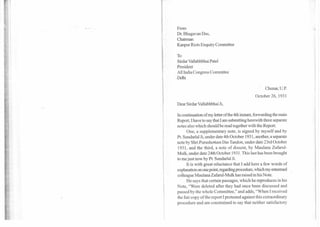
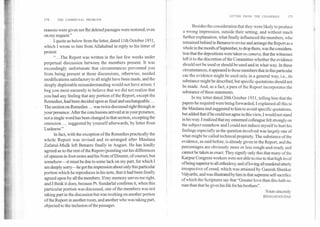
  • 107.
    192 THE COMMUNAL PROLI.Ervi SUPPLEMENTARYNOTE 193 by fou • this gs only; the learning of the wise, the justice of the great,t tept iyers of the good, and the valour of the brave." After the M ,ors were mercilessly driven out of Spain, the country never I nev the glory and the greatness which had been its own during ther eriod of Moor Government. Writing of the desolation of Grt zad. , after the departure of the Moors, said Conde, a Spank rd, VIeternal gloom envelopes the countries which their preser h. d brightened and enriched. Nature has not changed. She is is st tiling as ever; but the people and their religion have chang A.5 Mme mutilated monuments still dominate over the ruins /hie cover a desolate land; but from the midst of these monu -lent ., of these cold ruins, comes the cry of Truth: 'Honour and g. Dry .o the vanquished Arab, decay and misery for the conqu ;ring Spaniard'." co nparative study of the histories of Muslims and Christ ans Try forcibly brings out the fact that Christianity in its dealir gs v hether with persons of its own faith or with non- Chris ians has not shown a hundredth part of the tolerance and each i of outlook which have generally characterized the admit istrf lion of Muslim rulers. The organized atrocities of Chris anr Dwers on the Red Indians of America, or on the Negro race 1 ave to parallel in the history of Islam. With Christians them elve Muslims dealt in a spirit which contrasts powerfully with tie m inner in which Christians dealt with them. Leo, called the W se, r slates, with evident satisfaction, that on the reconquest of Cr te b the Byzantines, the Muslim colonists in the Island "were flay xl alive or plunged into the cauldrons of burning oil." The contrast is well brought out in the words of a Spanish Musl m who, driven out in 1610, is related to have uttered in .proteE t and in anguish: Did our victorious ancestors ever once attempt to extirpate Chris ianity out of Spain, when it was in their power? Did they not suffer your forefathers to enjoy the free use of their rites at the same time that they wore their chains? If there may have been some examples of forced conversions, they are so rare as scarce to deserve mentioning, and only attempted by men who had not the fear of God and the Prophet before their eyes, and who, in so doing, have acted directly and diametrically contrary to the holy precepts and ordinances of Islam, which cannot, without sacrilege, be violated by any who would be held worthy of the honourable epithet of Musalman. You can never produce among us any blood-thirsty formal tribunal on account of different pursuasions in points of faith, that any wise approaches your execrable Inquisitions. Our arms, it is true, are ever open to receive all who are disposed to embrace our religion, but we are not allowed by our Sacred Quran to tyrannize over consciences." In these few eloquent sentences is summarized, it seems to me, the whole history of Islam in the Middle Ages. I confess that reading their history as a whole, the chivalry, the abandon; the prodigal generosity of Muslims has always had a fascination for me and drawn my heart towards them. I remember there is a dark side to the picture also, that some misguided Muslims have in the past made, and often even during present-day riots try to make, forced conversions, that they have shown intolerance by demolishing temples and killing those who would not embrace Islam, that among themselves they have tyrannized over persons holding different views on secondary principles of religion, that Sunnis have butchered Shias, and Shias being in a minority have organized societies of assassins to murder Sunnis. But when we say this, we only repeat the truism that Human Nature is not perfect, that man's ambition and greed and religious perversity have been and are responsible for all the ills of the world, and have enacted millions of Karbalas during the long course of its written and un-written history. Whether the world ever be freed from these evils, or whether, in the words of the
  • 108.
    SUPPLEMENTARY NOTE 195 194 THE COMMUNALPROBLEM poet Ghalib (Merl to `mir men muzmir hai ek surat kharabi ki) they are inherent in our very make and composition is an unanswerable riddle. But one fact seems to emerge clearly from a synthetic study of history and psychology, namely, that toleration in religion has great limitations, and that a spirit of tolerance alone is a weak safeguard against the propensities to oppress, to plunder, and to force others to entertain the same opinions as oneself. The Quran teaches tolerance, "Let there be no compulsion in religion,"87 is its eternal commandment. And beautifully has the reason for this commandment be given: "But if thy Lord had pleased, verily all who are in the world would have believed together. Wilt thou then compel men to become believers?"88 The Bible teaches tolerance and forgiveness in these noble words: "Whoever smite thee on thy right cheek, turn to him the other also."" The Commandment in the Quran, "Recompense evil with that which is better,"9° is almost a paraphrase of the Christian commandment. The same idea is expressed with greater fullness of imagery in the following words of the Quran: "And a Paradise vast as the heavens and the earth, was prepared for those who mastered their anger and forgave others."91 These great precepts have, we know, acted as powerful brakes when, roused by anger or lust of wealth or power, Muslims and Christians have brought misery and desolation to the homes of their brother-men. In the case of Muslims, as shown above, the commandment of Mohammad has received greater reverence in action than the Christians have shown to that of the 87. Koran, ii. 256. 88. Ibid, x. 99. 89. Matthew v. 1-4. 90. Koran, xli. 34. 91. Ibid, id. 133-134. Christ.92 But the fair-minded amongst Muslims will readily admit that their history also is defaced with dark deeds of bloodshed and rapine committed in the name of religion. For the future, however, a more active principle of life than mere toleration will have to possess the hearts of men before they can rise to the full glories of which we catch glimpses now and again in isolated acts of great individuals. The spirit of toleration will have to rise still higher, and evolve into a synthetic and rational view of religion and a sympathetic recognition of the essential goodness of religions other than your own. "Howsoever men approach Me," says the Bhagavad Gita, "even so do I welcome them, for the path men take from every side is Mine, 0 Partha."93 And again— "0 son of Kunti: even the devotees of other deities who worship full of faith, they also worship Me, though not according to the established custom."94 It is in the recognition of this great principle in dealing with persons professing different faiths that peace, progress and happiness lies. m In the first chapter of the part relating to Kanpur Riots, there is a marginal heading, 'Effect of Communalism on Congress.' 92. Christian soldiers have often converted Christ from the prophet of mercy and love that he was into a kind of war-lord guiding and help- ing them in theil ferocious battles. During the crusades the portrait of Christ was actually painted on the banners of Christian knights when they went out to fight the Muslims in Jerusalem. 93. Bhagavad-Gita, iv. 11. 94. Ibid, ix. 23.
  • 109.
    196 "'HE COMMUNAL PROBLEMSUPPLEMENTARY NOTE 197 Sc ne Congressmen, it appears, indulged in talks of defensive commu 'al action. All of us agreed that patriotism requires that there s could be no such mental reservation. But from my knowle lge of Kanpur workers I feel that the language used in the last pan graph under that heading is stronger and more sweeping than its aould have been. Tl e Report had mentioned the good work done by Kanpur Congre smen during the riots. We have also paid our homage to the not le sacrifice of Shri Ganesh Shankar Vidyarthi. That a Ganes'i Shankar was produced from amongst Kanpur Congressmen was not a mere accident. He was the best representative of a group of workers capable of making great sacrific ,sin the cause of Hindu-Muslim Unity. N In the t iird part of the Report the question of cow sacrifice has been d ‘alt with under clause 8 of "Social Remedies." I do not agree" rith the manner in which that question has been disposed of. We are aware that this question has played an important part in the past in moulding the relations between Hindus and Muslims. I have spoken above of the spirit of toleration shown during the Muslim Rule. One of the aspects of the social life in which this toleration was so clearly evidenced was the great consideration which Muslim rulers invariably showed to the Hindu sentiment in regard to the cow. The cow question in its present form is a gift of the Bri'ish Rule. During the Muslim Period we do not read of cow slaughter on an organized scale. In fact, we have records of definite orders by Muslim rulers prohibiting the slaughter of cows for any purpose whatever. We also know that during the War of 1857 one of the points of agreement between Hindus and Muslims which led to such a strong combination was the prevention of cow- slaughter in the land. We have in the body of the Report laid stress on the essential oneness of the Hindu-Muslim culture inspite of the palpable differences, we have shown that a religious synthesis was being evolved which was disturbed by the advent of the British on the scene, and we have pleaded for an absolute fusion of the two cultures as the goal of all our recommendations. Keeping this end in view, it seems to me that the question of the cow has not been treated in a manner which would be helpful in bringing the goal nearer. We cannot too strongly urge that a Hindu must never use any kind of force for restraining the slaughter of cows, but at the same time a definite lead should be given for bringing about a condition under which tension would not be possible on this question. This I think can be done by laying down that all slaughter of cows should be effected only in slaughter houses constructed for the purpose, and in villages, where there are no slaughter- houses, away from theabadi,in such a manner as not to wound the susceptibilities of Hindus. There are two ways of approaching this question. One is to ask the Hindus to give up their sentiment in favour of the cow and to reconcile themselves to the view that the cow can be sacrificed in the same manner as other animals. The other method is that which is traditional in this country, viz., that the inhabitants of the soil, including Muslims, refrain from killing the cow. Several Muslim leaders have from time to time advised the Muslims to stop cow- sacrifice in India in the interest of brotherly relations between the two communities and have adduced religious and historical reasons in support of their argument. I do not feel competent to give that advice to the Muslim community. But at the same time, I am a dreamer of an absolute Hindu-Muslim fusion. I want Hindus and Muslims to live in the same Mohallas, in adjoining houses, and to have the most cordial social relations. And I want Hindu and Muslim women to have social relations as much as men. This dream is not likely of fulfillment if cows may be sacrificed in
  • 110.
    SUPPLEMENTARY NOTE 199198 THE COMMUNALPROBLEM private houses of Muslims situated side by side with Hindu homes. The Hindus may be persuaded to keep quiet when such sacrifices occur, but there would be no joy and happiness in living in a neighbourhood where such slaughter may take place. Even to-day the number of cows slaughtered for Muslims is very small, and I do not think that it would be any hardship if cow-slaughter is confined only to regularly constituted slaughter- houses at some distances from theabadiand is never permitted in private houses. The Hindus should accept this position, and the cow question must then cease to divide the two communities. With the rest of the Remedies suggested, I am in full agreement. We have not exhausted all the possible ways in which Hindus and Muslims may be brought together, but we have indicated lines which, if adopted would lead very soon to change in the whole atmosphere, which would itself lead on to other ties and relationships, so that ultimately their separate identities might merge into the one big individuality of the Hindustani nation. PURUSHOTTAM DAS TANDON Note of Dissent I have expressed my views in the foot-notes on the historical retrospect. The portion dealing with the riots has lost much of its grace, as the following passages were deleted after they had once been discussed and passed by the whole Committee: We put the following straight question to some of the most prominent Congressmen in Kanpur: 'Out of the thirty prominent Congressmen in Kanpur, how many do you think are absolutely above communal feeling, etc?' We chose the number thirty because there are thirty elected members of the Town Congress Executive. Their answers were frank and significant; we briefly reproduce them in their own words without giving the names of the witnesses, as these statements were givenin camera. "One gentleman says: "Men who are absolutely above Hindu-Muslim feeling are a microscopic minority—in the Congress organization here. Not more than two or three—the rest are all defensive communalists and not offensive communalists. I regard Malaviyaji as a defensive type and Bhai Paramanandji as an offensive type... About a dozen of our executive of thirty are such that they think Hindus should be organized separately, so that whenever necessary they should be prepared for self-defence. "A second says: "No other prominent Congressman at Kanpur is so much above communalism as Ganeshji was. Nearest to Ganeshji is . Then comes . Then comes Same about . (So and so) was some years back for Sangathan and also a Katha Vachak . (So and so) is a communalist. In the 1927 riots he took part with on the side of Hindus. He might have taken part this time also. He is quite partial in this matter. District workers like and are similarly Hindus. So... I am confidentially informed that these people created communal trouble in the district. I am ashamed of seeing (name of a well-known Muslim gentleman) as office-bearer of the District Congress Committee, because he is a communalist. of the Hindu Sabha was one of our vice- presidents.... I do not think it good that a Congressman should be a Sangathani or a Hindu Mahasabhaite. I believe that in this matter of Hindu-Muslim feeling there is a great need and want of purification of heart amongst Congressmen. There are very few who are above communalism. "A third says:—
  • 111.
    SUPPLEMENTARY NOTE 201200 THE COMMUNALPROBLEM "Out of the thirty prominent Congressmer in th town, there are all grades ofpeople with regard to co: nmu ial feeling. I think two or three of these can be said to b ; absolutely above Hindu-Muslim feeling. About ten tc He( n have some slight Hindu tinge in them... Two or thr ar ; aggressive communalists, and the rest ten or twelve are c 3mmunalist of defensive character. They do not mez. i an harm to the other community, but they do believe in I [indi s organ i7ing themselves for defence. "A fourth divides his comrades in fou cat( gories with regard to this question. In the first category to pi is men who are absolutely above Hindu-Muslim feeling Intl e second he puts those who have got some tinge of that fe :ling but who do not show it in practice. In the third, he puts Jefe isive Hindu communalists, and in the fourth, aggressive Hindu communalists. After forming these categories, he says: "Ganeshji may have belongedtothe first category, none else in our committee belongs to it. (So and ,.o) belongs to the second category. Majority of our memt ers t elong to the third category. Only one, namely (so a. id so ), as far as I know, belongs to the fourth category. "A fifth says: "I think, out of thirty prominent Con ,ress workers in Kanpur, about three are absolutely a )ove communal feeling almost like ; about four or ive ere defensive Hindu communalists; about three or fo it are aggressive communalists; and the remaining nineteea or twenty are all of one type with slight variation.... Men like (so and so) are admirers of Bhai Paramanand. "A sixth says: "If I am asked to give the Commission (Enquiry Committee) an ideaabout the mentality in matters commi mal ofprominent Congress workers, I should candidly say that except the one who is no more, there is not a single congressman here who could be said to be absolutely above communal feeling, but this admission does not mean that the Cong Yss Committee is essentially a communalist body. Most of the members are slightly tinged with the communal colour, which however does not carry with it any shade of aggression or domination about it. Some of course are aggressively communalists, but their activities have never been in the direction of jeopardizing the peace of the city. "A seventh says: "I believe that is absolutely above Hindu-Muslim feeling. I feel I am also of the same mentality. It is difficult for me to say how many other Congressmen are of this mentality. I believe there are gradations in this respect, but to give percentages is difficult, as I have been for about three years not in intimate touch with the workers. ...There are some, they may be one-fourth... of defensive Hindu mentality.... "An eighth says: "Of thirty prominent Congressmen in Kanpur, I believe roughly about 5 per cent are absolutely above communal feeling. A similar number are aggressive communalists, and the remaining 90 per cent are of various shades, but are mostly defensive communalists. "A ninth says: "I think, out of thirty prominent Congress workers in Kanpur, ...there are hardly two or three absolutely above the feeling. The rest are all in favour of Hindu Sangathan, but only for defensive purposes." "In such an atmosphere, and with such men at the helm, was ae C.D. Movement started in Kanpur. "But what has been said above must not be understood to
  • 112.
    202 THE COMMUNAL PROBLEM SUPPLEMENTARYNOTE 203 mean that the Hindiis were more acutely communalistic than the Musalmans. If the feelings of thirty prominent Muslim citizens of Kanpur were similarly analyzed, they would probably be found to be of much the same quality. Each begins with being defensive and ends with being offensive. The World War or 1914-18 is an illustration on a vast scale. But what we have said regarding Hindu feeling does mean that the Hindu Congressmen should have risen higher in spirit, should have been not defensive but attractive and tried positively to break down the others' aloofness and defensiveness and convert it into friendliness and co-operation. But, again, we are all wise after the event. The causes which led the Hindu members of the Congress into the attitude of mind they came to assume have been described in an earlier chapter.".. . When I received that fair copy of the report, I protested against this extraordinary procedure, and am constrained to say that neither satisfactory reasons were given, nor the deleted passages were restored even on my request. And this speaks for itself The survey of Hindu-Muslim relations at Kanpur presented in the first chapter would have remained incomplete if the suppressed passages were not reproduced here, hence I have taken this responsibility on my weak shoulders. The description of the awful events of the riots as well as the losses, requires no comment except that, on occasions, the colouring might have changed its shades if the brush was in other hands. But on the whole it represents a fairly correct picture. Perhaps the most important portion of the report from a practical point of view, is that which suggests remedies and is bound to have a lasting effect on the Hindu-Muslim relations in India. With this I propose to deal at some length. Although I agree with my colleagues in a good many remedies suggested by them, I am unable to give my whole-hearted support to the introductory note, at least, so far as it deals with the idea of the fusion of the Hindu-Muslim cultures. Doubtless, English literature has greatly influenced both the Hindu and Muslim intelligentsia, but it is yet doubtful, which of the two schools of thought has been influenced mostly English writers and Western thought, the one that advocates a fusion of the two cultures or the other which pleads for keeping the distinctive features of each culture intact. As for the Musalmans, there can be very little doubt that the idea of keeping their general features distinctively separate from those of the nations and communities is as old as Islam itself, for the holy Prophet (Peace be on him) has expressly commanded the Muslims to avoid all such fusion, by saying: reel-4 1-0 i4 .5-! 4. '1'413 0.'4 (Translation: He who imitates a people is one of them.) Numerous examples can be cited from reliable historians that even long before the English became a powerful nation and English literature spread among the Musalmans, leaders of Islamic thought, theologians, Sufis, philosophers and poets, had been laying great stress on keeping as model before them, the lives of the Prophet (peace be on him), the Khulafai Rashideen (Abu Bakr, Omar, Osman and Ali), and other companions of the Prophet (Sahaba), and following their modes of life to their utmost capacity. It cannot be denied, however, that people have not been generally able to follow this either through their ignorance and weaknesses or even for want of faith, but, excepting a very few of the free-thinker class, bulk of the great writers and thinkers of the Islamic world have always kept the same ideal in view and strongly criticized and condemned all attempts to break this line. Akbar, who is so highly admired equally by English and Hindu writers and even Muslim graduates of modern universities, however much we may appreciate his superior political talents or his incomparable administration, has always been treated
  • 113.
    SUPPLEMENTARY NOTE 205204 THE COMMUNALPROF _EM contemptuously by religious aithorities of his own times, and the very fact, that Aurangzeb is g =rally regarded to be not only one of the greatest Moslem king: , but almost a saint, clearly shows, which way the wind has beer blowing. The point need not be pre ssed further; but as one who believes in the infallibility ofQuran, an i in the highest utility and the greatest piety of following in the foot ,ceps of the holy Prophet (peace be on him) and his companions, t specially the Khulafai Rashideen, in the smallest detail of our dai y life and thus keeping the Islamic culture and civilization free fr gm alloy and mixture of the cultures and civilizations of the other rations, be they Asiatic or European, African or American, I ca -mot acquiesce in the following recommendations of the Con. nittee: I. Under sub-clause (2, of the Social group it has been suggested that- "Holi, Diwali, Idul-fitr, nd Shab-e-barat should be regarded as common festivals of botl communities, and new common national festivals should be et ::ated." Innovation in religious ',natters having been forbidden, it is absolutely impossible to accept the first portion of the recommendation, but the latt 3r portion may be acceptable if the procedure in any newly estal dished festival is so regulated as to make it a purely social functii and nothing is done that may not be acceptable to the Moslem: from their religious point of view, as the manner in which Hine a festivals are generally observed cannot be followed by Musal nans. Admittedly the present node of life here in India as well as in other Islamic countries, does not generally conform to all the teachings of Islam, just as the f >Rowers of others and older religions do not generally live up to tl e teachings of their religions, and there are obvious reasons fc r it, which need not be discussed here. But the fact that my brethren-in-faith do not act correctly cannot make me agree to any wrong suggestion. H. I cannot speak with authority about the teachings of any other religion, but I believe that the teachings of Islam are so comprehensive that almost the minutest details of our every day life come tinder the purview of our religion. Dress and appearance dealt with in Sub-clause (4) ordinarily seem to have nothing to do with one's religion, at least people of cosmopolitan views seem to think so, but a Musalman cannot or rather should not dress himself in a manner that in any way hinders or hampers the performance of his religious practices (for instance, prayers), and his appearance should also conform to the type approved by Islam. Hence the distinction, whether obtrusive or not, can hardly be avoided—it is rather imperative. Suh-clause (5) of the Social group recommends the abolition of Purdah. I know that the purdah system, as in vogue here, requires some changes, and I should be willing to accept any medications that do not go beyond what is allowed by our religion, but the abolition of Purdah will mean an interference in religion which cannot and should not be tolerated by Musalmans. In fact, this is a purely domestic affair and should be left to the Musalmans who may solve it according to their own religious and social ideals. IV. I am in general agreement with sub-clause (8) of the Social group, but I must clearly state that interference with the right of slaughtering of quadrupeds in one's house, either through legislation or executive orders, will always be a source of legitimate grievance to the Muslamans and other classes of people, and hope that the phraseology of this section, specially the phrase "should be governed by the general laws of the land" will not be made pretext for enacting or eforcing laws to infringe one's right of freely practiCing one's religions or the freedom of citizenship. A Musalman, while performing his religious obligation freely and without hitch or hindrance should take every care to see that he does not give any occasion for provocation to his neighbours. V. The recommendations classed under Religio-Educat i ona I
  • 114.
    20( THI COMMUNAL PROBLEMSUPPLEMENTARY NOTE 207 Si 4 grt up are ;enerally agreed upon, but I should like to say a few e following points: 'he statement in the preamble of sub-clause (2) that Iindu and Muslim students of the undenominational istitutions possess a broader outlook does not seem 3represent the correct position. It would be useless to iention any names in this connection, but I can say rithout fear of contradiction that most of the prominent 4uslim Nationalist are products of the Muslim Jniversity (formerly M.A.O. College, Aligarh) or have )een identified with it, while a very large number of the Imminent leader of Hindu Sangathan are ex-students )f undenominational institutions. Moreover, the ecommendations under this head, do not cover the nstitutions chiefly meant for imparting religious ducation. The recommendation under Sub-clause (7) which >rohibits the conversion ofminors under 18, is against he Islamic law and cannot therefore be accepted by vlusalmans. According to Muslim theologians, even hose minors have the right of conversion whose powers )f understanding are sufficiently developed and the age A minority does not go beyond 15 years, although many )eople, especially women, reach their age of puberty .ven at an earlier age. •I cat not also subscribe to the belief that there were no ge :mine c ises of conversion during the last 10 years or that the ac ivities of each and every organization, meant for the object of cc iversic a, were such that they should all be discontinued. The Committee only requires that in the matter of conversions, unfair means should not be allowed and those organizations must be discontinued which do not adhere to this. principle. IV. Under sub-clause (4) of the Politico-Economic group, I do not see my way to agree to the suggestion that separate electorates on religious basis be abolished. Whatever my friends of the Muslim Nationalist party may think, I am convinced that taking all the various circumstances in view, abolition of separate electorates is bound to affect the minorities adversely, and so long as the general attitude of high-caste Hindus, who have at present almost the monopoly of all that is worth having, does not undergo a radical change, and they are not willing to do full justice and give due share in all walks of life to the unhappy millions, mis- called untouchables, mixed electorates should not be forced upon the minorities. Has not Mahatma Gandhi himself stated that "the untouchables would be far worse under that Swaraj than they are. now, for the simple reason that our weakness and our failings would then be_ buttressed up by the accession of power?" My own suggestion, therefore, would be that the community in majority within a certain province be made to elect her representatives by mixed electorates, so that the rights of minorities may not be altogether neglected while the community which is in minority be permitted to elect her representatives, either by separate electorate or if it chooses by mixed electorates. This may seem rather an incongruity in constitution-making, but I am confident that it will prove beneficial and give the minorities sufficient protection. Conditions in this country are so different from those of Europe that in order to meet the requirements of our people we shall have to make alterations in our programme of work or even the constitution of administration. We need not copy the West in every detail. I have never been able to appreciate the view that separate electorate is or has been a source of Hindu-Muslim dissensions. The idea, as is said, might have emanated from officials, but there are many other things that have been introduced by them, and i t cannot be denied that they have done some good to us. Why we sds on t (a) • (b)
  • 115.
    SUPPLEMENTARY NOTE 209208 THE COMMUNALPROBLEM should then separate electorate be 'singled out for such whole: ale denunciation? "Give the dog a bad name nd then kick him o is an old English proverb, and to my mind is perfectly applicz ble in this case. If by some accident the position of M salmans were revel led and they became a powerful majority wi 1the position of sa ety held at present by the majority communit , it is very doubtful hat mixed electorate would have so persiste ttly been advocate( by the minority of that time. V. Under sub-clause (10) it has been .uggested that ban' ing and insurance, etc., should be organize, by joint efforts of the two communities. Interest on money in el, .'ry form or shape b( ing prohibited by Islam, I cannot ask my co religionists to join the banking or insurance business. On the cc atrary, I feel it my c uty to advice them to refrain from all such it 'moral undertakings, I would go one step further and request rn- Hindu brethren also to desist from this sort of business, which not only retards their rn oral and spiritual progress but tends to nourish capitalism, which the source of incalculable mischief to human ty. I am also convir ced that people doing this immoral trade spoil all chances of bette ing the condition of their future generation! , and their families are washed out of this earth within a very sho t time and thus the ery existence of our society is threatened wi h destruction. It is ( the good and pious that prosper and leave after them a prosper ous progeny. After presenting my views on the eh pter of remedies, I 'ant to supplement it by some more suggestio .s. Similarity in dre, s or appearance, interdining or comradery in t ducational institute )ns, or joining in festivals or gathering at clut,s and societies, wi' I no doubt help to a certain extent in advancing social relations; tut a dispassionate scrutiny of the whole problem of the Hindu-Mtulim Unity will, I trust, convince all thinking minds that real unity can only be achieved by a change of heart which is sure to create an atmosphere of confidence and good-will; sympathy and trust. And as trust disarms even wickedness, such an atmosphere cannot be created by mere outward and superficial devices. It would require a long and weary process of inward purifications. The passions of animosity and the desire for gaining ascendancy over one another will have to be subdued and sentiments of human brotherhood and love planted in the minds of the people at large. The experience, gained during the centuries of Muslim rule in India, goes to show clearly that natural causes led to some sort of fusion between the two communities without making any fuss about it or adopting any artificial means to force its pace. To my mind, love is the supreme curative for all our diseases, and if we can somehow or other instill it among the leaders and followers of the two communities, our objective would then be attained. How to do this is the crucial question. The great nations of Europe who fought the terrible World War of 1914-18 had most of them nearly common appearances, costumes, manners and customs, yet every one knows how ferociously one nation cut another 's throat and vied with every other in her inhuman effort of ruination and extinction. What has happened in Europe is likely to be repeated in India, even if without effecting any change in our hearts, we agree to act upon the various suggestions of the Committee that are based on the idea of cultural fusion. In order, however, to achieve a real and permanent unity and keep Hindus and Muslims on brotherly terms, we shall have to effect, in my humble opinion, radical changes in our methods, in the manners suggested below:— (1) The Hindus who form the majority community and are far ahead of the Muslims in wealth, modem education, organization, and propaganda, should try to win the hearts of the Mu slims minority by unhesitatingly
  • 116.
    SUPPLEMENTARY NOTE 211 210 TP. iCOMMUNAL PROBLEM riving the guarantees and facilities required by her or securing a proper place in the constitution of the ;ountry. (2) vIost of us delight in condemning modem civilization, nit, notwithstanding that, the truth is that in every walk of life we are doing our best to imitate Europe. 3oth Hindus and Muslims, pay only lip homage to their respective religions and merely boast on the greatness tnd beauties of their old cultures. And no one seems to realize that the mode of our daily life is being so changed, lay by day, that we are drifting farther and farther from what we call the Golden Age of our ancestors. This farce should be put an end to, and if we really care to be truthful and honest and long to live in peace and harmony we should give up all cravings for Western ideals and habits and turn back to the old days of Vedas and Quran. The idea of the one supreme God is the central point of belief, not only of the Musalmans but among some of the Hindu sects also, as mentioned on p.153 (chapter on Remedies). If constant and earnest efforts be made to propagate and inculcate this belief in all the Hindus sects, a certain degree of unity in religious thought can be achieved which will in its turn dispel feelings of contempt and hatred from the minds of the monist and the pagan both. (4) Although it is not possible to eradicate the human lust for power and wealth which is the chief source of all troubles and antagonism, yet it is not impossible to subdue or limit it to a great extent. This can only be attained through spiritualism, which is another name for godliness and purity of life. Real and sincere attempts have to be made to turn the minds of our younger generations and leaders of thought towards this much- desired consummation. When the weak has nothing to fear from the strong, lust has been generally subdued, and people have learnt to become God- fearing and live a purer life, Hindus and Muslims will easily become friends and learn to love each other like sons of the same parents. You bestow praises on Kabir, Sufis and saints and on prophets, but you turn your face as soon as the time for action comes and you are required to follow in their footsteps. This is not the way of bringing unity among the nations. It will, on the contrary, divide them further and increase dissensions to an extent which cannot perhaps be gauged at present, but it is sure to bring ruin upon them just as European Nations are being crushed under the burden of their own creation—the Western Civilization. How well has Maulana Muhammad Ali dealt with this subject and warned95 against new experiments in cultmaking:— "Religious reformers have at all times betrayed a fatal weakness for composition or the preparation of a religious compound formed of many samples gathered from many different sources. They have hoped that by adopting a policy of inclusion they would be able to form a faith embracing doctrines culled from diverse faiths and acceptable to all the followers of all these faiths, that is how they hope to attain Uniformity and secure Conformity. But history has shown that the cause of peace and unity has not been greatly furthered by the formation of such eclectic faiths. Only too often have they added one more to the warring creeds existing before and have only increased the disunion they were creating. Such well intentioned failures have at last made people fall back upon Toleration." 95. Presidential Address of the Coconada Congress, pp.74-75. (3) ZAFARUL-MULK
  • 117.
    Appendix Questionnaire 1. When didthe relations between the Hindus and the Muslims begin to get strained in this city? 2. Since when has the communal tension been especially increasing? What have beep the causes thereof? What are the special forms it has taken? 3. When and what new communal organizations were started by either community? What effect did such organizations produce on the relations between the two communities? What measures were taken by them for producing such effects? 4. What individual communal leaders, either local or from outside, have been working here, and what steps taken by them, if any, have tended to produce undesirable effects on the relations between the two communities? 5. What was the attitude of the Government officials towards the activities of such organizations? 6. What other causes have contributed towards the embittering of communal feelings? 7. What was the immediate cause or occasion of the starting of the recent riots'? 8. Did the Government officials do anything before the commencement of the riots, on the 24th March 1931, which tended to accentuate communal feelings? 9. After the tension had begun, what measures, if any, did the Government authorities take to relieve it?
  • 118.
    214 THE COMM "JNALPROBLEM APPENDIX 215 10. What effort> were made by the Government officials t restore peace after the disturbances had begun, and whe was peace re-established? 11. What was tl e attitude of the District authorities, the polio, and the mill ary during the days of the riots? 12. Is it a fact I iat the local authorities refused to give timel help to resp ,nsible Hindus and Muslims, saying, "Take he' from the Congress," or "Call Mahatma Gandhi," or otht r similar thinl. s? What inference do you draw about the attituc of the Government from such remarks? 13. During the lays of the riot, what was the attitude adopte by the Hint u and Muslim leaders of the city and by loc 1 communal c rganizations? What were the steps taken by the a for restorin ; peace? 14. Did the local Congress workers, or any one in the name of the Congress, do anything before the riots, which could 1: e regarded as a cause of the riots? What was the attitude of the Congress workers during the riots? 15. Was any fear of disturbance felt in the city before the ric actually broke out? If so, since when? Were any steps taken and by whc n, to allay the same? 16. Is there any economic question at the bottom of these riot:,? If so, what? 17. Is there any general political question involved in these riot ;? If so, what? Is any other local problem connected with the e riots? 18. Is there any purely religious quarrel at the bottom of the .e riots? 19. Approximately how many lives were lost altogether? He many persons were injured? How much worth of proper y was looted or destroyed? How many women and children were killed or are missing? What were the causes of the attacks on women and children? 20. How many incidents do you know of, in which Hindus gave help to or protected Muslims, or Muslims gave help to or protected Hindus? 21. Can it be inferred from the class of people who took part in these disturbances and from the manner in which the disturbances were carried on, that any previous preparations had been made for the same? Do we find any indication of pre-meditated or pre-organised action in the disturbances? 22. What measures can be taken (1) of a temporary and immediate nature,- and (2) of a permanent character, for the prevention of such riots in future? 23. Did the students or teachers of local educational institutions take any part in the recent riots or in the endeavour to quell them? 24. Do your consider it desirable or necessary to take educational measures to banish communal antagonisms and prejudices from and promote feelings of, unity and brotherhood in the hearts of the rising generations during their years of study? If so, what measures do you propose? Kanpur SUNDARLAL 9 April 1931 Member and Secretary Congress Enquiry Committee Printed at Shivam Offset Press, A-12/I Naraina Indl. Area, Phase-1. New Delhi-11002$