Russian literature
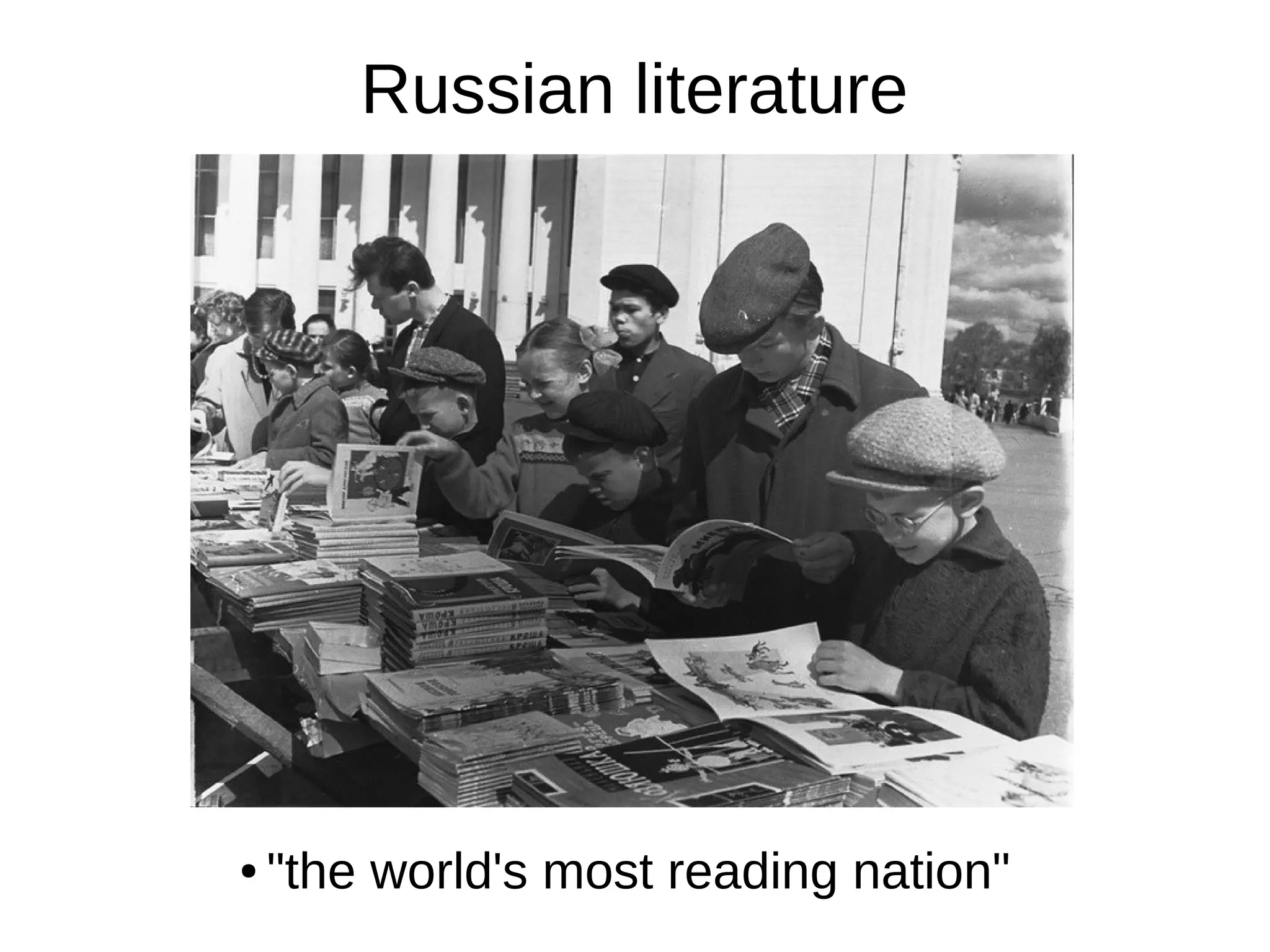
● "the world's most reading nation"
● Roots of Russian literature can be traced to the
Middle Ages, when epics and chronicles in Old
Russian were composed.
● Russian literature refers to
the literature of Russia and its
émigrés and to the Russian-
language literature of several
independent nations once a
part of what was historically
Rus', Russian Empire or the
Soviet Union.
18th century
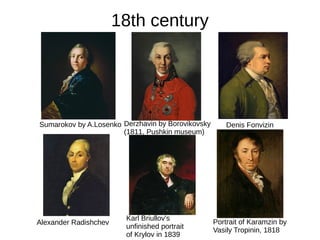
Sumarokov by A.Losenko Derzhavin by Borovikovsky
(1811, Pushkin museum)
Denis Fonvizin
Alexander Radishchev Portrait of Karamzin by
Vasily Tropinin, 1818
Karl Briullov's
unfinished portrait
of Krylov in 1839
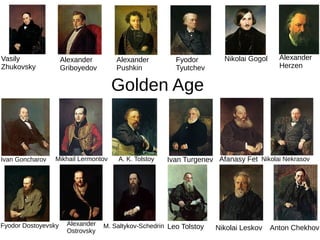
● By the Age of Enlightenment, literature had
grown in importance, and from the early 1830s,
Russian literature underwent an astounding
golden age in poetry, prose and drama.
Romanticism permitted a flowering of poetic
talent: Vasily Zhukovsky and later his protégé
Alexander Pushkin came to the fore.
Golden Age
Alexander
Ostrovsky
Fyodor Dostoyevsky M. Saltykov-Schedrin Leo Tolstoy Nikolai Leskov Anton Chekhov
Vasily
Zhukovsky
Alexander
Griboyedov
Alexander
Pushkin
Fyodor
Tyutchev
Nikolai Gogol Alexander
Herzen
Ivan Goncharov Mikhail Lermontov A. K. Tolstoy Ivan Turgenev Afanasy Fet Nikolai Nekrasov
● Prose was flourishing as well. The first great
Russian novelist was Nikolai Gogol. Then came
Ivan Turgenev, who mastered both short stories
and novels. Leo Tolstoy and Fyodor
Dostoyevsky soon became internationally
renowned. In the second half of the century
Anton Chekhov excelled in short stories and
became a leading dramatist.
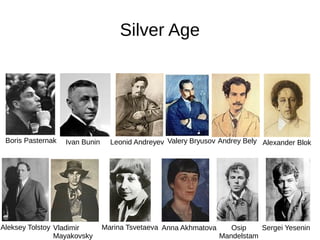
Silver Age
Ivan BuninBoris Pasternak Leonid Andreyev Valery Bryusov Andrey Bely Alexander Blok
Aleksey Tolstoy Vladimir
Mayakovsky
Anna Akhmatova Osip
Mandelstam
Sergei YeseninMarina Tsvetaeva
● The beginning of the 20th century ranks as the
Silver Age of Russian poetry. The poets most
often associated with the "Silver Age" are
Konstantin Balmont, Valery Bryusov, Alexander
Blok, Anna Akhmatova, Nikolay Gumilyov, Osip
Mandelstam, Sergei Yesenin, Vladimir
Mayakovsky, Marina Tsvetaeva and Boris
Pasternak.
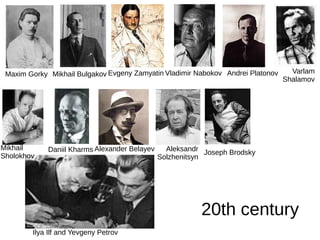
20th century
Maxim Gorky Evgeny ZamyatinMikhail Bulgakov Vladimir Nabokov Andrei Platonov Varlam
Shalamov
Mikhail
Sholokhov
Daniil Kharms Alexander Belayev Aleksandr
Solzhenitsyn
Joseph Brodsky
Ilya Ilf and Yevgeny Petrov
● This era produced some first-rate novelists and
short-story writers, such as Aleksandr Kuprin,
Nobel Prize winner Ivan Bunin, Leonid
Andreyev, Fedor Sologub, Aleksey Remizov,
Evgeny Zamyatin, Dmitry Merezhkovsky and
Andrei Bely.
● After the Revolution of 1917, Russian literature split into Soviet
and white émigré parts. While the Soviet Union assured universal
literacy and a highly developed book printing industry, it also
enforced ideological censorship. In the 1930s Socialist realism
became the predominant trend in Russia. Its leading figure was
Maxim Gorky, who laid the foundations of this style. Nikolay
Ostrovsky's novel How the Steel Was Tempered has been among
the most successful works of Russian literature. Alexander
Fadeyev achieved success in Russia.
● Various émigré writers, such as poets Vladislav
Khodasevich, Georgy Ivanov and Vyacheslav
Ivanov; novelists such as Mark Aldanov, Gaito
Gazdanov and Vladimir Nabokov; and short
story Nobel Prize winning writer Ivan Bunin,
continued to write in exile.
● The Khrushchev Thaw brought some fresh
wind to literature and poetry became a mass
cultural phenomenon. This "thaw" did not last
long; in the 1970s, some of the most prominent
authors were banned from publishing and
prosecuted for their anti-Soviet sentiments.
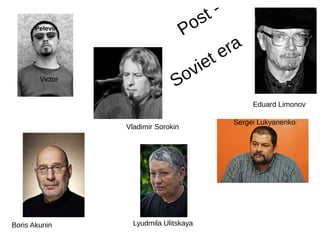
Post -
Soviet era
Lyudmila Ulitskaya
Eduard Limonov
Vladimir Sorokin
Boris Akunin
Victor
Pelevin
Sergei Lukyanenko
● The end of the 20th century was a difficult
period for Russian literature, with few distinct
voices. Among the most discussed authors of
this period were Victor Pelevin, who gained
popularity with short stories and novels, novelist
and playwright Vladimir Sorokin, and the poet
Dmitry Prigov.
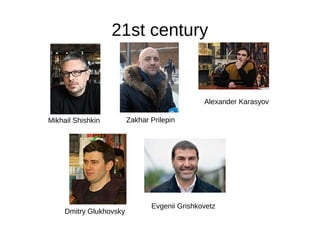
21st century
Evgenii Grishkovetz
Mikhail Shishkin Zakhar Prilepin
Alexander Karasyov
Dmitry Glukhovsky
● In the 21st century, a new generation of
Russian authors appeared, differing greatly
from the postmodernist Russian prose of the
late 20th century, which lead critics to speak
about “new realism”. Leading "new realists"
include Ilja Stogoff, Zakhar Prilepin, Alexander
Karasyov, Arkadi Babchenko, Vladimir
Lorchenkov, Alexander Snegiryov and the
political author Sergej Shargunov.
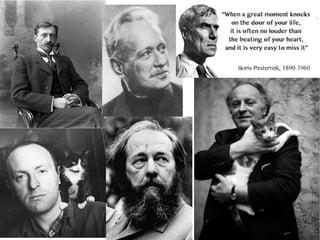
● Russian authors significantly contributed almost
to all known genres of the literature. Russia had
five Nobel Prize in literature laureates. As of
2011, Russia was the fourth largest book
producer in the world in terms of published
titles. A popular folk saying claims Russians are
"the world's most reading nation".
Russian literature

Russian literature

  • 1.
    Russian literature ● "theworld's most reading nation"
  • 2.
    ● Roots ofRussian literature can be traced to the Middle Ages, when epics and chronicles in Old Russian were composed. ● Russian literature refers to the literature of Russia and its émigrés and to the Russian- language literature of several independent nations once a part of what was historically Rus', Russian Empire or the Soviet Union.
  • 3.
    18th century Sumarokov byA.Losenko Derzhavin by Borovikovsky (1811, Pushkin museum) Denis Fonvizin Alexander Radishchev Portrait of Karamzin by Vasily Tropinin, 1818 Karl Briullov's unfinished portrait of Krylov in 1839
  • 4.
    ● By theAge of Enlightenment, literature had grown in importance, and from the early 1830s, Russian literature underwent an astounding golden age in poetry, prose and drama. Romanticism permitted a flowering of poetic talent: Vasily Zhukovsky and later his protégé Alexander Pushkin came to the fore.
  • 5.
    Golden Age Alexander Ostrovsky Fyodor DostoyevskyM. Saltykov-Schedrin Leo Tolstoy Nikolai Leskov Anton Chekhov Vasily Zhukovsky Alexander Griboyedov Alexander Pushkin Fyodor Tyutchev Nikolai Gogol Alexander Herzen Ivan Goncharov Mikhail Lermontov A. K. Tolstoy Ivan Turgenev Afanasy Fet Nikolai Nekrasov
  • 6.
    ● Prose wasflourishing as well. The first great Russian novelist was Nikolai Gogol. Then came Ivan Turgenev, who mastered both short stories and novels. Leo Tolstoy and Fyodor Dostoyevsky soon became internationally renowned. In the second half of the century Anton Chekhov excelled in short stories and became a leading dramatist.
  • 7.
    Silver Age Ivan BuninBorisPasternak Leonid Andreyev Valery Bryusov Andrey Bely Alexander Blok Aleksey Tolstoy Vladimir Mayakovsky Anna Akhmatova Osip Mandelstam Sergei YeseninMarina Tsvetaeva
  • 8.
    ● The beginningof the 20th century ranks as the Silver Age of Russian poetry. The poets most often associated with the "Silver Age" are Konstantin Balmont, Valery Bryusov, Alexander Blok, Anna Akhmatova, Nikolay Gumilyov, Osip Mandelstam, Sergei Yesenin, Vladimir Mayakovsky, Marina Tsvetaeva and Boris Pasternak.
  • 9.
    20th century Maxim GorkyEvgeny ZamyatinMikhail Bulgakov Vladimir Nabokov Andrei Platonov Varlam Shalamov Mikhail Sholokhov Daniil Kharms Alexander Belayev Aleksandr Solzhenitsyn Joseph Brodsky Ilya Ilf and Yevgeny Petrov
  • 10.
    ● This eraproduced some first-rate novelists and short-story writers, such as Aleksandr Kuprin, Nobel Prize winner Ivan Bunin, Leonid Andreyev, Fedor Sologub, Aleksey Remizov, Evgeny Zamyatin, Dmitry Merezhkovsky and Andrei Bely.
  • 11.
    ● After theRevolution of 1917, Russian literature split into Soviet and white émigré parts. While the Soviet Union assured universal literacy and a highly developed book printing industry, it also enforced ideological censorship. In the 1930s Socialist realism became the predominant trend in Russia. Its leading figure was Maxim Gorky, who laid the foundations of this style. Nikolay Ostrovsky's novel How the Steel Was Tempered has been among the most successful works of Russian literature. Alexander Fadeyev achieved success in Russia.
  • 12.
    ● Various émigréwriters, such as poets Vladislav Khodasevich, Georgy Ivanov and Vyacheslav Ivanov; novelists such as Mark Aldanov, Gaito Gazdanov and Vladimir Nabokov; and short story Nobel Prize winning writer Ivan Bunin, continued to write in exile.
  • 13.
    ● The KhrushchevThaw brought some fresh wind to literature and poetry became a mass cultural phenomenon. This "thaw" did not last long; in the 1970s, some of the most prominent authors were banned from publishing and prosecuted for their anti-Soviet sentiments.
  • 14.
    Post - Soviet era LyudmilaUlitskaya Eduard Limonov Vladimir Sorokin Boris Akunin Victor Pelevin Sergei Lukyanenko
  • 15.
    ● The endof the 20th century was a difficult period for Russian literature, with few distinct voices. Among the most discussed authors of this period were Victor Pelevin, who gained popularity with short stories and novels, novelist and playwright Vladimir Sorokin, and the poet Dmitry Prigov.
  • 16.
    21st century Evgenii Grishkovetz MikhailShishkin Zakhar Prilepin Alexander Karasyov Dmitry Glukhovsky
  • 17.
    ● In the21st century, a new generation of Russian authors appeared, differing greatly from the postmodernist Russian prose of the late 20th century, which lead critics to speak about “new realism”. Leading "new realists" include Ilja Stogoff, Zakhar Prilepin, Alexander Karasyov, Arkadi Babchenko, Vladimir Lorchenkov, Alexander Snegiryov and the political author Sergej Shargunov.
  • 18.
    ● Russian authorssignificantly contributed almost to all known genres of the literature. Russia had five Nobel Prize in literature laureates. As of 2011, Russia was the fourth largest book producer in the world in terms of published titles. A popular folk saying claims Russians are "the world's most reading nation".