Environmental Management Challenges in Dubai
Presentation Outline History Laws and Regulations Present-day Environment Department Environmental Challenges Conclusion
Dubai’s Environmental Management Origins 1986: explosion at Chernobyl Nuclear Power Station 1988: Leaders of Dubai formed environmental section in Health Department 1991: Dubai Municipality (with help of United Nations Environment Programme) create the Environment Department
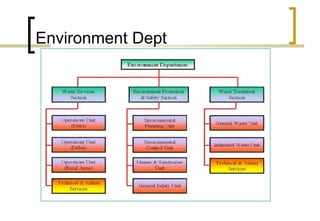
Environment Dept
Environmental Planning Unit The Unit is responsible for: the preparation and review of relevant Policies and Technical Guidelines on environmental protection  evaluating the environmental soundness of all proposed developmental projects …
Environmental  Environmental Regulations Federal Laws Basic Regulations for Protection Against Ionizing Radiation 2004 Air Pollution Law 2006 Regulations for Radioactive Waste Management  2004 Regulations for Safe Transport of Radioactive Materials 2004 Local Orders Local Order 61 of 1991 - Environment Protection Regulations Local Order 11 of 2003 - Public Health and Community Safety Local Order 07 of 2002 - Waste Disposal Sites Information Bulletins  Approved Hazardous Waste Transporters March 2006;  Environmental Standards And Allowable Limits of Pollutants May 2003 Codes of Practice Management of Legionella; Management of Dangerous Goods; Management of Medical Wastes; Good Environmental Practice for Hotels and Tourism Operators
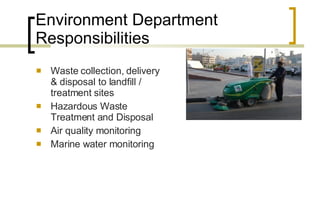
Environment Department Responsibilities Waste collection, delivery & disposal to landfill / treatment sites  Hazardous Waste Treatment and Disposal  Air quality monitoring Marine water monitoring
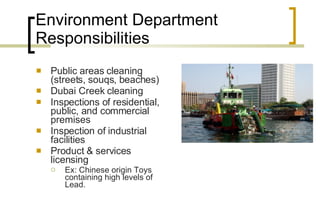
Environment Department Responsibilities Public areas cleaning (streets, souqs, beaches) Dubai Creek cleaning Inspections of residential, public, and commercial premises  Inspection of industrial facilities Product & services licensing  Ex: Chinese origin Toys containing high levels of Lead.
Some Environmental Challenges
Environmental Challenges:  Excessive coastal developments Issue High impact on the local marine ecology. The typically crystalline waters have become severely clouded with silt.  Construction activity is damaging the marine habitat, Concerns about the long-term viability of the projects. Rising sea levels from global climate change Possible Solutions 4 stakeholders to act responsibly Corporate sector: Due diligence; EIS Remediation measures Transparency
Environmental Challenges: Lack of Recycling & Conservation Issue Over consumption Recycling and conservation principles are totally absent (U.A.E. found to have largest ecological footprint) Possible Solutions Children identified as the primary target for environmental awareness programs  Diversifying awareness tools to suit the mix of cultures and background Increase the number of conservation site and protected areas.  Recycling stations Leading by the example
Environmental Challenges: Waste Disposal Sites Issue Rapidly running out of landfill space Possible Solutions Explore successful practices and technologies such as waste to energy systems Establish centralized facilities for general waste sorting, construction and demolition debris waste recycling, and tires utilization
Environmental Challenges: Ozone Issue High ozone levels at g round-level (becomes an air pollutant with harmful effects on the respiratory system) Ample emissions (industries and mobile sources) Favorable weather (sunlight, land/sea breeze)  Possible Solutions Utilize LNG/LPG in Power Plants and large transport fleets (taxis, busses)
Environmental Challenges: Noise levels in urban areas Issue High noise levels  Air traffic Road Traffic Industrial Possible Solutions Regulations (Zoning, Speed limit, Aircraft engine, etc.) Technology  Polluters pay
Environmental Challenges: Air Quality  Issue High concentration of fine particles in the air due to sand storms,  burning of fossil fuels, power plants  and extensive construction activities Stink in most luxurious housing estates caused by poor water quality, septic tanks Possible Solutions Monitor air quality, establish standards Introduce legislation / regulations Polluters pays  Increase green cover and public & community parks   Introduce technology Increase sewerage processing capacity Use means to neutralise the odours and the smell
Conclusion Lack of institutional capacity, civic engagement, corporate responsibility Public sector: Inadequate organisation structure Some good Initiatives: The Dubai International Award for Best Practices US$ 360,000 (= Database) PC recycling program: partnership between Dubai Municipality, NGOs and corporate sector The environmental and health awareness office: disseminates environmental and health awareness in order to improve the health status of all community members.

Environmental Managment in Dubai

  • 1.
  • 2.
    Presentation Outline HistoryLaws and Regulations Present-day Environment Department Environmental Challenges Conclusion
  • 3.
    Dubai’s Environmental ManagementOrigins 1986: explosion at Chernobyl Nuclear Power Station 1988: Leaders of Dubai formed environmental section in Health Department 1991: Dubai Municipality (with help of United Nations Environment Programme) create the Environment Department
  • 4.
  • 5.
    Environmental Planning UnitThe Unit is responsible for: the preparation and review of relevant Policies and Technical Guidelines on environmental protection evaluating the environmental soundness of all proposed developmental projects …
  • 6.
    Environmental EnvironmentalRegulations Federal Laws Basic Regulations for Protection Against Ionizing Radiation 2004 Air Pollution Law 2006 Regulations for Radioactive Waste Management 2004 Regulations for Safe Transport of Radioactive Materials 2004 Local Orders Local Order 61 of 1991 - Environment Protection Regulations Local Order 11 of 2003 - Public Health and Community Safety Local Order 07 of 2002 - Waste Disposal Sites Information Bulletins Approved Hazardous Waste Transporters March 2006; Environmental Standards And Allowable Limits of Pollutants May 2003 Codes of Practice Management of Legionella; Management of Dangerous Goods; Management of Medical Wastes; Good Environmental Practice for Hotels and Tourism Operators
  • 7.
    Environment Department ResponsibilitiesWaste collection, delivery & disposal to landfill / treatment sites Hazardous Waste Treatment and Disposal Air quality monitoring Marine water monitoring
  • 8.
    Environment Department ResponsibilitiesPublic areas cleaning (streets, souqs, beaches) Dubai Creek cleaning Inspections of residential, public, and commercial premises Inspection of industrial facilities Product & services licensing Ex: Chinese origin Toys containing high levels of Lead.
  • 9.
  • 10.
    Environmental Challenges: Excessive coastal developments Issue High impact on the local marine ecology. The typically crystalline waters have become severely clouded with silt. Construction activity is damaging the marine habitat, Concerns about the long-term viability of the projects. Rising sea levels from global climate change Possible Solutions 4 stakeholders to act responsibly Corporate sector: Due diligence; EIS Remediation measures Transparency
  • 11.
    Environmental Challenges: Lackof Recycling & Conservation Issue Over consumption Recycling and conservation principles are totally absent (U.A.E. found to have largest ecological footprint) Possible Solutions Children identified as the primary target for environmental awareness programs Diversifying awareness tools to suit the mix of cultures and background Increase the number of conservation site and protected areas. Recycling stations Leading by the example
  • 12.
    Environmental Challenges: WasteDisposal Sites Issue Rapidly running out of landfill space Possible Solutions Explore successful practices and technologies such as waste to energy systems Establish centralized facilities for general waste sorting, construction and demolition debris waste recycling, and tires utilization
  • 13.
    Environmental Challenges: OzoneIssue High ozone levels at g round-level (becomes an air pollutant with harmful effects on the respiratory system) Ample emissions (industries and mobile sources) Favorable weather (sunlight, land/sea breeze) Possible Solutions Utilize LNG/LPG in Power Plants and large transport fleets (taxis, busses)
  • 14.
    Environmental Challenges: Noiselevels in urban areas Issue High noise levels Air traffic Road Traffic Industrial Possible Solutions Regulations (Zoning, Speed limit, Aircraft engine, etc.) Technology Polluters pay
  • 15.
    Environmental Challenges: AirQuality Issue High concentration of fine particles in the air due to sand storms, burning of fossil fuels, power plants and extensive construction activities Stink in most luxurious housing estates caused by poor water quality, septic tanks Possible Solutions Monitor air quality, establish standards Introduce legislation / regulations Polluters pays Increase green cover and public & community parks Introduce technology Increase sewerage processing capacity Use means to neutralise the odours and the smell
  • 16.
    Conclusion Lack ofinstitutional capacity, civic engagement, corporate responsibility Public sector: Inadequate organisation structure Some good Initiatives: The Dubai International Award for Best Practices US$ 360,000 (= Database) PC recycling program: partnership between Dubai Municipality, NGOs and corporate sector The environmental and health awareness office: disseminates environmental and health awareness in order to improve the health status of all community members.

Editor's Notes

  • #2 Population of Dubai is exploding (approximately 1.3 million in 2007, expected to reach 5 million by 2020) Increase in demography puts stresses on the environment