Presentado por:
Dr. Alexis A. Cuevas
R1 Medicina Interna
Common
Musculoskeletal
Problems
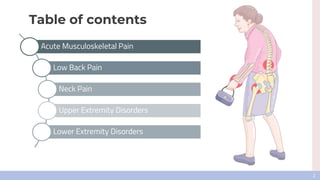
Table of contents
2
Acute Musculoskeletal Pain
Low Back Pain
Neck Pain
Upper Extremity Disorders
Lower Extremity Disorders
Acute Musculoskeletal Pain
is caused by various soft tissue injuries,
strains (injury to a tendon or a muscle), and
sprains (injury to a ligament).
3
Acute Musculoskeletal Pain
4
are inaccurately
treated with
opioids
20%
Substantial potential harms
➔ Risk for longer-term use
➔ Addiction
➔ Overdose
MKSAP 19. General Internal Medicine I. Common Musculoskeletal Problems
acute pain
(<4 weeks duration)
Topical
NSAIDs
second line
improved pain and function
Oral
NSAIDs
not recommended
Opioids
Low
Back Pain
5
Low Back Pain
6
Most common identifiable causes
➔ spinal stenosis
➔ disk herniation
➔ compression fractures
MKSAP 19. General Internal Medicine I. Common Musculoskeletal Problems
Chronic Pain
(>12 weeks)
Subacute Pain
(4 - 12 weeks)
Acute Pain
(<4 weeks)
Less common identifiable causes
➔ vertebral metastases
➔ infection
Diagnosis and Evaluation
7
MKSAP 19. General Internal Medicine I. Common Musculoskeletal Problems
8
MKSAP 19. General Internal Medicine I. Common Musculoskeletal Problems
Low Back Pain
9
MKSAP 19. General Internal Medicine I. Common Musculoskeletal Problems
History and Physical Examination
fever and
neurological signs
strength, sensory and
reflex testing of the
legs
ipsilateral and
contralateral straight
raise leg test
Low Back Pain
10
MKSAP 19. General Internal Medicine I. Common Musculoskeletal Problems
History and Physical Examination
Low Back Pain
11
MKSAP 19. General Internal Medicine I. Common Musculoskeletal Problems
Further Diagnostic Testing
Within the first 6 weeks of symptoms
➔ avoid performing images routinely
➔ imaging abnormalities are
common
➔ obtaining images is not associated
with improved outcomes
➔ their discovery may lead to
unhelpful and costly interventions
Imaging indications
➔ severe or progresive neurologic
compromise
➔ suspicion of a life/function
threatening cause
➔ MRI is the preferred test for most
suspicions
Low Back Pain
12
MKSAP 19. General Internal Medicine I. Common Musculoskeletal Problems
Treatment
Nonpharmacologic treatment Pharmacologic treatment
Acute Low Back Pain
➔ Physical therapy
➔ Local heat
➔ Acupuncture
➔ Spinal manipulation therapy
Chronic Low Back Pain
➔ Exercise therapy
➔ Massage therapy
➔ Acupuncture
➔ Yoga
➔ Cognitive Behavioral therapy
Acute Low Back Pain
➔ NSAIDs
➔ Non-benzodiazepine muscle
relaxants
Chronic Low Back Pain
➔ NSAIDs
➔ Non-benzodiazepine muscle
relaxants
➔ SNRIs
Neck Pain
13
Neck Pain
14
MKSAP 19. General Internal Medicine I. Common Musculoskeletal Problems
Diagnosis and Evaluation
A priority in evaluating neck pain is differentiating musculoskeletal pain from
conditions that may cause serious complications.
The most common causes
are musculoskeletal
➔ cervical strains
➔ spondylosis
➔ cervical facet osteoarthritis
Pain and stiffness in the absence of
neurologic abnormalities
Neck Pain
15
MKSAP 19. General Internal Medicine I. Common Musculoskeletal Problems
Diagnosis and Evaluation
Radiculopathy and myelopathy are the most common causes of neurological neck pain.
Cervical radiculopathy
Paresthesia in a dermatomal
distribution
Radiating arm pain
Neck pain
Decreased deep tendon reflexes
Diminished strength
Neck Pain
16
MKSAP 19. General Internal Medicine I. Common Musculoskeletal Problems
Diagnosis and Evaluation
Compressive cervical myelopathy
➔ neck pain with leg weakness
➔ gait/coordination disturbances
➔ bladder and bowel dysfunction
On examination
➔ upper motor neuron signs in upper
extremities
➔ lower motor neuron signs near
compression level
Neck Pain
17
MKSAP 19. General Internal Medicine I. Common Musculoskeletal Problems
Treatment
A multimodal approach that is tailored for each individual appears to work best
➔ range of motion exercise
➔ physical therapy
➔ ice / heat applications
➔ stretching / strengthening
exercises
Analgesic agents
➔ NSAIDs
➔ Non-benzodiazepine muscle
relaxants
➔ SNRIs
➔ Neuromodulators
Upper
Extremity
Disorders
18
Thoracic Outlet Syndrome
19
MKSAP 19. General Internal Medicine I. Common Musculoskeletal Problems
Diagnosis and Evaluation
Arterial
(1-3%)
➔ subclavian artery
compression
➔ w/wo thrombosis
➔ abnormal cervical rib
➔ arm or hand pain
➔ weakness
➔ paresthesia
➔ coolness
➔ pallor
Neurogenic
(>90%)
➔ compression of the
brachial plexus
➔ arm paresthesia
➔ pain
➔ weakness
Venous
(3-5%)
➔ axillary vein
compression
➔ thrombosis
➔ arm pain/fatigue
➔ swelling
➔ cyanosis
Thoracic Outlet Syndrome (TOS), refers to signs and symptoms due to compression of the
upper extremity neurovascular bundle.
Neurogenic TOS is a clinical diagnosis (electro-diagnostic testing may be
useful). Vascular causes require US. Arterial TOS may be identified using
chest x-ray imaging.
Thoracic Outlet Syndrome
20
MKSAP 19. General Internal Medicine I. Common Musculoskeletal Problems
Treatment
Venous/Arterial TOS
➔ Catheter directed
thrombolysis
➔ Prompt surgical
decompression of the
thoracic outlet
Neurogenic TOS
➔ Improving posture
➔ Strengthening
shoulder girdle
muscles
➔ Surgical treatment if
disabling symptoms
are present
Shoulder
Pain
21
Shoulder Pain
22
MKSAP 19. General Internal Medicine I. Common Musculoskeletal Problems
Diagnosis and Evaluation
Shoulder examination should be performed with both shoulders fully exposed, including
inspection, palpation, range-of-motion assessment, and specialized maneuvers.
Anterolateral shoulder pain
➔ most common shoulder pain
➔ impingement syndrome
➔ rotator cuff tendinopathy
➔ adhesive capsulitis
➔ labral tear
➔ biceps tendinitis
Posterior shoulder pain
➔ rotator cuff tendinopathy
➔ referred back pain
➔ glenohumeral joint pathology
➔ acromioclavicular pathology
Shoulder Pain
23
MKSAP 19. General Internal Medicine I. Common Musculoskeletal Problems
Rotator Cuff Disease
➔ most common cause of shoulder
pain
➔ encompases all rotator cuff
disorders
➔ pain is worsened with overhead
activities
Risk Factors
➔ increasing age
➔ activities that require repetitive
overhead arm use
Pharmacologic treatment
➔ Acetaminophen
➔ Oral or topical NSAIDs
➔ Glucocorticoid injections
Surgery
(if conservative therapy has failed)
Shoulder Pain
24
MKSAP 19. General Internal Medicine I. Common Musculoskeletal Problems
Adhesive Capsulitis
➔ anterolateral pain associated
with stiffness
➔ worse at night and in cold
weathers
Associated with
➔ prolonged immobilization
➔ history of shoulder injury
➔ diabetes
➔ hypothyroidism
➔ autoimmune disorders
Pharmacologic treatment
➔ Oral or topical NSAIDs
➔ Physical therapy
➔ Glucocorticoid injections
Surgery
(if conservative therapy has failed)
Shoulder Pain
25
MKSAP 19. General Internal Medicine I. Common Musculoskeletal Problems
Acromioclavicular Joint Degeneration
➔ poorly localized pain on the
superior shoulder
➔ pain usually elicited on palpation
of the acromioclavicular joint
➔ the crossed-arm adduction test
often reproduces the pain
Pharmacologic treatment
➔ Oral or topical NSAIDs
➔ Activity modifications
Shoulder Pain
26
MKSAP 19. General Internal Medicine I. Common Musculoskeletal Problems
Labral Tears
➔ superior labrum anterior and posterior
(SLAP) tears are common in athletes
and laborers
➔ pain worsens with abduction and
external rotation
➔ catching sensation, crepitus and
instability of the joint
early referral to an orthopedic surgeon
with experience in treating shoulder
injuries is recommended
Elbow
Problems
27
Elbow Problems
28
MKSAP 19. General Internal Medicine I. Common Musculoskeletal Problems
Diagnosis and Evaluation
Elbow problems may be caused by pathology within the elbow joint, surrounding tissues, or
nerves. Evaluation focuses on the patient history and physical examination.
Epicondylitis
➔ caused by repetitive strain of extensor
tendons
➔ pain and tenderness are located over the
lateral epicondyle and increase with
resisted wrist extension
Management
➔ avoidance of pain inducing activities
➔ physical therapy
➔ NSAIDs
Radial or Ulnar Nerve Entrapment
➔ the radial nerve is susceptible to
compression
➔ prolonged unconsciousness
➔ wrist drop
➔ sensory loss on the dorsum of the first 3
fingers
Management
➔ avoidance of elbow trauma
➔ nocturnal splinting
➔ NSAIDs
Elbow Problems
29
MKSAP 19. General Internal Medicine I. Common Musculoskeletal Problems
Diagnosis and Evaluation
Olecranon Bursitis and Synovitis
➔ most common cause of swelling of the
elbow
➔ secondary to trauma, crystal disease or
infection
➔ bursa or joint aspiration with culture and
fluid analysis (for severe pain), when there
is any suspicion of infection, or when crystal
disease is suspected.
Management
➔ joint rest
➔ elbow protection
➔ NSAIDs
Elbow Problems
30
MKSAP 19. General Internal Medicine I. Common Musculoskeletal Problems
Diagnosis and Evaluation
Wrist and Hand Pain
may be caused by trauma or overuse leading to musculoskeletal abnormalities and nerve
compression.
➔ acute pain associated with trauma
suggests fracture - requires imaging
➔ ulnar nerve entrapment
↪ wrist pain
↪ interosseous muscle weakness
↪ diminished sensation
➔ ganglion cysts
herniated synovial tissue around tendon
sheaths Finkelstein test for de Quervain stenosing
tenosynovitis
Elbow Problems
31
MKSAP 19. General Internal Medicine I. Common Musculoskeletal Problems
Diagnosis and Evaluation
Carpal Tunnel Syndrome
➔ median nerve compression
➔ wrist / hand pain
➔ paresthesia and weakness first 3
digits
➔ worse at night and with repetitive
wrist motion
Some findings include
➔ hipoalgesia
➔ thenar muscle atrophy
➔ weakened thumb abduction
Treatment
➔ activity modification
➔ wrist splinting
➔ short course of oral glucocorticoids
➔ surgery
Lower
Extremity
Disorders
32
Hip Pain
33
MKSAP 19. General Internal Medicine I. Common Musculoskeletal Problems
Diagnosis and Evaluation
The location of the pain (anterior/groin, lateral, or posterior) is often helpful in focusing the
evaluation.
Anterior hip pain
➔ insidious pain that worsens standing
(suggests osteoarthritis) older patients
(labral tear) younger patients
(infectious) fever
➔ gradual onset
↪ avascular necrosis
↳ alcoholism
↳ glucocorticoid use
↳ sickle cell anemia
↳ SLE
Hip Pain
34
MKSAP 19. General Internal Medicine I. Common Musculoskeletal Problems
Diagnosis and Evaluation
Hip Pain
35
MKSAP 19. General Internal Medicine I. Common Musculoskeletal Problems
Diagnosis and Evaluation
Lateral Hip Pain
➔ commonly caused by greater
trochanteric pain syndrome (GTPS)
➔ pain that worsens with lying on the
affected side suggests GTPS
➔ distal anterolateral thigh paresthesia
associated with tight-fitting clothes or
obesity
Symptoms follow the distribution of the lateral
femoral cutaneous nerve
Posterior Hip Pain
➔ lumbar radiculopathy
➔ vascular claudication
➔ sacroiliac joint dysfunction
➔ gluteal tendinopathy
The presence of morning stiffness, fever, or
peripheral joint symptoms should prompt
consideration of sacroiliitis
Hip Pain
36
MKSAP 19. General Internal Medicine I. Common Musculoskeletal Problems
FABER (Flexion, ABduction, and External Rotation) Test
Hip Pain
37
MKSAP 19. General Internal Medicine I. Common Musculoskeletal Problems
Treatment
Labral Tears
➔ muscle strengthening
➔ activity modification
➔ arthroscopic surgery if conservative
measures fail
➔ hip arthroplasty
(advanced avascular necrosis)
Greater Trochanteric Pain Syndrome
➔ activity modification
➔ NSAIDs
➔ glucocorticoid injection
Meralgia Paresthetica
➔ reassurance
➔ avoidance of tight-fitting clothes
➔ weight loss
Knee and
Leg Pain
38
Knee and Leg Pain
39
MKSAP 19. General Internal Medicine I. Common Musculoskeletal Problems
Diagnosis and Evaluation
The history should focus on timing (acute, subacute, or chronic) and pain characteristics. History of
knee injury or surgery, osteoarthritis, and crystal arthropathies should also be elicited.
Knee examination
(with both full knees exposed)
➔ inspection
➔ palpation
➔ range of motion testing
➔ special maneuvers
Radiography
➔ suspicion of
↪ fracture
↪ bone pathology
↪ osteoarthritis
MRI
➔ internal derangements
➔ surgery considerations
Joint Aspiration
➔ palpable effusion
(exclude inflammatory
or infectious arthritis)
Ligament and Meniscal Tears
40
MKSAP 19. General Internal Medicine I. Common Musculoskeletal Problems
41
MKSAP 19. General Internal Medicine I. Common Musculoskeletal Problems
Knee and Leg Pain
42
MKSAP 19. General Internal Medicine I. Common Musculoskeletal Problems
Patellofemoral Pain Syndrome
➔ caused by disordered patellar tracking
with knee movement
➔ poorly localized anterior knee pain
and/or stiffness with prolonged sitting,
climbing, or descending stairs, and with
running or squatting
➔ abrupt patellar deviation may be noted
during squatting and standing
Treatment
➔ NSAIDs
➔ ice
➔ physical therapy
➔ strengthening exercises
Knee and Leg Pain
43
MKSAP 19. General Internal Medicine I. Common Musculoskeletal Problems
Other disorders
Disorder Manifestations Causes Treatment
Bursitis acute or chronic swelling anterior to
the patella, tenderness, warmth, and
erythema
infection, trauma and gout Septic bursitis
knee immobilization, systemic antibiotics, and
re-aspiration if needed
Gouty bursitis managed with appropriate gout
therapy
Traumatic bursitis managed with activity
modification (avoidance of kneeling) and NSAID
Tendinopathies
and Tears
knee pain with movement, such as
jumping, running, or squatting
tendon tear causes acute
knee pain with effusion after
low-impact trauma or
fluoroquinolone or
glucocorticoid use
strengthening and stretching exercises and
NSAIDs
Osteochondral
Injury
diffuse knee pain significant trauma to the
knee or as an overuse injury
surgical
Knee and Leg Pain
44
MKSAP 19. General Internal Medicine I. Common Musculoskeletal Problems
Other disorders
Disorder Manifestations Causes Treatment
Medial Tibial Stress
Syndrome
pain in the mid to distal shins,
usually after activity
structural stress avoidance of high-impact activities
(e.g., running) and using shock-
absorbing insoles
Chronic Exertional
Compartment
Syndrome
swelling of a specific muscle bed,
throbbing pain during exercise
exercise modification of the exercise regimen
and occasionally surgical fasciotomy
Iliotibial Band
Syndrome
poorly localized lateral knee and
distal thigh pain
exercise abstaining from the inciting activity
and using ice, followed by a gradual
return to activity, stretching,
strengthening, and local massage
Popliteal Cysts posterior knee pain and swelling knee trauma, osteoarthritis, or
inflammatory arthritis
joint aspiration and intra-articular
glucocorticoid injection. Ruptured
cysts can be treated with rest,
elevation, and NSAIDs, surgical
excision
Ankle and
Foot Pain
45
Ankle and Foot Pain
46
MKSAP 19. General Internal Medicine I. Common Musculoskeletal Problems
Disorder Manifestations Causes Treatment
Ankle Sprains ecchymosis and swelling with
tenderness of involved ankle
ligaments
excessive ankle inversion intermittent cryotherapy and a lace-up support or air
stirrup brace combined with elastic compression
wrapping, acetaminophen and NSAIDs can be used for
pain control
Stress
Fracture
bony tenderness, pain with
percussion, or pain with hopping
on a single leg
structural stress immobilization and serial imaging or surgical fixation;
specialist involvement should be considered
Hindfoot
Pain
activity-related posterior heel
pain and stiffness that improves
with rest, tenderness of the
Achilles tendon
strenuous activities, although it
may occur spontaneously in
the elderly or rarely with
fluoroquinolone useral stress
treatment includes activity modification, eccentric
exercises (muscle lengthening in response to external
resistance), and use of appropriate footwear. NSAIDs
can be used for pain control
Midfoot Pain posteromedial heel paresthesia
that radiates distally into the
plantar foot surface
posterior tibial nerve
compression as it passes
through the tarsal tunnel
First-line treatment consists of activity modification,
orthotics, NSAIDs, and neuromodulators
Forefoot Pain pain between the metatarsal
heads and the sensation of
walking on a pebble
Morton neuroma, Hammertoe
deformities and Hallux or
bunion deformity
Ffootwear modification and padding. Glucocorticoid
injections may provide temporary relief. Interdigital
nerve resection is reserved for those who do not
respond to conservative measures
Thank You!
47

Common Musculoskeletal Problems.pptx

  • 1.
    Presentado por: Dr. AlexisA. Cuevas R1 Medicina Interna Common Musculoskeletal Problems
  • 2.
    Table of contents 2 AcuteMusculoskeletal Pain Low Back Pain Neck Pain Upper Extremity Disorders Lower Extremity Disorders
  • 3.
    Acute Musculoskeletal Pain iscaused by various soft tissue injuries, strains (injury to a tendon or a muscle), and sprains (injury to a ligament). 3
  • 4.
    Acute Musculoskeletal Pain 4 areinaccurately treated with opioids 20% Substantial potential harms ➔ Risk for longer-term use ➔ Addiction ➔ Overdose MKSAP 19. General Internal Medicine I. Common Musculoskeletal Problems acute pain (<4 weeks duration) Topical NSAIDs second line improved pain and function Oral NSAIDs not recommended Opioids
  • 5.
  • 6.
    Low Back Pain 6 Mostcommon identifiable causes ➔ spinal stenosis ➔ disk herniation ➔ compression fractures MKSAP 19. General Internal Medicine I. Common Musculoskeletal Problems Chronic Pain (>12 weeks) Subacute Pain (4 - 12 weeks) Acute Pain (<4 weeks) Less common identifiable causes ➔ vertebral metastases ➔ infection Diagnosis and Evaluation
  • 7.
    7 MKSAP 19. GeneralInternal Medicine I. Common Musculoskeletal Problems
  • 8.
    8 MKSAP 19. GeneralInternal Medicine I. Common Musculoskeletal Problems
  • 9.
    Low Back Pain 9 MKSAP19. General Internal Medicine I. Common Musculoskeletal Problems History and Physical Examination fever and neurological signs strength, sensory and reflex testing of the legs ipsilateral and contralateral straight raise leg test
  • 10.
    Low Back Pain 10 MKSAP19. General Internal Medicine I. Common Musculoskeletal Problems History and Physical Examination
  • 11.
    Low Back Pain 11 MKSAP19. General Internal Medicine I. Common Musculoskeletal Problems Further Diagnostic Testing Within the first 6 weeks of symptoms ➔ avoid performing images routinely ➔ imaging abnormalities are common ➔ obtaining images is not associated with improved outcomes ➔ their discovery may lead to unhelpful and costly interventions Imaging indications ➔ severe or progresive neurologic compromise ➔ suspicion of a life/function threatening cause ➔ MRI is the preferred test for most suspicions
  • 12.
    Low Back Pain 12 MKSAP19. General Internal Medicine I. Common Musculoskeletal Problems Treatment Nonpharmacologic treatment Pharmacologic treatment Acute Low Back Pain ➔ Physical therapy ➔ Local heat ➔ Acupuncture ➔ Spinal manipulation therapy Chronic Low Back Pain ➔ Exercise therapy ➔ Massage therapy ➔ Acupuncture ➔ Yoga ➔ Cognitive Behavioral therapy Acute Low Back Pain ➔ NSAIDs ➔ Non-benzodiazepine muscle relaxants Chronic Low Back Pain ➔ NSAIDs ➔ Non-benzodiazepine muscle relaxants ➔ SNRIs
  • 13.
  • 14.
    Neck Pain 14 MKSAP 19.General Internal Medicine I. Common Musculoskeletal Problems Diagnosis and Evaluation A priority in evaluating neck pain is differentiating musculoskeletal pain from conditions that may cause serious complications. The most common causes are musculoskeletal ➔ cervical strains ➔ spondylosis ➔ cervical facet osteoarthritis Pain and stiffness in the absence of neurologic abnormalities
  • 15.
    Neck Pain 15 MKSAP 19.General Internal Medicine I. Common Musculoskeletal Problems Diagnosis and Evaluation Radiculopathy and myelopathy are the most common causes of neurological neck pain. Cervical radiculopathy Paresthesia in a dermatomal distribution Radiating arm pain Neck pain Decreased deep tendon reflexes Diminished strength
  • 16.
    Neck Pain 16 MKSAP 19.General Internal Medicine I. Common Musculoskeletal Problems Diagnosis and Evaluation Compressive cervical myelopathy ➔ neck pain with leg weakness ➔ gait/coordination disturbances ➔ bladder and bowel dysfunction On examination ➔ upper motor neuron signs in upper extremities ➔ lower motor neuron signs near compression level
  • 17.
    Neck Pain 17 MKSAP 19.General Internal Medicine I. Common Musculoskeletal Problems Treatment A multimodal approach that is tailored for each individual appears to work best ➔ range of motion exercise ➔ physical therapy ➔ ice / heat applications ➔ stretching / strengthening exercises Analgesic agents ➔ NSAIDs ➔ Non-benzodiazepine muscle relaxants ➔ SNRIs ➔ Neuromodulators
  • 18.
  • 19.
    Thoracic Outlet Syndrome 19 MKSAP19. General Internal Medicine I. Common Musculoskeletal Problems Diagnosis and Evaluation Arterial (1-3%) ➔ subclavian artery compression ➔ w/wo thrombosis ➔ abnormal cervical rib ➔ arm or hand pain ➔ weakness ➔ paresthesia ➔ coolness ➔ pallor Neurogenic (>90%) ➔ compression of the brachial plexus ➔ arm paresthesia ➔ pain ➔ weakness Venous (3-5%) ➔ axillary vein compression ➔ thrombosis ➔ arm pain/fatigue ➔ swelling ➔ cyanosis Thoracic Outlet Syndrome (TOS), refers to signs and symptoms due to compression of the upper extremity neurovascular bundle. Neurogenic TOS is a clinical diagnosis (electro-diagnostic testing may be useful). Vascular causes require US. Arterial TOS may be identified using chest x-ray imaging.
  • 20.
    Thoracic Outlet Syndrome 20 MKSAP19. General Internal Medicine I. Common Musculoskeletal Problems Treatment Venous/Arterial TOS ➔ Catheter directed thrombolysis ➔ Prompt surgical decompression of the thoracic outlet Neurogenic TOS ➔ Improving posture ➔ Strengthening shoulder girdle muscles ➔ Surgical treatment if disabling symptoms are present
  • 21.
  • 22.
    Shoulder Pain 22 MKSAP 19.General Internal Medicine I. Common Musculoskeletal Problems Diagnosis and Evaluation Shoulder examination should be performed with both shoulders fully exposed, including inspection, palpation, range-of-motion assessment, and specialized maneuvers. Anterolateral shoulder pain ➔ most common shoulder pain ➔ impingement syndrome ➔ rotator cuff tendinopathy ➔ adhesive capsulitis ➔ labral tear ➔ biceps tendinitis Posterior shoulder pain ➔ rotator cuff tendinopathy ➔ referred back pain ➔ glenohumeral joint pathology ➔ acromioclavicular pathology
  • 23.
    Shoulder Pain 23 MKSAP 19.General Internal Medicine I. Common Musculoskeletal Problems Rotator Cuff Disease ➔ most common cause of shoulder pain ➔ encompases all rotator cuff disorders ➔ pain is worsened with overhead activities Risk Factors ➔ increasing age ➔ activities that require repetitive overhead arm use Pharmacologic treatment ➔ Acetaminophen ➔ Oral or topical NSAIDs ➔ Glucocorticoid injections Surgery (if conservative therapy has failed)
  • 24.
    Shoulder Pain 24 MKSAP 19.General Internal Medicine I. Common Musculoskeletal Problems Adhesive Capsulitis ➔ anterolateral pain associated with stiffness ➔ worse at night and in cold weathers Associated with ➔ prolonged immobilization ➔ history of shoulder injury ➔ diabetes ➔ hypothyroidism ➔ autoimmune disorders Pharmacologic treatment ➔ Oral or topical NSAIDs ➔ Physical therapy ➔ Glucocorticoid injections Surgery (if conservative therapy has failed)
  • 25.
    Shoulder Pain 25 MKSAP 19.General Internal Medicine I. Common Musculoskeletal Problems Acromioclavicular Joint Degeneration ➔ poorly localized pain on the superior shoulder ➔ pain usually elicited on palpation of the acromioclavicular joint ➔ the crossed-arm adduction test often reproduces the pain Pharmacologic treatment ➔ Oral or topical NSAIDs ➔ Activity modifications
  • 26.
    Shoulder Pain 26 MKSAP 19.General Internal Medicine I. Common Musculoskeletal Problems Labral Tears ➔ superior labrum anterior and posterior (SLAP) tears are common in athletes and laborers ➔ pain worsens with abduction and external rotation ➔ catching sensation, crepitus and instability of the joint early referral to an orthopedic surgeon with experience in treating shoulder injuries is recommended
  • 27.
  • 28.
    Elbow Problems 28 MKSAP 19.General Internal Medicine I. Common Musculoskeletal Problems Diagnosis and Evaluation Elbow problems may be caused by pathology within the elbow joint, surrounding tissues, or nerves. Evaluation focuses on the patient history and physical examination. Epicondylitis ➔ caused by repetitive strain of extensor tendons ➔ pain and tenderness are located over the lateral epicondyle and increase with resisted wrist extension Management ➔ avoidance of pain inducing activities ➔ physical therapy ➔ NSAIDs Radial or Ulnar Nerve Entrapment ➔ the radial nerve is susceptible to compression ➔ prolonged unconsciousness ➔ wrist drop ➔ sensory loss on the dorsum of the first 3 fingers Management ➔ avoidance of elbow trauma ➔ nocturnal splinting ➔ NSAIDs
  • 29.
    Elbow Problems 29 MKSAP 19.General Internal Medicine I. Common Musculoskeletal Problems Diagnosis and Evaluation Olecranon Bursitis and Synovitis ➔ most common cause of swelling of the elbow ➔ secondary to trauma, crystal disease or infection ➔ bursa or joint aspiration with culture and fluid analysis (for severe pain), when there is any suspicion of infection, or when crystal disease is suspected. Management ➔ joint rest ➔ elbow protection ➔ NSAIDs
  • 30.
    Elbow Problems 30 MKSAP 19.General Internal Medicine I. Common Musculoskeletal Problems Diagnosis and Evaluation Wrist and Hand Pain may be caused by trauma or overuse leading to musculoskeletal abnormalities and nerve compression. ➔ acute pain associated with trauma suggests fracture - requires imaging ➔ ulnar nerve entrapment ↪ wrist pain ↪ interosseous muscle weakness ↪ diminished sensation ➔ ganglion cysts herniated synovial tissue around tendon sheaths Finkelstein test for de Quervain stenosing tenosynovitis
  • 31.
    Elbow Problems 31 MKSAP 19.General Internal Medicine I. Common Musculoskeletal Problems Diagnosis and Evaluation Carpal Tunnel Syndrome ➔ median nerve compression ➔ wrist / hand pain ➔ paresthesia and weakness first 3 digits ➔ worse at night and with repetitive wrist motion Some findings include ➔ hipoalgesia ➔ thenar muscle atrophy ➔ weakened thumb abduction Treatment ➔ activity modification ➔ wrist splinting ➔ short course of oral glucocorticoids ➔ surgery
  • 32.
  • 33.
    Hip Pain 33 MKSAP 19.General Internal Medicine I. Common Musculoskeletal Problems Diagnosis and Evaluation The location of the pain (anterior/groin, lateral, or posterior) is often helpful in focusing the evaluation. Anterior hip pain ➔ insidious pain that worsens standing (suggests osteoarthritis) older patients (labral tear) younger patients (infectious) fever ➔ gradual onset ↪ avascular necrosis ↳ alcoholism ↳ glucocorticoid use ↳ sickle cell anemia ↳ SLE
  • 34.
    Hip Pain 34 MKSAP 19.General Internal Medicine I. Common Musculoskeletal Problems Diagnosis and Evaluation
  • 35.
    Hip Pain 35 MKSAP 19.General Internal Medicine I. Common Musculoskeletal Problems Diagnosis and Evaluation Lateral Hip Pain ➔ commonly caused by greater trochanteric pain syndrome (GTPS) ➔ pain that worsens with lying on the affected side suggests GTPS ➔ distal anterolateral thigh paresthesia associated with tight-fitting clothes or obesity Symptoms follow the distribution of the lateral femoral cutaneous nerve Posterior Hip Pain ➔ lumbar radiculopathy ➔ vascular claudication ➔ sacroiliac joint dysfunction ➔ gluteal tendinopathy The presence of morning stiffness, fever, or peripheral joint symptoms should prompt consideration of sacroiliitis
  • 36.
    Hip Pain 36 MKSAP 19.General Internal Medicine I. Common Musculoskeletal Problems FABER (Flexion, ABduction, and External Rotation) Test
  • 37.
    Hip Pain 37 MKSAP 19.General Internal Medicine I. Common Musculoskeletal Problems Treatment Labral Tears ➔ muscle strengthening ➔ activity modification ➔ arthroscopic surgery if conservative measures fail ➔ hip arthroplasty (advanced avascular necrosis) Greater Trochanteric Pain Syndrome ➔ activity modification ➔ NSAIDs ➔ glucocorticoid injection Meralgia Paresthetica ➔ reassurance ➔ avoidance of tight-fitting clothes ➔ weight loss
  • 38.
  • 39.
    Knee and LegPain 39 MKSAP 19. General Internal Medicine I. Common Musculoskeletal Problems Diagnosis and Evaluation The history should focus on timing (acute, subacute, or chronic) and pain characteristics. History of knee injury or surgery, osteoarthritis, and crystal arthropathies should also be elicited. Knee examination (with both full knees exposed) ➔ inspection ➔ palpation ➔ range of motion testing ➔ special maneuvers Radiography ➔ suspicion of ↪ fracture ↪ bone pathology ↪ osteoarthritis MRI ➔ internal derangements ➔ surgery considerations Joint Aspiration ➔ palpable effusion (exclude inflammatory or infectious arthritis) Ligament and Meniscal Tears
  • 40.
    40 MKSAP 19. GeneralInternal Medicine I. Common Musculoskeletal Problems
  • 41.
    41 MKSAP 19. GeneralInternal Medicine I. Common Musculoskeletal Problems
  • 42.
    Knee and LegPain 42 MKSAP 19. General Internal Medicine I. Common Musculoskeletal Problems Patellofemoral Pain Syndrome ➔ caused by disordered patellar tracking with knee movement ➔ poorly localized anterior knee pain and/or stiffness with prolonged sitting, climbing, or descending stairs, and with running or squatting ➔ abrupt patellar deviation may be noted during squatting and standing Treatment ➔ NSAIDs ➔ ice ➔ physical therapy ➔ strengthening exercises
  • 43.
    Knee and LegPain 43 MKSAP 19. General Internal Medicine I. Common Musculoskeletal Problems Other disorders Disorder Manifestations Causes Treatment Bursitis acute or chronic swelling anterior to the patella, tenderness, warmth, and erythema infection, trauma and gout Septic bursitis knee immobilization, systemic antibiotics, and re-aspiration if needed Gouty bursitis managed with appropriate gout therapy Traumatic bursitis managed with activity modification (avoidance of kneeling) and NSAID Tendinopathies and Tears knee pain with movement, such as jumping, running, or squatting tendon tear causes acute knee pain with effusion after low-impact trauma or fluoroquinolone or glucocorticoid use strengthening and stretching exercises and NSAIDs Osteochondral Injury diffuse knee pain significant trauma to the knee or as an overuse injury surgical
  • 44.
    Knee and LegPain 44 MKSAP 19. General Internal Medicine I. Common Musculoskeletal Problems Other disorders Disorder Manifestations Causes Treatment Medial Tibial Stress Syndrome pain in the mid to distal shins, usually after activity structural stress avoidance of high-impact activities (e.g., running) and using shock- absorbing insoles Chronic Exertional Compartment Syndrome swelling of a specific muscle bed, throbbing pain during exercise exercise modification of the exercise regimen and occasionally surgical fasciotomy Iliotibial Band Syndrome poorly localized lateral knee and distal thigh pain exercise abstaining from the inciting activity and using ice, followed by a gradual return to activity, stretching, strengthening, and local massage Popliteal Cysts posterior knee pain and swelling knee trauma, osteoarthritis, or inflammatory arthritis joint aspiration and intra-articular glucocorticoid injection. Ruptured cysts can be treated with rest, elevation, and NSAIDs, surgical excision
  • 45.
  • 46.
    Ankle and FootPain 46 MKSAP 19. General Internal Medicine I. Common Musculoskeletal Problems Disorder Manifestations Causes Treatment Ankle Sprains ecchymosis and swelling with tenderness of involved ankle ligaments excessive ankle inversion intermittent cryotherapy and a lace-up support or air stirrup brace combined with elastic compression wrapping, acetaminophen and NSAIDs can be used for pain control Stress Fracture bony tenderness, pain with percussion, or pain with hopping on a single leg structural stress immobilization and serial imaging or surgical fixation; specialist involvement should be considered Hindfoot Pain activity-related posterior heel pain and stiffness that improves with rest, tenderness of the Achilles tendon strenuous activities, although it may occur spontaneously in the elderly or rarely with fluoroquinolone useral stress treatment includes activity modification, eccentric exercises (muscle lengthening in response to external resistance), and use of appropriate footwear. NSAIDs can be used for pain control Midfoot Pain posteromedial heel paresthesia that radiates distally into the plantar foot surface posterior tibial nerve compression as it passes through the tarsal tunnel First-line treatment consists of activity modification, orthotics, NSAIDs, and neuromodulators Forefoot Pain pain between the metatarsal heads and the sensation of walking on a pebble Morton neuroma, Hammertoe deformities and Hallux or bunion deformity Ffootwear modification and padding. Glucocorticoid injections may provide temporary relief. Interdigital nerve resection is reserved for those who do not respond to conservative measures
  • 47.