By
Dr.Osama Arafa Abd EL Hameed
Consultant
of
Pediatrics & Neonatology
Head of Pediatrics Department
Port-Fouad Hospital
Faltering Growth
in infants…..Can we Help?!
Outline – Faltering Growth
 Introduction
 Definition of Faltering Growth
 Classification by birth weight
and gestation
 Useful Terminology
 Prevalence
 Causes
 Consequences
 Nutritional management
 Feeds for Faltering Growth
INTRODUCTION
“Severe malnutrition is one of the most
common causes of morbidity and mortality
among children under the age of 5 years
worldwide. Many severely malnourished
children die at home without care, but even
when hospital care is provided, case fatality
rates may be high, as high as 30-50% in
some hospitals.”
(WHO, Training course on the management of severe malnutrition,
2002)
A great many of the world’s children are
underweight i.e. 23% under age 5 according to
the UNICEF report in 2006.
INTRODUCTION
 Faltering Growth – can occur in both infants
(below one year of age) and in the children (> 1
year of age).
 Faltering Growth – can occur for many reasons
& it has severe consequences on the growth and
development of the infant/child.
 Faltering Growth (FG)– needs to be identified
early & nutritionally treated/managed.
Nutritional management of FG often requires long
term intervention.
INTRODUCTION
 According to the WHO, malnutrition is by far the
biggest contributor to child mortality
 Under-weight births and IUGR (intra-uterine
growth restrictions) cause 3 million child deaths
a year.
 According to the Lancet, consequences of
malnutrition in the first two years is
irreversible.
 Malnourished children grow up with worse
health and lower educational achievements.
 Malnutrition can exacerbate the problem of
diseases such as measles, pneumonia and
diarrhoea.
 But malnutrition can actually cause diseases
itself , and can be fatal in its own right
Definition of Faltering Growth
 The term 'faltering growth' is widely used in
relation to infants and young children whose weight
gain occurs more slowly than expected for
their age and sex.
 In the past, this was often described as a ‘failure to
thrive’ but this is no longer the preferred term :-
 partly because ‘failure’ could be perceived as
negative,
 but also because lesser degrees of faltering
growth may not necessarily indicate a significant
problem but merely represent variation from the
usual pattern when measured against the
standardized growth charts (WHO Growth
Charts).
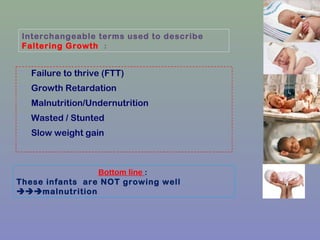
Interchangeable terms used to describe
Faltering Growth :
 Failure to thrive (FTT)
 Growth Retardation
 Malnutrition/Undernutrition
 Wasted / Stunted
 Slow weight gain
Bottom line :
These infants are NOT growing well
malnutrition
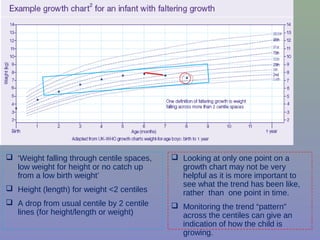
 The World Health Organization (WHO) has produced growth
standard charts.
 A child’s weight, length or height, and head circumference can be
plotted on the chart to provide a visual representation of their
growth over time.
 Looking at only one point on a
growth chart may not be very
helpful as it is more important to
see what the trend has been like,
rather than one point in time.
 Monitoring the trend “pattern”
across the centiles can give an
indication of how the child is
growing.
 ‘Weight falling through centile spaces,
low weight for height or no catch up
from a low birth weight’
 Height (length) for weight <2 centiles
 A drop from usual centile by 2 centile
lines (for height/length or weight)
Infants
Faltering
Growth
Classification by weight and gestation
 Preterm (premature)    born at 37 weeks' gestation or
less
 Term    born between the
beginning of week 38
and the end of week 41 of
gestation
 Post-term (postmature) born at 42 weeks' gestation or
more
Newborn classification based on gestational age
 Low birth weight (LBW)    < 2500 g 
 Very low birth weight (VLBW)    < 1500 g
 Extremely low birth weight (ELBW)    < 1000 g
Newborn classification based on birth weight
 Appropriate for gestational age (AGA)   weight is appropriate 
for the
gestational age
 Small for gestational age (SGA)   smaller than 
expected, the
weight falls bellow
the 5th
percentile for the
Newborn classification based on birth weight and gestation is
valuable in predicting the outcome.
Terminology
Newborn or
Neonate
An infant in the first 28 days after birth
Infant Is typically applied to young children between the ages of 1 - 12
months
Gestational age A baby that is delivered at 38-42 weeks.
“Conceptual age” and “postconceptual age” should be avoided.
Chronological age Refers to days, weeks, months, or years. It is the time elapsed from
birth. It is the postnatal age of the infant.
Corrected Age Also referred to as “adjusted age” , “corrected gestational age”
Chronological age reduced by the number of weeks born before 40
weeks of gestation ( measured in weeks or months)
Prematurity An infant born before 37 weeks
Perinatal period perinatal period starts at 22 completed weeks (154 days) of gestation
and ends 7 completed days after birth (WHO)
IUGR The most common definition of intrauterine growth restriction (IUGR)
is a fetal weight that is below the 10th
percentile for gestational age as
determined through an ultrasound. This can also be called small-for
gestational age (SGA) or fetal growth restriction.AAP, 2004
Prevalence - FG
Incidence
1–5% hospital admission (UK)
3–21% in primary care – depending on criteria used1
France – 26–40% of children were mild/moderately undernourished2
Netherlands– 31% of hospitalised children were malnourished
(10% severely)3
Germany – 31% of Dutch children screened in hospital were malnourished
(9% severely)4
Middle East - ?
SEA - ?
1) Sullivan P 2004 (In Blair et al 2004); 2) Sermet-Gaudelus et al 2000; 3) Pawellik I et al (abst) –
ESPGHAN 2006; 4) Schweizer J et al (abst) – ESPGHAN 2006
Causes of Malnutritionis multifactorial....
Disease/illness related
• Cardiac disease
• Cystic fibrosis
• Cerebral palsy
• Congenital heart disease (high risk of
FTT)
• Respiratory disease
• Surgery/transplants
• Burns
• Head injury
• Cancer, e.g. leukaemia
• Inflammatory bowel disease
Non-disease related
 Caloric deprivation – intentional
or unintentional (poor feeding
practices)
– e.g. parent isolation (immigrant),
poverty, feeding inaccuracies, etc.
 Emotional deprivation
e.g. loss of parent, postnatal
depression, chronic medical
problems of parent, substance
abuse by parent, etc.
Causes relating to Nutritional Factors
1
.
2
.
3.
Nutritional
imbalance
 Short- term:
• Lethargy, irritability/distressed child
• Limited /No growth (start to see falling through
the centiles
 Long- term:
• Growth Faltering with muscle-wasting and
• Stunting
• Delayed neuro-development
• Behavioral and cognitive deficiencies
• Increased risk for infections
• High morbidity and mortality rates
The United Nations Standing Committee on
Nutrition recently stated that
‘‘while under nutrition kills in early life, it also
leads
to a high risk of disease and death later in life”
“Optimal nutrition is one of the fundamental
components for infants to reach their full
growth potential and neurodevelopment“
Tuthill, 2007
Energy and Protein
 Requirements for energy and protein for healthy children are
generally calculated using the Dietary Reference Values (DRV).
 Many paediatric dietitians refer to a publication entitled
‘Nutritional requirements for Children in Health and
Disease’ produced by the Dietetics Department at Great
Ormond Street Hospital NHS Trust, 2002 (GOSH
Guidelines,2002).
 This document provides a summary of the DRV’s plus guidelines
for the nutritional management of sick infants and children.
 The guidelines for high and very high energy and protein intakes
in sick infants aged 0 – 1 year are presented below, compared to
those of healthy infants:
Protein & Energy requirements of infants – health & illness
Age Healthy infants* Infants with illness**
0–3 months Energy
100–115kcal/kg/d
Protein
2.1g/kg/d
Energy
120–200kcal/kg/d
Protein
3–4.5g/kg/d
4–6 months 95 kcal/kg/d 1.6g/kg/d 120–200kcal/kg/d 3–4.5g/kg/d
7–12
months
95 kcal/kg/d 1.5g/kg/d 120–200kcal/kg/d 3–4g/kg/d
(to max
10g/kg/d to
1yr)
* DRV UK
** GOSH data
Geukers et al
2005
Nutritional requirements for catch-up growth – protein
What is the protein/protein % energy (PE%) needed for catch-up
growth?
 >10-14% recommended by Deweys1
 9-11% suggested by Waterloo related to kcal load2
(Jackson confirmed
this5
)
 9% suggested by Shaw & Lawson3
 WHO Guidelines – severe acute malnutrition
1) Deweys et al 1996; 2) Waterloo et al 1961; 3) Shaw & Lawson 2001; 5) Jackson A 1990;
>9–14% needed – depending on condition
Energy and Protein
 Most children are prescribed high-energy feeds to meet their
basic requirements and to allow for catch-up growth.
 Healthy infants generally require between 7.5 - 12% of energy to
be derived from protein to allow for growth.
 Dietitians may refer to the guidelines mentioned in the ‘Clinical
Paediatric Dietetic Manual’ by Shaw & Lawson (3rd Ed, 2007),
which state that for ‘catch up’ growth it is necessary to provide
about 9% energy from protein.
Two principles that hold true irrespective of the etiology,
that all children with Faltering Growth need :
 High-calorie diet for catch-up growth,
 Close follow - up.
(WHO ,Guidelines for the inpatient treatment of severely malnourished Children, 2003 )
Fortification with supplements
Concentrate formula
Increase volume
High energy/protein formula
Current treatment practice may include…
Issues:
Unbalanced feed –  PE% = ~5.5PE%
Dilute nutrient composition –
micronutrients and vitamins are
approximately 50% lower1
Mixing feeds -  risk feed
contamination2,3
Preparation errors1
  osmolality4
 Difficult to make up to 100kcal/100ml –
protein up to 2.3g/kg but osmolality can
reach close to 500mOsmol/kg
(recommended <400mOmol/kg for sick
infants 5
)
 electrolyte & *pRSL –
>400mOsmol/100kcal risks hypertonic
dehydration in some sick infants 6
(unable
to tell level in concentrated formula)
Time consuming and costly
Prof. Koletzko ESPGHAN 2006
Fortification
Mixing of feeds causes contamination and therefore is a risk of
infectious complications!
nfection Control Nurse Association – www.icna.co.uk; Mathus-Vliegen 2006
Main sources and routes of microbial contamination in enteral feeding
systems
….…….…
Post-Discharge PhaseNICU Phase
Premature Infants
> 37 weeks 0 month
Term Infants
12
months
0 month
Term Infants
Premature Infants
> 37 weeks
Premature Formula
NICU Phase
12
months
 Premature formula has been developed for preterm
and NOT for term FG/FTT infants. Both patient groups
have different needs and need different nutritional
treatment.
 Not intended for feeding LBW infants after , highly
probably mainly because of its high protein content
and very high levels of fat soluble vitamins.
 There is a clear risk of overdosing both protein and
vitamins and minerals when giving premature formula
 Designed to be used as a post-discharge formula
for preterm infants for use up to 12 months
gestational age .
 (0.7-0.8 Kcal/ml)
Premature Infants
> 37 weeks 42 - 52
Weeks
(gestational age)
0 month
Term Infants
12
months
Post Discharge Formula
ESPGHAN
 “Infants discharged with a subnormal weight for corrected age
(post-conceptional age) and thus with an increased risk of long-term
growth failure, if fed on human milk should be supplemented to provide
an adequate nutrient intake.
 If such infants are fed formula, they should receive special post-discharge
formula with high contents of protein, minerals and trace elements as
well as LCPUFA, at least until a corrected age (post-conceptional age ) of
40 weeks, but possibly until about 52 weeks”.
“The use of post-discharge formulas, has been
shown to result in greater :-
linear growth,
weight gain, and
bone mineralization
when compared with the use of term formula. In
addition, small, preterm infants… may benefit from
the use of such formulas for up to 9 months after
hospital discharge”.
(Guidelines for Perinatal Care (Aap/Acog)) by American
Academy of Pediatrics - 2007
AAP & ACOG Recommendations
AAP American Academy of Pediatrics
ACOG American College of Obstetrics and Gynecology
0 month
Term Infants
Premature Infants
> 37 weeks
Infatrini
12
months
18
months
or 9 kg
 Designed to be used for
 Infant with chronic diseases and highly risk of faltering growth
 Low birth weight Infant (full term < 2,500g)
 Infant post preterm phase (SGA)
INFATRINI can only be recommended for a LBW or
premature infant where the paediatrian has done a corrected
gestational age.
Note : A corrected gestational age recommended by AAP is 40 weeks
(some regions may use 38 weeks)
INFATRINI can only be recommended for a LBW or
premature infant where the paediatrian has done a corrected
gestational age.
Note : A corrected gestational age recommended by AAP is 40 weeks
(some regions may use 38 weeks)
a rapid feeding approach is required for catch-up growth i.e. high
energy and high protein to encourage a weight gain of > 10g
gain/kg/day,i.e. 100 kcal/100 ml and 2.9 g protein/100 ml.
WHO Guidelines
Summary of Infatrini
Feature Benefit
Higher energy in a smaller
volume
• To support optimal catch-up growth in
infants with/at risk of growth failure
Low osmolality • For better tolerance
Improved ratio of LCPs &
Nucleotides
• For brain & cognitive development
• To support immune function
Ready to use • For convenience and safety
Nutritionally complete • For use as a sole source of nutrition from 0-
18 months or upto 9 kg body weight
Clinically evaluated • Trusted for over 10 years, +++ evidence vs
competitor products
  INFATRINI
per L
Energy (kJ) 4200kJ
Energy (kcal) 1000 kcal
Protein (g) 26
Fat (g) 54 [LCP’s]
CHO (g) 103
Calcium 800mg
Phosphorous 400 mg
Sodium 250 mg
Iron 10 mg
Zinc 9 mg
Vitamin A 810 µg RE
Vitamin D 17 µg
Potassium 930 mg
GOS/FOS 8 g
Osmolality
mOsm/kg/H2O
345
Osmolarity
mOsmol/L
295
Duggan C, et al. Nutrition in Pediatrics. 4th ed. Hamilton, Ontario, Canada: BC Decker Inc; 2008.
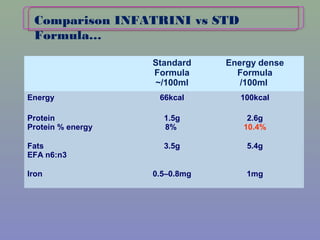
Standard
Formula
~/100ml
Energy dense
Formula
/100ml
Energy 66kcal 100kcal
Protein
Protein % energy
1.5g
8%
2.6g
10.4%
Fats
EFA n6:n3
3.5g 5.4g
Iron 0.5–0.8mg 1mg
Comparison INFATRINI vs STD
Formula…
 Faltering Growth is not a disease, but rather a description of a relatively
common growth pattern
 It is most commonly caused by undernutrition relative to a child’s
specific energy requirements
 Causes tend to be multifactorial and often involve problems with diet
and feeding behaviour
 More rarely, faltering growth may be associated with neglect or
maternal mental health problems or addiction
 Organic disease is often a contributing factor – due to
 Inadequate nutritional requirements.
 Increased nutritional needs
 Increased nutritional losses
Thank

Faltring growth

  • 1.
    By Dr.Osama Arafa AbdEL Hameed Consultant of Pediatrics & Neonatology Head of Pediatrics Department Port-Fouad Hospital Faltering Growth in infants…..Can we Help?!
  • 2.
    Outline – FalteringGrowth  Introduction  Definition of Faltering Growth  Classification by birth weight and gestation  Useful Terminology  Prevalence  Causes  Consequences  Nutritional management  Feeds for Faltering Growth
  • 3.
    INTRODUCTION “Severe malnutrition isone of the most common causes of morbidity and mortality among children under the age of 5 years worldwide. Many severely malnourished children die at home without care, but even when hospital care is provided, case fatality rates may be high, as high as 30-50% in some hospitals.” (WHO, Training course on the management of severe malnutrition, 2002) A great many of the world’s children are underweight i.e. 23% under age 5 according to the UNICEF report in 2006.
  • 4.
    INTRODUCTION  Faltering Growth– can occur in both infants (below one year of age) and in the children (> 1 year of age).  Faltering Growth – can occur for many reasons & it has severe consequences on the growth and development of the infant/child.  Faltering Growth (FG)– needs to be identified early & nutritionally treated/managed. Nutritional management of FG often requires long term intervention.
  • 5.
    INTRODUCTION  According tothe WHO, malnutrition is by far the biggest contributor to child mortality  Under-weight births and IUGR (intra-uterine growth restrictions) cause 3 million child deaths a year.  According to the Lancet, consequences of malnutrition in the first two years is irreversible.  Malnourished children grow up with worse health and lower educational achievements.  Malnutrition can exacerbate the problem of diseases such as measles, pneumonia and diarrhoea.  But malnutrition can actually cause diseases itself , and can be fatal in its own right
  • 6.
    Definition of FalteringGrowth  The term 'faltering growth' is widely used in relation to infants and young children whose weight gain occurs more slowly than expected for their age and sex.  In the past, this was often described as a ‘failure to thrive’ but this is no longer the preferred term :-  partly because ‘failure’ could be perceived as negative,  but also because lesser degrees of faltering growth may not necessarily indicate a significant problem but merely represent variation from the usual pattern when measured against the standardized growth charts (WHO Growth Charts).
  • 7.
    Interchangeable terms usedto describe Faltering Growth :  Failure to thrive (FTT)  Growth Retardation  Malnutrition/Undernutrition  Wasted / Stunted  Slow weight gain Bottom line : These infants are NOT growing well malnutrition
  • 8.
     The WorldHealth Organization (WHO) has produced growth standard charts.  A child’s weight, length or height, and head circumference can be plotted on the chart to provide a visual representation of their growth over time.
  • 9.
     Looking atonly one point on a growth chart may not be very helpful as it is more important to see what the trend has been like, rather than one point in time.  Monitoring the trend “pattern” across the centiles can give an indication of how the child is growing.  ‘Weight falling through centile spaces, low weight for height or no catch up from a low birth weight’  Height (length) for weight <2 centiles  A drop from usual centile by 2 centile lines (for height/length or weight)
  • 10.
  • 11.
    Classification by weightand gestation  Preterm (premature)    born at 37 weeks' gestation or less  Term    born between the beginning of week 38 and the end of week 41 of gestation  Post-term (postmature) born at 42 weeks' gestation or more Newborn classification based on gestational age  Low birth weight (LBW)    < 2500 g   Very low birth weight (VLBW)    < 1500 g  Extremely low birth weight (ELBW)    < 1000 g Newborn classification based on birth weight  Appropriate for gestational age (AGA)   weight is appropriate  for the gestational age  Small for gestational age (SGA)   smaller than  expected, the weight falls bellow the 5th percentile for the Newborn classification based on birth weight and gestation is valuable in predicting the outcome.
  • 12.
    Terminology Newborn or Neonate An infantin the first 28 days after birth Infant Is typically applied to young children between the ages of 1 - 12 months Gestational age A baby that is delivered at 38-42 weeks. “Conceptual age” and “postconceptual age” should be avoided. Chronological age Refers to days, weeks, months, or years. It is the time elapsed from birth. It is the postnatal age of the infant. Corrected Age Also referred to as “adjusted age” , “corrected gestational age” Chronological age reduced by the number of weeks born before 40 weeks of gestation ( measured in weeks or months) Prematurity An infant born before 37 weeks Perinatal period perinatal period starts at 22 completed weeks (154 days) of gestation and ends 7 completed days after birth (WHO) IUGR The most common definition of intrauterine growth restriction (IUGR) is a fetal weight that is below the 10th percentile for gestational age as determined through an ultrasound. This can also be called small-for gestational age (SGA) or fetal growth restriction.AAP, 2004
  • 13.
    Prevalence - FG Incidence 1–5%hospital admission (UK) 3–21% in primary care – depending on criteria used1 France – 26–40% of children were mild/moderately undernourished2 Netherlands– 31% of hospitalised children were malnourished (10% severely)3 Germany – 31% of Dutch children screened in hospital were malnourished (9% severely)4 Middle East - ? SEA - ? 1) Sullivan P 2004 (In Blair et al 2004); 2) Sermet-Gaudelus et al 2000; 3) Pawellik I et al (abst) – ESPGHAN 2006; 4) Schweizer J et al (abst) – ESPGHAN 2006
  • 14.
    Causes of Malnutritionismultifactorial.... Disease/illness related • Cardiac disease • Cystic fibrosis • Cerebral palsy • Congenital heart disease (high risk of FTT) • Respiratory disease • Surgery/transplants • Burns • Head injury • Cancer, e.g. leukaemia • Inflammatory bowel disease Non-disease related  Caloric deprivation – intentional or unintentional (poor feeding practices) – e.g. parent isolation (immigrant), poverty, feeding inaccuracies, etc.  Emotional deprivation e.g. loss of parent, postnatal depression, chronic medical problems of parent, substance abuse by parent, etc.
  • 15.
    Causes relating toNutritional Factors 1 . 2 . 3. Nutritional imbalance
  • 16.
     Short- term: •Lethargy, irritability/distressed child • Limited /No growth (start to see falling through the centiles  Long- term: • Growth Faltering with muscle-wasting and • Stunting • Delayed neuro-development • Behavioral and cognitive deficiencies • Increased risk for infections • High morbidity and mortality rates
  • 17.
    The United NationsStanding Committee on Nutrition recently stated that ‘‘while under nutrition kills in early life, it also leads to a high risk of disease and death later in life” “Optimal nutrition is one of the fundamental components for infants to reach their full growth potential and neurodevelopment“ Tuthill, 2007
  • 18.
    Energy and Protein Requirements for energy and protein for healthy children are generally calculated using the Dietary Reference Values (DRV).  Many paediatric dietitians refer to a publication entitled ‘Nutritional requirements for Children in Health and Disease’ produced by the Dietetics Department at Great Ormond Street Hospital NHS Trust, 2002 (GOSH Guidelines,2002).  This document provides a summary of the DRV’s plus guidelines for the nutritional management of sick infants and children.  The guidelines for high and very high energy and protein intakes in sick infants aged 0 – 1 year are presented below, compared to those of healthy infants:
  • 19.
    Protein & Energyrequirements of infants – health & illness Age Healthy infants* Infants with illness** 0–3 months Energy 100–115kcal/kg/d Protein 2.1g/kg/d Energy 120–200kcal/kg/d Protein 3–4.5g/kg/d 4–6 months 95 kcal/kg/d 1.6g/kg/d 120–200kcal/kg/d 3–4.5g/kg/d 7–12 months 95 kcal/kg/d 1.5g/kg/d 120–200kcal/kg/d 3–4g/kg/d (to max 10g/kg/d to 1yr) * DRV UK ** GOSH data Geukers et al 2005
  • 20.
    Nutritional requirements forcatch-up growth – protein What is the protein/protein % energy (PE%) needed for catch-up growth?  >10-14% recommended by Deweys1  9-11% suggested by Waterloo related to kcal load2 (Jackson confirmed this5 )  9% suggested by Shaw & Lawson3  WHO Guidelines – severe acute malnutrition 1) Deweys et al 1996; 2) Waterloo et al 1961; 3) Shaw & Lawson 2001; 5) Jackson A 1990; >9–14% needed – depending on condition
  • 21.
    Energy and Protein Most children are prescribed high-energy feeds to meet their basic requirements and to allow for catch-up growth.  Healthy infants generally require between 7.5 - 12% of energy to be derived from protein to allow for growth.  Dietitians may refer to the guidelines mentioned in the ‘Clinical Paediatric Dietetic Manual’ by Shaw & Lawson (3rd Ed, 2007), which state that for ‘catch up’ growth it is necessary to provide about 9% energy from protein. Two principles that hold true irrespective of the etiology, that all children with Faltering Growth need :  High-calorie diet for catch-up growth,  Close follow - up.
  • 22.
    (WHO ,Guidelines forthe inpatient treatment of severely malnourished Children, 2003 )
  • 24.
    Fortification with supplements Concentrateformula Increase volume High energy/protein formula Current treatment practice may include…
  • 25.
    Issues: Unbalanced feed – PE% = ~5.5PE% Dilute nutrient composition – micronutrients and vitamins are approximately 50% lower1 Mixing feeds -  risk feed contamination2,3 Preparation errors1   osmolality4  Difficult to make up to 100kcal/100ml – protein up to 2.3g/kg but osmolality can reach close to 500mOsmol/kg (recommended <400mOmol/kg for sick infants 5 )  electrolyte & *pRSL – >400mOsmol/100kcal risks hypertonic dehydration in some sick infants 6 (unable to tell level in concentrated formula) Time consuming and costly Prof. Koletzko ESPGHAN 2006 Fortification
  • 26.
    Mixing of feedscauses contamination and therefore is a risk of infectious complications! nfection Control Nurse Association – www.icna.co.uk; Mathus-Vliegen 2006 Main sources and routes of microbial contamination in enteral feeding systems ….…….…
  • 27.
    Post-Discharge PhaseNICU Phase PrematureInfants > 37 weeks 0 month Term Infants 12 months
  • 28.
    0 month Term Infants PrematureInfants > 37 weeks Premature Formula NICU Phase 12 months  Premature formula has been developed for preterm and NOT for term FG/FTT infants. Both patient groups have different needs and need different nutritional treatment.  Not intended for feeding LBW infants after , highly probably mainly because of its high protein content and very high levels of fat soluble vitamins.  There is a clear risk of overdosing both protein and vitamins and minerals when giving premature formula
  • 29.
     Designed tobe used as a post-discharge formula for preterm infants for use up to 12 months gestational age .  (0.7-0.8 Kcal/ml) Premature Infants > 37 weeks 42 - 52 Weeks (gestational age) 0 month Term Infants 12 months Post Discharge Formula
  • 30.
    ESPGHAN  “Infants dischargedwith a subnormal weight for corrected age (post-conceptional age) and thus with an increased risk of long-term growth failure, if fed on human milk should be supplemented to provide an adequate nutrient intake.  If such infants are fed formula, they should receive special post-discharge formula with high contents of protein, minerals and trace elements as well as LCPUFA, at least until a corrected age (post-conceptional age ) of 40 weeks, but possibly until about 52 weeks”.
  • 31.
    “The use ofpost-discharge formulas, has been shown to result in greater :- linear growth, weight gain, and bone mineralization when compared with the use of term formula. In addition, small, preterm infants… may benefit from the use of such formulas for up to 9 months after hospital discharge”. (Guidelines for Perinatal Care (Aap/Acog)) by American Academy of Pediatrics - 2007 AAP & ACOG Recommendations AAP American Academy of Pediatrics ACOG American College of Obstetrics and Gynecology
  • 32.
    0 month Term Infants PrematureInfants > 37 weeks Infatrini 12 months 18 months or 9 kg  Designed to be used for  Infant with chronic diseases and highly risk of faltering growth  Low birth weight Infant (full term < 2,500g)  Infant post preterm phase (SGA) INFATRINI can only be recommended for a LBW or premature infant where the paediatrian has done a corrected gestational age. Note : A corrected gestational age recommended by AAP is 40 weeks (some regions may use 38 weeks) INFATRINI can only be recommended for a LBW or premature infant where the paediatrian has done a corrected gestational age. Note : A corrected gestational age recommended by AAP is 40 weeks (some regions may use 38 weeks)
  • 33.
    a rapid feedingapproach is required for catch-up growth i.e. high energy and high protein to encourage a weight gain of > 10g gain/kg/day,i.e. 100 kcal/100 ml and 2.9 g protein/100 ml. WHO Guidelines
  • 34.
    Summary of Infatrini FeatureBenefit Higher energy in a smaller volume • To support optimal catch-up growth in infants with/at risk of growth failure Low osmolality • For better tolerance Improved ratio of LCPs & Nucleotides • For brain & cognitive development • To support immune function Ready to use • For convenience and safety Nutritionally complete • For use as a sole source of nutrition from 0- 18 months or upto 9 kg body weight Clinically evaluated • Trusted for over 10 years, +++ evidence vs competitor products
  • 35.
      INFATRINI per L Energy(kJ) 4200kJ Energy (kcal) 1000 kcal Protein (g) 26 Fat (g) 54 [LCP’s] CHO (g) 103 Calcium 800mg Phosphorous 400 mg Sodium 250 mg Iron 10 mg Zinc 9 mg Vitamin A 810 µg RE Vitamin D 17 µg Potassium 930 mg GOS/FOS 8 g Osmolality mOsm/kg/H2O 345 Osmolarity mOsmol/L 295 Duggan C, et al. Nutrition in Pediatrics. 4th ed. Hamilton, Ontario, Canada: BC Decker Inc; 2008.
  • 36.
    Standard Formula ~/100ml Energy dense Formula /100ml Energy 66kcal100kcal Protein Protein % energy 1.5g 8% 2.6g 10.4% Fats EFA n6:n3 3.5g 5.4g Iron 0.5–0.8mg 1mg Comparison INFATRINI vs STD Formula…
  • 37.
     Faltering Growthis not a disease, but rather a description of a relatively common growth pattern  It is most commonly caused by undernutrition relative to a child’s specific energy requirements  Causes tend to be multifactorial and often involve problems with diet and feeding behaviour  More rarely, faltering growth may be associated with neglect or maternal mental health problems or addiction  Organic disease is often a contributing factor – due to  Inadequate nutritional requirements.  Increased nutritional needs  Increased nutritional losses
  • 38.