Chemistry
Lab Equipment
There are many more lab equipment that are
used in chemistry experiments. The list in this
PPT contains those that will be used most often
in our class. Any equipment used in class is fair
game.
Goggles & Lab Coat
● Goggles is for eye
protection and
should be worn of
all times.
● Vision glasses are
not protections
gear.
● Lab coat is to
protect clothing
and skin from
spillage
Beakers
● Beakers hold solids
or liquids
● unlikely to splatter
if stirred or
heated.
● Used to for
mixtures that may
not release gases.
● Can be in
different sizes.
Erlenmeyer Flasks
● Erlenmeyer flasks
hold solids or
liquids that may
release gases
during a reaction
or
● that are likely to
splatter if
stirred or
heated.
Graduated Cylinders
● A graduated
cylinder is
used to
measure
volumes of
liquids.
● Comes in
different
sizes
Test Tubes
13 x 100 mm test tubes
10 x 75 mm
test tubes
● May be heated
● Holds small
amounts of
liquid chemicals
● Observe small
rxns.
Test Tube Holder
A test tube
holder is useful
for holding a
test tube which
is too hot to
handle.
Test Tube Racks
Test tube racks are for holding and
organizing test tubes on the laboratory
counter. Plastic racks may melt in
contact with very hot test tubes. Can
be plastic, wood or metal.
Test Tube Brushes
Test tube brushes
are used to clean
test tubes and
graduated cylinders.
Forcing a large brush
into a small test
tube will often break
the tube.
Well (Spot) Plates
Spot plates are
used to perform
many (more than
one) small scale
reactions at one
time.
Watch Glass
A watch glass is
used to hold a
small amount of
solid, such as
the product of
a reaction.
Stirring Rod
● A rod is used to
manually stir
solutions. It can
also be used to
transfer a single
drop of a
solution.
● Can be glass,
plastic or wood.
Spatulas
Spatulas are used
to dispense solid
chemicals from
their containers.
Chemicals should
never be
transferred with
your bare hands.
Scoopula
Transfer
solids: to a
weigh paper
for weighing,
to a weighing
boat.
Tweezers ( Forceps )
Tweezers (or forceps)
are used to pick up
small objects.
Medicine Dropper
A medicine dropper
is used to transfer a
small volume of liquid
(less than 1 mL).
On top of each medicine
dropper is a “rubber
bulb”
Wash Bottle
● A wash bottle has a
spout that delivers a
wash solution to a
specific area. Distilled
water should be used in
a wash bottle.
● IT IS NOT FOR
WASHING EQUIPMENT
OR CLEANING!!!
Micropipettes
A pipette is
calibrated with a
series of
graduation lines to
allow the
measurement of
one or more/less
than one volume
of liquids.
Rubber Stoppers
Rubber stoppers are
used to close
containers to avoid
spillage or
contamination.
Containers should
never be heated when
there is a stopper in
place.
Funnel
A funnel is
used to aid
in the
transfer of
liquid from
one vessel to
another.
Weighing Boat / Weighing Paper
Weighing boats
& papers are
used to weigh
solids that will
be transferred
to another
vessel.
Beaker Tongs
Beaker tongs
are used to
move beakers
containing hot
liquids.
Crucible Tongs
For handling hot
crucibles; also used
to pick up other hot
objects. NOT to be
used for picking up
beakers!
Bunsen Burner
Bunsen burners are
used for the heating
of nonvolatile liquids
and solids.
Clay Triangle
The clay
triangle is used
as a support
for porcelain
crucibles when
being heated
over a Bunsen
burner.
Crucible
Crucibles are used
for heating certain
solids, particularly
metals, to very
high temperatures.
Evaporating Dish
The evaporating dish
is used for the
heating of stable
solid compounds and
elements.
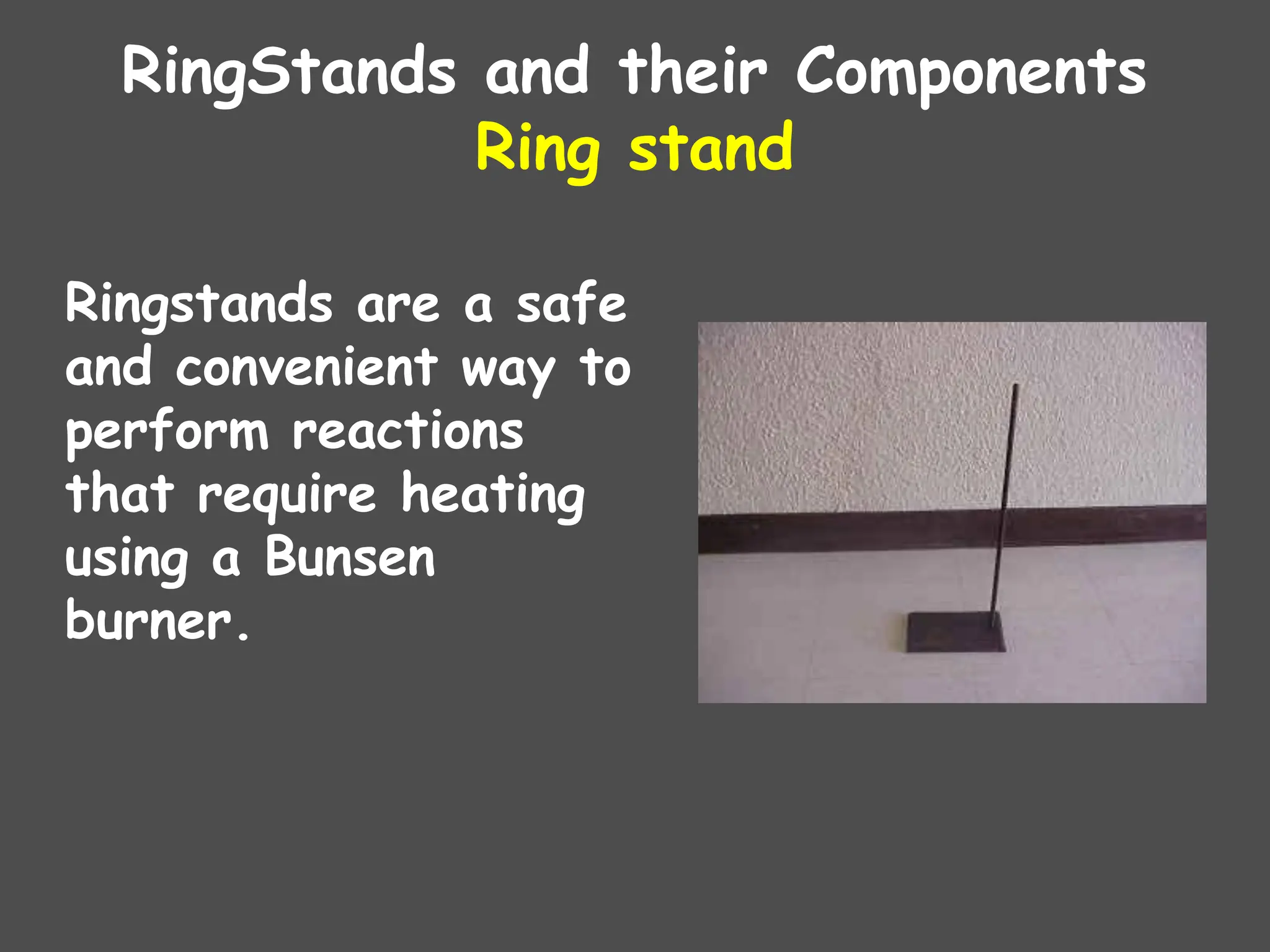
RingStands and their Components
Ring stand
Ringstands are a safe
and convenient way to
perform reactions
that require heating
using a Bunsen
burner.
Ringstands and their Components
Rings
Iron rings connect
to a ring stand
and provide a
stable, elevated
platform for the
reaction.
Ringstands and their Components
Test Tube (utility) Clamp
Utility clamps are
used to secure test
tubes, distillation
columns, and burets
to the ring stand.
Ringstands and their Components
Wire Gauze
Wire gauze sits on the
iron ring to provide a
place to stand a
beaker.
On older wire gauze,
the white material is
asbestos!
Strikers (Spark match)
Strikers are used
to light Bunsen
burners.
We will use regular
household lighters
and matches in our
class.
Glass Plates
Glass plates
provide a surface
for semi-micro
scale experiments,
such as drop
reactions and
testing of acids
and bases.
Electronic Or Triple Beam Balance
The electronic or triple
beam balance is an
instrument used to
measure mass very
precisely.
We will mostly be using
electronic balance.
Hot Plate
Generally used to
heat glassware
or its contents.

lab_equipment and apparatus their uses.pdf

  • 1.
    Chemistry Lab Equipment There aremany more lab equipment that are used in chemistry experiments. The list in this PPT contains those that will be used most often in our class. Any equipment used in class is fair game.
  • 2.
    Goggles & LabCoat ● Goggles is for eye protection and should be worn of all times. ● Vision glasses are not protections gear. ● Lab coat is to protect clothing and skin from spillage
  • 3.
    Beakers ● Beakers holdsolids or liquids ● unlikely to splatter if stirred or heated. ● Used to for mixtures that may not release gases. ● Can be in different sizes.
  • 4.
    Erlenmeyer Flasks ● Erlenmeyerflasks hold solids or liquids that may release gases during a reaction or ● that are likely to splatter if stirred or heated.
  • 5.
    Graduated Cylinders ● Agraduated cylinder is used to measure volumes of liquids. ● Comes in different sizes
  • 6.
    Test Tubes 13 x100 mm test tubes 10 x 75 mm test tubes ● May be heated ● Holds small amounts of liquid chemicals ● Observe small rxns.
  • 7.
    Test Tube Holder Atest tube holder is useful for holding a test tube which is too hot to handle.
  • 8.
    Test Tube Racks Testtube racks are for holding and organizing test tubes on the laboratory counter. Plastic racks may melt in contact with very hot test tubes. Can be plastic, wood or metal.
  • 9.
    Test Tube Brushes Testtube brushes are used to clean test tubes and graduated cylinders. Forcing a large brush into a small test tube will often break the tube.
  • 10.
    Well (Spot) Plates Spotplates are used to perform many (more than one) small scale reactions at one time.
  • 11.
    Watch Glass A watchglass is used to hold a small amount of solid, such as the product of a reaction.
  • 12.
    Stirring Rod ● Arod is used to manually stir solutions. It can also be used to transfer a single drop of a solution. ● Can be glass, plastic or wood.
  • 13.
    Spatulas Spatulas are used todispense solid chemicals from their containers. Chemicals should never be transferred with your bare hands.
  • 14.
    Scoopula Transfer solids: to a weighpaper for weighing, to a weighing boat.
  • 15.
    Tweezers ( Forceps) Tweezers (or forceps) are used to pick up small objects.
  • 16.
    Medicine Dropper A medicinedropper is used to transfer a small volume of liquid (less than 1 mL). On top of each medicine dropper is a “rubber bulb”
  • 17.
    Wash Bottle ● Awash bottle has a spout that delivers a wash solution to a specific area. Distilled water should be used in a wash bottle. ● IT IS NOT FOR WASHING EQUIPMENT OR CLEANING!!!
  • 18.
    Micropipettes A pipette is calibratedwith a series of graduation lines to allow the measurement of one or more/less than one volume of liquids.
  • 19.
    Rubber Stoppers Rubber stoppersare used to close containers to avoid spillage or contamination. Containers should never be heated when there is a stopper in place.
  • 20.
    Funnel A funnel is usedto aid in the transfer of liquid from one vessel to another.
  • 21.
    Weighing Boat /Weighing Paper Weighing boats & papers are used to weigh solids that will be transferred to another vessel.
  • 22.
    Beaker Tongs Beaker tongs areused to move beakers containing hot liquids.
  • 23.
    Crucible Tongs For handlinghot crucibles; also used to pick up other hot objects. NOT to be used for picking up beakers!
  • 24.
    Bunsen Burner Bunsen burnersare used for the heating of nonvolatile liquids and solids.
  • 25.
    Clay Triangle The clay triangleis used as a support for porcelain crucibles when being heated over a Bunsen burner.
  • 26.
    Crucible Crucibles are used forheating certain solids, particularly metals, to very high temperatures.
  • 27.
    Evaporating Dish The evaporatingdish is used for the heating of stable solid compounds and elements.
  • 28.
    RingStands and theirComponents Ring stand Ringstands are a safe and convenient way to perform reactions that require heating using a Bunsen burner.
  • 29.
    Ringstands and theirComponents Rings Iron rings connect to a ring stand and provide a stable, elevated platform for the reaction.
  • 30.
    Ringstands and theirComponents Test Tube (utility) Clamp Utility clamps are used to secure test tubes, distillation columns, and burets to the ring stand.
  • 31.
    Ringstands and theirComponents Wire Gauze Wire gauze sits on the iron ring to provide a place to stand a beaker. On older wire gauze, the white material is asbestos!
  • 32.
    Strikers (Spark match) Strikersare used to light Bunsen burners. We will use regular household lighters and matches in our class.
  • 33.
    Glass Plates Glass plates providea surface for semi-micro scale experiments, such as drop reactions and testing of acids and bases.
  • 34.
    Electronic Or TripleBeam Balance The electronic or triple beam balance is an instrument used to measure mass very precisely. We will mostly be using electronic balance.
  • 35.
    Hot Plate Generally usedto heat glassware or its contents.