Constipation In Pediatric Age
Group
Dr. Arjun A. Pawar
MBBS, MS,
M. Ch. Pediatric Surgery,
DNB Pediatric Surgery,
FMAS,
FIAGES, DCC
Objectives
Define “constipation”
Classification
Etiology
Risk factors
Clinical Evaluation
Investigations
Management
Constipation- Epidemiology:
• Major gastrointestinal disorder diagnosed in clinical
practice
• One of the common cause of Abdominal pain
• Prevalence of childhood constipation:12 to 19%
(Ref: Sinclair M. The use of abdominal massage to treat chronic constipation. J. Bodyw.
Mov. Ther. 2011;15:436–445. doi: 10.1016/j.jbmt.2010.07.007.)
• Pathophysiology- Complex & Multifactorial
• Common in patients with positive family history
Genetics is not known
• Identical twins have 6 folds possibility than non identical
twins.
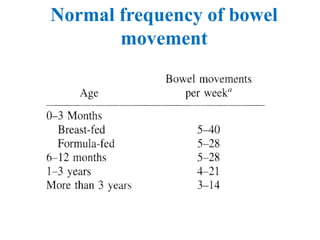
Normal frequency of bowel
movement
Chronic Constipation
Definition
Rome 4 Criteria
Ref: Lacy B.E., Mearin F., Chang L., Chey W.D., Lembo A.J., Simren M., Spiller R.
Bowel disorders. Gastroenterology. 2016;150:1393–1407.e5.
doi: 10.1053/j.gastro.2016.02.031.
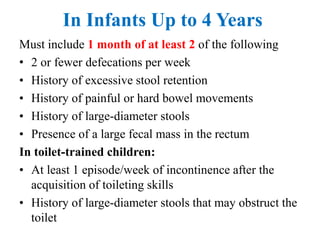
In Infants Up to 4 Years
Must include 1 month of at least 2 of the following
• 2 or fewer defecations per week
• History of excessive stool retention
• History of painful or hard bowel movements
• History of large-diameter stools
• Presence of a large fecal mass in the rectum
In toilet-trained children:
• At least 1 episode/week of incontinence after the
acquisition of toileting skills
• History of large-diameter stools that may obstruct the
toilet
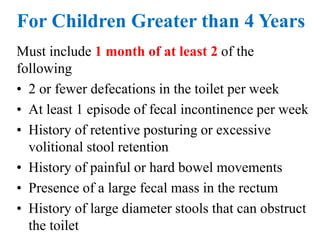
For Children Greater than 4 Years
Must include 1 month of at least 2 of the
following
• 2 or fewer defecations in the toilet per week
• At least 1 episode of fecal incontinence per week
• History of retentive posturing or excessive
volitional stool retention
• History of painful or hard bowel movements
• Presence of a large fecal mass in the rectum
• History of large diameter stools that can obstruct
the toilet
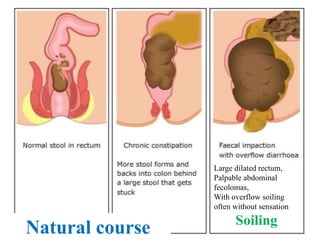
Natural course
Large dilated rectum,
Palpable abdominal
fecolomas,
With overflow soiling
often without sensation
Soiling
‘Soiling’
• Often referred to as ‘constipation with
overflow’
• Inappropriate passage of stool in underwear
associated with chronic constipation
• Faeces are often loose and ‘smelly’
• Involuntary action over which child has no
control
Classification
Etiology : Primary & secondary
• Primary constipation -constipation
predominant irritable bowel syndrome (IBS-C),
functional constipation, slow transit
constipation (myopathy, neuropathy, and
functional defecation disorders)
• Secondary constipation -metabolic disorders
(e.g., hypercalcemia), medications (e.g., calcium
channel blockers or opiates), primary colonic
disorders (e.g. HD,ARM,) and neurologic
disorders(Spina bifida)
Daniali M., Nikfar S., Abdollahi M. An overview of interventions for constipation in adults. Expert
Rev. Gastroenterol. Hepatol. 2020;14:721–732. doi: 10.1080/17474124.2020.1781617.
Colonic transit- 3 sub groups
Normal colonic transit- suffer from functional
constipation- Commonest Type
Rectal evacuation disorders-
Dyssynergic defecation
Mechanisms: paradoxical anal contraction,
impaired rectal contraction and inadequate anal
relaxation.
Slow colonic constipation- dysfunctional
retrograde colonic propulsion
Primary- Functional Constipation
Secondary- Organic Constipation
Functional constipation- Etiology
• Inappropriate toilet training
• ‘Holding on’ - often initiated by passage
of large / painful stool
• Toilet phobias / fears
• Child sexual abuse
• Anal fissure
Functional constipation- Etiology
• Delay in passage of normal stool
• Avoidance of response to nature call
• Inconvenient / uncomfortable places
• Vicious cycle of retention
development.
Functional constipation- Etiology
• Insufficient fiber or fluid intake
• Cow’s milk allergies
• Lack of exercise
• Obesity
• Dysbiosis of gut microbiota
(Decreased number of Actinobacteria in fecal
samples and increased level of Bacteroides in
their mucosal samples)
Organic Constipation- Etiology
• Hirschsprung's disease,
• Anorectal malformations
• Spina bifida- MMC, OSB
• Trauma to spinal cord
• Intestinal Tumors, Intestinal Pseudo
Obstruction
Organic Constipation- Etiology
• Endocrine, Metabolic and GI disorders
-Hypothyroid
-Hypokalemia
-Hypercalcemia
-Cystic Fibrosis, Coeliac disease
-DM
-DI
Organic Constipation- Etiology
• Drugs
-phenobarbital, antacids, anticholinergics
-antidepressants, opiates
• OTHER
• -Botulism
• -lead ingestion
Constipation – Risk Factors
• Insufficient fiber or fluid intake
• lack of exercise
• Positive family history
• dysbiosis of gut microbiota
Ref: Iacono G., Scalici C., Iacono S. Chronic Costipation as a Symptom of Food
Allergy. Austin J. Allergy. 2016;3:1024.
Ref: Ohkusa T., Koido S., Nishikawa Y., Sato N. Gut microbiota and chronic constipation:
A review and update. Front. Med. 2019;6:19. doi: 10.3389/fmed.2019.00019.
Constipation – Risk Factors
Environmental issues
• Unhygienic School toilets!
• Toilets - cold/dark
• Toilets - dirty
• Uncomfortable toilet seats
• Lack of privacy
• Lack of toilet paper
• Inaccessible lavatory
Constipation – Risk Factors
Psychological factors
• Fear
• Precipitating family stress
• Learned behaviour
• Anxiety,
• Trauma
• Depression
• Attention deficit disorder
• Autism
Ref: S., Devanarayana N.M., Perera B.J.C., Benninga M.A. Childhood constipation as an emerging
public health problem. World J. Gastroenterol. 2016;22:6864–6875. doi: 10.3748/wjg.v22.i30.6864.
Recent- Mechanism
Possible mechanisms
• Decrease in the number of Cajal cells
• Disruptions in the serotonin level.
Ref: Camilleri M., Brandler J. Refractory Constipation: How to Evaluate and
Treat. Gastroenterol. Clin. N. Am. 2020;49:623–642. doi: 10.1016/j.gtc.2020.05.002.
Evaluation
• History.
• Physical examination
• Radio imaging.
History- Constipation
‘ Red flag’ symptoms
• Delayed Passage of meconium > 24 hrs
• Abdominal distension in failure to thrive
patients
• Infrequent small or ribbon stools
• Constant stool leaking along with urinary
leaking (Bowel bladder dysfunction)
• Failed management with appropriate
therapy
General health profile
Check for:
• Daytime urinary problems
• Nocturnal enuresis
• Appetite / approximate fibre intake
• Fluid intake
• Any medical problems
• Any current medication
Bowel profile
• Description of stools
- frequency
- consistency
- size
- any pain /discomfort/blood/mucus
• Use of toilet / potty
• Any previous treatments /interventions
Toilet training profile
• Age-toilet training commenced
• Age for bladder control
• Age for bowel control
• Any significant changes / problems /
events occurring at this time
Physical examination
• Growth of the child
• Abdominal Distention
• Fecal mass felt on abdominal
examination.
• DRE: for loaded rectum
• Fecal soiling.
• Ano-genital index
• Anal fissure / perianal excoriation
• Signs of trauma (abuse).
• Signs of spinal defects
• Neurological assessment of L.L. and
anal canal.
• Occult blood in stool
• Absence of anal wink
• Decreased lower extremity tone &
strength
Investigations
• Plain abdominal X RAY.
• Lumbosacral X RAY / MRI
• Ba. Enema
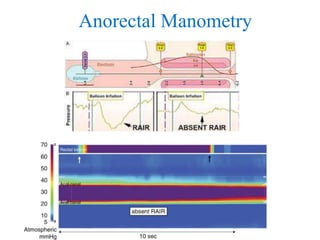
• Anorectal manometry.
• Rectal biopsy.
• Anal sphincter EMG.
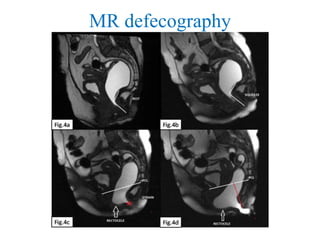
• Defecography.
• Colorectal transit study.
• Free T4, T4 & TSH
• Na, K levels
• Serum Calcium
• CBC
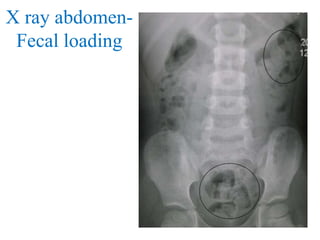
X ray abdomen-
Fecal loading
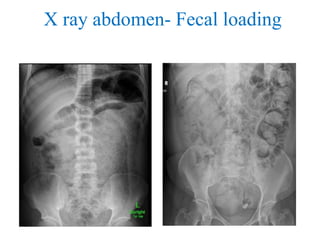
X ray abdomen- Fecal loading
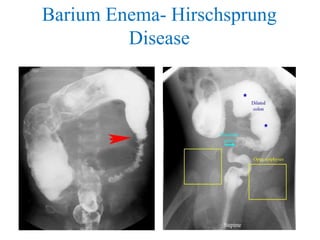
Barium Enema- Hirschsprung
Disease
Anorectal Manometry
MR defecography
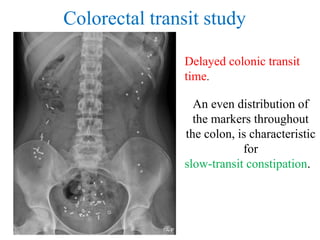
Colorectal transit study
Delayed colonic transit
time.
An even distribution of
the markers throughout
the colon, is characteristic
for
slow-transit constipation.
Constipation Management
• Education
• Evacuation
• Maintenance
Constipation management-
Education
Demystification – child and family need
to be aware of:
 Normal variation in bowel habits
 Protracted course of treatment
 Relapses are common
 Long term laxatives often required -only to
be stopped on advice
 Symptoms may get worse initially
Education
• Demystification with written
information
• Structured toileting programme
• Consistent scheduled toileting
• Positive reinforcement
• Diet & fluid adjustment
• Promote Sports activity
Dietary Intervention
• Balanced diet-whole grains, fruits, vegetables
• Adequate water intake
Fluid- 85 to 90 ml/kg/day
• High fiber diet or Supplements:
Age in years + 5gm
• Avoid foods that constipate-
white rice, ripe bananas, tea, Coffee, Chocolate,
Junk Foods, Biscuits, Milk & Milk products
• Don’t force diet on child- best success when
child feels in control
Behavioral modification:
• Regular toilet habit
• Keep diary and record of toilet
• Motivation (avoid negative comments)
• Modify parental behavior- no rushing in the
morning to leave for school--allow for
adequate toileting time
• No punishments or ridicule for constipation
or soiling
• Identify psycho-social stressors
Evacuation
• Manual disimpaction under Short GA
• Distal Colonic Washouts-
Enemas(Sodium Phosphate and Glycerine
suppositories)
• Proximal Washouts-
Oral lavage with polyethylene glycol
solutions-recommend 1 to 1.5 g/kg/day
Disimpaction
Polyethylene glycol:
Movicol / Pegalup / Relux:
• 2-4years: 2-8 sachets,
• 5-11 years: 4-12 sachets –
to be started with minimum number of sachets
for age and increase every other day until
evacuation complete (usually within 7 days).
Supervised PC enemas
Maintenance therapy
Aim to prevent relapse
• On going advice and support
• Continue with diet/fluid advice
• Long term laxative therapy
• Consider cautious reduction 6 monthly
• Behaviour modification
• Use adequate doses of laxatives to pass
stool once or twice every day
• May need to use a combination of stool
softener, bulking agent and bowel
stimulant (lactulose/PEG, Fibre and senna)
• Will need at least 6 months treatment and
often much longer to learn/re-learn bowel
habit
Laxative Dosage
• Lactulose: <1 year:2.5ml bd;
1-5 years: 5ml bd; 5-10 years: 10ml bd
• PEG( Macrogol): 1gm/kg/day
2-6 years:1-4 sachets,
7-11 years:2-4 sachets per day (titrate dose as necessary)
• Senna (syrup): 2-6 years: 2.5 – 5ml in morning,
over 6 years: 5-10 ml
• Mineral oil (Liquid paraffin oil); 1-3 ml/kg/day
• Docusate (oral solution): 6 months to 2 years 12.5 mg
tds; 2-12 years 12.5 – 25 mg tds;
Surgical Treatment
Newer Evaluation modalities:
• Dynamic magnetic resonance proctography
Dynamic anal endosonography
Scintigraphic proctography
Will Diagnose:
Anatomical defects: Rectocoele, Internal prolapse,
Perineal descent, and atypical herniations including
Enterocoele and Levator ani defects
Functional defect: Anismus ( Puborectalis paradox)
Rentsch M, Paetzel C, Lenhart M, et al. Dynamic magnetic resonance imaging
defecography. Dis Colon Rectum. 2001;44:999–1007
Surgical Treatment:
• Anorectal Myectomy for anal sphincter achalasia,
SSHD.
• MACE: Malone antegrade continent enema
Antegrade colonic irrigation using an
appendicostomy- for Spina Bifida & ARM
• Idiopathic slow-transit constipation:
1. Temporary defunctioning colostomy.
2. Colectomy and ileo-rectal or ileo-sigmoid
anastomosis
• Anismus:
1. Biofeedback- modify higher center control of defecation
2. Pharmacological puborectalis paralysis using botulinum
toxin
Constipation and Magarectum / Magabowel
• Intractable constipation in childhood
• Involves rectum ,sigmoid and more proximal colon
• Etiology:
-50% idiopathic (intact RAIR & normal ganglia on full-thickness
biopsy.), Chagas disease , chronic intestinal pseudo-obstruction,
ultrashort–segment Hirschsprung’s disease.
• Pathophysiology of these idiopathic cases is poorly understood
• Treatment: laxatives and enemas for at least 6 months
If fails:
• colectomy and ileorectal/ileosigmoid anastomosis,
• proctectomy and coloanal anastomosis,
• pull-through procedures- Duhamel operation,
• anal myomectomy and more recently
• restorative proctocolectomy.
Long-Term Outcome of Functional
Childhood Constipation
Childhood constipation appears to be a
predictor of Irritable Bowel Syndrome in
adulthood.
Thank You

Pediatric Constipation

  • 1.
    Constipation In PediatricAge Group Dr. Arjun A. Pawar MBBS, MS, M. Ch. Pediatric Surgery, DNB Pediatric Surgery, FMAS, FIAGES, DCC
  • 2.
  • 3.
    Constipation- Epidemiology: • Majorgastrointestinal disorder diagnosed in clinical practice • One of the common cause of Abdominal pain • Prevalence of childhood constipation:12 to 19% (Ref: Sinclair M. The use of abdominal massage to treat chronic constipation. J. Bodyw. Mov. Ther. 2011;15:436–445. doi: 10.1016/j.jbmt.2010.07.007.) • Pathophysiology- Complex & Multifactorial • Common in patients with positive family history Genetics is not known • Identical twins have 6 folds possibility than non identical twins.
  • 4.
    Normal frequency ofbowel movement
  • 5.
    Chronic Constipation Definition Rome 4Criteria Ref: Lacy B.E., Mearin F., Chang L., Chey W.D., Lembo A.J., Simren M., Spiller R. Bowel disorders. Gastroenterology. 2016;150:1393–1407.e5. doi: 10.1053/j.gastro.2016.02.031.
  • 6.
    In Infants Upto 4 Years Must include 1 month of at least 2 of the following • 2 or fewer defecations per week • History of excessive stool retention • History of painful or hard bowel movements • History of large-diameter stools • Presence of a large fecal mass in the rectum In toilet-trained children: • At least 1 episode/week of incontinence after the acquisition of toileting skills • History of large-diameter stools that may obstruct the toilet
  • 7.
    For Children Greaterthan 4 Years Must include 1 month of at least 2 of the following • 2 or fewer defecations in the toilet per week • At least 1 episode of fecal incontinence per week • History of retentive posturing or excessive volitional stool retention • History of painful or hard bowel movements • Presence of a large fecal mass in the rectum • History of large diameter stools that can obstruct the toilet
  • 8.
    Natural course Large dilatedrectum, Palpable abdominal fecolomas, With overflow soiling often without sensation Soiling
  • 9.
    ‘Soiling’ • Often referredto as ‘constipation with overflow’ • Inappropriate passage of stool in underwear associated with chronic constipation • Faeces are often loose and ‘smelly’ • Involuntary action over which child has no control
  • 10.
    Classification Etiology : Primary& secondary • Primary constipation -constipation predominant irritable bowel syndrome (IBS-C), functional constipation, slow transit constipation (myopathy, neuropathy, and functional defecation disorders) • Secondary constipation -metabolic disorders (e.g., hypercalcemia), medications (e.g., calcium channel blockers or opiates), primary colonic disorders (e.g. HD,ARM,) and neurologic disorders(Spina bifida) Daniali M., Nikfar S., Abdollahi M. An overview of interventions for constipation in adults. Expert Rev. Gastroenterol. Hepatol. 2020;14:721–732. doi: 10.1080/17474124.2020.1781617.
  • 11.
    Colonic transit- 3sub groups Normal colonic transit- suffer from functional constipation- Commonest Type Rectal evacuation disorders- Dyssynergic defecation Mechanisms: paradoxical anal contraction, impaired rectal contraction and inadequate anal relaxation. Slow colonic constipation- dysfunctional retrograde colonic propulsion
  • 12.
  • 13.
    Functional constipation- Etiology •Inappropriate toilet training • ‘Holding on’ - often initiated by passage of large / painful stool • Toilet phobias / fears • Child sexual abuse • Anal fissure
  • 14.
    Functional constipation- Etiology •Delay in passage of normal stool • Avoidance of response to nature call • Inconvenient / uncomfortable places • Vicious cycle of retention development.
  • 15.
    Functional constipation- Etiology •Insufficient fiber or fluid intake • Cow’s milk allergies • Lack of exercise • Obesity • Dysbiosis of gut microbiota (Decreased number of Actinobacteria in fecal samples and increased level of Bacteroides in their mucosal samples)
  • 16.
    Organic Constipation- Etiology •Hirschsprung's disease, • Anorectal malformations • Spina bifida- MMC, OSB • Trauma to spinal cord • Intestinal Tumors, Intestinal Pseudo Obstruction
  • 17.
    Organic Constipation- Etiology •Endocrine, Metabolic and GI disorders -Hypothyroid -Hypokalemia -Hypercalcemia -Cystic Fibrosis, Coeliac disease -DM -DI
  • 18.
    Organic Constipation- Etiology •Drugs -phenobarbital, antacids, anticholinergics -antidepressants, opiates • OTHER • -Botulism • -lead ingestion
  • 19.
    Constipation – RiskFactors • Insufficient fiber or fluid intake • lack of exercise • Positive family history • dysbiosis of gut microbiota Ref: Iacono G., Scalici C., Iacono S. Chronic Costipation as a Symptom of Food Allergy. Austin J. Allergy. 2016;3:1024. Ref: Ohkusa T., Koido S., Nishikawa Y., Sato N. Gut microbiota and chronic constipation: A review and update. Front. Med. 2019;6:19. doi: 10.3389/fmed.2019.00019.
  • 20.
    Constipation – RiskFactors Environmental issues • Unhygienic School toilets! • Toilets - cold/dark • Toilets - dirty • Uncomfortable toilet seats • Lack of privacy • Lack of toilet paper • Inaccessible lavatory
  • 21.
    Constipation – RiskFactors Psychological factors • Fear • Precipitating family stress • Learned behaviour • Anxiety, • Trauma • Depression • Attention deficit disorder • Autism Ref: S., Devanarayana N.M., Perera B.J.C., Benninga M.A. Childhood constipation as an emerging public health problem. World J. Gastroenterol. 2016;22:6864–6875. doi: 10.3748/wjg.v22.i30.6864.
  • 22.
    Recent- Mechanism Possible mechanisms •Decrease in the number of Cajal cells • Disruptions in the serotonin level. Ref: Camilleri M., Brandler J. Refractory Constipation: How to Evaluate and Treat. Gastroenterol. Clin. N. Am. 2020;49:623–642. doi: 10.1016/j.gtc.2020.05.002.
  • 23.
    Evaluation • History. • Physicalexamination • Radio imaging.
  • 24.
    History- Constipation ‘ Redflag’ symptoms • Delayed Passage of meconium > 24 hrs • Abdominal distension in failure to thrive patients • Infrequent small or ribbon stools • Constant stool leaking along with urinary leaking (Bowel bladder dysfunction) • Failed management with appropriate therapy
  • 25.
    General health profile Checkfor: • Daytime urinary problems • Nocturnal enuresis • Appetite / approximate fibre intake • Fluid intake • Any medical problems • Any current medication
  • 26.
    Bowel profile • Descriptionof stools - frequency - consistency - size - any pain /discomfort/blood/mucus • Use of toilet / potty • Any previous treatments /interventions
  • 27.
    Toilet training profile •Age-toilet training commenced • Age for bladder control • Age for bowel control • Any significant changes / problems / events occurring at this time
  • 28.
    Physical examination • Growthof the child • Abdominal Distention • Fecal mass felt on abdominal examination. • DRE: for loaded rectum • Fecal soiling. • Ano-genital index
  • 29.
    • Anal fissure/ perianal excoriation • Signs of trauma (abuse). • Signs of spinal defects • Neurological assessment of L.L. and anal canal. • Occult blood in stool • Absence of anal wink • Decreased lower extremity tone & strength
  • 30.
    Investigations • Plain abdominalX RAY. • Lumbosacral X RAY / MRI • Ba. Enema • Anorectal manometry. • Rectal biopsy. • Anal sphincter EMG. • Defecography. • Colorectal transit study.
  • 31.
    • Free T4,T4 & TSH • Na, K levels • Serum Calcium • CBC
  • 32.
  • 33.
    X ray abdomen-Fecal loading
  • 34.
  • 35.
  • 36.
  • 37.
    Colorectal transit study Delayedcolonic transit time. An even distribution of the markers throughout the colon, is characteristic for slow-transit constipation.
  • 38.
  • 39.
    Constipation management- Education Demystification –child and family need to be aware of:  Normal variation in bowel habits  Protracted course of treatment  Relapses are common  Long term laxatives often required -only to be stopped on advice  Symptoms may get worse initially
  • 40.
    Education • Demystification withwritten information • Structured toileting programme • Consistent scheduled toileting • Positive reinforcement • Diet & fluid adjustment • Promote Sports activity
  • 41.
    Dietary Intervention • Balanceddiet-whole grains, fruits, vegetables • Adequate water intake Fluid- 85 to 90 ml/kg/day • High fiber diet or Supplements: Age in years + 5gm • Avoid foods that constipate- white rice, ripe bananas, tea, Coffee, Chocolate, Junk Foods, Biscuits, Milk & Milk products • Don’t force diet on child- best success when child feels in control
  • 42.
    Behavioral modification: • Regulartoilet habit • Keep diary and record of toilet • Motivation (avoid negative comments) • Modify parental behavior- no rushing in the morning to leave for school--allow for adequate toileting time • No punishments or ridicule for constipation or soiling • Identify psycho-social stressors
  • 43.
    Evacuation • Manual disimpactionunder Short GA • Distal Colonic Washouts- Enemas(Sodium Phosphate and Glycerine suppositories) • Proximal Washouts- Oral lavage with polyethylene glycol solutions-recommend 1 to 1.5 g/kg/day
  • 44.
    Disimpaction Polyethylene glycol: Movicol /Pegalup / Relux: • 2-4years: 2-8 sachets, • 5-11 years: 4-12 sachets – to be started with minimum number of sachets for age and increase every other day until evacuation complete (usually within 7 days). Supervised PC enemas
  • 45.
    Maintenance therapy Aim toprevent relapse • On going advice and support • Continue with diet/fluid advice • Long term laxative therapy • Consider cautious reduction 6 monthly • Behaviour modification
  • 46.
    • Use adequatedoses of laxatives to pass stool once or twice every day • May need to use a combination of stool softener, bulking agent and bowel stimulant (lactulose/PEG, Fibre and senna) • Will need at least 6 months treatment and often much longer to learn/re-learn bowel habit
  • 47.
    Laxative Dosage • Lactulose:<1 year:2.5ml bd; 1-5 years: 5ml bd; 5-10 years: 10ml bd • PEG( Macrogol): 1gm/kg/day 2-6 years:1-4 sachets, 7-11 years:2-4 sachets per day (titrate dose as necessary) • Senna (syrup): 2-6 years: 2.5 – 5ml in morning, over 6 years: 5-10 ml • Mineral oil (Liquid paraffin oil); 1-3 ml/kg/day • Docusate (oral solution): 6 months to 2 years 12.5 mg tds; 2-12 years 12.5 – 25 mg tds;
  • 48.
    Surgical Treatment Newer Evaluationmodalities: • Dynamic magnetic resonance proctography Dynamic anal endosonography Scintigraphic proctography Will Diagnose: Anatomical defects: Rectocoele, Internal prolapse, Perineal descent, and atypical herniations including Enterocoele and Levator ani defects Functional defect: Anismus ( Puborectalis paradox) Rentsch M, Paetzel C, Lenhart M, et al. Dynamic magnetic resonance imaging defecography. Dis Colon Rectum. 2001;44:999–1007
  • 49.
    Surgical Treatment: • AnorectalMyectomy for anal sphincter achalasia, SSHD. • MACE: Malone antegrade continent enema Antegrade colonic irrigation using an appendicostomy- for Spina Bifida & ARM • Idiopathic slow-transit constipation: 1. Temporary defunctioning colostomy. 2. Colectomy and ileo-rectal or ileo-sigmoid anastomosis • Anismus: 1. Biofeedback- modify higher center control of defecation 2. Pharmacological puborectalis paralysis using botulinum toxin
  • 50.
    Constipation and Magarectum/ Magabowel • Intractable constipation in childhood • Involves rectum ,sigmoid and more proximal colon • Etiology: -50% idiopathic (intact RAIR & normal ganglia on full-thickness biopsy.), Chagas disease , chronic intestinal pseudo-obstruction, ultrashort–segment Hirschsprung’s disease. • Pathophysiology of these idiopathic cases is poorly understood • Treatment: laxatives and enemas for at least 6 months If fails: • colectomy and ileorectal/ileosigmoid anastomosis, • proctectomy and coloanal anastomosis, • pull-through procedures- Duhamel operation, • anal myomectomy and more recently • restorative proctocolectomy.
  • 51.
    Long-Term Outcome ofFunctional Childhood Constipation Childhood constipation appears to be a predictor of Irritable Bowel Syndrome in adulthood.
  • 52.