MANAGEMENT OF CHILDHOODFUNCTIONAL CONSTIPATION:
CONSENSUS PRACTICE GUIDELINES OF INDIAN SOCIETY OF
PEDIATRIC GASTROENTEROLOGY, HEPATOLOGY AND
NUTRITION AND PEDIATRIC GASTROENTEROLOGY CHAPTER
OF INDIAN ACADEMY OF PEDIATRICS
MODERATOR-DR KALPANA(AP)
PRESENTER-DR DIVYA YADAV(JUNIOR RESIDENT)
2.
Objective:
• To Formulatepractice guidelines for the management of childhood functional
constipation that are relevant to Indian children.
3.
METHOD
• In OrderTo Understand The Existing Practices And Magnitude Of The Problem, A
Questionnaire Was Prepared With 22 Questions And Circulated To Practicing
Pediatricians And Pediatric Gastroenterologists In India From October To December,
2014 Using Monkey Survey Tool.
• All The Respondents Felt The Need For An Indian Guideline. To Accomplish This
Goal, A Group Of Pediatric Gastroenterologists And Surgeons Searched The
Published Literature Under 12 Headings.
• A Two-day Deliberation Was Held On 19-20 September, 2015 At Jaipur, Attended By
Selected Pediatricians, Pediatric Gastroenterologists
4.
DEFINITION
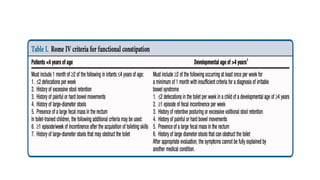
It ischaracterized by infrequent, painful, and hard stools and may be accompanied
by fecal incontinence and abdominal pain. Functional constipation is a clinical
diagnosis based on history and physical examination, and is defined according to
the Rome IV criteria
Functional constipation constituted 30% of Pediatric gastroenterology office
practice, 4-5% of all referrals to Pediatric gastroenterology tertiary care centers
and 0.8-1% of all Pediatric cases in medical colleges.
5.
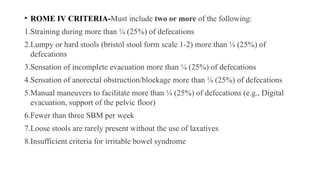
• ROME IVCRITERIA-Must include two or more of the following:
1.Straining during more than ¼ (25%) of defecations
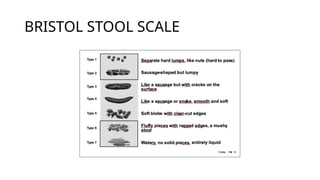
2.Lumpy or hard stools (bristol stool form scale 1-2) more than ¼ (25%) of
defecations
3.Sensation of incomplete evacuation more than ¼ (25%) of defecations
4.Sensation of anorectal obstruction/blockage more than ¼ (25%) of defecations
5.Manual maneuvers to facilitate more than ¼ (25%) of defecations (e.g., Digital
evacuation, support of the pelvic floor)
6.Fewer than three SBM per week
7.Loose stools are rarely present without the use of laxatives
8.Insufficient criteria for irritable bowel syndrome
Based on theNorth American Society of Pediatric Gastroenterology, Hepatology
and Nutrition (NASPGHAN) guidelines, Rome III criteria [3,4] and expert opinion,
the definition recommended for application in Indian children
Functional constipation is considered when any of the two or more
criteria to be fulfilled to label as constipation. The criteria include: ;
Stool frequency ≤2 per week
History of hard and painful bowel movements
History of retention of stools
Large diameter stool obstructing the Indian pots ; Fecal incontinence
Per abdomen or per rectum examination reveals fecal mass
9.
Fecal incontinenceis classified as:
1. Constipation-associated fecal incontinence
2. Non-retentive fecal incontinence: diagnosed only if there is no constipation and
normal anal sphincter tone, and symptoms last for more than 2 months in a child
with a developmental age of ≥4 years.
Refractory constipation: Constipation not responding to optimal
conventional treatment for at least 3 months, despite good compliance.
10.
HISTORY AND EXAMINATION
•History and examination are relevant in making a diagnosis of constipation,
differentiating functional and organic constipation, looking for precipitants of
functional constipation and eliciting issues relevant to management like incontinence,
impaction, past treatment, treatment compliance and response to treatment.
• Dietary history: Details of diet should be taken: intake of fruits and vegetables and
refined foods ( Bakery products), beverages etc.
o Exclusive and prolonged milk intake with minimal solids in young infants is a major
factor causing functional constipation in India. These children are at an increased risk
of iron deficiency anemia.
11.
Important precipitating factorsof functional
constipation:
• The following are the most common factors which initiate constipation in children
1. Premature initiation of toilet training (normally toilet training should start not
before 24 months in a developmentally normal child)
2. Drugs and inter-current illnesses
3. Quick and abrupt transition of diet e.g. Liquid to solid, breastfeeding to bottle
feeding
4. Change in local environment (start of schooling) and psychosocial factors.
12.
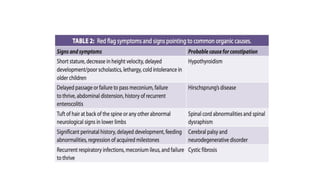
Red flags suggestiveof organic constipation:
• Delayed passage of meconium,
• Onset in early infancy, ribbon or pellet stools
• Bilious vomiting
• Uniform abdominal distension
• Failure to thrive
• Recurrent lower respiratory infections
• Cold intolerance, neuro-developmental delay or regression
• Gush of stools on DRE, anal malformations
• abnormal neurological examination (paraspinal, lower limbs and anorectal reflexes).
14.
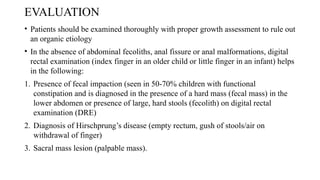
EVALUATION
• Patients shouldbe examined thoroughly with proper growth assessment to rule out
an organic etiology
• In the absence of abdominal fecoliths, anal fissure or anal malformations, digital
rectal examination (index finger in an older child or little finger in an infant) helps
in the following:
1. Presence of fecal impaction (seen in 50-70% children with functional
constipation and is diagnosed in the presence of a hard mass (fecal mass) in the
lower abdomen or presence of large, hard stools (fecolith) on digital rectal
examination (DRE)
2. Diagnosis of Hirschprung’s disease (empty rectum, gush of stools/air on
withdrawal of finger)
3. Sacral mass lesion (palpable mass).
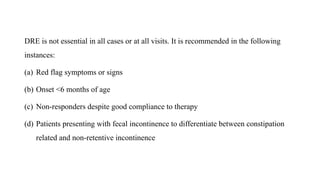
15.
DRE is notessential in all cases or at all visits. It is recommended in the following
instances:
(a) Red flag symptoms or signs
(b) Onset <6 months of age
(c) Non-responders despite good compliance to therapy
(d) Patients presenting with fecal incontinence to differentiate between constipation
related and non-retentive incontinence
16.
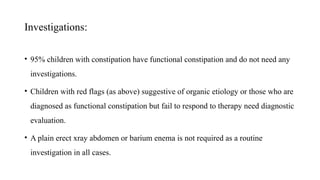
Investigations:
• 95% childrenwith constipation have functional constipation and do not need any
investigations.
• Children with red flags (as above) suggestive of organic etiology or those who are
diagnosed as functional constipation but fail to respond to therapy need diagnostic
evaluation.
• A plain erect xray abdomen or barium enema is not required as a routine
investigation in all cases.
17.
MANAGEMENT OF FUNCTIONALCONSTIPATION
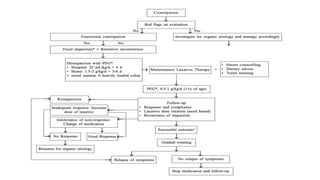
• Patient Counselling
oSalient pathophysiological aspects inclusive of objective of treatment should be
explained to the parents.
oAny precipitating factors identified should be eliminated or modified by
appropriate advice (e.g. in a child with exclusive milk feeding, (semi) solid diet
supplementation should be instituted; drugs causing constipation should be
stopped; any psychosocial factor operating needs to be addressed).
18.
Toilet-training
• Toilet trainingshould not be started before 24 months of age; however, there is a variation in
recommended age of training between 3-4 years.
• Follow the ‘rule of 1’: toilet training to be done by one person, one routine (5 min after each
major meal), one place, one word e.g. Pooh/potty etc. In a child with constipation:
o Make the child sit in the toilet, 2-3 times a day for 5-10 minutes after meals (within 30
minutes of meal intake)
o Sit in squatting position in the Indian toilet or with foot rest in English toilet/potty seat to
have appropriate angulation of knees and thighs to facilitate expulsion of stools
o Reward system (positive reinforcement) helps in motivating the child and avoiding child-
parent conflict.
19.
• Diet, Fiberand Water Intake
• There are no well-conducted randomized controlled studies of diet and treatment
of constipation. Daily fiber requirement is 0.5 gm/kg/day.
• Adequate intake of fiber- rich diet (cereals, whole pulses with bran, vegetables,
salad and fruits) is recommended at the initial counseling.
• High fiber diet chart should be given to parents (as per local practice). Restrict
milk and encourage intake of semi-
• solids and solids in younger children. Ensure adequate intake of water. Normal
activity is recommended.
20.
Medical Therapy
• Itconsists of initial phase of disimpaction in patients with fecal impaction and a maintenance phase with
laxatives.
Disimpaction
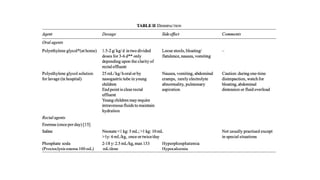
• Rationale of disimpaction: Completely clear the colon so that no residual hard fecal matter is retained.
Thereafter the maintenance laxative therapy can keep the bowel moving and empty so that there is no
retention.
• This enables rectum to achieve the normal diameter and tone for proper anorectal reflexes and pelvic floor
coordination to facilitate normal stool expulsion
There are two ways of Disimpaction
1. One-time hospital based (100% success)
2. Home based in split doses (68-97% success)
23.
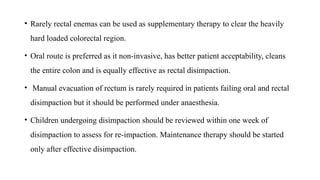
• Rarely rectalenemas can be used as supplementary therapy to clear the heavily
hard loaded colorectal region.
• Oral route is preferred as it non-invasive, has better patient acceptability, cleans
the entire colon and is equally effective as rectal disimpaction.
• Manual evacuation of rectum is rarely required in patients failing oral and rectal
disimpaction but it should be performed under anaesthesia.
• Children undergoing disimpaction should be reviewed within one week of
disimpaction to assess for re-impaction. Maintenance therapy should be started
only after effective disimpaction.
24.
Maintenance therapy
• Thereare different classes of laxatives used for constipation (osmotic and
stimulants).
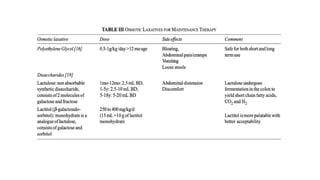
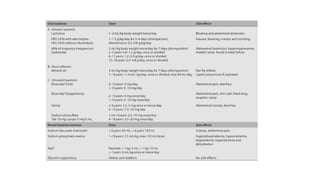
Osmotic laxatives: These are the mainstay of maintenance therapy in children
• . These laxatives draw water into the stool thereby making the stools softer and
easy to pass. The two main osmotic laxatives are polyethylene glycol (PEG) and
lactulose/lactitol
25.
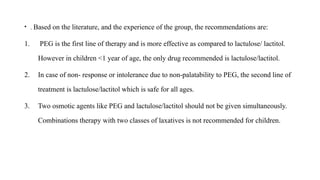
• . Basedon the literature, and the experience of the group, the recommendations are:
1. PEG is the first line of therapy and is more effective as compared to lactulose/ lactitol.
However in children <1 year of age, the only drug recommended is lactulose/lactitol.
2. In case of non- response or intolerance due to non-palatability to PEG, the second line of
treatment is lactulose/lactitol which is safe for all ages.
3. Two osmotic agents like PEG and lactulose/lactitol should not be given simultaneously.
Combinations therapy with two classes of laxatives is not recommended for children.
26.
Stimulant Laxatives:
• Stimulantlaxatives are used only as rescue therapy
• No randomized controlled trials are available in children regarding their efficacy.
• Stimulants are usually required as rescue therapy (an acute or sudden episode of
constipation while being on regular compliant maintenance therapy).
• These stimulants are given for a short duration of 2-3 days to tide over the acute
episode of constipation, and then stopped
28.
Follow-up:
• At eachfollow- up, record the stool history, associated symptoms, compliance with
diet, medications and toilet-training. It is important to have a stool diary for proper
follow-up.
• Parents should maintain a stool diary for objective assessment of response to
therapy related to stool frequency and consistency.
• First follow-up is advised at 14 days to assess compliance. Subsequently, 1-2
monthly follow-up till normal bowel habit is attained or physician is satisfied with
response as defined below as ‘successful outcome’further, 3-monthly follow-up for
a minimum period of one year.
29.
• Successful outcomeof treatment should be defined as
(a) Stool normalcy while on laxatives for a period of at least 4 weeks of initiation
of therapy,
(b) Achievement of stool normalcy for a minimum period of 6 months before
tapering. Normalcy of stools should defined as daily, not- hard, nor loose watery
stools, with absence of pain, straining, bleeding, posturing or incontinence.
30.
When to stoplaxatives:
• Based on the natural history, child should have been symptom-free while on
maintenance therapy for at least 6 months before attempting to taper the laxatives.
• It is then advisable to taper gradually over a period of 3 months.
• Laxatives should never be stopped abruptly. Dietary and toilet training advice
should continue even after stoppage of laxatives. Triggers and precipitating factors
of functional constipation should have been adequately addressed.
• Parents should have the knowledge about the management and also risk of
relapse of symptoms on stoppage of medication.
31.
• Refractory constipation:
•Those patients not responding to a sustained optimal medical management of
functional constipation should be investigated for hypothyroidism, celiac disease,
hirschprung disease, cow milk protein allergy in young children, lead poisoning
and spinal abnormalities.
• These children also need evaluation for presence of slow colonic transit, pelvic
dyssynergia and pseudo-obstruction, in centers with expertise.
33.
CONCLUSION
• Functional constipationshould be diagnosed in the absence of red flags.
• Functional constipation should be diagnosed only in the absence of red flags on
history and examination.
• Those with impaction and/or retentive incontinence should be disimpacted with
polyethylene glycol (hospital or home-based).
• Osmotic laxatives (polyethylene glycol more than 1 year of age and
lactulose/lactitol less than 1 year of age) are the first line of maintenance therapy.
Stimulant laxatives should be reserved only for rescue therapy.
34.
• Combination therapiesof two osmotics, two stimulants or two classes of laxatives
are not recommended.
• Laxatives as maintenance therapy should be given for a prolonged period and
should be tapered off gradually, only after a successful outcome.
• Essential components of therapy for a successful outcome include counselling,
dietary changes, toilet-training and regular follow-up.


![Based on the North American Society of Pediatric Gastroenterology, Hepatology
and Nutrition (NASPGHAN) guidelines, Rome III criteria [3,4] and expert opinion,
the definition recommended for application in Indian children
Functional constipation is considered when any of the two or more
criteria to be fulfilled to label as constipation. The criteria include: ;
Stool frequency ≤2 per week
History of hard and painful bowel movements
History of retention of stools
Large diameter stool obstructing the Indian pots ; Fecal incontinence
Per abdomen or per rectum examination reveals fecal mass](https://image.slidesharecdn.com/functionalconstipation-251209170009-c4c19b7f/85/FUNCTIONAL-CONSTIPATION-pptxcccc-bbbbbbbb-8-320.jpg)