Common Childhood GI Problems
11/4/2023 1
Gastroenteritis
 Gastroenteritis is an inflammatory disease of the
gastric, and enteric sites of the GIT.
It is characterized by a sudden onset of diarrhea
with or without vomiting.
Causes include; virus, bacteria, protozoa, and non
infectious causes.
11/4/2023 2
Diarrhea
Definition
Passage of loose stool > 3x/24hrs (WHO) or
watery stool of any frequency
Is abnormally liquid or unformed stools
associated with increased frequency of defecation.
The recent change in consistency and character
of stool is more important than number of stool.
11/4/2023 3
Causes
 Viral: account for the largest causes of diarrhea in pediatrics
 Rotavirus is the leading viral pathogen worldwide.
 Others; Cali virus, astovirus, and adenovirus in gastroenteritis.
 Bacterial: the second leading cause of diarhea in peadiatrics.
 Compylobacter Jejuni is the leading bacterial cause of
gastroenteritis
 Other forms of bacteria include; shigella, Enterohemorhagic E.
coli.
11/4/2023 4
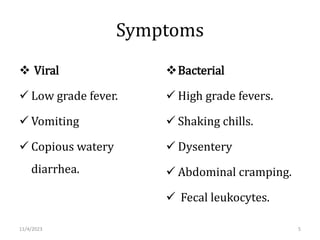
Symptoms
 Viral
 Low grade fever.
 Vomiting
 Copious watery
diarrhea.
Bacterial
 High grade fevers.
 Shaking chills.
 Dysentery
 Abdominal cramping.
 Fecal leukocytes.
11/4/2023 5
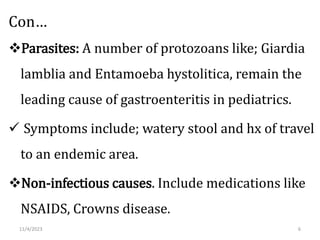
Con…
Parasites: A number of protozoans like; Giardia
lamblia and Entamoeba hystolitica, remain the
leading cause of gastroenteritis in pediatrics.
 Symptoms include; watery stool and hx of travel
to an endemic area.
Non-infectious causes. Include medications like
NSAIDS, Crowns disease.
11/4/2023 6
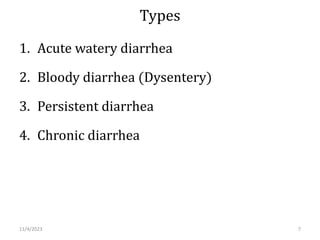
Types
1. Acute watery diarrhea
2. Bloody diarrhea (Dysentery)
3. Persistent diarrhea
4. Chronic diarrhea
11/4/2023 7
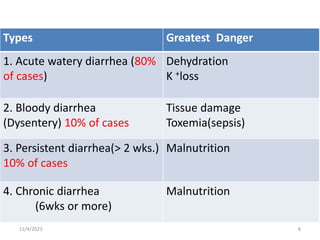
Types Greatest Danger
1. Acute watery diarrhea (80%
of cases)
Dehydration
K +loss
2. Bloody diarrhea
(Dysentery) 10% of cases
Tissue damage
Toxemia(sepsis)
3. Persistent diarrhea(> 2 wks.)
10% of cases
Malnutrition
4. Chronic diarrhea
(6wks or more)
Malnutrition
8
11/4/2023
Assessment of Diarrhea
9
— Is your child have Diarrhea?
— If yes, ask for how long?
— Is there blood in the stool?
— Assess for sign of DHN
— Look at the child’s general condition. Is the child:
Lethargic or unconscious? Restless and irritable?
— Look for sunken eyes.
— Offer the child fluid. Is the child: Not able to drink
or drinking poorly? Drinking eagerly, thirsty?
— Pinch the skin of the abdomen. Does it go back:
Very slowly (longer than 2 seconds)? Slowly?
11/4/2023
Assessment Con…
• Severe dehydration will have two of these signs:
– Abnormally sleepy or lethargic
– Sunken eyes
– Drinking poorly or not at all
– Very slow skin pinch
• Some dehydration will have two of these signs:
– Restlessness or irritability
– Sunken eyes
– Drinking eagerly
– Slow skin pinch
• No dehydration
– None of these signs
10
11/4/2023
Laboratory Investigation
CBC
Stool specimen(mucus, blood, WBC)
Rectal swab
Blood culture
 Stool culture: in bloody diarrhea,
WBC,
Serum electrolytes
11
11/4/2023
Treatment of diarrhea
Main principle in management of acute
diarrhea is:
1. Replace lost water and salts.
2. Continue to feed to prevent malnutrition.
3. Antibiotics & antiprotozoals when needed.
4. Prevention of diarrhea
12
11/4/2023
Treatment Con…
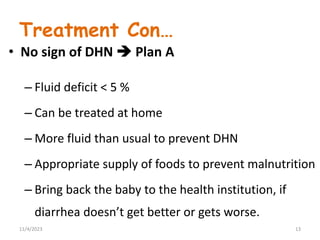
• No sign of DHN  Plan A
– Fluid deficit < 5 %
– Can be treated at home
– More fluid than usual to prevent DHN
– Appropriate supply of foods to prevent malnutrition
– Bring back the baby to the health institution, if
diarrhea doesn’t get better or gets worse.
13
11/4/2023
Con...
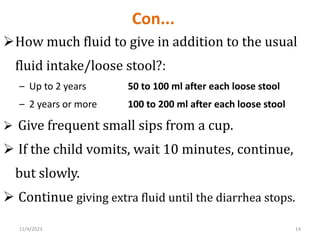
How much fluid to give in addition to the usual
fluid intake/loose stool?:
– Up to 2 years 50 to 100 ml after each loose stool
– 2 years or more 100 to 200 ml after each loose stool
 Give frequent small sips from a cup.
 If the child vomits, wait 10 minutes, continue,
but slowly.
 Continue giving extra fluid until the diarrhea stops.
14
11/4/2023
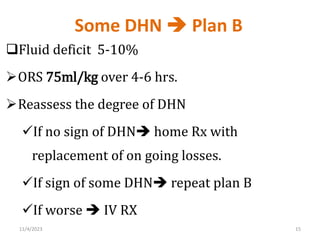
Some DHN  Plan B
Fluid deficit 5-10%
ORS 75ml/kg over 4-6 hrs.
Reassess the degree of DHN
If no sign of DHN home Rx with
replacement of on going losses.
If sign of some DHN repeat plan B
If worse  IV RX
15
11/4/2023
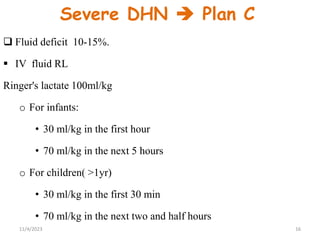
Severe DHN  Plan C
 Fluid deficit 10-15%.
 IV fluid RL
Ringer's lactate 100ml/kg
o For infants:
• 30 ml/kg in the first hour
• 70 ml/kg in the next 5 hours
o For children( >1yr)
• 30 ml/kg in the first 30 min
• 70 ml/kg in the next two and half hours
16
11/4/2023
Treatment Con…
Antimicrobial therapy is administered to
selected patients.
Give antiprotozoal for patients with proven
ameabiasis and no response to treatment for
shigella.
17
11/4/2023
Zinc supplementation
Reduce duration and severity of diarrhea
Prevents recurrence.
promotes ion absorption, restores epithelial proliferation,
and stimulates immune response.
 Children with diarrhea should receive oral zinc for 10-
14 days during and after diarrhea (10 mg/day for infants
<6 mo of age and 20 mg/day for those >6 mo).
11/4/2023 18
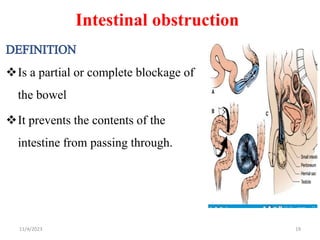
Intestinal obstruction
Is a partial or complete blockage of
the bowel
It prevents the contents of the
intestine from passing through.
11/4/2023 19
Classification
 Dynamic(Mechanical obstruction)/Adynamic(Paralytic
Ileus)
 Small bowel obstruction/Large bowel
obstruction/both(generalized ileus).
 Acute/Chronic
 Simple/Strangulated
 Closed loop obstruction
20
11/4/2023
Classi…
Dynamic : where peristalsis is working against a
mechanical obstruction.
Adynamic (paralytic ileus):Ineffective motility
without any physical obstruction.
Acute obstruction: sudden onset of severe colicky
central abdominal pain, distention and early vomiting
&then, constipation
Usually occur in small bowel obstruction)
21
11/4/2023
Clasi…
Chronic obstruction :lower abdominal colic &
absolute constipation, followed by distention.
Usually seen in large bowel obstruction with
Simple mechanical obstruction:
In which there is obstruction but blood supply to
intestine remains intact.
22
11/4/2023
Cont …
 Strangulated obstruction : Mesentric blood vessel are
blocked besides the usual mechanical obstruction.
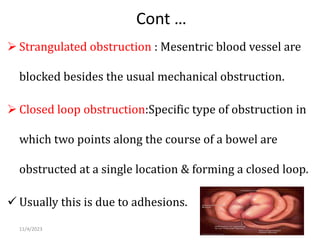
 Closed loop obstruction:Specific type of obstruction in
which two points along the course of a bowel are
obstructed at a single location & forming a closed loop.
 Usually this is due to adhesions.
11/4/2023 23
Common causes of IO in children
Intussusception
Hirschsprung’s disease
Band of adhesions
Necrotizing enterocolitis
Pyloric stenosis
Hernia
24
11/4/2023
Intusisupation
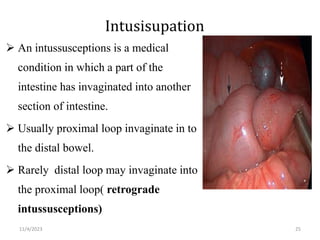
 An intussusceptions is a medical
condition in which a part of the
intestine has invaginated into another
section of intestine.
 Usually proximal loop invaginate in to
the distal bowel.
 Rarely distal loop may invaginate into
the proximal loop( retrograde
intussusceptions)
25
11/4/2023
Epidemiology
Most common cause of intestinal obstruction in
infants between 6 and 36 months of age.
Approximately 60% < 1 year &
80 to 90% <2 years old
 Intussusception is less common before three
months and after six years of age
 Male: female ratio of approximately 4:1
26
11/4/2023
Clinical presentation
 The first sign of intussusception may be sudden, loud
crying caused by abdominal pain.
 Infants who have abdominal pain may pull their knees to
their chests when they cry.
 The pain of intussusception comes and goes, usually every
15 to 20 minutes
 Vomiting
 Lethargic
27
11/4/2023
Con…
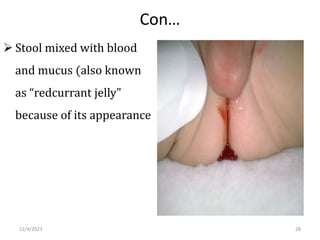
 Stool mixed with blood
and mucus (also known
as “redcurrant jelly"
because of its appearance
28
11/4/2023
Diagnosis
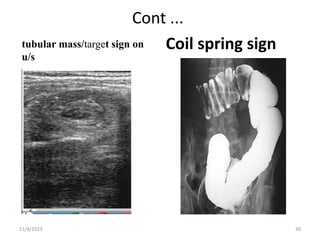
U/S of the abdomen identify target sign.
Longitudinal scan reveal tubular mass
 Barium enema reveal coiled spring sign
29
11/4/2023
Cont ...
tubular mass/target sign on
u/s
Coil spring sign
11/4/2023 30
Management
 Air or hydrostatic enema reduction
 Surgical reduction if enema fails
 Surgical resection and anastmosis in late
presentation
Antibiotics in case of surgical intervention
Adequate fluid resuscitation to correct the often severe
dehydration caused by vomiting
31
11/4/2023
HIRSCHSPRUNG’S DISEASE
 It is a blockage of the large intestine due to improper muscle
movement in the bowel
• CAUSES:
 Muscle contractions in the gut help digested materials move through
the intestine.
 Nerves in between the muscle layers trigger the contractions.
 Areas without such nerves cannot push material through.
 This causes a blockage.
 Intestinal contents build up behind the blockage, causing the
bowel and abdomen to become swollen
Symptoms
.
 Difficulty with bowel movements
 Failure to pass meconium shortly after birth
 Poor feeding
 Poor weight gain
 Vomiting
 Constipation
 Fecal impaction
 Malnutrition
Dx
 During a physical examination, the doctor may be able to
feel loops of bowel in the swollen belly.
 A rectal examination may reveal a loss of muscle tone in the
rectal muscles.
 tests
 Abdominal x—ray
 Barium enema
 Rectal biopsy
TREATMENT
 Colostomy
 A variety of subsequent corrective operations
Are carried out at approximately 1 year of age
,
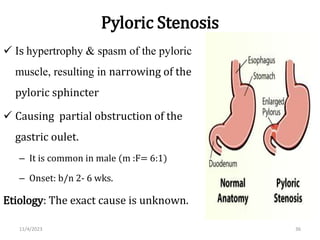
Pyloric Stenosis
 Is hypertrophy & spasm of the pyloric
muscle, resulting in narrowing of the
pyloric sphincter
 Causing partial obstruction of the
gastric oulet.
– It is common in male (m :F= 6:1)
– Onset: b/n 2- 6 wks.
Etiology: The exact cause is unknown.
11/4/2023 36
Pyloric stenos …
C/M
 Vomiting(after feeding)(postprandial), non-bilious, often
projectile & demands to be re-fed soon afterwards (a
"hungry vomiter"). (classic presentation)
 Excessive hunger
 Crying with out tear (sign of dehydration)
 Loss of Wt. or failure to gain wt.
37
11/4/2023
DX
 Usually based on clinical manifestations
-projectile vomiting(non bilious)
-Palpation of pyloric mass can be felt.
 Abdominal U/S (the enlarged thickened pylorus is seen on U/S monitor)
confirms the diagnosis
 pyloric thickness >4 mm or an overall pyloric length >14 mm.
 X-ray examination with barium meal.
-Narrowing of pyloric canal.
-Enlarged stomach
RX-
 RX may be surgical or medical.
- Surgical(pyloromyotomy) is the best management.
- Medical Rx :like gastric lavage 38
11/4/2023
Preventive Strategies
• Promotion of Exclusive Breastfeeding
• Improved Complementary Feeding Practices
• Immunization(measles , cholera, rotavirus)
• Improved Water and Sanitary Facilities
• Promotion of Personal and Domestic Hygiene
• Improved Case Management of Diarrhea
11/4/2023 39
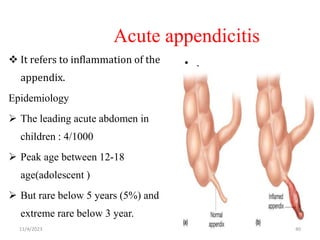
Acute appendicitis
 It refers to inflammation of the
appendix.
Epidemiology
 The leading acute abdomen in
children : 4/1000
 Peak age between 12-18
age(adolescent )
 But rare below 5 years (5%) and
extreme rare below 3 year.
• .
11/4/2023 40
Cause
 An obstruction: Food waste or a hard piece of stool
(fecal stone),tumor etc can block the opening of the
cavity
 An infection: May also follow an infection, such as a
gastrointestinal infections, or it may result from other
types of inflammation.
 In both cases, bacteria inside the appendix multiply
rapidly, causing the appendix to become inflamed,
swollen and filled with pus.
 If not treated promptly, the appendix can rupture.
11/4/2023 41
Pathophysiology
Appendix become obstructed
Increase intra-luminal pressure
Decrease venous drainage, thrombosis, edema,
and bacterial invasion of bowel wall.
Appendix become increasingly hyperemic, warm
and covered with exudate.
Perforation and gangrene of appendix
11/4/2023 42
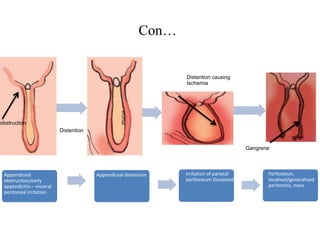
Con…
Appendiceal
obstruction/early
appendicitis – visceral
peritoneal irritation
Appendiceal distension Irritation of parietal
peritoneum (localised)
Perforation,
localised/generalised
peritonitis, mass
obstruction
Distention
mucus
Distention causing
Ischemia
Gangrene
Clinical manifestation
 Peri-umblical pain
 Shift of maximal pain to right lower abdomen
 Early malaise and anorexia
 Low grade fever and vomiting
 Severe RLQ pain which limits movement
 Perforation after 36-48 hours (65%)
 High grade fever and rigid abdomen is a sign of
peritonitis due to perforation
11/4/2023 44
Physical examination
 Mild fever and tachycardia
 Child walks bending down
 Direct tenderness over RLQ area
 Positive psoas and obturator sign
 Positive rovsing sign (rebound tenderness)
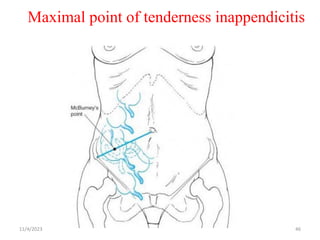
 Point of maximal pain at McBurny’s point.
11/4/2023 45
Maximal point of tenderness inappendicitis
11/4/2023 46
Laboratory investigation
 Leukocytosis
 Raised ESR
Radiologically,
 Ultrasound often reveal swollen, distended appendix
 Appendiceal mass or abscess in few cases
11/4/2023 47
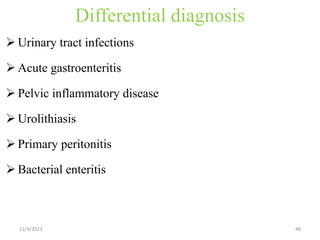
Differential diagnosis
 Urinary tract infections
 Acute gastroenteritis
 Pelvic inflammatory disease
 Urolithiasis
 Primary peritonitis
 Bacterial enteritis
11/4/2023 48
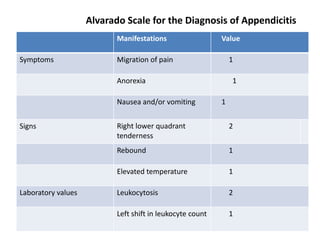
Alvarado Scale for the Diagnosis of Appendicitis
Value
Manifestations
1
Migration of pain
Symptoms
1
Anorexia
1
Nausea and/or vomiting
2
Right lower quadrant
tenderness
Signs
1
Rebound
1
Elevated temperature
2
Leukocytosis
Laboratory values
1
Left shift in leukocyte count
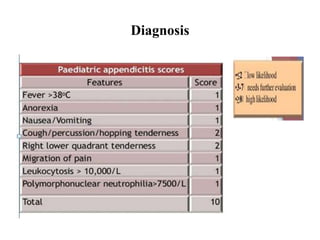
Diagnosis
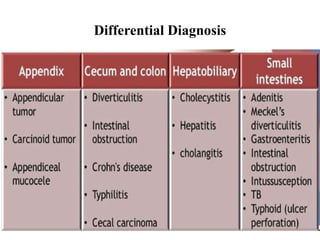
Differential Diagnosis
Treatment
 Pain control and hydration
 Keep NPO for surgery
 Antibiotics to cover GIT flora
 Ceftriaxone and Metronidazole OR
 Ampicillin, Gentamycin
 Emergency operation(appendectomy )
11/4/2023 52
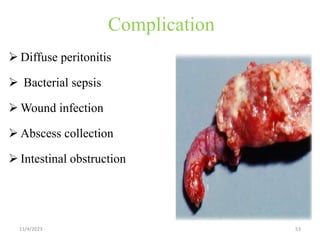
Complication
 Diffuse peritonitis
 Bacterial sepsis
 Wound infection
 Abscess collection
 Intestinal obstruction
11/4/2023 53
Umbilical hernia
 Hernia: Is the protrusion/projection of an organ or a part of an
organ through abnormal opening in the wall of the cavity that
normally contains it.
 Umbilical hernia: Protuberant umbilicus
Diagnosis: Soft reducible swelling at umbilicus covered with skin
Treatment
• Most close spontaneously
 Apply adhesive tape (2 inches)
• Repair if not closed by age 6 years, or if there is a history of the
hernia being difficult to reduce.
54
11/4/2023
Inguinal hernia
 Swelling or bulge at inguinal area.
Diagnosis
 Intermittent reducible swelling in the groin that is observed when the
child is crying or straining.
 Occurs where the spermatic cord exits the abdomen (inguinal canal).
 Distinguish from a hydrocele (fluid that collects around testicle).
 Hydrocele trans illuminates and usually do not extend up into the
inguinal canal.
 Can also occur rarely in girls.
55
11/4/2023
Inguinal hernia ---
Treatment
Uncomplicated inguinal hernia: elective surgical
repair to prevent incarceration.
Hydrocele: repair if not resolved by age 1 year.
Unrepaired hydroceles will turn into inguinal
hernias.
56
11/4/2023
Incarcerated hernias
 These occur when the bowel or other intra-abdominal structure is trapped
in the hernia.
Diagnosis
 Non-reducible tender swelling at the site of an inguinal or umbilical
hernia.
 There may be signs of intestinal obstruction (vomiting and abdominal
distension) if the bowel is trapped in the hernia.
Treatment
 Attempt to reduce by steady constant pressure.
 If the hernia does not reduce easily, an operation will be required.
 Give the child nothing orally.
57
11/4/2023
RX Incarcerated hernias---
 Give intravenous fluids.
 Pass a nasogastric tube if there is vomiting or
abdominal distension.
 Give antibiotics if compromised bowel is suspected:
 Ampicillin (25–50 mg/kg IM or IV four times a day),
gentamicin (7.5 mg/kg IM or IV once a day) and
metronidazole (7.5 mg/kg three times a day).
58
11/4/2023
11/4/2023 By Bogale C. 59
Thank you!!!

Gastro intestinal system.pptx

  • 1.
    Common Childhood GIProblems 11/4/2023 1
  • 2.
    Gastroenteritis  Gastroenteritis isan inflammatory disease of the gastric, and enteric sites of the GIT. It is characterized by a sudden onset of diarrhea with or without vomiting. Causes include; virus, bacteria, protozoa, and non infectious causes. 11/4/2023 2
  • 3.
    Diarrhea Definition Passage of loosestool > 3x/24hrs (WHO) or watery stool of any frequency Is abnormally liquid or unformed stools associated with increased frequency of defecation. The recent change in consistency and character of stool is more important than number of stool. 11/4/2023 3
  • 4.
    Causes  Viral: accountfor the largest causes of diarrhea in pediatrics  Rotavirus is the leading viral pathogen worldwide.  Others; Cali virus, astovirus, and adenovirus in gastroenteritis.  Bacterial: the second leading cause of diarhea in peadiatrics.  Compylobacter Jejuni is the leading bacterial cause of gastroenteritis  Other forms of bacteria include; shigella, Enterohemorhagic E. coli. 11/4/2023 4
  • 5.
    Symptoms  Viral  Lowgrade fever.  Vomiting  Copious watery diarrhea. Bacterial  High grade fevers.  Shaking chills.  Dysentery  Abdominal cramping.  Fecal leukocytes. 11/4/2023 5
  • 6.
    Con… Parasites: A numberof protozoans like; Giardia lamblia and Entamoeba hystolitica, remain the leading cause of gastroenteritis in pediatrics.  Symptoms include; watery stool and hx of travel to an endemic area. Non-infectious causes. Include medications like NSAIDS, Crowns disease. 11/4/2023 6
  • 7.
    Types 1. Acute waterydiarrhea 2. Bloody diarrhea (Dysentery) 3. Persistent diarrhea 4. Chronic diarrhea 11/4/2023 7
  • 8.
    Types Greatest Danger 1.Acute watery diarrhea (80% of cases) Dehydration K +loss 2. Bloody diarrhea (Dysentery) 10% of cases Tissue damage Toxemia(sepsis) 3. Persistent diarrhea(> 2 wks.) 10% of cases Malnutrition 4. Chronic diarrhea (6wks or more) Malnutrition 8 11/4/2023
  • 9.
    Assessment of Diarrhea 9 —Is your child have Diarrhea? — If yes, ask for how long? — Is there blood in the stool? — Assess for sign of DHN — Look at the child’s general condition. Is the child: Lethargic or unconscious? Restless and irritable? — Look for sunken eyes. — Offer the child fluid. Is the child: Not able to drink or drinking poorly? Drinking eagerly, thirsty? — Pinch the skin of the abdomen. Does it go back: Very slowly (longer than 2 seconds)? Slowly? 11/4/2023
  • 10.
    Assessment Con… • Severedehydration will have two of these signs: – Abnormally sleepy or lethargic – Sunken eyes – Drinking poorly or not at all – Very slow skin pinch • Some dehydration will have two of these signs: – Restlessness or irritability – Sunken eyes – Drinking eagerly – Slow skin pinch • No dehydration – None of these signs 10 11/4/2023
  • 11.
    Laboratory Investigation CBC Stool specimen(mucus,blood, WBC) Rectal swab Blood culture  Stool culture: in bloody diarrhea, WBC, Serum electrolytes 11 11/4/2023
  • 12.
    Treatment of diarrhea Mainprinciple in management of acute diarrhea is: 1. Replace lost water and salts. 2. Continue to feed to prevent malnutrition. 3. Antibiotics & antiprotozoals when needed. 4. Prevention of diarrhea 12 11/4/2023
  • 13.
    Treatment Con… • Nosign of DHN  Plan A – Fluid deficit < 5 % – Can be treated at home – More fluid than usual to prevent DHN – Appropriate supply of foods to prevent malnutrition – Bring back the baby to the health institution, if diarrhea doesn’t get better or gets worse. 13 11/4/2023
  • 14.
    Con... How much fluidto give in addition to the usual fluid intake/loose stool?: – Up to 2 years 50 to 100 ml after each loose stool – 2 years or more 100 to 200 ml after each loose stool  Give frequent small sips from a cup.  If the child vomits, wait 10 minutes, continue, but slowly.  Continue giving extra fluid until the diarrhea stops. 14 11/4/2023
  • 15.
    Some DHN Plan B Fluid deficit 5-10% ORS 75ml/kg over 4-6 hrs. Reassess the degree of DHN If no sign of DHN home Rx with replacement of on going losses. If sign of some DHN repeat plan B If worse  IV RX 15 11/4/2023
  • 16.
    Severe DHN Plan C  Fluid deficit 10-15%.  IV fluid RL Ringer's lactate 100ml/kg o For infants: • 30 ml/kg in the first hour • 70 ml/kg in the next 5 hours o For children( >1yr) • 30 ml/kg in the first 30 min • 70 ml/kg in the next two and half hours 16 11/4/2023
  • 17.
    Treatment Con… Antimicrobial therapyis administered to selected patients. Give antiprotozoal for patients with proven ameabiasis and no response to treatment for shigella. 17 11/4/2023
  • 18.
    Zinc supplementation Reduce durationand severity of diarrhea Prevents recurrence. promotes ion absorption, restores epithelial proliferation, and stimulates immune response.  Children with diarrhea should receive oral zinc for 10- 14 days during and after diarrhea (10 mg/day for infants <6 mo of age and 20 mg/day for those >6 mo). 11/4/2023 18
  • 19.
    Intestinal obstruction Is apartial or complete blockage of the bowel It prevents the contents of the intestine from passing through. 11/4/2023 19
  • 20.
    Classification  Dynamic(Mechanical obstruction)/Adynamic(Paralytic Ileus) Small bowel obstruction/Large bowel obstruction/both(generalized ileus).  Acute/Chronic  Simple/Strangulated  Closed loop obstruction 20 11/4/2023
  • 21.
    Classi… Dynamic : whereperistalsis is working against a mechanical obstruction. Adynamic (paralytic ileus):Ineffective motility without any physical obstruction. Acute obstruction: sudden onset of severe colicky central abdominal pain, distention and early vomiting &then, constipation Usually occur in small bowel obstruction) 21 11/4/2023
  • 22.
    Clasi… Chronic obstruction :lowerabdominal colic & absolute constipation, followed by distention. Usually seen in large bowel obstruction with Simple mechanical obstruction: In which there is obstruction but blood supply to intestine remains intact. 22 11/4/2023
  • 23.
    Cont …  Strangulatedobstruction : Mesentric blood vessel are blocked besides the usual mechanical obstruction.  Closed loop obstruction:Specific type of obstruction in which two points along the course of a bowel are obstructed at a single location & forming a closed loop.  Usually this is due to adhesions. 11/4/2023 23
  • 24.
    Common causes ofIO in children Intussusception Hirschsprung’s disease Band of adhesions Necrotizing enterocolitis Pyloric stenosis Hernia 24 11/4/2023
  • 25.
    Intusisupation  An intussusceptionsis a medical condition in which a part of the intestine has invaginated into another section of intestine.  Usually proximal loop invaginate in to the distal bowel.  Rarely distal loop may invaginate into the proximal loop( retrograde intussusceptions) 25 11/4/2023
  • 26.
    Epidemiology Most common causeof intestinal obstruction in infants between 6 and 36 months of age. Approximately 60% < 1 year & 80 to 90% <2 years old  Intussusception is less common before three months and after six years of age  Male: female ratio of approximately 4:1 26 11/4/2023
  • 27.
    Clinical presentation  Thefirst sign of intussusception may be sudden, loud crying caused by abdominal pain.  Infants who have abdominal pain may pull their knees to their chests when they cry.  The pain of intussusception comes and goes, usually every 15 to 20 minutes  Vomiting  Lethargic 27 11/4/2023
  • 28.
    Con…  Stool mixedwith blood and mucus (also known as “redcurrant jelly" because of its appearance 28 11/4/2023
  • 29.
    Diagnosis U/S of theabdomen identify target sign. Longitudinal scan reveal tubular mass  Barium enema reveal coiled spring sign 29 11/4/2023
  • 30.
    Cont ... tubular mass/targetsign on u/s Coil spring sign 11/4/2023 30
  • 31.
    Management  Air orhydrostatic enema reduction  Surgical reduction if enema fails  Surgical resection and anastmosis in late presentation Antibiotics in case of surgical intervention Adequate fluid resuscitation to correct the often severe dehydration caused by vomiting 31 11/4/2023
  • 32.
    HIRSCHSPRUNG’S DISEASE  Itis a blockage of the large intestine due to improper muscle movement in the bowel • CAUSES:  Muscle contractions in the gut help digested materials move through the intestine.  Nerves in between the muscle layers trigger the contractions.  Areas without such nerves cannot push material through.  This causes a blockage.  Intestinal contents build up behind the blockage, causing the bowel and abdomen to become swollen
  • 33.
    Symptoms .  Difficulty withbowel movements  Failure to pass meconium shortly after birth  Poor feeding  Poor weight gain  Vomiting  Constipation  Fecal impaction  Malnutrition
  • 34.
    Dx  During aphysical examination, the doctor may be able to feel loops of bowel in the swollen belly.  A rectal examination may reveal a loss of muscle tone in the rectal muscles.  tests  Abdominal x—ray  Barium enema  Rectal biopsy
  • 35.
    TREATMENT  Colostomy  Avariety of subsequent corrective operations Are carried out at approximately 1 year of age ,
  • 36.
    Pyloric Stenosis  Ishypertrophy & spasm of the pyloric muscle, resulting in narrowing of the pyloric sphincter  Causing partial obstruction of the gastric oulet. – It is common in male (m :F= 6:1) – Onset: b/n 2- 6 wks. Etiology: The exact cause is unknown. 11/4/2023 36
  • 37.
    Pyloric stenos … C/M Vomiting(after feeding)(postprandial), non-bilious, often projectile & demands to be re-fed soon afterwards (a "hungry vomiter"). (classic presentation)  Excessive hunger  Crying with out tear (sign of dehydration)  Loss of Wt. or failure to gain wt. 37 11/4/2023
  • 38.
    DX  Usually basedon clinical manifestations -projectile vomiting(non bilious) -Palpation of pyloric mass can be felt.  Abdominal U/S (the enlarged thickened pylorus is seen on U/S monitor) confirms the diagnosis  pyloric thickness >4 mm or an overall pyloric length >14 mm.  X-ray examination with barium meal. -Narrowing of pyloric canal. -Enlarged stomach RX-  RX may be surgical or medical. - Surgical(pyloromyotomy) is the best management. - Medical Rx :like gastric lavage 38 11/4/2023
  • 39.
    Preventive Strategies • Promotionof Exclusive Breastfeeding • Improved Complementary Feeding Practices • Immunization(measles , cholera, rotavirus) • Improved Water and Sanitary Facilities • Promotion of Personal and Domestic Hygiene • Improved Case Management of Diarrhea 11/4/2023 39
  • 40.
    Acute appendicitis  Itrefers to inflammation of the appendix. Epidemiology  The leading acute abdomen in children : 4/1000  Peak age between 12-18 age(adolescent )  But rare below 5 years (5%) and extreme rare below 3 year. • . 11/4/2023 40
  • 41.
    Cause  An obstruction:Food waste or a hard piece of stool (fecal stone),tumor etc can block the opening of the cavity  An infection: May also follow an infection, such as a gastrointestinal infections, or it may result from other types of inflammation.  In both cases, bacteria inside the appendix multiply rapidly, causing the appendix to become inflamed, swollen and filled with pus.  If not treated promptly, the appendix can rupture. 11/4/2023 41
  • 42.
    Pathophysiology Appendix become obstructed Increaseintra-luminal pressure Decrease venous drainage, thrombosis, edema, and bacterial invasion of bowel wall. Appendix become increasingly hyperemic, warm and covered with exudate. Perforation and gangrene of appendix 11/4/2023 42
  • 43.
    Con… Appendiceal obstruction/early appendicitis – visceral peritonealirritation Appendiceal distension Irritation of parietal peritoneum (localised) Perforation, localised/generalised peritonitis, mass obstruction Distention mucus Distention causing Ischemia Gangrene
  • 44.
    Clinical manifestation  Peri-umblicalpain  Shift of maximal pain to right lower abdomen  Early malaise and anorexia  Low grade fever and vomiting  Severe RLQ pain which limits movement  Perforation after 36-48 hours (65%)  High grade fever and rigid abdomen is a sign of peritonitis due to perforation 11/4/2023 44
  • 45.
    Physical examination  Mildfever and tachycardia  Child walks bending down  Direct tenderness over RLQ area  Positive psoas and obturator sign  Positive rovsing sign (rebound tenderness)  Point of maximal pain at McBurny’s point. 11/4/2023 45
  • 46.
    Maximal point oftenderness inappendicitis 11/4/2023 46
  • 47.
    Laboratory investigation  Leukocytosis Raised ESR Radiologically,  Ultrasound often reveal swollen, distended appendix  Appendiceal mass or abscess in few cases 11/4/2023 47
  • 48.
    Differential diagnosis  Urinarytract infections  Acute gastroenteritis  Pelvic inflammatory disease  Urolithiasis  Primary peritonitis  Bacterial enteritis 11/4/2023 48
  • 49.
    Alvarado Scale forthe Diagnosis of Appendicitis Value Manifestations 1 Migration of pain Symptoms 1 Anorexia 1 Nausea and/or vomiting 2 Right lower quadrant tenderness Signs 1 Rebound 1 Elevated temperature 2 Leukocytosis Laboratory values 1 Left shift in leukocyte count
  • 50.
  • 51.
  • 52.
    Treatment  Pain controland hydration  Keep NPO for surgery  Antibiotics to cover GIT flora  Ceftriaxone and Metronidazole OR  Ampicillin, Gentamycin  Emergency operation(appendectomy ) 11/4/2023 52
  • 53.
    Complication  Diffuse peritonitis Bacterial sepsis  Wound infection  Abscess collection  Intestinal obstruction 11/4/2023 53
  • 54.
    Umbilical hernia  Hernia:Is the protrusion/projection of an organ or a part of an organ through abnormal opening in the wall of the cavity that normally contains it.  Umbilical hernia: Protuberant umbilicus Diagnosis: Soft reducible swelling at umbilicus covered with skin Treatment • Most close spontaneously  Apply adhesive tape (2 inches) • Repair if not closed by age 6 years, or if there is a history of the hernia being difficult to reduce. 54 11/4/2023
  • 55.
    Inguinal hernia  Swellingor bulge at inguinal area. Diagnosis  Intermittent reducible swelling in the groin that is observed when the child is crying or straining.  Occurs where the spermatic cord exits the abdomen (inguinal canal).  Distinguish from a hydrocele (fluid that collects around testicle).  Hydrocele trans illuminates and usually do not extend up into the inguinal canal.  Can also occur rarely in girls. 55 11/4/2023
  • 56.
    Inguinal hernia --- Treatment Uncomplicatedinguinal hernia: elective surgical repair to prevent incarceration. Hydrocele: repair if not resolved by age 1 year. Unrepaired hydroceles will turn into inguinal hernias. 56 11/4/2023
  • 57.
    Incarcerated hernias  Theseoccur when the bowel or other intra-abdominal structure is trapped in the hernia. Diagnosis  Non-reducible tender swelling at the site of an inguinal or umbilical hernia.  There may be signs of intestinal obstruction (vomiting and abdominal distension) if the bowel is trapped in the hernia. Treatment  Attempt to reduce by steady constant pressure.  If the hernia does not reduce easily, an operation will be required.  Give the child nothing orally. 57 11/4/2023
  • 58.
    RX Incarcerated hernias--- Give intravenous fluids.  Pass a nasogastric tube if there is vomiting or abdominal distension.  Give antibiotics if compromised bowel is suspected:  Ampicillin (25–50 mg/kg IM or IV four times a day), gentamicin (7.5 mg/kg IM or IV once a day) and metronidazole (7.5 mg/kg three times a day). 58 11/4/2023
  • 59.
    11/4/2023 By BogaleC. 59 Thank you!!!