• Completely factorpolynomials
with common monomial factor
and by grouping.
Lesson
Objectives
• Solve problems involving special
products and factors of
polynomials.
12.
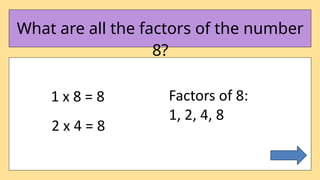
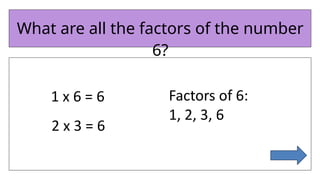
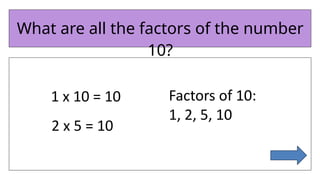
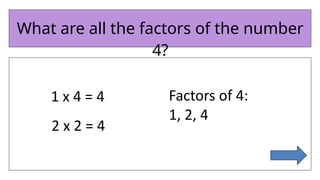
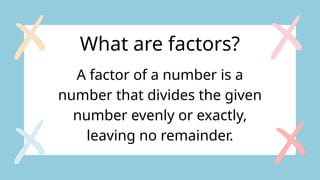
What are factors?
Afactor of a number is a
number that divides the given
number evenly or exactly,
leaving no remainder.
13.
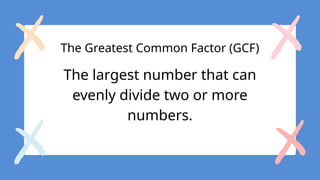
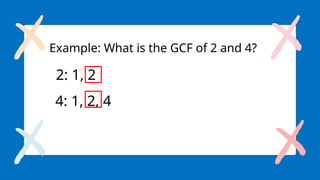
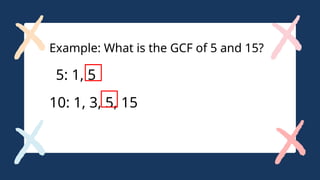
The Greatest CommonFactor (GCF)
The largest number that can
evenly divide two or more
numbers.
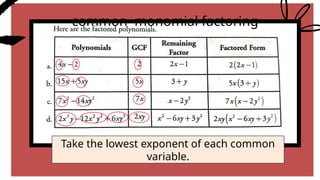
By reversing theprocess of multiplication, we will
be able to factor polynomials. Factoring a
polynomial means writing it as a product of other
polynomials.
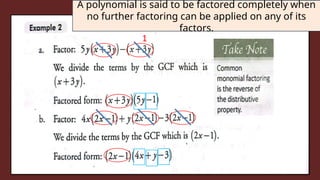
1
A polynomial is said to be factored completely when
no further factoring can be applied on any of its
factors.
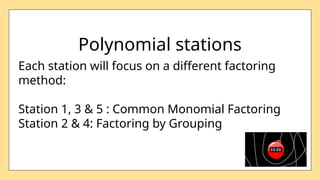
Each station willfocus on a different factoring
method:
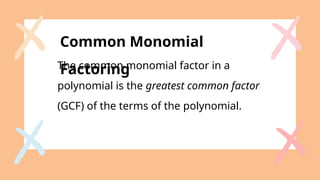
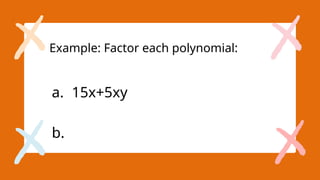
Station 1, 3 & 5 : Common Monomial Factoring
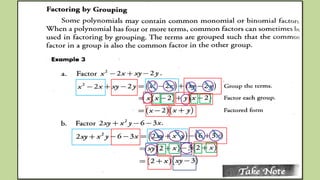
Station 2 & 4: Factoring by Grouping
Polynomial stations
Answer page 45Quick check a-c
Instructions: Given the following equations, factor each
completely. Show all steps in your solution. Write your answers
in your test notebook.
#2 I will play a song while the student holding the dice must pass it to the next classmate. When the music stops, the student holding the dice must throw or roll the dice to get number. The number obtained has a corresponding question that must be answered.
#22 You’ll be working in groups of 5. Make sure everyone is involved — discuss your ideas, help one another, and explain your thinking. This is a team effort.
At each station, your group will:
Solve 1-2 problem each station.
Identify the factoring method used.
Show all steps clearly on the worksheet provided.
This is not a race — focus on accuracy and understanding, not just speed."
We have five stations, and you’ll be working in five small groups — Group 1, Group 2, Group 3, Group 4, and Group 5. Each group will start at a different station so we’re all spread out and can work comfortably.”
“For example:
Group 1 will start at Station 1
Group 2 at Station 2
Group 3 at Station 3
Group 4 at Station 4
Group 5 at Station 5”
“You’ll spend about 3 minutes at each station. When time is up, your group will rotate to the next numbered station.”
“Here’s how the rotation will go:
If you’re at Station 1, you’ll move to Station 2 next.
From Station 2, go to Station 3.
Station 3 goes to Station 4.
Station 4 to Station 5.
And if you’re at Station 5, you’ll rotate back to Station 1.”
“Make sure to bring your worksheet with you as you move. I’ll also give you a 1-minute warning before each rotation so you can wrap up.”
Ready?