Conjunction uses and
punctuation
By. Engr. Anum Arif
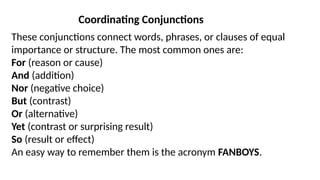
Coordinating Conjunctions
These conjunctions connect words, phrases, or clauses of equal
importance or structure. The most common ones are:
For (reason or cause)
And (addition)
Nor (negative choice)
But (contrast)
Or (alternative)
Yet (contrast or surprising result)
So (result or effect)
An easy way to remember them is the acronym FANBOYS.
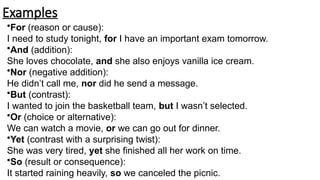
Examples
•For (reason or cause):
I need to study tonight, for I have an important exam tomorrow.
•And (addition):
She loves chocolate, and she also enjoys vanilla ice cream.
•Nor (negative addition):
He didn’t call me, nor did he send a message.
•But (contrast):
I wanted to join the basketball team, but I wasn’t selected.
•Or (choice or alternative):
We can watch a movie, or we can go out for dinner.
•Yet (contrast with a surprising twist):
She was very tired, yet she finished all her work on time.
•So (result or consequence):
It started raining heavily, so we canceled the picnic.
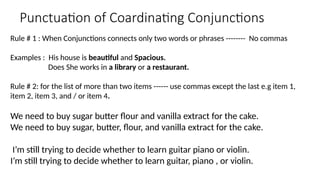
Punctuation of Coardinating Conjunctions
Rule # 1 : When Conjunctions connects only two words or phrases -------- No commas
Examples : His house is beautiful and Spacious.
Does She works in a library or a restaurant.
Rule # 2: for the list of more than two items ------ use commas except the last e.g item 1,
item 2, item 3, and / or item 4.
We need to buy sugar butter flour and vanilla extract for the cake.
We need to buy sugar, butter, flour, and vanilla extract for the cake.
I’m still trying to decide whether to learn guitar piano or violin.
I’m still trying to decide whether to learn guitar, piano , or violin.
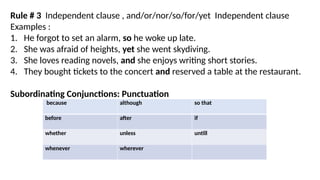
Rule # 3 Independent clause , and/or/nor/so/for/yet Independent clause
Examples :
1. He forgot to set an alarm, so he woke up late.
2. She was afraid of heights, yet she went skydiving.
3. She loves reading novels, and she enjoys writing short stories.
4. They bought tickets to the concert and reserved a table at the restaurant.
Subordinating Conjunctions: Punctuation
because although so that
before after if
whether unless untill
whenever wherever
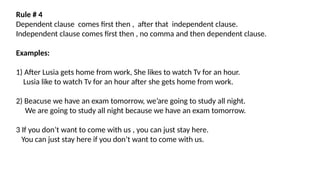
Rule # 4
Dependent clause comes first then , after that independent clause.
Independent clause comes first then , no comma and then dependent clause.
Examples:
1) After Lusia gets home from work, She likes to watch Tv for an hour.
Lusia like to watch Tv for an hour after she gets home from work.
2) Beacuse we have an exam tomorrow, we’are going to study all night.
We are going to study all night because we have an exam tomorrow.
3 If you don’t want to come with us , you can just stay here.
You can just stay here if you don’t want to come with us.
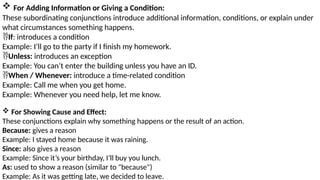
 For Adding Information or Giving a Condition:
These subordinating conjunctions introduce additional information, conditions, or explain under
what circumstances something happens.
If: introduces a condition
Example: I’ll go to the party if I finish my homework.
Unless: introduces an exception
Example: You can’t enter the building unless you have an ID.
When / Whenever: introduce a time-related condition
Example: Call me when you get home.
Example: Whenever you need help, let me know.
 For Showing Cause and Effect:
These conjunctions explain why something happens or the result of an action.
Because: gives a reason
Example: I stayed home because it was raining.
Since: also gives a reason
Example: Since it’s your birthday, I’ll buy you lunch.
As: used to show a reason (similar to "because")
Example: As it was getting late, we decided to leave.
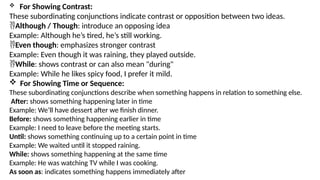
 For Showing Contrast:
These subordinating conjunctions indicate contrast or opposition between two ideas.
Although / Though: introduce an opposing idea
Example: Although he’s tired, he’s still working.
Even though: emphasizes stronger contrast
Example: Even though it was raining, they played outside.
While: shows contrast or can also mean "during"
Example: While he likes spicy food, I prefer it mild.
 For Showing Time or Sequence:
These subordinating conjunctions describe when something happens in relation to something else.
After: shows something happening later in time
Example: We’ll have dessert after we finish dinner.
Before: shows something happening earlier in time
Example: I need to leave before the meeting starts.
Until: shows something continuing up to a certain point in time
Example: We waited until it stopped raining.
While: shows something happening at the same time
Example: He was watching TV while I was cooking.
As soon as: indicates something happens immediately after
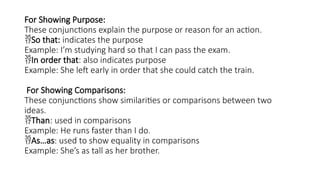
For Showing Purpose:
These conjunctions explain the purpose or reason for an action.
So that: indicates the purpose
Example: I’m studying hard so that I can pass the exam.
In order that: also indicates purpose
Example: She left early in order that she could catch the train.
For Showing Comparisons:
These conjunctions show similarities or comparisons between two
ideas.
Than: used in comparisons
Example: He runs faster than I do.
As…as: used to show equality in comparisons
Example: She’s as tall as her brother.
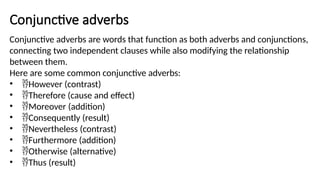
Conjunctive adverbs
Conjunctive adverbs are words that function as both adverbs and conjunctions,
connecting two independent clauses while also modifying the relationship
between them.
Here are some common conjunctive adverbs:
• However (contrast)
• Therefore (cause and effect)
• Moreover (addition)
• Consequently (result)
• Nevertheless (contrast)
• Furthermore (addition)
• Otherwise (alternative)
• Thus (result)
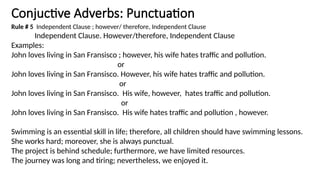
Conjuctive Adverbs: Punctuation
Rule # 5 Independent Clause ; however/ therefore, Independent Clause
Independent Clause. However/therefore, Independent Clause
Examples:
John loves living in San Fransisco ; however, his wife hates traffic and pollution.
or
John loves living in San Fransisco. However, his wife hates traffic and pollution.
or
John loves living in San Fransisco. His wife, however, hates traffic and pollution.
or
John loves living in San Fransisco. His wife hates traffic and pollution , however.
Swimming is an essential skill in life; therefore, all children should have swimming lessons.
She works hard; moreover, she is always punctual.
The project is behind schedule; furthermore, we have limited resources.
The journey was long and tiring; nevertheless, we enjoyed it.
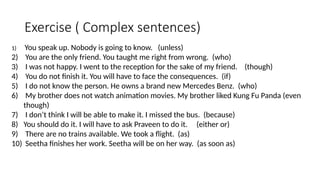
Exercise ( Complex sentences)
1) You speak up. Nobody is going to know. (unless)
2) You are the only friend. You taught me right from wrong. (who)
3) I was not happy. I went to the reception for the sake of my friend. (though)
4) You do not finish it. You will have to face the consequences. (if)
5) I do not know the person. He owns a brand new Mercedes Benz. (who)
6) My brother does not watch animation movies. My brother liked Kung Fu Panda (even
though)
7) I don’t think I will be able to make it. I missed the bus. (because)
8) You should do it. I will have to ask Praveen to do it. (either or)
9) There are no trains available. We took a flight. (as)
10) Seetha finishes her work. Seetha will be on her way. (as soon as)
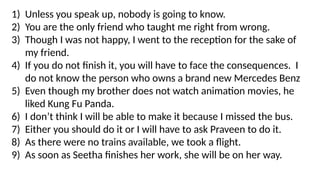
1) Unless you speak up, nobody is going to know.
2) You are the only friend who taught me right from wrong.
3) Though I was not happy, I went to the reception for the sake of
my friend.
4) If you do not finish it, you will have to face the consequences. I
do not know the person who owns a brand new Mercedes Benz
5) Even though my brother does not watch animation movies, he
liked Kung Fu Panda.
6) I don’t think I will be able to make it because I missed the bus.
7) Either you should do it or I will have to ask Praveen to do it.
8) As there were no trains available, we took a flight.
9) As soon as Seetha finishes her work, she will be on her way.

Conjunction uses and punctuation. punctuation with conjuctive adjectives, coardinating conjunctions pptx

  • 1.
  • 2.
    Coordinating Conjunctions These conjunctionsconnect words, phrases, or clauses of equal importance or structure. The most common ones are: For (reason or cause) And (addition) Nor (negative choice) But (contrast) Or (alternative) Yet (contrast or surprising result) So (result or effect) An easy way to remember them is the acronym FANBOYS.
  • 3.
    Examples •For (reason orcause): I need to study tonight, for I have an important exam tomorrow. •And (addition): She loves chocolate, and she also enjoys vanilla ice cream. •Nor (negative addition): He didn’t call me, nor did he send a message. •But (contrast): I wanted to join the basketball team, but I wasn’t selected. •Or (choice or alternative): We can watch a movie, or we can go out for dinner. •Yet (contrast with a surprising twist): She was very tired, yet she finished all her work on time. •So (result or consequence): It started raining heavily, so we canceled the picnic.
  • 4.
    Punctuation of CoardinatingConjunctions Rule # 1 : When Conjunctions connects only two words or phrases -------- No commas Examples : His house is beautiful and Spacious. Does She works in a library or a restaurant. Rule # 2: for the list of more than two items ------ use commas except the last e.g item 1, item 2, item 3, and / or item 4. We need to buy sugar butter flour and vanilla extract for the cake. We need to buy sugar, butter, flour, and vanilla extract for the cake. I’m still trying to decide whether to learn guitar piano or violin. I’m still trying to decide whether to learn guitar, piano , or violin.
  • 5.
    Rule # 3Independent clause , and/or/nor/so/for/yet Independent clause Examples : 1. He forgot to set an alarm, so he woke up late. 2. She was afraid of heights, yet she went skydiving. 3. She loves reading novels, and she enjoys writing short stories. 4. They bought tickets to the concert and reserved a table at the restaurant. Subordinating Conjunctions: Punctuation because although so that before after if whether unless untill whenever wherever
  • 6.
    Rule # 4 Dependentclause comes first then , after that independent clause. Independent clause comes first then , no comma and then dependent clause. Examples: 1) After Lusia gets home from work, She likes to watch Tv for an hour. Lusia like to watch Tv for an hour after she gets home from work. 2) Beacuse we have an exam tomorrow, we’are going to study all night. We are going to study all night because we have an exam tomorrow. 3 If you don’t want to come with us , you can just stay here. You can just stay here if you don’t want to come with us.
  • 7.
     For AddingInformation or Giving a Condition: These subordinating conjunctions introduce additional information, conditions, or explain under what circumstances something happens. If: introduces a condition Example: I’ll go to the party if I finish my homework. Unless: introduces an exception Example: You can’t enter the building unless you have an ID. When / Whenever: introduce a time-related condition Example: Call me when you get home. Example: Whenever you need help, let me know.  For Showing Cause and Effect: These conjunctions explain why something happens or the result of an action. Because: gives a reason Example: I stayed home because it was raining. Since: also gives a reason Example: Since it’s your birthday, I’ll buy you lunch. As: used to show a reason (similar to "because") Example: As it was getting late, we decided to leave.
  • 8.
     For ShowingContrast: These subordinating conjunctions indicate contrast or opposition between two ideas. Although / Though: introduce an opposing idea Example: Although he’s tired, he’s still working. Even though: emphasizes stronger contrast Example: Even though it was raining, they played outside. While: shows contrast or can also mean "during" Example: While he likes spicy food, I prefer it mild.  For Showing Time or Sequence: These subordinating conjunctions describe when something happens in relation to something else. After: shows something happening later in time Example: We’ll have dessert after we finish dinner. Before: shows something happening earlier in time Example: I need to leave before the meeting starts. Until: shows something continuing up to a certain point in time Example: We waited until it stopped raining. While: shows something happening at the same time Example: He was watching TV while I was cooking. As soon as: indicates something happens immediately after
  • 9.
    For Showing Purpose: Theseconjunctions explain the purpose or reason for an action. So that: indicates the purpose Example: I’m studying hard so that I can pass the exam. In order that: also indicates purpose Example: She left early in order that she could catch the train. For Showing Comparisons: These conjunctions show similarities or comparisons between two ideas. Than: used in comparisons Example: He runs faster than I do. As…as: used to show equality in comparisons Example: She’s as tall as her brother.
  • 10.
    Conjunctive adverbs Conjunctive adverbsare words that function as both adverbs and conjunctions, connecting two independent clauses while also modifying the relationship between them. Here are some common conjunctive adverbs: • However (contrast) • Therefore (cause and effect) • Moreover (addition) • Consequently (result) • Nevertheless (contrast) • Furthermore (addition) • Otherwise (alternative) • Thus (result)
  • 11.
    Conjuctive Adverbs: Punctuation Rule# 5 Independent Clause ; however/ therefore, Independent Clause Independent Clause. However/therefore, Independent Clause Examples: John loves living in San Fransisco ; however, his wife hates traffic and pollution. or John loves living in San Fransisco. However, his wife hates traffic and pollution. or John loves living in San Fransisco. His wife, however, hates traffic and pollution. or John loves living in San Fransisco. His wife hates traffic and pollution , however. Swimming is an essential skill in life; therefore, all children should have swimming lessons. She works hard; moreover, she is always punctual. The project is behind schedule; furthermore, we have limited resources. The journey was long and tiring; nevertheless, we enjoyed it.
  • 12.
    Exercise ( Complexsentences) 1) You speak up. Nobody is going to know. (unless) 2) You are the only friend. You taught me right from wrong. (who) 3) I was not happy. I went to the reception for the sake of my friend. (though) 4) You do not finish it. You will have to face the consequences. (if) 5) I do not know the person. He owns a brand new Mercedes Benz. (who) 6) My brother does not watch animation movies. My brother liked Kung Fu Panda (even though) 7) I don’t think I will be able to make it. I missed the bus. (because) 8) You should do it. I will have to ask Praveen to do it. (either or) 9) There are no trains available. We took a flight. (as) 10) Seetha finishes her work. Seetha will be on her way. (as soon as)
  • 13.
    1) Unless youspeak up, nobody is going to know. 2) You are the only friend who taught me right from wrong. 3) Though I was not happy, I went to the reception for the sake of my friend. 4) If you do not finish it, you will have to face the consequences. I do not know the person who owns a brand new Mercedes Benz 5) Even though my brother does not watch animation movies, he liked Kung Fu Panda. 6) I don’t think I will be able to make it because I missed the bus. 7) Either you should do it or I will have to ask Praveen to do it. 8) As there were no trains available, we took a flight. 9) As soon as Seetha finishes her work, she will be on her way.