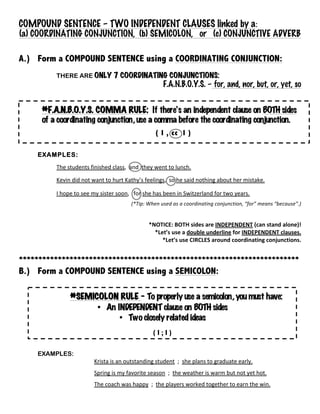
COMPOUND SENTENCE – TWO INDEPENDENT CLAUSES linked by a:
(a) COORDINATING CONJUNCTION, (b) SEMICOLON, or (c) CONJUNCTIVE ADVERB
A.) Form a COMPOUND SENTENCE using a COORDINATING CONJUNCTION:
THERE ARE ONLY 7 COORDINATING CONJUNCTIONS:
F.A.N.B.O.Y.S. – for, and, nor, but, or, yet, so
EXAMPLES:
The	students	finished	class,		and		they	went	to	lunch.	
	
Kevin	did	not	want	to	hurt	Kathy’s	feelings,		so	he	said	nothing	about	her	mistake.	
	
I	hope	to	see	my	sister	soon,			for	she	has	been	in	Switzerland	for	two	years.	
	
(*Tip:	When	used	as	a	coordinating	conjunction,	“for”	means	“because”.)	
	
	
*NOTICE:	BOTH	sides	are	INDEPENDENT	(can	stand	alone)!		
*Let’s	use	a	double	underline	for	INDEPENDENT	clauses.	
*Let’s	use	CIRCLES	around	coordinating	conjunctions.	
	
************************************************************************
B.) Form a COMPOUND SENTENCE using a SEMICOLON:
EXAMPLES:
Krista	is	an	outstanding	student		;		she	plans	to	graduate	early.	
Spring	is	my	favorite	season		;		the	weather	is	warm	but	not	yet	hot.	
The	coach	was	happy		;		the	players	worked	together	to	earn	the	win.	
*F.A.N.B.O.Y.S. COMMA RULE: If there’s an independent clause on BOTH sides
of a coordinating conjunction,use a comma before the coordinating conjunction.
( I , cc I ) 	
*SEMICOLON RULE – To properly use a semicolon,you must have:
• An INDEPENDENT clause on BOTH sides
• Two closely related ideas
( I ; I )
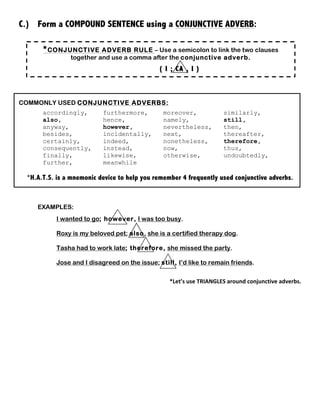
C.) Form a COMPOUND SENTENCE using a CONJUNCTIVE ADVERB:
COMMONLY USED CONJUNCTIVE ADVERBS:
accordingly, furthermore, moreover, similarly,
also, hence, namely, still,
anyway, however, nevertheless, then,
besides, incidentally, next, thereafter,
certainly, indeed, nonetheless, therefore,
consequently, instead, now, thus,
finally, likewise, otherwise, undoubtedly,
further, meanwhile
*H.A.T.S. is a mnemonic device to help you remember 4 frequently used conjunctive adverbs.
EXAMPLES:
I wanted to go; however, I was too busy.
Roxy is my beloved pet; also, she is a certified therapy dog.
Tasha had to work late; therefore, she missed the party.
Jose and I disagreed on the issue; still, I’d like to remain friends.
	
*Let’s	use	TRIANGLES	around	conjunctive	adverbs.	
*CONJUNCTIVE ADVERB RULE – Use a semicolon to link the two clauses
together and use a comma after the conjunctive adverb.
( I ; CA , I )

Compound Sentence Printed Notes

  • 1.
    COMPOUND SENTENCE –TWO INDEPENDENT CLAUSES linked by a: (a) COORDINATING CONJUNCTION, (b) SEMICOLON, or (c) CONJUNCTIVE ADVERB A.) Form a COMPOUND SENTENCE using a COORDINATING CONJUNCTION: THERE ARE ONLY 7 COORDINATING CONJUNCTIONS: F.A.N.B.O.Y.S. – for, and, nor, but, or, yet, so EXAMPLES: The students finished class, and they went to lunch. Kevin did not want to hurt Kathy’s feelings, so he said nothing about her mistake. I hope to see my sister soon, for she has been in Switzerland for two years. (*Tip: When used as a coordinating conjunction, “for” means “because”.) *NOTICE: BOTH sides are INDEPENDENT (can stand alone)! *Let’s use a double underline for INDEPENDENT clauses. *Let’s use CIRCLES around coordinating conjunctions. ************************************************************************ B.) Form a COMPOUND SENTENCE using a SEMICOLON: EXAMPLES: Krista is an outstanding student ; she plans to graduate early. Spring is my favorite season ; the weather is warm but not yet hot. The coach was happy ; the players worked together to earn the win. *F.A.N.B.O.Y.S. COMMA RULE: If there’s an independent clause on BOTH sides of a coordinating conjunction,use a comma before the coordinating conjunction. ( I , cc I ) *SEMICOLON RULE – To properly use a semicolon,you must have: • An INDEPENDENT clause on BOTH sides • Two closely related ideas ( I ; I )
  • 2.
    C.) Form aCOMPOUND SENTENCE using a CONJUNCTIVE ADVERB: COMMONLY USED CONJUNCTIVE ADVERBS: accordingly, furthermore, moreover, similarly, also, hence, namely, still, anyway, however, nevertheless, then, besides, incidentally, next, thereafter, certainly, indeed, nonetheless, therefore, consequently, instead, now, thus, finally, likewise, otherwise, undoubtedly, further, meanwhile *H.A.T.S. is a mnemonic device to help you remember 4 frequently used conjunctive adverbs. EXAMPLES: I wanted to go; however, I was too busy. Roxy is my beloved pet; also, she is a certified therapy dog. Tasha had to work late; therefore, she missed the party. Jose and I disagreed on the issue; still, I’d like to remain friends. *Let’s use TRIANGLES around conjunctive adverbs. *CONJUNCTIVE ADVERB RULE – Use a semicolon to link the two clauses together and use a comma after the conjunctive adverb. ( I ; CA , I )