CH 3: Perception of Self and Others in Interpersonal Communication (slide 1)
Chapter 3: Perceptions of Self
and Others in Interpersonal
Communication
This multimedia product and its contents are protected under copyright law. The following are prohibited by law:
any public performance or display, including transmission of any image over a network;
preparation of any derivative work, including the extraction, in whole or in part, of any images;
any rental, lease, or lending of the program.
Copyright
©
2013,
2009,
2006
Pearson
Education,
Inc.
All
Rights
Reserved
CH 3: Perception of Self and Others in Interpersonal Communication (slide 2)
The Self in Interpersonal
Communication
Copyright
©
2013,
2009,
2006
Pearson
Education,
Inc.
All
Rights
Reserved
Self concept – how you see yourself comes
from four sources
1. Others’ images of you (looking glass self)
2. Social comparisons
Upward
Downward
3. Cultural teachings
4. Self evaluation
CH 3: Perception of Self and Others in Interpersonal Communication (slide 3)
The Self in Interpersonal
Communication (cont.)
Copyright
©
2013,
2009,
2006
Pearson
Education,
Inc.
All
Rights
Reserved
Self awareness – how well you know yourself
The Johari Model emphasizes four aspects of self
awareness
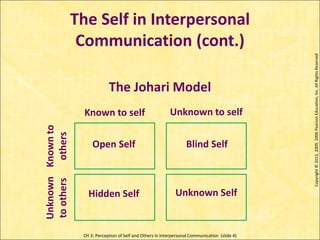
1. Open – known to self and others
2. Blind – known to others but not self
3. Hidden – known to self but not others
4. Unknown – no one knows
CH 3: Perception of Self and Others in Interpersonal Communication (slide 4)
The Self in Interpersonal
Communication (cont.)
Copyright
©
2013,
2009,
2006
Pearson
Education,
Inc.
All
Rights
Reserved
The Johari Model
Known to self Unknown to self
Unknown
to
others
Known
to
others
Open Self Blind Self
Hidden Self Unknown Self
CH 3: Perception of Self and Others in Interpersonal Communication (slide 5)
The Self in Interpersonal
Communication (cont.)
Copyright
©
2013,
2009,
2006
Pearson
Education,
Inc.
All
Rights
Reserved
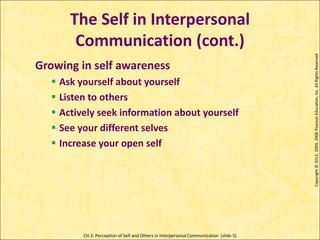
Growing in self awareness
 Ask yourself about yourself
 Listen to others
 Actively seek information about yourself
 See your different selves
 Increase your open self
CH 3: Perception of Self and Others in Interpersonal Communication (slide 6)
The Self in Interpersonal
Communication (cont.)
Copyright
©
2013,
2009,
2006
Pearson
Education,
Inc.
All
Rights
Reserved
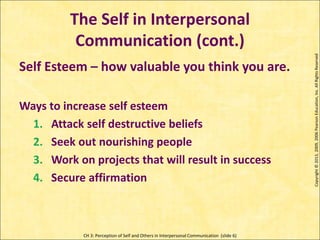
Self Esteem – how valuable you think you are.
Ways to increase self esteem
1. Attack self destructive beliefs
2. Seek out nourishing people
3. Work on projects that will result in success
4. Secure affirmation
CH 3: Perception of Self and Others in Interpersonal Communication (slide 7)
Perception in Interpersonal
Communication
Copyright
©
2013,
2009,
2006
Pearson
Education,
Inc.
All
Rights
Reserved
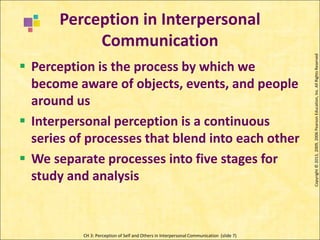
 Perception is the process by which we
become aware of objects, events, and people
around us
 Interpersonal perception is a continuous
series of processes that blend into each other
 We separate processes into five stages for
study and analysis
CH 3: Perception of Self and Others in Interpersonal Communication (slide 8)
Perception in Interpersonal
Communication (cont.)
Copyright
©
2013,
2009,
2006
Pearson
Education,
Inc.
All
Rights
Reserved
Five stages of perception
Stage One: Stimulation
 Selective perception
 Selective attention
 Selective exposure
CH 3: Perception of Self and Others in Interpersonal Communication (slide 9)
Perception in Interpersonal
Communication (cont.)
Copyright
©
2013,
2009,
2006
Pearson
Education,
Inc.
All
Rights
Reserved
Stage Two: Organization
1. Rules
 Proximity
 Similarity
 Contrast
2. Schemata (schema)
3. Scripts
CH 3: Perception of Self and Others in Interpersonal Communication (slide 10)
Perception in Interpersonal
Communication (cont.)
Copyright
©
2013,
2009,
2006
Pearson
Education,
Inc.
All
Rights
Reserved
Stage Three: Interpretation and Evaluation
 Combined because they are simultaneous
Stage Four: Memory
Stage Five: Recall
CH 3: Perception of Self and Others in Interpersonal Communication (slide 11)
Impression Formation
Copyright
©
2013,
2009,
2006
Pearson
Education,
Inc.
All
Rights
Reserved
Impression formation processes
1.Self-fulfilling prophecy
2.Implicit personality theory
 “Halo effect”
 “Reverse halo effect” or “horns effect”
3.Perceptual accentuation
CH 3: Perception of Self and Others in Interpersonal Communication (slide 12)
Impression Formation (cont.)
Copyright
©
2013,
2009,
2006
Pearson
Education,
Inc.
All
Rights
Reserved
4. Primacy-recency effect
5. Consistency
6. Attribution of control
 Self-serving bias
 Overattribution
 Fundamental attribution error
CH 3: Perception of Self and Others in Interpersonal Communication (slide 13)
Impression Formation (cont.)
Copyright
©
2013,
2009,
2006
Pearson
Education,
Inc.
All
Rights
Reserved
Ways to increase accuracy in impression
formation
 Analyze impressions
 Check perceptions
 Reduce uncertainty
 Increase cultural Sensitivity
CH 3: Perception of Self and Others in Interpersonal Communication (slide 14)
Impression Management:
Goals and Strategies
Copyright
©
2013,
2009,
2006
Pearson
Education,
Inc.
All
Rights
Reserved
 Impression management – how to
communicate to others the image of yourself
you want them to see
 Self-presentation
 Identity-management
CH 3: Perception of Self and Others in Interpersonal Communication (slide 15)
Impression Management (cont.)
Copyright
©
2013,
2009,
2006
Pearson
Education,
Inc.
All
Rights
Reserved
Impression management strategies
1. To be liked
 Immediacy – connects you to the other person
 Affinity seeking – techniques to get others to
like you
 Politeness – make ourselves appear likeable
CH 3: Perception of Self and Others in Interpersonal Communication (slide 16)
Impression Management (cont.)
Copyright
©
2013,
2009,
2006
Pearson
Education,
Inc.
All
Rights
Reserved
Politeness and Face
Positive face – desire to be seen favorably or
positively by others
 Keep positive face – help someone look favorably
 Attack positive face – make someone look bad
CH 3: Perception of Self and Others in Interpersonal Communication (slide 17)
Impression Management (cont.)
Copyright
©
2013,
2009,
2006
Pearson
Education,
Inc.
All
Rights
Reserved
Politeness and Face
Negative face – desire to be autonomous or free to
act as we wish
 Keep negative face – ask someone nicely to do
something
 Attack negative face – order or command someone to
do something
CH 3: Perception of Self and Others in Interpersonal Communication (slide 18)
Impression Management (cont.)
Copyright
©
2013,
2009,
2006
Pearson
Education,
Inc.
All
Rights
Reserved
2. To be believed
 Credibility strategies
3. To excuse failure
 Self-handicapping strategies
4. To secure help
 Self-deprecating strategies
CH 3: Perception of Self and Others in Interpersonal Communication (slide 19)
Impression Management (cont.)
Copyright
©
2013,
2009,
2006
Pearson
Education,
Inc.
All
Rights
Reserved
5. To hide faults
 Self-monitoring strategies
6. To be followed
 Influencing strategies
7. To confirm self image
 Image-confirming strategies

Interpersonal Perception.ppt

  • 1.
    CH 3: Perceptionof Self and Others in Interpersonal Communication (slide 1) Chapter 3: Perceptions of Self and Others in Interpersonal Communication This multimedia product and its contents are protected under copyright law. The following are prohibited by law: any public performance or display, including transmission of any image over a network; preparation of any derivative work, including the extraction, in whole or in part, of any images; any rental, lease, or lending of the program. Copyright © 2013, 2009, 2006 Pearson Education, Inc. All Rights Reserved
  • 2.
    CH 3: Perceptionof Self and Others in Interpersonal Communication (slide 2) The Self in Interpersonal Communication Copyright © 2013, 2009, 2006 Pearson Education, Inc. All Rights Reserved Self concept – how you see yourself comes from four sources 1. Others’ images of you (looking glass self) 2. Social comparisons Upward Downward 3. Cultural teachings 4. Self evaluation
  • 3.
    CH 3: Perceptionof Self and Others in Interpersonal Communication (slide 3) The Self in Interpersonal Communication (cont.) Copyright © 2013, 2009, 2006 Pearson Education, Inc. All Rights Reserved Self awareness – how well you know yourself The Johari Model emphasizes four aspects of self awareness 1. Open – known to self and others 2. Blind – known to others but not self 3. Hidden – known to self but not others 4. Unknown – no one knows
  • 4.
    CH 3: Perceptionof Self and Others in Interpersonal Communication (slide 4) The Self in Interpersonal Communication (cont.) Copyright © 2013, 2009, 2006 Pearson Education, Inc. All Rights Reserved The Johari Model Known to self Unknown to self Unknown to others Known to others Open Self Blind Self Hidden Self Unknown Self
  • 5.
    CH 3: Perceptionof Self and Others in Interpersonal Communication (slide 5) The Self in Interpersonal Communication (cont.) Copyright © 2013, 2009, 2006 Pearson Education, Inc. All Rights Reserved Growing in self awareness  Ask yourself about yourself  Listen to others  Actively seek information about yourself  See your different selves  Increase your open self
  • 6.
    CH 3: Perceptionof Self and Others in Interpersonal Communication (slide 6) The Self in Interpersonal Communication (cont.) Copyright © 2013, 2009, 2006 Pearson Education, Inc. All Rights Reserved Self Esteem – how valuable you think you are. Ways to increase self esteem 1. Attack self destructive beliefs 2. Seek out nourishing people 3. Work on projects that will result in success 4. Secure affirmation
  • 7.
    CH 3: Perceptionof Self and Others in Interpersonal Communication (slide 7) Perception in Interpersonal Communication Copyright © 2013, 2009, 2006 Pearson Education, Inc. All Rights Reserved  Perception is the process by which we become aware of objects, events, and people around us  Interpersonal perception is a continuous series of processes that blend into each other  We separate processes into five stages for study and analysis
  • 8.
    CH 3: Perceptionof Self and Others in Interpersonal Communication (slide 8) Perception in Interpersonal Communication (cont.) Copyright © 2013, 2009, 2006 Pearson Education, Inc. All Rights Reserved Five stages of perception Stage One: Stimulation  Selective perception  Selective attention  Selective exposure
  • 9.
    CH 3: Perceptionof Self and Others in Interpersonal Communication (slide 9) Perception in Interpersonal Communication (cont.) Copyright © 2013, 2009, 2006 Pearson Education, Inc. All Rights Reserved Stage Two: Organization 1. Rules  Proximity  Similarity  Contrast 2. Schemata (schema) 3. Scripts
  • 10.
    CH 3: Perceptionof Self and Others in Interpersonal Communication (slide 10) Perception in Interpersonal Communication (cont.) Copyright © 2013, 2009, 2006 Pearson Education, Inc. All Rights Reserved Stage Three: Interpretation and Evaluation  Combined because they are simultaneous Stage Four: Memory Stage Five: Recall
  • 11.
    CH 3: Perceptionof Self and Others in Interpersonal Communication (slide 11) Impression Formation Copyright © 2013, 2009, 2006 Pearson Education, Inc. All Rights Reserved Impression formation processes 1.Self-fulfilling prophecy 2.Implicit personality theory  “Halo effect”  “Reverse halo effect” or “horns effect” 3.Perceptual accentuation
  • 12.
    CH 3: Perceptionof Self and Others in Interpersonal Communication (slide 12) Impression Formation (cont.) Copyright © 2013, 2009, 2006 Pearson Education, Inc. All Rights Reserved 4. Primacy-recency effect 5. Consistency 6. Attribution of control  Self-serving bias  Overattribution  Fundamental attribution error
  • 13.
    CH 3: Perceptionof Self and Others in Interpersonal Communication (slide 13) Impression Formation (cont.) Copyright © 2013, 2009, 2006 Pearson Education, Inc. All Rights Reserved Ways to increase accuracy in impression formation  Analyze impressions  Check perceptions  Reduce uncertainty  Increase cultural Sensitivity
  • 14.
    CH 3: Perceptionof Self and Others in Interpersonal Communication (slide 14) Impression Management: Goals and Strategies Copyright © 2013, 2009, 2006 Pearson Education, Inc. All Rights Reserved  Impression management – how to communicate to others the image of yourself you want them to see  Self-presentation  Identity-management
  • 15.
    CH 3: Perceptionof Self and Others in Interpersonal Communication (slide 15) Impression Management (cont.) Copyright © 2013, 2009, 2006 Pearson Education, Inc. All Rights Reserved Impression management strategies 1. To be liked  Immediacy – connects you to the other person  Affinity seeking – techniques to get others to like you  Politeness – make ourselves appear likeable
  • 16.
    CH 3: Perceptionof Self and Others in Interpersonal Communication (slide 16) Impression Management (cont.) Copyright © 2013, 2009, 2006 Pearson Education, Inc. All Rights Reserved Politeness and Face Positive face – desire to be seen favorably or positively by others  Keep positive face – help someone look favorably  Attack positive face – make someone look bad
  • 17.
    CH 3: Perceptionof Self and Others in Interpersonal Communication (slide 17) Impression Management (cont.) Copyright © 2013, 2009, 2006 Pearson Education, Inc. All Rights Reserved Politeness and Face Negative face – desire to be autonomous or free to act as we wish  Keep negative face – ask someone nicely to do something  Attack negative face – order or command someone to do something
  • 18.
    CH 3: Perceptionof Self and Others in Interpersonal Communication (slide 18) Impression Management (cont.) Copyright © 2013, 2009, 2006 Pearson Education, Inc. All Rights Reserved 2. To be believed  Credibility strategies 3. To excuse failure  Self-handicapping strategies 4. To secure help  Self-deprecating strategies
  • 19.
    CH 3: Perceptionof Self and Others in Interpersonal Communication (slide 19) Impression Management (cont.) Copyright © 2013, 2009, 2006 Pearson Education, Inc. All Rights Reserved 5. To hide faults  Self-monitoring strategies 6. To be followed  Influencing strategies 7. To confirm self image  Image-confirming strategies