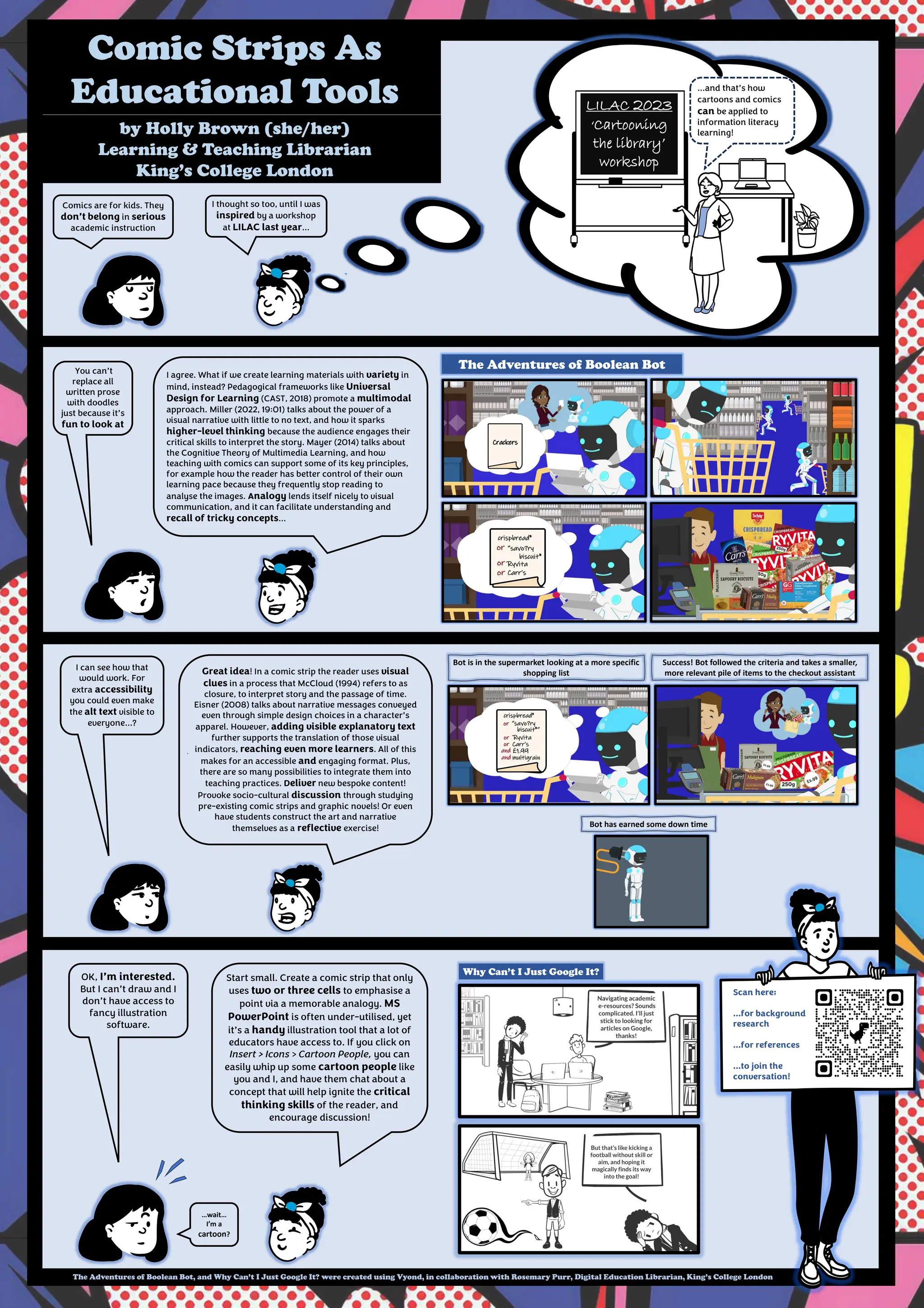
Comics are for kids. They
don’t belong in serious
academic instruction
Comic Strips As
Educational Tools LILAC 2023
‘Cartooning
the library’
workshop
Bot is in the supermarket looking at a more specific
shopping list
Success! Bot followed the criteria and takes a smaller,
more relevant pile of items to the checkout assistant
The Adventures of Boolean Bot, and Why Can’t I Just Google It? were created using Vyond, in collaboration with Rosemary Purr, Digital Education Librarian, King’s College London
by Holly Brown (she/her)
Learning & Teaching Librarian
King’s College London
Scan here;
…for background
research
…for references
…to join the
conversation!
The Adventures of Boolean Bot
Bot has earned some down time
…wait…
I’m a
cartoon?
OK, I’m interested.
But I can’t draw and I
don’t have access to
fancy illustration
software.
Start small. Create a comic strip that only
uses two or three cells to emphasise a
point via a memorable analogy. MS
PowerPoint is often under-utilised, yet
it’s a handy illustration tool that a lot of
educators have access to. If you click on
Insert > Icons > Cartoon People, you can
easily whip up some cartoon people like
you and I, and have them chat about a
concept that will help ignite the critical
thinking skills of the reader, and
encourage discussion!
Great idea! In a comic strip the reader uses visual
clues in a process that McCloud (1994) refers to as
closure, to interpret story and the passage of time.
Eisner (2008) talks about narrative messages conveyed
even through simple design choices in a character’s
apparel. However, adding visible explanatory text
further supports the translation of those visual
indicators, reaching even more learners. All of this
makes for an accessible and engaging format. Plus,
there are so many possibilities to integrate them into
teaching practices. Deliver new bespoke content!
Provoke socio-cultural discussion through studying
pre-existing comic strips and graphic novels! Or even
have students construct the art and narrative
themselves as a reflective exercise!
I thought so too, until I was
inspired by a workshop
at LILAC last year…
I agree. What if we create learning materials with variety in
mind, instead? Pedagogical frameworks like Universal
Design for Learning (CAST, 2018) promote a multimodal
approach. Miller (2022, 19:01) talks about the power of a
visual narrative with little to no text, and how it sparks
higher-level thinking because the audience engages their
critical skills to interpret the story. Mayer (2014) talks about
the Cognitive Theory of Multimedia Learning, and how
teaching with comics can support some of its key principles,
for example how the reader has better control of their own
learning pace because they frequently stop reading to
analyse the images. Analogy lends itself nicely to visual
communication, and it can facilitate understanding and
recall of tricky concepts…
You can’t
replace all
written prose
with doodles
just because it’s
fun to look at
…and that’s how
cartoons and comics
can be applied to
information literacy
learning!
Why Can’t I Just Google It?
I can see how that
would work. For
extra accessibility
you could even make
the alt text visible to
everyone…?

Comic strips as educational tools - Holly Brown

  • 1.
    Comics are forkids. They don’t belong in serious academic instruction Comic Strips As Educational Tools LILAC 2023 ‘Cartooning the library’ workshop Bot is in the supermarket looking at a more specific shopping list Success! Bot followed the criteria and takes a smaller, more relevant pile of items to the checkout assistant The Adventures of Boolean Bot, and Why Can’t I Just Google It? were created using Vyond, in collaboration with Rosemary Purr, Digital Education Librarian, King’s College London by Holly Brown (she/her) Learning & Teaching Librarian King’s College London Scan here; …for background research …for references …to join the conversation! The Adventures of Boolean Bot Bot has earned some down time …wait… I’m a cartoon? OK, I’m interested. But I can’t draw and I don’t have access to fancy illustration software. Start small. Create a comic strip that only uses two or three cells to emphasise a point via a memorable analogy. MS PowerPoint is often under-utilised, yet it’s a handy illustration tool that a lot of educators have access to. If you click on Insert > Icons > Cartoon People, you can easily whip up some cartoon people like you and I, and have them chat about a concept that will help ignite the critical thinking skills of the reader, and encourage discussion! Great idea! In a comic strip the reader uses visual clues in a process that McCloud (1994) refers to as closure, to interpret story and the passage of time. Eisner (2008) talks about narrative messages conveyed even through simple design choices in a character’s apparel. However, adding visible explanatory text further supports the translation of those visual indicators, reaching even more learners. All of this makes for an accessible and engaging format. Plus, there are so many possibilities to integrate them into teaching practices. Deliver new bespoke content! Provoke socio-cultural discussion through studying pre-existing comic strips and graphic novels! Or even have students construct the art and narrative themselves as a reflective exercise! I thought so too, until I was inspired by a workshop at LILAC last year… I agree. What if we create learning materials with variety in mind, instead? Pedagogical frameworks like Universal Design for Learning (CAST, 2018) promote a multimodal approach. Miller (2022, 19:01) talks about the power of a visual narrative with little to no text, and how it sparks higher-level thinking because the audience engages their critical skills to interpret the story. Mayer (2014) talks about the Cognitive Theory of Multimedia Learning, and how teaching with comics can support some of its key principles, for example how the reader has better control of their own learning pace because they frequently stop reading to analyse the images. Analogy lends itself nicely to visual communication, and it can facilitate understanding and recall of tricky concepts… You can’t replace all written prose with doodles just because it’s fun to look at …and that’s how cartoons and comics can be applied to information literacy learning! Why Can’t I Just Google It? I can see how that would work. For extra accessibility you could even make the alt text visible to everyone…?