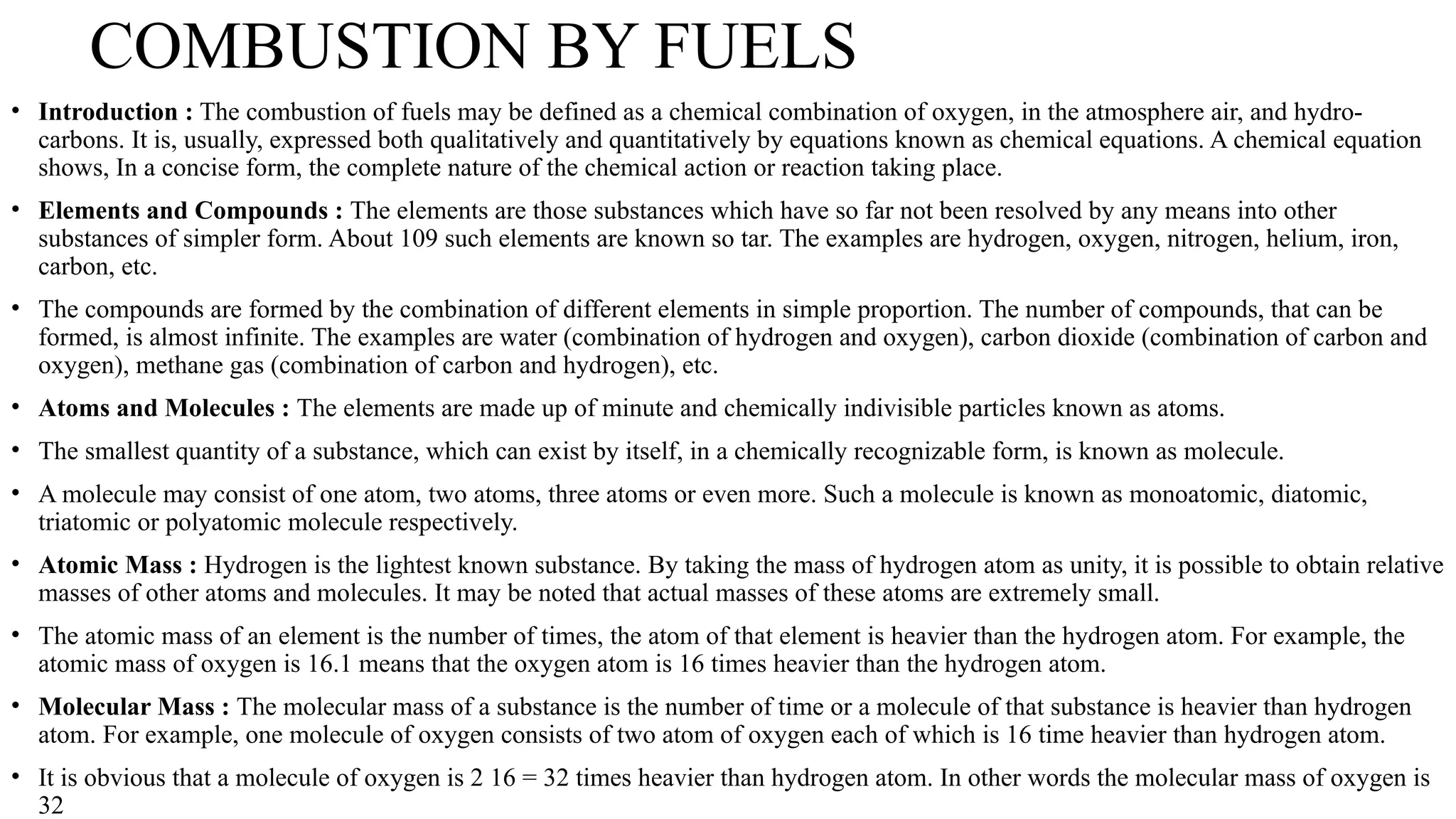
COMBUSTION BY FUELS
•Introduction : The combustion of fuels may be defined as a chemical combination of oxygen, in the atmosphere air, and hydro-
carbons. It is, usually, expressed both qualitatively and quantitatively by equations known as chemical equations. A chemical equation
shows, In a concise form, the complete nature of the chemical action or reaction taking place.
• Elements and Compounds : The elements are those substances which have so far not been resolved by any means into other
substances of simpler form. About 109 such elements are known so tar. The examples are hydrogen, oxygen, nitrogen, helium, iron,
carbon, etc.
• The compounds are formed by the combination of different elements in simple proportion. The number of compounds, that can be
formed, is almost infinite. The examples are water (combination of hydrogen and oxygen), carbon dioxide (combination of carbon and
oxygen), methane gas (combination of carbon and hydrogen), etc.
• Atoms and Molecules : The elements are made up of minute and chemically indivisible particles known as atoms.
• The smallest quantity of a substance, which can exist by itself, in a chemically recognizable form, is known as molecule.
• A molecule may consist of one atom, two atoms, three atoms or even more. Such a molecule is known as monoatomic, diatomic,
triatomic or polyatomic molecule respectively.
• Atomic Mass : Hydrogen is the lightest known substance. By taking the mass of hydrogen atom as unity, it is possible to obtain relative
masses of other atoms and molecules. It may be noted that actual masses of these atoms are extremely small.
• The atomic mass of an element is the number of times, the atom of that element is heavier than the hydrogen atom. For example, the
atomic mass of oxygen is 16.1 means that the oxygen atom is 16 times heavier than the hydrogen atom.
• Molecular Mass : The molecular mass of a substance is the number of time or a molecule of that substance is heavier than hydrogen
atom. For example, one molecule of oxygen consists of two atom of oxygen each of which is 16 time heavier than hydrogen atom.
• It is obvious that a molecule of oxygen is 2 16 = 32 times heavier than hydrogen atom. In other words the molecular mass of oxygen is
32
3.
Symbols for Elementsand Compounds
• The elements and compounds are, generally, represented by symbols.
• The symbol of an atom is, usually, the initial letter of the element in capital. The symbol for carbon atom, for
example, is C for hydrogen atom H, for oxygen atom O, and so on.
• A molecule is represented by a single expression For example, molecule of oxygen is written as O2 where the
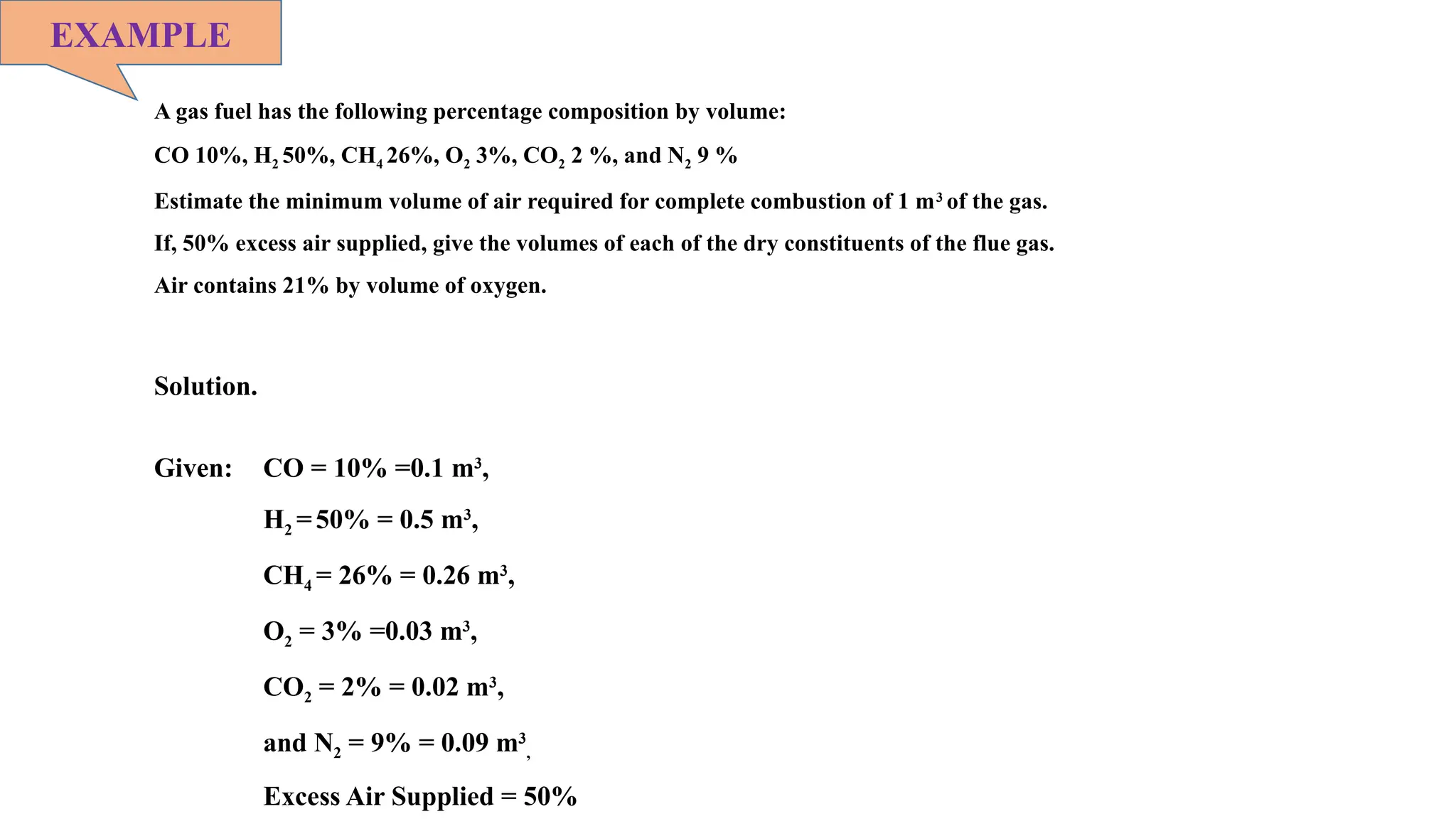
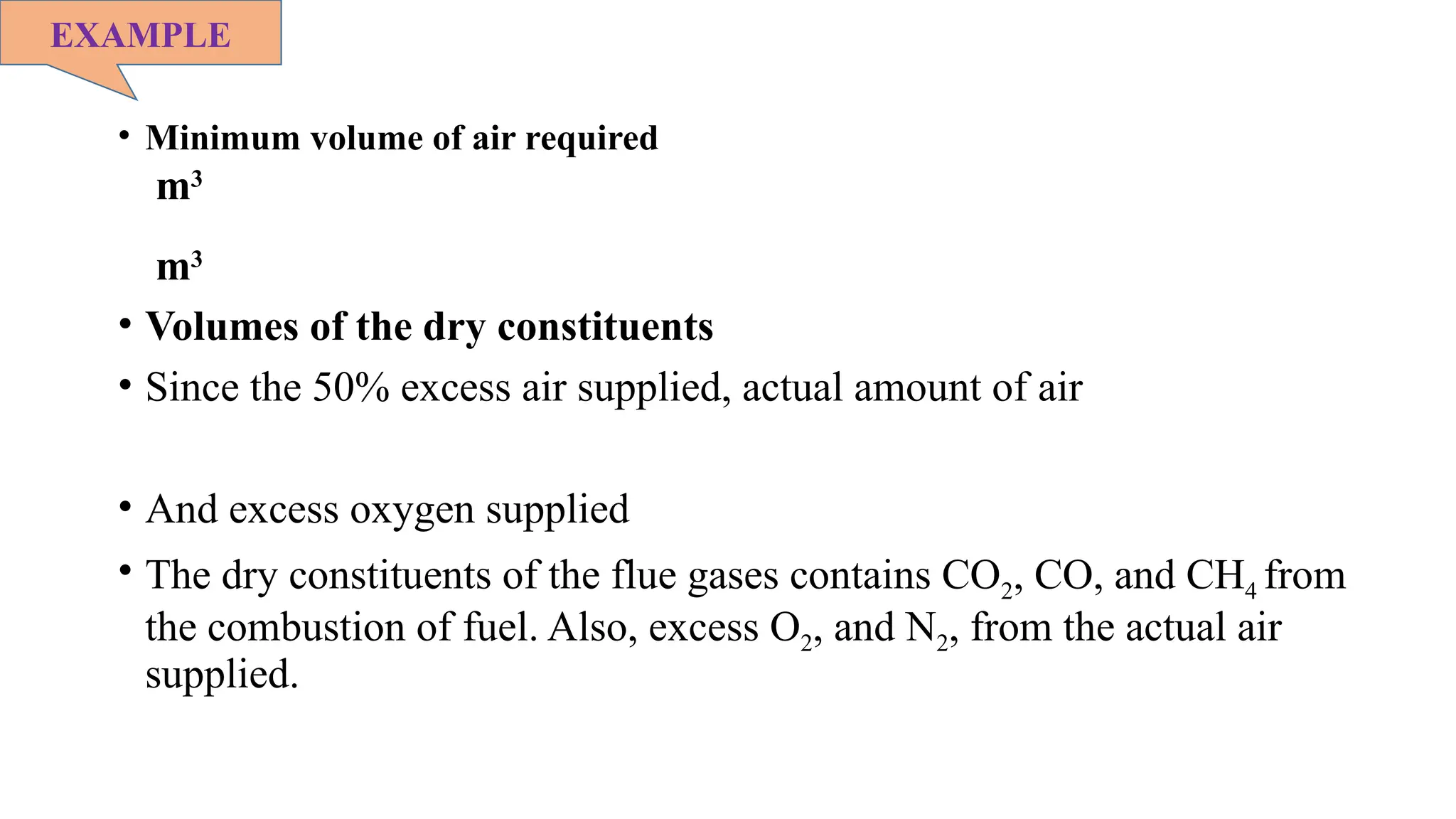
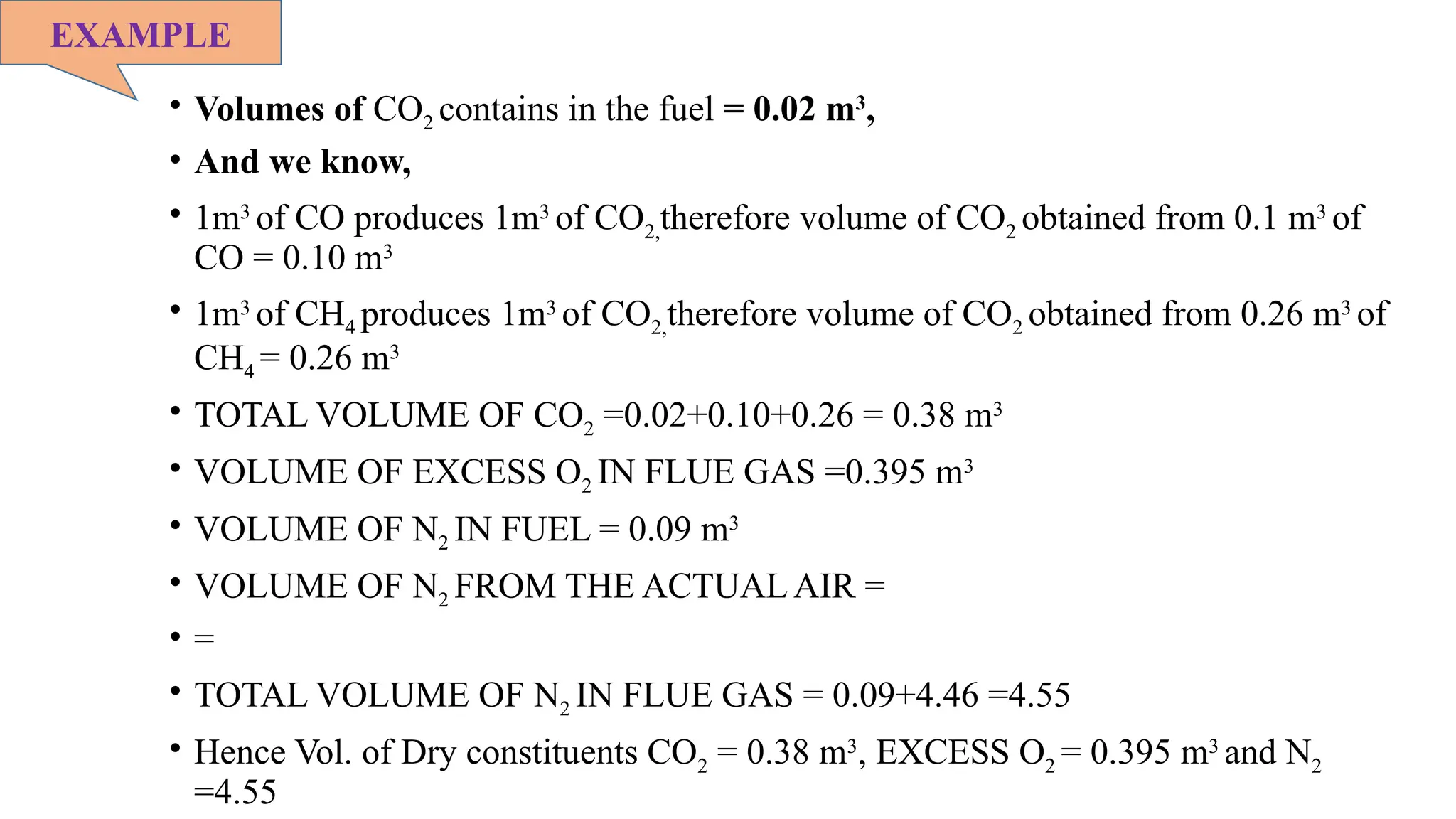
suffix 2 represents the number of atoms in one molecule of oxygen.
• Similarly CO, stands for one molecule of carbon dioxide gas, which consists of one atom of carbon and two
atoms of oxygen.
• The coefficients or prefix of an expression indicates the number of molecules of a substance, e.g. 7 CO2,
means 7 molecules of carbon dioxide, each of which consists of one atom of carbon and two atoms of oxygen.
• If the atomic mass of a substance is known, then its molecular mass may be easily obtained,
• For example molecular mass of CO2 = 12 + ( 2 × 16 ) = 44
4.
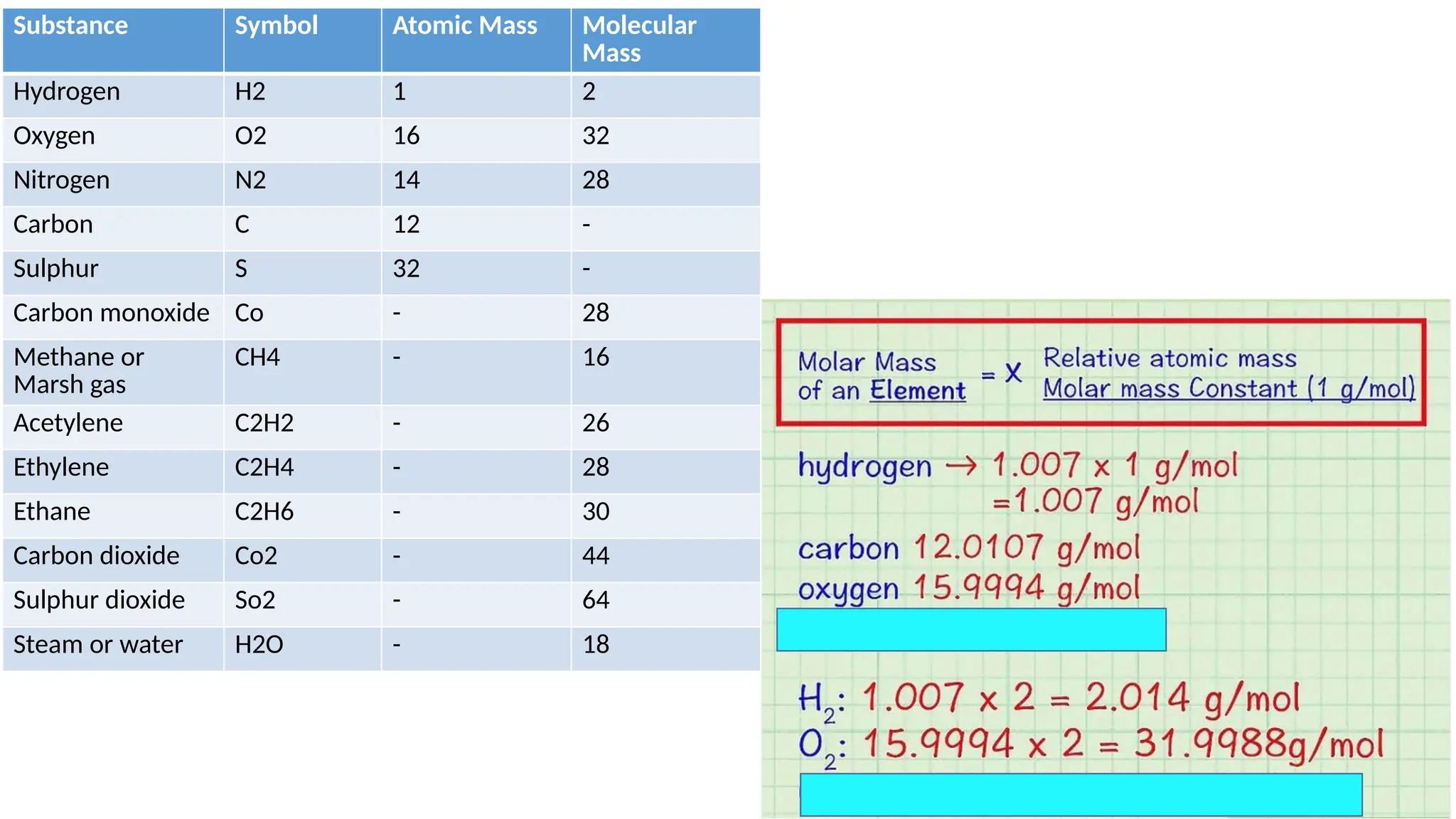
Substance Symbol AtomicMass Molecular
Mass
Hydrogen H2 1 2
Oxygen O2 16 32
Nitrogen N2 14 28
Carbon C 12 -
Sulphur S 32 -
Carbon monoxide Co - 28
Methane or
Marsh gas
CH4 - 16
Acetylene C2H2 - 26
Ethylene C2H4 - 28
Ethane C2H6 - 30
Carbon dioxide Co2 - 44
Sulphur dioxide So2 - 64
Steam or water H2O - 18
5.
Combustion Equations ofSolid Fuels
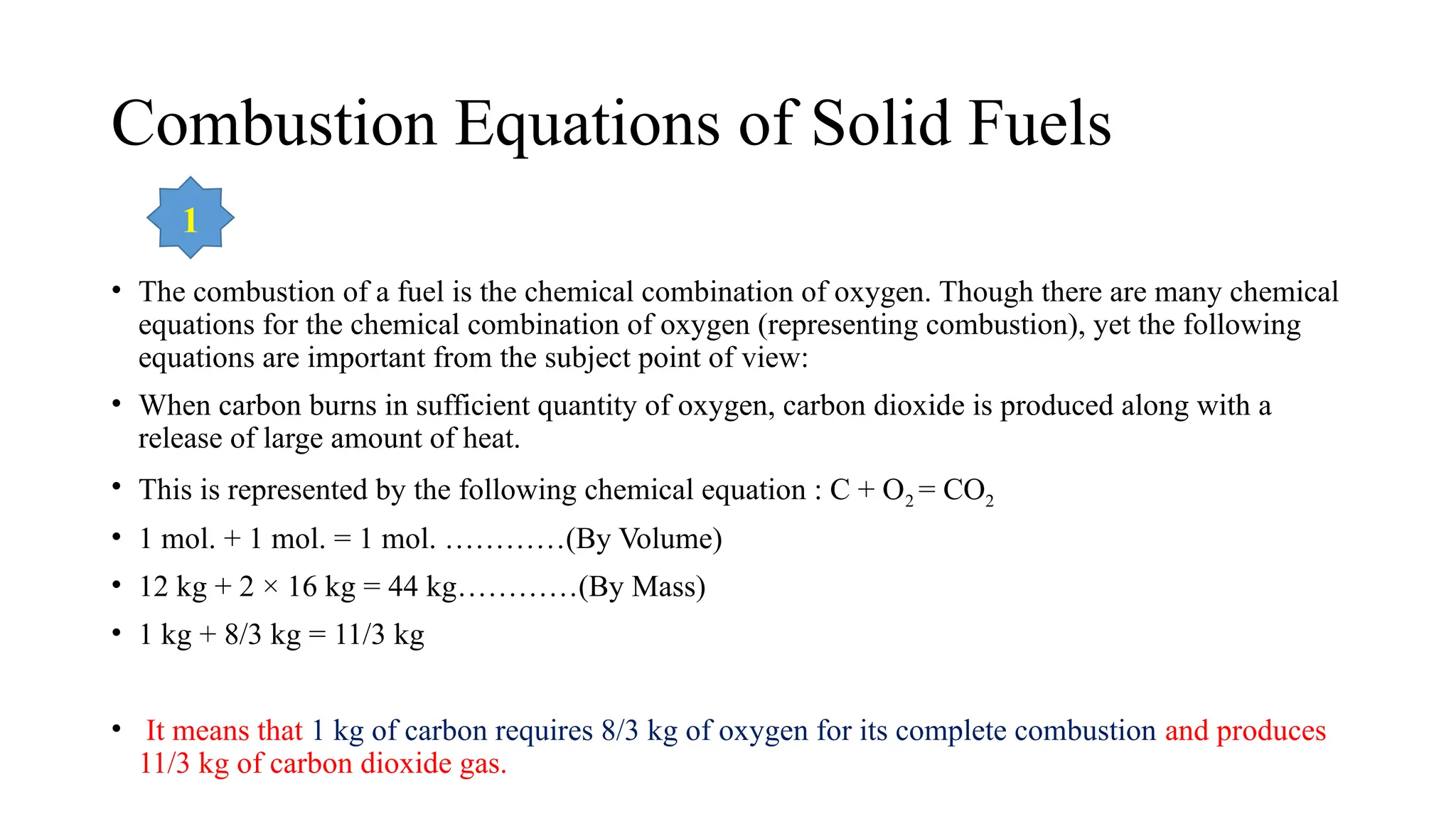
• The combustion of a fuel is the chemical combination of oxygen. Though there are many chemical
equations for the chemical combination of oxygen (representing combustion), yet the following
equations are important from the subject point of view:
• When carbon burns in sufficient quantity of oxygen, carbon dioxide is produced along with a
release of large amount of heat.
• This is represented by the following chemical equation : C + O2 = CO2
• 1 mol. + 1 mol. = 1 mol. …………(By Volume)
• 12 kg + 2 × 16 kg = 44 kg…………(By Mass)
• 1 kg + 8/3 kg = 11/3 kg
• It means that 1 kg of carbon requires 8/3 kg of oxygen for its complete combustion and produces
11/3 kg of carbon dioxide gas.
1
6.
Combustion Equations ofSolid Fuels
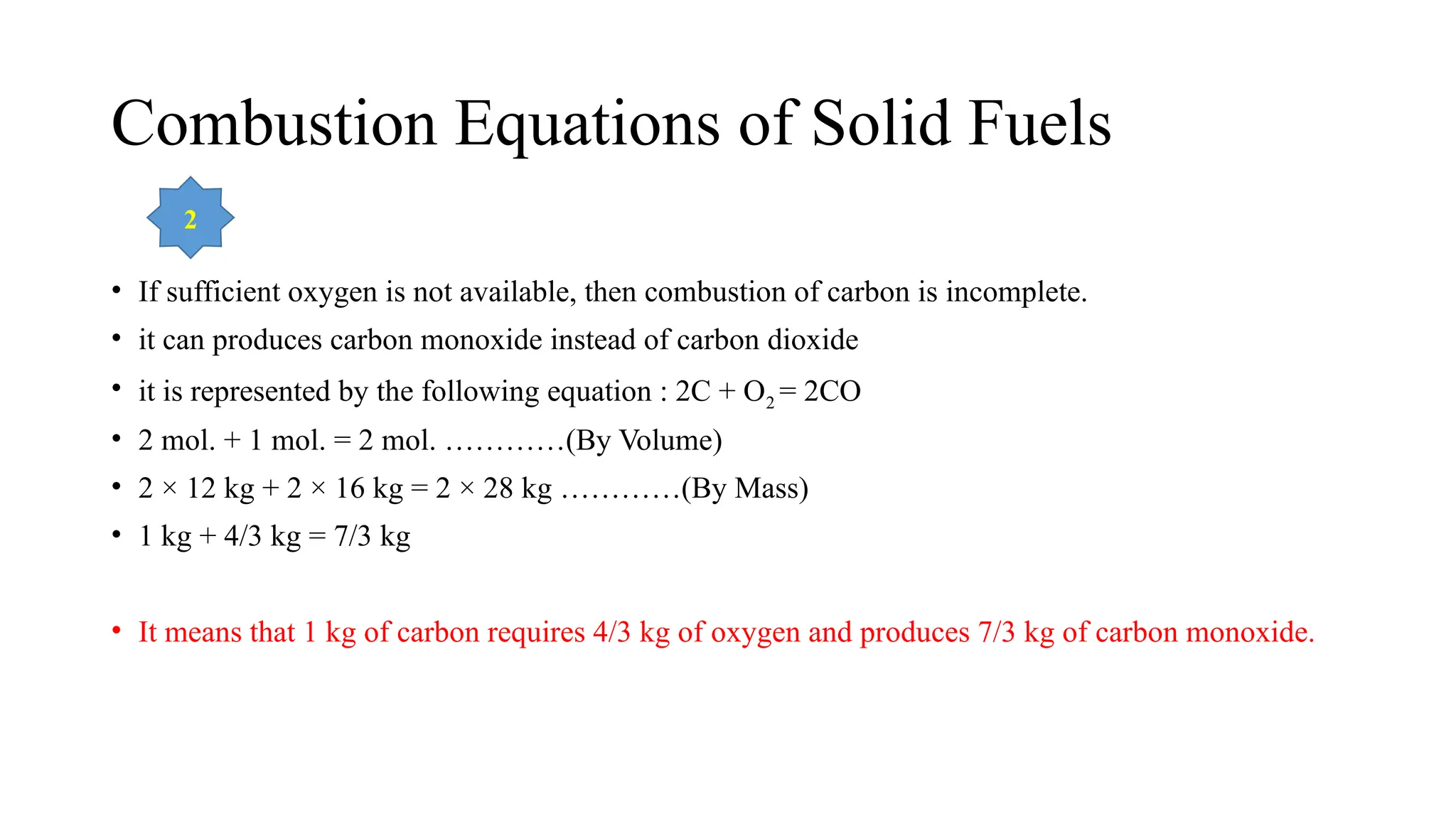
• If sufficient oxygen is not available, then combustion of carbon is incomplete.
• it can produces carbon monoxide instead of carbon dioxide
• it is represented by the following equation : 2C + O2 = 2CO
• 2 mol. + 1 mol. = 2 mol. …………(By Volume)
• 2 × 12 kg + 2 × 16 kg = 2 × 28 kg …………(By Mass)
• 1 kg + 4/3 kg = 7/3 kg
• It means that 1 kg of carbon requires 4/3 kg of oxygen and produces 7/3 kg of carbon monoxide.
2
7.
Combustion Equations ofSolid Fuels
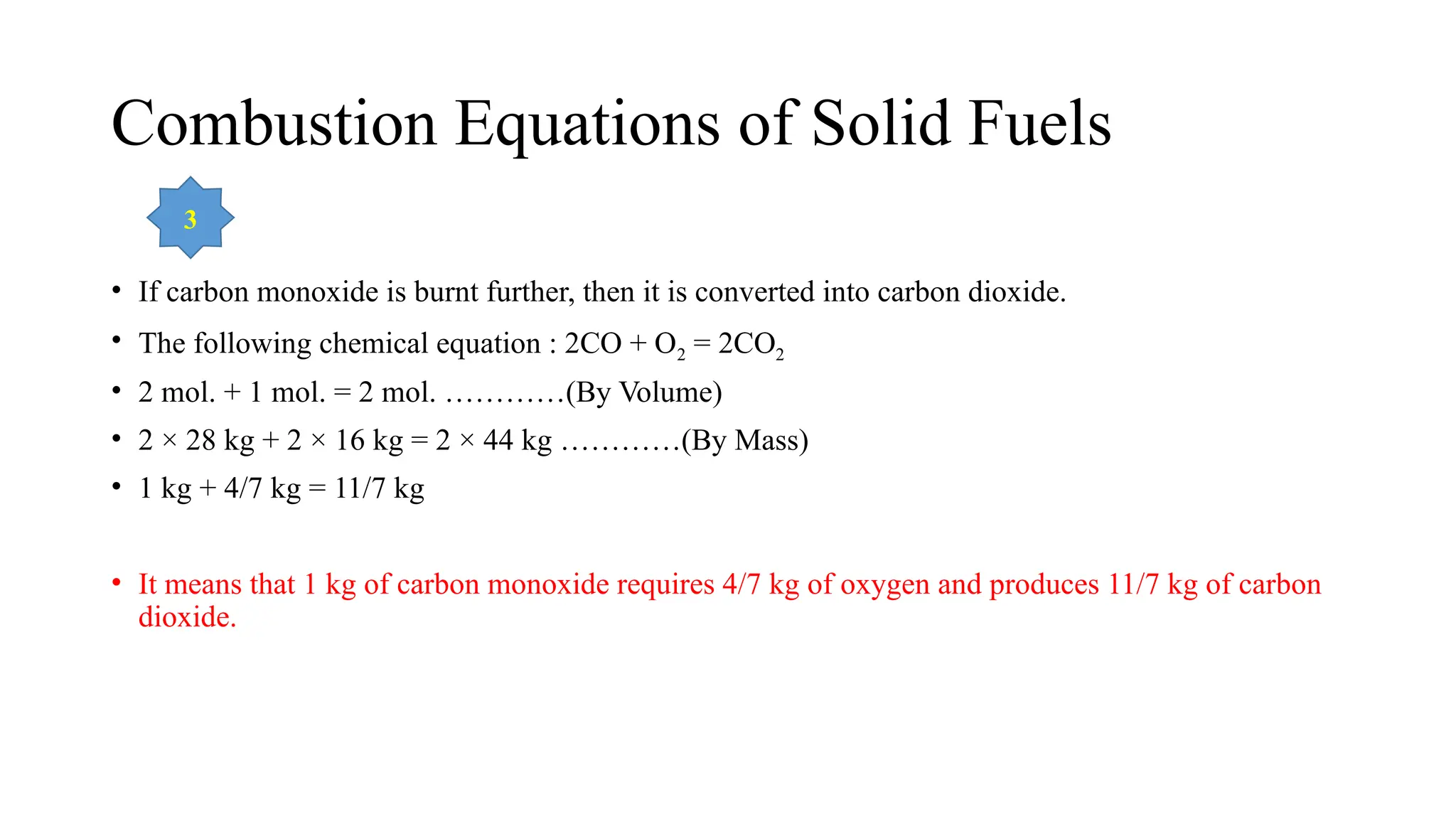
• If carbon monoxide is burnt further, then it is converted into carbon dioxide.
• The following chemical equation : 2CO + O2 = 2CO2
• 2 mol. + 1 mol. = 2 mol. …………(By Volume)
• 2 × 28 kg + 2 × 16 kg = 2 × 44 kg …………(By Mass)
• 1 kg + 4/7 kg = 11/7 kg
• It means that 1 kg of carbon monoxide requires 4/7 kg of oxygen and produces 11/7 kg of carbon
dioxide.
3
8.
Combustion Equations ofSolid Fuels
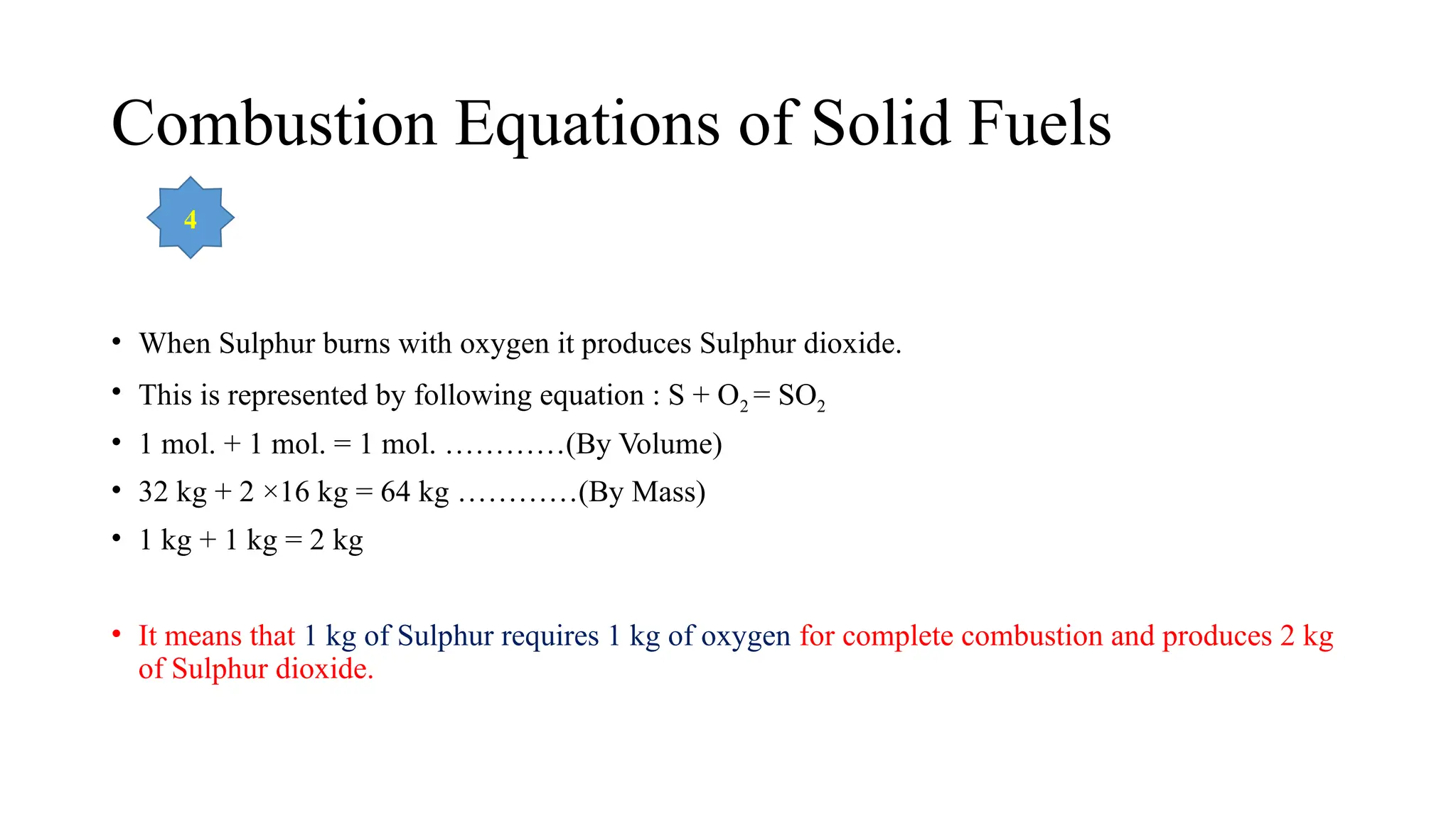
• When Sulphur burns with oxygen it produces Sulphur dioxide.
• This is represented by following equation : S + O2 = SO2
• 1 mol. + 1 mol. = 1 mol. …………(By Volume)
• 32 kg + 2 ×16 kg = 64 kg …………(By Mass)
• 1 kg + 1 kg = 2 kg
• It means that 1 kg of Sulphur requires 1 kg of oxygen for complete combustion and produces 2 kg
of Sulphur dioxide.
4
9.
Combustion Equations ofGaseous Fuels
• The gaseous fuels are generally measured by volume in m3
then by mass in kg. It is thus obvious
that their combustion equation are usually stated quantitatively in volume form, though we may
use mass is also.
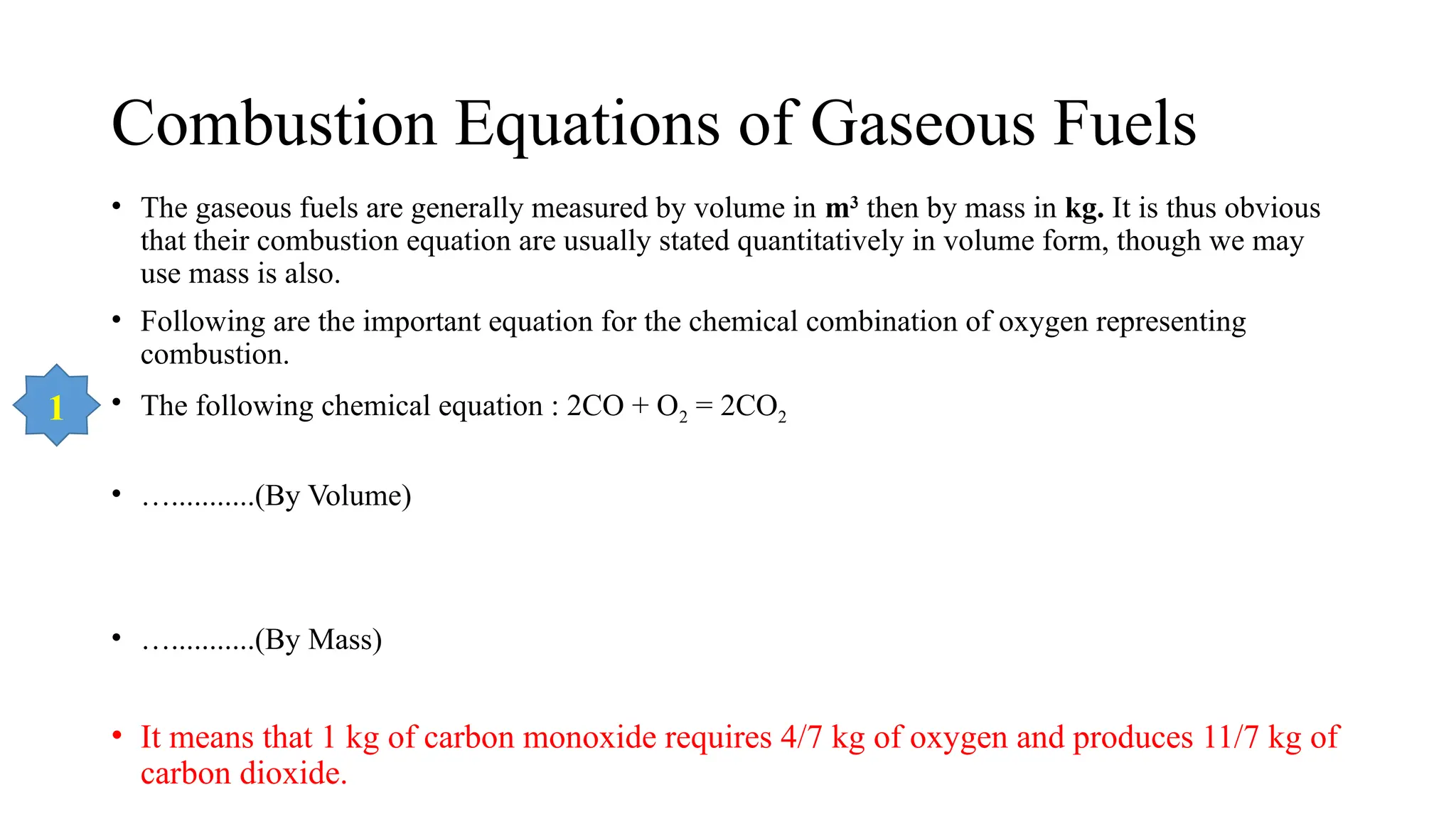
• Following are the important equation for the chemical combination of oxygen representing
combustion.
• The following chemical equation : 2CO + O2 = 2CO2
• …...........(By Volume)
• …...........(By Mass)
• It means that 1 kg of carbon monoxide requires 4/7 kg of oxygen and produces 11/7 kg of
carbon dioxide.
1
10.
Combustion Equations ofGaseous Fuels
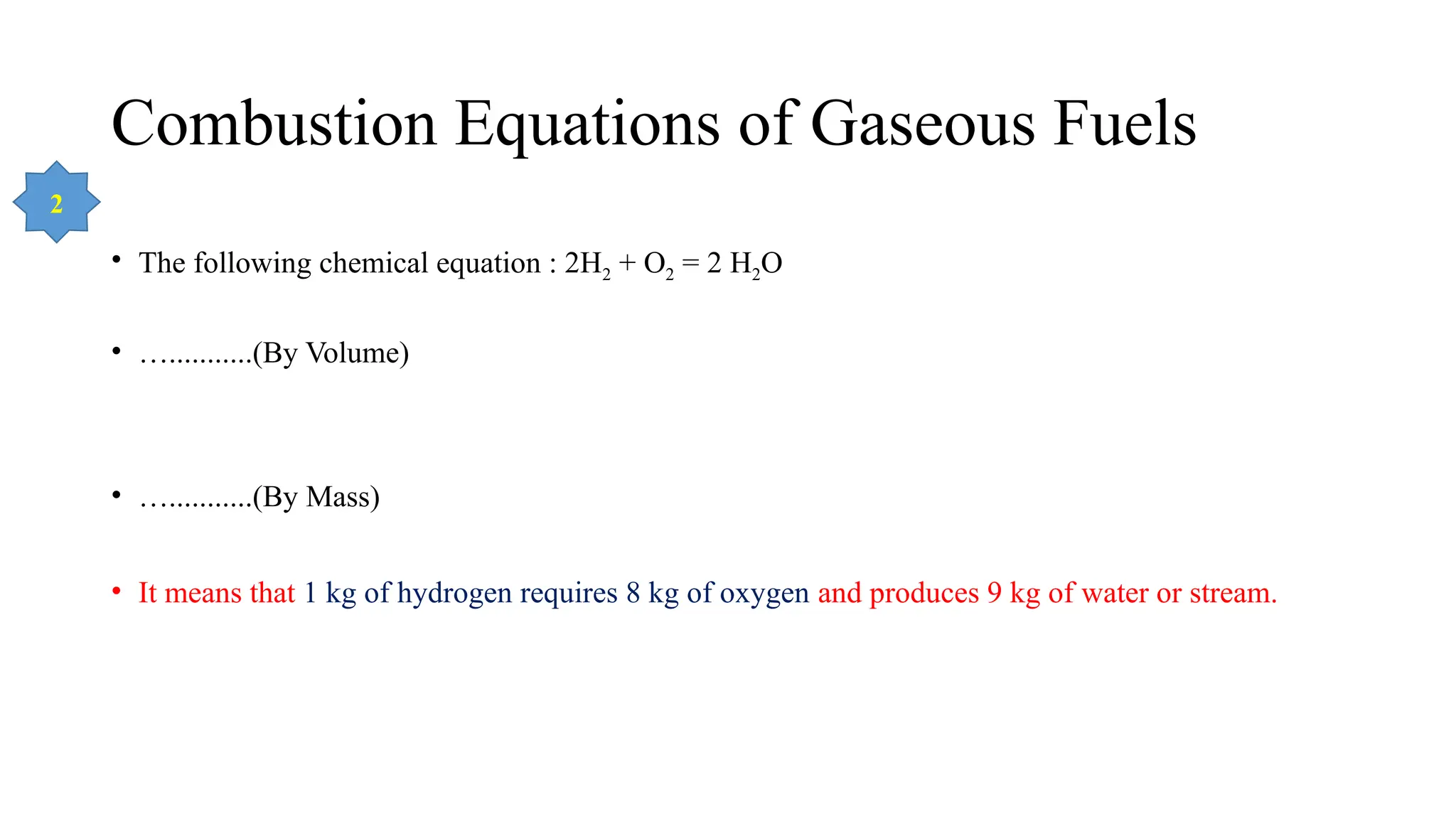
• The following chemical equation : 2H2 + O2 = 2 H2O
• …...........(By Volume)
• …...........(By Mass)
• It means that 1 kg of hydrogen requires 8 kg of oxygen and produces 9 kg of water or stream.
2
11.
Combustion Equations ofGaseous Fuels
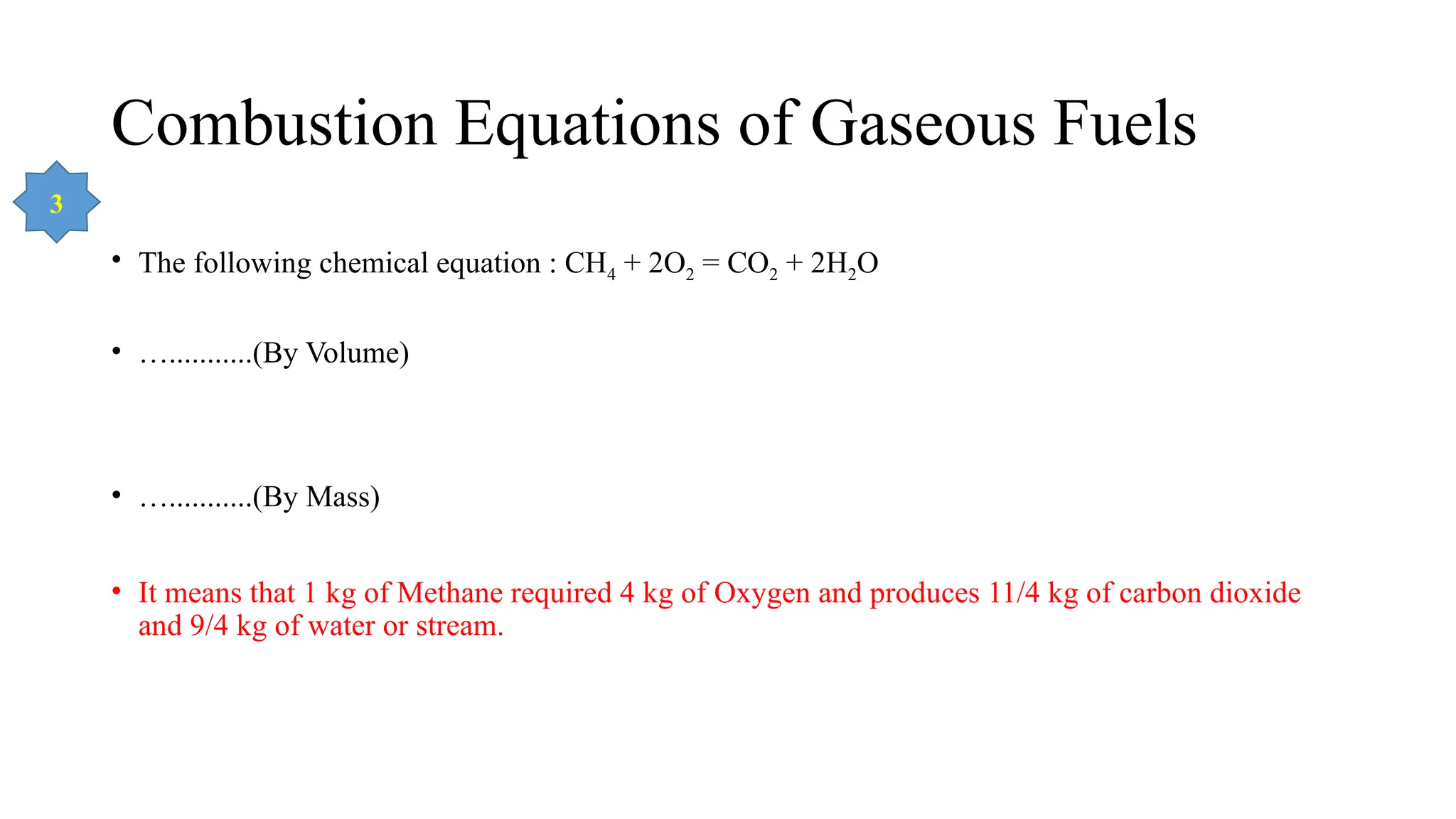
• The following chemical equation : CH4 + 2O2 = CO2 + 2H2O
• …...........(By Volume)
• …...........(By Mass)
• It means that 1 kg of Methane required 4 kg of Oxygen and produces 11/4 kg of carbon dioxide
and 9/4 kg of water or stream.
3
12.
Combustion Equations ofGaseous Fuels
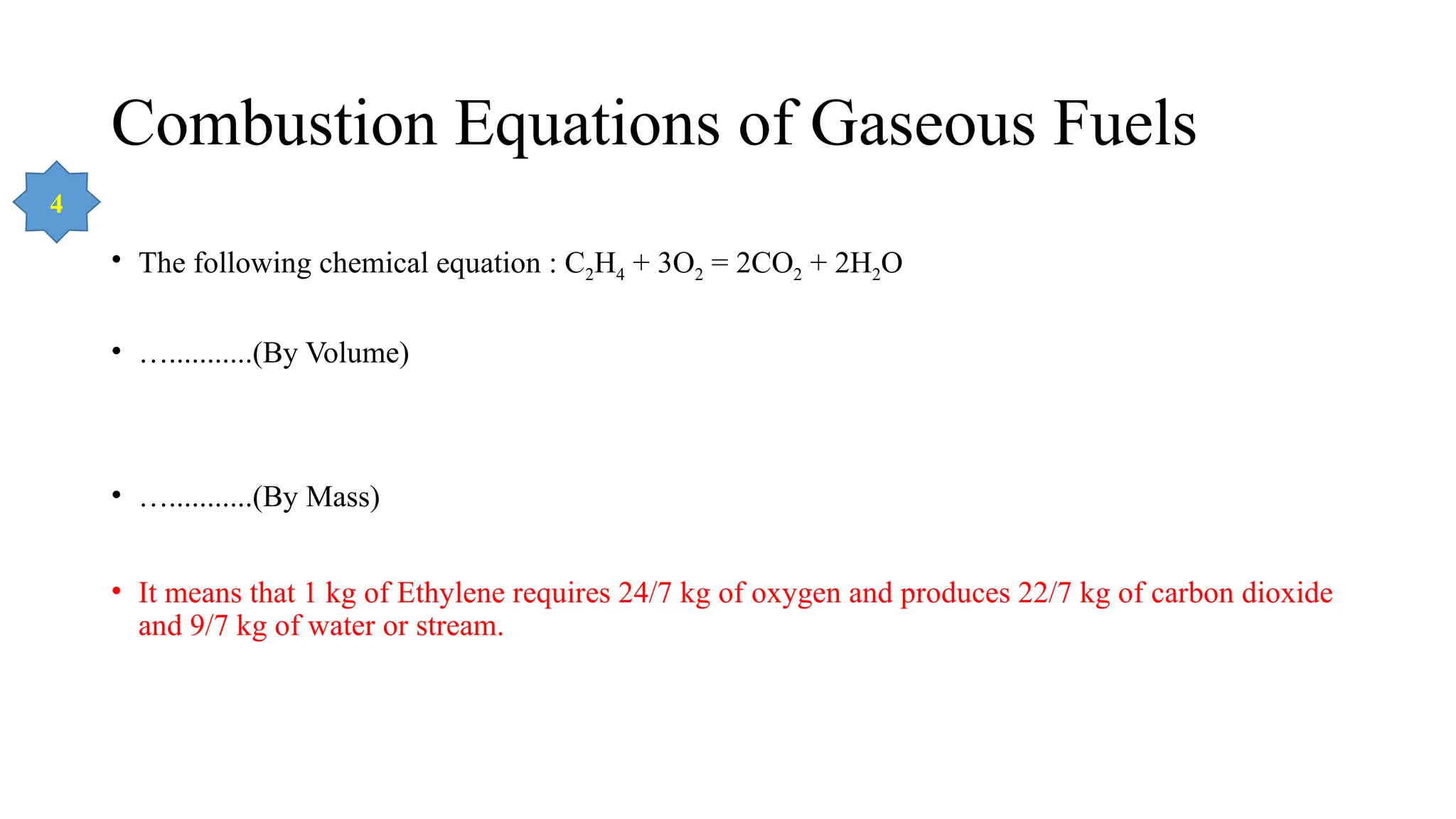
• The following chemical equation : C2H4 + 3O2 = 2CO2 + 2H2O
• …...........(By Volume)
• …...........(By Mass)
• It means that 1 kg of Ethylene requires 24/7 kg of oxygen and produces 22/7 kg of carbon dioxide
and 9/7 kg of water or stream.
4
13.
Theoretical Or MinimumMass of Air
Required for Complete Combustion
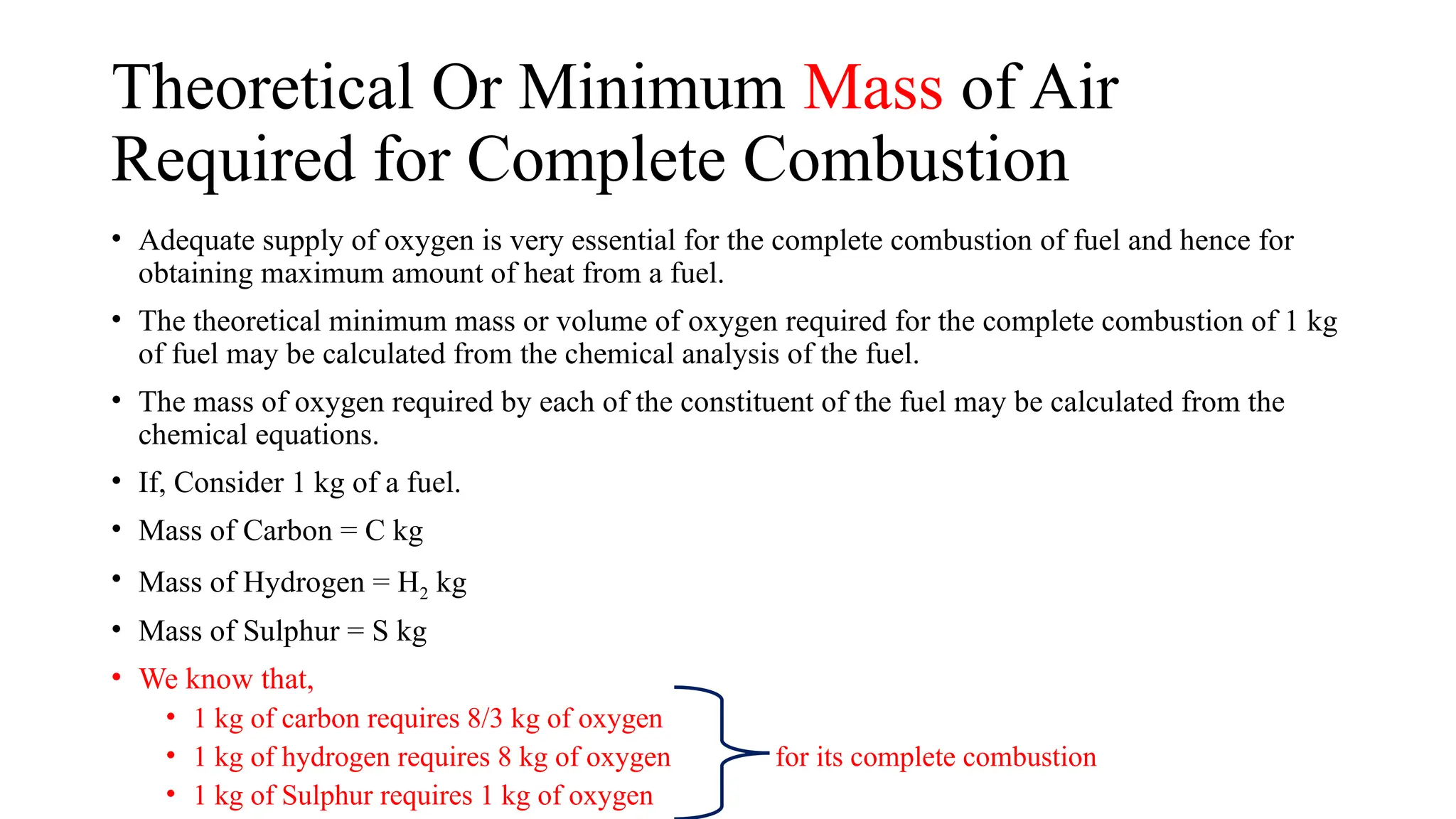
• Adequate supply of oxygen is very essential for the complete combustion of fuel and hence for
obtaining maximum amount of heat from a fuel.
• The theoretical minimum mass or volume of oxygen required for the complete combustion of 1 kg
of fuel may be calculated from the chemical analysis of the fuel.
• The mass of oxygen required by each of the constituent of the fuel may be calculated from the
chemical equations.
• If, Consider 1 kg of a fuel.
• Mass of Carbon = C kg
• Mass of Hydrogen = H2 kg
• Mass of Sulphur = S kg
• We know that,
• 1 kg of carbon requires 8/3 kg of oxygen
• 1 kg of hydrogen requires 8 kg of oxygen for its complete combustion
• 1 kg of Sulphur requires 1 kg of oxygen
14.
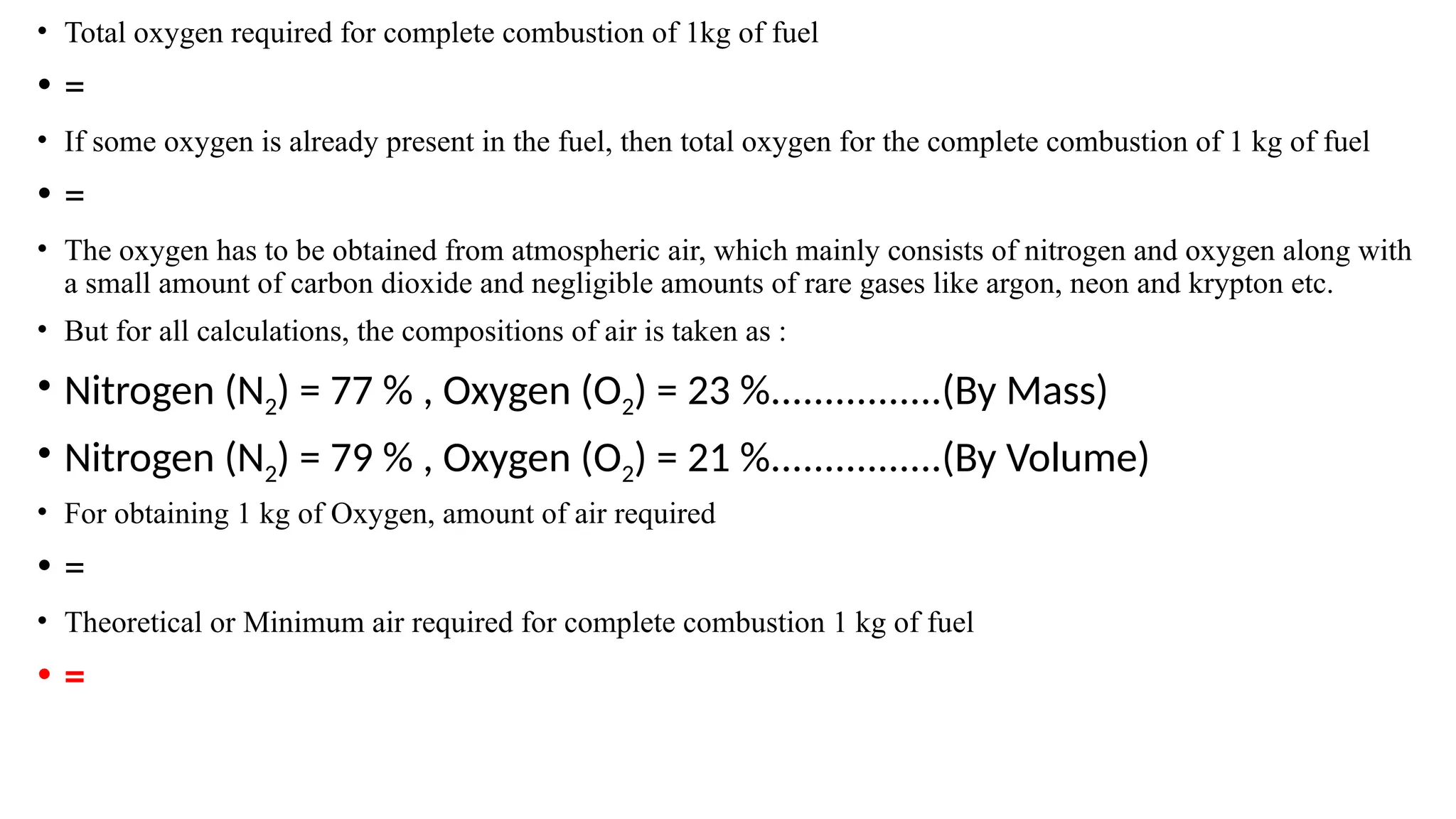
• Total oxygenrequired for complete combustion of 1kg of fuel
• =
• If some oxygen is already present in the fuel, then total oxygen for the complete combustion of 1 kg of fuel
• =
• The oxygen has to be obtained from atmospheric air, which mainly consists of nitrogen and oxygen along with
a small amount of carbon dioxide and negligible amounts of rare gases like argon, neon and krypton etc.
• But for all calculations, the compositions of air is taken as :
• Nitrogen (N2) = 77 % , Oxygen (O2) = 23 %................(By Mass)
• Nitrogen (N2) = 79 % , Oxygen (O2) = 21 %................(By Volume)
• For obtaining 1 kg of Oxygen, amount of air required
• =
• Theoretical or Minimum air required for complete combustion 1 kg of fuel
• =
15.
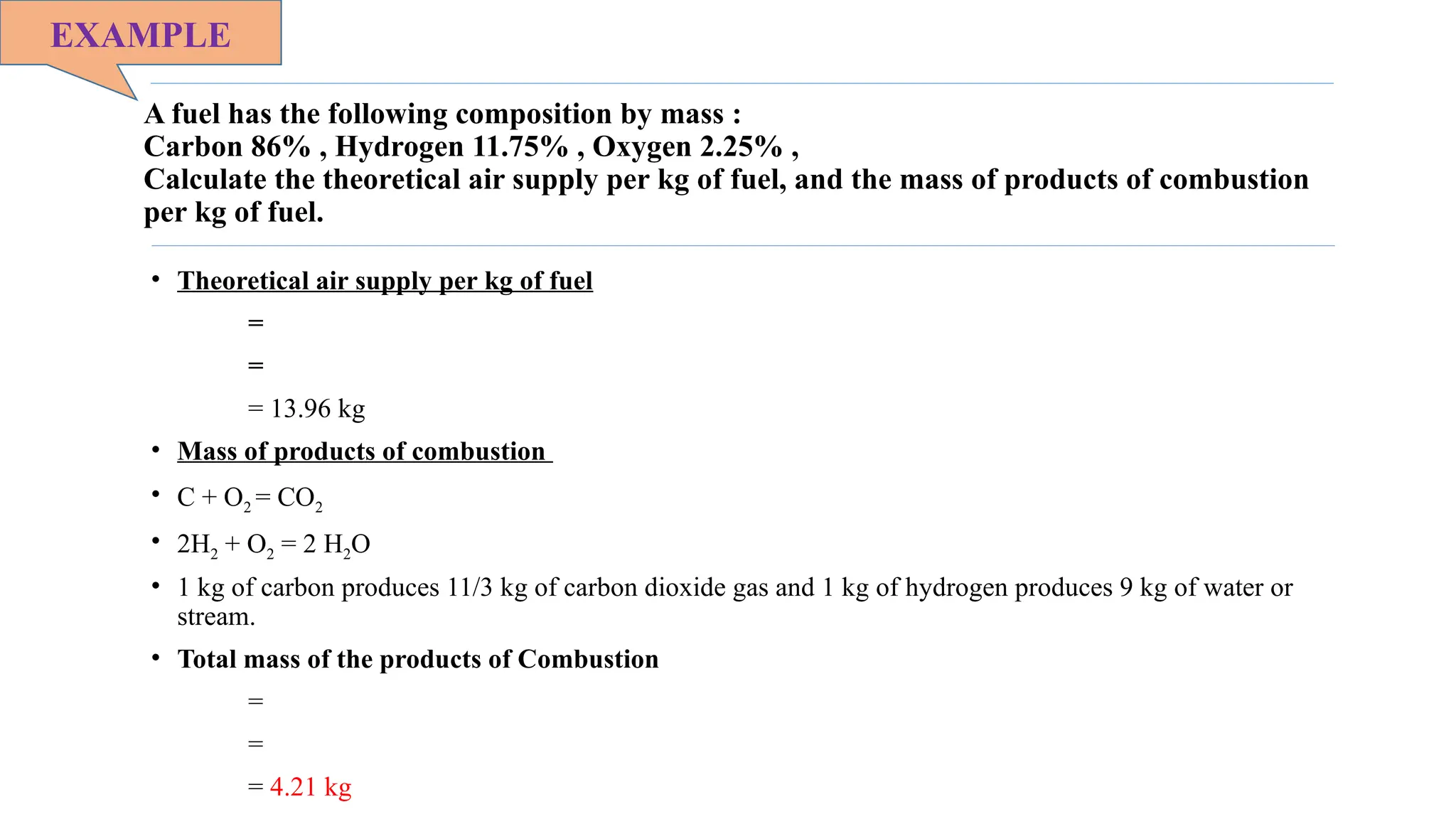
A fuel hasthe following composition by mass :
Carbon 86% , Hydrogen 11.75% , Oxygen 2.25% ,
Calculate the theoretical air supply per kg of fuel, and the mass of products of combustion
per kg of fuel.
• Theoretical air supply per kg of fuel
=
=
= 13.96 kg
• Mass of products of combustion
• C + O2 = CO2
• 2H2 + O2 = 2 H2O
• 1 kg of carbon produces 11/3 kg of carbon dioxide gas and 1 kg of hydrogen produces 9 kg of water or
stream.
• Total mass of the products of Combustion
=
=
= 4.21 kg
EXAMPLE
16.
Theoretical Or MinimumVolume of Air
Required for Complete Combustion
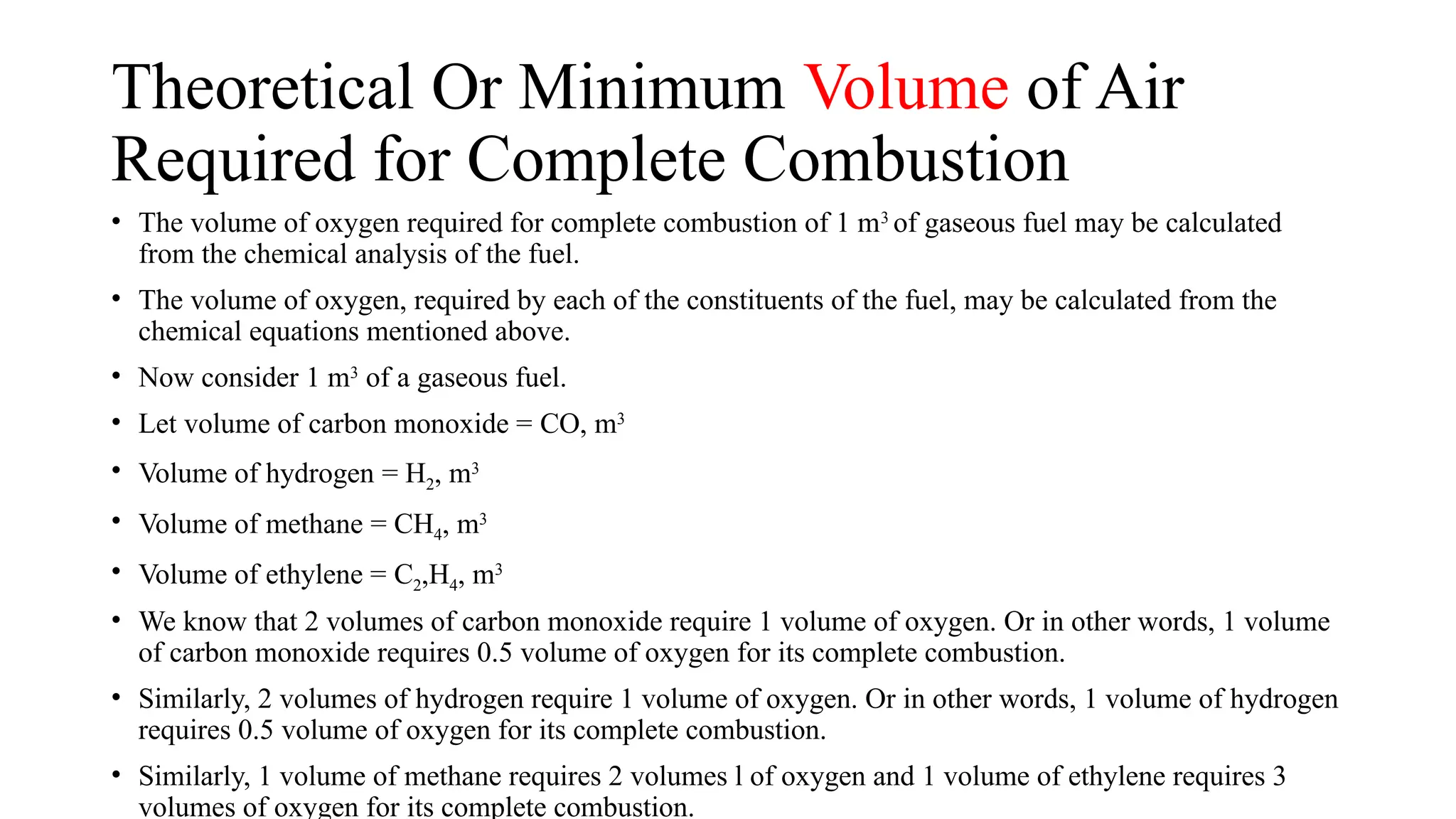
• The volume of oxygen required for complete combustion of 1 m3
of gaseous fuel may be calculated
from the chemical analysis of the fuel.
• The volume of oxygen, required by each of the constituents of the fuel, may be calculated from the
chemical equations mentioned above.
• Now consider 1 m3
of a gaseous fuel.
• Let volume of carbon monoxide = CO, m3
• Volume of hydrogen = H2, m3
• Volume of methane = CH4, m3
• Volume of ethylene = C2,H4, m3
• We know that 2 volumes of carbon monoxide require 1 volume of oxygen. Or in other words, 1 volume
of carbon monoxide requires 0.5 volume of oxygen for its complete combustion.
• Similarly, 2 volumes of hydrogen require 1 volume of oxygen. Or in other words, 1 volume of hydrogen
requires 0.5 volume of oxygen for its complete combustion.
• Similarly, 1 volume of methane requires 2 volumes l of oxygen and 1 volume of ethylene requires 3
volumes of oxygen for its complete combustion.
17.
• Total oxygenrequired for complete combustion of 1 m3
of fuel
• = 0.5 CO + 0.5 H2 + 2CH4 +3 C2H4 m3
• If some oxygen (say O2 m3
) is already present in the fuel, then total oxygen required for complete
combustion of 1 m3
of fuel
• =[0.5 CO + 0.5 H2 + 2CH4 +3 C2H4] – O2 m3
• Since the oxygen present in the air is 21% by volume, therefore theoretical or minimum volume of air
required for complete combustion of 1 m3
of fuel
• m3
18.
Conversion Of VolumetricAnalysis into Mass
Analysis or Gravimetric Analysis
• Volumetric analysis : is defined as a way of analyzing an unknown chemical by adding a known
re-agent in known quantities to cause a reaction in the chemical added.
• Gravimetric Analysis : Any of several methods and techniques of analytical chemistry in which
the amount of a substance in a sample is determined by weighing a precipitate, filtrate, residue etc.
after some physical or chemical process.
• When the volumetric composition of any fuel gas is known it can be converted into gravimetric
composition by applying Avogadro’s law.
• Multiply the volume of each constituent by its own molecular mass this gives the proportional
mass of the constituents.
• Add up this masses and divide each mass by the total mass and express it as a percentage.
• This gives percentage analysis by mass.
19.
The volumetric analysisof a gas is CO2-14%, CO - 1%, O2 - 5%, and N2 - 80%,
Calculate the fuel gas composition by mass.
EXAMPLE
Constituent Volume in 1m3
of
flue gas
Molecular
mass
Propotional
mass
Mass in kg per
kg of flue gas
% by mass
- (a) (b) (c) =(a) (d) = (d) 100
CO2 0.14 44 6.16 20.2%
CO 0.01 28 0.28 0.9%
O2 0.05 32 1.60 5.3%
N2 0.80 28 22.40 73.6%
Total 1.00 - 1.0000 100.00
20.
Conversion Of MassAnalysis into Volumetric
Analysis
• The conversion of mass analysis of a fuel gas into the volumetric analysis may be done by the
following steps:
• Divide the percentage mass of each constituent by its own molecular mass. This gives the
proportional volumes of the constituents.
• Add these volumes and divide each volume by this total volume, and express it as a percentage.
• This gives percentage analysis by volume.
21.
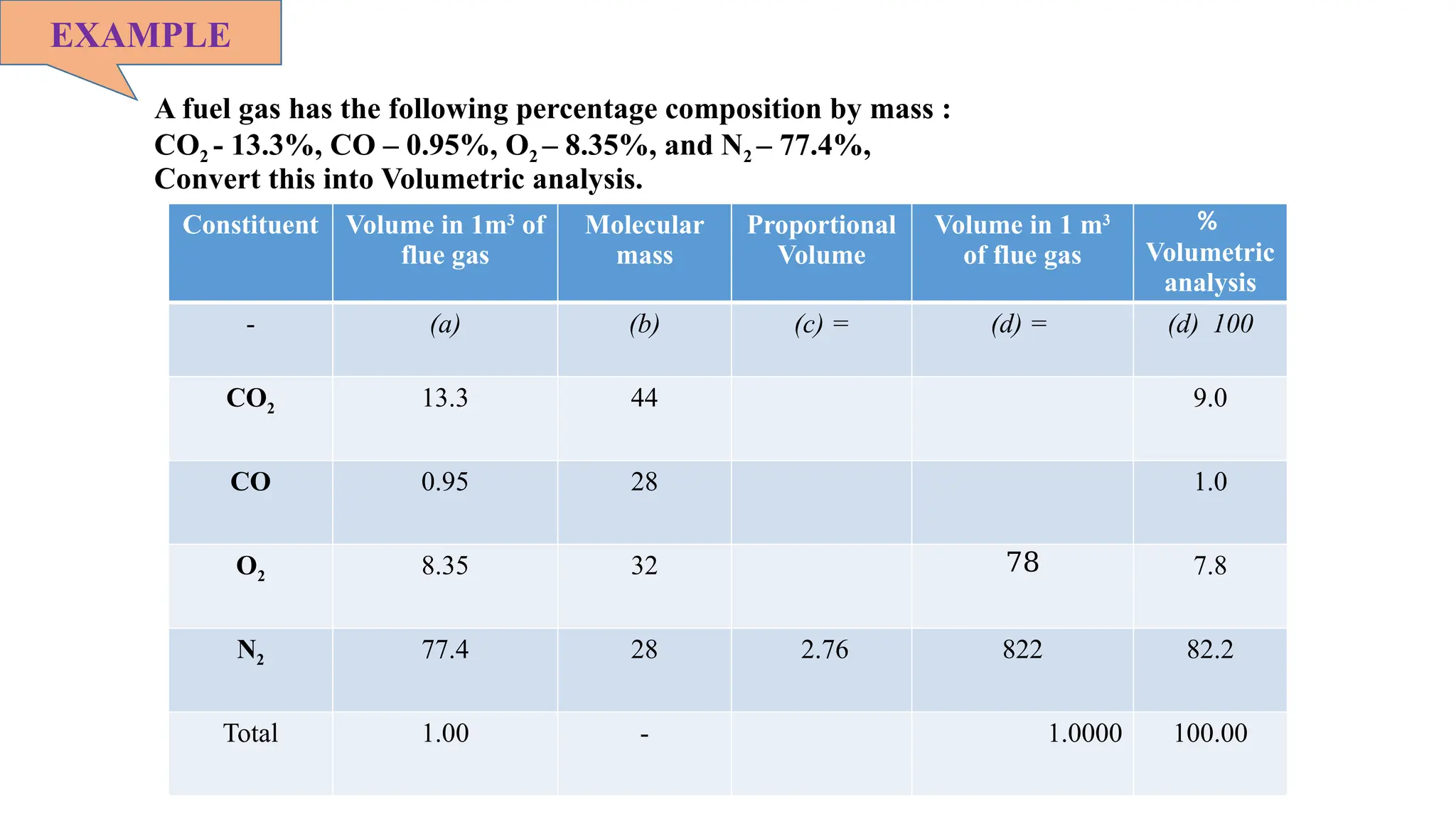
A fuel gashas the following percentage composition by mass :
CO2 - 13.3%, CO – 0.95%, O2 – 8.35%, and N2 – 77.4%,
Convert this into Volumetric analysis.
EXAMPLE
Constituent Volume in 1m3
of
flue gas
Molecular
mass
Proportional
Volume
Volume in 1 m3
of flue gas
%
Volumetric
analysis
- (a) (b) (c) = (d) = (d) 100
CO2 13.3 44 9.0
CO 0.95 28 1.0
O2 8.35 32 78 7.8
N2 77.4 28 2.76 822 82.2
Total 1.00 - 1.0000 100.00
22.
Mass of Carbonin flue gases
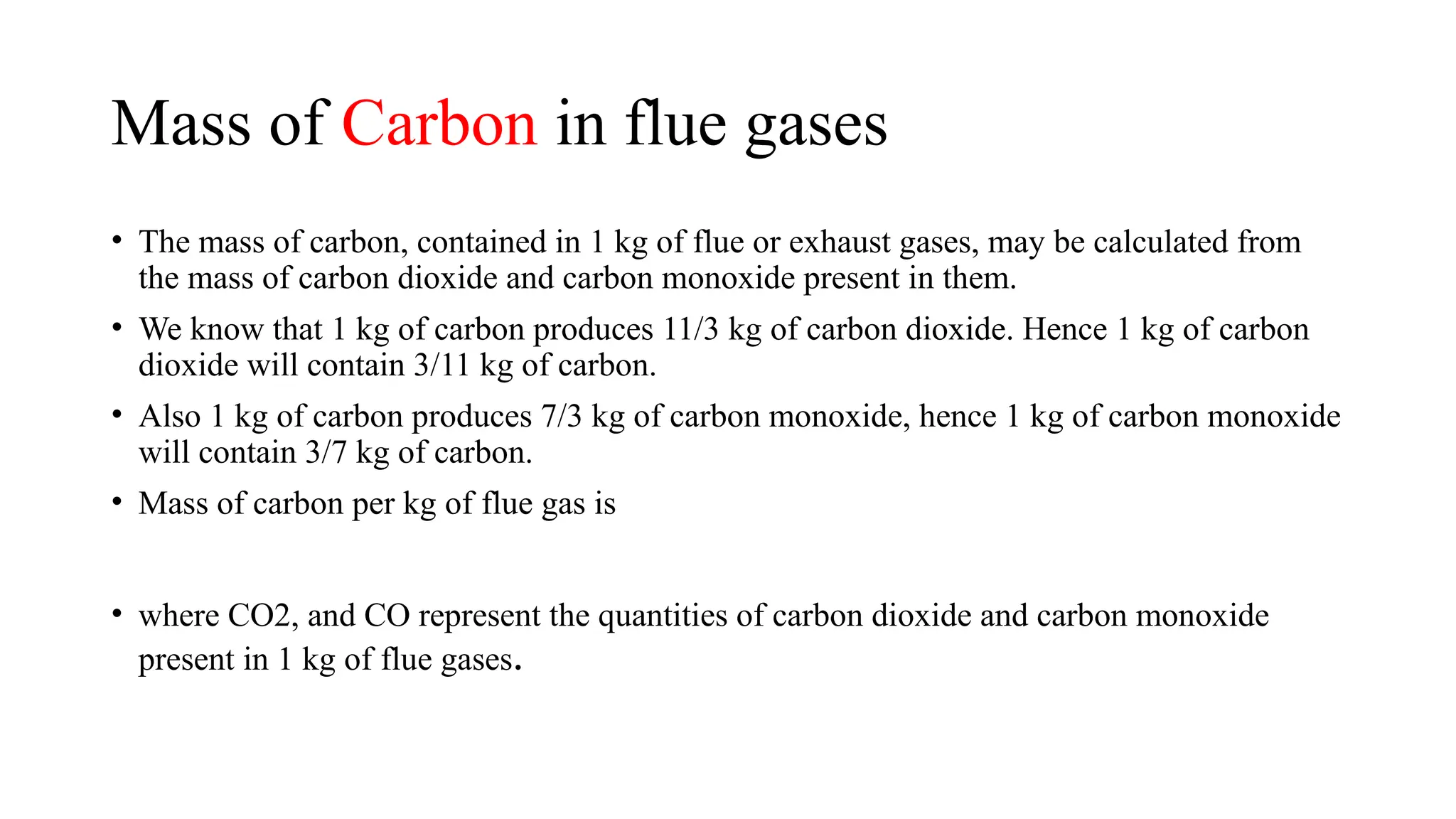
• The mass of carbon, contained in 1 kg of flue or exhaust gases, may be calculated from
the mass of carbon dioxide and carbon monoxide present in them.
• We know that 1 kg of carbon produces 11/3 kg of carbon dioxide. Hence 1 kg of carbon
dioxide will contain 3/11 kg of carbon.
• Also 1 kg of carbon produces 7/3 kg of carbon monoxide, hence 1 kg of carbon monoxide
will contain 3/7 kg of carbon.
• Mass of carbon per kg of flue gas is
• where CO2, and CO represent the quantities of carbon dioxide and carbon monoxide
present in 1 kg of flue gases.
23.
Mass of Fluegases per kg of Fuel Burnt
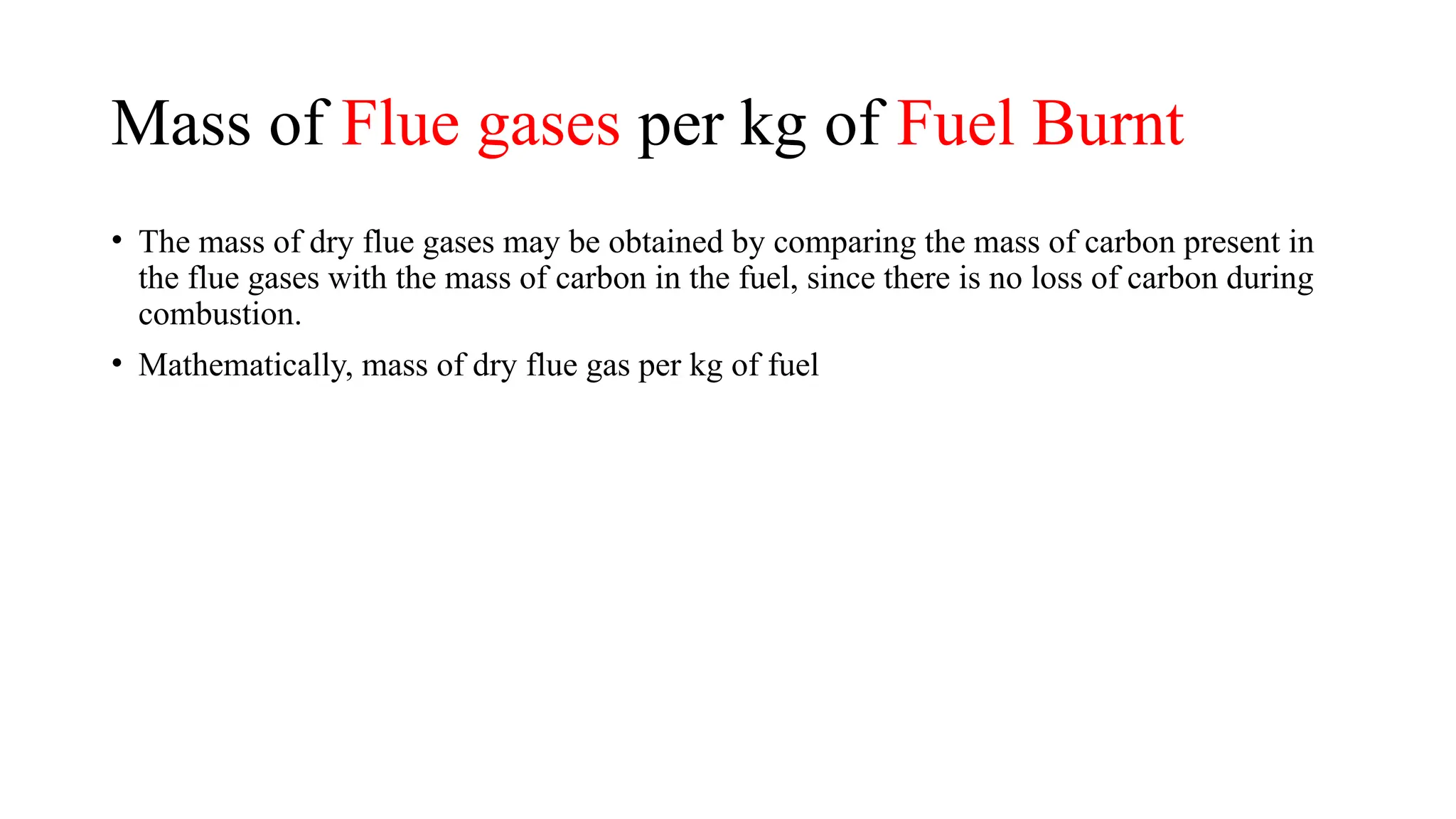
• The mass of dry flue gases may be obtained by comparing the mass of carbon present in
the flue gases with the mass of carbon in the fuel, since there is no loss of carbon during
combustion.
• Mathematically, mass of dry flue gas per kg of fuel
24.
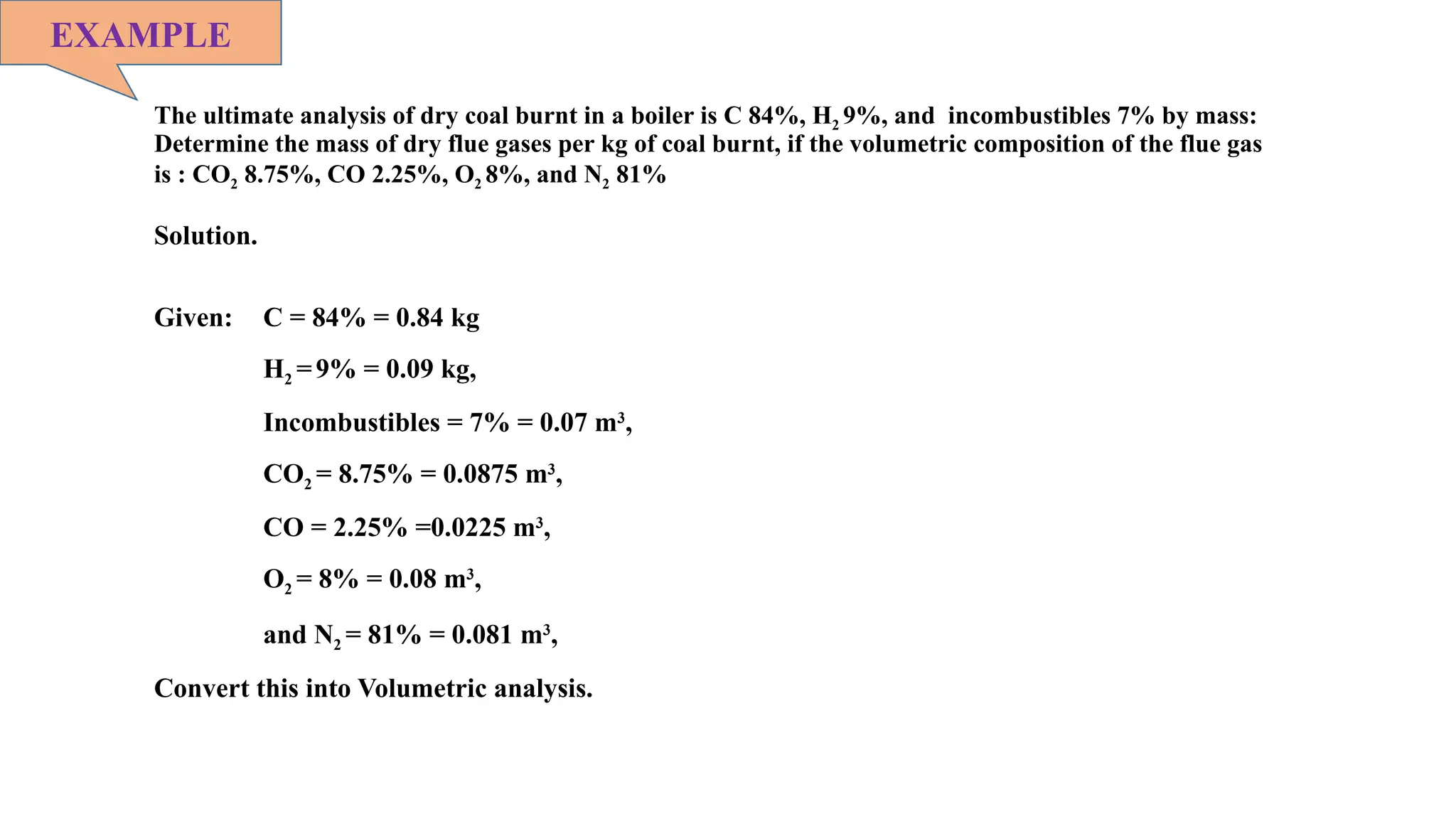
The ultimate analysisof dry coal burnt in a boiler is C 84%, H2 9%, and incombustibles 7% by mass:
Determine the mass of dry flue gases per kg of coal burnt, if the volumetric composition of the flue gas
is : CO2 8.75%, CO 2.25%, O2 8%, and N2 81%
EXAMPLE
Solution.
Given: C = 84% = 0.84 kg
H2 =9% = 0.09 kg,
Incombustibles = 7% = 0.07 m3
,
CO2 = 8.75% = 0.0875 m3
,
CO = 2.25% =0.0225 m3
,
O2 = 8% = 0.08 m3
,
and N2 = 81% = 0.081 m3
,
Convert this into Volumetric analysis.
25.
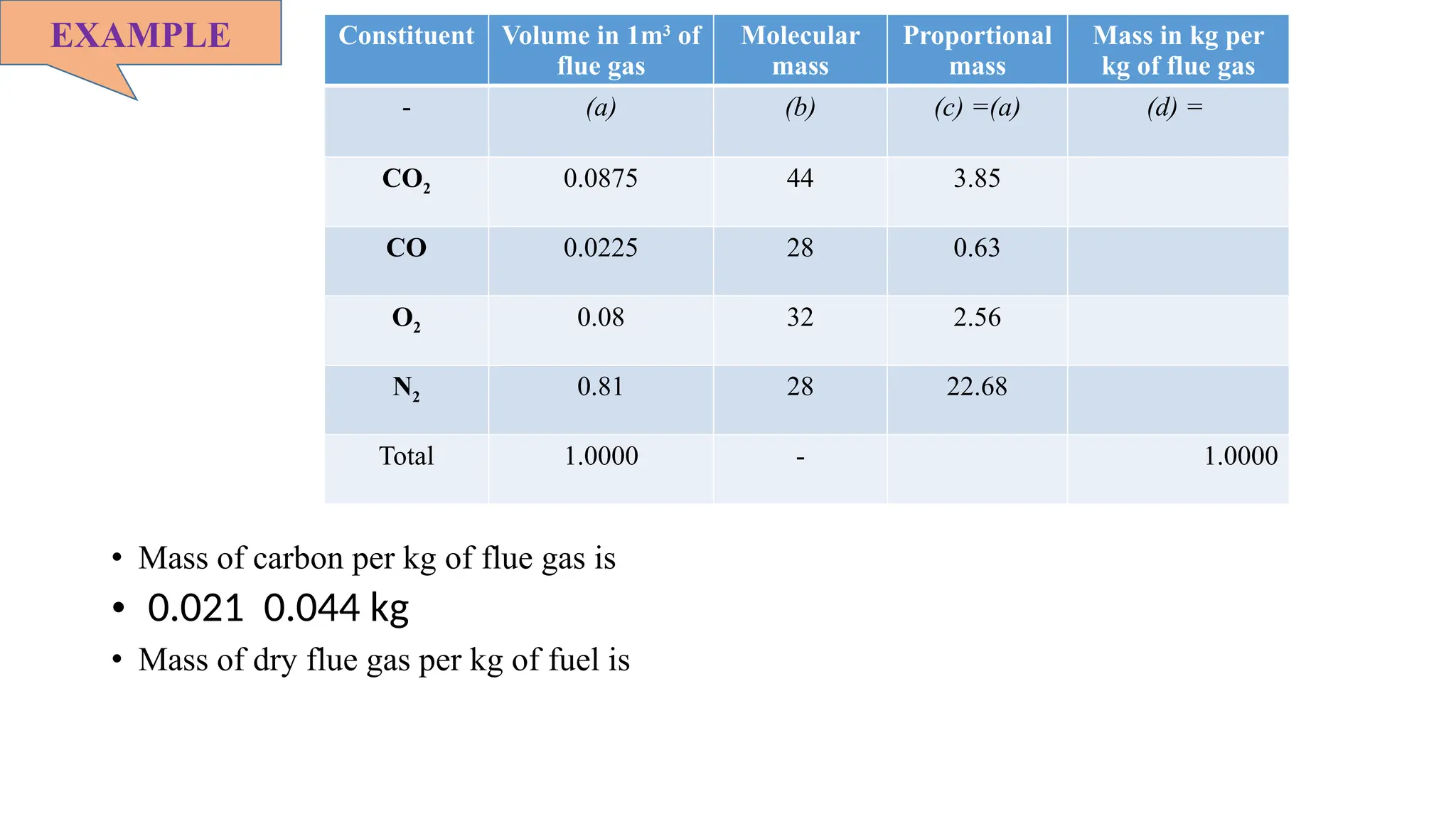
EXAMPLE Constituent Volumein 1m3
of
flue gas
Molecular
mass
Proportional
mass
Mass in kg per
kg of flue gas
- (a) (b) (c) =(a) (d) =
CO2 0.0875 44 3.85
CO 0.0225 28 0.63
O2 0.08 32 2.56
N2 0.81 28 22.68
Total 1.0000 - 1.0000
• Mass of carbon per kg of flue gas is
• 0.021 0.044 kg
• Mass of dry flue gas per kg of fuel is
26.
Excess of Airsupplied
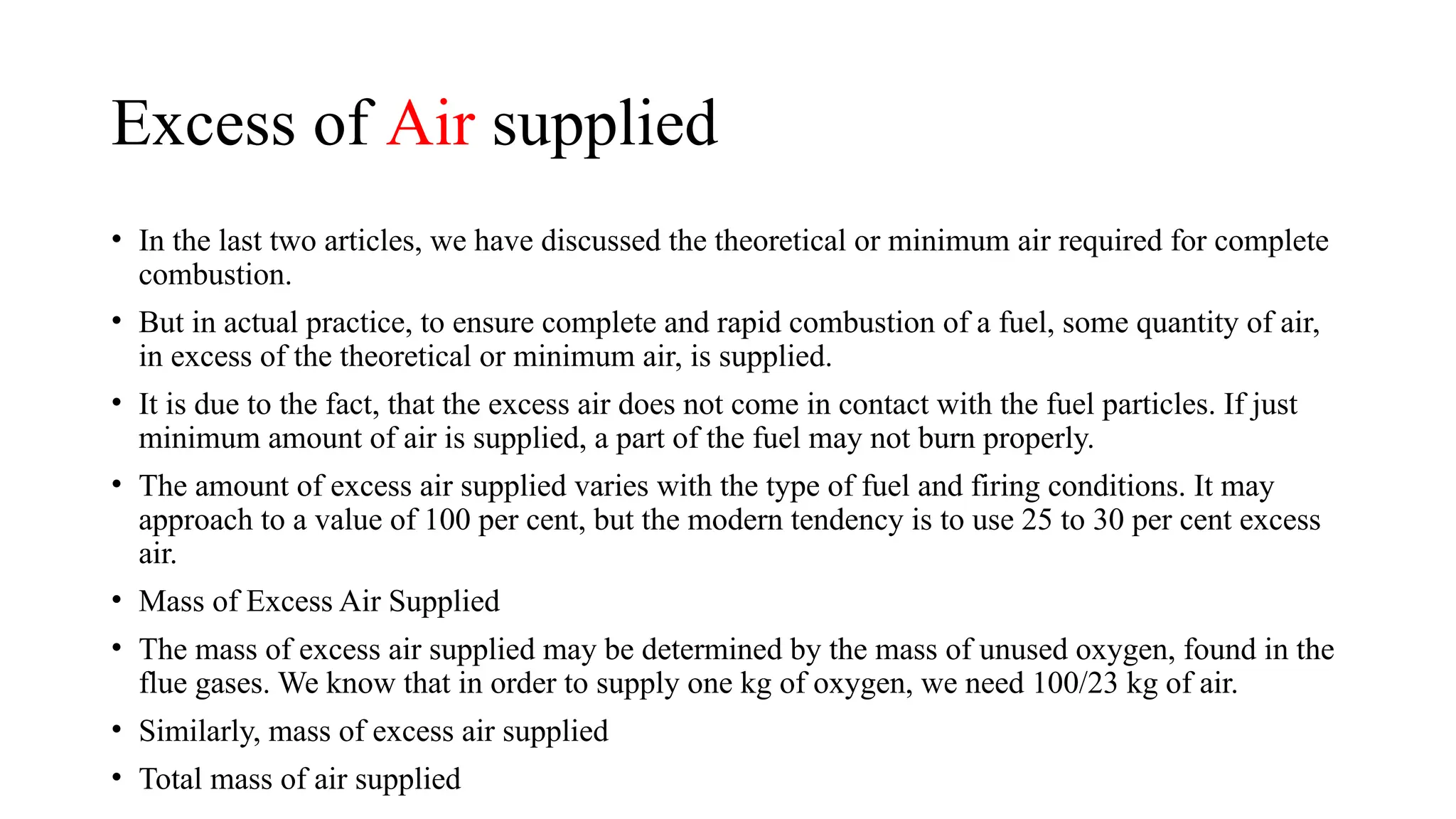
• In the last two articles, we have discussed the theoretical or minimum air required for complete
combustion.
• But in actual practice, to ensure complete and rapid combustion of a fuel, some quantity of air,
in excess of the theoretical or minimum air, is supplied.
• It is due to the fact, that the excess air does not come in contact with the fuel particles. If just
minimum amount of air is supplied, a part of the fuel may not burn properly.
• The amount of excess air supplied varies with the type of fuel and firing conditions. It may
approach to a value of 100 per cent, but the modern tendency is to use 25 to 30 per cent excess
air.
• Mass of Excess Air Supplied
• The mass of excess air supplied may be determined by the mass of unused oxygen, found in the
flue gases. We know that in order to supply one kg of oxygen, we need 100/23 kg of air.
• Similarly, mass of excess air supplied
• Total mass of air supplied
27.
Excess of Airsupplied
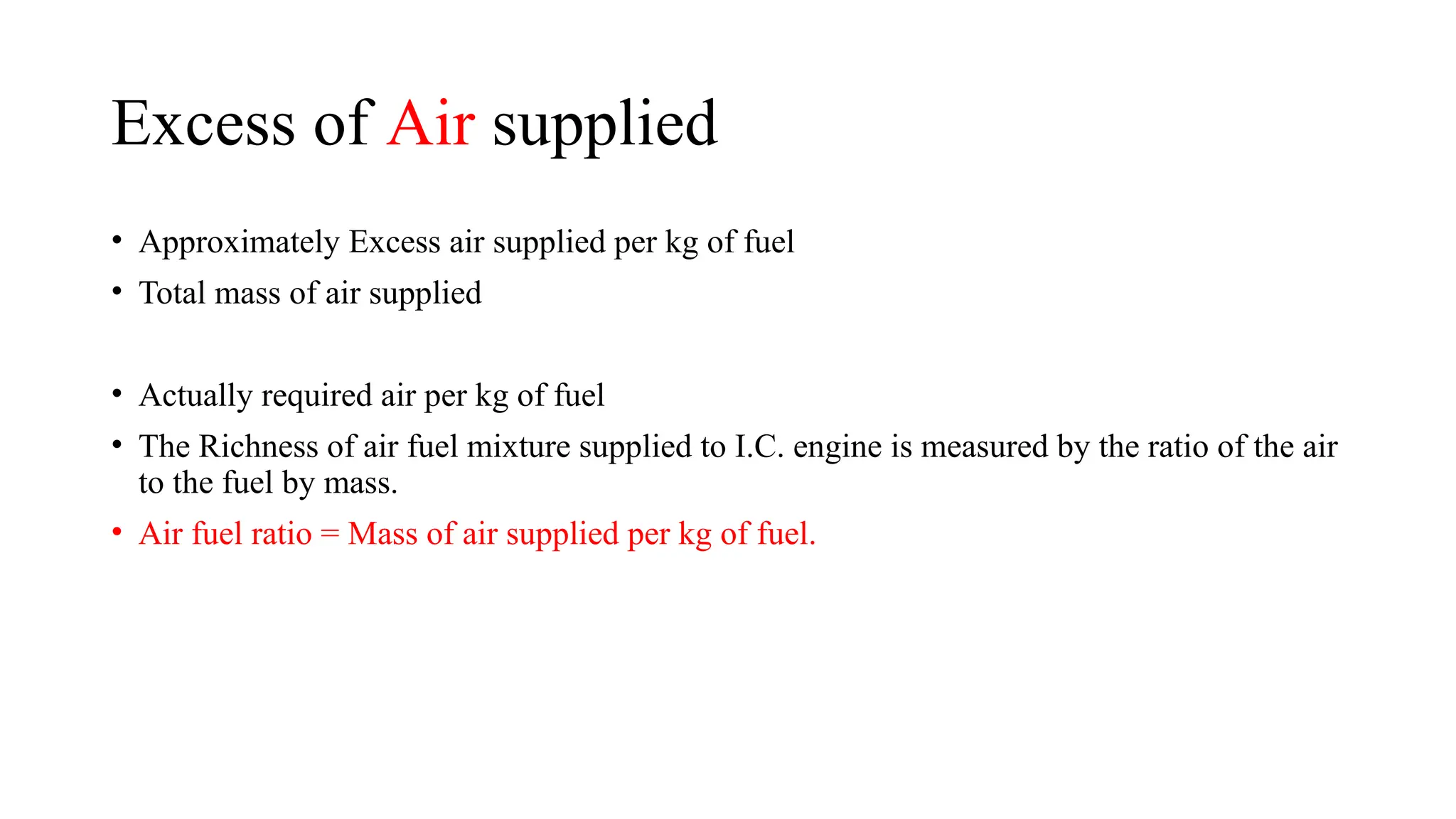
• Approximately Excess air supplied per kg of fuel
• Total mass of air supplied
• Actually required air per kg of fuel
• The Richness of air fuel mixture supplied to I.C. engine is measured by the ratio of the air
to the fuel by mass.
• Air fuel ratio = Mass of air supplied per kg of fuel.
28.
A gas fuelhas the following percentage composition by volume:
CO 10%, H2 50%, CH4 26%, O2 3%, CO2 2 %, and N2 9 %
Estimate the minimum volume of air required for complete combustion of 1 m3
of the gas.
If, 50% excess air supplied, give the volumes of each of the dry constituents of the flue gas.
Air contains 21% by volume of oxygen.
EXAMPLE
Solution.
Given: CO = 10% =0.1 m3
,
H2 =50% = 0.5 m3
,
CH4 = 26% = 0.26 m3
,
O2 = 3% =0.03 m3
,
CO2 = 2% = 0.02 m3
,
and N2 = 9% = 0.09 m3
,
Excess Air Supplied = 50%
29.
• Minimum volumeof air required
m3
m3
• Volumes of the dry constituents
• Since the 50% excess air supplied, actual amount of air
• And excess oxygen supplied
• The dry constituents of the flue gases contains CO2, CO, and CH4 from
the combustion of fuel. Also, excess O2, and N2, from the actual air
supplied.
EXAMPLE
30.
• Volumes ofCO2 contains in the fuel = 0.02 m3
,
• And we know,
• 1m3
of CO produces 1m3
of CO2,therefore volume of CO2 obtained from 0.1 m3
of
CO = 0.10 m3
• 1m3
of CH4 produces 1m3
of CO2,therefore volume of CO2 obtained from 0.26 m3
of
CH4 = 0.26 m3
• TOTAL VOLUME OF CO2 =0.02+0.10+0.26 = 0.38 m3
• VOLUME OF EXCESS O2 IN FLUE GAS =0.395 m3
• VOLUME OF N2 IN FUEL = 0.09 m3
• VOLUME OF N2 FROM THE ACTUAL AIR =
• =
• TOTAL VOLUME OF N2 IN FLUE GAS = 0.09+4.46 =4.55
• Hence Vol. of Dry constituents CO2 = 0.38 m3
, EXCESS O2 = 0.395 m3
and N2
=4.55
EXAMPLE

![• Total oxygen required for complete combustion of 1 m3
of fuel
• = 0.5 CO + 0.5 H2 + 2CH4 +3 C2H4 m3
• If some oxygen (say O2 m3
) is already present in the fuel, then total oxygen required for complete
combustion of 1 m3
of fuel
• =[0.5 CO + 0.5 H2 + 2CH4 +3 C2H4] – O2 m3
• Since the oxygen present in the air is 21% by volume, therefore theoretical or minimum volume of air
required for complete combustion of 1 m3
of fuel
• m3](https://image.slidesharecdn.com/fuelscombustion-251128045050-e7c42f76/75/FUELS-and-combustion-for-mechanical-engineering-student-and-professors-17-2048.jpg)



![1. SIH2025-IDEA-Presentation-Format[1].pptx](https://cdn.slidesharecdn.com/ss_thumbnails/1-251204091914-b1bb69d5-thumbnail.jpg?width=640&height=640&fit=bounds)


