COMBINED BRAKE SYSTEM
Submitted By
SANJAY S
Reg. No: 19022072
S5 Mechanical
INTRODUCTION
• A combined braking system (CBS), also called linked braking
system (LBS), is a system for linking front and rear brakes on a motorcycle
or scooter.[1] In this system, the rider's action of depressing one of the brake
levers applies both front and rear brakes. The amount of each brake applied
may be determined by a proportional control valve. This is distinct from
integrated brakes, where applying pressure to brake pedal only includes
application of some front brake.
PRINCIPLE OF BRAKING
• Common principles on which a braking system depends when stopping a car
is friction and heat.
• By applying resistance, or friction, to a turning wheel, a vehicle's brakes
cause the wheel to slow down and eventually stop, creating heat as a
byproduct.
• The rate at which a wheel can be slowed depends on several factors
including vehicle weight, braking force and total braking surface area.
WHAT IS COMBI BRAKE SYSTEM?
• The most efficient way of braking is to apply the front and rear brakes
simultaneously. But it is a practice, most two-wheeler riders have not
mastered.
• The Combi Brake System in Honda two-wheelers enables you to use both
brakes with just a lever^.
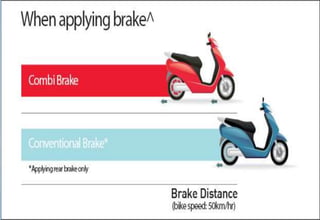
• It reduces the braking distance and improves stability while braking.
• Honda Combi Brake with Equaliser, ensures distribution of Force between
the Front and Rear Wheel at the same time, giving perfect balance to the
rider.
• It ensures that rider with low expertise is also confident while braking.
• Simultaneous application of Front and Rear Brake leads to the most effective
braking.
BASIC FUNCTIONING OF CBS
Equalizer
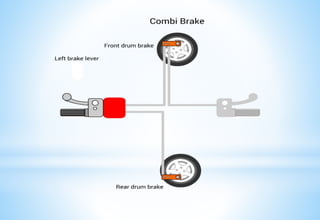
• Equalizer is the brain of the system. Pressing the left lever activates
the Equalizer, which distributes the braking force between the front
and rear wheels simultaneously so that you can ride with the
confidence of efficient braking in your hands.
WORKING OF CBS
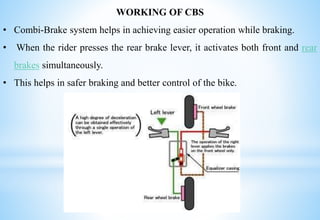
• Combi-Brake system helps in achieving easier operation while braking.
• When the rider presses the rear brake lever, it activates both front and rear
brakes simultaneously.
• This helps in safer braking and better control of the bike.
• The Combi braking system is basically designed for small scooters. With
the application of left lever , brakes is applied to both front as well as rear
wheels
• The right lever applies the brakes on the front wheel only but as you press
the left lever , it will apply brakes to both front and rear wheels with the
help of Equalizer placed between front and rear wheels . Hence a high
degree of deceleration can be obtained with a single operation of left lever.
COMBINED BRAKING SYSTEM
ADVANTAGES
• Comparatively better & safe braking option for low priced and small
capacity motorcycles.
• Cost effective feature for safe braking system.
• Helpful feature for armature, inexperienced and infrequent motorcycle users.
• It reduces the braking distance and improves stability while braking.
COMBINED BRAKING SYSTEM – DISADVANTAGES
• It somewhat puzzling for frequent and experienced motorcycle user.
• Not good for serous motorcyclist.
• Not good feature for high profile and high performance sports motorcycles.
• It’s not applicable for off road or stunt sports motorcycles.
• CBS is a mechanical feature; so it cannot be switched off.
ANTI LOCK BRAKING SYSTEM
VS
COMBINED BRAKING SYSTEM
• Considering the safety feature ABS is much more advanced and safe feature
than CBS. But being an expensive feature it’s not a suitable option for low
capacity and low priced motorcycles.
• Hence in such situation CBS can be a preferable option. But again CBS is
not so comfortable for serious type or experienced motorcycle users.
• Moreover considering situation and riding pattern ABS can be switch off or
on. But in CBS it’s not possible.
• Apart from “BS” in both names, ABS and CBS are different in terms of
purpose and application. For good and effective braking, brake should be
applied on both the wheels simultaneously which the CBS (Combi Braking
system) does and stops the vehicle with lesser braking distance.
COMMONLY CBS USING VEHICLES
HONDA SCOOTERS
SUZUKI SCOOTERS
TVS SCOOTERS
CONCLUSION
• Thus with CBS, the necessary basis has been created for integrating
additional safety functions beyond the basic functions of CBS, and for
improving the performance of the existing functionality.
• A variety of assistant functions will continue to relieve the rider, as in
passenger cars, and increase riding safety in the future.
REFERENCES
[1] World Health Organisation. Road Traffic Injuries Fact, March 2013. Available from:
http://www.who.int/mediacentre/factsheets/fs358/en/ [Last accessed on 2013 Jul]
[2] The international road traffic and accident database of the international
transport forum annualreport2013.http://www.nrso.ntua.gr/index.php/knowled
ge/item/548-irtad-road-safety-annual-report- 2013.html
[3] Rowden, P. J., Watson, B. C., & Haworth, N. L. (2012). Risk taking by motorcyclists:
rider training and stages of change. In Australasian Road Safety Research, Policing and
Education Conference 2012, 4-6 October 2012, Wellington, New Zealand.
Combined Brake System PPT.pptx

Combined Brake System PPT.pptx

  • 1.
    COMBINED BRAKE SYSTEM SubmittedBy SANJAY S Reg. No: 19022072 S5 Mechanical
  • 2.
    INTRODUCTION • A combinedbraking system (CBS), also called linked braking system (LBS), is a system for linking front and rear brakes on a motorcycle or scooter.[1] In this system, the rider's action of depressing one of the brake levers applies both front and rear brakes. The amount of each brake applied may be determined by a proportional control valve. This is distinct from integrated brakes, where applying pressure to brake pedal only includes application of some front brake.
  • 3.
    PRINCIPLE OF BRAKING •Common principles on which a braking system depends when stopping a car is friction and heat. • By applying resistance, or friction, to a turning wheel, a vehicle's brakes cause the wheel to slow down and eventually stop, creating heat as a byproduct. • The rate at which a wheel can be slowed depends on several factors including vehicle weight, braking force and total braking surface area.
  • 4.
    WHAT IS COMBIBRAKE SYSTEM? • The most efficient way of braking is to apply the front and rear brakes simultaneously. But it is a practice, most two-wheeler riders have not mastered. • The Combi Brake System in Honda two-wheelers enables you to use both brakes with just a lever^. • It reduces the braking distance and improves stability while braking.
  • 5.
    • Honda CombiBrake with Equaliser, ensures distribution of Force between the Front and Rear Wheel at the same time, giving perfect balance to the rider. • It ensures that rider with low expertise is also confident while braking. • Simultaneous application of Front and Rear Brake leads to the most effective braking.
  • 7.
    BASIC FUNCTIONING OFCBS Equalizer • Equalizer is the brain of the system. Pressing the left lever activates the Equalizer, which distributes the braking force between the front and rear wheels simultaneously so that you can ride with the confidence of efficient braking in your hands.
  • 9.
    WORKING OF CBS •Combi-Brake system helps in achieving easier operation while braking. • When the rider presses the rear brake lever, it activates both front and rear brakes simultaneously. • This helps in safer braking and better control of the bike.
  • 10.
    • The Combibraking system is basically designed for small scooters. With the application of left lever , brakes is applied to both front as well as rear wheels • The right lever applies the brakes on the front wheel only but as you press the left lever , it will apply brakes to both front and rear wheels with the help of Equalizer placed between front and rear wheels . Hence a high degree of deceleration can be obtained with a single operation of left lever.
  • 12.
    COMBINED BRAKING SYSTEM ADVANTAGES •Comparatively better & safe braking option for low priced and small capacity motorcycles. • Cost effective feature for safe braking system. • Helpful feature for armature, inexperienced and infrequent motorcycle users. • It reduces the braking distance and improves stability while braking.
  • 13.
    COMBINED BRAKING SYSTEM– DISADVANTAGES • It somewhat puzzling for frequent and experienced motorcycle user. • Not good for serous motorcyclist. • Not good feature for high profile and high performance sports motorcycles. • It’s not applicable for off road or stunt sports motorcycles. • CBS is a mechanical feature; so it cannot be switched off.
  • 14.
    ANTI LOCK BRAKINGSYSTEM VS COMBINED BRAKING SYSTEM • Considering the safety feature ABS is much more advanced and safe feature than CBS. But being an expensive feature it’s not a suitable option for low capacity and low priced motorcycles. • Hence in such situation CBS can be a preferable option. But again CBS is not so comfortable for serious type or experienced motorcycle users.
  • 15.
    • Moreover consideringsituation and riding pattern ABS can be switch off or on. But in CBS it’s not possible. • Apart from “BS” in both names, ABS and CBS are different in terms of purpose and application. For good and effective braking, brake should be applied on both the wheels simultaneously which the CBS (Combi Braking system) does and stops the vehicle with lesser braking distance.
  • 16.
    COMMONLY CBS USINGVEHICLES HONDA SCOOTERS SUZUKI SCOOTERS TVS SCOOTERS
  • 17.
    CONCLUSION • Thus withCBS, the necessary basis has been created for integrating additional safety functions beyond the basic functions of CBS, and for improving the performance of the existing functionality. • A variety of assistant functions will continue to relieve the rider, as in passenger cars, and increase riding safety in the future.
  • 18.
    REFERENCES [1] World HealthOrganisation. Road Traffic Injuries Fact, March 2013. Available from: http://www.who.int/mediacentre/factsheets/fs358/en/ [Last accessed on 2013 Jul] [2] The international road traffic and accident database of the international transport forum annualreport2013.http://www.nrso.ntua.gr/index.php/knowled ge/item/548-irtad-road-safety-annual-report- 2013.html [3] Rowden, P. J., Watson, B. C., & Haworth, N. L. (2012). Risk taking by motorcyclists: rider training and stages of change. In Australasian Road Safety Research, Policing and Education Conference 2012, 4-6 October 2012, Wellington, New Zealand.